Jung’s Theory Of Collective Consciousness

From Dreams to Reality: How Carl Jung Reshaped Our Worldview

Som Dutt

Som Dutt

Published in Philosophy Simplified

Jun 13, 2023 (Medium.com)

Jung’s Theory Of Collective Consciousness-by “Som Dutt” on Medium https://medium.com/@somdutt777
Credit: azquotes

Throughout the course of human history, countless individuals have made significant contributions to our understanding of the human psyche and the complex workings of the mind. However, few have left as profound an impact on the field of psychology as Carl Jung.

A pioneering Swiss psychiatrist and psychoanalyst, Jung’s theories on the collective consciousness have not only reshaped our worldview but have also provided invaluable insights into the nature of dreams, archetypes, and the human quest for meaning.

In order to truly appreciate the significance of Carl Jung’s theory on collective consciousness, one must delve into the depths of his remarkable life and work. Born in 1875 in Kesswil, Switzerland, Jung grew up in an era marred by societal upheavals, rapid industrialization, and an increasing disconnect between individuals and their inner selves. It was within this context that Jung’s fascination with the human mind began to take shape.

“A group experience takes place on a lower level of consciousness than the experience of an individual. This is due to the fact that, when many people gather together to share one common emotion, the total psyche emerging from the group is below the level of the individual psyche. If it is a very large group, the collective psyche will be more like the psyche of an animal, which is the reason why the ethical attitude of large organizations is always doubtful. The psychology of a large crowd inevitably sinks to the level of mob psychology. If, therefore, I have a so-called collective experience as a member of a group, it takes place on a lower level of consciousness than if I had the experience by myself alone.”
― C.G. Jung, The Archetypes and the Collective Unconscious

Jung’s theory of the collective consciousness stemmed from his observations of the recurring themes and symbols that appeared in the dreams and fantasies of his patients. He believed that these shared motifs were not mere coincidences, but rather manifestations of a deeper, collective unconscious that transcended individual experiences.

This collective unconscious, according to Jung, was a reservoir of archetypes — universal symbols and images that are deeply embedded in the human psyche and emerge spontaneously in dreams, myths, and cultural expressions.

“Real liberation comes not from glossing over or repressing painful states of feeling, but only from experiencing them to the full.”
― C.G. Jung, The Archetypes and the Collective Unconscious

One of the most groundbreaking aspects of Jung’s theory was his recognition of the profound interconnections between the individual and the collective. He postulated that our personal unconscious, shaped by our individual experiences and memories, is intricately intertwined with the collective unconscious, which contains the shared experiences of the entire human race.

This collective consciousness, Jung argued, influences our thoughts, emotions, and behaviors in ways that are often beyond our conscious awareness.

By studying the dreams and myths of various cultures, Jung unearthed a wealth of common symbols and archetypes that appeared across different societies and epochs. These archetypes, such as the wise old man, the nurturing mother, and the shadow, embody fundamental aspects of the human experience and reflect universal patterns of thought and behavior.

Jung’s theory on collective consciousness highlighted the profound significance of these archetypes in shaping both individual lives and the broader fabric of society.

“Were it not for the leaping and twinkling of the soul, man would rot away in his greatest passion, idleness.”
― C.G. Jung, The Archetypes and the Collective Unconscious

Furthermore, Jung believed that the exploration and integration of the collective unconscious were essential for individual growth and psychological well-being. He asserted that by delving into our dreams, fantasies, and cultural myths, we can access the wisdom and transformative potential of the collective consciousness.

This process, known as individuation, involves becoming aware of and integrating our unconscious aspects, thereby achieving a state of wholeness and self-realization.

The implications of Jung’s theory on collective consciousness extend far beyond the realm of psychology. They have profound implications for fields such as literature, art, philosophy, and even spirituality. Jung’s ideas have influenced countless artists, writers, and thinkers, who have sought to explore the depths of the human psyche and tap into the rich symbolism of the collective unconscious.

His concepts have provided a framework for understanding the symbolism and metaphorical language present in works of art, literature, and religious texts, further enriching our understanding of human culture and expression.

Deep within each of us lies a hidden world of dreams, symbols, and shared experiences that transcend language and culture. This mysterious realm is at the heart of Carl Jung’s groundbreaking theory on collective consciousness, which has not only redefined our understanding of the human psyche but also transformed various aspects of art, literature, and spirituality.

Journey with us as we unveil the enigma behind Carl Jung’s most intriguing concept: the collective unconscious.

Key Takeaways

  1. Carl Jung’s theory of collective consciousness suggests that all human beings share a pool of inherited knowledge, experiences, and instincts.
  2. Archetypes -universal symbols or patterns- shape our understanding of reality and play an essential role in shaping individual behavior and attitudes toward the world.
  3. Dreams offer insights into universal archetypes shared by humans across cultures and time periods, providing access to the collective unconscious.
  4. Jung’s contributions range from reshaping psychoanalysis to influencing modern art, literature, and culture while bringing together psychology with spirituality and religion.

What is the Theory of Collective Consciousness?

Carl Jung’s theory on collective consciousness suggests that human beings are connected to each other and their ancestors through a shared consciousness, which he believed was shaped by universal archetypes, signs, symbols, and patterns of thinking that exist in the inherited experiences of the unconscious psyche.

“The mirror does not flatter, it faithfully shows whatever looks into it; namely, the face we never show to the world because we cover it with the persona, the mask of the actor.”
― C.G. Jung, The Archetypes and the Collective Unconscious

In other words, it suggests that all human beings share an inherited pool of knowledge, experiences, and instincts. In essence, our conscious minds are like icebergs floating above the surface of this deep ocean called the collective unconscious. Beneath these individual thoughts and experiences lies an intricate web of connections formed by archetypes — universal themes or symbols that shape and inform our understanding of reality.

Just as DNA carries genetic information passed down through generations within a species; similarly, according to Jung’s theory, every human being inherits these archetypes which reside beneath our everyday awareness and manifest themselves in various aspects such as dreams or myths.

“If it be true that there can be no metaphysics transcending human reason, it is no less true that there can be no empirical knowledge that is not already caught and limited by the a priori structure of cognition.”
― C.G. Jung, The Archetypes and the Collective Unconscious

A classic example can be found in widely recognized motifs such as “The Hero’s Journey” or symbolic figures like “The Wise Old Man,” which appear consistently across diverse cultures throughout history despite having no direct connection with one another.

Explanation Of Archetypes And Their Role In Shaping It

Archetypes are fundamental symbols or patterns of thinking that exist in the collective unconscious. They are universal and shared by all human beings, regardless of cultural background.

“When, for instance, a highly esteemed professor in his seventies abandons his family and runs off with a young red-headed actress, we know that the gods have claimed another victim.”
― C.G. Jung, The Archetypes and the Collective Unconscious

One of the most well-known archetypes is the hero archetype. This archetype represents our desire for greatness, courage, and triumph over adversity. The hero can be seen in many myths and stories from different cultures around the world.

Jung believed that accessing these archetypes through dreams or other means could help individuals gain insight into their psyches and connect with their ancestral ties to humanity’s collective consciousness.

The Significance Of Dreams In Accessing The Collective Unconscious

Dreams are an essential component of Carl Jung’s theory on the collective unconscious. According to Jung, dreams provide access to the collective unconscious and can offer insights into universal archetypes shared by human beings across cultures and time periods.

“We have let the house our fathers built fall into decay, and now we try to break into Oriental palaces that our fathers never knew. Anyone who has lost the historical symbols and cannot be satisfied with substitutes is certainly in a very difficult position today: before him there yawns the void, and he turns away from it in horror. What is worse, the vacuum gets filled with absurd political and social ideas, which one and all are distinguished by their spiritual bleakness.”
― C.G. Jung, The Archetypes and the Collective Unconscious

Dreams tap into a part of our minds that is beyond our conscious control and can reveal hidden aspects of ourselves and the world around us. For example, recurring dreams about being chased or falling could be interpreted as expressions of universal fears related to survival or loss of control.

Jung believed that accessing the collective unconscious through dreams requires a shift in perception from a rational mindset to one that is open to intuition and spontaneity.

This process involves allowing oneself to remain receptive to whatever emerges from the subconscious mind without judgment or interpretation.

Jung’s Influence On Modern Psychology, Arts, And Culture

Jung’s theory has had a profound influence on modern psychology, inspiring new developments in psychoanalysis and analytical psychology.

His ideas challenged traditional Freudian theories by emphasizing the importance of subjective experience and the integration of spirituality and religion in psychological practice.

Jung believed that psychotherapy should focus on helping individuals achieve individuation, a process through which one becomes more fully integrated with their true self.

This involved exploring both conscious and unconscious aspects of oneself, including repressed memories, dreams, and fantasies.

Jung’s approach to therapy and his emphasis on the integration of spirituality has been influential in developing modern approaches to psychology such as transpersonal psychology.

The concept of archetypes shapes our understanding of the world and has influenced many artistic movements, including surrealism and expressionism.

In addition, Jung’s work has also had a significant influence on literature. His concept of the shadow self, or the hidden parts of our personality that we repress or deny, is central to many literary works exploring themes such as identity and personal growth.

Connection To Spirituality And Religion

Jung argued that myths and symbols found in different religions across cultures reveal similarities in a spiritual sense due to universal archetypes shared within the human psyche.

For example, the archetype of “the hero” appears in many religious traditions — from Jesus Christ in Christianity to Buddha in Buddhism.

Understanding these concepts is crucial as it allows them to appreciate how religion impacts individuals’ mental health while also pointing out potential areas where divine interventions might occur during therapy sessions.

Criticisms And Controversies Surrounding Jung’s Theory

Critics have accused Jung of being anti-Semitic and racist, while others have criticized his approach to therapy as lacking scientific rigor.

These allegations stem from his writings about race and culture, where he discussed certain ethnic groups in a manner that is now viewed as problematic.

For example, he referred to African people as “primitive” and described Jewish people as having a “peculiar nature.” While these statements are undoubtedly controversial today, it is important to remember the context in which they were written.

It should also be noted that Jung’s personal diaries reveal instances where he expressed sympathy for Nazi Germany during World War II. This has further fueled accusations of anti-Semitism against him.

However, there is no evidence suggesting that Jung was an active supporter of the Nazi regime or harbored any ill-will towards Jewish people beyond the societal norms of his era.

While Carl Jung’s approach to therapy has been criticized for its lack of structure and focus.

Unlike other forms of psychotherapy that emphasize specific techniques and goals, Jungian analysis tends to be more open-ended and focused on exploring the unconscious psyche.

Additionally, some critics argue that Jung’s emphasis on symbolism and mythology may not be effective for all individuals seeking treatment. For example, those who are more rational or logical in their thinking may struggle to connect with the symbolic language used in Jungian analysis and it lacks empirical evidence and relies too heavily on subjective interpretation.

Despite these criticisms, many psychologists continue to draw upon Jung’s theories today, particularly in the areas of analytical psychology and archetypal symbolism.

Overall, while there may be disagreements over the specifics of his ideas, there is little doubt that Carl Jung continues to be a significant figure in the field of psychology and beyond.

The Role Of Collective Consciousness In Shaping Societal Values And Behaviors

Collective consciousness plays a vital role in shaping societal values and behaviors, and as globalization continues to reshape our world, it is increasingly important for individuals to be aware of their place within the collective unconscious.

Human beings are not only connected to each other through shared experience but also through a group consciousness that influences their thinking, acting, and decision-making processes.

The process of socialization further reinforces these cultural norms and beliefs as individuals learn from their families, peers, and schools about what’s right or wrong within their culture.

This knowledge gets ingrained into the individual’s psyche over time as they interact with different people from varied backgrounds.

For example, if someone were to say “Diamonds are forever,” many people associate this statement with love and commitment because it has been popularized through advertisements for decades.

The Impact Of Globalization On The Collective Unconscious

Globalization has had a profound impact on the collective unconscious. As people become more interconnected, cultural exchange and hybridity have led to new archetypes emerging within the collective unconscious.

For example, as Western culture spreads globally, it is influencing and blending with other cultures to form new archetypes that represent this fusion of traditions. At the same time, globalization can also lead to cultural homogenization and loss of traditional customs and values which could result in alienation from one’s own roots.

This can create a sense of fragmentation and disconnection from the ancestral ties that make up our shared human experience.

The Importance Of Individual Awareness And Responsibility In Collective Consciousness

The concept of collective consciousness underscores the idea that we are all connected in some way, and our actions can have a ripple effect on others. To fully tap into this collective consciousness, it is essential to cultivate individual awareness and responsibility.

By becoming more conscious of ourselves and our role in society, we can start to understand how our thoughts and actions impact the world around us. Furthermore, taking responsibility for our actions means acknowledging that we have agency over our lives and recognizing the power we wield to make positive changes both within ourselves and in society as a whole.

The Enduring Legacy Of Carl Jung’s Collective Unconscious Theory

Carl Jung’s theory of collective unconscious has a lasting impact on psychology and philosophy, offering the potential for transformative societal change through accessing shared experiences and knowledge not accessible to the conscious mind.

As we explore and understand our shared experiences and inherited narratives, we can begin to dismantle harmful patterns of thinking and behavior that have been ingrained in our culture.

Jung believed that by accessing the collective unconscious, we can tap into a source of creativity and innovation that lies beyond individual consciousness.

This idea is central to his theory of synchronicity, which suggests that events in the external world are connected to internal psychological processes.

Examples of collective transformation through accessing the collective unconscious include social movements such as #MeToo or #BlackLivesMatter — both began by amplifying marginalized voices with shared experiences towards an ultimate goal; creating structural changes via society-wide reforms.

Applications Of Carl Jung’s Collective Unconscious Theory

  1. Exploration of the Collective Unconscious: Jung’s theory provides a framework for exploring the collective unconscious through dreams and symbols. This can help individuals gain insight into their own unconscious patterns of thought and behavior.
  2. Understanding Cultural Myths and Symbols: By recognizing shared archetypes in myths and symbols across cultures, we can gain a better understanding of the human experience and our connections to each other.
  3. Personal Growth and Individuation: Jung believed that accessing the collective unconscious could lead to personal growth and individuation, or the process of becoming one’s true self.
  4. Therapy: Analytical psychology, which is based on Jung’s theories, can be used as a form of therapy to help individuals uncover unconscious patterns that may be contributing to mental health issues.
  5. Creative Expression: Jung believed that art and creativity were important ways for individuals to access the collective unconscious and express universal themes and emotions.
  6. Social Justice: Understanding shared cultural archetypes can help facilitate empathy, understanding, and social justice by recognizing the interconnectedness of all humans.
  7. Spirituality: Accessing the collective unconscious through meditation or prayer can help individuals connect with a higher power or divine consciousness.

Final Thoughts

Carl Jung’s theory on collective consciousness has fundamentally reshaped our worldview, illuminating the intricate interplay between the individual and the collective, and offering valuable insights into the nature of dreams, archetypes, and the human quest for meaning.

It provides insight into how our shared experiencesuniversal archetypes, and inherited patterns of thinking shape not only our individual psyche but also society as a whole.

This exploration can lead to greater empathy, self-awareness, and personal growth.

Through this process of individuation, individuals come to recognize their unique qualities while also recognizing their interconnectedness with others.

By recognizing the existence and significance of the collective unconscious, Jung has provided a powerful tool for self-discovery, personal growth, and the exploration of the human condition.

As we delve deeper into the mysteries of our own minds and strive to understand the intricate tapestry of our shared human experience, Jung’s legacy continues to guide us toward a more profound understanding of ourselves and the world

By exploring the role of archetypes and the importance of accessing the collective unconscious through dreams, he reshaped our worldview in significant ways.

Despite controversy and criticism surrounding his ideas, Jung’s work continues to be influential in modern psychology, arts, and culture. His theories offer insights into how we can better understand ourselves as individuals and as members of society.

Book: “Of Boys and Men: Why the Modern Male Is Struggling, Why It Matters, and What to Do About It”

Book Cover

Ratings & Reviews for

Of Boys and Men: Why the Modern Male Is Struggling, Why It Matters, and What to Do About It

Richard V. Reeves

Summary:

Richard V. Reeves’s Of Boys and Men takes a hard look at the challenges faced by the modern American male and advocates for structural changes that can help boys and men overcome them. In Part One, Reeves describes what he calls “the male malaise,” how boys and men have fallen behind and become disengaged from school, work, and family life. In Part Two, he argues that particular boys and men are at a “double disadvantage,” especially if they are Black and/or poor. He also includes a chapter on the mysterious inability (or refusal) of men to take advantage of programs and policies that might help them. In Part Three, Reeves lays out the abundant evidence for significant sex differences between men and women, primarily that men tend to be more aggressive, have higher sex drives, and take risks more readily. He points out that these qualities are the combined products of biology and culture, and asserts that they must be properly understood and accepted if we are to provide effective aid to boys and men. Part Four covers the dysfunctional nature of our nation’s “political stalemate,” in which progressives are overly dismissive of male failures and misattribute them to a culture of “toxic masculinity,” and conservatives are sympathetic to male hardship but think the answer is to return both sexes to a regressive model of “traditional” gender roles. Part Five presents Reeves’s ideas for structural reform, which include “redshirting the boys” (delaying school enrollment for an extra year), a massive recruitment effort to get men into HEAL (health, education, administration, and literary) professions, and new policies to support fatherhood as an “independent social institution.” Of Boys and Men a tour de force of scientific analysis, social commentary, and passionate argumentation––a brilliant and much-needed book about one of America’s most widespread and urgent problems.

Key Concepts and Notes:

––My favorite term from this book is “prosocial masculinity,” which Reeves says we need in order to “help men adapt to the dramatic changes of recent decades without asking them to stop being men” (xiii). I’ve previously explored a few different ways of saying this––”new masculinity,” “positive masculinity,” and “humanist masculinity”––but “prosocial masculinity” is absolutely the right label. It’s the motivating and empowering antithesis to “toxic masculinity.”
––As readers will quickly learn, the scope and scale of the “male malaise” is daunting. Some of the headline statistics include:

––The college education gap is now wider than it was when Title IX was implemented, except it has flipped in favor of women. Men were up by 13% in 1972 and women were up by 15% in 2019.

––Due primarily to a combination of outsourcing and automation in male-dominated professions, male workforce participation has dropped 7% over the last half century, from 96% to 89%, with the biggest decline happening among young men aged 25-34.

––A third of men with only a high school diploma are now out of the workforce (about 5 million).

––Men who entered the workforce in 1983 will earn about 10% less, in real wages, across their working life compared to men who started working in 1967. For women, lifetime earnings have risen 33% over the same time period.

––The male rate of “deaths of despair” (suicides, drug overdoses, and alcohol-related illnesses) is about three times that of women.

––Globally, men were about 50% more likely to die from COVID-19 compared to women, and in the USA nearly twice as many men died (184 male deaths for every 100 female deaths). Importantly, this was due to natural biological vulnerabilities in men, not lifestyle choices.

––The male share of American K-12 teachers is now just 24% (down from 33% in the 1980s), and only 11% of elementary teachers and 3% of pre-K and kindergarten teachers are men.

––For every new STEM (science, technology, engineering, and mathematics) job created by 2030, there will be more than three new HEAL jobs. HEAL jobs are the jobs of the future.

––An estimated 22% of positive contributions to children’s mental health, delinquency, and civil engagement are unique to men and women, with fathers adding more “human capital” and mothers specializing in “availability and closeness.”

––In 2020, $38 billion was collected in child support, with another $115 billion owed in arrears. For unmarried couples, child support payments can be required even if custody and visitation are restricted, and the payment amounts are often financially debilitating for low-income fathers.

––Anyone who suspects or claims that this book is somehow “anti-feminist” or “anti-women” is entirely incorrect. Throughout the text, Reeves bends over backwards to celebrate the gains of the feminist movement and push for increased gender equality in both directions. He often presents successful feminist policies and programs as models for how we can help boys and men, and readily admits the areas where gender inequalities are still suffered disproportionately by women. It’s not a zero-sum game where helping one gender means we must somehow disadvantage the other, and the promotion of prosocial masculinity is a “natural extension” of women’s liberation (184).
––Reeves’s chapter on natural sex differences is hands-down the best summary of this topic I have come across––something I wish everyone would read. Reeves balances perfectly between the biological/evolutionary realities and cultural influences that make men men and women women, insisting that these dimorphic differences matter while also eschewing “sex essentialism.” As a result, his analysis of occupational representation sidesteps the unreasonable goal of “perfect gender parity” and embraces the more modest and realistic position that extreme gender imbalances are undesirable and ought to be ameliorated.
––My main criticism of Reeves’s approach is that he overemphasizes structural problems and soft-pedals the importance of personal responsibility and male psychology. His structural analysis is sound but, in my view, incomplete. I’m sympathetic with his desire to avoid “victim-blaming,” but I also think it’s important to acknowledge that men contribute quite a lot to our own problems. Let’s not forget that men––usually elite men, who are doing great by the way––are largely responsible for creating and maintaining the systems that are disenfranchising average men and boys. There are also the countless decisions we make every day that determine whether we set ourselves up for success or failure. Reeves seems to think that it would be disempowering or unfair to point this out, but I actually think it’s disempowering to not admit that male agency plays a role here. Yes, social structures and political policies matter, and I’m in favor of pretty much all of Reeves’s recommendations. But we are not simply doomed in the absence of these reforms; there are additional avenues of exploration and flourishing we can pursue autonomously and in cooperation with other men––or not. The choice is ours.
––I agree with Reeves’s view that “toxic masculinity” has become a loose and alienating label “lacking any coherent or consistent definition,” but I disagree that it’s a completely “counterproductive term” (107). When applied appropriately, I think “toxic masculinity” is a useful way of describing a host of deplorable male behaviors, including but not limited to sexual harassment and assault, overblown physical aggression, and unjustifiable risk-taking. I think we should restrain and refine our use of this term rather than get rid of it. At the same time, we should elevate “prosocial masculinity” in our public discourse and admit that “toxic femininity” can also be a problem.
––Finally, I prefer a more expansive definition of “fatherhood” over the narrower, more traditional one that Reeves employs. I totally get that Reeves is all about helping “actual” dads and their families, but there doesn’t seem to be much room here for us childfree guys. I also fancy myself capable of “fathering,” despite not having my own kids. In my view, a crucial element of prosocial masculinity involves what Terrence Real calls the “move into fathering,” a process that “can, but need not, involve the biological begetting of children.” This occurs when a man learns to “become a true provider” by “entering into a fathering relationship to a child, a mate, an art, a cause, to the planet entire” (I Don’t Want to Talk About It: Overcoming the Secret Legacy of Male Depression, 321-2).

Weekly Invitational Translation Group

Translation is a 5-step process of “straight thinking in the abstract.” The first step is an ontological statement of being beginning with the syllogism: “Truth is that which is so. That which is not truth is not so. Therefore Truth is all there is.” The second step is the sense testimony (what the senses tell us about anything). The third step is the argument between the absolute abstract nature of truth from the first step and the relative specific truth of experience from the second step. The fourth step is filtering out the conclusions you have arrived at in the third step. The fifth step is your overall conclusion.

The claims in a Translation may seem outrageous, but they are always (or should always) be based on self-evident syllogistic reasoning. Here is one Translation from this week.

1)    Truth is that which is so.  That which is not truth is not so.  Therefore Truth is all that is.  Truth being all is therefore total, therefore whole, therefore complete, therefore otherless, therefore one, therefore united, therefore harmonious.  i think therefore I am.  Since I am and since Truth is all that is, therefore I am Truth.  Since I am Truth therefore I, being, am total, whole, complete, otherless, one, united, harmonious.  Since I am mind and I am Truth, therefore Truth is Mind (Consciousness).

2)    Sometimes being beautiful, being attractive, can be dangerous.

Word-tracking:
beauty:  bonus, good, ideal, idea, perfect thought
attractive:  to draw near
danger:  under the power of the lord
lord:  loaf, guardian, feudal superior

3)    Since Truth is one, Truth does not draw near or attract, Truth IS everything OR Everything is attractive.  Truth being one is not a feudalistic system of lords and vassals. Therefore the system of Truth is one, independent, Self-sustaining, vassal-less system OR Truth is Lord over Him/Herself only.  Truth being perfect, is therefore ideal, therefore good, therefore beautiful.  Since Truth is beautiful and since Truth is Lord, therefore being Lord is beautiful.

4)    Truth IS everything.
        Everything is attractive. 
        The system of Truth is one, independent, Self-sustaining, vassal-less system 
        Truth is Lord over Him/Herself only. 
        [Truth is] beautiful.
        Being Lord is beautiful.

5)    Being powerful is beautiful. Being beautiful is powerful.

For information about Translation or other Prosperos classes go to: https://www.theprosperos.org/teaching

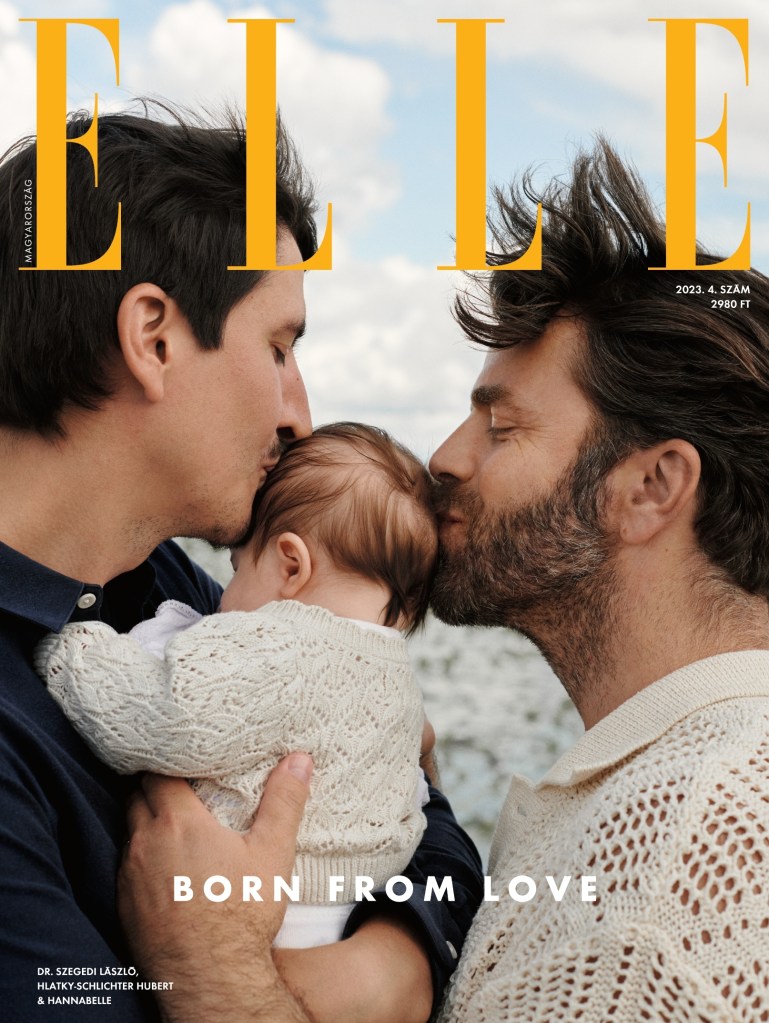
Elle Hungary puts gay dads on cover in powerful defiance of government’s anti-LGBTQ+ agenda

Two gay dads - Hungarian restaurateur Hubert Hlatky Schlichter and his neurosurgeon husband Laszlo Szegedi - kiss their baby daughter Hannabel on the head on the cover of Elle Hungary.

Elle Hungary has defiantly featured a gay couple and their daughter on its cover. (Elle Hungary)

The Hungarian version of Elle magazine has put a pair of gay dads and their child on its front cover, in a defiant move amid the country’s worsening anti-LGBTQ+ equality record.

The couple, Hungarian restaurateur Hubert Hlatky Schlichter and his neurosurgeon husband Laszlo Szegedi, are pictured tenderly kissing their baby daughter Hannabel on the head.

Sharing the cover on Instagram yesterday, Elle Hungary declared its intention was to “contribute to the acceptance of rainbow families” and help the publication to “campaign all over the country for love and all forms of family”.

The post went on: “Every child deserves to grow up in a safe, caring and supportive environment and no one can prevent this based on their parents’ gender identity or sexual orientation.”

In the issue, the two fathers speak openly about the discrimination they’ve faced in Hungary, particularly as they welcomed their baby girl into the world.

The cover of Elle Hungary, which shows gay dads Hubert Hlatky Schlichter and his neurosurgeon husband Laszlo Szegedi kissing their baby daughter Hannabel on the head
The Hungarian goverment has launched legislative attacks on LGBTQ+ families in recent years. (Elle Hungary)

In 2010, Hungary voted in hard-line right-wing prime minister Viktor Orbán, co-founder and leader of the Fidesz party. In the 13 years since his election, he has enacted numerous policies aimed at curtailing LGBTQ+ equality.

During his time in power, Orbán has amended the Hungarian constitution to define families as “based on marriage and the parent-child relation [whereby] the mother is a woman, the father a man”.

Same-sex marriage in the country is illegal, and a law passed in 2020 decrees that adoption is only allowed by couples who are married, effectively outlawing same-sex couples from adopting children.

Earlier this year, Orbán attempted to introduce a chilling law that would have enabled citizens to report LGBTQ+ families to the authorities. The law was vetoed by the country’s president Katalin Novák, in what was considered an unusual rebuke from an otherwise staunch Orbán ally.

Orbán has also taken aim at the trans community. In 2020, the country banned transgender, non-binary and intersex people from legally changing their gender, effectively erasing them from existence

Prime minister Viktor Orbán stands in front of a blue background, in a suit and tie.
Prime minister Viktor Orbán has a poor record on LGBTQ+ rights. (Getty)

In 2021, the government passed a law banning LGBTQ+ topics from being discussed in schools or in the media, to prevent queer content from being accessed by minors.

Books that depict LGBTQ+ relationships are required to be wrapped in foil. In July, a bookshop was fined 12 million fornits (approximately £27,800 or $35,900) for not covering a copy of Alice Oseman’s Heartstopper series – something the author said made her sad and angry.

“Queer young people deserve to see themselves in literature. Queerness is not inappropriate for kids,” Oseman wrote at the time. “Sending love to everyone fighting this and supporting queer books.”

While a same-sex couple featured on a British or US-based magazine would seem innocuous, in Hungary, it marks a landmark step for positive queer representation in the media.

On Instagram, the magazine’s comment section has been flooded with people celebrating the cover.

“They are wonderful, and you are the same for showing it,” wrote Hungarian model Ági Pataki.

Another person said: “Love, togetherness and happiness oozes from this photo. You are role models and I hope other similar couples draw strength in your lives.”

A third reader wrote: “My hope is strengthened that maybe many other children can still have a wonderful life with wonderful parents like them. Sincere, true love really conquers all, loving and being loved from your heart is what really matters.”

(Contributed by Gwyllm Llwydd)

Reproductive Problems in Both Men and Women Are Rising at an Alarming Rate

A likely culprit is hormone-disrupting chemicals

Reproductive Problems in Both Men and Women Are Rising at an Alarming Rate
Credit: Getty Images

When you see or hear a reference to “the 1 percent,” most people think of socioeconomic status—the people with the top 1 percent of wealth or income in the United States, which is how the term is commonly used in our culture.

Not us, though.

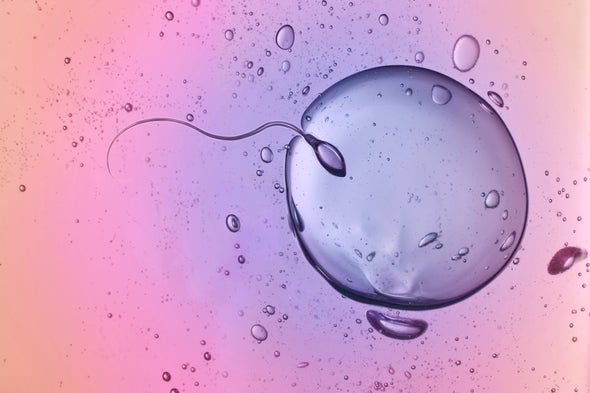
What we think of is the fact that the whole spectrum of reproductive problems in males are increasing by about 1 percent per year in Western countries. This “1 percent effect” includes the rates of declining sperm countsdecreasing testosterone levels and increasing rates of testicular cancer, as well as a rise in the prevalence of erectile dysfunction. On the female side of the equation, miscarriage rates are also increasing by about 1 percent per year in the U.S., and so is the rate of gestational surrogacy. Meanwhile, the total fertility rate worldwide has dropped by nearly 1 percent per year from 1960 to 2018.

When people hear of this, there’s often a natural instinct to shrug it off, believing that 1 percent per year isn’t really a big deal. But it is a huge deal! It adds up to more than 10 percent per decade and more than 50 percent over 50 years. When you consider that sperm counts declined by 50 percent in just 40 years, as Shanna’s meta-analysis published in a 2017 issue of the journal Human Reproduction Update showed, it’s difficult to deny or discount how alarming this is.

So, we continue to wonder: Where is the outrage on this issue? The annual 1 percent decline in reproductive health is faster than the rate of global warming (thankfully!)—and yet people are up in arms about global warming (and rightly so) but not about these reproductive health effects. To put the 1 percent effect in perspective, consider this: scientific data show a 1.1 percent per year increase in the number of children diagnosed with autism spectrum disorder between 2000 and 2016, according to the Centers for Disease Control and Prevention. People have been rightly unnerved about this.

Why aren’t people equally troubled by reproductive damage to males and females? Maybe it’s because many don’t realize that these worrisome changes are happening, or that they’re marching along at the same rate. But everyone should. After all, these reproductive changes can hardly be a coincidence. They’re just too synchronous for that to be possible.

The truth is, these reproductive health effects are interconnected, and they are largely driven by a common cause: the presence of hormone-altering chemicals (a.k.a., endocrine-disrupting chemicals, or EDCs) in our world. These hormone-hijacking chemicals, which include phthalates, bisphenol A, and flame retardants, among others, have become ubiquitous in modern life. They’re in water bottles and food packaging, electronic devices, personal-care products, cleaning supplies and many other items we use regularly. And they began being produced in increasing numbers after 1950, when sperm counts and fertility began their decline.

Exposure to these chemicals is especially problematic during pregnancy because what happens during pregnancy doesn’t stay in pregnancy. Rather, an expectant mother’s exposure to toxic chemicals in the air she breathes, the water she drinks, the foods she eats and the products she slathers on her skin can enter her body (and hence the fetus) and influence her baby’s reproductive development. This is particularly true early in pregnancy—in what’s called the reproductive programming window—and it’s especially true for male babies.

For example, if a woman is exposed to chemicals that block the action of androgens during the first trimester of pregnancy, this can affect the reproductive development of the male fetus in numerous ways. It can result in a shortening of the anogenital distance (AGD), the span from the anus to the base of the penis, which is significant because research has shown that a shorter AGD correlates with a smaller penis and, in the adult, a lower sperm count. In addition, prenatal disruption of the male hormonal system can result in reduced testosterone levels and increase the risk that a baby boy will have undescended testicles (cryptorchidism) or a particular type of malformed penis (hypospadias) at birth. And if a boy is born with these genital defects, he will have an increased risk of low sperm count and testicular cancer as an adult.

This cluster of related reproductive problems—for both men and women—is presenting huge challenges to the world’s population. There’s the obvious challenge related to fertility issues and the declining birth rate. But endocrine disruption is also a culprit in rising rates of autoimmune disorders as well as the growing epidemic of obesity and metabolic syndrome (a cluster of conditions that increases the risk of heart disease, stroke and type 2 diabetes). Some of these reproductive effects are even associated with an increased risk of premature death.

To put it mildly, these issues are more important than the “1 percent” people usually pay attention to, which means: We need to shift our collective focus. It’s time for us to make it a priority to demand that endocrine-disrupting chemicals in the everyday products are replaced with chemicals that don’t affect our hormones and don’t persist in the environment. It’s also time to establish better testing methods and regulatory actions so that only safe chemicals can enter the market and our bodies. In other words, we need to stop using each other and our unborn children as lab rats for EDC exposures. The health and the future of the human race really do depend on it.

newsletter promo

Rights & Permissions

ABOUT THE AUTHOR(S)

Shanna H. Swan, Ph.D., is a professor of Environmental Medicine and Public Health at the Icahn School of Medicine at Mount Sinai. She is the co-author, with Stacey Colino, of the book COUNT DOWN: How Our Modern World is Threatening Sperm Counts, Altering Male and Female Productive Development, and Imperiling the Future of the Human Race.

Stacey Colino is an award-winning writer specializing in health and environmental issues and a regular contributor to US News & World Report. She is the co-author, with Shanna H. Swann, of the book COUNT DOWN: How Our Modern World is Threatening Sperm Counts, Altering Male and Female Productive Development, and Imperiling the Future of the Human Race.

(Contributed by Hanz Bolen, H.W., M.)

Word-Built World: instar

instar

PRONUNCIATION:

(noun: IN-star, verb: in-STAR) 

MEANING:

noun: A stage in the life of an insect between two molts, prior to reaching maturity.
verb tr.: To make a star or decorate using stars.

ETYMOLOGY:

For noun: From Latin instar (image, form). Earliest documented use: 1895.
For verb: From in- (in, into) + star, from Old English steorra (star). Earliest documented use: 1592.

Space Caterpillar in the Carina Nebula. Photo: Stuart Rankin / NASA

(wsmith@wordsmith.org)

How to hack your brain when you’re in pain

Amy Baxter | TED2023

• April 2023

Have we misunderstood pain? Researcher and physician Amy Baxter unravels the symphony of connections that send pain from your body to your brain, explaining practical neuroscience hacks to quickly block those signals. Her groundbreaking research offers alternatives for immediate pain relief — without the need for addictive opioids. (Followed by a Q&A with TED current affairs curator Whitney Pennington Rodgers)

About the speaker

Amy Baxter

Pain management pioneerSee speaker profile

Amy Baxter translates neuroscience into disruptive, actionable solutions for pervasive public health problems.

Yes to Life, in Spite of Everything: Viktor Frankl’s Lost Lectures on Moving Beyond Optimism and Pessimism to Find the Deepest Source of Meaning

By Maria Popova (themarginalian.org)

“To decide whether life is worth living is to answer the fundamental question of philosophy,” Albert Camus wrote in his classic 119-page essay The Myth of Sisyphus in 1942. “Everything else… is child’s play; we must first of all answer the question.”

Sometimes, life asks this question not as a thought experiment but as a gauntlet hurled with the raw brutality of living.

That selfsame year, the young Viennese neurologist and psychiatrist Viktor Frankl (March 26, 1905–September 2, 1997) was taken to Auschwitz along with more than a million human beings robbed of the basic right to answer this question for themselves, instead deemed unworthy of living. Some survived by reading. Some through humor. Some by pure chance. Most did not. Frankl lost his mother, his father, and his brother to the mass murder in the concentration camps. His own life was spared by the tightly braided lifeline of chance, choice, and character.

Viktor Frankl

A mere eleven months after surviving the unsurvivable, Frankl took up the elemental question at the heart of Camus’s philosophical parable in a set of lectures, which he himself edited into a slim, potent book published in Germany in 1946, just as he was completing Man’s Search for Meaning.

As our collective memory always tends toward amnesia and erasure — especially of periods scarred by civilizational shame — these existential infusions of sanity and lucid buoyancy fell out of print and were soon forgotten. Eventually rediscovered — as is also the tendency of our collective memory when the present fails us and we must lean for succor on the life-tested wisdom of the past — they are now published in English for the first time as Yes to Life: In Spite of Everything (public library).

Frankl begins by considering the question of whether life is worth living through the central fact of human dignity. Noting how gravely the Holocaust disillusioned humanity with itself, he cautions against the defeatist “end-of-the-world” mindset with which many responded to this disillusionment, but cautions equally against the “blithe optimism” of previous, more naïve eras that had not yet faced this gruesome civilizational mirror reflecting what human beings are capable of doing to one another. Both dispositions, he argues, stem from nihilism. In consonance with his colleague and contemporary Erich Fromm’s insistence that we can only transcend the shared laziness of optimism and pessimism through rational faith in the human spirit, Frankl writes:

We cannot move toward any spiritual reconstruction with a sense of fatalism such as this.

Liminal Worlds by Maria Popova. (Available as a print.)

Generations and myriad cultural upheavals before Zadie Smith observed that “progress is never permanent, will always be threatened, must be redoubled, restated and reimagined if it is to survive,” Frankl considers what “progress” even means, emphasizing the centrality of our individual choices in its constant revision:

Today every impulse for action is generated by the knowledge that there is no form of progress on which we can trustingly rely. If today we cannot sit idly by, it is precisely because each and every one of us determines what and how far something “progresses.” In this, we are aware that inner progress is only actually possible for each individual, while mass progress at most consists of technical progress, which only impresses us because we live in a technical age.

Insisting that it takes a measure of moral strength not to succumb to nihilism, be it that of the pessimist or of the optimist, he exclaims:

Give me a sober activism anytime, rather than that rose-tinted fatalism!

How steadfast would a person’s belief in the meaningfulness of life have to be, so as not to be shattered by such skepticism. How unconditionally do we have to believe in the meaning and value of human existence, if this belief is able to take up and bear this skepticism and pessimism?

[…]

Through this nihilism, through the pessimism and skepticism, through the soberness of a “new objectivity” that is no longer that “new” but has grown old, we must strive toward a new humanity.

Sophie Scholl, upon whom chance did not smile as favorably as it did upon Frankl, affirmed this notion with her insistence that living with integrity and belief in human goodness is the wellspring of courage as she courageously faced her own untimely death in the hands of the Nazis. But while the Holocaust indisputably disenchanted humanity, Frankl argues, it also indisputably demonstrated “that what is human is still valid… that it is all a question of the individual human being.” Looking back on the brutality of the camps, he reflects:

What remained was the individual person, the human being — and nothing else. Everything had fallen away from him during those years: money, power, fame; nothing was certain for him anymore: not life, not health, not happiness; all had been called into question for him: vanity, ambition, relationships. Everything was reduced to bare existence. Burnt through with pain, everything that was not essential was melted down — the human being reduced to what he was in the last analysis: either a member of the masses, therefore no one real, so really no one — the anonymous one, a nameless thing (!), that “he” had now become, just a prisoner number; or else he melted right down to his essential self.

Illustration by Margaret C. Cook for a rare 1913 edition of Leaves of Grass. (Available as a print.)

In a sentiment that bellows from the hallways of history into the great vaulted temple of timeless truth, he adds:

Everything depends on the individual human being, regardless of how small a number of like-minded people there is, and everything depends on each person, through action and not mere words, creatively making the meaning of life a reality in his or her own being.

Frankl then turns to the question of finding a sense of meaning when the world gives us ample reasons to view life as meaningless — the question of “continuing to live despite persistent world-weariness.” Writing in the post-war pre-dawn of the golden age of consumerism, which has built a global economy by continually robbing us of the sense of meaning and selling it back to us at the price of the product, Frankl first dismantles the notion that meaning is to be found in the pursuit and acquisition of various pleasures:

Let us imagine a man who has been sentenced to death and, a few hours before his execution, has been told he is free to decide on the menu for his last meal. The guard comes into his cell and asks him what he wants to eat, offers him all kinds of delicacies; but the man rejects all his suggestions. He thinks to himself that it is quite irrelevant whether he stuffs good food into the stomach of his organism or not, as in a few hours it will be a corpse. And even the feelings of pleasure that could still be felt in the organism’s cerebral ganglia seem pointless in view of the fact that in two hours they will be destroyed forever. But the whole of life stands in the face of death, and if this man had been right, then our whole lives would also be meaningless, were we only to strive for pleasure and nothing else — preferably the most pleasure and the highest degree of pleasure possible. Pleasure in itself cannot give our existence meaning; thus the lack of pleasure cannot take away meaning from life, which now seems obvious to us.

He quotes a short verse by the great Indian poet and philosopher Rabindranath Tagore — the first non-European to win the Nobel Prize, Einstein’s onetime conversation partner in contemplating science and spirituality, and a man who thought deeply about human nature:

I slept and dreamt
that life was joy.
I awoke and saw
that life was duty.
I worked — and behold,
duty was joy.

In consonance with Camus’s view of happiness as a moral obligation — an outcome to be attained not through direct pursuit but as a byproduct of living with authenticity and integrity — Frankl reflects on Tagore’s poetic point:

So, life is somehow duty, a single, huge obligation. And there is certainly joy in life too, but it cannot be pursued, cannot be “willed into being” as joy; rather, it must arise spontaneously, and in fact, it does arise spontaneously, just as an outcome may arise: Happiness should not, must not, and can never be a goal, but only an outcome; the outcome of the fulfillment of that which in Tagore’s poem is called duty… All human striving for happiness, in this sense, is doomed to failure as luck can only fall into one’s lap but can never be hunted down.

In a sentiment James Baldwin would echo two decades later in his superb forgotten essay on the antidote to the hour of despair and life as a moral obligation to the universe, Frankl turns the question unto itself:

At this point it would be helpful [to perform] a conceptual turn through 180 degrees, after which the question can no longer be “What can I expect from life?” but can now only be “What does life expect of me?” What task in life is waiting for me?

Now we also understand how, in the final analysis, the question of the meaning of life is not asked in the right way, if asked in the way it is generally asked: it is not we who are permitted to ask about the meaning of life — it is life that asks the questions, directs questions at us… We are the ones who must answer, must give answers to the constant, hourly question of life, to the essential “life questions.” Living itself means nothing other than being questioned; our whole act of being is nothing more than responding to — of being responsible toward — life. With this mental standpoint nothing can scare us anymore, no future, no apparent lack of a future. Because now the present is everything as it holds the eternally new question of life for us.

Another of Margaret C. Cook’s illustrations for the 1913 English edition of Leaves of Grass. (Available as a print.)

Frankl adds a caveat of tremendous importance — triply so in our present culture of self-appointed gurus, self-help demagogues, and endless podcast feeds of interviews with accomplished individuals attempting to distill a universal recipe for self-actualization:

The question life asks us, and in answering which we can realize the meaning of the present moment, does not only change from hour to hour but also changes from person to person: the question is entirely different in each moment for every individual.

We can, therefore, see how the question as to the meaning of life is posed too simply, unless it is posed with complete specificity, in the concreteness of the here and now. To ask about “the meaning of life” in this way seems just as naive to us as the question of a reporter interviewing a world chess champion and asking, “And now, Master, please tell me: which chess move do you think is the best?” Is there a move, a particular move, that could be good, or even the best, beyond a very specific, concrete game situation, a specific configuration of the pieces?

What emerges from Frankl’s inversion of the question is the sense that, just as learning to die is learning to meet the universe on its own terms, learning to live is learning to meet the universe on its own terms — terms that change daily, hourly, by the moment:

One way or another, there can only be one alternative at a time to give meaning to life, meaning to the moment — so at any time we only need to make one decision about how we must answer, but, each time, a very specific question is being asked of us by life. From all this follows that life always offers us a possibility for the fulfillment of meaning, therefore there is always the option that it has a meaning. One could also say that our human existence can be made meaningful “to the very last breath”; as long as we have breath, as long as we are still conscious, we are each responsible for answering life’s questions.

Art from Margaret C. Cook’s 1913 English edition of Leaves of Grass. (Available as a print.)

With this symphonic prelude, Frankl arrives at the essence of what he discovered about the meaning of life in his confrontation with death — a central fact of being at which a great many of humanity’s deepest seers have arrived via one path or another: from Rilke, who so passionately insisted that “death is our friend precisely because it brings us into absolute and passionate presence with all that is here, that is natural, that is love,” to physicist Brian Greene, who so poetically nested our search for meaning into our mortality into the most elemental fact of the universe. Frankl writes:

The fact, and only the fact, that we are mortal, that our lives are finite, that our time is restricted and our possibilities are limited, this fact is what makes it meaningful to do something, to exploit a possibility and make it become a reality, to fulfill it, to use our time and occupy it. Death gives us a compulsion to do so. Therefore, death forms the background against which our act of being becomes a responsibility.

[…]

Death is a meaningful part of life, just like human suffering. Both do not rob the existence of human beings of meaning but make it meaningful in the first place. Thus, it is precisely the uniqueness of our existence in the world, the irretrievability of our lifetime, the irrevocability of everything with which we fill it — or leave unfulfilled — that gives our existence significance. But it is not only the uniqueness of an individual life as a whole that gives it importance, it is also the uniqueness of every day, every hour, every moment that represents something that loads our existence with the weight of a terrible and yet so beautiful responsibility! Any hour whose demands we do not fulfill, or fulfill halfheartedly, this hour is forfeited, forfeited “for all eternity.” Conversely, what we achieve by seizing the moment is, once and for all, rescued into reality, into a reality in which it is only apparently “canceled out” by becoming the past. In truth, it has actually been preserved, in the sense of being kept safe. Having been is in this sense perhaps even the safest form of being. The “being,” the reality that we have rescued into the past in this way, can no longer be harmed by transitoriness.

In the remainder of the slender and splendid Yes to Life, Frankl goes on to explore how the imperfections of human nature add to, rather than subtract from, the meaningfulness of our lives and what it means for us to be responsible for our own existence. Complement it with Mary Shelley, writing two centuries ago about a pandemic-savaged world, on what makes life worth living, Walt Whitman contemplating this question after surviving a paralytic stroke, and a vitalizing cosmic antidote to the fear of death from astrophysicist and poet Rebecca Elson, then revisit Frankl on humor as lifeline to sanity and survival.

Free Will Astrology: Week of September 7, 2023

SEPTEMBER 5, 2023 AT 7:00 AM BY ROB BREZSNY (newcity.copm)

Photo: Sindre Aalberg

ARIES (March 21-April 19): Aries chess grandmaster Garry Kasparov says war is “more like a game of poker than chess. On a chessboard, the pieces are face up, but poker is essentially a game of incomplete information, a game where you have to guess and act on those guesses.” I suspect that’s helpful information for you these days, Aries. You may not be ensconced in an out-and-out conflict, but the complex situation you’re managing has resemblances to a game of poker. For best results, practice maintaining a poker face. Try to reduce your tells to near zero. Here’s the definition of “tell” as I am using the term: Reflexive or unconscious behavior that reveals information you would rather withhold.

TAURUS (April 20-May 20): Raised in poverty, Taurus-born Eva Perón became a charismatic politician and actor who served as First Lady of Argentina for six years. The Argentine Congress ultimately gave her the title of “Spiritual Leader of the Nation.” How did she accomplish such a meteoric ascent? “Without fanaticism,” she testified, “one cannot accomplish anything.” But I don’t think her strategy has to be yours in the coming months, Taurus. It will make sense for you to be highly devoted, intensely focused and strongly motivated—even a bit obsessed in a healthy way. But you won’t need to be fanatical.

GEMINI (May 21-June 20): Gemini author Ben H. Winters has useful counsel. “Every choice forecloses on other choices,” he says. “Each step forward leaves a thousand dead possible universes behind you.” I don’t think there are a thousand dead universes after each choice; the number’s more like two or three. But the point is, you must be fully committed to leaving the past behind. Making decisions requires resolve. Second-guessing your brave actions rarely yields constructive results. So are you ready to have fun being firm and determined, Gemini? The cosmic rhythms will be on your side if you do.

CANCER (June 21-July 22): Journalist Alexandra Robbins was addressing young people when she gave the following advice, but you will benefit from it regardless of your age: “There is nothing wrong with you just because you haven’t yet met people who share your interests or outlook on life. Know that you will eventually meet people who will appreciate you for being you.” I offer this to you now, Cancerian, because the coming months will bring you into connection with an abundance of like-minded people who are working to create the same kind of world you are. Are you ready to enjoy the richest social life ever?

LEO (July 23-Aug. 22): Author Kevin Kelly is a maverick visionary who has thought a lot about how to create the best possible future. He advocates that we give up hoping for the unrealistic concept of utopia. Instead, he suggests we empower our practical efforts with the term protopia. In this model, we “crawl toward betterment,” trying to improve the world by one percent each year. You would be wise to apply a variation on this approach to your personal life in the coming months, Leo. A mere one-percent enhancement is too modest a goal, though. By your birthday in 2024, a six-percent upgrade is realistic, and you could reach as high as ten percent.

VIRGO (Aug. 23-Sept. 22): In honor of the Virgo birthday season, I invite you to be exceptionally distinctive and singular in the coming weeks, even idiosyncratic and downright incomparable. That’s not always a comfortable state for you Virgos to inhabit, but right now it’s healthy to experiment with. Here’s counsel from writer Christopher Morley: “Read, every day, something no one else is reading. Think, every day, something no one else is thinking. Do, every day, something no one else would be silly enough to do. It is bad for the mind to continually be part of unanimity.” Here’s a bonus quote from Virgo poet Edith Sitwell: “I am not eccentric! It’s just that I am more alive than most people.”

LIBRA (Sept. 23-Oct. 22): Do you sometimes wish your life was different from what it actually is? Do you criticize yourself for not being a perfect manifestation of your ideal self? Most of us indulge in these fruitless energy drains. One of the chief causes of unhappiness is the fantasy that we are not who we are supposed to be. In accordance with cosmic rhythms, I authorize you to be totally free of these feelings for the next four weeks. As an experiment, I invite you to treasure yourself exactly as you are right now. Congratulate yourself for all the heroic work you have done to be pretty damn good. Use your ingenuity to figure out how to give yourself big doses of sweet and festive love.

SCORPIO (Oct. 23-Nov. 21): Scorpio novelist Kurt Vonnegut testified, “I want to stay as close on the edge as I can without going over. Out on the edge, you see all kinds of things you can’t see from the center. Big, undreamed-of-things—the people on the edge see them first.” I’m not definitively telling you that you should live like Vonnegut, dear Scorpio. To do so, you would have to summon extra courage and alertness. But if you are inclined to explore such a state, the coming weeks will offer you a chance to live on the edge with as much safety, reward and enjoyment as possible.

SAGITTARIUS (Nov. 22-Dec. 21): “Where there is great love, there are always miracles,” wrote Sagittarian novelist Willa Cather (1873–1947). In accordance with upcoming astrological aspects, I encourage you to prepare the way for such miracles. If you don’t have as much love as you would like, be imaginative as you offer more of the best love you have to give. If there is good but not great love in your life, figure out how you can make it even better. If you are blessed with great love, see if you can transform it into being even more extraordinary. For you Sagittarians, it is the season of generating miracles through the intimate power of marvelous love.

CAPRICORN (Dec. 22-Jan. 19): Capricorn author Alexander Woollcott (1887–1943) could be rude and vulgar. He sometimes greeted cohorts by saying, “Hello, Repulsive.” After he read the refined novelist Marcel Proust, he described the experience as “like lying in someone else’s dirty bath water.” But according to Woollcott’s many close and enduring friends, he was often warm, generous and humble. I bring this to your attention in the hope that you will address any discrepancies between your public persona and your authentic soul. Now is a good time to get your outer and inner selves into greater harmony.

AQUARIUS (Jan. 20-Feb. 18): In 1963, Aquarian author Betty Friedan published “The Feminine Mystique,” a groundbreaking book that became a bestseller crucial in launching the feminist movement. She brought to wide cultural awareness “the problem that has no name”: millions of women’s sense of invisibility, powerlessness and depression. In a later book, Friedan reported on those early days of the awakening: “We couldn’t possibly know where it would lead, but we knew it had to be done.” I encourage you to identify an equivalent quest in your personal life, Aquarius: a project that feels necessary to your future, even if you don’t yet know what that future will turn out to be.

PISCES (Feb. 19-March 20): “Among those whom I like or admire, I can find no common denominator, but among those whom I love, I can: All of them make me laugh.” Piscean poet W. H. Auden said that. After analyzing the astrological omens, I conclude that laughing with those you love is an experience you should especially seek right now. It will be the medicine for anything that’s bothering you. It will loosen obstructions that might be interfering with the arrival of your next valuable teachings. Use your imagination to dream up ways you can place yourself in situations where this magic will unfold.

Homework: What message has life been trying to send you but you have been ignoring? Newsletter.FreeWillAstrology.com