Free Will Astrology: Week of May 25, 2023

MAY 23, 2023 AT 7:00 AM BY ROB BREZSNY (newcity.com

Photo: Thomas Despeyroux

ARIES (March 21-April 19): My reading of the astrological omens inspires me to make a series of paradoxical predictions for you. Here are five scenarios I foresee as being quite possible in the coming weeks. 1. An epic journey to a sanctuary close to home. 2. A boundary that doesn’t keep people apart but brings them closer. 3. A rambunctious intervention that calms you down and helps you feel more at peace. 4. A complex process that leads to simple clarity. 5. A visit to the past that empowers you to redesign the future.

TAURUS (April 20-May 20): Do you want a seed to fulfill its destiny? You must bury it in the ground. There, if it’s able to draw on water and the proper nutrients, it will break open and sprout. Its life as a seed will be over. The plant it eventually grows into will look nothing like its source. We take this process for granted, but it’s always a miracle. Now let’s invoke this story as a metaphor for what you are hopefully on the verge of, Taurus. I invite you to do all that’s helpful and necessary to ensure your seed germinates!

GEMINI (May 21-June 20): Your meandering trek through the Unpromised Land wasn’t as demoralizing as you feared. The skirmish with the metaphorical dragon was a bit disruptive, but hey, you are still breathing and walking around—and even seem to have been energized by the weird thrill of the adventure. The only other possible downside was the new dent in your sweet dream. But I suspect that in the long run, that imperfection will inspire you to work even harder on behalf of your sweet dream—and this will be a blessing. Here’s another perk: The ordeal you endured effectively cleaned out stale old karma, freeing up space for a slew of fresh help and resources.

CANCER (June 21-July 22): Testing time is ahead, but don’t get your nerves in an uproar with fantasy-spawned stress. For the most part, your challenges and trials will be interesting, not unsettling. There will be few if any trick questions. There will be straightforward prods to stretch your capacities and expand your understanding. Bonus! I bet you’ll get the brilliant impulse to shed the ball and chain you’ve been absent-mindedly carrying around with you.

LEO (July 23-Aug. 22): Biologist Edward O. Wilson said that the most social animals are ants, termites and honeybees. He used the following criteria to define that description: “altruism, instincts devoted to social life, and the tightness of the bonds that turn colonies into virtual superorganisms.” I’m going to advocate that you regard ants, termites, and honeybees as teachers and role models for you. The coming weeks will be a great time to boost your skill at socializing and networking. You will be wise to ruminate about how you could improve your life by enhancing your ability to cooperate with others. And remember to boost your altruism!

VIRGO (Aug. 23-Sept. 22): Jack Sarfatti is an authentic but maverick physicist born under the sign of Virgo. He suggests that if we make ourselves receptive and alert, we may get help from our future selves. They are trying to communicate good ideas to us back through time. Alas, most of us don’t believe such a thing is feasible, so we aren’t attuned to the potential help. I will encourage you to transcend any natural skepticism you might have about Sarfatti’s theory. As a fun experiment, imagine that the Future You has an important transmission for you—maybe several transmissions. For best results, formulate three specific questions to pose to the Future You.

LIBRA (Sept. 23-Oct. 22): I have five points for your consideration. 1. You are alive in your mysterious, endlessly interesting life, and you are imbued with the fantastically potent power of awareness. How could you not feel thrilled? 2. You’re on a planet that’s always surprising, and you’re in an era when so many things are changing that you can’t help being fascinated. How could you not feel thrilled? 3. You have some intriguing project to look forward to, or some challenging but engaging work you’re doing, or some mind-bending riddle you’re trying to solve. How could you not feel thrilled? 4. You’re playing the most enigmatic game in the universe, also known as your destiny on Earth, and you love ruminating on questions about what it all means. How could you not feel thrilled? 5. You never know what’s going to happen next. You’re like a hero in an epic movie that is endlessly entertaining. How could you not feel thrilled?

SCORPIO (Oct. 23-Nov. 21): “Trust those that you have helped to help you in their turn,” advises Scorpio author Neil Gaiman. Let’s make that one of your mantras for the coming weeks. In my astrological understanding, you are due to cash in on favors you have bestowed on others. The generosity you have expressed should be streaming back your way in abundance. Be bold about welcoming the bounty. In fact, I hope you will nudge and prompt people, if necessary, to reward you for your past support and blessings.

SAGITTARIUS (Nov. 22-Dec. 21): So many of us are starved to be listened to with full attention. So many of us yearn to be seen and heard and felt by people who are skilled at receptive empathy. How many of us? I’d say the figure is about 99.9 percent. That’s the bad news, Sagittarius. The good news is that in the coming weeks, you will have an exceptional ability to win the attention of good listeners. To boost the potential healing effects of this opportunity, here’s what I recommend: Refine and deepen your own listening skills. Express them with panache.

CAPRICORN (Dec. 22-Jan. 19): Because you’re a Capricorn, earthiness is probably one of your strengths. It’s your birthright to be practical and sensible and well-grounded. Now and then, however, your earthiness devolves into muddiness. You get too sober and earnest. You’re bogged down in excess pragmatism. I suspect you may be susceptible to such a state these days. What to do? It may help if you add elements of air and fire to your constitution, just to balance things out. Give yourself a secret nickname with a fiery feel, like Blaze, or a crispy briskness, like Breezy. What else could you do to rouse fresh, glowing vigor, Breezy Blaze—even a touch of wildness?

AQUARIUS (Jan. 20-Feb. 18): I love to use metaphors in my writing, but I hate to mix unrelated metaphors. I thrive on referring to poetry, sometimes even surrealistic poetry, but I try to avoid sounding like a lunatic. However, at this juncture in your hero’s journey, Aquarius, I frankly feel that the most effective way to communicate with you is to offer you mixed metaphors and surrealist poetry that border on sounding lunatic. Why? Because you seem primed to wander around on the edges of reality. I’m guessing you’ll respond best to a message that’s aligned with your unruly mood. So here goes: Get ready to surf the spiritual undertow all the way to the teeming wilderness on the other side of the cracked mirror. Ignore the provocative wasteland on your left and the intriguing chaos on your right. Stay focused on the stars in your eyes and devote yourself to wild joy.

PISCES (Feb. 19-March 20): “The gift of patience opens when our body, heart and mind slow enough to move in unison.” So says Piscean poet Mark Nepo. I feel confident you are about to glide into such a grand harmony, dear Pisces. Through a blend of grace and your relaxed efforts to be true to your deepest desires, your body, heart and mind will synchronize and synergize. Patience will be just one of the gifts you will receive. Others include: a clear vision of your most beautiful future; a lucid understanding of what will be most meaningful to you in the next three years; and a profound sense of feeling at home in the world wherever you go.

Homework: What is the most spiritually nourishing pleasure you should seek out but don’t? Newsletter.FreeWillAstrology.com

Uvalde Anniversary

May 24, 2023

Prayer to End Gun Violence 
Eternal God, we stand in awe of You.

Lord, when babies die at a church school, it is time for us to move beyond thoughts and prayers.

Remind our lawmakers of the words of the British statesman Edmund Burke: ‘All that is necessary for evil to triumph is for good people to do nothing.’

Lord, deliver our leaders from the paralysis of analysis that waits for the miraculous.

We pray, in Your powerful name, Amen.
Modified from Opening Prayer in the Capitol,
Senate Chaplain Retired Rear Adm. Barry C. Black, March 28, 2023

In Praise Of Four-Letter Words

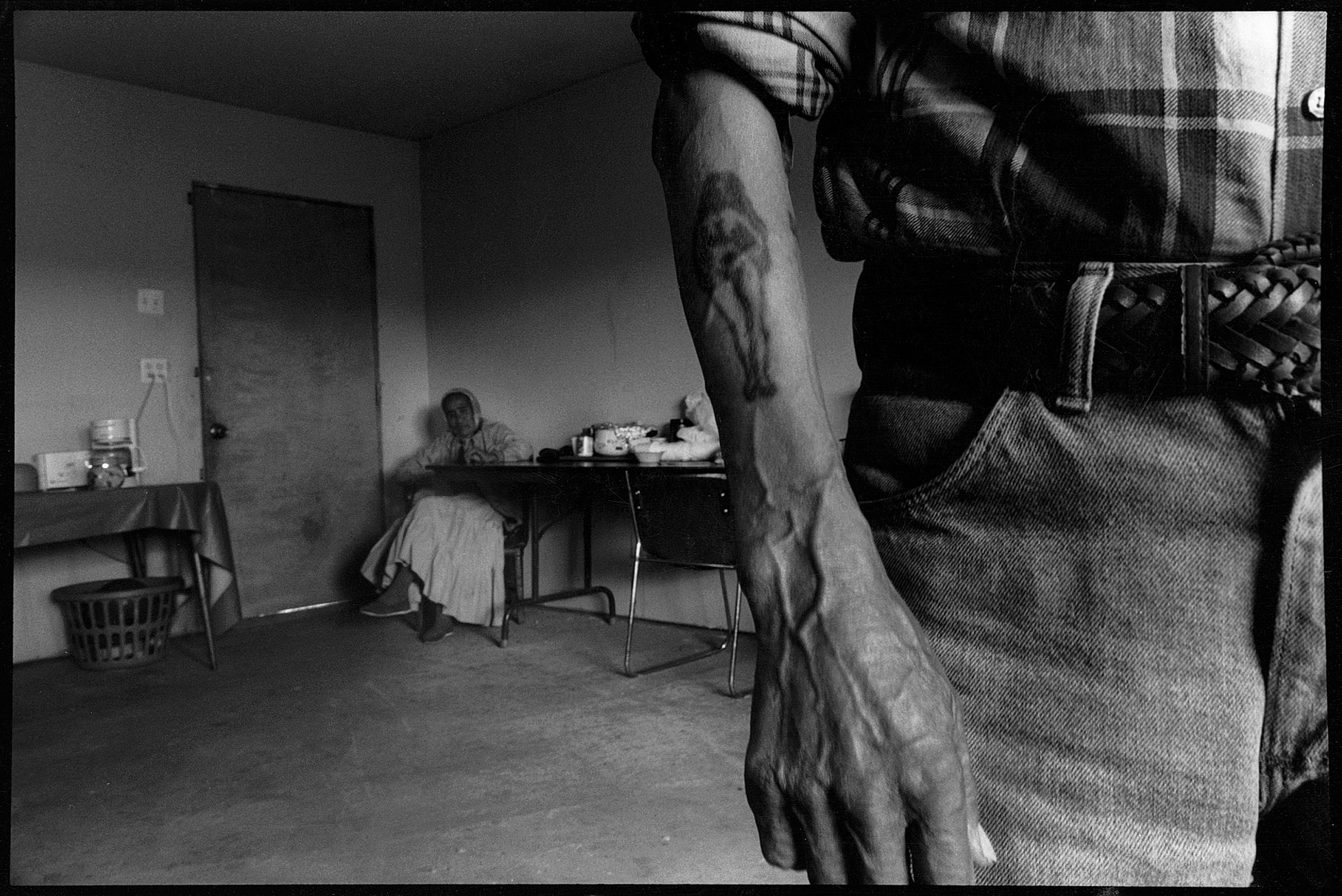
An older woman in a long dress sits in the back corner of a sparsely furnished room while a man stands in the foreground wearing jeans and a plaid shirt with the sleeves folded up. He has a tattoo of a naked woman on his forearm.

© Chip Thomas

BY ELLEN BASS • DECEMBER 2004

We yell shit
when the egg carton slips
and the ivory globes
splatter on blue tile.
And when someone leaves you
bruised as a dropped pear, you spit
that fucker, fucking bastard, motherfucker.
And if you just got fired, the puppy
swallowed a two-inch nail, or
your daughter needs another surgery,
you might walk around murmuring
fuckfuckfuckfuckfuck
under your breath like reciting a rosary.

Cock and cunt — we spew them out
as though they were offal,
as though that vulnerable
bare skin of the penis, that swaying it does
like a slender reed in a pond, the vulva
with its delicate mauve or taupe
or cinnamon fluted petals were the worst
things we know. You’d think we despise
the way they slide together,
can’t bear all those nerves
bunched up close as angels
seething on the head of a pin.

And suck, our yes
to the universe, first hunger, whole
mammalian tribe of damp newborns
held in contempt for the urgent rooting,
the nubbly feel of the nipple in the mouth,
fine spray on the soft palate.

What does it mean
to bring another’s body
into our body, whether through our mouth
or that other mouth — to be taken in?
When life cracks us
like a broken tooth,
when it wears us down
like the tread of old tires,
when it creeps over us
like shower mold, isn’t this
what we cry for?

Maybe all that shouting
is shouting to God, to the universe,
to anyone who can hear us.
In lockdown within our own skins
we’re banging on the bars with tin spoons,
screaming in the only language strong
enough to convey the shock
of our shameful need. Fuck! —
we look around us in terrified amazement —
Goddamn! Goddamn! Holy shit!

Is someone you love suffering in silence? Here’s what to do

335,810 views | Gus Worland • TED2023

Lots of people talk about the need to be physically fit, but mentally fit? Not as much. In a powerful talk, mental health advocate Gus Worland shares how an experience of deep grief from his own life sparked his mission to advocate for suicide prevention — and shows why “looking after your own village” can be as simple as sending a text message, right now, to the person you cannot imagine living without.

About the speaker

Gus Worland

Mental fitness advocateSee speaker profile

Gus Worland helps people develop the resilience, emotional muscle and social connections needed to prevent suicide and build mental fitness.

Tina Turner – Missing You

Tina Turner Mar 31, 2022 The official music video for Tina Turner – Missing You. Listen to Tina Turner’s greatest hits and more here: https://lnk.to/TinaTurnerGreatestHits Taken from Tina Turner’s album Wildest Dreams from 1996, featuring the singles GoldenEye, Whatever You Want and On Silent Wings. Subscribe to the Tina Turner channel for her amazing music videos, exhilarating live performances, interviews and much more here: https://lnk.to/TinaTurnerYTSubscribe See more official videos from Tina Turner here:    • Tina Turner – Off…   Follow Tina Turner: Website – https://www.tinaturnerofficial.com/ Facebook – https://www.facebook.com/TinaTurner/ Twitter – https://twitter.com/LoveTinaTurner Instagram – https://www.instagram.com/tinaturner/ Experience the breathtaking, critically-acclaimed Tina: The Tina Turner Musical – get your tickets here: https://tinathemusical.com/ Lyrics: Every time I think of you, I always catch my breath And I’m still standing here, and you’re miles away And I’m wondering why you left And there’s a storm that’s raging Through my frozen heart tonight I hear your name in certain circles And it always makes me smile I spend my time thinking about you And it’s almost driving me wild And there’s a heart that’s breaking Down this long distance line tonight I ain’t missing you at all (missing you) Since you’ve been gone away (missing you) I ain’t missing you (missing you) No matter what I might say (missing you) There’s a message in the wire And I’m sending the signal tonight You don’t know how desperate I’ve become And it looks like I’m losing this fight In your world I have no meaning Though I’m trying hard to understand And it’s my heart that’s breaking Down this long distance line tonight I ain’t missing you at all (missing you) Since you’ve been gone away (missing you) I ain’t missing you (missing you) No matter what I might say (missing you) There’s a message that I’m sending out Via telegraph to your soul And if I can’t breach this distance Stop this heartbreak overload I ain’t missing you at all …ow…(missing you) Since you’ve been gone away (missing you) I ain’t missing you (missing you) No matter what my friends say (missing you) I ain’t missing you I ain’t missing you.. I can’t lie to myself And there’s a storm that’s raging Through my frozen heart tonight I ain’t missing you at all I ain’t missing you…missing you I ain’t missing you, oh no I ain’t missing you, I ain’t missing you I ain’t missing you, I ain’t missing you I ain’t missing you, I ain’t missing you Every time I think of you, I always catch my breath About Tina: Tina Turner is revered around the world, inspiring millions through her personal story, singing, dancing and beyond. Her music legacy is a collection of some of the best-known songs of all time, including The Best, What’s Love Got To Do With It, Proud Mary and much more. Tina’s electric live shows lit up the globe, including her World Record performance at the Maracanã in front of over 180,000 adoring fans. In recent times Tina has released books such as My Love Story, been remixed by superstar producer Kygo, and had her inspirational life story recounted through the Tony nominated Tina: The Tina Turner Musical, and the critically acclaimed feature documentary TINA. With multiple #1s and platinum records across the world, 12 Grammy® Awards, a Grammy Lifetime Achievement Award, and most recently her second induction into the Rock & Roll Hall of Fame; Tina continues to be one of the world’s most loved artists, with her career continuing to build momentum and find new fans.

Nobel-Winning Physicist Wolfgang Pauli on Science, Spirit, and Our Search for Meaning

By Maria Popova (themarginalian.org)

“The fact that religions through the ages have spoken in images, parables, and paradoxes means simply that there are no other ways of grasping the reality to which they refer,” physicist and quantum mechanics pioneer Niels Bohr observed while contemplating the nature of reality five years after he received the Nobel Prize, adding: “But that does not mean that it is not a genuine reality. And splitting this reality into an objective and a subjective side won’t get us very far.”

Bohr, who introduced the notion of complementarity, went on to influence generations of thinkers, including a number of Nobel laureates. Among them was the Swiss-Austrian physicist Wolfgang Pauli (April 25, 1900–December 15, 1958) — another pioneering figure of particle physics and quantum mechanics. Invested in the conquest of truth at the deepest strata of nature, Pauli took up this question of reality as a physical and metaphysical object of inquiry in a rather improbable arena: his friendship with the influential Swiss psychiatrist Carl Jung, whose entire body of work was centered on the conviction that “man cannot stand a meaningless life.”

Carl Jung and Wolfgang Pauli

Pauli’s longtime correspondence and collaboration with Jung occupies a small but significant portion of Figuring (public library) — an exploration of the tessellated facets of our search for meaning, from which this essay is adapted. Their unlikely friendship, which precipitated the invention of synchronicity, bridged the world of science and the world of spirit, entwining the irrepressible human impulses for finding truth and making meaning — a kind of non-Euclidean intersection of our parallel searches for understanding the reality within and the reality without.

Long before he won the Nobel Prize in Physics for his exclusion principle — the tenet of quantum physics stating that multiple identical particles within a single quantum system cannot occupy the same quantum state at the same time — and around the time he theorized the neutrino, Pauli was thrust into existential tumult. His mother, to whom he was very close, died by suicide. His tempestuous marriage ended in divorce within a year — a year during which he drowned his unhappiness in alcohol. Caught in the web of drinking and despair, Pauli reached out to Jung for help.

Jung, already deeply influenced by Einstein’s ideas about space and time, was intrigued by his brilliant and troubled correspondent. What began as an intense series of dream analyses unfolded, over the course of the remaining twenty-two years of Pauli’s life, into an exploration of fundamental questions regarding the nature of reality through the dual lens of physics and psychology — a testament to Einstein’s assertion that “every true theorist is a kind of tamed metaphysicist.” Each used the tools of his expertise to shift the shoreline between the known and the unknown, and together they found common ground in the analogy between the atom, with its nucleus and orbiting electrons, and the self, with its central conscious ego and its ambient unconscious.

Art by Derek Dominic D’souza from Song of Two Worlds by Alan Lightman

While there is a long and lamentable history of science — physics in particular — being hijacked for mystical and New Age ideologies, two things make Jung and Pauli’s collaboration notable. First, the analogies between physics and alchemical symbolism were drawn not only by a serious scientist, but by one who would soon receive the Nobel Prize in Physics. Second, the warping of science into pseudoscience and mysticism tends to happen when scientific principles are transposed onto nonscientific domains with a false direct equivalence. Pauli, by contrast, was deliberate in staying at the level of analogy — that is, of conceptual parallels furnishing metaphors for abstract thought that can advance ideas in each of the two disciplines, but with very different concrete application.

Jung had borrowed the word “archetype” from Kepler, drawing on the astronomer’s alchemical symbolism. More than three centuries after Kepler’s alchemy, Pauli’s exclusion principle became the basic organizing principle for the periodic table. The alchemists had been right all along, in a way — they had just been working on the wrong scale: Only at the atomic level can one element become another, in radioactivity and nuclear fission. Even the atom itself had to transcend the problem of scale: The Greek philosopher Democritus theorized atoms in 400 BC, but he couldn’t prove or disprove their existence empirically — a hundred thousand times smaller than anything the naked eye could see, the atom remained invisible. It wasn’t for another twenty-three centuries that we were able to override the problem of scale by the prosthetic extension of our vision, the microscope.

What had originally attracted Pauli to the famous psychiatrist was Jung’s work on symbols and archetypes — a Keplerian obsession that in turn obsessed Pauli, who devoted various essays and lectures to how Kepler’s alchemy and archetypal ideas influenced the visionary astronomer’s science. In physics, he saw numerous analogies to alchemy: In symmetry, he found the archetypal structure of matter and in elementary particles, the substratum of reality that the alchemists had sought; in the spectrograph, which allowed scientists for the first time to study the chemical composition of stars, an analogue of the alchemist’s oven; in probability, which he defined as “the actual correspondence between the expected result… and the empirically measured frequencies,” the mathematical analogue of archetypal numerology.

A 1573 painting by Portuguese artist, historian, and philosopher Francisco de Holanda, a student of Michelangelo’s and a contemporary of Kepler’s, found in Cosmigraphics: Picturing Space Through Time

But Pauli recognized that the dawn of quantum physics, in which he himself was a leading sun, introduced a new necessity to reconcile different facets of reality. Nearly a century after the trailblazing astronomer Maria Mitchell — a leading figure in Figuring — asserted that “every formula which expresses a law of nature is a hymn of praise to God,” Pauli reflected in one of his Kepler lectures:

It would be most satisfactory of all if physics and psyche could be seen as complementary aspects of the same reality. To us [modern scientists], unlike Kepler and Fludd, the only acceptable point of view appears to be one that recognizes both sides of reality — the quantitative and the qualitative, the physical and the psychical — as compatible with each other, and can embrace them simultaneously.
[…]

In my own view it is only a narrow passage of truth (no matter whether scientific or other truth) that passes between the Scylla of a blue fog of mysticism and the Charybdis of a sterile rationalism. This will always be full of pitfalls and one can fall down on both sides.

Illustration by Hugh Lieber from Human Values and Science, Art and Mathematics by Lillian Lieber

Four decades before the revered physicist John Archibald Wheeler, who popularized the term black hole, made his influential assertion that “this is a participatory universe [and] observer-participancy gives rise to information,” Pauli wrote to Jung:

Modern [particle physics] turns the observer once again into a little lord of creation in his microcosm, with the ability (at least partially) of freedom of choice and fundamentally uncontrollable effects on that which is being observed. But if these phenomena are dependent on how (with what experimental system) they are observed, then is it not possible that they are also phenomena (extra corpus) that depend on who observes them (i.e., on the nature of the psyche of the observer)? And if natural science, in pursuit of the ideal of determinism since Newton, has finally arrived at the stage of the fundamental “perhaps” of the statistical character of natural laws… then should there not be enough room for all those oddities that ultimately rob the distinction between “physics” and “psyche” of all its meaning?

And yet Pauli was careful to recognize that “although [particle physics] allows for an acausal form of observation, it actually has no use for the concept of ‘meaning’” — that is, meaning is not a fundamental function of reality but an interpretation superimposed by the human observer.

Complement with Carl Sagan on science and spirituality and Einstein’s historic conversation with the Nobel-winning Indian poet and philosopher Tagore, then revisit other excerpts from Figuring: Emily Dickinson’s electric love letters to Susan Gilbert, Margaret Fuller on what makes a great leader, the story of how the forgotten pioneer Harriet Hosmer paved the way for women in art, Herman Melville’s passionate and heartbreaking love letters to Nathaniel Hawthorne, and astrophysicist Janna Levin’s stunning reading of the Auden poem that became the book’s epigraph.

Hippocratic Oath 

“I swear by Apollo the physician, and Aesculapius the surgeon, likewise Hygeia and Panacea, and call all the gods and goddesses to witness, that I will observe and keep this underwritten oath, to the utmost of my power and judgment.

I will reverence my master who taught me the art. Equally with my parents, will I allow him things necessary for his support, and will consider his sons as brothers. I will teach them my art without reward or agreement; and I will impart all my acquirement, instructions, and whatever I know, to my master’s children, as to my own; and likewise to all my pupils, who shall bind and tie themselves by a professional oath, but to none else.

With regard to healing the sick, I will devise and order for them the best diet, according to my judgment and means; and I will take care that they suffer no hurt or damage.

Nor shall any man’s entreaty prevail upon me to administer poison to anyone; neither will I counsel any man to do so. Moreover, I will give no sort of medicine to any pregnant woman, with a view to destroy the child.

Further, I will comport myself and use my knowledge in a godly manner.
I will not cut for the stone, but will commit that affair entirely to the surgeons.

Whatsoever house I may enter, my visit shall be for the convenience and advantage of the patient; and I will willingly refrain from doing any injury or wrong from falsehood, and (in an especial manner) from acts of an amorous nature, whatever may be the rank of those who it may be my duty to cure, whether mistress or servant, bond or free.

Whatever, in the course of my practice, I may see or hear (even when not invited), whatever I may happen to obtain knowledge of, if it be not proper to repeat it, I will keep sacred and secret within my own breast.
If I faithfully observe this oath, may I thrive and prosper in my fortune and profession, and live in the estimation of posterity; or on breach thereof, may the reverse be my fate!”

(mccolloughscholars.as.ua.edu)

William F. Buckley on being a conservative

William F. Buckley Jr.

“A conservative is someone who stands athwart history, yelling Stop, at a time when no one is inclined to do so, or to have much patience with those who so urge it.”

― William F. Buckley

William Frank Buckley Jr. (November 24, 1925 – February 27, 2008) was an American conservative writer, public intellectual, and political commentator. In 1955, he founded National Review, the magazine that stimulated the conservative movement in the mid-20th century United States. Wikipedia