291,060 views | Afrika Afeni Mills • TED Salon: TED-Ed and Gates Foundation
Learning how to have productive conversations about race is a necessary part of the human experience. Educator Afrika Afeni Mills says the best place to start is in the classroom — because the earlier these skills are taught, the fewer biases there are to unlearn. She shares four actionable lessons to help people overcome their fear and take on these conversations at any age.
Afrika Afeni Mills works with teachers, instructional coaches and administrators to develop culturally responsive and sustaining anti-bias, anti-racist, pro-human instructional practices.
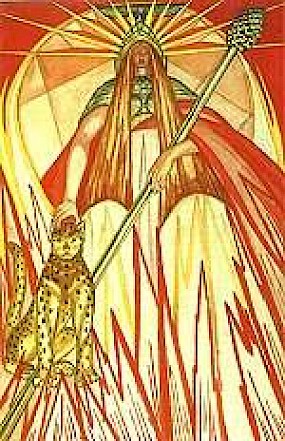
As a suit, Wands are direct, determined and connected to Will and its appropriate application. The Queen of Wands represents a woman who knows exactly what she wants out of life, and aims at her goals with great dedication.
She is often a woman who has experienced conflict and trauma, and learned from these. She’s usually independent, forthright and self-motivated. As a friend she will be loyal and honest, though sometimes given to handing out unwelcome advice, and taking over.
As a parent she can be quite dominant, claiming that she wants her off spring to be self-reliant and confident, but sometimes tending to become impatient, and do things on their behalf in her own way, rather than allowing her children to make up their own minds.
She’s a fighter, who does not suffer fools gladly. She will support and assist those who are vulnerable and needy, offering unceasing energy and determination. She takes up causes readily, and proves herself a worthy adversary. However she has a tendency not to know when to stop, and enjoys being at the forefront of the battle, rather than beavering away on the more routine aspects of any campaign.
This is a forceful and proud woman. She applies high standards to everything she becomes involved in. As a result, she can sometimes be somewhat intolerant of people who do things differently.
So – The Queen of Wands – a fine ally, and a dangerous enemy!
An intense engagement with mortality, by a young writer taken too soon, blends religious and scientific imagery
Carol RumensMon 23 Mar 2020 09.00 EDT (TheGuardian.com)
‘I eat the stars’ … the Milky Way over Alberta, Canada. Photograph: Stocktrek Images, Inc/Alamy
Antidotes to Fear of Death
Sometimes as an antidote To fear of death, I eat the stars.
Those nights, lying on my back, I suck them from the quenching dark Til they are all, all inside me, Pepper hot and sharp.
Sometimes, instead, I stir myself Into a universe still young, Still warm as blood:
No outer space, just space, The light of all the not yet stars Drifting like a bright mist, And all of us, and everything Already there But unconstrained by form.
And sometime it’s enough To lie down here on earth Beside our long ancestral bones:
To walk across the cobble fields Of our discarded skulls, Each like a treasure, like a chrysalis, Thinking: whatever left these husks Flew off on bright wings.
In 1986, Rebecca Elson (1960-1999) was a young Canadian astronomer who had begun a post-doctoral research fellowship examining Hubble telescope data at Princeton. In the essay From Stones to Stars, which concludes her posthumously published and single poetry collection A Responsibility to Awe, Elson contrasted the discomforts of working in such a male-dominated environment with her pleasure in the openness and congeniality of Princeton’s poetry community. But she went on to add a significant qualification, that “the discussions there were also a reminder that, although I loved the unlimited licence to invent, I also loved the sense of exploring not an inner, but an outer world, that was really there, in some objective sense”. This week’s poem seems to accommodate this dilemma, by working on a borderline between inventive “poetic” figures and more objective description, while never fully letting go of the former.
The opening lines are simple and striking. The speaker doesn’t merely lie on her back to look up at the night sky, as any non-astronomer might do, but, childlike, she “eats” the stars. She goes on to tell us how she eats them: she sucks them, and finds the taste “pepper hot and sharp”. This is purposefully visceral and immediate, and a summons to the child star-lover in herself, a tuning-in to the old excitement before academia took over.
She continues the “nutrition” metaphor with the word “stir” in the third stanza, but a change of approach is heralded as we’re invited to follow her into the early universe: “No outer space, just space.” And now poetic diction is reduced, the whole imaginative process more restrained. The biblical creation narrative is recalled, when the earth was “without form, and void” – yet the description, especially that of “the not yet stars”, feels logical and objective.
The alternative to stargazing and imagining, proposed in the fifth stanza, is “To lie down here on earth / Beside our long ancestral bones …” Because of the placing of the conjunction in the first line – “And sometimes it’s enough” – the activity is subtly emphasised. It’s at least as important as looking up at the stars to be aware of the horizontal neighbourhood, that of our “long ancestral bones”. The pun on “long” is beautifully judged here.
Elson doesn’t refute biological “science”. Dead matter is transformed, but kept interestingly visible in the reference to “cobble fields / Of our discarded skulls”. It’s an imaginative truce with fact, followed by speculation, and recourse to the soul-as-butterfly myth. Inevitably, the “bright wings” connect us to the “bright mist” in stanza four, as if a new creation might transpire from death.
Antidotes to Fear of Death is undated, and may have been written before the poet was diagnosed with non-Hodgkin lymphoma, the disease from which she died at the age of 39. It’s the kind of intense engagement with death that an imaginative young writer might make, regardless of personal circumstance. As an act of generosity, like so much of Elson’s work, it includes readers by its imaginative accessibility and universal theme. Although “antidote” is a strong word, the poem has some power to challenge the individual’s fear of extinction with a wider, less egocentric focus on space and time. It lies just outside religious consolation, and just outside “scientific” detachment. Imagination is all we have to suggest alternative universes, a quality required for survival, for poetry, and for the hypotheses of science.
A Responsibility to Awe was first published in 2001, and was reissued in 2018 as a Carcanet Classic. To read Elson’s brave and gentle work during the current pandemic crisis is to take a fresh breath, and to see a little farther.
The nightmares began when Ryan Hammons was 4 years old. He would wake up clutching his chest, telling his mother Cyndi that he couldn’t breathe and that his heart had exploded in Hollywood. But they didn’t live in Los Angeles; Hammons’s family resided in Oklahoma.
A few months prior, in early 2009, Ryan had started talking about going home to Hollywood and pleaded with Cyndi to take him to see his other family. He would yell, “Action!” and pretend to direct films when he played with friends; he knew scenes from a cowboy movie he had never watched; and said a cafe reminded him of Paris, where he had never been. He talked about his child, worldly travels, and his job at an agency where people changed their names. Cyndi didn’t think much of it until the nightmares set in and Ryan started describing death.
Hoping to figure out what he was talking about, Cyndi went to the public library and checked out a few books about Hollywood. She was flipping through one of them when Ryan got excited at a photo from the 1932 movie Night After Night. “Hey Mama, that’s George. We did a picture together,” he told her. “And Mama, that guy’s me. I found me.” George, Cyndi discovered, was George Raft, an actor and dancer who specialized in gangster films in the 1930s and 1940s. She couldn’t track down the name of the man Ryan had identified as himself.
Cyndi had never encountered anything like this before. She was a county clerk deputy who’d been raised in the Baptist church. Her husband, Kevin, was a Muskagee police officer and the son of a Church of Christ minister. She considered them to be fairly ordinary people, but she was starting to wonder if Ryan wasn’t so ordinary. Cyndi contemplated the possibility that this could be a case of reincarnation.
Cyndi contemplated the possibility that this could be a case of reincarnation.
Though she could have looked to one of the religions that hold a belief in reincarnation, such as Hinduism or Buddhism, instead, Cyndi turned to science. In February 2010, she wrote a letter to the Division of Perceptual Studies in the psychiatry and neurobehavioral department at the University of Virginia School of Medicine. Within weeks, they wrote back; Ryan was far from alone in having memories of a past life.
The roots of the Division of Perceptual Studies stretch back to the 1920s, when Dr. Ian Stevenson was growing up in Canada. A sickly child, he contracted bronchitis numerous times and spent hours in bed, devouring his mother’s extensive collection of books on Eastern religions. It was in those pages that he was first exposed to reports of paranormal phenomena. He claimed to possess an unusually good memory and earned his medical degree at McGill University in 1943, before moving to Arizona. He briefly studied biochemistry before moving to psychosomatic medicine, in search of “something closer to the whole human being” than what he had found in biochemistry. From there, he trained in psychiatry and psychoanalysis.
His academic career flourished in the U.S. and he was named chairman of the department of psychiatry at the University of Virginia (UVA) in 1957, while still in his 30s. Around that time, he revived his childhood interest in the paranormal. He dipped his toes into the waters of parapsychology—the study of mental abilities that seem to go against or be outside of the known laws of nature and science—by writing book reviews and articles for non-academic publications like Harper’s magazine.
The most convincing cases, he realized, all involved young children, generally between the ages of 2 and 5, who spoke in great detail of places they had never visited and people they had never met.
In 1958, he won the American Society for Psychical Research’s contest for the best essay on paranormal mental phenomena and their relationship to life after death. His essay, “The Evidence for Survival from Claimed Memories of Incarnations,” looked at 44 cases of individuals around the world who had memories of past lives. The most convincing cases, he realized, all involved young children, generally between the ages of 2 and 5, who spoke in great detail of places they had never visited and people they had never met, or who had birthmarks corresponding to injuries incurred by other people when they faced violent, untimely deaths. Most of those cases were in Asian countries where belief in reincarnation was already high.
Chester Carlson, a wealthy physicist who invented the photocopying process that led to the Xerox Corporation’s founding, read Stevenson’s winning essay. Having become interested in parapsychology through his wife Dorris, Carlson contacted Stevenson with an offer of funding; Stevenson declined. But Stevenson fell deeper into his new research, taking his first fieldwork trip to interview children with past-life memories in India and Sri Lanka in 1961 and publishing his first book on the topic, Twenty Cases Suggestive of Reincarnation, in 1966. He reconsidered Carlson’s offer; the following year, the funding allowed him to step down as chair of the psychiatry department to focus full-time on his reincarnation research—a move that pleased the dean of UVA’s medical school, who was not thrilled with the direction that Stevenson’s work was taking. But when Stevenson stepped down, the dean agreed to let him form a small research division in which to do his curious new research within UVA that still exists today.
Carlson died unexpectedly the next year and left UVA $1 million to support Stevenson’s research. Over the following decades, Stevenson traversed the globe tracking down instances of children with past-life memories, logging an average of 55,000 miles a year and identifying over 2,000 cases. Along the way, he authored more than 300publications, includingfourteenbooks.
The new research division at UVA was called the Division of Parapsychology—a name forced onto Stevenson, according to Dr. Jim. B. Tucker, the division’s current director. Stevenson changed the name to the Division of Personality Studies, concerned that parapsychology was isolating itself from the rest of academia. The vagueness of “personality studies” suited Stevenson, as he continued working to gain the respect of mainstream science. That mission permeated his studies: He ceaselessly quantified his data—coding 200 variables in his database of cases, calculating the probabilities of one or two birthmarks corresponding to one or two wounds on another person’s body, and painstakingly examining every possible normal, as opposed to paranormal, explanation—in a bid to be taken seriously. Now, the research unit is called the Division of Perceptual Studies, or DOPS, and remains up and running despite Stevenson’s death in 2007. There, Cyndi Hammons’s letter about Ryan’s Hollywood memoriesfound Tucker.
Tucker traveled to Oklahoma to meet the Hammons family in April 2010. With help from a TV crew that was following Ryan’s case, they identified the man in the photo from Night After Night as Marty Martyn, who died in 1964. Tucker showed Ryan photos of people Martyn had known in sets of four, asking if anyone looked familiar. He later realized this wording was too vague, especially for a 6 year old, but Ryan did pick out Martyn’s wife, saying that she looked familiar, but that he wasn’t sure how he knew her. Together, they flew to Los Angeles and met Martyn’s daughter, who’d been 8 years old when her father had died. Ryan was confused to find she had grown.
Tucker fact-checked some of Ryan’s memories with Martyn’s daughter. A lot of the details proved accurate; a lot of them did not. Some couldn’t be verified. Martyn had acted as an extra in movies before becoming a talent agent. He and his wife had traveled the globe. Ryan had talked about dancing on Broadway, which Tucker thought unlikely for someone who’d been an extra with no lines, but Martyn’s daughter verified those memories. He had mentioned two sisters and a mother with curly brown hair—also true. He recalled his address having Rock or Mount in its name, and Martyn’s last address was 825 N. Roxbury.
RYAN HAMMONS RECOGNIZED THE ACTOR GEORGE RAFT IN OLD HOLLYWOOD PHOTOGRAPHS WHEN HE WAS A CHILD. (JOHN SPRINGER COLLECTION/CORBIS/CORBIS VIA GETTY IMAGES)
But his heart had not exploded. Martyn had leukemia and died of a cerebral hemorrhage in 1964. Ryan had also said that his father had raised corn and died when he was still a child, which didn’t prove accurate. Still, the case presented “strong evidence for reincarnation,” Tucker wrote in his 2013 book, Return to Life, in which he documented this story, but it was certainly not definitive.
“What this offered was an opportunity to look at the big picture, this question of there being more of us than just the physical.”
When Tucker first heard about Stevenson’s research on reincarnation, he was a child psychiatrist in private practice in Charlottesville, Virginia, where UVA is located. He didn’t believe in reincarnation, but his wife was open to ideas about reincarnation and psychics, so he gradually opened up to those concepts too. And his wife wasn’t alone: A 2018 Pew Research Center poll found that 33 percent of adults in the United States believe in reincarnation. After reading one of Stevenson’s books, he heard that DOPS was doing a project on near-death experiences—another field of research within parapsychology—and reached out. He began working there part-time in 1999.
“What this offered was an opportunity to look at the big picture, this question of there being more of us than just the physical. That was really quite appealing—and not just the question but also the approach to the question, that these were rational, serious-minded people that were doing this work,” he told VICE News.
Ten years prior to meeting the Hammons family, Tucker gave up his private practice to join DOPS full-time. For nine years, he also served as medical director of UVA’s Child and Family Psychiatry Clinic alongside pursuing his parapsychological research through DOPS. Most of Stevenson’s work focused on reincarnation in Asia, but as Tucker plunged into researching past-life memories, he realized that if he were to get Americans to consider his work seriously, he needed to search for cases among those in the U.S. that didn’t believe in reincarnation.
Tucker has now published two books documenting cases of children with past-life memories—a term he prefers over the flashier “reincarnation.” He writes in a decidedly more approachable voice than Stevenson did, aiming for a mainstream audience instead of an academic one. “Ian’s primary goal was to get the scientific world, the scientific establishment, to seriously consider this possibility [of reincarnation]. And that’s a pretty tough audience,” he said. “But beyond that, if you just write for that audience for decades, at some point you have to decide that the rest of the world needs to hear about it too.”
Even in Europe, where parapsychological research is more common in universities like the University of Edinburgh and the University of Northampton, the broader psychology community remains skeptical of this work.
In spite of Stevenson’s attempts to turn reincarnation studies into a hard science, parapsychology is still a stigmatized niche within academia, where it is not viewed as a very respectable field. It’s one of the reasons that Tucker, as well as many other parapsychologists, keeps one foot in mainstream psychiatry or psychology while pursuing their parapsychological research. Even in Europe, where parapsychological research is more common in universities like the University of Edinburgh and the University of Northampton, the broader psychology community remains skeptical of this work.
Tucker and his colleagues at DOPS are not the only academics in this field in the U.S, either. “I think there’s an assumption oftentimes that if you’re studying parapsychology, that means that you absolutely believe everything you’re studying, and I try and work hard to say that you don’t have to believe in everything you study. It’s an academic interest and these are experiences that human beings have reported across different times and across cultures, and we really need to try and understand all aspects of human experience,” said Christine Simmonds-Moore, a parapsychologist and associate professor of psychology at the University of West Georgia.
Simmonds-Moore gravitated towards the paranormal as a child in the UK, but it wasn’t until she was far into her psychology degree that she realized she could actually study paranormal phenomena seriously. After getting her PhD in England, she moved to the US to research at the Rhine Center, an independent parapsychology research center in North Carolina that was once affiliated with Duke University. It was while working there that she first encountered the researchers at UVA.
She never met Stevenson, but she distinctly remembers her first visit to DOPS. “It does send shivers down your spine when you go into the room and you see all the filing cabinets containing all of the cases of the past lives that were investigated by Stevenson,” she told me. “You see all of his work and you see all of the things that he collected from his travels whilst he was doing the investigations. So there are lots of artifacts on the walls there. It’s quite a beautiful experience just to see the room with these filing cabinets.”
Not everyone is so moved by Stevenson and Tucker’s work. Christopher French, a professor of psychology at Goldsmiths, University of London, considers himself a skeptic when it comes to paranormal phenomena, despite conducting some of his own research on past-life memories. He began his career studying mainstream neuroscience before embracing anomalistic psychology, the study of human behavior associated with the paranormal but based on the assumption that nothing paranormal is involved. French’s new direction was, he described, “tolerated” by his department, and he had to keep up his more mainstream psychological research in parallel with the anomalistic work that interested him far more.
“I think they are false memories that have arisen as a result of a kind of interesting social psychological interaction between the child and those around them.”
He thinks the most plausible explanation for the majority of cases is that the children are experiencing false memories, though he maintains respect for Stevenson’s meticulous research. “I think they are false memories that have arisen as a result of a kind of interesting social psychological interaction between the child and those around them,” he argued. “You do wonder to what end the researchers are kind of just finding the things that match what’s gone on.” He thinks that young children will often say things that don’t make sense to their parents when they first start to speak and the parents will then inadvertently feed them information as they begin to wonder whose life the child could be describing—perhaps showing them photographs and asking if they remember the people in the picture and “having this interaction that ultimately will produce a situation where they’ve unintentionally implanted false memories,” as French put it.
Stevenson’s work informed French’s own forays into investigating children with past-life memories. Many years ago, the two men met when seated next to each other at a conference dinner. “He came across as a very intelligent, reasonable person,” French recalled. “I think his work is very good as far as it goes, but I don’t think it’s the whole story.”
He doesn’t, however, question the necessity of the research itself. “There could only be two possibilities. One is that there is something genuinely paranormal happening, and if that is true, that would be amazing,” he told me. “Or, alternatively—which is more the line that I do favor—it tells us something very interesting about human psychology. So either way, it’s worth taking seriously.”
Dr. Anita H. Clayton, chair of UVA’s psychiatry and neurobehavioral department, which houses DOPS, echoed that sentiment: “My question is, Where should DOPS be if it’s not in the department of psychiatry? And where should it be if it’s not in academics? Because I think what scientists do is dispassionately investigate phenomena that we don’t yet understand.”
And yet, mainstream science still largely relegates parapsychology to its own community, with researchers struggling to get their work published in major journals. Instead, they often publish in parapsychology journals, which, all the parapsychologists I spoke with agreed, is a bit ineffective—they are preaching to the choir when they would rather be reaching the skeptics.
On April 30, 2011, the TV show that had followed Ryan Hammon’s case, The UneXplained: A Life in the Movies,aired on the Biography Channel. As a young child, Ryan had always been shy about sharing his Hollywood memories out of fear that people would think he was crazy; his parents, too, had been nervous about what people in their small town would think of them. But just over a year after Cyndi sent that first letter to DOPS, her family’s story appeared on national television. In the end, the family thought the producers did a great job. Soon after the episode aired, Ryan stopped talking about Marty Martyn. Within six months, Ryan had taken down his Martyn-themed bedroom decorations—an iron Eiffel Tower, pictures of New York—and told his mom it was time to be a regular kid.
After more than two decades of researching children with past-life memories, Tucker is still getting letters about children like Ryan and he is still seeking out new cases. At his last count, there were about 2,200 cases coded in his database. He describes himself as “spiritual but not religious,” and his goal remains unique from Stevenson’s, who was open about his unfulfilled quest for mainstream science to value his life’s work.
“A lot of it, to be perfectly honest, is trying to figure out the answers for myself,” Tucker told me. “Hopefully my work or my writings have had a positive impact on some people, but they’re still trying to answer the question of, What is the level of evidence that, in fact, there is this part of us that survives after the body dies?”
“We are each an expression of the creative force behind diversity, selectively focusing uponthe infinite matrix of probability that our intention to experience individuality brought into being.”
Your spiritis the eternal, non-physical level of consciousness from which you chose to enter into the human experience of individuality. Spiritual awakening is the path of becoming as familiar with your spirit as you are with your physical self. This is most easily understood as the path of learning to live through the guidance of your feelings, gut, and intuition — instead of through the fear-based wounds within your mind.
You have the ability to be aware of the reality of your spirit through opening yourself to recognize and allow wider experiences of consciousness.
Contrary to many of the teachings of religion, the purpose of human existence is not to awaken to your spirit and ‘ascend’ to the non-physical state. We — from the inherent freedom of our eternal spirit — created the human form because it is precisely what we wanted to experience. We did not create the human experience as a prison to be escaped or a hardship to be endured.
The idea that reality is a test we must pass (or a punishment we must endure) comes from religion using fear as a tool of control.
There is no edict to be spiritual. Anyone who lives a joyful life which flows from their heart — regardless of their spiritual beliefs — is doing what they birthed here to do, even if they die with no belief in an afterlife and a dislike for spirituality.
You are under no obligation or pressure to recognize your spiritual nature (i.e. the innate freedom of your consciousness) through any particular way or name. Being spiritual does not require you to call it ‘spirituality’ or dress it up in religious sounding words or rituals. You could call it ‘authenticity’ or ‘living consciously with love’ for example.
At the simplest level, it is the recognition that in just being yourself, you are fulfilling your purpose. At the deepest level, it is just being yourself. ‘Be yourself’ is as complicated as a spiritual philosophy needs to be.
You are not here to awaken to your spirit (although you may choose to). You are here to live your spirit’s dream / intention for this life.
Our hopes and dreams for life are about joy — not some idea of an external God.
Our intention is to love — not sacrifice who we are.
Our choice for a human life is about the beauty of feeling — not mental construction based on the accumulation and refinement of knowledge.
The dream in your heart can never be met through the idea that you ‘should’ be spiritual. Joy is met through the realization that we allintend, and deserve, to live in joy. Do not believe in the ideas in this book because you want to be ‘more spiritual’.
Believe in ANY idea, regardless of where you find it, that aids you in living your life through a state of joy and appreciation.
There is a perspective from which you both are your spirit and arenot your spirit. Imagine your spirit as an expression of all possibility. In human form, we are not all possibility in that we area chosenfocus of self (a focus created from the state of all possibility). What is more, the potential for all possibility continues to exist within us, but in an encoded form (meaning physicality, reality, and our embodied self are each expressions of the state of all possibility).
As you explore and develop the expression of yourself, so you decode your chosen focus within all possibility into what you choose to express yourself to be in each moment. In this way, all that you perceive, which is an expression of all possibility (regardless of whether you perceive it as external or internal) is like a menu that aids you in your creation of your mortal self.
The creation of your mortal self is through the selection of potentials from the infinite menu of all possibility.
Imagine your consciousness / spirit as an open rose. You are the seed of that rose. You contain the complete awareness to transform yourself into the rose. There are an infinite number of ways in which you can do this … ways which, in this moment, you are creating with the freedom of your perception. As you discover new and exciting ways of becoming the rose, so you enhance the rose. In doing this, you enhance The One Consciousness / all consciousness / eternal consciousness (because of our holographic nature).
You are The One Consciousness (which is unified because of how consciousness exists outside of time and space) in a state of expressing and exploring the freedom of consciousness to be. To be in a state of freedom is not the same as being all that The One Consciousness is, and yet there is no state within The One Consciousness you are not free to explore. There is nothing you cannot be and no quality you cannot embody.
Your choice is unlimited.
Your potential is infinite.
This is how you are both simultaneously limited and unlimited — singular, yet infinite.
This is how you both are and are not your spirit.
This is how your spirit both is and is not The One Consciousness.
This is how you are.
This is what allows you to be in the experience of an individuated self.
To see this is to see why you should not seek to be all — you should seek to be yourself. The All already exists as All That Is / The One Consciousness. You, however, are the only state of being that exists as you. You are unique in your expression of The One Consciousness. Your potential is that of a birthing ‘God’ in human form. Do not destroy yourself to become what already exists. Be bold. Be what you came to be.
And that is to say, “be something new”.
And that is to say, “be you”.
Within human form, we experience different selves as having particular preferences because of our choice to physically imprint predefined preferences into our human form. You selected these to be in line with your intentions for your individuation. You genetically coded yourself to be a unique expression of consciousness.
‘Being yourself’ is to reveal your spirit’s choice … which, in turn, reveals your spirit.
Because The One Consciousness is a unified state of consciousness, it experiences a singular will. Within the individuated state, we experience that will as being our own, even though it is the one and only will in existence. Therefore, despite how complex, conflicted, and diverse our collective reality appears to be, a ‘single will’ made every choice in its creation.
To exercise your will is to exercise your ability to choose. Just as there is only one consciousness in existence with infinite expressions, so there is only one will in existence with infinite manifestations. Your will is not different from my will.
There is only one will in existence. It makes all choices. This is why the foundation of life — beneath the illusion of competition — is harmony.
Your personal experience of will is a unique experience of the one will. This means that even though there is only one will, no one experiences it in exactly the same way. This uniqueness is why the realization that there is only one will does not reduce or devalue your experience of that will. It is a self-defining quality of your individuated perspective.
Your choices are the manifestation of potential self-definitions that you are capable of perceiving and selecting. Whenever you make a choice of one thing over another, you in some way further define / refine / navigate / select your experience of self.
You are free in your choice of your experience of self, and you are free to deny making this choice.
An individual can be thought of as a vehicle for consciousness. Vehicle here refers to the complete reality experience (including not only our outer reality but also our inward beliefs, thoughts, memories, and emotions). Individuals are constantly changing through the accumulation of their reactions to their experiences.
In each moment, the vantage-point that each vehicle offers creates a unique experience of the one consciousness and its will.
It is through this will that our experience of freedom arises (one of the most beloved human qualities). Our unique experience of ‘the freedom of our will to choose’ allows The One Consciousness to experience making many different responses to the same choice. This diversity of reactions always results from variations in the vantage-point of the individual and not through any difference in their will. Different responses to a choice only exist because of the differing vantage points created by individuality.
The diversity of human preference is an illusion that is full of meaning. Beneath this apparent diversity, what we all want is the same.
When we feel judgment about another person’s choice, we generally believe we would have made ‘a better choice’. This is to not accept that if you took on the other person’s exact vantage-point (which is to become them) then you would make the exact same choice you are judging.
If you walked fully in any other person’s shoes, then you would choose as they chose because we are all expressions of the same consciousness. To judge another’s choices is to deny that we are all one consciousness with one will. Although seeing that you would choose as others do is a liberation from separation, it is usually resisted because of how it removes the ability to judge or blame the actions of others. Judgment is a denial that we are the same consciousness.
The vantage-point that arises out of your individuality is what uniquely defines you and, in each moment, your vantage-point includes the accumulation of all that has ever affected you.
You are an eternally, self-evolving vantage-point that is not tied to any particular form of vehicle or lifespan.
This is to say…
You are infinite (which is the religious equivalent of saying “you are God”).
Infinityis not a definition of quantity. It is the concept of something without end or limit — something with unending potential that will always reveal new detail the more you focus upon it. For example, with perception capable of seeing it, you could perceive an infinite number of hues within a rainbow.
The One Consciousness becoming diversified created a perceptual illusion that revealed infinite dimensions of detail within itself / what already exists / its oneness.
I use the term ‘The Infinite Matrix’ (or ‘The Infinite Menu’) as a conceptualization of the complete array of unending potential experiences that came into being when eternal consciousness conceived of the perceptual lens of diversity. As such, it represents the collective potential of all diversity. This ‘Infinite Matrix’ contains infinite unique reflections of The One Consciousness. Being uniquely differentiated, these reflections can be focused upon individually or in combination, creating an unending potential for experience.
Although ‘The Infinite Matrix’ is not a literal structure, it can be helpful to picture it as a gigantic multi-dimensional web that contains every single possible version of every possible experience, and then to imagine yourself as an individuated point of consciousness — or focus — navigating this infinite landscape of potential experiences of self.
In each moment, we choose from an ocean of potentials (often visualized as a radiant web of timelines), each offering evermore unique tastes of what it is to be The One Consciousness.
If The One Consciousness is white light and the lens of diversity is ‘as a prism’, then the infinite matrix of probabilities that we exist within is the conception of the rainbow of diversity that is revealed. In this, see how a prism does not create a spectrum of colors out of nothing — it only reveals the infinite hues that were already existing within the white light.
The presence of diversity in The One Consciousness does not change what it is, as the lens of diversity only reveals what is already present. However, for wider consciousness to consciously perceive its own diversity is to evolve its understanding of itself through reflection. This is done by looking into the lens and perceptually entering a selective focus on this infinite matrix.
There is no end to how far you can travel into the lens of diversity. To be within the infinite matrix of potential it creates is to be in an ever-unfolding evolution of your own experience. It is a focus that will always draw you forward into an unfolding extension of the present moment through the creation of the perceptual illusion of linear time.
Time is a color in the palette of creation that adds a particular flavor of meaning to an experience.
This unending potential can also be imagined as the potential that exists within a block of marble before a sculptor carves it. Every possible sculpture that could ever be sculpted is simultaneously present within the block of marble. A sculptor is a person who removes a part of the marble to reveal their creative vision. You are a sculptor of self. The act of carving away the stone is analogous to the application of perceptual blindness (forgetting / unconsciousness) to the full spectrum experience of The One Consciousness in order to create the illusion of a uniquely defined / focused individual (the definition of the sculpture).
We are each The One Consciousness looking at the same uncarved block of marble (The Infinite Matrix), perceptively fantasizing (dreaming) whatever we desire as a reality.
We are each an expression of the creative force behind diversity, selectively focusing upon the infinite matrix of probability that our intention to experience individuality brought into being. In focusing upon the unique experiences reflected through diversity, The One Consciousness enters an unending potential for experience. All have equal access to this unending potential. The lens of diversity has birthed us into an infinite collective experience. As a collective, we exist in relation to each other across this diversity of potentials.
We are each a self-evolving selective focus of eternal, unified consciousness upon itself, perceived through the lens of diversity.
You can choose to say that there is a certain number of colors in a rainbow, but each of those colors is then revealed to contain infinite variations such that the most orange yellow stands so close to the yellowest orange that it is not experienced as distinct from it. It is the same with selves. Although a meaningful distinction between ‘other beings’ and ‘other versions of yourself’ can be drawn, the wider understanding is that each, and every being is another version of The One Consciousness (which can therefore also be referred to as ‘The One Self’).
How we divide our perception is a choice.
When considering experiences based upon linearity, the infinite matrix of probabilities can be imagined being like a harp with an infinite number of strings, with each string representing a linear unfolding of a state of definition. We traverse the strings of the harp and experience them as variations of our current experience.
You are a musician … a sculptor … a creative creator of creation.
In this stirring call to arms, the activist, spiritual leader, and New York Times bestselling author of the classic A Return to Love confronts the cancerous politics of fear and divisiveness threatening the United States today, urging all spiritually aware Americans to return to—and act out of—our deepest love. America’s story is one of great social achievement. From the Abolitionists who fought to outlaw slavery, to the Suffragettes who championed women’s right to vote, to the Civil Rights proponents who battled segregation and institutionalized white supremacy, to the proponents of the women’s movement and gay rights seeking equality for all, citizens for generations have risen up to fulfill the promise of our nation. Over the course of America’s history, these activists have both embodied and enacted the nation’s deepest values. Today, America once again is in turmoil. A spiritual cancer of fear threatens to undo the progress we have achieved. Discord and hatred are dissolving our communal bonds and undermining the spirit of social responsibility—the duty we feel toward one another. In this powerful spiritual manifesto, Marianne Williamson offers a tonic for this cultural malignancy. She urges us to imitate the heroes of our past and live out our deepest spiritual where some have sown hatred, let us now sow love. Williamson argues that we must do more than respond to external political issues. We must address the deeper, internal causes that have led to this current dysfunction. We need a new, whole-person politics of love that stems not just from the head but from the heart, not just from intellectual understanding but from a genuine affection for one another. By committing to love, we will make a meaningful contribution to the joyful, fierce and disruptive energies that are rising at this critical point in time. In the words of Abraham Lincoln, "we must think anew, and act anew . . . and then we shall save our country."
The award-winning film 1995 Braveheart is deservingly considered one of the best films from the 1990s. The Mel Gibson epic depicts the life of the Scottish hero William Wallace and his struggle for independence from English rule. While a fantastic piece of filmmaking and storytelling, it is riddled with historical inaccuracies.
A shortlist of inaccuracies include the wearing of kilts (hundreds of years too early), blue warpaint (about a thousand years too late), and an affair with the princess of England (Isabella was a child in France at the time of Wallace’s death and would never have met him). There are also issues with how Wallace is depicted almost as an educated commoner instead of a member of Scottish nobility as well as making Edward I seem like a homicidal maniac (though the Scots probably saw him that way).
However, one scene in the film, which becomes a catalyst for Wallace’s rebellion, purports a historical myth passed down through the century. In an attempt to “breed out” the resistant Scots, Edward I allows the nobles to invoke the right of prima nocta. This allowed the noble to sleep with any female subject on her wedding night. This violation, which Wallace witnesses at a friend’s wedding, along with the murder of his wife, incites Wallace to rise against the English.
What Was Prima Nocta?
Prima nocta is a shortening of the Latin phrase jus prima nocta or “right of the first night.” This gave the ruler the right to bed any female subject regardless of social rank on her wedding night. Similar customs are mentioned in the Sumerian Epic of Gilgamesh and the Histories of the Greek historian Heroditus, though the term is not used in either source. There is also evidence that the city of Volsinii in Italy revolted against the Etruscans for the abuses of the female population.
Since the Epic of Gilgamesh is a literary work and Heroditus was known to stretch the truth, whether this custom was true is debatable. Sadly, as we know that men in power can often abuse that power and those subject to them, such a custom is not out of the realm of reality in the ancient world.
While there is no evidence of the prima nocta in Medival records, there are records of a marriage fine or merchet. While some historians have pointed to this as evidence of payment to avoid the vile custom, it was more likely compensation to the lord for a subject leaving his land. Similar indulgences were paid to the Catholic Church to wave a prohibition on intercourse on the couple’s wedding night.
Looking at Medieval laws and sources, historians have found no valid reference to the custom. They do pop up more from monastic sources, using it as a metaphor either for sexual immorality in society or to show non-Christian communities as barbaric. While some non-European cultures, such as the Khitan in modern China, some areas of the Hawaiian Islands, and Central Asian cultures, there is no evidence of the custom taking place in Medival Europe.
Where Did the Myth Come From?
So, if Edward I did not encourage his men to rape women on their wedding day as part of some ancient right, then where did this myth come from? Gibson did not come up with the plot device for his movie. For that answer, we have to look at the 18th and 19th centuries.
Mentions of the ancient practice began to pop up in the 1500s with stories of how kings in the past abolished the custom of jus prima nocta. The Scottish king Malcolm III supposedly did so under the influence of his wife in the 11th century, Ferdinand II of Aragon, in the 1480s.
Renaissance and Early Modern literature used the custom as a plot device in plays and novels to show how evil the antagonists were. French philosopher and writer Voltaire would coin the term droit de seigneur (“lord’s right”) when speaking of the Early Middle Ages or the Dark Ages.
Voltaire and his contemporaries used the term to show how far society had come by the 17th century and the age of the Enlightenment. They were no longer these barbaric people with low morals but sophisticated people with rational laws.
The myth of prima nocta also was a powerful political tool. By showing how better your group was than your enemy, you could gain sympathy and justification for your actions. For instance, if Edward I had indeed incited this custom into law, the Scots had a good reason to revolt (of course, they had multiple real reasons to revolt against English overlordship).
Why Does the Myth Continue?
So if prima nocta did not exist, why does it still come up in pop culture? The easy answer, it is a handy plot device. If you want to make your villain seem horrible, there is nothing worse than legalizing sexual assault. Films such as Braveheart and television shows like Game of Thrones have used the act or threat of the act as a way to show how horrible some of the characters were.
There is still a debate amongst some scholars on if such customs did exist. While there may have been similar customs in ancient times in Europe, most historians agree that I had died out before the Medieval period.
An old hermit was once invited to visit the court of the most powerful king of the day.
“I envy a holy man, who is content with so little,” commented the sovereign.
“I envy Your Majesty, who is content with less than I. I have the music of the celestial spheres; I have the rivers and mountains of the whole wide world; I have the moon and the sun, because I have God in my soul. Your Majesty, however, has only this kingdom.”
Author Unknown
Consciousness, spirituality, biography, sexuality, androgyny, futurism, space, the arts, science, astrology, democracy, humor, books, movies and more





 An old hermit was once invited to visit the court of the most powerful king of the day.