Last year, one of the most optimistic humans in history passed away.
His name was Lama Zopa, said to be the reincarnation of a yogi from a region called Lawudo in Nepal.
This yogi died in retreat, and Lama Zopa as a child would spontaneously run to climb up the mountain to his previous life’s retreat cave. He’d say to his mother that he still had work to do up there!
But such aberrations of behaviour aren’t the only “proof” that our subtle consciousness can continue beyond our mental/physical dissolution.
You can find it yourself — but only if you get your head out of the sand.
The biggest stumbling block to this, in modern folks, is that we’re utterly identified with what isn’t truly us–our name, appearance, privilege, mind, thoughts and emotional state.
You can’t even consider that the deeper reality beyond, which is reborn, will actually be “you” when it manifests a new form. Because you identify totally with the lie of a self that’s bound to come to an end one day.
How will you ever notice where your root tendencies actually come from, which is beyond your parents, culture, education, and environment?
To an extent, this lazy and ignorant interpretation is right
“You” are a unique recipe of manifestation that won’t ever come about in the same combination again.
Congratulations, snowflake – now realize when you melt, you’ll still be water. And it’s cold, so you’ll freeze back again – influenced by the way you melted last.
Reincarnation isn’t much different.
Sure, your future manifestations will process the world slightly differently. They’ll have a very different body. Emotions unknown to you now will reveal themselves in full bloom in another realm of possibility.
But if you latch onto all this, calling it truly you and yours, guess what? It’ll slip through your fingers like sand. Again and again, birth after birth, with nothing lasting but the passing pains and pleasures of this unpredictable world.
How is that even a remotely dignified way to live?
It’s not your fault you’re brainwashed
Our culture is inherently geared to what Buddhist philosophy labels as “the affairs of this life.”
Your reputation, material gain, relationships – all the bridges made of sand that you can’t take with you. And not because of some kind of inherent Western inferiority — because even ancient India, China, and Tibet had cultures tending to gear toward this physical reality.
It’s because it’s simply easier to focus on what’s in front of you. The distant future is just that: out of view and hence out of mind.
But is it actually out of reach, if every moment is creating it?
It’s not only right in front of you, but it’s the deep purpose in you being here in the first place.
Humans are the only form of life we know of that can influence the process of their consciousness’ development.
We undergo involution, whereas the natural world is subject to evolution.
So how do you obtain that which benefits you even after death?
Proper effort on the spiritual path is considered to be the only thing that brings value beyond this coarse manifestation. Because it creates the conditioning of the next ones.
How, you ask? Most obviously by shifting the kind of mental and physical apparatus that emerges from the “DNA” of karmic seeds deposited in the subtle mental continuum.
Acts of generosity and patience deposit energetic potentials of expansiveness and sturdiness.
Selfishness and anger produce contraction and restriction.
Engineer enough of these deep, root-level habits, and happiness is likely to come about in this very life, let alone in the far future.
But if you roast the seeds entirely, something magical happens
In the Buddhist theoretical landscape of psychology models to explain these concepts, there is a term called ‘storehouse consciousness’ that is the holder of all these karmic potentials. It’s the subtle stream of consciousness that reincarnates after death.
The deep work that Lama Zopa’s previous yogic incarnation was doing had something to do with ‘shaking off’ the accumulations of karma in this layer, using the burning blaze of insight.
He saw right through the entire process, so it was impossible to unconsciously fall into (coarse) karma ever again.
One of his most outspoken students, Robina Courtin, told a story about how his childhood was itself “proof” of his success in his past life’s spiritual endeavor.
After falling into a lake and almost drowning, Lama Zopa struggled and barely saved himself from potential death. But recounting his state of mind during the event: he said there was absolutely zero fear, just awareness and action.
Lack of mental afflictions like overpowering lust, anger, dullness, and anxiety is a sign that someone has entered what Buddhism calls ‘irreversibility.’
This is the inability to turn back to faulty, delusional forms of existence in this world.
And these are exactly the inner superheroes our confused modernity desperately needs.
But they can’t arise out of nowhere
Deep work is impossible without dedicated individual efforts plus institutional support.
How will you know which path is right without trying several, that too in an intensive & immersive environment, with access to living masters?
Yet ashrams are rare in our capitalist Western world, where housing is a commodity and community is a luxury.
How will you know what you’re capable of, beyond the whims of this life, without abandoning your obsession with it?
But few people, even supposedly spiritual ones, have actually turned away from the external world, becoming totally dedicated to optimizing their inner one.
So if the causes and conditions actually come together for you to do something out of the ordinary scheme of things – even if it’s sitting for 10 minutes in meditation after watching a video about it on the internet – consider it a lucky moment.
It’s aligned with the higher potential you’re here to embody.
Distraction isn’t your problem, it’s your solution
When the influences of the collective unconscious bear heavy, remember the following story.
A king who would go on barefoot walks decided one day to make all the land he had influence over ‘perfect’ for this strange habit of his.
He went about carpeting the roads, and jailing those who made messes of the walking paths. Until one day, someone convinced him to wear shoes – and then to provide them to all who couldn’t afford them.
The king is your tendency to think you’re truly in charge.
Walking barefoot is your overly sensitive nature.
The carpet is your delusional and stressful effort to change the world to suit your “needs.”
And the shoes are the insight of your own (fixable) inner faults being the main issue in life, not a list of external complaints.
Like the Buddha said, we’re all walking around minds impaled by arrows.
Why not perform the essential care we need, rather than building whole cultural systems geared toward ways to “cope” with our condition?
The nightmares began when Ryan Hammons was 4 years old. He would wake up clutching his chest, telling his mother Cyndi that he couldn’t breathe and that his heart had exploded in Hollywood. But they didn’t live in Los Angeles; Hammons’s family resided in Oklahoma.
A few months prior, in early 2009, Ryan had started talking about going home to Hollywood and pleaded with Cyndi to take him to see his other family. He would yell, “Action!” and pretend to direct films when he played with friends; he knew scenes from a cowboy movie he had never watched; and said a cafe reminded him of Paris, where he had never been. He talked about his child, worldly travels, and his job at an agency where people changed their names. Cyndi didn’t think much of it until the nightmares set in and Ryan started describing death.
Hoping to figure out what he was talking about, Cyndi went to the public library and checked out a few books about Hollywood. She was flipping through one of them when Ryan got excited at a photo from the 1932 movie Night After Night. “Hey Mama, that’s George. We did a picture together,” he told her. “And Mama, that guy’s me. I found me.” George, Cyndi discovered, was George Raft, an actor and dancer who specialized in gangster films in the 1930s and 1940s. She couldn’t track down the name of the man Ryan had identified as himself.
Cyndi had never encountered anything like this before. She was a county clerk deputy who’d been raised in the Baptist church. Her husband, Kevin, was a Muskagee police officer and the son of a Church of Christ minister. She considered them to be fairly ordinary people, but she was starting to wonder if Ryan wasn’t so ordinary. Cyndi contemplated the possibility that this could be a case of reincarnation.
Cyndi contemplated the possibility that this could be a case of reincarnation.
Though she could have looked to one of the religions that hold a belief in reincarnation, such as Hinduism or Buddhism, instead, Cyndi turned to science. In February 2010, she wrote a letter to the Division of Perceptual Studies in the psychiatry and neurobehavioral department at the University of Virginia School of Medicine. Within weeks, they wrote back; Ryan was far from alone in having memories of a past life.
The roots of the Division of Perceptual Studies stretch back to the 1920s, when Dr. Ian Stevenson was growing up in Canada. A sickly child, he contracted bronchitis numerous times and spent hours in bed, devouring his mother’s extensive collection of books on Eastern religions. It was in those pages that he was first exposed to reports of paranormal phenomena. He claimed to possess an unusually good memory and earned his medical degree at McGill University in 1943, before moving to Arizona. He briefly studied biochemistry before moving to psychosomatic medicine, in search of “something closer to the whole human being” than what he had found in biochemistry. From there, he trained in psychiatry and psychoanalysis.
His academic career flourished in the U.S. and he was named chairman of the department of psychiatry at the University of Virginia (UVA) in 1957, while still in his 30s. Around that time, he revived his childhood interest in the paranormal. He dipped his toes into the waters of parapsychology—the study of mental abilities that seem to go against or be outside of the known laws of nature and science—by writing book reviews and articles for non-academic publications like Harper’s magazine.
The most convincing cases, he realized, all involved young children, generally between the ages of 2 and 5, who spoke in great detail of places they had never visited and people they had never met.
In 1958, he won the American Society for Psychical Research’s contest for the best essay on paranormal mental phenomena and their relationship to life after death. His essay, “The Evidence for Survival from Claimed Memories of Incarnations,” looked at 44 cases of individuals around the world who had memories of past lives. The most convincing cases, he realized, all involved young children, generally between the ages of 2 and 5, who spoke in great detail of places they had never visited and people they had never met, or who had birthmarks corresponding to injuries incurred by other people when they faced violent, untimely deaths. Most of those cases were in Asian countries where belief in reincarnation was already high.
Chester Carlson, a wealthy physicist who invented the photocopying process that led to the Xerox Corporation’s founding, read Stevenson’s winning essay. Having become interested in parapsychology through his wife Dorris, Carlson contacted Stevenson with an offer of funding; Stevenson declined. But Stevenson fell deeper into his new research, taking his first fieldwork trip to interview children with past-life memories in India and Sri Lanka in 1961 and publishing his first book on the topic, Twenty Cases Suggestive of Reincarnation, in 1966. He reconsidered Carlson’s offer; the following year, the funding allowed him to step down as chair of the psychiatry department to focus full-time on his reincarnation research—a move that pleased the dean of UVA’s medical school, who was not thrilled with the direction that Stevenson’s work was taking. But when Stevenson stepped down, the dean agreed to let him form a small research division in which to do his curious new research within UVA that still exists today.
Carlson died unexpectedly the next year and left UVA $1 million to support Stevenson’s research. Over the following decades, Stevenson traversed the globe tracking down instances of children with past-life memories, logging an average of 55,000 miles a year and identifying over 2,000 cases. Along the way, he authored more than 300publications, includingfourteenbooks.
The new research division at UVA was called the Division of Parapsychology—a name forced onto Stevenson, according to Dr. Jim. B. Tucker, the division’s current director. Stevenson changed the name to the Division of Personality Studies, concerned that parapsychology was isolating itself from the rest of academia. The vagueness of “personality studies” suited Stevenson, as he continued working to gain the respect of mainstream science. That mission permeated his studies: He ceaselessly quantified his data—coding 200 variables in his database of cases, calculating the probabilities of one or two birthmarks corresponding to one or two wounds on another person’s body, and painstakingly examining every possible normal, as opposed to paranormal, explanation—in a bid to be taken seriously. Now, the research unit is called the Division of Perceptual Studies, or DOPS, and remains up and running despite Stevenson’s death in 2007. There, Cyndi Hammons’s letter about Ryan’s Hollywood memoriesfound Tucker.
Tucker traveled to Oklahoma to meet the Hammons family in April 2010. With help from a TV crew that was following Ryan’s case, they identified the man in the photo from Night After Night as Marty Martyn, who died in 1964. Tucker showed Ryan photos of people Martyn had known in sets of four, asking if anyone looked familiar. He later realized this wording was too vague, especially for a 6 year old, but Ryan did pick out Martyn’s wife, saying that she looked familiar, but that he wasn’t sure how he knew her. Together, they flew to Los Angeles and met Martyn’s daughter, who’d been 8 years old when her father had died. Ryan was confused to find she had grown.
Tucker fact-checked some of Ryan’s memories with Martyn’s daughter. A lot of the details proved accurate; a lot of them did not. Some couldn’t be verified. Martyn had acted as an extra in movies before becoming a talent agent. He and his wife had traveled the globe. Ryan had talked about dancing on Broadway, which Tucker thought unlikely for someone who’d been an extra with no lines, but Martyn’s daughter verified those memories. He had mentioned two sisters and a mother with curly brown hair—also true. He recalled his address having Rock or Mount in its name, and Martyn’s last address was 825 N. Roxbury.
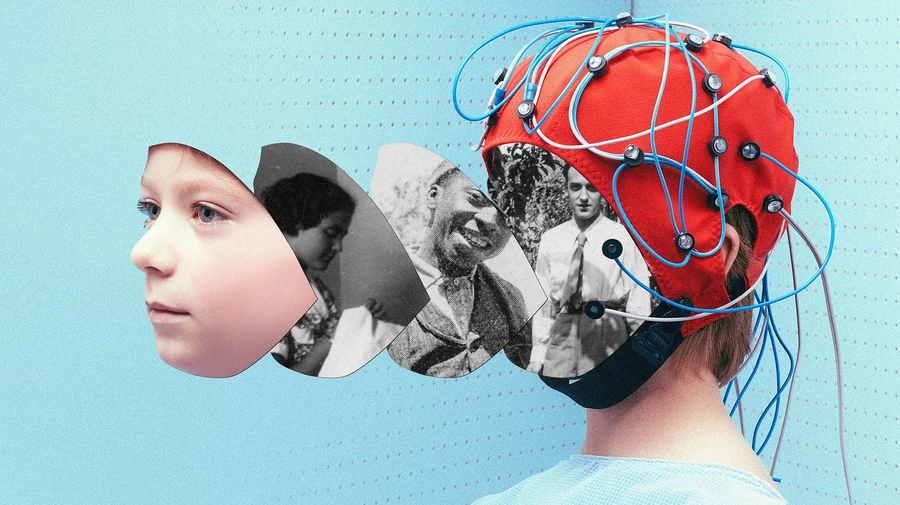
RYAN HAMMONS RECOGNIZED THE ACTOR GEORGE RAFT IN OLD HOLLYWOOD PHOTOGRAPHS WHEN HE WAS A CHILD. (JOHN SPRINGER COLLECTION/CORBIS/CORBIS VIA GETTY IMAGES)
But his heart had not exploded. Martyn had leukemia and died of a cerebral hemorrhage in 1964. Ryan had also said that his father had raised corn and died when he was still a child, which didn’t prove accurate. Still, the case presented “strong evidence for reincarnation,” Tucker wrote in his 2013 book, Return to Life, in which he documented this story, but it was certainly not definitive.
“What this offered was an opportunity to look at the big picture, this question of there being more of us than just the physical.”
When Tucker first heard about Stevenson’s research on reincarnation, he was a child psychiatrist in private practice in Charlottesville, Virginia, where UVA is located. He didn’t believe in reincarnation, but his wife was open to ideas about reincarnation and psychics, so he gradually opened up to those concepts too. And his wife wasn’t alone: A 2018 Pew Research Center poll found that 33 percent of adults in the United States believe in reincarnation. After reading one of Stevenson’s books, he heard that DOPS was doing a project on near-death experiences—another field of research within parapsychology—and reached out. He began working there part-time in 1999.
“What this offered was an opportunity to look at the big picture, this question of there being more of us than just the physical. That was really quite appealing—and not just the question but also the approach to the question, that these were rational, serious-minded people that were doing this work,” he told VICE News.
Ten years prior to meeting the Hammons family, Tucker gave up his private practice to join DOPS full-time. For nine years, he also served as medical director of UVA’s Child and Family Psychiatry Clinic alongside pursuing his parapsychological research through DOPS. Most of Stevenson’s work focused on reincarnation in Asia, but as Tucker plunged into researching past-life memories, he realized that if he were to get Americans to consider his work seriously, he needed to search for cases among those in the U.S. that didn’t believe in reincarnation.
Tucker has now published two books documenting cases of children with past-life memories—a term he prefers over the flashier “reincarnation.” He writes in a decidedly more approachable voice than Stevenson did, aiming for a mainstream audience instead of an academic one. “Ian’s primary goal was to get the scientific world, the scientific establishment, to seriously consider this possibility [of reincarnation]. And that’s a pretty tough audience,” he said. “But beyond that, if you just write for that audience for decades, at some point you have to decide that the rest of the world needs to hear about it too.”
Even in Europe, where parapsychological research is more common in universities like the University of Edinburgh and the University of Northampton, the broader psychology community remains skeptical of this work.
In spite of Stevenson’s attempts to turn reincarnation studies into a hard science, parapsychology is still a stigmatized niche within academia, where it is not viewed as a very respectable field. It’s one of the reasons that Tucker, as well as many other parapsychologists, keeps one foot in mainstream psychiatry or psychology while pursuing their parapsychological research. Even in Europe, where parapsychological research is more common in universities like the University of Edinburgh and the University of Northampton, the broader psychology community remains skeptical of this work.
Tucker and his colleagues at DOPS are not the only academics in this field in the U.S, either. “I think there’s an assumption oftentimes that if you’re studying parapsychology, that means that you absolutely believe everything you’re studying, and I try and work hard to say that you don’t have to believe in everything you study. It’s an academic interest and these are experiences that human beings have reported across different times and across cultures, and we really need to try and understand all aspects of human experience,” said Christine Simmonds-Moore, a parapsychologist and associate professor of psychology at the University of West Georgia.
Simmonds-Moore gravitated towards the paranormal as a child in the UK, but it wasn’t until she was far into her psychology degree that she realized she could actually study paranormal phenomena seriously. After getting her PhD in England, she moved to the US to research at the Rhine Center, an independent parapsychology research center in North Carolina that was once affiliated with Duke University. It was while working there that she first encountered the researchers at UVA.
She never met Stevenson, but she distinctly remembers her first visit to DOPS. “It does send shivers down your spine when you go into the room and you see all the filing cabinets containing all of the cases of the past lives that were investigated by Stevenson,” she told me. “You see all of his work and you see all of the things that he collected from his travels whilst he was doing the investigations. So there are lots of artifacts on the walls there. It’s quite a beautiful experience just to see the room with these filing cabinets.”
Not everyone is so moved by Stevenson and Tucker’s work. Christopher French, a professor of psychology at Goldsmiths, University of London, considers himself a skeptic when it comes to paranormal phenomena, despite conducting some of his own research on past-life memories. He began his career studying mainstream neuroscience before embracing anomalistic psychology, the study of human behavior associated with the paranormal but based on the assumption that nothing paranormal is involved. French’s new direction was, he described, “tolerated” by his department, and he had to keep up his more mainstream psychological research in parallel with the anomalistic work that interested him far more.
“I think they are false memories that have arisen as a result of a kind of interesting social psychological interaction between the child and those around them.”
He thinks the most plausible explanation for the majority of cases is that the children are experiencing false memories, though he maintains respect for Stevenson’s meticulous research. “I think they are false memories that have arisen as a result of a kind of interesting social psychological interaction between the child and those around them,” he argued. “You do wonder to what end the researchers are kind of just finding the things that match what’s gone on.” He thinks that young children will often say things that don’t make sense to their parents when they first start to speak and the parents will then inadvertently feed them information as they begin to wonder whose life the child could be describing—perhaps showing them photographs and asking if they remember the people in the picture and “having this interaction that ultimately will produce a situation where they’ve unintentionally implanted false memories,” as French put it.
Stevenson’s work informed French’s own forays into investigating children with past-life memories. Many years ago, the two men met when seated next to each other at a conference dinner. “He came across as a very intelligent, reasonable person,” French recalled. “I think his work is very good as far as it goes, but I don’t think it’s the whole story.”
He doesn’t, however, question the necessity of the research itself. “There could only be two possibilities. One is that there is something genuinely paranormal happening, and if that is true, that would be amazing,” he told me. “Or, alternatively—which is more the line that I do favor—it tells us something very interesting about human psychology. So either way, it’s worth taking seriously.”
Dr. Anita H. Clayton, chair of UVA’s psychiatry and neurobehavioral department, which houses DOPS, echoed that sentiment: “My question is, Where should DOPS be if it’s not in the department of psychiatry? And where should it be if it’s not in academics? Because I think what scientists do is dispassionately investigate phenomena that we don’t yet understand.”
And yet, mainstream science still largely relegates parapsychology to its own community, with researchers struggling to get their work published in major journals. Instead, they often publish in parapsychology journals, which, all the parapsychologists I spoke with agreed, is a bit ineffective—they are preaching to the choir when they would rather be reaching the skeptics.
On April 30, 2011, the TV show that had followed Ryan Hammon’s case, The UneXplained: A Life in the Movies,aired on the Biography Channel. As a young child, Ryan had always been shy about sharing his Hollywood memories out of fear that people would think he was crazy; his parents, too, had been nervous about what people in their small town would think of them. But just over a year after Cyndi sent that first letter to DOPS, her family’s story appeared on national television. In the end, the family thought the producers did a great job. Soon after the episode aired, Ryan stopped talking about Marty Martyn. Within six months, Ryan had taken down his Martyn-themed bedroom decorations—an iron Eiffel Tower, pictures of New York—and told his mom it was time to be a regular kid.
After more than two decades of researching children with past-life memories, Tucker is still getting letters about children like Ryan and he is still seeking out new cases. At his last count, there were about 2,200 cases coded in his database. He describes himself as “spiritual but not religious,” and his goal remains unique from Stevenson’s, who was open about his unfulfilled quest for mainstream science to value his life’s work.
“A lot of it, to be perfectly honest, is trying to figure out the answers for myself,” Tucker told me. “Hopefully my work or my writings have had a positive impact on some people, but they’re still trying to answer the question of, What is the level of evidence that, in fact, there is this part of us that survives after the body dies?”