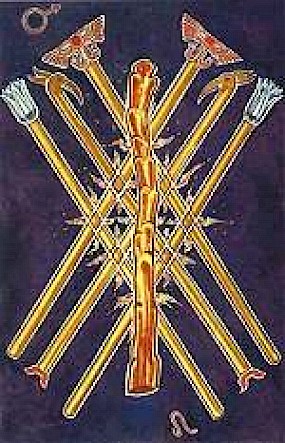
The Lord of Valour can best be summed up by the phrase ‘feel the fear and do it anyway’. It is a card about encountering demanding and formidable situations in life, and having the courage to be true to your own desires, ambitions and needs.
Life is full of challenges. And sometimes we find it difficult to seize the moment, grasp our opportunities and live life to the full. The Seven of Wands comes up to indicate that you are facing one of those momentous happenings in life, and advises you to believe in yourself, grab your courage in both hands and go forward.
This will not only apply to difficult things – it can also point out to you that there is an opportunity to make your wildest dream come true, if only you will throw caution to the winds and dive right in!
The Lord of Valour is an exciting card, but when it comes up you will probably also feel a bit apprehensive. Don’t let caution dampen your enthusiasm. Go ahead! Fight for what you want. If you do, you’ll stand a good chance of getting it.
Because Wands are a suit much concerned (at their deepest level) with the ethics of right living, there is another instance when this card might show in a reading. That is when you find yourself in a position where you are forced to fight for what you believe in. Whilst sometimes reluctant to take up the fight, you will feel compelled to stand up and be counted. Identify this aspect if you have the Aeon (the Last Judgement) or Adjustment (Justice) coming up. Often, if we acquit ourselves well in times like these, we will achieve major progress in our own spiritual journey.
And remember – there’s no courage without fear. If you don’t feel fearful, courage is not required!!
Patrick Solomon • Mar 19, 2020 The official full length version of FINDING JOE: A story about Joseph Campbell and The Hero’s Journey. Starring: Deepak Chopra Rashida Jones Robin Sharma Sir Ken Robinson Mick Fleetwood Brian Johnson Robert Walter Rebbecca Armstrong Alan Cohen Tony Hawk Laird Hamilton Gay Hendricks In the early 20th century, while studying world mythology, Joseph Campbell discovered a pattern hidden in every story ever told and he called it “The Hero’s Journey”. A truly inspirational film, FINDING JOE takes us on the ultimate hero’s journey: the journey of self discovery. As you slay dragons and uncover treasures, you just may find that the holy grail you seek is closer than you think. If you’ve seen this film then you know how much of an impact it could make in the world! A message from the Producer: “If you haven’t seen it then you are in for a treat! This is hope, courage and love all wrapped up in an 80 minute burrito of inspiration. I promise who ever you share this with thank you. Please share this with as many people as you can… the world needs this message now! With Maximum Love ~ Patrick Takaya Solomon”
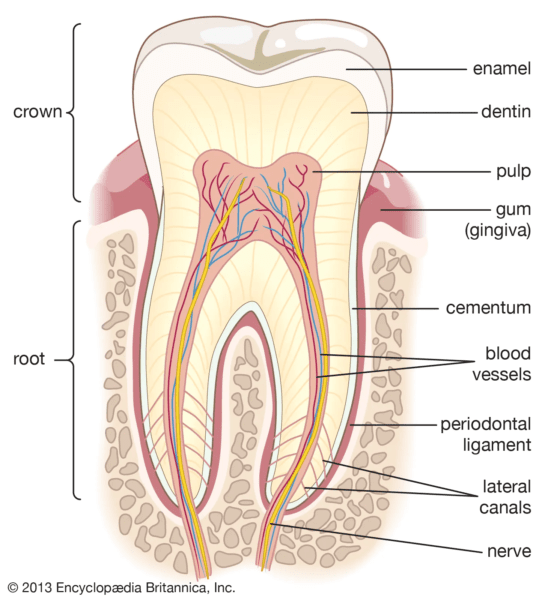
A technique pioneered in the Tissue Engineering and Regenerative Medicine Laboratory of Dr. Jeremy Mao, the Edward V. Zegarelli Professor of Dental Medicine at Columbia University Medical Center, can orchestrate stem cells to migrate to a three-dimensional scaffold infused with growth factor, holding the translational potential to yield an anatomically correct tooth in as soon as nine weeks once implanted.
People who have lost some or all of their adult teeth typically look to dentures, or, more recently, dental implants to improve a toothless appearance that can have a host of unsettling psycho-social ramifications. Despite being the preferred treatment for missing teeth nowadays, dental implants can sometimes fail and develop other problems.
An animal-model study has shown that by homing stem cells to a scaffold made of natural materials and integrated in surrounding tissue, there is no need to use harvested stem cell lines, or create an environment outside of the body (e.g., a Petri dish) where the tooth is grown and then implanted once it has […]
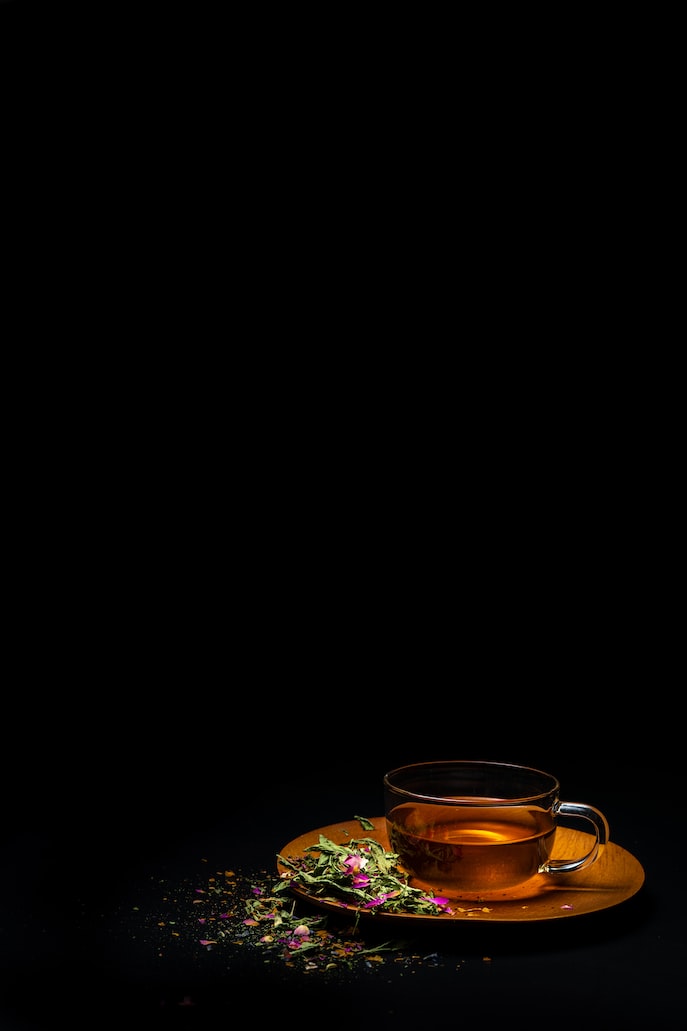
On this particular afternoon a fly fell into my tea. This was of course a minor occurrence. After a year in India I considered myself to be unperturbed by insects; ants in the sugar bin, spiders in the cupboard and even scorpions in my shoes in the morning. Still, as I lifted my cup, I must have registered by my facial expression the presence of the fly.
Choegyal, the 18 year old Tulku, who was teaching me Tibetan Buddhism, leaned forward in sympathy and asked, “What’s the matter?”
“Oh nothing,” I said. “It’s nothing, just a fly in my tea.” I laughed to convey my acceptance and composure.
Choegyal said softly, “Oh, oh, a fly in the tea.”
I said it was no problem, but he continued to focus great concern on my cup. Rising from his chair he leaned over and inserted his finger into my tea cup. With great care he lifted out the fly and exited the room. When Choegyal returned he was beaming. “He’s going to be alright.” he told me quietly. He explained how he’d placed the fly on a leaf where its wings could dry. The fly was still alive fanning its wings, so it could be expected to take flight soon.
I could not share Choegyal’s compassion, but the pleasure in his face revealed how much I was missing by not extending my concern to all beings, even to flies.
Yet the very notion that it was possible gave me boundless delight.
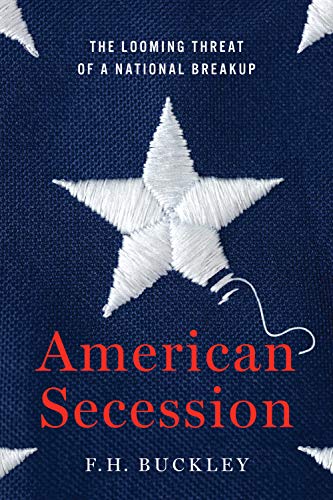
Americans have never been more divided, and we’re ripe for a breakup. The bitter partisan animosities, the legislative gridlock, the growing acceptance of violence in the name of political virtue—it all invites us to think that we’d be happier were we two different countries. In all the ways that matter, save for the naked force of law, we are already two nations.
There’s another reason why secession beckons, says F.H. Buckley: we’re too big. In population and area, the United States is one of the biggest countries in the world, and American Secession provides data showing that smaller countries are happier and less corrupt. They’re less inclined to throw their weight around militarily, and they’re freer too. There are advantages to bigness, certainly, but the costs exceed the benefits. On many counts, bigness is badness.
Across the world, large countries are staring down secession movements. Many have already split apart. Do we imagine that we, almost alone in the world, are immune? We had a civil war to prevent a secession, and we’re tempted to see that terrible precedent as proof against another effort. This book explodes that comforting belief and shows just how easy it would be for a state to exit the Union if that’s what its voters wanted.
But if that isn’t what we really want, Buckley proposes another option, a kind of Secession Lite, that could heal our divisions while allowing us to keep our identity as Americans.
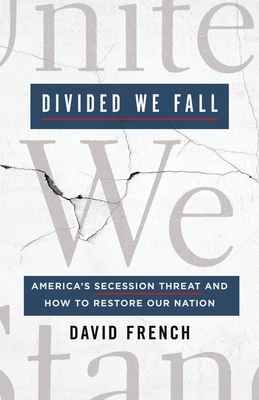
Divided We Fall: America’s Secession Threat and How to Restore Our Nation
David French warns of the potential dangers to the country―and the world―if we don’t summon the courage to reconcile our political differences.
Two decades into the 21st Century, the U.S. is less united than at any time in our history since the Civil War. We are more diverse in our beliefs and culture than ever before. But red and blue states, secular and religious groups, liberal and conservative idealists, and Republican and Democratic representatives all have one thing in each believes their distinct cultures and liberties are being threatened by an escalating violent opposition. This polarized tribalism, espoused by the loudest, angriest fringe extremists on both the left and the right, dismisses dialogue as appeasement; if left unchecked, it could very well lead to secession.
An engaging mix of cutting edge research and fair-minded analysis, Divided We Fall is an unblinking look at the true dimensions and dangers of this widening ideological gap, and what could happen if we don’t take steps toward bridging it. French reveals chilling, plausible scenarios of how the United States could fracture into regions that will not only weaken the country but destabilize the world.
But our future is not written in stone. By implementing James Madison’s vision of pluralism―that all people have the right to form communities representing their personal values―we can prevent oppressive factions from seizing absolute power and instead maintain everyone ’s beliefs and identities across all fifty states.
Reestablishing national unity will require the bravery to commit ourselves to embracing qualities of kindness, decency, and grace towards those we disagree with ideologically. French calls on all of us to demonstrate true tolerance so we can heal the American divide. If we want to remain united, we must learn to stand together again.
TikTok CEO Shou Chew dives into how the trend-setting video app and cultural phenomenon works — from what distinguishes its algorithm and drives virality to the challenges of content moderation and digital addiction. In a wide-ranging conversation with head of TED Chris Anderson, he tells stories about the TikTok creators he loves and digs into thorny issues like data privacy and government manipulation — as well as speaking personally about his commitment to inspiring creativity and building community.
After following a white rabbit down a hole in the ground and changing sizes several times, Alice finds herself wondering “Who in the world am I?”
This scene, from Lewis Carroll’s “Alice’s Adventures in Wonderland,” might resonate with you: In a world that’s constantly changing, it can be challenging to find your authentic self.
I am a social psychologist, and over the past few years my colleagues and I have been conducting research to better understand what it means to be authentic. Our findings provide some valuable insights that not only shed light on what is meant by authenticity — a somewhat vague term whose definition has been debated — but can also offer some tips for how to tap into your true self.
What is authenticity?
In “Sincerity and Authenticity,” literary critic and professor Lionel Trilling described how society in past centuries was held together by the commitment of people to fulfilling their stations in life, whether they were blacksmiths or barons.
Trilling argued that people in modern societies are much less willing to give up their individuality, and instead value authenticity.
But what, exactly, did he mean by authenticity?
Like Trilling, many modern philosophers also understood authenticity as a kind of individuality. For example, Søren Kierkegaard believed that being authentic meant breaking from cultural and social constraints and living a self-determined life. The German philosopher Martin Heidegger equated authenticity to accepting who you are today and living up to all the potential you have in the future. Writing many decades after Heidegger, the French existentialist Jean-Paul Sartre had a similar idea: People have the freedom to interpret themselves, and their experiences, however they like. So being true to oneself means living as the person you think yourself to be.
Common among these different perspectives is the notion that there is something about a person that represents who they really are. If we could only find the true self hidden behind the false self, we could live a perfectly authentic life.
In an attempt to define authenticity, psychologists in the early 21st century started to characterize what an authentic person looks like.
They settled on some criteria: An authentic person is supposed to be self-aware and willing to learn what makes them who they really are. Once an authentic person gains insight into their true self, they will aim to be unbiased about it — choosing not to delude themselves and distort the reality of who they are. After deciding what defines the true self, the authentic person will then behave in a way that is true to those characteristics, and avoid being “false” or “fake” merely to please others.
Some researchers have used this framework to create measurement scales that can test how authentic a person is. In this view, authenticity is a psychological trait — a part of someone’s personality.
But my colleagues and I felt there was more to the experience of authenticity — something that goes beyond a list of characteristics or certain ways of living. In our most recent work, we explain why this traditional definition of authenticity might be falling short.
Thinking is hard
Have you ever found yourself trying to analyze your own thoughts or feelings about something, only to make yourself more confused? The poet Theodore Roethke once wrote that “self-contemplation is a curse, that makes an old confusion worse.”
And there’s a growing body of psychological research supporting this idea. Thinking, on its own, is surprisingly effortful and even a little bit boring, and people will do almost anything to avoid it. One study found they’ll even shock themselves to avoid having to sit with their own thoughts.
This is a problem for a definition of authenticity that requires people to think about who they are and then act on that knowledge in an unbiased way. We don’t find thinking very enjoyable, and even when we do, our reflection and introspection abilities are rather poor.
Fortunately, our research gets around this problem by defining authenticity not as something about a person, but as a feeling.
When something feels ‘right’
We propose that authenticity is a feeling that people interpret as a sign that what they are doing in the moment aligns with their true self.
Importantly, this view does not require people to know what their true self is, nor do they need to have a true self at all. According to this view, an authentic person can look many different ways; and as long as something feels authentic, it is. Although we are not the first to take this view, our research aims to describe exactly what this feeling is like.
This is where we depart a bit from tradition. We propose that the feeling of authenticity is actually an experience of fluency.
Have you ever been playing a sport, reading a book, or having a conversation, and had the feeling that it was just right?
This is what some psychologists call fluency, or the subjective experience of ease associated with an experience. Fluency usually happens outside of our immediate awareness — in what psychologist William James called fringe consciousness.
According to our research, this feeling of fluency might contribute to feelings of authenticity.
In one study, we asked U.S. adults to recall the last activity they did and to rate how fluent it felt. We found that, regardless of the activity — whether it was work, leisure or something else — people felt more authentic the more fluent the activity was.
Getting in the way of fluency
We were also able to show that when an activity becomes less fluent, people feel less authentic.
To do this, we asked participants to list some attributes that describe who they really are. However, sometimes we asked them to try to remember complicated strings of numbers at the same time, which increased their cognitive load. At the end, participants answered some questions about how authentic they felt while completing the task.
As we predicted, the participants felt less authentic when they had to think about their attributes under cognitive load, because being forced to do the memory task at the same time created a distraction that impeded fluency.
At the same time, this doesn’t necessarily mean you’re not being authentic if you take on challenging tasks.
While some people may interpret feelings of unease as a hint that they aren’t being true to themselves, in some cases difficulty might be interpreted as importance.
Research by a team of psychologists led by Daphna Oyserman has shown that people have different personal theories about ease and difficulty when carrying out tasks. Sometimes when something is too easy it feels “not worth our time.” Conversely, when something gets difficult — or when life gives us lemons — we might see it as especially important and worth doing.
We choose to make lemonade instead of giving up.
This might mean that there are times when we feel particularly true to ourselves when the going gets tough — as long as we interpret that difficulty as important to who we are.
Trust your gut
As romantic as it sounds to have a true self that’s merely hiding behind a false one, it probably isn’t that simple. But that doesn’t mean authenticity shouldn’t be an something to strive for.
Seeking fluency — and avoiding internal conflict — is probably a pretty good way to stay on the path to being true to yourself, pursuing what is morally good and knowing when you’re “in the right place.”
When you go searching for the self in a sea of change, you might find yourself feeling like Alice in Wonderland.
But the new science of authenticity suggests that if you let feelings of fluency be your guide, you might find what you’ve been looking for all along.
This article is from The Conversation, an independent nonprofit news organization dedicated to sharing the knowledge of academic experts. Find out more about us or subscribe to our weekly Science Editors’ Picks.
Matthew Baldwin does not work for, consult, own shares in or receive funding from any company or organization that would benefit from this article, and has disclosed no relevant affiliations beyond their academic appointment.
University of Florida provides funding as a founding partner of The Conversation U.S.
If the Queen of Cups appears in a reading to indicate a woman, she will be a gentle and tranquil woman, romantic by nature, generous with her tenderness. She will be something of a day-dreamer – perhaps a bit unrealistic, but creative and hopeful.
She is often involved in creative or literary pursuits, and enjoys art, good music, literature and things of beauty. She is unstinting in her readiness to nurture others, sometimes to her own detriment. She’s often connected with motherhood, and mothering.
She is often intuitive, and psychic. Her foremost ability in this area is a talent for simply absorbing energies around her and reflecting them back, unchanged. In this aspect she can often be a revealer for those around her.
If she is badly aspected, however, another aspect of her personality shows through. The gentleness and tranquillity convert to weakness and unspoken resentment. She nurtures for the sake of inducing dependancy, and places undue importance on being in a relationship, no matter what its quality. She will believe herself unable to stand alone.
Her reflective quality backfires so that she begins to take on the attitudes and thoughts of others. When this happens she begins to show signs of feeling victimised. She might present to the world with a poor-little-me attitude.
When the card comes up to indicate a change in some-one’s response, we see the woman in love – entering into the deepest and most emotional realms of her personality, and returning refreshed and invigorated.
Sometimes the card will come up to indicate a woman acting as priestess of the Goddess.
Inside Serene • Mar 6, 2023 Why being nice can kill you? Dr. Gabor Mate explores the dangers of excessive niceness In “Being Nice Can Kill You,” Dr. Gabor Mate explores the hidden dangers of excessive niceness and how it can harm an individual’s health and well-being. He explains how prioritizing others above oneself can lead to neglecting one’s own needs and desires, resulting in physical and mental exhaustion, burnout, and chronic health problems. Dr. Mate highlights how being too nice can make it difficult for individuals to set boundaries, say “no” when necessary, or stand up for themselves when mistreated, leading to overwhelming stress and even resentment. He also notes how excessively nice individuals may attract toxic relationships, leading to emotional turmoil and stress. Moreover, Dr. Mate discusses how being too nice can lead to difficulty expressing one’s own emotions or needs, which can lead to bottling up feelings that result in anxiety, depression, or other mental health issues. He also notes how excessive niceness can contribute to self-criticism and perfectionism, leading to high levels of stress and anxiety as individuals strive to meet unrealistic expectations or standards to please others. Overall, Dr. Mate’s work sheds light on the importance of finding a balance between being kind and compassionate towards others while also prioritizing one’s own health and well-being. His insights serve as a reminder to individuals that taking care of oneself is a necessary step towards leading a fulfilling and healthy life. This video is owned by @AndreDuqum I would like to credit him to this video you can find the original video on his channel and learn more about his passion on his website: https://www.knowthyself.one/ You can also buy Dr Gabor Mates book in Amazon: https://amzn.to/434h7Wm
Consciousness, spirituality, biography, sexuality, androgyny, futurism, space, the arts, science, astrology, democracy, humor, books, movies and more


 Inside Serene