
The Astrology Podcast Apr 27, 2023 • PodcastA look ahead at the astrological forecast for May of 2023, with astrologers Chris Brennan, Austin Coppock, and Claire Moon. May opens with a solar eclipse in Scorpio, as well as the second half of a Mercury retrograde in Taurus. Later in the month Mars moves into Leo and then forms a T-square with Jupiter in Taurus and Pluto in Aquarius.At the top of the episode we talk about some recent news and events, such as the discovery of a lost text by the 2nd century astrologer Claudius Ptolemy, or the identification of the earliest woman who is known by name to have been a practicing astrologer. This is episode 399 of The Astrology Podcast:
Monthly Archives: April 2023
Unveiling Hidden Realities with Christopher Noël
New Thinking Allo • Apr 25, 2023 Christopher Noël holds a Master’s degree in Philosophy from Yale University and a Master’s in Fine Arts from Vermont College of Fine Arts where he taught writing for 20 years. He also researches the phenomenon of Sasquatch. He is the author of In the Unlikely Event of a Water Landing: A Geography of Grief, Sasquatch and Autism: Twelve Parallels, MindSpeak: Tapping into Sasquatch and Science, and There is No Veil: At Play in the Vast Here and Now. His website is thenearnessofyou.net. Christopher suggests that invisible dark matter, often considered to be empty space, may be spiritual matter or consciousness that blends with what is perceived as physical or ordinary matter. 00:00:00 Introduction 00:03:46 Spirit Contact 00:10:15 No heaven or earth hierarchy 00:15:30 Spirit world and mediums 00:29:09 Dark matter and ordinary matter 00:38:11 Purpose for the veil 00:51:14 Merging with solid objects 01:00:20 Conclusion Edited subtitles for this video are available in Russian, Portuguese, Italian, German, French, and Spanish. New Thinking Allowed CoHost, Emmy Vadnais, OTR/L, is an intuitive healer and health coach based in St. Paul, Minnesota. She is the author of Intuitive Development: How to Trust Your Inner Knowing for Guidance With Relationships, Health, and Spirituality. Her website is https://emmyvadnais.com/ (Recorded on March 8, 2023)
Llewellyn Vaughn-Lee on the knowledge of the heart

The Antidote to the Irreversibility of Life: Hannah Arendt on What Forgiveness Really Means
By Maria Popova (themarginalian.org)

“To forgive is to assume a larger identity than the person who was first hurt,” poet and philosopher David Whyte observed as he dove for the deeper meanings of our commonest concepts. But, as James Baldwin and Margaret Mead demonstrated in their historic conversation about forgiveness and the crucial difference between guilt and responsibility, Western culture has a confused understanding of what forgiveness really requires of us and what it really gives us — a confusion tangled in the conflicting legacies of Ancient Greek culture, that primordial womb of drama and democracy, with its politically immature notions of justice, and Christian dogma, with its incomplete and psychologically puerile conceptions of love.
To disentangle this cultural confusion into a lucid and luminous understanding of forgiveness demands an uncommon largeness of spirit and depth of intellect, an uncommon breadth of erudition and historical knowledge, and an uncommon sensitivity to what it means to be human. That is what the uncommon Hannah Arendt (October 14, 1906–December 4, 1975) accomplishes throughout The Human Condition (public library) — the superb 1958 book that gave us her insight into how we invent ourselves and reinvent the world.
Hannah Arendt by Fred Stein, 1944 (Photograph courtesy of the Fred Stein Archive)
The very need for forgiveness, Arendt observes in a chapter titled “Irreversibility and the Power to Forgive,” springs from “the irreversibility and unpredictability of the process started by acting” — a process fundamental to what it means to be alive. We act because we are, but we don’t always act along the axis of who we aspire to be. Aspiration is a sort of promise — a promise we make to ourselves and, sometimes, to the world. Forgiveness is only ever needed, and possible, because of the inherent tension between action and aspiration. Arendt writes:
The possible redemption from the predicament of irreversibility — of being unable to undo what one has done though one did not, and could not, have known what he was doing — is the faculty of forgiving. The remedy for unpredictability, for the chaotic uncertainty of the future, is contained in the faculty to make and keep promises. The two faculties belong together in so far as one of them, forgiving, serves to undo the deeds of the past… and the other, binding oneself through promises, serves to set up in the ocean of uncertainty, which the future is by definition, islands of security without which not even continuity, let alone durability of any kind, would be possible in the relationships between [us].
To live in a world without forgiveness, she intimates, is to make of life an instant fossil record, each imperfect action instantly ossifying us into a failed promise of personhood:

Art from Cephalopod Atlas, the world’s first encyclopedia of deep-sea creatures. (Available as a print and as stationery cards, benefitting The Nature Conservancy.)
As a secular philosopher and one of the greatest champions of reason amid one of the most unreasonable epochs in the history of our civilization, Arendt observes:
The capacity for forgiveness and the enactment of that capacity in the willingness to forgive is what holds the sphere of human experience together — the private sphere as much as the public sphere, for forgiveness is as vital in our deepest personal bonds as it is in the collective experience of public life. In a sentiment the great civil rights leader John Lewis would echo in his life-earned conviction that “forgiveness and compassion must become more important principles in public life,” Arendt writes:

Art by Jacqueline Ayer from The Paper-Flower Tree
In a passage evocative of Oliver Sacks’s stirring first-hand lesson in choosing empathy over vengeance, she adds:
Arendt observes that punishment is not the opposite of forgiveness but an alternative to it — one enfeebled by the paradox that human beings are “unable to forgive what they cannot punish and that they are unable to punish what has turned out to be unforgivable.” (Yes, do read that again; turn it over in your mind like a Zen koan — I did — until it unfolds its subtle riches of profound wisdom.) She considers the complicated and often superficially understood relationship between forgiveness and love — the least public emotion upon which, somehow, the foundation of all public and political life rests:

One of Aubrey Beardsley’s radical 1893 illustrations for Oscar Wilde’s Salome. (Available as a print.)
With one of her exquisite pirouettes of logic, Arendt thus delivers us at — and delivers us from — the most dangerous fault line in the Christian model, a fault line that must be sealed and healed before we can have a less confused, more complete and generative understanding of forgiveness: one based not on the emotionally intoxicating but unstable experience we call love but on the ethically and intellectually grounded orientation of respect. She writes:
Against this backdrop, forgiveness can only ever be a communal experience. More than half a century after Arendt, in a cultural moment so inflamed with reflexive indictment and so clouded with the saccharine delirium of self-righteousness, it is nothing less than an act of countercultural courage and resistance to regard this wisdom with unwincing receptivity. Such courage asks of us what Arendt terms “the good will to counter the enormous risks of action by readiness to forgive and to be forgiven, to make promises and to keep them.” There is, after all, nothing riskier than willingness, and nothing more rewarding.
Complement this fragment of Arendt’s enduringly illuminating The Human Condition with philosopher Martha Nussbaum — in many ways an intellectual heir of Arendt’s — on anger and forgiveness, then revisit Arendt herself on love and how to live with the fundamental fear of loss.
Tarot Card for April 27: The Universe
The Universe
The Universe (or World) is numbered twenty one and is the final card of the Major Arcana. We usually see a female figure dancing within or upon the world, often surrounded by a laurel wreath. The four elemental creatures can be seen, suggesting mastery. This is a card of completion. The soul has attained earthly perfection after passing through the final, self-imposed, trial of the Aeon.
There are many positive and enjoyable connotations to this card. There is satisfaction, fulfilment and pride, because we have achieved something. There is fruitfulness and bounty as a reward for our earlier efforts. There is good fortune and confirmation that now we are putting enough into life to get out of it what we need.
The Universe completes the journey and evolution of the Fool. We begin in innocence, mature through experience and education, becoming wise and measured. Balanced in this way we finally achieve the good fortune and joy of the Universe. The traumas and self-imposed obstacles are gone. We have integrated all parts of our being into a harmonious synthesis which brings positivity and success into material reality. Like the figure depicted in the card, we dance with the joy of life. And again we are the Innocent.
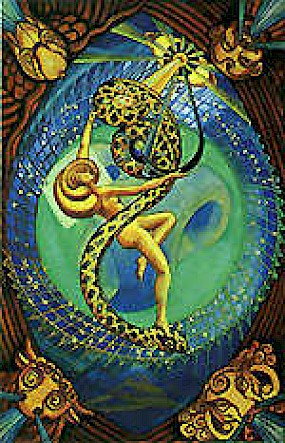
(via angelpaths.com and Alan Blackman)
Free Will Astrology: Week of April 27, 2023
APRIL 25, 2023 AT 7:00 AM BY ROB BREZSNY (newcity.com)

ARIES (March 21-April 19): According to a study by Newsweek magazine, fifty-eight percent of us yearn to experience spiritual growth; thirty-three percent report having had a mystical or spiritual experience; twenty percent of us say we have had a revelation from God in the last year; and thirteen percent have been in the presence of an angel. Given the astrological omens currently in play for you Aries, I suspect you will exceed all those percentages in the coming weeks. I hope you will make excellent use of your sacred encounters. What two areas of your life could most benefit from a dose of divine assistance or intervention? There’s never been a better time than now to seek a Deus ex machina. (More info: tinyurl.com/GodIntercession)
TAURUS (April 20-May 20): After the fall of the Roman Empire, political cohesion in its old territories was scarce for hundreds of years. Then a leader named Charlemagne (747-814) came along and united much of what we now call Western Europe. He was unusual in many respects. For example, he sought to master the arts of reading and writing. Most other rulers of his time regarded those as paltry skills that were beneath their dignity. I mention this fact, Taurus, because I suspect it’s a propitious time to consider learning things you have previously regarded as unnecessary or irrelevant or outside your purview. What might these abilities be?
GEMINI (May 21-June 20): I’m turning this horoscope over to Nigerian poet Ijeoma Umebinyuo. She has three messages that are just what you need to hear right now. 1. “Start now. Start where you are. Start with fear. Start with pain. Start with doubt. Start with hands shaking. Start with voice trembling but start. Start and don’t stop. Start where you are, with what you have.” 2. “You must let the pain visit. You must allow it to teach you. But you must not allow it to overstay.” 3. “Write a poem for your fourteen-year-old self. Forgive her. Heal her. Free her.”
CANCER (June 21-July 22): Historical records tell us that Chinese Emperor Hungwu (1328-1398) periodically dealt with overwhelming amounts of decision-making. During one ten-day phase of his reign, for example, he was called on to approve 1,660 documents concerning 3,391 separate issues. Based on my interpretation of the planetary omens, I suspect you may soon be called on to deal with a similar outpouring. This might tempt you toward over-stressed reactions like irritation and self-medication. But I hope you’ll strive to handle it all with dignity and grace. In fact, that’s what I predict you will do. In my estimation, you will be able to summon the extra poise and patience to manage the intensity.
LEO (July 23-Aug. 22): Is it even possible for us humans to live without fear—if even for short grace periods? Could you or I or anyone else somehow manage to celebrate, say, seventy-two hours of freedom from all worries and anxieties and trepidations? I suspect the answer is no. We may aspire to declare our independence from dread, but 200,000 years of evolution ensures that our brains are hard-wired to be ever-alert for danger. Having provided that perspective, however, I will speculate that if anyone could approach a state of utter dauntlessness, it will be you Leos in the next three weeks. This may be as close as you will ever come to an extended phase of bold, plucky audacity.
VIRGO (Aug. 23-Sept. 22): “Dear Sunny Bright Cheery Upbeat Astrologer: You give us too many sunny, bright, cheery, upbeat predictions. They lift my mood when I first read them, but later I’m like, ‘What the hell?’ Because yeah, they come true, but they usually cause some complications I didn’t foresee. Maybe you should try offering predictions that bum me out, since then I won’t have to deal with making such big adjustments. —Virgo Who is Weary of Rosy Hopeful Chirpy Horoscopes.” Dear Virgo: You have alluded to a key truth about reality: Good changes often require as much modification and adaptation as challenging changes. Another truth: One of my specialties is helping my readers manage those good changes. And by the way: I predict the next two weeks will deliver a wealth of interesting and buoyant changes.
LIBRA (Sept. 23-Oct. 22): Poet Pablo Neruda wrote, “Let us look for secret things somewhere in the world on the blue shores of silence.” That might serve as a good motto for you in the coming weeks. By my astrological reckoning, you’ll be wise to go in quest for what’s secret, concealed and buried. You will generate fortuitous karma by smoking out hidden agendas and investigating the rest of the story beneath the apparent story. Be politely pushy, Libra. Charmingly but aggressively find the missing information and the shrouded rationales. Dig as deep as you need to go to explore the truth’s roots.
SCORPIO (Oct. 23-Nov. 21): We’ve all done things that make perfect sense to us, though they might look nonsensical or inexplicable to an outside observer. Keep this fact in your awareness during the next two weeks, Scorpio. Just as you wouldn’t want to be judged by uninformed people who don’t know the context of your actions, you should extend this same courtesy to others, especially now. At least some of what may appear nonsensical or inexplicable will be serving a valuable purpose. Be slow to judge. Be inclined to offer the benefit of the doubt.
SAGITTARIUS (Nov. 22-Dec. 21): I completely understand if you feel some outrage about the lack of passion and excellence you see in the world around you. You have a right to be impatient with the laziness and carelessness of others. But I hope you will find ways to express your disapproval constructively. The best approach will be to keep criticism to a minimum and instead focus on generating improvements. For the sake of your mental health, I suggest you transmute your anger into creativity. You now have an enhanced power to reshape the environments and situations you are part of so they work better for everyone.
CAPRICORN (Dec. 22-Jan. 19): In the seventeenth century, renowned Capricorn church leader James Ussher announced he had discovered when the world had been created. It was at 6pm on October 22 in the year 4004 BCE. From this spectacularly wrong extrapolation, we might conclude that not all Capricorns are paragons of logic and sound analysis one hundred percent of the time. I say we regard this as a liberating thought for you in the coming weeks. According to my analysis, it will be a favorable time to indulge in wild dreams, outlandish fantasies and imaginative speculations. Have fun, dear Capricorn, as you wander out in the places that singer Tom Petty referred to as “The Great Wide Open.”
AQUARIUS (Jan. 20-Feb. 18): We often evaluate prospects quantitatively: how big a portion do we get, how much does something cost, how many social media friends can we add? Quantity does matter in some cases, but on other occasions may be trumped by quality. A few close, trustworthy friends may matter more than hundreds of Instagram friends we barely know. A potential house may be spacious and affordable, but be in a location we wouldn’t enjoy living in. Your project in the coming weeks, Aquarius, is to examine areas of your life that you evaluate quantitatively and determine whether there are qualitative aspects neglected in your calculations.
PISCES (Feb. 19-March 20): “Dear Dr. Astrology: Help! I want to know which way to go. Should I do the good thing or the right thing? Should I be kind and sympathetic at the risk of ignoring my selfish needs? Or should I be a pushy stickler for what’s fair and true, even if I look like a preachy grouch? Why is it so arduous to have integrity? —Pinched Pisces.” Dear Pisces: Can you figure out how to be half-good and half-right? Half-self-interested and half-generous? I suspect that will generate the most gracious, constructive results.
Homework: If you could change into an animal for a day, what would you be? Newsletter.FreeWillAstrology.com
The Revelation of Joseph Murphy
Apr 20, 2023 (mitch-horowitz-nyc.Medium.com)

A New Thought pioneer’s radical idealism
Metaphysical writer and minister Joseph Murphy (1898–1981) encouraged his readers and listeners to live by an entirely different scale of values.
Most of us born in the West grew up with the notion — almost wholly untested — that mood and outlook result from personal circumstance. Emotions are symptoms. Murphy’s work, particularly his widely impactful 1963 bestseller, The Power of Your Subconscious Mind, upends that view of life.

Across thousands of lectures and dozens of books and pamphlets, Murphy described and documented a radically different and more self-determinative way of living.
Mood, thought, and mental image, he taught, are causes rather than symptoms. Murphy considered this true in the most literal and universal sense.
More so, the metaphysician reasoned, the individual is an expression and channel of the deific creative powers referenced in Scripture. Hence, you are, at this moment and all moments, constructing your world through your emotive mental images.
Beginning with his first book This Is It in 1945, the Irish minister combined principles of psychology, self-suggestion, and a cosmological theology, which he had been developing and testing for many years.
It is notable that Murphy did not step out as a writer until age 47. (I experienced a similar trajectory in my own writing career.) The seeker-mystic first sought to validate his ideas in the laboratory of personal experience. There are, of course, manifold perils of personal bias toward a favored thesis. But to restrict self-knowledge to credentialed study is to eradicate the impulse itself.
Once Murphy found his footing as a writer and speaker, his output was prodigious, as you can see from the timeline at the end of this article. His original books (not counting myriad anthologies and reissues) surpass forty.
Equally remarkable — and a lesson in itself — is that Murphy did not produce the work that made him famous, The Power of Your Subconscious Mind, until age 65. His career is a reminder not to view traditional milestones of age as nonnegotiable.
Since Murphy’s death in 1981, the size of his readership — measured by reprints, multiple editions, digital and audio volumes, translations, and anthologies — has dramatically grown.
Part of the reason for Murphy’s posterity is that he adventurously and, for many seekers, convincingly married 20th century psychology with the New Metaphysics, specifically New Thought, Science of Mind, Unity, Christian Science, and Divine Science.
In so doing, the author gave generations of readers a dramatic new sense of self-potential. Interestingly, Murphy himself “requested that no funeral be held and that no obituary be written,” according to scholar of religion J. Gordon Melton in Religious Leaders of America, 2nd edition (1999).
Murphy accepted the traditional premise that we possess two minds: the rational, analytic mind called the conscious; and the inner, emotional mind called the subconscious, or what may be termed the psyche.
The subconscious is generally agreed to be the driving engine of experience — it is the hidden influence that shapes and reinforces your attitudes, affinities, perceptions, self-image, and relational patterns. But Murphy went further. He reasoned that the subconscious is programed by the conscious to function as a tool of causation: what we view and accept as valid or perceptually justified — whether sound or desirable — is acted upon and out-pictured by your subconscious in a complexity of ways.
Hence, Murphy reasoned that the mission of your conscious mind, aside from navigating circumstance, is to protect your subconscious from receiving impressions that misdirect its life-shaping energies. You must consciously filter out or temper suggestions that you do not want your psyche to uncritically accept and act on.
The stakes of this transaction are daunting. The subconscious, Murphy reasoned, mediates between individual experience and the existence of an Infinite Mind, which courses through each of us like inlets of a vast ocean. Seen differently, the subconscious or psyche is the medium through which Infinite Mind, or what is called God in Scripture and Nous in Hermeticism, creates and actualizes.
This view is largely at home in New Thought. It differs somewhat from Christian Science insofar as Christian Science theology sees the human mind not as a mediator between the individual and the Higher but as an illusion — sometimes called “mortal” or “material” mind, which must be allowed to dissolve like a mirage so that the one Higher Mind can shine through.
In effect, however, Murphy’s philosophy agrees with Christian Science and the related metaphysical schools: materialism is ultimately a delusion and the one true reality is the fullness and unsurpassed peace of the Higher Mind. In this sense, Murphy endeavored to harmonize the New Metaphysics, biblical revelation, religious symbolism, and modern psychology.
Whether by intent or happenstance, in no book did Murphy succeed more fully than The Power of Your Subconscious Mind, which combined self-suggestion, historical and anecdotal portraits, psychological insights, and the cosmic theology Murphy had been developing and testing since he began his career as a metaphysical philosopher almost twenty years earlier.
Murphy produced many potent essays, sermons, and books, but this one was his culminating and most powerful statement. It is one of the two or three modern landmarks of creative-mind philosophy, perched in timing and influence between Norman Vincent Peale’s 1952 The Power of Positive Thinking and Rhonda Byrne’s 2006 The Secret.
Unlike those books, however, which might be found in homes with few other works of popular metaphysics, The Power of Your Subconscious Mind, as with Murphy’s other writings, brought him a following among readers who, like the minister himself, were not casual toe-dippers but lifelong seekers.
Murphy was born on May 20, 1898, to a devout Catholic family on the Southern Coast of Ireland in Ballydehob, County Cork. He was the fourth of five children, three girls and two boys.
Murphy’s father worked as headmaster of a local boys high school. His parents urged him to join the priesthood. But the young seminarian found religious doctrine and catechism too limiting. Eager to gaze more deeply into the internal mechanics of life, he left his Jesuit seminary to dedicate his energies to chemistry, which he studied in Dublin both before and following his religious training.
In the early 1920s, married yet still searching for his place in the world of career and commerce, Murphy relocated to America to seek employment as a chemist and druggist. After running a pharmacy counter at New York’s Algonquin Hotel, Murphy renewed his study of mystical and metaphysical ideas.
He read works of Taoism, Confucianism, Transcendentalism, Buddhism, Scripture — and, most fatefully, New Thought. The seeker grew enamored of the New Metaphysics sweeping the Western world. The causative power of thought, Murphy came to believe, revealed the authentic meaning of the world’s religions, the deeper mechanics of psychology, and the eternal laws of life.
In reaching his matured spiritual outlook, Murphy told an interviewer that he studied in the 1930s with the teacher who tutored his contemporary New Yorker and friend, mystic Neville Goddard (1905–1972). Murphy said the seekers shared the same guide: a turbaned man of black-Jewish descent named Abdullah.

Shortly before his death in 1981, Murphy sat for a little-known series of interviews with French-Canadian writer Bernard Cantin who in 1987 published the French language work Joseph Murphy se raconte à Bernard Cantin [Joseph Murphy Speaks to Bernard Cantin]. It has never appeared in English. Murphy described his encounter with the mysterious Abdullah, as recounted by Cantin:
It was in New York that Joseph Murphy also met the professor Abdullah, a Jewish man of black ancestry, a native of Israel, who knew, in every detail, all the symbolism of each of the verses of the Old and the New Testaments. This meeting was one of the most significant in Dr. Murphy’s spiritual evolution. In fact, Abdullah, who had never seen nor known the Murphy family, said flatly that Murphy came from a family of six children, and not five, as Murphy himself had believed. Later on, Murphy, intrigued, questioned his mother and learned that, indeed, he had had another brother who had died a few hours after his birth, and was never spoken of again.
In a letter of June 1987, reproduced below, Murphy’s second wife Jean, told Cantin that his interviews with her husband were the only to have received the metaphysician’s approval in the past thirty years.

Following the period described to Cantin, Murphy in the late-1930s began his climb as a minister and writer, soon lecturing over radio and speaking on both coasts. He wrote prolifically on the autosuggestive and causative faculties of thought — and finally, at 65, reached a worldwide audience in 1963 with The Power of Your Subconscious Mind, which went on to sell millions of copies and has remained one of the most enduring books on mind-power metaphysics.

The Power of Your Subconscious Mind boasts an unusual range of admirers, including actors David Hasselhoff and Victoria Principal. (Murphy’s 1953 book The Miracles of Your Mind sat in Marilyn Monroe’s library.) Parents have told me that they raise their children on the methods and ideas explored in The Power of Your Subconscious Mind. I’ve heard from committed spiritual seekers who report that this popular how-to has proven one of the deepest influences in their search. The success and longevity of Murphy’s landmark rests, in part, on how it affirms and organizes some of our deepest instincts about the radical possibilities of thought and marries a range of psychological and spiritual suppositions. Among Murphy’s key ideas:
1.Every religious, psychological, and ethical philosophy agrees: What you think dramatically affects your quality of life.
2.Your subconscious mind harbors insightful and creative power — if properly harnessed, this suggestive power can solve problems and shape circumstances in ways that you never considered possible.
3.The power of your mind is indifferent: Your subconscious picks up on and carries out what you dwell upon, for good or ill.
4.You can tap the power of your subconscious by setting aside time just before going to sleep at night to reflect on a cherished aim or the solution to a problem. Drift off with assurance that your subconscious is working on it.
5.Form vivid, believable, emotionally charged mental pictures — and stick with them. Consistency is key in training your subconscious.
6.Never force a mental image. Forced effort brings failure. Be relaxed, calm, and confident when impressing your subconscious. If you find this difficult, step away and return to it when you’re in a calm and confident state.
7.Once you have acted to impress your subconscious, do not dwell on the ways and means of accomplishment — these will reach your conscious mind in the form of hunches, happy accidents, and breakthrough ideas.
8.Neither disdain nor worship money. Understand money as a natural, healthful part of life. Your subconscious will act gainfully on that belief.
9.Specialize in work you love and strive to know as much as possible about it. Passion and focus act powerfully upon your subconscious.
10.Your subconscious is not to be trifled with. Scrutinize your desires regularly to ensure that they are ethically sound and for the presumed benefit of all concerned.
In sum, Murphy taught that if you want to make one definite and gainful investment in your future, learn how to cultivate an affirming, meditative, and flexible pattern of thought, informed by the principle: You are as your mind is.
Iadmire Murphy’s scruples, life journey, and efforts. But I do not mean to leave the impression of total comfort with his ideas.
I believe that Murphy, like most of his New Thought contemporaries, failed to come to terms with global or individual suffering, much less develop a persuasive or mature spiritual response to calamity, other than to reassert the therapeutic primacy of the psyche, or what might be deemed the “try again” response.
Indeed, when confronted with questions of evil and chronic suffering, New Thought writers, Murphy included, tended to slip into circular reasoning or contradiction, unable to fully account for tragedy and limitation in their model of a self-created world.
Murphy fitfully sought to contend with this problem in his 1954 book The Meaning of Reincarnation. In it, he blamed the thought patterns of parents for an offspring’s illness or disability. Murphy later moved away from that indefensible proposition to suggest that the pooled thoughts of all humanity, extending to antiquity, could be the responsible factor in incomprehensible suffering.
The minister further attempted to confront the question of tragedy in his 1971 book Psychic Perception where he described the individual as subject to thoughts of a “world mind” or “race mind,” which contained the substance of every thought — good or ill, nourishing or withering — that every individual had ever conceived. Hence, as he saw it, an infant born ill could be a victim of this “world mind.”
Yet to assume, as Murphy wrote, that every thought has a timeless ripple effect — so that a person could be impacted by something randomly conceived centuries or millennia earlier — places us at the mercy of a near-infinitude of influences and outcomes. This amounts to tacit acknowledgment of randomness or accident — the very things Murphy argued do not exist.
Today, some New Thought writers and seekers attempt to ascribe natural disasters, wars, pandemics, and famines to mass or personal karma. I do not believe that the law of karma or some ersatz version of it — the concept itself is forebodingly vast and varied within traditional Vedic moorings — is intended to flatten complexity. Karma is not putty to plug ontological gaps. Indeed, on the spiritual path, we measure verities through intimate experience. If a person hasn’t been through global calamities that is reason enough not to attempt judgment. Judging the suffering of another is tantamount to throwing a stone rather than gleaning a truth.
I believe that in our known sphere we experience many laws and forces; the law of mind, I warrant, is ever operative but is impacted by other experiences in our physical framework, just as gravity is impacted by mass. I wish it was a subject area where Murphy had gone further.
To his credit, I believe that certain of his insights coalesce with traditional Vedic ideas about reincarnation, especially when he describes all of humanity emerging from and returning to original thought substance. In this regard, Murphy’s outlook on reincarnation runs closely to that of occult explorer Madame H.P. Blavatsky (1831–1891).
How then to regard Murphy? One of the maladies of modern intellectual culture is, I believe, prevalence of an “all or nothing” attitude, in which we are expected to either wholly accept or reject every aspect of a writer’s outlook. That would leave the search impoverished and monochromatic (which, for many people, it is).
The thrill of reading Murphy is that, questions and dissents aside — and such things ought to populate every mature seeker’s experience — he exudes the practical joy of possibilities of expansive thought, of perceptual basis of experience (in which I firmly believe), and of protean aspects of idealistic philosophy.
On these topics, the alternative spiritual culture has produced few better writers — and perhaps no greater or more impactful work than The Power of Your Subconscious Mind.
Joseph Murphy Timeline
Many author bios of Joseph Murphy are replete with errors, including in some of his best-known books. To remedy matters, this timeline presents the fullest information I could locate through immigration records, Murphy’s few interviews, and cross-referenced statements and historical sources.

1898 — Joseph Denis Murphy is born on May 20, the fourth of five children (three girls and two boys) to a devout Catholic family on the Southern Coast of Ireland in Ballydehob, County Cork. Murphy’s father was headmaster of a local boys high school.
Circa 1914–1915 — After being educated locally, Murphy studies chemistry in Dublin. Bowing to his parents’ wishes he enrolls briefly in a Jesuit seminary. Dissatisfied with his studies and unbelieving of the doctrine of no salvation outside the church, Murphy leaves seminary.
Circa 1916–1918 — Murphy works as a pharmacist for England’s Royal Army Medical Corps during World War I.
1918–1921 — Murphy works as a in pharmacist in Dublin. He earns a monthly salary of about $10.
1922 — Dissatisfied with traditional religion and finding limited opportunities to practice as a chemist, Murphy just shy of age 24 arrives in New York City on April 17, 1922. He is accompanied by his wife, Madolyn, who is eight years his senior (wedding date unknown). He arrives with $23. Applies for citizenship in August.
1923–1938 — Murphy works as a pharmacist in New York City including at a pharmacy counter at the Algonquin Hotel. He deepens his study into metaphysics and years later recounts having studied with the figure of Abdullah, a black man of Jewish descent whom Murphy’s contemporary and fellow New Yorker Neville Goddard (1905–1972) said that he studied with. Murphy reports that Abdullah tells him that he actually had three brothers, not two. Upon checking with his mother, Murphy discovers that he had a third brother who died at birth and was never spoken of.
Circa 1931 — Murphy begins attending the Church of the Healing Christ in New York City, presided over by Emmet Fox.
Circa 1938 — Murphy is ordained as a Divine Science minster. He continues to work as a druggist and chemist.
1941 — Murphy begins broadcasting metaphysical sermons over the radio.
1942 — Murphy enlists as a pharmacist in the New York State National Guard, a post he holds until 1948.
1943 — Murphy studies Tarot in New York City and comes to believe in symbolic correspondences between Tarot cards and Scripture.
1945 — Murphy writes his first book, This Is It: The Art Of Metaphysical Demonstration.
1946 — Murphy is ordained as a Religious Science Minister in Los Angeles. He soon takes over the pulpit of the Institute for Religious Science in Rochester, New York. He publishes the short works Wheels of Truth, The Perfect Answer, and Fear Not.
1948 — Murphy publishes St. John Speaks, Love is Freedom, and The Twelve Powers Mystically Explained.
1949 — Murphy is re-ordained into Divine Science and becomes minister of the Los Angeles Divine Science Church, a post he holds for the next 28 years. Services become so popular that they are held at the Wilshire Ebell Theater.
1952 — Publishes Riches Are Your Right.
1953 — Publishes The Miracles of Your Mind, The Fragrance of God, and How to Use the Powers of Prayer.
1954 — Publishes The Magic of Faith and The Meaning of Reincarnation, one of his most controversial books.
1955 — Publishes Believe in Yourself and How to Attract Money, one of his most enduringly popular works.
1956 — Murphy writes Traveling With God in which he recounts his international speaking tours, comparing New Thought with various global traditions. He also publishes Peace Within Yourself (St. John Speaks revised) and Prayer Is the Answer.
1957 — Publishes How to Use Your Healing Power.
1958 — Publishes the short works Quiet Moments with God, Pray Your Way Through It, The Healing Power of Love, Stay Young Forever, Mental Poisons and Their Antidotes, and How to Pray With a Deck of Cards.
1959 — Publishes Living Without Strain.
1960 — Publishes Techniques in Prayer Therapy.
1961 — Publishes You Can Change Your Whole Life and Nuclear Religion.
1962 — Publishes Why Did This Happen to Me?
1963 — Publishes The Power of Your Subconscious Mind, which becomes a worldwide bestseller and landmark of New Thought philosophy. Its publication transforms Murphy into one of the most widely read metaphysical writers in the world.
1964 — Publishes The Miracle of Mind Dynamics.
1965 — Publishes The Amazing Laws of Cosmic Mind Power.
1966 — Publishes Your Infinite Power to Be Rich.
1968 — Publishes The Cosmic Power Within You.
1969 — Publishes Infinite Power for Richer Living.
1970 — Publishes Secrets of the I Ching.
1971 — Publishes Psychic Perception: The Magic of Extrasensory Perception.
1972 — Publishes Miracle Power for Infinite Riches.
1973 — Publishes Telepsychics: The Magic Power of Perfect Living.
1974 — Publishes The Cosmic Energizer: Miracle Power of the Universe.
1976 — Murphy’s first wife Madolyn dies. He remarries his secretary, Jean L. Murphy (nee Wright), also a Divine Science minister. He writes Great Bible Truths for Human Problems.
1977 — Publishes Within You Is the Power.
1979 — Publishes Songs of God.
1980 — Publishes How to Use the Laws of Mind.
1981 — Murphy dies on December 16 in Laguna Hills, CA, where he and his wife Jean are living at the Leisure World retirement community, now known as Laguna Woods Village. “He requested that no funeral be held and that no obituary be written.” (Religious Leaders of America, 2nd edition by J. Gordon Melton, The Gale Group, 1999.)
1982 — These Truths Can Change Your Life is published posthumously.
1987 — Canadian writer Bernard Cantin publishes the French language work Joseph Murphy se raconte à Bernard Cantin [Joseph Murphy Speaks to Bernard Cantin] with Quebec’s Éditions Un Monde Différent. The book is based on extended interviews Cantin conducted with Murphy before his death and provides a rare window into Murphy’s career. It does not appear in English. The Collected Essays of Joseph Murphy is published posthumously.
Huston Smith on compassion


Rumi and the Mysterion
By Kabir Helminski

Kabir Helminski is co-director, with his wife, Camille Helminski, of the Threshold Society, a nonprofit organization dedicated to sharing the knowledge and practice of Sufism. He is the author of Living Presence and the translator of four volumes of Rumi’s poetry, including Love Is a Stranger and Rumi: Daylight. His new book is The Mysterion: Rumi and the Secret of Becoming Fully Human.
Kabir’s website: sufism.org
Mentioned in the episode: Can a Computer Become Conscious by Federico Faggin from the SAND18 Conference
A Neurologist’s Tips to Protect Your Memory
A new book by a renowned brain expert says there are a few simple things we can do to prevent memory decline as we age.

By Hope Reese
Published July 6, 2022 Updated July 18, 2022 (NYTimes.com)
As we age, our memory declines. This is an ingrained assumption for many of us; however, according to neuroscientist Dr. Richard Restak, a neurologist and clinical professor at George Washington Hospital University School of Medicine and Health, decline is not inevitable.
The author of more than 20 books on the mind, Dr. Restak has decades’ worth of experience in guiding patients with memory problems. “The Complete Guide to Memory: The Science of Strengthening Your Mind,” Dr. Restak’s latest book, includes tools such as mental exercises, sleep habits and diet that can help boost memory.
Yet Dr. Restak ventures beyond this familiar territory, considering every facet of memory — how memory is connected to creative thinking, technology’s impact on memory, how memory shapes identity. “The point of the book is to overcome the everyday problems of memory,” Dr. Restak said.
Especially working memory, which falls between immediate recall and long-term memory, and is tied to intelligence, concentration and achievement. According to Dr. Restak, this is the most critical type of memory, and exercises to strengthen it should be practiced daily. But bolstering all memory skills, he added, is key to warding off later memory issues.
Memory decline is not inevitable with aging, Dr. Restak argues in the book. Instead, he points to 10 “sins,” or “stumbling blocks that can lead to lost or distorted memories.” Seven were first described by the psychologist and memory specialist Daniel Lawrence Schacter — “sins of omission,” such as absent-mindedness, and “sins of commission,” such as distorted memories. To those Dr. Restak added three of his own: technological distortion, technological distraction and depression.
Ultimately, “we are what we can remember,” he said. Here are some of Dr. Restak’s tips for developing and maintaining a healthy memory.
Pay more attention.
Some memory lapses are actually attention problems, not memory problems. For instance, if you’ve forgotten the name of someone you met at a cocktail party, it could be because you were talking with several people at the time and you didn’t properly pay attention when you heard it.
“Inattention is the biggest cause for memory difficulties, ” Dr. Restak said. “It means you didn’t properly encode the memory.”
One way to pay attention when you learn new information, like a name, is to visualize the word. Having a picture associated with the word, Restak said, can improve recall. For instance, he recently had to memorize the name of a doctor, Dr. King, (an easy example, he acknowledged). So he pictured a male doctor “in a white coat with a crown on his head and a scepter instead of a stethoscope in his hand.”
Find regular everyday memory challenges.
There are many memory exercises that you can integrate into everyday life. Dr. Restak suggested composing a grocery list and memorizing it. When you get to the store, don’t automatically pull out your list (or your phone) — instead, pick up everything according to your memory.
“Try to see the items in your mind,” he said, and only consult the list at the end, if necessary. If you’re not going to the store, try memorizing a recipe. He added that frequent cooking is actually a great way to improve working memory.
Once in a while, get in the car without turning on your GPS, and try to navigate through the streets from memory. A small 2020 study suggested that people who used GPS more frequently over time showed a steeper cognitive decline in spatial memory three years later.
Play games.
Games like bridge and chess are great for memory, but so is a simpler game, said Dr. Restak. For instance, Dr. Restak’s “favorite working memory game” is 20 Questions — in which a group (or a single person) thinks of a person, place or object, and the other person, the questioner, asks 20 questions with a yes-or-no answer. Because to succeed, he said, the questioner must hold all of the previous answers in memory in order to guess the correct answer.
Another of Restak’s tried-and-true memory exercises simply requires a pen and paper or audio recorder. First, recall all of the U.S. presidents, starting with President Biden and going back to, say, Franklin D. Roosevelt, writing or recording them. Then, do the same, from F.D.R. to Biden. Next, name only the Democratic presidents, and only the Republican ones. Last, name them in alphabetical order.
If you prefer, try it with players on your favorite sports team or your favorite authors. The point is to engage your working memory, “maintaining information and moving it around in your mind,” Restak wrote.
Read more novels.
One early indicator of memory issues, according to Dr. Restak, is giving up on fiction. “People, when they begin to have memory difficulties, tend to switch to reading nonfiction,” he said.
Over his decades of treating patients, Dr. Restak has noticed that fiction requires active engagement with the text, starting at the beginning and working through to the end. “You have to remember what the character did on Page 3 by the time you get to Page 11,” he said.
Beware of technology.
Among Dr. Restak’s three new sins of memory, two are associated with technology.
First is what he calls “technological distortion.” Storing everything on your phone means that “you don’t know it,” Dr. Restak said, which can erode our own mental abilities. “Why bother to focus, concentrate and apply effort to visualize something when a cellphone camera can do all the work for you?” he wrote.
The second way our relationship with technology is detrimental for memory is because it often takes our focus away from the task at hand. “In our day, the greatest impediment of memory is distraction,” Dr. Restak wrote. As many of these tools have been designed with the aim of addicting the person using them, and, as a result, we are often distracted by them. People today can check their email while streaming Netflix, talking with a friend or walking down the street. All of this impedes our ability to focus on the present moment, which is critical for encoding memories.
Work with a mental health professional if you need to.
Your mood plays a big role in what you do or do not remember.
Depression, for instance, can greatly decrease memory. Among “people who are referred to neurologists for memory issues, one of the biggest causes is depression,” Dr. Restak said.
Your emotional state affects the kind of memories you recall. The hippocampus (or “memory entry center,” according to Dr. Restak) and the amygdala (the part of the brain that manages emotions and emotional behavior) are linked — so “when you’re in a bad mood, or depressed, you tend to remember sad things,” Dr. Restak said. Treating depression — either chemically or via psychotherapy — also often restores memory.
Determine whether there is cause for concern.
Throughout his career, Dr. Restak has been asked by dozens of patients how they can improve their memory. But not all memory lapses are problematic. For instance, not remembering where you parked your car in a crowded lot is pretty normal. Forgetting how you arrived at the parking lot in the first place, however, indicates potential memory issues.
There is no simple solution to knowing what should be of concern, Dr. Restak said — much of it is context-dependent. For instance, it’s normal to forget the room number of your hotel, but not the address of your apartment. If you’re concerned, it’s best to consult with a medical expert.
Hope Reese is a journalist who writes for Vox, Shondaland, The Atlantic and other publications.
(Contributed by Michael Kelly, H.W.)