You Really Don’t Want to Know How Giraffes Flirt

Recent research into giraffe behavior has revealed some unexpected—and, frankly, gross—mating habits.

By Isaac Schultz

Published Thursday 9:58AM (gimodo.com)

Comments (11)

A male giraffe having a flehmen response to a female’s urine.

Giraffes are so stoic that many researchers once thought the animals were totally mute, making their romantic ventures something of an enigma.

Now, a pair of scientists has learned something new about the tall creatures’ flirting strategies: Male giraffes nudge the females and sniff their genitalia. If the female is interested, she urinates. The males then collects that urine in his mouth and inhales deeply, in order to discern her availability by way of ovulatory pheromones.

“They have to nudge the female, effectively saying, ‘Please urinate now.’ And often she will,” said Lynette Hart, a researcher of population health and reproduction at UC Davis and the study’s lead author, in a university release. “He has to elicit her cooperation. If not, he’ll know there’s no future for him with her.”

Giraffes are the sole ungulates that breed at any time of year. But endless open season has a drawback, as males don’t know when any given female is available. The animals rely on a behavior known as the flehmen response to inhale deeply through the mouth, taking in pheromones related to the female’s ovulation cycle.

Other animals (including cats, horses, and dogs) have this response, but typically wait for urine to hit the floor before interrogating it, according to the researchers. That’s not an option for super-tall giraffes.

“They don’t risk going all the way to the ground because of the extreme development of their head and neck,” Hart said.

Giraffes can grow up to 19 feet tall. Their necks can be 7 feet long. They’re so tall they sometimes get struck by lightning, basically becoming fuzzy lightning rods in open grasslands. The researchers suspect giraffe males would rather take in pheromones (and urine) straight from the source, rather than letting it get all the way down to the ground, where it becomes harder for them to reach. The research is published in the journal Animals.

The observations of the giraffes used for this study took place in 1994, 2002, 2003, and 2004. In total, the team documented 102 instances of a male giraffe investigating a female’s genitalia; of those, 54 females urinated, and 51 times the males responded by flehmening.

Besides the, uh, unconventional courtship, the team detailed some other previously unknown or underemphasized giraffe behaviors. Previous research had noted that giraffes will sometimes chew bones, an exercise known as osteophagia. The new work found numerous instances of giraffes apparently searching for bones and gnawing on them. They even documented cases of the animals getting bones stuck in their mouths.

To be clear, the towering creatures are herbivores; they can eat up to 75 pounds of food per day, primarily in the form of acacia leaves, which they remove from trees with their long, prehensile purple tongues. Chewing bones may provide them with nutrients they aren’t getting from their green diets. The study authors noted that lactating crested porcupines chew bones, potentially to boost their calcium and phosphorus levels, and giraffes may do so for similar reasons.

Giraffes keep their secrets close to their patchy chests. In 2021, researchers found that the animals may have a matriarchal social structure comparable to that of elephants or orcas. The same year, scientists announced the discovery of short-legged ‘corgi’ giraffes, about half as tall as their ordinary counterparts. And the animals rarely vocalize, hence some scientists thinking the animals were mutebut the new research documents a case of a male giraffe’s growl.

The study details an instance in 2002, when a male let out a loud growl during a mating sequence, scaring the surrounding giraffes away from the nearby watering hole. Another example, in 2004, involved a male snorting during a fight.

These iconic African mammals apparently remain little understood, despite their conspicuous presence in savannas. Sadly, giraffes are listed as vulnerable by the International Union for Conservation of Nature, and their population is declining due to habitat loss and hunting.

Star-forming nebula

This recent image, taken by the James Webb Space Telescope, shows an unusual star-forming nebula inside the Small Magellanic Cloud, a satellite galaxy of our Milky Way. This particular formation, known as NCG 346, is some 200,000 light years from us. It is composed mostly of the two most primitive elements: hydrogen and helium. Because of this, it is producing stars much more actively than is normal for present-day galaxies. Astronomers suggest all galaxies were like this about 10 billion years ago, before stars had time to churn out heavier elements through nuclear fusion.

Jeffrey (jmishlove@newthinkingallowed.com)

Love and Relationship Placements in the Birth Chart

The Astrology Podcast • Feb 12, 2020 • Astrologers Chris Brennan and Leisa Schaim lead a group workshop about interpreting placements for love and relationships in a birth chart. This is a recording of a local meeting of the Denver Astrology Group, and it was meant to be an introductory overview to some of the techniques that astrologers employ when looking at relationships through the lens of natal astrology. There are three primary areas that we focus on for relationships in the birth chart: 1. Planets in the 7th house 2. The ruler of the 7th house 3. The condition of Venus During the course of the meeting we demonstrate the techniques by sharing some celebrity and client example charts from our private files, and several members of the audience also shared their personal birth charts so that we could hear how certain placements have worked out in the lives of individuals directly. This episode of the podcast acts as sort of a companion to other episodes we’ve done on relationships in the past, which you can find on the podcast website. There are some concepts that we only mention in passing in this episode, since they have been touched on in other episodes, and also since this was just meant to be a more basic technical introduction. We would also recommend checking out some of the previous workshops we’ve done recently, such as the one on the annual profections timing technique, or the workshop on interpreting where transiting eclipses fall in your birth chart:

Language of the Gods, Parts 1-3

New Thinking Allowed • Dec 27, 2015 Debashish Banerji, PhD, is former Dean of Academic Affairs at the University of Philosophical Research in Los Angeles as well as an adjunct faculty member at Pasadena City College and the California Institute of Integral Studies. He is also the former director of the East West Cultural Center in Los Angeles. He is author of Seven Quartets of Becoming: A Transformative Yoga Psychology Based on the Diaries of Sri Aurobindo and also The Alternate Nation of Abanindranath Tagore, a book about his great grandfather. He edited an anthology about his great uncle, Rabindranath Tagore in the Twenty-First Century. Here he describes the Indo-European family of languages and the relationship between Sanskrit and other languages of Europe and Asia. The linguistic similarities are also related to cultural and religious similarities. It is notable that the pantheon of gods in the ancient Rig Veda bears a strong resemblance to the Greek pantheon. This is not accidental. In India, Sanskrit developed a unique life as a language used in ritual and as a language for the sacred texts of the Vedanta tradition. These include the Vedas and the Upanishads, the Brahmanas, and the Bhagavat Gita. As such, Sanskrit became a language for contemplation. The very sounds of the language were thought to have the power of altering consciousness. Of particular interest is the mantra, AUM. It is considered to be the primordial sound of the universe that, when repeated, gives access to the entire spectrum of consciousness. New Thinking Allowed host, Jeffrey Mishlove, PhD, is author of The Roots of Consciousness, Psi Development Systems, and The PK Man. Between 1986 and 2002 he hosted and co-produced the original Thinking Allowed public television series. He is the recipient of the only doctoral diploma in “parapsychology” ever awarded by an accredited university (University of California, Berkeley, 1980). He serves as dean of transformational psychology at the University of Philosophical Research. He teaches parapsychology for ministers in training with the Centers for Spiritual Living through the Holmes Institute. He has served as vice-president of the Association for Humanistic Psychology, and is the recipient of its Pathfinder Award for outstanding contributions to the field of human consciousness. He is also past-president of the non-profit Intuition Network, an organization dedicated to creating a world in which all people are encouraged to cultivate and apply their inner, intuitive abilities. (Recorded on December 19, 2015)

Crazy Jane Talks with the Bishop

BY WILLIAM BUTLER YEATS

I met the Bishop on the road

And much said he and I.

`Those breasts are flat and fallen now

Those veins must soon be dry;

Live in a heavenly mansion,

Not in some foul sty.’

`Fair and foul are near of kin,

And fair needs foul,’ I cried.

‘My friends are gone, but that’s a truth

Nor grave nor bed denied,

Learned in bodily lowliness

And in the heart’s pride.

`A woman can be proud and stiff

When on love intent;

But Love has pitched his mansion in

The place of excrement;

For nothing can be sole or whole

That has not been rent.’

W. B. Yeats, “Crazy Jane Talks with the Bishop” from The Poems of W. B. Yeats: A New Edition, edited by Richard J. Finneran. Copyright 1933 by Macmillan Publishing Company, renewed © 1961 by Georgie Yeats. Reprinted with the permission of A. P. Watt, Ltd. on behalf of Michael Yeats.

Source: The Collected Poems of W. B. Yeats (1989)

Ukraine Emergency Translation Group

Translation is a 5-step process of “straight thinking in the abstract.” The first step is an ontological statement of being beginning with the syllogism: “Truth is that which is so. That which is not truth is not so. Therefore Truth is all there is.” The second step is the sense testimony (what the senses tell us about anything). The third step is the argument between the absolute abstract nature of truth from the first step and the relative specific truth of experience from the second step. The fourth step is filtering out the conclusions you have arrived at in the third step. The fifth step is your overall conclusion.

We call it the Ukraine Emergency Translation Group because that is how and when we started, but we welcome Translations about anything. Here is one sense testimony (2nd step) and its corresponding conclusion (5th step) from this week.

2) Consumption of sugar may cause inflammation.
5) Truth effortlessly and naturally flows into all that is within consciousness.

To submit your Translation, email zonta1111@aol.com and we will anonymously publish your sense testimony and conclusion.

For information about Translation or other Prosperos classes go to: https://www.theprosperos.org/teaching

Is democracy doomed? The global fight for our future

If you think democracy is some kind of inevitable, default setting for the world, then you aren’t going to have it for very long, says historian and author Timothy Snyder. From World War I to the Russian invasion of Ukraine, Snyder dives into the structures that uplift and tear down political systems, offering a historical perspective on the current state of democracy around the world as well as the patterns of thought that lead to tyranny. Learn more about a new approach to democ…

Subscribe to Timothy’s newsletter, Thinking about…, on Substack.

Subscribe

If you think democracy is some kind of inevitable, default setting for the world, then you aren’t going to have it for very long, says historian and author Timothy Snyder. From World War I to the Russian invasion of Ukraine, Snyder dives into the structures that uplift and tear down political systems, offering a historical perspective on the current state of democracy around the world as well as the patterns of thought that lead to tyranny. Learn more about a new approach to democracy that could help create and protect a future of freedom. (This conversation, hosted by TED current affairs curator Whitney Pennington Rodgers, was part of an exclusive TED Membership event. Visit ted.com/membership to become a TED Member.)

Participate

About the speaker

Timothy Snyder

Historian, authorSee speaker profile

Timothy Snyder helps us forecast the future by understanding the past.

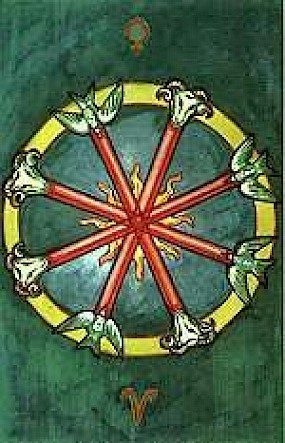
Tarot Card for February 10: The Four of Wands

The Four of Wands

The Lord of Completion marks a point where a circle has been completed. It can apply to work projects, personal situations – even phases of life. In some respects it’s like a lesser reflection of the Universe, the final Major Arcana card.

Another aspect of the Four of Wands associate it with the Major Arcanum of Adjustment, or Justice. This is because this Wand indicates the manifestation of balanced forces, resulting in the fulfilment of earlier hopes, ideas and dreams. The balance aspect, combined with the overall morality of Wands, brings us to think about injustice being resolved, inequity acknowledged and set right.

This is a good card, promising not only the sense of natural satisfaction which arises when we follow our ideas through to their logical conclusion, but also the opportunity to start new things off.

If we stop when we have achieved a goal along the way, we begin to stagnate. We need to take the sense of contentment and channel it into the stage on our journey – that way we continually grow.

The Four of Wands

(via angelpaths.com and Alan Blackman)

Isaac Asimov’s three laws of robotics

A robot may not injure a human being or, through inaction, allow a human being to come to harm. A robot must obey orders given it by human beings except where such orders would conflict with the First Law. A robot must protect its own existence as long as such protection does not conflict with the First or Second Law.

(These were introduced in his 1942 short story Runaround, although they were foreshadowed in a few earlier stories.)

(Auburn.edu)