verb: slough; 3rd person present: sloughs; past tense: sloughed; past participle: sloughed; gerund or present participle: sloughing
shed or remove (a layer of dead skin).”a snake sloughs off its old skin”
get rid of (something undesirable or no longer required).”he is concerned to slough off the country’s bad environmental image”
(of dead skin) drop off; be shed.
(of soil or rock) collapse or slide into a hole or depression.
noun
noun: slough
the dropping off of dead tissue from living flesh.”the drugs can cause blistering and slough”
Origin
Middle English (as a noun denoting a skin, especially the outer skin shed by a snake): perhaps related to Low German slu(we ) ‘husk, peel’. The verb dates from the early 18th century.
21st Century Thin • Nov 18, 2020 For more of the best wisdom like this all you have to do is SUBSCRIBE: https://bit.ly/21stThinking. There are many motivational videos on YouTube featuring people like Jordan Peterson and Jim Carey but hardly any featuring some of the great spiritual minds of our time such as the legendary John Butler. John Butler’s spiritual wisdom has delighted and enchanted many on his YouTube channel as well as Conscious TV and Pure Unintentional ASMR but his spiritual guidance and knowledge is second to none. “In order to be what you are, you must come out of what you are not.” But John Butler is a man with unbound wisdom who first rI first became aware of John Butler through the YouTube channel Pure Unintentional ASMR. There I discovered Conscious TV. Be sure to check Conscious TV if you haven’t already for more interviews on consciousness, non duality and spirituality. And also the John Butler’s YouTube channel [Links below]
WICKED The Musical • May 6, 2016 The women who started it all return with “For Good.” Watch the newest installment in WICKED’s Out of Oz series! For information about WICKED, visit us at: http://www.wickedthemusical.com Winner of over 50 major awards including the Grammy Award and three Tony Awards®, WICKED is the untold story of the witches of Oz. Long before Dorothy drops in, two other girls meet in the land of Oz. One, born with emerald-green skin, is smart, fiery and misunderstood. The other is beautiful, ambitious and very popular. WICKED tells the story of their remarkable odyssey, how these two unlikely friends grow to become the Wicked Witch of the West and Glinda the Good. Declared “The Best Musical of the Decade” by Entertainment Weekly and “A Cultural Phenomenon” by Variety, WICKED is based on the novel by Gregory Maguire, has music and lyrics by Stephen Schwartz, and a book by Winnie Holzman. The production is directed by Joe Mantello with musical staging by Wayne Cilento.
Thanks to the internet, many newspapers in major U.S. cities — the New York Times, the Washington Post — have become much easier for out-of-towners to access than they were in the past. The Times has plenty of online subscribers who don’t live in the Big Apple; the Post has many readers outside of Washington, D.C. The internet has, in effect, made it easier for urban newspapers to become national publications.
But at the same time, many journalism professors and media analysts have been sounding the alarm about the shortage of local news in the United States — especially outside of major urban centers. Nancy Gibbs, who serves as director of the Shorenstein Center on Media, Politics and Public Policy at Harvard University in Cambridge, Massachusetts, addresses that topic in an op-ed published by the Post on December 27.
“Every couple of weeks,” Gibbs explains, “you can read about another newspaper shutting its doors, or moving from daily to weekly, or hollowing out its newsroom until it’s little more than a skeleton staff bulked up with j-school students. Study the maps made by Penny Abernathy, visiting professor at Northwestern University and an expert on dwindling sources of news, and you can see the dead zones — the 200 or so counties with no local paper. About 1600 other counties have only one.”
Gibbs elaborates, “Local news is the oxygen of democracy, the most trusted source for the most essential information. And we’ve long known why dying newsrooms damage communities. But look at the maps again, and another alarming picture comes into focus: The very places where local news is disappearing are often the same places that wield disproportionate political power.”
In June 2020, Poytner’s Tom Stites lamented that “the relentless spread of news deserts” was “speeding up even before the coronavirus incapacitated local economies” and that “since then, the rate” had “accelerated some more.”
Stites noted a report published that month by Penelope Muse Abernathy and her colleagues at the Hussman School of Journalism and Media at the University of North Carolina at Chapel Hill. The report was titled, “News Deserts and Ghost Newspapers: Will Local News Survive?”
Stites lamented, “Since the fall of 2018, the report says: 300 more newspapers have failed, bringing the death toll to 2100, almost 25 percent of the 9000 newspapers that were being published 15 years ago. The number of communities that had their own newspapers in 2004 and now have no original reporting whatsoever, in print or digitally, has grown to 1800 from 1300. These are news deserts, with no coverage of issues ‘such as the quality of schools in that community or the spread of an infectious disease.’ Many are in economically challenged rural places, but news deserts are now also invading wealthy suburbs.”
Stites’ article and Abernathy’s report were published two and one-half years ago. And the state of local news hasn’t gotten any better since then.
Gibbs, in her Washington Post op-ed, notes that in South Dakota, for example, “about half of” the state’s “66 counties have only a single weekly newspaper,” adding that “seven counties” in South Dakota “have no newspaper at all.”
“You could do the same math for residents of Wyoming, Montana, North Dakota, Vermont or Delaware, all states with similarly enhanced political clout,” Gibbs observes. “But finding reliable local news sources is much harder in the first three — geographically larger, rural states with dispersed populations, which are much more likely to lack high-speed internet as well. In contrast, Delaware’s three small counties have 13 newspapers; Vermont’s 14 counties have 39. By now, we know quite a bit about why this matters. The citizens whose votes count the most might have the hardest time learning about the issues and candidates running in their communities — because there’s no longer anyone reporting on them.”
Gibbs argues that the shortage of local news encourages reflexive partisanship.
“If you’re a Democrat hoping to stand a chance of winning in a red state, or a Republican in a blue one, it helps if voters get to know you personally, see you at ribbon cuttings and town halls, hear where your views depart from party orthodoxy,” Gibbs warns. “That’s a lot harder to do without local reporters providing reliable coverage, no matter how many targeted Facebook ads you buy. By the same logic, winning candidates are accountable to the voters who elevate them — unless no one knows what they ran on or what they are doing with their power, beyond whether they have an R or a D on their jersey. If you weaken the connection between voters and their representatives, you empower their donors, lobbyists and conflict entrepreneurs.”
There are times in life when the firmament of our being seems to collapse, taking all the light with it, swallowing all color and sound into a silent scream of darkness. It rarely looks that way from the inside, but these are always times of profound transformation and recalibration — the darkness is not terminal but primordial; in it, a new self is being born, not with a Big Bang but with a whisper. Our task, then, is only to listen. What we hear becomes new light.
I read it here accompanied by another patron saint of turning darkness into light — Bach, and his Cello Suite No. 5 in C Minor, performed by Colin Carr:
LET THIS DARKNESS BE A BELL TOWER by Rainer Maria Rilke
Quiet friend who has come so far,
feel how your breathing makes more space around you. Let this darkness be a bell tower and you the bell. As you ring,
what batters you becomes your strength. Move back and forth into the change. What is it like, such intensity of pain? If the drink is bitter, turn yourself to wine.
In this uncontainable night, be the mystery at the crossroads of your senses, the meaning discovered there.
And if the world has ceased to hear you, say to the silent earth: I flow. To the rushing water, speak: I am.
“Do stuff. Be clenched, curious. Not waiting for inspiration’s shove or society’s kiss on your forehead. Pay attention. It’s all about paying attention. Attention is vitality. It connects you with others. It makes you eager. Stay eager.”
–SUSAN SONTAG
Born this day in 1933
Susan Sontag (January 16, 1933 – December 8, 2004) was an American writer, philosopher, and political activist. She mostly wrote essays, but also published novels; she published her first major work, the essay “Notes on ‘Camp'”, in 1964. Wikipedia
TEN YEARS AGO this week, Aaron Swartz, a key figure in the fight for an open internet, died by suicide. This week we also learned of the tragic death of New York Times journalist Blake Hounshell, whose death is being investigated by police as a suicide. Ryan Grim speaks to Jason Cherkis, who’s writing a book on suicide prevention and is the author of the groundbreaking article at HuffPost Highline titled “The Best Way to Save People From Suicide.”
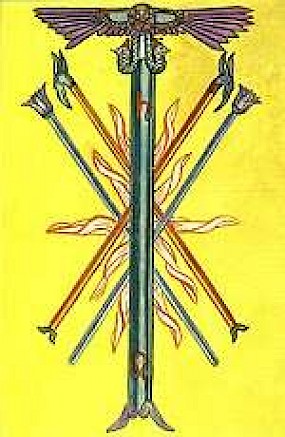
The Lord of Strife usually appears in a reading to indicate quarrels, conflict and discord. There is rarely anything of value to be gained from the disharmony introduced by this card – in fact, it will often indicate bitterness and argument for argument’s sake.
To try to determine how serious the strife will be, look for cards like Nine of Swords, Ten of Swords or the Tower to indicate a really bad situation. With cards such as the Eight of Wands or the Six of Wands it’s probable that the friction may clear an outstanding problem area.
This card will often come up when some-one is very unhappy with a working situation – there is, perhaps, a clash of personality with somebody else; or perhaps the individual is unhappy with working practises. Often in this situation there’s a tendency toward rashness and loss of control which can lead to further problems.
Another time that the Lord of Strife will make an appearance is when we are in inner conflict – most often about something we consider to be immoral. This is probably the most significant type of problem that can be highlighted with this card. For instance, if we have taken an easy option, or a dishonest turn, and are now troubled by the voice of our conscience, we could expect to see the Lord of Strife appearing.
In this case we need to set right whatever we believe we have done wrong – or failed to do altogether. We will not be at peace until we do. The Five of Wands is a card that reminds us quite firmly about the ethical considerations that underpin the Suit of Wands.
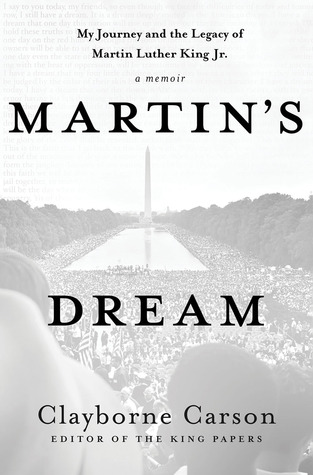
On August 28, 1963 hundreds of thousands of demonstrators flocked to the nation’s capital for the March on Washington for Jobs and Freedom, where Dr. Martin Luther King Jr. delivered his famous “I Have a Dream” speech. It was Clayborne Carson’s first demonstration. A nineteen year old black student from a working-class family in New Mexico, Carson hitched a ride to Washington. Unsure how he would return home, he was nonetheless certain that he wanted to connect with the youthful protesters and community organizers who spearheaded the freedom struggle. Decades later, Coretta Scott King selected Dr. Carson—then a history professor at Stanford University– to edit the papers of her late husband.
In this candid and engrossing memoir, he traces his evolution from political activist to activist scholar. He vividly recalls his involvement in the movement’s heyday and in the subsequent turbulent period when King’s visionary Dream became real for some and remained unfulfilled for others. He recounts his conversations with key African Americans of the past half century, including Black Power firebrand Stokely Carmichael and dedicated organizers such as Ella Baker and Bob Moses. His description of his long-term relationship with Coretta Scott King sheds new light on her crucial role in preserving and protecting her late husband’s legacy.
Written from the unique perspective of a renowned scholar, this highly readable account gives readers valuable new insights about the global significance of King’s inspiring ideas and his still unfolding legacy.
New Thinking Allowed with Jeffrey Mishlove Jan 15, 2023 James C. Carpeter, PhD, is among the last living students of J. B. Rhine, the founder of American parapsychology. He is a former Clinical Associate Professor in the Department of Psychiatry of the University of North Carolina School of Medicine. He is author of First Sight: ESP and Parapsychology in Everyday Life. This interview focuses primarily on how extrasensory perception and psychokinesis operate in all individuals all of the time. 00:00 Introduction 08:03 Psychological basis of psi 14:46 The role of psychokinesis 19:29 Alfred North Whitehead 22:32 Entanglement 26:34 Subliminal Perception 34:47 Psychological priming 46:23 Random and pseudorandom 48:09 The illusion of control 50:22 Conclusion New Thinking Allowed host, Jeffrey Mishlove, PhD, is author of The Roots of Consciousness, Psi Development Systems, and The PK Man. Between 1986 and 2002 he hosted and co-produced the original Thinking Allowed public television series. He is the recipient of the only doctoral diploma in “parapsychology” ever awarded by an accredited university (University of California, Berkeley, 1980). He is also the Grand Prize winner of the 2021 Bigelow Institute essay competition regarding the best evidence for survival of human consciousness after permanent bodily death. (Recorded on December 10, 2022)
Consciousness, spirituality, biography, sexuality, androgyny, futurism, space, the arts, science, astrology, democracy, humor, books, movies and more




 LET THIS DARKNESS BE A BELL TOWER