Bio: Maria Deraismes

From Wikipedia, the free encyclopedia

Maria Deraismes
Born17 August 1828
Paris, France
Died6 February 1894 (aged 65)
OccupationWriter, Suffragist
NationalityFrench
RelativesAnna Féresse-Deraismes (sister)

Maria Deraismes (17 August 1828 – 6 February 1894) was a French author, Freemason, and major pioneering force for women’s rights.

Biography

Born in Paris, Maria Deraismes grew up in Pontoise in the city’s northwest outskirts. From a prosperous middle-class family, she was well educated and raised in a literary environment. She wrote several literary works and soon developed a reputation as a very capable communicator. She became active in promoting women’s rights.[1]

In 1866 a feminist group called the Société pour la Revendication du Droit des Femmes began to meet at the house of André Léo. Members included Paule MinckLouise MichelEliska VincentÉlie Reclus and his wife Noémie, Mme Jules Simon and Caroline de Barrau. Maria Deraismes was persuaded to participate.

Because of the broad range of opinions, the group decided to focus on the subject of improving girls’ education.[2] In 1870 Deraismes founded L’Association pour le droit des femmes with Léon Richer. She helped fund Richer’s paper Le Droit des femmes.[3]

Following the ouster of Napoleon III, Deraismes understood the new politics of the day meant a more moderate approach under the Third Republic in order for feminism to survive and not be marginalized by the new breed of male power brokers emerging at the time. Deraismes’s work brought her recognition in Great Britain and she became an influence upon American activist Elizabeth Cady Stanton, who met her in Paris in 1882.

Maria Deraismes was initiated into Freemasonry on 14 January 1882, when it was still rare for a woman to be admitted into that Fraternity. She joined “Les Libres Penseurs” Lodge, of Pecq, a small village to the west of Paris. A year later, she and Georges Martin organized a Masonic lodge that allowed both men and women as members. From this co-masonic Lodge developed the Grande Loge Symbolique Ecossaise “Le Droit Humain”, which grew into the International Order of Freemasonry Le Droit Humain.

Caricature of Maria Deraismes

With support of other suffragettes such as Hubertine Auclert, Deraismes worked to achieve political emancipation for women. She stood as a symbolic candidate in the elections of 1885.

On her death in 1894, Deraismes was interred in the Montmartre Cemetery. Her complete writings were published in 1895. Much information on her work can be found at the Bibliothèque Marguerite Durand in Paris.

To honor her memory, a street in Paris was named for her. In addition, a statue was erected in a small park, Square de Epinettes in the 17th arrondissement. The town square in St. Nazaire was also named in her honor.

More at: https://en.wikipedia.org/wiki/Maria_Deraismes

Wendy Cicchetti: Sophisticated Fourth Quarter Of 2022

Nightflight Sep 23, 2022 Wendy Chiccetti explains the energies for the rest of the year. Full interview: https://www.patreon.com/Nightflight – What to expect from the solar eclipse over Europe? – Shocking information to surface – Multiple planets go retrograde – Mars in Gemini for 7 months – Saturn Uranus tensions continue – Checking the EU chart – The grinding down of old structures

Irrational war on drugs, destruction of the Amazon, expose humanity’s failures, Colombia’s Petro tells UN

President Gustavo Petro Urrego of Colombia addresses the general debate of the UN General Assembly’s 77th session.

UN Photo/Cia Pak

President Gustavo Petro Urrego of Colombia addresses the general debate of the UN General Assembly’s 77th session.

20 September 2022 (news.un.org)

UN Affairs

During his first speech at the General Assembly as the President of Colombia, Gustavo Petro said that the world’s addiction to money, oil and carbon is destroying the rainforest and its people under the excuse of a “hypocritical” war against drugs.

Mr. Petro described his country as one of the most beautiful and nature-rich in the world but said that blood also flowed into its rivers and biodiversity.

He explained that violence in the rainforest was fuelled by the prosecution of the sacred plant of the Incas: the coca plant.

“As in a paradoxical crossroads. The forest that should be saved is at the same time being destroyed. To destroy the coca plant, they throw poisons such as glyphosate that drips into our waters, they arrest their cultivators and then imprison them,” he stated.

He added that destroying the Amazon has seemingly become the slogan of some States and negotiators and he denounced such “save the jungle speech” as hypocritical.

“The jungle is burning, gentlemen, while you wage war and play with it. The jungle, the climatic pillar of the world, disappears with all its life. The great sponge that absorbs the planetary CO2 evaporates. The jungle is our saviour, but it is seen in my country as the enemy to defeat, as a weed to be extinguished,” he underscored.

Mr. Petro highlighted that while the developed world let the rainforest burn as an excuse for the war against drugs, it also asked for more oil, “to calm their other addiction” to consumption, power and money.

“What is more poisonous for humanity, cocaine, coal or oil? The opinion of power has ordered that cocaine is poison and must be persecuted, while it only causes minimal deaths from overdoses…but instead, coal and oil must be protected, even when it can extinguish all humanity,” he said, adding that such reasoning was “unjust and irrational”.

“The culprit of drug addiction is not the rainforest; it is the irrationality of the world’s power. Give a blow of reason to this power. Turn on the lights of the century again”, he urged.

The President said that the war against drugs has lasted over 40 years, and it has not been won.

“By hiding the truth, they will only see the rainforest and democracies die. The war on drugs has failed. The fight against the climate crisis has failed,” he noted.

Mr. Petro then demanded, speaking in the name of all of Latin-America, the end of the “irrational war against drugs”.

“Reducing drug use does not require wars, it needs us all to build a better society: a more supportive, more affectionate society, where the meaning of life saves us from addictions… Do you want fewer drugs? Think of earning less and giving more love. Think of a rational exercise of power”, he told world leaders.

Mr. Petro also addressed the climate disaster and the displacement it causes, saying that wars were only excuses to not act against it.

“The climate disaster that will kill hundreds of millions of people is not being caused by the planet, it is being caused by capital. By the logic of consuming more and more, producing more and more, and for some earning more and more”, he said.

The Colombian President added that within the fires and poisoning of the Amazon rainforest was embedded a “failure of humanity”.

“Behind cocaine and drug addiction, behind oil and coal addiction, there is the true addiction of this phase of human history: the addiction to irrational power, profit and money. That is the huge deadly machinery that can extinguish humanity”, he explained.

Mr. Petro urged a dialogue with Latin-America to end the war, saying it was “time for peace”.

“Only in peace we can save life in our land. There will be no peace without social, economic and environmental justice. We are at war with the planet too. Without peace with the planet, there will be no peace among nations,” he concluded.

New Moon In Libra – Will Love Find A Way?

Astro Butterfly

Sep 23, 2022

On September 25th, 2022, we have a New Moon in Libra.

The New Moon is at 2° Libra and it is opposite Jupiter (at 3° Aries), giving us an appetite for risk-taking. Ready, set, action?

Not quite. The New Moon ruler, Venus is conjunct Mercury retrograde, so there are some considerations to make.

We have 2 scenarios.

On one hand, the New Moon in Libra opposite Jupiter asks us to solve the dichotomy: give peace a chance (New Moon in Libra) while standing up for our own convictions and beliefs (Jupiter in Aries).

The New Moon in Libra and Jupiter in Aries are resolution oriented. They really want to find a consensus, but they will put up a fight first, to set things straight. There’s too much cardinal energy to hide around the bush.

On the other hand, Venus, the New Moon ruler conjunct Mercury retrograde, asks us to consider a different course of action. We may have a change of mind – or a change or heart – that will open new possibilities and help us see a completely different scenario.

How many times have we told ourselves, in justification attempts “That was the only thing that could have been done”… when in fact, there’s always another way, there’s always a better way?

Finding a win-win scenario, which is truly at the heart of any New Moon in Libra, requires a different approach.

To find a new way, a better way, we need to let go of our expectations, of our agendas, and just “be”. We need to genuinely acknowledge the other and try to understand where they’re coming from.

Then and only then we can find a solution where everyone can win.

Venus Opposite Neptune – Will Love Find A Way?

The New Moon in Libra chart features an interesting aspect pattern. Venus, the New Moon ruler, is the propeller of a kite with Neptune at the apex. A kite is an aspect pattern that connects 4 planets in a geometrical configuration that looks like a wind kite.

The most important planets in this New Moon kite are Venus in Virgo opposite Neptune in Pisces.

Neptune at the apex of the kite asks us to aim higher, and surrender to the unconditional love that the Universe is overflowing with.

But do we have what it takes? Are we willing – and able – to let go of one-sided mental and relating models that keep us stuck in the past, and separated from others?

Venus in Virgo plays a crucial role here. Not only she’s the New Moon ruler, but she’s also the propeller, the driving force of the kite. The stakes are high.

Virgo, Scorpio, Libra In Relationships

What’s interesting is that Venus is in fall and detriment in Virgo and Scorpio, and in domicile in the sign in the middle: Libra.

What does Venus get so right in Libra, but has difficulties to embrace in its neighboring signs?

Firstly, if your Venus is in Virgo or Scorpio, there’s nothing wrong with this placement. People with Venus in Virgo or Scorpio have the same chances of finding love and happiness as any other Venus placement. However, the approach to get there is counter intuitive.

Libra is the sign of relationships, more exactly, the sign of equal relationships. Libra’s symbol is a scale. The relationship act (the equinox, when the day is equal to the night) happens in Libra. Before and after, we have unequal relationships.

Virgo is the sign before Libra, so a Virgo’s relationships are unequal because of a lack of experience. Scorpio is the sign after Libra, so Scorpio’s relationships are unequal because of too much experience.

In relationships, Virgos are tempted to take the same approach they take in their everyday life: work hard, prove themselves, give more than they take. “If only I’d go to the gym every day and lose those pounds”.

This obsession with perfection can be also projected onto the other “If only that loving, smart, mature, educated, funny, sexy, loyal (…) person would come into my life”.

Virgos approach relationships like a project. Virgos are so good at working on themselves… however, when we do relationships, we enter a completely new territory. What works so well in the sphere of the “Self” no longer applies in relationships.

What they should do instead is realize that relationships are a North Node territory, surrender and allow their partner to take the lead.

Scorpio has the opposite approach. Scorpio knows way too well what relationships are about. They’re the sign after Libra, right? Been there, done that. They know the ins and outs of relating. That’s why they are great psychologists. That’s why they are the masters of intimacy.

But the mistake they make is that they expect their partners to feel the same way they do. Scorpio won’t give in, they’ll seek control and play relationship chess until their partner loves them as deeply and intensely as they do.

The downfall? They can wait a lifetime for that to happen. A much better approach is to play out their strengths and take the emotional leadership role in the relationship. To accept that there are Virgos out there that don’t know what love is, and are waiting for someone to show them.

Scorpio’s instinctual approach is to freeze, wait and control… when a better approach would be to use their emotional gifts to lead the way.

New Moon In Libra – The Dawn Of A New Day

In Libra, the sign in between Virgo and Scorpio, we seem to find a balance between “not being good enough” and “being too good for anyone else”.

Libra knows that relationships are uncharted territory so they approach them with a beginner’s heart. And when that balance between “me” and “you” is found, something magical happens.

Love emerges spontaneously.

With a New Moon in Libra, and Venus in Virgo opposite Neptune, one important question is raised: will love find a way?

The sabian symbol of the New Moon in Libra gives us a hint: “The dawn of a new day reveals everything changed”. Every day is an opportunity to start with a beginner’s heart.

UKRAINE EMERGENCY TRANSLATION GROUP

Translation is a 5-step process of “straight thinking in the abstract.” The first step is an ontological statement of being beginning with the syllogism: “Truth is that which is so. That which is not truth is not so. Therefore Truth is all there is.” The second step is the sense testimony (what the senses tell us about anything). The third step is the argument between the absolute abstract nature of truth from the first step and the relative specific truth of experience from the second step. The fourth step is filtering out the conclusions you have arrived at in the third step. The fifth step is your overall conclusion.

The Ukraine Emergency Translation Group meets every Friday at 11 a.m. Pacific time via Zoom. We call it the Ukraine Emergency Translation Group but we welcome Translations about anything. Here are sense testimonies (2nd steps) we translated and their corresponding conclusions: (5th steps) this week.

2) Technology is more important than MIND.
5)  MIND creates ALL there is.

2) Preconceived and judgmental attitudes can inhibit life.
5) All  that can be or known is whole, complete, everpresent, absolute, perfect Truth. 

2)  I have an umbilical hernia.
5) Truth is one motherless, parentless, ageless, endless, person-proof, infinite, subjective perception.

All Translators are welcome to join us on Fridays at 11 a.m. Pacific time. The link is: https://us06web.zoom.us/j/83608167293?pwd=cFRsckVibXMwTGJ0KzhaV0R2cWJtdz09

For information about Translation or other Prosperos classes go to: https://www.theprosperos.org/teaching

Some comments from group members about this group:

“I like the group interaction and different perspectives. Also, at least for me, it gives me a sense of accountability and keeps the practice fresh in my mind. ” –Sarah Flynn

“This group has freed me up to have more fun with my Translations.”
–Mike Zonta

Dietrich showed how adopting a persona can reveal one’s true self

Dietrich showed how adopting a persona can reveal one’s true self | Psyche

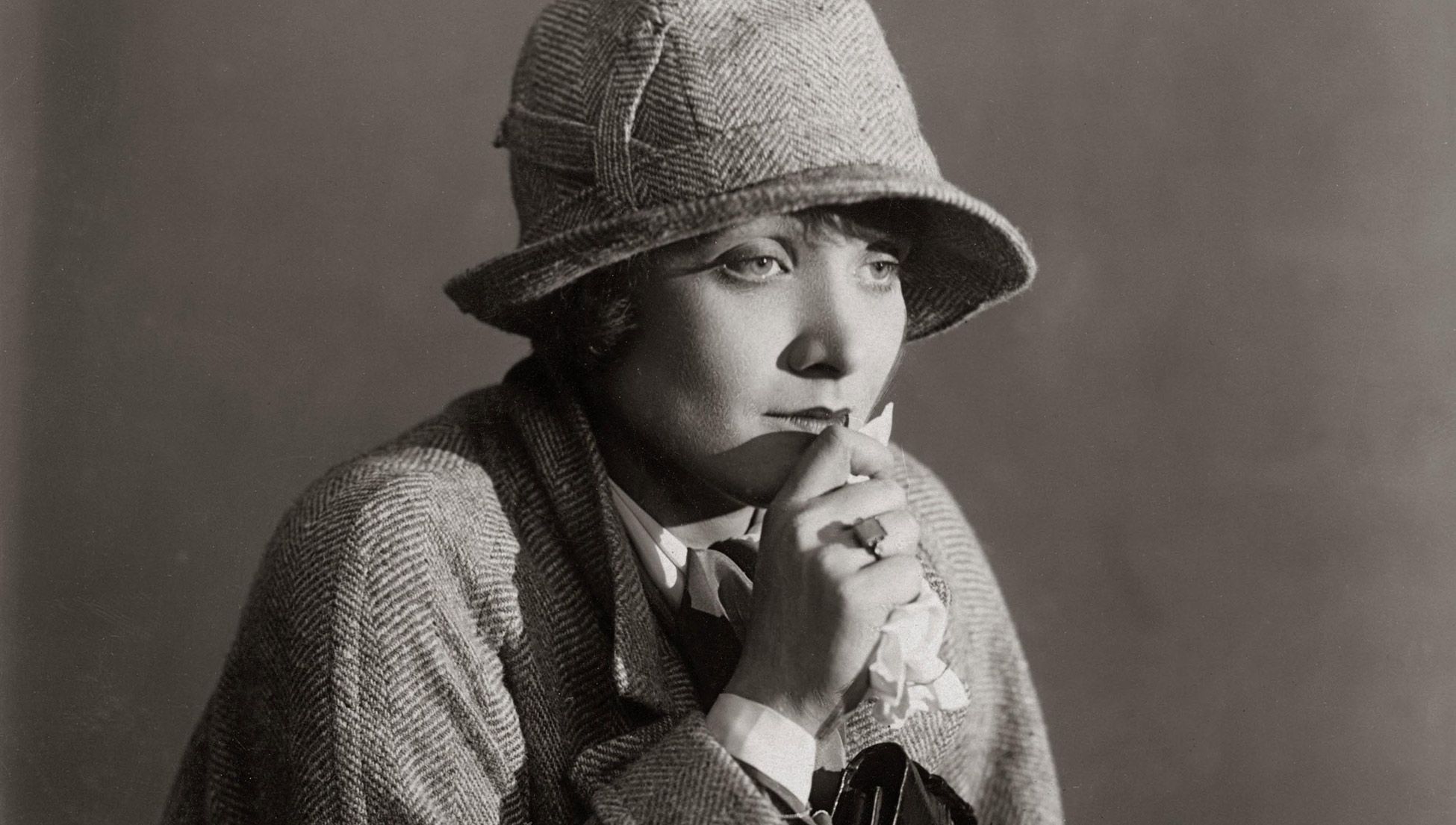
Marlene Dietrich photographed in Vienna in 1928. Photo by Imagno/Getty

Sam Millsis a novelist/nonfiction author. Her books include Blackout (2010), The Quiddity of Will Self (2012), The Fragments of My Father (2020) and Chauvo-Feminism (2021). She is also managing director of the publishing house Dodo Ink. She lives in London.

Edited by Marina Benjamin

21 September 2022 (psyche.co)

‘Kaloprosopia’ means transforming your personality by living your life as a work of art. The term was coined in the late 19th century by the French writer Joséphin Péladan in reaction to the growth of capitalism and mass commerce, to people being herded into becoming consumers. Kaloprosopia – from the Greek καλός (beautiful) and πρόσωπον (person) – enabled one to stand out. A century on, with so many of us on social media, the effect of such self-styling is diluted; it is hard to resist the impulse towards conformity. We are just as likely to adopt group personas as our own, creating bubbles and echo chambers, shaping our posts to glean Likes, and mimicking the language of our circle. But, in the past, self-creation was often an act of resistance. The adoption of a mask might be both protective and illuminating, allowing someone a chance to flout convention and explore aspects of their character that would otherwise remain repressed.

Oscar Wilde stands out in the annals of kaloprosopia, his self-reinvention beginning at university in Oxford, where he exchanged his Irish accent for an English one, became notorious for his wit, and decorated his room in the style of Aestheticism – ‘I find it harder and harder every day to live up to my blue china,’ he quipped. In the previous century, we might think of Andy Warhol, whose skew-whiff wigs and nervous mumbling in interviews became as iconic as his Pop Art, or David Bowie, whose mercurial shifts from persona to persona – Ziggy Stardust to Halloween Jack to the Thin White Duke – became a game his fans delighted in, wondering who Bowie would become next. Madonna and Lady Gaga would adopt the same conceit, surfing the restless waves of a capitalist economy seeking the next best thing by perpetually recreating themselves as the next best thing.

Marlene Dietrich, too, devoted her adult life to the art of kaloprosopia. At the age of 11, Maria Magdalene became Marlene (a name that didn’t exist at the time), and not long after she determined to become an actress. Her breakout success came in 1930 with The Blue Angel, Germany’s first talking film. Directed by Josef von Sternberg, it cast Dietrich as an icily destructive femme fatale. Paramount executives, who’d been seeking a star to rival Greta Garbo, swooped down, enticing Dietrich to Hollywood with a seven-picture deal. Dietrich liked to pretend that The Blue Angel was her debut film when, in fact, while living in Weimar Berlin, she’d starred in nearly 20 silent films (which she later denied and disowned), looking very different from the glamorous blonde icon we know: dark haired, a little chubby and unpolished.

In each film that Dietrich and von Sternberg made together, she played variations on the femme fatale archetype: aloof, seductive, poised. At first, von Sternberg seemed to have the dominant hand: Dietrich claimed he was determined ‘to Pygmalionise’ her. But while Pygmalion breathed life into the female statue he created, von Sternberg performed the reverse on Dietrich, helping shape her as the star whose beauty – staged and lit to perfection – was almost statuesque. Insisting that his actors were ‘marionettes, pieces of colour on my canvas’, von Sternberg would give Dietrich precise instructions on where to stand, walk, talk and pause on set.

But Dietrich was no mere mannequin: Jean Cocteau called her ‘the most terrifying and exciting woman I have ever known’. Her real relationship with von Sternberg was collaborative. Each became a muse to the other, and they challenged each other, flinging down ‘artistic gauntlets like duelists’, according to the biography by Dietrich’s daughter, Maria Riva. Each character von Sternberg created was directly inspired by his infatuation with Dietrich, melding fact and fiction, mixing her character with his imaginative fantasy; in Morocco (1930), she wears what became her trademark tuxedo, top hat and tails, which were inspired by outfits he’d seen her wear in her Weimar days.

Dietrich would sometimes refer to herself in the third person, as if her persona were a lifelong portrait she might layer and finesse, year on year

Google ‘Dietrich’, and you’ll be dazzled by images capturing her elegant, sultry beauty. She vetted every picture ever released of her. Dietrich learnt from von Sternberg exactly how lighting could accentuate every hollow and curve in her face. At one point, she had her molars removed so that her cheeks would sink in further.

By the end of 1930, Dietrich was world famous. She would sometimes refer to herself in the third person, as if her persona were a lifelong portrait she might layer and finesse, year on year. She cultivated a mysterious allure that wreaths her pictures like cigarette smoke from an elegant holder. ‘Each man or woman should be able to find in the actress the thing he or she most desires, and still be left with the promise that they will find something new and exciting every time they see her again,’ she declared in a press interview.

Carl Jung coined the term persona, derived from the Latin for ‘character’, to describe the protective masks that people adopt in their daily role-playing. Just as Dietrich devoted herself to kaloprosopia, Bowie – an avowed admirer of hers – adopted exaggerated personas, drawing attention to the theatricality of the compromise between self and society that we struggle with daily. He liberated fans who mimicked him, inspiring them to break with social constraints, particularly those of gender and sexuality. With Ziggy Stardust – a red-haired bisexual alien rock-star character – he helped thousands of gays and bis out of the closet. Dietrich had likewise embraced androgyny in her public dress, and was bi in her private life. Bowie paid Dietrich homage on his Hunky Dory (1971) UK album cover, a look inspired by a Dietrich photo-book that he took to the shoot. As the Thin White Duke, his silhouette echoed Dietrich’s classic pose.

The question of how wide is the gap between persona and true self fascinates the public: who is she/he beneath the mask? Bowie turned this into a game to tease and enthral his fans, allowing them to collaborate in the process; when it came to Ziggy, Bowie said: ‘other people reread him and contributed more information … than I put into him.’ Influenced by kabuki theatre, which draws attention to its own theatricality, he declared: ‘I’m Pierrot. I’m Everyman. What I’m doing is theatre, and only theatre.’ However, his fans suffered the paradox of enjoying his determination to be indeterminate while also wanting to pin him down. They felt betrayed when, at the start of the AIDS crisis in the early 1980s, he dropped the theatrical veil, declaring himself a ‘closet heterosexual’. Later, he told Rolling Stone that coming out had stymied his US career, and later still redeclared himself bi once more. Personas gave both Bowie and Dietrich the freedom to push societal boundaries – until society deemed they had gone too far, and tore up their masks.

Jung argued that a persona could become pathological if an individual identified too closely with it. When a persona is shattered – whether intentionally or not – the result is disintegration, chaos, collapse. For Dietrich, the collapse of her film persona was imposed upon her by the Hays Code. Introduced to Hollywood in 1930, it dictated that ‘no picture shall be produced that will lower the moral standards of those who see it.’ As cinema became increasingly popular, concern about its messaging intensified, particularly among religious and Catholic groups. The Hays Code was drafted by a Jesuit priest, Father Daniel A Lord. It comprised a list of rules about sex and violence, and banned sexual ‘perversions’ such as homosexuality. Adultery should not be shown; childbirth was banned; and morals had to be present, like a watermark, in plotlines that should promote wholesome American values.

Even Bowie’s death was ‘a work of art’, his swansong album released just two days before he died

We often imagine that the complex screen roles for woman we celebrate today – the ‘hot mess’ that Phoebe Waller-Bridge plays in the TV series Fleabag (2016-19), or the blackly comic, murderous Cassie (played by Carey Mulligan) in the film Promising Young Woman (2020) – represent a new evolution, but the early 1930s were a golden age for rich female roles, notwithstanding cultural fears about the corrupting impact on female viewers: Dietrich and other female stars of her age were considered a box-office draw for women rather than men.

Until 1934, the Hays Code wasn’t strictly enforced. Then came the clampdown. The Production Code Administration office vetted scripts before filming, making suggestions to sanitise and simplify them, often to disastrous artistic effect. Queer characters couldn’t be shown as sympathetic, so they appeared as caricatures: drag queens, child molesters, villains or cowards.

Dietrich built her career as a seductive, mysterious, transgressive star with androgynous appeal, but now her films – and von Sternberg’s artistic vision – were fatally compromised. In The Devil Is a Woman (1935), she played Concha, a seductress, in a story of erotic bedazzlement; the script censors wanted to punish Dietrich’s sexy character, and suggested she become a ‘scrawny, impoverished hag’, and that her love interest could choke her to death in its finale. The film had to be cut from 96 minutes to 79, and the result was a terrible critical and commercial flop (though it later received critical recognition). Dietrich was labelled ‘box office poison’ in an ad that named and shamed Hollywood stars who’d lost their bankability. She made a comeback with the Western comedy Destry Rides Again (1939), where she consciously mocked her previous ice-goddess incarnation by playing a character who was likeable and down to earth – qualities she reprised throughout the 1940s but that lacked the complexity of her female heroines in the decade before. Then, in the 1950s, she reinvented herself once more as a glamorous cabaret star. Her final film, Just a Gigolo (1978), saw her sharing the screen with Bowie.

Dietrich spent her last decade shut away in her Parisian apartment, refusing to go out in public, so that her wrinkles and blackened teeth would not destroy the memory of her iconic beauty. Perhaps, as Jung warned, her obsession with persona became pathological.

She was the ultimate unreliable narrator, hiding her true sexuality and fictionalising parts of her life if it enhanced the legend. ‘Her whole life has been built on a grand illusion,’ Fritz Lang feared. Bowie lived his final days with more flair. His producer Tony Visconti remarked that even his death was ‘a work of art’, after Bowie’s swansong album, Blackstar (2016), was released just two days before he died.

As Wilde had observed in the essay ‘The Critic as Artist’ (1881): ‘Man is least himself when he talks in his own person. Give him a mask, and he’ll tell you the truth.’ Both Dietrich and Bowie were elusive legends but perhaps, as Wilde suggests, the shimmering personas they adopted give us glimpses of their truest selves.

Tarot Card for September 23: The Empress


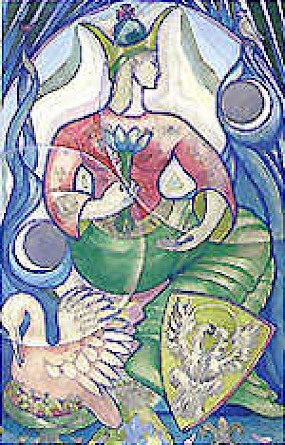
The Empress

The Empress is numbered three and symbolises one half of a perfect polarity – the Emperor being the other side of the balance. From the purity of the High Priestess we move naturally onwards to the Empress’ sense of bounty and fertility. She represents the Mother Goddess, fulfilling her part in the eternal cycle of creation.

The Empress holds the power to steadily and determinedly rebuild, renew, nurture and nourish. She has an unquenchable and generous courage, responding instantly when she sees a need to defend. Her realm is built of love, fertility and warmth. When the Empress holds us we are once again in the sure safety of the infant at its mother’s breast.

She also represents unconditional love – making no demands and setting no conditions. If we allow her love to flow through us then we too can become a pure spring through which the Universe flows. Only our fears stand between us and the Goddess.

The Empress

(via angelpaths.com and Alan Blackman)

Déjà Vu with Vernon Neppe

New Thinking Allowed with Jeffrey Mishlove Sep 23, 2022 Vernon Neppe, MD, PhD, FRSSAf, is a neuropsychiatrist and head of the Pacific Neuropsychiatric Institute in Seattle. He is a former president of the South African Society for Psychical Research. He is author of Déjà Vu Revisited, Déjà Vu: A Second Look, Déjà Vu: Glossary and Library, Cry the Beloved Mind: A Voyage of Hope, Reality Begins with Consciousness: A Paradigm Shift that Works (written with physicist Edward Close), and Innovative Psychopharmacotherapy. His professional publications number over 700. Dr Neppe has amplified many of his concepts in two of the websites linked with his work. On www.Brainvoyage.com, his books are amplified. www.VernonNeppe.org is his gateway and includes more information on the Neppe-Close model of the Triadic Distinction Vortical Paradigm. In this video from 2016, Dr. Neppe defines déjà vu as an “as if” experience that is accompanied by the impression of inappropriateness. He notes that there are dozens of different kinds of déjà vu experience that he divides into four different types. Associative déjà vu is the most common type and is non-pathological. As the name suggests, is based on psychological associations. Two pathological types of déjà vu are related either to epilepsy or to psychosis. The fourth type is based upon subjective paranormal experience. Neppe distinguishes between déjà vu and precognitive experience. New Thinking Allowed host, Jeffrey Mishlove, PhD, is author of The Roots of Consciousness, Psi Development Systems, and The PK Man. Between 1986 and 2002 he hosted and co-produced the original Thinking Allowed public television series. He is the recipient of the only doctoral diploma in “parapsychology” ever awarded by an accredited university (University of California, Berkeley, 1980). He is also past-president of the non-profit Intuition Network, an organization dedicated to creating a world in which all people are encouraged to cultivate and apply their inner, intuitive abilities. (Recorded on April 15, 2016)

Goya’s razor-sharp vision

Sunday January 17, 2021 (thearticle.com)

by JEFFREY MEYERS

Goya’s razor-sharp vision

(Shutterstock)

Francisco Goya (1746-1828), the greatest Spanish painter after Diego Velázquez, is also the most modern. His searing images of human stupidity and cruelty influenced many artists and writers from Edouard Manet to Ernest Hemingway. Vigorous, confident, prosperous and long-lived, despite his disability and near-fatal illness, he made his career in turbulent times, boldly ignoring the need to conform, and remained committed to his fierce vision.

He was born in a village 20 miles from Zaragoza in north-east Spain. Little is known about his wife, Josefa, who bore seven children, six of whom died of smallpox or fever. When his surviving son became dangerously ill, Goya felt his own life was finished and exclaimed, “I have a boy of four years who is the child who all in Madrid consider as beautiful and he has been sick and I have not lived during the entire time.”

He had a passion for hunting and proved himself, Janis Tomlinson writes, “by killing eighteen animals [and birds] with nineteen shots: two hares, a rabbit, five partridges and ten quail.” He was also keenly interested in bullfights. In his Tauromaquia etchings he portrayed a daring man who “first mounted the bull and then, with shackles on his ankles, jumped from a table onto the bull.” He also depicted matadors pinned to the ground or thrown into the air by the horns of the bull. In modern Ronda, a hill town in Andalucía where bullfighting originated, traditional bullfights with matadors dressed in 18th-century costumes are called Goyescas.

He became a court painter in Madrid (population 157,000 in 1787) and had a lucky break when a rival fell off a scaffold. Goya painted walls and ceilings as well as royal portraits, and both taught and supervised younger artists. A new king gave him only 45 minutes to paint his face before a stand-in put on his garments and assumed his pose. Many of Goya’s letters are urgent but polite requests for long overdue payments.

He had a defiant and combative temperament, and was outraged when his sketches for a ceiling fresco were criticised and the judges ordered an inferior painter (his brother-in-law) to retouch them. Confident of his genius, he defied protocol and declared, “To consent to such a shameful indignity would be to erase all the merit achieved by my works at court.” He proudly and unrealistically added, “I always work with the same integrity, which pleases me, without having to deal with any enemies or being subject to anyone.” His rival was forced to follow the judges’ orders and Goya decided “to shit on the whole affair.” Despite this setback and estrangement from his relative, Goya prospered under royal patronage. He became wealthy as his salary and private sales of portraits increased, and acquired a stylish wardrobe and well-furnished house and studio. On a test drive in his fashionable carriage, he was flung out of it, hurt his leg and abandoned the vehicle. Nevertheless, he told a friend, “I spend a lot because I decided to and because I like it.”

Goya’s illuminating letters ranged from the humble and obsequious to the obscene and crude. Petitioning the King to allow him to return to court after his health-cure in a French spa, he begged, “I come to place myself at Your Feet, as your faithful servant, to entreat you to grant me my retirement, with the honorarium I enjoy . . . if the goodness of Your Majesty concede me this grace.” By contrast, when corresponding with an old friend, he was uninhibited and amusing about the torments of old age: “I would like to know, if you are good looking, serious, noble or unhappy, if you have grown a beard and if you have all your teeth, if your nose has grown, if you wear glasses, if you walk erect, if you have any gray hairs and if time has passed for you as it has for me.” In a postscript he added, “Take what I can’t give you,” and embellished the letter with drawings of male and female genitals.

Letters were even more precious when in 1792, age 46, he suffered vertigo and noise in his head, and lost his hearing from a “paralysis of the auditory nerves”. He’d recently purchased 220 pounds of lead-white, which poisoned and deafened him. Electric therapy failed and from then on (like Beethoven) he heard absolutely nothing, but the malady that drove him inward also sharpened his vision.

During Goya’s five decades in Madrid, beginning in 1775, he witnessed the downfall of the Bourbon monarchy (which had appointed an eight-year-old to be Archbishop of Toledo), the occupation of the Spanish throne by Napoleon’s brother during the Peninsular War and the restoration of the Spanish king. Though Goya loathed the French invaders and condemned them in The Disasters of War, he was unjustly attacked for his willingness to profit from any regime that paid him. Why not? He was passionately dedicated to his art, which came before politics, and wanted to keep on painting.

In 1820 the widowed Goya began a liaison with a Spanish married woman, Leocadia Weiss, 42 years his junior. He painted her standing, resting her arm on a huge rock and wearing a long black gown with a veil that blurred her rosy cheeks and tiny features. Though she faithfully accompanied him into self-imposed exile in Bordeaux in 1824, she had a fierce temper, and either ranted at the old man or amused herself without him. A friend reported, “I don’t see the greatest harmony between them.” Goya adored Leocadia’s young daughter Rosario, born in 1814. He taught her to paint and praised her precocious talent: “She is perhaps the greatest phenomenon in the world doing what she does at her age. . . . The things that she does have astounded all the professors in Madrid.”

A friend, discreetly omitting to mention the scandalous Leocadia, observed that Goya arrived in Bordeaux “deaf, old, awkward and weak, and without knowing a word of French, and without a servant (that no one needs more than he), and so content and so desirous to see the world.” He admired the Garonne River, walks, streets, shops, theaters and people, took pleasure in the country, food, independence and tranquility as well as the company of numerous exiles who fled during the reign of the conservative Ferdinando VII. The French police, keeping an eye on all foreign liberals, recorded: “He never receives anyone at his lodgings, and the difficulty he has in speaking and understanding French keeps him often at home, which he leaves only to visit the monuments and stroll in public places.”

Goya developed a tumour on his kidney, which his doctor called “as dangerous as it is uncomfortable”. But like Titian (and later Picasso and Lucian Freud), in old age he still had a powerful urge to create and bravely declared, “You may thank me a lot for my bad writing, because I have neither sight, nor pulse, nor pen, nor inkstand. Everything is lacking and only my will abounds.” He died in Bordeaux after a paralytic stroke on April 16, 1828. He was 82.

Janis Tomlinson, Director of the University of Delaware Museum, has published four important books on Goya’s art, but does not give sufficient attention to his work in this biography. She explains that she wrote “the first draft of this book as a history, dependent solely on extensive documentation,” then realised that this “did no more justice to Goya than a curriculum vitae”.

Yet this book, despite its Joycean subtitle, is still more a documentary history than a biography. Goya often disappears for several pages in a mass of dull details as she asks: “We lose track of the family. . . . Where was he?” Tomlinson includes almost everything she’s found rather than what interests the reader. Though she’s knowledgeable and intelligent, her dozens of laborious and plodding sentences, with lists of unfamiliar names, feel like trudging in mud: “he grew accustomed to the apprentices who came and went: Joseph Ornos (or Hornos) in 1749, Miguel San Juan in 1750, Manuel Peralta in 1751 and again in 1754,Tomas Martínez in 1751, and Vicente Onzín in 1754 (to be identified as Vicente Uncín in 1755 and as Onzí in 1756 and 1757).” Another sentence, 88 words in 7 lines, contains the names of 10 places, people and titles.

Tomlinson’s academic biography is heavily factual, but there is also a great deal of speculation. She uses typically speculative words — perhaps, possibly, probably, presumably, purportedly, reportedly, may have, might have and we can only imagine—about 50 times and ends the book with another “final speculation”. But there’s no need to speculate about Abila, “yet to be identified”; it is Albi, which Goya visited on the way home from France. She is good on the Napoleonic wars and the French invasion of Spain; better on Goya’s paintings than on his life, though she’s more interested in costume and technique than in meaning: “Working on metal rounds about three inches in diameter, he applied a red-toned ground similar to that of his oil portraits, then with fluid strokes defined the weave of Gumersinda’s straw or Manuela’s stiffened gauze bonnet, the shimmer of ribbons, the transparency of the pleated edging of their dresses.” But she lacks vivid personal details and Goya never quite comes alive. Robert Hughes’ biography of 2003, which she does not list in her bibliography (mostly works in Spanish), is infinitely superior: more lively, perceptive and well written.

At the end of the book Tomlinson states that “the goal of a biography is to study a life, rather than focus on an artist’s work, but there is always hope that lives examined will shed new light on the oeuvre.” Since the artist’s work makes the life worth studying, a first-rate biography should include both. She does, however, provide a precise description of Goya’s full-length portrait of the duchess of Alba:

“Wearing a white dress with red sash, the duchess stands before an arid landscape. . . . Small dots of paint and subtle vertical strokes give weight to her abundant white gauze skirt, as does the gold brocade decoration that anchors its hemline. Counterbalancing the skirt’s expanse of white are the accents of the red sash and bows, double-stranded coral necklace, gold earrings, bracelet, armlet, and the duchess’ crowning glory, the abundant black curls credited by contemporaries with awakening the desire of all men who saw her.”

It’s sad to recall that this beauty, with her typical Goyesque features—large dark eyes, thin nose, small mouth—later became insane.

King Carlos IV, Goya’s principal patron, was a cultured man, interested not only in hunting but also in music, decorative arts and painting. Tomlinson identifies the 13 people in The Family of Carlos IV and mentions that Goya’s shadowy appearance in the left background, contemplating his masterwork on a gigantic canvas, was inspired by Velázquez’s inclusion of himself in Las Meninas. In Goya’s daring painting, which abandons the usual flattery, the king’s sister is a wide-eyed old witch with a black patch covering her skin cancer. The Spanish writer Salvador de Madariaga wrote that the “half-witted” Carlos had “mental powers of the most touching modesty.” Though Goya risked dungeons and chains for lèse majesté, he felt that Carlos was too ignorant, egoistic and complacent to realise that he and his wife were being satirised.

Majas were lower-class but well-dressed women notorious for their cheeky behaviour. Since naked female models were forbidden in 18th-century Spain, we may assume that Goya did not paint from life his Naked Maja with her scandalous and seductive fringe of pubic hair. The dress intensified the eroticism of this woman in The Clothed Maja, and suggested that the promise of sexual pleasure was even greater than actual consummation. The all-powerful Spanish Inquisition, replete with torture instruments, had ordered Goya to paint over the exposed breast of a woman in an altarpiece, and The Naked Maja got him into more trouble. The painting was taken from the collection of a powerful nobleman and confiscated by the Inquisition, which sought to identify “the painter who has occupied himself with the creation of works so indecent and prejudicial to the common good.” Goya was unmasked and summoned to appear in court, but since there is no further record, his prestige and patrons may have protected him.

Tomlinson briefly describes Goya’s greatest painting The Third of May, 1814 (pictured),in which French soldiers in a firing squad point their rifles very close to the doomed prisoner: “Goya crystallised the atrocity in an iconic image of good versus evil [though it is much more complex than that], juxtaposing the fear and disorder of the prisoners, illuminated by a lantern and trapped by the hillside behind, with the merciless precision of the guns raised by anonymous figures in greatcoats and shakos.” She adds that Goya portrays “the precise stances of struggling opponents, the reactions of those for whom death is imminent, and the weight of corpses in the left foreground that threaten to bleed into the viewer’s space.” The partisan wears an open white shirt and yellow breeches and raises his extended arms like Christ on the Cross. As a robed monk kneels in prayer, friends weep for the victim and hide their agonised faces with their hands. The Naked Maja influenced Manet’s Olympia, just as The Third of May influenced his Execution of Maximilian. And Goya’s Meadow of San Isidro was the precise model for Berthe Morisot’s View of Paris from the Trocadéro.

Tomlinson emphasises the contrast between the figures in Self-Portrait with Dr Arrieta, the man who saved Goya’s life:

“Centrally placed, the physician supports Goya and coaxes him to sip his red tincture. The juxtaposition of doctor and patient is a study in contrasts of one man in his prime and another in old age: Arrieta’s concentration and focused gaze counter Goya’s barely opened eyes and apparent oblivion to his surroundings; Arrieta’s vigor contrasts with Goya’s inability to sit without his support. Colors reinforce these differences, as the doctor’s ruddy complexion, set off by his green coat, counters Goya’s ashen pallor and the gray tones of his robe. Goya is present in body only; with eyes unseeing, his mind strays into the shadows, perhaps [my italics] conjuring the faces that emerge from the shadows behind.”

But the similarities of the two men and the doctor’s sympathetic identification with his patient are more striking than the contrasts. Dr Arrieta’s tousled hair, pouchy deep-set eyes, lined face and grim expression do not suggest a man in his vigorous prime. He sustains Goya not only with medicine but also by cradling him as the artist falls backwards and desperately clutches the sheet. The sickly doctor shares his illness and suffers with him.

It’s worth noting two fascinating works not discussed by Tomlinson. In Saturn Devouring One of His Sons a gigantic, shaggy, wide-eyed, open-mouthed, ravenous, demonic, cannibalistic god, clutching his helpless victim, has gnawed an arm and head off the bloody torso and — like Ugolino gnawing his son’s skull in Dante’s Inferno — feasting on the torn flesh of the remaining arm stump. Goya wrote that his Caprichos etchings (1799) portray “the peculiarities of physiognomy, profound expression of the passions and understanding of anatomy” and are “capable of inspiring endless moral reflections.” Que Sacrificio!, which I own and have carefully studied, depicts a pretty young buxom girl with long black hair, belted white gown and tiny feet spread apart in pointed shoes. Sacrificed in marriage by her avaricious family and by their smiling complicit go-between, she clasps her hands, tilts her head backward and closes her eyes to avoid the repulsive scene that destroys her life. Her mother weeps as her hideous father pushes the suitor forward with open palm and extended fingers. A wealthy and grotesquely deformed hunchback–with bulbous hooked nose, protruding rump and thick crooked legs—crouches with his head close to and staring at the girl’s breasts. There’s an agonising contrast in this sad and intensely dramatic scene—in which Goya portrays extreme emotions with razor-sharp lines–between the horrified virgin and the lecherous hunchback eager to ravish her.

Tomlinson could have profitably discussed the influence on The Disasters of War of the surrealistic and grotesque cruelty in Brueghel’s The Triumph of Death and Bosch’s The Garden of Earthly Delights, both stolen and taken to Madrid after the Spanish conquest of the Netherlands in 1556. When Napoleon invaded Spain he continued this artistic rape and took hundreds of paintings from the royal collections; when Wellington defeated the French, he sent 81 pictures to his mansion (now the museum of Apsley House) in London.

Goya had a profound influence on Hemingway as well as on Manet. In Disasters he portrayed many of the atrocities that Hemingway described in his story A Natural History of the Dead: fighting women, dead horses, pillaging the dead, mutilated bodies, rotting corpses, cartloads for the cemeteries, mass burials and the death of truth. The grim scenes in Disasters recall modern atrocities: the Nazi photos of hanged partisans in occupied Poland, and the corpses of starved civilians piled up in the streets during the long wartime siege of Leningrad.

In Death in the Afternoon (1932) Hemingway gives a brilliant summary of Goya’s achievement and his appeal to all the senses but hearing: “Goya did not believe in costume but he did believe in blacks and in greys, in dust and in light, in high places rising from the plains, in the country around Madrid, in movement, in his own cojones, in painting, in etching, and in what he had seen, felt, touched, handled, smelled, enjoyed, drunk, mounted, suffered, spewed-up, lain-with, suspected, observed, loved, hated, lusted, feared, detested, admired, loathed, and destroyed.” As André Malraux observed, Goya wanted “to tear the mask of deception from the world’s face.”

Janis Tomlinson. Goya: A Portrait of the Artist. 34 colour plates and 46 figures. Princeton UP, 2020. 388 pp. £30.

© 2022 TheArticle. 
All rights reserved