
- Casey Chang | Staff
- Apr 30, 2026 (DailyCal.org)
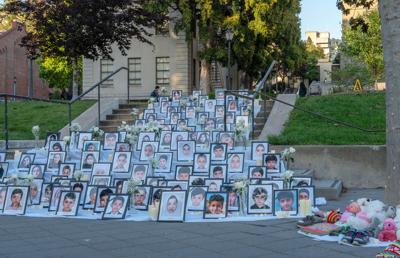
Campus student groups organized a candlelight vigil with more than 100 attendees on Sproul Plaza on Tuesday evening to honor those killed during the Feb. 28 missile strike on Shajareh Tayyebeh Elementary School in Minab, Iran.
U.S. military investigators found the United States were likely responsible for the attack that killed about 168 people, including 110 students.
“The difficulty in having a candlelight vigil is that you hope that it will stop,” said ethnic studies lecturer Hatem Bazian. “But unfortunately, as we’re seeing the development around the world, it doesn’t look like there is any stopping anytime soon.”
Vigil organizers displayed poster boards featuring poetry and photos of the school and those killed in the strike. A projector played a video of Josephine Guilbeau, a former U.S. Army counterterrorism officer, in which she alleged the U.S. strike constituted a war crime. Following Guilbeau’s speech, the projector also played home videos of the children who were killed.
A member of UC Berkeley’s Ahlul Bayt Student Association, who requested anonymity because of fear of retribution, said it took about two weeks to organize the event.
“I’m a graduating senior right now, and seeing these backpacks with red blood on them or these innocent faces, I can’t help but think that I’m so privileged to be able to experience my education at a university,” the member said.
Maryam Farahmand-Asil, UC Berkeley alumna and assistant professor at Northeastern University, first approached Ahlul Bayt Student Association and other student groups to organize the event.
Farahmand-Asil had been planning the event for more than a month with the intention to raise campus awareness of the missile strike.
“About 168 students were killed on a strike in just one day, during school time — they didn’t know that the war happened,” Farahand-Asil said. “We want to raise awareness to all the students … So when they see what’s happened, they just search and they see how they can help.”
Another student group that helped organize the event was the campus chapter of Students for Justice in Palestine.
A member of SJP, who requested anonymity because of fear of retribution, highlighted Sproul as a “great and accessible space” to hold the vigil.
Fateme D. Montazeri, a scholar at campus’s Center for Middle Eastern Studies, said she connected with the event on a personal level.
“I have long followed violence in the Middle East, but this one reached me differently,” Montazeri said. “Was it because the children of Minab spoke my mother tongue? … For the first time, I could not maintain the distance between what I knew and what I felt.”