Bio: Martin Niemöller

From Wikipedia, the free encyclopedia
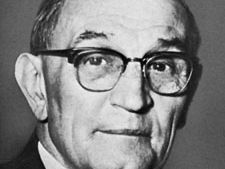
Martin Niemöller
Niemöller at St. James’ ChurchThe Hague, in May 1952
BornFriedrich Gustav Emil Martin Niemöller
14 January 1892
LippstadtGerman Empire
Died6 March 1984 (aged 92)
WiesbadenWest Germany
Spouse(s)Else Bruner ​(m. 1919)​[1]
Children6[1]
ChurchEvangelical Church of the old-Prussian Union
Protestant Church in Hesse and Nassau
Confessing Church
Evangelical Church in Germany
WritingsFirst they came …
Congregations servedSt. Anne’s in Dahlem, Germany
Offices heldPresident, Evangelical Church in Hesse and Nassau (1945–1961)
President, World Council of Churches (1961–1968)
TitleOrdained pastor
Military career
AllegianceGerman Empire
Service/branchImperial German Navy
Battles/warsWorld War I

“First they came for the Communists, and I did not speak out—Because I was not a communist. Then they came for the trade unionists, and I did not speak out—Because I was not a trade unionist. Then they came for the Jews, and I did not speak out—Because I was not a Jew. Then they came for me—and there was no one left to speak for me.”

Martin Niemöller

Friedrich Gustav Emil Martin Niemöller (German: [ˈmaʁtiːn ˈniːmœlɐ] (listen); 14 January 1892 – 6 March 1984) was a German theologian and Lutheran pastor.[2][3] He is best known for his opposition to the Nazi regime during the late 1930s and for his widely quoted 1946 poem “First they came …“. The poem exists in many versions; the one featured on the United States Holocaust Memorial reads: “First they came for the Communists, and I did not speak out—Because I was not a communist. Then they came for the trade unionists, and I did not speak out—Because I was not a trade unionist. Then they came for the Jews, and I did not speak out—Because I was not a Jew. Then they came for me—and there was no one left to speak for me.”

Niemöller was a national conservative and initially a supporter of Adolf Hitler,[4] but he became one of the founders of the Confessing Church, which opposed the Nazification of German Protestant churches. He opposed the Nazis’ Aryan Paragraph,[5] but was also a self-identified antisemite.[6] For his opposition to the Nazis’ state control of the churches, Niemöller was imprisoned in Sachsenhausen and Dachau concentration camps from 1938 to 1945.[7][8] He narrowly escaped execution. After his imprisonment, he expressed his deep regret about not having done enough to help victims of the Nazis.[5] He turned away from his earlier nationalistic beliefs and was one of the initiators of the Stuttgart Declaration of Guilt.[5] From the 1950s on, he was a vocal pacifist and anti-war activist, and vice-chair of War Resisters’ International from 1966 to 1972.[9] He met with Ho Chi Minh during the Vietnam War and was a committed campaigner for nuclear disarmament.[10]

Youth and World War I participation

Niemöller was born in Lippstadt, then in the Prussian Province of Westphalia (now in North Rhine-Westphalia), on 14 January 1892 to the Lutheran pastor Heinrich Niemöller and his wife Pauline (née Müller), and grew up in a very conservative home.[5] In 1900, the family moved to Elberfeld where he finished school, taking his abitur exam in 1908.

He began a career as an officer of the Imperial Navy of the German Empire, and in 1915, was assigned to U-boats. His first boat was SMS Thüringen. In October of that year, he joined the submarine mother boat Vulkan, followed by training on the submarine U-3. In February 1916, he became second officer on U-73, which was assigned to the Mediterranean in April 1916.[11] There the submarine fought on the Saloniki front, patrolled in the Strait of Otranto and from December 1916 onward, planted many mines in front of Port Said and was involved in commerce raiding. Flying a French flag as a ruse of war, the SM U-73 sailed past British warships and torpedoed two Allied troopships and a British man-of-war.

In January 1917, Niemöller was navigator of U-39. Later he returned to Kiel, and in August 1917, he became first officer on U-151, which attacked numerous ships at Gibraltar, in the Bay of Biscay, and other places. During this time, the SM U-151 crew set a record by sinking 55,000 tons of Allied ships in 115 days at sea. In June 1918, he became commander of the UC-67. Under his command, UC-67 achieved a temporary closing of the French port of Marseille by sinking ships in the area, by torpedoes, and by the laying of mines.[11]

For his achievements, Niemöller was awarded the Iron Cross First Class. When the war drew to a close, he decided to become a preacher, a story he later recounted in his book Vom U-Boot zur Kanzel (From U-boat to Pulpit). At war’s end, Niemöller resigned his commission, as he rejected the new democratic government of the German Empire that formed after the abdication of the German Emperor Wilhelm II.

Weimar Republic and education as pastor

On 20 July 1919, he married Else Bremer (20 July 1890 – 7 August 1961). That same year, he began working at a farm in Wersen near Osnabrück but gave up becoming a farmer as he could not afford to buy his own farm. He subsequently pursued his earlier idea of becoming a Lutheran pastor and studied Protestant theology at the Westphalian Wilhelms-University in Münster from 1919 to 1923. His motivation was his ambition to give a disordered society meaning and order through the Gospel and church bodies.

During the Ruhr Uprising in 1920, he was battalion commander of the “III. Bataillon der Akademischen Wehr Münster” belonging to the paramilitary Freikorps.

Niemöller was ordained on 29 June 1924.[11] Subsequently, the united Evangelical Church of the old-Prussian Union appointed him curate of Münster’s Church of the Redeemer. After serving as the superintendent of the Inner Mission in the old-Prussian ecclesiastical province of Westphalia, Niemöller in 1931 became pastor of the Jesus Christus Kirche (comprising a congregation together with St. Anne’s Church) in Dahlem, an affluent suburb of Berlin.[12]

Role in Nazi Germany

Like most Protestant pastors, Niemöller was a national conservative, and openly supported the conservative opponents of the Weimar Republic. He thus welcomed Hitler’s accession to power in 1933, believing that it would bring a national revival.[13]: 235  In his autobiography, From U-Boat to Pulpit published in the spring of 1933, he called the time of “the System” (a pejorative name for the Weimar Republic) the “years of darkness” and hailed Adolf Hitler for beginning a “national revival”.[13]: 235  Niemöller’s autobiography received positive reviews in Nazi newspapers and was a bestseller.[13]: 235  However, he decidedly opposed the Nazis’ “Aryan Paragraph” to Jewish converts to Lutheranism. In 1936, he signed the petition of a group of Protestant churchmen which sharply criticized Nazi policies and declared the Aryan Paragraph incompatible with the Christian virtue of charity.[5]

The Nazi regime reacted with mass arrests and charges against almost 800 pastors and ecclesiastical lawyers.[14] In 1933, Niemöller founded the Pfarrernotbund, an organization of pastors to “combat rising discrimination against Christians of Jewish background”.[12] By the autumn of 1934, Niemöller joined other Lutheran and Protestant churchmen such as Karl Barth and Dietrich Bonhoeffer in founding the Confessional Church, a Protestant group that opposed the Nazification of the German Protestant churches.[12] Author and Nobel Prize laureate Thomas Mann published Niemöller’s sermons in the United States and praised his bravery.[5]

However, Niemöller only gradually abandoned his national conservative views. Even as he opposed the Nazis, he made pejorative remarks about Jews of faith while protecting – in his own church – baptised Christians, persecuted as Jews by the Nazis, due to their forefathers’ Jewish descent. In one sermon in 1935, he remarked: “What is the reason for [their] obvious punishment, which has lasted for thousands of years? Dear brethren, the reason is easily given: the Jews brought the Christ of God to the cross!”[15]

This has led to controversy about his attitude toward Jews and to accusations of anti-JudaismHolocaust historian Robert Michael argues that Niemöller’s statements were a result of traditional anti-Semitism, and that Niemöller agreed with the Nazis’ position on the “Jewish question” at that time.[6][16] American sociologist Werner Cohn lived as a Jew in Nazi Germany, and he also reports on antisemitic statements by Niemöller.[17]

Thus, Niemöller’s ambivalent and often contradictory behaviour during the Nazi period makes him a controversial figure among those who opposed the Nazis. Even his motives are disputed. Historian Raimund Lammersdorf considers Niemöller “an opportunist who had no quarrel with Hitler politically and only began to oppose the Nazis when Hitler threatened to attack the churches”.[18] Others have disputed this view and emphasize the risks that Niemöller took while opposing the Nazis.[5] Nonetheless, Niemöller’s behaviour contrasts sharply with the much more broad-minded attitudes of other Confessing Church activists such as Hermann Maas. Pastor and liberal politician Maas — unlike Niemöller — belonged to those who unequivocally opposed every form of antisemitism and was later accorded the title Righteous Among the Nations by Yad Vashem.[19]

Imprisonment and liberation

Niemöller was arrested on 1 July 1937. On 2 March 1938, he was tried by a “Special Court” for activities against the State. He was given Sonder- und Ehrenhaft status. He received a 2,000 Reichmarks fine and seven-months imprisonment. But as he had been detained pre-trial for longer than the seven-month jail term, he was released by the Court after sentencing. However, he was immediately rearrested by Himmler‘s Gestapo—presumably because Rudolf Hess found the sentence too lenient and decided to take “merciless action” against him.[13] He was interned in Sachsenhausen and Dachau concentration camps for “protective custody” from 1938 to 1945.[20]

He volunteered in September 1939 to become a U-boat commander; his offer was rejected.[21]

His former cellmate, Leo Stein, was released from Sachsenhausen to go to America, and he wrote an article about Niemöller for The National Jewish Monthly in 1941.[4] Stein reports having asked Niemöller why he ever supported the Nazi Party, to which Niemöller replied:

I find myself wondering about that too. I wonder about it as much as I regret it. Still, it is true that Hitler betrayed me. I had an audience with him, as a representative of the Protestant Church, shortly before he became Chancellor, in 1932. Hitler promised me on his word of honor, to protect the Church, and not to issue any anti-Church laws. He also agreed not to allow pogroms against the Jews, assuring me as follows: “There will be restrictions against the Jews, but there will be no ghettos, no pogroms, in Germany.”

I really believed, given the widespread anti-Semitism in Germany, at that time—that Jews should avoid aspiring to Government positions or seats in the Reichstag. There were many Jews, especially among the Zionists, who took a similar stand. Hitler’s assurance satisfied me at the time. On the other hand, I hated the growing atheistic movement, which was fostered and promoted by the Social Democrats and the Communists. Their hostility toward the Church made me pin my hopes on Hitler for a while.

I am paying for that mistake now; and not me alone, but thousands of other persons like me.

In late April 1945, Niemöller – together with about 140 high-ranking prisoners – was transported to the Alpenfestung. The group possibly were to be used as hostages in surrender negotiations. The transport’s SS guards had orders to kill everyone if liberation by the advancing Western Allies became imminent. However, in the south Tyrol region, regular German troops took the inmates into protective custody. The entire group was eventually liberated by advanced units of the U.S. Seventh Army.[22][23]

Later life and death

In 1947, he was denied Nazi victim status.[24] According to Lammersdorf, there had been some attempts to whitewash his past, which were soon followed by harsh criticism because of his role as an NSDAP supporter and his attitude toward Jews.[18] Niemöller himself never denied his own guilt in the time of the Nazi regime. In 1959, he was asked about his former attitude toward Jews by Alfred Wiener, a Jewish researcher into racism and war crimes committed by the Nazi regime. In a letter to Wiener, Niemöller stated that his eight-year imprisonment by the Nazis became the turning point in his life, after which he viewed things differently.[5]

Niemöller was president of the Protestant Church in Hesse and Nassau from 1947 to 1961. He was one of the initiators of the Stuttgart Declaration of Guilt, signed by leading figures in the German Protestant churches. The document acknowledged that the churches had not done enough to resist the Nazis.[25]

Under the impact of a meeting with Otto Hahn (referred to as the “father of nuclear chemistry“) in July 1954, Niemöller became an ardent pacifist and campaigner for nuclear disarmament.[10] He was soon a leading figure in the post-war German peace movement and was even brought to court in 1959 because he had spoken about the military in a very unflattering way.[26][failed verification] His visit to North Vietnam‘s communist ruler Ho Chi Minh at the height of the Vietnam War caused an uproar. Niemöller also took active part in protests against the Vietnam War and the NATO Double-Track Decision.[27]

In 1961, he became president of the World Council of Churches.[12] He was awarded the Lenin Peace Prize in December 1966.

He gave a sermon at the 30 April 1967 dedication of a Protestant “Church of Atonement” in the former Dachau concentration camp, which in 1965 had been partially restored as a memorial site.[28]

Niemöller died at WiesbadenWest Germany, on 6 March 1984, at the age of 92.[2]

More at: https://en.wikipedia.org/wiki/Martin_Niem%C3%B6ller

Vladimir Pozner: How the United States Created Vladimir Putin


YaleUniversity
On September 27, 2018, Yale’s Program in Russian, East European and Eurasian Studies, and the Poynter Fellowship for Journalism hosted Vladimir Pozner, the acclaimed Russian-American journalist and broadcaster. Pozner spoke on the impact of US foreign policy towards Russia after the Soviet Union has been disbanded, and shared his opinions on a range of issues raised by the audience, from the alleged Russian interference in the 2016 US presidential elections, to Skripal poisoning, to the state of independent media in Russia and the US.

(Courtesy of Julia Yepez-Macbeth)

Tarot Card for March 7: The Knight of Swords

The Knight of Swords

When the Knight of Swords comes up to indicate a man, he will be intelligent, subtle and clever. His capacity for abstract thought will be well developed. He is also highly intuitive and perceptive.

His nature will be elusive and ethereal, yet he has a strength and fascination that is hard to deny. He compels attention, except when he doesn’t want it, and at those times you will not even notice him pass by.

Because of the enquiring and analytic nature of his mind, you will often find him involved in occult study, and following spiritual pursuits. Whilst tolerant of those who know less than him, he will not divulge his knowledge easily. Rather those who wish to learn from him must fight to see him clearly, rather than falling for the projections he readily casts around him.

If this man is badly dignified his subtlety turns to manipulation, and his fascination to glamour. In this way, he becomes unprincipled and self-seeking. There is a certain ruthlessness present in the Knight of Swords at all times.

Even when we meet him at his best, he makes a hard task master, and an acutely keen observer. The sword in his hand will quite often be used to cut to the heart of things – and sometimes we will not be comfortable with what is revealed.

When this card comes up to indicate a state of mind in a man not normally seen as a Knight of Swords, we are then dealing with quite another issue. Now we must address the darkest qualities of the card. This is an angry man, who has quite possibly been emotionally hurt, and may well be looking for revenge.

He has the potential to be physically violent and mentally cruel. He is a nasty enemy and somebody who needs to be treated with the utmost caution.

The Knight of Swords

(via angelpaths.com and Alan Blackman)

War in Europe – Drama in Ukraine | DW Documentary

DW Documentary On February 21, 2022, Russian President Vladimir Putin recognized the separatist territories in eastern Ukraine as “independent” and ordered troops into the Russian-backed enclaves. This provoked an international outcry. Three days later, Russia began attacking Ukraine. This two-part documentary gives the background to the escalation of the Ukraine conflict from 2014 to 2021. Through exclusive interviews with international Ukraine experts, politicians and Ukrainian President Zelenskyy himself, the film provides a multi-perspective view of a war that illustrates the troubled relationship between Europe, the US and Russia. Watch Part 2 here: https://youtu.be/g75TCVNCLPk [This documentary was originally released in 2021]

Two Putin documentaries from FRONTLINE/PBS

FRONTLINE PBS | Official In this 2015 documentary, FRONTLINE traces Vladimir Putin’s ascent from unemployed spy to modern-day czar, and investigates the accusations of criminality and corruption that have surrounded his reign in Russia. (Aired 2015) This journalism is made possible by viewers like you. Support your local PBS station here: http://www.pbs.org/donate​. In this 2015 film, a coproduction with the Canadian Broadcasting Corporation, producer Neil Docherty and correspondent Gillian Findlay traced Putin’s career back two decades to his political start in St. Petersburg, where allegations of corruption began almost immediately. Drawing on firsthand accounts from exiled Russian business tycoons, writers and politicians, as well as the exhaustive research of scholar and best-selling “Putin’s Kleptocracy” author Karen Dawisha, the film examined troubling episodes in Putin’s past, from alleged money-laundering activities and ties to organized crime, to a secret personal fortune said to be in the billions. Love FRONTLINE? Find us on the PBS Video App, where there are more than 300 FRONTLINE documentaries available to watch any time: https://to.pbs.org/FLVideoApp​

FRONTLINE PBS | Official Watch author and journalist Masha Gessen’s candid, full interview on Putin and allegations of Russian interference in the 2016 U.S. election – part of FRONTLINE’s media transparency project for our investigation, “Putin’s Revenge.”

More: http://www.pbs.org/wgbh/frontline/int…

Bernardo Kastrup – Decoding Jung’s Metaphysics

“Conscious AI cannot be created because it’s based on a fallacy which is that consciousness can be created. Consciousness is that within which everything is created.”

—Bernardo Kastrup

The Sacred Speaks Conversation starts @ 8:36 We begin by exploring Dr. Kastrup’s history with Jung and philosophers in the 19th and 20th centuries and very quickly move into antiquity through the classicist Peter Kingsley. We discuss the layers of meaning in writing throughout our cultural history, common misunderstandings of texts, positivism of the 19th and 20th centuries, assumptions within systems of thought and belief, the problem of abstractions and interpretations of reality, Aristotelian logic and conflicts with abstractions, quantum systems, maps and logic, intuitionism, maintaining mystery, Pauli & Jung, synchronicity, meaning, myth and language, & reality as mind. Bio: Bernardo Kastrup is the executive director of Essentia Foundation. His work has been leading the modern renaissance of metaphysical idealism, the notion that reality is essentially mental. He has a Ph.D. in philosophy (ontology, philosophy of mind) and another Ph.D. in computer engineering (reconfigurable computing, artificial intelligence). As a scientist, Bernardo has worked for the European Organization for Nuclear Research (CERN) and the Philips Research Laboratories (where the ‘Casimir Effect’ of Quantum Field Theory was discovered). Formulated in detail in many academic papers and books, his ideas have been featured on ‘Scientific American,’ the ‘Institute of Art and Ideas,’ the ‘Blog of the American Philosophical Association’ and ‘Big Think,’ among others.

Venus Conjunct Mars At 0° Aquarius – United We Stand, Divided We Fall

by Astro Butterfly (astrobutterfly.com)

On March 6th, 2022 Venus and Mars leave Capricorn and simultaneously enter Aquarius. This means we also have a Venus-Mars conjunction at the 0° degree of Aquarius

The 0° of any sign is a powerful degree. Conjunctions by themselves come with new cycles and new beginnings. A conjunction at 0° is a very powerful new beginning. 

The 0° degree of Aquarius is the same degree we had the Jupiter-Saturn conjunction in December 2020, so we have a repetition. The Universe is urging us to make some changes – to leave behind old operating models and to embrace the Aquarian approach.

If Jupiter and Saturn spoke for collective developments that impacted us on a collective level, the Venus-Mars conjunction in Aquarius is about how we, as individuals, get to shape the collective

What does Aquarius stand for? Most people associate Aquarius with freedom, rebellion and uniqueness.

But that’s only one side of Aquarius. Let’s not forget that Aquarius is ruled by both Uranus and Saturn. Aquarius is not rebellion for the sake of rebellion.

Venus Conjunct Mars In Aquarius – What Makes Us Human

Aquarius has learned the hard way that one-way power has its limits. Aquarius is still a Saturn sign, but not the top-down, daddy-issues Capricorn Saturn. In Aquarius, the blended Saturn and Uranian qualities are about finding a democratic, inclusive approach. 

To make it clear, by no means Capricorn or Saturn energy is bad, and Aquarius or Uranus good. We are however witnessing the last strike of Pluto in Capricorn, and we get to see more of the shadow manifestation of the sign.

Pluto’s role is to destroy everything that can no longer sustain growth, and in Capricorn, that’s corruption, abuse of power, and the top-down “you do what I say” approach. 

The Capricorn Saturn is the general. I command you to do that. The Aquarius Saturn is the advisory board, the elected MP, the opposition party – those societal forces that work so that there is a democratic distribution of power, and that power is not concentrated in the hands of a few. 

The highest Aquarian goal is not strife and revolution, but inclusion and true democracy.  Aquarius respects individual differences – and focuses on what we share in common, our humanity. 

Aquarius And Prometheus – The Light Of Knowledge

Archetypally, Aquarius is Prometheus who stole the fire from the Gods and gave it to the people. The fire is a metaphor for the light of knowledge and awareness. Uranus, Aquarius’ co-ruler is the lightning that cracks the sky open, bringing insight and clarity where there was darkness. 

Aquarius is a collective Air sign, and it rules the distribution of information. The printed press and now the internet and social media are ruled by Aquarius. Aquarius’ goal is to give everyone the means to become informed.

This is not to say that the media is not manipulating – of course, any institution is exposed to corruption. But the principle of creating an infrastructure where everyone, at least in theory, gets access to information is an Aquarian pursuit.

From Martin Luther, who made the Bible accessible to everyone, to discussion forums where people around the world can share their opinion, through freedom of speech – these are all Aquarian themes. 

Aquarius is the most humanitarian sign, and it rules Human rights. Human rights are rights we have because we exist as human beings – they are not granted by any state.

These universal rights are inherent to us all, regardless of nationality, sex, national or ethnic origin, color, religion, language, or any other status. They range from the most fundamental – the right to life – to those that make life worth living, such as the rights to food, education, work, health, and liberty. 

The Venus-Mars conjunction in Aquarius is asking us to look at what makes us human. Are some people more ‘human’ than others?

Venus Conjunct Mars In Aquarius – We’re All In This Together

If Aries or Leo are individualistic energies that ask us to focus on what makes us different, Aquarius is a collective, inclusive energy that asks us to focus on what we share in common.

The keyword for Aquarius is inclusiveness. How do we create a society where everyone is included, where everyone has a voice?  

Venus and Mars in Aquarius’s goal is to help us see that we’re all in this together

Aquarius invites us to stop the divisiveness, to see where we’re influenced and affected by top-down agendas. Political leaders have nothing to lose. It’s the regular person who gets affected by the decisions of the few.

When we operate from a “me against them”, “good guys vs. bad guys” paradigm, we operate from a win-lose scenario which can easily flip into a lose-lose; NEVER in a win-win. When some of us lose, we all lose.

When we focus on our humanity, we automatically make decisions that are in the support of our greatest collective good. 

The Venus-Mars conjunction in the first degree of Aquarius reminds us that we the people truly have the power to make the world a better place. 

Embracing Aquarian energy comes at a cost. Freedom comes with responsibilities. We are responsible for what happens in our lives.

There’s no more parent figure to act on our behalf (and to blame later), no more good and bad, no more division. We are the ones in charge of shaping our reality. And this is terrifying. But it is also highly liberating. 

Venus And Mars In Aquarius – The Path To Freedom

Coming back to the Promethean myth.

The gods decided to punish Prometheus (Uranus) for stealing the fire and giving it to humans. Zeus chained Prometheus to a rock where an eagle slowly ate his liver. Prometheus was immortal, he couldn’t die, so the ordeal would repeat every day, to eternity.

His salvation came from Chiron. Chiron traded his own immortality to save Prometheus.

What’s interesting is that Chiron orbits between Saturn (the Capricorn principle) and Uranus (the Aquarius principle). Chiron is the bridge between the two, is what it takes to evolve from Saturn’s material limitations to Uranus’ freedom and liberation. 

The myth is a metaphor for the work we need to do as individuals to transcend the pain of separation and find true freedom. Chiron was a half-man, half-horse, which is a metaphor for the dual nature of our existence. We are 50% matter, 50% spirit.

When we don’t integrate our animal and our godly side, this is when we polarize the good and the bad and end up with the ‘good guys’ vs. the ‘bad guys’, right vs. wrong.

But when we integrate this duality, when we recognize that all these qualities can all be found within ourselves  – both positive and negative – we are no longer triggered by division, and witness humanity: in ourselves and others

Should You Still Wear a Mask?

Experts weigh in on where, and when, you can safely take one off.

Credit…Tim Peacock

By Amelia Nierenberg and Illustrations by Tim Peacock

Feb. 25, 2022 Leer en español (NYTimes.com)

As masking mandates lift and new coronavirus infections fall across the United States, there’s lots of confusion about if, and when, to wear a mask.

“This is the hardest thing of all, because it’s not just the risks and benefits to you,” said Dr. Robert Wachter, a professor and the chair of the medicine department at the University of California, San Francisco. “It’s the risks and benefits to the people around you.”

One good way to frame the issue is to ask: Who is the most vulnerable person in your immediate circle?

If you have compromised immunity, for example, or live with someone who does, it’s a good idea to continue to wear a mask and maintain social distance around strangers, especially in indoor areas with standing air where the virus may collect. Masks are also important if you’re unvaccinated or spending time with others who are unvaccinated. Unvaccinated people are at overwhelmingly higher risk of hospitalization and death from Covid-19. Masks are also a must in hospitals, where there are many vulnerable people.

But if you’re otherwise healthy and have received your vaccine and booster shots, your risk of getting seriously ill with Covid is extraordinarily small. It’s about in line with other risks people take every day, such as driving in a car.

Many people “are weighing the fact that they would love to go back to normal and may be willing to accept a little bit of risk in order to gain a level of simplicity that they last knew in 2019,” Dr. Wachter said. “That’s not irrational.”

There’s also always the risk that someone may develop long-Covid, even if they are vaccinated, though much about the condition remains unknown.

If infection rates where you live are high, which has been pretty much everywhere during the latest Omicron wave, the Centers for Disease Control and Prevention continues to recommend masks in most indoor spaces. But in many situations, the decision to wear a mask is becoming a personal one.

We spoke to experts to help give you a guide to the places, and the situations, where it’s a good idea to cover your face.

There’s little scientific evidence to show that face coverings offer much added protection in many outdoor spaces such as sidewalks or parks. Things get a little hairier with crowds, like at a concert or sports venue.

“If you can’t feel wind on your cheeks, you’re probably not in an area of great outdoor ventilation,” said Dr. Asaf Bitton, a primary care doctor who is the executive director of Ariadne Labs, a public health innovation center at Brigham and Women’s Hospital and the Harvard T.H. Chan School of Public Health. “If you’re really shoulder-to-shoulder with people, that might be a case of outdoor mask wearing, at least for now.”

Erin Bromage, an associate professor of biology who studies infectious diseases at the University of Massachusetts Dartmouth, has helped touring music bands assess Covid risks throughout the pandemic. The main place he’s seen risk of transmission in concerts is in the standing-room-only area close to the stage.

“Where the risk is mainly focused is the pits at the very, very front of the stage where people are on top of each other singing, physically exerting,” Dr. Bromage said.

Most outdoor concerts, though, are generally safe, he said. “If you’re standing on a lawn watching a show, there’s really no data to support that a mask does anything to protect you that Mother Nature’s not taking care of.”

And if the venue requires vaccines or a recent negative Covid test, you’re in even better shape.

First and foremost, follow the norms and the rules of the business you’re entering. If the sign at the door says “Mask Required,” you don’t want to make retail workers have to enforce policies over which they have no control. Their jobs are hard enough, and everyone can wear a mask with little to no sacrifice.

If the business is mask optional, consider the space, the crowds and the airflow.

Dr. Bromage suggests a cigarette analogy: If someone were smoking, would the smell and taste of cigarettes quickly fill the air? If yes, so would the virus. You’d be smart to wear a mask. If not, it’s unlikely that you’ll get infected.

“When I walk into a space, I always do that,” Dr. Bromage said. “How high are the ceilings? Is the air moving? Can I create my own little buffer of space?”

The Coronavirus Pandemic: Latest Updates

Updated March 6, 2022

Take a big box store with high ceilings. “Those tend to have good ventilation and because of the high ceilings, there’s a lot of dilution,” said Linsey Marr, an engineering professor at Virginia Tech who studies the airborne transmission of viruses. “The risks are pretty low, unless you’re in a crowded line waiting to check out.”

“If it’s a smaller space and crowded space, Trader Joe’s, for example, or some New York market with tiny aisles and people are really packed in there, the risk is higher,” she continued. “You might want to wear a mask.”

A hair salon might be a small space, Dr. Bromage said, but there typically won’t be that many people inside the business, so the risk of an infected person passing through will generally be low, especially as case counts fall.

At a restaurant, one person’s cigarette smoke at the next table over wouldn’t fill the air above yours. But you would smell someone smoking at your own table, so your direct dining companions pose the highest risk, Dr. Bromage said.

The gym may feel especially scary. Heavier breathing can expel more virus particles, but most gyms have excellent ventilation systems. (“If gyms did not have good air circulation, they would stink,” Dr. Bromage said.) That means any virus particles that may be floating around are also being sucked away with the sweat smell.

Dr. Bromage again uses the cigarette analogy. He’d run on the treadmill unmasked, but he’d put an extra treadmill between himself and another runner. But a spin class, in a small room with “people shouting, yelling, huffing puffing”? Probably not yet, he said.

Public transit is exempt from local mandates: You are still required to wear a mask, per federal requirements.

It’s also just a good idea — on buses and subways, there are a lot of strangers moving in and out of a tight, enclosed space.

“That is somewhere I would probably still wear a mask,” Dr. Marr said.

On airplanes, you should definitely wear a mask. There’s no national mandate requiring airline passengers to be vaccinated, so even if you’re vaccinated, you don’t know the status of the people around you.

Also, you don’t want to ruin your vacation or business trip by becoming infected and having to quarantine, even if your risk of becoming seriously sick remains low.

Public health experts agree that school mask mandates should not last forever, but they differ on whether the time has come to remove them. For parents, changing rules can be confusing.

Here are a few things to consider in making the choice for your own family.

Children almost never suffer severe symptoms, whether or not they’re vaccinated. Many students have gone to school without masks during the pandemic — like in Britain, part of Europe and many U.S. states — and very few children have gotten seriously sick.

“The risk to children has always been lower than it is to adults,” said Dr. David Rubin, a professor of pediatrics at the Perelman School of Medicine at the University of Pennsylvania.

The jury is also still out on whether masks impede social development. But several studies do suggest that a mask makes communication difficult, inhibiting children’s ability to recognize one another or each other’s emotions.

“Children and their schools have had to shoulder a collective burden, largely to protect the adults in their lives,” said Dr. Rubin, who is also the director of PolicyLab at Children’s Hospital of Philadelphia.

And as much of the world opens up, consider all the ways children hang out with each other. Masks may stop transmission in the classroom itself, but children interact outside of school hours.

“Masks don’t work when people are wearing them in one circumstance, but later that day, they take them off,” said Dr. Bromage, who has consulted with schools about different mask policies. “All we’re doing is transferring infection from the school to after school.”

Also, know that the United States is an outlier in its devotion to pediatric masks. The World Health Organization does not recommend them for kids under 5, and the European Centre for Disease Prevention and Control doesn’t recommend them for children under 12.

Covid is not the only bug floating around, nor is it the only one that can be harmful to vulnerable people. The flu, for example, kills more than 30,000 Americans in a typical season, most of whom are older adults or immunocompromised.

“Flus and colds are probably transmitted the same way as Covid,” Dr. Marr said. “If you feel a little sick, then you could be shedding virus into the air and transmitting to other people. You should stay home or, if you must go out, wear a mask.”

A well-fitting, high quality mask will protect you, experts say, even if other people aren’t covering their airways.

KN95, N95 and KF94 masks are the best protection around, just make sure they’re not counterfeit. Cloth masks offer limited protection — especially if you don’t add a filter or a second mask — and surgical masks often gape.

Here’s a Wirecutter guide to buying N95 and KN95 masks, and here’s how to spot a fake.

(Contributed by Michael Kelly, H.W.)

Book: “Reality”

Book Cover

Reality

Peter Kingsley

Reality introduces us to the extraordinary mystical tradition that lies right at the roots of western culture. This is the true story of Parmenides, Empedocles, and those like them: spiritual guides and experts in other states of consciousness, healers and interpreters of dreams, prophets and magicians who laid the foundation for the world we now live in. Reality documents the excruciating process that led to their work and teaching being distorted, covered over, forgotten. And most importantly, it presents these original teachings in all their immediacy and power—revealing their ability, just as vibrant now as at the dawn of the western world, to awaken us to what reality truly is.

(Goodreads.com)

The Backdoor to Immortality: Marguerite Duras on What Makes Life Worth Living in the Face of Death

By Maria Popova (brainpickings.org)

“What exists, exists so that it can be lost and become precious,” Lisel Mueller wrote as she weighed what gives meaning to our mortal lives in a stunning poem — one of the hundreds that outlived her as she returned her borrowed stardust to the universe at ninety-six. And yet, by some felicitous deviation from logic — perhaps an adaptive imbecility essential for our mental and emotional survival, one of the touching incongruences that make us human — the moment something becomes precious to us, we quarantine the prospect of its loss in some chamber of the mind we choose not to enter. On some deep level beyond the reach of reason, we come to believe that the people we love are — must be, for the alternative is a fathomless terror — immortal.

And so, when a loved one dies, this deepest part of us grows wild with rage at the universe — a rage skinned of sensemaking, irrational and raw, unsalved by our knowledge that the entropic destiny of everything alive is to die and of everything that exists to eventually not, even the universe itself; unsalved by the the immense cosmic poetry hidden in this fact; unsalved by the luckiness of having lived at all against the staggering cosmic odds otherwise; unsalved by remembering that only because ancient archaebacteria were capable of dying, as was every organism that evolved in their wake, we and the people we love and the people we lose came to exist at all.

Marguerite Duras

The French novelist, playwright, essayist, and filmmaker Marguerite Duras (April 4, 1914–March 3, 1996) captures this bewildering rage in the final pages of The Lover (public library) — her autobiographical novel about a writer creating herself as a woman and an artist in the act of writing, published the year I was born, some 3.7 billion years after the first archaebacterium began mutating and died.

When the novel’s protagonist-narrator receives a telegram from Saigon, carrying news that her younger brother has been killed at twenty-seven, she receives the news as a kind of mistake, a “momentary error” eclipsing the universe, filling her soul with outrage “on the scale of God.” She realizes with the stab of hindsight that her brother had always appeared immortal to her, purely by virtue of being her beloved brother. Duras writes:

The error, the outrage, filled the whole universe… People ought to be told of such things. Ought to be taught that immortality is mortal, that it can die, it’s happened before and it happens still. It doesn’t ever announce itself as such — it’s duplicity itself. It doesn’t exist in detail, only in principle. Certain people may harbor it, on condition they don’t know that’s what they’re doing. Just as certain other people may detect its presence in them, on the same condition, that they don’t know they can.

With this, Duras turns to what fills our fragile mortality with meaning — what consecrates it with the sort of transcendence we might experience as joy, or art, or love. A century and a half after Mary Shelley contemplated what makes life worth living as she envisioned a world savaged by a deadly pandemic, and a century after Walt Whitman contemplated what makes life worth living after a paralytic stroke made him confront his own mortality, Duras arrives at a kindred conclusion:

It’s while it’s being lived that life is immortal, while it’s still alive. Immortality is not a matter of more or less time, it’s not really a question of immortality but of something else that remains unknown. It’s as untrue to say it’s without beginning or end as to say it begins and ends with the life of the spirit, since it partakes both of the spirit and of the pursuit of the void.

Art by Giuliano Cucco from Before I Grew Up — a lyrical elegy for life, loss, and our search for life.

This harmonic of life and death sings from the pages of Duras’s posthumous published wartime notebooks, in one of which she reflects on the Mekong River of her native Vietnam as she traverses aboard a ferry:

All around the ferry is the river, it’s brimful, its moving waters… The river has picked up all it has met with since Tonle Sap and the Cambodian forest. It carries everything along, straw huts, forests, burned-out fires, dead birds, dead dogs, drowned tigers and buffaloes, drowned men, bait, islands of water hyacinths all stuck together. Everything flows toward the Pacific, no time for anything to sink, all is swept along by the deep and headlong storm of the inner current, suspended on the surface of the river’s strength.

Complement with artist, poet, and philosopher Etel Adnan, who lived to ninety-five, on how to live and how to die, Olivia Laing on life, loss, and the wisdom of rivers, and mathematician Michael Frame’s uncommonly original perspective on how fractals can help us fathom loss and reorient to the ongoingness of life.