Is Consciousness Everywhere?

Experience is in unexpected places, including in all animals, large and small, and perhaps even in brute matter itself.

MIT Press Reader (getpocket.com)

  • Christof Koch

a group of honey bees looking into a hive hole

Honey bees can recognize faces, communicate the location and quality of food sources to their sisters via the waggle dance, and navigate complex mazes with the help of cues they store in short-term memory. Image: Boba Jaglicic/Unsplash

What is common between the delectable taste of a favorite food, the sharp sting of an infected tooth, the fullness after a heavy meal, the slow passage of time while waiting, the willing of a deliberate act, and the mixture of vitality, tinged with anxiety, just before a competitive event?

All are distinct experiences. What cuts across each is that all are subjective states, and all are consciously felt. Accounting for the nature of consciousness appears elusive, with many claiming that it cannot be defined at all, yet defining it is actually straightforward. Here goes: Consciousness is experience.

This article is adapted from Christof Koch’s book “The Feeling of Life Itself.” Koch is chief scientist of the MindScope Program at the Allen Institute for Brain Science.

That’s it. Consciousness is any experience, from the most mundane to the most exalted. Some distinguish awareness from consciousness; I don’t find this distinction helpful and so I use these two words interchangeably. I also do not distinguish between feeling and experience, although in everyday use feeling is usually reserved for strong emotions, such as feeling angry or in love. As I use it, any feeling is an experience. Collectively taken, then, consciousness is lived reality. It is the feeling of life itself.

But who else, besides myself, has experiences? Because you are so similar to me, I abduce that you do. The same logic applies to other people. Apart from the occasional solitary solipsist this is uncontroversial. But how widespread is consciousness in the cosmos at large? How far consciousness extends its dominion within the tree of life becomes more difficult to abduce as species become more alien to us.

One line of argument takes the principles of integrated information theory (IIT) to their logical conclusion. Some level of experience can be found in all organisms, it says, including perhaps in Paramecium and other single-cell life forms. Indeed, according to IIT, which aims to precisely define both the quality and the quantity of any one conscious experience, experience may not even be restricted to biological entities but might extend to non-evolved physical systems previously assumed to be mindless — a pleasing and parsimonious conclusion about the makeup of the universe.


How Widespread Is Consciousness in the Tree of Life?

The evolutionary relationship among bacteria, fungi, plants, and animals is commonly visualized using the tree of life metaphor. All living species, whether fly, mouse, or person, lie somewhere on the periphery of the tree, all equally adapted to their particular ecological niches.

Every living organism descends in an unbroken lineage from the last universal common ancestor (abbreviated to a charming LUCA) of planetary life. This hypothetical species lived an unfathomable 3.5 billion years ago, smack at the center of the tree-of-life mandala. Evolution explains not only the makeup of our bodies but also the constitution of our minds — for they don’t get a special dispensation.

The tree of life: Based on the complexity of their behavior and nervous systems, it is likely that it feels like something to be a bird, mammal (marked by *), insect, and cephalopod — represented here by a crow, dog, bee, and octopus. The extent to which consciousness is shared across the entire animal kingdom, let alone across all of life’s vast domain, is at present difficult to establish. The last universal common ancestor of all living things is at the center, with time radiating outward.

Given the similarities at the behavioral, physiological, anatomical, developmental, and genetic levels between Homo sapiens and other mammals, I have no reason to doubt that all of us experience the sounds and sights, the pains and pleasures of life, albeit not necessarily as richly as we do. All of us strive to eat and drink, to procreate, to avoid injury and death; we bask in the sun’s warming rays, we seek the company of conspecifics, we fear predators, we sleep, and we dream.

While mammalian consciousness depends on a functioning six-layered neocortex, this does not imply that animals without a neocortex do not feel. Again, the similarities between the structure, dynamics, and genetic specification of nervous systems of all tetrapods — mammals, amphibians, birds (in particular ravens, crows, magpies, parrots), and reptiles — allows me to abduce that they too experience the world. A similar inference can be made for other creatures with a backbone, such as fish.

But why be a vertebrate chauvinist? The tree of life is populated by a throng of invertebrates that move about, sense their environment, learn from prior experience, display all the trappings of emotions, communicate with others — insects, crabs, worms, octopuses, and on and on. We might balk at the idea that tiny buzzing flies or diaphanous pulsating jellyfish, so foreign in form, have experiences.

Yet honey bees can recognize faces, communicate the location and quality of food sources to their sisters via the waggle dance, and navigate complex mazes with the help of cues they store in short-term memory. A scent blown into a hive can trigger a return to the place where the bees previously encountered this odor, a type of associative memory. Bees have collective decision-making skills that, in their efficiency, put any academic faculty committee to shame. This “wisdom of the crowd” phenomenon has been studied during swarming, when a queen and thousands of her workers split off from the main colony and chooses a new hive that must satisfy multiple demands crucial to group survival (think of that when you go house hunting). Bumble bees can even learn to use a tool after watching other bees use them.

Charles Darwin, in an 1881 book on earthworms, wanted “to learn how far the worms acted consciously and how much mental power they displayed.” Studying their feeding behaviors, Darwin concluded that there was no absolute threshold between complex and simple animals that assigned higher mental powers to one but not to the other. No one has discovered a Rubicon that separates sentient from nonsentient creatures.

Of course, the richness and diversity of animal consciousness will diminish as their nervous system becomes simpler and more primitive, eventually turning into a loosely organized neural net. As the pace of the underlying assemblies becomes more sluggish, the dynamics of the organisms’ experiences will slow down as well.

Does experience even require a nervous system? We don’t know. It has been asserted that trees, members of the kingdom of plants, can communicate with each other in unexpected ways, and that they adapt and learn. Of course, all of that can happen without experience. So I would say the evidence is intriguing but very preliminary. As we step down the ladder of complexity rung by rung, how far down do we go before there is not even an inkling of awareness? Again, we don’t know. We have reached the limits of abduction based on similarity with the only subject we have direct acquaintance with — ourselves.


Consciousness in the Universe

IIT offers a different chain of reasoning. The theory precisely answers the question of who can have an experience: anything with a non-zero maximum of integrated information; anything that has intrinsic causal powers is considered a Whole. What this Whole feels, its experience, is given by its maximally irreducible cause-effect structure. How much it exists is given by its integrated information.

In other words, the theory doesn’t stipulate that there is some magical threshold for experience to switch on. The degree of consciousness is instead measured with Φ, or phi. If phi is zero, then the system doesn’t exist for itself; anything with Φmax greater than zero exists for itself, has an inner view, and has some degree of irreducibility — the larger this number, the more conscious it is. And that means there are a lot of Wholes out there.

Certainly, this includes people and other mammals with neocortex, which we clinically know to be the substrate of experience. But fish, birds, reptiles, and amphibians also possess a telencephalon — the largest and most highly developed part of the brain — that is evolutionarily related to mammalian cortex. Given the attendant circuit complexity, the intrinsic causal power of the telencephalon is likely to be high.

When considering the neural architecture of creatures very different from us, such as the honey bee, we are confronted by vast and untamed neuronal complexity — about one million neurons within a volume the size of a grain of quinoa, a circuit density 10 times higher than that of our neocortex of which we are so proud. And unlike our cerebellum, the bee’s mushroom-shaped body is heavily recurrently connected. It is likely that this little brain forms a maximally irreducible cause-effect structure.

Integrated information is not about input–output processing, function or cognition, but about intrinsic cause-effect power. Having liberated itself from the myth that consciousness is intimately related to intelligence, the theory is free to discard the shackles of nervous systems and to locate intrinsic causal power in mechanisms that do not compute in any conventional sense.

A case in point is that of single-cell organisms, such as Paramecium, the animalcules discovered by the early microscopists in the late 17th century. Protozoa propel themselves through water by whiplash movements of tiny hairs, avoid obstacles, detect food, and display adaptive responses. Because of their minuscule size and strange habitats, we don’t think of them as sentient. But they challenge our presuppositions. One of the early students of such microorganisms, H. S. Jennings, expressed this well:

The writer is thoroughly convinced, after long study of the behavior of this organism, that if Amoeba were a large animal, so as to come within the everyday experience of human beings, its behavior would at once call forth the attribution to it of states of pleasure and pain, of hunger, desire, and the like, on precisely the same basis as we attribute these things to the dog.

Among the best-studied of all organisms are the even smaller Escherichia coli, bacteria that can cause food-poisoning. Their rod-shaped bodies, about the size of a synapse, house several million proteins inside their protective cell wall. No one has modeled in full such vast complexity. Given this byzantine intricacy, the causal power of a bacterium upon itself is unlikely to be zero. Per IIT, it is likely that it feels like something to be a bacterium. It won’t be upset about its pear-shaped body; no one will ever study the psychology of a microorganism. But there will be a tiny glow of experience. This glow will disappear once the bacterium dissolves into its constituent organelles.

Let us travel down further in scale, transitioning from biology to the simpler worlds of chemistry and physics, and compute the intrinsic causal power of a protein molecule, an atomic nucleus or even a single proton. Per the standard model of physics, protons and neutrons are made out of three quarks with fractional electrical charge. Quarks are never observed by themselves. It is therefore possible that atoms constitute an irreducible Whole, a modicum of “enminded” matter. How does it feel to be a single atom compared to the roughly 1026 atoms making up a human brain? Given that its integrated information is presumably barely above zero, just a minute bagatelle, a this-rather-than-not-this?

To wrap your mind around this possibility that violates Western cultural sensibilities, consider an instructive analogy. The average temperature of the universe is determined by the afterglow left over from the Big Bang, the cosmic microwave background radiation. It evenly pervades space at an effective temperature of 2.73° above absolute zero. This is utterly frigid, hundreds of degrees colder than any temperature terrestrial organisms can survive. But the fact that the temperature is non-zero implies a corresponding tiny amount of heat in deep space. This of course implies a corresponding tiny amount of experience.

To the extent that I’m discussing the mental with respect to single-cell organisms let alone atoms, I have entered the realm of pure speculation, something I have been trained all my life as a scientist to avoid. Yet three considerations prompt me to cast caution to the wind.

First, these ideas are straightforward extensions of IIT — constructed to explain human-level consciousness — to vastly different aspects of physical reality. This is one of the hallmarks of a powerful scientific theory — predicting phenomena by extrapolating to conditions far from the theory’s original remit. There are many precedents — that the passage of time depends on how fast you travel, that spacetime can break down at singularities known as black holes, that people, butterflies, vegetables, and the bacteria in your gut use the same mechanism to store and copy their genetic information, and so on.

Second, I admire the elegance and beauty of this prediction. (Yes, I’m perfectly cognizant that the last 40 years in theoretical physics have provided ample proof that chasing after elegant theories has yielded no new, empirically testable evidence describing the actual universe we live in.) The mental does not appear abruptly out of the physical. As Leibniz expressed it, natura non facit saltus, or nature does not make sudden leaps (Leibniz was, after all, the co-inventor of infinitesimal calculus). The absence of discontinuities is also a bedrock element of Darwinian thought.

Intrinsic causal power does away with the challenge of how mind emerges from matter. IIT stipulates that it is there all along.

Third, IIT’s prediction that the mental is much more widespread than traditionally assumed resonates with an ancient school of thought: panpsychism.


Many but Not All Things Are Enminded

Common to panpsychism in its various guises is the belief that soul (psyche) is in everything (pan), or is ubiquitous; not only in animals and plants but all the way down to the ultimate constituents of matter — atoms, fields, strings, or whatever. Panpsychism assumes that any physical mechanism either is conscious, is made out of conscious parts, or forms part of a greater conscious whole.

Some of the brightest minds in the West took the position that matter and soul are one substance. This includes the pre-Socratic philosophers of ancient Greece, Thales, and Anaxagoras. Plato espoused such ideas, as did the Renaissance cosmologist Giordano Bruno (burned at the stake in 1600), Arthur Schopenhauer, and the 20th-century paleontologist and Jesuit Teilhard de Chardin (whose books, defending evolutionary views on consciousness, were banned by his church until his death).

Particularly striking are the many scientists and mathematicians with well-articulated panpsychist views. Foremost, of course, is Leibniz. But we can also include the three scientists who pioneered psychology and psychophysics — Gustav Fechner, Wilhelm Wundt, and William James — and the astronomer and mathematicians Arthur Eddington, Alfred North Whitehead, and Bertrand Russell. With the modern devaluation of metaphysics and the rise of analytic philosophy, the last century evicted the mental entirely, not only from most university departments but also from the universe at large. But this denial of consciousness is now being viewed as the “Great Silliness,” and panpsychism is undergoing a revival within the academe.

Debates concerning what exists are organized around two poles: materialism and idealism. Materialism, and its modern version known as physicalism, has profited immensely from Galileo Galilei’s pragmatic stance of removing mind from the objects it studies in order to describe and quantify nature from the perspective of an outside observer. It has done so at the cost of ignoring the central aspect of reality — experience. Erwin Schrödinger, one of the founders of quantum mechanics, after whom its most famous equation is named, expressed this clearly:

The strange fact [is] that on the one hand all our knowledge about the world around us, both that gained in everyday life and that revealed by the most carefully planned and painstaking laboratory experiments, rests entirely on immediate sense perception, while on the other hand this knowledge fails to reveal the relations of the sense perceptions to the outside world, so that in the picture or model we form of the outside world, guided by our scientific discoveries, all sensual qualities are absent.

Idealism, on the other hand, has nothing productive to say about the physical world, as it is held to be a figment of the mind. Cartesian dualism accepts both in a strained marriage in which the two partners live out their lives in parallel, without speaking to each other (this is the interaction problem: how does matter interact with the ephemeral mind?). Behaving like a thwarted lover, analytic, logical-positivist philosophy denies the legitimacy and, in its more extreme version, even the very existence of one partner in the mental-physical relationship. It does so to obfuscate its inability to deal with the mental.

Panpsychism is unitary. There is only one substance, not two. This elegantly eliminates the need to explain how the mental emerges out of the physical and vice versa. Both coexist.

But panpsychism’s beauty is barren. Besides claiming that everything has both intrinsic and extrinsic aspects, it has nothing constructive to say about the relationship between the two. Where is the experiential difference between one lone atom zipping around in interstellar space, the hundred trillion trillion making up a human brain, and the uncountable atoms making up a sandy beach? Panpsychism is silent on such questions.

IIT shares many insights with panpsychism, starting with the fundamental premise that consciousness is an intrinsic, fundamental aspect of reality. Both approaches argue that consciousness is present across the animal kingdom to varying degrees.

All else being equal, integrated information, and with it the richness of experience, increases as the complexity of the associated nervous system grows, although sheer number of neurons is not a guarantee, as shown by the cerebellum. Consciousness waxes and wanes diurnally with alertness and sleep. It changes across the lifespan — becoming richer as we grow from a fetus into a teenager and mature into an adult with a fully developed cortex. It increases when we become familiar with romantic and sexual relationships, with alcohol and drugs, and when we acquire appreciation for games, sports, novels, and art; and it will slowly disintegrate as our aging brains wear out.

Most importantly, though, IIT is a scientific theory, unlike panpsychism. IIT predicts the relationship between neural circuits and the quantity and quality of experience, how to build an instrument to detect experience, pure experience (consciousness without any content) and how to enlarge consciousness by brain-bridging, why certain parts of the brain have it and others not (the posterior cortex versus the cerebellum), why brains with human-level consciousness evolved, and why conventional computers have only a tiny bit of it.

When lecturing about these matters, I often get the you’ve-got-to-be-kidding-stare. This passes once I explain how neither panpsychism nor IIT claim that elementary particles have thoughts or other cognitive processes. Panpsychism does, however, have an Achilles’ heel — the combination problem, a problem that IIT has squarely solved.


On the Impossibility of Group Mind, or Why Your Neurons Are Not Conscious

William James gave a memorable example of the combination problem in the foundational text of American psychology, “The Principles of Psychology” (1890):

Take a sentence of a dozen words, and take twelve men and tell to each one word. Then stand the men in a row or jam them in a bunch, and let each think of his word as intently as he will; nowhere will there be a consciousness of the whole sentence.

Experiences do not aggregate into larger, superordinate experiences. Closely interacting lovers, dancers, athletes, soldiers, and so on do not give rise to a group mind, with experiences above and beyond those of the individuals making up the group. John Searle wrote:

Consciousness cannot spread over the universe like a thin veneer of jam; there has to be a point where my consciousness ends and yours begins.

Panpsychism has not provided a satisfactory answer as to why this should be so. But IIT does. IIT postulates that only maxima of integrated information exist. This is a consequence of the exclusion axiom — any conscious experience is definite, with borders. Certain aspects of experience are in, while a vast universe of possible feelings are out.

The mind–body problem resolved? Integrated information theory posits that any one conscious experience, here that of looking at a Bernese mountain dog, is identical to a maximally irreducible cause-effect structure. Its physical substrate, its Whole, is the operationally defined neural correlate of consciousness. The experience is formed by the Whole but is not identical to it.

Consider the image above, in which I’m looking at my dog Ruby and have a particular visual experience, a maximally irreducible cause-effect structure. It is constituted by the underlying physical substrate, the Whole, here a particular neural correlate of consciousness within the hot zone in my posterior cortex. But the experience is not identical to the Whole. My experience is not my brain.

This Whole has definite borders; a particular neuron is either part of it or not. The latter is true even if this neuron provides some synaptic input to the Whole. What defines the Whole is a maximum of integrated information, with the maximum being evaluated over all spatiotemporal scales and levels of granularities, such as molecules, proteins, subcellular organelles, single neurons, large ensembles of them, the environment the brain interacts with, and so on.

It is the irreducible Whole that forms my conscious experience, not the underlying neurons. So not only is my experience not my brain, but most certainly it is not my individual neurons. While a handful of cultured neurons in a dish may have an itsy-bitsy amount of experience, forming a mini-mind, the hundreds of millions neurons making up my posterior cortex do not embody a collection of millions of mini-minds. There is only one mind, my mind, constituted by the Whole in my brain.

Other Wholes may exist in my brain, or my body, as long as they don’t share elements with the posterior hot zone Whole. Thus, it may feel like something to be my liver, but given the very limited interactions among liver cells, I doubt it feels like a lot.

The exclusion principle also explains why consciousness ceases during slow sleep. At this time, delta waves dominate the EEG and cortical neurons have regular hyperpolarized down-states during which they are silent, interspersed by active up-states when neurons are more depolarized. These on- and off-periods are regionally coordinated. As a consequence, the cortical Whole breaks down, shattering into small cliques of interacting neurons. Each one probably has only a whit of integrated information. Effectively, “my” consciousness vanishes in deep sleep, replaced by myriad of tiny Wholes, none of which is remembered upon awakening.

The exclusion postulate also dictates whether or not an aggregate of conscious entities — ants in a colony, cells making up a tree, bees in a hive, starlings in a murmurating flock, an octopus with its eight semiautonomous arms, or the hundreds of Chinese dancers and musicians during the choreographed opening ceremony of the 2008 Olympic games in Beijing — exist as conscious entities. A herd of buffalo during a stampede or a crowd can act as if it had “one mind,” but this remains a mere figure of speech unless there is a phenomenal entity that feels like something above and beyond the experiences of the individuals making up the group. Per IIT, this would require the extinction of the individual Wholes, as the integrated information for each of them is less than the Φmax of the Whole. Everybody in the crowd would give up his or her individual consciousness to the mind of the group, like being assimilated into the hive mind of the Borg in the “Star Trek” universe.

IIT’s exclusion postulate does not permit the simultaneous existence of both individual and group mind. Thus, the Anima Mundi or world soul is ruled out, as it requires that the mind of all sentient beings be extinguished in favor of the all-encompassing soul. Likewise, it does not feel like anything to be the three hundred million citizens of the United States of America. As an entity, the United States has considerable extrinsic causal powers, such as the power to execute its citizens or start a war. But the country does not have maximally irreducible intrinsic cause-effect power. Countries, corporations, and other group agents exist as powerful military, economic, financial, legal, and cultural entities. They are aggregates but not Wholes. They have no phenomenal reality and no intrinsic causal power.

Thus, per IIT, single cells may have some intrinsic existence, but this does not necessarily hold for the microbiome or trees. Animals and people exist for themselves, but herds and crowds do not. Maybe even atoms exist for themselves, but certainly not spoons, chairs, dunes, or the universe at large.

IIT posits two sides to every Whole: an exterior aspect, known to the world and interacting with other objects, including other Wholes; and an interior aspect, what it feels like, its experience. It is a solitary existence, with no direct windows into the interior of other Wholes. Two or more Wholes can fuse to give rise to a larger Whole but at the cost of losing their previous identity.

Finally, panpsychism has nothing intelligible to say about consciousness in machines. But IIT does. Conventional digital computers, built out of circuit components with sparse connectivity and little overlap among their inputs and their outputs, do not constitute a Whole. Computers have only a tiny amount of highly fragmented intrinsic cause-effect power, no matter what software they are executing and no matter their computational power. Androids, if their physical circuitry is anything like today’s CPUs, cannot dream of electric sheep. It is, of course, possible to build computing machinery that closely mimics neuronal architectures. Such neuromorphic engineering artifacts could have lots of integrated information. But we are far from those.

IIT can be thought of as an extension of physics to the central fact of our lives — consciousness. Textbook physics deals with the interaction of objects with each other, dictated by extrinsic causal powers. My and your experiences are the way brains with irreducible intrinsic causal powers feel like from the inside.

IIT offers a principled, coherent, testable, and elegant account of the relationship between these two seemingly disparate domains of existence — the physical and the mental — grounded in extrinsic and intrinsic causal powers. Causal power of two different kinds is the only sort of stuff needed to explain everything in the universe. These powers constitute ultimate reality.

Further experimental work will be essential to validate, modify, or perhaps even reject these views. If history is any guide, future discoveries in laboratories and clinics, or perhaps off-planet, will surprise us.

We have come to the end of our voyage. Illuminated by the light of our pole star — consciousness — the universe reveals itself to be an orderly place. It is far more enminded than modernity, blinded by its technological supremacy over the natural world, takes it to be. It is a view more in line with earlier traditions that respected and feared the natural world.

Experience is in unexpected places, including in all animals, large and small, and perhaps even in brute matter itself. But consciousness is not in digital computers running software, even when they speak in tongues. Ever-more powerful machines will trade in fake consciousness, which will, perhaps, fool most. But precisely because of the looming confrontation between natural, evolved and artificial, engineered intelligence, it is absolutely essential to assert the central role of feeling to a lived life.


Christof Koch is Chief Scientist of both the MindScope Program at the Allen Institute for Brain Science and The Tiny Blue Dot Foundation, following 27 years as a Professor at the California Institute of Technology. He is the author of several books, including “Consciousness: Confessions of a Romantic Reductionist” and “The Feeling of Life Itself Why Consciousness Is Widespread but Can’t Be Computed,” from which this article is adapted.Save


Logo for MIT Press Reader

This post originally appeared on MIT Press Reader and was published March 15, 2021. This article is republished here with permission.

Deepak Chopra Explains That Divinity Can Be Found Even Within The Random Bullshit He Makes Up

Yesterday 9:31AM (theonion.com)

NEW YORK—Expounding upon the immutable, transcendental beauty of the universe, bestselling author and New Age guru Deepak Chopra told reporters Monday that divinity can be found even within the random bullshit he’s always making up. “When you quiet yourself, open your heart, and really listen, you can find enlightenment anywhere, including in the trite garbage I just rattle off the top of my head in order to sell you books,” Chopra said before appropriating a series of scientific terms and misusing them to justify the quasi-intellectual rhetoric that has garnered him a personal net worth estimated at more than $150 million. “As unbelievable as it sounds, you can find health and fulfillment in something as insignificant as the asinine drivel that pours out of my mouth on a daily basis. If you simply take a moment to look inward and clear your mind, you will discover the divine permeates our entire cosmos: the earth, the stars, the darkness, the light, and also the absolute horseshit I’ve been serving up for decades to anyone who’s credulous enough to swallow it.” At press time, reports confirmed Chopra had secured another multimillion-dollar advance after spending an hour or two on a book proposal titled How To Live Forever And Never Feel Sadness Or Pain Of Any Kind.

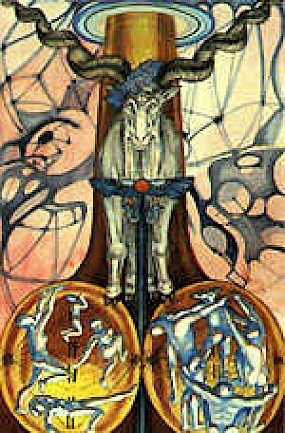
Tarot Card for March 15: The Devil

The Devil

The Devil is numbered fifteen and shows a figure, usually male and satyr-like, half-man and half-animal. Sometimes, male and female forms are shown chained or trapped at his feet. The Thoth deck (shown here) has the Devil as a goat, appearing against a background of the male sex organs. His third eye represents the Eye of God and the staff across his chest is topped with the Winged Disk symbol and double-headed snakes.

The Devil card is often misunderstood and feared. However, before Christianity became a leading religion, there were several pantheons which contained fertility gods and they were often depicted as animals – the Horned God of the Wicca for example, servant and consort of the Goddess. The Devil does not therefore necessarily represent an evil being.

The Devil is the personification of the animal, instinctual and even bestial parts of us. Pre-occupation with matters connected to the Devil can lead to degradation and sheer ugliness, but by identifying and accepting the darkness within we learn to discover that it is simply the dark side of our light.

The Devil

(via angelpaths.com and Alan Blackman)

Brave Woman Crashes Russian Newscast Live On-Air

The Rational National March 14, 2022 A brave Russian woman interrupted a live Russian newscast to protest Putin’s invasion of Ukraine. === Support the show at http://TheRationalNational.com/Join Donate Directly at http://PayPal.me/daviddoel Tip at https://streamlabs.com/therationalnat… ‘Join’ on YouTube: https://www.youtube.com/channel/UCo9o… Follow David Doel at http://twitter.com/DavidDoel Follow The Rational National at http://twitter.com/TRNshow Follow on Twitch at http://twitch.tv/TheRationalNational Follow on Facebook: https://facebook.com/trnshow === Sources: https://bit.ly/3N0gyVs (clip & thread, Kevin Rothrock) https://bit.ly/3N1iH3h (more context) https://bit.ly/3MS7tO8 (TACC) https://bit.ly/3Ic5fWD (Deadline)

Race is the Original American Fiction

Joe Gough

On Reuniting with The Descendants of Thomas Jefferson’s Slaves

By Andrew Mitchell Davenport

April 13, 2017 (lithub.com)

“And who, by the way, was the mother of our country?”
–Ralph Ellison

I.

Our nation’s historical origins began in the revolutionary age of the 1770s, when Thomas Jefferson and the Founding Fathers set forth their protestations against the British crown. In the past 20 or so years, many Americans have taken it as fact that Jefferson established a long-term relationship with Sally Hemings, an enslaved woman, mother to at least six of his children, and his widow’s half-sister. “The Jefferson-Hemings affair,” writes Clarence Walker, “given Jefferson’s place in the pantheon of the Founding Fathers, raises questions about the national identity or racial provenance of the United States . . . At the moment of its creation the nation was not a white racial space but a mixed-race one, in which Jefferson and Hemings, as a mixed-race couple, rather than George and Martha Washington, should be considered the founding parents of the North American republic.”

Race, we are accustomed to thinking, is a fiction—a “construction”—a myth older than Don Quixote. Literacy was not as commonplace when Jefferson and Hemings began their relationship, and Americans have never quite gotten over this textual and cultural illiteracy, a willful blindness, when it comes to matters of citizenship and recognition. Like any fiction worth its weight, race must be read and reread, interpreted, and examined.

Exclusive Clip from Poetry in America #307: “Rabbits and Fire” and “Bear Fat”

With her 1852 novel Uncle Tom’s Cabin, Harriett Beecher Stowe, “gave black characters a dignity and self-consciousness that paved the way for other writers, including African-American writers, to explore the question of race in America,” as literary historian Philip Gura writes. As fate would have it, in May of the following year Stowe met a man who was soon to become the first black American novelist.

William Wells Brown was already an inspiring and accomplished man when he met Stowe in London. He’d been born into slavery in Kentucky, the son of a white father and a slave mother, and he’d traveled widely for an individual of the 19th century, free or enslaved. Brown escaped slavery, after losing his mother and his sister to slave auctions, and began a career as an author and anti-slavery lecturer.“Like any fiction worth its weight, race must be read and reread, interpreted, and examined.”

Brown’s 1853 novel, Clotel, has for its plot the Jefferson-Hemings liaison that Walker refers to, a relationship that has fired the imaginations of Americans for more than two centuries, ever since James Callender published a scathing exposé of Thomas Jefferson in the Richmond Recorder. Callender had previously outed Alexander Hamilton’s extramarital affair with Mrs. Maria Reynolds, but when Jefferson refused to acquiesce to Callender’s threats of blackmail, he went public with the not-quite-news that Jefferson kept an enslaved woman as his “concubine” on his Monticello plantation.

Though Brown was the first American novelist to address the Jefferson-Hemings relationship, Charles Dickens had actually included a reference in his 1844 novel Martin Chuzzlewit. Dickens wrote of Jefferson, that “noble patriot . . . who dreamed of Freedom in a slave’s embrace.” It is an unattributed quote from the Irish poet Thomas Moore, who’d read Callender’s article in the Recorder.

“What better plot,” historian Jill Lepore writes, “than the shocking story that had animated the pen of Dickens himself?” Brown, according to his biographer Ezra Greenspan, was, like many Americans, long acquainted with the story of Sally and Tom. He’d published Clotel well before he met a Hemings family member, Virginia Isaacs, in Boston in the 1860s. A great-granddaughter of Elizabeth Hemings, mother to Jefferson’s Sally, Virginia Isaacs is a distant relative of mine; Sally Hemings’ brother Peter is my ancestor.

II.

Visiting Monticello in 1796, the duc de La Rochefoucauld-Liancourt claimed to have seen “slaves, who neither in point of color nor features showed the least trace of their original descent.”

In the summer of 2016, I stood in the back of a line comprised of descendants of Jefferson’s slaves waiting to enter the air conditioned pavilion in Monticello’s visitor center. A family directly before me looked white at first glance. But they are descendants of Sally and Tom, even prouder of their Hemings blood than they are of their Jefferson lineage. We were gathered to eat. It’d be our last meal before a family sleepover that night in Monticello’s slave cabins.

Inside, a buffet table was laid out before us, filled to overflowing with soul food. Iced tea with mint leaves to wash down the fried chicken. Biscuits barely made it into our mouths before melting. The room brimmed with joy. Some nuclear families sat together but I took a seat at a table with Jefferson, Hemings and Gillette descendants. I met Sakeena. She was wearing a purple African print dress, a headscarf beneath her Fulani straw hat. We fell into talking. I was introduced to April, Joan and Stephen, and Sakeena’s brother Gregory. Sakeena and Gregory’s forefathers and mine were given to Jefferson’s estate, after his father-in-law’s death, in 1774.

A presentation began. Any descendants of those pictured were to stand and introduce themselves. A photo of Moses Gillete was shown. April, Joan, Stephen, Sakeena and Gregory rose from their seats. More photos of the enslaved were projected. Cousin Calvin kept standing up. He stood when Jefferson’s personal servant Jupiter’s name was mentioned. He sat down only to stand again when Wormley Hughes’ name was called out. Calvin had on a red Washington Nationals ball cap with matching tank top and his teenage granddaughter Jade with him. She wore her thick hair in pigtails. I thought Jade really must love her grandfather to spend a night in the slave cabins with a bunch of distant relatives—strangers, really. Many of us were strangers to her and each other.

By the time we made it up to the mountaintop, the sun was just setting beyond the hills below. What land! I was transfixed by the view. Monticello is a kind of sylvan grove, and there is a view clear across the creasing hills all the way to the Blue Ridge Mountains. A brilliant dusk radiated from behind a cloud like the spokes of a wagon wheel. I’d never seen a sunset like that one. No one at Monticello had either, and they moved to gather us for photographs with that special sky for a background.

Afterwards, we gathered on Mulberry Row, a tree-lined walk where some of our slave ancestors lived and worked, for a bonfire. We talked quietly in twos and threes before coming together to talk as a family. A debate began with an old question. Calvin asked if any of us thought Sally Hemings could have loved Jefferson. I think they heard Gregory’s cries of dissent way down in Charlottesville. “Hell no!” he said. “Nothing about a teenage girl and her 40-something master calls out ‘love’ to these ears! Ain’t no love there!”

“She didn’t have a choice! She was his slave!” Sakeena said.

Calvin was pressing the issue. “I know about both those things but she was exercising some degree of power over him, and how about this—each one of her sisters had children by white men. What you make of that?”

Sakeena nearly leapt off her log. Gregory held her back but she couldn’t be quieted. “What I make of that?” Sakeena hollered. “What I make of that! They were raped. They were raped by the white man. They were preyed upon. What you make of that?”

Calvin was slyly smiling beneath his mustache. “I’m only asking the questions we all been hearing for, oh, two-hundred years now. Don’t got to get all worked up like that, cousin.”

“You don’t know what you trying to do!”

“Listen. Think about this. You got to think about how much power Sally’s mother had over TJ. She’d raised his wife, who loved her deeply, and she’d raised Sally. And TJ loved both of those women—those half-sisters. To think that Elizabeth Hemings wasn’t exercising some kind of control over TJ is ludicrous. She was playing him like a fiddle.”

“She was a slave, Calvin.”

“I don’t care what she was, she got whatever she wanted for her children. And she got whatever she wanted for herself, too. I think of her as the matriarch of this entire plantation.”

“Her daughters were raped by white men.”

“They coulda had relationships with these men! TJ and Sally were in a decades-long relationship. Something like 35, 40 years! When we talking about these ‘slave women’ we talking about some of the most powerful people—white or black—for miles around. You telling me Elizabeth Hemings, mother of Sally and nanny to Martha, who went way back with the family, didn’t have TJ by the wig I think you smoking something outta the garden down there.”

“Calvin, you saying the Hemings women had white lovers because their mother mighta arranged all that. What you forgetting—somehow! who knows how you forgetting this—was that they were slaves. And that they didn’t have a choice. By all accounts they were beautiful women, too, and that just made them more easily preyed upon.”

“I’m just raising questions. That’s all I’m doing. What I’m wondering is if Elizabeth Hemings was making sure her daughters got with the white man. ‘Cause look at how her grandchildren turned out! They got their freedom through the white man. They were freed, the ones that was the progeny of the white man. And Elizabeth knew full well the benefits of being white cause she was half white herself. If she had a little control over TJ and his kin or his visitors or what have you, I’m willing to bet she was angling toward having her grandchildren be freed that way. That is, after all, how Sally got TJ to promise to free her kids.”

Sakeena addressed the group, slipping her comments in before either Calvin or her brother could say anything further. “Next time you getting slave families together,” she said, “bring a therapist. We got to have some real counseling here. Our heads all screwed up and these Hemings bothering me!” We were all laughing. “Really! These Hemings bothering me. All anybody wondering about anytime I bring up that we come from Monticello is the Hemings. It’s Hemings this or Hemings that. I’m proud not to be a Hemings. I’m a Gillette. And we came like pendants with Elizabeth Hemings from John Wayles’ Guinea plantation to Monticello. And nobody ever talk about the Gillettes. We probably on the same damn ship over here! And nobody talking about us. Hemingses take up all the air in the room. See these tourists traipsing all around here earlier. Only thing they asking about is Sally. Or ‘the talented Hemings.’ What about everyone else!”

There was much more good cheer than not. But the debates were going to continue all night. Might even continue for another generation or two. I walked to find a place of solitude when I heard the cousins, those who remained by the fire pit, asking one another about escaped slaves. Who’d left? Was he caught? Heard from again?

The moon rose higher, the night sky awash with stars. I looked out toward the horizon. Down in the blue-night valleys I imagined the ruby glow of long ago campfires. Sakeena joined me. She looked mildly distressed and gestured toward the security guards who were going around turning off the lampposts. “I’m down walking by my cabin to get something and I see these uniformed men in the dark and I thought it was the KKK coming for me! Why they leaving us out here in the dark? Can’t they leave us with some light? They said they’d be taking care of us. Well, I want light to see with! We’re being left out here. But look at those stars!”“I heard the cousins asking one another about escaped slaves. Who’d left? Was he caught? Heard from again?”

Sakeena had a flair for the dramatic. She’d traveled via Greyhound from New York. Sakeena converted to Islam “a hundred years ago,” as she put it, and sometime in the intervening century she’d traveled to Mecca for hajj. We looked out into the night. “This,” she said, “this is a pilgrimage all its own. I truly feel that way. I’m coming back to honor my dead.”

“You ever feel anything for, you know . . . Africa?” I asked. I’d been prompted by one of the cousins, who said that an aunt of hers said that she had heard from an aunt of hers, that the Monticello slaves had rubbed oil on their noses. This was supposedly proof that we were descended from some specific African tribe.

“Well, we from there somewheres but our lives began right here,” Sakeena said. “Doesn’t stop me from wearing these African dresses, though. And each year I go up to the medieval festival at Fort Tryon Park, I’m the only black person there, and I dress up as an African queen. I treat myself. I’m crazy. And you’re crazy. Why else we here except for us being crazy? Why else we sleeping in the slave cabins? My kids don’t answer the phone anymore when they see me calling. They think I should be put up in Bellevue. I want to talk to someone about all this; it’s just hard to. Not everybody wants to talk about the past . . . And I’m careful who I tell I come from Monticello. You got to be discriminating. ‘Cause not everyone cares. Actually, most people don’t care. Then they start joking with you. Most of us don’t know our history, so anybody who does they making fun of. In Brownsville they call me Mrs. Jefferson. And that just drives me nuts! Only safe place I’ve found to talk about the past? This plantation. This plantation is the only place I’ve ever found safe enough to talk over everything with everyone. Even if security leaving us in the dark. Out here. In the wilderness. Alone. Damn—we alone out here in the wilderness!”

III.

Before I had any idea who I was—what I was composed of—I knew of a few landmarks in my New England town. We lived in Redding, Connecticut, on a wooded property no more than a mile from where Mark Twain died. The annual Mark Twain Book Fair reminded us all of our indebtedness to him. The town library had been named after him, and his estate, Stormfield, was within an easy downhill jaunt of my home. On the way to the library, a walk I undertook frequently during the summer, we’d pass the “elephant walk,” where P.T. Barnum is said to have corralled his elephants. Later, as a young man of about 13, I began working as a farmhand for a family of writers who’d purchased their considerable property from a great-granddaughter of Nathaniel Hawthorne. American history, it seemed, was inescapable. And farm chores were inhibiting my full enjoyment of my teenage years. Predictably, when the owners of the farm left for an extended period of time, I threw parties. In honor of Hawthorne, my fellow debauchers and I nicknamed the property “Nate’s House.”

In Wendy Warren’s 2016 book New England Bound, the author recounts a visit Hawthorne made to Williams College for commencement ceremonies in 1838. Hawthorne was surprised to encounter free African Americans in New England. There were “a good many blacks among the crowd . . . a drunken negro . . . [a] gray old negro . . . [and] three or four well dressed and decent negro wenches . . . I suppose they used to emigrate across the border, while New-York was a slave state.”

“Hawthorne’s astonishment,” writes Warren, “at seeing African descent in a New England crowd and in a New England tavern, underscored just how effectively the importance of slavery to the region’s development had been erased from memory.”

Hawthorne’s great-great grandfather, John Hathorne, the only judge from the Salem Witch Trials who did not repent of his actions, presided over the courts when an enslaved Indian woman named Tituba, and at least two enslaved Africans, were accused of witchcraft. Some 24 years after his visit to Williams College, Nathaniel Hawthorne still could not perceive of the long-established presence of African-descended people in New England.

There is an historical circumstance, known to few, that connects the children of the Puritans with these Africans of Virginia, in a very singular way. They are our brethren, as being lineal descendants from the Mayflower, the fated womb of which, in her first voyage, sent forth a brood of Pilgrims upon Plymouth Rock, and, in a subsequent one, spawned slaves upon the Southern soil—a monstrous birth, but with which we have an instinctive sense of kindred, and so are stirred by an irresistible impulse to attempt their rescue, even at the cost of blood and ruin. The character of our sacred ship, I fear, may suffer a little by this revelation; but we must let her white progeny offset her dark one—and two such portents never sprang from an identical source before.

Hawthorne was mistaken; in point of fact, there were several ships named Mayflower operating in the 17th century, and the one that carried enslaved individuals was not the same that carried Puritans. “But in metaphorical terms,” Warren writes, “of course, he was absolutely right.”

More than a decade prior to Hawthorne’s mistaken assertion, William Wells Brown included in Clotel a juxtaposition of the Mayflower with a slave ship to Virginia: “Behold the May-flower anchored at Plymouth Rock, the slave-ship in James River . . . These ships are the representation of good and evil in the New World, even to our day. When shall one of those parallel lines come to an end?”

Despite Brown’s stature as a pioneering American novelist, he goes unmentioned in Clarence Walker’s writing on the mythic origins of the American people—though, of course, this is precisely what Brown was setting forth. Brown is also ignored in Annette Gordon-Reed’s magisterial studies of the Jefferson-Hemings relationship, though in a colloquy on Gordon-Reed’s The Hemingses of Monticello Robert S. Levine stated that “Reading Clotel and The Hemingses of Monticello side by side, one realizes that Gordon-Reed, in her great history of the Hemings family and Jefferson, has written a classic African American novel of the early Republic for the 21st century.”

IV.

“What’s it like to learn about your family in history books?” I was once asked. But the reality is that we all learn about our families through history books and the literary arts. In the writings of Albert Murray and his friend Ralph Ellison, I learn we are each of us engaged in the unconscious reenactment of rituals as old as humanity itself. We eat, pray, make love and procreate, sleep, communicate, and make art. It is this last act that distinguishes human life from other sentient beings. Stories are our domain.

In a remarkable essay, “Hidden Name and Complex Fate,” Ellison describes the power of reading literature: “The more I learned of literature . . . the more the details of my background became transformed.” When, during one of his first few days in Harlem Langston Hughes suggested he read Andre Malraux, Ellison drank deeply from Man’s Fate and Days of Wrath, “which led to my selecting Malraux as a literary ‘ancestor,’ whom, unlike a relative, the artist is permitted to choose.”“It is a human paradox that we derive our liberality, our truths, from fiction. There is sublime magic in stories, and the past is regenerated before our eyes.”

With Clotel, William Wells Brown describes how the story of the Jefferson-Hemings relationship is representative of our national and personal origins, despite what we perceive to be our racial or cultural differences. Brown takes the story back from the tabloids, back from slanderous rumors, and gives it to us. We return to our writers—like Brown, Twain, Stowe, Ellison, Morrison, and Whitehead—for a view of ourselves and our ancestors.

It is a human paradox that we derive our liberality, our truths, from fiction. There is sublime magic in stories, and the past is regenerated before our eyes. Our literary artists do not turn away from the past. Instead, they lift for us the veil of time and history so that we may find ourselves. Like a family elder unbraiding the knot of the past for us to better understand, our writers initiate the psychodrama of self-identification. History is not so very far from us, unequivocally ours to hold. We are inheritors of an outrageous fortune.

Andrew Mitchell Davenport

Andrew Mitchell Davenport is an editor of Full Stop and The Scofield. He was recently named a Robert H. Smith Fellow at the International Center for Jefferson Studies.

George Orwell on doublethink

Winston ponders the intricacies of doublethink:

To know and not to know, to be conscious of complete truthfulness while telling carefully constructed lies, to hold simultaneously two opinions which canceled out, knowing them to be contradictory and believing in both of them… To forget whatever it was necessary to forget, then to draw it back into memory again at the moment when it was needed, and then promptly to forget it again… that was the ultimate subtlety.

–1984 by George Orwell

Police arrest Russian peace protester within seconds of starting interview

The Telegraph March 14, 2022 Footage shared on social media shows the moment a Russian peace protester was arrested just moments after starting an interview. The video was captured on Manezhnaya Square in Moscow by the Russian activism group Activatica, and shared on social media on March 13. Russian police have been cracking down on anti-war protests across Russia as the invasion into Ukraine enters the third week. Latest updates: https://www.telegraph.co.uk/world-new… Subscribe to The Telegraph on YouTube ► https://bit.ly/3idrdLH Get the latest headlines: https://www.telegraph.co.uk/ Telegraph.co.uk and YouTube.com/TelegraphTV are websites of The Telegraph, the UK’s best-selling quality daily newspaper providing news and analysis on UK and world events, business, sport, lifestyle and culture.

Tarot Card for March 14: The Prince of Swords

The Prince of Swords

One of the most common interpretation of this card is that it represents a dangerous or treacherous man – which, IMHO, is a very superficial way of looking at a Court card.

Certainly this Prince can be sly, dishonest and untrustworthy – but only when badly dignified by the cards around him. The card can also sometimes come up to mark a person who is angry, or vengeful.

But the pure Prince of Swords type is a highly intellectual and usually well-educated person, with a rapid fire mind and a great capacity for abstract thinking. He produces ideas with astonishing speed, but often moves on too quickly to follow through or elaborate on them. He can be challenging, entertaining, stimulating – and completely exhausting!

The card represents a private person, who defends his inner space quite determinedly. This is some-one who is hard to get to know – in fact, you’ll probably not succeed entirely no matter how long you know him. He is a thinker, and chooses those he shares his thoughts with carefully. He’s usually also very independent, and often appears unemotional and cold.

Sometimes the Prince of Swords will come up to represent somebody who is embarking on a serious course of occult study – with the Knight indicating the dedicated initiate.

The bad reputation comes from one peculiarity of this card and the Knight of Swords, I think. They both tend to appear when a man is angry, violent or vicious. However this is a function of the Suit – Swords deal with conflict and pain quite extensively. So don’t imagine that every Prince of Swords you see is bad – most of them aren’t.

The Prince of Swords

(via angelpaths.com and Alan Blackman)

What It’s Like Being Married to Neil deGrasse Tyson – Key & Peele

Key & Peele Neil deGrasse Tyson has an explanation for everything. Paramount+ is here! Stream Key & Peele now on Paramount+. Try it FREE at https://bit.ly/3qyOeOf#KeyandPeele Subscribe to Comedy Central: https://bit.ly/2SP55QM About Key & Peele: Key & Peele showcases the fearless wit of stars Keegan-Michael Key and Jordan Peele as the duo takes on everything from “Gremlins 2” to systemic racism. With an array of sketches as wide-reaching as they are cringingly accurate, the pair has created a bevy of classic characters, including Wendell, the players of the East/West Bowl and President Obama’s Anger Translator. Watch more Comedy Central: https://www.youtube.com/comedycentral Follow Key & Peele: Facebook: https://www.facebook.com/KeyAndPeele/ Twitter: https://twitter.com/keyandpeele Watch full episodes of Key & Peele: http://www.cc.com/shows/key-and-peele Follow Comedy Central: Twitter: https://twitter.com/ComedyCentral Facebook: https://www.facebook.com/ComedyCentral/ Instagram: https://www.instagram.com/comedycentral/

Band flaunts specialized masks for flutists

Flutists+Colin+Sumala+%E2%80%9922+and+Caton+Daval-Santos+%E2%80%9922+demonstrate+how+they+use+their+new+COVID-safe+masks.

John McQuaid ’22

Flutists Colin Sumala ’22 and Caton Daval-Santos ’22 demonstrate how they use their new COVID-safe masks.

Christian Ramirez Cortes ’22, News Editor
March 11, 2022 (rcrusadernews.com)

Starting with graduation rehearsal in 2021, the Riordan band began wearing special masks and using instrument covers made to prevent the spread of COVID-19 while they play their instruments. Although there is a slight difference in sound quality, the members seem to be okay with the change in masks.

There are different types of masks for all of the instruments. Each instrument has to have its own instrument cover and there are some instruments that have to have specific musician masks. Wind instrument masks, for example, have a slit that allows the musician to put the mouthpiece in and play it.

Jalen Woods ’22 stated, “There’s a bit of a difference in the sound quality as the mask does muffle it just a bit so you do need to play out more to really get a clear sound, but it’s not bad at all. I definitely don’t feel like the masks make it more difficult to play my instrument.”

Due to the size of the group and in order to be able to play safely at various events, it was necessary that these masks be used. Since the start of the COVID-19 pandemic, there’s been trouble with getting the band to play at events as they used to do.

The instrument covers are a requirement in the state of California and in San Francisco. Before the masks and instrument covers, the band was not allowed to perform inside at events like Riordan basketball games. They just got done performing at their second basketball game this year thanks to the purchase and use of the masks and covers.

Band Director Kyle Hildebrant stated, “We were actually pretty excited to be back performing inside for the basketball games because without the masks and covers we wouldn’t be able to be in there.”

With COVID-19 having the ability to spread through breathing in air when close to an infected person who is exhaling small droplets and particles that contain the virus, the need for the new masks and covers was clear. The band is glad to be able to play inside again and are overall feeling good about the change.

“As things change, we’ll adapt and keep going. We’ve had a lot of challenges along the way but we’re not going to let those keep us down. We’re going to keep charging on and playing on.”
— Kyle Hildebrant

However, the band does not have to wear the masks in San Francisco as long as members are vaccinated and keep a 3 feet distance between each other. They only need instrument covers, which cover the area where the air exits out of the instrument. These mainly affect the sound of bass instruments.

Daniel Galvan ’22 said, “Honestly, I really like them. They allow us to play inside, which is a lot better than having to play and set up in front of the school in the freezing cold.”

Although the band had these masks for the 2021 graduation, only returning members had them and nearly 80 percent of new members did not have these masks until the beginning of this year.

The actual masks were only purchased for flute players. These masks, along with the covers, were purchased through various suppliers, but mainly through Amazon. There was an instrument cover shortage during the first part of the school year due to other schools being allowed to play inside with covers on.

Hildebrant expressed, “It’s been a wild journey with COVID and everything else. The band was able to purchase the masks for no more than $2,000. Being outside and now coming inside, we’ve had to change a lot of what we do. And we’re just now coming back to a sense of normalcy being back inside.”

He added, “As things change, we’ll adapt and keep going. We’ve had a lot of challenges along the way but we’re not going to let those keep us down. We’re going to keep charging on and playing on.”