
New Thinking Allowed with Jeffrey Mishlove Bernardo Kastrup, PhD, is a computer scientist, who has also completed a second doctoral degree in philosophy. He is author of Rationalist Spirituality, Why Materialism is Baloney, Dreamed Up Reality, Meaning in Absurdity, Brief Peeks Beyond, More Than Allegory, The Idea of the World, Decoding Schopenhauer’s Metaphysics, and Decoding Jung’s Metaphysics: The Archetypal Semantics of an Experiential Universe, and most recently Science Ideated: The Fall of Matter and the Countours of the Next Mainstream Scientific Worldview. He has published several papers on Scientific American’s website arguing for metaphysical idealism. His website is https://www.bernardokastrup.com/. This is an unusual video because it runs for over three hours, and also because it is a very personal discussion in which both Bernardo and Jeffrey reveal aspects of their own inner life that are rarely discussed publicly. Bernardo maintains that his intensive focus on arguing for analytical idealism, both philosophically and scientifically, is the result of often uncomfortable prodding from his “daimon” – part of his conscious awareness that he experiences as separate from himself. The lengthy conversation covers many topics in science, philosophy, and culture. New Thinking Allowed host, Jeffrey Mishlove, PhD, is author of The Roots of Consciousness, Psi Development Systems, and The PK Man. Between 1986 and 2002 he hosted and co-produced the original Thinking Allowed public television series. He is the recipient of the only doctoral diploma in “parapsychology” ever awarded by an accredited university (University of California, Berkeley, 1980). He is the Grand Prize winner of the Bigelow Institute essay competition on the postmortem survival of human consciousness. (Recorded on February 10, 2021)
Monthly Archives: February 2022
Socrates’ Daemon
(markandrealexander.com)
Socrates often mentions that he is guided by a daemon, a kind of divine spirit, oracle, or “sign,” that takes the form of an inner voice or non-vocal nudge. The guide never tells Socrates what to do. It only indicates when Socrates is not to do something.
This distinction is important. One way to tell that a dialogue is spurious is if it has Socrates’ daemon tell someone else what to do.
Socrates learned over time to listen to this inner divine voice. He acted in service to it. Nothing that he does in his life is untouched by this inner divine voice.
He describes it in the Apology:
You have heard me speak at sundry times and in diverse places of an oracle or sign which comes to me, and is the divinity which Meletus ridicules in the indictment. This sign, which is a kind of voice, first began to come to me when I was a child; it always forbids but never commands me to do anything which I am going to do. This is what deters me from being a politician.
Later, he explains that the defense he is giving to the Athenian court has been approved by this inner divine voice.
Hitherto the divine faculty of which the internal oracle is the source has constantly been in the habit of opposing me even about trifles, if I was going to make a slip or error in any matter; and now as you see there has come upon me that which may be thought, and is generally believed to be, the last and worst evil. But the oracle made no sign of opposition, either when I was leaving my house in the morning, or when I was on my way to the court, or while I was speaking, at anything which I was going to say; and yet I have often been stopped in the middle of a speech, but now in nothing I either said or did touching the matter in hand has the oracle opposed me. What do I take to be the explanation of this silence? I will tell you. It is an intimation that what has happened to me is a good, and that those of us who think that death is an evil are in error. For the customary sign would surely have opposed me had I been going to evil and not to good.
Commentators throughout the centuries wonder at what it was that drove Socrates to be the Athenian gadfly, the devoted citizen and warrior, the one who chose poverty over charging his students or any who would listen to his one-on-one conversations.
This divine inner voice spoke inwardly to him, moving him to be the true hero of the Athenian people, being a corrective to their hubris. Along the way, Socrates became a true hero of the Greek people and western civilization; and he became so effective that they killed him for it.
Almost 500 years later, Plutarch wrote a dialogue on this daemon of Socrates. It is included in this anthology.
*****
from the Editor’s Introduction: The Best Complete Plato
*****

Ballet22 puts men on pointe
New Bay Area troupe moves LGBTQ+ stories to the forefront
By James Salazar Examiner staff writer • February 24, 2022 (SFExaminer.com)

The pointe shoe is instrumental and symbolic to ballet.
As a tool, pointe shoes extend a dancer’s line and create a sense of physical lightness. As an emblem, the pointe shoe is associated with ballet’s strict gender roles: The shoe is worn by women, not men.
Similarly, female ballet dancers are expected to execute delicate and precise movements and male dancers are expected to display strength by effortlessly lifting and supporting their partners. George Balanchine, one of ballet’s most influential choreographers, likened female dancers to “a garden of beautiful flowers” and described male dancers as “the gardener.”
Since its founding in December 2020, Ballet22 has been questioning these gender normative traditions.
Ballet22, which performs Friday through Sunday at San Francisco’s Great Star Theater, choreographs male-identifying dancers on pointe and amplifies queer voices by reimagining classical ballets such as “Swan Lake” and “The Nutcracker.”
Usually males on pointe elicit laughter. Productions such as “Cinderella” and the all-male Les Ballets Trockadero de Monte Carlo ham up choreographic jokes by putting their male dances in pointe shoes. Roberto Vega Ortiz toured with Les Ballets Trockadero in 2017, and got to dance on pointe, but said he felt “there was still something missing because it was comedy, you’re in drag and you have a wig on.”
During California’s stay-at-home order in early 2020, Ortiz, 25, posted videos to social media of himself dancing on pointe with the hashtag #maleballerinas. Reactions were so overwhelmingly supportive that Ortiz and a close friend, Carlos Hopuy, decided to offer Zoom classes teaching men how to dance in pointe shoes. With a substantial social media following and a push from Theresa Knudson, Ortiz’s close friend and roommate, Ballet22, a troupe of male ballerinas dancing on pointe but not in drag, was founded in December 2020.
For Knudson, the company’s executive director, Ballet22’s work separates the history and culture of ballet. “Ballet is really old and it’s held on a platform and pedestal of tradition, which is beautiful. Many times that sternness to uphold tradition means that certain things like racism, ageism, ableism, sexism … get stuck in the web,” she said.
The company uses a “dancers first” approach that gives performers the freedom to express themselves on stage. While the classical ballet world enforces a uniform look of clean-shaven faces and tight buns, Ballet22 has no interest, allowing dancers to wear beards, braids and mustaches. “We don’t want to see you change how you’re presenting for a show. In fact, double down on it,” said Knudson of Ballet22’s performers.

Dancers with Ballet22 rehearse for an upcoming performance. (Isaac Hall)https://5889fec8986e2f65916ba87dd8c64b6f.safeframe.googlesyndication.com/safeframe/1-0-38/html/container.html
Trevor Williams, who trained with the Louisville Ballet, was drawn to Ballet22’s subversion of the art. “There is a fine line and blurred energy between masculine and feminine in this company that I love. It’s something that you can’t find anywhere else,” said Williams, who joined Ballet22 specifically to dance professionally on pointe.
Philip Rocamora, a dancer recruited for the company’s 2022 gala performances, was first introduced to pointe dancing in 2012 through a friend in Les Trockadero and immediately fell in love with the style. Male dancers typically wear ballet slippers, so there was a learning curve for Rocamora. “Dancing on flats and dancing on pointe are like up and down. It’s so different,” he said. “Even if you’re good, when you put the shoes on, it’s like you’re learning from the start because pointe is a different technique.”
Ballet22’s dancers have spent the last few weeks tapping their pointe shoes against Marley floor mats in an Oakland studio. This weekend, they migrate to Chinatown’s Great Star Theater for their first live performance of the year. The program will feature scores from classics like “Swan Lake,” a world premiere by Durante Verzola and the duet “Symbiotic Twins” choreographed by Annabelle Lopez Ochoa.
Knudson believes Ballet22’s future is bright and a means for LGBTQ+ dancers to unleash their creativity. “I think all of us are wanting to see a more independent woman or want to see more queer stories. We want to see our real lives and not just fairy tales,” said Knudson. She says that while “the fairy tales and the traditions should be preserved,” those in ballet must also ask themselves: “How do we make this field move forward?”
Ortiz views the modernization of ballet in increments of 10, comparing the field’s progress from a decade ago to where it is headed in the coming years. “I can’t wait to see what has changed and what has happened and what will happen with other companies because I hope we’re not the only one,” said Ortiz. “We are the first one, just kind of setting the example.”
IF YOU GO:
“Ballet22 Gala”
When: 7 p.m., Feb. 25 & 26, 3 p.m., Feb. 27
Where: Great Star Theater, S.F.
Tickets: $20 to $600
Contact: (415) 735-4159, https://www.greatstartheater.org/ballet22-gala
jsalazar@sfexaminer.com
Book: “The Last Lecture”

The Last Lecture
Randy Pausch, Jeffrey Zaslow (Contributor)
A lot of professors give talks titled ‘The Last Lecture’. Professors are asked to consider their demise and to ruminate on what matters most to them: What wisdom would we impart to the world if we knew it was our last chance? If we had to vanish tomorrow, what would we want as our legacy?
When Randy Pausch, a computer science professor at Carnegie Mellon, was asked to give such a lecture, he didn’t have to imagine it as his last, since he had recently been diagnosed with terminal cancer. But the lecture he gave, ‘Really Achieving Your Childhood Dreams’, wasn’t about dying. It was about the importance of overcoming obstacles, of enabling the dreams of others, of seizing every moment (because time is all you have and you may find one day that you have less than you think). It was a summation of everything Randy had come to believe. It was about living.
In this book, Randy Pausch has combined the humour, inspiration, and intelligence that made his lecture such a phenomenon and given it an indelible form. It is a book that will be shared for generations to come.
(Goodreads.com)
The Idea That Everything From Spoons to Stones is Conscious is Gaining Academic Credibility
“If you think about consciousness long enough, you either become a panpsychist or you go into administration.”
Quartz (getpocket.com)
- Olivia Goldhill

Is everything concious? Photo by NASA
Consciousness permeates reality. Rather than being just a unique feature of human subjective experience, it’s the foundation of the universe, present in every particle and all physical matter.
This sounds like easily-dismissible bunkum, but as traditional attempts to explain consciousness continue to fail, the “panpsychist” view is increasingly being taken seriously by credible philosophers, neuroscientists, and physicists, including figures such as neuroscientist Christof Koch and physicist Roger Penrose.
“Why should we think common sense is a good guide to what the universe is like?” says Philip Goff, a philosophy professor at Central European University in Budapest, Hungary. “Einstein tells us weird things about the nature of time that counters common sense; quantum mechanics runs counter to common sense. Our intuitive reaction isn’t necessarily a good guide to the nature of reality.”
David Chalmers, a philosophy of mind professor at New York University, laid out the “hard problem of consciousness” in 1995, demonstrating that there was still no answer to the question of what causes consciousness. Traditionally, two dominant perspectives, materialism and dualism, have provided a framework for solving this problem. Both lead to seemingly intractable complications.
The materialist viewpoint states that consciousness is derived entirely from physical matter. It’s unclear, though, exactly how this could work. “It’s very hard to get consciousness out of non-consciousness,” says Chalmers. “Physics is just structure. It can explain biology, but there’s a gap: Consciousness.” Dualism holds that consciousness is separate and distinct from physical matter—but that then raises the question of how consciousness interacts and has an effect on the physical world.
Panpsychism offers an attractive alternative solution: Consciousness is a fundamental feature of physical matter; every single particle in existence has an “unimaginably simple” form of consciousness, says Goff. These particles then come together to form more complex forms of consciousness, such as humans’ subjective experiences. This isn’t meant to imply that particles have a coherent worldview or actively think, merely that there’s some inherent subjective experience of consciousness in even the tiniest particle.
Panpsychism doesn’t necessarily imply that every inanimate object is conscious. “Panpsychists usually don’t take tables and other artifacts to be conscious as a whole,” writes Hedda Hassel Mørch, a philosophy researcher at New York University’s Center for Mind, Brain, and Consciousness, in an email. “Rather, the table could be understood as a collection of particles that each have their own very simple form of consciousness.”
But, then again, panpsychism could very well imply that conscious tables exist: One interpretation of the theory holds that “any system is conscious,” says Chalmers. “Rocks will be conscious, spoons will be conscious, the Earth will be conscious. Any kind of aggregation gives you consciousness.”
Interest in panpsychism has grown in part thanks to the increased academic focus on consciousness itself following on from Chalmers’ “hard problem” paper. Philosophers at NYU, home to one of the leading philosophy-of-mind departments, have made panpsychism a feature of serious study. There have been several credible academic books on the subject in recent years, and popular articles taking panpsychism seriously.
One of the most popular and credible contemporary neuroscience theories on consciousness, Giulio Tononi’s Integrated Information Theory, further lends credence to panpsychism. Tononi argues that something will have a form of “consciousness” if the information contained within the structure is sufficiently “integrated,” or unified, and so the whole is more than the sum of its parts. Because it applies to all structures—not just the human brain—Integrated Information Theory shares the panpsychist view that physical matter has innate conscious experience.
Goff, who has written an academic book on consciousness and is working on another that approaches the subject from a more popular-science perspective, notes that there were credible theories on the subject dating back to the 1920s. Thinkers including philosopher Bertrand Russell and physicist Arthur Eddington made a serious case for panpsychism, but the field lost momentum after World War II, when philosophy became largely focused on analytic philosophical questions of language and logic. Interest picked up again in the 2000s, thanks both to recognition of the “hard problem” and to increased adoption of the structural-realist approach in physics, explains Chalmers. This approach views physics as describing structure, and not the underlying nonstructural elements.
“Physical science tells us a lot less about the nature of matter than we tend to assume,” says Goff. “Eddington”—the English scientist who experimentally confirmed Einstein’s theory of general relativity in the early 20th century—“argued there’s a gap in our picture of the universe. We know what matter does but not what it is. We can put consciousness into this gap.”
In Eddington’s view, Goff writes in an email, it’s “”silly” to suppose that that underlying nature has nothing to do with consciousness and then to wonder where consciousness comes from.” Stephen Hawking has previously asked: “What is it that breathes fire into the equations and makes a universe for them to describe?” Goff adds: “The Russell-Eddington proposal is that it is consciousness that breathes fire into the equations.”
The biggest problem caused by panpsychism is known as the “combination problem”: Precisely how do small particles of consciousness collectively form more complex consciousness? Consciousness may exist in all particles, but that doesn’t answer the question of how these tiny fragments of physical consciousness come together to create the more complex experience of human consciousness.
Any theory that attempts to answer that question, would effectively determine which complex systems—from inanimate objects to plants to ants—count as conscious.
An alternative panpsychist perspective holds that, rather than individual particles holding consciousness and coming together, the universe as a whole is conscious. This, says Goff, isn’t the same as believing the universe is a unified divine being; it’s more like seeing it as a “cosmic mess.” Nevertheless, it does reflect a perspective that the world is a top-down creation, where every individual thing is derived from the universe, rather than a bottom-up version where objects are built from the smallest particles. Goff believes quantum entanglement—the finding that certain particles behave as a single unified system even when they’re separated by such immense distances there can’t be a causal signal between them—suggests the universe functions as a fundamental whole rather than a collection of discrete parts.
Such theories sound incredible, and perhaps they are. But then again, so is every other possible theory that explains consciousness. “The more I think about [any theory], the less plausible it becomes,” says Chalmers. “One starts as a materialist, then turns into a dualist, then a panpsychist, then an idealist,” he adds, echoing his paper on the subject. Idealism holds that physical matter does not exist at all and conscious experience is the only thing there is. From that perspective, panpsychism is quite moderate.
Chalmers quotes his colleague, the philosopher John Perry, who says: “If you think about consciousness long enough, you either become a panpsychist or you go into administration.”
Olivia was a science reporter at Quartz from 2015 to Oct. 2020, most recently covering the healthcare industry and psychedelic research. She previously reported on philosophy and psychology, and was part of a Quartz investigative team focused on online political propaganda. Olivia was a 2020 Livingston Award finalist for her work on misuse of data to fuel propaganda in Brazil. Before Quartz, she was a reporter and features writer at The Daily Telegraph in the UK.
Save
How was it? Save stories you love and never lose them.

This post originally appeared on Quartz and was published January 26, 2018. This article is republished here with permission.
Reclaiming Friendship: A Visual Taxonomy of Platonic Relationships to Counter the Commodification of the Word “Friend”
By Maria Popova (brainpickings.org)
Friendship, C.S. Lewis believed, “like philosophy, like art, like the universe itself … has no survival value; rather it is one of those things which give value to survival.” But the poetic beauty of this sentiment crumbles into untruth for anyone who has ever been buoyed from the pit of despair by the unrelenting kindness of a friend, or whose joys have been amplified by a friend’s warm willingness to bear witness.
Illustration by Maurice Sendak from a vintage ode to friendship by Janice May Udry
I often puzzle over the nature, structure, and function of friendship in human life — a function I have found to be indispensable to my own spiritual survival and, I suspect, to that of most human beings. But during a recent interview on Think Again, I found myself concerned with the commodification of the word “friend” in our culture. We call “friends” peers we barely know beyond the shallow roots of the professional connection, we mistake mere mutual admiration for friendship, we name-drop as “friends” acquaintances associating with whom we feel reflects favorably on us in the eyes of others, thus rendering true friendship vacant of Emerson’s exacting definition. We have perpetrated a corrosion of meaning by overusing the word and overextending its connotation, compressing into an imperceptible difference the vast existential expanse between mere acquaintanceship and friendship in the proper Aristotelian sense.
In countering this conflation, I was reminded of philosopher Amelie Rorty’s fantastic 1976 taxonomy of the levels of personhood and wondered what a similar taxonomy of interpersonhood might look like. I envisioned a conception of friendship as concentric circles of human connection, intimacy, and emotional truthfulness, each larger circle a necessary but insufficient condition for the smaller circle it embraces. “I live my life in widening circles,” Rilke wrote.

Within the ether of strangers — all the humans who inhabit the world at the same time as we do, but whom we have not yet met — there exists a large outermost circle of acquaintances. Inside it resides the class of people most frequently conflated with “friend” in our culture, to whom I’ve been referring by the rather inelegant but necessarily descriptive term person I know and like. These are people of whom we have limited impressions, based on shared interests, experiences, or circumstances, on the basis of which we have inferred the rough outlines of a personhood we regard positively.
Even closer to the core is the kindred spirit — a person whose values are closely akin to our own, one who is animated by similar core principles and stands for a sufficient number of the same things we ourselves stand for in the world. These are the magnifiers of spirit to whom we are bound by mutual goodwill, sympathy, and respect, but we infer this resonance from one another’s polished public selves — our ideal selves — rather than from intimate knowledge of one another’s interior lives, personal struggles, inner contradictions, and most vulnerable crevices of character.
Some kindred spirits become friends in the fullest sense — people with whom we are willing to share, not without embarrassment but without fear of judgment, our gravest imperfections and the most anguishing instances of falling short of our own ideals and values. The concentrating and consecrating force that transmutes a kinship of spirit into a friendship is emotional and psychological intimacy. A friend is a person before whom we can strip our ideal self in order to reveal the real self, vulnerable and imperfect, and yet trust that it wouldn’t diminish the friend’s admiration and sincere affection for the whole self, comprising both the ideal and the real.
It is important to clarify here that the ideal self is not a counterpoint to the real self in the sense of being inauthentic. Unlike the seeming self, which springs from our impulse for self-display and which serves as a kind of deliberate mask, the ideal self arises from our authentic values and ideals. Although it represents an aspirational personhood, who we wish to be is invariably part of who we are — even if we aren’t always able to enact those ideals. In this sense, the gap between the ideal self and the real self is not one of insincerity but of human fallibility. The friend is one who embraces both and has generous patience for the rift between the two. A true friend holds us lovingly accountable to our own ideals, but is also able to forgive, over and over, the ways in which we fall short of them and can assure us that we are more than our stumbles, that we are shaped by them but not defined by them, that we will survive them with our personhood and the friendship intact.
For a complementary perspective, see poet and philosopher David Whyte on the true meaning of friendship and John O’Donohue on the ancient Celtic notion of “soul-friend.”
Special thanks to my friend Wendy MacNaughton for the diagrammatic inspiration
Tarot Card for February 24: The Nine of Cups
The Nine of Cups
This is a lovely card, known as Lord of Happiness. It talks about a sense of inner fulfilment and bliss, which radiates outward to touch everybody with whom you come into contact.
At a spiritual level, we’re talking about inner harmony, contentment and tranquillity – an appreciation of the High Powers, feeling at one with the Universe. This feeling leads to feeling that we are blessed by life.
On an everyday level, the card will often come up to mark periods of high achievement, and the resulting sense of pleasure and satisfaction. It will also come up to acknowledge joy and happiness in an emotional relationship.
When this card appears in your reading, it’s important to make the time to simply enjoy your own feelings, to revel in your sense of calmness and joy.
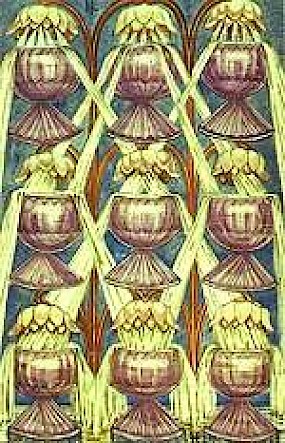
(via angelpaths.com and AlanBlackman)
Free Will Astrology: Week of February 24, 2022
FEBRUARY 22, 2022 AT 7:00 AM BY ROB BREZSNY (NewCity.com)

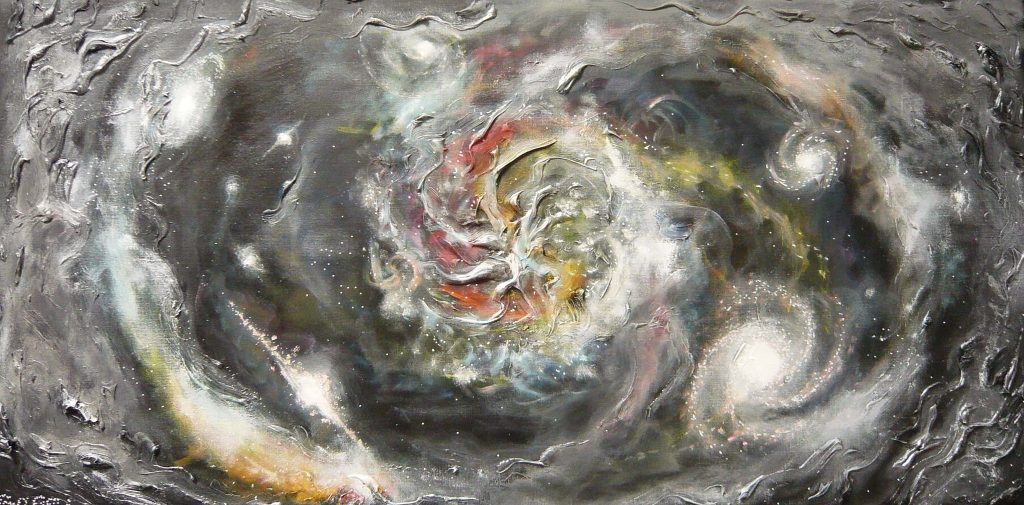
Big Bang/Image: Cédric Sorel
ARIES (March 21-April 19): “A dead thing can go with the stream, but only a living thing can go against it,” wrote author G. K. Chesterton. Amen to that! Please regard his observation as the first part of your horoscope. Here’s the second part: It’s sometimes the right approach to move in harmony with the flow, to allow the momentum of elemental forces to carry you along. But now is not one of those times. I suggest you experiment with journeys against the flow. Go in quest of what the followers of easy options will never experience. Do it humbly, of course, and with your curiosity fully deployed.
TAURUS (April 20-May 20): “You’re never allowed to step on people to get ahead,” said TV personality and author Star Jones, “but you can step over them if they’re in your way.” I suspect the coming months will be a time when you really should step over people who are in your way. There’s no need to be mad at them, criticize them, or gossip about them. That would sap your energy to follow your increasingly clear dreams. Your main task is to free yourself from influences that obstruct your ability to be the Royal Sovereign of Your Own Destiny.
GEMINI (May 21-June 20): Gemini-born Gena Rowlands is retired now, but she had an award-winning six-decade career as an actor. At age twenty, she decided what she wanted to do with her life, and her parents offered her their blessings. She testified: “I went home and I told my mom that I wanted to quit college and be an actress, and she said, ‘Huh, that sounds fascinating. It’s wonderful!’ And I told my father, and he literally said, ‘I don’t care if you want to be an elephant trainer if it makes you happy.’” Dear Gemini, in the coming months, I would love for you to receive similar encouragement for your budding ideas and plans. What can you do to ensure you’re surrounded by influences like Rowlands’ parents? I hope you embark on a long-term project to get all the support you need.
CANCER (June 21-July 22): As you enter an astrological phase when vast, expansive ruminations will be fun and healthy for you, I will offer you some vast, expansive thoughts. Hopefully, they will inspire your own spacious musings. First, here’s artist M. C. Escher: “Wonder is the salt of the earth.” Next, author Salman Rushdie: “What’s real and what’s true aren’t necessarily the same.” Here’s poet Allen Ginsberg: “When you notice something clearly and see it vividly, it then becomes sacred.” A proverb from the Omaha people: “Ask questions from your heart, and you will be answered from the heart.” G. K. Chesterton: “Let your religion be less of a theory and more of a love affair.” Finally, playwright Tony Kushner: “I’m not religious, but I like God, and he likes me.”
LEO (July 23-Aug. 22): “Out of love, you can speak with straight fury,” wrote author Eudora Welty. Here’s how I interpret that in light of the current chapter of your life story: You have an opportunity to recalibrate some misaligned energy. You have the necessary insight to fix an imbalance or dissolve an illusion or correct a flow that has gone off-course. And by far the best way to do that is by wielding the power of love. It will need to be expressed with vehemence and intense clarity, however. It will require you to be both compassionate and firm. Your homework: Figure out how to express transformative truths with kindness.
VIRGO (Aug. 23-Sept. 22): Virgo political science professor Tatah Mentan was born and raised in the African country of Cameroon, which has never fully recovered from its grueling colonization by Germany, France and England. The democratic tradition there is tenuous. When Mentan first taught at a university in the Cameroonian capital, authorities found his ideas too controversial. For the next sixteen years, he attempted to be true to himself while avoiding governmental censorship, but the strain proved too stressful. Fearing for his safety, he fled to the United States. I’m turning to him for advice that will serve you well in the coming weeks. He tells us, “Peace does not mean to be in a place where there is no noise, trouble, or hard work. Peace means to be in the midst of all those things and still be calm in your heart.”
LIBRA (Sept. 23-Oct. 22): “Anything you do from the heart enriches you, but sometimes not till years later,” wrote author Mignon McLaughlin. I’m pleased to inform you, Libra, that you will soon receive your rewards for generous actions you accomplished in the past. On behalf of the cosmic rhythms, I apologize for how long it has taken. But at least it’s finally here. Don’t underestimate how big this is. And don’t allow sadness about your earlier deprivation to inhibit your enthusiastic embrace of compensation.
SCORPIO (Oct. 23-Nov. 21): No matter how reasonable and analytical you are, Scorpio, you possess a robust attraction to magic. You yearn for the refreshing invigoration of non-rational mysteries. You nurture urges to be delighted by outbreaks of the raw, primal lust for life. According to my astrological assessment, you are especially inclined to want and need these feelings in the next few weeks. And that’s good and healthy and holy! At the same time, don’t abandon your powers of discernment. Keep them running in the background as you enjoy your rejuvenating communions with the enigmatic pleasures of the Great Unknown.
SAGITTARIUS (Nov. 22-Dec. 21): Author Diane Ackerman tells us, “In the absence of touching and being touched, people of all ages can sicken and grow touch starved. Touch seems to be as essential as sunlight.” This is always important to remember, but it will be extra crucial for you to keep in mind during the coming weeks. I advise you to be ingenious and humble and frank as you collect as much physical contact as you can. Be polite and respectful, of course. Never force yourself on anyone. Always seek permission. With those as your guidelines, be greedy for hugs and cuddling and caresses.
CAPRICORN (Dec. 22-Jan. 19): “Education, fundamentally, is the increase of the percentage of the conscious in relation to the unconscious.” Author and educator Sylvia Ashton-Warner said that, and now I’m telling you—just in time for one of the most lesson-rich times of a year that will be full of rich lessons. In the next nine months, dear Capricorn, the proportion of your consciousness in relation to your unconsciousness should markedly increase. And the coming weeks will be a favorable phase to upgrade your educational ambitions.
AQUARIUS (Jan. 20-Feb. 18): You’re entering a phase of your cycle when your ability to boost your finances will be stronger than usual. You’ll be more likely to attract good luck with money and more apt to discover useful tips on how to generate greater abundance. To inspire your efforts, I offer you this observation by author Katharine Butler Hathaway: “To me, money is alive. It is almost human. If you treat it with real sympathy and kindness and consideration, it will be a good servant and work hard for you, and stay with you and take care of you.”
PISCES (Feb. 19-March 20): Author Deb Caletti made the following observation: “You have ordinary moments and ordinary moments and more ordinary moments, and then, suddenly, there is something monumental right there. You have past and future colliding in the present, your own personal Big Bang, and nothing will ever be the same.” In my vision of your destiny in 2022, Pisces, there could be several of these personal Big Bangs, and one of them seems to be imminent. To prepare—that is, to ensure that the changes are primarily uplifting and enjoyable—I suggest you chant the following mantra at least five times every day: “I love and expect good changes.”
Homework: Give yourself a blessing. Say why you’re wonderful and name a marvelous event that’s ahead for you. Newsletter.FreeWillAstrology.com
On Gratitude
We’re always told in metaphysical circles and elsewhere that we should be grateful for things. I realized while taking a shower this a.m. that it’s not the things in my life, my health, my wealth, my friends, that I should be grateful for but the source of those things, i.e., Consciousness.
For Translators, it’s like we don’t need to be thankful to the 2nd step things in our life, but to the 1st and 5th step Source of everything.
(If you are unfamiliar with Translation, Prosperos Mentor Rick Thomas will be giving a live Translation class via Zoom on March 12 and 13. More info on its way.)
–Mike Zonta, BB editor
The Nature of Higher Consciousness with Sally Ornstein
New Thinking Allowed with Jeffrey Mishlove Sally M. Ornstein was married to the late psychologist, Robert E. Ornstein, for more than 35 years. She is coauthor, with him, of God 4.0: On the Nature of Higher Consciousness and the Experience Called “God”. Here she describes the capacities of the brain’s right hemisphere for experiences of transcendence and wholeness. She maintains that higher states of awareness are achieved, naturally, by deactivating certain areas of the brain that keep us focused on egoic concerns – the right parietal lobe and the default mode network. She describes stages in humanity’s religious evolution leading up to the integration of science and spirituality. New Thinking Allowed host, Jeffrey Mishlove, PhD, is author of The Roots of Consciousness, Psi Development Systems, and The PK Man. Between 1986 and 2002 he hosted and co-produced the original Thinking Allowed public television series. He is the recipient of the only doctoral diploma in “parapsychology” ever awarded by an accredited university (University of California, Berkeley, 1980). He is also the 1st Prize winner of the 2021 Bigelow Institute essay competition regarding the best evidence for survival of human consciousness after permanent bodily death. (Recorded on October 13, 2021)