Teenagers are going to sext, let’s teach them to do it safely

Teenagers are going to sext, let’s teach them to do it safely | Psyche

Photo by Leon Seibert/Unsplash

Joris Van Ouytselis a senior researcher in the Department of Communication Studies at the University of Antwerp in Belgium. His work is supported by the Research Foundation – Flanders.

Edited by Lucy Foulkes

16 NOVEMBER 2020 (psyche.co)

Teenage lovers have always shared intimate messages with each other. While previous generations relied on handwritten notes, late-night phone calls or Polaroid pictures, today’s adolescents can express intimacy through sexts – self-made sexually explicit images and videos shared via mobile phones. Most teenagers themselves refer to the phenomenon as ‘sending nudes’ or simply ‘sharing pics’.

Worldwide, around 15 per cent of 12- to 17-year-olds have sent a sext, and around 27 per cent have received one. Contrary to popular belief, girls are just as likely as boys to both send and receive these messages. They are mostly used to flirt or to express love and intimacy, and are usually sent to a boyfriend or girlfriend. Sometimes, young people use sexting as a signal, to indicate to a partner that they’re ready to have sex. Within this context, and when done consensually, sexting is a normal part of teenagers’ sexual development and experimentation.

The trouble comes when sexts are unleashed from this private context, forwarded to other people via messaging apps or posted publicly on social media. There are many ways this can happen: boys in particular might share sexts with friends as a form of boasting, or classmates might discover sexts by looking through someone’s phone. They can also be shared after a relationship has ended, as a form of revenge. The problem then snowballs: other teenagers who see these images and videos share them with others as a form of ‘visual gossip’. It doesn’t take long for a sext to spread widely across a friendship group or school.

For victims – young people whose intimate photos have been shared without their consent – this can be a traumatising experience with long-lasting consequences. Not only because of bullying and stigma from peers, but also because they’ve experienced a serious breach of trust, as the images were shared within a private relationship. What makes this worse is the enduring nature of digital photos: victims might continue to live with the fear that the images will resurface – even years after the initial incident.

Because of these risks, sexting is understandably a major concern for parents. As a researcher who has extensively studied sexting, I’ve learnt that most parents feel that there is only one solution: absolute prevention. Parents think that teenagers must be taught not to sext at all, and they look to schools to organise these lessons. But preaching abstinence is unlikely to be effective. When it comes to sex offline, abstinence-based education doesn’t work: it doesn’t delay intercourse or prevent sexually transmitted infections or pregnancy. Many teenagers who receive these lessons still have sex – because exploring sexuality is an important part of adolescence. It’s unlikely that this approach would work any better for online sexual behaviour.

Don’t include tattoos, piercings or birthmarks, and avoid images showing the face

The abstinence approach is also problematic because it sends the message that romantic or sexual partners can’t be trusted. According to a recent Belgian study, around 60 per cent of teenagers who had sent a sext did so to their romantic partner; another 12 per cent sent one to someone they hoped would become their partner. Telling teens that they can’t trust their boyfriend or girlfriend won’t resonate with how they see their relationship, and so is unlikely to be effective.

A more realistic approach is needed. If teenagers are going to send sexts anyway, a better idea would be to teach them how to do it more safely, with the understanding that there is no completely safe way to sext. A parallel can be drawn with sexual health lessons that encourage the use of contraception: condoms can’t remove all risks of sexual contact, but those risks can be considerably reduced.

Unfortunately, there is currently no research available on exactly which ‘safe sexting’ messaging would be most effective. However, waiting several more years for these evidence-based programmes to be developed and tested isn’t an option either. A substantial minority of teenagers are sexting today, and need guidance on how to navigate the risks associated with sexting. Luckily, we can make some educated guesses about what would be helpful for young people while we wait for the research to be completed.

One key message is that teenagers should avoid being recognisable in sexts. This includes being careful not to include tattoos, piercings or birthmarks, and avoiding images showing their face. They should also avoid taking pictures against a recognisable background, such as their bedrooms. Our research shows that 70 per cent of teenagers already take this approach when sending sexts. Young people should also be encouraged to engage in sexting only with people they know well, ideally in the context of a committed relationship. Anyone thinking of sending a photo should obtain consent from their partner before doing so, to avoid unsolicited sexting, and anyone receiving an image should agree not to save it on their phone permanently.

There is also the issue of pressure. In our qualitative study, respondents reported that (mostly) girls often received repeated pressure from their partners to engage in sexting. Some girls believe that sexting is expected from them – often because their boyfriend has explicitly said so – and fear that, if they don’t comply, the relationship might end. One of the female participants in our interviews said: ‘Most of the times if you don’t do it, then they will say, well don’t you trust me? We are in a relationship, right?’

To reduce the risk of sexting due to pressure, we can teach teenagers how to negotiate with their partners. Although there’s no research to date on effective negotiation around sexting, some strategies from research on condom use might be useful. For example, direct communication and sharing information about risk are both effective strategies for increasing condom use; the same approaches might be helpful for those who feel uncomfortable sending sexts.

The most effective way to reduce digital abusive behaviours is by encouraging bystanders to act in the right way

Of course, not all responsibility for safer sexting should be placed on the shoulders of the person in the image. Safer sexting education should also involve a broader discussion about the responsibilities that come with receiving a sext. It has to be made clear that forwarding a sext without consent constitutes a form of sexual abuse that can have a long-lasting impact on the victim. In many countries, it is illegal to forward a sexted image from another person.

Then there are the bystanders – the teenagers who receive the forwarded sexts and then forward them on again, or who join in the bullying or gossiping about the victim. A lot of the damage during sexting incidents is done by these individuals. From research on cyberbullying, we know that the most effective way to reduce digital abusive behaviours is by encouraging bystanders to act in the right way, and this could be harnessed to teach young people how to respond to forwarded sexts. Besides not sharing the image, we could encourage teenagers to condemn and reprimand anyone who does; to comfort and help the victim; and to reach out to teachers or other trusted adults for help. If we can stop sexts from spreading through social networks, the negative consequences for the original sender are considerably reduced.

Lastly, adults can help too. It’s hard for parents and educators to engage in conversations about sexting, but they could try starting a broad conversation about safer internet use and sexting whenever these topics are discussed on the news or on TV. Parents can ask their children about their favourite social media apps so that they’re aware of their features and understand the importance of smartphones in their children’s lives.

Most importantly, they can make it clear that they’re always available in case their children experience problems online and that they will never threaten to take away their access to the internet or their smartphone. Teenagers are often scared to report the problems that they experience online to their parents because they’re afraid that adults will overreact, or take away access to their phones.

Safer sexting education ultimately means that we have to destigmatise sexting and recognise its role as a normal form of sexual communication. While we can’t make sexting completely safe, we can make it safer. We can teach teenagers to mitigate risks while allowing them to experiment with their sexuality.

We Have Never Been Here Before

THOMAS L. FRIEDMAN

Feb. 25, 2022 (NYTimes.com)

A Soviet-era statue in Oleksandriya, Ukraine, titled “Knowledge Is Strength” was transformed a few weeks ago to include a Ukrainian flag.
A Soviet-era statue in Oleksandriya, Ukraine, titled “Knowledge Is Strength” was transformed a few weeks ago to include a Ukrainian flag.Credit…Brendan Hoffman for The New York Times
Thomas L. Friedman

By Thomas L. Friedman

Opinion Columnist

The seven most dangerous words in journalism are: “The world will never be the same.” In over four decades of reporting, I have rarely dared use that phrase. But I’m going there now in the wake of Vladimir Putin’s invasion of Ukraine.

Our world is not going to be the same again because this war has no historical parallel. It is a raw, 18th-century-style land grab by a superpower — but in a 21st-century globalized world. This is the first war that will be covered on TikTok by super-empowered individuals armed only with smartphones, so acts of brutality will be documented and broadcast worldwide without any editors or filters. On the first day of the war, we saw invading Russian tank units unexpectedly being exposed by Google maps, because Google wanted to alert drivers that the Russian armor was causing traffic jams.

You have never seen this play before.

Yes, the Russian attempt to seize Ukraine is a throwback to earlier centuries — before the democracy revolutions in America and France — when a European monarch or Russian czar could simply decide that he wanted more territory, that the time was ripe to grab it, and so he did. And everyone in the region knew he would devour as much as he could and there was no global community to stop him.

In acting this way today, though, Putin is not only aiming to unilaterally rewrite the rules of the international system that have been in place since World War II — that no nation can just devour the nation next door — he is also out to alter that balance of power that he feels was imposed on Russia after the Cold War.

That balance — or imbalance in Putin’s view — was the humiliating equivalent of the Versailles Treaty’s impositions on Germany after World War I. In Russia’s case, it meant Moscow having to swallow NATO’s expansion not only to include the old Eastern European countries that had been part of the Soviet Union’s sphere of influence, like Poland, but even, in principle, states that were part of the Soviet Union itself, like Ukraine.

I see many people citing Robert Kagan’s fine book “The Jungle Grows Back” as a kind of shorthand for the return of this nasty and brutish style of geopolitics that Putin’s invasion manifests. But that picture is incomplete. Because this is not 1945 or 1989. We may be back in the jungle — but today the jungle is wired. It is wired together more intimately than ever before by telecommunications; satellites; trade; the internet; road, rail and air networks; financial markets; and supply chains. So while the drama of war is playing out within the borders of Ukraine, the risks and repercussions of Putin’s invasion are being felt across the globe — even in China, which has good cause to worry about its friend in the Kremlin.

Welcome to World War Wired — the first war in a totally interconnected world. This will be the Cossacks meet the World Wide Web. Like I said, you haven’t been here before.

“It’s been less than 24 hours since Russia invaded Ukraine, yet we already have more information about what’s going on there than we would have in a week during the Iraq war,” wrote Daniel Johnson, who served as an infantry officer and journalist with the U.S. Army in Iraq, in Slate on Thursday afternoon. “What is coming out of Ukraine is simply impossible to produce on such a scale without citizens and soldiers throughout the country having easy access to cellphones, the internet and, by extension, social media apps. A large-scale modern war will be livestreamed, minute by minute, battle by battle, death by death, to the world. What is occurring is already horrific, based on the information released just on the first day.”

A Ukrainian volunteer paramedic at a base in Pavlograd on Thursday sharing a video of the Ukrainian military using anti-aircraft weapons.
A Ukrainian volunteer paramedic at a base in Pavlograd on Thursday sharing a video of the Ukrainian military using anti-aircraft weapons.Credit…Lynsey Addario for The New York Times
A woman recording fragments of a downed aircraft in Kyiv on Friday.
A woman recording fragments of a downed aircraft in Kyiv on Friday.Credit…Lynsey Addario for The New York Times

The outcome of this war will depend in large part on the will of the rest of the world to deter and roll back Putin’s blitzkrieg by primarily using economic sanctions and by arming the Ukrainians with antiaircraft and anti-tank weaponry to try to slow his advance. Putin may also be forced to consider the death toll of his own comrades.

Will Putin be brought down by imperial overstretch? It is way too soon to say. But I am reminded these days of what a different warped leader who decided to devour his neighbors in Europe observed. His name was Adolf Hitler, and he said: “The beginning of every war is like opening the door into a dark room. One never knows what is hidden in the darkness.”

In Putin’s case, I find myself asking: Does he know what is hiding in plain sight and not just in the dark? Does he know not only Russia’s strengths in today’s new world but also its weaknesses? Let me enumerate them.

Russia is in the process of forcibly taking over a free country with a population of 44 million people, which is a little less than one-third the size of Russia’s population. And the majority of these Ukrainians have been struggling to be part of the democratic, free-market West for 30 years and have already forged myriad trade, cultural and internet ties to European Union companies, institutions and media.

We know that Putin has vastly improved Russia’s armed forces, adding everything from hypersonic missile capabilities to advanced cyberwarfare tools. He has the firepower to bring Ukraine to heel. But in this modern era we have never seen an unfree country, Russia, try to rewrite the rules of the international system and take over a free country that is as big as Ukraine — especially when the unfree country, Russia, has an economy that is smaller than that of Texas.

Then think about this: Thanks to rapid globalization, the E.U. is already Ukraine’s biggest trading partner — not Russia. In 2012, Russia was the destination for 25.7 percent of Ukrainian exports, compared with 24.9 percent going to the E.U. Just six years later, after Russia’s brutal seizure of Crimea and support of separatist rebels in eastern Ukraine and Ukraine’s forging of closer ties with the E.U. economically and politically, “Russia’s share of Ukrainian exports had fallen to only 7.7 percent, while the E.U.’s share shot up to 42.6 percent,” according to a recent analysis published by Bruegel.org.

If Putin doesn’t untangle those ties, Ukraine will continue drifting into the arms of the West — and if he does untangle them, he will strangle Ukraine’s economy. And if the E.U. boycotts a Russia-controlled Ukraine, Putin will have to use Russia’s money to keep Ukraine’s economy afloat.

Was that factored into his war plans? It doesn’t seem like it. Or as a retired Russian diplomat in Moscow emailed me: “Tell me how this war ends? Unfortunately, there is no one and nowhere to ask.”

But everyone in Russia will be able to watch. As this war unfolds on TikTok, Facebook, YouTube and Twitter, Putin cannot closet his Russian population — let alone the rest of the world — from the horrific images that will come out of this war as it enters its urban phase. On just the first day of the war, more than 1,300 protesters across Russia, many of them chanting “No to war,” were detained, The Times reported, quoting a rights group. That’s no small number in a country where Putin brooks little dissent.

And who knows how those images will affect Poland, particularly as it gets overrun by Ukrainian refugees. I particularly mention Poland because it is Russia’s key land bridge to Germany and the rest of Western Europe. As strategist Edward Luttwak pointed out on Twitter, if Poland just halts truck and rail traffic from Russia to Germany, “as it should,” it would create immediate havoc for Russia’s economy, because the alternative routes are complicated and need to go through a now very dangerous Ukraine.

Anyone up for an anti-Putin trucker strike to prevent Russian goods going to and through Western Europe by way of Poland? Watch that space. Some super-empowered Polish citizens with a few roadblocks, pickups and smartphones could choke Russia’s whole economy in this wired world.

This war with no historical parallel won’t be a stress test just for America and its European allies. It’ll also be one for China. Putin has basically thrown down the gauntlet to Beijing: “Are you going to stand with those who want to overturn the American-led order or join the U.S. sheriff’s posse?”

That should not be — but is — a wrenching question for Beijing. “The interests of China and Russia today are not identical,” Nader Mousavizadeh, founder and C.E.O. of the global consulting firm Macro Advisory Partners, told me. “China wants to compete with America in the Super Bowl of economics, innovation and technology — and thinks it can win. Putin is ready to burn down the stadium and kill everyone in it to satisfy his grievances.”

The dilemma for the Chinese, added Mousavizadeh, “is that their preference for the kind of order, stability and globalization that has enabled their economic miracle is in stark tension with their resurgent authoritarianism at home and their ambition to supplant America — either by China’s strength or America’s weakness — as the world’s dominant superpower and rules setter.”

I have little doubt that in his heart China’s president, Xi Jinping, is hoping that Putin gets away with abducting Ukraine and humiliating the U.S. — all the better to soften up the world for his desire to seize Taiwan and fuse it back to the Chinese motherland.

But Xi is nobody’s fool. Here are a couple of other interesting facts from the wired world: First, China’s economy is more dependent on Ukraine than Russia’s. According to Reuters, “China leapfrogged Russia to become Ukraine’s biggest single trading partner in 2019, with overall trade totaling $18.98 billion last year, a nearly 80 percent jump from 2013. … China became the largest importer of Ukrainian barley in the 2020-21 marketing year,” and about 30 percent of all of China’s corn imports last year came from farms in Ukraine.

Second, China overtook the United States as the European Union’s biggest trading partner in 2020, and Beijing cannot afford for the E.U. to be embroiled in conflict with an increasingly aggressive Russia and unstable Putin. China’s stability depends — and the legitimacy of the ruling Communist Party rests — on Xi’s ability to sustain and grow his already massive middle class. And that depends on a stable and growing world economy.

I don’t expect China to impose sanctions on Russia, let alone arm the Ukrainians, like the U.S. and the E.U. All that Beijing has done so far is mumble that Putin’s invasion was “not what we would hope to see” — while quickly implying that Washington was a “culprit” for “fanning up flames” with NATO expansion and its recent warnings of an imminent Russian invasion.

So China is obviously torn, but of the three key superpowers with nuclear weapons — the U.S., China and Russia — China, by what it says or doesn’t say, holds a very big swing vote on whether Putin gets away with his rampage of Ukraine or not.

To lead is to choose, and if China has any pretense of supplanting the U.S. as the world leader, it will have to do more than mumble.

Finally, there is something else Putin will find hiding in plain sight. In today’s interconnected world, a leader’s “sphere of influence” is no longer some entitlement from history and geography, but rather it is something that has to be earned and re-earned every day by inspiring and not compelling others to follow you.

The musician and actress Selena Gomez has twice as many followers on Instagram — over 298 million — as Russia has citizens. Yes, Vladimir, I can hear you laughing from here and echoing Stalin’s quip about the pope: “How many divisions does Selena Gomez have?”

She has none. But she is an influencer with followers, and there are thousands and thousands of Selenas out there on the World Wide Web, including Russian celebrities who are posting on Instagram about their opposition to the war. And while they cannot roll back your tanks, they can make every leader in the West roll up the red carpet to you, so you, and your cronies, can never travel to their countries. You are now officially a global pariah. I hope you like Chinese and North Korean food.

For all these reasons, at this early stage, I will venture only one prediction about Putin: Vladimir, the first day of this war was the best day of the rest of your life. I have no doubt that in the near term, your military will prevail, but in the long run leaders who try to bury the future with the past don’t do well. In the long run, your name will live in infamy.

I know, I know, Vladimir, you don’t care — no more than you care that you started this war in the middle of a raging pandemic. And I have to admit that that is what is most scary about this World War Wired. The long run can be a long way away and the rest of us are not insulated from your madness. That is, I wish that I could blithely predict that Ukraine will be Putin’s Waterloo — and his alone. But I can’t, because in our wired world, what happens in Waterloo doesn’t stay in Waterloo.

Indeed, if you ask me what is the most dangerous aspect of today’s world, I’d say it is the fact that Putin has more unchecked power than any other Russian leader since Stalin. And Xi has more unchecked power than any other Chinese leader since Mao. But in Stalin’s day, his excesses were largely confined to Russia and the borderlands he controlled. And in Mao’s day, China was so isolated, his excesses touched only the Chinese people.

Not anymore — today’s world is resting on two simultaneous extremes: Never have the leaders of two of the three most powerful nuclear nations — Putin and Xi — had more unchecked power and never have more people from one end of the world to the other been wired together with fewer and fewer buffers. So, what those two leaders decide to do with their unchecked power will touch virtually all of us directly or indirectly.

Putin’s invasion of Ukraine is our first real taste of how crazy and unstable this kind of wired world can get. It will not be our last.

(Contributed by Michael Kelly, H.W.)

March 2022 Astrology Forecast

The Astrology Podcast A look ahead at the astrology of March 2022, with astrologers Chris Brennan, Austin Coppock, and special guest co-host Christopher Renstrom. The astrology of March features the second of two Venus-Mars conjunctions, as well as the build up to a conjunction between Mars and Saturn in Aquarius and a Jupiter-Neptune conjunction in Pisces. There is also a New Moon in Pisces early in the month on March 2, and a Full Moon in Virgo on March 18. This is episode 341 of The Astrology Podcast: https://theastrologypodcast.com/2022/… About the Astrologers https://www.chrisbrennanastrologer.comhttps://austincoppock.comhttps://www.rulingplanets.com Zodiac Buzzed astrology card game: https://www.drunkendecks.com Patreon for The Astrology Podcast https://www.patreon.com/astrologypodcast Auspicious Date for March March is: March 2, 2022 at 10:45 AM local time, with Gemini rising For more good dates in March see our subscription electional astrology podcast available through our page on Patreon: https://theastrologypodcast.com/auspi… For dates later in the year see our 2022 Year Ahead Electional Astrology Report: https://courses.theastrologyschool.co… Please be sure to like and subscribe! #TheAstrologyPodcast Timestamps: 00:00:00 Intro 00:00:35 Overview of March 00:01:35 Introducing Christopher 00:03:38 Announcement: seeking new podcast editor 00:06:22 February review 00:11:40 Mars-Venus conjunction in Aquarius 00:24:10 New Moon in Pisces conjunct Jupiter 00:45:51 Uranus sextile New Moon 00:48:37 Mercury conjunct Saturn in Aquarius 00:52:15 Venus-Mars-Pluto conjunction in Capricorn 01:00:36 Electional chart for March 01:03:58 Sponsor: Zodiac Buzzed card game 01:08:47 Mercury in Pisces 01:09:53 Venus’ journey the past two months 01:13:44 Venus square Uranus 01:23:20 Mars square Uranus 01:29:52 Full moon in Virgo 01:37:44 Cliffhanger at end of March 01:42:31 Mars-Saturn conjunction in Aquarius 01:49:23 Jupiter-Neptune conjunction in Pisces 01:58:06 Christopher’s workshop 01:59:28 Austin’s upcoming projects 02:00:52 Chris’ upcoming podcast episodes 02:02:15 Conclusion, patrons, and sponsors

Book: “Daimonic Reality: A Field Guide to the Otherworld”

Book Cover

Daimonic Reality: A Field Guide to the Otherworld

Patrick Harpur

Books about monsters, apparitions, UFOs, demons & “the otherworld” tend to be fiction. But those that aren’t, those that purport to document or comment on such phenomena in what passes for “real life” vary across such a wide range of quality, credulity & comprehensibility that it’s tempting to dismiss them all as pure badly-written hokum. Of course, as in any genre, no matter how microscopic, there are classics. Charles Fort’s Book of the Damned is surely in the forefront. But once you get past the looming shadow of Charles Fort, matters become far murkier. Patrick Harpur’s Daimonic Reality is a work that would surely make the top ten lists of many Fortean scholars. Subtitled A Field Guide to the Otherworld, Daimonic Reality synthesizes the reports of many different phenomena into a single Unified Field Theory of the Strange. It’s an audacious attempt that largely succeeds. Harpur has a low key writing style that makes this work easy to read. His comprehensive knowledge of a wide variety of inexplicable events is impressive & entertaining. Most importantly, he has drawn together these disparate elements with a rather interesting philosophical take that looks to Jung, Fort, Blake, Yeats & beyond. There are enough elements in this stew to make it a really tasty treat for the hungry mind.
Daimonic Reality is divided into three sections thru which Harpur journeys ever deeper into the mind behind the perceptions. But he’s careful not to shortchange the perceptions & events themselves. Part One: Apparitions covers apparitions of all kinds, from UFOs to lights in the sky, from aliens & fairies to sightings of Black Dogs & Big Cats. Harpur’s economical coverage of these subjects makes it easy for any level of Fortean reader to enjoy the individuality of each experience. But this treatment also enables the reader to step back & see the bigger picture, to move towards the idea of the otherworld. The individual reports are carefully chosen & beautifully written.
Harpur takes a more substantial step towards the otherworld in Part Two: Vision. Starting with a discussion of “seeing things”, he moves on to visions of Ladies, which are dominated by (but not exclusively) visions of the Blessed Virgin Mary. He discusses the evidence that these encounters leave behind, from fairy shoes to crop circles. (Coming soon to a theater near you.) He talked about the part that Imagination plays in the otherworld & finally reaches the mythic land itself.
In Part Three: Otherworld Journeys, Harpur gives both practical & philosophical advice for otherworld journeys. He discusses the variety of journeys that one can have, from missing time to alien encounters, from a trip to fairyland to an out-of-body experience. When Harpur sticks to the practical, he has practically no peer in writing compelling prose about otherworldly experiences. His philosophical thoughts aren’t quite as page-turning, but they’re pithy, fascinating & pertinent. Harpur isn’t content to merely provoke thought. He wants to invoke internal debate in the reader, & does so with some formal philosophical discussion that is difficult to pull off with the authority that Harpur achieves. He’s a remarkably intelligent writer & his work requires a reader of nearly equal intelligence.
You don’t have to be a philosopher to read Harpur’s work, but it certainly helps to be philosophically inclined. This isn’t mere reportage of events, but a reasoned analysis, with conclusions that go well beyond ‘Is it real or are they all just a bunch of crazy yahoos?’ That there is an audience for this sort of thinking is shown by the eternal sales of the works of writers such as Carlos Castenada, not to mention the immense & increasing popularity of Fortean fiction, horror, science fiction & fantasy. That’s because Harpur is looking to snatch something from the center of creation, something that is partly in the human mind & partly in the otherworld. Daimonic Reality does an excellent job grasping at the ineffable & getting it in print.
As of 2/2003, this title is back in print by Pine Winds Press/Idyll Arbor. They’ve chosen an equally nice cover print, & are publishing the book as a sturdy US hardcover. Better yet, they’re a small press, so you can buy directly from them. Since Harpur has managed to wrestle the ineffable into print, we’ve got to thank Pine Winds Press for keeping it in print.–Rick Kleffel

(Goodreads.com)

“Everything is Determined.”

Sabine HossenfelderSabine Hossenfelder Check out the math & physics courses that I mentioned (many of which are free!) and support this channel by going to https://brilliant.org/Sabine/ where you can create your Brilliant account. The first 200 will get 20% off the annual premium subscription. This is a video I have promised you almost two years ago: How does superdeterminism make sense of quantum mechanics? It’s taken me a long time to finish this because I have tried to understand why people dislike the idea that everything is predetermined so much. I hope that in this video I have addressed the biggest misconceptions. I genuinely think that discarding superdeterminism unthinkingly is the major reason that research in the foundations of physics is stuck. If you want to know more about superdeterminism, these two papers (and references therein) may give you a good starting point: https://arxiv.org/abs/1912.06462https://arxiv.org/abs/2010.01324 You can support me on Patreon: https://www.patreon.com/Sabine0:00 Intro 0:24 What is superdeterminism? 2:28 What’s with free will? 8:13 How does superdeterminism work? 13:51 Why would it destroy science? 15:43 What is it good for? 19:25 Sponsor message

ODE TO THE AMERICAN BUS

Where Found Verse Meets Democracy in Motion

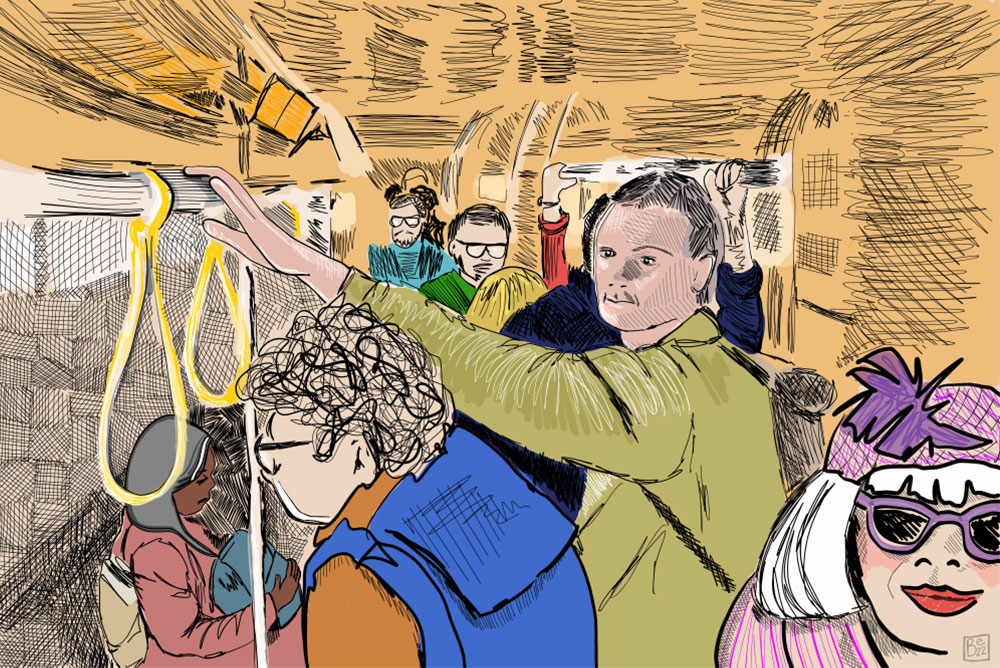
Illustration by Be Boggs.

by DEREK MONG | FEBRUARY 24, 2022 (Zocalopublicsquare.org)

How many of us grow rapturous in the presence of a bus? The number, I’d guess, is relatively small. Hulking metal loaves of the urban landscape, buses do not, when rattling past, draw voices down to a reverential hush. Heads don’t turn. Some buses are admittedly charming. Think of London’s double-deckers. Think of a school bus, first day of class. Others, though, are comically awkward, like the long bendy kind, their waistlines accordioned round corners. Only a few are truly memorable: Rosa Parks, Montgomery, Alabama, 1955; Ken Kesey, Merry Pranksters, the ’60s; Keanu Reeves, Los Angeles, Speed.

This collective disdain, born of class warfare and the American obsession with cars, does buses a disservice. They’re democratic institutions, sight-seeing stalwarts, and the delivery system for poetry—both found and made. To ride one among neighbors, the stamp of your municipality affixed to its hide, is to bind the communal and the commuter. Of course, buses break down. Of course, they’re late. But it’s the gap between their purpose and their product, their design and their delivery, that tells the story, in miniature, of the U.S.’s efforts to fulfill its obligations to us all.

I’ve missed countless buses. More than a handful have missed me. I know the taste of exhaust, the bite of the rain. And yet I still swoon over the routes and the timetables, the stops and the seats, of my bus-riding life. My swoon grew only more swoony after a pandemic and a move reduced my ridership to near nil. Since 2016, I’ve lived in rural Indiana. There are no buses. And so I am nostalgic for a time when cosmopolitanism and contagion-free air were commonplace.

What do I love about buses? Repetition comes to mind. Eavesdropping too. I love watching the glass shelters of bus stops sail by like diving bells. I love knowing, by the sound of a speed bump or the scrape of a pendulous branch, how near I am to home. This reminds me of verse, which—formal or free—thrives on patterns. And it reminds me of the poetry of my fellow passengers: “Nope, you’re good,” a woman reassures a man, “we could eat off your face.” (Was his beard mangy? His brow stained?) Later, a few seats over, a daughter shares a cookie with her dad: “Daddy, don’t eat the crumbs!” (He stops.)

Such found poetry flourishes just below a published kind: those colorful signs, linked up like train carriages, that line a bus’s interior. They usually advertise bail bondsmen or prohibit loud music. Their language is boilerplate or cant. At least it was until, 30 years ago this year, the Poetry Society of America and New York City collaborated on a series of poems that went—in a spatial sense only—right over our heads. They called it Poetry in Motion, and it recast the poem, that most highbrow of literary artifacts, as a public good.

That project spawned other projects in other cities. All offer a respite from the hectoring advertisement or the moralizing drone of the PSA. In the era before smart phones, the bus poem gave us a little entertainment. Now, it releases us from our screens.

What was the first Poem in Motion? Walt Whitman’s “Crossing Brooklyn Ferry.” It’s there that the poet declares, to riders of ferryboats past, present, and future, that he too “was one of a crowd.” It’s a democratic statement, and democracy, to my mind, is what makes poetry and buses so symbiotic. Metaphor is an equal sign, a union, a democracy of the world’s disparate parts. Poetry thrives on it, and short poems rely on it more. Here’s the most famous Anglophone poem about public transportation, as it first appeared in 1913, by Ezra Pound:

In a Station of the Metro

The apparition of these faces in the crowd:
Petals on a wet, black bough.

Metaphor makes dissimilar things seem suddenly, surprisingly alike. These ghostly faces, for instance, and “[p]etals on a wet, black bough.” In Pound’s poem, the colon unites these oppositesAmong American democracy’s disparate elements, it’s the franchise, the social contract, and—I like to think—public transportation. Is it any wonder that the literary critic I.A. Richards named the second half of any metaphor, the imagined part (here, “petals”), the vehicle? It’s where the imagination goes.

In America, Whitman saw this link first. Plenty have seen it since. The rush hour crowd is a stand-in for the demos. The confines of the carriage are a metaphor for the country. Poems about public transportation are always already poems about ourselves. “[M]ingled / black and white / so near / no room for fear,” Langston Hughes writes in “Subway Rush Hour.” Where urban density meets urban diversity, Hughes argues, racial acceptance stands a chance.That’s when my belief in ex omnibus unum—what I’ve come to call this rumbling urge, this latter-day hope, that public transit can rejuvenate public life—was born.

In “Flat American Waltz,” a double sonnet that replicates, in its elaborate, circuitous syntax, an urban bus route, Kevin González reminds us that bus riders enter an American experiment that’s still hurtling forward, herky-jerky and unsure. “Let’s all believe,” he writes, “in the place, / these hard plastic seats are taking us.”

That’s harder to do these days, what with the republic in peril, and I wonder if my nostalgia for buses isn’t just a nostalgia for better times. From 2008 to 2016, I lived in cities and rode buses all the time. Violent insurrections felt foreign and a skinny Black guy from Chicago was president, buoyed by a coalition—people of color, white liberals, urbanites—that looked a lot like my fellow bus riders.

That’s when my belief in ex omnibus unum—what I’ve come to call this rumbling urge, this latter-day hope, that public transit can rejuvenate public life—was born. But ours is an era of the MAGA caravan and the Google bus, the Uber infiltration and the airplane mask fight. Today I wonder if we can pull the stop cord on our current predicament, hop off, and walk home. The trouble, of course, is that we’re already there.

But I wallow. I detour. At such moments, when I get lost in the now, I remind myself that any good poem exists in the now and the after. I think of Allen Ginsberg’s “In the Baggage Room at Greyhound,” a poem in which the poet—depressed, working as a luggage clerk—“realized shuddering / these thoughts were not eternity.” Or I consider the school bus, which is, for so many, the first taste of shared transit. All across America, school buses are pressing a connection between jostling rides and dense reads into the hot pleather seats of kids’ minds.

Or I rewatch Jim Jarmusch’s Paterson, a movie that taught me how riding a bus is like reading a poem. Both take you, once you’re on board, wherever they go. And the poet, like the driver, played here deftly by Adam Driver, leads you around its turns. And Driver here is both a poet and a driver; he writes poems at lunch. And the word “verse” comes to us from the Latin versus, “a “turn of the plow.” Every stop is a stanza break. Every segment shows you a little more of your world.

That movie helps me to remember that I’ve lived a privileged life, a life where the bus is a study not a slog, while Michael Spence drove a Seattle bus for 30 years, then documented his experience in The Bus Driver’s Threnody. Or I’ll reread Terrance Hayes’s “Woofer (When I Consider the African-American).” It begins when the poet forgets his “father’s warning about meeting women / at bus stops” and ends, well… I’ll let you read the poem.

GET MORE ZÓCALO

Ideas journalism with a head and heart.

You may opt out or contact us anytime.

Poetry lifts us and persists past us. It time travels. It makes you miss your stop. And when the era seems hellbent on collision, and you’re forced to watch it, bracing for an impact that you cannot avert, poetry reminds you that others lived through worse. “I am with you,” Walt Whitman writes in “Crossing Brooklyn Ferry,” “[j]ust as you feel when you look on the river and sky, so I felt.” This from a guy who survived a Civil War. Who saw the limbs piled high.

But it’s not Whitman that I’d choose for a seatmate on a long bus ride. No, that’d be Elizabeth Bishop, whose shoulder I’d look over, sharing her prismatically sure vision of the world.

Take “The Moose,” the poem where she and a busload of passengers spot the eponymous beast in the middle of the road. The driver stops. No one moves. “Why, why do we feel / (we all feel) this sweet / sensation of joy?” she writes, as the moose loiters, majestically unaware. Because we’re in this together. Because we’ll soon be moving on.

DEREK MONG is a poet and critic, and the Byron K. Trippet Assistant Professor of English at Wabash College. His latest collection is The Identity Thief, excerpts of which can be found on his website.

‘Their golden hour’: Donetsk and Luhansk leaders revel in rising profile

Ukraine crisis has thrust Denis Pushilin and Leonid Pasechnik into centre of events, amid claim they are puppets of Putin

Leonid Pasechnik (left) and Denis Pushilin in January 2021.
Leonid Pasechnik (left) and Denis Pushilin in January 2021. Photograph: Valentin Sprinchak/Tass

Pjotr Sauer in MoscowThu 24 Feb 2022 (TheGuardian.com)

For many Russians, it was an unfamiliar sight to see the faces of the two leaders of the pro-Kremlin proxy states in eastern Ukraine pop up on their television screens last Friday, announcing the mass evacuation of Donbas citizens to Russia.

Since then, however, Denis Pushilin and Leonid Pasechnik, heads of the self-proclaimed republics in Luhansk and Donetsk, have seen their political profiles rocket, culminating on Monday with the two leaders asking the Russian president, Vladimir Putin, to recognise their “republics”.

“This is their golden hour; they are quickly becoming stars,” said the political analyst Konstantin Skorkin, a Luhansk native who focuses on the region.

Amid reports of Russian tanks rolling into the Donbas, questions have arisen as to what extent the separatists have been acting on their own accord or are just pawns in the Kremlin’s bigger geopolitical aims.

“They are simply puppets of the Kremlin and the recent events only confirmed this once again,” said Skorkin.

https://interactive.guim.co.uk/uploader/embed/2022/02/ukraine_donbas-zip/giv-825awq6J0gMLB9e/

He points to how each statement that the two leaders made over the past week was quickly picked up by state media and the Kremlin. “The Russian leadership coordinated everything and nothing was left to chance,” the analyst said.

The two regions have been highly dependent on Russian support since their formation in 2014 as they suffered economic collapse during their eight years of unrecognised independence.

The regions’ People’s Militia is also fully armed by the Russian state, and Ukrainian officials believe up to 11,000 Russian soldiers are permanently stationed in the Donbas.

“They just simply wouldn’t exist without Russian support,” said Nikolaus von Twickel, former OSCE staff member in Donetsk who has written extensively on the Donbas. “But their relationship with Moscow has changed over the years.”

In the chaos that followed the 2014 Maidan revolution, a number of rogue and unpredictable local leaders emerged as heads of the two separatist states. Von Twickel said the Kremlin had since worked systematically to replace these firebrands with trusted loyalists.

Analysts see 2018 as a turning point in the relative independence of the region, when Alexander Zakharchenko, the head of the self-proclaimed Donetsk people’s republic, was killed in a car bomb and replaced by the more reliable Pushilin. The Ukrainian security service said at the time Zakharchenko’s death was a result of an operation by Russian special forces.

“Zacharchenko had his own personal army, and the Donbas even had its own defence ministry – all of that has disbanded since. It was a clear signal that the rebels will only act according to Kremlin’s rules,” Von Twickel said.

And while experts now point to the very limited autonomy of Pushilin and Pasechnik, closely following the two leaders can serve as a good indication of what the Kremlin may do next in Ukraine.

Denis Pushilin

Denis Pushilin, head of the self-proclaimed Donetsk people’s republic.
Denis Pushilin, head of the self-proclaimed Donetsk people’s republic. Photograph: Alexander Ryumin/Tass

The younger and more charismatic of the two, not much is known about Pushilin’s early days in the Donbas.

He first came to prominence in 2011, while working for the infamous MMM group, a notorious Russian Ponzi scheme that is considered to be one of the world’s largest fraud organisations of all time.

“He is your typical wheeler-dealer kind of guy,” said Von Twickel.

Pushilin joined the separatist cause early on in 2014, but in contrast to some of the other Donetsk leaders, he never saw any large military action, often sporting a suit in public, a habit he was occasionally mocked for by the other rebels.

But over the years, Pushilin looked to have gained the Kremlin’s trust as he became the head of the region after the murky murder of Zakharchenko.

Pushilin has repeatedly expressed his desire for the region to be part of a “renewed Russian empire” rather than an independent state. “Donbas should be part of the Russian empire. I don’t see anything bad in imperialism,” he once said.

Leonid Pasechnik

Leonid Pasechnik during a meeting with Vladimir Putin.
Leonid Pasechnik during a meeting with Vladimir Putin. Photograph: Anadolu Agency/Getty Images

Prior to the 2014 Maidan revolution, Pasechnik had a long career in the Ukrainian security services, where he rose to the rank of lieutenant colonel.

He first received national attention in 2006 when in a special operation he intercepted 7.24m Russian roubles in cash (almost £2m) that was being smuggled across the Russian-Ukrainian border. Pasechnik reportedly refused to take a bribe from the smugglers in the operation, receiving a medal from the pro-western Ukrainian president, Viktor Yushchenko, for the operation.

Like many other generals in the Ukrainian security services in the Donbas, Pasechnik chose the side of the pro-Russian separatists in 2014, when he headed the notorious state security department of the self-proclaimed Luhansk people’s republic.

“He operated the main prisons and the so-called isolation cells, cellars where pretty sinister stuff happened,” said Von Twickel, referring to the many media reports depicting stories of torture of those who opposed the separatists.

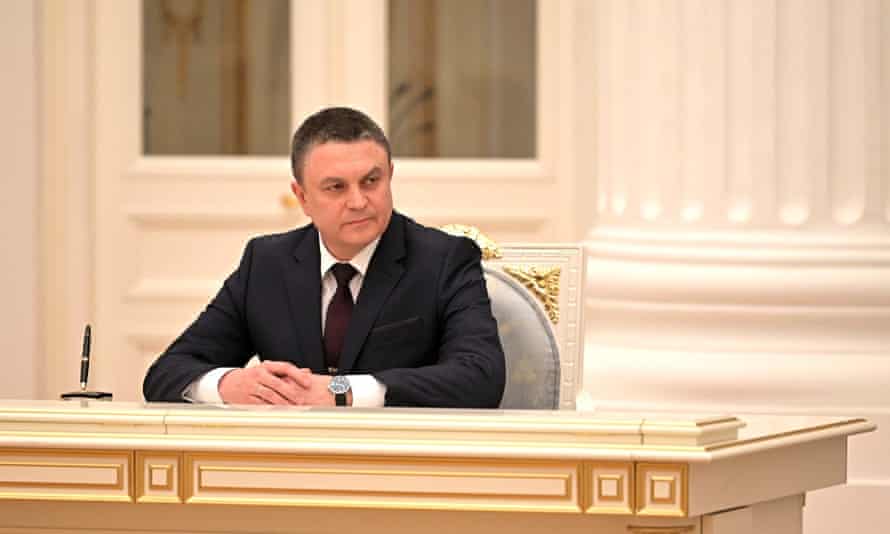
In 2017, Pasechnik emerged as the victor of a violent power struggle with the then head of Luhansk, Igor Plotnitsky. Not much has since been heard from the camera-shy and timid Pasechnik, and he has somewhat looked out of place as he was suddenly sprung into the country’s spotlight.

Democracy Rising 1 Introduction: Idiots Я Us

By Tom Prugh, originally published by Resilience.org

  • October 27, 2021

Democracy Rising is a series of blog posts on deliberative democracy: what it is, why it’s powerful, why the time is right for it, how it works, and how to get it going in your community. Written by deliberation scholars and practitioners, the series originates in the United States but will discuss principles and draw upon examples from around the world. Views and opinions expressed in each post are those of the individual contributors only.

Introduction: Idiots Я Us

Most Americans consider the freedom from politics to be part of their wellbeing.—Robert Samuelson[1]

Politicians are always letting the public off the hook—it might be the most unforgivably dishonest thing they do.—George Packer[2]

Democracy is not the multiplication of ignorant opinions.
—Beatrice Webb[3]

To be meaningful, democracy requires settings that allow direct knowledge of persons and issues.—William Ophuls[4]

Come now, and let us reason together.—Isaiah 1:18

Pop quiz: the American political system is (pick one):

  1. A) still, after nearly 250 years, a visionary triumph of robust representative democracy, a beacon to all nations and peoples seeking the fairest, most just way for people to govern themselves and collectively create a common future; or
  2. B) a corrupt, sclerotic, and cynical train wreck of a system dominated by entrenched elites and run by a two-party political cartel with a death grip on power, incapable of facing and addressing a host of critical challenges and content to feather its own nest—and its donors’—while the country goes off the rails.

Chances are you picked B.

If so, you have lots of company. Democracy seems to be wobbling or fading in many places across the globe, but lately the United States has displayed some particularly alarming signs of weakness. Volumes have been written about our governance system’s problems and failures: the corruption, the pandering, the polarization, the embedded racism, the lack of social mobility, the vast inequalities of wealth and income. A great many Americans are exhausted by these problems, despairing at their seeming intractability, and hungry for something better. And of course these concerns are hardly exclusive to Americans; millions of people all around the world share the desire for more responsive political systems and a greater capacity to shape their collective lives together.

Regular visitors to Resilience.org likely are already familiar with many possibilities for reforming our political systems to make them more responsive and effective. This Democracy Rising series of blog posts will focus on one that may not be so well known: deliberative democracy.

The deliberative democracy (DD) process discussed in this series is a bottom-up approach that regularly and deeply engages ordinary people—and their concerns, ideas, and values—in the process of identifying and addressing the problems of their communities and regions.[5] Though under-appreciated, it has an ancient pedigree and is growing in popularity worldwide. At one time it might have been made the foundation of the American political system, and in fact it was considered. The Founders might have encouraged and supported engagement, discussion, and power-wielding by ordinary people, but (with a few exceptions) most of them thought the system would work better without such broad participation. In effect, they designed an oligarchy—they kept the reins of power in elite hands by reducing everyone else to bystanders, or at best mere voters—and restricted voting to property-holding white males.[6]

The system enshrined in the U.S. Constitution included the sensible notion of dividing power to prevent anybody from having too much—the famous “checks and balances.” But it was basically meant to keep people and their differences apart and to resolve those differences at a distance. After so many years, too many of us hardly know how to work out differences among ourselves. In fact we can hardly imagine doing so. The right to vote (though now under siege) has gradually been extended to most adults, but too many of us still have little or no direct role in making the laws and policies that shape our communities and our nation. We may join political parties, work for candidates, and even run for office ourselves. But mostly we limit ourselves to grousing, which naturally focuses on what’s broken at the top.

Of course, the system is broken at the top. But in far too many communities it’s also broken at the bottom, and the top probably won’t get fixed until the bottom is. If the system doesn’t work for the people it’s meant to serve, maybe it’s because those people are just not engaged with it. In many cases, whole groups have been disenfranchised or squeezed out, and years (or centuries) of such marginalization have understandably driven many members of those groups to give up. In other cases the call of consumerism drowns out everything else. Many of us have simply decided, consciously or not, to focus solely on our private lives.

And so, by one pathway or another, a critical share of us has become idiots.

“Idiot” comes from a Greek root that means a private, un- or mis-informed person, one who is concerned only with narrowly defined interests and rejects personal commitment or investment in the wider community.[7] That’s the opposite of  what we must become, i.e., citizens, as the Greeks understood the term—meaning civically conscious and engaged community members.[8]

In the United States our current approach to developing such community members sets a pretty low bar. High schools require civics courses that discuss the three branches of government and tout party membership, the virtues of voting, listening to candidate debates, and so on. Those are not necessarily bad things—they just don’t work very well. Every state requires some civics education[9] but the requirements are wildly uneven, and misconceptions and gaps in students’ knowledge abound. (Despite what some civics test results suggest, Osama bin Laden was never U.S. Vice President. Utah is not a country.[10])

We need a deeper process. The foundation of this Democracy Rising series of blog posts is that deliberative democracy is one of keys to curing what ails our system. Plenty of attention has been given to various top-down fixes to the machinery of governance, but we also need to shift the system’s center of gravity from political parties, which are clubs for people who seek power (and the money to acquire it), to ordinary citizens. For that to work, people must cultivate ongoing conversations with each other about their own governance. When this happens broadly and consistently, it can create a more educated—and less credulous—public, tap the distributed knowledge and wisdom of many more people, create buy-in for policies, and hold the larger system and its servants to closer account.

These are bold claims, but there is plenty of evidence for them, both here in the United States and elsewhere, as later posts will show.

What is deliberative democracy? Despite being largely under the public radar, DD is a surprisingly broad field that harbors a number of different conceptions.[11] But in this series it refers to a vision of governance that:

  • is locally focused;
  • invites citizens into structured and modulated gatherings (in person and/or online) to support ongoing, respectful, and public dialogue, exchange, and mutual education;
  • engages ordinary people and strives to be broadly inclusive of all community members;
  • is based on solid, balanced information and transparent processes; and
  • addresses “wicked” issues and aims to arrive at public judgments about them that are rooted in participants’ values[12] and firmly and consistently linked to policy outcomes.

DD is a worldview, as well as a method and process for cultivating a robust form of citizenship. DD is highly participatory: it starts with the assumption that ordinary people can gather to discuss an issue, not as adversaries seeking to win a debate (though they may well disagree, and not even like each other much), but as collaborators looking for solutions to shared problems. DD routinely taps expert knowledge, but experts are not in charge. Crucially, it also seeks to exert influence on bureaucrats, officials, and politicians, because a key aim of successful deliberative democracy is power, i.e., its ability to shape policy.

The remaining posts in this series, written by a variety of DD theorists and practitioners with varying perspectives, will discuss these ideas in more detail, drawing on examples and stories from the United States and elsewhere. The posts will mix glimpses of deliberation’s long history and some key milestones in America’s political journey with more nuts-and-bolts topics. We will take a look at what social and cognitive science has to say about why DD makes sense as a way for human beings to run their own affairs. Other posts will show how deliberation and its power to educate people into citizenship could help us address some of the major crises facing America—and the world—including widening inequality and our multifaceted sustainability crisis. And although DD’s primary focus is on local communities, the expanding adoption of deliberative democracy could eventually—aspirationally—cross  a threshold and, by aggregation, create a widespread culture of deliberation that would have tangible ripple effects at national and even international levels.

The Resilience readership is highly knowledgeable about sustainability policies and practices, but transition activists and communities will need to raise their game on self-governance as well. Like communication, organizing, and “soft skills” in general, governance can’t be taken for granted. We believe that Resilience readers, as well as millions of other people, are hungry for a democracy that is more responsive to their countries’ needs and better suited to the challenges facing them. Building deliberative democratic cultures will be valuable both in enhancing support for sustainability action and in creating the kind of community cohesion necessary to weather the ecological, social, political, and economic turmoil ahead. And so, because we want to inspire readers to rebuild the system from the bottom up and from the inside out, we will offer some practical advice on how to do it. Our aim is to support a movement of “democracy preppers” who want to stockpile social and community capital rather than dried beans and ammunition.

We believe that our national political systems cannot work well and with integrity unless we build and strengthen local political systems that do so—and deliberating citizens are the heart and soul of local politics. This series aims to show where that’s happening already, how it can happen nearly anywhere—and how it can be a great source of satisfaction and stronger communities.

[1] “Why Clinton Hangs On,” The Washington Post, April 1, 1998, p. A19.

[2] “Parting Words,” The New Yorker, January 23, 2017, p. 17.

[3] Cited in Edward Luce, The Retreat of Western Liberalism (New York: Atlantic Monthly Press, 2017), p. 75.

[4] Immoderate Greatness: Why Civilizations Fail (North Charleston, SC: CreateSpace Independent Publishing Platform, 2012), p. 78 note 4.

[5] Deliberative democracy is an expansive and evolving field, and there are other approaches to it—and tensions and trade-offs among them. Democracy Rising posts will explore these to an extent, but our particular focus will be mainly on bottom-up approaches that are tied as firmly as possible to policy outcomes.

[6] See Daniel Kemmis, Community and the Politics of Place (Norman, OK: University of Oklahoma Press, 1990), pp. 10, 11; and Patrick Deneen, Why Liberalism Failed (New Haven: Yale University Press, 2018), p. 9.

[7] Benjamin Barber, Strong Democracy: Participatory Politics for a New Age (Berkeley: University of California Press, 1984), p. 42.

[8]Given that immigration policies and practices are hot-button issues in many places, “citizen” can be a fraught term. Those issues are highly worthy of deliberation but are beyond the scope of this series. In these posts “citizen” refers to a role, not necessarily a legal state—that is, it signifies anyone who devotes a significant share of their time and energy to the concerns and wellbeing of the communities where they live.

[9] Education Commission of the States, December 12, 2016, 50-State Comparison: Civic Education Policieshttps://www.ecs.org/citizenship-education-policies/.

[10] https://www.huffingtonpost.com/2012/06/13/us-history-lesson-video-casts-negative-light-on-public-school-system_n_1594700.html.

[11] David Kahane and Gwendolyn Blue, “The Theory and Practice of Deliberative Democracy,” Chapter 2 in Lorelei Hanson, ed., Public Deliberation on Climate Change (Edmonton: Athabasca University Press, 2018), p. 78.

[12] “Whereas public deliberation needs to be anchored in facts, sound judgment—whether on the part of individuals or groups—is not based mainly on a command of pertinent facts, as policy experts often assume. Deliberation consists chiefly of exchanges about what individuals and groups value, their priorities and personal stories, and their relevance to public concerns.” In Keith Melville et al., “National Issues Forums,” Chapter 3 in John Gastil and Peter Levine, The Deliberative Democracy Handbook: Strategies for Effective Civic Engagement in the 21st Century (San Francisco: Jossey-Bass, 2005), p.  42.

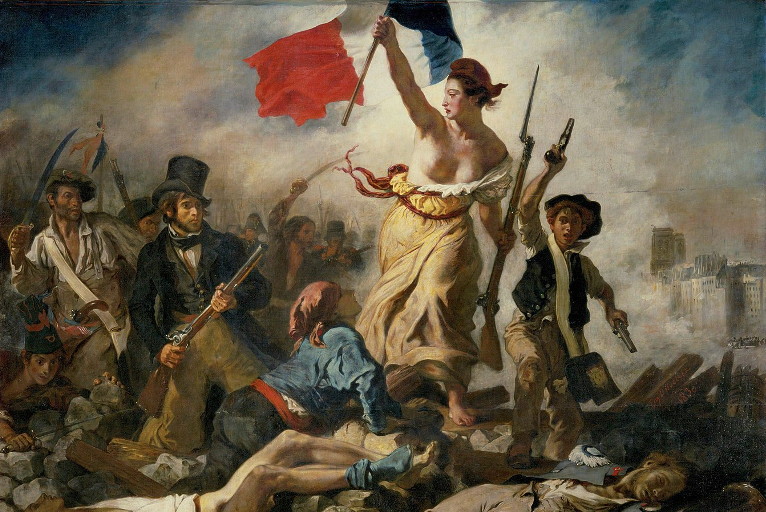
Teaser photo credit: By Eugène Delacroix – Erich Lessing Culture and Fine Arts Archives via artsy.net, Public Domain, https://commons.wikimedia.org/w/index.php?curid=27539198

(Contributed by Walter J. Smith)

Tarot Card for February 25: Death

Death

Death is numbered thirteen and is the most feared card in the deck. We see the Grim Reaper depicted as a dark and powerful figure, sometimes on horseback and at other times on foot. He usually carries a scythe and leaves bodies, limbs and so on in his wake. Whoever we are, Death will claim us eventually.

The Death card signifies endings, but not necessarily shocking and disruptive ones. In any case, endings always lead to new beginnings and Death itself symbolises a sweeping away of the past. If we rid ourselves of past garbage then we are free to set out on an entirely new path

When Death appears it almost always signifies a major change in one’s life. Sometimes the change will appear disruptive and unexpected, sometimes it will be a breath of fresh air – clearing away obstacles and allowing you to surge forward. So do not assume that Death is a negative card – it is often just what we need in order to progress when fear is holding us up.

Death

(via angelpaths.com and Alan Blackman)