
scienceandnonduality Wisdom of Trauma – Talk on Trauma Series Part 2 https://thewisdomoftrauma.com In this conversation Dr. Gabor Maté explores w/ Stephen W. Porges: – Effects of childhood trauma on the autonomic nervous system – Applications of Polyvagal Theory for trauma treatment – Integrated theory of neuro-visceral regulation Watch the movie and access all the Talks on Trauma at: https://thewisdomoftrauma.com
Monthly Archives: February 2022
Let your Bold but Stealthy Tiger Rule this Year!
 Happy New Year of the Tiger Happy New Year of the Tiger For the second year in a row (and hopefully for the last time), the Divination Foundation will not be hosting our festive annual Chinese New Year’s party in Portland … yet another casualty of this ongoing pandemic. But we can still opine on whether the future looks brighter for the Year of the Water Tiger! There’s something about every new year that stimulates the hope for easier and more pleasing times. The Western new year has passed, but the Chinese Lunar calendar begins February 1, 2022 (always the second full moon after Solstice). We are entering the Year of the Tiger. While a sign for a whole year may not be too personally compelling, astrology can provide some perspective on a period of time. An awareness of and a feeling for trends can help us maximize our good fortune. I call this “intuitive intelligence” (the name of my last book). 2020 was a Rat Year where we needed to rapidly adapt for the sake of survival itself. 2021 was a Year of the Ox—more about slow progress, practical hard work, and trying to anchor ourselves in a new and ever-shifting reality. This new year’s regal Tiger is known for intensity, quick action, power, and ferocity. (Note: I enjoy several planets in Gemini, the Western astrological equivalent of the Chinese Tiger :-). To be sure, another new year will produce sudden disruptions, surprising developments, strong emotions and important decisions—personally, professionally or politically. Going forward, we can expect situations to turn on a dime. Tigers are persistent and stealthy hunters, who take bold steps carefully. The super brave (or foolhardy) of us will thrive after taking great leaps, while others could crash and burn. We are told, by cosmic Chinese astrologers, that this year could even bring unexpected good news! Ambitious dreams could turn into successful reality. Our awareness of life becomes more complex, so there may also be setbacks, dashed hopes or painful drama. At times it may be hard to find middle ground. Try to stay nimble! Every 12 years, a Tiger year brings change and upheaval, but this one will be more intense because 2022 is the “Water Tiger.” Water is a powerful flowing force of nature that can transform solids, conquer fire, go around or destroy any obstacle. Water is also about the flowing of sensitivity, emotions, creative impulses and openness to change and impermanence. 1962 was the last Water Tiger year. Like back in1962, we can expect revolutionary change in politics, the economy, society, and technologies that will shape the world for years to come. For better or worse? As the ancient sage said (without remorse), “I don’t know … it’s not our job to know, just to go with the flow!” Pathways is still going strong despite the pandemic, bringing you conversations with leaders in personal and cultural transformation. You can listen to episodes of Pathways Radio by Paul O’Brien via Divination.com, or wherever you get your podcasts. |
Holocaust Remembrance: We all wear the triangle
by Kittredge Cherry | Jan 27, 2022 (qspirit.net)
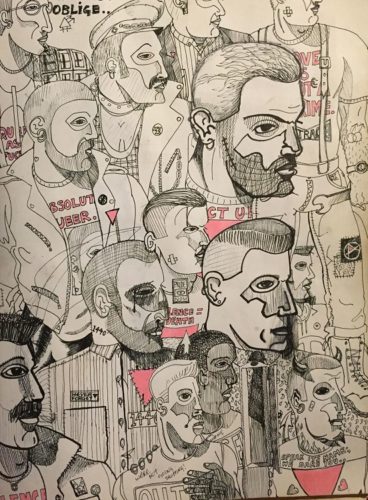
International Holocaust Remembrance Day (Jan. 27) honors the victims of the Nazi era, including the estimated 5,000 to 60,000 sent to concentration camps for homosexuality.
The United Nations set the date as the anniversary of the liberation of the Auschwitz-Birkenau, the largest Nazi death camp, in 1945.
Established by the UN in 2005, International Holocaust Remembrance Day recalls the state-sponsored extermination of 6 million Jews and 11 million others deemed inferior by the Nazis, including LGBTQ people, Slavic peoples, Soviet prisoners of war, Gypsies and others not of the “Aryan race,” the mentally ill, the disabled, people, and religious dissidents such as Jehovah’s Witnesses and Catholics. Holocaust Remembrance Day aims to help prevent future genocides.
Approximately 100,000 men were arrested from 1933 and 1945 under Paragraph 175, the German law against homosexuality. They were imprisoned or sent to concentration camps. Only about 4,000 survived. During the Nazi regime, some mobilized their “deviant” sexualities to counteract Nazi ideologies.
The defeat of the Nazis brought liberation for most prisoners in the concentration camps, but some of those accused of homosexuality were re-imprisoned in post-war Germany based on evidence found by the Nazis.
Artists who address LGBTQ deaths in the holocaust (or “homocaust”) include Tony O’Connell, Mary Button, William Hart McNichols, Richard Grune, John Bittinger Klomp, Keith Haring and those who designed the world’s dozens of memorials to LGBTQ Holocaust victims. Their art is featured here today.
Pink triangles turn shame to pride
Nazis used the pink triangle to identify male prisoners sent to concentration camps for homosexuality. Originally intended as a badge of shame, the pink triangle has become a symbol of pride for the LGBTQ rights movement. Pink triangles used to be the most common LGBTQ symbol.
They show clearly in the drawing at the top of this post. Queer British artist Tony O’Connell sketched it based on attending his first Pride march — the 1992 Pride march in London. “This page from my 1992 sketchbook was influenced by men I saw on my first Pride March mixed with various gay stereotypes and historical symbols. It could become a very old distant cousin for an image of queer saints marching,” O’Connell said.
Now pink triangles have mostly been replaced by rainbows, which emphasize diversity, but don’t connect with queer history in the same way that the pink triangle does. Pink triangles live on in replicas of vintage buttons and shirts from Pride marches and protests of the past.
Holocaust art and monuments with the pink triangle
The pink triangle appears in a variety of monuments that have been built around the world to commemorate LGBTQ victims of the Nazi regime.
The world’s first LGBTQ Holocaust memorial was the Homomonument, opened in 1987 in the Netherlands. O’Connell made a photo and video record of his prayers and offerings at the Homomonument in Amsterdam on Christmas Day 2014 as part of his contemporary performance art series of LGBTQ pilgrimages.

Holocaust Memorial Pilgrimage to Homomonument in Amsterdam by Tony O’Connell
O’Connell visits LGBTQ historical sites such as the Harvey Milk Metro station in San Francisco, New York City’s Stonewall Inn, and the Alan Turing Memorial Bench in Manchester. Democratizing the idea of sacredness and reclaiming the holiness in ordinary life, especially in LGBTQ experience, are major themes in O’Connell’s work. Based in Liverpool, O’Connell was raised in the Roman Catholic church, but has been a practicing Buddhist since 1995. For more info about O’Connell’s art, see my previous post Codebreaker Alan Turing honored in queer pilgrimage by artist Tony O’Connell.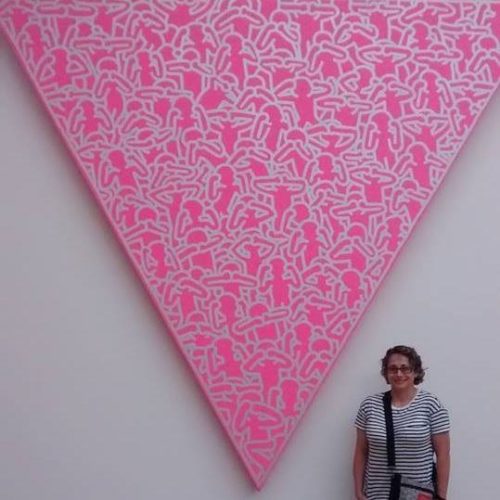
“Silence = Death” by Keith Haring (1988) is shown here at a 2016 exhibit in Munich, Germany. Photo courtesy of Steph Budwey.
Pink triangles are featured in the work of various artists, including Keith Haring (1958-1990), one of the most well-known gay artists of the 20th century. Works such as his 1988 “Silence = Death” draw a parallel between the Nazi holocaust and the oppression and invisibility of people with AIDS. He did multiple versions in different sizes. They show a pink triangle overlaid with figures covering their eyes, ears and mouths.
Another painting on the theme is “Pink Triangle” by John Bittinger Klomp, a gay artist based in Florida.

“Pink Triangle” by John Bittinger Klomp, 2012
“The Pink Triangle was part of the system of triangles used by the Nazis during World War II to denote various peoples they deemed undesirable, and included Jews, Jehovah’s Witnesses and homosexuals,” Klomp said. The painting is part of his “Gay Dictionary Series” on words and symbols related to being gay.
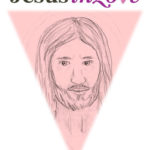
The original logo for the Jesus in Love Blog also shows the face of Jesus in a pink triangle. He joins queer people in transforming suffering into power.
In January 2014 Israel’s first memorial for LGBT victims of the Holocaust was unveiled in Tel Aviv. Since 1984, more than 20 gay Holocaust memorials have been established in places ranging from San Francisco to Sydney, from Germany to Uruguay. Some are in the actual concentration camp sites, such as the plaque for gay victims in Dachau pictured below.
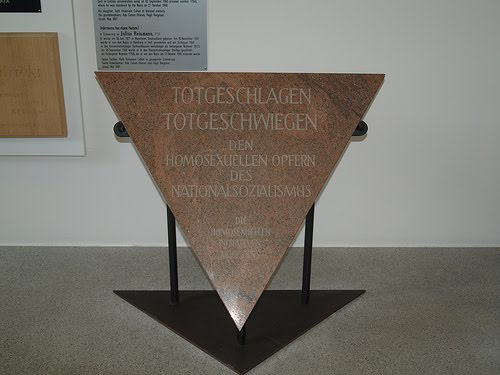
Plaque for gay victims at Dachau concentration camp by nilexuk
To see powerful photos of all the queer Holocaust memorials and read the stories behind them, visit:
http://andrejkoymasky.com/mem/holocaust/ho08.html
Priest who wore the pink triangle
A gay priest who was killed in the Holocaust is honored in the icon “Holy Priest Anonymous One of Sachsenhausen.” It was painted by Father William Hart McNichols, a New Mexico artist and Catholic priest who was rebuked by church leaders for his LGBTQ-affirming icons of unapproved saints. The icon of the anonymous priest of Sachsenhausen icon appears in the book “The Bride: Images of the Church,” which McNichols co-authored with peace activist Daniel Berrigan.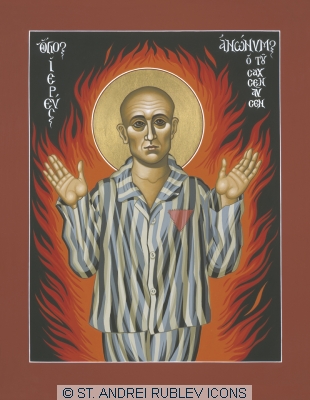
A gay priest killed in the Holocaust appears in “Holy Priest Anonymous One of Sachsenhausen” by William Hart McNichols
The anonymous 60-year-old gay priest, beaten to death because he refused to stop praying at the concentration camp in Sachsenhausen, Germany. Eyewitness Heinz Heger reported that the murder was so brutal that “I felt I was witnessing the crucifixion of Christ in modern guise.”
Here is the beginning of his tragic story, as told by Heger in his book The Men With the Pink Triangle.
Toward the end of February, 1940, a priest arrived in our block, a man some 60 years of age, tall and with distinguished features. We later discovered that he came from Sudetenland, from an aristocratic German family.
He found the torment of the arrival procedure especially trying, particularly the long wait naked and barefoot outside the block. When his tonsure was discovered after the shower, the SS corporal in charge took up a razor and said “I’ll go to work on this one myself, and extend his tonsure a bit.” And he saved the priest’s head with the razor, taking little trouble to avoid cutting the scalp. quite the contrary.
The priest returned to the day-room of our lock with his head cut open and blood streaming down. His face was ashen and his eyes stared uncomprehendingly into the distance. He sat down on a bench, folded his hands in his lap and said softly, more to himself than to anyone else: “And yet man is good, he is a creature of God!”
The book goes on to recount in heartbreaking detail how the Nazis tortured the priest, hurling anti-gay slurs and beating him to death. More excerpts are available at the Queering the Church Blog in a post titled The Priest With the Pink Triangle.
More artwork remembering LGBTQ people in the Holocaust
Persecution of LGBTQ people during the Holocaust is juxtaposed with the suffering of Jesus in two paintings from “Stations of the Cross: The Struggle For LGBT Equality” by Mary Button. In Station 3, Jesus falls the first time and Nazis ban homosexual groups. The painting features headshots of men who were arrested for homosexuality under Paragraph 175 of the German criminal code and sent to concentration camps between 1933 and 1945.

Station 3 from “Stations of the Cross: The Struggle For LGBT Equality” by Mary Button, courtesy of Believe Out Loud
In Station 4, Jesus meets his mother and LGBTQ prisoners are kept in Nazi concentration camps after Allied liberation. Nazis and Allies were enemies, but they agreed that homosexuals should be locked up. The Allies liberated everyone else, but kept those who wore the pink triangle in prison. Upon liberation of Nazi concentration camps, those interned for homosexuality were not freed, but required to serve out the full term of their sentences under Paragraph 175. The painting shows railroad tracks leading to the gas chambers at Auschwitz-Birkenau concentration and extermination camp, uniforms with pink triangles, and the Nazi chart of symbols used to classify prisoners.

Station 4 from “Stations of the Cross: The Struggle For LGBT Equality” by Mary Button, courtesy of Believe Out Loud
Using bold colors and collage, Button puts Jesus’ suffering into a queer context by matching scenes from his journey to Golgotha with milestones from the last 100 years of LGBTQ history. For an overview of all 15 paintings in the LGBT Stations series, see my article LGBT Stations of the Cross shows struggle for equality.
A scene from “The Life of Gad Beck: Gay. Jewish. Nazi Fighter.” by Dorian Alexander and Levi Hastings (theNib.com)
Powerful images of gay Jewish resistance appear in “The Life of Gad Beck: Gay. Jewish. Nazi Fighter,” a non-fiction comic by Dorian Alexander and Levi Hastings. It was first posted online for Holocaust Remembrance Day 2019.
It open with the lines, “When we think of queer people and the Holocaust, it’s hard to think of anything but victimization. But that would be a mistake.” It goes on to show the inspiring story of how Beck resisted and survived the Nazis.
Beck also tells his own story in his 2000 autobiography titled An Underground Life: Memoirs of a Gay Jew in Nazi Berlin.
Richard Grune, a Bauhuas-trained German artist sent to Nazi concentration camps for homosexuality, also saw a connection between Christ’s Passion and the suffering of people in the camps. After being imprisoned in Sachsenhausen and Flossenbürg, he created “Passion of the 20th Century,” a set of lithographs depicting the nightmare of life in the camps. Published in 1947, it is considered one of the most important visual records of the camps to appear in the immediate postwar years.

“Solidarity.” Richard Grune lithograph from a limited edition series “Passion des XX Jahrhunderts” (Passion of the 20th Century). Grune was prosecuted under Paragraph 175 and from 1937 until liberation in 1945 was incarcerated in concentration camps. In 1947 he produced a series of etchings detailing what he witnessed in the camps. Grune died in 1983. (Credit: Courtesy Schwules Museum, Berlin) (US Holocaust Museum) https://www.youtube.com/embed/YUQHEw3auj0
A gay Dutch artist who died in the Holocaust was Willem Arondeus (Aug. 22, 1894 – July 1, 1943). He participated in the anti-Nazi resistance movement with openly lesbian cellist Frieda Belinfante and others. Arondeus was openly gay before World War II began and proudly asserted his queer identity in his last message before his execution: “Let it be known that homosexuals are not cowards.” His life and art are featured in a YouTube video.
Lesbians in the Holocaust
The Nazis also denounced and attacked lesbians, but usually less severely and less systematically than they persecuted male homosexuals. Their history is told online in the article Lesbians Under the Nazi Regime at the US Holocaust Museum. Some lesbians claim the black triangle as their symbol. The Nazis imposed the black triangle on people who were sent to concentration camps for being “anti-social.”

Identification pictures of Henny Schermann, a shop assistant in Frankfurt am Main. In 1940 police arrested Henny, who was Jewish and a lesbian, and deported her to the Ravensbrueck concentration camp for women. She was killed in 1942. Ravensbrueck, Germany, 1941. (US Holocaust Memorial Museum Photo Archives)
Eve Adams, also known as Eva Kotchever, was a Polish Jewish immigrant to New York City, where she wrote the groundbreaking book “Lesbian Love” in 1925 and ran an openly lesbian literary salon in 1925-26. She was convicted of obscenity and disorderly conduct, and deported back to Europe. This led to her arrest and death in Auschwitz on Dec. 19, 1943. Her story is told in the 2021 book “The Daring Life and Dangerous Times of Eve Adams” by Jonathan Ned Katz, published by Chicago Review Press.
A lesbian couple, both artists, used their creativity to resist the Nazis during World War II. Their story is told in the 2020 book “Paper Bullets: Two Artists Who Risked Their Lives to Defy the Nazis” by Jeffrey H. Jackson. French avant-garde artists Lucy Schwob and Suzanne Malherbe were imprisoned and sentenced to death, but kept resisting and managed to survive. The lesbian partners were known for cross-dressing and creating the kind of queer work that the Nazis would come to call “degenerate art.” They attended political rallies in Paris and socialized with artists such as Gertrude Stein. The author is a history professor at Rhodes College in Memphis, Tennessee.
Memoirs of gay Holocaust survivors
The last surviving man to wear the pink triangle in the concentration camps was Rudolf Brazda, who died in 2011 at age 98. His story is told in his obituary at the New York Times.

The award-winning 1979 play “Bent” by Martin Sherman helped increase awareness of Nazi persecution of gays, leading to more historical research and education. A film version of “Bent” was made in 1997 with an all-star British cast including Clive Owen, Mick Jagger and Jude Law. Its title comes from the European slang word “bent” used as a slur for homosexuals.
The 2000 documentary film “Paragraph 175” tells the stories of several gay men and one lesbian who were persecuted by the Nazis, including interviews with some of the last survivors.
In recent years new memoirs of gay Holocaust survivors have been published and queer theory has brought new understanding of the Gay Holocaust as not just atrocities, but also a system of social control. Valuable books include:
I, Pierre Seel, Deported Homosexual: A Memoir of Nazi Terror by Pierre Seel (2011)
Lost Intimacies: Rethinking Homosexuality under National Socialism by William J. Spurlin (2008)
“The Hidden Holocaust?: Gay and Lesbian Persecution in Germany 1933-45” by Gunter Grau (1995)
The Pink Triangle: The Nazi War Against Homosexuals by Richard Plant (1988) — first comprehensive book on the subject
“Homosexuality d Male Bonding in Pre-Nazi Germany: The Youth Movement, the Gay Movement, and Male Bonding Before Hitler’s Rise” by Hubert Kennedy (1992)
Josef Jaeger by Jere’ M Fishback (young adult novel based partly on the life of Jürgen Ohlsen, Nazi propaganda film star who turned out to be gay)
A Prayers for Holocaust Remembrance
International Holocaust Remembrance Day is a suitable time for LGBTQ Christians and their allies to remember and repent the role of churches in fostering the antisemitism that led to the Holocaust. This day is devoted to the Nazi Holocaust, but it is important to remember that genocide and murder based on discrimination happened in many times and places. The list of queer martyrs executed for homosexuality is long.
Equal Rites prayer
Here International Holocaust Remembrance Day is observed here with the prayer “We All Wear the Triangle” by Steve Carson. It appears in the book “Equal Rites: Lesbian and Gay Worship, Ceremonies, and Celebrations.” Carson was ordained by Metropolitan Community Churches and served congregations in New York, Boston and San Francisco.
___
One: We are in many ways a culture without memory. The Holocaust, a series of events that occurred just over a generation ago, changed the world forever. Yet by some the Holocaust is forgotten, or seen as irrelevant, or even viewed as something that never happened.
All: As people of faith, we refuse to forget. We refuse to participate in the erasing of history. As a community of faith, we decide to remember, as we hear the historical record from Europe a generation ago and reflect upon events in our own time. We dare to listen to the voices of the past, even as they echo today.
One: In this moment, we are all Jews wearing the yellow Star of David.
All: We are all homosexuals wearing the pink triangle.
One: We are all political activists wearing the red triangle.
All: We are all criminals wearing the green triangle.
One: We are all antisocials wearing the black triangle.
All: We are all Jehovah’s Witnesses wearing the purple triangle.
One: We are all emigrants wearing the blue triangle.
All: We are all gypsies wearing the brown triangle.
One: We are all undesirable, all extendable by the state.
…Leader: To God of both memory and hope, we pledge ourselves to be a people of resistance to the powers of death wherever they may appear, to honor the living and the dead, and to make with them our promise: Never again!
Believe Out Loud prayer
Believe Out Loud shared a multi-faith prayer for International Holocaust Remembrance Day 2022. It commemorates all lives lost in the Holocaust with an emphasis on the LGBTQIA community. The prayer is read aloud by Jewish, Christian and Muslim leaders in North America and in Germany in the video version.https://www.youtube.com/embed/R2ajI3jTxB4
The full prayer text is posted online at Believe Out Loud. It includes these lines:
We cry for the looting, closing, and burning of the extensive collection in the Institute for Sexual Science.
We cry for the 15,000 who were accused of homosexuality and deported to concentration camps where they died, mostly from exhaustion….
We stand in awe and gratitude of your persistent love for each and all your children: Jewish, Muslim, Christian, and queer too.
We are all precious manifestations of the Divine.
Links related to Nazi persecution of Homosexuals
Nazi Persecution of Homosexuals 1933-45 (US Holocaust Museum)
Pink Triangle at the Legacy Walk
Persecution of Homosexuals in Nazi Germany and the Holocaust (Wikipedia)
Sachsenhausen (Counterlight’s Peculiars).
___
To read this article in Italian, go to:
Quando l’arte fa memoria dell’Olocausto dei triangoli rosa (gionata.org)
___
Top image credit:
“Sketchbook page 1992” by Tony O’Connell is inspired by the 1992 Pride March in London.
___
This post is part of the LGBTQ Calendar series by Kittredge Cherry. The series celebrates religious and spiritual holidays, events in LGBTQ history, holy days, feast days, festivals, anniversaries, liturgical seasons and other occasions of special interest to lesbian, gay, bisexual, transgender and queer people of faith and our allies.
This article was originally published on Q Spirit in January 2017 and was updated for accuracy and expanded with new material on Jan. 27, 2022.
Copyright © Kittredge Cherry. All rights reserved.
Qspirit.net presents the Jesus in Love Blog on LGBTQ spirituality.

Follow Kittredge CherryFounder at Q Spirit Kittredge Cherry is a lesbian Christian author who writes regularly about LGBTQ spirituality.She holds degrees in religion, journalism and art history.She was ordained by Metropolitan Community Churches and served as its national ecumenical officer, advocating for LGBTQ rights at the National Council of Churches and World Council of Churches.
NASA Designs Near Light Speed Engine That Breaks Laws Of Physics
Wild IronWild Iron84.8K subscribersSUBSCRIBEOne of humanity’s most inspiring achievements was when we first flew into space. But the entire space program would not have been possible without the existence of the rocket engine! With interest in space travel growing every year, more and more companies are striving to develop their own technological solutions to turn this dream into a reality. In today’s video, we are going to take a look at several different intriguing technological solutions that will have a person heading to the stars over and over in the future!
(Contributed by Ben Gilberti, H.W., M.)
The science of dreams
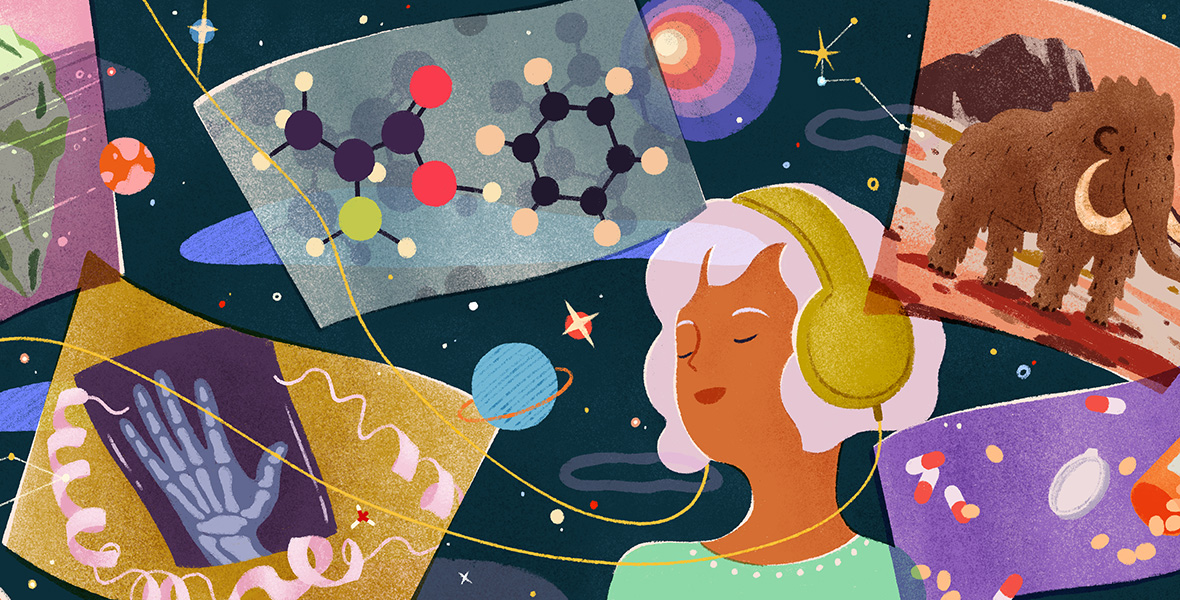
PODCAST: We have thoughts, visions and feelings while we sleep, experiencing a virtual reality of sorts. But how and why does dreaming happen? Researchers bring us closer to understanding the work our brains do while our bodies rest. (Season 2/Episode 1)
By Charlotte Stoddart 02.01.2022 (knowablemagazine.org)
Listen on: Amazon Music | Apple Podcasts | Deezer | Google Podcasts | LibSyn | Player.FM | Soundcloud | Spotify | Stitcher
CREDIT: JESSIE LIN
Catch up on Season 1 and see what Season 2 has in store
The Knowable Magazine Podcast from Annual Reviews explores the limits to what’s knowable — and how thinking about big questions in science and technology evolves over time. Listen now!
TRANSCRIPT:
What did you dream about last night while you were sleeping?
When you woke up, did you remember your dream? Can you still remember it? How reliable is that memory?
Dreaming is one of the most impractical things a scientist could choose to study. Dreams are a universal part of human experience. But they are by nature subjective. We can’t share them. How can we understand dreams in general then, beyond the vague, untrustworthy recollections that we have of them when we’re awake? How can we study them scientifically and answer the question: Why do we dream?
This is Knowable. And I’m Charlotte Stoddart.
People have been trying to explain dreams for millennia. For a long time, these explanations were rooted in spiritual beings outside of our bodies; dreams were understood as messages from gods or as communications from our ancestors. The scientific study of dreams as something that happens in the brain began with Freud right at the dawn of the 20th century.
In his book “The Interpretation of Dreams,” Freud famously sets out his theory of dreams as the fulfilment of our unconscious wishes. He expands this theory in a later book called “Dream Psychology,” in which he describes the dreams of his patients and explains how to analyze them:
What is common in all these dreams is obvious. They completely satisfy wishes excited during the day which remain unrealized. They are simply and undisguisedly realizations of wishes.
With these books and his other work, Freud founded the field of psychoanalysis. His psychoanalytic approach is often seen as unscientific. But it’s likely that Freud actually wanted to study the dreaming brain in a scientific way; he just didn’t have the tools to do it. As a young researcher at the University of Vienna, Freud spent years studying the nervous system of sea lamprey and eels, publishing several scientific papers on his findings. Freud also studied human nerve cells, using a microscope to see his tissue samples. But a microscope was no use for studying the dreaming brain of live, sleeping human subjects.
Allan Hobson: “I think Freud understood that to really study dreaming, you had to know what was going on in the brain. He just couldn’t do it. I mean, there were no instruments; the technology wasn’t available to study the brain. So he dropped the brain side of the story and devoted himself solely to the psychological side. And of course, that was bold move, but it’s obviously inadequate.”YOU MAY ALSO LIKETHE MIND
How learning happens in the brains of sleeping babes
Memory, the mystery
Psychedelics open a new window on the mechanisms of perception
That’s Allan Hobson, emeritus professor of psychiatry at Harvard Medical School. Hobson studied sleep and the dreaming brain for six decades, right up until his death at the age of 88, a few weeks after he spoke to me. He was able to do what Freud couldn’t, thanks to an invention in Germany in the 1920s.
Hans Berger was a psychiatrist with a particular interest in psychic phenomena. He wanted to find correlations between brain activity and psychic events. And this led him to come up with a way to record electrical activity in the brain. He experimented with inserting silver electrodes under the scalp, and with placing the electrodes on the surface of his patients’ heads, as is done today. Berger’s recordings revealed patterns of electrical activity that looked like waves when transcribed on paper. He called them electroencephalograms, now known simply as EEGs.
Scientists and doctors began using EEGs to document differences in brain wave patterns between people and during different activities. The breakthrough for dreaming came in the 1950s, at the University of Chicago, where Eugene Aserinsky was trying to launch his career as a physiologist. At that time, sleep was thought of as a period when the brain switches off and rests. And in keeping with that, EEG recordings showed slow waves indicating low-level activity in the brain’s cortex. Not much going on, not much to study. But Aserinsky’s supervisor — Nathaniel Kleitman — thought differently and told Aserinsky to focus on researching sleep.
One evening, Aserinsky decided to hook his 8-year-old son up to an EEG machine, attaching electrodes to his skull and the skin around his eyes. While his son slept, Aserinsky watched the brain patterns produced by the machine. At first he saw the slow waves that he expected, a telltale sign of sleep. But at one point he noticed that the pens tracking his son’s eye movements — as well as the ones registering brain activity — were swinging back and forth, recording jerky eye movements and faster brain waves.
Aserinsky went to check on his son, expecting to find him wide awake and looking around. But the boy was still asleep. Aserinsky observed the same kind of brain activity in other sleeping subjects. It was characterized by rapid eye movements and became known as — you guessed it — rapid eye movement or REM sleep. Aserinsky realized that sleepers could have multiple periods of REM sleep during the night and, crucially, that when people were woken up during REM sleep they were more likely to recall vivid dreams.
By 1973, when a review on sleep was published in the Annual Review of Psychology, it was clear that there were at least two different stages of sleep: slow wave sleep that became known as non-REM sleep, and REM sleep, during which the brain is more active:
As data develop on the phenomenology of sleep states, it becomes increasingly clear that sleep is not simply a resting state, waxing and waning near the lower pole of a continuum of vigilance. Instead, sleep appears to be an extremely complex, constantly changing, but cyclic succession of psychophysiological patterns, qualitatively rather than quantitatively different from those of waking.
Keep this thought in mind, because at the end of this podcast we’ll return to the idea of sleep — and in particular dreaming — as not so different from our conscious awake state.
So, the invention of EEG showed that the sleeping brain is an active organ, not simply a resting one. Now there was a way to go beyond our unreliable recollections of dreams and actually study the phenomenon of dreaming. Now scientists could monitor the sleeping brain and they knew when during sleep a person was likely to be dreaming. This was a game changer, says sleep researcher Erin Wamsley:
Erin Wamsley: “It was the discovery of EEG that launched this kind of modern — second half of the 20th century — field of dreaming. And so the discovery of rapid eye movement sleep really is what kicked off the modern era, the post-Freud era of dream research. And so that was all about looking for what is the biological sign that someone is dreaming.”
We’ll hear more about Erin’s research shortly. But first, let’s step into a sleep lab.
For 40 years, the sleep lab was the prime way to study dreaming. That’s where Allan Hobson began his investigations of the dreaming brain in the 1960s.
Allan Hobson: “We had a patient room, a subject room, in which the subject was attached to electrodes, and the electrodes went through the wall. And we sat in a room next door and recorded the brain waves, and when the subjects entered REM or another stage that interested us, we’d wake them up and try to figure out what was going on.”
When they woke their subjects up, they asked them for a “dream report.” Dream reports were nothing new; psychologists and psychiatrists had been asking patients to recount their dreams since Freud. But these earlier reports might be made days, weeks or months after the actual dream took place, with patients choosing to relate only the most memorable of their dreams or perhaps being steered towards particular recollections by their interrogator. Hobson wanted to make dream reports more scientific.
Allan Hobson: “I was becoming aware that what was really needed was a much more quantitative approach to a subjective activity, and that’s why I developed the scoring system that I developed.”
Hobson’s scoring system was a way to record and quantify the content of people’s dreams, including the people who showed up in them, the places, plot continuity and so on.
Allan Hobson: “I think what you have to realize is that most people, including scientists, just didn’t do that. To do that is to create a science instead of a speculative psychology.”
Content analysis by researchers such as William Domhoff, whose name we’ll hear again later, showed that although dreams can seem bizarre, mostly they feature people who are known to us, places that are familiar to us and everyday activities that we perform in our waking lives, as well as things that are on our mind. So a tennis player is likely to dream about playing tennis, maybe with a friend or a family member. While a skier will probably not be playing tennis in her dream, but might be rehearsing downhill turns. These findings might not sound groundbreaking, but in the 1960s and ’70s, every discovery was important because so little was known about dreaming. Here’s Ursula Voss, a psychologist who collaborated with Hobson on more recent studies of dreaming.
Ursula Voss: “I admire the most about these early studies that they didn’t really have a strong hypothesis in one or the other direction, so their research was mostly exploratory. No matter what they found, it was important. And so in my view it’s very reliable and very objective research.”
By the late 1970s researchers had a good understanding of what people dream about.
The question of why we dream was more difficult to answer.
Nevertheless, a 1978 review of sleep and dreams did attempt to address this question. The second half, on dreaming, was written by Rosalind Cartwright. As one of the first women to work in this area, she was often called the “queen of dreams.” Officially she was a psychologist who ran a sleep lab at the University of Illinois, and then for many years at Rush University. In the 1978 review, Cartwright begins by lamenting our lack of understanding, despite now having the tools to study dreams:
It is the syntax and grammar of dreams as cognitive behavior, their meaning and function in relation to other types of cognitive activity of sleep and waking, and their place in our understanding of human behavior more generally that has lagged behind.
The trouble with theories about the function of dreams is that they are difficult to test. One theory that caught Cartwright’s attention is that dreams help us to “assimilate anxiety.” A couple of studies had been done on this, and…
The results of none of these studies is strong and convincing in and of themselves, but all lend some support to the hypothesis that when dreaming is intact in normal persons, waking situations which were previously emotion-evoking are faced more directly and handled more calmly…
Cartwright was intrigued and designed her own experiment to test the theory. She found 29 women undergoing divorce and studied them in her sleep lab for six nights. The women were divided into two groups: depressed and not depressed — and compared to a group of happily married women. In 1984, she published her findings in the journal Psychiatry:
The dreams of those divorcing without major mood upset were longer and dealt with a wider time frame than those of the other two groups. They also dealt with marital status issues which were absent in the dreams of the depressed group.
Cartwright concluded that dreams can act as overnight therapy, a night shift designed to help us process difficult emotions.
This idea has been brought up to date by recent studies looking at chemical changes in the brain, as well as studies using magnetic resonance imaging, MRI, to see which areas of the brain are most active at different stages of sleep. The findings from these studies were summarized in a 2014 review called “The Role of Sleep in Emotional Brain Function”:
Neuroimaging studies reveal significant activity increases during REM sleep in emotion-related regions… These changes in functional brain activity are paralleled (and likely governed by) striking alterations in neurochemistry. Perhaps most remarkable is a substantial reduction in levels of noradrenaline during REM sleep…
Noradrenaline, also known as norepinephrine, is one of the body’s “fight or flight” chemicals. It makes us alert, restless, maybe anxious. It prepares us for action. Irregular levels of noradrenaline are associated with PTSD and major depression.
REM sleep may serve a noradrenergic “housekeeping” function, one that reduces and thus restores concentrations of noradrenaline to baseline each day… allowing for optimal wakeful functioning.
If we don’t get enough REM sleep, as is common among people with PTSD, who fear experiencing flashbacks in their dreams, then our noradrenaline levels aren’t reset properly and we may wake up in a hyper-vigilant, restless state.
These are intriguing findings about REM sleep. But it’s difficult to know exactly what role dreaming plays, because although we can record how much REM sleep someone has, or check their noradrenaline levels, we can’t know for sure how much they are dreaming.
Another theory about why we dream is that dreams help us to consolidate memories. This is what Erin Wamsley studies at Furman University in South Carolina.
Erin Wamsley: “Well, we know that when animals — and apparently humans — fall asleep, patterns of brain activity that were first established when we had a recent experience, are then reactivated or replayed in the sleeping brain. For example, in rodent studies, we see that when a rat is moving through a track — like moving through a maze — you can describe their movement through the maze in terms of a sequence of cells firing: Cell 5, Cell 8, Cell 7. And then when the animal falls asleep, we again see: Cell 5, Cell 8, Cell 7. Cell 5, Cell 8, Cell 7 — but played back in a speeded, time-compressed manner. We haven’t seen exactly that in humans, but still, when humans do a learning task in wakefulness, you can measure patterns of brain activity occurring during that task and see that those patterns of brain activity that occurred during the learning task are again present when the human falls asleep.”
We also know that we dream about our experiences — that’s one of the things that the early content analysis studies told us.
Erin Wamsley: “And then our work has actually shown that when you dream of something you learned recently, people who dream about that experience improve their memory more, compared to people who do not report remembering a dream about the experience. So all that put together, I would say the most plausible explanation is that, at least part of the content of dreams is reflecting this memory-related brain activity, right? I can’t say for sure whether dreams are helping your memory, because we don’t know if it’s important that you consciously experience it; it could be just a side effect.”
Even if it’s not just a side effect — and that’s a difficult thing to test — Erin Wamsley doesn’t think that strengthening memories explains the whole function of dreaming. And Hobson agreed that memory processing is probably only part of the explanation.
Besides, the bizarre scenes that can unfold in our dreams, they aren’t like memories, says Antti Revonsuo, a Finnish philosopher and neuroscientist.
Antti Revonsuo: “What we dream about, they are not our memories. It’s always in the present, it’s novel, it’s creative, it’s original experience, rather than a memory.”
So what other theories are there?
How often are you scared in your dreams? Are you running away from something?
Antti Revonsuo thinks that dreams are a way for us to rehearse potentially threatening situations in order to aid our survival. He calls this the threat simulation theory of dreaming.
Antti Revonsuo: “The most universal topics of dreams are like primitive threat simulations, like being chased, being attacked, and also modern types of threats: You lose your wallet, your phone, the elevator doesn’t work, you are late from the plane — and everybody recognizes this. So I started to realize that the data actually points to this direction.”
Content analysis of dreams by Revonsuo’s research group and others backs this up.
Antti Revonsuo: “In the normal population, it’s usually about two-thirds of dream reports that contain at least one threatening event. The number is usually between 65 to 70 percent of dream reports.”
So the threat simulation theory could explain many of our dreams. But what about dreams that aren’t nightmares or even mildly threatening? How does Revonsuo explain those dreams?
Antti Revonsuo: “I ended up proposing together with my colleagues what we call the social simulation theory, and the basic idea there is that the kind of non-threatening dreams, that what we are rehearsing there, is like social perception, social interaction, social bonding. And this is based on what we now know, as well, if we quantify this kind of social content of dreams, there is also a bias for dreams to contain more social events than our waking lives.”
So far we’ve heard that dreams might help us to rehearse social situations or threatening events, that they might be the product of our brain’s memory processing system, and that they might help us to deal with our emotions.
But not all sleep researchers sign up to one of these theories. In fact, some think that dreams have no biological function at all. William Domhoff, who’s been studying dreams for over five decades, proposes that dreaming is just an accidental byproduct of the brain in sleep mode. Could the complex, vivid imaginings that we all experience every night be a mere side effect, an accident of evolution? Some find that hard to buy. As Allan Rechtschaffen, another longtime sleep researcher, put it in a well-known quote: “If sleep does not serve an absolutely vital function, then it is the biggest mistake the evolutionary process has ever made.”
What have we learnt then, from over 60 years of studying dreaming? Is there any agreement on the what, when and why of dreaming?
We’ve learnt that dreams reflect our waking experiences, with the same people, places and concerns popping up in them — even if they’re mixed up.
We now know that we dream a lot more than we once thought, and we dream during non-REM sleep as well as REM sleep. Here’s Erin Wamsley to explain:
Erin Wamsley: “So if you wake people up from rapid eye movement sleep, on average they might remember a dream around 80 percent of trials. And if you wake people up from non-rapid eye movement sleep, like Stage 2, they would maybe remember a dream around 50 percent of trials. It’s a quantitative difference. And the other differences between dreams and the two sleep stages are the same way. Actually, on average, REM dreams are longer and more vivid. And on average, non- REM dreams are shorter and less vivid, but those two distributions are overlapping. So it would be false to say we only have “real” dreams in REM sleep.”
But what progress have we made on the question of why we dream?
Erin Wamsley: “I don’t think there’s a consensus on what dreaming is, why we dream, what we do, what the function of dreaming is, or even if there is a function. But that being said, maybe some hypotheses from the past have now been ruled out by most people, which itself is a form of consensus and progress. So most psychologists and neuroscientists today have abandoned Freudian dream theory. And most neuroscientists and psychologists today view dreaming as having at least some substantial overlap with waking cognition, that some of the brain and mental processes are similar or overlapping between what we see generates thought and imagery and daydreaming in wakefulness, and what we see generates thought, imagery and daydreaming in sleep. Whereas in the past, there had been more a focus on sleep and dreaming are this crazy, mysterious thing that has nothing to do with being awake, and that was very Freud-influenced.”
So to understand dreaming, says Wamsley, we also need to understand how we generate thoughts and images when we’re awake — and that’s a big, complicated task. Undaunted, in his final years, Allan Hobson tried to synthesize everything he’d learnt about dreaming over his long career into a single theory that also accommodated this overlap between dreaming and our waking thoughts.
A dream is an experience of being present in an imaginary world. You might think of it as a virtual-reality world or a simulation of the world created by the brain. Being awake and conscious is also an experience of being a person in the world. Hobson began by proposing that we are all born with a virtual-reality model of the world in our heads. This innate or “genetic” model needs to be fine-tuned to fit the actual world that we live in and experience every day.
Allan Hobson: “I think you remake your model of the world every night in bed. You compare the genetic model with the experiential model, and you make such adjustments as you can. And you do that every single night.”
Hobson thought of this model of the world that we are born with as a prototype of consciousness. In fact, he thought that it’s there even before birth, when REM sleep becomes active in the fetus’s brain. This is the brain’s way of preparing itself for full consciousness. As we gain experience in the world, we refine our model — and that’s what we’re doing when we dream.
Hobson’s theory, which he called the protoconsciousness theory, can incorporate the idea that dreams and memories are linked, and it accommodates Revonsuo’s threat simulation theory of dreaming. So what does Revonsuo make of it?
Antti Revonsuo: “Well, I find the protoconscious theory, I find very, very interesting idea, and I have nothing against it. I think it would be consistent with any other simulation theories, but the problem with that theory is that it’s much harder to test.”
Still, Revonsuo agrees with Hobson that the dreaming brain is a route to understanding consciousness.
Antti Revonsuo: “Dreaming, we can take it as a model system of the basic form of consciousness. So our waking consciousness and dreaming consciousness, they are pretty much the same system, or highly overlapping systems, in the brain. It’s the same system that generates our being in the world experiencing both cases, and therefore to explain dreaming is to explain consciousness and vice versa. But dreaming is a better model system, because it really highlights the subjectivity of the phenomenon. Dreaming is a phenomenon that we cannot share. We can’t invite anybody into our dream world and say, “Yeah, I have these interesting dreams — please come and take a look.” So we can’t share dreams in any kind of empirical way. They are non-transmissible in some very fundamental manner. And that’s the problem with consciousness as well. Consciousness is subjective. And that’s the challenge for science. How can we do science on a phenomenon that is fundamentally experienced only by one person?”
This is a big shift in thinking. For a long time, most people imagined dreams as coming from outside of the dreamer’s own mind — they came from gods or other spiritual beings. Then Freud suggested that dreams are the product of our unconscious mind, writing:
The interpretation of dreams is the royal road to a knowledge of the unconscious activities of the mind.
But for scientists like Hobson and Revonsuo, dreams are the gateway not to our unconscious mind, but to consciousness itself. Revonsuo is happy that we finally seem to have an agreed definition of what dreams are, even if different theories emphasize different functions.
Antti Revonsuo: “We can say that now everybody is happy to say that, yeah, we can define dreaming as a world simulation or a virtual reality, that it takes into account that the idea that being in a dream feels like being in a world, basically. So nobody says that that’s somehow totally wrong. And then, this is just like the form of dreaming, then when we start to discuss the contents of dreaming, then maybe different theories emphasize different contents. And I’m very happy about that development, because this is kind of what I wanted to see — that the field actually moves forward.”
If you enjoyed this show, please share it with your friends, family and colleagues — we’d love to hear your feedback too. Tweet us @KnowableMag, write to us — we’re podcast@knowablemagazine.org — or leave us a review wherever you listen to podcasts. And don’t forget to subscribe so you don’t miss episodes on the search for extrasolar planets, the development of massive particle accelerators and our quest to treat depression.
In this episode you heard from Allan Hobson, Erin Wamsley, Ursula Voss and Antti Revonsuo. The episode also featured quotes from three articles published by Annual Reviews. They are: Harold Williams et al., 1973; Wilse Webb and Rosalind Cartwright, 1978; Andrea Goldstein and Matthew Walker, 2014. You can find links to those papers and others mentioned in this podcast in the show notes on our website: knowablemagazine.org/podcast.
This podcast was produced by Knowable Magazine, a nonprofit publication that seeks to make scientific knowledge accessible to all. Knowable Magazine is an editorially independent initiative from Annual Reviews. Explore more sound science and smart stories at knowablemagazine.org.
I’m Charlotte Stoddart and this has been Knowable.
10.1146/knowable-013122-1
Charlotte Stoddart is a freelance science journalist and filmmaker living in Frankfurt, Germany. For many years, she worked for the journal Nature, where she launched the popular Nature Video Channel on YouTube and made documentaries and animations for the channel. She still makes films and podcasts for Nature as well as for other science publications, including Knowable Magazine. Charlotte has a degree in the history and philosophy of science from the University of Cambridge. Before becoming a science journalist, she spent two years teaching English in Japan.
Tarot Card for February 2: The Star
The Star
The Star (or Daughter of the Firmament) is numbered seventeen and is probably the most optimistic and beautiful card in the deck. A beautiful young woman, often naked, is depicted pouring water from a jug into the ground or into a pool by her feet. There are stars in the sky above her.
Stars have long been seen as symbols of hope, regeneration, vision and new life. When this card appears, you know somehow that life is just about to become easier and brighter. Life’s forces combine to assist rather than hinder.
Here is the truth about our power – we can join the solid earth of material existence with the flowing waters of spirit and create within ourselves a Universe. We have removed self-criticism and concentrated instead on our skills and strengths. When we regard ourselves with love, humour, tenderness and sympathy, we access the God and Goddess within and we are transformed.
“Every man and woman is a star” A. Crowley
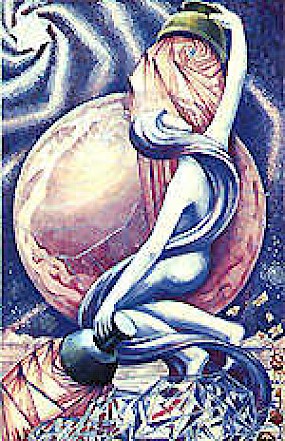
(via angelpaths.com and Alan Blackman)
Astrology 2022: The Year of Healing Waters
Matthew Stelzner I’ve been studying the star maps, and it looks to me like this year has the most healing astrology alignment of the 21st century. That’s a big statement, I know, but isn’t that exactly what the angels would bring right about now? I’m referring to a particular alignment in April when there is a very exact quadruple conjunction of the Moon, Venus, Jupiter and Neptune all aligning in the watery sign Pisces. This four planet alignment is the tightest, all within 4 degrees, on April 27th. For the rest of this century these four planets do not align any closer than 10 degrees, and so I feel this year’s alignment represents a very rare nodal point of opportunity for both the world and for each of us individually. While this is an alignment that with the Moon only lasts a couple of days, and with Venus a couple of weeks, at the heart of this alignment is a once-in-thirteen-year conjunction of Jupiter and Neptune that is operative all year until next February. I feel that when it is joined by Venus and the Moon in April we will be receiving the yummiest Jupiter-Neptune waves of energy, and we will be able to then ride those yummy waves for the rest of the year, and perhaps for the rest of our lives. In this new video I share exactly what I’m talking about. To check out more of my work, see my blog, and get information about my intuitive readings, visit my website at: http://stelz.biz/ Sign up for my mailing list here: http://stelz.biz/register-for-my-emai… If you sign up for my mailing list you will also receive my newsletter and special promotions. Check me out on Instagram where you will find unique content that is not shared here: @tarot_and_lola
Dr Wayne Dyer – 5 Minutes Before You Fall Asleep
Spiritual Mind “All blame is a waste of time. No matter how much fault you find with another, and regardless of how much you blame him, it will not change you. The only thing blame does is to keep the focus off you when you are looking for external reasons to explain your unhappiness or frustration. You may succeed in making another feel guilty about something by blaming him, but you won’t succeed in changing whatever it is about you that is making you unhappy. ” “You are not stuck where you are unless you decide to be.” ― Dr Wayne W. Dyer 1940 – 2015 https://www.drwaynedyer.com/ To listen to the affirmation only without music ? https://youtu.be/rZ5OLTeMJDQ Before sleep meditation Revised & Extended version ? https://www.youtube.com/watch?v=44ImQ… Watch the full talk “Mastering the Art of Manifesting” Wayne Dyer at Wanderlust’s Speakeasy – https://www.youtube.com/watch?v=zNrEF… ? Thank you to all who have contributed subtitles in other languages ❤️? http://www.youtube.com/timedtext_vide… Thank you so much ❤️ ? Books… Three Magic Words us – http://amzn.to/2z5ZdEz uk – http://amzn.to/2z3fey7 canada – http://amzn.to/2yOCizO Wishes Fulfilled: Mastering The Art Of Manifesting us – http://amzn.to/2fS2Jd2 uk – http://amzn.to/2yHMvOI canada – http://amzn.to/2h6qgs6 Some Books recommended by this channel https://www.amazon.com/shop/spiritual… ? Video edit & Transcription: Spiritual Mind ❤️Instagram: https://bit.ly/2Rsmeym ?Twitter: https://bit.ly/2TMZlCm ?Facebook: https://bit.ly/2HkwvaW ?Email: spiritualmind7@outlook.com ?Affiliate: https://amzn.to/2RL7Xff ? Event Departure by Silent Partner – https://www.youtube.com/watch?v=J0ipW… Running Waters by Audionautix is licensed under a Creative Commons Attribution licence (https://creativecommons.org/licenses/…) Artist: http://audionautix.com/ Dark Times by Kevin MacLeod is licensed under a Creative Commons Attribution licence (https://creativecommons.org/licenses/…) Source: http://incompetech.com/music/royalty-… Artist: http://incompetech.com/ Disclaimer: Amazon links are affiliate links that let you help support the creation of more videos on this channel at no extra cost.
(Contributed by Beth Kuper)
New Moon In Aquarius – King Arthur’s Table
| by Astro Butterfly (astrobutterfly.com) |
On February 1st, 2022 we have a New Moon in Aquarius. The New Moon is at 12° Aquarius and it aspects both its rulers, Saturn and Uranus.
When a New Moon is aspected by its ruler, the archetypal energy of the sign is amplified.
This New Moon has a strong Aquarius flavor – and it’s your chance to understand at a deeper level the Aquarius archetype.
Irrespective of our Sun sign or planetary placements, we all have Aquarius embedded in our chart – so understanding how Aquarius ‘works’ will help us understand ourselves, and our relationship with the world at a deeper level.
New Moon In Aquarius – Freedom, Inclusion And Belonging
What does Aquarius stand for? We all know that Aquarius rules friends, groups of people, and communities.
Friends, communities and groups of people serve a very important purpose: they address our need for freedom, inclusion and belonging.
When we’re with our friends, we feel seen, heard and accepted. There’s no hidden agenda, no ‘transaction’, no ‘i give you this if you give me that’. Our friends take us as we are.
Our groups and communities – and here we can include the local yoga class, the people we meet in the local pub or church, people who like the same music or support the same sports team – give us a feeling of belonging.
There’s a deep resonance, acceptance, a sense of flow with people who share our interests and passions. We get them – and they get us. We feel safe, supported, and resonate at a collective soul level.
11 years ago I moved to a different city where I didn’t know anyone. To get to know people, I decided to join an event hosted by an expat group called “Internations”. Internations’ tagline was “Nobody stands alone”.
I was a little bit anxious when I entered the venue, but as I stepped in immediately someone from the New Joiners’ boot came to greet me, asked me a few questions and then introduced me to some people with whom I shared things in common.
In less than 5 minutes, I was deeply engaged in interesting conversations and making new friends. I felt included from the get-go and continued to attend Internations events for as long as I lived in that city.
Not all the group activities I attended shared Internations’ Aquarian values. I remember going to several events and conferences where there was no onboarding process in place.
No one would come to say hi, there was a sense of ‘clubbiness’ – members already knew each other and stayed in small groups. I felt like an outsider – pretty much the opposite experience I had with Internations.
Aquarius is how we feel in society – do we belong, or we don’t? Are we included, or we’re left behind?
Aquarius – Saturn Vs Uranus
Aquarius is ruled by Saturn and Uranus.
For a group to be functional, we need a setup, some basic roles and responsibilities, an onboarding process for new members, and ongoing activities to keep members’ interests alive.
When we have a Saturnian framework in place, people relax and then we get to see Aquarius’ Uranian side. When people feel included and accepted, they are free to be whoever they want, without the fear of being judged or rejected.
When this happens, their individuality and uniqueness shine through. When we feel relaxed and supported, our unique gifts and talents naturally come forward.
Being included and accepted in a true Aquarian manner is a wonderful thing. But this need for inclusion and belonging sometimes clashes with our need to express ourselves as unique individuals.
2021 was marked by a tense Saturn-Uranus square, so these themes have been present in our collective psyche for a while now. Having both Aquarius’ ruling planets square each other has shown us the not-so-easy path to Aquarius’ promise of freedom, inclusion and belonging.
The New Moon in Aquarius on February 1st, 2022 is conjunct Saturn and square Uranus. Our commitment to our Aquarian ideal (New Moon conjunct Saturn) is tested. Our need for safety and predictability clashes with our need to be true to ourselves (Uranus).
When we don’t acknowledge this conflict within ourselves, we project it as a conflict onto the outside. Who is not with us (the accepted, integrated part of our psyche), is against us (the unintegrated part of our psyche).
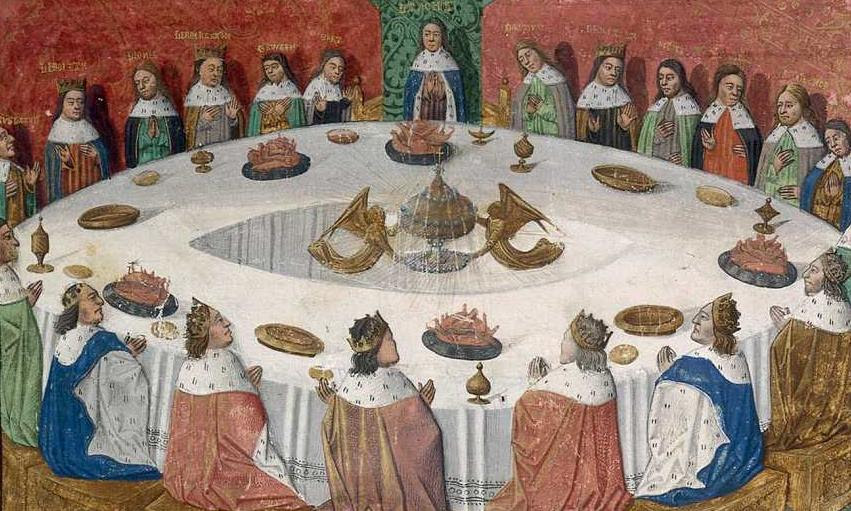
New Moon In Aquarius – King Arthur’s Table
King Arthur is known in history for introducing the round table.
King Arthur wanted the knights in his court to be equal; he did not want them fighting over status or rank. There was no ‘head’ of the table since it was round. The Round Table represented chivalry in its highest form.
Aquarius at its best is King Arthur’s round table. Saturn’s discipline is channeled for its highest good: equality and inclusion.
At King Arthur’s round table, Saturn’s natural bossiness is tempered by Uranus’ disregard for status and rules. And Uranus’ sense of freedom is kept in check by Saturn’s commitment to making things work.
When we allow these different parts of our psyche to sit together at the same (round) table, we can find that deep sense of freedom and belonging – and accept ourselves and others for who we are.
Precognitive Dreams with Paul Kalas
New Thinking Allowed with Jeffrey Mishlove Paul Kalas is adjunct professor of astronomy at the University of California, Berkeley. He is known for his discoveries of debris disks around stars. Paul led a team of scientists to obtain the first visible-light images of an extrasolar planet. He has been recording his own dreams since his teenage years. He is the author of The Oneironauts: Using Dreams to Engineer Our Future. His website is https://sites.google.com/view/oneiron… Here he describes dreams he had that, after careful examination, he believes were precognitive in nature. He explains the process by which he came to rule out alternative explanations. One of these dreams, in particular, appears to have contained detailed information regarding one of his major astronomical discoveries. He suggests that the study of precognitive dreams could be accelerated through application of sophisticated computer analysis. New Thinking Allowed host, Jeffrey Mishlove, PhD, is author of The Roots of Consciousness, Psi Development Systems, and The PK Man. Between 1986 and 2002 he hosted and co-produced the original Thinking Allowed public television series. He is the recipient of the only doctoral diploma in “parapsychology” ever awarded by an accredited university (University of California, Berkeley, 1980). (Recorded on October 6, 2020)