A Course in Miracles: Lesson 196

Lesson 196 It can be but myself I crucify.

When this is firmly understood and kept in full awareness, you will not attempt to harm yourself, nor make your body slave to vengeance. You will not attack yourself, and you will realize that to attack another is but to attack yourself. You will be free of the insane belief that to attack a brother saves yourself. And you will understand his safety is your own, and in his healing you are healed.

Perhaps at first you will not understand how mercy, limitless and with all things held in its sure protection, can be found in the idea we practice for today. It may, in fact, appear to be a sign that punishment can never be escaped because the ego, under what it sees as threat, is quick to cite the truth to save its lies. Yet must it fail to understand the truth it uses thus. But you can learn to see these foolish applications, and deny the meaning they appear to have.

Thus do you also teach your mind that you are not an ego. For the ways in which the ego would distort the truth will not deceive you longer. You will not believe you are a body to be crucified. And you will see within today’s idea the light of resurrection, looking past all thoughts of crucifixion and of death, to thoughts of liberation and of life.

Today’s idea is one step we take in leading us from bondage to the state of perfect freedom. Let us take this step today, that we may quickly go the way salvation shows us, taking every step in its appointed sequence, as the mind relinquishes its burdens one by one. It is not time we need for this. It is but willingness. For what would seem to need a thousand years can easily be done in just one instant by the grace of God.

The dreary, hopeless thought that you can make attacks on others and escape yourself has nailed you to the cross. Perhaps it seemed to be salvation. Yet it merely stood for the belief the fear of God is real. And what is that but hell? Who could believe his Father is his deadly enemy, separate from him, and waiting to destroy his life and blot him from the universe, without the fear of hell upon his heart?

Such is the form of madness you believe, if you accept the fearful thought you can attack another and be free yourself. Until this form is changed, there is no hope. Until you see that this, at least, must be entirely impossible, how could there be escape? The fear of God is real to anyone who thinks this thought is true. And he will not perceive its foolishness, or even see that it is there, so that it would be possible to question it.

To question it at all, its form must first be changed at least as much as will permit fear of retaliation to abate, and the responsibility returned to some extent to you. From there you can at least consider if you want to go along this painful path. Until this shift has been accomplished, you can not perceive that it is but your thoughts that bring you fear, and your deliverance depends on you.

Our next steps will be easy, if you take this one today. From there we go ahead quite rapidly. For once you understand it is impossible that you be hurt except by your own thoughts, the fear of God must disappear. You cannot then believe that fear is caused without. And God, Whom you had thought to banish, can be welcomed back within the holy mind He never left.

Salvation’s song can certainly be heard in the idea we practice for today. If it can but be you you crucify, you did not hurt the world, and need not fear its vengeance and pursuit. Nor need you hide in terror from the deadly fear of God projection hides behind. The thing you dread the most is your salvation. You are strong, and it is strength you want. And you are free, and glad of freedom. You have sought to be both weak and bound, because you feared your strength and freedom. Yet salvation lies in them.

There is an instant in which terror seems to grip your mind so wholly that escape appears quite hopeless. When you realize, once and for all, that it is you you fear, the mind perceives itself as split. And this had been concealed while you believed attack could be directed outward, and returned from outside to within. It seemed to be an enemy outside you had to fear. And thus a god outside yourself became your mortal enemy; the source of fear.

Now, for an instant, is a murderer perceived within you, eager for your death, intent on plotting punishment for you until the time when it can kill at last. Yet in this instant is the time as well in which salvation comes. For fear of God has disappeared. And you can call on Him to save you from illusions by His Love, calling Him Father and yourself His Son. Pray that the instant may be soon,–today. Step back from fear, and make advance to love.

There is no Thought of God that does not go with you to help you reach that instant, and to go beyond it quickly, surely and forever. When the fear of God is gone, there are no obstacles that still remain between you and the holy peace of God. How kind and merciful is the idea we practice! Give it welcome, as you should, for it is your release. It is indeed but you your mind can try to crucify. Yet your redemption, too, will come from you.
Extreme heat in oceans ‘passed point of no return’ in 2014

Formerly rare high temperatures now covering half of seas and devastating wildlife, study shows

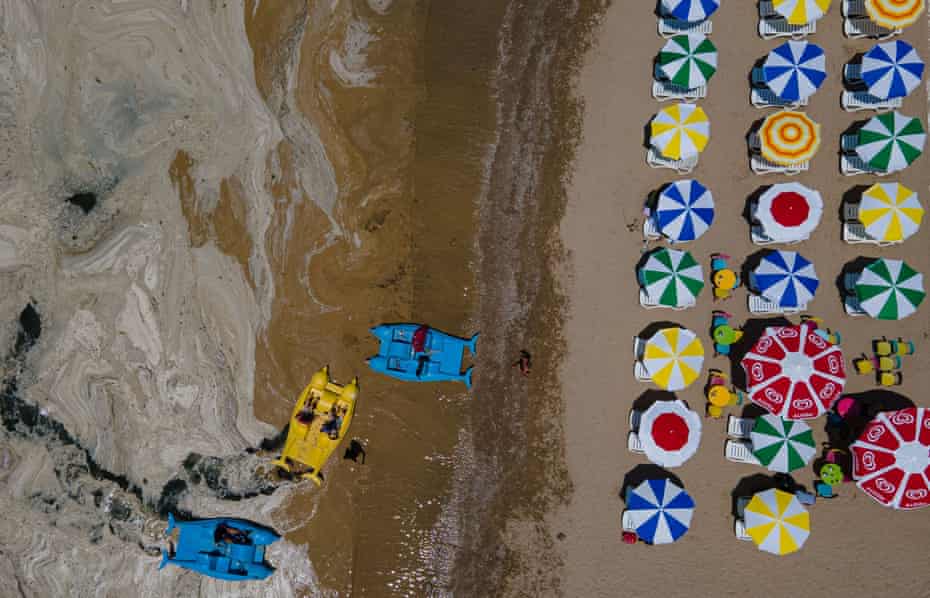
Pedalos on the banks of the Marmara Sea covered with sea snot, a jelly-like layer of slime, in Kocaeli, Turkey
Pedalos on the banks of the Marmara Sea covered with sea snot. As the climate crisis heats the seas, plankton are on the move, with potentially profound consequences for ocean life and humans. Photograph: Yasin Akgül/AFP/Getty

Damian Carrington Environment editor@dpcarrington

Tue 1 Feb 2022 14.00 EST (theguardian.com)

Extreme heat in the world’s oceans passed the “point of no return” in 2014 and has become the new normal, according to research.

Scientists analysed sea surface temperatures over the last 150 years, which have risen because of global heating. They found that extreme temperatures occurring just 2% of the time a century ago have occurred at least 50% of the time across the global ocean since 2014.

In some hotspots, extreme temperatures occur 90% of the time, severely affecting wildlife. More than 90% of the heat trapped by greenhouse gases is absorbed by the ocean, which plays a critical role in maintaining a stable climate.

“By using this measure of extremes, we’ve shown that climate change is not something that is uncertain and may happen in the distant future – it’s something that is a historical fact and has occurred already,” said Kyle Van Houtan, at the Monterey Bay Aquarium, US, and one of the research team. “Extreme climate change is here, it’s in the ocean, and the ocean underpins all life on Earth.”

Van Houtan and his colleague Kisei Tanaka are ecologists and began the study because they wanted to assess how heat extremes were related to the loss of kelp forests off the coast of California.Advertisement

“Ecology teaches us that extremes have an outsized impact on ecosystems,” Van Houtan said. “We are trying to understand the dramatic changes that we’ve seen along our coasts and in the ocean, on coral reefs, kelp, white sharks, sea otters, fish, and more.”

Other scientists reported in 2019 that the number of heatwaves affecting the planet’s oceans had increased sharply, killing swathes of sea life like “wildfires that take out huge areas of forest”.

Van Houtan and Tanaka found no measure of extreme heat existed and so extended their work globally. The study, published in the Plos Climate journal, examined the monthly temperature in each one-degree-by-one-degree part of the ocean and set the highest temperature in the 50-year period as the benchmark for extreme heat.

The scientists then examined temperature records from 1920 to 2019, the most recent year available. They found that by 2014, more than 50% of the monthly records across the entire ocean had surpassed the once-in-50–years extreme heat benchmark. The researchers called the year when the percentage passed 50% and did not fall back below it in subsequent years the “point of no return”.

By 2019, the proportion of the global ocean suffering extreme heat was 57%. “We expect this to keep on going up,” said Van Houtan. But the extreme heat was particularly severe in some parts of the ocean, with the South Atlantic having passed the point of no return in 1998. “That was 24 years ago – that is astounding,” he said.

The proportion of the ocean experiencing extreme heat in some large ecosystems is now 80%-90%, with the five worst affected including areas off the north-east coasts of the US and Canada, off Somalia and Indonesia, and in the Norwegian Sea.

“You should care about turtles, seabirds and whales, but even if you don’t, the two most lucrative fisheries in the US, lobster and scallops, are in those exact spots,” said Van Houtan, while 14 fisheries in Alaska have recently been declared federal disasters.

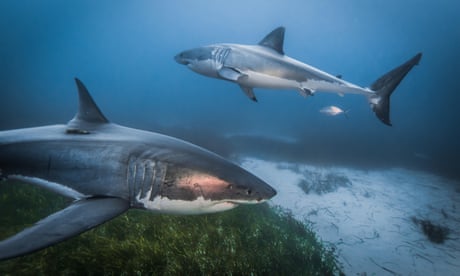
Great white sharks

The heat content of the top 2,000 metres of the ocean set a new record in 2021, the sixth in a row. Prof John Abraham at the University of St Thomas in Minnesota, one of the team behind the assessment, said ocean heat content was the most relevant to global climate, while surface temperatures were most relevant to weather patterns, as well as many ecosystems.

“Oceans are critical to understanding climate change. They cover about 70% of the planet’s surface and absorb more than 90% of global warming heat,” Abraham said. “The new study is helpful because the researchers look at the surface temperatures. It finds there has been a big increase in extreme heat at the ocean’s surface and that the extremes are increasing over time.”

The mind-bending art of deep time

Short-sightedness may be the greatest threat to humanity, says conceptual artist Katie Paterson, whose work engages with deep time — an idea that describes the history of the Earth over a time span of millions of years. In this lively talk, she takes us through her art — a telephone line connected to a melting glacier, maps of dying stars – and presents her latest project: the Future Library, a forested room holding unread manuscripts from famous authors, not to be published or read until the year 2114.

This talk was presented at an official TED conference. TED’s editors chose to feature it for you.

About the speaker

Katie Paterson Deep-time artist See speaker profile Katie Paterson’s art is at once understated and monumental.

To experience Zen-like awakening, try going the headless way

To experience Zen-like awakening, try going the headless way | Psyche

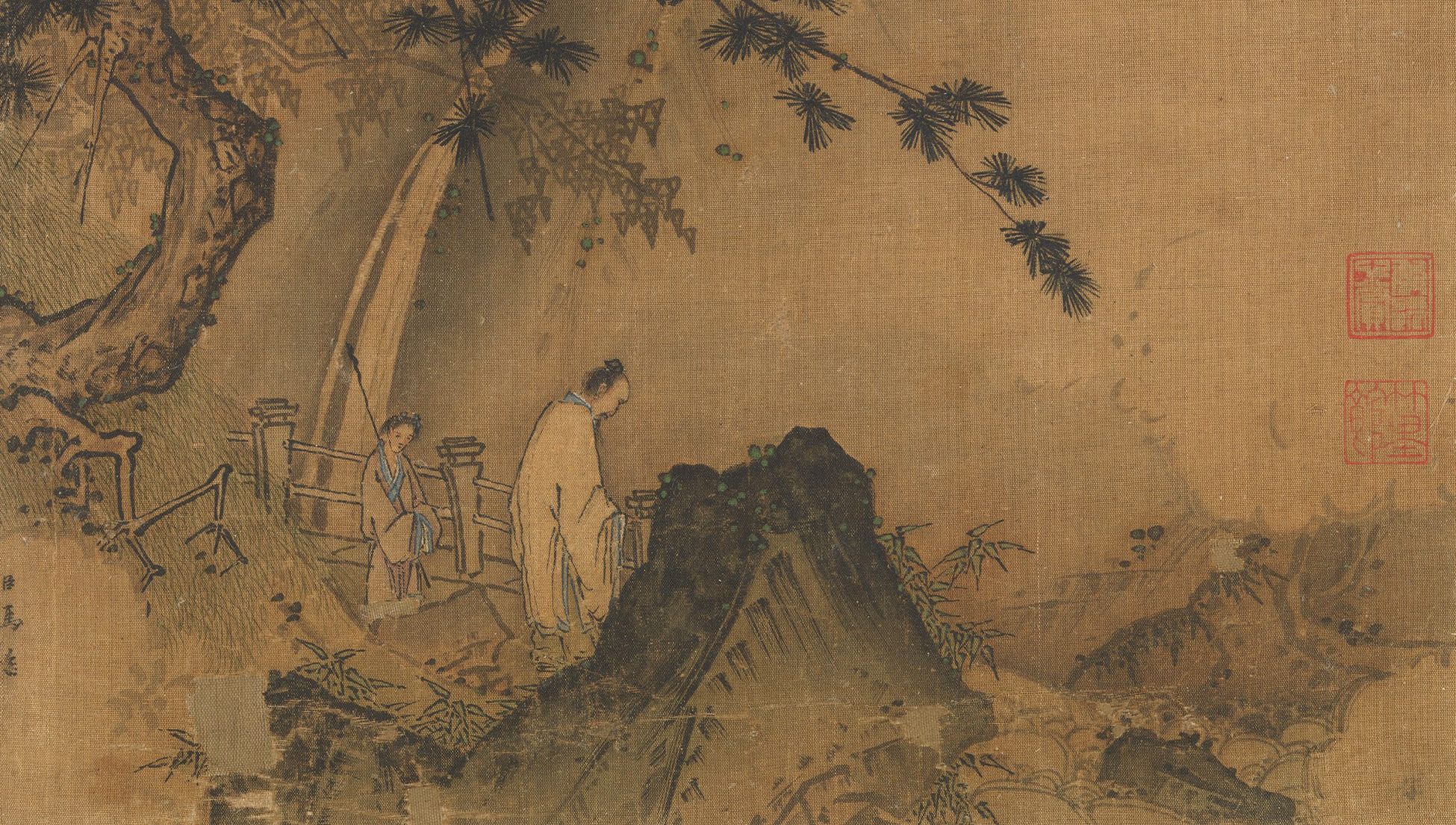
Scholar Viewing a Waterfall (late 12th to early 13th century) by Ma Yuan. Courtesy the Met Museum, New York

Brentyn J Rammis a Humboldt postdoctoral fellow in the Department of Psychology and Psychotherapy at Witten/Herdecke University in Germany. He currently lives in Fremantle, Western Australia.

Edited by Sam Dresser

2 February 2022 (psyche.co)

A prominent theme in Asian religious traditions such as the Advaita Vedanta and Zen Buddhism is that our everyday human experience is like a dream. The dream is that you are merely a person – a thing in the world bounded by your skin, a self that is separate from things and other people. But you are not separate from things and other people. And when you see through the illusion of separation, you become ‘awakened’.

In Chinese Zen Buddhism (Ch’an), a significant form of awakening experience is known as ‘Kensho’. This literally translates as ‘seeing one’s true nature’. In Zen, one’s true nature is often described as ‘empty’ – and at the same time identical with the given world. Kensho isn’t the end point of practice. It isn’t some supreme final state such as ‘enlightenment’ or ‘nirvana’ (if these states are even possible). Rather, it is the beginning, for awakening is in fact a life-long practice, never truly completed. This is the type of awakening experience that I am interested in here.

Hui Hai, an 8th-century Zen Master renowned for establishing a monastery and insisting on the importance of manual work, said that your true nature should not be sought externally. He described your true nature as follows:

Mind has no colour, such as green or yellow, red or white; it is not long or short; it does not vanish or appear; it is free from purity and impurity alike; and its duration is eternal. It is utter stillness. Such then is the form and shape of our original mind, which is also our original body.

Our true nature, then, is like a void. It lacks all objective qualities. It is shapeless, colourless, limitless, motionless. So how exactly does one see one’s own true nature, if it is so shorn of discernible features? The traditional method is to sit for many years in an intense meditation practice under the guidance of an experienced teacher. Unfortunately, most practitioners never experience ‘the void’. There is however a tradition in Zen of spontaneous awakening even in the absence of any meditation practice. This suggests that there is a far quicker and more direct means of awakening.

Early Chinese Zen masters referred to the need to ‘chop off one’s head’

Let’s look at a method of self-enquiry called ‘the headless way’, which provides a modern method of approaching awakening. These first-person experiments were developed by the English philosopher and mystic Douglas Harding in his influential book On Having No Head: Zen and the Rediscovery of the Obvious (1961). Harding grew up in a fundamentalist Christian sect in which he wasn’t allowed to go to the cinema and the only book he was permitted to read was the Bible. When he left the sect at 21, he was determined to seek the truth for himself and to be his own authority. The approach he developed was unconventional and can be considered a form of radical empiricism.

The key to his method is noticing that you cannot see your own head. Rather than looking out of a head, visually speaking, there is just a gap here. Indeed, early Chinese Zen masters referred to the need to ‘chop off one’s head’. Hui Hai claimed that he could teach nothing as he had no tongue to teach with. The heart sutra, which distils the essence of Zen teaching, states that ‘in emptiness there is no form, no eye, no ear, no nose, no tongue, no body, no mind.’ Zen masters also urge practitioners to recognise their ‘original face’ – another name for one’s true nature.

Self-portrait by the Austrian physicist and philosopher Ernst Mach from his book The Analysis of Sensations (1914). Public domain

How does one see their true nature according to Zen? One of the best places to start is with the mysterious figure Bodhidharma, the First Patriarch of Zen, who reputedly brought Buddhism to China from India around the 5th century. A legend about him tells us that he attained enlightenment after sitting for nine years facing a cave wall, and also that he cut off his own eyelids to stop himself from falling asleep. Bodhidharma is attributed with the following verse, which is often thought to express the core of Zen teaching:

A special transmission outside the scriptures,
Not founded upon words and letters;
By pointing directly to one’s mind
It lets one see into one’s own true nature and thus attain Buddhahood.

How exactly does one directly point to one’s mind or true nature? Harding’s ‘pointing experiment’ assists in turning one’s attention within, starting with the exercise of pointing a finger literally to the spot from which you are looking. Note that if these exercises are not carried out, or if they are merely thought about, this article will make no sense. So please do the following:

Point at a distant thing, such as a wall. Notice its shape and colour. It is a thing that is extended in space. It is also opaque. You cannot see through it. Point to the floor. Again, notice the coloured expanse and its textures. Point to your foot. Again, it is a shaped and coloured thing. Point to your chest and notice its colours and shape and the movement from your breathing. Now point to where you are looking from. In your present experience, is there any colour here? Any shape? Any texture? Any movement? Are there any eyes, mouth or cheeks here? Are there any features of a person? Notice that this spot is totally lacking in any personally identifying characteristics. Is there anything at all here? Or is it just a transparent opening?

When I look within, when I turn my attention 180 degrees from objects over there to where I am, I find that I am not a coloured, limited thing in the world, but rather a colourless, unchanging capacity for the world, exactly as described by Zen. Is this the much sought-after ‘void’ that is referred to by contemplative traditions across times and cultures?

When you were an infant, you did not recognise that face in the mirror as your own. It was just a baby behind some glass

A well-known story in Zen is of Tung-Shan’s awakening, in the 9th century, which also shows intriguing parallels with Harding’s observations. Once, as a child, Tung-Shan was reading the heart sutra with his tutor when he came upon the passage ‘no eye, no ear, no nose, no tongue, no body, no mind’. He was confused. He used his hands to feel his face and then asked his tutor why the sutra said they didn’t exist. His tutor told Tung-Shan that he could not help him, so Tung-Shan spent many years searching for a worthy master to explain this and other mysteries of the Dharma to him. One day he was crossing a river and saw his face reflected in the water. He saw where his face was in his lived experience, and he instantly had a great awakening.

Zen goes beyond words and letters, so merely thinking about this story would be against the spirit of Zen. To test this out directly in your own experience, please carry out the ‘mirror experiment’:

Look into a mirror. You can now see your human face. Notice where it is. In my experience, it is over there, a couple of feet away, not on my shoulders. Is this true for you? It is also facing the wrong way. It is looking in, rather than outwards. How many faces do you see? Two, or just one? Notice the shapes, textures and colours of that little face trapped behind the glass. By contrast, notice the lack of shapes, textures, colours and indeed boundaries to the spot you are looking from.

That face over there is your acquired face. When you were an infant, you did not recognise it as your own. It was just a baby behind some glass. It took many months to learn to identify with that face. You learnt to marry that visual thing over there with the ‘facial’ sensations you feel here, and hence you became boxed in (at least apparently so). Isn’t how you are for yourself – that is, your ‘original face’ – in total contrast to that little face in the mirror? In fact, as lacking any characteristics of its own, isn’t this ‘gap’ seamlessly united with the world? Couldn’t you equally say that your ‘original face’ is the given world itself?

All this might sound a little esoteric, so let’s look at one potential practical benefit of the ‘headless’ practice in the case of personal relationships. We think that we meet each other face-to-face, thing-to-thing. Of course, this is how it looks to others from the outside. But you relate to others from your first-person perspective, not from over there. The lived experience of being with others isn’t in fact of being face-to-face, but rather face-to-no-face. My face never gets in the way of the faces of others – including those you dislike. The ‘space’ you are looking out of has no preferences. It takes on everyone completely, no matter who they are, without judgement. Noticing this is a rather simple and concrete way to see that you are not, in fact, separate from others. In theory, this could provide a basis for true compassion towards others.

One can meditate for many years without seeing their own true nature. Most never do. The precision and apparent reliability of these experiments open up a form of Zen-like awakening to empirical investigation. Yet these techniques have so far received little attention from philosophers and scientists. (I describe these experiments and discuss their relation to Zen more fully in my recent article ‘The Technology of Awakening’.) The results of the experiments suggest that it doesn’t require a lifetime or many lifetimes to see your true nature. You can do so right now. It is simply to see who or what you are at this very moment – that which is seeing these very words.

Alan Watts Predicts The Future

True MeaningTrue Meaning Alan Watts talks about the consciousness and AI technology. Subscribe for more videos: https://bit.ly/2VO7I3f Speech extract from “Being In The Way” by Alan Watts, courtesy of https://alanwatts.org​​. ►Speaker: Alan Watts Follow the Alan Watts Organization: YouTube: https://www.youtube.com/channel/UC3wx… Facebook: https://www.facebook.com/alanwattsoff… Instagram: https://www.instagram.com/alanwattsor… Full lectures found at: https://www.alanwatts.com/​​ Speech licensed from: https://mindsetdrm.com/ ►Follow us 🙂 Facebook: https://bit.ly/2zCoOKg Instagram: truemeaningco ►Music by Whitesand. ►Subscribe for more videos: https://bit.ly/2VO7I3f It Will Give You Goosebumps – Alan Watts Predicts The Future

Grace Paley on the Art of Growing Older

By Maria Popova (brainpickings.org)

“For old people,” Ursula K. Le Guin wrote in her sublime meditation on aging and what beauty really means“beauty doesn’t come free with the hormones, the way it does for the young… It has to do with who the person is.” But who is the person staring back at us from the mirror as the decades roll by? The mystery of what makes you and your childhood self the same person despite a lifetime of changes is, after all, one of the most interesting questions of philosophy. Perhaps the greatest perplexity of aging is how to fill with gentleness the void between who we feel we are on the inside and who our culture tells us is staring back from that mirror.

That’s what beloved writer Grace Paley (December 11, 1922–August 22, 2007) addresses with extraordinary humor and intellectual elegance in a 1989 piece titled “Upstaging Time,” found in Just As I Thought (public library) — the same indispensable nonfiction collection that gave us Paley’s astute advice to writers.

Grace Paley

Paley, at sixty-seven, writes:

A couple of years ago a small boy yelled out as he threw a ball to a smaller boy standing near me, “Hey, dummy, tell that old lady to watch out.”

What? What lady? Old? I’m not vain or unrealistic. For the last twenty years my mirror seems to have reflected — correctly — a woman getting older, not a woman old. Therefore, I took a couple of the hops, skips, and jumps my head is accustomed to making and began to write what would probably become a story. The first sentence is: “That year all the boys on my block were sixty-seven.”

Then I was busy and my disposition, which tends to crude optimism anyway, changed the subject. Also, my sister would call, and from time to time she’d say, “Can you believe it? I’m almost seventy-eight. And Vic is going on eighty. Can you believe it?” No, I couldn’t believe it, and neither could anyone who talked to them or saw them. They’ve always been about fifteen years older than I, and still were. With such a sister and brother preceding me, it would seem bad manners to become old. My aging (the aging of the youngest) must seem awfully pushy to them.

[…]

I returned to my work and was able to write the next sentence of what may still become a story: “Two years later, two of the boys had died and my husband said, ‘Well, I’d better take this old-age business a little more seriously.’”

Illustration by Leonard Weisgard from a 1949 edition of Alice in Wonderland. Click image for more.

To manifest the needed seriousness, Paley considers some of the practicalities of that old-age business:

You may begin to notice that you’re invisible. Especially if you’re short and gray-haired. But I say to whom? And so what? All the best minorities have suffered that and are rising nowadays in the joy of righteous wrath.

[…]

You are expected to forget words or names, and you do. You may look up at the ceiling. People don’t like this. They may say, “Oh come on, you’re not listening.” You’re actually trying to remember their names.

While he could still make explanations, my father explained to me that the little brain twigs, along with other damp parts of the body, dry up, but that there is still an infinity of synaptic opportunities in the brain. If you forget the word for peach (“A wonderful fruit,” he said), you can make other pathways for the peach picture. You can attach it to another word or context, which will then return you to the word “peach,” such as “What a peachy friend,” or springtime and peach blossoms. This is valuable advice, by the way. It works. Even if you’re only thirty, write it down for later.

Paley returns to the subject thirteen years later, at eighty, in a magnificent short piece titled “My Father Addresses Me on the Facts of Old Age,” originally written for the New Yorker in 2002 and included in Here and Somewhere Else: Stories and Poems by Grace Paley and Robert Nichols (public library) — a marvelous celebration of literature, love, and the love of literature by Paley and her husband, published a few months before she died at the age of eighty-five.

Paley writes:

My father had decided to teach me how to grow old. I said O.K. My children didn’t think it was such a great idea. If I knew how, they thought, I might do so too easily. No, no, I said, it’s for later, years from now. And besides, if I get it right it might be helpful to you kids in time to come.

They said, Really?

My father wanted to begin as soon as possible.

[…]

Please sit down, he said. Be patient. The main thing is this — when you get up in the morning you must take your heart in your two hands. You must do this every morning.

That’s a metaphor, right?

Metaphor? No, no, you can do this. In the morning, do a few little exercises for the joints, not too much. Then put your hands like a cup over and under the heart. Under the breast. He said tactfully. It’s probably easier for a man. Then talk softly, don’t yell. Under your ribs, push a little. When you wake up, you must do this massage. I mean pat, stroke a little, don’t be ashamed. Very likely no one will be watching. Then you must talk to your heart.

Talk? What?

Say anything, but be respectful. Say — maybe say, Heart, little heart, beat softly but never forget your job, the blood. You can whisper also, Remember, remember.

Complement Paley’s wholly rewarding Just As I Thought and Here and Somewhere Else with Meghan Daum on why we romanticize our imperfect younger selves, Henry Miller on growing old and the measure of a life well lived, and legendary cellist Pablo Casals, at ninety-thee, on the secret of creative vitality.

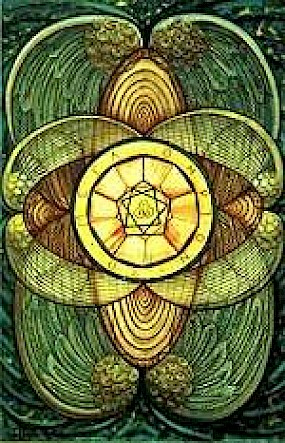
Tarot Card for February 3: The Ace of Disks


The Ace of Disks

The Ace of Disks marks, on the everyday level, the start of a new project, which is likely to be successful. So it will come up to show a new job, or a new business venture. Usually this will be the sort of project that seems to continuously keep on growing, with each level of attainment producing – almost of itself – the next step in the journey.

Sometimes the Ace will come up to indicate a sudden change of material fortune, or a windfall – though either of these would have to be quite substantial to invoke the Ace. Aces are always big influences, marking the beginning of something new and important. So if we see the card coming up to represent a sudden input of funds, expect this to cause major changes in the querent’s life.

On a more spiritual level, this card relates to the Earth, and to the appreciation of Nature. It might mark a period where we draw closer to environmental issues, or where we engage in a period of study, contemplation and alignment with Earth forces.

One thing that we often miss, when considering spiritual development, is the way that each development grows out of the last. Anyone who has been involved in the search for spiritual truth will already have experienced the weirdly coincidental manner in which spiritual opportunities and teachers present themselves at the relevant stage in our growth.

There’s a saying – ‘The right teacher only appears when the student is ready’. It is as though we grow spiritually from the inside, the same way that trees do. And in so doing, maybe we develop inner rings – just like a tree’s trunk. The outer ring, just under the bark could not exist without all of the others it encircles.

We’re basically the same. The topic that we are exploring today has grown from all of the earlier topics we have looked into. Our experience is formed in layers, each of which is inter-dependent with the earlier ones. The Ace of Disks relates very closely with this method of human development – it shows us the way we grow. And warns us against trying to skip any of the stages!

The Ace of Disks

(via angelpaths.com and Alan Blackman)

A Course in Miracles: Lesson 195

Lesson 195 Love is the way I walk in gratitude.

Gratitude is a lesson hard to learn for those who look upon the world amiss. The most that they can do is see themselves as better off than others. And they try to be content because another seems to suffer more than they. How pitiful and deprecating are such thoughts! For who has cause for thanks while others have less cause? And who could suffer less because he sees another suffer more? Your gratitude is due to Him alone Who made all cause of sorrow disappear throughout the world.

It is insane to offer thanks because of suffering. But it is equally insane to fail in gratitude to One Who offers you the certain means whereby all pain is healed, and suffering replaced with laughter and with happiness. Nor could the even partly sane refuse to take the steps which He directs, and follow in the way He sets before them, to escape a prison that they thought contained no door to the deliverance they now perceive.

Your brother is your “enemy” because you see in him the rival for your peace; a plunderer who takes his joy from you, and leaves you nothing but a black despair so bitter and relentless that there is no hope remaining. Now is vengeance all there is to wish for. Now can you but try to bring him down to lie in death with you, as useless as yourself; as little left within his grasping fingers as in yours.

You do not offer God your gratitude because your brother is more slave than you, nor could you sanely be enraged if he seems freer. Love makes no comparisons. And gratitude can only be sincere if it be joined to love. We offer thanks to God our Father that in us all things will find their freedom. It will never be that some are loosed while others still are bound. For who can bargain in the name of love?

Therefore give thanks, but in sincerity. And let your gratitude make room for all who will escape with you; the sick, the weak, the needy and afraid, and those who mourn a seeming loss or feel apparent pain, who suffer cold or hunger, or who walk the way of hatred and the path of death. All these go with you. Let us not compare ourselves with them, for thus we split them off from our awareness of the unity we share with them, as they must share with us.

We thank our Father for one thing alone; that we are separate from no living thing, and therefore one with Him. And we rejoice that no exceptions ever can be made which would reduce our wholeness, nor impair or change our function to complete the One Who is Himself completion. We give thanks for every living thing, for otherwise we offer thanks for nothing, and we fail to recognize the gifts of God to us.

Then let our brothers lean their tired heads against our shoulders as they rest a while.  We offer thanks for them.  For if we can direct them to the peace that we would find, the way is opening at last to us.  An ancient door is swinging free again; a long forgotten Word re-echoes in our memory, and gathers clarity as we are willing once again to hear.

Walk, then, in gratitude the way of love. For hatred is forgotten when we lay comparisons aside. What more remains as obstacles to peace? The fear of God is now undone at last, and we forgive without comparing. Thus we cannot choose to overlook some things, and yet retain some other things still locked away as “sins.” When your forgiveness is complete you will have total gratitude, for you will see that everything has earned the right to love by being loving, even as your Self.

Today we learn to think of gratitude in place of anger, malice and revenge. We have been given everything. If we refuse to recognize it, we are not entitled therefore to our bitterness, and to a self-perception which regards us in a place of merciless pursuit, where we are badgered ceaselessly, and pushed about without a thought or care for us or for our future. Gratitude becomes the single thought we substitute for these insane perceptions. God has cared for us, and calls us Son. Can there be more than this?

Our gratitude will pave the way to Him, and shorten our learning time by more than you could ever dream of. Gratitude goes hand in hand with love, and where one is the other must be found. For gratitude is but an aspect of the Love which is the Source of all creation. God gives thanks to you, His Son, for being what you are; His Own completion and the Source of love, along with Him. Your gratitude to Him is one with His to you. For love can walk no road except the way of gratitude, and thus we go who walk the way to God.

Trees don’t rush to heal from trauma and neither should we

Trees don’t rush to heal from trauma and neither should we | Psyche

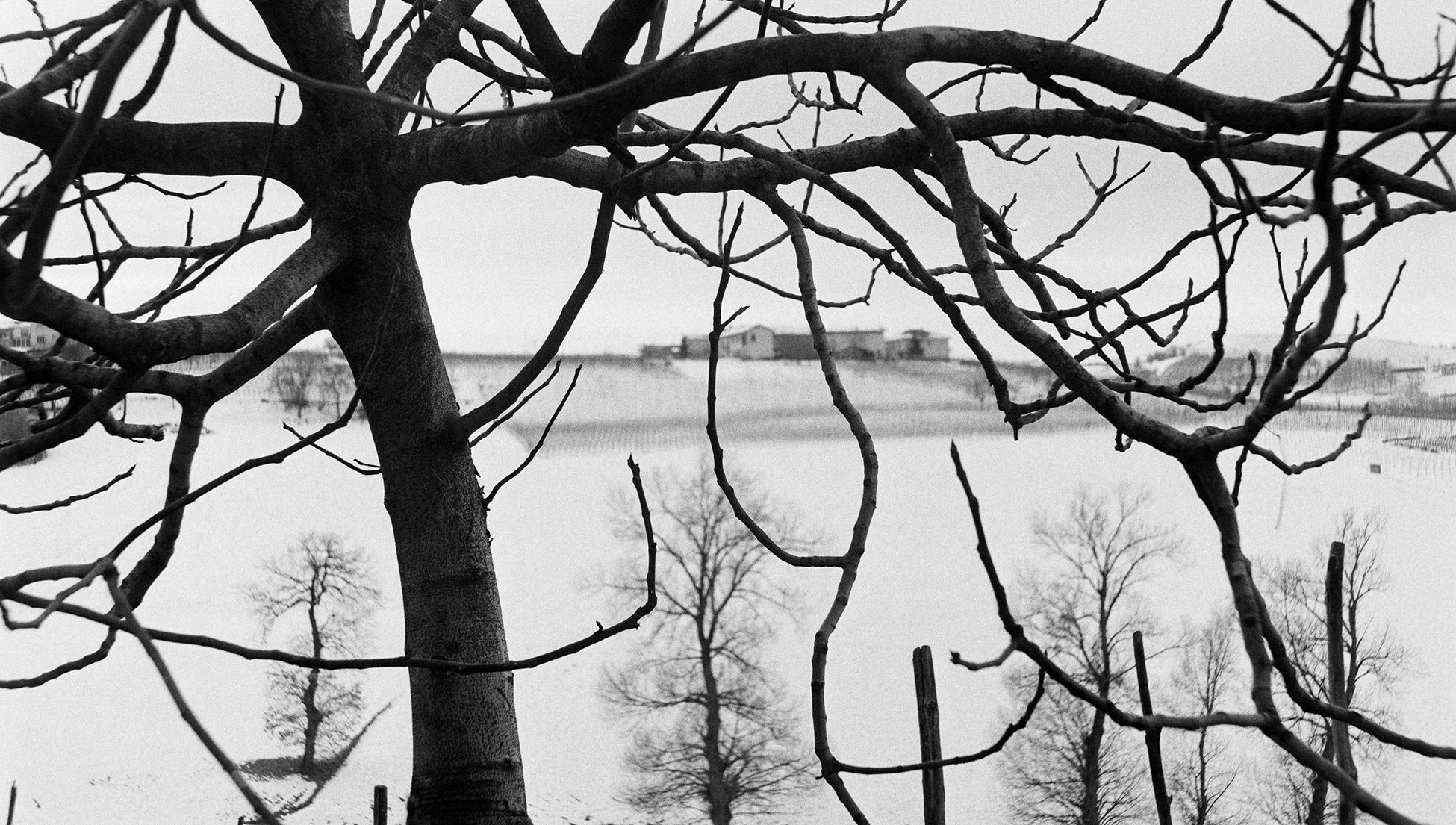
Photo by Stuart Franklin/Magnum

Beronda Montgomeryis foundation professor of biochemistry and molecular biology, and of microbiology and molecular genetics, at Michigan State University. She is the author of Lessons from Plants (2021).

Edited by Sam Dresser

1 February 2022 (psyche.co)

On my winter walks, I like to observe the architecture of tree trunks. Usually trunks are hidden from view under the enrobing green foliage of spring and summer, or the colourful blaze that typifies autumn. But as deciduous trees prepare for winter, and the carefully orchestrated process of leaf senescence begins, the hidden structures of trees emerge.

During the autumnal senescence, the tree suspends active growth and recovers the nutrients of its leaves. This process occurs first by degrading the green chlorophylls that drive photosynthesis – the means by which plants harness light energy – and then converting complex compounds into soluble sugars and amino acids, which are banked over winter for use by the tree in the following spring. Once the nutrients are resorbed, the tree begins to drop its leaves. At the base of each leaf, a physical barrier known as an abscission layer forms, which releases the leaf from the tree. With the leaves gone, the trunk is in full view throughout the course of winter. It enters a state of rest.

Some have said that the leafless dormancy of deciduous trees in winter renders them inconspicuous. And compared with the colourful showiness of autumn, or the vibrant display of health and greenery of summer, I can see how the stillness of winter might be read as unremarkable. But, for me, when deciduous trees divest themselves of their leaves, the strength, experience and history of the trunk emerges into full view. The full girth of a tree, typically a proxy of its age, as well as a tree’s branching and structure are on display. Even as such deciduous trees are largely dormant and focused on maintenance and protection from harsh conditions, the lessons that they have to offer us are boldly active in winter, and are distinct from those lessons prevailing in other seasons.

Trees don’t just ignore trauma or ageing in order to get back to business as usual

I and others have previously explored the many lessons that one can learn from plants: lessons about mentoring and supporting others in the community, lessons from trees on resilience, and lessons from polyculture on reciprocity and the benefits of diversity. One of the profound teachings that I have learned from winter trees is based on the observation of organismal experiences that emerge from careful consideration of a tree’s exposed structure. The pattern of branching, the abundance (or lack) of winter buds, the presence of scars or wounds – all are parts of the autobiography of a tree. Years of plenty or scarcity result in different profusions of buds and different capacities for building up wood. The environmental context affects how branches develop and elongate. The architecture of the tree reflects the kind of years it lived through. Of all of these features, I’ve been deeply impacted by what we can learn from how trees recuperate from the manifest wounds they inevitably endure.

Wounds – whether deliberately induced through pruning or fortuitously caused by natural disaster – become highly visible as the trees stand exposed in fall and winter. Trees notice when there is damage or loss, and embark upon a process of recuperation and healing. They don’t just ignore trauma or ageing in order to get back to business as usual. Indeed, failure to respond – and respond actively and dynamically – could result in long-term poor health, even death. So when a wound occurs, trees initiate a protective response that often takes place in two distinct stages – an initial, rapid chemical phase, followed by a slower, long-term physical adaptation. The rapid chemical response to wounding is an active attempt to limit damage by pests, who are attracted to the sugars and plant-based chemicals (or phytochemicals) that are exposed by a wound. The second, slower response is to physically scar over and close off the injury.

Some of the phytochemicals produced during the chemical response to wounding serve to actively protect the plant by functioning as antimicrobial or antifungal compounds to prevent the establishment of disease in an open wound, which could lead to decay. In addition to inducing protective chemical mechanisms, trees produce wound wood or ‘callus’ (soft tissue that develops and grows over an open wound surface) in order to slowly close over the damaged tissue. Ultimately, this walls off or isolates an injury and provides a long-term protective barrier to infestation by pathogens or disease-causing agents. For plants that pursue such a path, healing results in the resolution or closing off of a traumatic or transitional event.

To remain alive, some paths have to be closed and new possibilities pursued

During the healing process, oxygen availability to an open tree wound facilitates the recovery process. Premature closure of the wound can be catastrophic. Rather, it is best to let trees follow their naturally evolved process of sealing off wounds to compartmentalise damage. This tree wound response of seeking cleansing and healthy closure after trauma – by keeping the wound free of infection and promoting oxygenation, followed by covering over the wound with long-term protective scar tissue – offers a powerful lesson from plants. Covering a wound prematurely simply to keep the damage out of sight, without attention to openly dealing with it through cleansing and therapeutic care, can lead to a festering of issues rather than a healthy progression towards healing, reformulation, growth and thriving.

Effectively healing a wound maintains the overall health of the tree, and leads to the growth of new branches and leaves that will support new fruits or seeds. What I learn from trees each year is that there is a delicate balancing act in the struggle to recover from trauma. Sometimes, a path must be closed off to avoid sickness, atrophy, loss; other times, one must recognise when it is time to build a new path to allow the continuation of one’s core purpose, work and impact. Some paths are there to be turned away from, others to be followed and renewed. In winter, you can see the paths a tree has taken.

I believe we humans too frequently think that the expected response to trauma is to pursue a path of prompt forgiveness and a quick return to ‘normal’. While this is sometimes feasible, and certainly reconciliation has its merits, there are alternative ways to heal and move forward based on closure and a redirection of energy. The healing of wounds in trees – the closing off or protective sealing off of a tissue, and the ensuing construction of new living paths inclusive of sugar-transporting phloem tissues and water-passing xylem structures – allows the continued pursuit of a tree’s core purpose. This wound-healing paradigm exemplifies that, to remain alive, some paths have to be closed and new possibilities pursued. I have used these lessons to move forward in both personal and professional realms.

There are singular moments when these lessons root deeply in my consciousness. Major disruptions such as the global pandemic can be met in multiple ways: a desire for a return to normalcy and a need for massive restructuring of our responses to the trauma of sickness and death. Reflecting on unique lessons from healing responses to trauma and transition in trees invites us to ask how we can best ensure both rapid responses to prevent damage during the presence of an open wound, and the long-term responses of seeking closure and forging new paths ahead, rather than defaulting to attempts to resume pre-trauma definitions of normalcy. The lessons are there for our learning and application, if we look to winter trees as teachers.

Sex education should start with consent

Consent can be a tricky topic to talk about in sex education Consent can be a tricky topic to talk about in sex education curriculums, but it doesn’t have to be. In this hilarious and relatable talk, sex educator and TED Fellow Kaz offers a fresh look at teaching young people about the core principles of consent — and shows how demystifying this topic leads to healthier and more satisfying relationships for people of all ages.

About the speaker

TED Fellow Karen “Kaz” Lucas is a leader in the world of arts and culture in Kenya.