WHAT IF THE U.S. HADN’T GONE TO WAR AFTER 9/11?

Afghan Pashtun children watch a soldier in the 1st Battalion, 2nd Brigade of the 101st Airborne Division during a patrol near Zoldag Mongah west of Kandahar, Afghanistan, on Oct. 8, 2010. Photo: Chris Hondros/Getty Images

New research offers an alternative to the war on terror as the Biden administration rethinks its counterterrorism playbook.

Nick Turse
February 8 2022, 6:00 a.m. (TheIntercept.com)

ON SEPTEMBER 19, 2001, CIA officers collected cardboard boxes filled with $3 million in nonsequential $100 bills to buy off Afghan warlords, beginning America’s martial response to the 9/11 attacks. A day later, President George W. Bush stood before Congress and declared a “war on terror” that would “not end until every terrorist group of global reach has been found, stopped, and defeated.”

Over the next 20-plus years, the tab on that conflict, which began in Afghanistan but spread across the globe to Burkina Faso, Iraq, Libya, Mali, Niger, Pakistan, Somalia, Syria, Tunisia, and Yemen, has ballooned to more than $6 trillion. The payoff has been dismal: To date, the war has killed around 900,000 people, including more than 350,000 civilians; displaced as many as 60 million; and led to humanitarian catastrophes and the worst U.S. military defeat since the Vietnam War. American cash has built armies that have collapsed or evaporated when challenged; meanwhile, the number of foreign terrorist groups around the world has more than doubled from 32 to 69.“Counterterrorism strategies which address the root causes of terrorism, rather than the organizations and people that commit it, might end the waves of terrorist violence.”

It didn’t have to be this way, according to a new study of counterterrorism approaches from Brown University’s Costs of War Project. “Terrorism is a political phenomenon,” writes researcher Jennifer Walkup Jayes in “Beyond the War Paradigm: What History Tells Us About How Terror Campaigns End,” which was shared exclusively with The Intercept ahead of its release on Tuesday. “Counterterrorism strategies which address the root causes of terrorism, rather than the organizations and people that commit it, might end the waves of terrorist violence.”

Sophisticated statistical analyses have demonstrated that there are proven, effective methods to hasten the demise of terrorist organizations, according to Walkup Jayes’s report. But the “war paradigm,” which was a departure from America’s previous law enforcement approach to counterterrorism, is not one of them.

One innovative study of 648 militant groups cited by Walkup Jayes notes that only 7 percent of terrorist groups were defeated through military efforts. What bleeding-heart, leftist, ivory tower eggheads came to this conclusion? The 2008 study was conducted by the RAND Corporation, the military’s go-to think tank, when the cost of the war on terror was still a paltry $752 billion.

“In Iraq and Afghanistan,” Bush said that same year, “we set a clear definition of success: Success will come when Al Qaeda has no safe haven in those countries and the people can protect themselves from terror. Success will come when Iraq and Afghanistan are economically viable. Success will come when Iraq and Afghanistan are democracies that govern themselves effectively and respond to the will of their people. Success will come when Iraq and Afghanistan are strong and capable allies on the war on terror.”

Today, Al Qaeda is still present in Afghanistan. Its successor, the Islamic State, is active in Afghanistan and Iraq. And neither of those nations is a democracy or economically viable, as Afghanistan now teeters on the brink of economic collapse and is ruled by the very regime that Bush deposed in 2001.

Experts say this cascade of failures could have been largely avoided. “You can envision a scenario, after 9/11, in which the terrorist attacks were treated primarily as a criminal justice problem,” said Stephanie Savell, co-director of the Costs of War Project, noting that the FBI and the CIA could have led the effort with a goal of arresting, prosecuting, and imprisoning Osama bin Laden and others who planned the attacks.

While noting that the Costs of War report highlights drawbacks to this approach, Savell told The Intercept that it would have been transformational. “You wouldn’t have seen 20 years of conflict and this incredible waste of resources,” she said. “The U.S. response wouldn’t have led to this spiral of escalation, of war and violence begetting more war and violence.”

The money spent on the war paradigm could instead have been allocated to more serious national security concerns. Walkup Jayes draws attention to the perils of the global climate crisis, the fact that a lack of health insurance kills more than 45,000 people a year, and the Covid-19 pandemic which has not only led to the deaths of close to 1 million Americans but also laid bare the sorry state of U.S. health care. “The reality is that poverty, racism, and other structural inequalities pose far greater threats to human lives than do terror attacks,” she observes. “These threats are far more dangerous to far more people than are militant groups who use terror tactics, and there are feasible policies to address them.”RelatedWhat the U.S. Could Have Bought After 9/11 Instead of a “War on Terror”

It all raises the question of what might have been if the budget for the war on terror had been repurposed. “If the U.S. government had used even a portion of the $8 trillion spent and obligated on the post-9/11 wars on other domestic policies to promote societal health and well-being or mitigate the effects of climate change, that would have resulted in far more meaningful human security in this country,” Savell told The Intercept.

“Beyond the War Paradigm” lays out 10 distinct, though sometimes overlapping, counterterrorism alternatives to America’s militarized approach. These include the law enforcement model, which relies on policing and the judicial system; using public messaging and media campaigns to blunt radical ideologies; addressing the root causes of terrorism by funding development projects and aid groups; and an even more holistic “human security” model, which “aims to empower disenfranchised groups politically and economically … making terrorism a less compelling tactic for changemaking.”

An infographic from “Beyond the War Paradigm,” a new study of counterterrorism approaches from Brown University’s Costs of War Project.

Image: Courtesy of Brown University’s Costs of War Project

Heather Brandon-Smith, the legislative director for militarism and human rights for the Friends Committee on National Legislation, a Quaker group, says “Beyond the War Paradigm” is crucial to educating members of Congress, many of whom entered government after 9/11, about the alternatives to America’s ineffective but long-standing strategy. “We’ve had 20 years of counterterrorism being seen through the lens of war,” she told The Intercept. “This new report presents different options and demonstrates that long-term, non-military solutions are the most effective. To have the research and evidence laid out in such a clear way is extremely important. It provides the information necessary to have the conversation with Congress and the Biden administration about how to properly resource these non-military tools, which are critical to successful counterterrorism.”

One year ago, the White House imposed temporary limits on drone strikes and commando raids outside of conventional war zones. The administration launched a review of such missions and began writing a new “playbook” to govern counterterrorism operations. That policy, which was reportedly slated to be released around the 20th anniversary of 9/11, has been delayed as the White House has dealt with the fallout of the chaotic withdrawal of U.S. forces from Afghanistan and a final “righteous” drone strike in the country that the Pentagon was forced to admit killed only civilians, most of them children.

The White House would not provide even basic information about the state of the counterterrorism review and when — or whether — the administration might reveal its new policies. “We continuously assess our counterterrorism posture around the world and make adjustments as needed,” a senior administration official told The Intercept.The 9/11 Wars

Recently, Reps. Pramila Jayapal, D-Wash., and Barbara Lee, D-Calif., called for far more than “adjustments.” “The greatest threats to America’s security — pandemics, climate change, economic inequality, authoritarianism — cannot be defeated at the barrel of a gun. It’s time to stop relying on the same old playbook and instead forge a foreign policy that works for everyday people,” they wrote in an article announcing a Congressional resolution they introduced. “Today’s greatest security challenges cannot be solved through military adventurism. International cooperation, diplomacy, development, and peacebuilding — not bombs — must be the foreign-policy tools the country reaches for first.”

Other experts have called for a hybrid policy that maintains existing military capabilities but puts greater emphasis on alternative methods. Luke Hartig, a senior director for counterterrorism at the National Security Council in the Obama White House and now a fellow in New America’s International Security program, called for an “all tools approach to counterterrorism” that combines law enforcement, border security, intelligence, the targeting of terrorist financing, foreign partnerships, and countering extremist ideologies, as well as military operations.“We have over-resourced our military responses and under-resourced our civilian programs.”

“We have over-resourced our military responses and under-resourced our civilian programs,” he told The Intercept. “I don’t think ending the forever war means ending all military operations against terrorist groups, but it does mean shifting to a civilian-led paradigm. That means investing more in things like countering violent extremism and institution building. It means deploying savvy diplomacy to advance counterterrorism objectives. And it means being willing to rely on our defenses to protect the country rather than lethally targeting every threat we see in the world.”

“Beyond the War Paradigm” is packed with intriguing findings from studies of militancy, such as the link between an imbalanced sex ratio among young adults and terrorism and the fact that education in the humanities “may offer inoculation against violent ideologies, particularly those which target others on the grounds of ethnicity or religion,” as well as suggestions about how such research might be employed to achieve real-world counterterrorism results. Altogether, it reinforces a seemingly self-evident finding from the World Bank’s 2011 World Development report, highlighted by Walkup Jayes, that nonetheless appears to have escaped four presidential administrations and hundreds of lawmakers over more than 20 years: State violence in the form of invasion, occupation, and repression is central to the rationale of terrorist groups.

“We would be in a very different place if we had prosecuted the 9/11 attacks as criminal acts and called it a day,” Walkup Jayes told The Intercept. “The war paradigm has caused more people to take up arms against the United States and broadened support for the terrorist groups that the war aimed to eliminate. So if your goal is to truly prevent terrorism, your best bet is to help foster security and human rights, and guarantee people have access to the resources that they need.”
CONTACT THE AUTHOR:

Nick Turse@nickturse

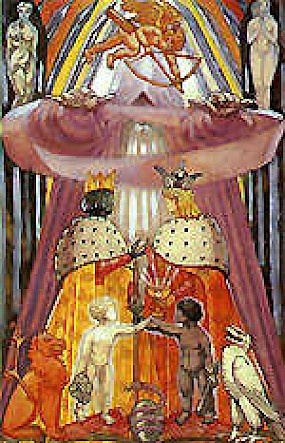
Tarot Card for February 11: The Lovers


The Lovers

The Lovers is numbered six and is a card of innocence, trust, exhileration and joy. The couple (often seen intertwined or standing side by side) are soulmates, each being one half of a perfect union. The figure flying above them is Cupid, blessing them with the might of Universal Love.

The Lovers are the embodiment of the harmony of opposites. This is how we are before the fear and prejudices of life intervene. We give our love freely to others and we need no other to make us whole.

Love is much misunderstood. It is subjective and the word ‘love’ is so overused that it has almost lost its original meaning. We are all capable of the immense power of deep feelings. Love happens when we step out of the darkness of fear, pain and doubt into the light. Love can move mountains. Love breeds love – a happy smile breaking through another’s melancholy proves this.

Loving ourselves is the first step to touching the mighty power of Universal Love. We must live each moment as though it were the only one – rejoicing and celebrating, loving the soul within us rather than fighting with the reflection the rest of the world sees.

The Lovers

(via angelpaths.com and Alan Blackman)

February 2022 Astrology Forecast

The Astrology Podcast Astrologers Chris Brennan, Austin Coppock, and special guest co-host Patrick Watson look ahead at the astrology of February 2022. The astrology of February features a stellium of planets piling up in Capricorn, with Venus and Mercury stationing direct there, and Mars having recently ingressed into the sign. Mid-month Mars will catch up to Venus and form a conjunction in Capricorn, and then later in the month the United States has the first of three exact Pluto returns. The lunations this month include a New Moon in Aquarius and a Full Moon in Leo. This is episode 337 of The Astrology Podcast: https://theastrologypodcast.com/2022/… Ephemeris Birth Chart Necklace This episode is sponsored by Ephemeris, which creates custom birth chart necklaces: https://ephemeris.co/necklace Use the promo code ASTROLOGYPODCAST to get a 10% discount. More info about Austin, Patrick, and Chris: https://austincoppock.comhttps://patrickwatsonastrology.comhttps://www.patreon.com/astrologypodcast Auspicious Date for February February 2, 2022, at 8:15 AM, with Pisces rising For more dates in February see our subscription electional astrology podcast: https://theastrologypodcast.com/auspi… For dates later in the year see our 2022 Year Ahead Electional Astrology Report: https://courses.theastrologyschool.co… Please be sure to like and subscribe! #TheAstrologyPodcast00:00:00 Intro and February overview 00:03:44 Venus retrograde in Capricorn review 00:15:58 Venus-Mars conjunction 00:32:58 Mercury Retrograde Jan 14 to Feb 3 00:42:19 Saturn-Uranus and labor tensions 00:54:14 New Moon in Aquarius Feb 1 00:59:10 Sun conjunct Saturn Feb 4 01:00:58 Election chart for February 01:06:40 Monthly sponsor: ephemeris.co birth chart necklaces 01:09:30 Week 2 01:18:38 USA Pluto return 01:31:33 Bitcoin and Jupiter in Pisces 01:39:00 Avatar 01:43:20 Mars trine Uranus 01:45:20 Full Moon in Leo 01:48:12 Omicron and November 2021 astrology 01:51:20 Mars-Saturn conjunction in Aquarius 01:56:10 True vs. mean node 01:59:02 Full Moon in Leo and the nodes 02:01:38 Week 3 02:02:50 Sun enters Pisces 02:06:02 Week 4 sextiles 02:09:21 Period of chill in late February 02:11:00 Austin’s upcoming class and Sphere and Sundry election 02:13:22 Patrick’s upcoming rectification course with Chris 02:15:46 Chris’ upcoming podcast episodes 02:17:20 Conclusion, patrons, and sponsors

#5 Dr. Stephen Porges POLYVAGAL THEORY EXPLAINED

Chasing Consciousness Podcast What’s the importance of our sense of safety to health? In this episode we’re going to be talking about the neuroscience of safety and how our sense of safety can be hugely important to the way we communicate and learn. Research shows that when we perceive threat, we go into a hyper-vigilant state and certain circuits of the brain shut down to focus on self-protection. If we can become aware of this as it’s happening we can not only use certain tools to mediate it, but we can also help others not end up in that state too. We are extremely lucky today to go straight to the horses mouth so to speak of this research, speaking with the founder of Polyvagal Theory himself, Dr Stephen Porges. Dr. Porges is the founding director of the Traumatic Stress Research Consortium at Indiana University. He is Professor of Psychiatry at the University of North Carolina, and Professor Emeritus at both the University of Illinois at Chicago and the University of Maryland. He has published more than 300 peer-reviewed papers across several disciplines including anesthesiology, biomedical engineering, critical care medicine, neurology, neuroscience, obstetrics, pediatrics, psychiatry, psychology, psychometrics, space medicine, and substance abuse.  In this episode we’ll be unpacking his Polyvagal Theory, a theory that links the evolution of the mammalian autonomic nervous system to social behaviour. The theory is leading to innovative treatments based on insights into the mechanisms operating in several behavioural, psychiatric, and physical disorders.  He is the author of several books which we’ll be mentioning in the interview and you can find links to in the show notes, and he is the creator of a music-based intervention, the Safe and Sound Protocol™, which currently is used by more than 1400 therapists to improve spontaneous social engagement, to reduce hearing sensitivities, to improve language processing and state regulation. What we discuss in this episode: 00:00 Intro 06:29 What’s going on inside people’s heads? 09:00 If your body is in a state of threat you can’t access certain areas of your brain 12:49 What does the Vagal nerve do? 15:00 The sympathetic nervous system for both fight and flight and excitement or exuberance – so good stress vs bad stress 17:00 Facial expression and tone of voice broadcast our physiological state via the Vagal nerve 18:30 What was the experience like of the theory emerging out of the research? 20:00 The vagal paradox: How can the Vagal Nerve be protective and kill you? 22:30 The link between the face/voice and regulation of the heart in new borns. Co-regulation between parent and child 24:00 Polyvagal Theory explained by its founder 24:30 Collaboration and connectedness for the evolution of human survival 26:00 Digestion problems when constantly problem solving 28:00 Bidirectionality: feedback between physiological state and mental state 29:45 Respecting bodily feelings 32:00 Trauma, making ourselves numb, disassociation and turning off your body 34:00 2 systems of bidirectional feedback: between the individual brain and its body and between different bodies 35:00 Co-regulation VS co-exacerbation between individual and collective systems 39:00 The Vagal ‘break’ regulates the threshold of optimal interaction 40:30 Dan Siegal’s ‘window of tolerance’ 41:30 Trauma affects vagal efficiency, rendering even high vagal tone (break ability) useless 43:00 Error in thinking about trauma, of focusing on event and not on bodily reaction and feelings 45:30 Stephen’s new book ‘Polyvagal safety: attachment, communication, self-regulation’ 48:00 Physical and mental illness are the same, but medical professionals aren’t taught this 51:45 Vagal metrics to help explain ‘medically unexplained symptoms’ 52:30 Social connection and safety directly assist neural regulation 54:00 ‘Neural exercise’ (play and social interaction) should be a fundamental part of a healthy education 55:00 Authoritarian threat based education methods inhibit rather than motivate learning 57:00 Moving beyond Paul McLean’s outdated concepts of the Triune brain and the Limbic system 1:03:45 Polyvagal theory working bottom up has simplicity but working top down has complexity 1:04:34 Being listened to is crucial to feeling safe 1:07:30 Voice cues for safety have been critical to man’s survival 1:07:40 The ‘Safe and Sound’ protocol for inducing clam and safety 1:12:00 Tools from Polyvagal theory for bypassing trauma triggers 1:13:45 Listen to your body don’t hack it. References: Dr. Stephen Porges ‘The pocket guide to polyvagal theory: the transformative power of feeling safe?’ Dr. Stephen Porges ‘Polyvagal safety: attachment, communication, self-regulation’ https://www.stephenporges.com/books Dan Siegal’s ‘window of tolerance’ concept Stephenporges.com Polyvagalinstitute.org Safe and Sound protocol™

Wintering: Resilience, the Wisdom of Sadness, and How the Science of Trees Illuminates the Art of Self-Renewal Through Difficult Times

By Maria Popova (brainpickings.org)

Rilke reverenced winter as the season for tending to the inner garden of the soul: “Suddenly to be healed again and aware that the very ground of my being — my mind and spirit — was given time and space in which to go on growing,” he wrote to a grief-stricken young woman who had reached out to him for consolation. “In the depths of winter, I finally learned that within me there lay an invincible summer,” Albert Camus wrote a generation later in his stunning essays about travel, which are really meditations on homecoming to our strength. Camus was soon to become the second-youngest Nobel laureate of all time and soon to die in a car crash with an unused train ticket to the same destination in his pocket. We are not invincible. But in how we garden the winters of the soul, we find the summer of our strength and the bloom of our fragile aliveness.

That is what Katherine May explores in Wintering: The Power of Rest and Retreat in Difficult Times (public library) — a gorgeous book, a generous book, a layered book of uncommon sensitivity and substance, drawn from May’s own experience of living through a deep and disquieting winter of life. She writes:

[Since childhood] we are taught to ignore sadness, to stuff it down into our satchels and pretend it isn’t there. As adults, we often have to learn to hear the clarity of its call. That is wintering. It is the active acceptance of sadness. It is the practice of allowing ourselves to feel it as a need. It is the courage to stare down the worst parts of our experience and to commit to healing them the best we can. Wintering is a moment of intuition, our true needs felt keenly as a knife.

Art by Valerio Vidali from The Shadow Elephant by Nadine Robert — a subtle children’s book about honoring sadness.

Like happiness — which, as George Eliot well knew, is a skill we incrementally master as we grow older — sadness, May reminds us, is also a skill: There are self-punishing ways to be sad, and self-salving ways to be sad. In skillful wintering, we learn the difference between the two. Rilke, who wintered amply and wisely, knew that great sadnesses clarify us to ourselves — winters of the spirit come in various sizes and cycles, each meaningful, all cumulative in their soul-sculpting beneficence. May writes:

When you start tuning in to winter, you realise that we live through a thousand winters in our lives — some big, some small… Some winters creep up on us so slowly that they have infiltrated every part of our lives before we truly feel them.

[…]

To get better at wintering, we need to address our very notion of time. We tend to imagine that our lives are linear, but they are in fact cyclical.

This cyclical nature of the seasons of the spirit is counter to our dominant cultural narrative of self-improvement, with its ethos of linear progression toward states of ever-increasing flourishing. It is counter, too, to the world’s major spiritual traditions, with their ideas of salvation and enlightenment. (Any longtime practitioner of Zen or metta meditation, for instance, knows that while we do reach moments of so-called enlightenment — a gladsome dissolution of the self into an all-pervading lovingkindness — these moments are inevitably punctuated by visitations of our habitual tendencies toward egoic shortness of temper, the self-absorption we call melancholy, and other conditioned modes of unenlightened conduct.) And yet befriending this cyclical rhythm of our inner lives, May observes with life-tested clarity, is the key to wintering — to emerging from the coldest seasons of the soul not only undiminished but revitalized.

Ever/After by Maria Popova. (Available as a print.)

Drawing on the analogy of tress — these most fertile metaphors for our humanity, in which we see ourselves and see quiet wisdom on how to live with ourselves, on how to live with each other, on the root of authenticity, on what it means to be an artist and what it means to be human — she writes:

We are in the habit of imagining our lives to be linear, a long march from birth to death in which we mass our powers, only to surrender them again, all the while slowly losing our youthful beauty. This is a brutal untruth. Life meanders like a path through the woods. We have seasons when we flourish and seasons when the leaves fall from us, revealing our bare bones. Given time, they grow again.

In one of the book’s wonderful portals into the world of science as a means of comprehending our elemental humanity, May considers the astonishing actuality of trees beyond the merely metaphorical:

The dropping of leaves by deciduous trees is called abscission. It occurs on the cusp between autumn and winter, as part of an arc of growth, maturity, and renewal. In spring and summer, leaf cells are full of chlorophyll, a bright green substance that absorbs sunlight, fueling the process that converts carbon dioxide and water into the starch and sugar that allow the tree to grow. But at the end of the summer, as the days grow shorter and the temperature falls, deciduous trees stop making food. In the absence of sunlight, it becomes too costly to maintain the machinery of growth. The chlorophyll begins to break down, revealing other colours that were always present in the leaf, but which were masked by the abundance of green pigment: oranges and yellows, derived from carotene and xanthophyll. Other chemical changes take place to create red anthocyanin pigments. The exact mix is different for each tree, sometimes producing bright yellows, oranges, and browns, and sometimes displaying as reds or purples.

But while this is happening, a layer of cells is weakening between the stem and the branch: this is called the abscission zone. Gradually it severs the leaf from access to water, and the leaf dries and browns and in most cases falls off, either under its own weight or encouraged by wintery rains and winds. Within a few hours, the tree will have released substances to heal the scar the leaf has left, protecting itself from the evaporation of water, infection, or the invasion of parasites.

Winter Moon at Toyamagahara, 1931 — one of Japanese artist Hasui Kawase’s stunning vintage woodblocks of trees. (Available as a print.)

I have always cherished the bare beauty of winter trees, so fractal and pulmonary against the somber sky — so skeletal, yet so alive. Anyone willing to look closely — and why be alive at all if not to relish the ecstasy of noticing, that crowning glory of our consciousness? — is rewarded with the gasping recognition that the branches are already covered in tiny dormant buds encoding the Braille promise of spring.

May writes:

Most trees produce their buds in high summer, and the autumn leaf fall reveals them, neat and expectant, protected from the cold by thick scales… from the sharp talons of the beech to the hooflike black buds of the ash. Many trees also display catkins in the winter, like the acid-green lambs’ tails of the hazel and the furry grey nubs of the willow. These employ the wind or insects to spread pollen, ready for the new year.

The tree is waiting. It has everything ready. Its fallen leaves are mulching the forest floor, and its roots are drawing up the extra winter moisture, providing a firm anchor against seasonal storms. Its ripe cones and nuts are providing essential food in this scarce time for mice and squirrels, and its bark is hosting hibernating insects and providing a source of nourishment for hungry deer. It is far from dead. It is in fact the life and soul of the wood. It’s just getting on with it quietly. It will not burst into life in the spring. It will just put on a new coat and face the world again.

Art from Trees at Night by Art Young, 1926. (Available as a print.)

Looking back on her own barren-branched seasons of the soul, she reflects:

Here is another truth about wintering: you’ll find wisdom in your winter, and once it’s over, it’s your responsibility to pass it on. And in return, it’s our responsibility to listen to those who have wintered before us. It’s an exchange of gifts in which nobody loses out. This may involve the breaking of a lifelong habit, one passed down carefully through generations: that of looking at other people’s misfortunes and feeling certain that they brought them upon themselves in a way that you never would. This isn’t just an unkind attitude. It does us harm, because it keeps us from learning that disasters do indeed happen and how we can adapt when they do. It stops us from reaching out to those who are suffering. And when our own disaster comes, it forces us into a humiliated retreat, as we try to hunt down mistakes that we never made in the first place or wrongheaded attitudes that we never held. Either that, or we become certain that there must be someone out there we can blame. Watching winter and really listening to its messages, we learn that effect is often disproportionate to cause; that tiny mistakes can lead to huge disasters; that life is often bloody unfair, but it carries on happening with or without our consent. We learn to look more kindly on other people’s crises, because they are so often portents of our own future.

Art by Arthur Rackham for a rare 1917 edition of the Brothers Grimm fairy tales. (Available as a print.)

The whole of Wintering — which explores the biological, psychological, neurochemical, and philosophical subtleties of our state of being in winter the season and winter the metaphor — is a splendid and soul-salving read. Complement it with Thoreau’s transcendentalist strategy for finding inner warmth in the cold of life, Annie Dillard on how winter awakens us to life, Adam Gopnik’s lyrical love letter to the white season, and D.H. Lawrence on trees, solitude, and how we root ourselves when our worlds collapse, then savor more of May’s writing and the personal story from which it springs in her wonderful On Being conversation with Krista Tippett.

Tarot Card for February 10: The Two of Disks


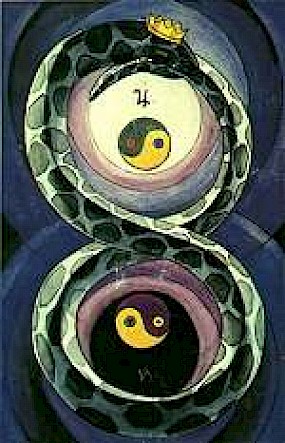
The Two of Disks

The Lord of Change is a card that indicates the necessity of constant change in life if we are not to stagnate. It often marks a turning point – a new job, a shift of fortune, a move of home.

Disks are an earthy suit, covering matters of material life, and the manifest Universe. If you look at the planet we live on, though in itself it seems solid and predictable (less so in recent years, mind you) it is in a constant state of change and movement. It turns in space, and if it did not, we’d all be very unhappy with the consequences. The cycle of seasons swings past us each and every year. The tides ebb and rise. Constant change is natural, normal and positive.

We do, though, often fear change in our lives. We will struggle against anything that appears to alter the pre-planned pattern we have applied to our future. But that’s exactly what this card does – instigates change. Sometimes we think that the change is bad – and on the face of it, it may appear to be – yet whenever the 2 of Disks appears, it’s warning us that change has become imperative. Something is stagnating, demanding to be broken down and made over.

It’s worth remembering that if you resist the change advocated by the Lord of Change, you might find that life imposes it upon you anyway – and then you’ll feel the effects either of the Death card, or the Tower. When this card appears, it demands a thorough re-assessment of your overall position and willingness to go with the chances that come your way.

The card is especially strengthened by cards like Fortune, and positive Disks and Wands. You can usually track down which area of life it applies to by looking at the cards that surround it – Cups would suggest you need to look at your emotional life. Disks would imply that it’s either your working or financial area that needs attention. Swords would probably indicate conflict around whatever changes you need to make, and may point to a need for clear communication. Wands would be more connected with your own application of Will, and the way you are trying to build your life. Major Arcana cards would suggest an inner, more spiritual area needs to be looked at.

The Two of Disks

(via angelpaths.com and Alan Blackman)

Free Will Astrology: Week of February 10, 2022

FEBRUARY 8, 2022 AT 6:55 AM BY ROB BREZSNY

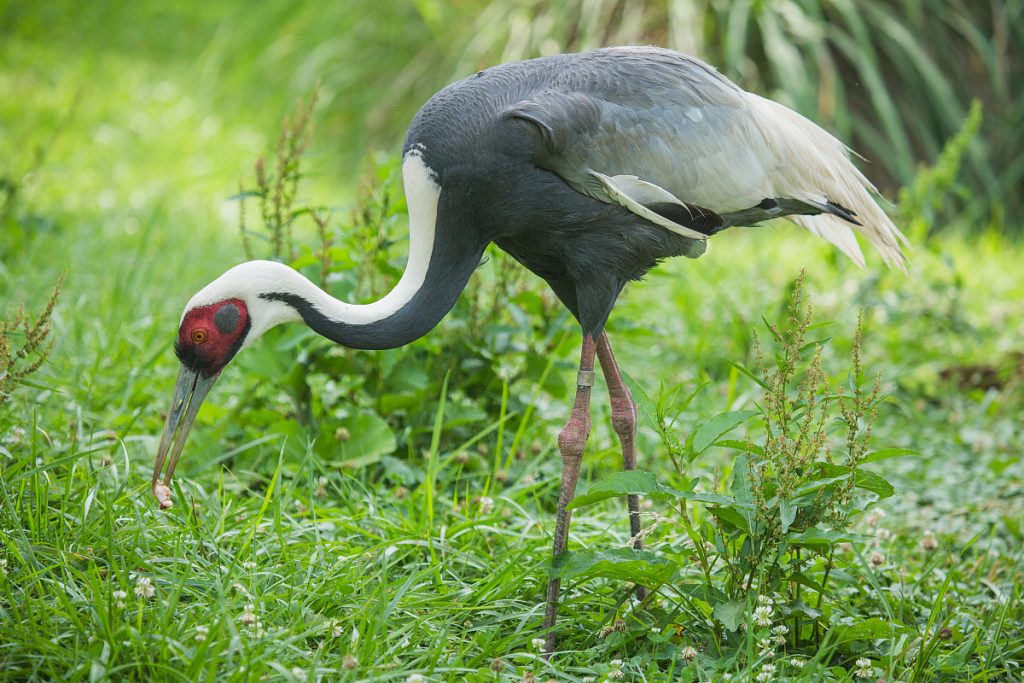
White-naped Crane/Photo: Roshan Patel, Smithsonian’s National Zoo

ARIES (March 21-April 19): “Real love is a pilgrimage,” declared author Anita Brookner. “It happens when there is no strategy, but it is very rare because most people are strategists.” That’s the bad news, Aries. The good news is that you have more potential than ever before to free your love of strategic maneuvering and manipulation. For the foreseeable future, I invite you to drop all romantic agendas and simply make yourself extra receptive to love’s teachings. Are you ready to learn what you don’t even realize you need to know?

TAURUS (April 20-May 20): In the near future, I’ll be pleased if you dole out lavish praise to allies who enchant you. I will celebrate if you deliver loving inspirations and lush invitations to those who help you fulfill your reasons for being here on the planet. To get you in the mood, here are some suggested provocations. 1. “Your body makes mine into a shrine; holy, divine, godtouched.” —Ramona Meisel. 2. “Your luster opens glories on my glowing face.” —Federico García Lorca. 3. “All night long if you want. We’ll tell our secrets to the dark.” —Gayle Forman. 4. “I’ll let you be in my dreams if I can be in yours.” —Bob Dylan. 5. “We are each other’s harvest. We are each other’s business. We are each other’s magnitude and bond.” —Gwendolyn Brooks.

GEMINI (May 21-June 20): In Gemini author Orhan Pamuk’s novel “Snow,” the main character Ka asks a woman named Ipek, “What is the thing you want most from me? What can I do to make you love me?” Ipek’s answer: “Be yourself.” In the coming days, Gemini, I would love you to engage in similar exchanges with those you care for. According to my understanding of the astrological omens, now is a favorable time for you and your best allies to shed all fakery and pretense so that you may be soulfully authentic with each other—and encourage each other to express what’s most raw and genuine.

CANCER (June 21-July 22): Are you in the mood to make extravagant gestures in behalf of love? Are you feeling an urge to move beyond your habitual approaches to intimate togetherness as you dare to engage in fun experiments? Now is a good time for such behavior with allies you trust. To spur your imagination, immerse yourself in the spirit of this poem by Nizar Qabbani: “I abandon my dictionaries to the flames, / And ordain you my language. / I fling my passport beneath the waves, / And christen you my country.” Your homework: Dream up and carry out a playful and audacious venture that will energize one of your close relationships.

LEO (July 23-Aug. 22): I’ve created a list of splashy titles for stories or poems or songs or artworks or dances that you could compose for beloved allies or people you want to be beloved allies. I hope my list inspires you to get gushy and lyrical. I hope you’ll be creative and marvelous as you express your passionate appreciation. Here are the titles: 1. Glistening Passion. 2. Incandescent Rapture. 3. Succulent Dazzle. 4. Molten Luminosity. 5. Splashy Fire Bliss. 6. Shimmering Joy Beams. 7. Opulent Delirium. 8. Wild Soul Synergy. 9. Sublime Friction. 10. Fluidic Gleam Blessings. 11. Throbbing Reverence. 12. Sacred Heart Salvation.

VIRGO (Aug. 23-Sept. 22): Author Eve Ensler tells us, “You have to give to the world the thing that you want the most, in order to fix the broken parts inside you.” This is perfect counsel for you to carry out in the coming weeks, Virgo. Life will conspire to help you heal yourself, in dramatic and even semi-miraculous ways, as you offer the people and animals you care for the same blessings that you crave to receive. I foresee an influx of restorative karma flowing in your direction. I predict the fixing of at least some of your broken parts.

LIBRA (Sept. 23-Oct. 22): In Michael Chabon’s novel “The Mysteries of Pittsburgh,” the character named Arthur says to the character named Cleveland, “Love is like falconry. Don’t you think that’s true?” Cleveland replies, “Never say love is like anything. It isn’t.” I propose we make that your meditation during this Valentine season, Libra. In accordance with astrological omens, you will be wise to purge all your preconceptions about love. Use your ingenuity to revive your innocence about the subject. Cultivate a sense of wonder as you let your imagination run wild and free in its fantasies about love and sex and intimacy.

SCORPIO (Oct. 23-Nov. 21): I’ll love it if sometime soon you create a situation in which you tell an ally words similar to what author Jamaica Kincaid spoke to her lover: “To behold the startling truths of your naked body frees me to remember the song I was born from.” Do you think you can make that happen, Scorpio? The astrological indicators at play in your life suggest that it would be right and sacred for you to do so. And if there is no such ally, then I hope you will deliver the same message to your naked self. And by the way, what is the song you were born from? (PS: There has never been a better time than now to learn treasured truths about yourself through your connections with others.)

SAGITTARIUS (Nov. 22-Dec. 21): I’m afraid I must be downright practical and mundane in my oracle for you. Don’t hate me! I’m only reporting what the planetary omens are telling me. They say that now is a favorable time for you to practice, practice and practice some more the fine arts hinted at by author Ivan Goncharov: “A close, daily intimacy between two people has to be paid for: It requires a great deal of experience of life, logic, and warmth of heart on both sides to enjoy each other’s good qualities without being irritated by each other’s shortcomings and blaming each other for them.” Be diligently positive, Sagittarius, as you work through the demanding daily trials of togetherness.

CAPRICORN (Dec. 22-Jan. 19): I’ll offer you a radical idea about love from author Hélène Cixous. Although it’s not always true for everyone, it will have special meaning for you in the coming months. She wrote, “It is easy to love and sing one’s love. That is something I am extremely good at doing. But to be loved, that is true greatness. Being loved, letting oneself be loved, entering the magic and dreadful circle of generosity, receiving gifts, finding the right thank-you’s, that is love’s real work.” How about it, Capricorn? Are you up for the challenge? Are you willing to expand your capacity to welcome the care and benevolence and inspiration coming your way from others?

AQUARIUS (Jan. 20-Feb. 18): Actor Leelee Sobieski was mourning her romantic adventures—or rather the lack of romantic adventures. She said, “If only I could find a guy who wasn’t in his seventies to talk to me about white cranes, I’d be madly in love.” The good news is that Sobieski knows precisely what she wants, and it’s not all that complicated. The bad news is that there are few men near her own age (thirty-eight) who enjoy discussing the fine points of the endangered bird species known as the white crane. I bring her predicament to your attention, Aquarius, in the hope that you’ll be inspired to be as exact and lucid as she is in identifying what you want—even as you cheat just a bit in the direction of wanting what is actually available.

PISCES (Feb. 19-March 20): I’ve never offered you the wisdom of actor Natalie Portman, but her idealistic attitude about relationships is exactly what I think you should aspire to in the coming months. She said, “I always ask myself, would I want someone to do something that wasn’t comfortable for them to do just to please me? And the answer is no.” What do you think, Pisces? Do you suspect it might be interesting to apply that principle to your closest alliances? I hope so. If you do, the planetary energies will conspire to deepen your intimate bonds.

What love goal would you like to accomplish between now and February 2023? Write it down, stating it as an intention and vow. Share? Freewillastrology.com

(nwecity.com)

Ray Chen Mendelssohn Violin Concerto in E minor, Op. 64

Ray ChenRay Chen Live concert on 28th February, 2015 Ray Chen with the Gothenburg Symphony Orchestra and Maestro Kent Nagano I. Allegro molto appassionato II. Andante III. Allegretto non troppo – Allegro molto vivace _______________________________________ RAY CHEN m e r c h : https://www.raychen.plus/ d i s c o r d : https://discord.gg/raychen w e b s i t e : https://www.raychenviolin.com/ f a c e b o o k : https://www.facebook.com/raychenvioli… i n s t a g r a m : https://www.instagram.com/raychenviolin t w i t t e r : https://twitter.com/raychenviolin r e d d i t : https://www.reddit.com/r/raychenviolin/

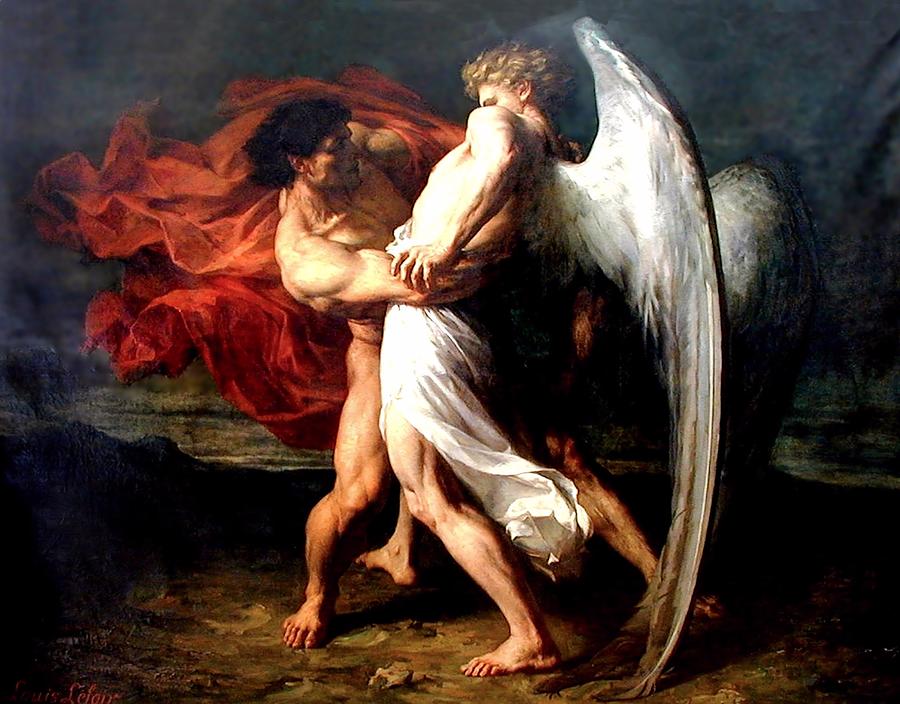
Jacob wrestling with the angel

From Wikipedia, the free encyclopedia

Jacob wrestling with the angel is described in Genesis (32:22–32; also referenced in Hosea 12:3–5). The “angel” in question is referred to as “man” (אִישׁ) and “God” in Genesis, while Hosea references an “angel” (מַלְאָךְ).[1] The account includes the renaming of Jacob as Israel (etymologized as “contends-with-God“).

In the Genesis narrative, Jacob spent the night alone on a riverside during his journey back to Canaan. He encounters a “man” who proceeds to wrestle with him until daybreak. In the end, Jacob is given the name “Israel” and blessed, while the “man” refuses to give his own name. Jacob then names the place where they wrestled Penuel (פְּנוּאֵל “face of God” or “facing God”[2]).

Biblical text

The Masoretic text reads as follows:

The same night he arose and took his two wives, his two female servants, and his eleven children, and crossed the ford of the Jabbok. He took them and sent them across the stream, and everything else that he had. And Jacob was left alone. And a man wrestled with him until the breaking of the day. When the man saw that he did not prevail against Jacob, he touched his hip socket, and Jacob’s hip was put out of joint as he wrestled with him. Then he said, “Let me go, for the day has broken.” But Jacob said, “I will not let you go unless you bless me.” And he said to him, “What is your name?” And he said, “Jacob.” Then he said, “Your name shall no longer be called Jacob, but Israel, for you have striven with God and with men, and have prevailed.” Then Jacob asked him, “Please tell me your name.” But he said, “Why is it that you ask my name?” And there he blessed him. So Jacob called the name of the place Peniel, saying, “For I have seen God face to face, and yet my life has been delivered.” The sun rose upon him as he passed Penuel, limping because of his hip. Therefore to this day the people of Israel do not eat the sinew of the thigh that is on the hip socket, because he touched the socket of Jacob’s hip on the sinew of the thigh.— Genesis 32:22–32

The account contains several plays on the meaning of Hebrew names—Peniel (or Penuel)Israel—as well as similarity to the root of Jacob’s name (which sounds like the Hebrew for “heel”) and its compound.[3] The limping of Jacob (Yaʿaqob ), may mirror the name of the river, Jabbok (Yabbok יַבֹּק , sounds like “crooked” river), and Nahmanides (Deut. 2:10 of Jeshurun) gives the etymology “one who walks crookedly” for the name Jacob.[4]

The Hebrew text states that it is a “man” (אִישׁ, LXX ἄνθρωπος, Vulgate vir) with whom Jacob wrestles, but later this “man” is identified with God (Elohim) by Jacob.[5] Hosea 12:4 furthermore references an “angel” (malak). Following this, the Targum of Onkelos offers “because I have seen the Angel of the Lord face to face”, and the Targum of Palestine gives “because I have seen the Angels of the Lord face to face”.[6]

Interpretations

The identity of Jacob’s wrestling opponent is a matter of debate,[7] named variously as a dream figure, a prophetic vision, an angel (such as Michael and Samael), a protective river spirit, Jesus, or God.[8]

Jewish interpretations

In Hosea 12:4, Jacob’s opponent is described as malakh “angel”: “Yes, he had power over the angel, and prevailed: he wept, and made supplication to him: he found him in Bethel, and there he spoke with us;”. The relative age of the text of Genesis and of Hosea is unclear, as both are part of the Hebrew Bible as redacted in the Second Temple Period, and it has been suggested that malakh may be a late emendation of the text, and would as such represent an early Jewish interpretation of the episode.[9]

Maimonides believed that the incident was “a vision of prophecy”,[10] while Rashi believed Jacob wrestled with the guardian angel of Esau (identified as Samael),[11] his elder twin brother.[12] Zvi Kolitz (1993) referred to Jacob “wrestling with God”.[13]

As a result of the hip injury Jacob suffered while wrestling, Jews are prohibited from eating the meat tendon attached to the hip socket (sciatic tendon),[14][15][16] as mentioned in the account at Genesis 32:32.[17]

Christian interpretations

The interpretation that “Jacob wrestled with God” (glossed in the name Isra-‘el) is common in Protestant theology, endorsed by both Martin Luther and John Calvin (although Calvin believed the event was “only a vision”),[10] as well as later writers such as Joseph Barker (1854)[18] or Peter L. Berger (2014).[19] Other commentaries treat the expression of Jacob’s having seen “God face to face” as referencing the Angel of the Lord as the “Face of God”.[20]

The proximity of the terms “man” and “God” in the text in some Christian commentaries has also been taken as suggestive of a ChristophanyJ. Douglas MacMillan (1991) suggests that the angel with whom Jacob wrestles is a “pre-incarnation appearance of Christ in the form of a man.”[21]

According to one Christian commentary of the Bible incident described, “Jacob said, ‘I saw God face to face’. Jacob’s remark does not necessarily mean that the ‘man’ with whom he wrestled is God. Rather, as with other, similar statements, when one saw the ‘angel of the Lord,’ it was appropriate to claim to have seen the face of God.”[20]

Islamic interpretation

This story is not mentioned in the Quran, but is discussed in Muslim commentaries.[22][23] The commentaries employ the story in explaining other events in the Hebrew Bible that are discussed in the Quran that have parallels, like Moses being attacked by an angel,[24] and to explain Jewish eating customs.[22][25] Like some Jewish commentators, Islamic commentators described the event as punishment for Jacob failing to give tithes to God but making an offering like a tithe to Esau.[24]

Other views

In an analysis of Marxist philosopher Ernst Bloch‘s 1968 book Atheism in Christianity, Roland Boer says that Bloch sees the incident as falling into the category of “myth, or at least legend”. Boer calls this an example of “a bloodthirsty, vengeful God … outdone by cunning human beings keen to avoid his fury”.[26]

The wrestling incident on the bank of a stream has been compared to the Greek mythology stories of Achilles‘ duel with the river god Scamander[27] and with Menelaus wrestling with the sea-god Proteus.[28] It is also claimed the wrestling incident, along with other Old Testament stories of the Jewish Patriarchs, is based on Akhenaten-linked Egyptian mythology, where Jacob is Osiris/Wizzer, Esau is Set, and the wrestling match is the struggle between them.[29]

Rosemary Ellen Guiley gives this summary:”This dramatic scene has spurred much commentary from Judaic, Catholic, and Protestant theologians, biblical scholars, and literary critics. Does Jacob wrestle with God or with an angel? … There is no definitive answer, but the story has been rationalized, romanticized, treated as myth, and treated symbolically.”[30]

In arts

Visual arts

One of the oldest visual depictions is in the illustrated manuscript the Vienna Genesis.[31] Many artists have depicted the scene, considering it as a paradigm of artistic creation.[32] In sculpture Jacob Wrestling with the Angel is the subject of a 1940 sculpture by Sir Jacob Epstein on display at the Tate Britain.[33] Paintings include:

In music

The Latin text of Genesis 32:30 ‘Vidi dominum facie ad faciem; et salva facta est anima mea’ (I have seen the Lord face to face) was set for the third nocturn at Matins on the second Sunday of Lent and was a popular medieval telling of the story of Jacob’s encounter with the angel. It is set as the tenor (upper voice) text of Machaut‘s multi-text-layered Motet Vidi dominum (M 15; I have seen the Lord) simultaneously with two secular French texts: “Faux semblant m’a decü” and “Amours qui ha le pouvoir.”[35] Machaut musically contrasts God’s blessing in the Latin text with the disappointments of secular love in the French texts.[36] Charles Wesley‘s hymn “Come, O Thou Traveller Unknown“, often known as “Wrestling Jacob”, is based on the passage which describes Jacob wrestling with an angel. It is traditionally sung to the tune of St Petersburg.[37] U2‘s Bullet the Blue Sky, the 4th track on their 1987 album The Joshua Tree includes the lyric “Jacob wrestled the angel and the angel was overcome.” The lyrics of Isaac, a song featured on Madonna‘s Confessions on a Dance Floor album, contains many allusions to the book of Genesis and references Jacob’s encounter with the angel in the line “wrestle with your darkness, angels call your name”. Noah Reid released his song “Jacob’s Dream” as the second single of his 2020 second album.[38] The song uses the metaphor of wrestling with angels to explore that “blessings are hard to come by and they cost you something,” as Reid told Indie88.[39] Mark Alburger‘s Israel in Trouble, Op. 57 (1997) includes the story in movement VIII. On his way.

In literature and theatre

The motif of “wrestling with the angels” occurs in several novels including Hermann Hesse‘s Demian (1919), Dodie Smith‘s I Capture the Castle (1948), Margaret Laurence‘s The Stone Angel (1964). In T.H. White‘s The Once and Future King, the Wart is described as knowing that the work of training a hawk “had been like Jacob’s struggle with the angel”. In poetry the theme appears in Rainer Maria Rilke‘s “The Man Watching” (c.1920), Henry Wadsworth Longfellow‘s “Evangeline,”[40] Herman Melville‘s poem “Art,” and Emily Dickinson‘s poem “A little East of Jordan” (Fr145B, 1860). In theatre, wrestling with the angel is mentioned in Tony Kushner‘s play Angels in America (1990); the version depicted in its miniseries adaptation is the 1865 version by Alexander Louis Leloir. Gustave Dore’s image is reenacted in Jean-Luc Godard‘s Passion by a film extra dressed as an angel and Jerzy Radziwiłowicz.[41] Also Maud Hart Lovelace‘s Betsy’s Wedding (1955), Stephen King‘s novel 11/22/63 (2011),[42] Sheila Heti‘s novel Motherhood (2018) and David Fennario‘s play Balconville (1979). A short story in Daniel Mallory Ortberg‘s collection The Merry Spinster (2018) explores a version of the narrative as told from the perspective of the angel.

More at: https://en.wikipedia.org/wiki/Jacob_wrestling_with_the_angel#:~:text=Jacob%20wrestling%20with%20the%20angel%20is%20described%20in%20Genesis%20(32,%2Dwith%2DGod%22).