
Expanding Perceptions In this conversation, James Tunney discusses his views on what he sees as a devaluing of personal sovereignty, human conscious, and personhood in our culture. He examines how certain groups have a desire to view humans more as machines than as conscious persons. He encourages people to avoid an overreliance on technology, connect more with nature, become more open to walking a spiritual path, and not relinquish their personal sovereignty. James Tunney is an Irish Barrister, expert on international law, artist, poet, author, and mystic. To find out more about James, go to his website: https://www.jamestunney.com/
Monthly Archives: December 2021
New Year Greetings from The McGuire Sisters: Let’s Start the New Year Right
VideosTimes2 In another of their amazing production numbers the McGuire Sisters prove what fine entertainers they were with their fine harmonizing and fancy foot work! Marked by dazzling entertainment values, the three sisters perform
The Gnostics with Jason Reza Jorjani
New Thinking Allowed with Jeffrey Mishlove Jason Reza Jorjani, PhD, is a philosopher and author of Prometheus and Atlas, World State of Emergency, Lovers of Sophia, and Novel Folklore: The Blind Owl of Sadegh Hedayat. Here he points out that, while the term Gnosticism is very popular, few people really understand what it means. While it is a very loose religious movement, it does have certain common elements. Among these are the idea that our world is under the sway of a malevolent deity who is served by powers and principalities. He traces Gnostic movements such as Manicheism, Mazdakism, and the Cathars. He also discusses the rebirth of Gnosticism in our age, due to the rediscovery of the Nag Hammadi library. (Recorded on April 5, 2018)
Warriors resisted temptation to play hero ball — and it paid off
The open man should, and did, get the shot

By John Krolik
Special to The Examiner December 27, 2021 (SFExaminer.com)
It’s one of the most iconic images — the star player taking the last shot as the clock winds down. A play NBA fans obsess over, “which player would you rather have take the last shot?” can often stand in as shorthand for “which player do you think is better?” A team’s best player is expected to be their closer: the player who comes up the biggest when the stakes are at their highest.
Players are highly conscious of this. Look no further than the 1994 series between the Knicks and the Jordan-less Bulls, when Scottie Pippen infamously sat out the last 1.8 seconds of a tied game because Phil Jackson drew up a play for Toni Kukoc to take the last shot. (Kukoc made the game-winner, so Jackson probably knew what he was doing.) Yet decades later, Pippen describes how he felt like it was an insult to not be given the right to the final shot.
There are no shortages of great players making iconic shots over helpless defenders in big moments. Magic Johnson’s junior skyhook against the Celtics. Reggie Miller’s eight points in nine seconds against the Knicks. Kobe Bryant swishing a fadeaway as time expired against the Suns. Damian Lillard sending the Thunder home with a shot from the half-court logo. Kawhi Leonard eliminating the 76ers. Steph Curry beating the Thunder with his own incredibly deep pull-up. LeBron James’ buzzer-beating bank shot against the Raptors. And, of course, Michael Jordan’s series-winning pull-up over Craig Ehlo in 1989 and championship-winning shot over Byron Russell in 1998.
The strategy in these big moments, so much as there is one, is about as simple as it gets: Give the ball to your best player and watch him go to work. If the player you want taking the shot gets double-teamed hard, then perhaps he can kick the ball to a wide-open teammate. Jordan giving up the ball to John Paxson and Steve Kerr for their own crucial game-winning shots comes to mind, although it really helps that they made their respective shots (in 2020, LeBron James was criticized by some for passing the ball to a wider-than-wide open Danny Green in the waning moments of Game 5 of the NBA Finals rather than take what would have been a twisting fadeaway over two defenders). Mostly, however, it’s all about giving your key player the ball and getting out of the way.
Over the past few years, this strategy has been derisively referred to as “hero ball,” especially since the numbers show that NBA teams shoot extraordinarily low percentages in last-shot or late-game situations. (Some of this has to do with teams liking to hold the ball for as long as possible in order to ensure they get the final shot. Conventional strategy tends to be conservative in this manner.)
With just over a minute remaining in Thursday night’s game, the Warriors showed a glimpse of a better approach. With the Warriors leading the Grizzlies 104-102, Steph Curry was double-teamed and forced to give the ball up, which he did by flipping a lob to Draymond Green near the three-point line. At this point, most teams would have seen Steph frantically darting back and forth to get the ball back, and then getting whatever shot he could up before time expired.
Instead, Draymond took his own initiative and put the ball on the floor for one of his patented “short rolls,” wherein he gets the ball out of a trap and dribbles at a canter towards the defense, waiting for them to react and then making his decision. On this play, two Grizzlies defenders stepped up to block Draymond’s path to the basket, leaving Juan Toscano-Anderson wide-open just outside of the paint, so Green gave it to him. After the one dribble it took Toscano-Anderson to get to the basket, three Grizzlies defenders had converged on him. Anderson made the only play he had available to him, which was to pass the ball to Gary Payton II, who happened to be wide-open from beyond the three-point line. Payton calmly swished the shot, and the game was effectively over.
The Warriors still used the attention Steph demands to get a good shot, but they were patient and able to resist the temptation to play hero ball well enough. The player who ended up taking the shot had made 43 career threes in the NBA before that moment — Steph had made 2,994. None of that mattered, because Payton was the open man, and the open man is who should get the shot. (Kerr, who sunk a 17-footer in the closing moments of Game 6 of the 1997 NBA Finals off a pass from a double-teamed Jordan, likely understands this better than most.)
For the Warriors to be effective come playoff time, they can’t abandon the concepts that make them exceptional in the final two minutes of close games and lapse into hero ball. They didn’t on Thursday, and that’s a very good sign.
Love remembers
elephantnews #ElephantNeverForget#KhamLha#Reunion Watch the moment of Kham Lha herd running to a reunion with Darrick a man who has been away from the herd for 14 months. Darrick has been staying in Cambodia for Elephant Kavann Project. Watch their reaction when they meet each other again at Elephant Nature Park. Learn More: https://www.saveelephant.org/
(Courtesy of William P. Chiles)
“Happy New Year” from Jack Benny and Rochester van Jones
The Jack Benny Program – Complete The Jack Benny Program Episode 2 – 4 172 episodes of The Jack Benny Program from the 1950s and 60s plus seventeen TV specials. Some of the shows have the original network commercials. Picture quality varies as they are from a private collection and not all available for purchase. These shows were produced from: November 4, 1951 to March 1, 1965 *And entered the public domain between: November 4, 1979 and March 1, 1993.
Bio: Desmond Tutu

From Wikipedia, the free encyclopedia
| The Most Reverend Desmond Tutu OMSG CH GCStJ | |
|---|---|
| Archbishop of Cape TownPrimate of the Anglican Church of Southern AfricaChairman of the Truth and Reconciliation Commission | |
| Church | Anglican Church of Southern Africa |
| See | Cape Town |
| Installed | 7 September 1986 |
| Term ended | 1996 |
| Predecessor | Philip Russell |
| Successor | Njongonkulu Ndungane |
| Other post(s) | Bishop of LesothoBishop of JohannesburgArchbishop of Cape Town |
| Orders | |
| Ordination | 1960 (deacon)1961 (priest) |
| Consecration | 1976 |
| Personal details | |
| Birth name | Desmond Mpilo Tutu |
| Born | 7 October 1931 Klerksdorp, South Africa |
| Died | 26 December 2021 (aged 90) Cape Town, South Africa |
| Spouse | Nomalizo Leah Shenxane(m. 1955) |
| Children | 4, including Mpho |
| Occupation | Bishoptheologiansocial activistauthor |
| Education | King’s College, University of London |
| Signature |


| Styles of Desmond Tutu | |
|---|---|
| Reference style | Archbishop |
| Spoken style | Your Grace |
| Religious style | The Most Reverend |

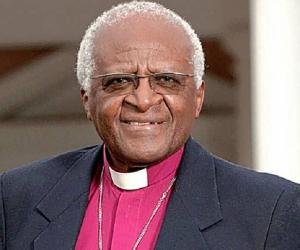
Desmond Mpilo Tutu OMSG CH GCStJ (7 October 1931 – 26 December 2021) was a South African Anglican bishop and theologian, known for his work as an anti-apartheid and human rights activist. He was Bishop of Johannesburg from 1985 to 1986 and then Archbishop of Cape Town from 1986 to 1996, in both cases being the first black African to hold the position. Theologically, he sought to fuse ideas from black theology with African theology.
Desmond Mpilo Tutu was born of mixed Xhosa and Motswana heritage to a poor family in Klerksdorp, South Africa. Entering adulthood, he trained as a teacher and married Nomalizo Leah Shenxane in 1955, with whom he had four children, including Mpho Tutu van Furth. In 1960, he was ordained as an Anglican priest and in 1962 moved to the United Kingdom to study theology at King’s College London. In 1966 he returned to Africa, teaching at the Federal Theological Seminary, South Africa, and then the University of Botswana, Lesotho and Swaziland. In 1972, he became the Theological Education Fund’s director for Africa, a position based in London but necessitating regular tours of the African continent. Back in southern Africa in 1975, he served first as dean of St Mary’s Cathedral in Johannesburg and then as Bishop of Lesotho; from 1978 to 1985 he was general-secretary of the South African Council of Churches. He emerged as one of the most prominent opponents of South Africa’s apartheid system of racial segregation and white minority rule. Although warning the National Party government that anger at apartheid would lead to racial violence, as an activist he stressed non-violent protest and foreign economic pressure to bring about universal suffrage.
In 1985, Tutu became Bishop of Johannesburg and in 1986 the Archbishop of Cape Town, the most senior position in southern Africa’s Anglican hierarchy. In this position, he emphasised a consensus-building model of leadership and oversaw the introduction of female priests. Also in 1986, he became president of the All Africa Conference of Churches, resulting in further tours of the continent. After President F. W. de Klerk released the anti-apartheid activist Nelson Mandela from prison in 1990 and the pair led negotiations to end apartheid and introduce multi-racial democracy, Tutu assisted as a mediator between rival black factions. After the 1994 general election resulted in a coalition government headed by Mandela, the latter selected Tutu to chair the Truth and Reconciliation Commission to investigate past human rights abuses committed by both pro and anti-apartheid groups. Following apartheid’s fall, Tutu campaigned for gay rights and spoke out on a wide range of subjects, among them his support of Palestinians in the Israeli–Palestinian conflict, his opposition to the Iraq War, and his criticism of South African presidents Thabo Mbeki and Jacob Zuma. In 2010, he retired from public life.
As Tutu rose to prominence in the 1970s, white conservatives who supported apartheid despised him, while many white liberals regarded him as too radical; many black radicals accused him of being too moderate and focused on cultivating white goodwill, while Marxist–Leninists criticised his anti-communist stance. He was popular among South Africa’s black majority and was internationally praised for his anti-apartheid activism, receiving a range of awards, including the Nobel Peace Prize. He also compiled several books of his speeches and sermons.
Early life
Childhood: 1931–1950
Desmond Mpilo Tutu was born on 7 October 1931 in Klerksdorp, northwest South Africa.[1] His mother, Allen Dorothea Mavoertsek Mathlare, was born to a Motswana family in Boksburg.[2] His father, Zachariah Zelilo Tutu, was from the amaFengu branch of Xhosa and grew up in Gcuwa, Eastern Cape.[3] At home, the couple spoke the Xhosa language.[4] Having married in Boksburg,[5] they moved to Klerksdorp in the late 1950s, living in the city’s “native location,” or black residential area, since renamed Makoetend.[6] Zachariah worked as the principal of a Methodist primary school and the family lived in the mud-brick schoolmaster’s house in the yard of the Methodist mission.[7]The Church of Christ the King in Sophiatown, where Tutu was a server under priest Trevor Huddlestone

The Tutus were poor;[8] describing his family, Tutu later related that “although we weren’t affluent, we were not destitute either.”[9] Tutu had an older sister, Sylvia Funeka, who called him “Mpilo” (“life”), a name given to him by his paternal grandmother.[10] He was his parents’ second son; their firstborn boy, Sipho, had died in infancy.[11] Another daughter, Gloria Lindiwe, was born after him.[12] Tutu was sickly from birth;[13] polio resulted in the atrophy of his right hand,[14] and on one occasion he was hospitalised with serious burns.[15] Tutu had a close relationship with his father, although was angered at the latter’s heavy drinking, during which he would sometimes beat his wife.[16] The family were initially Methodists and Tutu was baptised into the Methodist Church in June 1932.[17] They subsequently changed denominations, first to the African Methodist Episcopal Church and then to the Anglican Church.[18]
In 1936, the family moved to Tshing, where Zachariah became principal of a Methodist school.[15] There, Tutu started his primary education,[9] learned Afrikaans,[19] and became the server at St Francis Anglican Church.[20] He developed a love of reading, particularly enjoying comic books and European fairy tales.[21] In Tshing his parents had a third son, Tamsanqa, who also died in infancy.[9] Around 1941, Tutu’s mother moved to the Witwatersrand to work as a cook at Ezenzeleni Blind Institute in Johannesburg. Tutu joined her in the city, living in Roodepoort West.[22] In Johannesburg, he attended a Methodist primary school before transferring to the Swedish Boarding School (SBS) in the St Agnes Mission.[23] Several months later, he moved with his father to Ermelo, eastern Transvaal.[24] After six months, the duo returned to Roodepoort West, where Tutu resumed his studies at SBS.[24] Pursuing his interest in Christianity, at the age of 12 he underwent confirmation at St Mary’s Church, Roodepoort.[25]
Tutu entered the Johannesburg Bantu High School in 1945, where he excelled academically.[26] There, he joined a school rugby team, developing a lifelong love of the sport.[27] Outside of school, he earned money selling oranges and as a caddie for white golfers.[28] To avoid the expense of a daily train commute to school, he briefly lived with family nearer to Johannesburg, before moving back in with his parents when they relocated to Munsieville.[29] He then returned to Johannesburg, moving into an Anglican hostel near the Church of Christ the King in Sophiatown.[30] He became a server at the church and came under the influence of its priest, Trevor Huddleston;[31] later biographer Shirley du Boulay suggested that Huddleston was “the greatest single influence” in Tutu’s life.[32] In 1947, Tutu contracted tuberculosis and was hospitalised in Rietfontein for 18 months, during which he was regularly visited by Huddleston.[33] In the hospital, he underwent circumcision to mark his transition to manhood.[34] He returned to school in 1949 and took his national exams in late 1950, gaining a second-class pass.[35]
College and teaching career: 1951–1955
Although Tutu secured admission to study medicine at the University of the Witwatersrand, his parents could not afford the tuition fees.[35] Instead, he turned toward teaching, gaining a government scholarship to start a course at Pretoria Bantu Normal College, a teacher training institution, in 1951.[36] There, he served as treasurer of the Student Representative Council, helped to organise the Literacy and Dramatic Society, and chaired the Cultural and Debating Society.[37] During one debating event he first met the lawyer—and future president of South Africa—Nelson Mandela; they would not encounter each other again until 1990.[38] At the college, Tutu attained his Transvaal Bantu Teachers Diploma, having gained advice about taking exams from the activist Robert Sobukwe.[39] He had also taken five correspondence courses provided by the University of South Africa (UNISA), graduating in the same class as future Zimbabwean leader Robert Mugabe.[40]
In 1954, he began teaching English at Madibane High School; the following year, he transferred to the Krugersdorp High School, where he taught English and history.[41] He began courting Nomalizo Leah Shenxane, a friend of his sister Gloria who was studying to become a primary school teacher.[42] They were legally married at Krugersdorp Native Commissioner’s Court in June 1955, before undergoing a Roman Catholic wedding ceremony at the Church of Mary Queen of Apostles; although he was an Anglican, Tutu agreed to the ceremony due to Leah’s Roman Catholic faith.[43] The newlyweds lived at Tutu’s parental home before renting their own six months later.[44] Their first child, Trevor, was born in April 1956;[45] a daughter, Thandeka, appeared 16 months later.[46] The couple worshipped at St Paul’s Church, where Tutu volunteered as a Sunday school teacher, assistant choirmaster, church councillor, lay preacher, and sub-deacon,[46] while outside of the church he also volunteered as a football administrator for a local team.[44]
Joining the clergy: 1956–1966
Tutu first ministered to a white congregation at the Church of St Alban the Martyr in Golders Green, living with his family in the curate’s flat

In 1953, the white-minority National Party government introduced the Bantu Education Act to further their apartheid system of racial segregation and white domination. Disliking the Act, Tutu and his wife left the teaching profession.[47] With Huddleston’s support, Tutu chose to become an Anglican priest.[48] In January 1956, his request to join the Ordinands Guild was turned down due to his debts; these were then paid off by the wealthy industrialist Harry Oppenheimer.[49] Tutu was admitted to St Peter’s Theological College in Rosettenville, Johannesburg, which was run by the Anglican Community of the Resurrection.[50] The college was residential, and Tutu lived there while his wife moved to train as a nurse in Sekhukhuneland and his children lived with his parents in Munsieville.[51] In August 1960, his wife gave birth to another daughter, Naomi.[52]
At the college, Tutu studied the Bible, Anglican doctrine, church history, and Christian ethics,[53] earning a Licentiate of Theology degree,[54] and winning the archbishop’s annual essay prize.[55] The college’s principal, Godfrey Pawson, wrote that Tutu “has exceptional knowledge and intelligence and is very industrious. At the same time, he shows no arrogance, mixes in well, and is popular… He has obvious gifts of leadership.”[56] During his years at the college, there had been an intensification in anti-apartheid activism as well as a crackdown against it, including the Sharpeville massacre of 1960.[57] Tutu and his other trainees did not engage in anti-apartheid activism;[58] he later noted that “we were in some ways a very apolitical bunch.”[59]
In December 1960, Edward Paget ordained Tutu as an Anglican priest at St Mary’s Cathedral.[60] Tutu was then appointed assistant curate in St Alban’s Parish, Benoni, where he was reunited with his wife and children,[61] and earned two-thirds of what his white counterparts were given.[62] In 1962, Tutu was transferred to St Philip’s Church in Thokoza, where he was placed in charge of the congregation and developed a passion for pastoral ministry.[63] Many in South Africa’s white-dominated Anglican establishment felt the need for more indigenous Africans in positions of ecclesiastical authority; to assist in this, Aelfred Stubbs proposed that Tutu train as a theology teacher at King’s College London (KCL).[64] Funding was secured from the International Missionary Council‘s Theological Education Fund (TEF),[65] and the government agreed to give the Tutus permission to move to Britain.[66] They duly did so in September 1962.[67]During his master’s degree, Tutu worked as assistant curate at St Mary’s Church in Bletchingley, Surrey

At KCL’s theology department, Tutu studied under theologians like Dennis Nineham, Christopher Evans, Sydney Evans, Geoffrey Parrinder, and Eric Mascall.[68] In London, the Tutus felt liberated experiencing a life free from South Africa’s apartheid and pass laws;[69] he later noted that “there is racism in England, but we were not exposed to it.”[70] He was also impressed by the freedom of speech available in the country, especially that at Speakers’ Corner.[71] The family moved into the curate’s flat behind the Church of St Alban the Martyr in Golders Green, where Tutu assisted Sunday services, the first time that he had ministered to a white congregation.[72] It was in the flat that a daughter, Mpho Andrea Tutu, was born in 1963.[73] Tutu was academically successful and his tutors suggested that he convert to an honours degree, which entailed his also studying Hebrew.[74] He received his degree from Queen Elizabeth The Queen Mother in a ceremony held at the Royal Albert Hall.[75]
Tutu then secured a TEF grant to study for a master’s degree;[76] he studied for this degree from October 1965 until September 1966, completing his dissertation on Islam in West Africa.[77] During this period, the family moved to Bletchingley in Surrey, where Tutu worked as the assistant curate of St Mary’s Church.[78] In the village, he encouraged cooperation between his Anglican parishioners and the local Roman Catholic and Methodist communities.[79] Tutu’s time in London helped him to jettison any bitterness to whites and feelings of racial inferiority; he overcame his habit of automatically deferring to whites.[80]
Career during apartheid
Teaching in South Africa and Lesotho: 1966–1972
In 1966, Tutu and his family moved to East Jerusalem, where he studied Arabic and Greek for two months at St George’s College.[81] They then returned to South Africa,[82] settling in Alice, Eastern Cape, in 1967. The Federal Theological Seminary (Fedsem) had recently been established there as an amalgamation of training institutions from different Christian denominations.[83] At Fedsem, Tutu was employed teaching doctrine, the Old Testament, and Greek;[84] Leah became its library assistant.[85] Tutu was the college’s first black staff-member,[86] and the campus allowed a level of racial-mixing which was rare in South Africa.[87] The Tutus sent their children to a private boarding school in Swaziland, thereby keeping them from South Africa’s Bantu Education syllabus.[88]
Tutu joined a pan-Protestant group, the Church Unity Commission,[85] served as a delegate at Anglican-Catholic conversations,[89] and began publishing in academic journals.[89] He also became the Anglican chaplain to the neighbouring University of Fort Hare;[90] in an unusual move for the time, Tutu invited female as well as male students to become servers during the Eucharist.[91] He joined student delegations to meetings of the Anglican Students’ Federation and the University Christian Movement,[92] and was broadly supportive of the Black Consciousness Movement that emerged from South Africa’s 1960s student milieu, although did not share its view on avoiding collaboration with whites.[93] In August 1968, he gave a sermon comparing South Africa’s situation with that in the Eastern Bloc, likening anti-apartheid protests to the recent Prague Spring.[94] In September, Fort Hare students held a sit-in protest over the university administration’s policies; after they were surrounded by police with dogs, Tutu waded into the crowd to pray with the protesters.[95] This was the first time that he had witnessed state power used to suppress dissent.[96]
In January 1970, Tutu left the seminary for a teaching post at the University of Botswana, Lesotho and Swaziland (UBLS) in Roma, Lesotho.[97] This allowed him to live closer to his children and offered twice the salary he earned at Fedsem.[98] He and his wife moved to the UBLS campus; most of his fellow staff members were white expatriates from the U.S. or Britain.[99] As well as his teaching position, he also became the college’s Anglican chaplain and the warden of two student residences.[100] In Lesotho, he joined the executive board of the Lesotho Ecumenical Association and served as an external examiner for both Fedsem and Rhodes University.[89] He returned to South Africa on several occasions, including to visit his father shortly before the latter’s death in February 1971.[89]
Africa Director for the TEF: 1972–1975
Black theology seeks to make sense of the life experience of the black man, which is largely black suffering at the hands of rampant white racism, and to understand this in the light of what God has said about himself, about man, and about the world in his very definite Word… Black theology has to do with whether it is possible to be black and continue to be Christian; it is to ask on whose side is God; it is to be concerned about the humanisation of man, because those who ravage our humanity dehumanise themselves in the process; [it says] that the liberation of the black man is the other side of the liberation of the white man—so it is concerned with human liberation.
— Desmond Tutu, in a conference paper presented at the Union Theological Seminary, 1973[101]
The TEF offered Tutu a job as their director for Africa, a position that required relocating to England. Tutu agreed, although was initially refused permission to leave by the South African authorities; they regarded him with suspicion ever since the Fort Hare student protests and were also increasingly antagonistic toward the WCC, which ran the TEF, because it had condemned apartheid as un-Christian. After Tutu insisted that taking the position would be good publicity for South Africa, the authorities relented.[102] In March 1972, he returned to Britain. The TEF’s headquarters were in Bromley, with the Tutu family settling in nearby Grove Park, where Tutu became honorary curate of St Augustine’s Church.[103]
Tutu’s job entailed assessing grants to theological training institutions and students.[104] This required him touring Africa in the early 1970s, and he wrote accounts of his experiences.[105] In Zaire, he for instance lamented the widespread corruption and poverty and complained that Mobutu Sese Seko‘s “military regime… is extremely galling to a black from South Africa.”[106] In Nigeria, he expressed concern at Igbo resentment following the crushing of their Republic of Biafra.[107] In 1972 he travelled around East Africa, where he was impressed by Jomo Kenyatta‘s Kenyan government and witnessed Idi Amin‘s expulsion of Ugandan Asians.[108]
During the early 1970s, Tutu’s theology changed due to his experiences in Africa and his discovery of liberation theology.[109] He was also attracted to black theology,[110] attending a 1973 conference on the subject at New York City‘s Union Theological Seminary.[111] There, he presented a paper in which he stated that “black theology is an engaged not an academic, detached theology. It is a gut level theology, relating to the real concerns, the life and death issues of the black man.”[112] He stated that his paper was not an attempt to demonstrate the academic respectability of black theology but rather to make “a straightforward, perhaps shrill, statement about an existent. Black theology is. No permission is being requested for it to come into being… Frankly the time has passed when we will wait for the white man to give us permission to do our thing. Whether or not he accepts the intellectual respectability of our activity is largely irrelevant. We will proceed regardless.”[113] Seeking to fuse the African-American derived black theology with African theology, Tutu’s approach contrasted with that of those African theologians, like John Mbiti, who regarded black theology as a foreign import irrelevant to Africa.[111]
Dean of Johannesburg and Bishop of Lesotho: 1975–1978
In 1975, Tutu was nominated to be the new Bishop of Johannesburg, although he lost out to Timothy Bavin.[114] Bavin suggested that Tutu take his newly vacated position, that of the dean of St Mary’s Cathedral, Johannesburg. Tutu was elected to this position—the fourth highest in South Africa’s Anglican hierarchy—in March 1975, becoming the first black man to do so, an appointment making headline news in South Africa.[115] Tutu was officially installed as dean in August 1975. The cathedral was packed for the event.[116] Moving to the city, Tutu lived not in the official dean’s residence in the white suburb of Houghton but rather in a house on a middle-class street in the Orlando West township of Soweto, a largely impoverished black area.[117] Although majority white, the cathedral’s congregation was racially mixed, something that gave Tutu hope that a racially equal, de-segregated future was possible for South Africa.[118] He encountered some resistance to his attempts to modernise the liturgies used by the congregation,[119] including his attempts to replace masculine pronouns with gender neutral ones.[120]As Bishop of Lesotho, Tutu travelled around the country’s mountains visiting the people living there
.jpg)
Tutu used his position to speak out on social issues,[121] publicly endorsing an international economic boycott of South Africa over apartheid.[122] He met with Black Consciousness and Soweto leaders,[123] and shared a platform with anti-apartheid campaigner Winnie Mandela in opposing the government’s Terrorism Act, 1967.[124] He held a 24-hour vigil for racial harmony at the cathedral where he prayed for activists detained under the act.[125] In May 1976, he wrote to Prime Minister B. J. Vorster, warning that if the government maintained apartheid then the country would erupt in racial violence.[126] Six weeks later, the Soweto uprising broke out as black youth clashed with police. Over the course of ten months, at least 660 were killed, most under the age of 24.[127] Tutu was upset by what he regarded as the lack of outrage from white South Africans; he raised the issue in his Sunday sermon, stating that the white silence was “deafening” and asking if they would have shown the same nonchalance had the youth killed been white.[128]
After seven months as dean, Tutu was nominated as a candidate for the position of Bishop of Lesotho.[129] Although Tutu stipulated that he did not want the position, he was elected to it in March 1976, at which time he reluctantly accepted.[130] This decision upset some of his congregation, who felt that he had used their parish as a stepping stone to advance his career.[131] In July, Bill Burnett consecrated Tutu as a bishop at St Mary’s Cathedral.[132] In August, Tutu was enthroned as the Bishop of Lesotho in a ceremony at Maseru‘s Cathedral of St Mary and St James; thousands attended, including King Moshoeshoe II and Prime Minister Leabua Jonathan.[132] Travelling through the largely rural diocese,[133] he learned Sesotho.[134] He appointed Philip Mokuku as the first dean of the diocese and placed great emphasis on further education for the Basotho clergy.[135] He befriended the royal family although his relationship with Jonathan’s government was strained.[136] In September 1977 he returned to South Africa to speak at the Eastern Cape funeral of Black Consciousness activist Steve Biko, who had been killed by police.[137] At the funeral, Tutu stated that Black Consciousness was “a movement by which God, through Steve, sought to awaken in the black person a sense of his intrinsic value and worth as a child of God.”[138]
General-Secretary of the South African Council of Churches: 1978–1985
Taking control of the SACC
We in the SACC believe in a non-racial South Africa where people count because they are made in the image of God. So the SACC is neither a black nor a white organization. It is a Christian organization with a definite bias in favour of the oppressed and the exploited ones of our society.
— Desmond Tutu, on the SACC[139]
After John Rees stepped down as general secretary of the South African Council of Churches, Tutu was among the nominees for his successor. John Thorne was ultimately elected to the position, although stepped down from the position after three months. Tutu was nominated once more, this time being selected. Tutu agreed to accept at the urging of the synod of bishops.[140] His decision angered many Anglicans in Lesotho, who felt that Tutu was abandoning them.[141] Tutu took charge of the SACC in March 1978.[142] Returning to Johannesburg—where the SACC’s headquarters were based at Khotso House[143]—the Tutus returned to their former Orlando West home, now bought for them by an anonymous foreign donor.[144] Leah gained employment as the assistant director of the Institute of Race Relations.[145]
The SACC was one of the only Christian institutions in South Africa where black people had the majority representation,[146] and Tutu was its first black leader.[147] There, he introduced a schedule of daily staff prayers, regular Bible study, monthly Eucharist, and silent retreats.[148] He also developed a new style of leadership, appointing senior staff who were capable of taking the initiative, delegating much of the SACC’s detailed work to them, and keeping in touch with them through meetings and memorandums.[149] Many of his staff referred to him as “Baba” (father).[150] He was determined that the SACC become one of South Africa’s most visible human rights advocacy organisations.[147] His efforts gained him international recognition; in 1978 KCL elected him a fellow while the University of Kent and General Theological Seminary gave him honorary doctorates, as did Harvard University in 1979.[151]
As head of the SACC, Tutu’s time was dominated by fundraising for the organisation’s projects.[152] While Tutu was in charge of the SACC, it was revealed that one of its divisional directors had been stealing funds. In 1981 a government commission launched to investigate the issue, headed by the judge C. F. Eloff.[153] Tutu gave evidence to the commission, during which he condemned apartheid as “evil” and “unchristian.”[154] When the Eloff report was published, Tutu criticised it, focusing particularly on the absence of any theologians on its board, likening it to “a group of blind men” judging the Chelsea Flower Show.[155] In 1981 Tutu also became the rector of St Augustine’s Church in Soweto’s Orlando West.[156] The following year he published a collection of his sermons and speeches, Crying in the Wilderness: The Struggle for Justice in South Africa;[157] another volume, Hope and Suffering, appeared in 1984.[157]
Activism and the Nobel Peace Prize
Tutu testified on behalf of a captured cell of Umkhonto we Sizwe, an armed anti-apartheid group linked to the banned African National Congress (ANC). He stated that although he was committed to non-violence and censured those on all sides who used violence, he could understand why black Africans would become violent when their non-violent tactics had failed to overturn apartheid.[158] In an earlier address, he had expressed the view that an armed struggle against South Africa’s government had little chance of succeeding but also accused Western nations of hypocrisy for condemning armed liberation groups in southern Africa while they had praised similar organisations operating in Europe during the Second World War.[159] Tutu also signed a petition calling for the release of ANC activist Nelson Mandela,[160] leading to a correspondence between the pair.[161]U.S. President Ronald Reagan meeting with Desmond Tutu in 1984. Tutu described Reagan’s administration as “an unmitigated disaster for us blacks,”[162] and Reagan himself as “a racist pure and simple.”[163]

After Tutu told Danish journalists that he supported an international economic boycott of South Africa, he was called before two government ministers to be reprimanded in October 1979.[164] In March 1980, the government confiscated his passport, raising his international profile and bringing condemnations from the US State Department.[165] In 1980, the SACC committed itself to supporting civil disobedience against apartheid.[166] After Thorne was arrested in May, Tutu and Joe Wing led a march of protest, during which they were arrested, imprisoned overnight, and fined.[167] The authorities confiscated Tutu’s passport.[168] In the aftermath, a meeting was organised between 20 church leaders, including Tutu, Prime Minister P. W. Botha, and seven government ministers. At this August meeting the clerical leaders unsuccessfully urged the government to end apartheid.[169] Some clergy saw this dialogue as pointless, but Tutu disagreed, noting that “Moses went to Pharaoh repeatedly to secure the release of the Israelites.”[170]
In January 1981, the government returned Tutu’s passport to him.[171] In March, he embarked on a five-week tour of Europe and North America, meeting politicians including the UN Secretary-General Kurt Waldheim, and addressing the UN Special Committee Against Apartheid.[172] In England, he met Robert Runcie and gave a sermon in Westminster Abbey, while in Rome he met Pope John Paul II.[173] On his return to South Africa, Botha again ordered his passport confiscated, preventing Tutu from personally collecting several further honorary degrees.[174] It was returned to him 17 months later.[175] In September 1982 Tutu addressed the Triennial Convention of the Episcopal Church in New Orleans before traveling to Kentucky to see his daughter Naomi, who lived there with her American husband.[176] Tutu gained a popular following in the US, where he was often compared to civil rights leader Martin Luther King Jr., although white conservatives like Pat Buchanan and Jerry Falwell lambasted him as an alleged communist sympathiser.[177]
This award is for mothers, who sit at railway stations to try to eke out an existence, selling potatoes, selling mealies, selling produce. This award is for you, fathers, sitting in a single-sex hostel, separated from your children for 11 months a year… This award is for you, mothers in the KTC squatter camp, whose shelters are destroyed callously every day, and who sit on soaking mattresses in the winter rain, holding whimpering babies… This award is for you, the 3.5 million of our people who have been uprooted and dumped as if you were rubbish. This award is for you.
— Desmond Tutu’s speech on receiving the Nobel Peace Prize[178]
Tutu angered much of South Africa’s press and white minority,[179] especially conservative whites who supported apartheid.[179] Pro-government media like The Citizen and the South African Broadcasting Corporation criticised him,[180] often focusing on how his middle-class lifestyle contrasted with the poverty of the blacks he claimed to represent.[181] He received hate mail as well as death threats from white far-right groups like the Wit Wolwe.[182] Although he remained close with prominent white liberals like Helen Suzman,[183] his angry anti-government rhetoric also alienated many white liberals, who believed that apartheid could be gradually reformed away; among the white liberals who publicly criticised Tutu were Alan Paton and Bill Burnett.[184]
By the 1980s, Tutu was an icon for many black South Africans, a status rivalled only by Mandela.[185] In August 1983, he became a patron of the new anti-apartheid United Democratic Front (UDF).[186] In 1984, Tutu embarked on a three-month sabbatical at the General Theological Seminary of the Episcopal Church in New York.[187] In the city, he was invited to address the United Nations Security Council,[188] later meeting the Congressional Black Caucus and the subcommittees on Africa in the House of Representatives and the Senate.[189] He was also invited to the White House, where he unsuccessfully urged President Ronald Reagan to change his approach to South Africa.[190] He was troubled that Reagan had a warmer relationship with South Africa’s government than his predecessor Jimmy Carter, describing Reagan’s government as “an unmitigated disaster for us blacks.”[191] Tutu later described Reagan as “a racist pure and simple.”[163]
In New York, Tutu was informed that he had won the 1984 Nobel Peace Prize; he had previously been nominated in 1981, 1982, and 1983.[192] The Nobel Prize selection committee had wanted to recognise a South African and thought Tutu would be a less controversial choice than Mandela or Mangosuthu Buthelezi.[193] In December, he attended the award ceremony in Oslo—which was hampered by a bomb scare—before returning home via Sweden, Denmark, Canada, Tanzania, and Zambia.[194] He shared the US$192,000 prize money with his family, SACC staff, and a scholarship fund for South Africans in exile.[195] He was the second South African to receive the award, after Albert Luthuli in 1960.[162] South Africa’s government and mainstream media either downplayed or criticised the award,[196] while the Organisation of African Unity hailed it as evidence of apartheid’s impending demise.[197]
Bishop of Johannesburg: 1985–1986
After Bavin retired as Bishop of Johannesburg, Tutu was among five candidates considered as his replacement. An elective assembly met at St Barnabas’ College in October 1984 and although Tutu was one of the two most popular candidates, the white laity voting bloc consistently voted against his candidature. After a deadlock ensued, a bishops’ synod met and decided to give the role to Tutu.[198] Black Anglicans celebrated, although many white Anglicans were angry;[199] some withdrew their diocesan quota in protest.[200] Tutu was enthroned as the sixth Bishop of Johannesburg in St Mary’s Cathedral in February 1985.[201] The first black man to hold the role,[202] he took over the country’s largest diocese, comprising 102 parishes and 300,000 parishioners, approximately 80% of whom were black.[203] In his inaugural sermon, Tutu declared that he would call on the international community to introduce economic sanctions against South Africa unless apartheid was not being dismantled within 18 to 24 months.[204] Tutu sought to reassure white South Africans that he was not the “horrid ogre” some feared; as bishop he spent much time visiting white-majority parishes and wooing the support of white Anglicans in his diocese.[205] As bishop, he resigned as patron of the UDF.[206]
I have no hope of real change from this government unless they are forced. We face a catastrophe in this land and only the action of the international community by applying pressure can save us. Our children are dying. Our land is bleeding and burning and so I call the international community to apply punitive sanctions against this government to help us establish a new South Africa – non-racial, democratic, participatory and just. This is a non-violent strategy to help us do so. There is a great deal of goodwill still in our country between the races. Let us not be so wanton in destroying it. We can live together as one people, one family, black and white together.
— Desmond Tutu, 1985[207]
The mid-1980s saw growing clashes between black youths and the security services, resulting in a rising death toll; Tutu was invited to speak at many of their funerals.[208] At a Duduza funeral, he intervened to stop the crowd from killing a black man accused of being a government informant.[209] Tutu angered some black South Africans by speaking against the torture and killing of suspected collaborators.[210] For these militants, Tutu’s calls for non-violence were perceived as an obstacle to revolution.[211] When Tutu accompanied the U.S. politician Ted Kennedy on the latter’s visit to South Africa in January 1985, he was angered that protesters from the Azanian People’s Organisation (AZAPO)—who regarded Kennedy as an agent of capitalism and American imperialism—disrupted proceedings.[212]
Amid the violence, the ANC called on black South Africans to make the country “ungovernable,”[213] while foreign companies increasingly disinvested in the country and the rand reached a record low.[214] In July 1985, Botha declared a state of emergency in 36 magisterial districts, suspending civil liberties and giving the security services additional powers;[215] Tutu’s offer to serve as a go-between for the government and leading black organisations was rebuffed by the former.[216] He also continued protesting; in April 1985, Tutu led a small march of clergy through Johannesburg to protest the arrest of Geoff Moselane.[217] In October 1985, he backed the National Initiative for Reconciliation’s proposal for people to refrain from work and engage in a day of prayer, fasting and mourning.[218] He also proposed a national strike against apartheid, angering trade unions whom he had not consulted about such an idea.[219]
Tutu continued promoting his cause abroad. In May 1985 he embarked on a speaking tour of the U.S.,[220] and in October 1985 addressed the political committee of the United Nations General Assembly, urging the international community to impose sanctions on South Africa if apartheid was not dismantled within six months.[221] Proceeding to the United Kingdom, he met with Prime Minister Margaret Thatcher.[222] He also formed a Bishop Tutu Scholarship Fund to financially assist South African students living in exile.[223] He returned to the U.S. in May 1986,[89] and in August 1986 visited Japan, China, and Jamaica to promote sanctions.[224] Given that most senior anti-apartheid activists were imprisoned, Mandela referred to Tutu as “public enemy number one for the powers that be.”[225]
Archbishop of Cape Town: 1986–1994
Tutu on a visit to San Francisco in 1986
.jpg)
After Philip Russell announced his retirement as the Archbishop of Cape Town,[226] in February 1986 the Black Solidarity Group formed a plan to get Tutu appointed as his replacement.[227] At the time of the meeting, Tutu was in Atlanta, Georgia, receiving the Martin Luther King, Jr. Nonviolent Peace Prize.[228] Tutu secured a two-thirds majority from both the clergy and laity and was then ratified in a unanimous vote by the synod of bishops.[229] He was the first black man to hold the post.[226] Some white Anglicans left the church in protest.[230] Over 1300 people attended his enthronement ceremony at the Cathedral of St George the Martyr on 7 September 1986.[231] The guest list raised a frenzy amongst the press. Invitees included Coretta Scott King, Harry Belafonte, Stevie Wonder, Senator Edward Kennedy, Bishop Trevor Huddleston and the Archbishop of Canterbury, Robert Runcie. At the time the guest list was said to have been deliberately intended to infuriate the government. [232]: page 65 Adding to the tensions, a message from the Red Cross Society in Johannesburg warned of a plot to assassinate Tutu, but the presence of the Archbishop of Canterbury and the involvement of the British Ambassador contributed to a successful event.[232]: page 66
After the ceremony, Tutu held an open-air Eucharist for 10,000 people at the Cape Showgrounds in Goodwood, where he invited Albertina Sisulu and Allan Boesak to give political speeches.[233]
As archbishop, Tutu moved into the post’s official residence at Bishopscourt. He did so illegally, because he had not sought official permission to reside in what the state allocated as a “white area.”[234] He obtained money from the church to oversee renovations of the house,[235] and had a children’s playground installed in its grounds, opening this and the Bishopscourt swimming pool to members of his diocese.[236] He invited the English priest Francis Cull to set up the Institute of Christian Spirituality at Bishopscourt, with the latter moving into a building in the house’s grounds.[237] Such projects led to Tutu’s ministry taking up an increasingly large portion of the Anglican church’s budget, which Tutu sought to expand through requesting donations from overseas.[237] Some Anglicans were critical of his spending.[238]
His work as archbishop, coupled with his political activism and regular foreign trips, led to him accumulating a vast workload, which he managed with the assistance of his executive officer Njongonkulu Ndungane and with Michael Nuttall, who in 1989 was elected dean of the province.[239] In church meetings, Tutu drew upon traditional African custom by adopting a consensus-building model of leadership, seeking to ensure that competing groups in the church reached a compromise and thus all votes would be unanimous rather than divided.[240] He secured approval for the ordination of female priests in the Anglican church, having likened the exclusion of women from the position to the exclusionary system of apartheid.[241] He also appointed gay priests to senior positions and privately—although not at the time publicly—criticised the church’s insistence that gay priests remain celibate, regarding it as impractical.[242]
Along with Boesak and Stephen Naidoo, Tutu became one of the church leaders involved in mediating conflicts between black protesters and the security forces; they for instance worked to avoid clashes at the 1987 funeral of ANC guerrilla Ashley Kriel.[243] In February 1988, the government banned 17 black or multi-racial organisations, including the UDF, and restricted the activities of trade unions. Church leaders organised a protest march, and after that too was banned they established the Committee for the Defense of Democracy. When the group’s rally was banned, Tutu, Boesak, and Naidoo organised a service at St George’s Cathedral to replace it.[244]
You have already lost! Let us say to you nicely: you have already lost! We are inviting you to come and join the winning side! Your cause is unjust. You are defending what is fundamentally indefensible, because it is evil. It is evil without question. It is immoral. It is immoral without question. It is unchristian. Therefore, you will bite the dust! And you will bite the dust comprehensively.
— Desmond Tutu addressing the government, 1988[245]
In March 1988, he took up the cause of the Sharpeville Six who had been sentenced to death; opposed on principle to capital punishment, he called for their lives to be spared.[246] He telephoned representatives of the U.S., British, and German governments urging them to pressure Botha on the issue,[247] and personally met with Botha at the latter’s Tuynhuys home to discuss the issue. The two did not get on well, and argued.[248] Botha accused Tutu of supporting the ANC’s armed campaign; Tutu said that while he did not support their use of violence, he supported the ANC’s objective of a non-racial, democratic South Africa.[249] The death sentences were ultimately commuted.[250]
In May 1988, the government launched a covert campaign against Tutu, organised in part by Stratkom wing of the State Security Council.[251] The security police printed leaflets and stickers with anti-Tutu slogans while unemployed blacks were paid to protest at the airport when he arrived there.[251] Traffic police arrested Leah and locked her in a cell when she was late to renew her motor vehicle license.[252] Although the security police organised assassination attempts on various anti-apartheid Christian leaders, they later claimed to have never done so for Tutu, regarding him as too high-profile.[253]
Tutu remained actively involved in acts of civil disobedience against the government; he was encouraged by the fact that many whites also took part in these protests.[254] In August 1989 he helped to organise an “Ecumenical Defiance Service” at St George’s Cathedral,[255] and shortly after joined protests at segregated beaches outside Cape Town.[256] To mark the sixth anniversary of the UDF’s foundation he held a “service of witness” at the cathedral,[257] and in September organised a church memorial for those protesters who had been killed in clashes with the security forces.[258] He organised a protest march through Cape Town for later that month, which the new President F. W. de Klerk agreed to permit; a multi-racial crowd containing an estimated 30,000 people took part.[259] That the march had been permitted inspired similar demonstrations to take place across the country.[260] In October, de Klerk met with Tutu, Boesak, and Frank Chikane; Tutu was impressed that “we were listened to.”[261] In 1994, a further collection of Tutu’s writings, The Rainbow People of God, was published, and followed the next year with his An African Prayer Book, a collection of prayers from across the continent accompanied by the Archbishop’s commentary.[157]
Dismantling of apartheid
Tutu welcomed Mandela (pictured) to Bishopscourt when the latter was released from prison and later organised the religious component of his presidential inauguration ceremony.
.jpg)
In February 1990, de Klerk lifted the ban on political parties like the ANC; Tutu phoned him to congratulate him on the move.[262] De Klerk then announced Mandela’s release from prison; at the ANC’s request, Mandela and his wife stayed at Bishopscourt on the former’s first night of freedom.[263] Tutu and Mandela met for the first time in 35 years at Cape Town City Hall, where Mandela spoke to assembled crowds from the balcony.[264] Tutu invited Mandela to attend an Anglican synod of bishops in February 1990, at which the latter described Tutu as the “people’s archbishop.”[265] There, Tutu and the bishops called for an end to foreign sanctions once the transition to universal suffrage was “irreversible,” urged anti-apartheid groups to end armed struggle, and ban Anglican clergy from belonging to political parties.[266] Many clergy were angry that the latter was being imposed without consultation, although Tutu defended it, stating that priests affiliating with political parties would prove divisive, particularly amid growing inter-party violence.[267]
In March, violence broke out between supporters of the ANC and of Inkatha in kwaZulu; Tutu cancelled a visit to the US to join the SACC delegation in talks within Mandela, de Klerk, and Inkatha leader Mangosuthu Buthelezi in Ulundi.[268] Church leaders urged Mandela and Buthelezi to hold a joint rally to quell the violence between their parties.[269] Although Tutu’s relationship with Buthelezi had always been strained—particularly due to Tutu’s opposition to Buthelezi’s collaboration in the government’s Bantustan system—the clergyman repeatedly visited Buthelezi to encourage his involvement in the democratic process.[270] As the ANC-Inkatha violence spread from kwaZulu into the Transvaal, Tutu toured affected townships in Witwatersrand,[271] and later met with victims of the Sebokeng and Boipatong massacres.[272]
Like many activists, Tutu believed that there was a “third force” stoking the tensions between the ANC and Inkatha; it later emerged that sectors of the intelligence agencies were supplying Inkatha with weapons to weaken the ANC’s negotiating position.[273] Unlike some ANC figures, Tutu never accused de Klerk of personal complicity in this.[274] In November 1990, Tutu organised a “summit” at Bishopscourt attended by both church leaders and leaders of political groups like the ANC, PAC, and AZAPO, in which he encouraged them to call on their supporters to avoid violence and allow free political campaigning.[275] After the South African Communist Party leader Chris Hani was assassinated, Tutu served as preacher at Hani’s funeral outside Soweto; despite his objections to Hani’s Marxism, Tutu had admired him.[276] Amid these events, Tutu had experienced physical exhaustion and ill-health,[277] and he undertook a four-month sabbatical at Emory University‘s Candler School of Theology in Atlanta, Georgia.[278]
Tutu was exhilarated by the prospect of South Africa transforming towards universal suffrage via a negotiated transition rather than civil war.[279] He allowed his face to be used on posters encouraging South Africans to vote.[280] When the April 1994 multi-racial general election took place, Tutu was visibly exuberant, telling reporters that “we are on cloud nine.”[281] He voted in Cape Town’s Gugulethu township.[281] The ANC won the election and Mandela was declared president, heading a government of national unity.[282] Tutu attended Mandela’s inauguration ceremony; he had planned its religious component, insisting that Christian, Muslim, Jewish, and Hindu leaders all take part.[283]
International affairs
Tutu also turned his attention to events elsewhere in Africa. In 1987 gave the keynote speech at the All Africa Conference of Churches (AACC) in Lomé, Togo, calling on churches to champion the oppressed throughout Africa; he stated that “it pains us to have to admit that there is less freedom and personal liberty in most of Africa now then there was during the much-maligned colonial days.”[284] There, he was elected president of the AACC, while José Belo was elected its general-secretary; they worked closely over the next decade.[285] In 1989 they visited Zaire to encourage the country’s churches to distance themselves from Seko’s government.[285] In 1994, he and Belo visited war-torn Liberia. There, they met Charles Taylor, but Tutu did not trust his promise of a ceasefire.[286] In 1995, Mandela sent Tutu to Nigeria to meet with Nigerian military leader Sani Abacha to request the release of imprisoned politicians Moshood Abiola and Olusegun Obasanjo.[287] In July 1995, he visited Rwanda a year after the genocide, where he preached to 10,000 people in Kigali. Drawing on his experiences in South Africa, he called for justice to be tempered with mercy towards the Hutu who had orchestrated the genocide.[288] Tutu also travelled to other parts of world, for instance spending March 1989 in Panama and Nicaragua.[289]
Tutu spoke about the Israeli–Palestinian conflict. Tutu argued that Israel’s treatment of Palestinians was reminiscent of apartheid in South Africa.[290] Referring to the Israeli-occupied territories in the Gaza Strip and West Bank, he stated that there were “deeply, deeply distressing” parallels with apartheid.[291] He declared his support for the use of boycotts, divestment and sanctions as a means to compel Israel to alter its policies, noting that this approach was key to the success of the anti-apartheid struggle.[292] At the same time, Tutu recognised Israel’s right to exist. In 1989, he visited Palestine Liberation Organization leader Yasser Arafat in Cairo, urging him to accept Israel’s existence.[293] In the same year, during a speech in New York, Tutu observed Israel had a “right to territorial integrity and fundamental security,” but criticised Israel’s complicity in the Sabra and Shatila massacre and condemned Israel’s support for the apartheid regime in South Africa.[294] He expressed anger that Israel had supplied military hardware to the apartheid regime, wondering how the Jewish state could co-operate with a government containing Nazi sympathisers.[295] Tutu called for a Palestinian state,[296] and emphasised that his criticisms were of the Israeli government rather than of Jews.[297] At the invitation of Palestinian bishop Samir Kafity, he undertook a Christmas pilgrimage to Jerusalem, where he gave a sermon near Bethlehem, in which he called for a two-state solution.[298] On that trip in 1989, he laid a wreath at the Yad Vashem Holocaust memorial and gave a sermon on the importance of forgiving the perpetrators of the Holocaust.[299][300] Tutu’s calls to forgive those who perpetrated the Holocaust, coupled with his support for a Palestinian state, brought criticism from many Jewish groups around the world,[301] including from Holocaust survivor and journalist, Eli Wiesel, who said, “No one has the right to forgive except the dead themselves”.[300] This was exacerbated by his attempts to evade accusations of anti-Semitism through comments such as “my dentist is a Dr. Cohen.”[293] During the same visit, Tutu re-affirmed that despite his criticism of Israel, the country had a right to exist.[300]
Tutu also spoke out regarding The Troubles in Northern Ireland. At the Lambeth conference of 1988, he backed a resolution on the issue which condemned the use of violence by all sides; Tutu believed that, given Irish republicans had the right to vote, they had not exhausted peaceful means of bringing about change and thus should not resort to armed struggle.[302] Three years later, he gave a televised service from Dublin‘s Christ Church Cathedral where he called for negotiations between all factions.[302] He visited Belfast in 1998 and again in 2001.[296]
Later life
In October 1994, Tutu announced his intention to retire as archbishop in 1996.[157] Although retired archbishops normally return to the position of bishop, the other bishops bestowed on him a new title: “archbishop emeritus.”[303] A farewell ceremony was held at St George’s Cathedral in June 1996, attended by senior politicians like Mandela and de Klerk.[303] There, Mandela awarded Tutu the Order for Meritorious Service, South Africa’s highest honour.[303] Tutu was succeeded as archbishop by Ndungane.[304]
In January 1997, Tutu was diagnosed with prostate cancer and travelled abroad for treatment.[305] He publicly revealed his diagnosis, hoping to encourage other men to go for prostate exams.[306] He faced recurrences of the disease in 1999 and 2006.[307] Back in South Africa, he divided his time between homes in Soweto’s Orlando West and Cape Town’s Milnerton area.[304] In 2000, he opened an office in Cape Town.[304] In June 2000, the Cape Town-based Desmond Tutu Peace Centre was launched, which in 2003 launched an Emerging Leadership Program.[308]
Conscious that his presence in South Africa might overshadow Ndungane, Tutu agreed to a two-year visiting professorship at Emory University.[304] This took place between 1998 and 2000, and during the period he wrote a book about the TRC, No Future Without Forgiveness.[309] In early 2002 he taught at the Episcopal Divinity School in Cambridge, Massachusetts.[308] From January to May 2003 he taught at the University of North Carolina.[308] In January 2004, he was visiting professor of postconflict societies at KCL, his alma mater.[308] While in the United States, he signed up with a speakers’ agency and travelled widely on speaking engagements; this gave him financial independence in a way that his clerical pension would not.[304] In his speeches, he focused on South Africa’s transition from apartheid to universal suffrage, presenting it as a model for other troubled nations to adopt.[310] In the US, he thanked anti-apartheid activists for campaigning for sanctions, also calling for US companies to now invest in South Africa.[311]
Truth and Reconciliation Commission: 1996–1998
Tutu at the Embassy of South Africa, Washington, D.C., in 1997

Tutu popularised the term “Rainbow Nation” as a metaphor for post-apartheid South Africa after 1994 under ANC rule.[312] He had first used the metaphor in 1989 when he described a multi-racial protest crowd as the “rainbow people of God.”[313] Tutu advocated what liberation theologians call “critical solidarity,” offering support for pro-democracy forces while reserving the right to criticise his allies.[279] He criticised Mandela on several points, such as his tendency to wear brightly coloured Madiba shirts, which he regarded as inappropriate; Mandela offered the tongue-in-cheek response that it was ironic coming from a man who wore dresses.[314] More serious was Tutu’s criticism of Mandela’s retention of South Africa’s apartheid-era armaments industry and the significant pay packet that newly elected members of parliament adopted.[315] Mandela hit back, calling Tutu a “populist” and stating that he should have raised these issues privately rather than publicly.[316]
A key question facing the post-apartheid government was how they would respond to the various human rights abuses that had been committed over the previous decades by both the state and by anti-apartheid activists. The National Party had wanted a comprehensive amnesty package whereas the ANC wanted trials of former state figures.[317] Alex Boraine helped Mandela’s government to draw up legislation for the establishment of a Truth and Reconciliation Commission (TRC), which was passed by parliament in July 1995.[318] Nuttall suggested that Tutu become one of the TRC’s seventeen commissioners, while in September a synod of bishops formally nominated him.[319] Tutu proposed that the TRC adopt a threefold approach: the first being confession, with those responsible for human rights abuses fully disclosing their activities, the second being forgiveness in the form of a legal amnesty from prosecution, and the third being restitution, with the perpetrators making amends to their victims.[320]
Mandela named Tutu as the chair of the TRC, with Boraine as his deputy.[321] The commission was a significant undertaking, employing over 300 staff, dividing into three committees, and holding as many as four hearings simultaneously.[322] In the TRC, Tutu advocated “restorative justice,” something which he considered characteristic of traditional African jurisprudence “in the spirit of ubuntu.”[323] As head of the commission, Tutu had to deal with its various inter-personal problems, with much suspicion between those on its board who had been anti-apartheid activists and those who had supported the apartheid system.[324] He acknowledged that “we really were like a bunch of prima donnas, frequently hypersensitive, often taking umbrage easily at real or imagined slights.”[325] Tutu opened meetings with prayers and often referred to Christian teachings when discussing the TRC’s work, frustrating some who saw him as incorporating too many religious elements into an expressly secular body.[325]
The first hearing took place in April 1996.[325] The hearings were publicly televised and had a considerable impact on South African society.[326] He had very little control over the committee responsible for granting amnesty, instead chairing the committee which heard accounts of human rights abuses perpetrated by both anti-apartheid and apartheid figures.[327] While listening to the testimony of victims, Tutu was sometimes overwhelmed by emotion and cried during the hearings.[328] He singled out those victims who expressed forgiveness towards those who had harmed them and used these individuals as his leitmotif.[329] The ANC’s image was tarnished by the revelations that some of its activists had engaged in torture, attacks on civilians, and other human rights abuses. It sought to suppress part of the final TRC report, infuriating Tutu.[330] He warned of the ANC’s “abuse of power,” stating that “yesterday’s oppressed can quite easily become today’s oppressors… We’ve seen it happen all over the world and we shouldn’t be surprised if it happens here.”[331] Tutu presented the five-volume TRC report to Mandela in a public ceremony in Pretoria in October 1998.[332] Ultimately, Tutu was pleased with the TRC’s achievement, believing that it would aid long-term reconciliation, although recognised its short-comings.[333]
Apartheid, Perpetrators, Forgiveness: Desmond Tutu’s views
litxlit Desmond Tutu, Chairman of the South African Truth and Reconciliation Commission, his thoughts on forgiveness and its effect on the victim and the perpetrator. A moving, yet optimistic discussion. Visit the PBS archives to see the complete show and more of Bill Moyers. http://www.pbs.org/moyers American Doctors’ Charity Saves Lives Around the World http://www.youtube.com/watch?v=BS05uK… You choose! U.S. Health Care reform vs Successful Health Care systems of Taiwan and Switzerland http://www.youtube.com/watch?v=xxIOSc… Health care Fails American Workers, Now 3rd World Charity Offers Care http://www.youtube.com/watch?v=H4kbag… Failing to Protect, Serve and Lead, Our Federal Government http://www.youtube.com/watch?v=_gEYDz… Presidential Election and the Supreme Court http://www.youtube.com/watch?v=zFM0DE… Moyers, Susan Jacoby: American failure in education, reason http://www.youtube.com/watch?v=nY8Jyn… Saudi-American Reporter Layla Fidel and Bill Moyers discuss Iraq; Pres. Debates critique (Pt 1) http://www.youtube.com/watch?v=Nh6mip… “Where Does the Money Go?” National Debt, Bill Moyers http://www.youtube.com/watch?v=ziBazB… Impeachment, the Constitution, and the President, Pt 1 http://www.youtube.com/watch?v=iMeCTb… John C. Bogel and Moyers, Capitalism and Democracy Pt 1 http://www.youtube.com/watch?v=0jNpQO… Fall of Rome vs Failure of American Politics and Economy http://www.youtube.com/watch?v=lXGGm4… WELFARE for the Wealthy, as U.S. Poverty, Hunger Increase http://www.youtube.com/watch?v=yGVFOr… Also: Corp Welfare, Bill Moyers and David Cay Johnston http://www.youtube.com/watch?v=LUNHwZ… Health Care reform options from other developed countries. http://www.youtube.com/watch?v=xxIOSc…
Archbishop Desmond Tutu (1931-2021) on Apartheid, War, Palestine, Guantánamo, Climate Crisis & More
Democracy Now! Archbishop Desmond Tutu, the South African anti-apartheid icon, has died at the age of 90. In 1984 Desmond Tutu won the Nobel Peace Prize for his work fighting to end white minority rule in South Africa. After the fall of apartheid, Archbishop Tutu chaired the South African Truth and Reconciliation Commission, where he pushed for restorative justice. He was a leading voice for human rights and peace around the world. He opposed the Iraq War and condemned the Israeli occupation in Palestine, comparing it to apartheid South Africa. We reair two interviews Archbishop Tutu did on Democracy Now!, as well as two speeches on the Iraq War and the climate crisis.
I Feel, Therefore I Am: Neuroscientist Antonio Damasio on Consciousness and How the Feeling-Tone of the Body Underscores the Symphony of the Mind
By Maria Popova (brainpickings.org)

“A purely disembodied emotion is a nonentity,” William James wrote in his revolutionary theory of how our bodies affect our feelings just before the birth of neuroscience — a science still young, which has already revolutionized our understanding of the cosmos inside the cranium as much as the first century of telescopic astronomy revolutionized our understanding of our place in the universe.
Meanwhile, ninety miles inland from William James, while Walt Whitman was redoubling his metaphysical insistence that “the body includes and is the meaning, the main concern… and is the soul,” Emily Dickinson was writing in one of her science-prescient poems:
The Brain — is wider than the Sky —
For — put them side by side —
The one the other will contain
With ease — and you — beside —The Brain is deeper than the sea —
For — hold them — Blue to Blue —
The one the other will absorb —
As sponges — Buckets — do —

Art by Margaret Cook from a rare 1913 edition of Leaves of Grass. (Available as a print)
It is the task, the destiny of science to concretize with evidence what the poets have always intuited and imagized in abstraction: that we are infinitely more miraculous and infinitely less important than we thought. The universe without, which made us and every star-dusted atom of our consciousness, is ever-vaster and more complex than we suppose it to be; the universe within, which makes the universe without and renders our entire experience of reality through the telescopic lens of our consciousness, is ever-denser and more complex than we suppose it to be.
A century and a half after James, neuroscientist Antonio Damasio picks up an empirical baton where Dickinson had left a torch of intuition. In his revelatory book Feeling & Knowing: Making Minds Conscious (public library), he makes the bold case that consciousness — that ultimate lens of being, which shapes our entire experience of life and makes blue appear blue and gives poems their air of wonder — is not a mental activity confined to the brain but a complex embodied phenomenon governed by the nervous-system activity we call feeling.
Decades after Toni Morrison celebrated the body as the supreme instrument of sanity and self-regard, neuroscience affirms the body as the instrument of feeling that makes the symphony of consciousness possible: feelings, which arise from the dialogue between the body and the nervous system, are not a byproduct of consciousness but made consciousness emerge. (Twenty years earlier — an epoch in the hitherto lifespan of neuroscience — the uncommonly penetrating Martha Nussbaum had anticipated this physiological reality through the lens of philosophy, writing in her superb inquiry into the intelligence of emotions that “emotions are not just the fuel that powers the psychological mechanism of a reasoning creature, they are parts, highly complex and messy parts, of this creature’s reasoning itself.”)
One of neuroscience founding father Santiago Ramón y Cajal’s little-known drawings of the brain.
Damasio’s premise rises from the flatland of earlier mind-based theories by a conceptual fulcrum both simple and profound:
This view defies both extremes that dominate our present models of consciousness, each unimaginative and intellectually unambitious in its own way, as all extremes invariably are: materialism, which confines it to the neural activity of the brain, and mysticism, which places it entirely outside the contours of the body and beyond the reach of scientific investigation. Damasio writes:
Drawing on the native poetics of our physiology, Damasio offers a definition of consciousness:

One of the doodles Darwin’s kids left all over his manuscript of On the Origin of Species.
A century and a half after Darwin scribbled a note to himself in the margin of one of his manuscripts — “Never say higher or lower in referring to organisms… Say more complicated.” — Damasio details the levels of complexity by which various organisms manage the living wonder of themselves. All life-forms, from bacteria to Bach, share a basic machinery of stimulus-detection called sensing. Organisms with nervous systems are capable of minding — the nurobiological process of mapping information into patterns and translating it into mental images.
These images furnish representations of the world, making it comprehensible and therefore survivable as the organism navigates that world by a sort of native biological intelligence that powers the basic self-care necessary for maintaining homeostasis — maintenance that eventually comes aglow with feeling. More complex organisms can manipulate those images, integrating them into a system of reference we call knowledge, which the nervous system makes explicit by creating patterns and committing them to memory, so that the organism can plan, reason, and reflect.
Ultimately, feeling conspires with minding and knowing to give rise to the system-level phenomenon of consciousness from the infrastructure of the nervous system and the body: Our perceptual senses — sight, touch, hearing, smell, taste — render the external world in mental images; our feelings render the internal world, representing in our own minds the state of our bodies — those roiling inner worlds in which all sense of wellbeing is won or lost. From this sense of ownership of ourselves arises the phenomenon of consciousness — the functions that makes possible the novel responses we call adaptation, or art.
Damasio writes:

Art by Olivier Tallec from Big Wolf & Little Wolf by Nadine Brun-Cosme
The most crucial of these bits of sapience manifest as mental images formed by body-mind interactions:
[…]
When we relate and combine images in our minds and transform them within our creative imaginations, we produce new images that signify ideas, concrete as well as abstract; we produce symbols; and we commit to memory a good part of all the imagetic produce. As we do so, we enlarge the archive from which we will draw plenty of future mental contents.
But it is the feeling coloring these mental images that makes our consciousness what it is — every perceived and stored scene or song, landscape or idea, is already infused with affect in the jar of memory, and that is what makes it shimmer with meaning.
Insisting that “we should celebrate the wealth and the messiness we have been gifted by affect,” Damasio writes:
[…]
Feelings are commingled with the things and events we feel thanks to the exceptional and intimate cross talk between body structures and nervous system.

The Human Heart. One of French artist Paul Sougy’s mid-century scientific diagrams of life. (Available as a print and as a face mask.)
Mapping the four-billion-year history of living organisms along its branching streams, Damasio envisions the distributary that led to us as a cascade of three evolutionary stages: being, feeling, and knowing, which continue to coexist in each of us modern sapiens, coursing through the various anatomical and functional systems that give us life. No invention of nature, Damasio argues, powered a greater leap than the emergence of nervous systems, which made minds possible — but their inception, like so many great inventions, was an unbidden byproduct of solving pressing necessities:
Nervous systems are splendid “afterthoughts” of a non-minded, non-thinking, but pioneeringly prescient nature.
These astonishing afterthoughts of evolution became the stage on which the theater of consciousness plays out. Damasio explains:
He considers how this transformative afterthought might have evolved and how it gave us the capacity for feeling that forever changed the course of life on Earth:
[…]
Feelings… provide the urge and the incentive to behave according to the information they carry and do what is most appropriate for the current situation, be it running for cover or hugging the person you have missed.

Art by Olivier Tallec from What If…? by Thierry Lenain
Through this essential feedback loop of feeling, we are able to assess how we are doing at the basic task of living — not only at the binary state of whether or not we are staying alive, but on the qualitative scale of how well our actual experience maps onto our optimal experience. Pleasure and pain, love and longing — these are all varieties of conscious experience that allow us to fine-tune our flourishing. They all arise when stimuli trigger molecular messages that travel from body tissues and organs, through nerve terminals, into the central nervous system and the brain, producing mental images that give us valuable information we experience as emotional states, which serve to steer us toward corrective action.
This might seem mechanistic and unpoetic, but out of this biological feedback loop arises our capacity for problem-solving and poetry, for beauty and transcendence, for everything we call creativity. In consonance with the consolation Lou Andreas-Salomé offered to her dispirited poet-friend Rainer Maria Rilke — “A great deal of poetic work has arisen from various despairs.” — Damasio observes:
[…]
Ultimately, we are puppets of both pain and pleasure, occasionally made free by our creativity.
This feedback loop of feeling is unavailable to organisms in the less developed being stage of evolution, and yet out entire sense of being — the meta-awareness we experience as a self — is contingent upon it. Damasio writes:
Once being and feeling are structured and operational, they are ready to support and extend the sapience that constitutes the third member of the trio: knowing.
Feeling provides us with knowledge of life in the body and, without missing a beat, makes that knowledge conscious… The maps and images created on the basis of sensory information become the most abundant and diverse constituents of mind, side by side with ever present and related feelings. More often than not, they dominate the mental proceedings.
[…]
Once experiences begin to be committed to memory, feeling and conscious organisms are capable of maintaining a more or less exhaustive history of their lives, a history of their interactions with others and of their interaction with the environment, in brief, a history of each individual life as lived inside each individual organism, nothing less than the armature of personhood.

Illustration by Hugh Lieber from Human Values and Science, Art and Mathematics by Lillian Lieber
This understanding defeats a popular dictum of the self-help world — the comfort-blanket belief that one cannot cause another person’s feelings or be caused to feel a certain way by another person’s actions. No: One person can very much make choices and take actions toward another that impact and impair the other person’s homeostasis — that is, the organism’s sense of stability and safety — thus producing in that other person the negative feelings that are the organism’s feedback loop to protect homeostasis: pain, our primary signal for course-correction.
This is where our physiology and psychology converge. Offering neuoroscientific affirmation of Hannah Arendt’s searing philosophical-political indictment that “society has discovered discrimination as the great social weapon by which one may kill men without any bloodshed,” Damasio writes:
This is so because feelings are not purely mental phenomena but delicate interleavings of body and mind — the serpent of consciousness biting its own tail:

Art by indigenous Gond artist Bhajju Shyam from Creation by Thierry Lenain
In the land of language, however, the adventure has been burdened by a great deal of cultural baggage, loaded with misconceptions and misuses. Consciousness is a young English word, not yet born when Milton wrote that “the mind is its own place, and in it self can make a Heav’n of Hell, a Hell of Heav’n.” Today, particularly in panpsychic theory, it is often used interchangeably with mind, which plunders it of the essential role of feeling. Damasio points out that even in the older Romance languages, which include his native Portuguese, one must settle for the word conscience, already blunted by its multiple meanings. My native Bulgarian might come closest to Damasio’s model — the most literal translation of our word for consciousness is self-knowledge.
This, indeed, is the crux of Damasio’s case for feeling — feelings are how we know that our experience is our own, that the bodies through which experience courses are our own, that the perspective through which images flicker on the screen of the mind is our own. I am reminded here of something I once heard Gloria Steinem say, in the midst of a twenty-first century cultural dark age for conscience: “The place where we need to go is where our bodies… are our own. This is the basis of democracy.”
With an eye to this essential parameter of ownership — the great revelation made possible by feeling — Damasio writes:
[…]
What does it mean to say “I am conscious”? At the simplest level imaginable, it means to say that my mind, at the particular moment in which I describe myself as conscious, is in possession of knowledge that spontaneously identifies me as its proprietor… Some knowledge about the current operations of my body [and] some knowledge as retrieved from memory, about who I am at the moment and about who I have been, recently and in the long ago past… [produce] mental states imbued with feeling and a sense of personal reference.
At the heart of this idea is the loosening of the brain’s stronghold of consciousness and its diffusion through the entirety of the living organism — a reconfiguration that, as Damasio puts it, “requires the placement of that mind in the setting of its body.”
Katharina Fritsch: Display Stand with Brains, 1989. (San Francisco Museum of Modern Art, 2009. Photograph: Maria Popova.)
This embodied model of consciousness looms with some profound consequences.
One, which Damasio does not address directly — perhaps because it is self-evident, or perhaps because he prefers not to ruffle the feelings (that is, the consciousnesses) of those who take flight from evidence in such beliefs — is a bold debunking of certain escapist fantasies from our creaturely reality: both the fantasies haunted by our parochial past and its various religious mythologies of an immortal soul that survives the death of the body (“soul” being the conceptual placeholder for consciousness before the word was coined), and the fantasies haunting the techno-utopian future with Silicon dreams of machine consciousness and technology-assisted ways of preserving human consciousness beyond the lifespan of the body by digitizing and migrating the contents of the brain alone.
Another, which Damasio does touch on at the end of the book, is a humbling antidote to the dual hubris with which humanity regards itself and other life-forms: the hubris of human exceptionalism across species, which presumes that our superior cognitive capacity relative to other animals automatically means superior consciousness (a hubris readily deconditioned by what we have been learning, for instance, about the complex consciousness of the far more modest-brained octopus), and the within-species hubris that treats individuals with higher cognitive capacity measured by our deeply flawed IQ metrics as superior to those with other, less computationally driven and computable forms of intelligence and sensitivity.
Art from Cephalopod Atlas, the world’s first encyclopedia of deep-sea creatures. (Available as a print, aface mask, and stationery cards, benefitting The Nature Conservancy.)
And this is the optimistic underdone I hear in Damasio’s model: By understanding as a full-body phenomenon the consciousness that lenses our view of reality and shapes our life-experience, we can not only become better stewards of our own bodies and of the planet we share with other bodies, human and nonhuman, but we can begin to dismantle the artificial hierarchies and categories by which we have long bolstered our creaturely centrality across the various scales and spectra of existence, from Ptolemism to anthropocentrism to racism, choosing instead to be both humbled and hallowed by the evolutionary wonder of consciousness.
In the remainder of Feeling & Knowing, Damasio goes on to detail the three universes of experience from which our mental images spring, how our chemistry and our skeletal frame converge to produce our sense of belonging to ourselves, the role of affect in how we allocate attention, and much more, including how the discoveries of science in the epochs since Emily Dickinson penciled her far-seeing verse have clarified her core insight: