On the origin of minds

On the origin of minds | Aeon

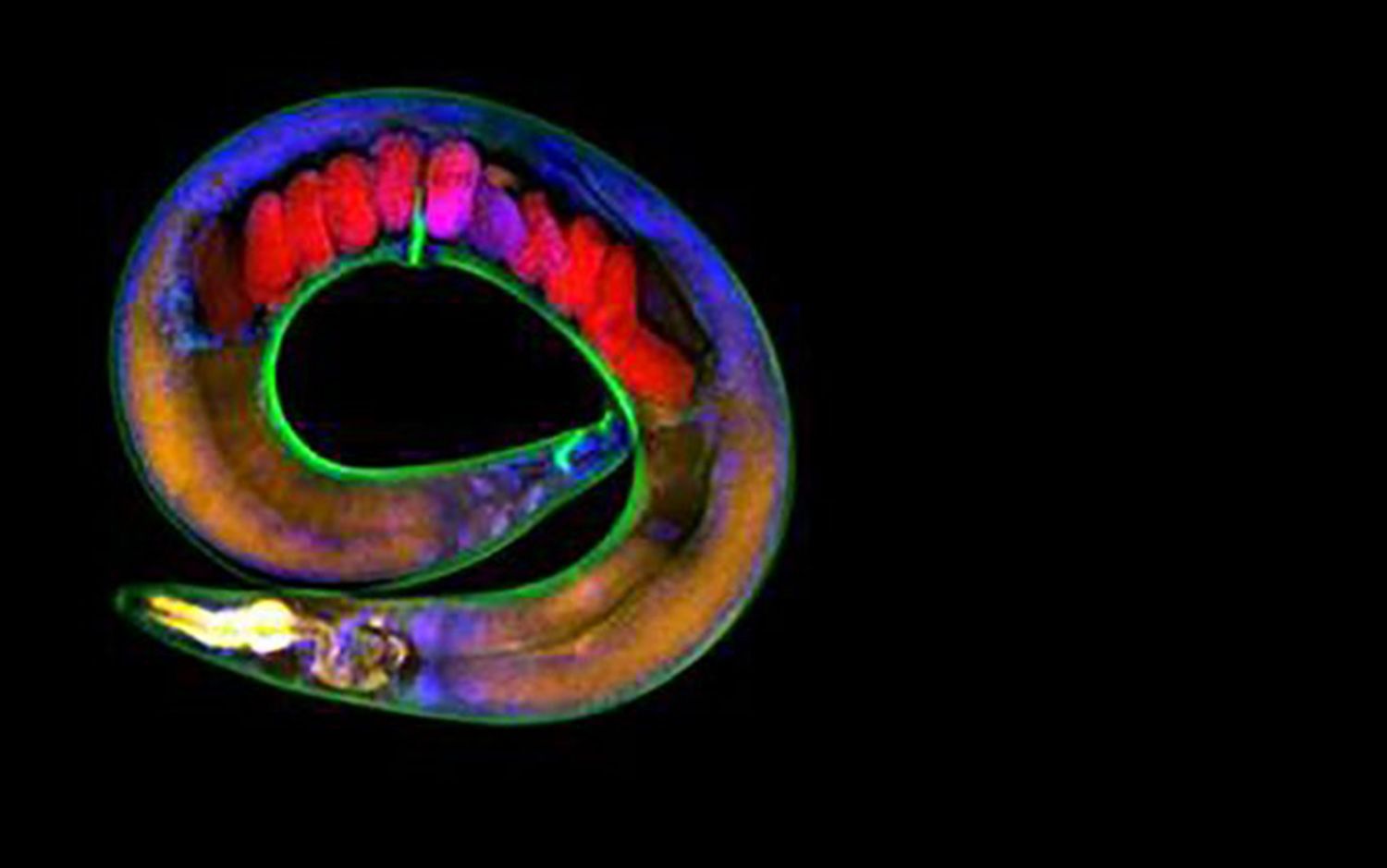
Cognition did not appear out of nowhere in ‘higher’ animals but goes back millions, perhaps billions, of years Caenorhabditis elegans, a small-brained worm, challenges big-brained scientists’ ideas about how cognition works. Photo by Adam Klosin/CRG

Pamela Lyon is an interdisciplinary visiting research fellow at the Southgate Institute for Health, Society and Equity, College of Medicine and Public Health, Flinders University in Adelaide. She is currently writing a book based on the ideas in this essay.

Edited by Sally Davies

21 October 2021

Love Aeon?

Support our work DONATE

In On the Origin of Species (1859), Charles Darwin draws a picture of the long sweep of evolution, from the beginning of life, playing out along two fundamental axes: physical and mental. Body and mind. All living beings, not just some, evolve by natural selection in both ‘corporeal and mental endowments’, he writes. When psychology has accepted this view of nature, Darwin predicts, the science of mind ‘will be based on a new foundation’, the necessarily gradual evolutionary development ‘of each mental power and capacity’.

Darwin guessed that life arose from a single ancestral ‘form’, presumed to be single-celled. Soon, scientists in Germany, France and the United States began investigating microscopic organisms for evidence of ‘mental faculties’ (perception, memory, decision-making, learning). All three groups were headed by men destined for eminence. Two of them – Alfred Binet, the psychologist who devised the first practical intelligence test, and Herbert Spencer Jennings, who laid the foundations of mathematical genetics – were persuaded by their research that Darwin was right: behaviour even in microbes suggests that mental as well as physical evolution exists. Max Verworn, a giant of German physiology, was unconvinced.

Thus kicked off a heated debate about the continuity of mental evolution, the idea that what in humans is called ‘mind’ and in other animals is usually called ‘cognition’ developed and changed over millions of years (billions, actually). That debate continues to this day. The rise of behaviourism in the early 1900s, which privileged observable behaviour as the only admissible scientific data, curtailed discussion by taking talk about minds off the table for decades. When the ‘cognitive revolution’ launched mid-century, discontinuity was firmly established. The consensus was that, at some point in evolution (and we might never know when), cognition – poof! – somehow appears in some animals. Before that, behaviour – the only indicator of cognition available without language – would have been entirely innate, machine-like, reflexive. It might have looked cognitively driven but wasn’t. This remains the dominant view, almost entirely on the grounds of its ‘intuitive’ plausibility based on commonsense understanding.

The philosopher Daniel Dennett, among the earliest cognitive philosophers to invoke evolution, dubbed natural selection ‘Darwin’s dangerous idea’ because it showed that the appearance of design in nature requires no designer, divine or otherwise. Like most of his colleagues, philosophical and scientific, Dennett didn’t buy the continuity of mental evolution. However, my view is that this neglected insight of Darwin’s was his most radical idea, one with the potential to induce a full-blown Copernican revolution in the cognitive sciences and to transform the way we see the world and our place in it.

The Copernican revolution turned on a single shift in perspective. For 1,400 years, European scholars agreed with ordinary folk that Earth is the still point around which the heavens revolve. The Ptolemaic model of the cosmos had set the Sun, Moon, stars and planets moving in nested crystalline spheres around Earth. In 1543 Nicolaus Copernicus published a detailed alternative that replaced Earth with the Sun. By setting it in motion around the Sun with other celestial ‘wanderers’, our planet was dethroned as the cosmic centre, and modern astronomy was born.

Similarly, Darwin’s radical idea dethrones human and other brains from their ‘intuitively obvious’ position at the centre of the (Western) cognitive universe. In their place, Darwin sets an evolving, cognising being struggling to survive, thrive and reproduce in predictably and unpredictably changing conditions. This single shift of perspective – from a brain-centred focus, where Homo sapiens is the benchmark, to the facts of biology and ecology – has profound implications. The payoff is a more accurate and productive account of an inescapable natural phenomenon critical to understanding how we became – and what it means to be – human.

What is cognition? Like many mental concepts, the term has no consensus definition, a fact that infuriated William James 130 years ago and occasional others since. This is my definition: Cognition comprises the means by which organisms become familiar with, value, exploit and evade features of their surroundings in order to survive, thrive and reproduce. Here is how I came to it.

As a PhD student in Asian Studies 21 years ago, my research focused on four Buddhist propositions that I aimed to subject to forensic Western philosophical and scientific analysis. Implicit in these propositions is a highly sophisticated Buddhist view of mind: what it is, how it works, what it does under benighted conditions, what it can do with training and practice. I looked for a Western comparator in what was then called cognitive science (in the singular) and found… nothing.

Four cartons of books and a laptop full of articles later, I had a collection of loose, dissonant ideas, and related streams of argument, none of which provided purchase on the experience of having a mind or its role in behaviour. As the neurobiologist Steven Rose observed in 1998 (and nothing much has changed), neuroscience had generated oceans of data but no theory to make sense of them. At the dawn of the 21st century, this struck me as outrageous. It still does.

Cognitive science was then ruled by three (decades-old) reference frames that provided the foundation of the ‘cognitivist’ paradigm: 1) the human brain; 2) a belief that the brain is a computing machine; and 3) the idea that ‘cognition is computation over representations’. The latter tenet doggedly resists easy explanation because the central concepts introduced fresh ambiguities into the field (as if any more were needed). Roughly, it boils down to this: there are identifiable things in the brain that ‘stand in’ for aspects of the world, much how words do in sentences. These bits of information are ‘processed’ according to algorithms yet to be discovered. This is what we call thinking, planning, decision-making, and so on. No mental activity exists over and above the processing of representations; cognition just is this processing.

Evolution had laid a foundation of capacities considered cognitive well before nervous systems appeared

Biology and evolution, which I assumed must be of utmost importance, were largely absent; so were physiology, emotion and motivation. Researchers who believed the study of animal behaviour had something useful to offer cognitive science were just beginning to publish in the field and were not warmly welcomed. ‘Embodied’ and ‘situated’ cognition were gaining traction but were then more an acknowledgement of the bleeding obvious than a coherent framework. Without criteria for identification, attributions of biological cognition were all over the taxonomic shop.

I still needed a comparator, however. I decided to investigate whether biology held the answers I assumed it must. I opted to start at the rootstock of the tree of life – bacteria – to see if anything conceivably cognitive was going on; 20 years on, I am still mining this rich seam.

My first theoretical guides, recommended by an unconventional Australian biologist, were the zoologist Jakob von Uexküll and the neuroscientist Humberto Maturana. Von Uexküll’s Umwelt concept (popularised in English in 1934) made me appreciate the particularity of the world constructed by an organism’s unique complement of senses and the value the organism imputes to elements of that construction, evolved in dependence upon how the organism makes a living. Elevated carbon dioxide is an attractant for a mosquito seeking a blood meal, but induces transient breathlessness, dizziness and minor anxiety in many people (as the COVID-19 experience with masking has shown). Maturana’s Biology of Cognition (1970) made me realise just how weird the living state is compared with any other physical system on Earth.

As Maturana sees it, life is self-producing, not merely self-organising or self-maintaining. If an Airbus A380 performed the same feat, it could seek out, take in and transform into fuel sources of matter and energy from its surroundings and manufacture the components that enable it to function (taxi, take off, fly, maintain a stable inner environment, touch down) while in flight. And that’s saying nothing about reproduction. Maturana’s account of cognition focuses on the organism’s need to interact continually with its surroundings to accomplish this amazing feat. This ‘domain of interactions’ between organism and environment is cognition for Maturana, such that ‘living as a process is a process of cognition’ (author’s italics), a claim I have confirmed in bacteria to my satisfaction.

Cognitivism effectively requires cognition-as-the-domain-of-interactions to arise not earlier than the origin of brains, and very likely long afterward. In Maturana’s view (and he was a neuroscientist), the cognitive domain of interactions arose with single-celled life. Neural structures added complexity, in both cognitive organism and exploitable environment, but didn’t generate cognition as such. Evidence for Maturana’s view grows daily.

Basal cognition – the study of cognitive capacities in non-neural and simple neural organisms (to which my PhD research led) – is in its infancy as a field. However, evidence already shows that evolution had laid a solid foundation of capacities typically considered cognitive well before nervous systems appeared: about 500-650 million years ago. Perception, memory, valence, learning, decision-making, anticipation, communication – all once thought the preserve of humankind – are found in a wide variety of living things, including bacteria, unicellular eukaryotes, plants, fungi, non-neuronal animals, and animals with simple nervous systems and brains.

No amount of positive evidence for basal cognition will persuade a diehard neurocentric, however. (What do you mean by memory, valence, decision-making? Isn’t it a matter of definition?) Darwin’s radical idea must solve problems that cognitivism cannot. The Copernican model didn’t become a revolution until the Ptolemaic model confronted findings it couldn’t predict or explain, but the heliocentric model could. This required Tycho Brahe’s meticulous, comprehensive astronomical observations, Johannes Kepler’s laws of planetary motion, Galileo Galilei’s theorising based on optically improved observations, and Isaac Newton’s law of gravitation, which built on the previous work (‘the shoulders of giants’). It took time: 144 years.

Darwin’s thesis of the continuity of mental evolution is older than that but lies much closer to the bone of human identity. After all, ‘wise’ is in our Latin species designation (the ‘sapiens’ in H sapiens). Possession of an intelligent, rational mind is supposed to be humankind’s defining characteristic. Accepting a Sun-centred cosmos is as nothing compared with accepting a life-centred psychology. We might not have a choice, however.

Cognitive neuroscience currently faces several challenges that must be overcome to understand how brains and nervous systems work, a prerequisite to understanding how cognitive capacities are generated by such systems. Three are sketched below. What seems needed in all three cases are simpler model systems, from which it’s more likely that fundamental discoveries about the drivers of organisms’ interactions with their surroundings will be made. Such discoveries might lead to general principles that can be tested in more complex organisms.

The first challenge to neuroscience relates to the ‘functional unit’ of the brain or nervous system. For more than a century, the single nerve cell has served as the structural and functional unit of brain activity. Pioneers of cognitive science enlisted the neuron doctrine as the foundation of the brain’s putative computational capacities. Each neuron was conceived as an on-off switch presumed capable of acting as a logic gate, enabling information to be ‘digitised’ (turned into ones or zeros) and thereby ‘encoded’. Single neurons were assumed to perform complex encoding tasks, including for places, faces and locations in space; a Nobel Prize was awarded on this basis.

Microbes can illuminate cognitive mechanisms ordinarily associated with complex animals

Two findings have put pressure on this account. First is the number of different types of cells in the human brain. A recent study revealed no fewer than 75 different cell types: 24 excitatory types, 45 inhibitory types and six non-neuronal types. What they all do and how they interact are poorly understood. Second, it’s now clear that populations of neurons – acting in ensembles, networks and/or circuits – are the most likely units of functional activity. Defining a neural ensemble, network and/or circuit is non-trivial, however; so is understanding how they form and interact, how stable they are over time, how and whether they’re nested in hierarchies, and how they generate behaviour. All are still major works in progress.

Understanding how neural circuits form and function requires an organism behaving as a whole system. This is why the neuroscientist Rafael Yuste introduced Hydra vulgaris, a freshwater animal with the simplest known nervous system, as a model for studying neural circuits. The decision has paid off handsomely. Hydra’s entire nerve net has been imaged simultaneously – on video – as the microscopic animal stretches out its tentacles to capture food and contracts into a ball, enabling correlation of different neural circuits with different behaviours. Thanks to Hydra’s regenerative capacities, the step-by-step sequence from neuronal growth to whole-body integration of multiple neural networks has now been identified in animals regrown from separated cells. The ecological significance of Hydra behaviour is still poorly understood, however, and much work to understand what certain behaviour is for (for the organism) remains to be done. This should help further illuminate the dynamic (bio)logic of neural activity.

While the idea of shifting collectives of cells whose coordinated activity both requires, and might constitute, cognition doesn’t easily square with the cognitivist tenet of ‘computation over representations’, support is widespread in biology. Complex behaviours coordinated by thousands of interacting, autonomous cells are well studied in bacteria (eg, Bacillus subtilis, Myxococcus xanthus) and social amoeba (Dictyostelium discoideum). The discovery in B subtilis of colonies of long-distance electrical signalling via ion channels – the mechanism of electrical transmission in neurons – provided ‘proof of concept’ that microbes can illuminate cognitive mechanisms ordinarily associated with complex animals. This finding led to further discoveries of previously unknown collective bacterial behaviours that resemble some types of cognitive brain activity, including memory. Studies of bacterial behaviour mediated by electrical signalling are just beginning.

Network activity among bacterial signal transduction proteins was first described 25 years ago. Today, the network properties of large arrays of signalling proteins, common in bacteria that rely on whip-like flagella to navigate chemical gradients (chemotaxis), are an active area of research. Highly conserved over the course of evolution, this architecture has been compared only slightly tongue-in-cheek to a ‘nanobrain’, because it functions as a network, is capable of processing large amounts of information, is exquisitely sensitive to tiny changes in environmental conditions, and is positioned at the leading pole of the cell, akin to the cell’s ‘head’ but one that shifts position as the cell changes direction.

These arrays might be processing more information than imagined. Escherichia coli recently were found to reject the bacterial equivalent of junk food due to sluggish growth. Chemotaxis, movement toward or away from some states of affairs, is one of E coli’s most energetically costly behaviours; it should be puzzling that bacteria will leave available food (the proverbial bird in the hand) and continue foraging for better nutrition elsewhere – except that the strategy often works. Caenorhabditis elegans, a small-brained worm, does this, too. If it has fed on high-quality food in the past, the tiny worm will leave poor-quality food in anticipation of finding something better. This discovery was a stunner at the time because such behaviour was assumed to require a ‘higher-order’ decision-making capacity.

The second challenge to neuroscience arrived when a heroic scientific success disclosed a ‘surprising failure’. The wiring diagram of the C elegans brain, a project started in cognitivism’s heyday, was completed. Connections between the worm’s 302 neurons were mapped, and behaviours associated with most cell types defined. Yet this stunning achievement revealed little about how and why a worm behaves the way it does – the aim of the research. According to the neuroscientist Cori Bargmann, C elegans studies ‘suggest that it will not be possible to read a [neural] wiring diagram as if it were a set of instructions’ for behaviour. This is for two main reasons.

First, behaviour under more ecologically realistic conditions violated key assumptions about the causal relation between activity in particular neurons (eg, sensory, motor, integrative) and certain behaviours (forward and reverse locomotion, feeding) derived from genetic knock-out studies. On the contrary, a single behaviour might be induced by several different neural circuits. Moreover, one circuit’s starting point might result in different – even opposing – behaviours in different circumstances. In short, a single wiring diagram represented more potential behaviour than originally assumed.

The default mode network is not the only spontaneous oscillation in the brain

Second, context and the organism’s internal state proved much more important to behaviour than initially thought. Context and internal state are believed to be signalled by molecules – neuromodulators and their smaller cousins, neuropeptides – although precisely how is unclear. These signalling molecules, many of which are produced by neurons themselves, can alter neural function from seconds to minutes to hours; interact with different targets (other neurons, muscle cells, glands); and activate or silence entire circuits. C elegans produces more than 100 such molecules.

In bacteria and unicellular eukaryotes (cells with a defined nucleus, which bacteria lack), coordinated activity involving thousands of individuals – the equivalent of multicellular behaviour – is also facilitated by signalling molecules, a phenomenon called quorum sensing. Quorum sensing molecules have been compared to hormones because they alter behaviour by similar mechanisms. As hormones do in animals and plants – and the activity of neuromodulators and neuropeptides is not dissimilar – signalling molecules produced by microbial cells induce changes in behaviour in four ways: 1) in the producing cell; 2) in an immediate neighbour via cell-cell contact; 3) within cell neighbourhoods; and 4) in cells at longer distances. Many unicellular signalling molecules exist but far fewer than in multicellular organisms.

The third challenge to neuroscience wasn’t a paradigm misfire; it came from left-field. Cognitive processes were traditionally conceived as entirely reactive: something in the world affects the organism (input), resulting in a response (output). The input-output view is basic to cognitivism. Discovery in the late 1990s of spontaneous, ongoing brain activity without an external stimulus thus was initially thought to be an artefact of imaging technology, then deeply puzzling, and now is a major research field. The default mode network is defined as functionally connected brain regions that are active during wakeful rest and inactive during task-oriented behaviour. Chimpanzees and mice exhibit default mode activity. In humans, default network disturbance is associated with psychiatric disorders. This means it’s important to cognitive functioning.

The default mode network is not the only spontaneous oscillation in the brain, far from it. The neuroscientist György Buzsáki, who has worked hard to draw attention to the ‘rhythms of the brain’, claims that this kind of brain activity is not system noise but ‘is actually the source of our cognitive abilities’ and might be the brain’s ‘fundamental organiser of neuronal information’. Spontaneous low-frequency oscillations have been detected in Hydra but also in a wide variety of organisms, including plants, single-celled eukaryotes and bacteria, as well as in diverse animals. If such oscillations are central organisers of living activity – hypothesised by Alison Hanson, a medical resident in Yuste’s lab – clearly neurons aren’t necessary to generate them.

Oscillations are produced by ion channels in cellular membranes found across the tree of life. Michael Levin’s lab has shown that ion channel-generated bioelectricity plays a key role in ‘pattern memory’ for regenerating animal bodies. Headless planaria regenerate brains, tadpoles regrow tails, adult frogs regrow functional hindlimbs (if induced), and electrical stimulation can make things grow where they shouldn’t – for example, a second worm head where a tail should be. For Levin, pragmatic acceptance that even cells in tissues inherit some of the decision-making capacities of their unicellular forebears – what he calls ‘the cognitive lens’ – could transform fields as different as developmental biology, immunology, neuroscience, bioengineering and artificial intelligence.

What is needed is a shift in perspective. In The Brain from Inside Out (2019), Buzsáki argues that many of the seemingly intractable problems that neuroscience faces arise entirely from ‘human-constructed ideas’ about how the mind/brain must work, based on philosophical and scientific conjecture over millennia, which are then shoe-horned on to observed brain activity. This is what he calls the ‘outside-in’ perspective: ‘the dominant framework of mainstream neuroscience, which suggests that the brain’s task is to perceive and represent the world, process information, and decide how to respond … in an “outside-in” manner’. This is what Maturana calls ‘observer dependence’, from the observer’s point of view, not the observed system’s. The spontaneously active brain has its own logic, of which almost nothing is understood. Deciphering this logic from the perspective of the system generating the activity – from ‘inside-out’ – should be the primary goal of neuroscience, Buzsáki argues, not mapping human assumptions on to neuronal observations.

I made a similar distinction 15 years ago. I called the view of cognition grounded in ideas originating in human experience and reflection the anthropogenic (human-born) approach, what Buzsáki calls ‘outside-in’. Although cognitivism asserts that cognition can be realised in different physical forms (including robots), the approach remains anthropogenic because it derives from the human capacity to compute numbers. The contrast case is what I call the biogenic (life-born) approach, which privileges the biological mode of existence as the source of cognition and entails the ‘inside-out’ view.

If understanding human cognition is the goal, then a biogenic/inside-out approach is the most promising path to take us beyond this geriatric shuffle on a road to nowhere. Given the massive investment of public and private funds, to say nothing of human ingenuity, time and effort over the past 70 years, we should by now know so much more about what cognition is, what it’s for, and how it works – theories of these things, not simply data derived from brain activity. Think of how society has transformed since the 1950s. How many dogmas have crashed and burned? How much has been learned in so many fields?

We can see ourselves – with scientific justification – in a daffodil, an earthworm, even a bacterium

The Human Genome Project was supposed to yield a genetic ‘blueprint’. Instead, when the first draft was published 21 years ago, we learned how much we didn’t know. For example, there is too much so-called ‘junk DNA’ for it actually to be junk; human beings share a surprising proportion of genes with plants; and our genome carries genes transferred by single-celled organisms. As whole genomes increasingly began to be compared, we discovered that among the genes shared with plants were some involved in the central nervous systems of animals, including us. Also, a system among the most critical to human survival – immune defence mechanisms operating autonomously at the level of individual cells – was inherited from bacteria or its sister kingdom, archaea, possibly billions of years ago. What’s this got to do with cognition? Well, it turns out that normal functioning of memory and learning depends on the interaction with neurons of immune-stimulating elements (cytokines). A. Real. Surprise. In the 1950s (and later), the brain was considered ‘immune privileged’; the immune system couldn’t operate there.

Yet we still don’t have a good grip on the fundamentals of cognition: how the senses work together to construct a world; how and where memories are stored long term, whether and how they remain stable, and how retrieval changes them; how decisions are made, and bodily action marshalled; and how valence is assessed.

Valence is the value an organism imputes to circumstances within itself and/or its surroundings as advantageous, threatening or neutral. The core role of valence in emotions is well established. Consensus is now forming that human emotions are fundamentally involved in the body’s regulation of its basic functioning. For nearly 50 years, we’ve known that bacteria migrate toward certain substances (advantage) and seek to evade other circumstances (harm). Could understanding the mechanisms of valenced bacterial behaviour shed any light on how emotions generate behaviour in more complex organisms? We’ll never know unless we look.

At the end of Origin, Darwin describes a ‘tangled bank’ where the laws of natural selection play out in the evolution and current behaviour of plants and animals that appear so different from one another as to be utterly unrelated, but are not, and which depend upon one another for life. At a deep level, Darwin suggests, all living things are related. We know that now in ways Darwin could only imagine, because we have incomparably more sophisticated tools and a far richer understanding of how evolution works that includes developmental plasticity, epigenetics and whole-genome change, which provides – in addition to mutations of single genes – heritable variation for natural selection to act upon.

‘There is grandeur in this view of life,’ Darwin writes, and he is correct. We can now see ourselves – with scientific justification and with no need for mystical overlay or anthropomorphism – in a daffodil, an earthworm, perhaps even a bacterium, as well as a chimpanzee. We share common origins. We share genes. We share many of the mechanisms by which we become familiar with and value the worlds that our senses make. We are all struggling for existence, each in our own way, dependent on one another, striving to survive, to thrive and (for some) to reproduce, on this planet we share – which is not the centre of the Universe, or even the solar system, but is the only home any one of us has.

Just as we have come to think of our bodies as evolved from simpler forms of body, it is time to embrace Darwin’s radical idea that our minds, too, are evolved from much simpler minds. Body and mind evolved together and will continue to do so.

This Essay was made possible through the support of a grant to Aeon+Psyche from the John Templeton Foundation. The opinions expressed in this publication are those of the author and do not necessarily reflect the views of the Foundation. Funders to Aeon+Psyche are not involved in editorial decision-making.
Cognition and intelligence

Jeffrey Mishlove on the Holocaust

Seekers of Unity Trailblazer in the extra-ordinary, cartographer of the unknown, Jeffery Mishlove is a clinical psychologist, host and producer of Thinking Allowed and New Thinking Allowed. Jeffery studied the psychology of religious mysticism, and completed a PhD in Parapsychology, the only ever awarded by an accredited University (Berkley 1980), published later as Psi Development Systems. He is the author of The Roots of Consciousness and The PK Man. Over the past few decades Jeffery has been a pioneer of innerfaith dialogue and has had the great distinction of interviewing many of characters who have shaped our current world of Mysticism, Religion, Philosophy and Psychology, with the likes of Colin Wilson, David Chalmers, Huston Smith, Irvin Yalom, John Searle, Oliver Sacks, Rabbi Zalman Schachter-Shalomi, Jean Houston, Ram Dass, Robert Anton Wilson, Rollo May, Rupert Sheldrake, Stanislav Grof, Steven Pinker, Terence McKenna, U. G. Krishnamurti and Whitley Strieber, just to name a few. In this lit conversation Jeffrey shares his story with us, tells of his falling in and out of religion, we discuss his most memorable interviews, mystic vs psychic, particularism vs universalism, initiating yourself, being true to ourselves in religion and how to create meaning. We farbreng about the broken tablets and the trees of Eden, we cry, laugh, smile and sing in an adventure of human connection. Join us. Timestamps: 00:00 Excerpt 01:38 Intro to Jeffrey 04:35 Jeffrey’s Story, in his own words 37:08 Finding/Creating Meaning in a Deconstructed World 39:50 Making Oneness real in our lives | Innerfairth Dialogue 43:59 Do we need to practice one tradition? Particularism vs Universalism 48:43 Did Judaism take a wrong turn with Moses? 50:49 Living between Exile/Samsara and Redemption/Enlightenment: Broken tablets and whole tables, tree of knowledge and tree of life 54:08 Mysticism vs Psychic phenomenon? and What is a Mysticism? 56:18 Jeffrey’s favorite interview? 57:56 Conclusion and Upcoming Projects “We live in an era where the spiritual tradition of the world are everybody inheritance” – Jeffery Mishlove New/ Thinking Allowed: channel: https://www.youtube.com/newthinkingal… videos: https://newthinkingallowed.com/Listin…. website: http://www.newthinkingallowed.org. facebook: https://www.facebook.com/newthinkinga… twitter:: https://twitter.com/newthinkallowed instagram: https://www.instagram.com/jeffreymish… linkedIn: https://www.linkedin.com/groups/13860… podcast: https://itunes.apple.com/us/podcast/n… Seekers: facebook: https://facebook.com/seekersofunity instagram: https://instagram.com/seekersofunity twitter: https://www.twitter.com/SeekersofU podcast: https://anchor.fm/seekersofunity website: https://www.seekersofunity.com

Word-Built World: insufflation

insufflation

noun

in·​suf·​fla·​tion | \ ˌin(t)-sə-ˈflā-shən  , in-ˌsə-ˈflā- \

Definition of insufflation

an act or the action of blowing on, into, or in: such asaa Christian ceremonial rite of exorcism performed by breathing on a personbmedicine the act of blowing something (such as a drug in powdered form) into a body cavityspecificallythe introduction of a flow of gas into a body cavityabdominal insufflation with carbon dioxide

Other Words from insufflation

insufflate \ ˈin(t)-​sə-​ˌflāt  , in-​ˈsə-​ˌflāt \ transitive verbinsufflator \ ˈin(t)-​sə-​ˌflā-​tər  \ noun

First Known Use of insufflation

15th century, in the meaning defined above

History and Etymology for insufflation

Middle English insufflacion, from Late Latin insufflation-, insufflatio, from insufflare to blow upon, from Latin in- + sufflare to inflate, from sub- + flare to blow — more at BLOW

(merriam-webster.com)

Bio: Daniel O’Connell

From Wikipedia, the free encyclopedia

Daniel O’Connell
Dónall Ó Conaill
Daniel O’Connell, in an 1836 watercolour by Bernard Mulrenin
Member of Parliament
for Clare
In office
5 July 1828 – 29 July 1830
Preceded byWilliam Vesey-FitzGerald
Succeeded byWilliam Macnamara
Member of Parliament
for Dublin City
In office
5 August 1837 – 10 July 1841
Preceded byGeorge Hamilton
Succeeded byJohn West
In office
22 December 1832 – 16 May 1836
Preceded bySir Frederick Shaw
Succeeded byGeorge Hamilton
Lord Mayor of Dublin
In office
1841–1842
Preceded bySir John James, 1st Bt
Succeeded byGeorge Roe
Member of Parliament
for Cork County
In office
15 July 1841 – 2 July 1847
Preceded byGarrett Standish Barry
Succeeded byEdmund Burke Roche
Personal details
Born6 August 1776
CahersiveenCounty KerryIreland
Died15 May 1847 (aged 71)
GenoaKingdom of Sardinia
Resting placeGlasnevin Cemetery, Dublin
Political partyRadicalsRepeal Association
Spouse(s)Mary O’Connell (m. 1802)
ChildrenMauriceEllenCatherineTimothyElizabethJohnMorganDaniel
Alma materLincoln’s Inn
King’s Inns
OccupationBarrister, political activist, politician
Signature
Military service
Allegiance Kingdom of Ireland
Branch/serviceYeomanry
Years of service1797
UnitLawyer’s Artillery Corps

Daniel O’Connell (IrishDónall Ó Conaill; 6 August 1775 – 15 May 1847), hailed in his time as The Liberator,[1] was the acknowledged political leader of Ireland’s Roman Catholic majority in the first half of the 19th century. His mobilisation of Catholic Ireland through to the poorest class of tenant farmer helped secure Catholic emancipation in 1829 and allowed him to take a seat in the United Kingdom Parliament to which he had twice been elected. At Westminster O’Connell championed liberal and reform causes (he was renowned internationally as an abolitionist) but failed in his declared objective for Ireland: the restoration of a separate Irish Parliament through repeal of the 1800 Acts of Union. Against the background of a growing agrarian crisis and, in his final years, of the Great Irish Famine, O’Connell contended with dissension at home. Criticism of his political compromises and system of patronage led to a split in the national movement he had singularly led.

Early and professional life

Kerry and France

O’Connell was born at Carhan near CahersiveenCounty Kerry, to the O’Connells of Derrynane, a wealthy Roman Catholic family that, under the Penal Laws, had been able to retain land only through the medium of Protestant trustees and the forbearance of their Protestant neighbours.[2] His parents were Morgan O’Connell and Catherine O’Mullane. The poet Eibhlín Dubh Ní Chonaill was an aunt; and Daniel Charles, Count O’Connell, an Irish Brigade officer in the service of the King of France (and twelve years a prisoner of Napoleon), an uncle. O’Connell grew up in Derrynane House, the household of his bachelor uncle, Maurice “Hunting Cap” O’Connell (landowner, smuggler and justice of the peace) who made the young O’Connell his heir presumptive

In 1791, under his uncle’s patronage, O’Connell and his elder brother Maurice were sent to continue their schooling in France. Revolutionary upheaval and their mob denunciation as “young priests” and “little aristocrats”, persuaded them in January 1793 to flee their Jesuit college at Douai. They crossed the English Channel with the brothers and United IrishmenJohn and Henry Sheares who displayed a handkerchief soaked, they claimed, in the blood of Louis XVI, the late executed king.[3] The experience is said to have left O’Connell with a lifelong aversion to mob rule and violence.[4]

1798 and Legal Practice

After further legal studies in London, including a pupillage at Lincoln’s Inn, O’Connell returned to Ireland in 1795. Henry Grattan‘s third Catholic Relief Act in 1793, while maintaining the Oath of Supremacy that excluded Catholics from parliament, had granted them the vote on the same terms as Protestants and removed most of the remaining barriers to their professional advancement. O’Connell, nonetheless, remained of the opinion that in Ireland the whole policy of the Irish Parliament and of the London-appointed Dublin Castle executive, was to repress the people and to maintain the ascendancy of a privileged and corrupt minority.[5]

On 19 May 1798, O’Connell was called to the Irish Bar. Four days later, the United Irishmen staged their ill-fated rebellion. Toward the end of his life O’Connell claimed to have been a United Irishman. Asked how that could be reconciled with his membership of the government’s volunteer Yeomanry (the Lawyers Artillery Corps), he replied that in ’98 “the popular party was so completely crushed that the only chance of doing any good for the people was by affecting ultra loyalty.”[6]

O’Connell appeared to have had little faith in the United Irish conspiracy or in their hopes of French intervention. He sat out the rebellion in his native Kerry. When in 1803 Robert Emmet faced execution for attempting an insurrection in Dublin he was condemned by O’Connell: as the cause of so much bloodshed Emmett had forfeited any claim to “compassion”.[7]

In the decades that followed, O’Connell practised private law and, although invariably in debt, reputedly had the largest income of any Irish barrister. In court he sought to prevail by refusing deference, showing no compunction in studying and exploiting a judge’s personal and intellectual weaknesses. He was long ranked below less accomplished Queen’s Counsels, a status not open to Catholics until late in his career. But when offered he refused the senior judicial position of Master of the Rolls.[8][9]

Family

In 1802 O’Connell married his third cousin, Mary O’Connell. He did so in defiance of his benefactor, his uncle Maurice, who believed his nephew should have sought out an heiress.[10] They had four daughters (three surviving), Ellen (1805-1883), Catherine (1808-1891), Elizabeth (1810-1883), and Rickarda (1815-1817) and four sons. Maurice (1803), Morgan (1804), John (1810), and Daniel (1816), all of whom were all to join their father as Members of Parliament. Despite O’Connell’s early infidelities,[11] the marriage was happy and Mary’s death in 1837 was a blow from which her husband is said never to have recovered.[12]

Political beliefs

1834 portrait of Daniel O’Connell by George Hayter

Church and state

O’Connell’s personal principles reflected the influences of the Enlightenment and of radical and democratic thinkers some of whom he had encountered in London and in masonic lodges. He was greatly influenced by William Godwin‘s Enquiry Concerning Political Justice (public opinion the root of all power, civil liberty and equality the bedrock of social stability),[13] and was, for a period, converted to Deism by his reading of Thomas Paine‘s The Age of Reason.[14] O’Connell from the 1820s has been described as an “English rationalist utilitarian“,[15] a “Benthamite”.[16] For a time Jeremy Bentham and O’Connell did become personal friends as well as political allies.[17]

At Westminster O’Connell played a major part in passage of the Reform Act of 1832 and in the abolition of Slavery (1833) (a cause in which he continued to campaign).[18] He welcomed the revolutions of 1830 in Belgium and France,[18] and advocated “a complete severance of the Church from the State”.[19] Such liberalism made all the more intolerable to O’Connell the charge that as “Papists” he and his co-religionists could not be trusted with the defence of constitutional liberties.

O’Connell protested that, while “sincerely Catholic”, he did not “receive” his politics “from Rome”.[20] In 1808 “friends of emancipation”, Henry Grattan among them, proposed that fears of Popery might be allayed if the Crown were accorded the same right exercised by continental monarchs, a veto on the confirmation of Catholic bishops. Even when, in 1814, the Curia itself (then in a silent alliance with Britain against Napoleon) proposed that bishops be “personally acceptable to the king”, O’Connell was unyielding in his opposition. Refusing any instruction from Rome as to “the manner of their emancipation”, O’Connell declared that Irish Catholics should be content to “remain for ever without emancipation” rather than allow the king and his ministers “to interfere” with the Pope’s appointment of their senior clergy.[20][21]

Church and nation

In his travels in Ireland in 1835, Alexis de Tocqueville remarked on the “unbelievable unity between the Irish clergy and the Catholic population.” The people looked to the clergy, and the clergy “rebuffed” by the “upper classes” (“Protestants and enemies”), had “turned all its attention to the lower classes; it has the same instincts, the same interests and the same passions as the people; [a] state of affairs altogether peculiar to Ireland”.[22] This is a unity, O’Connell argued, the bishops would have sacrificed had they agreed to Rome submitting their appointments for Crown approval. Licensed by the government they and their priests would have been as little regarded as the Anglican clergy of the Established Church.[23] For O’Connell this would have represented a strategic loss. In most districts of the country, the priest was the sole figure, with standing independent of the Protestant landlords and magistrates, around whom a national movement could be reliably built.[24][25] It would also have been to compromise the very conception of the Irish people as a nation.

Against the charge of political dictation from Rome, O’Connell insisted that the Catholic Church in Ireland “is a national Church”. At the same time, he openly declared that “if the people rally to me they will have a nation for that Church”.[26] For O’Connell Catholicism defined the nation for which he sought both a civil and political emancipation. The “positive and unmistakable” mark of distinction between Irish and English, according to O’Connell’s newspaper, the Pilot, was “the distinction created by religion”.[27]

Northern opposition

The Repealer Repulsed, Belfast 1841

Conscious of their minority position in Ulster, Catholic support for O’Connell in the north was “muted”. William CrollyBishop of Down and Connor and later Archbishop of Armagh, was ambivalent, anxious lest clerical support for Repeal disrupt his “carefully nurtured relationship with Belfast’s liberal Presbyterians”.[28]

O’Connell “treasured his few Protestant Repealers”. But to many of his contemporaries he appeared “ignorant” of the Protestant (largely Presbyterian) majority society of the north-east, Ulster, counties.[29][30] Here there was already premonition of future Partition. While protesting that its readers wished only to preserve the Union, in 1843 Belfast’s leading paper, the Northern Whig, proposed that if differences in “race” and “interests” argue for Ireland’s separation from Great Britain then “the Northern ‘aliens’, holders of ‘foreign heresies’ (as O’Connell says they are)” should have their own “distinct kingdom”, Belfast as its capital.[31]

O’Connell seemed implicitly to concede the separateness of the Protestant North. He spoke “invading” Ulster to rescue “our Persecuted Brethren in the North”. In the event, and in the face of the hostile crowds that disrupted his one foray to Belfast in 1841 (“the Repealer repulsed!”), he “tended to leave Ulster strictly alone”.[32] Perhaps persuaded by their presence through much of the south as but a thin layer of officials, landowners and their agents, O’Connell proposed Protestants had not the staying power of true “religionists”. Their ecclesiastical dissent (and not alone their unionism) was a function, he argued, of political privilege. To Dr Paul Cullen (the future Cardinal and Catholic Primate of Ireland) in Rome, O’Connell wrote:

The Protestants of Ireland… are political Protestants, that is, Protestants by reason of their participation in political power… If the Union were repealed and the exclusive system abolished, the great mass of the Protestant community would with little delay melt into the overwhelming majority of the Irish nation. Protestantism would not survive the Repeal ten years.[33]

(O’Connell’s view of the link between nation and faith is one that a number of Protestant Irish nationalists in converting to Catholicism may have embraced: Repealer and O’Connell’s mayoral secretary William O’Neill Daunt,[34] Home Ruler Joseph BiggarGaelic Leaguer William GibsonSinn Féiner William Stockley, and, on the day of his execution, Roger Casement).

Disavowal of violence

Consistent with the position he had taken publicly in relation to rebellions of 1798 and 1803, O’Connell focused upon parliamentary representation and popular, but peaceful, demonstration to induce change. “No political change”, he offered, “is worth the shedding of a single drop of human blood”.[35] His critics, however, were to see in his ability to mobilise the Irish masses an intimation of violence. It was a standing theme with O’Connell that if the British establishment did not reform the governance of Ireland, Irishmen would start to listen to the “counsels of violent men”.[35]

O’Connell insisted on his loyalty, greeting George IV effusively on his visit to Ireland in 1821. In contrast to his later successor Charles Stewart Parnell (although like O’Connell, himself a landlord), O’Connell was also consistent in his defence of property.[8] Yet he was willing to defend those accused of political crimes and of agrarian outrages. In his last notable court appearance, the Doneraile conspiracy trials of 1829, O’Connell saved several tenant Whiteboys from the gallows.

Abandonment of the Irish language

Irish was O’Connell’s mother tongue and that of the vast majority of the rural population. Yet he insisted on addressing his (typically open-air) meetings in English, sending interpreters out among the crowd to translate his words. At a time when “as a cultural or political concept ‘Gaelic Ireland’ found few advocates”, O’Connell declared:

I am sufficiently utilitarian not to regret [the] gradual abandonment [of Irish]… Although the language is associated with many recollections that twine round the hearts of Irishmen, yet the superior utility of the English tongue, as the medium of all modern communication is so great, that I can witness, without a sigh, the gradual disuse of Irish.[36]

O’Connell’s “indifference to the fate of the language”, a decade before the Famine, was consistent with the policies of the Catholic Church (which under Cullen was to develop a mission to the English-speaking world)[37] and of the government-funded National Schools. Together, these were to combine in the course of the century to accelerate the near complete conversion to English.[38]

There is no evidence to suggest that that O’Connell saw “the preservation or revival or any other aspect of ‘native culture’ (in the widest sense of the term) as essential to his political demands”.[36]

Emancipation and the agrarian crisis

The “Liberator”

Catholic Emancipation as a world upside down: held aloft, Daniel O’Connell promises whigs – symbol of Ascendancy rank and property – for “ye all.” (Isaac Cruikshank 1789-1856)

To broaden and intensify the campaign for emancipation, in 1823, O’Connell established Catholic Association. For a “Catholic rent” of a penny a month (typically paid through the local priest), this, for the first time, drew the labouring poor into a national movement. Their investment enabled O’Connell to mount “monster” rallies (crowds of over 100,000) that stayed the hands of authorities, and emboldened larger enfranchised tenants to vote for pro-Emancipation candidates in defiance of their landlords.[39]

The government moved to suppress the Association by a series of prosecutions, but with limited success. Already in 1822 O’Connell had manoeuvred his principal foe, the Attorney GeneralWilliam Saurin, into actions sufficiently intemperate to ensure his removal by the Lord Lieutenant.[40] His confrontation with Dublin Corporation, equally unbending in its defence of the “Protestant Constitution”, took a more tragic turn.

Outraged at O’Connell’s refusal to retract his description of the corporation as “beggarly”,[41] one of their number, John D’Esterre, challenged O’Connell to a duel. As an experienced duellist, there was some hope that D’Esterre, would dispose of a man considered “worse than a public nuisance”. In the event it was O’Connell who mortally wounded D’Esterre. Distressed by the killing, O’Connell offered to share his income with D’Esterre’s widow. She consented to a small allowance for her daughter, which O’Connell regularly paid for more than thirty years until his death.[5]

Some months later, O’Connell was engaged to fight a second duel with the Chief Secretary for IrelandRobert Peel, O’Connell’s repeated references to him as “Orange Peel” (“a man good for nothing except to be a champion for Orangeism“) being the occasion. Only O’Connell’s arrest in London en route to their rendezvous in Ostend prevented the encounter, and the affair went no further.[42] But in 1816, following his return to faithful Catholic observance, O’Connell made “a vow in heaven” never again to put himself in a position where he might shed blood.[43] In “expiation for the death d’Esterre”, he is said thereafter to have accepted the insults of men whom he refused to fight “with pride”.[44]

In 1828 O’Connell defeated a member of the British cabinet in a parliamentary by-election in County Clare. His triumph, as the first Catholic to be returned in a parliamentary election since 1688, made a clear issue of the Oath of Supremacy—the requirement that MPs acknowledge the King as “Supreme Governor” of the Church and thus forswear the Roman communion. Fearful of the widespread disturbances that might follow from continuing to insist on the letter of the oath, the government finally relented. With the Prime Minister, the Duke of Wellington, persuading the King, George IV, and the Home Secretary, Sir Robert Peel, engaging the Whig opposition, the Catholic Relief Act became law in 1829.[45] The act was not made retroactive so that O’Connell had to stand again for election. He was returned unopposed in July 1829.[46]

Such was O’Connell’s prestige as “the Liberator” that George IV reportedly complained that while “Wellington is the King of England”, O’Connell was “King of Ireland”, and he, himself, merely “the dean of Windsor.” Some of O’Connell younger lieutenants in the new struggle for Repeal—the “Young Irelanders“—were critical of the leader’s acclaim. Michael Doheny noted that the 1829 act had only been the latest in a succession of “relief” measures dating back to the Papists Act 1778. Honour was due rather to those who had “wrung from the reluctant spirit of a far darker time the right of living, of worship, of enjoying property, and exercising the franchise”.[47]

Tenant Disenfranchisement and the Tithe War

Entry to parliament had not come without a price. Bringing it into line with England, the 1829 Act raised the property threshold for voting in county seats five-fold, eliminating the middling tenantry (the Irish “forty-shilling freeholders“) who had risked much in defying their landlords on O’Connell’s behalf in the Clare election. The measure reduced the Irish Catholic electorate from 216,000 voters to just 37,000.[48]

Perhaps trying to rationalise the sacrifice of his freeholders, O’Connell wrote privately in March 1829 that the new ten-pound franchise might actually “give more power to Catholics by concentrating it in more reliable and less democratically dangerous hands”.[30] The Young Irelander John Mitchel believed that this was the intent: to detach propertied Catholics from the increasingly agitated rural masses.[49]

In a pattern that had been intensifying from the 1820s as landlords cleared land to meet the growing livestock demand from England,[50] tenants had been banding together to oppose evictions, and to attack tithe and process servers. De Tocqueville recorded these Whiteboys and Ribbonmen protesting:

The law does nothing for us. We must save ourselves. We have a little land which we need for ourselves and our families to live on, and they drive us out of it. To whom should we address ourselves?… Emancipation has done nothing for us. Mr. O’Connell and the rich Catholics go to Parliament. We die of starvation just the same.[51]

In 1830, discounting evidence that “unfeeling men had given in favour of cultivating sheep and cattle instead of human beings”, O’Connell had sought repeal of the Sub-Letting Act which facilitated the clearlings.[52] In a Letter to the People of Ireland, he also proposed a 20 percent tax on absentee landlords for poor relief, and the abolition of tithes[53] levied atop rents by the Anglican establishment—”the landlords’ Church”.

An initially peaceful campaign of non-payment of tithes turned violent in 1831 when the newly founded Irish Constabulary in lieu of payment began to seize property and conduct evictions. Although opposed to the use of force, O’Connell defended those detained in the so-called Tithe War. For all eleven accused in the death of fourteen constables in the Carrickshock incident, O’Connell helped secure acquittals. Yet fearful of embarrassing his Whig allies, in 1838 he rejected the call of the Protestant tenant-righter William Sharman Crawford for the complete elimination of the Church of Ireland levy. O’Connell accepted the Tithe Commutation Act.[54] This did effectively exempt the majority of cultivators—those who held land at will or from year to year—from the charge, while offering those still liable relief: a 25 percent reduction and a forgiveness of arrears.[55] On the other hand, it transferred the onus for its collection from the church minister to the landlord who had the authority to evict and a still unchecked freedom to appropriate any and all tenant surpluses through increased rent.

Campaign for repeal of the Union

The meaning of Repeal

O’Connell’s call for a repeal of the Act of Union, and for a restoration of the Kingdom of Ireland under the Constitution of 1782, which he linked (as he had with emancipation) to a multitude of popular grievances, may have been less a considered constitutional proposal than “an invitation to treat”.[56]

The legislative independence won by Grattan’s “Patriot Parliament” in 1782 had left executive power in the hands of London-appointed Dublin Castle administration. In declining to stand as a Repeal candidate, Thomas Moore (Ireland’s national bard)[57] objected that with a Catholic Parliament in Dublin, “which they would be sure to have out and out”, this would be an arrangement impossible to sustain. Separation from Great Britain was its “certain consequence”, so that Repeal was a practical policy only if (in the spirit of the United Irishmen) Catholics were again “joined by the dissenters”—the Presbyterians of the North.[58]

But for O’Connell, the historian R.F. Foster suggests that “the trick was never to define what the Repeal meant—or did not mean”. It was “emotional claim”, an “ideal”, with which “to force the British into offering something“.[59]

“Testing” the Union

O’Connell did prepare the ground for the “Home Rule” compromise negotiated between Irish-nationalists and British Liberals from the 1880s. He declared that while he would “never ask for or work” for anything less than an independent legislature, he would accept a “subordinate parliament” as “an instalment”.[60] But for the predecessors to Gladstone’s Liberals, Lord Melbourne’s Whigs, with whom O’Connell sought an accommodation in the 1830s, even an Irish legislature devolved within the United Kingdom was a step too far.

Having assisted Melbourne, through an informal understanding (the Lichfield House Compact), to a government majority, in 1835 O’Connell suggested he might be willing to give up the project of an Irish parliament altogether. He declared his willingness to “test” the Union:

The people of Ireland are ready to become a portion of the empire, provided they be made so in reality and not in name alone; they are ready to become a kind of West Britons if made so in benefits and in justice, but if not, we are Irishmen again.

Underscoring the qualifying clause—”if not we are Irishmen again”—historian J.C. Beckett proposes that the change was less that it may have appeared. Under the pressure of a choice between “effectual union or no union”, O’Connell was seeking to maximise the scope of shorter-term, interim, reforms.[61]

O’Connell failed to stall the application to Ireland of the new English Poor Law system of Workhouses, the prospect of which, as de Tocqueville found, was broadly dreaded in Ireland.[62] As an alternative to outdoor relief, the Workhouses made it easier for landlords to clear their estates in favour of larger English-export oriented farms.[61] But as regards the general conduct of the Dublin Castle administration under the Whigs, Beckett concludes that “O’Connell had reason to be satisfied, and “the more so as his influence carried great weight in the making of appointments”. Reforms opened the police and judiciary to greater Catholic recruitment, and measures were taken to reduce the provocations and influence of the pro-Ascendancy Orange Order.[61]

In 1840 municipal government was reconstructed on the basis of a rate-payer franchise. In 1841, O’Connell became the first Roman Catholic Lord Mayor of Dublin since the reign of James II. In breaking the Protestant monopoly of corporate rights, he was confident that town councils would become a “school for teaching the science of peaceful political agitation”.[52] But the measure was less liberal than municipal reform in England, and left the majority of population to continue under the landlord-controlled Grand Jury system of county government. In view of Thomas Francis Meagher, in return for damping down Repeal agitation, a “corrupt gang of politicians who fawned on O’Connell” were being allowed an extensive system of political patronage.[63] The Irish people were being “purchased back into factious vassalage.”[64]

In 1842 all eighteen of O’Connell’s parliamentary “tail” at Westminster voted in favour of the Chartist petition which, along with its radical democratic demands, included Repeal.[65] But the Chartists in England, and in their much smaller number in Ireland, were also to accuse O’Connell of being unreliable and opportunistic in his drive to secure Whig favour.[66]

Continue reading Bio: Daniel O’Connell

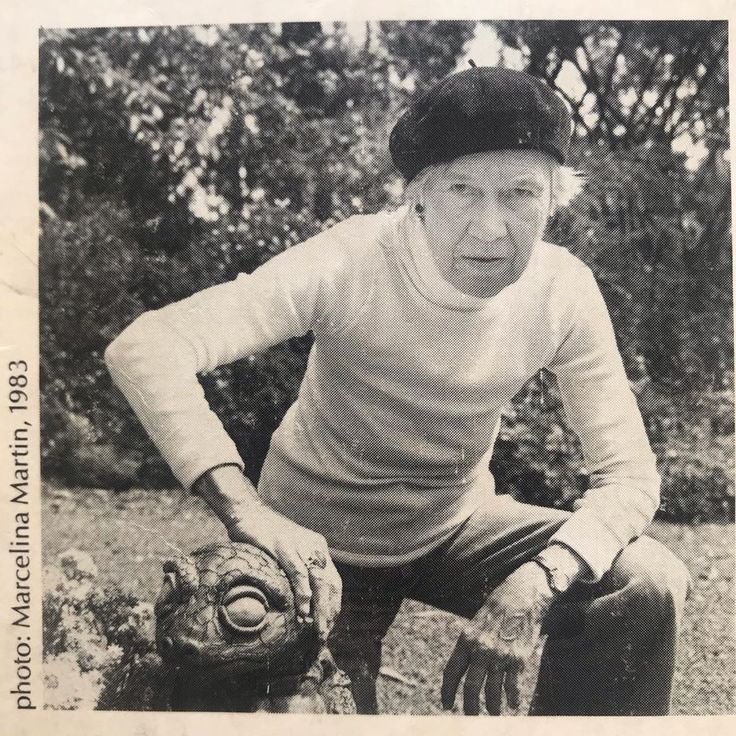
Bio: Elsa Gidlow

From Wikipedia, the free encyclopedia

Elsa Gidlow
Gidlow in 1974
BornElsie Alice Gidlow
29 December 1898
HullYorkshire, England
Died8 June 1986 (aged 87)
Mill Valley, California, United States
OccupationPoetauthoreditorjournalistpolitical activistphilosopher
EducationSelf-educated[1]: 104 
Period1917–1986
GenreLove poetry, essays, autobiography
SubjectLove, beauty, politics, protest, mysticism, nature
Literary movementLesbian literature
Feminist literature
Notable worksOn A Grey Thread (1923)
Elsa, I Come with My Songs (1986)
PartnerIsabel Grenfell Quallo (1945–1964)
“Tommy” Violet Henry-Anderson (1924–1935†)
Muriel Symington (1922)
RelativesThea (sister)

Elsa Gidlow (29 December 1898 – 8 June 1986) was a British-born, Canadian-American poet, freelance journalist, philosopher and humanitarian. She is best known for writing On a Grey Thread (1923), the first volume of openly lesbian love poetry published in North America.[2] In the 1950s, Gidlow helped found Druid Heights, a bohemian community in Marin County, California.[3] She was the author of thirteen books and appeared as herself in the documentary film, Word Is Out: Stories of Some of Our Lives (1977).[4][5] Completed just before her death, her autobiography, Elsa, I Come with My Songs (1986), recounts her life story.[6] It is the first complete-life, lesbian autobiography published where the author “outs” herself and does not employ a pseudonym.

Early life

Elsa Gidlow was born Elsie Alice Gidlow on 29 December 1898, at 9 Wells Terrace, Great Thornton Street, HullYorkshire, England.[7] Her father, Samuel A. Gidlow, was a railway safety clerk from Nottingham, her mother, Alice May (née Reichardt) Gidlow, the daughter of a German immigrant tailor. By 1901, the family had moved to a new house, 183 Clumber Street.[8] In 1904, Samuel Gidlow emigrated to Canada. Alice, young Elsie and her brother Samuel joined him the following year. They settled in TétreaultvilleMontreal. Elsa had six siblings:Thea, Ivy, Stanley, Ruby, Eric, and Phyllis, whom she referred to as her “unfortunate family,” because of their intimate association with mental illness. At the age of 15, Gidlow was first employed by her father on the Canadian Railway, and later by a contact of her father’s in Montreal, a factory doctor, as assistant editor to Factory Facts, an in-house magazine.[9]

Career

In 1917, she began seeking out fellow writers and meeting with them, particularly in the field of amateur journalism, which was popular at the time. With collaborator Roswell George Mills, Gidlow published Les Mouches fantastiques, the first magazine in North America where gay and lesbian issues were discussed, and the lifestyle celebrated.[10][11] It was also adamantly anti-war, influenced by Mills and Gidlow’s pacifist and anarchist viewpoints.[12] H. P. Lovecraft, a fellow amateur journalist, attacked their work, leading Gidlow to defend it and attack back in return; the dispute created a minor controversy but brought Gidlow and Mills public, albeit negative attention.[13]

Gidlow moved to New York in 1920 at the age of 21. There, among other jobs, she was employed by Frank Harris of Pearson’s, a magazine supportive of poets and unsympathetic to the war and England.[12] She became the poetry editor later becoming the associate editor. It was at this time she met a young Kenneth Rexroth who became known as the “father” of the San Francisco Renaissance. In 1926, Elsa moved to San Francisco. Rexroth numbered her among his closest friends. With the exception of nearly a year spent in Europe, mostly in Paris, in 1928, she continued living in the San Francisco Bay Area for the rest of her life.

In the 1940s, she lived in Fairfax, California, where in 1944 she became a home owner, active in local politics eventually becoming one of the planning commissioners.[14] Due to her membership in political and writers’ groups allegedly affiliated with communists, she was suspected of being “Un-American” and was subsequently investigated, subpoenaed and forced to testify in front of California’s Un-American Activities Committee in 1947. The committee’s final report accused her of being affiliated with communist front organizations.[15] However, as a philosophical anarchist Gidlow was ideologically opposed to communism, and she denied the accusation.[14] Patricia Holt of the San Francisco Chronicle writes:

It amused Gidlow that such “radical” ideas set her up for a witch hunt in Fairfax, where she had moved in her 40s. [Their] charges that Gidlow was a “red,” as Stanton Delaplane reported in The Chronicle, were “Washed Pink at Fairfax Hearings.” But Gidlow, who lived with a woman of African descent and often made dinner for the Chans from San Francisco, was later accused of “living with a colored woman and frequently entertaining Chinese people…This was damning evidence that I could not be a loyal American.”[4]

Druid Heights

Perhaps seeking solitude, Gidlow left her first home, Madrona, and the garden she had so lovingly tended for 10 years there, and in 1954, purchased a ranch which she subsequently shared with Roger Somers and his family above Muir Woods on the southwest flank of Mount Tamalpais in Marin County, California.[16] Gidlow named her portion of the mountain ranch, which included a secondary dwelling, “Druid Heights“, a nod to her friend, Irish poet Ella Young.[17] Gidlow and her partner Isabel Grenfell Quallo (1896–1985) lived together for a short time at Druid Heights, but family commitments called Isabel away. Also living there at one time or another were notable residents including her close friend Alan Watts, the poet Gary Snyder, furniture maker Edward Stiles and freewheeling bohemian Roger Somers.

Along with Watts and his soon to be wife Mary Jane Yates, Gidlow planned and then co-founded the Society for Comparative Philosophy here in 1962. This society financed many of the improvements to the property and brought many of the important visitors and “artists in residence” for whom Druid Heights is now known. Besides Alan Watts, notable residents who, through Elsa’s largess, found cheap rent and a place to create or escape were David Wills, Catherine Mackinnon, Roger Somers, Sunyata, John Blofeld, and many leaders of various women’s rights efforts. The Society morphed into the Druid Heights Artist Retreat after her death whereupon she provided the funds to begin the nascent-albeit short-lived-organization, Druid Heights Artists Retreat; A Facebook group called “Save Druid Heights” has been formed where many today hope to return DHAR to her home at Druid Heights.

Gidlow socialized with many famous artists, radical thinkers, mystics, and political activists, including, Dizzy GillespieLouis ArmstrongMargo St. James, Allen Ginsberg, James Broughton, Baba Ram DassLama Govinda, Robert Shapiro, Maude Oakes, Robert Duncan, Clarkson Crane, Sara Bard Fields, Kenneth Rexroth, Edward Stiles, Roger Somers, Catharine MacKinnon and Maya Angelou.[4] Gidlow helped plan the funeral for her friend Alan Watts, when he died there. The monks from nearby Green Gulch Monastery often came to visit and participated in a ceremony there upon Watts’s death which included an Anglican Mass; they then buried half of his ashes near his library at Druid Heights, and brought the second half to Green Gulch Monastery in the nearby valley.

Autobiography

Gidlow’s autobiography Elsa, I Come with My Songs: The Autobiography of Elsa Gidlow, published in 1986, gives a personal and detailed account of seeking, finding and creating a life with other lesbians at a time when little was recorded on the topic; notably, it is the first lesbian autobiography written where the author does not use a pseudonym. It offers a superb account of one eyewitness-participant’s view of twentieth-century artistic-bohemian life and of the cultural history of the San Francisco area. Gidlow also openly discussed her lifetime experience as a lesbian in the critically acclaimed 1977 documentary feature Word Is Out: Stories of Some of Our Lives, which was released theatrically and which was broadcast on many PBS stations around the United States starting in 1978.

Death

The last few months of her life, Gidlow experienced several strokes. She chose not to seek medical care in a hospital and died at home in Druid Heights at the age of 87.[18] Gidlow was cremated and her ashes were mixed with rice and buried beneath an apple tree in Druid Heights.[16] Parts of Druid Heights have subsequently fallen into ruin, but Gidlow’s home remained intact as recently as 2012.[19]

Legacy

Gidlow’s estate donated her extensive personal papers to the GLBT Historical Society in San Francisco in 1991. The collection consists of 16 boxes (13 linear feet) of correspondence, journals, literary manuscripts, legal records, photographs and other materials documenting Gidlow’s life, work and relationships. The papers are organized into nine series: Correspondence, Subject Files, Manuscripts, Published Works, Journals and Yearbooks, Audio-Visual and Photographs, Ephemera, Oversize Materials, and Original Documents. The collection is fully processed and available to researchers.[20]

Thoreau’s economics: the truly precious costs precious little

Thoreau’s economics: the truly precious costs precious little | Psyche

Walden Pond at sunset. Photo by Geoff Livingston/Flickr

John Kaagis the professor and Chair of Philosophy at the University of Massachusetts, Lowell and Miller Scholar at the Santa Fe Institute. He is the author of American Philosophy: A Love Story (2016); Hiking with Nietzsche: Becoming Who You Are (2018); and Sick Souls, Healthy Minds: How William James Can Save Your Life (2018). He lives outside Boston with his wife Kathleen and their kids.

Jonathan van Belleis an author and independent scholar in philosophy. His books include The Charter Party Companion to Private Holidays (2017) and Zenithism (2021)​. He lives in Portland, Oregon.

Edited by Sam Dresser

20 OCTOBER 2021 (psyche.co)

The word ‘economy’ evolved from the Greek root οἶκος. ‘Oikos’ had three interrelated senses in ancient Greece: the family, the family’s land, and the family’s home. These three, taken interchangeably, constituted the first or fundamental political unit in the ancient Greek world, especially in the minds of Greece’s hereditary aristocrats, for whom family mattered more than all other affiliations. The family, then and after, was viewed as the state in miniature, with its rules of order and its exemplars (of moral strength or moral incontinence).

Henry David Thoreau, knowing his Greek, loving puns and etymologies, and being a punctilious writer, was likely quite deliberate in the choice of ‘Economy’ as his title for the longest and first chapter in Walden (1854). By living in his spartan little pond house, his oikos, and getting this house in order, as it were, Thoreau meant to help others get their houses in order – and, house by house, family by family, give new life to society. The dry title hides a pun with a deep purpose, one that whispers: this is a book about a house, a simple one on a pond, but also a not-so-simple one, a disordered one, orbiting the Sun.

Thoreau’s simple furniture from the cabin at Walden. Photo courtesy the NYPL

Thoreau’s purpose at his pond house was akin to the purposes of his contemporaries. While Thoreau’s intellectual compatriots, especially the Transcendentalists, experimented with communal living – for example, George Ripley’s Brook Farm (1841-47) and Amos Bronson Alcott’s Fruitlands (1843-44) – Thoreau experimented with the opposite: solitary living. The scholar Michael Meyer notes this contrast in his introduction to the Penguin Classics edition of Walden, adding that Thoreau’s ‘two-year retreat to Walden Pond was his response to the communal efforts of the Transcendentalists’.

Why so many experiments in living at that time? Why that explosion of new forms of ‘home economics’, communal or solitary? The answer might be related to the fact that the national oikos was divided. Abraham Lincoln’s ‘House Divided’ speech, given 11 years after Thoreau’s last day in his Walden Pond home, and four years after the publication of Walden, confronts the essential fears of this period:

‘A house divided against itself cannot stand.’ I believe this government cannot endure, permanently half slave and half free. I do not expect the Union to be dissolved – I do not expect the house to fall – but I do expect it will cease to be divided. It will become all one thing or all the other.

An abolitionist, Thoreau felt his country becoming all one thing: a nation of slave auction blocks, driven by immoral and insatiable commercial cravings. The Fugitive Slave Act of 1850, enacted four years before the publication of Walden, required all slaves be returned to their owners, even if the escapee lived in a free state. Effectively, there were no more free states. The house was all one cruel thing now. The federal act, of course, saddled the federal government with its enforcement: Washington, DC became the national slave-catcher.

Thoreau’s ‘Economy’ asks us to change the American house, if not the global house, by changing ourselves, putting ourselves in order

Thoreau spent a night in jail for refusing to pay a tax to this government; he would not bankroll slave-catchers, nor the unjust war against Mexico. From this brief incarceration, Thoreau wrote one of the most influential political essays of all time, ‘Civil Disobedience’ (1849); Leo Tolstoy, Mahatma Gandhi, and Martin Luther King, Jr, were among those profoundly inspired by it.

Gandhi employed his own modified version of civil disobedience, Satyagraha, to end the British exploitation of the Indian oikos. One example, Gandhi’s powerful 24-day, 240-mile ‘Salt March’ or ‘Salt Satyagraha’ in 1930 , recalls a line in the ‘Economy’ chapter of Walden: ‘Finally, as for salt, … to obtain this might be a fit occasion for a visit to the seashore.’ Gandhi, like Thoreau, understood the potency of personal change – a change at the fundamental political unit: you. Gandhi wrote:

We but mirror the world. All the tendencies present in the outer world are to be found in the world of our body. If we could change ourselves, the tendencies in the world would also change … We need not wait to see what others do.

Thoreau’s ‘Economy’ asks us to change the American house, if not the global house, by changing ourselves, putting ourselves in order. Think globally, act locally. This is home economics at all political levels. ‘Live deliberately’ – not merely a personal motto, but a social one – exhorts us to wake up, to examine clearly what everyday choices we make, in our home first and foremost, but not only there.

Thoreau’s pond house, by the way, was an open house. ‘I would gladly tell all that I know … and never paint “No Admittance” on my gate,’ he writes in the ‘Economy’ chapter. As Robert Sullivan, in The Thoreau You Don’t Know (2009), reports:

On August 7 of the first year [of Thoreau’s Walden experiment], the Concord Freeman, a local paper, covered the annual meeting of the women in Concord who were against slavery, a meeting convened on the anniversary of the freeing of the slaves in the West Indies. The meeting was held at Thoreau’s house at Walden.

Thoreau likely learned this hospitality from his mother Cynthia, who operated the Thoreau house as a boarding house during the recessed economic period following the Panic of 1837. But Thoreau also learned good housekeeping from another woman, Lydia Maria Child, an abolitionist and an activist for the rights of women and Native Americans.

When we give our attention to our homes, the places where we immediately live, we find that they are worth much more than the places we are not

Child’s modest how-to manual, The Frugal Housewife: Dedicated to Those Who Are Not Ashamed of Economy (1829), opens with a passage that presages Thoreau’s desire to ‘improve the nick of time’:

The true economy of housekeeping is simply the art of gathering up all the fragments, so that nothing be lost. I mean fragments of time, as well as materials. Nothing should be thrown away so long as it is possible to make any use of it, however trifling that use may be; and whatever be the size of a family, every member should be employed either in earning or saving money.

This might sound miserly and profoundly out of tune with Thoreau’s supposed disregard for pecuniary matters. ‘Supposed’, however, is the right word: Thoreau was quite interested in money, in tallying the true cost of things. ‘Economy’ is comprised of lists of figures, such as food and construction costs. These accounting figures are, in part, spoofs of the house pattern books popular in Thoreau’s time, but there is a serious purpose, an aquifer, under the dry details. The messages of Thoreau and Child are in perfect chorus: ‘Waste not, want not.’ As Thoreau tallied them, the necessities of life, the things truly precious to an individual or family, actually cost preciously little.

A postcard from 1907-08 showing the cairn location of Thoreau’s hut on Walden Pond, Concord, Massachusetts. Photo courtesy the New York Public Library

Being ‘at home’ with these necessities is key to a meaningful life. As Child put it in an often-overlooked section of the Frugal Housewife centring explicitly on philosophy:

All of us covet some neighbour’s possession, and think our lot would have been happier, had it been different from what it is. Yet most of us could obtain worldly distinctions, if our habits and inclinations allowed us to pay the immense price at which they must be purchased. True wisdom lies in finding out all the advantages of a situation in which we are placed, instead of imagining the enjoyments of one in which we are not placed.

True wisdom indeed, and painfully difficult to gain. One of the ways to achieve this wisdom is to slowly, intentionally, methodically, work with what you already have. ‘The most characteristic mark of a great mind,’ Child wrote, ‘is to choose some one object, which it considers important, and pursue that object through life.’ Marie Kondo’s The Life-Changing Magic of Tidying Up (2010) reached blockbuster status by way of a similar intuition. There is a reason why the expression ‘paying attention’ makes sense: when we give our attention to our homes, the places where we immediately live, we find that they are worth much more than the places we are not. In ‘Economy’, Thoreau made this point, more pointedly, more than a century and a half earlier.

Why do we say ‘more pointedly’? Because Thoreau never valorised sheer drudgery. He didn’t encourage us to ‘be zen’ about chores that should bore us to death. He encouraged us to live deliberately in light of economic forces, of the forces that will make a house a home – and genuinely our own. Quarantine recently put new emphasis on that home life. Now, in what some call ‘The Great Resignation’, we are, en masse, not returning to the office. We’re staying remote or simply resigning if remote is not an option; we’ve staked our pond houses and now, perhaps, we mean to live deliberately.

So let’s not squander that which is absolutely precious, the time that we still have. Make decisions about how and where to tap meaning. That is the paramount economic skill. Do not covet the farms and mansions owned by the Joneses of your neighbourhood; acknowledge the prices they have paid for owning them. And notice that you have friends at your modest fire, and a roof over your head, and stars above, and say a little prayer to the minor deities of home-economy.

How conspiracy theories bypass people’s rationality

How conspiracy theories bypass people’s rationality | Psyche

Photo by Rick Loomis/Getty

Jan-Willem van Prooijenis a behavioural scientist. He is an associate professor of social psychology at Vrije Universiteit Amsterdam, a senior researcher at the Netherlands Institute for the Study of Crime and Law Enforcement, and Endowed Professor of Radicalization, Extremism, and Conspiracy Thinking at Maastricht University. His books include The Moral Punishment Instinct (2018), The Psychology of Conspiracy Theories (2018) and, as editor, The Psychology of Political Polarization (2021).

Edited by Matt Huston

20 OCTOBER 2021 (psyche.co)

A secret cabal of prominent Hollywood actors and Democratic political elites (so the story goes) keep young children hostage at various locations. They subject these poor children to satanic rituals, drink their blood, and abuse them sexually. Among each other, these evil cabal members use the codeword ‘Pizza’ to order new children and satisfy their perverse desires. These attention-grabbing (and false) allegations are associated with the QAnon movement – a cult-like, far-Right group that supports the former US president Donald Trump. QAnon is known for promulgating far-fetched conspiracy theories that accuse political adversaries of the most horrific crimes imaginable – typically without a shred of evidence.

As bizarre as such ideas might seem, the impact of the QAnon movement on society is undeniable. QAnon started in 2017 through the online postings of the mysterious person ‘Q’, who claimed to have access to classified government information. QAnon quickly became visible in the offline world. Initially, ‘Q’ signs started to appear regularly at Trump rallies. Later on, Marjorie Taylor Greene, a supporter of QAnon and its ridiculous allegations, was elected to the US House of Representatives. QAnon eventually spread around the world. I live in the Netherlands, and vocal supporters of the movement have recently surfaced here as well. The dangers of QAnon are evident: its adherents were among the rioters who stormed Capitol Hill on 6 January 2021.

What explains the appeal of such evidence-free conspiracy theories? Classic psychological explanations focus on negative emotions: when people feel anxious, out of control or uncertain, they become more susceptible to conspiracy narratives. Accordingly, conspiracy beliefs gain traction in societal crisis situations and are more common among groups that experience structural oppression. But new research suggests that it’s not just negative emotions that contribute to the appeal of conspiracy theories. People can also find conspiracy theories entertaining – and the more entertaining people find them, it seems, the more likely they are to believe in them.

Conspiracy theories actually have a lot in common with fictional stories such as scary movies or detective novels. Much like these works of fiction, conspiracy theories have a plotline that often includes a brave hero and a group of villains (eg, Trump fighting a conspiracy of satanic Democrats). There is a classic battle between good and evil, involving harmless victims (such as young children, the archetype of innocence) and perpetrators who lack a conscience and stop at nothing to pursue their twisted goals. Conspiracy theories therefore have great potential to trigger suspense. Many successful movies feature a powerful conspiracy. James Bond frequently fights a devious plot that threatens the world. Malevolent and mysterious conspiracies also appear in movies such as The Matrix (1999), The Net (1995), The Truman Show (1998) and many others.

The intense emotions triggered by conspiracy theories might suppress people’s capacity to think rationally about them

It makes sense, then, that many people would find conspiracy theories entertaining: that is, interesting and exciting. The key to their entertaining qualities is probably not negative emotions, per se, but rather intense emotional experiences. Indeed, the common assumption that people always experience emotions such as anxiety as negative might be somewhat simplistic. Let’s again draw a comparison with scary movies. People often feel anxious when watching a scary movie, but that does not mean that watching it is an aversive experience. In fact, people pay money to see scary movies, and might leave the cinema disappointed if the movie does not frighten them enough. A plausible reason why people find such movies entertaining is because they elicit intense emotions. These emotions can distract from boredom and make people feel more alive. Likewise, conspiracy theories might elicit intense emotional experiences that involve anxiety, but also fascination and the sense that one is discovering something unique and truly important.

Why might the entertaining qualities of conspiracy theories promote belief in them? Part of the answer lies in a quality that psychologists refer to as fluency. Information that is interesting and attention-grabbing is easier to mentally process than information that is boring (such as realistic yet not particularly exciting information revealing that, on most days, politicians simply work on new legislation in their offices). Greater ease of processing, or fluency, has been found to promote truth judgments. This fluency heuristic likely exists because, in daily life, information that ‘feels right’ in this way is often true (eg, birds fly; fish swim). But the side-effect is that, when false information is easy to process, people more readily infer that the information is correct.

Additionally, the intense emotions triggered by conspiracy theories might suppress people’s capacity to think rationally about them. Emotions are part of a system within the human mind that produces snap judgments, while slower, more analytic thought is required for scepticism about conspiracy theories. The combination of fluency and suppression of rationality could promote the belief that there is truth in an entertaining conspiracy theory.

To investigate the role of entertainment in conspiracy-theory belief, I recently conducted a series of studies with my former students Joline Ligthart, Sabine Rosema and Yang Xu. In two of these studies, participants read an experimenter-designed blog post about either the fire at Notre-Dame cathedral in Paris or the death of the wealthy sex offender Jeffrey Epstein. Some participants read a blog post presenting the mainstream explanation of these events (ie, the Notre-Dame fire was a tragic accident; Epstein killed himself in his prison cell). Other participants, however, read a post that promoted a conspiracy theory (ie, Notre-Dame was set on fire deliberately; Epstein was murdered by powerful people). Participants then rated how entertaining they found the article, scoring the narrative on adjectives such as ‘entertaining’, ‘exciting’, ‘boring’, and ‘attention-grabbing’. They also indicated to what extent they believed the conspiracy theories surrounding these events.

Participants clearly tended to rate the blog post supporting the conspiracy theory as the more entertaining one. Their entertainment appraisals were associated more with the self-reported intensity of their emotional experiences than with the negativity or positivity of emotions. Importantly, the conspiracy post also elicited stronger conspiracy beliefs – and this effect seemed to be supported by the post’s entertaining qualities.

Conspiracy theories can provide some of the excitement that sensation-seekers desire

Another study suggested that people are more inclined to expect conspiracies to be at play in entertaining narratives. Participants read about an election in a fictitious country but, this time, the narrative did not contain references to possible conspiracies. Instead, some of the participants read a narrative with attention-grabbing, emotional content (eg, ‘Everyone holds their breath up until the very last minute, as it is extremely unpredictable and exciting who will win’) while the other participants read a narrative that was designed to be boring, using detached language (eg, ‘based on opinion polls it is difficult to ascertain what the outcome of the electoral process will be’). On average, participants who read the exciting text considered it more likely that the elections would be rigged than participants who read the boring text.

While some narratives are clearly more entertaining than others, it’s also the case that people differ in the extent to which they crave such entertainment – a difference that could matter for conspiracy-theory susceptibility. So, in a final set of studies, we examined the role of a personality trait called sensation-seeking, which refers to someone’s desire for novel and exciting experiences. As such, the more sensation-seeking people are, the more appealing they should find entertaining stories such as conspiracy theories. We found that sensation-seeking tendencies were indeed associated with increased conspiracy beliefs, both in the context of organisations (eg, beliefs that their managers conspire to harm employees) and more broadly (eg, the belief that the Moon landings were a hoax). It appears that conspiracy theories can provide some of the excitement that sensation-seekers desire.

The evidence that entertainment is a factor in conspiracy-theory belief has a number of implications. First, the spectacular plotlines of conspiracy theories likely contribute to their appeal and reduce people’s ability to distinguish fact from fiction. As it happens, some conspiracy beliefs are directly inspired by works of fiction: some citizens truly believe the conspiracy theory described in Dan Brown’s bestselling novel The Da Vinci Code (2003). Second, the role of entertainment underscores the risks when the media sensationalises political or societal issues too much. While efforts to make news more entertaining certainly have commercial benefits, it’s possible that they also stimulate many people’s assumptions that hostile conspiracies operate in the shadows.

More generally, these findings underscore that trying to correct misinformation and reduce feelings of anxiety in times of crisis might not be enough to combat conspiracy theories. It is also important for parents, teachers and the media to promote the recognition that the most entertaining stories people encounter frequently do not correspond to reality; often, the truth can be quite boring.

Tarot Card for October 20: The Queen of Wands

The Queen of Wands

As a suit, Wands are direct, determined and connected to Will and its appropriate application. The Queen of Wands represents a woman who knows exactly what she wants out of life, and aims at her goals with great dedication.

She is often a woman who has experienced conflict and trauma, and learned from these. She’s usually independent, forthright and self-motivated. As a friend she will be loyal and honest, though sometimes given to handing out unwelcome advice, and taking over.

As a parent she can be quite dominant, claiming that she wants her off spring to be self-reliant and confident, but sometimes tending to become impatient, and do things on their behalf in her own way, rather than allowing her children to make up their own minds.

She’s a fighter, who does not suffer fools gladly. She will support and assist those who are vulnerable and needy, offering unceasing energy and determination. She takes up causes readily, and proves herself a worthy adversary. However she has a tendency not to know when to stop, and enjoys being at the forefront of the battle, rather than beavering away on the more routine aspects of any campaign.

This is a forceful and proud woman. She applies high standards to everything she becomes involved in. As a result, she can sometimes be somewhat intolerant of people who do things differently.

So – The Queen of Wands – a fine ally, and a dangerous enemy!

The Queen of Wands

(via angelpaths.com and Alan Blackman)

Study Finds Big Bang Result Of Last Universe Blowing Itself Up With Fireworks

Tuesday 9:10AM (theonion.com)

PHILADELPHIA—In a landmark study that deepens our understanding of the explosion that began all space and time, a paper published Tuesday in the Journal Of Cosmology And Astroparticle Physics found that the Big Bang was caused by a prior universe blowing itself up with fireworks. “Upon extensive analysis of cosmic background radiation originating from the Big Bang, we can now conclude that the previous universe collapsed and ours was created after a major pyrotechnic display went terribly wrong,” said study co-author and theoretical physicist Ismael Gomez, explaining that the earlier universe’s inhabitants were presumed to have tied together the wicks of an unquantifiable number of Black Cats and Roman candles and then shot them off all at once to see what would happen. “Based on the sheer destructive force of the blast, we’re pretty sure they must have had a lot of M-60s in there, too, and maybe some bottle rockets. The result was a moment of near infinite heat and density that marked the end of their universe and the beginning of ours, culminating 10-32 seconds later in a jaw-dropping finale with multicolored sparks shooting everywhere into an exponentially expanding space. This was perhaps caused by lighting off a ton of those 24-shot Excalibur artillery shells, but further research is needed to confirm this.” In response to the new research, top cosmologists told reporters they had shortened their estimates of our universe’s lifespan by hundreds of billions of years, citing humanity’s ease of access to fireworks and voracious desire to watch stuff blow up.

David Graeber’s Final Challenge

By Giulio Ongaro

19 October 2021 (tribunemag.co.uk)

A new book by David Wengrow and the late David Graeber is a rejection of the fatalistic myths of human history – and a defence of our power to shape our own world.

Anthropologist David Graeber passed away in September 2020.

Origin myths the world over have a basic psychological effect: regardless of their scientific validity, they have the sly power of justifying existing states of affairs, while simultaneously contouring one’s sense of what the world might look like in the future. Modern capitalist society has built itself upon two variants of one such myth.

As one story goes, life as primitive hunter-gatherers was ‘nasty, brutish and short’ until the invention of the state allowed us to flourish. The other story says that in a childlike state of nature, humans were happy and free, and that it was only with the advent of civilisation that ‘they all ran headlong to their chains’.

These are two variants of the same myth because they both assume an unilinear historical trajectory, one that begins from simple egalitarian hunter-gatherer bands and ends with increasing social complexity and hierarchy. They also nurture a similar fatalistic perspective on the future: whether we go with Hobbes (the first) or Rousseau (the second), we are left with the idea that the most we can do to change our current predicament is, at best, a bit of modest political tinkering. Hierarchy and inequality are the inevitable price to pay for having truly come of age.

Both versions of the myth picture the human past as a primordial soup of small bands of hunter-gatherers, lacking in vision and critical thought, and where nothing much happened until we embarked on the process that, with the advent of agriculture and the birth of cities, culminated in the modern Enlightenment.

What makes Graeber and Wengrow’s The Dawn of Everything an instant classic is its comprehensive scientific demolition of this myth—what they call ‘the Myth of the Stupid Savage’. Not a shred of archaeological evidence tells us that the picture of the human past is remotely close to what the foundational myth suggests.

Instead, what the available evidence shows is that the trajectory of human history has been a good deal more diverse and exciting and less boring than we tend to assume because, in an important sense, it has never been a trajectory. We never permanently lived in tiny hunter-gatherer bands. We also were never permanently egalitarian. If there is a defining trait of our prehistorical condition it is its bewildering capacity of shifting, almost constantly, across a diverse array of social systems of all kinds of political, economic, and religious nature.

Graeber and Wengrow’s suggestion is that the only way to explain this kaleidoscopic variety of social forms is to posit that our ancestors were not actually that stupid, but were instead self-conscious political actors, capable of fashioning their own social arrangements depending on circumstances. More often than not, people would choose to switch seasonally between socio-political identities as to avoid the perils of lasting authoritarian power.

And so, rather than asking ‘Why did inequality arise?’, the most interesting question to pose about human history becomes ‘Why did we get stuck with it?’ This is only one of many kindred claims advanced in this astounding new book.

Upending the Narrative

The book draws much of its value from its eclectic approach. David Wengrow is a professor of comparative archaeology at UCL. He is well-known for his work on early cultural and political transformations in Africa and Eurasia. David Graeber, who died suddenly in September 2020, was a professor of anthropology at LSE, widely regarded as the most brilliant of his generation.

Together, they explore a suite of recent archaeological findings that prove anomalous to the standard narrative (for instance, the existence of ancient large-scale egalitarian cities), but that, until now, had only been privy to a handful of experts who never quite unravelled the implications. Archaeological discoveries are therein appraised from anthropological eyes. The result is a sweeping tour into the past that hops from continent to continent and from one social sphere to another to tell stories that, depending on the reader’s familiarity with the archaeological record, might come as revelations.

We learn, for instance, that the uniformity in material culture across Eurasia in the Upper Palaeolithic meant that people lived in a large-scale imagined community spanning continents, putting to rest the idea that ‘primitives’ only spent their time in isolated bands. Counterintuitively, the scale of single societies decreased over the course of human history as populations grew larger.

From monumental sites such as Göbekli Tepe in Turkey or Hopewell in Ohio, we learn that people would seasonally come together from distant lands in what appear to have been large centres of cultural interactions for recreation and the exchange of knowledge. Journeying great distances while expecting to be welcomed into an extended community was a typical feature of our ancestors’ lives.

The book then pivots to agriculture. The received view has it that the birth of agriculture meant the more or less automatic emergence of stratified societies. Yet, this assumption runs into problems once we consider a phenomenon like ‘play farming’ across Amazonia, where acephalous societies like the Nambikwara, though familiar with techniques of plant domestication, consciously decided not to make agriculture the basis for their economy and to opt for a more relaxed approach that switched flexibly between foraging and cultivation. (Agriculture generally emerged in the absence of easier alternatives.)

Further, we learn that some of the first agricultural societies of the Middle East formed themselves as egalitarian and peaceful responses to the predatory foragers of the surrounding hills. It was mostly women, here, that propelled the growth of agricultural science. We also learn that complex works of irrigation in some such places were executed communally without chiefs, and even where structures of hierarchy existed, these works were accomplished despite authority, not because of it. The gradual spread of agriculture across the globe was far less unilinear than anyone had previously guessed.

In what’s perhaps the best chapter of the book, the authors move on to examine cities. Nowadays, large-scale egalitarian cities, the mere idea of it, smacks of utopianism; but Graeber and Wengrow argue that it shouldn’t when we start thinking of cities as the coalescence, in a single physical space, of already existing extended imagined communities with their own egalitarian ethos and norms—first happening seasonally, then more stationarily, as conscious experiments in urban form.

Sites like Çatalhöyük in southern Anatolia and many others offer incontrovertible evidence of the past existence of such cities, where no sign of authoritarian rule can be found. (Generally, when these are found, they stand out in the form of palaces, temples, fortification, etc.) Other ancient cities like Cahokia in Mississippi or Shimao in China exhibit evidence of a temporal succession of different political orders, sometimes moving from authoritarian to egalitarian, which leaves the possibility of urban revolutions as a likely explanation for the change.

The final chapters focus on the ‘state’—or better, on how misleading it is to define societies like the Inka or the Aztecs as ‘incipient states’ because these were far more diverse than what this straitjacket term would make us think. From the Olmec and the Chavin societies in Mesoamerica to the Shilluk of South Sudan, The Dawn of Everything gives us a taste of the variety of authoritarian structures throughout history. By the end of the book, we encounter the archaeological gem that is Minoan Crete—a ‘beautiful irritant for archaeology’—where all evidence points to the existence of an ancient system of female political rule, most likely a theocracy run by a college of priestesses.

There is much more. The leitmotif running through the chapters is that if we want to make sense of all these phenomena, we are obliged to put human collective intentionality back into the picture of human history, as a genuine explanatory variable—to assume, that is, that our ancestors were imaginative beings who were eminently capable of self-consciously creating their social arrangements.

The authors by no means discount the importance of ecological determinants. Rather, they see their effort as moving the dial to a more sensible position within the agency–determinism continuum, which usually only takes one extreme. The key upshot is that this newfound view of our past equips us with an expanded sense of possibilities as to what we might do with ourselves in the future. Fatalistic sentiments about human nature melt away upon turning the pages.

A More Free Future

Staying true to Ostrom’s law—‘whatever works in practice must work in theory’—Graeber and Wengrow set out a new framework for interpreting the social reality brought to light by empirical findings.

First, they urge us to abandon terms like ‘simple’ or ‘complex’ societies, let alone the ‘origin of the state’ or ‘origin of social complexity’. These terms already presuppose the kind of teleological thinking challenged in the book. The same goes for ‘modes of production’: whether a society relies on farming or fishing is a poor criterion for classification because it tells us almost nothing about its social dynamics.

Second, they lay out some new descriptive categories of their own. They show, for instance, that social domination can be broken down into three elements—control of violence, control of knowledge, and charismatic power—and that permutations of these elements yield consistent patterns throughout history. While the modern nation state embodies all three, most hierarchical societies of the past had only one or two, and this allowed for the people who lived under them degrees of freedom that are barely imaginable for us today.

Graeber and Wengrow reflect at length on this last point. More than a work on the history of inequality, The Dawn of Everything is a treatise on human freedom. In parsing the anthropological record, they identify three types of freedom—freedom to abandon one’s community (knowing one will be welcomed in faraway lands), freedom to reshuffle the political system (often seasonally), and freedom to disobey authorities without consequences—that appear to have been simply assumed among our ancestors but are now largely lost (obviously, their conclusion is a far cry from Rousseau’s: there is nothing inevitable about this loss!).

This analysis flips the question one should really be asking about the historical development of hierarchy: ‘The real puzzle is not when chiefs first appeared,’ they suggest, ‘but rather when it was no longer possible to simply laugh them out of court.’

So much of what makes this book fascinating is the alien nature of the phenomena we encounter within, at least to contemporary eyes. Potlaches, headhunting and skull portraits, stranger kings, revolutions, shamanic art, vision quests… The Dawn of Everything reads like a work of sci-fi, except that what turns out to be fictional is our received view of human history. The writing is often funny, sometimes hilarious. At the same time, because hardly a paragraph goes by without bequeathing insight, this is a book that requires to be patiently taken in. It sits in a different class to all the other volumes on world history we are accustomed to reading.

The Dawn of Everything intellectually dwarfs the likes of Pinker, Diamond, or Fukuyama (and Harari too). Whenever non-specialists try their hands at human history, they inevitably end up reproducing the same old myths we have grown up with. Take Steven Pinker: for all his talk about scientific progress, his books might as well have been written at the times of Hobbes, in the seventeenth century, when none of the evidence unearthed recently was available. Graeber and Wengrow casually expose these popular authors’ startling incompetence at handling the anthropological record. Only a solid command of the latter—namely, of the full documented range of human possibilities—affords a credible interpretative lens over the distant past. For it supplies the researcher with a refined sense of the rhythms of human history.

One of the experiences of delving into this book, at least in my case, was a gradual recognition of being in the presence of an intellectual oddity, something difficult to situate within the current landscape of social theory. By embracing once again the ‘grand narrative’, the book makes a clean break with post-structuralist and post-humanist trends widespread in contemporary academia. We know that Graeber, at least, liked to think himself as a ‘pre-humanist’, actively expecting to see humanity realise its full potential.

One can certainly see this work as a contribution in that direction. One can also see The Dawn of Everything as belonging to the tradition of the Enlightenment (except that one of the other major claims in the book is that Enlightenment thought developed largely in response to indigenous intellectuals’ critiques of European society of the time). As for how it squares with current archaeological and anthropological theory, the book is of such a real sweep that I don’t think it admits easy comparisons.

If comparisons must be made, they should be made with works of similar calibre in other fields, most credibly, I venture, with the works of Galileo or Darwin. Graeber and Wengrow do to human history what the first two did to astronomy and biology respectively. The book produces a similar decentring effect: in dethroning our self-appointed position at the pinnacle of social evolution, it deals a blow to the teleological thinking that so insidiously shape our understanding of history.

With the exception that while works such as Dialogue Concerning the Two Chief World Systems and On the Origin of Species hinted at the relative insignificance of humans in the face of the cosmos, The Dawn of Everything explores all the possibilities we have to act within it. And if Galileo and Darwin stirred turmoil of their own, this will do even more so for precisely this reason. Ultimately, a society that accepts the story presented here as its official origin story—a story that is taught in its schools, that seeps into its public consciousness—will have to be radically different than the society we are currently living in.

David Graeber and David Wengrow’s The Dawn of Everything: A New History of Humanity is published by Penguin.

About the Author

Giulio Ongaro is a postdoctoral researcher in anthropology at LSE.

(Contributed by Gwyllm Llwydd)