ACIM 50
“I am sustained by the love of God.”
–Marianne Williamson

swinginkatz View this and others, from the Great Musical, Black and Blue Revue.
(Courtesy of Alan Blackman)
 |
 |
| Sign-Ups are Now Open For Translation® Class with Calvin Harris, H.W., M.Saturday, October 16, 2021, 9:00 AM to 6:00 P.M., and on Sunday, October 17, 2021, 10:00 AM to 5:00 PM A 2-day class with Live & Monitor tape segments Presented on Zoom Click Here to Register Translation class provides the fundamental resource required for shedding limitation, disorder, and confusion from your world: Through cogitative thinking in the abstract. It is said that when we judge by appearances we judge amiss. “That which is essential is invisible to the eye,” as Antoine de Saint Exupéry wrote. Learn to see through what seems to be – limitation, anxiety, oppression – to Truth which lies waiting for your discovery. Not “A, or The Truth” – there is no “the” Truth – but Truth. Within which Your Ontological identity is ever-present, awaiting recognition. Class is live (on Zoom) with segments of Thane on tape, with music and video supplements to enhance the traditional Teacher/Student classroom format experience. Class Fees: New to Class $ 150. 00 Review 75. 00 Call now for more information call 949-331-7200 or Email ialchemy1@gmail.com |
The Rational National Iraq war veteran and filmmaker Mike Prysner disrupted a George Bush speaking event, and it was amazing. Subscribe to Empire Files: https://www.youtube.com/c/EmpireFiles === Support the show at http://TheRationalNational.com/Join Donate Directly at http://PayPal.me/daviddoel Tip at https://streamlabs.com/therationalnat… ‘Join’ on YouTube: https://www.youtube.com/channel/UCo9o… Follow David Doel at http://twitter.com/DavidDoel Follow The Rational National at http://twitter.com/TRNshow Follow on Twitch at http://twitch.tv/TheRationalNational Follow on Facebook: https://facebook.com/trnshow === Sources: https://www.youtube.com/watch?v=I-taJ… (original video) https://www.youtube.com/watch?v=IL992… (Mike Prysner in 2011) https://www.youtube.com/c/TheHumanist… (Humanist Report)
The path to becoming the nation’s first Native interior secretary
By Jenni Monet | Sep 15 2021 (sierraclub.org)
 Photo by Shane Balkowitsch
SHAYAI LUCERO watched Deb Haaland’s confirmation hearing from her flower shop on the Laguna Pueblo. She knows Haaland and her extended family. The floral business Lucero runs out of her converted garage used to belong to Haaland’s sister.
These relationships are as typical as any across the reservation—a sprawling community about 50 miles west of Albuquerque, New Mexico, comprising six small villages, a colonial mission, and the now-parched lagoon that inspired the pueblo’s Spanish name.
In the flower shop, a laptop played C-SPAN’s livestream of the proceedings.
Haaland arrived at the Dirksen Senate Office Building with her arms fully loaded. On one side, she held a big white binder at her hip. On the other, she cradled an ornately painted Pueblo pottery bowl like a baby. The New Mexico representative wore a charcoal-gray pantsuit, a basic black top, and strands of chunky turquoise stones around her neck. Tacked to her lapel was a congressional pin. It was February 23, 2021—mere weeks into her second term.Becoming “Madam Secretary” has catapulted her to the status of an Indigenous icon. She’s a meme. She’s a GIF. She’s some artist’s latest beadwork.
Haaland gifted the pottery to Don Young, a House Republican from Alaska. He had agreed to give a rare endorsement at the start of Haaland’s Senate hearing despite their disagreements over drilling for fossil fuels. Affectionately calling his colleague “Debbie,” the senior statesman explained to the gathering of mostly white and male lawmakers how he and Haaland had become fast friends. “It’s my job to try to convince her that she is not all right, and her job is to convince me I’m not right,” he said. “She will listen to you.”
John Barrasso, the ranking member of the Senate Energy and Natural Resources Committee, noted Haaland’s epoch-making hour. “If confirmed, she would be the first Native cabinet secretary,” he said. “For that reason, her nomination is historic and deserves to be recognized.”
He nodded gentlemanly toward the cabinet nominee, flipping a page from his script. “At the same time,” he said, sighing, “I am troubled by many of Representative Haaland’s views—views that many in my home state of Wyoming would consider as radical.”
At 60, Haaland has a face that reflects a lineage of Pueblo matriarchs. In 2018, she became one of the first two Native American women ever elected to Congress, along with Ho-Chunk Democratic representative Sharice Davids from Kansas. Her nomination for secretary of the interior largely came about because Indigenous activists had a wild idea, tested it, and lobbied President Joe Biden to follow along.

Deb Haaland is sworn in as the nation’s first Native interior secretary. | Photo by Lawrence Jackson/White House
Haaland greeted lawmakers in Keres, the language of the Káwáigamé, or People From the Small Lake, Laguna. “Guwadzi hauba,” she said, introducing herself by clan: Turquoise. Then she spoke of summers spent in Mesita village. “It was in the cornfields with my grandfather where I learned the importance of water and protecting our resources—where I gained a deep respect for the earth.” She encouraged Republicans, Democrats, and independents in the committee to consider their shared love for the outdoors.
But Republican senators wanted none of that. Barrasso worked to set the tone: a grilling.
“I’m an orthopedic surgeon,” he told Haaland. “And just a couple of months ago, you tweeted, ‘Republicans don’t believe in science,’ a pretty broad statement.”
“Senator, I . . .” Haaland gently waved her hand, searching for a response. “Yes, if you’re a doctor, I would assume you believe in science,” she said.
Science. The word came up frequently during the proceedings, revealing the cultural divide over whether to trust expert analyses on current issues like the coronavirus and climate change. For two days, oil-backed Republicans took turns expressing their frustrations. Senator James Risch of Idaho stirred tensions when he repeatedly pressed Haaland about the Keystone XL Pipeline—never mind that the energy project is determined by presidential permit and not by the Interior Department. Senator Steve Daines, the most vocal of Haaland’s critics, raised concerns about energy-sector job losses for his Montana constituents. Barrasso, meanwhile, insinuated that the congresswoman was a drug peddler for proposing cannabis cultivation to offset oil and gas revenues. At every turn, Haaland responded with inscrutable poise.”We must shed light on the unspoken traumas of the past, no matter how hard it will be.”
On March 15, the Senate gathered to vote on whether she would become the first Native person to lead the Interior Department. It was a historic day.
Lucero was again at work, placing bright marigolds into a perfect ring, a wreath that would lie on the grave of a young tribal member. It had been one year since Laguna Pueblo had closed its reservation borders in response to the pandemic; the coronavirus had hit the community particularly hard. The grieving she’d seen as the only florist on the reservation weighed on her.
Lucero is a wife and a mother, a daughter and an entrepreneur. She’s also a former Miss Indian World, a title she preserved in a collage of decorative pins, ticket stubs from memorable events, and photographs of her travels, hanging near her dining room. The year she reigned, in 1997, she journeyed to Japan, performed at Lincoln Center, and made stops across Indian Country, including an Iñupiat blanket toss in Alaska. Unlike other pageants, Miss Indian World is less about outward beauty and more about deep cultural ties. For the traditional talent competition, Lucero delivered a presentation about Pueblo plant medicines.
As the Senate vote got underway, Lucero’s mother, Cecelia, gave an enthusiastic play-by-play. “Murkowski for Haaland,” she said while her daughter focused on her sympathy wreath.
When the voting stopped, Lucero put down the marigolds and joined her mother at the laptop. The final vote was 51 to 40—confirmed—with most Republicans voting against Haaland. Lucero marked the moment by snapping a screenshot. She looked at her mother, expecting to see her beaming. Instead, she saw tears.
 Laguna Pueblo, where Haaland grew up. | Photo by Christian Heeb/laif/Redux
“I just keep thinking about all those Indian leaders who trekked from their homes to try to get the government to listen to them,” Cecelia told her daughter. “Centuries of chiefs and tribal leaders.”
Lucero’s mother might have been referencing any number of Native delegations who for over two centuries and during almost every presidential administration had visited the White House, and specifically the Interior Department, to advocate for themselves—their sovereignty, their land, their right to pray. So often these trips were futile. A rare exception came in 1922, when the All Indian Pueblo Council stopped a bill that would have seized some 60,000 acres of Pueblo land and disrupted their ceremonies.
“People in Indian Country, it just seems, we have this sense of relief,” Lucero said. “We’ve been ignored for so long.”
ALMOST EVERYONE CALLS Debra Anne Haaland “Deb.” Native millennials go further—to them she is “Auntie Deb.” Becoming “Madam Secretary” has catapulted her to the status of an Indigenous icon. She’s a meme. She’s a GIF. She’s some artist’s latest beadwork. Across social media, one of her most famous lines is now hashtagged on a regular basis: “Be fierce.”
Her appointment as the first Native American to lead the Interior Department is more than riveting considering the department’s legacy and documented abuse of Indigenous people. In 1851, two years after the department was created, President Millard Fillmore appointed Oliver M. Wozencraft as an Indian commissioner to form treaties with California tribes. Gold diggers had been scouring the Sierra Nevada foothills as militias carried out state-sponsored Indigenous genocide. There was a maniacal mood in what California’s first governor called a “war of extermination.” Wozencraft deceived tribes into signing 18 treaties—land negotiations that he knew Congress would never ratify. Interior Secretary Alexander H.H. Stuart helped break these pacts, writing a series of letters to Fillmore justifying the abrogation.
One hundred and seventy years later, Haaland quoted Stuart in a speech upon accepting her nomination. “This moment is profound when we consider that a former secretary of the interior once proclaimed his goal was to, quote, civilize or exterminate us,” she said. “I am a living testament to the failure of that horrific ideology.”
Haaland was sworn in on March 18 wearing a rainbow-striped ribbon skirt and tall calfskin moccasins, her initiation in joining the most diverse cabinet in US history. Only six of the president’s 15 secretary picks are straight white men—the lowest number in any administration.
Indigenous people have inhabited the North American continent for millennia, since well before European explorers arrived in the late 1400s. Despite what followed—calculated land dispossession by way of massacre, removal, and ethnic cleansing—some 3 million people are citizens of today’s 574 federally recognized Native nations. With barely 1 percent of the US population, Indian Country is one of the most overlooked and misunderstood communities in America. According to a 2015 report in Theory and Research in Social Education, 87 percent of state history standards do not mention Indigenous people after the year 1900. That could explain why many Americans’ knowledge of Indigenous history is so limited or, in the case of former senator Rick Santorum, rife with ignorance. “We birthed a nation from nothing,” Santorum said in an April 23 speech before the conservative Young America’s Foundation. “I mean, yes, we have Native Americans, but there isn’t much Native American culture in American culture.”
 Haaland hikes in Bears Ears National Monument with tribal leaders and Utah politicians. | Photo by Rick Bowmer/AP
For many, Haaland is the most visible reminder that Native people are still here. As the leader of the $12.6 billion Interior Department, she is a beacon of progressive policymaking, responsible for overseeing nearly a fifth of the nation’s public lands across 11 agencies, including the Bureau of Indian Affairs. Secretary Haaland is now poised to prioritize, for the first time in this country’s history, Indigenous affairs. Even before she came to Congress in 2019, the Pueblo politician had spoken out against fossil fuels. In 2016, she drove from Albuquerque to Standing Rock, North Dakota, to stand with water protectors protesting the Dakota Access Pipeline. At the beginning of her first term, Haaland joined other progressives—Alexandria Ocasio-Cortez, Ayanna Pressley, and Ilhan Omar—at a press conference introducing the Green New Deal.
By the end of Haaland’s first term, five of her signature bills had become law, all but one of them related to Indian Country. The Not Invisible Act is now being implemented in the Interior Department. This law and its companion legislation, Savanna’s Act, were signed by President Donald Trump last year. Together they call for enhanced policing to curb the dramatic rate at which Indigenous people are disappeared or found dead. A decades-long grassroots effort to address the “missing and murdered” was galvanized in 2017 after the horrific murder of Spirit Lake mother Savanna Lafontaine-Greywind. Investigators in Fargo, North Dakota, bungled the job, revealing the subtleties of police bias. In her second week at the Interior Department, Haaland established a Missing and Murdered Unit to help carry out these two laws.
“We’re looking at systems as a whole to be fundamentally delegitimized, so it’s a powerful moment,” said Sam Torres, director and researcher for the National Native American Boarding School Healing Coalition. “In a way, we’re starting to scratch the surface on correcting injustices that have been hundreds of years in the making.”
Torres has been examining cycles of violence in Indian Country triggered by the 1819 Indian Civilization Act, a federal policy designed for the cultural genocide of Indigenous people through a network of Indian boarding schools. The most notorious of these forced-assimilation programs was the Carlisle Indian Industrial School in Pennsylvania. Its stated mission: “Kill the Indian, and save the man.”
In her 2018 campaign blog, Haaland wrote that her Laguna Pueblo great-grandfather had been sent by train to attend Carlisle in 1881. In a 1995 essay for New Mexico Magazine, she said that her grandparents had been similarly separated from their families when they met as children at a boarding school in Santa Fe.
In June, before hundreds of tribal leaders attending the online National Congress of American Indians mid-year conference, she announced the first-ever investigation into the US boarding school policy, the Federal Indian Boarding School Initiative. Haaland confided to them that her role as Madam Secretary was one of the most important challenges of her professional life.
“I come from ancestors who endured the horrors of Indian boarding school assimilation policies carried out by the same department that I now lead, the same agency that tried to eradicate our culture, our language, our spiritual practices, and our people,” Haaland said. “We must shed light on the unspoken traumas of the past, no matter how hard it will be.”
BEFORE THE RAILROAD arrived in the 1880s, men in the village of Old Laguna would travel five or so miles to a jutting mesa where cornfields and fruit trees flourished in the summer. The farmers lived in makeshift camps until it made sense to permanently settle there. Today, Mesita village is a patchwork of roughly 40 homes, a Catholic church, a plaza, and a meeting hall. The occasional train passes along a northern sandstone bluff. To the south, a steady stream of 18-wheelers, RVs, and cars roll by on Interstate 40.
Helen Steele, Haaland’s grandmother, was raised in Mesita. At age 18, she married Tony Toya, a young man from the nearby Jemez Pueblo. He was courting her the day railway recruiters offered him a job some 200 miles west in Winslow, Arizona. The young couple moved there and settled behind a roundhouse, where a colony of Laguna workers had formed. They lived in homes converted from castaway boxcars. They spoke Keres and baked bread in handcrafted hornos, or mud ovens, just as they did back home. The Toyas, who were determined to maintain a connection to Mesita, took advantage of free train rides and returned to the reservation often, especially to tend to summer crops. Haaland was born in Winslow, and these experiences of her grandparents became a defining part of her upbringing.
In 1974, Haaland was a freshman at Albuquerque’s Highland High. Before then, she had bounced among more than a dozen schools, the sheltered daughter of two military parents. John David “Dutch” Haaland, a marine officer, had saved six lives during his two-year tour in Vietnam, for which he was awarded the Silver Star. Mary Toya, Haaland’s mother, served in the US Navy and kept a home with floors so clean you’d slip on them. As the war played out on TV, Haaland said, some days the news reports would bring her father to tears.
After graduating high school in 1978, Haaland packed her bags and moved with a friend to Los Angeles. Her ambitions were straightforward: “Just to meet some movie stars,” Haaland told me. Beyond that, they didn’t have much of a plan. Going broke brought her back to the popular Albuquerque bakery where she’d been working since age 14.
For Haaland, understanding her Indigeneity began in adulthood when she entered the University of New Mexico (UNM). She was 28, and her guides were Native authors and poets exploding onto the national scene. Today’s US poet laureate, Joy Harjo, who is Muscogee, was on her roster of instructors. Haaland read books with plotlines about characters returning to the reservation with “feet in two worlds.” Back then, Indigenous studies programs hardly fit the rubric for higher education, but Native literature and poetry laid that foundation. And it spoke to Haaland, who had been dancing on ceremonial feast days and Christmases since she was a young girl. “Sometimes I’d be the only one out of my family dancing,” she said. “Nobody else would dance.”
On graduation day in spring 1994, a very pregnant Haaland wore UNM’s red cap and gown. Four days later, at 33, she gave birth to a child she named Somàh. Single motherhood would alter the trajectory of their lives. “It was a choice I made to be a single mom,” Haaland said in a campaign video in 2018.
When Somàh turned two, Haaland started her own company, Pueblo Salsa, as a way to spend more time with her child. She worked out of a commercial kitchen and sourced some of the most sought-after red chilies in northern New Mexico. She sold jars that were stocked at local grocery stores and other small businesses statewide. But she struggled. When not making salsa, she was delivering it to her customers. In between, she traded preschool duties for Somàh’s free tuition while filing the occasional magazine essay as a freelance writer.
By 2002, Haaland had become drawn to political organizing. That year, South Dakota senator Tim Johnson eked out a narrow reelection victory, by 528 ballots, largely credited to Lakota voters. “When I saw what the Indian vote had done in South Dakota, I said, I bet we can do that here,” Haaland recalled.
She applied to law school, sold her company, and returned to UNM in 2003. But these ambitions threw her finances into tumult. Living away from New Mexico for a short stint had made her ineligible for in-state tuition. Haaland describes those years as lean—a diet of pinto beans and tortillas. Yet, when she sought emergency food stamps for the first time, she was denied. She had “too many assets,” she was told. She walked away feeling too poor to feed her tiny family but not poor enough in the eyes of the government. It took a brush with homelessness—essentially, couch surfing among friends—for her to become eligible.
Years later, Haaland’s efforts began to pay off: She was hired by President Barack Obama’s campaign to secure the Native vote. She became the state Democratic Party’s Native American caucus chair. She ran for lieutenant governor of New Mexico in 2014, lost, then circled back to the state Democratic Party as its first Native chairperson.
When Haaland was scoping out locations to kick off her For Congress, For Us campaign in 2017, a former professor at UNM Law School, John Feldman, offered up his juke joint. Two years later, he hosted the launch of her reelection campaign. “She’s a team builder,” Feldman said. “And not just everybody has that. That’s what I’ve seen all along.”
SHAYAI LUCERO REMEMBERS the day in 2004 when Haaland the canvasser came knocking on her door. Haaland had studied the data and noticed that Lucero rarely missed an election. Haaland asked her if she would mind driving Lagunas to the polls. “That was her grassroots effort, to get people to realize the importance of our vote,” Lucero said. “And the history of Miguel Trujillo.”
After World War II, Native veterans like Trujillo returned as heroes, but to a country that disenfranchised them. Across New Mexico, Native Americans did not secure the right to vote until 1948, through a lawsuit that Trujillo filed and won. But it took time for Natives in New Mexico to trust the electoral process, even in the 2000s, when Haaland canvassed area pueblos. Trujillo’s legacy was mostly suppressed in obscure history books until Haaland kept mentioning his name. She’d reserve Pueblo recreation halls, bring pots of green chile and a stack of tortillas, and register Native voters.
The night Haaland became one of the first two Native women elected to Congress, she acknowledged—who else?—Miguel Trujillo. “Seventy years ago, Native Americans right here in New Mexico couldn’t vote,” she said to her supporters. “Today we all came together, and we said we still believe in the American dream, and American democracy, and in hope.”
The room roared.
Across the 19 Pueblo governments in New Mexico, top leadership roles are mostly reserved for men. For Lucero, that fact has deep personal roots. “As a young woman, I always told my dad, ‘Oh, I would love to be governor,'” she said. “And he would always have to burst my bubble: ‘You’re never going to be governor.'”
Many Pueblo women see Haaland’s interior secretary appointment as a turning point.
“We need to be giving her our support,” Lucero’s mom said. “She’s going to be protector of our Mother. We need to support the woman who’s going to protect Her.”
HAALAND’S ENTOURAGE ZIGZAGGED up the Moki Dugway on a morning so clear and golden you could see why tourists love Bears Ears. The tawny earth and sandstone bluffs were only the beginning of a seemingly unbroken landscape.
Less than a month after being confirmed as interior secretary, Haaland was ascending a snakelike road up to Muley Point that was chiseled into Cedar Mesa for the Happy Jack uranium mine 70 years ago. She passed a few guardrails that don’t hide the fact that the occasional vehicle has gone over the edge. Eventually the silhouettes of two buttes, Bears Ears, came into sight.
It was quiet on the mesa during a prayer. As the top administrator of the nation’s public lands, Secretary Haaland had come to Utah to update President Biden on an American controversy: the making and breaking of a monument. For more than a century, the state’s southeast corner has been a resplendent backdrop for the racism that provoked the dispute over protections for the area. The mostly white, mostly Republican majority in Utah favors the loosest federal restrictions over the region, while many others—Natives, scientists, and environmentalists—say it is deserving of so much more.
Looting by locals has been a key catalyst for such contention. The decades-long pilfering of Indigenous holy objects got so bad that it led to unprecedented crackdowns by the Bureau of Land Management. One sophisticated sting in 2009 exposed looters’ houses stuffed with artifacts, including an unearthed cradleboard with an umbilical cord.
“They call it pot hunting, but it was grave robbery, really,” former interior secretary Sally Jewell told The Washington Post in 2019. Jewell was the head of the Interior Department when President Obama created the 1.35-million-acre Bears Ears National Monument in 2016. For conservatives across Utah, the designation felt like federal “overreach.” And they let President Trump know it after he succeeded Obama in the White House.
In the three years since Trump shrank Bears Ears, the threats to this treasured ecosystem have mounted, according to stakeholders who demand that the monument be restored. The hazards, aside from prolonged plunder, range from vandalism and over-visitation to unmonitored off-roading. More politically charged issues are linked to uranium mining and oil and gas drilling—all on a site considered a sanctuary to Native Americans.
“It is much like the Mormon temple up in Salt Lake City,” Clark Tenakhongva said at a press conference during Haaland’s visit. The vice-chairman of the Hopi Tribe is also co-chair of the Bears Ears Inter-Tribal Coalition. “If you desecrate, destroy our shrines, our temples down here, basically you’re destroying our culture, our religion, our lifeline.”
The land here is sacred to many of the region’s Native Americans, including a Pueblo diaspora who lived among these sunburned mesas about 1,200 years ago, before a megadrought forced their migration to the banks of the Rio Grande. It’s because of this that Haaland describes herself as a “35th generation New Mexican.” And it’s why her first act as a representative was drafting legislation to restore the protections to Bears Ears undone by Trump. That bill failed, making it unfinished business in her first official tour as interior secretary.
In the afternoon, Haaland hiked Butler Wash with Tenakhongva and other tribal leaders, along with Utah Republicans and the state’s governor, Spencer Cox. Conspicuously missing was senior senator Mike Lee, who had pestered Haaland about Bears Ears on both days of her confirmation hearing. Lee had invited Haaland to Utah, but now that she was there, he wasn’t.
If such treatment bothered Haaland, she appeared to have brushed it off. At one point, she stood in the center of a selfie snapped by Governor Cox; his long right arm stretched far enough to frame the shot with Senator Mitt Romney, who leaned in, off to the side. They smiled behind their masks. Romney and other Republicans want Haaland to tell Biden to back off, to let Congress decide the future of the monument.
“I think this is an opportunity to find common ground,” Romney said. “No pun intended.” And he promoted a “working together” approach, though the lawmaker, along with Lee, had been among the 40 senators who had voted against Haaland’s confirmation.
In a report sent to the White House in early June, the interior secretary advised Biden to reinstate the original boundaries at Bears Ears as well as Grand Staircase–Escalante National Monument. Utah is now poised to sue.
“Sister,” Tenakhongva, a former radio DJ, said to Haaland from the podium during the press conference. He then addressed his opponents’ gripes about government “overreach”: “Wait until you become a brown-skinned person and a Native American,” he said, his tone filled with frustration. “That’s when you will talk about overreach of the American government.”
Tenakhongva was crestfallen when Trump reduced Bears Ears. In December 2017, on his first day in office as the Hopi vice-chairman, he sued the president. The lawsuit is on hold pending Biden’s review. Tenakhongva explained to Haaland what it meant to have Obama designate a monument that, for the first time ever, honors traditional knowledge rooted in the land—the plants, the water, and the spirits of their kin. “It took years of hard work for us to get to that point,” he said. “It’s never been fair.”
While lobbying by at least one uranium company bolstered Trump’s decision to shrink the monument, the sense industry-wide is that mining the mineral is too expensive. Meanwhile, the Utah Geological Survey reported in March that all 255 oil and gas wells situated within Bears Ears have been abandoned since 1992.
Still, a recent uranium reserve included in the $1.9 trillion American Rescue Plan raises speculation. Last year the same uranium company that lobbied Trump, Energy Fuels, coordinated campaign contributions for members of Congress who supported the creation of a $75 million federal uranium stockpile for its conventional mill near Bears Ears, the only one operating in the United States. In its press release, Energy Fuels applauded the reserve. And it thanked a single senator by name: John Barrasso.
On her hike to Butler Wash, Haaland found herself at the edge of a rare perennial spring, a lifeline to the arid mesa. It glinted at her. Tenakhongva and other Bears Ears Inter-Tribal Coalition members burned earth medicines and offered them to the water. For the second time that day, in the home of her ancestors, Haaland acknowledged the land with gratitude and prayed. “The earth holds so much power,” she said as the desert light started to wane.
Hands shoved in pockets, a medicine bundle dangling around her neck, Madam Secretary stood in the Valley of the Gods as sundown gave shadow to the land.
This article appeared in the Fall quarterly edition with the headline “A Living Testament.”
Like what you read? Sign up for daily updates from Sierra magazine.
MORE STORIES ABOUT: indigenous communities, politics, public landsSee all storiesPublished in the Fall 2021 issue of Sierra Magazine
Jenni Monet is a journalist and founder of the weekly newsletter, Indigenously: Decolonizing Your Newsfeed. She is a tribal citizen of the Pueblo of Laguna.
I doubt that anybody feels comfortable when they pull this card in a reading. The Lord of Sorrow almost always indicates some sort of disruption which will cause pain and uncertainty. Such disruption leads to loss of balance and disharmony.
At worst, the Three of Swords will indicate loss or separation. In order to determine how serious this is liable to be, you need to consider the cards surrounding this one. With Death, or the Tower, the loss is liable to be of a serious and deeply distressing nature.
With cards like the Seven of Disks, you’d expect to find unexpected changes in the working situation – redundancy for instance. With Cups, the impact will probably be felt in the emotional area. Wands could indicate loss or damage to your inner nature – a big blow to the self-esteem, as one example.
However, sometimes, particularly when the Lord of Sorrow is not badly aspected by the cards around it, there’s another more complex reason for its appearance. This card will always come up during a period of unhappiness, confusion or disturbance. There will be doubt (especially of the self), inability to make decisions, sometimes ill-health which wears you down and makes you feel that you cannot cope.
And often during times like this, there are choices and decisions to be made, which you feel too uncertain to tackle. Yet the fact that you are unable to make your decisions perhaps prolongs a difficult or unsatisfactory situation, adding to your anxiety and worry.
To identify this as a meaning for the card, look for cards indicating weariness and apathy – Seven of Swords, Five of Disks, the Moon etc – and the absence of other ‘bad’ cards. If you feel that the Three of Swords is indicating that you are too untrusting and insecure to make important decisions, first and foremost, agree to give yourself a break!
Let things develop on their own for a while. Rest and allow yourself time to build up your energies. Then you will stop feeling quite so inadequate, and will be able to make the choices which will shape the next phase of your life.
And if the Lord of Sorrow brings grief and sadness into your life, try hard to look forward in the reading to the start of the recovery period, in order to give yourself something positive to hold onto. Sometimes this card will appear to mark a shocking unexpected event which, whilst painful, is not as awful as it might first appear. It helps a little to know when the tide is going to begin to turn in your favour.
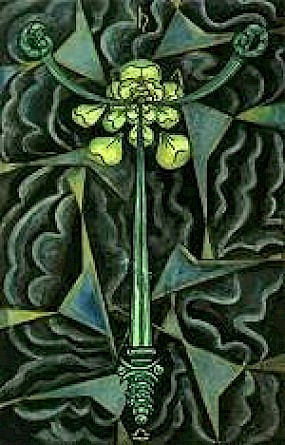
(via angelpaths.com and Alan Blackman)
Russell Brand The FDA is funded by the same Big Pharma & Corporations it regulates. What are the issues of the potential conflict of interests within this current system? #FDA#BigPharma#Corruption Elites are taking over! Our only hope is to form our own. To learn more join my cartel here https://www.russellbrand.com/join and get weekly bulletins too incendiary for anything but your private inbox. *not a euphemism Listen to my Luminary Original podcast, Under The Skin, to hear from guests including Edward Snowden, Jonathan Haidt, Jordan Peterson, Naomi Klein, Kehinde Andrews, Adam Curtis and Vandana Shiva. Subscribe to Luminary at http://apple.co/russell My NEW weekly meditation podcast, Above the Noise, is available now only on Luminary. SEE ME LIVE! Check out my live events and buy tickets here https://www.russellbrand.com/live-dates/ My Audible Original, ‘Revelation’, is out NOW! US: http://adbl.co/revelation UK: http://adbl.co/revelationuk AU: http://adbl.co/revelationau CA: http://adbl.co/revelationca For meditation and breath work, subscribe to my side-channel: https://www.youtube.com/c/AwakeningWi… Instagram: http://instagram.com/russellbrand/ Twitter: http://twitter.com/rustyrockets

Shivendra Misra · Nov 15, 2020 · Medium.com
“It’s almost as if science said, “Give me one free miracle, and from there the entire thing will proceed with a seamless, causal explanation.”’ The one free miracle was the sudden appearance of all the matter and energy in the universe, with all the laws that govern it.”
According to what we call science today, the Universe appeared out of nowhere. Everything fell perfectly into its place — the matter, the energies, and all the laws that govern them.
While only a few of us take time to question this hypothesis, it’s worth contemplating. Whether this statement is true or not will determine what kind of lives each one of us leads.
To give you an analogy, thinking that the Universe came out of nothing would be like saying that the device you’re reading this article on also appeared out of nowhere — where all the hardware and the batteries running the device fell into a perfect position governed by the laws of circuits that were also defined out of nowhere. Seems crazy, right? Thought so.
But before even trying to find out the truth of the statement and whether the Universe actually is the result of a random event, it’s worth asking why we even care about it.
The reason is simple. Let’s consider how our individual lives would be affected depending upon the worldview that we pick.
If you choose to believe that the Universe came out of nothing, then it is natural for you to feel isolated, alienated, lonely, fearful. In a world created haphazardly, all of us would be deemed as separate entities that also were born out of nowhere, and there would be every reason to care for your own survival at the cost of others.
The more you believe this worldview, the easier it would be for you to justify actions that most of us would consider immoral.
Now imagine, if man alternate worldview in which a central force created the Universe. This force not only guides the planets, stars, and all the celestial bodies in the Universe but also guides your life.
This then comes with the realization that all of us are in fact, one. We are not separate entities here to ensure our own survival at the cost of others. The same force that resides in me also resides in you and every other thing in this world. There’s no reason not to feel connected, loved, hopeful, and peaceful in a world like this.
Sadly, science, for most of its existence has tried to validate the former worldview. The more they validate their worldview, the more you feel fearful and disconnected from your inner reality. And even if you don’t feel it yourself, you see it in the malaise of the people around you.
On the other hand, the latter worldview has always been confirmed by yogis, saints, sages, and a lot of religions. In yogic science, the force from which the Universe came from and the force which guides our lives is known as Consciousness.
Consciousness is probably not a new term for you. Just like your lives are run by your individual consciousness, the Universe is created and governed by Cosmic Consciousness.
Traditional science has always been affirming what has been discovered by the yogic science millennia ago. Sooner or later, we come to natural conclusions that always end on what yogic science stated from the beginning.
And, if you think about it, it has to be that way. Every discovery should lead us to the Truth.
Perhaps skeptics would ask why hasn’t science been able to validate the existence of consciousness. And that is justified — for I’ve also been wondering about this.
Let’s see why
Mulla Nasreddin was a Sufi mystic who lived in the 13th century in present-day Turkey. His methods of teaching were different and he mainly taught through stories.
His stories were full of jokes and humorous anecdotes followed by a moral. Yet, even though most people stop at the moral, there’s usually something else in the story that brings the consciousness of a potential mystic closer to realization.
One of his stories goes like this.
Once Nasreddin lost his ring in the living room. He searched for it for a while, but since he could not find it, he went out into the yard and began to look there.
His wife, who saw what he was doing, asked: “Mulla, you lost your ring in the room, why are you looking for it in the yard?”
Mulla stroked his beard and said: “The room is too dark and I can’t see very well. I came out to the courtyard to look for my ring because there is much more light out here”.
That is precisely why we aren’t able to validate the presence of consciousness and why we can validate matter.
You see, the only difference between matter and consciousness is that we can measure and see matter with the mind, but consciousness has to be experienced internally.
Most of the researchers are looking for proof of the existence of consciousness outside themselves. But what they don’t realize is it cannot be perceived with the intellect or the mind alone. It’s a matter of the heart.
Take the case of a light bulb. A light bulb can shine the light on everything around it but not on the power that illuminates it. Similarly, you can see everything around you but not the consciousness that emanates from you. It’s beyond the normal functioning of the mind, the limits of intellect, and beyond thought.
And since we cannot validate its presence outside us or cannot contemplate it using our intellect, we deny its existence. This doesn’t seem right, does it?
Can you quantify or measure a mother’s love for a child? No. But does it mean it’s not there? No, again.
So that is the case with consciousness.
Now, even though I’ve bashed science for their follies, there are a few prominent individuals who’ve acknowledged the presence of this higher reality.
Max Planck was a Nobel Prize-winning German physicist and the father of quantum theory. His work in the field of theoretical physics led the way to many advances throughout the 20th century.
He said,
“I regard consciousness as fundamental. I regard matter as derivative from consciousness. We cannot get behind consciousness. Everything that we talk about, everything that we regard as existing, postulates consciousness.”
Next, consider what James Jeans, a physicist, astronomer, and mathematician had to say,
The stream of knowledge is heading towards a non-mechanical reality; the Universe begins to look more like a great thought than like a great machine. Mind no longer appears to be an accidental intruder into the realm of matter… we ought rather hail it as the creator and governor of the realm of matter — The Mysterious Universe
Further, when he was asked in an interview with Observer, “Do you believe that life on this planet is the result of some sort of accident, or do you believe that it is a part of some great scheme?” he said,
I incline to the idealistic theory that consciousness is fundamental, and that the material universe is derivative from consciousness, not consciousness from the material universe… In general the universe seems to me to be nearer to a great thought than to a great machine. It may well be, it seems to me, that each individual consciousness ought to be compared to a brain-cell in a universal mind.
And to bring more weight, to my argument, let me quote Einstein, the person who wanted to express God in an equation:
A human being is part of a whole, called by us the “Universe,” a part limited in time and space. He experiences himself, his thoughts and feelings, as something separated from the rest — a kind of optical delusion of his consciousness. This delusion is a kind of prison for us, restricting us to our personal desires and to affection for a few persons nearest us. Our task must be to free ourselves from this prison by widening our circles of compassion to embrace all living creatures and the whole of nature in its beauty
— Written in a letter as consolation to Robert S. Marcus, political director of the World Jewish Congress, whose young son had just died of polio
Interesting right? Well, even though Einstein wanted God on a piece of paper, he realized that even if he got a near-perfect equation, it would be useless — or doing something like this would be like describing Mozart’s music in the form of sound waves. You could potentially do it, but would you really grasp the spirit and the meaning of the music?
He often called his belief system a “cosmic religion” because for him “science without religion is lame, religion without science is blind.”

Eben Alexander became famous after his book Proof of Heaven: A Neurosurgeon’s Journey into the Afterlife became a New York Times bestseller. He described his experience in the afterlife before coming back out and into consciousness.
In 2008, he became ill with acute bacterial meningoencephalitis. His condition with a rapid decline in neurologic function conferred a 90 percent mortality rate.
For one week he was in a coma, brain dead. Yet, on the seventh day, when he opened his eyes his expressions were startling.
He writes in his personal account,
“A family friend who was there could not get over how my amazed expression looked more like the astonished gaze of an infant, not like what one would expect from an adult returning from an unconscious state.”
A person recovering from such a state is not expected to live let alone remember his coma’s memories. “Thus, you can imagine my surprise at remembering an elaborate and rich odyssey from deep within coma that comprised more than 20,000 words by the time I had written it all down during the six weeks following my return from the hospital”, he continues.
While I won’t go into the details of what he saw exactly, he was clearly transported to a different consciousness level. For him, God seemed too puny a word described the power, majesty, and awe he had experienced.
He further says, “I originally referred to that deity as Om, the sound that I recalled from that realm as the resonance within infinity and eternity.”
All his experiences can be conveniently disregarded as hallucinations as the traditional scientific community has been doing for ages. Yet, Eben argues that “The conventional reductive materialist (physicalist) model embraced by many in the scientific community, including its assumption that the physical brain creates consciousness and that our human existence is birth-to-death and nothing more, is fundamentally flawed.”
For Eben, the world will never be the same and he’s trying to convince the scientific community to graduate from Kindergarten and explore the possibilities of consciousness.
As you can see from Eben’s experience, those who get a glimpse of such consciousness cannot shut up or stop talking about it. It is not therefore a hallucination but is very real as much as the material reality around us.
You can read about a similar experience here.
These Near-Death Experiences (NDEs) have long remained a source of mystery for science since they’re always unable to explain what happened.
Eben himself came up with several models in neurophysiology and neuroanatomy but none could explain what he experienced.
Key characteristics of such NDEs include a sense of profound peace, unconditional love, leaving the physical body, light,
Yet, NDEs are not the only way you can go into such states.
There’s a scientific method and yogis and sages have been telling us for millennia — meditation.
It’s how you can calm the senses, still the body, still the mind and your thoughts. Once you do that (a herculean task in itself), then you can experience what many people have reported previously.
You can only find the Core Reality behind the fringe of your mind, once everything comes to a halt — that is, everything that makes you human and brings you into matter-consciousness.
If Descartes said, “I think, therefore I am,” the yogis would say, “When I stop thinking, then I really am.”
In that sense, everything you’re experiencing is just a delusion trying to get you away from experiencing that Reality. And if that Reality is the source and the essence of our being, there’s no reason to not try to know that.
Just as with the development of technology, the world has become a smaller place, with the development of meditation ability and “technology” the Universe can become a smaller place.
P.S. This article was largely motivated by Dada Gunamuktananda’s TED talk.