Gwyllm’s Newsletter

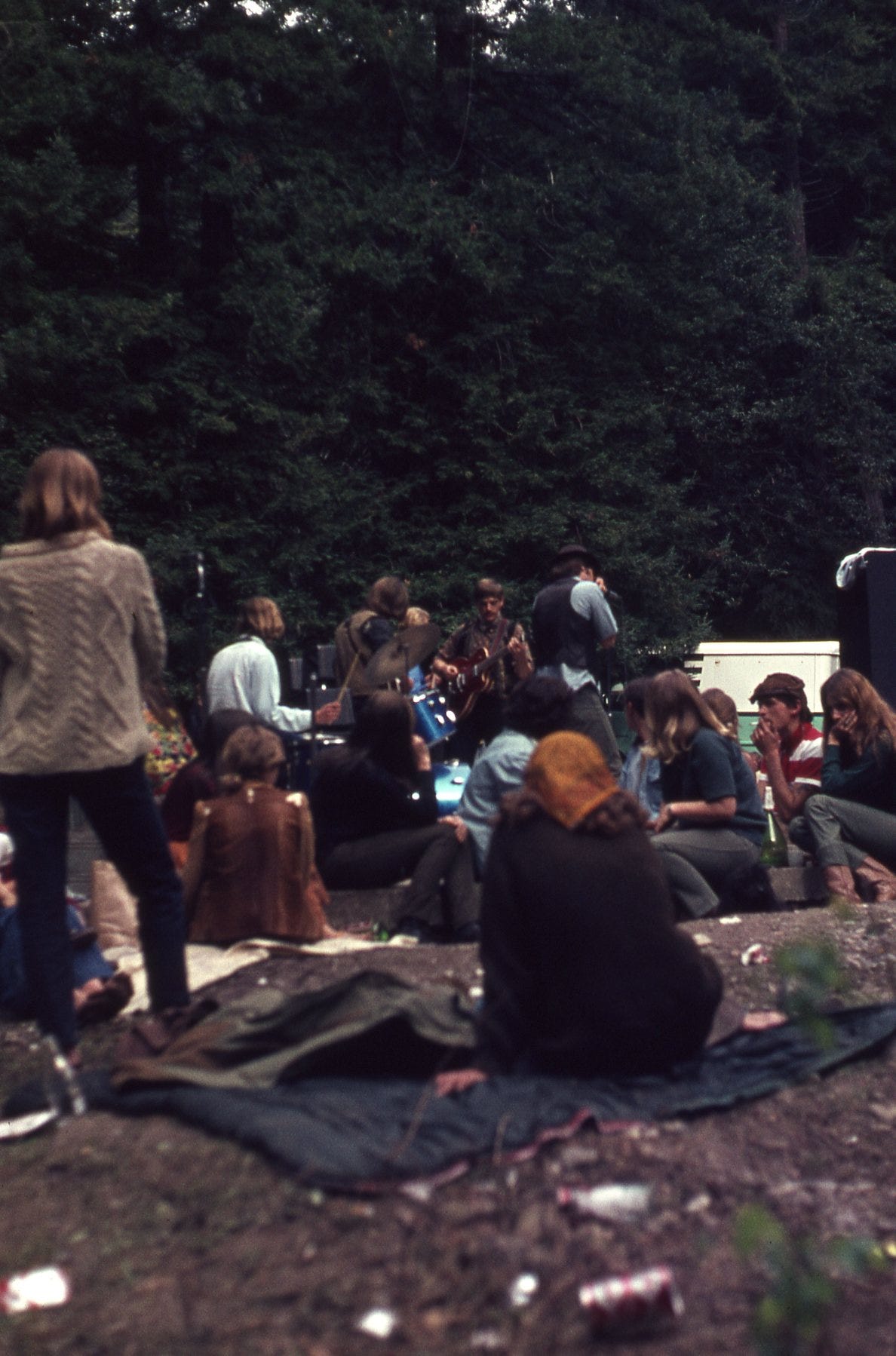
LimeKiln Big Sur, 1968

Gwyllm Llwydd Sep 12, 2021 (gwyllmllwydd.substack.com)

A wee intro:

I’ve had a blog for nearly 19 years, it started out as “Turfing” It later evolved to the “Hare’s Tale” which is still ongoing on my website Gwyllm.Com … you might want to check it out as it’s content is much different than what will be appearing here on substack.

This is a new direction for me. I have been reticent to put down the tales and stories that are part of my time here. I’ve been encouraged by friends over the years to do so and finally what is happening here on sub stack with my writings is that I am taking the plunge and getting them down while I have the chance.

Some of the tales will be from years long gone by and others will be of more recent occurrences. I have been blessed in my lifetime to stumble on and participate in amazing events that I think (at least for me) have cultural significance.

Hopefully you’ll enjoy these stories and I do appreciate any feedback on them that you can give.

I love the concept that the human world is made up of words and stories. I have been enthralled with the spoken word and stories since I was very young… who doesn’t like to sit around a fire or in a room and have someone take you into mythological places that we can have it with a well turned tale?

Some of these stories will center around the late ’60s and early ’70s. There is a demarcation there at least for me around 1972. From 1972 to about 1980 is another phase for these stories. In the late seventies into the ’80s it’s another zone, and so on. You see where this is going, it laps decades but it doesn’t lap cultural trends and shifts in consciousness.

Gwyllm

Enough Of That….

Limekiln

I don’t tell this story often, but to those who understand…. Enjoy.

Anyway, early 1968. I had fled the Haight, after the riots and being popped there, in Colorado and Malibu all within a month. (1 arrest for jaywalking, another for hitchhiking, and the previous one, busted for marijuana in Boulder) At that point in my life, all I had to do was walk outside or be riding a bicycle down Highway 1 and I would get pulled over, and frisked.  The US was… a little tense about creatures with long hair at that point… 🙂

So, in a mild state of desperation when I finally got back to San Francisco, I’d thrown The I-Ching for a solution to my legal run-ins, and it suggested I go south out of the different choices I posed in my question. So south I went, heading to Big Sur on the recommendations from flat mates in San Francisco.

I hitched down the coast, marveling as I went, and found myself eventually in Limekiln. Limekiln was a bit of beauty, a lovely creek runs through it, down to the sea. At the confluence of the waters, I was told that the Esalen people buried their dead long ago. Achingly beautiful, you could sit there for hours, and I did… I began to find healing there.

I explored Big Sur, spending time in Esalen (hanging out with Michael Murphy and others at the Hot Tubs) and up at the Big Sur Store etc. You could sit alongside the road for up to an hour before a car would come in either direction, sometimes longer. More than likely the first vehicle coming along your direction would pick you up. I had people going the other direction pull around and give me a lift up the road for the heck of it. I met wonderful people, yet Big Sur itself was the real deal for me. I fell in love with Lime Kiln more than anywhere, it had real magick. I would wander up into the hills, and be totally alone.

I took to exploring up the canyon, walking through the Sequoia up to the kilns through the meadows festooned with poison oak and fern, moving through the shafts of light coming down through the trees. I would sit on the outcroppings of rock, silent – listening to the forest. I took to practicing meditation as I knew it, and when done with that would examine my life and feelings. It wasn’t a bad thing to examine; I had clarity finally after all the time spent on the street or in jail, or on the run. It had been a twisted path. I would pass the days then, meditating upon, examining and exploring either the inner spaces or the country side. It all blended. Sleeping at night next to the stream, peering up through the trees at the stars, stirred deep waters in my soul.

As time went along I was joined by a close friend escaping from San Francisco. We would hang out down by the shore, where there was another camp site, with VW buses and vans of various types. The main resident of interest was a beautiful young woman, who would be there much all the time. She had long curly blond hair, and a fair complexion often taken to sitting on the rocks looking out over the sea. Most of the other campers were male, and they were all enthralled; she would smile, and on the weekend be joined by her lover. Still, some guys pursued just the same. As young men we were deeply impressed with her, as she would sit looking out to the sea. It was all very heady!

One afternoon of absolute stillness: I sat by the path, under the trees, bathed in light filtering through the boughs and branches. There was an intricate dance being performed between two banana slugs, slowly circling and circling. It goes on for an hour or more spiraling, and then they meet, shivering against each other. This goes on for hours, at least in my mind. Such beauty! I realize it has been a mating dance the whole time. I leave the lovers as the shadow fall.

People came and went over the weeks, and we finally ended up with a nice group who enjoyed each others company. We formed a camp together, cooking, and drinking tea, getting high. I continued to spend most of my time wandering the canyons, and along the shore alone. It was a golden time.

There were others at the camp sites strewn up the hill from the beach. Everyone was on the road in some way or another, having arrived at where they were heading or hesitating on this part of the coast. I learned more about the casting of the I-Ching, playing and working with it daily with one of the older men at the canyon campground. He was quite eager to teach me, and I was all ears. He would go over the Hexagrams, and used yarrow sticks rather than coins, “It doesn’t matter” he said, indicating that whatever tools that I used would be appropriate. He talked for hours about the practice, and how to use it properly. I drank it all in.

The weeks were quiet, but the weekends were crazed, generally we had plenty of room between our camps, but when the weekend would arrive, there would be a deluge of vehicles down from San Francisco and Santa Cruz. A handful would translate into hundreds for two days. People coming down from the Bay area, and Santa Cruz. Acid was of course everywhere, and parties went all night long. The weekends were festivals really, and full of joy and discovery. I had stepped away from Acid by that point, though I still enjoyed being around people who were experiencing it. One of the strangest sights I ever saw were a beautiful couple who had come down from the Haight, (and obviously on Acid) in the middle of a giant poison oak patch making slow, languorous love. As I drifted by on the edge of the clearing in my own daze they looked up, smiled and waved. I waved back, and kept on going up deeper into the hills to the kilns. I cannot imagine what the evening was like for them… Friends came and went, and often I had the camp site to myself for days on end. Come Sunday night, the campgrounds would have pretty much emptied out. The locals would gather and we’d sit around the fire talking about the events of the previous days.

One event stands out… A visitor down from Santa Cruz, a friend of a friend who was high on Acid one day. He came running down the canyon towards us, bubbling about a great discovery, when in his excitement, tripped over a root and fell. He laid there dazed for a moment, and then started screaming. I ran up to him, and he was gesturing at his right ankle. His foot was at a 45 degree angle, having snapped it in his fall. I sat with him, calming him as best as possible. Someone headed out to where there was a phone to call the ambulance. (I have no idea where a phone was, or can’t remember now). I sat with him getting him to chant with me as he could, cradling him when he panicked. We heard the ambulance in about 45 minutes, coming up the Coast Highway.

“I can’t do it! I can’t do it! I can’t do it! I can’t go to the hospital when I am tripping” he said to me. “Yes you can. You are going to maintain, you are going to remain calm. You can do this.” I replied.

The paramedics arrived, they gently put him on the stretcher and I walked along with him down to the road. He reached over and grabbed my hand just before they loaded him in the ambulance and took him to San Luis Obispo. I never saw him again. I have wondered about him over the years, and what transpired…

A few weeks in a friend visiting from the Haight brought a battery powered tape machine with speakers (a rarity then!) with early French field recordings of North African music. It was mid week so we had Limekiln pretty much to ourselves. It was late at night, the fog was rising up from the Ocean and we were smoking hashish as we sat around the fire listening to music from the Maghreb, and elsewhere. It was very transporting. I had heard Sandy Bull, but hearing the real thing, well.

That night, the moon was full, and incredibly bright, as we sat listening to the music, watching the tendrils of fog waft up through the forest towards us. One tendril was drifting up from the ocean, and it meandered slowly along the path. As I sat there listening with my friends the fog tendril drifted closer and closer. The tendril reached us; out of the fog emerged a vision; an old Indian who stood there looking at us. Everyone at the fire saw him. We sat transfixed as he looked us over. Ancient, ancient, ancient… There was this feeling of communication between him and everyone around the fire. After what seemed an eternity he turned, and headed deeper up the canyon with the fog. We all acknowledged what we had seen. I took it as a sign, but of what? That unfolded over the years. Vision comes, but answers are different. It was for me a turning point in my life.

I can still see him peering at us, emerging as the fog, part but not. It was deeply moving. There was a deep sorrow in it, and a beauty.

I had felt presences before, especially regarding the land through peyote. I had memories of the wee folk in Newfoundland that talked with me as a very young child in the woods, but this vision is the one that leaps out when I summon it. So, in this life I have been blessed. Only in the last few years have I realized that most go through their lives without these events. I cannot fathom how that would feel.

I lingered for another week or so at Lime Kiln I was getting antsy and I felt that I had to move on. It was like a pressure, perhaps a message/intuition from the future.

One of the concerns at that point especially among the crowd I was with was the possibility of the Asteroid Icarus predicted to impact Earth in the coming month of June. All kinds of discussion whirled around this. It was all very apocalyptic and paranoid of course. (Fueled no doubt by the consumption of various substances.)

I was talking to one of the older people in the campground, a guy that would probably be considered a Beat (generation wise) about this. He said “I see you have two choices here you can either go to Mexico down to Oaxaca where the mushroom fields are or you can go up to Northern California in the Siskiyou Mountain Wilderness.” I sat up by the fire, smoking hash thinking about all of possibilities that night.

Next morning after tea I got out the I Ching and the coins that I was using at that point and asked “should I go north or should I go south?” I tossed the coins, meditating on the question as I did so. After the throws, I opened up the proper hexagrams and although I have never found it since the passage read thus: “Go north young man good fortune will be yours.” Of course I took this to heart. I got my pack together and left the next morning hitchhiking over the mountains into Central California heading north to the Siskiyou’s. What should have taken a day a day and a half and ended up taking a week (another tale altogether!)

I didn’t return to Big Sur until nearly 20 years later with my wife for a long delayed honeymoon. That of course is a story in another time line.

Thank You For Reading….

Gwyllm

Lime Kiln spring equinox 68 (I had left by then)
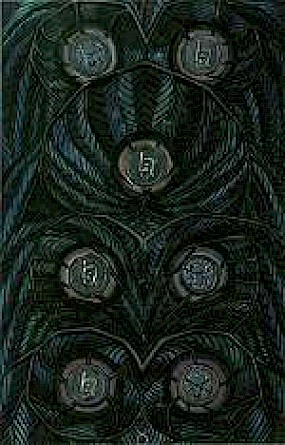
Tarot card for September 13: The Seven of Disks

The Seven of Disks

The Lord of Failure is another of those cards we don’t welcome too much in a reading – but things are not quite as bad as they seem with this one. Generally the card will come up to mark a difficult period in material life. That job you went after probably won’t be offered to you; your bank balance is giving you problems; you don’t seem to be able to get on top of things no matter how you try; unexpected bills turn up, causing you worry.

If you find yourself having a real run of bad financial fortune, it’s time to examine your own reactions to making a success of yourself. If you believe you’ll fail, then you surely will. If you allow fears about money and security to dominate your experience, then everything will be darkened by your own expectations. Remember – we have a major role in creating our own reality. If we expect negative things, we are inviting them into our lives.

So the solution is to see things from a different point of view. By affirming the positive things that we do for ourselves in the material sphere, we will improve that area of our lives – this is true of any area. So even when things are looking very black, it’s important to try to keep our fears under control, and to bear in mind that what we give out is what we get back.

The Seven of Disks will always indicate tension connected to our material life, whether fleeting or long term. This is another card where it is important to carefully assess what else comes up nearby in order to work out how serious the influence is. Where our own inner fears are causing our problems, we must be prepared to take charge.

The Seven of Disks

(via angelpaths.com and Alan Blackman)

Live Reading of The Little Prince by Antoine de Saint-Exupéry

Seekers of Unity Reading The Little Prince by Antoine de Saint-Exupéry to celebrate ten thousand subscribers. Join us: https://facebook.com/seekersofunityhttps://instagram.com/seekersofunityhttps://www.twitter.com/seekersofUhttps://www.seekersofunity.com Thank you to our beloved Patrons: Mendel, Jared, Tim, Mystic Experiment, MM, Lenny, Justin, Joshua, Jorge, Wayne, Jason, Caroline, Yaakov, Daniel, Wodenborn, Steve, Collin, Justin, Mariana, Vic, Shaw, Carlos, Nico, Isaac, Frederick, David, Ben, Rodney, Charley, Jonathan, Chelsea, Curly Joe and Adam. Join them in supporting us: patreon: https://www.patreon.com/seekers paypal: https://paypal.com/paypalme/seekersofu

The Gratitude Chain

TED Radio Hour September 10, 2021 (podcasts.google.com)
Listen Again: The Gratitude Chain: A.J. Jacobs
• 53 min

Link to podcast: https://podcasts.google.com/feed/aHR0cHM6Ly9mZWVkcy5ucHIub3JnLzUxMDI5OC9wb2RjYXN0LnhtbA/episode/OTU1ZTNhOWQtNWEzMy00YTE1LWE1NzMtODNhYWM5MjRmOGYw?hl=en&ved=2ahUKEwjVrv3Sk_ryAhV7CjQIHXPDAMIQieUEegQIBhAF&ep=6

Original broadcast date: February 19, 2021. When A.J. Jacobs set out to thank everyone who made his morning cup of coffee, he realized the chain of thank-yous was endless. This hour, Jacobs shares ideas on gratitude—and how to make it count.

(Contributed by Suzanne Deakins, H.W., M.)

“The true meaning of every word is God”

Festival of Faiths SACRED WISDOM: Pathways to Nonviolence – FESTIVAL of FAITHS 2016 Week Passes available: http://www.FestivalofFaiths.org/ Louisville, KY · May 17 – 21 A FIVE-DAY FESTIVAL of music, poetry, film, art and dialogue with internationally renowned spiritual leaders, thinkers and practitioners. The 2016 Festival of Faiths will explore how different spiritual traditions, teachers and practitioners address violence, heal our wounds and teach active commitment to nurturing peace in ourselves and in the world. “The peace produced by grace is a spiritual stability too deep for violence – it is unshakeable.”- Thomas Merton Join the Conversation. Join the Movement. #SACREDWISDOM Seyyed Hossein Nasr, one of the world’s leading experts on Islamic science and spirituality, and Swami Atmarupananda, renowned teacher of Hinduism, will talk about Compassion as being intrinsic to who we really are — the true Self, the “image of God” which is free of all alienation. And that is wisdom itself, love itself, discovered in inner silence — the still point that unites us to both God and the universe. http://www.festivaloffaiths.org

What makes a great astrologer?

by Astro Butterfly (astrobutterfly.com

One of my readers asked yesterday if it’s truly possible to learn astrology in 10 weeks. They suggested that in order to become a great astrologer, one should read at least 100 charts. In other words, you need a considerable amount of time to become a great astrologer.

This is what I answered:

That’s right, if you want to become a great astrologer, you should read at least 100 charts. Anyone who wants to become top 1% of their profession, has to dedicate a considerable amount of time and resources to get there. Getting to 1%, achieving true mastery is Saturn’s work – pretty much a lifetime journey.

HOWEVER. You can still help people with astrology even if you’re not yet in the top 1% (or top 10%, or even top 30%). You can help people with astrology as long as 1) you know more astrology than them and 2) you use the right consulting frameworks to present the information in a way that is empowering.

Chances are, even if you’re what you consider an “astrology beginner” you can still help most people learn more about themselves, and navigate through life with the help of astrology.

But this very valid question got me thinking about what are the contributing factors that can speed up (or slow down) the learning process.

Upon reflection, I’ve come up with 4 factors that can predict your success as an astrologer, and whether or not you can learn to give basic readings in 10 weeks:

  1. You have an “astrologer” profile, i.e. you have certain skills and talents that make it easier to connect with, and understand a multi-layered topic like astrology
  2. You have life experience. To help other people with astrology (and to do pretty much any counselling work) you need to graduate from Saturn’s “school of hard knocks” – which means you’ve had your 1st Saturn return, i.e. you’re at least 29 years old
  3. You are a high-speed learner, i.e. you pick up new topics quickly. Not all of us are blessed with high-caliber learning skills, but if you are, then you definitely have an advantage, in the sense that you can learn astrology (and any other topic) much faster
  4. You have the right astrology frameworks. You could learn astrology all by yourself, but you’ll probably need decades of trial and error. As with anything else you learn, the quality of structured frameworks makes a big difference.

From all these factors, factor 4) frameworks, is the #1 deal-breaker. There are still many astrology enthusiasts who believe that they can learn astrology by themselves. And if astrology is something “just for fun” of course, there’s no need to study it formally.

But learning astrology without tools and frameworks is like learning a new language without a dictionary. With 3000 students and years of experience of producing astrology courses and educational experiences, we are proud to have come up with an excellent framework to learn astrology and read natal charts in the Astro Butterfly Wings chart reading certification program.

Of course, 4) “astrology frameworks” is not enough. If you want to learn how to read charts in 10 weeks, you’ll need at least one of the other 3 factors 1) an astrologer profile, or 2) life experience, or 3) learning skills.

If you have more than 1, even better, but 1 is the minimum.

So you’ll need either a) an astrologer profile, OR b) life experience, OR c) learning skills.

Let’s talk a little bit about these 4 factors:

1) You have an astrologer profile. If you’re not an advanced astrology student yet, you may not even know whether you have an astrologer profile. The good news is that there are high chances that your interest in astrology is also backed up by some in-built astrologer “genes”.

People with no astrology markers in their charts are usually those people who don’t ‘believe’ in astrology anyway. Some of the ‘astrology signatures’ in the chart are a prominent Uranus, Jupiter or Chiron, or an above average number of planets in Air or Water signs. Of course, these are just some examples.

2) Life experience matters – the more, the better. Of course, age is just a number, and someone who has been through a lot by the age of 20 may have more life experience than someone who is 50, but has never ventured outside their comfort zone.

However, astrologically speaking, the Saturn return (which happens at the age of 29) is a pretty good indicator of whether we have ‘enough’ life experience to consult other people.

People with lots of life experience tend to have more sympathy, and they just ‘know’ what to say, and even more importantly, what NOT to say.

Of course, there are excellent astrologers who haven’t turned 29 yet, so this is definitely not a deal breaker – but it helps!

3) Learning skills – there are people who just learn faster than others. We’ve seen people who don’t have any astrological signatures in their chart and haven’t had their Saturn return, yet become excellent astrologers because they have the ability to learn pretty much anything. This is you if you quickly grasp new concepts, have good analysis/synthesis skills and are open to feedback.

4) Astrology frameworks – frameworks make it easier to put “2 and 2” together and see the big picture. Astrology is a very complex topic, so it’s not enough to learn what Venus in Gemini, or what Mars in the 2nd house means. You need frameworks to put all these different elements of the chart into context – so that you learn how to read charts holistically.

“Frameworks” doesn’t only mean educational material – it means the entire learning experience. When you have access to a teacher, when you’re part of a group of people studying the same topic at the same time – learning skyrockets. We’ve seen it again and again, and that’s why we only run this chart-reading program live.

If you have any of 1) astrology profile, or 2) life experience, or 3) learning skills, and you’re looking for a quality 4) framework, then we invite you to join the Astro Butterfly Wings Certification Program (make sure you click on the link that best describes your astrology starting point, Beginner or Intermediate/Advanced).

Astro Butterfly Wings BEGINNERS Group

Astro Butterfly Wings INTERMEDIATE and ADVANCED Group

Seyyed Hossein Nasr – Eternal Life is being “Fused but not Confused”


Closer To Truth
How to imagine the experience of eternal life? Would we sense ourselves? How would we feel? Whom would we know? What would we do? What would God do? Living forever seems so absurd, yet eternal life is the promise of almost every religion. But if we cannot even imagine what eternal life will be, how can we have hope in its reality? Free access to Closer to Truth’s library of 5,000 videos: http://bit.ly/376lkKN Watch more interviews on life after death: https://bit.ly/2K7iYG0 Seyyed Hossein Nasr is an Iranian University Professor of Islamic studies at George Washington University, and a prominent Islamic philosopher. Register for free at CTT.com for subscriber-only exclusives: http://bit.ly/2GXmFsP Closer to Truth presents the world’s greatest thinkers exploring humanity’s deepest questions. Discover fundamental issues of existence. Engage new and diverse ways of thinking. Appreciate intense debates. Share your own opinions. Seek your own answers.

Bio: Michele Besso

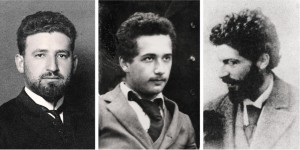
Marcel Grossmann (left) and Michele Besso (right), university friends of Albert Einstein (centre), both made important contributions to general relativity. Credit: Grossmann, Einstein: ETH-Bibliothek Zürich/Bildarchiv; Besso: Besso Family/AIP Emilio Segre Visual Archives

From Wikipedia, the free encyclopedia

Michele Angelo Besso (Riesbach, 25 May 1873 – Geneva, 15 March 1955) was a Swiss/Italian engineer.[1]

Besso was born in Riesbach from a family of Italian Jewish (Sephardi) descent. He was a close friend of Albert Einstein during his years at the Federal Polytechnic Institute in Zurich,[2] today the ETH Zurich, and then at the patent office in Bern, where Einstein helped him to get a job.[3] Besso is credited with introducing Einstein to the works of Ernst Mach, the sceptical critic of physics who influenced Einstein’s approach to the discipline.[4] Einstein called Besso “the best sounding board in Europe” for scientific ideas.[5] In Einstein’s original paper on Special Relativity, he ended the paper stating, “In conclusion, let me note that my friend and colleague M. Besso steadfastly stood by me in my work on the problem here discussed, and that I am indebted to him for many a valuable suggestion.”[6]

Besso died in Geneva, aged 81. In a letter of condolence to the Besso family, Albert Einstein wrote “Now he has departed from this strange world a little ahead of me. That means nothing. For us believing physicists the distinction between past, present, and future only has the meaning of an illusion, though a persistent one.”[7] Einstein died one month and 3 days after his friend, on 18 April 1955.

More at: https://en.wikipedia.org/wiki/Michele_Besso

Bio: Émilie du Châtelet

From Wikipedia, the free encyclopedia

Émilie du Châtelet
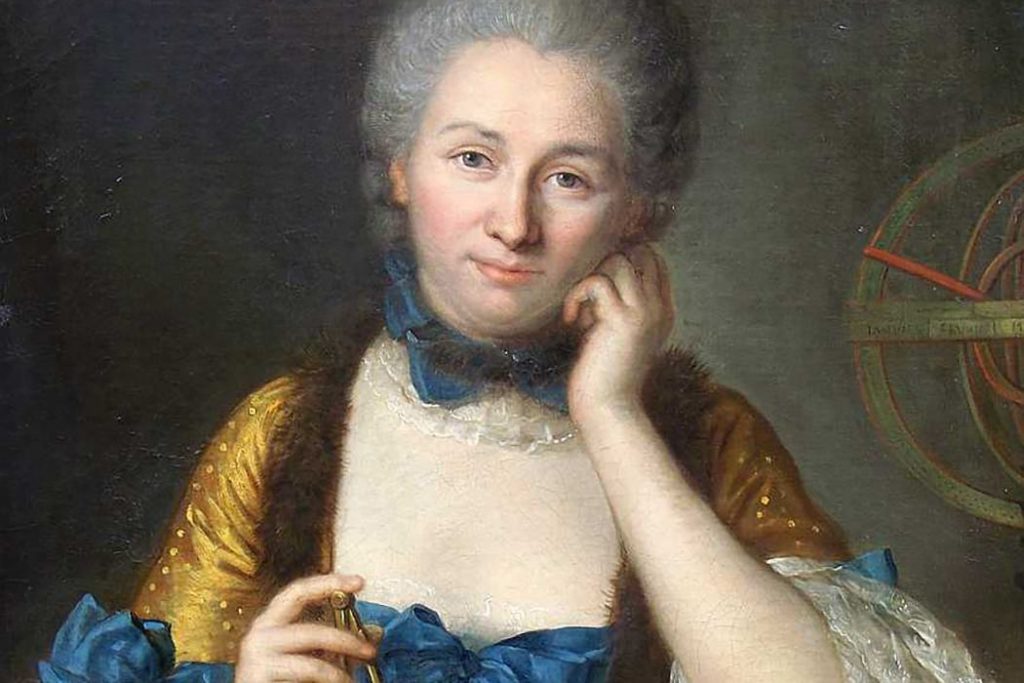
Portrait by Maurice Quentin de La Tour
Born17 December 1706
ParisKingdom of France
Died10 September 1749 (aged 42)
LunévilleKingdom of France
NationalityFrench
Known forTranslation of Newton’s Principia into French, natural philosophy which combines Newtonian physics with Leibnizian metaphysics, and advocacy of Newtonian physics
Spouse(s)Marquis Florent-Claude du Chastellet-Lomont​​(m. 1725)​
Partner(s)Voltaire (1733–1749)
ChildrenFrançoise Gabriel PaulineLouis Marie FlorentVictor-EspritStanislas-Adélaïde du Châtelet
Scientific career
FieldsNatural philosophyMathematicsPhysics
InfluencesIsaac NewtonGottfried LeibnizWillem ‘s Gravesande
Signature

Gabrielle Émilie Le Tonnelier de Breteuil, Marquise du Châtelet (French pronunciation: [emili dy ʃɑtlɛ] (listen); 17 December 1706–10 September 1749) was a French natural philosopher and mathematician during the early 1730s until her death due to complications during childbirth in 1749. Her most recognized achievement is her translation of and commentary on Isaac Newton‘s 1687 book Principia containing basic laws of physics. The translation, published posthumously in 1756, is still considered the standard French translation today. Her commentary includes a profound contribution to Newtonian mechanics—the postulate of an additional conservation law for total energy, of which kinetic energy of motion is one element. This led to her conceptualization of energy as such, and to derive its quantitative relationships to the mass and velocity of an object.

Her philosophical magnum opus, Institutions de Physique (Paris, 1740, first edition), or Foundations of Physics, circulated widely, generated heated debates, and was republished and translated into several other languages within two years of its original publication. She participated in the famous vis viva debate, concerning the best way to measure the force of a body and the best means of thinking about conservation principles. Posthumously, her ideas were heavily represented in the most famous text of the French Enlightenment, the Encyclopédie of Denis Diderot and Jean le Rond d’Alembert, first published shortly after du Châtelet’s death. Numerous biographies, books and plays have been written about her life and work in the two centuries since her death. In the early 21st century, her life and ideas have generated renewed interest.

Émilie du Châtelet had, over many years, a relationship with the writer and philosopher Voltaire.

Contribution to philosophy

In addition to producing famous translations of works by authors such as Bernard Mandeville and Isaac Newton, Du Châtelet wrote a number of significant philosophical essays, letters and books that were well known in her time.

Because of her well-known collaboration and romantic involvement with Voltaire, which spanned much of her adult life, for generations Du Châtelet has been known as mistress and collaborator to her much better known intellectual companion. Her accomplishments and achievements have often been subsumed under his, and as a result, even today she is often mentioned only within the context of Voltaire’s life and work during the period of the early French Enlightenment. The ideals of her works spread from the ideals of individual empowerment to issues of the social contract.

Recently, however, professional philosophers and historians[citation needed] have transformed the reception of Du Châtelet. Historical evidence indicates that Du Châtelet’s work had a very significant influence on the philosophical and scientific conversations of the 1730s and 1740s – in fact, she was famous and respected by the greatest thinkers of her time.

Du Châtelet corresponded with renowned mathematicians such as Johann II Bernoulli and Leonhard Euler, early developers of calculus. She was also tutored by Bernoulli’s prodigy students, Pierre Louis Moreau de Maupertuis and Alexis Claude ClairautFrederick the Great of Prussia, who re-founded the Academy of Sciences in Berlin, was her great admirer, and corresponded with both Voltaire and Du Châtelet regularly. He introduced Du Châtelet to Leibniz’s philosophy by sending her the works of Christian Wolff, and Du Châtelet sent him a copy of her Institutions.

Her works were published and republished in Paris, London, and Amsterdam; they were translated into German and Italian; and, they were discussed in the most important scholarly journals of the era, including the Memoires des Trévoux, the Journal des Sçavans, the Göttingische Zeitungen von gelehrten Sachen, and others. Perhaps most intriguingly, many of her ideas were represented in various sections of the Encyclopédie of Diderot and D’Alembert, and some of the articles in the Encyclopédie are a direct copy of her work (this is an active area of current academic research – the latest research can be found at Project Vox, a Duke University research initiative).

Biography

Early life

Émilie du Châtelet was born on 17 December 1706 in Paris, the only girl amongst six children. Three brothers lived to adulthood: René-Alexandre (b. 1698), Charles-Auguste (b. 1701), and Elisabeth-Théodore (b. 1710). Her eldest brother, René-Alexandre, died in 1720, and the next brother, Charles-Auguste, died in 1731. However, her younger brother, Elisabeth-Théodore, lived to a successful old age, becoming an abbot and eventually a bishop. Two other brothers died very young.[1] Du Châtelet also had an illegitimate half-sister, Michelle, who was born of her father and Anne Bellinzani, an intelligent woman who was interested in astronomy and married to an important Parisian official.[2]

Her father was Louis Nicolas le Tonnelier de Breteuil, a member of the lesser nobility. At the time of Du Châtelet’s birth, her father held the position of the Principal Secretary and Introducer of Ambassadors to King Louis XIV. He held a weekly salon on Thursdays, to which well-respected writers and scientists were invited. Her mother was Gabrielle Anne de Froullay, Baronne de Breteuil.[3]

Early education

Du Châtelet’s education has been the subject of much speculation, but nothing is known with certainty.[4]

Among their acquaintances was Fontenelle, the perpetual secretary of the French Académie des Sciences. Du Châtelet’s father Louis-Nicolas, recognizing her early brilliance, arranged for Fontenelle to visit and talk about astronomy with her when she was 10 years old.[5] Du Châtelet’s mother, Gabrielle-Anne de Froulay, was brought up in a convent, at the time the predominant educational institution available to French girls and women.[5] While some sources believe her mother did not approve of her intelligent daughter, or of her husband’s encouragement of Émilie’s intellectual curiosity,[5] there are also other indications that her mother not only approved of Du Châtelet’s early education, but actually encouraged her to vigorously question stated fact.[6]

In either case, such encouragement would have been seen as unusual for parents of their time and status. When she was small, her father arranged training for her in physical activities such as fencing and riding, and as she grew older, he brought tutors to the house for her.[5] As a result, by the age of twelve she was fluent in LatinItalianGreek and German; she was later to publish translations into French of Greek and Latin plays and philosophy. She received education in mathematics, literature, and science.

Du Châtelet also liked to dance, was a passable performer on the harpsichord, sang opera, and was an amateur actress. As a teenager, short of money for books, she used her mathematical skills to devise highly successful strategies for gambling.[5]

Marriage

On 12 June 1725, she married the Marquis Florent-Claude du Chastellet-Lomont.[7][note 1] Her marriage conferred the title of Marquise du Chastellet.[note 2] Like many marriages among the nobility, theirs was arranged. As a wedding gift, the husband was made governor of Semur-en-Auxois in Burgundy by his father; the recently married couple moved there at the end of September 1725. Du Châtelet was eighteen at the time, her husband thirty-four.

Children

The Marquis Florent-Claude du Chastellet and Émilie du Châtelet had three children: Françoise-Gabrielle-Pauline (30 June 1726 – 1754, married in 1743 to Alfonso Carafa, Duca di Montenero), Louis Marie Florent (born 20 November 1727), and Victor-Esprit (born 11 April 1733).[8] Victor-Esprit died as an infant in late summer 1734, likely the last Sunday in August.[9] On 4 September 1749 Émilie du Châtelet gave birth to Stanislas-Adélaïde du Châtelet (daughter of Jean François de Saint-Lambert). She died as an infant in Lunéville on 6 May 1751.[10]

Resumption of studies

In 1733, aged 26, Du Châtelet resumed her mathematical studies. Initially, she was tutored in algebra and calculus by Moreau de Maupertuis, a member of the Academy of Sciences; although mathematics was not his forte, he had received a solid education from Johann Bernoulli, who also taught Leonhard Euler. However by 1735 Du Châtelet had turned for her mathematical training to Alexis Clairaut, a mathematical prodigy known best for Clairaut’s equation and Clairaut’s theorem. Du Châtelet resourcefully sought some of France’s best tutors and scholars to mentor her in mathematics. On one occasion at the Café Gradot, a place where men frequently gathered for intellectual discussion, she was politely ejected when she attempted to join one of her teachers. Undeterred, she simply had some men’s clothing made for herself and strolled back in.[11]

Relationship with Voltaire

In the frontispiece to Voltaire‘s book on Newton’s philosophy, du Châtelet appears as Voltaire’s muse, reflecting Newton’s heavenly insights down to Voltaire.

Du Châtelet may have met Voltaire in her childhood at one of her father’s salons; Voltaire himself dates their meeting to 1729, when he returned from his exile in London. However, their friendship developed from May 1733 when she re-entered society after the birth of her third child.[4]

Du Châtelet invited Voltaire to live at her country house at Cirey in Haute-Marne, northeastern France, and he became her long-time companion. There she studied physics and mathematics and published scientific articles and translations. To judge from Voltaire’s letters to friends and their commentaries on each other’s work, they lived together with great mutual liking and respect. As a literary rather than scientific person, Voltaire implicitly acknowledged her contributions to his 1738 Elements of the Philosophy of Newton, where the chapters on optics show strong similarities with her own Essai sur l’optique. She was able to contribute further to the campaign by a laudatory review in the Journal des savants.[12]

Sharing a passion for science, Voltaire and Du Châtelet collaborated scientifically. They set up a laboratory in Du Châtelet’s home. In a healthy competition, they both entered the 1738 Paris Academy prize contest on the nature of fire, since Du Châtelet disagreed with Voltaire’s essay. Although neither of them won, both essays received honourable mention and were published.[13] She thus became the first woman to have a scientific paper published by the Academy.[14]

More at: https://en.wikipedia.org/wiki/%C3%89milie_du_Ch%C3%A2telet