Book: “The New Laurel’s Kitchen”

The New Laurel's Kitchen

The New Laurel’s Kitchen

by Laurel RobertsonBrian RuppenthalCarol Lee FlindersCarol L. Flinders 

The complete cookbook and reference center for the whole-foods kitchen – over a million copies sold!

The New Laurel’s Kitchen is everything that made the first edition loved and trusted, with hundreds of new recipes and the latest nutritional information.
   • Over 500 recipes, ideas, menus, and suggestions, each tested and perfected for satisfying, wholesome home cooking
   • Imaginative use of low-cost, easy-to-find foods
   • Dozens of ways to cut back on fat without losting flavor
   • Revolutionary food guide that makes good nutrition easy
   • Sections on cooking for children, elders, pregnant moms, athletes
   • Practical applications of the latest in nutrition science

(Goodreads.com)

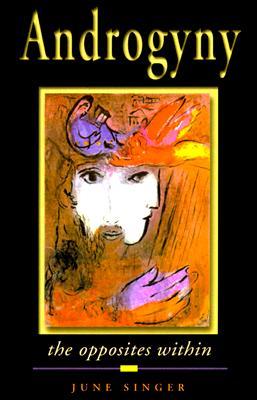
Book: “Androgyny: The Opposites Within”

Androgyny: The Opposites Within

Androgyny: The Opposites Within

by June K. Singer 

Full of psychological and spiritual insights that speak to today’s sexual confusion. Singer shows how a person can at once embrace complementary and contradictory attitudes toward sex and gender. Finally, she proposes a range of choices by which people can identify themselves, secure that the masculine/feminine interaction within each individual is not only normal, but the dynamic factor in their wholeness.

(Goodreads.com)

I AM AN INSTRUMENT

Bob Labansat on the left

By Bob Labansat

I am an instrument — Play me, play me.

I am an instrument of life Use me, use me.

My melody is an endless rhythm which echoes everywhere Hear me, hear me.

My music is an eternal concert,
A floating essence in the breeze of everywhere.
A musical mist, felt only as a moist freshness of an early morning spring. Oh, my concert, my music, everywhere it be listen, oh listen to me. Play me, oh play me.

Let me soothe you, love you, let me be One with you,

For I am an instrument.
And only as you play me, can I be what I was meant to be,

An instrument of your heart. My melody, my music only with your love has life.

Only with your touch do I play Oh play me, play me, play me.

Touch me, release me to express a softness, a tenderness sound to warm your heart, to mist your eye.

Such ecstasy is mine, for what greater delight might there be for an instrument playing, an eternal melody.

FROM A CRIME TO A CURE

Psychedelics are back in vogue after decades in the wilderness. now they could kick off a radical transformation of mental health care.

By Kevin Truong  –  Assistant Managing Editor, San Francisco Business TimesAug 20, 2021 (bizjournals.com)

More than a half century after the Summer of Love, the Bay Area is once again a center for a new psychedelic movement. But this one is characterized more by rigorous scientific research and regulatory approvals than free love and jam bands.

Propping up the movement are vocal supporters ranging from tech magnate Peter Thiel to author Michael Pollan to boxer Mike Tyson — and  a wave of entrepreneurs riding the swell.

A growing base of clinical research is validating the use of psychedelic drugs to treat a range of mental disorders, including depression, anxiety and PTSD, conditions that are short on treatment methods. 

At the same time, authorities at all levels are reconsidering the half-century approach to psychedelics as a law enforcement problem best dealt with by prosecution and imprisonment of users and dealers alike.

According to Data Bridge Market Research, the market for psychedelic drugs is projected to reach $6.9 billion by 2027. Three psychedelic companies have gone public in the U.S. over the last 12 months and new psychedelic research centers have launched at institutions like UC Berkeley and UC San Francisco.

These scientific, financial, political and cultural factors are converging to kick psychedelics into the mainstream. 

‘Mind manifesting’

Many of the drugs that are now seeing renewed interest in their effects on the human brain have been used by indigenous communities for thousands of years as part of traditional healing or spiritual practices.

The term psychedelic itself is derived from Greek roots meaning “mind manifesting” in reference to the way the drugs can unearth and reveal elements of the subconscious. The term entheogen is also used to describe psychoactive substances including MDMA (ecstasy), LSD (acid), ketamine, psilocybin (magic mushrooms) and mescaline that induce changes in behavior, mood or states of consciousness for the purpose of a spiritual or transcendent experience.

After chemist Albert Hoffman discovered the hallucinogenic effects of LSD in 1943, hundreds of papers were published in the 1950s and 1960s that explored the potential therapeutic effects of psychedelics on substance abuse, depression, anxiety, PTSD and other conditions. 

That largely came to a halt when the federal government started to crack down on psychedelics due to their association with the growing counterculture movement, eventually leading to the passage of the Controlled Substances Act and the launch of the War on Drugs. 

Nearly all common psychedelics such as LSD, mescaline and psilocybin – as well as cannabis – were categorized by the federal government as Schedule I drugs, the most stringent level of regulation for what the government alleged was a high potential for abuse and a lack of medical utility.

Decades of prohibition followed, withering existing lines of scientific inquiry and pushing activities under the table.

But a sea change is underway.

Last year, Oregon voters approved a ballot measure decriminalizing psilocybin and legalizing it for therapeutic use. Individual municipalities have also started to roll back restrictions, including Denver, Oakland and Santa Cruz, which have all decriminalized psilocybin. 

In May, state Sen. Scott Wiener, D-San Francisco, introduced SB 519 to decriminalize a number of psychedelics across the state of California. The law would allow those over 21 to use, cultivate or share limited amounts of DMT, ibogaine, LSD, mescaline, MDMA and psilocybin (ketamine was removed by lawmakers over fears it could be used as a date-rape drug).

Wiener told me he was first exposed to the therapeutic effect of psychedelics a decade ago by a former colleague with a son addicted to heroin, who found that an ibogaine-based therapy program got him sober after more traditional interventions failed.

SB 519 is part of a larger effort to rethink the existing zero-tolerance approach to drug enforcement and criminal justice, he said. The bill, which passed out of the Senate with a one-vote majority, is currently moving through the committee process in the state Assembly.

“The war on drugs is still ongoing. It’s not over. But the public increasingly understands that it has been an abject failure and a total waste of money. It’s not had any benefits, but it’s torn apart communities,” Wiener said, putting the ultimate likelihood of SB 519’s passage at “50-50.” “Step one is let’s stop arresting people for possessing these drugs.”

In the clinic

Like many doctors active in the space, Dr. Jennifer Guo’s professional interest in psychedelics was sparked by seeing first-hand the transformative effects that the drugs could have on patients. 

During her medical education at Yale University, she met one patient during a clinical rotation who had severe lifelong issues with depression that often veered into suicidality. The day after he received an infusion of ketamine as a part of a study, she saw a changed man in the emergency room.

“He told me, ‘I have never known what it was like to not feel depressed. And this is it,’” said Guo, the director of psychedelic medicine at San Francisco-based Mindful Health Solutions, which operates a number of clinics that offer ketamine-assisted therapies among other mental health treatments. 

That experience shifted what she wanted to do as a clinician and brought her out to San Francisco where she worked to give ketamine to veterans at the VA who had experienced complex trauma and PTSD.

Although ketamine isn’t considered a classic psychedelic, it is typically grouped together with drugs like psilocybin and LSD because of its ability to produce hallucinogenic effects. Typically prescribed as an anesthetic, the drug has been used off-label for decades as a treatment for a range of mental health conditions, including depression, substance abuse, OCD, anxiety disorders and PTSD.

“Ketamine is the leading edge for the psychedelic space. These clinics are gaining popularity and more and more people are starting to talk about ketamine for depression, anxiety, obviously the need for alternatives to medications like Xanax,” said Greg Rovner, the CEO of Burlingame-based Heally, which provides telemedicine services to alternative medical clinics.

In 2019, the Food and Drug Administration approved a version of ketamine known as esketamine with an oral antidepressant for use against treatment-resistant depression. Last year, regulators added an additional indication for the short-term treatment of suicidal ideation. 

“As the FDA goes and approves more treatments and more clinical trials are done, I think the stigma is going to go away and more and more providers are going to be willing to look at these alternative treatments,” Rovner said. “It’s just a question of time.”

While best practices are still debated, most psychedelic-assisted psychotherapies include a few key steps. 

First is consultation with the doctor to talk about potential risk factors, how to prepare mentally and physically and the goals of the treatment. Then the drug is administered, which in Guo’s case is done in a recliner chair in a low light and  a comfortable environment while blood pressure is monitored. That is followed by a period of integration where psychotherapy is used to help patients understand, interpret and find meaning in their psychedelic experience. 

Guo said in rare cases she’s seen a single therapy induce nearly complete remission from patients’ depression or mental health issues. For most people, however, change typically comes over a series of sessions. 

Dissociation — or a disconnection between a person’s thoughts, memories and identity — is often reported as an adverse effect of the use of ketamine. But Guo and her colleagues instead see it as a part of the path to healing for some patients.

“The idea is that you are not immediately caught up in your trauma and your anxiety and your ruminations. You’re able to separate a little bit from that, and then you’re able to see yourself with a different perspective,” Guo said. 

She used the example of one patient who saw herself as a mountain climber struggling up the slope of life’s challenges before making it to the peak, where she was met with a goddess. That experience, according to Guo, helped become a lasting mental metaphor that the patient used to empower herself in her daily life.

“With the traditional psychotropic treatments, it is more of a medical model. We give you this thing and it’s going to fix you,” Guo said. “With psychedelics what I say is that we open the door for you. But you start to walk through it. It’s not just a treatment we impose on the patient, but they have to be really engaged in it.”

Guo jokes she “would have been laughed out of the room” if she suggested studying psychedelics while earning her doctorate in neuroscience. But that stigma is slowly fading, with established medical leaders like National Institutes of Health Director Francis Collins singling out psychedelics as promising drug candidates.

“We’re lucky to be in the Bay Area where there’s a lot more acceptance and openness about these kinds of treatments. But we’re still not there yet,” Guo said.

She’s doing her own part as a professor at UCSF in designing curriculum that makes sure that knowledge of psychedelics are being shared with the next generation of doctors. 

A difference of opinion

Most psychedelics stimulate receptors for serotonin, a neurotransmitter that impacts mood. Research has also shown that they have the effect of triggering increased neuroplasticity – the ability of the brain to adapt or change itself by forming new neural networks. 

From here the theories move away from physiology and toward philosophy. One is predicated on individuals having an “inner healing intelligence.” Just as you don’t need to tell your finger to heal when you get a paper cut, the idea goes, your brain has a natural and innate ability to evolve toward healing and wholeness in response to mental illness. 

Research conducted over the past decade has shown strong positive treatment effects from psychedelics in areas ranging from depression to anxiety to substance abuse to PTSD. 

The results of a double-blind randomized controlled study led by Robin Carhart-Harris at Imperial College London published in April in the New England Journal of Medicine found that psilocybin was at least as effective as a leading antidepressant and had a longer-term positive effect.

“Previous drug-assisted psychotherapy hasn’t been that great and you get side effects associated with the drugs,” said Carhart-Harris, who now serves as the director of the recently launched Neuroscape Psychedelic Division at the University of California, San Francisco. “With psychedelics I believe that we really have something that combines in a synergistic way is way more than either component on its own.”

Carhart-Harris posits that the hallucinogenic experience, which creates a profound, altered state of consciousness, is key to that transformation because it allows for a systemic reshaping of self-narratives.

In the research he has conducted, Carhart-Harris said a major “macrodose” of a psychedelic like psilocybin followed by intensive psychotherapeutic work has been the most effective method in treating mood disorders like depression. 

“The biomedical model that has sort of dominated psychiatry in the past half century in my view is never going to be the solution for something as deep and complex as mental health,” Carhart-Harris said. “It’s a different thing to any sort of nonpsychoactive aspect like brain plasticity. It’s deeper. It’s more systemic. It’s about learning or relearning. It’s a shift in your outlook.”

David Olson, a biochemistry professor at UC Davis and the co-founder and chief innovation officer at Boston-based Delix Therapeutics, is taking a different approach that he argues could widely expand access to effective treatments for mental health.

Delix is developing what it calls nonhallucinogenic psychoplastogens, a class of drugs that would have the neuroplasticity boosting effects of psychedelics without the hallucinogenic trip. 

“These neuroplasticity promoting small molecules actually fix the damaged circuitry,” Olson said. “And so the hope is that we would actually have a cure for the diseases with these molecules rather than just something that’s going to ameliorate these symptoms.”

The idea is that by removing what Olson calls the “subjective hallucinogenic experience,” the therapies developed by Delix could reach patients scared off by the prospects of having a bad trip or those who have comorbidities that make it dangerous for them to take traditional psychedelics. 

“We want drugs that are so safe that you can put them in your medicine cabinet just like you would Tylenol or ibuprofen,” Olson said. 

By removing the psychostimulant or hallucinogenic effects, the hope is to limit the potential for abuse, while also potentially bypassing the federal prohibition that has limited research into the space for so long.

He argues that existing treatment methods like those seen in ketamine clinics such as Mindful Health or those studied by researchers like Carhart-Harris consist of hours of clinical interaction limiting the types of patients who conceivably afford or access the treatments. 

“If we can have a drug that does a lot of the rewiring of the brain without the subjective experience and without the need for cognitive behavioral therapy, you can hit an enormous fraction of the patients that need help,” Olson said.

Clashing culture 

The recent rash of excitement and investment around clinical uses for psychedelics has largely sidelined people like Hector, a psychedelic mushroom cultivator and dealer in Oakland who requested we use only his first name.

To be sure, Hector has benefited from what he characterizes as the “urbanization” of the psychedelic world and particularly the interest from the Silicon Valley set. Of late, he’s taken to selling cute pink pills with Mario-like mushroom branding for those who have started microdosing, taking regular sub-hallucinogenic amounts of psychedelics to improve focus and cognition. 

But his years spent working on the other side of the law has left him largely skeptical of the efforts to bring psychedelics into the mainstream.

“That’s exactly the business model that cannabis became,” he told me. “And that’s exactly what we don’t want to do because who’s going to benefit from that? The rich, white folks.”

Hector traced his relationship with psychedelics to childhood summers spent in the southern Mexican state of Oaxaca and his encounters with a legendary local healer named María Sabina who used psilocybin mushrooms as part of her ceremonial practice. He started cultivating his own mushrooms after a long spell of depression in college left him searching for a new path. 

He sees part of his role as sharing his cultural heritage and said he’s developed a customer base of other Latino men who have used the drugs as part of their own healing journey.

As for whether he plans to go legitimate if efforts to legalize use of mushrooms continue forward? “I’m black market until the day I f-ing die,” he said with a grin. 

Hector’s suspicions are in fact shared by those working on the legal side of psychedelics, who worry what will happen when biotech or Big Pharma get involved.

“Some of the tactics and approaches that are associated with a hard-nosed, sharp-elbowed capitalism is a real culture clash with the psychedelic medicine space because one of the deep realizations that be catalyzed through psychedelic medicine is the awareness of our interrelatedness and interconnectedness, which more sort of promotes a community mindedness,” Carhart-Harris said.

Compass Pathways, one of the leading companies active in the psychedelic space, has come under criticism from some activists for patenting its own form of synthesized psilocybin and its efforts to patent seemingly trivial but fundamental portions of a psilocybin-assisted treatment for depression, including using soft furniture and muted colors. 

“Without IP, there would be little incentive to take the risk to fund the research and development of new products, given the large number of drug candidates that fail during the development process,” Compass says on its website. 

While a known natural compound like psilocybin cannot be patented, it is possible to patent the process of producing a synthesized version used in medical treatments as well as how it is used in a clinical setting. 

“I come back to the idea of abundance,” said Joshua White, the founder and executive director of Fireside Project, a San Francisco psychedelic peer support line. “I think there should be multiple options that people have for the safe consumption of psychedelics and then people should be empowered with the choice.”

A former deputy city attorney for San Francisco, White started having his own psychedelic experiences more than a decade ago, which opened his eyes to the healing ability of the drugs.

Fireside offers free, confidential emotional support by phone and text message to people during and after their psychedelic experiences. The nonprofit has recruited 45 volunteers from a range of backgrounds who are trained in active listening, psychedelic emergencies and psychedelic integration. Currently the service is offered five days a week but plans to expand to seven days a week in October. 

“We see a parallel system where, yes, there are some people for whom consuming psychedelics in a clinic is the right solution for them,” White said. “But there are many other people for whom consuming psychedelics at home or with friends at a festival is the right answer. For all of those people we want to support them and meet them exactly where they are.”

A lasting integration 

Cannabis legalization may have been the gateway for the current movement to legalize psychedelics, but experts point out a number of key differences that will impact the vision for what a psychedelic future will look like.

Ismail Ali, the acting director of policy and advocacy for San Jose-based psychedelic research and educational nonprofit Multidisciplinary Association for Psychedelic Studies, traced a consistent arc for the legalization of cannabis that goes from activism to medical use to recreational adult use.

In psychedelics, however, medical use and decriminalization are moving on somewhat parallel tracks. Substances like MDMA and psilocybin have received breakthrough therapy classification from the FDA and are progressing through the typical drug approval process. At the same time municipalities are decriminalizing and legalizing less clinical uses of psychedelics.

“A lot of what we’re thinking through is how do we have access to different routes and how do they actually work in conjunction with one another?” Ali said. “There’s a lot of people who would benefit greatly from the use of psychedelics, who will never take it until a doctor can prescribe it to them, but there’s also a lot of people who would never go to a doctor to take a psychedelic. It’s not realistic to believe that either one of these systems is appropriate for all of society.”

Creating a legalized regulatory framework, Ali argues, would make it easier to root out bad actors by bringing what is already a vibrant community into the light. 

As psychedelics continue their infusion into the popular consciousness, advocates hope for what is ultimately a transformative effect on society in much the same way the drugs can spark an individual’s path of healing and self-discovery.

“I suppose what’s really exciting about psychedelic medicine is it can really fundamentally disrupt the system,”  Carhart-Harris said. “And that’s not just health care. That’s the system.”

The new age of psychedelics

Whether natural or synthesized, psychedelics have properties that experts say can be useful in treating a growing range of mental conditions.

  • DMT (Dimethyl-tryptamine): A psychedelic drug that binds with the serotonin receptors in the brain and induces visual, auditory and tactile hallucinations. One commonly reported experience is perceived communication with an external super-intelligent entity or being. It is one of the main active ingredients in ayahuasca, a psychoactive brew that originated in South America as a ceremonial spiritual practice.  
  • Ibogaine: A naturally occurring psychoactive substance with dissociative properties that is found in the roots and bark of the iboga plant native to West Africa. The drug can induce psychedelic effects including hallucinations, but adverse effects include difficulty coordinating muscle movement. It is sometimes used as an alternative medicine to treat substance abuse disorder, particularly opioid addiction.
  • Ketamine: Sometimes known as Special K, the drug in a medical context can be used as an anesthetic and induces a dissociative state that provides pain relief and sedation, alongside depressed breathing, stimulated heart function and increased blood pressure. Regularly used in veterinary medicine, ketamine functions by blocking glutamate receptors in the brain. In lower doses it has been used as an anti-depressant.
  • LSD (Lysergic acid diethylamide): Commonly known as acid, it is a psychedelic drug that can lead to visual and auditory hallucinations when taken in high enough quantities. Dilated pupils, increased blood pressure, and increased body temperature are also typical effects. First synthesized by Swiss chemist Albert Hofmann in 1938, the chemical is derived from a molecule present in the fungi ergot.
  • MDMA (3,4-Methyl​enedioxy​methamphetamine): Commonly referred to as ecstasy or molly, MDMA is a psychoactive drug that induces euphoria, alternated sensations and increased empathy. First developed by Merck more than a century ago, MDMA is now typically used recreationally as a party drug and is associated with the rave scene. In 2017, MDMA-assisted psychotherapy was granted a “breakthrough therapy” designation” as a treatment for severe PTSD.
  • Mescaline: A naturally occurring psychoactive substance that can be found in species of cactus including San Pedro, Peruvian torch and peyote. Used for thousands of years by Native Americans as part of religious practice, the drug leads to a psychedelic state that can include distorted time, altered thinking and visual hallucinations. 
  • Psilocybin and psilocyn: Active ingredients in magic mushrooms or shrooms are naturally found in various mushroom species. The molecules act on serotonin receptors, with effects that include euphoria, hallucinations, time distortion and perceived spiritual experiences. Psilocybin has been used by indigenous communities in spiritual and cultural practices for hundreds of years. The FDA has designated psilocybin as a “breakthrough therapy” for major depressive disorder and treatment-resistant depression.

© 2021 American City Business Journals. All rights reserved. Use of and/or registration on any portion of this site constitutes acceptance of our User Agreement (updated 1/1/21) and Privacy Policy and Cookie Statement (updated 7/20/21). The material on this site may not be reproduced, distributed, transmitted, cached or otherwise used, except with the prior written permission of American City Business Journals.

The original use of the word “Gai” for homosexual

The first illustration of Archy seen in an advertisement in the
New York Tribune on September 11, 1922, introducing the new column called ʺArchy and Mehitabelʺ
.

May 2009

by Mike Zonta, BB editor

From an email correspondence with Prosperos Mentor Billye Talmadge, weʹve been able to piece together an interesting history of the use of the word ʺgayʺ as a synonym for homosexual.

Early in the forties, Billye read a book of short essays written by Don Marquis called ʺArchy and Mehitabelʺ, and she fell in love with Mehitabel, the amorous, promiscuous alley cat whose motto was ʺtoujours gai, toujours gai.ʺ Mehitabelʹs story was written by Archy, the cockroach, who wrote his epistles by jumping one key at a time on his masterʹs typewriter. Archy wrote of Mehitabelʹs fabulous and numerous love affairs with the different toms of the neighborhood, each one ending on the note of ʺtoujours gai.ʺ ʺToujours gaiʺ is the signature for Mehitabel, whose life style and life motto was exactly that ‐‐‐toujours gai.

Some close friends (one of whom majored in French literature) and Billye were just beginning to figure out where they stood in the scheme of things and decided if they were going the ʺqueer route,ʺ then by golly, they would make up our own rules and adopted the motto ʺtoujours gai,ʺ spelled with an ʹiʹ. So the term became their motto as well, and they used it whenever they communicated with each other. The term ʹgaiʹ was spelled with an ʹiʹ for a long time, but time passed and the term ended up with the Americanized spelling of ʹgayʹ.

In the ʹ20s, both Gertrude Stein and Noel Coward used the term ʹgayʹ to refer loosely to homosexuals. “They were …gay, they learned little things that are things in being gay, … they were quite regularly gay.” —Gertrude Stein, 1922

“Pretty boys, witty boys,
You may sneer
At our disintegration.

Haughty boys, naughty boys,
Dear, dear, dear!

Swooning with affectation…
And as we are the reason
For the ʺNinetiesʺ being gay,
We all wear a green carnation. ”

—Noel Coward, 1929 , Bitter Sweet

But it may have been Billye and her friends who first used the term to specifically refer to specific homosexuals, i.e., themselves.

(from the May 2009 issue of the Bathtub Bulletin)

Bio: Billye Talmadge on Wikipedia

Billye Talmadge, H.W., M.

From Wikipedia, the free encyclopedia

Billye Talmadge (December 7, 1929 – October 24, 2018), also known as Billie Tallmij, was a lesbian American activist and educator at the forefront of the burgeoning gay liberation movement in the 1950-60s as well as a founding member of the Daughters of Bilitis, the first organization established to fight explicitly for lesbian civil and political rights in the United States. Her main focus was empowering lesbian youth through education and counseling at a time when many homosexual and lesbian voices had been silenced by the current social and political climate.

Early life

Billye Talmadge was born in Missouri, but raised in Oklahoma by her mother.[1] She never knew her father and was always a self-described tomboy.[2] She was the niece of Herman E. Talmadge, former U.S. Senator and Georgia Governor.[3]

Personal life

Talmadge first became aware that she was a lesbian at the age of 17 in her freshman year at a Kansas college, when she received a letter from a high school friend detailing her involvement with a girl.[4] Shaken by the news, Talmadge sought answers from the her Dean of Women, who gave her a reading list which included The Well of Loneliness, a book credited as an important step to self-acceptance by many other lesbians of the time and cited by Talmadge as her equivalent to the Bible.[5] Talmadge described herself as being so absorbed in it that she read it twice in one weekend, describing it as a “a coming home, a recognition, and a knowing.”[2] Once she had a name for it, Talmadge recognized that her sexuality influenced her social relations throughout her childhood.

At the same time, Talmadge found a particular distaste for Krafft-Ebing and similar literature popular at the time, which described homosexuality as biologically anomalous and perverse.[2] Unable to find other published works to answer her questions, Talmadge turned to following another student rumored to be a lesbian on campus for a few days, before approaching her at a café just off campus.[5] They drove to a park, where Talmadge asked her questions ranging from what being a lesbian meant to how to make love to a woman. This conversation became a milestone in Talmadge’s life, credited for giving her an understanding of herself as well as a knowledge that there were others who had the same questions, and there needed to be people they could turn to for honest answers.[2][6]

Following Talmadge’s graduation in the late 1940s, her mother found out about her sexuality by chance after the mother found a letter in a school annual which Talmadge had written to a friend that was supposed to move to Seattle after her. Her mother blamed herself and the lack of a present male influence in Talmadge’s life for her sexuality, but despite admitting to not understanding, continued to support Talmadge and any lovers or friends she brought home throughout her life. Talmadge stated that her close relationship with her mother made her lack a need for disclosure and acceptance which drove many other lesbians of her time.[2]

Talmadge did not have her first relationship until two years after she began identifying as a lesbian, at which time she had finished college and taught her first year at a school. Her first relationship started in Seattle with Jaye “Shorty” Bell, with whom she then moved to San Francisco, where she discovered there was other literature available regarding lesbians and homosexuals.[2]

In the early 1950s, a personal friend left out a piece of personal correspondence between herself and Talmadge which was discovered by the local postman. The letter contained information on both the women’s sexualities and had been written on stationary identifying Talmadge’s name and place of work, which the postman then used in an attempt to blackmail Talmadge’s friend for sexual favors. Upon finding out about this, Talmadge grew angry and looked up the closest FBI office in the phonebook. The FBI office was closed when she arrived, but it was located directly above a post office, and Talmadge demanded to speak to the Oakland postmaster general. The postmaster general set up a meeting with the postal inspector, who questioned Talmadge on whether the contents of the letter could be construed as pornography. Talmadge denied this and stated when asked that it was a letter that the post inspector would feel comfortable letting his teenage daughter read if needed. The postal inspector got in contact with the Seattle authorities, who placed the postman under arrest for tampering with federal property and blackmail, both of which were tried as felonies. Talmadge cited this experience as a driving factor in her work in educating gay and lesbian youth in order to make them less vulnerable to both legal authorities and individual blackmail.[7]

Talmadge spent twenty years with her long-time partner, Berkley professor and Cherokee activist Marcia Herndon, who died in 1997. [8]

Professional life

Following her move to Seattle after she graduated college in the late 1940s, Talmadge briefly worked in the acoustics divisions at Boeing Aircraft where her work required a high security clearance. She was followed by a national security agent as part of the investigation process for granting clearance for approximately three weeks. At the end of this period, the agent followed her into a gay bar on her way home from work and revealed that he had been investigating her and warning her that if he had told the company she was a lesbian, she would have been fired immediately. Talmadge obtained top security clearance just before she quit to follow her then-girlfriend, Jaye Bell, to San Francisco, CA.[2]

Talmadge held 2 PhDs in education and was foremost a teacher and educator.[3] In the course of her career she won the Golden Apple Award for her work with blind and Deaf children.[1] At the time, many state laws listed the suspicion of homosexuality as reasons for immediate termination from a teaching job.[9] This led Talmadge to use the Welsh spelling of her name, Billie Tallmij, as a pseudonym in order to keep her identity and activism separate from her source of income.[2][7]

Activism

Daughters of Bilitis

Talmadge first learned about the Daughters of Bilitis in San Francisco when a friend invited her and her then-girlfriend to a house party at Del Martin and Phyllis Lyon’s home.[2] At this point, the Daughter of Bilitis (DOB) had been in existence as a social group meant to keep young lesbians out of gay bars, which were undergoing frequent police raids.[10] Of the 8 women who had originally been part of the DOB, Martin and Lyon were the only remaining members when Talmadge attended the party. Discussion between the attendees of this house party transferred the focus of the DOB from a social group to an activist agenda.[10]

In 1955, Talmadge helped write the Daughters of Bilitis statement of purpose, in which she focused primarily on popularizing education.[2] Talmadge encouraged representation and racial diversity in the organization, which she noted to include not just African American members, but also Asians and Latinas.[11] The political and social climate fostered a general fear of homosexuality, silencing of homosexual and lesbian voices, and a generation of young lesbians who did not know their rights in front of the law.[12] Talmadge sought to educate young lesbians that it was not against criminal law to be a homosexual, as long as one was not caught performing what were then illegal sexual acts. The DOB continued efforts to create safe meeting spaces for lesbians, but also started efforts to educate both their own people and the general public.[2]

Talmadge frequented gay bars and dives in both Seattle and California, some of which were called “toilets” owing to the state they were in. At the time, a California law was in effect stating that any establishment which sold liquor and catered to what was considered “pimps, prostitutes, addicts, and perverts” could have their licensing revoked and the patrons arrested.[13] Police often used this law to arrest and hold patrons of gay bars. In a raid just outside San Francisco city limits during which 97 patrons were arrested, a woman sought legal aid from the Daughters of Bilitis. Talmadge and Del Martin called in legal representation and advised that all of the defendants plead not guilty and demand a jury trial. When brought into court, all defendants were accused of a violation which was not explained beyond its numerical code. All but 4 women pled guilty, were fined, and walked away with permanent records. The 4 women who pled not guilty had their cases dismissed, and later found out they had almost been charged with prostitution. Following this incident, Talmadge began efforts to educate lesbians to their legal and civil rights, and well as procedures and scripts to follow upon arrest and in the courts. These education efforts strove to eliminate disinformation about what individuals were required to give or tell to authorities and to make it harder for police to intimidate gay or lesbian defendants into pleading guilty for crimes they did not commit.[2]

Though the lesbian separatist movement did not officially begin until the late 1960s, lesbians and gay men acted in large part independently of each other at the time. At the inception of the DOB, Talmadge and the other founding members had not even been aware that the San Francisco chapter of the Mattachine Society existed. Talmadge argued for open communication and the unification of lesbian and gay organizations. This proposition was often met with animosity from members in the early days of the DOB.[4]

Gab n’ Javas

Though she acted as a counselor for the community, Talmadge was at the time not professionally certified as such and worked to find a professional to counsel lesbians who had gone through traumatic situations. After the first attempt to put someone into contact with a professional psychiatrist resulted in him sexually assaulting the client, Talmadge became extremely wary of reaching out for help outside the community.[2] Talmadge eventually connected with Dr. Blanche Baker, who began counseling incoming youth as well as training the officers of the DOB such as Talmadge regarding how to conduct group counseling. These group counseling and discussion sessions became known as Gab n’ Javas, which would often be held at Talmadge’s home and would cover topics ranging from how and when lesbians should come out to feelings alienation from religious communities. The attendance for Gab n’ Java sessions could reach up to 70 women at a time, many having to seat themselves on the stairs for lack of any more available seating. These sessions were informal meetings serving coffee and cigarettes and fostering an environment of open exchange of similar experiences in order to build a sense of community. Talmadge was generally the moderator of these discussions.[4]

Public Education

Expanding education to the general public included lectures and talks to church groups or on the radio, as well as letters to editors in newspapers and publications, often under pseudonyms. At this time in the late 1950s, the DOB offices began to receive large amounts of letters both domestically and internationally bearing a wide range of reactions to their work.[14] Only the officers of the organization had to publicize their first and last names, which led Talmadge to use the Welsh spelling of her name, Billie Tallmij, as a way of protecting her identity. Talmadge made several public appearances, notably traveling to speak in Estes Park, Colorado at their request, in order to help foster a better understanding between the local community and lesbian college students on a nearby campus. The Ladder, the DOB’s newsletter bearing several of Talmadge’s own writings, was widely quoted in the legal briefings leading to the Supreme Court One, Inc. v. Olesen decision that determined homosexual writings did not violate obscenity laws.[2]

In 1960 Talmadge helped organize the Daughter of Bilitis National Convention in San Francisco. The convention was advertised in the Ladder, which contained certain rules of entry, including a mandatory dress code requiring skirts. Talmadge has been labeled an “accommodationist” due to her part in encouraging lesbians to wear clothing which did not make them easily identifiable.[7] At the time, laws prohibiting people from appearing in public in apparel customarily worn by the opposite sex were in effect in certain areas of the United States.[12]

Following the national convention, Talmadge became heavily involved in the formation of the Los Angeles chapter of the DOB. Talmadge invested a significant amount of time and personal income into fostering growth in the DOB, taking the title of Vice President in 1958.[15] Talmadge phased out of activity with the Daughter of Bilitis in 1965 as it became more focused on political ideology rather than helping individuals. Following her affiliation with the DOB, Talmadge pursued more counseling training with another group of homosexual activists. She continued trying to educate gay and lesbian youth to find the humor in terrible situations, believing that laughter was often the best way to combat trauma.[2]

Talmadge became a personal friend of Dr. Evelyn Hooker, one of the pioneers of studies on homosexual men which argued that homosexuality was not a mental disorder. Talmadge could not get Dr. Hooker to perform similar studies on lesbians due to how the connotations of a woman studying homosexual women would impact Hooker’s professional reputation and the validity of her previous work. Instead, Talmadge worked to coordinate and participate in the first Kinsey Institute studies on lesbians.[15]

Council on Religion and the Homosexual

In the early 1960s, Talmadge and the other officers of the DOB conducted a survey regarding the religious standings of their membership. This survey found that many, like Talmadge herself, continued to be religious but had stopped attending church services after they began identifying as lesbians. They found it was particularly hard for Mormon women to reconcile their identities with their religion. Talmadge began reaching out in search of ministers that would work with and welcome lesbians into their churches, but found very few willing to do so. Talmadge and other members of the DOB began writing scathing letters challenging these beliefs and urging ministers to come speak with them in order at attempt resolving the gap between religion and homosexuality.[4][14][2]

This led to the organizing of the Mill Valley Conference from May 31 to June 2, 1964, in which 17 gay men and 4 gay women, of which Talmadge was the spokesperson, spent three days in a Methodist church with a collection of ministers in order to facilitate discussion. Talmadge spoke last, asking questions such as where lesbians were mentioned in the Bible. Following group discussion sessions, the ministers were taken on a tour of the local gay bars and told that because lesbians and gay men could not meet out in the open, they were forced to frequent these bars. Many ministers left admitting they felt unqualified to speak on the subject of homosexuality. Out of the three-day conference came the formation of the Council on Religion and the Homosexual.[4][2]

Publications

Talmadge’s poems and musings were compiled and published by her longtime friend and caregiver Suzanne Deakins in the book Beyond The Mist by Billye G Talmadge.[16] Her interviews are transcribed in Making history : the struggle for gay and lesbian equal rights, 1945-1990 : an oral history by Eric Marcus, and video recorded in the Lesbian Herstory Archives Audio Visual Collections under the Daughters of Bilitis Video Project. While Talmadge was not heavily involved with the Ladder, she has published several articles in it under the name Billie Tallmij, written during her time with the DOB.[15]

More at: https://en.wikipedia.org/wiki/Billye_Talmadge

Can statistics help crack the mysterious Voynich manuscript?

CREDIT: BEINECKE RARE BOOK & MANUSCRIPT LIBRARY, YALE UNIVERSITY

The meaning of the cryptic text has eluded scholars for centuries. Their latest efforts include computational analyses seeking new insights into the medieval enigma.

By Greg Miller 08.20.2021 (knowablemagazine.org)

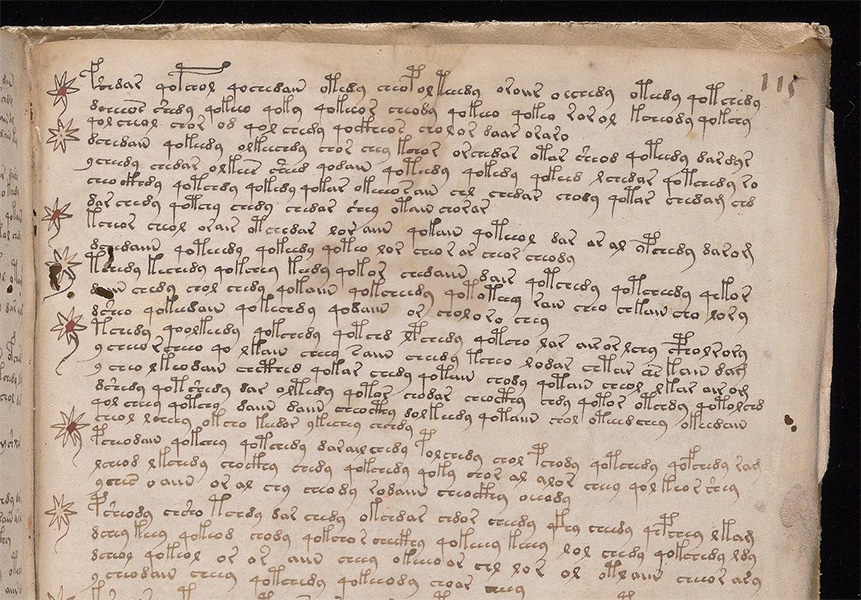
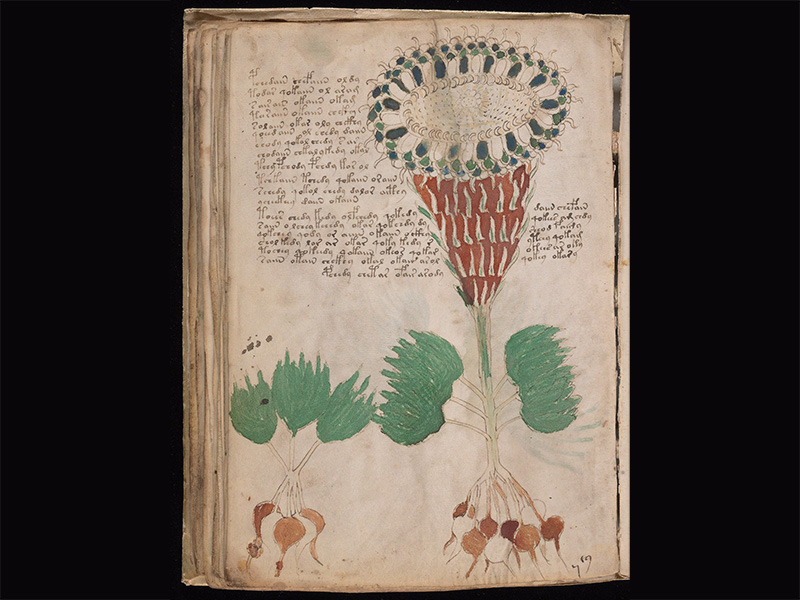
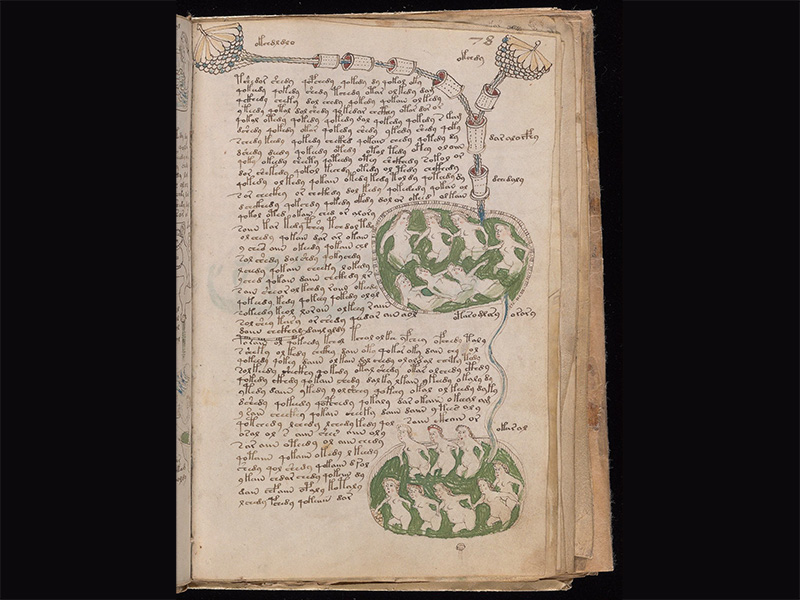
The 15th century Voynich manuscript has puzzled scholars and confounded attempts to decipher it for centuries. Its 200-odd pages contain dozens of colorful illustrations of plants, astrological diagrams and naked female figures bathing in elaborately plumbed pools of green water.

Stranger still, the manuscript is not written in any known script or language. If it’s written in code, no one has cracked it, though many have tried.

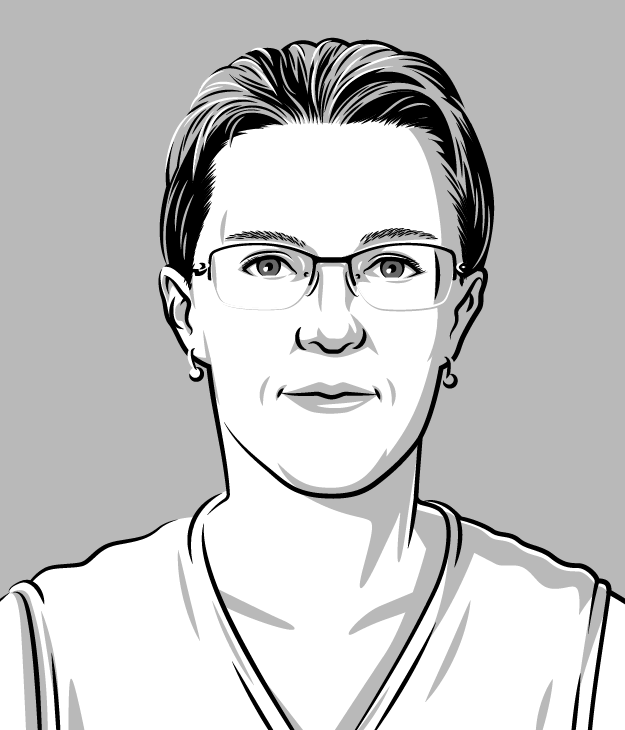
Portrait of Claire Bowern

CREDIT: JAMES PROVOST (CC BY-ND)

Linguist Claire Bowern

Yale University

The manuscript takes its name from Wilfrid Voynich, the Polish-born antiquarian who acquired and publicized it in the early 20th century. Some scholars have argued that the text is gibberish, the document an elaborate hoax. Others have variously claimed that the underlying language is Latin, or one of the Romance languages or Hebrew. In 2018, a pair of researchers, citing the apparent similarity of some of the manuscript’s plant illustrations to the flora of Central America, claimed that the manuscript was produced by the ancient Aztecs. None of these claims has gained widespread acceptance.

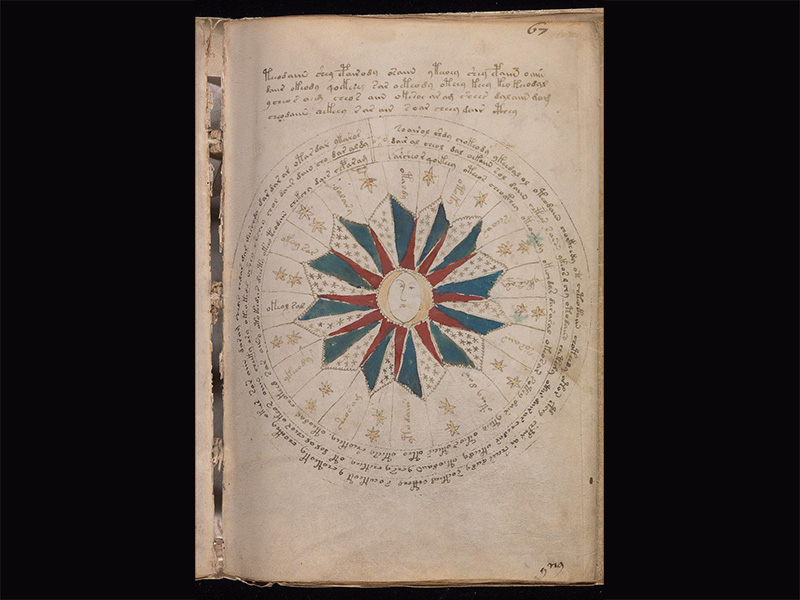
The manuscript now resides in the Beinecke Rare Book & Manuscript Library at Yale University. “It’s surprisingly small, a bit bigger than a paperback,” says Yale linguist Claire Bowern. It appears to have five main sections, she says. The section on plants is the longest, making up just over half of the manuscript. The astrological section includes zodiac charts and depictions of the sun and moon. The section with the bathing nymphs is often called the balneological section, a reference to the science of baths and bathing. A “pharmaceutical” section depicts what may be herbal remedies — plant roots alongside medicine bottles — and a fifth section, unillustrated, has blocks of text demarcated with little stars.

The mystery surrounding the Voynich manuscript has inspired novels, cameo appearances in popular TV shows and video games, and even a symphony — which debuted at Yale in 2017, along with an exhibit Bowern attended with a couple of her students. Seeing the manuscript in person got Bowern thinking: Even though her main research focus is on documenting endangered Indigenous languages in Australia (where she’s from), perhaps some of the statistical methods, software and approaches that she and other linguists use to study and compare languages could be used to study the Voynich manuscript.

Bowern created and taught an undergraduate class to explore the possibilities, which she and post-doctoral researcher Luke Lindemann describe in a recent paper in the Annual Review of Linguistics. She spoke with Knowable about some of their insights. This conversation has been edited for length and clarity.

Do we know where the manuscript came from or who created it?

No, not at all. We know that the manuscript was in Prague in the early 1600s. And from there it went to the library of the Jesuit scholar Athanasius Kircher, and presumably stayed there until it ended up in a Jesuit archives outside Rome, where Wilfrid Voynich found it in 1911 or 1912.

Voynich himself shrouded the manuscript in mystery. He was never clear in his lifetime about where it came from. He said he found it in a castle, but that seems like he was trying to be unclear about where he got it.

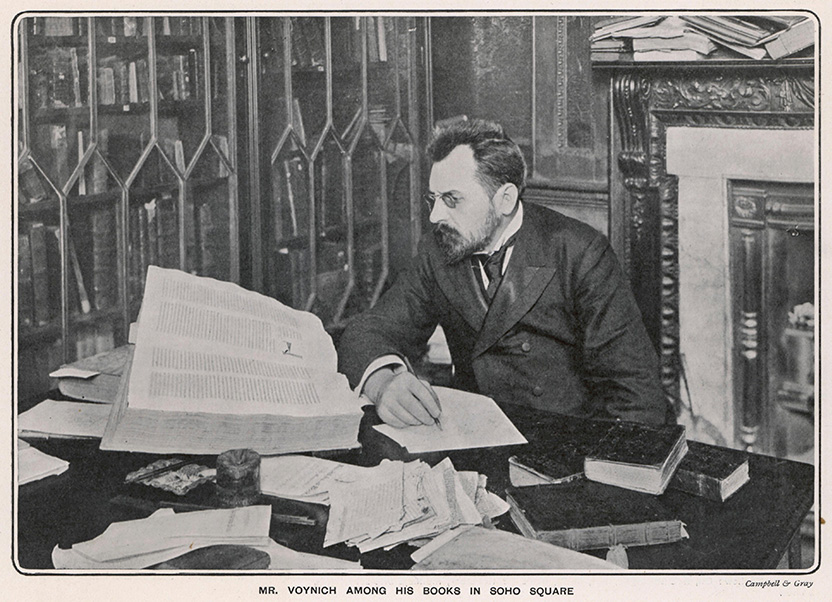
Old photograph of a man with a beard sitting at a desk covered with books and papers. He is writing something on a piece of paper and looking intently at a large book.
Wilfrid Voynich, shown here in a photograph taken around 1899, was never completely forthcoming about how he acquired the mysterious manuscript that bears his name.CREDIT: WIKIMEDIA COMMONS

Was he trying to increase the price he could get by creating an air of mystery around it? Or what was he up to?

Partly that, and also it’s not quite clear whether he obtained the manuscript totally above board. He received a number of manuscripts from the Jesuit archives, and it’s not quite clear whether they knew that this manuscript was part of it, or whether the person who was selling the manuscript had the authority to do so.

Is there any chance he created the manuscript himself?

I’m pretty comfortable saying this is an early 15th century object. We get that from the carbon dating of the parchment, which puts it between 1404 and 1438. The type of ink is typical of what was used in that time period, and the clothing of the figures in the illustrations and so on are all consistent with that time period. Of course, it could be a copy of even earlier material, just as we have modern paperbacks of Shakespeare but the plays themselves go back hundreds of years.

Why would someone in those days create a ciphered manuscript?

I think people in the medieval period probably acted from similar sorts of motivations to people these days. So, why do people people encipher things in general? Either to to hide it from people who shouldn’t see it, or to create some sort of in-group solidarity type of thing.

One theory that’s come up, which I’m not sure I buy into, is that this was witchcraft or it was a manuscript that contained information that the Catholic Church didn’t want to get out. But that strikes me rather more as a Dan Brown scenario than something that might have actually happened.

We do have examples of information being made secret, but it’s military information or political information, and it’s 100 or 150 years later. Books of herbal remedies, on the other hand, were widely distributed and not secret. So that raises the question of why someone would have enciphered information that was readily attainable.

Close-up of a page from the Voynich manuscript. The page is brown with age and is covered with writing. A number of stars are drawn in the left margin.
One section of the manuscript has no illustrations, only blocks of text marked with stars.CREDIT: BEINECKE RARE BOOK & MANUSCRIPT LIBRARY, YALE UNIVERSITY

One possible analogy is the technical terminology in academia. As a linguist, I have a huge number of technical terms I use with other linguists, and they’re not exactly meant to keep people out, but they’re a shorthand way of talking with other linguists and a marker that I’m part of the in-group of knowledgeable individuals. So maybe we should think about this not so much as hiding information from others, but more as a kind of in-joke or preservation of knowledge for people who knew that particular language or way of writing.

Some people still think it’s a medieval hoax. Why?

One reason is that — I’m going to be flippant about this — we haven’t solved it yet, so maybe there is nothing to solve. Another is that the language in some ways looks very different from other natural languages. Languages have particular statistical properties, which are very difficult to consciously manipulate. At the word level, “Voynichese” looks very, very different from other languages.

For example, we can look at how predictable different letters in a writing system are. For instance, in English, if I think of a word whose first letter is q, then it’s pretty likely the second letter is going to be u. We can calculate this for sequences of characters in different languages. It’s a metric called the h2, or second-order conditional entropy, and there is a range of values, between three and four, for languages across the world. For Voynichese it’s more like two, which makes it look at first sight like Voynichese is maybe not a natural language. The character sequences are much more predictable than they are in other languages.

So why do you think it actually is natural language?

When you look above the word level, at the level of pages or sections of the manuscript, we find internal structure that looks pretty similar to other natural languages. For instance, we can look at the way particular words cluster on a page. If you think about a newspaper, it has stories about particular items that use a lot of vocabulary related to that item. A story about Covid will have a lot of Covid-related vocabulary.

The Voynich manuscript shows that same sort of topic distribution. There are words used in the herbal pages that are not used in other parts of the manuscript. We can look at these computationally, and the sort of clustering of words we see on pages of the Voynich manuscript is extremely unlikely to be random.

Manuscript page with huge red-and-blue cone-like flower, green leaves and radish-like roots. There is text on the page too.
Lots of writing on this page of the manuscript as well as drawings of two green pools in which women are bathing. The two pools are connected by a thin stream. There is a strange pipe-like device coming down into the top pool.
The page contains many colored images of what look like different kinds of plant roots. There is a big green plant with a huge leaf at the bottom. To the left are a number of red layered cone structures with a birthday cake look to them.

Next1 / 4

The section of botanical illustrations takes up a little more than half of the manuscript.

CREDIT: BEINECKE RARE BOOK & MANUSCRIPT LIBRARY, YALE UNIVERSITY

The astrological section includes zodiac diagrams and drawings of the sun and moon.

CREDIT: BEINECKE RARE BOOK & MANUSCRIPT LIBRARY, YALE UNIVERSITY

The most unusual part of the manuscript depicts naked female figures bathing in green pools with elaborate plumbing.

CREDIT: BEINECKE RARE BOOK & MANUSCRIPT LIBRARY, YALE UNIVERSITY

The “pharmaceutical” section has illustrations that appear to show plant roots and jars, suggestive of herbal remedies.

CREDIT: BEINECKE RARE BOOK & MANUSCRIPT LIBRARY, YALE UNIVERSITY

Are there other insights that could come from using these kinds of computational tools?

We know from previous work that different parts of the manuscript were written by different scribes, so we looked at how the parts written by each scribe lined up with topics and word use. Scribe Four, for example, wrote all of the astrological and astronomical sections, whereas other scribes seem to have collaborated on other sections. Our computational modeling suggests that different scribes also had slightly different ways of writing or perhaps used different encipherment mechanisms.

For example, the scribes seem to share a substantial common vocabulary, but it appears as if some scribes are using certain terms or spelling words differently than other scribes, perhaps like how Australian and US English have subtle differences. Of course, we don’t know any of the words in Voynichese and how they’re spelled, so it’s impossible to know what’s really behind these differences.

Does this work reveal anything about how the manuscript was created?

It raises some questions, but overall it suggests the scribes were working in a consistent way, despite these minor differences. If it’s just gibberish, why would it matter if they’re all working the same way? I might expect that if the scribes each had their own encipherment methods then we would find much more differentiation.

Are you still working on this?

One thing we’ve just started working on is exploring what type of encipherment methods give the sort of odd character distributions — the low h2 — we see in Voynichese. We have a corpus of text from Wikipedia and an ancient language corpus of digitized materials from medieval and historical texts, and we can apply different cipher methods to these texts and see if the result matches the statistical properties of Voynichese.

We can also test other people’s claims about the underlying language and cipher mechanism. So if the claim is that it’s Latin encoded with a 15th century Crema cipher, we can take a block of Latin and apply a Crema cipher and see if it has similar properties to Voynichese. But what we’re finding so far is that the language we test doesn’t matter that much, because all natural languages are sufficiently alike and Voynichese is so different at this level.

That implies to me that someone did some very deliberate manipulation to the way the language is written, which coincidentally made it very different from other natural languages at the word level. But at the same time, they included information that ultimately works the same way as other natural languages, and we can see that structure when we look at sections or pages of the manuscript. It’s a very interesting contradiction. It’s quite a puzzle!

Do you think it will ever be solved?

I don’t know. I think it’s quite possible that we’ll have a pretty good idea about how the language was constructed, but we won’t be able to undo the code and recover the message. It’s not impossible, but I think that’s pretty unlikely at this stage unless we find an original source manuscript. Let’s just say: I’m having fun learning more about the manuscript without any expectation that I will ever be able to read what’s underneath.

Greg Miller is a science journalist based in Portland, Oregon.

(Contributed by Michael Kelly, H.W.)

Aquarius Full Blue Moon, August 22, 2021

Wendy Cicchetti

Aquarius Full Blue Moon

The Aquarius Full Moon occurs at the anaretic, or critical degree (between 29° and 29°59′ of the sign). This amplifies the Moon’s fullness, magnifies the significance of issues and feelings, and adds an edge to the usual community-minded Aquarian themes of rationale, detachment, and fairness. While Aquarius often wants what’s best for everyone, it’s usually from a logical, almost scientific angle, rather than an emotional one. There could be a need to apply this detached and reasoned approach to a certain situation to avoid an impassioned struggle. With any luck, presenting facts and inarguable logic in such an instance could override any pressure resulting from another’s impetus.

There is also the possibility of facing a practical situation with a “do or die” momentum about it. Perhaps a decision just cannot be put off now — as much as we may like to procrastinate or wait for other solutions to emerge. On the plus side, the sense of having our backs against the wall can mean the options we face may seem starkly monochromatic yet strangely straightforward, as though the universe itself has decreed the obvious answer! Here, the Aquarian theme may play out in terms of realizing that we do not have as much individual control as we might have imagined and that this is not necessarily a bad thing. We are part of a greater tapestry, guided by a whole range of considerations that involve other people and outcomes.

This universal linkage may be comforting, especially in a situation where we feel pressure to “save face” and protect our reputation — as accentuated here by the Sun in Leo. When one has little choice, the internal logic of the situation may cancel out some of the onus to be seen as “doing the right thing.” Instead, we know that we can do only what is possible and within the limits of whatever we are faced with.

The Moon is conjunct Jupiter, adding a sense of justification — or justice — to matters under the spotlight during this lunation period. For some people, legal processes will be in motion and a decision reached that hopefully does seem just — and if not, then it may be “justified” in some way. But, since Jupiter is currently retrograde, there is the potential for a former injustice to be revealed and unraveled. Such outcomes do not come easily, but surely make an impact when they do, such as creating a revision of an aspect of law. With the anaretic degree of the Moon, and both Moon and Jupiter disposited by Saturn — also in Aquarius — there is the prospect of an authority figure setting a boundary to limit certain revisions, appeals, or adjustments — perhaps strategies put in place to outline time limits, for instance, or the number of occasions a subject can be revisited.

Sometimes events around a potent Full Moon can be seen in terms of societal impact or on the world stage, and at other times we experience them more personally and internally. In the latter case, the Moon and Jupiter in Aquarius highlight group situations and events organized by clubs and societies, and we may have a plethora of invitations in these spheres! But the anaretic degree underlines weighing up which options really suit us. A longstanding affiliation may no longer seem as relevant, urging us to consider whether it is right for us to belong anymore. Maybe there is another tribe, organization, or body to join, with which we feel a greater current affinity.

In some instances, the air element of Aquarius prompts us towards more distant connections if they will deliver more relevant content and particularly where the internet makes this more realistic than otherwise. If the issue with a situation is that it involves too much travel, however, we should not overlook researching a more nearby option. This is particularly indicated at this time with all of the Uranus activity, it’s alright to do the odd thing sometimes, especially when it turns up its own internal logic! Besides, Uranus, trine Mercury and Mars, applies equal value to communications and physical connections.

This article is from the Mountain Astrologer, written by Diana Collis.

Bio: Ptolemy

From Wikipedia, the free encyclopedia

Ptolemy
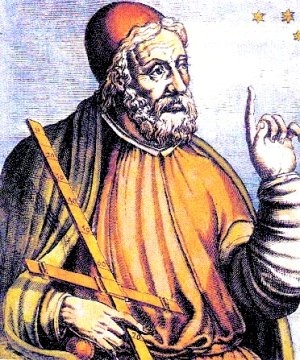
Claudius Ptolemy ‘the Alexandrian’, as depicted in a 16th-century engraving [1]
Bornc. 100 AD[2]
Egypt, Roman Empire
Diedc. 170 (aged 69–70) AD[2]
Alexandria, Egypt, Roman Empire
Known forPtolemaic universe
Ptolemy’s world map
Ptolemy’s theorem
Scientific career
FieldsAstronomyGeographyAstrologyOptics
InfluencesAristotle
Hipparchus
InfluencedTheon of Alexandria
Abu Ma’shar
Nicolaus Copernicus

Claudius Ptolemy (/ˈtɒləmi/Koinē Greek: Κλαύδιος Πτολεμαῖος, Klaúdios Ptolemaîos[ˈklaw.di.os pto.lɛˈmɛ.os]LatinClaudius Ptolemaeus; c. 100 – c. 170 AD)[2] was a mathematicianastronomergeographer, and astrologer who wrote about a dozen scientific treatises, three of which were of importance to later ByzantineIslamic, and Western European science. The first is the astronomical treatise now known as the Almagest, although it was originally entitled the Mathēmatikē Syntaxis or Mathematical Treatise, and later known as The Greatest Treatise. The second is the Geography, which is a thorough discussion on maps and the geographic knowledge of the Greco-Roman world. The third is the astrological treatise in which he attempted to adapt horoscopic astrology to the Aristotelian natural philosophy of his day. This is sometimes known as the Apotelesmatika (lit. “On the effects”) but more commonly known as the Tetrábiblos, from the Koine Greek meaning “Four Books,” or by its Latin equivalent Quadripartitum.

Unlike most ancient Greek mathematicians, Ptolemy’s writings (foremost the Almagest) never ceased to be copied or commented upon, both in Late Antiquity and in the Middle Ages.[3] However, it is likely that only a few truly mastered the mathematics necessary to understand his works, as evidenced particularly by the many abridged and watered-down introductions to Ptolemy’s astronomy that were popular among the Arabs and Byzantines alike.[4][5]

Biography

Ptolemy lived in or around the city of Alexandria, in the Roman province of Egypt under Roman rule,[6] had a Latin name (which several historians have taken to imply he was also a Roman citizen),[7] cited Greek philosophers, and used Babylonian observations and Babylonian lunar theory. In half of his extant works, Ptolemy addresses a certain Syrus, a figure of whom almost nothing is known but who likely shared some of Ptolemy’s astronomical interests.[8]

The 14th-century astronomer Theodore Meliteniotes gave his birthplace as the prominent Greek city Ptolemais Hermiou (Πτολεμαΐς ‘Ερμείου) in the Thebaid (Θηβᾱΐς). This attestation is quite late, however, and there is no evidence to support it.[9] Ptolemy died in Alexandria around 168.[10]

Naming and nationality

Engraving of a crowned Ptolemy being guided by Urania, from Margarita Philosophica by Gregor Reisch (1508), showing an early confluence between his person and the rulers of Ptolemaic Egypt.

Ptolemy’s Greek namePtolemaeus (Πτολεμαῖος, Ptolemaîos), is an ancient Greek personal name. It occurs once in Greek mythology and is of Homeric form.[11] It was common among the Macedonian upper class at the time of Alexander the Great and there were several of this name among Alexander’s army, one of whom made himself pharaoh in 323 BC: Ptolemy I Soter, the first pharaoh of the Ptolemaic Kingdom. Almost all subsequent pharaohs of Egypt, with a few exceptions, were named Ptolemies until Egypt became a Roman province in 30 BC, ending the Macedonian family’s rule.[12][13]

The name Claudius is a Roman name, belonging to the gens Claudia; the peculiar multipart form of the whole name Claudius Ptolemaeus is a Roman custom, characteristic of Roman citizens. Several historians have made the deduction that this indicates that Ptolemy would have been a Roman citizen.[15] Gerald Toomer, the translator of Ptolemy’s Almagest into English, suggests that citizenship was probably granted to one of Ptolemy’s ancestors by either the emperor Claudius or the emperor Nero.[16]

The 9th century Persian astronomer Abu Maʻshar mistakenly presents Ptolemy as a member of Ptolemaic Egypt’s royal lineage, stating that the descendants of the Alexandrine general and Pharaoh Ptolemy I Soter were wise “and included Ptolemy the Wise, who composed the book of the Almagest“. Abu Maʻshar recorded a belief that a different member of this royal line “composed the book on astrology and attributed it to Ptolemy”. We can infer historical confusion on this point from Abu Maʿshar’s subsequent remark: “It is sometimes said that the very learned man who wrote the book of astrology also wrote the book of the Almagest. The correct answer is not known.”[17] Not much positive evidence is known on the subject of Ptolemy’s ancestry, apart from what can be drawn from the details of his name, although modern scholars have concluded that Abu Maʻshar’s account is erroneous.[18] It is no longer doubted that the astronomer who wrote the Almagest also wrote the Tetrabiblos as its astrological counterpart.[19] In later Arabic sources he was often known as “the Upper Egyptian“,[20] suggesting he may have had origins in southern Egypt.[21] Arabic astronomersgeographers and physicists referred to his name in Arabic as Baṭlumyus (Arabic: بَطْلُمْيوس‎).[22]

Ptolemy wrote in ancient Greek and can be shown to have utilized Babylonian astronomical data.[23][24] He might have been a Roman citizen, but was ethnically either a Greek[2][25][26] or at least a Hellenized Egyptian.[25][27][28]

Astronomy

Astronomy was the subject to which Ptolemy devoted the most time and effort; about half of all the works that survived deal with astronomical matters, and even others such as the Geography and the Tetrabiblios have significant references to astronomy.[5]

Mathēmatikē Syntaxis

Further information: AlmagestPages from the Almagest in Arabic translation showing astronomical tables.

Ptolemy’s Mathēmatikē Syntaxis (Ancient GreekΜαθηματικὴ Σύνταξις, lit. “Mathematical Systematic Treatise”), better known as the Almagest, is the only surviving comprehensive ancient treatise on astronomy. Although Babylonian astronomers had developed arithmetical techniques for calculating and predicting astronomical phenomena, these were not based on any underlying model of the heavens; early Greek astronomers, on the other hand, provided qualitative geometrical models to “save the appearances” of celestial phenomena without the ability to make any predictions.[29]

The earliest person that attempted to merge these two approaches was Hipparchus, who produced geometric models that not only reflected the arrangement of the planets and stars but could be used to calculate celestial motions.[30] Ptolemy, following Hipparchus, derived each of his geometrical models for the Sun, Moon, and the planets from selected astronomical observations done in the spanning of more than 800 years; however, many astronomers have for centuries suspected that some of his models’ parameters were adopted independently of observations.[31]

Ptolemy presented his astronomical models alongside convenient tables, which could be used to compute the future or past position of the planets.[32] The Almagest also contains a star catalogue, which is a version of a catalogue created by Hipparchus. Its list of forty-eight constellations is ancestral to the modern system of constellations but, unlike the modern system, they did not cover the whole sky (only what could be seen with the naked eye).[33] For over a thousand years, the Almagest was the authoritative text on astronomy across Europe, the Middle East, and North Africa, and its author soon became an almost legendary figure: Ptolemy, King of Alexandria.[34]

The Almagest was preserved, like many extant Greek scientific works, in Arabic manuscripts; the modern title is thought to be an Arabic corruption of the Greek name H Megiste Syntaxis (lit. “The greatest treatise”), as the work was presumably known in Late Antiquity.[35] Because of its reputation, it was widely sought and translated twice into Latin in the 12th century, once in Sicily and again in Spain.[36] Ptolemy’s planetary models, like those of the majority of his predecessors, were geocentric and almost universally accepted until the reappearance of heliocentric models during the scientific revolution.

Handy Tables

The Handy Tables (Ancient GreekΠρόχειροι κανόνες) are a set of astronomical tables, together with canons for their use. To facilitate astronomical calculations, Ptolemy tabulated all the data needed to compute the positions of the Sun, Moon and planets, the rising and setting of the stars, and eclipses of the Sun and Moon, making it a useful tool for astronomers and astrologers. The tables themselves are known through Theon of Alexandria’s version. Although Ptolemy’s Handy Tables do not survive as such in Arabic or in Latin, they represent the prototype of most Arabic and Latin astronomical tables or zījes.[37]

Additionally, the introduction to the Handy Tables survived separately from the tables themselves (apparently part of a gathering of some of Ptolemy’s shorter writings) under the title Arrangement and Calculation of the Handy Tables.[38]

Planetary Hypotheses

A depiction of the Ptolemaic Universe as described in the Planetary Hypotheses by Bartolomeu Velho (1568).

The Planetary Hypotheses (Ancient GreekὙποθέσεις τῶν πλανωμένων, lit. “Hypotheses of the Planets”) is a cosmological work, probably one of the last written by Ptolemy, in two books dealing with the structure of the universe and the laws that govern celestial motion.[39] Ptolemy goes beyond the mathematical models of the Almagest to present a physical realization of the universe as a set of nested spheres,[40] in which he used the epicycles of his planetary model to compute the dimensions of the universe. He estimated the Sun was at an average distance of 1,210 Earth radii (now known to actually be ~23,450 radii), while the radius of the sphere of the fixed stars was 20,000 times the radius of the Earth.[41]

The work is also notable for having descriptions on how to build instruments to depict the planets and their movements from a geocentric perspective, much like an orrery would have done for a heliocentric one, presumably for didactic purposes.[42]

Other works

The Analemma is a short treatise where Ptolemy provides a method for specifying the location of the sun in three pairs of locally orientated coordinate arcs as a function of the declination of the sun, the terrestrial latitude, and the hour. The key to the approach is to represent the solid configuration in a plane diagram that Ptolemy calls the analemma.[43]

In another work, the Phaseis (Risings of the Fixed Stars), Ptolemy gave a parapegma, a star calendar or almanac, based on the appearances and disappearances of stars over the course of the solar year.[44]

The Planispherium (Ancient GreekἍπλωσις ἐπιφανείας σφαίρας, lit. ‘Simplification of the Sphere’) contains 16 propositions dealing with the projection of the celestial circles onto a plane. The text is lost in Greek (except for a fragment) and survives in Arabic and Latin only.[45]

Ptolemy also erected an inscription in a temple at Canopus, around 146-147 CE, known as the Canobic Inscription. Although the inscription has not survived, someone in the sixth century transcribed it and manuscript copies preserved it through the Middle Ages. It begins: “To the savior god, Claudius Ptolemy (dedicates) the first principles and models of astronomy,” following by a catalog of numbers that define a system of celestial mechanics governing the motions of the sun, moon, planets, and stars.[46]

Cartography

Main article: Geography (Ptolemy)Further information: Ptolemy’s world mapA printed map from the 15th century depicting Ptolemy’s description of the Ecumene by Johannes Schnitzer (1482).

Ptolemy’s second most well-known work is his Geographike Hyphegesis (Ancient GreekΓεωγραφικὴ Ὑφήγησις; lit. “Guide to Drawing the Earth”), known as the Geography, a handbook on how to draw maps using geographical coordinates for parts of the Roman world known at the time.[47][48] He relied on previous work by an earlier geographer, Marinus of Tyre, as well as on gazetteers of the Roman and ancient Persian Empire.[48][49] He also acknowledged ancient astronomer Hipparchus for having provided the elevation of the north celestial pole[50] for a few cities. Although maps based on scientific principles had been made since the time of Eratosthenes (c. 276-195 BCE), Ptolemy improved on map projections.

The first part of the Geography is a discussion of the data and of the methods he used. Ptolemy notes the supremacy of astronomical data over land measurements or travelers’ reports, though he possessed these data for only a handful of places. Ptolemy’s real innovation, however, occurs in the second part of the book, where he provides a catalogue of 8,000 localities he collected from Marinus and others, the biggest such database from antiquity.[51] About 6,300 of these places and geographic features have assigned coordinates so that they can be placed in a grid that spanned the globe.[5] Latitude was measured from the equator, as it is today, but Ptolemy preferred to express it as climata, the length of the longest day rather than degrees of arc: the length of the midsummer day increases from 12h to 24h as one goes from the equator to the polar circle.[52]

In the third part of the Geography, Ptolemy gives instructions on how to create maps both of the whole inhabited world (oikoumenè) and of the Roman provinces, including the necessary topographic lists, and captions for the maps. His oikoumenè spanned 180 degrees of longitude from the Blessed Islands in the Atlantic Ocean to the middle of China, and about 80 degrees of latitude from Shetland to anti-Meroe (east coast of Africa); Ptolemy was well aware that he knew about only a quarter of the globe, and an erroneous extension of China southward suggests his sources did not reach all the way to the Pacific Ocean.[49][48]

It seems likely that the topographical tables in the second part of the work (Books 2–7) are cumulative texts, which were altered as new knowledge became available in the centuries after Ptolemy.[53] This means that information contained in different parts of the Geography is likely to be of different dates, in addition to containing many scribal errors. However, although the regional and world maps in surviving manuscripts date from c. 1300 CE (after the text was rediscovered by Maximus Planudes), there are some scholars who think that such maps go back to Ptolemy himself.[51]

Astrology

Main article: TetrabiblosA copy of the Quadripartitum (1622)

Ptolemy wrote an astrological treatise, in four parts, known by the Greek term Tetrabiblos (lit. “Four Books”) or by its Latin equivalent Quadripartitum.[54] Its original title is unknown, but may have been a term found in some Greek manuscripts, Apotelesmatiká (biblía), roughly meaning “(books) on the Effects” or “Outcomes”, or “Prognostics”.[55] As a source of reference, the Tetrabiblos is said to have “enjoyed almost the authority of a Bible among the astrological writers of a thousand years or more”.[56] It was first translated from Arabic into Latin by Plato of Tivoli (Tiburtinus) in 1138, while he was in Spain.[57]

Much of the content of the Tetrabiblos was collected from earlier sources; Ptolemy’s achievement was to order his material in a systematic way, showing how the subject could, in his view, be rationalized. It is, indeed, presented as the second part of the study of astronomy of which the Almagest was the first, concerned with the influences of the celestial bodies in the sublunary sphere.[4][18] Thus explanations of a sort are provided for the astrological effects of the planets, based upon their combined effects of heating, cooling, moistening, and drying.[58] Ptolemy dismisses other astrological practices, such as considering the numerological significance of names, that he believed to be without sound basis, and leaves out popular topics, such as electional astrology (interpreting astrological charts to determine courses of action) and medical astrology, for similar reasons.[59]

The great popularity that the Tetrabiblos did possess might be attributed to its nature as an exposition of the art of astrology, and as a compendium of astrological lore, rather than as a manual. It speaks in general terms, avoiding illustrations and details of practice.

A collection of one hundred aphorisms about astrology called the Centiloquium, ascribed to Ptolemy, was widely reproduced and commented on by Arabic, Latin, and Hebrew scholars, and often bound together in medieval manuscripts after the Tetrabiblos as a kind of summation.[5] It is now believed to be a much later pseudepigraphical composition. The identity and date of the actual author of the work, referred to now as Pseudo-Ptolemy, remains the subject of conjecture.[60]

More at: https://en.wikipedia.org/wiki/Ptolemy

Forest hermit to Professor, it’s never too late to change. | Dr. Gregory P. Smith | TEDxByronBay

TEDx Talks Completely disillusioned with a society that rejected him, Gregory P. Smith walked into a rainforest near Byron Bay and became a hermit for 10 years. He exited the forest, on the brink of death and still haunted by personal demons, to eventually gain a Ph.D., become a university lecturer in the Faculty of Business, Law, and Arts and become an ambassador for Australia’s ‘forgotten children’. This incredible story is a personal testament to ‘never giving up’. Dr. Gregory P. Smith is a survivor, an academic, and a social researcher. Homeless for much of his adult life living as a recluse in a forest near Byron Bay, he now has a Ph.D. in Sociology and teaches at Southern Cross University in Lismore, Australia. In 2018 he published his memoir ‘Out of the Forest’ with Penguin Random House and has been the subject of two Australian documentaries. His profoundly touching and uplifting memoir is at once a unique insight into how far off track a life can go and a powerful reminder that we can all find our way back. Gregory is heavily involved in advocating for the vulnerable and disadvantaged and continues to be the patron of a number of charity organisations while also consulting with several specialist services and agencies. Currently, Dr. Smith is engaged as a consultant and program evaluator in the Premiers Priority Project to reduce rough sleeping in NSW, Australia by 50% in 2025 and zero by 2030. This talk was given at a TEDx event using the TED conference format but independently organized by a local community. Learn more at https://www.ted.com/tedx

(Contributed by Julia Yepez-Macbeth)