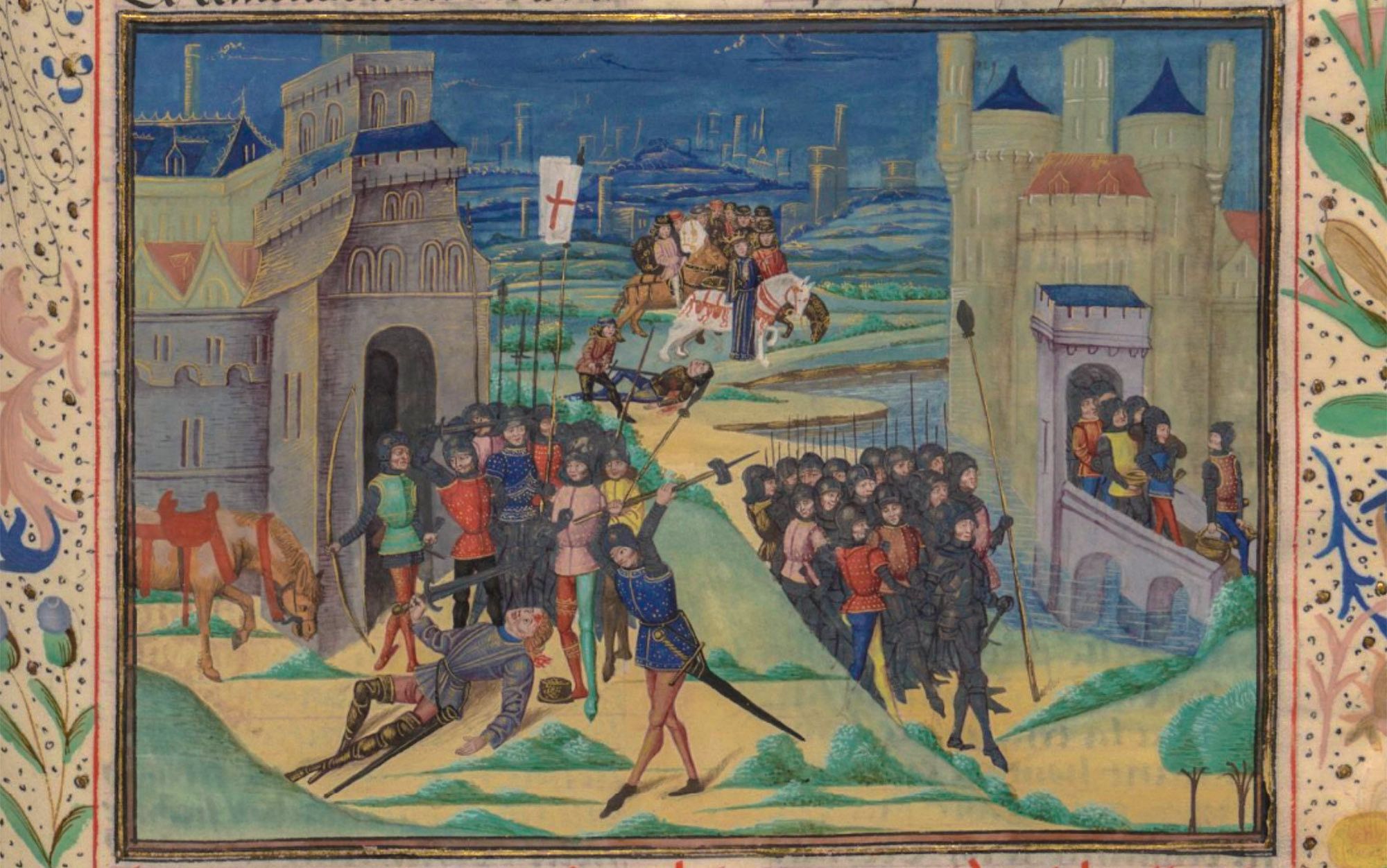
What can the decline of the Roman Empire and the end of European feudalism tell us about COVID-19 and the future of the West?The Peasants’ Revolt of 1381. The miniature illustrates, right, rebels entering London in 1381; left, the slaying of Sir Robert Salle by rebels at Norwich; and, centre background, the killing of Wat Tyler, the peasants’ leader, before the king at Smithfield. From Recueil des chroniques et anchiennes istories de la Grant Bretaigne by Jean de Wavrin. Courtesy Bibliothèque Nationale de France, MS français 78, f. 96rJohn Rapley
is a political economist at the University of Cambridge, as well as a senior fellow at the Johannesburg Institute for Advanced Study. His latest book is Twilight of the Money Gods: Economics as a Religion and How it all Went Wrong (2017). He lives in London and Johannesburg.
Brought to you by Curio, an Aeon partner
Edited by Sam Haselby
13 July 2021 (aeon.co)
Aeon for Friends
Early in 2020, after a mysterious coronavirus emerged out of China and then raced across the globe, a quiet new year took a screeching turn. Stark images of ventilated patients in Italian hospital hallways soon filled our newsfeeds. Panic erupted across the West. One after another, governments that had been telling their citizens everything was fine suddenly screamed at everyone to shelter in place and avoid all human contact. It felt like the modern world had just met its Black Death.
With no living memory of such scenes, Western audiences reached for the timeless literature of apocalypse to make sense of it all. But whereas ancient traditions of end times blamed spiritual causes for the collapse of civilisations, we, being the moderns that we are, opted for what we imagined to be a ‘scientific’ discourse – the so-called genre of collapsology. Although some modern scholars, such as Edward Gibbon, Oswald Spengler and Arnold Toynbee, retained essentially spiritual explanations for civilisation decline, while embedding them in empirical ground, those who would shape our interpretation of COVID-19 came from a different tradition, one that took inspiration from Thomas Malthus’s 1798 thesis about the natural consequences of human development.
Neo-Malthusians credited environmental feedback loops, not moral failings, for regime collapse. In the 1960s and ’70s, works by Paul Ehrlich and Donella Meadows et al argued that the world’s population was growing so fast it would soon outstrip resource supplies, leading to (among other things) widespread food shortages. More recently, Jared Diamond wrote of the role that environmental depletion and diseases played in the fall of civilisations, and his theory that the collapse of Easter Island resulted from overexploitation of the natural environment has enjoyed particular resonance. For its part, the COVID-19 pandemic revived old theories about the role that diseases played in regime collapse, and we were reminded that plagues had laid low the Roman Empire and destroyed European feudalism.
Except, that wasn’t what happened. At least, not quite the way supposed.
The thesis that environmental stresses cause regime collapse remains a topic of great debate. We can start just with the cases mentioned above. The alarmist warnings in the 1970s about overpopulation soon gave way not to concerns about food shortages, but about the problems caused by global overproduction of food, which was driving down food prices and accelerating the urbanisation of the developing world. Regarding Diamond’s book about Easter Island, pretty much from the get-go it faced strong criticism for its questionable evidence. For similar reasons, many historians of the Roman Empire doubt that the plague played a part in its downfall. As for the Black Death, in much of Europe it didn’t end feudalism but actually reinforced it. More generally, measured by the scale of the loss in human life as a proportion of the total population in the affected areas, 19th-century epidemics of cholera, and the flu pandemic of 1918, all took a far greater toll in the Western world than COVID-19. Yet you’d be hard-pressed to find hints of regime stress in response to any of them.
Still, the scholars who make a case for the civilisational impact of epidemics might be on to something. For starters, the link between empires and disease is quite strong, with cholera, tuberculosis, syphilis, bubonic plague, smallpox and other diseases all fanning out across the trade routes of empire. Tellingly, when one contrasts the responses to the COVID-19 pandemic of, say, China and Western countries, it seems plausible that this pandemic could hasten the relative decline, if not the fall, of the West. But given that China and the West confronted the same plague, why have the outcomes differed so wildly? Fortunately, history offers some insights.
An exogenous shock must encounter a vulnerability to bring down a regime
Let’s return to the Black Death of 14th-century Europe. The thesis that the plague ended feudalism starts with the fact that Europe’s labour supply dropped suddenly and sharply. This then augmented the bargaining power of the labouring classes, altering their relations to the nobility. But as mentioned, in much of Europe, and particularly in the east, the nobility responded by then reinforcing feudal bonds. However, in other places, the legal system permitted the renegotiation of the relationship between lords and producers. For example, in England, the evolution of Common Law had created a framework that made it possible for land tenure to change from feudal to market-based relations. As a result, when the Black Death caused an agrarian crisis, English society produced new forms of tenancy, thereby accelerating the decline of feudalism. In effect, English feudalism had a vulnerability to exogenous shock that was not present in other parts of Europe.
As it happens, the thesis that an exogenous shock must encounter a vulnerability to bring down a regime happens to fit the case of the Roman Empire. Recent historiography attributes that empire’s fall not to plagues but to the Hunnish invasions. Importantly, though, the sudden incursion of the Huns didn’t itself signal the Roman Empire’s collapse. The Huns emerge into the historical record in the 4th century, but it would be another century before they toppled the empire – which is to say, the exogenous shock alone didn’t change anything. Until well into the 5th century, the Romans dealt with the Huns as they had always done with frontier invaders, using a combination of repression and negotiation to neutralise the threat. But in the mid-5th century, at around the time of the empire’s greatest economic output, its reckless expansionism multiplied the conflicts on its borders, such that it could no longer concentrate its firepower on one foe. Thus, the vulnerability did not result from Rome’s internal weakening, as the Gibbon thesis had maintained. It actually came at the point when the empire was at its peak in both economic output and, it would appear, hubris.
That an empire’s strength might actually be its weakness, creating vulnerabilities to exogenous shocks that didn’t exist in earlier stages of its history, bears consideration in light of the comparatively poor performance of Western countries in dealing with the COVID-19 pandemic. Even more importantly, it could help us chart the likely long-term geopolitical impacts of the pandemic. While far more devastating in human lives, the 1918 flu pandemic did little economic harm to Western societies. In contrast, COVID-19 plunged today’s West into an economic slump that will set back growth, in some cases by years, hastening its decline relative to China and much of the erstwhile global periphery. All told, the same exogenous shock, a very different outcome: COVID-19 seems to have found a vulnerability that did not exist in the West in 1918 – and does not exist in much of the Western world’s former periphery.
When the COVID-19 pandemic hit and countries went into lockdown, markets crashed. To keep their markets and economies afloat, Western governments began raining cash, borrowing trillions of dollars and adding an average fifth of gross domestic product to national debts. The result was dramatic. Instead of the feared New Great Depression, Western economies by and large experienced short recessions, followed by sharp rebounds. Markets, meanwhile, scaled unprecedented heights. The economic firepower of the Western world was shown to be seemingly limitless. When contrasted with the relatively modest expense incurred by governments in response to the 1918 flu pandemic, observers noted how much more Western countries could now do than before. Richer than ever, and with deep pools of capital, governments enjoyed the luxury of being able to spend heavily to protect their citizens and preserve their economies.
But if that appears to be a sign of strength, it might also reveal a weakness. Consider an analogy. I once had a conversation with an Irish colleague in which I marvelled at how, in the space of little more than a generation, Ireland had transformed from a poor country into a rich one. ‘Correction,’ he said, ‘we’re a high-income country, we’re not yet rich,’ going on to explain that it would take many more generations to actually accumulate the wealth in endowments, investment funds and the like that characterise rich countries. And the thing about wealth is that, when you have it, you have to keep spending to preserve it. Suppose, for example, that one year you earned $1 million. You could spend it, enjoying the high life, but running the risk alluded to by my colleague – that, if in the next year you lost your job or business, you’d be back down to zero. So instead, you could invest it, say, by building a house. That way you’d have capital you could live off if hard times returned. But you’d also have incurred other expenses – repair bills, utility charges, property taxes, decorating costs, and the need to buy and replace furnishings.
Empires also entail ongoing costs. The richer an empire becomes, the more it must spend to preserve that wealth. As the Roman Empire expanded into virgin lands, it built up the massive estates that enabled it to accumulate its endowment of capital, much of which survives to this day in roads, ruins and aqueducts. But those lands were virgin only to the Romans. Other people already lived there, and as they were beaten back or enslaved by the Romans, resistance to the empire inevitably grew. Rebellions were thus a constant feature of frontier life. That created the need for a standing military and the tax revenues to sustain it.
For most of the history of its empire, Rome was able to concentrate military forces on comparatively disorganised and weak opponents and, coupled with diplomatic measures such as subsidies, thereby neutralise the threats. However, as the empire grew richer, not only did it make more enemies, but those enemies had the capacity to more effectively withstand Roman assaults because they’d been increasingly exposed to Roman military and administrative technologies, and had accumulated wealth from trading across the imperial frontier (the Vindolanda tablets revealed just how much of a frontier garrison’s food was sourced from across the frontier). The very wealth of the empire was what had produced this vulnerability.
Today’s immigration bolsters Western capital, plugging the labour shortages that are emerging
The modern West shows a similar arc. At the time of the 1918 pandemic, most of the world outside Europe and its then ‘white dominions’ (Canada, Australia, New Zealand) and the former colonies of the United States were either colonies of one of the European empires, notionally independent but in an economically subservient status (China, Latin America), or struggling to resist Western assimilation (Japan, the Ottoman Empire). Nationalism was embryonic in the Asian and African colonies, but it would be the 1930s, and especially during the Second World War, before it began to significantly challenge European dominance. In terms of its share of global output, the West was still rising, its peak to come only after the war when the US used a set of institutions (NATO, the World Bank and IMF, the United Nations) to effectively unify Western countries into a confederal empire – a model not unlike that used in the late Roman Empire, in fact. The flow of capital in the world economy came from the global periphery to the West. Firms in New York, London, Paris and other Western cities banked the surpluses. Meanwhile, the population of the Western world was young and growing, meaning that the vast majority of its people were either in or about to enter the workforce. In short, the West was still ascendant, and busily accumulating its wealth.
At the turn of the millennium, the West (developed OECD countries) accounted for four-fifths of global economic output. Since then, with the erstwhile periphery of the global economy rapidly rising as the net flow of capital shifted in its favour for the first time, that share has been declining, suggesting that the highwater mark reached 20 years ago was in fact the peak of the West. Some contemporary commentators, recalling that the wealth of the peak Roman Empire attracted the barbarian invasions, warn that we face a similar fate today if we don’t act urgently. Spotting the foe among immigrants from the global periphery, Right-wing politicians who want to close the borders find support from scholars such as Niall Ferguson, who, in accounting for Islamist terrorism in Western countries, has written that immigrants today resemble the invaders of Rome in that they ‘have coveted [Europe’s] wealth without renouncing their ancestral faith … Like the Roman Empire in the early 5th century, Europe has allowed its defences to crumble.’ This, he says, ‘is exactly how civilisations fall’. It sounds reasonable but it’s not true.
Invasion was the proximate cause of one civilisation’s fall, not the underlying cause. To begin with, the argument that modern immigration amounts to an exogenous shock is feeble at best. The invasions that toppled Rome were large-scale military assaults organised by external actors. Today, aside from a very small share of illegal immigration, the influx is fragmented and managed almost entirely by the importing state. If you doubt how extensive that state’s control is, spend a day with an undocumented immigrant. More importantly, the invasions of antiquity seized capital, especially when the invaders obtained land and any loot they could find. Today’s immigration actually bolsters Western capital, plugging the labour shortages that are emerging amid ageing populations.
The more significant analogy is to the vulnerability to exogenous shock that comes from having accumulated so much wealth. The location of that vulnerability today is entirely different, though. Over the previous generation, as economic growth has slowed in Western countries, wealth has started growing faster than income. And whereas wealth once depended on income, now for much of the population income depends on wealth. This is especially true for the share of the population that is retired, which in Western societies averages around a fifth. Since a drop in wealth entails a loss of income for wealth-holders, that gives the state a very strong incentive to preserve the value of that wealth. This incentive is further strengthened by the fact that the retired share of the population tends to be the most engaged in politics (illustrating Machiavelli’s rule that today’s losers constitute a more formidable political constituency than tomorrow’s winners).
What threatens that wealth, which is held largely in real estate and pension funds, is not a foreign invasion whose purpose is to seize those assets, as happened to Rome. For all the talk of fearmongering and xenophobia, we would have to be facing something like organised raids by undocumented immigrants hacking into share-registries and appropriating the assets of pension funds for Ferguson’s analogy to be remotely apt. Nor for that matter is the threat a disease outbreak that reduces the agricultural income of land, as was the case for Europe’s medieval nobility. The coronavirus pandemic ravaged Western people and societies but, as has been much discussed, the performance of stock markets has continued to be great for owners. Nevertheless, in the response of markets to the year’s events, there might be a clue to the vulnerability of the West, one that COVID-19 helped to expose and possibly exacerbate.
Consider the difference between market crashes today and those of history. When in 1929 the stock market collapsed, the Great Depression followed. Then, after the massive government wartime spending that John Maynard Keynes himself said was the first major successful experiment with fiscal stimulus, the economy took off. But it wouldn’t be until the 1950s that the stock market returned to the levels it had reached in 1929.
In contrast, over the past 30 years or so, Western countries have used a different set of tools when addressing market crashes, be they in stocks, bonds or real estate. They have pumped monetary stimulus directly into asset markets, and have targeted fiscal stimulus less at protecting incomes than at preserving asset values by, for example, bailing out banks or providing tax breaks for property purchases. After all, governments had committed themselves to the neoliberal dogma of fiscal prudence and were, if anything, cutting spending. So, while the economy has chugged along sluggishly, asset markets have repeatedly bounced right back. Those two outcomes might not be unrelated to one another. By inflating asset values, monetary stimulus amid fiscal austerity raises fixed costs and steers investment away from productive activities, thereby inhibiting economic growth. In other words, whereas government stimulus programmes once kickstarted economic growth, today they tend to protect accumulated wealth. Western societies spend a lot of money just to stay rich.
COVID-19 did not topple the West. But it might have hobbled it in its competition with the global South
The massive fiscal and monetary response to the COVID-19 pandemic looks no different. When Western economies were forced into lockdown, their governments borrowed some $17 trillion in order to keep businesses and consumers afloat, and to shore up asset values. For now, the size of the tab doesn’t overly concern economists. Western countries have carried higher debt loads in the past and, with interest rates expected to remain ultra-low for years, the cost of servicing the debt remains very manageable. The problem, rather, is what the debt is used for.
Returning to the analogy of the million-dollar year and the house you built with it, the difference between fiscal stimulus then and fiscal stimulus now is arguably the difference between taking out a loan to add a sundeck or swimming pool to the house, and taking out a loan to repair flood damage. The first will augment the house’s value, the second merely preserves it. Last year’s massive stimulus was not designed for a new era of economic growth. It was heavily oriented towards just keeping businesses and the economy afloat. But the risk is that, by bailing out many firms that added little dynamism to the economy, Western countries will lock in a Japanification of the economy, a syndrome that first emerged after Japan’s 1989 crash, characterised by chronic anaemic economic growth. In the global periphery, debt-fuelled investment tends to increase output and productivity more than is the case in Western countries, where much borrowing is essentially geared to keeping us in the lifestyles to which we’ve grown accustomed. The odds are therefore good that the response to the pandemic will only reinforce the long-term trend, of future growth being increasingly skewed towards the periphery. COVID-19 did not topple the West. But it might have hobbled it in its competition with the rising economies of the global South, most of which were once colonies of, or subservient regimes to, Western countries.
The wealth of the Roman imperial economy lay in land. Owned by the 10th of society that comprised the nobility, its revenues were taxed to support the military, whose job it was to protect the asset from outsiders. The wealth of today’s Western economy lies in financial markets, and is owned mostly by the top 10th of society that belong to the global 1 per cent. A wider group than one might suppose, since it includes almost any homeowner with a defined benefit pension, this is effectively the modern nobility. Although it faces no threat from invasion, the cost to society of preserving it in its current state might be getting as onerous as that of the late Roman Empire.