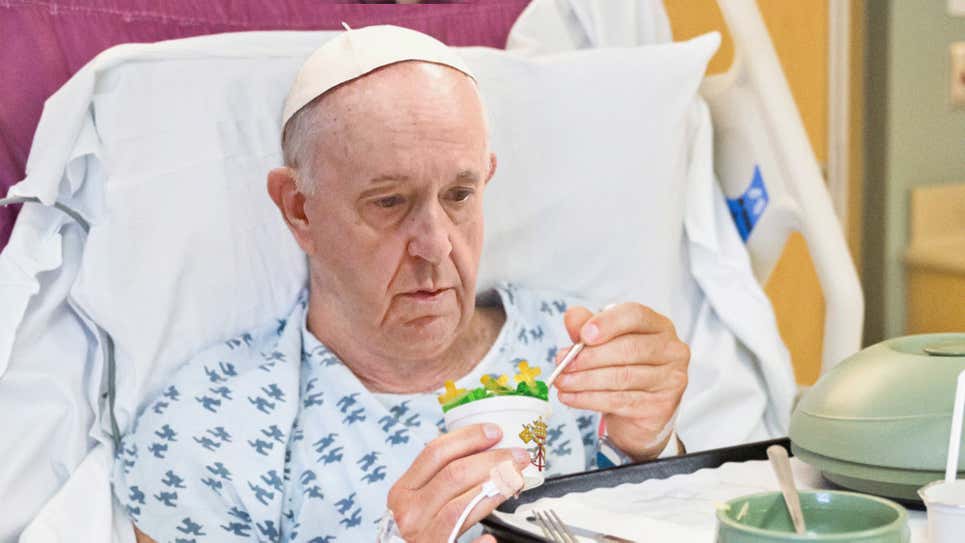
ROME—Steeling himself to eat the unappetizing concoction as he sat in his hospital bed, Pope Francis on Tuesday was reportedly served Eucharist Jell-O while recovering from colon surgery. “They said it’ll be a few more days until I can eat solid Eucharist again, but in the meantime I have to admit this stuff is pretty gross,” said the Supreme Pontiff, choking down his ninth single-serving cup of Eucharist Jell-O in three days of post-surgery hospitalization. “Loaves and fishes this ain’t, I’ll say that much. It’s clearly been sitting out for days. The nurses told me that this will help bring me healing salvation while I recover from surgery, but it tastes like absolute ass. I’d just throw it away, but I’m hungry, and you can’t exactly drop the body of Christ into the trash can. I just hope I can gut through it and keep it all down.” Pope Francis admitted to reporters that his only saving grace was being able to press a button on his bedside and a nurse would come to increase the levels of his communion wine IV drip.
Native to central and southern Europe, the amphibious alpine newt breeds in shallow water, where its larvae are born, hatch and feed on plankton, before sprouting legs and moving to land. This timelapse video from the Dutch director Jan van IJken tracks the development of a single-celled zygote into the hatched larva of an alpine newt. Captured in stunning detail at microscopic scales, Becoming is a remarkable look at the process of cell division and differentiation, whence all animals – from newts to humans – come. For more awe-inspiring biology from van IJken, watch The Art of Flying.
What do you see when you stare in the mirror? I don’t ask this as a philosophical question, more a literal one. Do you like the way you look? Do you immediately notice flaws – a nose you wish was smaller, a stomach you wish was flatter, legs you wish were longer or capable of running faster? The thoughts and feelings that you have about your physical appearance are the focus of body image research.
If you don’t feel uniformly positive about your appearance, you should know that you’re not alone. In a recent survey of people in the United States, 55 per cent of women and 42 per cent of men reported some measure of dissatisfaction with at least one element of their appearance. The degree to which people are concerned about their bodies ranges widely, from not liking one particular feature to a serious mental health condition called body dysmorphic disorder, in which people focus obsessively on their appearance. People with the disorder often limit their social interactions and frequently experience other mental health problems such as eating disorders and obsessive compulsive disorder.
Body image concerns are not merely superficial, but can affect many aspects of people’s lives. Of course, this also means that developing a positive body image can have positive consequences for both mental and physical health and wellbeing. Consider my friend, Ann. Despite being a relatively slender person, she has spent much of her adulthood concerned about her body and weight. She vacillates between restrictive diets (for months or even years at a time) and ‘regular’ eating habits. She also worries about what she wears. Perhaps most disconcerting is the impact that her body dissatisfaction has on her relationships and mental health in general. Some days, she wants to avoid people or situations because of how she feels about herself, and she wrestles with depression and anxiety.
Body image researchers such as myself want to help people like Ann, but there’s no pill one can take to banish body dissatisfaction. It might seem counterintuitive, but changing your appearance is unlikely to permanently transform your body image. Consider what happens when you get a wonderful new haircut. At first, you feel like a better version of yourself, and others might comment on how great your hair looks. Then, a couple of weeks pass, and both you and the people around you get used to your new haircut; it ceases to make you feel as special. The same tends to happen as a result of any change to your physical appearance; the boost to your body image is likely to be short-lived. This is why improving the cognitive and emotional facets of your body image is important.
I have been a psychologist, professor and body image researcher for nearly 25 years. In this Guide, I offer evidence-based suggestions for improving your body image, whether you’re experiencing mild or more serious body dissatisfaction. (However, if you feel that you have serious body image concerns, I recommend seeking professional help from a therapist, and I provide additional resources below.) Some of these suggestions might be easier to embrace than others; we all live in an appearance-focused world. But adoption of these body image-improving strategies is likely to make you both happier and healthier. I encourage you to try them out on your path to developing a more satisfying relationship with your body.NEED TO KNOWWHAT TO DOKEY POINTSLEARN MORELINKS & BOOKS
What to do
Reflect on your values
We all grew up hearing about the importance of not judging a book by its cover. But we also all grew up in a world that values people’s appearances. If we were to totally ignore our appearance, never giving a thought to what we wear, we’d likely be viewed as eccentric or strange. We have a choice, however, in terms of how much to care and how much energy to spend on our appearance. We should try to live what we value.
Nichole Wood-Barcalow, a psychologist in Ohio who treats patients with body image and eating concerns and who co-authored the Positive Body Image Workbook (2021), suggests that we should take time to consider what it is, exactly, that we value. You can start by thinking about what you hope to achieve in your life. Maybe you’re aiming for professional success or maybe you most want to focus on your relationships with others. Consider what you want others to value about you. Are you a reliable friend or coworker? Are you fun to be around?
An appreciation of beauty or the adoration of others might be components of our value systems. However, maybe we value compassion, diversity and equality more? Although improvements have been made recently, the beauty and fashion industries have rarely promoted images and advertisements that embrace people of all different shapes, sizes, colours and ability statuses. It’s worth considering the extent to which we want to take our cues from industries that devalue so many of us. Further, it’s unlikely that the people we care about and enjoy are in our lives because of their physical appearance; we experience their beauty in a variety of ways.
Living our values can mean embracing our own and other people’s bodies as they are. This might begin with appreciating that some people naturally have relatively small bodies, and some naturally have larger bodies; people’s body sizes are not necessarily a direct indication of their habits or health. In other words, we all have a natural body size that we’re likely to hover around when we’re adequately nourishing ourselves and engaging in a healthy amount of physical activity. Not everyone will be slender – even when they maintain healthy habits.
The psychologist Renee Engeln in Illinois refers to our cultural obsession with our appearance as ‘beauty sickness’. It’s not that she doesn’t appreciate why we care about how we look. She suggests the problem is when we care about our looks more than other – arguably more important – aspects of our lives. If we spend too much time and mental energy focusing on our appearance, we might have less time and energy for hobbies, friends or family.
Practise body gratitude
Do you ever look in the mirror and feel grateful instead of critical? What would happen if you started to focus on the parts of yourself that you enjoy? Research suggests that expressing appreciation for our bodies can actually improve body image.
So where do you start? When your critical inner voice starts to emerge with a thought such as I wish my nose were smaller, reply to it with I love my hair. For most people, the critical inner voice can be fairly easily distracted. This might feel silly at first, but if you create a list of the parts of your body that you like – or, at least, can appreciate – it will become more natural to automatically quiet your inner critic. So spend some time thinking about and listing the physical features that you do genuinely like, and put this list to good use.
You can also aim to get into a routine, such as expressing gratitude about your body every night when you brush your teeth. The key is to pair your gratitude exercise with another behaviour that you’re already in the habit of practising daily. This way, the habitual behaviour serves as a reminder to stick with the gratitude exercise.
Focus on functionality
Our bodies are much more than a façade; they serve vital functions that allow us to live our lives and experience our worlds. Focusing more on what a body does as opposed to just how it looks can be a useful step toward body positivity.
Body functionality is a term used to describe the many physical functions of our bodies: breathing, sleeping, walking, singing, dancing, engaging with other people and anything else a body can do. Although many people feel dissatisfied with their bodies or even ‘at war with’ them, our bodies aren’t deliberately trying to hold us back from living our lives. One way to reorient ourselves toward our body’s capabilities is through writing and reflection. In one study, women were asked to write statements about 10 functions of their bodies and how those functions contributed to their wellbeing. The women who took part in this simple exercise showed improvements on measures of body image during the study.
Try concentrating on your own body functionality – and even making a list of the ways that your body serves you well. Referring back to your list later might boost your positive feelings about your body following any initial improvement.
Engage in protective filtering
An important part of developing a positive body image is navigating the array of external influences that are apt to make you feel dissatisfied with your body. I am going to focus here on managing your consumption of media that can trigger body dissatisfaction. The bottom line, however, is that you can benefit from becoming more aware of how a variety of different people and environments make you feel, and then reacting to those feelings in protective ways.
Body image researchers refer to the avoidance of negative body image influences as ‘protective filtering’. This is not the same as maladaptive avoidance of anxiety-inducing situations or phobic behaviour; you can function in a psychologically healthy manner while still avoiding certain celebrities on social media. Some forms of media can be avoided more completely than others. For example, you might decide against watching television shows such as Next Top Model or The Bachelor, which feature women in objectified roles with a focus on their appearance. You can decline to buy or flick through magazines that are replete with articles and ads displaying emaciated women or selling beauty products.
Social media poses particular challenges and opportunities when it comes to your body image. Because most forms of social media feature content that’s curated based on your own interests and usage, you can shape your social media world to be protective. This might require unfollowing influencers, celebrities and possibly even friends who embody values contrary to your development of a positive body image. Instead of engaging with those on social media who focus extensively on their own appearance – and cosmetics or clothing that they feel enhance it – you could engage with body positivity activists, mental health professionals and others who offer tools and advice to aid you in your journey toward self-acceptance.
Media has a negative effect on body image largely because it provides endless opportunities to compare ourselves with others. Psychologists believe that it’s natural for us to compare ourselves with other people; it’s one way to gauge how we are doing when there aren’t other, objective metrics available to us. And, when it comes to assessing our own appearance, there aren’t really objective measures. The problem is that we tend to feel badly about ourselves and our bodies when we think we don’t measure up.
We might be especially likely to feel badly when we compare ourselves with celebrities and social media personalities. It’s important to be aware of how these comparisons make us feel and do our best to avoid them. It’s also helpful to remember that it’s essentially (most) celebrities’ and influencers’ job to look good. And they have a lot of help – from hair stylists to lighting to photo editing specialists – so the people we see in the media rarely look in real life the way we see them. And even if some of them do, it’s worth recognising that another’s beauty doesn’t detract from your own.
Reframe your goals for exercise and eating
The health habits that you maintain can affect your body image, but how you think about your habits is also important. Let me provide an example. If you go for a run, but you think of it as obligatory or as punishment (for eating? for living?), you’re unlikely to enjoy that run. But if you think of running as something you do to help yourself feel good, improve your health and take care of yourself, you might actually enjoy running more and find it easier to sustain this behaviour. Further, this mindset will likely support your positive body image as opposed to detracting from it. One of my former students, Allie, recently shared that she had changed her mindset about exercise: ‘I decided I just needed to move every day and not worry about how “intense” my workouts are.’
There is a fairly extensive psychological literature on goal setting and achievement that suggests that when we frame goals in terms of things we want to do (called approach goals) versus things we want to avoid (called avoidance goals), it’s typically easier to achieve our goals. A number of explanations have been offered for this, but one is that it can be difficult to avoid certain thoughts or behaviours entirely, making avoidance goals less satisfactory and less easily achieved. How is this relevant to body image? It’s unlikely that you’ll be able to avoid all the behaviours that contribute to body dissatisfaction. If our goal is to completely avoid foods we deem unhealthy, then we’re likely doomed to fail. But if our goal is to eat foods that are nutritious, such as one or two pieces of fruit per day, we stand a better chance of meeting that goal. When we meet goals that are important to us, we feel a sense of pride that can motivate us to continue on a psychologically and physically healthy path.
The key is to reframe our behaviours in ways that make healthy ones sustainable. Punishing or shaming ourselves for not doing all the ‘right’ things is rarely an effective approach to health (mental or physical) and can reinforce negative body image. Easing ourselves into healthy habits can be more effective for achieving enduring change. A woman I work with, Christie, told me that she used a gradual approach a few years ago to become more physically active. She started out exercising two days a week for about 20 minutes per day, and slowly worked her way up to 40 minutes about six times per week. Most importantly, she told me, ‘don’t worry if one day you run out of time to exercise or just don’t have a good workout. Some days are like that.’NEED TO KNOWWHAT TO DOKEY POINTSLEARN MORELINKS & BOOKS
Key points
Body dissatisfaction is common, and people experience varying degrees of it. An intense focus on physical appearance can negatively impact your social life and mental health.
You can learn to feel better about your body, but it’s likely to require some attention to your current thought patterns and habits.
You can start to change your relationship with your body by considering what you truly value – beyond physical beauty – and how you can best live in accordance with your values.
One aspect of living your values can be to accept your own and other people’s bodies. Some people will naturally tend to have relatively large bodies, even if they’re living healthfully.
Body image can be improved by focusing on the aspects of your body that you genuinely appreciate and the ways your body enables you to experience the world.
You can defend your body image by filtering out negative external influences, such as appearance-focused content on social media and television.
Your body image can benefit if you think about your health habits – especially your eating and physical activity patterns – in terms of self-care rather than self-punishment or avoidance.
Learn more
Some body image scholars and activists have suggested that aiming for a positive body image can keep you overly focused on your appearance. In other words, for some people, trying to feel good about how they look might involve too much thinking about their appearance. If this resonates with you, then you might want to aim for ‘body neutrality’. Whereas the goal of body positivity is to feel good about your body, the goal of body neutrality is to just not really think about your body. For some people, body neutrality might be a stop on the way to a positive body image. For others, body neutrality is a satisfactory endpoint.
A body-neutral perspective allows for any and all people to be beautiful because the focus is on inner beauty and not physical beauty. It reduces the pressure to try to feel positively about or love aspects of your body that you currently might not. Instead of trying to convince yourself that you love your entire physical self, you can make a decision to not care as much about every aspect of your physical appearance.
Body neutrality can be comparable to not caring that you’re not a gifted musician, nor a talented athlete, nor a charismatic public speaker. If you don’t expect these things of yourself and don’t care that you don’t possess these qualities, you’ll spend less time and energy thinking about them. For example, aside from sometimes saying: ‘I wish I had learned to play an instrument as a child,’ I don’t ever yearn to be more musically inclined or able. The difference between these skills and your appearance, of course, is that you can (most likely) avoid playing music, sports or public speaking, but you can’t avoid having an appearance.
If you’re interested in adopting a more body-neutral mentality, you might want to start with affirmations that emphasise self-acceptance. When I’m having a bad body-image day (yes, it can still happen to me), I call up one of my personal mantras: ‘I am a middle-aged woman, professor, wife, mother of two teenagers – and I am doing OK. No one I really care about cares much about how I look.’ My self-affirmations are not necessarily about the aspects of my appearance that I like, but a reminder to myself that my appearance is not what I or others most value about me.
I don’t believe any of us need to love our bodies every second of every day to be happy. But we do need to value and respect our bodies. We should view the process of body image discovery as a journey and, above all, seek to take care of ourselves – body and mind.NEED TO KNOWWHAT TO DOKEY POINTSLEARN MORELINKS & BOOKS
Links & books
For direct support in improving your body image, consider meeting with a counsellor who has experience treating eating disorders and body image concerns. Most eating disorders awareness and treatment organisations – such as NEDA, the National Eating Disorders Association in the US; Beat Eating Disorders in the UK, and the Butterfly Foundation in Australia – offer resources to help you connect with a qualified professional. If your concerns focus primarily on your relationship with food, you might want to seek a registered dietician who has what’s known as a ‘Health at Every Size’ (HAES) orientation.
The bookMore Than a Body: Your Body Is an Instrument, Not an Ornament (2020) by Lexie Kite and Lindsay Kite is full of inspiration for women looking to improve their body image. Their website contains information about their online courses, blog and speaking events. Lindsay Kite’s TEDx talk ‘Body Positivity or Body Obsession? Learning to See More and Be More’ (2017) features a description of her personal and professional journey toward body image resilience.
The bookBeauty Sick (2017) by Renee Engeln provides a feminist view of body image and appearance concerns. The corresponding website contains information and a link to the author’s discussion of her work.
The Australian scholar Scott Griffiths is a world-renowned body image researcher. His TEDx talk ‘Muscle Dysmorphia: The Male Eating Disorder’ (2017) features a discussion of eating disorders and body image concerns among men.
If you’re interested in working on protective filtering, you might want to consider unfollowing some influencers and celebrities on social media and instead following body-positive social media influencers from this list I compiled.
In her bookMeaningFULL: 23 Life-Changing Stories of Conquering Dieting, Weight, and Body Image Issues, Alli Spotts-De Lazzer, a therapist in California, compiles inspiring accounts of everyday people who have found a way to move past their own body dissatisfaction and create richer lives for themselves.
The bookPositive Body Image Workbook: A Clinical and Self-Improvement Guide (2021) by Nichole Wood-Barcalow, Tracy Tylka and Casey Judge provides information, exercises and a review of all of the critical topics in positive body image scholarship and research.
I’ve written extensively about body image for Psychology Today and the US News and World Report. I’ve also writtenThe Body Image Book for Girls: Love Yourself and Grow Up Fearless (2020) and Being You: The Body Image Book for Boys (forthcoming). Although the target audiences for these books are tweens and teens, they contain accessible information about body image for any age.
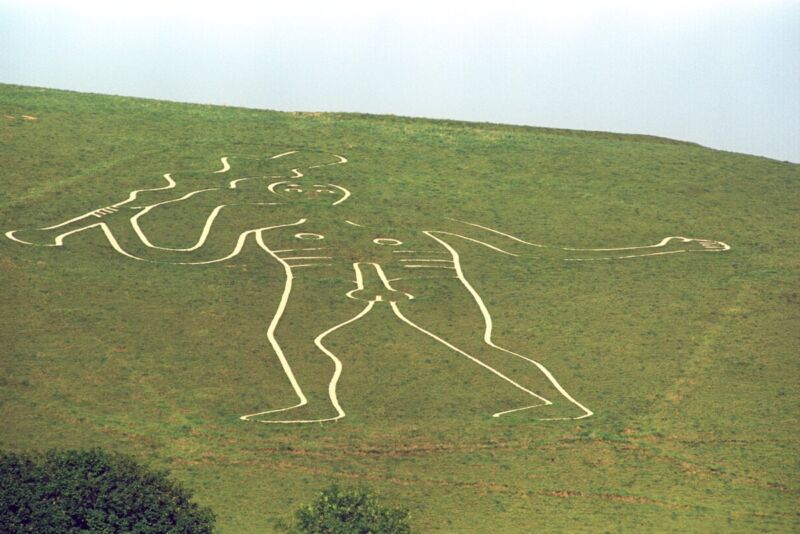
Enlarge / Behold, the “Rude Man” chalk giant carved on a hill above the village of Cerne Abbas in Dorset, England.Barry Batchelor/PA Images/Getty Images
The Cerne Abbas Giant is a 180-foot-tall figure of a naked man wielding a large club, carved with chalk into a hilltop in Dorset, England. The figure’s generously sized erect phallus has earned it the nickname “Rude Man” and no doubt contributes to its popularity as a tourist attraction. Archaeologists have long speculated over exactly when, and why, the geoglyph was first created. Now, thanks to a new analysis of sediment samples, researchers have narrowed down the likely date for the Rude Man’s creation to the late Saxon period—a surprising result, since no other similar chalk figures in the region are known to date from that time period.
“This is not what was expected,” said geoarchaeologist Mike Allen, who has been working with the National Trust on the ongoing project to learn more about the Cerne Abbas Giant. “Many archaeologists and historians thought he was prehistoric or post-medieval, but not medieval. Everyone was wrong, and that makes these results even more exciting.” National Trust senior archaeologist Martin Papworth told the Guardian he was “flabbergasted” by the results, saying, “I was expecting 17th century.”
In the 1990s, archaeologists relied on soil samples to date another well-known geoglyph—the 360-foot-long Uffington White Horse in Oxfordshire—to between 1380 and 550 BCE. And the Long Man of Wilmington in East Sussex dates back to the 16th century. “Archaeologists have wanted to pigeonhole chalk hill figures into the same period,” said Allen. “But carving these figures was not a particular phase—they’re all individual figures, with local significance, each telling us something about that place and time.”
The Cerne Abbas Giant was formed by cutting trenches two feet deep into the steep hillside and then filling them with crushed chalk. Some scholars believed the giant might date back to the Iron Age as a fertility symbol. Local folklore holds that copulating on the giant’s crotch will help a couple conceive a child, and there is an Iron Age earthwork known as the Trendle at the top of the hill in which the giant has been carved. However, there is no mention of the figure in a 1540s survey of the Abbey lands, nor in a 1617 survey conducted by the English cartographer John Norden.Advertisement
The earliest known written reference to the Cerne Giant appears in a 1694 warden’s account from St. Mary’s Church in Cerne Abbas, recording the cost of three shillings to repair “ye Giant.” There are also references to the figure in a 1734 letter by the then-Bishop of Bristol and a 1738 letter by antiquarian Francis Wise. The first survey to mention the giant was published in 1763 and included measurements and a drawing. After that, mention of the giant becomes far more common in the historical record.
Cerne Abbey was founded in 987 CE, and given the evidence for a medieval origin date, it’s possible that the giant was created to help convert local inhabitants from worshiping the early Anglo-Saxon god Heil (or Helith). However, Papworth is skeptical of this theory. “Why would a rich and famous abbey—just a few yards away—commission, or sanction, a naked man carved in chalk on a hillside?” he said.
Others have suggested the giant is a depiction of Hercules, citing evidence that the figure may have once worn a cloak, in keeping with traditional depiction of the demigod. Or perhaps it was created in the 17th century as a parody of Oliver Cromwell, who was sometimes mocked as “England’s Hercules” by contemporaries.
A giant Homer Simpson appeared alongside the Cerne Abbas Giant on July 16, 2007—a publicity stunt to promote The Simpsons Movie. Tim Bunce/CC BY 2.0
Another publicity stunt: Big Smith Jeans gave the giant a pair of purple trousers. The National Trust was not amused. Tim Ockenden/PA Images/Getty Images
The Uffington White Horse in Oxfordshire dates back to between 1380 and 550 BCE. Michael Serraillier/Gamma-Rapho/Getty Images
Long Man of Wilmington, 16th century. CM Dixon/Print Collector/Getty Images
Last year, the National Trust announced that soil samples taken from the figure included species of microscopic snails introduced to the region during the medieval period, in keeping with the new findings. For this latest analysis, the team relied upon a technique known as Optically Stimulated Luminescence, which involved subjecting the samples to laser light. That light released trapped particles, and by measuring their concentrations, it was possible to calculate when individual grains in those samples were last exposed to sunlight. That in turn enabled researchers to infer a likely date of origin.
The deepest samples—taken from the giant’s elbows and feet—rule out a prehistoric Roman origin, indicating that the giant was probably first made by late Saxons sometime between 700 and 1100 CE. However, other samples indicate a later date of around 1560—still predating the first recorded mention of the giant in the 1694 church warden’s account.
According to Papworth, it’s possible that people have been re-chalking the Rude Man over a very long period of time, which would explain the different dates, as well as all the evidence suggesting the giant’s features have changed over time. A 2020 LIDAR scan, for instance, revealed that the impressive phallus had been added much later—perhaps when the figure was re-cut as a Cromwell parody in the 17th century.
“I wonder whether he was created very early on, perhaps in the late Saxon period, but then became grassed over and was forgotten,” Papworth said. “But at some stage, in low sunlight, people saw that figure on the hill and decided to re-cut him again. That would explain why he doesn’t appear in the abbey records or in Tudor surveys.”
Being able to narrow down the date for the Cerne Abbas Giant is an impressive feat, but there is always more to learn about the figure. “Future research could tell us even more about how he changed over time and whether our theory about his ‘lost’ years is true,” said Papworth. “When we began the work, some people wanted the giant’s age to remain a mystery—but archaeologists want to use science to seek answers. We have nudged our understanding a little closer to the truth, but he still retains many of his secrets. He still does have an air of mystery, so I think everyone’s happy.”
JENNIFER OUELLETTE Jennifer Ouellette is a senior writer at Ars Technica with a particular focus on where science meets culture, covering everything from physics and related interdisciplinary topics to her favorite films and TV series. Jennifer lives in Los Angeles. EMAILjennifer.ouellette@arstechnica.com // TWITTER@JenLucPiquant
“We’re all intrinsically of the same substance,” astrophysicist Janna Levin wrote in her exquisite inquiry into whether the universe is infinite or finite. “The fabric of the universe is just a coherent weave from the same threads that make our bodies. How much more absurd it becomes to believe that the universe, space and time could possibly be infinite when all of us are finite.” How, then, do we set aside this instinctual absurdity in order to grapple with the concept of infinity, which pushes our creaturely powers of comprehension past their limit so violently?
That’s what the mathematician and writer Lillian R. Lieber (July 26, 1886–July 11, 1986) set out to explore more than half a century earlier in the unusual and wonderful 1953 gem Infinity: Beyond the Beyond the Beyond (public library) — one of seventeen marvelous books she published in her hundred years, inviting the common reader into science with uncommon ingenuity and irresistible warmth. Emanating from Lieber’s discussion of infinity is a larger message about what it means, and what it takes, to be a finite but complete and balanced human being.
Lillian R. Lieber
Lieber belongs to the “enchanter” category of great writers and was among the first generation of women mathematicians to hold academic positions in her role chairing the Department of Mathematics at Long Island University. She had a peculiar style resembling poetry, though she insisted it was not free verse but, rather, a deliberate way of breaking lines in order to speed up reading and intensify comprehension. (Curiously, I find her style to have precisely the opposite effect, which is why I’ve enjoyed it so tremendously — it does what poetry does, which is slow down the spinning world and dilate the pupil of attention so that the infinite becomes comprehensible.)
Populating her books is the character of T.C. Mits, “the Celebrated Man-in-the-Street,” and his mate, Wits, “the Woman-in-the-Street.” Accompanying Lieber’s writing are original line drawings by her own mate, the illustrator Hugh Gray Lieber.
Lieber’s work was so influential in elevating the popular science genre that even Albert Einstein himself heartily praised her book on relativity, yet many of her books have fallen out of print — no doubt because the depth, complexity, and visionary insurgency of her style don’t conform to the morass of formulaic mediocrity passing for popular science writing today.
Lieber frames the premise of Infinity in the charming opening verse — or, as she insisted, decidedly not-verse — of the second chapter:
Of course you know that the Infinite is a subject which has always been of the deepest interest to all people — to the religious, to poets, to philosophers, to mathematicians, as well as to T.C. Mits (The Celebrated Man-in-the-Street) and to his mate, Wits (the Woman-in-the-Street). And it probably interests you, or you would not be reading this book.
But it is in the first chapter, titled “Our Good Friend, Sam,” that Lieber’s genius for science, metaphor, and wordplay shines most brilliantly as she takes on everything from the symbiotic relationship between art and science to free will to the vital difference between common sense and truth to the evils of antisemitism and all exclusionary ideologies. (It is self-evident to point out that Lieber, a Jewish woman writing shortly after WWII in a climate of acute antisemitism and sexism, was, like any artist, bringing all of herself to her art.)
Lieber writes:
For those who have not met SAM before, I wish to summarize VERY BRIEFLY what his old acquaintances may already know, and then to tell to all of you MORE about him. In the first place, the name “SAM” was first derived from Science, Art, Mathematics; but I now find the following interpretation much more helpful: the “S” stands for OUR CONTACT WITH THE OUTSIDE WORLD; please note that I do NOT say that “S” represents “facts” or “reality”, for the only knowledge we can have of the outside world is through our own senses or “extended” senses — like microscopes and telescopes et al which help us to see better, or radios, etc., which help us to hear sounds which we would otherwise not be aware of at all, and so on and so on.
But of course there may be many, many more things in the world which we do not yet perceive either directly through our senses or with the aid of our wonderful inventions. And so it would be Quite arrogant to speak as if we knew what the outside world “really” is. That is why I wish to give to “S” the more modest interpretation and emphasize that it represents merely that PART of the OUTSIDE world which we are able to contact, — and therefore even “S” has a “human” element in it.
Next: the “A” in SAM represents our INTUITION, our emotions, — loves, hates, fears, etc. — and of course is also a “human” element.
And the “M” represents our ability to draw inferences, and hence includes mathematics, logic, “common sense”, and other ways in which we mentally derive the “consequences” before they hit us. So the “M” too is a “human” element.
Thus SAM is entirely human though not an individual human being.
Furthermore, a Scientist utilizes the SAM within him, for he must make “observations” (“S”), he must use his “intuition” (“A”) to help him formulate a good set of basic postUlates, from which his “reasoning powers” (“M”) will then help him to derive conclusions which in turn must again be “tested” (“S” again!) to see if they are “correct”.
Perhaps you are thinking that SAM and the Scientist are really one and the same, and that all I am doing is to recommend that we all become Scientists! But you will soon see that this is not the case at all. For, in the first place, it too often happens, — alas and alack! — that when a Scientist is not actually engaged in doing his scientific work, he may “slip” and not use his “S”, his “A”, and his “M”, so carefully, will bear watching, like the rest of us.
In a sentiment which physicist and poet Alan Lightman would come to echo decades later in his beautiful meditation on the creative sympathies of art and science, Lieber adds:
So, you see, being a SAMite and being a Scientist are NOT one and the same.
Besides, a SAMite may not be a Scientist at all, but an Artist! For an Artist, too, must use his “S” in order to “observe” the world, his “A” (“intuition”) to sense some basic ways to translate his “observations”, and his “M” to derive his “results” in the form of drawings, music, and so on. Thus an Artist, too, WHEN AT HIS BEST, is a SAMite.
Perhaps Lieber’s most interesting, layered, and timelessly relevant discussion is of the concept of freedom, its misconceptions and mutations, and its implication for our private, public, and political lives:
Now consider a person who is SOMETIMES or OFTEN like this: SaM. He is evidently relying very heavily on his “intuition”, his “hunches”, his “emotions”, hardly checking to see whether the “observations” of the outside world (“S”) and his own reasoning powers (“M”) show his “hunch” to be correct or not! And so, precious as our “intuition” may be, it can go terribly “haywire” if not checked and double-checked by “S” and “M”. Thus, a person who habitually behaves like this is allowing his “S” and “M” to become practically atrophied, and is the wild, “over-emotional” type, who is not only a nuisance to have around, but is hurting himself and not allowing himself to become adjusted to the world he lives in. Such a person, with an exaggerated “A”, and atrophied “S” and “M”, has a feeling of “freedom”, of not being held down by “S” and “M” (“facts” and “reason”) ; but, as you can easily see this makes for Anarchy, for a lack of “self-control” — and can lead to fatty degeneration from feeling “free” to eat all he wants; to the D.T.’s from feeling “free” to drink all he wants; to accidents because he feels “free” to drive as fast as he wants and to “hog” the road; to a sadistic lack of consideration for others by feeling “free” to kick them in the teeth for “nuttin’”; to antisocial “black market” practices from a similar feeling of “freedom”, giving “free” reign to the “A” without the necessary consideration of “facts” (“S”) and “reason” (“M”). Needless to say this is a PATHOLOGICAL FREEDOM as against a NORMAL, HEALTHY FREEDOM of the well-balanced SAM which is so necessary in society in which EACH individual must be guided by the SAM within himself in order to avoid conflict with the SAM in someone else. This is something that a bully does not understand — that if he acts like a pathological sAm, he induces sAmite-ism in others, as in mob violence; this is indeed a horrible “ism” that can destroy a society as well as individuals in it.
Lieber proceeds to build on this taxonomy of psychological imbalances, reminiscent of neuroscience founding father Santiago Ramón y Cajal ‘s taxonomy of the “diseases of the will.” She turns to the next imbalance — the person blinded by isolated facts, unable to integrate them into an understanding of the big picture:
Similarly, there is the Sam type: he may be called the “tourist” type — running around seeing this and that but without the “imagination” (“A”) or the reasoning power (“M”) to put his observations together with either heart (“A”) or mind (“M”), but is concerned only with ISOLATED BITS OF INFORMATION: he is like the man who, seeing a crowd had gathered, wanted to know what happened. and, when someone told him “Ein Mann hat sich dem Kopf zerbrochen” (It happened to be in Germany), corrected the speaker’s grammar and said “DEN Kopf!” He knew his bit of grammar, but what an inadequate reaction under the circumstances. don’t you think?
Next comes the flawed rationalizer, who misuses the tools of logic against reason:
And there is also the saM type — one who can reason (“M”) but starts with perhaps some postulate (“A”) favoring murder. Such a man would make a wonderfully “rational” homicidal maniac or crook who could plan you a murder calmly and rationally enough to surprise any who are not familiar with this sAM type of pathological case.
Lieber returns to the core purpose of her SAM metaphor and its relationship to the central question of the book:
Thus SAM gives us a way of examining our own behavior and that of others, taking into account the “facts” (“S”), and using imagination and sympathy (“A”) in a rational way (“M”).
Are you perhaps thinking, “Well, this may be interesting, but why all this talk about SAM, when you are writing a book about Infinity?” To which the answer is: The yearning for Infinity, for Immortality, is an “intuitive” yearning (“A”): we look for support for it in the physical world (“S”), we try to reason about it (“M”), — but only when we turn the full light of SAM upon it are we able to make genuine progress in considering Infinity.
In a brilliant and necessary caveat reminiscent of mathematician Kurt Gödel’s world-changing incompleteness theorems, which unsettled some of our most elemental assumptions by demonstrating the limits of logic turned unto itself, Lieber adds:
There is only one more point I must make here: Namely, that even being a well-balanced SAMite — and not a pathological anti-SAMite like SAM, etc. etc. — is NECESSARY but NOT SUFFICIENT. You will probably agree that it is further necessary to have our SAM up-to-date. For he is a GROWING boy, and what was good enough for him in 1800 is utterly inadequate in 1953; and unless the “S” is up-to-date and the postulates (“A”) and reasoning (“M”) are appropriately MODERN, we cannot make proper ADJUSTMENT in the world TODAY. And ADJUSTMENT is what we must have. For adjustment means SURVIVAL, and that is a MINIMUM demand — for, without survival we need not bother to study anything we just won’t be here to tell the tale.
In a passage of piercing pertinence today, as we watch various oppressive ideologies and tyrannical regimes engulf the globe, Lieber concludes by returning to the subject of freedom, its malformations, and its redemptions:
And so let me summarize by saying that the ANTI-SAMITES hurt not only themselves, by getting “ulcers”, nervous breakdowns, drinking excessively, etc. etc., but hurt others also, for from their ranks are recruited those who advocate war and destruction, the homicidal maniacs, the greedy crooks, the gamblers, the drunken drivers, the liars, et al.
[…]
Just a word more about FREEDOM — you have seen above the pathological idea of freedom, but when you consider this important concept from SAM’s WEll-BALANCED viewpoint, you will see that, from this point of view, the “feeling” of freedom (“A”), being supported on one side by “S” (the “facts” of the outside world), and on the other by “M” (“sweet reasonableness”) — is definitely NOT the ANARCHICAL freedom of SAM, but is a sort of CONTROLLED FREEDOM — controlled by facts and reason and is therefore SELF-controlled (by the SAM within us) and hence implies VOLUNTARY COOPERATION rather than FORCE. Thus anyone who demands “freedom unlimited” as his right, is a pathological SAM, a destructive creature; whereas, in mathematics you will find the CONTROLLED FREEDOM of SAM and you will feel refreshed to see how genuine progress can be made with this kind of freedom.
ARIES (March 21-April 19): In his poem “Litany,” Aries poet Billy Collins testifies that he is “the sound of rain on the roof.” He also claims to be “the moon in the trees, the paper blowing down an alley, the basket of chestnuts on the kitchen table, and the shooting star.” He does make it clear, however, that he is not “the bread and the knife” on the table, nor the “crystal goblet and the wine.” What about you, Aries? What are all the earthy and fiery phenomena that you are? Are you, as Collins suggests, “the dew on the morning grass and the burning wheel of the sun and the marsh birds suddenly in flight”? Now would be an excellent time to dream up your own version of such colorful biographical details.
TAURUS (April 20-May 20): “Why else keep a journal, if not to examine your own filth?” wrote poet Anne Sexton. And yes, Sexton did have a lot of filth to explore, including the physical abuse of her daughters. But most of us don’t need to focus so obsessively on our unlovely aspects. Keeping a journal can also be about identifying our ripening potentials and unused riches. This approach would be especially fun and wise for you Tauruses right now. The coming weeks will be an auspicious time for deep introspection that frees capacities and powers you have only partially activated up until now.
GEMINI (May 21-June 20): Journalist Sam Anderson marvels at his young daughter’s project: a small plastic dome-like structure that houses a community of ladybugs. All they need to consume, for weeks at a time, are “two water-soaked raisins.” I don’t think you’ll need to be forever as efficient and hardy as those ladybugs, Gemini, but you may have to be like that temporarily. My advice? Don’t regard it as a hardship. Instead, see it as an opportunity to find out how exquisitely resourceful and resilient you can be. The skills you learn and refine now will be priceless in the long run.
CANCER (June 21-July 22): Cancerian poet Linda Hogan says she doesn’t like to be parched. She wants to be like “a tree drinking the rain.” I think every Cancerian has similar dreams: to be steadily immersed in engrossing feelings, awash with intimate longings, flowing along in rhythm with the soul’s songs. The coming weeks will be prime time for you to relish these primal pleasures. It’s probably best to avoid an outright flood, but I think it’s wise to invite a cascade.
LEO (July 23-Aug. 22): Lupita Nyong’o had a starring role in Steve McQueen’s film “12 Years a Slave.” She praised his directorial skills. She loved the fact that he told her, “Fail, and then fail better.” Why? “That kind of environment, where failure is an option, is magical,” she said. It allowed her to experiment freely, push herself beyond her previous limits, and focus on being true to the character she was playing rather than trying to be a “good actor.” I think these are excellent principles for you to keep in mind during the coming weeks.
VIRGO (Aug. 23-Sept. 22): Virgo-born Wayne Shorter is a legendary jazz composer and saxophonist. He has been making music for over 60 years, often with other legendary creators like Miles Davis and Herbie Hancock. The New York Times described Shorter as “jazz’s greatest living small-group composer and a contender for greatest living improviser.” Bass prodigy Tal Wilkenfeld, who is 53 years younger than Shorter, tells the story of a show she performed with him. Just before going on stage, Shorter came up to her, sensing she was nervous, and whispered some advice: “Play eternity.” Now I’m offering that same counsel to you as you carry out your tasks in the coming days. Be as timeless as you dare to be. Immerse yourself in the most expansive feelings you can imagine. Authorize your immortal soul to be in charge of everything you do.
LIBRA (Sept. 23-Oct. 22): Libran author Paula McLain says the word “paradise” is derived from the ancient Persian word “pairidaeza,” meaning “walled garden.” For her, this association suggests that making promises and being faithful to our intentions are keys to creating happiness with those we care for. Paradise requires walls! To scrupulously cultivate freedom, we need discipline. If we hope to thrive in joyous self-expression, we must focus on specific goals. I bring these thoughts to your attention because now is a pivotal time to work on building, refining and bolstering your own personal version of paradise.
SCORPIO (Oct. 23-Nov. 21): Thousands of 28-pound bars of 24-carat gold are stored in the Bank of England’s underground vault. To gain entry to the treasure trove, bankers use metal keys that are three feet long. They must also utter a secret password into a microphone. According to my reading of the astrological omens, you Scorpios can now gain access to a more metaphorical but nevertheless substantial source of riches. How? The key is a particular scene in your imagination that has recently begun to coalesce. It is an emblem of a future triumph or breakthrough that you will accomplish. As for the password, which you will also need, it’s “vigorous rigor.”
SAGITTARIUS (Nov. 22-Dec. 21): Somehow, I have lived all these years without ever coming across the rare English word “selcouth.” Today, as I meditated on the exotic astrological portents coming up for you, that word appeared—arriving on my phone via text message from my Sagittarius friend Lila. She told me, “I have a feeling that life is about to get intensely SELCOUTH for us Sagittarians.” I looked up the unfamiliar word and found these synonyms: unusual, marvelous, strange, magnificent, scarce, wondrous, weird, rare, and exotic. Those terms do indeed coincide with my interpretation of your immediate future. So Happy Selcouth to you, dear Centaur! Celebrate with awed appreciation!
CAPRICORN (Dec. 22-Jan. 19): Lexicographer Jonathon Green provides us with the following 19th-century slang words for the sex act: horizontal refreshment, strumming, playing at romps, cully-shangie, taking a turn at Mount Pleasant, dancing the blanket hornpipe, honeyfugle, giving a hot poultice for the Irish toothache, and—my favorite—fandango de pokum. In accordance with astrological potentials, I recommend that you consider trying them all out in the next four weeks. In other words, experiment with shifting your approach to belly-bumping and libido-gratifying. If you don’t have a human partner, do it alone or with an angel or in your fantasy life.
AQUARIUS (Jan. 20-Feb. 18): If a lover or spouse is perpetually churning out fantasies of you in their imagination, they may be less than totally tuned in to the real you. Instead, they may be focused on the images they have of you—maybe so much so that they lose sight of who you genuinely are and what you are actually doing. The same possibility exists for other allies, not only lovers and spouses. They may be so entranced by their stories about you that they are out of touch with the ever-changing marvel that you are always evolving. That’s the bad news, Aquarius. Here’s the good news: The coming weeks will be a decisive time to correct such distortions—and revel in the raw truth about you.
AQUARIUS (Jan. 20-Feb. 18): If a lover or spouse is perpetually churning out fantasies of you in their imagination, they may be less than totally tuned in to the real you. Instead, they may be focused on the images they have of you—maybe so much so that they lose sight of who you genuinely are and what you are actually doing. The same possibility exists for other allies, not only lovers and spouses. They may be so entranced by their stories about you that they are out of touch with the ever-changing marvel you are. That’s the bad news, Aquarius. Here’s the good news: The coming weeks will be a decisive time to correct such distortions—and revel in the raw truth about you.
PISCES (Feb. 19-March 20): Here’s how art critic Walter Pater characterized the work of Piscean artist Michelangelo: “sweetness and strength, pleasure with surprise, an energy of conception which seems to break through all the conditions of comely form, recovering, touch by touch, a loveliness found usually only in the simplest natural things.” I’ve been waiting for the arrival of astrological aspects that would mean you’d be an embodiment of that description. And now they are here. Congrats! For the next 13 days, I will visualize you as a fount of ever-refreshing grace—as a fluid treasure that emanates refined beauty and wild innocence.
Homework: Tell me how you like it the best. Write to Newsletter@FreeWillAstrology.com.
Community Update July 2021 HERE’S WHAT’S HAPPENING!
Summer Class Series Our summer series of online classes has been going very well! We invite you to join us for the next exciting class offerings. To learn more about these and other classes, as well as additional events, please visit our website at https://www.theprosperos.org/events. We look forward to seeing you soon!
RELEASING THE HIDDEN SPLENDOUR July 17-18, 2021 – Anne Bollman, H.W., M., monitor/instructor This essential technique gives you a safe and systematic method of re-perceiving the past, freeing yourself from negative emotions, conflicting memories, and self-defeating habit patterns. A workshop is included. For information and to register, please visit the web page for this class at: https://www.theprosperos.org/prosperos-events/onl-202107-rhs-m-1.
SELF-ENCOUNTER July 31, 2021 – Rick Thomas, H.W., M. An adjunct to Releasing the Hidden Splendour, this class provides fast techniques for uncovering the origin of self-defeating attitudes in order to allow your true Self to flourish. To register, please visit our web page at: https://www.theprosperos.org/prosperos-events/self-encounter.
SUPRACARGO: The Paranormal Requisites of the Superpro August 21-22, 2021 – Heather Williams, H.W., M., monitor/instructor Within you is a wellspring of creative potential! Only you can go in there, gather up the extraordinary potential, choose an expression, and share it with others. To learn more and to register, please visit the web page at: https://www.theprosperos.org/prosperos-events/onl-202108-ss-m-1.
Sunday Meetings Presenting Prosperos Mentors and inspiring guests, these online events are open to all who are interested. There is no charge, although we do encourage contributions. Join us at: https://us02web.zoom.us/j/332275676! Coming up:
SUNDAY, JULY 18 (11:00 am PDT) “Spontaneity through Conversation” Ben Gilberti, H.W., M., leads the group in a spontaneous, thought-provoking discussion of subjects of interest to participants.
SUNDAY, JULY 25 (11:00 am PDT) “Conversations with Calvin” Calvin Harris, H.W., M. and guest Eric Davis discuss using your natural intelligence, talents, abilities, and your Divine gift to create your best life.
Have you missed a meeting? Recordings of selected Sunday Meetings are available online. For information, please contact us at info@theprosperos.org.
Plan Now for Assembly 2022! LABOR DAY WEEKEND, SEPT. 2-5, 2022 – COLORADO We are really looking forward to next year’s gathering! Won’t you join us? We’re planning interesting and inspiring presentations, activities and experiences, and of course, friendship and lots of ALOHA! So, clear your calendar and start saving up for that trip to gorgeous Colorado! Watch this space for more information….
JOIN OUR STUDENT BLOG!“VESPER FLIGHTS” WANTS YOUR THOUGHTS Do you have an insight or experience you’d like to share with the School and our friends? Please write down your thoughts and send them to our coordinator, Pam Rodolph, H.W., M., at pam.rodolph@theprosperos.org. You can read the contributions already published, and share your comments, at https://www.theprosperos.org/vespers. We’re looking forward to hearing from you!
MAY WE HELP YOU? High Watch Translation ServiceNeed help with a problem? You can request Translation for any issue: illness, relationships, professional difficulties, etc. Members of The Prosperos High Watch—students who have shown their understanding of Translation—will work to reveal the Truth behind the appearance. Contributions are welcome; all information is confidential. Please post your request at: http://TheProsperos.org/community/hwts.
Personal Counseling Prosperos Mentors (Teacher/Counselors) are available for personal counseling, using the principles taught through the School. If you wish to arrange for personal counseling, or need questions answered about the techniques, or just want to talk, Prosperos Mentors are ready to help. For counselor names and contact information, please contact us at info@theprosperos.org.
Volunteer OpportunitiesWEBSITE ASSISTANCE: We are currently seeking volunteers with experience in web design and social media. To offer your services, or request more information on how you can help, please write to info@theprosperos.org. Thank you!
FOR MORE INFORMATION… We invite you to visit our websites for information about the School, as well as for descriptions of our wide selection of printed, recorded, and online resources (many are free; others are available for purchase).
General Information – For our calendar, newsletter, blogs and other articles and information, please visit https://TheProsperos.org.
Audio Center – This site offers free podcasts, talks and lectures, and a wealth of other recorded material for our students and friends. To see what’s available, please visit https://TheProsperos.com.
The New School Sponsored by The Nation Institute and The New School (http://www.newschool.edu), Pulitzer Prize-winning journalist and acclaimed author Chris Hedges sits down for a one-to-one interview with public intellectual, academic and activist Cornel West. We are riding the crest of a revolutionary epic: from the historic referendum against austerity in Greece to #BlackLivesMatter and the Fight for $15. In his new book, Wages of Rebellion, Chris Hedges—who has long chronicled the malaise of a society in moral decline — investigates what social and psychological factors cause revolution, rebellion, and resistance. In what will be a timely and thought-provoking conversation, Cornel West will engage Hedges’ on his message that popular uprisings in the United States and around the world are inevitable in the face of environmental destruction and wealth polarization and together discuss the moral imperative of revolt. Location: The Auditorium at 66 West 12th Street, Alvin Johnson/J.M. Kaplan Hall Wednesday, October 14, 2015 at 6:30 pm
Chiron goes retrograde on July 15th, 2021 at 12° Aries. Chiron is retrograde until December 19th, 2021, and turns direct on December 20th, 2021 at 8° Aries.
If you have your natal Chiron in Aries, or if you have planets or angles between 8°-12° Aries, you want to especially pay attention to this transit.
Chiron is the Wounded Healer of the Zodiac. Chiron is a sensitive point in our chart – it is where we feel broken, ashamed and inadequate.
Now that Chiron is in Aries, these feelings of brokenness and inadequacy are about the very foundation of who we are (Aries is the sign of identity). Basically, with Chiron in Aries, we feel that something is wrong with us.
But Chiron is also where we have the opportunity to heal ourselves. These ‘Chiron’ feelings of woundedness, pain, and vulnerability are a symptom of a healing crisis. Something inside has cracked. Healing is about to happen.
Let’s say you have an infection on your leg and you take antibiotics treatment. After two or three days you start to feel sick. Why that? The antibiotic has killed the infection. Now your body deals with the toxins and dead pathogens.
Your body is temporarily overloaded – and that’s why you feel sick. This temporary sickness is, in fact, a sign that the treatment has succeeded, even if it doesn’t feel that way.
In the same way, you first have to bring whatever is ‘wrong’, repressed or unacceptable about yourself to the surface – so you can deal with it.
If you want to heal, there is no other way around. You have to face the pain.
What happens if you don’t deal with the pain?
If you bury these feelings inside, if you keep them away from your awareness, you start to dissociate from a part of yourself.
With time, the feelings and mental models things that are not “acceptable” only grow bigger and stronger. Much like cancer, they create a new living organism – your shadow. Soon, without even realizing, there will be two of you: theAcceptable You and the Unacceptable You.
There are two people sharing the same body, but not communicating with each other. At best, they will ignore each other. At worst, they will start to fight. There can be only one of you, right? This is what sickness – physical, emotional, spiritual – is. A split, a conflict between two ‘foreign’ entities.
Yes, you can take antibiotics and kill the ‘enemy’. But because you created that enemy in the first place, it’s only a matter of time until you create it again. That’s why many times we have remissions when the disease is chronic.
The disease comes back because THAT you are trying to kill with pills, with fasting or other treatments – is a part of YOU.
When we process pain, we, in fact, accept that pain is part of us, and ultimately, embrace that part of us we were trying to hide. That’s how we heal.
I’m not saying that pills, exercise, or healthy food are not good for you and are not going to heal you. But if you have a Chironic illness (and we all do), then trying to ‘cure’ what is ‘wrong’ with you, trying to ‘fight’ the enemy is not going to work.
The only way to heal from a Chironic illness is to accept yourself fully.
Chiron shows us what’s split inside us, and also what we need to do to bring these broken parts into a unified whole.
Just like Chiron was half-human, half-horse, half-mortal, half immortal, we too are a sum of broken parts. There are parts of us we accept and identify with, and parts of us we despise and reject.
When you feel shame, guilt, or inadequacy, ask yourself: which part of myself I am trying to hide, or to ‘fix’? That’s exactly that part of you that you must learn to love.
Chiron Retrograde – Become Your Own Medicine
When Chiron goes retrograde, this search for integration moves inwards.
When Chiron is direct we look for answers outside. We go to the doctor, to the shaman, to the spiritual guru, to the coach. We travel to faraway places. We find mentors and people who can teach us things we don’t know.
With Chiron retrograde, we look for answers inside. We become our own medicine. We become the Shaman.
When Chiron is retrograde we apply what we’ve learned while Chiron was direct, and we heal. Chiron retrograde is when we make sense of everything we’ve learned on our own terms.
Unlike Mercury for example, which is retrograde for only 3 weeks, Chiron spends almost half a year in retrograde motion (when in Pisces, Aries and Taurus). Chiron, as well as the other outer planets, take time to integrate. We need more time to process its energy.
From now until December (when Chiron goes direct again) you will dive into the healing waters of Chiron by diving inside. You will become your own medicine.
Chiron is a maverick. His knowledge goes beyond our limited Mercurial knowledge. When you’re ready, your inner Chiron will help you heal your physical, psychological, emotional, or spiritual illness.
When Chiron is retrograde, you are Chiron.
Bring all of your broken parts together, including those you are ashamed of the most. Make peace with ‘the enemy’. Accept yourself fully. When you own your shame, your inadequacy, your vulnerability, your shadow, this is when you become whole, this is when you heal.
It was my lovely doctor wife who leaned over to me and said: “Did you know scores of people in Canada are dead because of the heat? Near Vancouver?” Suffering a severe case of brain fog thanks to being in a pandemic for a year and counting now, I was tuned out. “Hmm,” I replied, absently. And then I woke up, suddenly hearing the words. “Wait, what?”
Canada’s not exactly a place you associate with “people dead from the heat.” And yet it’s a grim tale of what’s to come.
This isn’t a heatwave. It’s a dying planet.
Much of the Pacific Northwest is trapped under what climate scientists are calling a “heat dome.” It stretches up and down the coast. Temperatures have rocketed off the charts. It was 115 degrees in Portland, Oregon. That’s hotter than Cairo, Egypt, or Karachi, Pakistan.
This is a region of the world that should be temperate and cool — not boiling hot. But it’s trapped under a “heat dome,” which is a huge region of high pressure, that creates an effect literally akin to a pressure cooker. Yesterday’s “heat waves” — a few days of higher than normal temperatures are giving way to “heat domes” — something much more catastrophic, as the planet warms beyond all recognition, in ways profound hostile to us.
Why do I say “dangerous”? Well, what is life under extreme heat like?
The day before, I’d read an article about the hottest place on earth, which is Jacobabad, in Pakistan. It claims that title because average temperatures go beyond 52ºC. Remember, the heat dome in the Pacific Northwest has already pushed temperatures there almost within striking distance of that — the 115 Fahrenheit is 46 degrees Celsius. Portland and Seattle reached temperatures that are approaching the hottest city on earth.
That’s “climate change,” or far more accurately put, global warming. We are beginning to be boiled alive.
If you think that’s an exaggeration, consider life in Jacobabad. People don’t leave the house much when it’s that hot. They stay inside, trying to stay cool however they can. Business, commerce, trade, social events — all these things come to a halt. What does that sound like to you? It sounds a lot like lockdown. If you want to understand what the world will look like a few years or decades hence, the last year is — grimly — a very good guide. Extreme heat is a lot like pandemic lockdown, because these are both catastrophes that are on the verge of being unsurvivable.
Jacobabad broils for months. Portland and Vancouver and Seattle’s heat dome will go away. But that’s a distinction without much of a difference. Because chances are the heat dome will be back next year, for longer. And so too the year after that. This is what living on a planet that’s heating rapidly is.
What happens when Jacobabad gets even hotter? What happens as the Pacific Northwest experiences heat domes for longer, more frequently?
For that, you need to understand the notion of “wet bulb temperature.” It accounts for heat stress to living things. When you cover a thermometer with a wet cloth, you record the temperature at which sweat cools the body with evaporation. Here’s how climate scientist Simon Lewis puts it. “Humans cannot survive prolonged exposure to a wet-bulb temperature beyond 35ºC because there is no way to cool our bodies. Not even in the shade, and not even with unlimited water.
Did you get that? Beyond 95 degrees Fahrenheit — which is what 35ºC is — at 100% humidity, you’re dead. Fast. Bang. You can’t cool yourself. You go into organ failure, and literally boil alive from the inside, as your proteins denature (you can think my doctor wife for that lovely description.)
Now, that wet bulb temperature has only been reached in a few places, for a few hours — so far. But we are now experiencing dramatic, massive warming as a globe. Warming which only, frankly, extremists and idiots can go on denying. You only have to think about how much hotter summer’s gotten wherever you are to literally feel how much our planet’s heating. We’re going to cross that line. Nobody can say for sure when. But what we can say is that we’re heading towards it at light speed, faster than anyone thinks. Portland and Vancouver being as hot as the hottest places on earth?
As we cross the wet-bulb threshold of about 35ºC, places simply become unlivable. Lewis says “something truly terrifying is emerging: the creation of unliveable heat.”
What happens as we cross that line? Well, you might think: I’ll just run my AC harder! Bzzt, wrong. ACs need lower humidity to work well, and the more humid conditions get, the harder they need to work. Meanwhile, the harder you work your AC, the more the power grid, stressed by demand, unable to cope, will crash regularly — just as it does in Jacobabad, or it did in Portland and Vancouver.
We don’t have a technology that’s going to allow us to live comfortably on a boiling planet. I know that you might think we do, because, like me, you’re used to the luxury of air conditioned bliss. The truth is that technology only works in a profoundly narrow range of environmental conditions, maybe from 50 to 100 Fahrenheit, with relatively low humidity. We aren’t going to be able to air-condition our way out of being boiled alive.
Instead, entire regions of the planet will simply become, as Lewis says, unlivable. Some place will suffer regular heat domes. Some, like Jacobabad, will just be too hot, period, year round. And some will have a drier heat that produces megafires, over and over again. There a lot of ways — too many — that you get to “unlivable.”
Those places are also going to be a lot more numerous than we think. All those air conditioned glass towers in Miami? Good luck with that as the planet warms. All those steel and glass luxury skyscrapers in Manhattan? Have fun with a power grid that needs more juice than the entire East Coast can supply.
What happens as a place becomes unlivable? Massive levels of disruption do. People have already fled Jacobabad. As “human capital flight” ensues, disruptions happens on three levels. The place people are fleeing from gets poorer and more unstable. The place they’re fleeing to usually doesn’t want them there, especially if they’re coming with nothing.
And they will be coming with nothing, all these climate refugees and migrants, because, well, most of us have just one real asset, if we’re lucky, and that’s our homes. But if you have to leave a place because it’s gotten too hot to live there…nobody’s buying your home. It’s worthless. Congratulations, now you’re something like a war refugee — fleeing with the clothes on your back, and the money you can take with you.
As societies face these kinds of obstacles, they tend to destabilize. Let’s talk about another effect of extreme heat and warming for a moment — the megadrought the American West faces. Right about now, most of us are pretending that it isn’t a big deal. That’s because there are still a few meagre resources left to tap. But once what’s left of the water’s gone, it’s gone. For good. How are cities like Las Vegas and Los Angeles going to survive? The classic pattern goes like this: the rural hinterlands suffer the effects of drought and famine first, and then it creeps inwards, towards richer, more developed urban centres. Right about now, the West’s mega drought is felt in California’s once-lush farming valleys. But as it spreads east and west, like a cancer, as it’s sure to do — what then?
Then…bang. Catastrophe. There’s another whole category of refugees you might never have considered. Not people fleeing from extreme heat, but people fleeing for fresh water. What do we even call these new categories of migrants and refugees? We don’t even have names for them — and yet these changes are already upon us. And that’s the point.
We are now living on a dying planet. It’s not dying in an ultimate and final sense — probably not, anyways, although there’s still some chance we end up with a cycle of runaway warming so severe we end up like Venus. We’re living on a dying planet in the sense that it’s heating up incredibly fast, faster than it has for hundreds of millions of years, quite possibly the fastest it’s ever heated up.
And as the planet continues warming, faster and faster, living things are going to die. Lots of lots of them. Trillions upon trillions of them. Trees, insects, animals, fish. Rivers, oceans, skies, if you think of those as living things, too. And us.
What’s certain not to survive is this way of life. We can’t use the technologies we have now to fight the Existential Threats already on our doorstep. You can’t air condition way out of a boiling planet. We can’t use the cultural mores, values, norms, and institutions we have now to fight them, either — materialism, greed, selfishness, carelessness, indifference, and so on.
Where does that leave us? You probably already suspect my answer. This isn’t a heatwave — it’s a dying planet. Our civilisation is now beginning to collapse. When Portland and Seattle are almost as hot as Jacobabad — the hottest place on earth — which itself is becoming so that that soon it will literally be unsurvivable…then, my friends, we are a civilisation that has literally cooked itself alive. In the combustion and fumes of its own addiction to exploitation, stuff, toys, hate, rage, all the ways we try to escape from our own demons of loneliness, despair, ignorance, and powerlessness.
We’re living on a dying planet. I guess the question then is: who gets to survive?



 Of course you know that