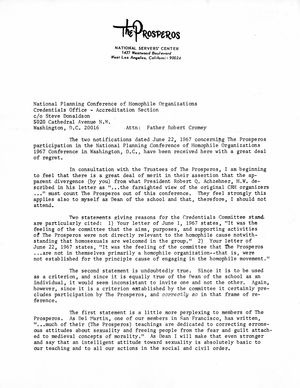
(First page of two-page letter. Right click “Open Image in New Tab” for a larger view.)

From Wikipedia, the free encyclopedia
The Wannsee Conference (German: Wannseekonferenz) was a meeting of senior government officials of Nazi Germany and Schutzstaffel (SS) leaders, held in the Berlin suburb of Wannsee on 20 January 1942. The purpose of the conference, called by the director of the Reich Main Security Office SS-Obergruppenführer Reinhard Heydrich, was to ensure the co-operation of administrative leaders of various government departments in the implementation of the Final solution to the Jewish question (German: Endlösung der Judenfrage), whereby most of the Jews of German-occupied Europe would be deported to occupied Poland and murdered. Conference participants included representatives from several government ministries, including state secretaries from the Foreign Office, the justice, interior, and state ministries, and representatives from the SS. In the course of the meeting, Heydrich outlined how European Jews would be rounded up and sent to extermination camps in the General Government (the occupied part of Poland), where they would be killed.[1]
Discrimination against Jews began immediately after the Nazi seizure of power on 30 January 1933. Violence and economic pressure were used by the Nazi regime to encourage Jews to voluntarily leave the country. After the invasion of Poland in September 1939, the extermination of European Jewry began, and the killings continued and accelerated after the invasion of the Soviet Union in June 1941. On 31 July 1941, Hermann Göring gave written authorization to Heydrich to prepare and submit a plan for a “total solution of the Jewish question” in territories under German control and to coordinate the participation of all involved government organisations. At the Wannsee Conference, Heydrich emphasised that once the deportation process was complete, the fate of the deportees would become an internal matter under the purview of the SS. A secondary goal was to arrive at a definition of who was Jewish.
One copy of the Protocol with circulated minutes of the meeting survived the war. It was found by Robert Kempner in March 1947 among files that had been seized from the German Foreign Office. It was used as evidence in the Subsequent Nuremberg Trials. The Wannsee House, site of the conference, is now a Holocaust memorial.
Legalized discrimination against Jews in Germany began immediately after the Nazi seizure of power in January 1933. Violence and economic pressure were used by the Nazi regime to encourage Jews to voluntarily leave the country. The ideology of Nazism brought together elements of antisemitism, racial hygiene, and eugenics and combined them with pan-Germanism and territorial expansionism with the goal of obtaining more Lebensraum (living space) for the Germanic people.[2] Nazi Germany attempted to obtain this new territory by attacking Poland and the Soviet Union, intending to deport or exterminate the Jews and Slavs living there, who were viewed as being inferior to the Aryan master race.[3]
Discrimination against Jews, long-standing, but extra-legal, throughout much of Europe at the time, was codified in Germany immediately after the Nazi seizure of power on 30 January 1933. The Law for the Restoration of the Professional Civil Service, passed on 7 April of that year, excluded most Jews from the legal profession and the civil service. Similar legislation soon deprived other Jews of the right to practise their professions.[4] Violence and economic pressure were used by the regime to force Jews to leave the country.[5] Jewish businesses were denied access to markets, forbidden to advertise in newspapers, and deprived of access to government contracts. Citizens were harassed and subjected to violent attacks and boycotts of their businesses.[6]1935 chart shows racial classifications under the Nuremberg Laws: German, Mischlinge, and Jew.
In September 1935, the Nuremberg Laws were enacted, prohibiting marriages between Jews and people of Germanic extraction, extramarital sexual relations between Jews and Germans, and the employment of German women under the age of 45 as domestic servants in Jewish households.[7] The Reich Citizenship Law stated that only those of German or related blood were defined as citizens; thus, Jews and other minority groups were stripped of their German citizenship.[8] A supplementary decree issued in November defined as Jewish anyone with three Jewish grandparents, or two grandparents if the Jewish faith was followed.[9] By the start of World War II in 1939, around 250,000 of Germany’s 437,000 Jews emigrated to the United States, Palestine, Great Britain, and other countries.[10][11]
After the invasion of Poland in September 1939, Hitler ordered that the Polish leadership and intelligentsia should be destroyed.[12] The Sonderfahndungsbuch Polen (Special Prosecution Book Poland)—lists of people to be killed—had been drawn up by the SS as early as May 1939.[12] The Einsatzgruppen (special task forces) performed these murders with the support of the Volksdeutscher Selbstschutz (Germanic Self-Protection Group), a paramilitary group consisting of ethnic Germans living in Poland.[13] Members of the SS, the Wehrmacht (German Armed Forces), and the Ordnungspolizei (Order Police; Orpo) also shot civilians during the Polish campaign.[14] Approximately 65,000 civilians were killed by the end of 1939. In addition to leaders of Polish society, they killed Jews, prostitutes, Romani people, and the mentally ill.[15][16]
On 31 July 1941, Hermann Göring gave written authorization to SS-Obergruppenführer (Senior Group Leader) Reinhard Heydrich, Chief of the Reich Main Security Office (RSHA), to prepare and submit a plan for a “total solution of the Jewish question” in territories under German control and to coordinate the participation of all involved government organisations.[17] The resulting Generalplan Ost (General Plan for the East) called for deporting the population of occupied Eastern Europe and the Soviet Union to Siberia, for use as slave labour or to be murdered.[18] The minutes of the Wannsee Conference estimated the Jewish population of the Soviet Union to be five million, including nearly three million in Ukraine.[19]
In addition to eliminating Jews, the Nazis also planned to reduce the population of the conquered territories by 30 million people through starvation in an action called the Hunger Plan devised by Herbert Backe.[20] Food supplies would be diverted to the German army and German civilians. Cities would be razed and the land allowed to return to forest or resettled by German colonists.[21] The objective of the Hunger Plan was to inflict deliberate mass starvation on the Slavic civilian populations under German occupation by directing all food supplies to the German home population and the Wehrmacht on the Eastern Front.[22] According to the historian Timothy Snyder, “4.2 million Soviet citizens (largely Russians, Belarusians, and Ukrainians) were starved” by the Nazis (and the Nazi-controlled Wehrmacht) in 1941–1944 as a result of Backe’s plan.[23][24]
Harvests were poor in Germany in 1940 and 1941 and food supplies were short, as large numbers of forced labourers had been brought into the country to work in the armaments industry.[25] If these workers—as well as the German people—were to be adequately fed, there must be a sharp reduction in the number of “useless mouths”, of whom the millions of Jews under German rule were, in the light of Nazi ideology, the most obvious example.[26]
At the time of the Wannsee Conference, the killing of Jews in the Soviet Union had already been underway for some months. Right from the start of Operation Barbarossa—the invasion of the Soviet Union—Einsatzgruppen were assigned to follow the army into the conquered areas and round up and kill Jews. In a letter dated 2 July 1941, Heydrich communicated to his SS and Police Leaders that the Einsatzgruppen were to execute Comintern officials, ranking members of the Communist Party, extremist and radical Communist Party members, people’s commissars, and Jews in party and government posts.[27] Open-ended instructions were given to execute “other radical elements (saboteurs, propagandists, snipers, assassins, agitators, etc.)”.[27] He instructed that any pogroms spontaneously initiated by the occupants of the conquered territories were to be quietly encouraged.[27] On 8 July, he announced that all Jews were to be regarded as partisans, and gave the order for all male Jews between the ages of 15 and 45 to be shot.[28] By August the net had been widened to include women, children, and the elderly—the entire Jewish population.[29] By the time planning was underway for the Wannsee Conference, hundreds of thousands of Polish, Serbian, and Russian Jews had already been killed.[30] The initial plan was to implement Generalplan Ost after the conquest of the Soviet Union.[18][31] European Jews would be deported to occupied parts of Russia, where they would be worked to death in road-building projects.[30]
Letter from Heydrich to Martin Luther, Undersecretary at the Foreign Office, notifying him that the conference would be delayed.
On 29 November 1941, Heydrich sent invitations for a ministerial conference to be held on 9 December at the offices of Interpol at Am Kleinen Wannsee 16.[32] He changed the venue on 4 December to the eventual location of the meeting.[32] He enclosed a copy of a letter from Göring dated 31 July that authorised him to plan a so-called Final solution to the Jewish question. The ministries to be represented were Interior, Justice, the Four-year plan, Propaganda, and the Reich Ministry for the Occupied Eastern Territories.[33]
Between the date the invitations to the conference went out (29 November) and the date of the cancelled first meeting (9 December), the situation changed. On 5 December 1941, the Soviet Army began a counter-offensive in front of Moscow, ending the prospect of a rapid conquest of the Soviet Union. On 7 December 1941, the Japanese attacked the United States at Pearl Harbor, causing the U.S. to declare war on Japan the next day. The Reich government declared war on the U.S. on 11 December. Some invitees were involved in these preparations, so Heydrich postponed his meeting.[34] Somewhere around this time, Hitler resolved that the Jews of Europe were to be exterminated immediately, rather than after the war, which now had no end in sight.[35][a] At the Reich Chancellery meeting of 12 December 1941 he met with top party officials and made his intentions plain.[36] On 18 December, Hitler discussed the fate of the Jews with Himmler in the Wolfsschanze.[37] Following the meeting, Himmler made a note on his service calendar, which simply stated: “Jewish question/to be destroyed as partisans”.[37]
The war was still ongoing, and since transporting masses of people into a combat zone was impossible, Heydrich decided that the Jews currently living in the General Government (the German-occupied area of Poland) would be killed in extermination camps set up in occupied areas of Poland, as would Jews from the rest of Europe.[1]
On 8 January 1942, Heydrich sent new invitations to a meeting to be held on 20 January.[38] The venue for the rescheduled conference was a villa at Am Großen Wannsee 56–58, overlooking the Großer Wannsee. The villa had been purchased from Friedrich Minoux in 1940 by the Sicherheitsdienst (Security Force; SD) for use as a conference centre and guest house.[39]
Eichmann‘s list
In preparation for the conference, Eichmann drafted a list of the numbers of Jews in the various European countries. Countries were listed in two groups, “A” and “B”. “A” countries were those under direct Reich control or occupation (or partially occupied and quiescent, in the case of Vichy France); “B” countries were allied or client states, neutral, or at war with Germany.[43][b] The numbers reflect the estimated Jewish population within each country; for example, Estonia is listed as Judenfrei (free of Jews), since the 4,500 Jews who remained in Estonia after the German occupation had been exterminated by the end of 1941.[44] Occupied Poland was not on the list because by 1939 the country was split three ways among Polish areas annexed by Nazi Germany in the west, the territories of Poland annexed by the Soviet Union in the east, and the General Government where many Polish and Jewish expellees had already been resettled.[45]
Heydrich opened the conference with an account of the anti-Jewish measures taken in Germany since the Nazi seizure of power in 1933. He said that between 1933 and October 1941, 537,000 German, Austrian, and Czech Jews had emigrated.[46] This information was taken from a briefing paper prepared for him the previous week by Eichmann.[47]
Heydrich reported that there were approximately eleven million Jews in the whole of Europe, of whom half were in countries not under German control.[43][b] He explained that since further Jewish emigration had been prohibited by Himmler, a new solution would take its place: “evacuating” Jews to the east. This would be a temporary solution, a step towards the “final solution of the Jewish question”.[48]
Under proper guidance, in the course of the final solution the Jews are to be allocated for appropriate labor in the East. Able-bodied Jews, separated according to sex, will be taken in large work columns to these areas for work on roads, in the course of which action doubtless a large portion will be eliminated by natural causes. The possible final remnant will, since it will undoubtedly consist of the most resistant portion, have to be treated accordingly, because it is the product of natural selection and would, if released, act as the seed of a new Jewish revival.[49]
German historian Peter Longerich notes that vague orders couched in terminology that had a specific meaning for members of the regime were common, especially when people were being ordered to carry out criminal activities. Leaders were given briefings about the need to be “severe” and “firm”; all Jews were to be viewed as potential enemies that had to be dealt with ruthlessly.[50] The wording of the Wannsee Protocol—the distributed minutes of the meeting—made it clear to participants that evacuation east was a euphemism for death.[51]The conference room at the Wannsee Conference House, 2003
Heydrich went on to say that in the course of the “practical execution of the final solution”, Europe would be “combed through from west to east”, but that Germany, Austria, and the Protectorate of Bohemia and Moravia would have priority, “due to the housing problem and additional social and political necessities”.[49] This was a reference to increasing pressure from the Gauleiters (regional Nazi Party leaders) in Germany for the Jews to be removed from their areas to allow accommodation for Germans made homeless by Allied bombing, as well as to make space for laborers being imported from occupied countries. The “evacuated” Jews, he said, would first be sent to “transit ghettos” in the General Government, from which they would be transported eastward.[49] Heydrich said that to avoid legal and political difficulties, it was important to define who was a Jew for the purposes of “evacuation”. He outlined categories of people who would not be killed. Jews over 65 years old, and Jewish World War I veterans who had been severely wounded or who had won the Iron Cross, might be sent to Theresienstadt concentration camp instead of being killed. “With this expedient solution”, he said, “in one fell swoop, many interventions will be prevented.”[49]
The situation of people who were half or quarter Jews, and of Jews who were married to non-Jews, was more complex. Under the Nuremberg Laws of 1935, their status had been left deliberately ambiguous. Heydrich announced that Mischlinge (mixed-race persons) of the first degree (persons with two Jewish grandparents) would be treated as Jews. This would not apply if they were married to a non-Jew and had children by that marriage. It would also not apply if they had been granted written exemption by “the highest offices of the Party and State”.[52] Such persons would be sterilised or deported if they refused sterilisation.[52] A “Mischling of the second degree” (a person with one Jewish grandparent) would be treated as German, unless he or she was married to a Jew or a Mischling of the first degree, had a “racially especially undesirable appearance that marks him outwardly as a Jew”,[53] or had a “political record that shows that he feels and behaves like a Jew”.[54] Persons in these latter categories would be killed even if married to non-Jews.[53] In the case of mixed marriages, Heydrich recommended that each case should be evaluated individually, and the impact on any German relatives assessed. If such a marriage had produced children who were being raised as Germans, the Jewish partner would not be killed. If they were being raised as Jews, they might be killed or sent to an old-age ghetto.[54] These exemptions applied only to German and Austrian Jews, and were not always observed even for them. In most of the occupied countries, Jews were rounded up and killed en masse, and anyone who lived in or identified with the Jewish community in any given place was regarded as a Jew.[55][c]Facsimiles of the minutes of the Wannsee Conference and Eichmann’s list, presented under glass at the Wannsee Conference House Memorial
Heydrich commented, “In occupied and unoccupied France, the registration of Jews for evacuation will in all probability proceed without great difficulty”,[56] but in the end, the great majority of French-born Jews survived.[57] More difficulty was anticipated with Germany’s allies Romania and Hungary. “In Romania the government has [now] appointed a commissioner for Jewish affairs”, Heydrich said.[56] In fact the deportation of Romanian Jews was slow and inefficient despite a high degree of popular antisemitism.[58] “In order to settle the question in Hungary”, Heydrich said, “it will soon be necessary to force an adviser for Jewish questions onto the Hungarian government”.[56] The Hungarian regime of Miklós Horthy continued to resist German interference in its Jewish policy until the spring of 1944, when the Wehrmacht invaded Hungary. Very soon, 600,000 Jews of Hungary (and parts of Czechoslovakia, Romania, and Yugoslavia occupied by Hungary) were sent to their deaths by Eichmann, with the collaboration of Hungarian authorities.[59]
Heydrich spoke for nearly an hour. Then followed about thirty minutes of questions and comments, followed by some less formal conversation.[60] Otto Hofmann (head of the SS Race and Settlement Main Office; RuSHA) and Wilhelm Stuckart (State Secretary of the Reich Interior Ministry) pointed out the legalistic and administrative difficulties over mixed marriages, and suggested compulsory dissolution of mixed marriages or the wider use of sterilisation as a simpler alternative.[61] Erich Neumann from the Four Year Plan argued for the exemption of Jews who were working in industries vital to the war effort and for whom no replacements were available. Heydrich assured him that this was already the policy; such Jews would not be killed.[62][d] Josef Bühler, State Secretary of the General Government, stated his support for the plan and his hope that the killings would commence as soon as possible.[63] Towards the end of the meeting cognac was served, and after that the conversation became less restrained.[61] “The gentlemen were standing together, or sitting together”, Eichmann said, “and were discussing the subject quite bluntly, quite differently from the language which I had to use later in the record. During the conversation they minced no words about it at all … they spoke about methods of killing, about liquidation, about extermination”.[60] Eichmann recorded that Heydrich was pleased with the course of the meeting. He had expected a lot of resistance, Eichmann recalled, but instead, he had found “an atmosphere not only of agreement on the part of the participants, but more than that, one could feel an agreement which had assumed a form which had not been expected”.[55]
View of the Großer Wannsee lake from the villa at 56–58 Am Grossen Wannsee, where the conference was held
At the conclusion of the meeting Heydrich gave Eichmann firm instructions about what was to appear in the minutes. They were not to be verbatim: Eichmann ensured that nothing too explicit appeared in them. He said at his trial: “How shall I put it – certain over-plain talk and jargon expressions had to be rendered into office language by me”.[63] Eichmann condensed his records into a document outlining the purpose of the meeting and the intentions of the regime moving forward. He stated at his trial that it was personally edited by Heydrich, and thus reflected the message he intended the participants to take away from the meeting.[64] Copies of the minutes (known from the German word for “minutes” as the “Wannsee Protocol”[e]) were sent by Eichmann to all the participants after the meeting.[65] Most of these copies were destroyed at the end of the war as participants and other officials sought to cover their tracks. It was not until 1947 that Luther’s copy (number 16 out of 30 copies prepared) was found by Robert Kempner, a U.S. prosecutor in the International Military Tribunal at Nuremberg, in files that had been seized from the German Foreign Office.[66]
The Wannsee Conference lasted only about ninety minutes. The enormous importance which has been attached to the conference by post-war writers was not evident to most of its participants at the time. Heydrich did not call the meeting to make fundamental new decisions on the Jewish question. Massive killings of Jews in the conquered territories in the Soviet Union and Poland were ongoing, and a new extermination camp was already under construction at Belzec at the time of the conference; other extermination camps were in the planning stages.[30][67] The decision to exterminate the Jews had already been made, and Heydrich, as Himmler’s emissary, held the meeting to ensure the cooperation of the various departments in conducting the deportations.[68] Observations from historian Laurence Rees support Longerich’s position that the decision over the fate of the Jews was determined before the conference; Rees notes that the Wannsee Conference was really a meeting of “second-level functionaries”, and stresses that neither Himmler, Goebbels, nor Hitler were present.[69] According to Longerich, a primary goal of the meeting was to emphasise that once the deportations had been completed, the fate of the deportees became an internal matter of the SS, totally outside the purview of any other agency.[70] A secondary goal was to determine the scope of the deportations and arrive at definitions of who was Jewish and who was Mischling.[70] “The representatives of the ministerial bureaucracy had made it plain that they had no concerns about the principle of deportation per se. This was indeed the crucial result of the meeting and the main reason why Heydrich had detailed minutes prepared and widely circulated”, said Longerich.[71] Their presence at the meeting also ensured that all those present were accomplices and accessories to the murders that were about to be undertaken.[72]
Eichmann’s biographer David Cesarani agrees with Longerich’s interpretation; he notes that Heydrich’s main purpose was to impose his own authority on the various ministries and agencies involved in Jewish policy matters, and to avoid any repetition of the disputes that had arisen earlier in the annihilation campaign. “The simplest, most decisive way that Heydrich could ensure the smooth flow of deportations”, he writes, “was by asserting his total control over the fate of the Jews in the Reich and the east, and [by] cow[ing] other interested parties into toeing the line of the RSHA”.[73]
In 1965, historian Joseph Wulf proposed that the Wannsee House should be made into a Holocaust memorial and document centre, but the West German government was not interested at that time. The building was in use as a school, and funding was not available. Despondent at the failure of the project, and the West German government’s failure to pursue and convict Nazi war criminals, Wulf committed suicide in 1974.[74]
On 20 January 1992, on the fiftieth anniversary of the conference, the site was finally opened as a Holocaust memorial and museum known as the Haus der Wannsee-Konferenz (House of the Wannsee Conference).[75] The museum also hosts permanent exhibits of texts and photographs that document events of the Holocaust and its planning.[76] The Joseph Wulf Bibliothek / Mediothek on the second floor houses a large collection of books on the Nazi era, plus other materials such as microfilms and original Nazi documents.[76]
A.Word.A.Day with Anu Garg
PRONUNCIATION:(duhns)
MEANING:noun: A person regarded as dim-witted or foolish.
ETYMOLOGY:After theologian John Duns Scotus (c. 1265/66-1308). Earliest documented use: 1530.
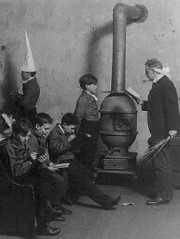
NOTES:John Duns Scotus was a Catholic priest and Franciscan friar (literally, brother, from French frère: brother) in the 13th century. In his time he was known as a sophisticated thinker and philosopher and given the name “the Subtle Doctor”. Protestantism came along in 1517. As these things go, they now considered his followers, known as Dunses or Dunsmen, as hair-splitting and resistant to new learning. The word was later respelled as dunce, and took on the meaning as someone incapable of learning. The word also gave rise to a dunce cap, the conical hat, formerly used to punish schoolchildren.
USAGE:“It feels surprising that the big beasts of the US gambling scene, Las Vegas casino companies, are such digital dunces that they require UK-listed companies to tell them how to run an online betting business.” Nils Pratley; No Need for Entain to Rush into Accepting MGM Resorts Offer; The Guardian (London, UK); Jan 4, 2021.
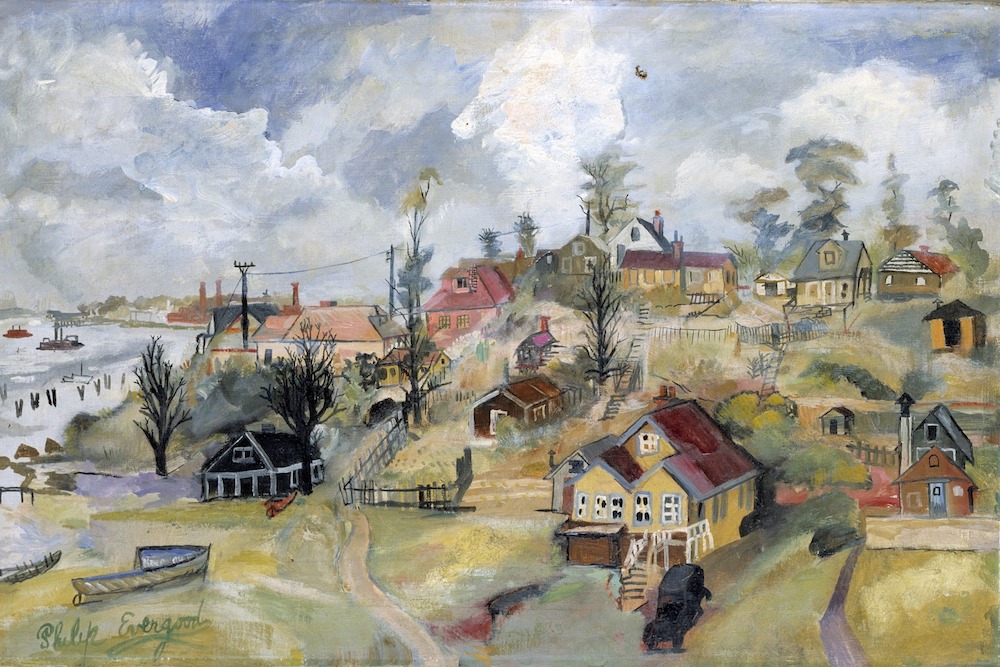
“Workers Houses, Flushing Bay” by 19th-century American painter Philip Evergood. Courtesy of Smithsonian American Art Museum, Gift of Arnold and Augusta Newman.
by FIRMIN DEBRABANDER | FEBRUARY 4, 2021 (zocalopublicsquare.org)
Is privacy overrated?
The question might seem daft, given how gravely privacy is endangered in our digital age. Spies in government and the private sector routinely devour data for insights into our behavior, insights that may be used to manipulate our behavior. And privacy’s advocates contend that freedom and democracy are unthinkable without it. As philosopher Michael Lynch puts it, privacy affords us control over our thoughts and feelings, which is a “necessary condition for being in a position to make autonomous decisions, for our ability to determine who and what we are as persons.”
This idea—that privacy is an enduring, universal, even sacred virtue—is seductive. But it is wrong, and in a few ways: Privacy is a relatively recent institution, and less than essential to democracy. What’s more, privacy has never been secure; vulnerability is its native state.
Americans may be forgiven for assuming that privacy is a foundational institution in our democracy. You might have read that the nation was spawned, in part, by privacy concerns: colonists rebelled against British troops occupying their homes and invading their warehouses and workplaces. Privacy may not have been quite so central to our founders’ concerns, however. The term is not mentioned in the US Constitution—a right to privacy is never spelled out. In American constitutional law, this right wasn’t articulated until a century after the Revolutionary War, by future Supreme Court Justice Louis Brandeis and his law partner Samuel Warren in an 1890 Harvard Law Review article. And privacy only earned a robust legal defense in the 1960s, when the Supreme Court under Earl Warren held that a right to privacy is presumed by the Bill of Rights.
It actually makes sense that privacy was a late arrival to democracy. It seems privacy was more revered, at least early on, as a spatial virtue, rather than a moral one. Historians indicate privacy was conceived as a bourgeois value in the 18th and 19th centuries, born of relative wealth. Premodern homes had few rooms, and certainly few that were designated for single—private—use, like a bathroom or bedroom. People all over the world generally lived in common spaces, which were also quite narrow.
This changed toward the end of the 19th century when a growing middle class demanded homes with multiple rooms into which residents could retreat. As industrialized societies became wealthier, the working class looked to enjoy the same benefits as the wealthy—including privacy. The English ultimately considered it a basic human right for laborers to have homes with private gardens in front and back.
The development and expansion of suburban architecture, especially in America, reflects the gains privacy made in the 20th century. You might say privacy is the central organizing principle of suburbia: houses are removed from the street; sidewalks are a rarity in many suburban neighborhoods, thus limiting intrusion by strangers; socializing happens in fenced-in backyards and spacious basements. Since, the 1970s, the average suburban home has grown by a third, even while the number of its inhabitants has fallen, meaning that suburbanites are practically swimming in private space, which seems to be a basic need.
It is easy to forget how new such standards of privacy are. In 1972, the British government formed a committee to report on the state of privacy. The committee found that “the modern middle-class family … relatively sound-proofed in their semi-detached house, relatively unseen behind their privet hedge … insulated in the family car … are probably more private in the sense of being unnoticed in all their everyday doings than any sizeable section of the population in any other time or place.”This idea—that privacy is an enduring, universal, even sacred virtue—is seductive. But it is wrong, and in a few ways: Privacy is a relatively recent institution, and less than essential to democracy. What’s more, privacy has never been secure; vulnerability is its native state.
But even as the “Younger Report” (so named because it was chaired by Sir Kenneth Younger, an experienced politician who led several commissions reporting on the state of British society) was claiming that privacy had been achieved in the 20th century as never before, democratic governments were finding new ways to infiltrate their citizens’ lives. In the U.S., historian Sarah Igo explains, that included surveillance of home populations during World War I, public health initiatives that invaded and exposed the homes and lives of the poor, and a growing bureaucracy that aimed to address a host of social ills, from retirement to unemployment to homeownership.
Said bureaucracy ballooned mid-century when the Social Security program was enacted, and assigned identifying numbers to all citizens, rendering them transparent to the government in the process. Many critics and commentators issued dire warnings that echo current concerns for privacy.
“[Our] wage-earning citizens … may well resent a system of surveillance in which every individual among them is kept under the eye of the Federal Government,” one of Social Security’s detractors claimed. “Our people have been accustomed to privacy and freedom of movement.” Likewise, a newspaper column warned readers that “your personal life would be laid bare,” “your life will be an open book,” and “you are to be regimented—catalogued—put on file.”
Such concerns soon evaporated, however. The dangers of lost privacy were unclear, uncertain, unproven; the tradeoff for being documented—namely, you gained a secure retirement—was evident.
In the digital age, these tradeoffs—often made with the active participation of the public—have so thoroughly routed privacy that people now have little expectation of it. Digital spies do not have to work hard to monitor us; this is a new era of sharing. Over the last two decades, consumers have become accustomed to divulging their data in exchange for the conveniences offered by technology. Many people expose intimate and once embarrassing details on social media, as a matter of course. Digital citizens increasingly live their lives in public, for all to see.
This may not be the tragedy that privacy advocates suggest.
I don’t mean to minimize violations of privacy, or to say that it’s not important or cherished—because surveillance does open the door to being taken advantage of, manipulated, or coerced. But I wish to offer this caution from history: privacy has never been essential to human liberty and flourishing; and it has always been threatened, and exceedingly hard to achieve or secure.
By understanding the history of privacy, we can better look to its future, and better evaluate proposals about data control. We should be skeptical, for example, about any law’s ability to protect our privacy—and about our own individual commitments to protecting it. We also should be careful not to oversell privacy as eternal and universal and vital.
If anything, privacy might prove to be a dangerous distraction from more important values. In this digital age, privacy itself can be dangerous when, isolated behind our computer screens, we are swayed by, and moved to magnify, all manner of conspiracies and untruths that undermine democracy. It is not surprising that autocratic regimes have thrived on digital communications, and the division, confusion, and alienation they produce.
The health, welfare, and vibrancy of democracy rely more on the public than the private realm—this has always been the case. How citizens organize in public, how they demonstrate, how they muster the tenacity, courage, and creativity to capture the attention of the populace, and sow the seeds of moral persuasion, this is the basis of our common liberty. We would be wise to relearn and apply this lesson.
FIRMIN DEBRABANDERi s a professor of philosophy at the Maryland Institute College of Art in Baltimore, and the author of Do Guns Make Us Free and Life After Privacy.

Ned Henry February 4, 2021 · nedhenry.medium.com
It’s 2 PM — In an hour I have a zoom meeting with the oncologist. Still need to do some prep, really just organizing my thoughts. It’s a pretty important meeting about my treatment. This drug, Vincristine, is the one I am reactingVincristineVincristine, also known as leurocristine and marketed under the brand name Oncovin among others, is a chemotherapy…en.wikipedia.org
to pretty severely. It’s an important part of R-CHOP. Not sure what Dr. Allen is going to say today. Got a lot done this morning. Well alot considering I can’t move. Got a load of laundry in and made a batch of smoothies that will last a few days. Took a long shower Clean clothes and all that. Simple things take a lot longer when you can’t walk with out a cane and everything is just so slow.

Here’s today’s selfie. I must admit I’m not looking too good. This Vincristine is really taking a toll. I’m numb, I hurt, I can’t walk and balance. Not sure where we go from here. I want to explore cellular therapies with the Oncologist, but I’m not sure Winship is doing an cellular therapies for DLBCL. We’ll see. Gotta go prep for this call. More later.
3:15 PM — Call with Doctor Allen Notes:
Dropping Vincristine from chemo. Will reduce efficacy of treatment a little bit but Vincristine is the least important R-CHOP drug. Reducing it instead of eliminating it creates a possibility of long term disability. As it is, I need to improve to eliminate that possibility of long term disability. I run that risk now if I don’t improve with the neuropathy therapies I am on.
Neuropathy treatment — Continue with Lyrica and Gabapentin. Monitor for a week, look for improvement and adjust treatment as needed with Cymbalta or other pharmaceuticals.
Cellular therapy is not an option at this point. If R-CHOP fails to cure the cancer after 6 cycles, then I would move to CAR-T cellular therapy. It is not FDA approved outside of some small trials where is is given after 2 rounds of R-CHOP. Not an option for me to join these trials at this point and Winship is not a place these trials are being done.
Access to Dr. Allen. As simple as asking to speak with her on the portal. Dr. Allen with follow up with Priya to find out why my neuropathy problem was not escalated and instead went to Palliative care instead to Dr. Allen.
ACIM — Lesson — God is in everything I see.

9 PM — Look what David found in an old box. Thanks for sending it to me. This is Jane, David and me at Karme Choling. Great experience and one that changed everything related to money for me. I forgot we wore ties to that last banquet. I sure look better here than I do in the photo from today. Also got a book today from Rich Harris. Testimony by Robbie Robertson.
10:30 PM — Not sure what to say. My foot is numb and my legs hurt. I don’t know where all this is going. Glad that Vincristine is no longer part of my future. Concerned about the neuropathy I am experiencing. Work on chronic pain. That’s all for today. I’m tired.
| Indigenous Knowledge |
| Hallo everyone The shamans of indigenous tribes taught me that if we fear death, it stalks us. If we don’t fear death, we have no attachment to it until it comes. Then we can be passionate about life and its ups and downs. If death appears, we surrender as it is just a doorway to another perspective and nothing to fear. They know that there is no difference to being killed by a microbe or a Jaguar as we are the co-creators with consciousness of all that we experience. We are in a narrative now that the microbe is an illness and the jaguar is an accident. Everything is connected and we have lost this indigenous knowledge. We have an opportunity to feel and think outside of the hypnosis of the repeating phrases of mainstream media about our lives now. Please use this time whenever you can to feel into your heart. Do your research into the numbers of fear you are given. Then you can make sense yourself as to what kind of world we can co-create for ourselves, our children and nature. You are so powerful. Love Wendy |
| Copyright © 2021 Wendy Mandy UK, All rights reserved. “You contacted me about appointments and information, or you signed up to my newsletter via www.wendymandy.uk” |
Juan Enriquez|TED2020 (ted.com)
What drives society’s understanding of right and wrong? In this thought-provoking talk, futurist Juan Enriquez offers a historical outlook on what humanity once deemed acceptable — from human sacrifice and public executions to slavery and eating meat — and makes a surprising case that exponential advances in technology leads to more ethical behavior.
This talk was presented at an official TED conference, and was featured by our editors on the home page.
ABOUT THE SPEAKER
From Wikipedia, the free encyclopedia
| Émile Zola | |
|---|---|
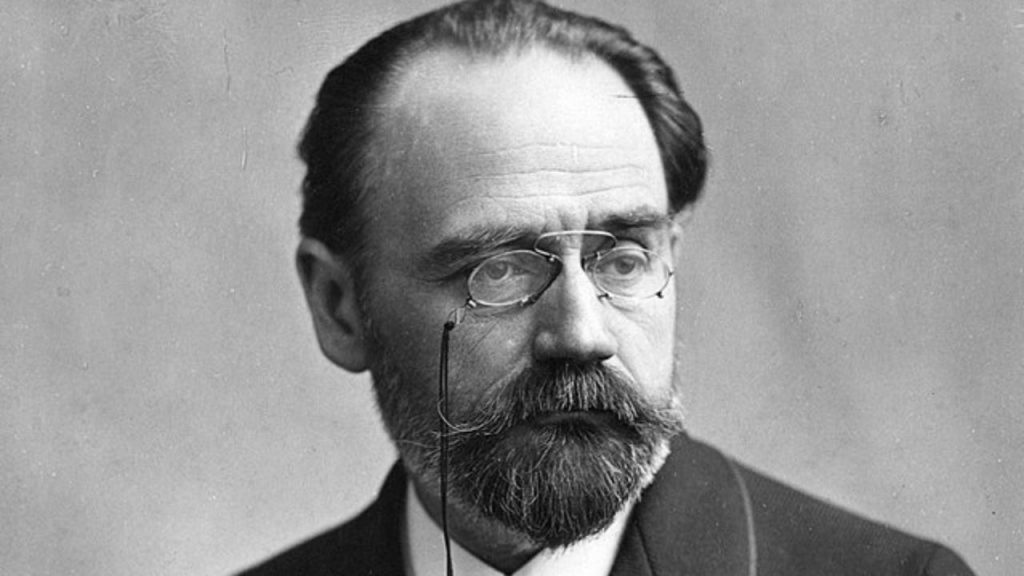
| Zola in 1902 | |
| Born | Émile Édouard Charles Antoine Zola 2 April 1840 Paris, France |
| Died | 29 September 1902 (aged 62) Paris, France |
| Occupation | Novelist, journalist, playwright, poet |
| Nationality | French |
| Genres | Novelshort story |
| Literary movement | Naturalism |
| Notable works | Les Rougon-Macquart, Thérèse Raquin, Germinal, Nana |
| Spouse | Éléonore-Alexandrine Meley |
| Relatives | François Zola (father) Émilie Aubert (mother) |
| Signature |
Émile Édouard Charles Antoine Zola (/ˈzoʊlə/,[1][2] also US: /zoʊˈlɑː/,[3][4] French: [emil zɔla]; 2 April 1840 – 29 September 1902)[5] was a French novelist, journalist, playwright, the best-known practitioner of the literary school of naturalism, and an important contributor to the development of theatrical naturalism.[citation needed] According to major Zola scholar and biographer Henri Mitterand, “Naturalism contributes something more than realism: the attention brought to bear on the most lush and opulent aspects of people and the natural world. The realist writer reproduces the object’s image impersonally, while the naturalist writer is an artist of temperament.”[6] He was a major figure in the political liberalization of France and in the exoneration of the falsely accused and convicted army officer Alfred Dreyfus, which is encapsulated in the renowned newspaper headline J’Accuse…! Zola was nominated for the first and second Nobel Prize in Literature in 1901 and 1902.[7][8]
Zola was born in Paris in 1840 to François Zola (originally Francesco Zolla), and his wife Émilie Aubert. His father was an Italian engineer with some Greek ancestry,[9] who was born in Venice in 1795, and engineered the Zola Dam in Aix-en-Provence; his mother was French.[10] The family moved to Aix-en-Provence in the southeast when Émile was three years old. Four years later, in 1847, his father died, leaving his mother on a meager pension. In 1858, the Zolas moved to Paris, where Émile’s childhood friend Paul Cézanne soon joined him. Zola started to write in the romantic style. His widowed mother had planned a law career for Émile, but he failed his Baccalauréat examination twice.[11][12]
Before his breakthrough as a writer, Zola worked for minimal pay as a clerk in a shipping firm and then in the sales department for the publisher (Hachette).[12] He also wrote literary and art reviews for newspapers. As a political journalist, Zola did not hide his dislike of Napoleon III, who had successfully run for the office of president under the constitution of the French Second Republic, only to use this position as a springboard for the coup d’état that made him emperor.
In 1860s, Zola was naturalized as a French citizen.[13] In 1865, he met Éléonore-Alexandrine Meley, who called herself Gabrielle, a seamstress, who became his mistress.[11] They married on 31 May 1870.[14] Together they cared for Zola’s mother.[12] She stayed with him all his life and was instrumental in promoting his work. The marriage remained childless. Alexandrine Zola had a child before she met Zola that she had given up, because she was unable to take care of it. When she confessed this to Zola after their marriage, they went looking for the girl, but she had died a short time after birth.
In 1888, he was given a camera, but he only began to use it in 1895 and obtained a near professional level of expertise.[15] Also in 1888, Alexandrine hired Jeanne Rozerot, a seamstress who was to live with them in their home in Médan.[16] Zola fell in love with Jeanne and fathered two children with her: Denise in 1889 and Jacques in 1891.[17] After Jeanne left Médan for Paris, Zola continued to support and visit her and their children. In November 1891 Alexandrine discovered the affair, which brought the marriage to the brink of divorce.[citation needed] The discord was partially healed, which allowed Zola to take an increasingly active role in the lives of the children. After Zola’s death, the children were given his name as their lawful surname.[18]
During his early years, Zola wrote numerous short stories and essays, four plays, and three novels. Among his early books was Contes à Ninon, published in 1864.[9] With the publication of his sordid autobiographical novel La Confession de Claude (1865) attracting police attention, Hachette fired Zola. His novel Les Mystères de Marseille appeared as a serial in 1867. He was also an aggressive critic, his articles on literature and art appearing in Villemessant’s journal L’Événement.[9] After his first major novel, Thérèse Raquin (1867), Zola started the series called Les Rougon-Macquart.
In Paris, Zola maintained his friendship with Cézanne, who painted a portrait of him with another friend from Aix-en-Provence, writer Paul Alexis, entitled Paul Alexis Reading to Zola.
Paul Cézanne, Paul Alexis Reading to Émile Zola, 1869–1870, São Paulo Museum of Art
More than half of Zola’s novels were part of the twenty-volume Les Rougon-Macquart cycle, which details the history of a single family under the reign of Napoléon III. Unlike Balzac, who in the midst of his literary career resynthesized his work into La Comédie Humaine, Zola from the start, at the age of 28, had thought of the complete layout of the series.[citation needed] Set in France’s Second Empire, in the context of Baron Haussmann’s changing Paris, the series traces the environmental and hereditary influences of violence, alcohol, and prostitution which became more prevalent during the second wave of the Industrial Revolution. The series examines two branches of the family—the respectable (that is, legitimate) Rougons and the disreputable (illegitimate) Macquarts—over five generations.
In the preface to the first novel of the series, Zola states, “I want to explain how a family, a small group of regular people, behaves in society, while expanding through the birth of ten, twenty individuals, who seem at first glance profoundly dissimilar, but who are shown through analysis to be intimately linked to one another. Heredity has its own laws, just like gravity. I will attempt to find and to follow, by resolving the double question of temperaments and environments, the thread that leads mathematically from one man to another.”[19]
Although Zola and Cézanne were friends from childhood, they experienced a falling out later in life over Zola’s fictionalised depiction of Cézanne and the Bohemian life of painters in Zola’s novel L’Œuvre (The Masterpiece, 1886).
From 1877, with the publication of L’Assommoir, Émile Zola became wealthy; he was better paid than Victor Hugo, for example.[20] Because L’Assommoir was such a success, Zola was able to renegotiate his contract with his publisher Georges Charpentier to receive more than 14% royalties and the exclusive rights to serial publication in the press.[21] Subsequently, sales of L’Assommoir were even exceeded by those of Nana (1880) and La Débâcle (1892).[9] He became a figurehead among the literary bourgeoisie and organised cultural dinners with Guy de Maupassant, Joris-Karl Huysmans, and other writers at his luxurious villa (worth 300,000 francs)[22] in Médan, near Paris, after 1880. Despite being nominated several times, Zola was never elected to the Académie française.[9]
Zola’s output also included novels on population (Fécondité) and work (Travail), a number of plays, and several volumes of criticism. He wrote every day for around 30 years, and took as his motto Nulla dies sine linea (“not a day without a line”).
The self-proclaimed leader of French naturalism, Zola’s works inspired operas such as those of Gustave Charpentier, notably Louise in the 1890s. His works, inspired by the concept of heredity and milieu (Claude Bernard and Hippolyte Taine)[23] and by the realism of Balzac and Flaubert.[24] He also provided the libretto for several operas by Alfred Bruneau, including Messidor (1897) and L’Ouragan (1901); several of Bruneau’s other operas are adapted from Zola’s writing. These provided a French alternative to Italian verismo.[25]
He is considered to be a significant influence on those writers that are credited with the creation of the so-called new journalism; Wolfe, Capote, Thompson, Mailer, Didion, Talese and others. Tom Wolfe wrote that his goal in writing fiction was to document contemporary society in the tradition of John Steinbeck, Charles Dickens, and Émile Zola.[citation needed]
Main articles: Dreyfus affair and J’accuseFront page cover of the newspaper L’Aurore for Thursday 13 January 1898, with the open letter J’Accuse…!, written by Émile Zola about the Dreyfus affair. The headline reads “I Accuse…! Letter to the President of the Republic”—Paris Museum of Jewish Art and History
Captain Alfred Dreyfus was a French-Jewish artillery officer in the French army. In September 1894, French intelligence found information about someone giving the German Embassy military secrets. Anti-semitism caused senior officers to suspect Dreyfus, though there was no direct evidence of any wrongdoing. Dreyfus was court-martialed, convicted of treason, and sent to Devil’s Island in French Guiana.
Lt. Col. Georges Picquart came across evidence that implicated another officer, Ferdinand Walsin Esterhazy, and informed his superiors. Rather than move to clear Dreyfus, the decision was made to protect Esterhazy and ensure the original verdict was not overturned. Major Hubert-Joseph Henry forged documents that made it seem as if Dreyfus were guilty, while Picquart was reassigned to duty in Africa. However, Picquart’s findings were communicated by his lawyer to the Senator Auguste Scheurer-Kestner, who took up the case, at first discreetly and then increasingly publicly. Meanwhile, further evidence was brought forward by Dreyfus’s family and Esterhazy’s estranged family and creditors. Under pressure, the general staff arranged for a closed court-martial to be held on 10–11 January 1898, at which Esterhazy was tried in camera and acquitted. Picquart was detained on charges of violation of professional secrecy.
In response Zola risked his career and more, and on 13 January 1898 published J’Accuse…![26] on the front page of the Paris daily L’Aurore. The newspaper was run by Ernest Vaughan and Georges Clemenceau, who decided that the controversial story would be in the form of an open letter to the President, Félix Faure. Zola’s J’Accuse…! accused the highest levels of the French Army of obstruction of justice and antisemitism by having wrongfully convicted Alfred Dreyfus to life imprisonment on Devil’s Island. Zola’s intention was that he be prosecuted for libel so that the new evidence in support of Dreyfus would be made public.[27] The case, known as the Dreyfus affair, deeply divided France between the reactionary army and Catholic church on one hand, and the more liberal commercial society on the other. The ramifications continued for many years; on the 100th anniversary of Zola’s article, France’s Roman Catholic daily paper, La Croix, apologised for its antisemitic editorials during the Dreyfus affair.[28] As Zola was a leading French thinker and public figure, his letter formed a major turning point in the affair.[citation needed]
Zola was brought to trial for criminal libel on 7 February 1898, and was convicted on 23 February and removed from the Legion of Honour. The first judgment was overturned in April on a technicality, but a new suit was pressed against Zola, which opened on 18 July. At his lawyer’s advice, Zola fled to England rather than wait for the end of the trial (at which he was again convicted). Without even having had the time to pack a few clothes, he arrived at Victoria Station on 19 July, the start of a brief and unhappy residence in the UK. After initially staying at the Grosvenor Hotel, Victoria, Zola then went to the Oatlands Park Hotel in Weybridge and shortly afterwards rented a house locally called Penn where he was joined by his family for the summer. At the end of August, they moved to another house in Addlestone called Summerfield. In early October the family moved to London and then his wife and children went back to France so the children could resume their schooling. Thereafter Zola lived alone in the Queen’s Hotel, Norwood.[29] He stayed in Upper Norwood from October 1898 to June 1899.[citation needed]
In France, the furious divisions over the Dreyfus affair continued. The fact of Major Henry’s forgery was discovered and admitted to in August 1898, and the Government referred Dreyfus’s original court-martial to the Supreme Court for review the following month, over the objections of the General Staff. Eight months later, on 3 June 1899, the Supreme Court annulled the original verdict and ordered a new military court-martial. The same month Zola returned from his exile in England. Still the anti-Dreyfusards would not give up, and on 8 September 1899 Dreyfus was again convicted. Dreyfus applied for a retrial, but the government countered by offering Dreyfus a pardon (rather than exoneration), which would allow him to go free, provided that he admit to being guilty. Although he was clearly not guilty, he chose to accept the pardon. Later the same month, despite Zola’s condemnation, an amnesty bill was passed, covering “all criminal acts or misdemeanours related to the Dreyfus affair or that have been included in a prosecution for one of these acts”, indemnifying Zola and Picquart, but also all those who had concocted evidence against Dreyfus. Dreyfus was finally completely exonerated by the Supreme Court in 1906.[30]
Zola said of the affair, “The truth is on the march, and nothing shall stop it.”[31] Zola’s 1898 article is widely marked in France as the most prominent manifestation of the new power of the intellectuals (writers, artists, academicians) in shaping public opinion, the media and the state.[citation needed]

Ned Henry February 3, 2021 · nedhenry.medium.com
My foot is as painful as it’s ever been this morning. It woke me up at 6 AM. It feel like fire on the top of my left foot. Maybe an 8 out of 10. Pain doctors always try to measure pain that way. I’ve yelled and screamed and moaned and cried. Anything to just tolerate this level of pain. Nerve pain. Called Sue. Called Palliative care.
2 PM — Palliative care is giving me a new Rx for Lyrica. So we’ll try that. This is still a reaction to the Vincristine in the chemo cocktail and I will discuss with the oncologist tomorrow.
Bit the bullet and had my tutoring session with Yunus. Did not let on with him that I was in pain. We had a good session. He told me when we signed off to stay strong. He’s such a good kid. We worked on calcuations with fractions and by the end of our hour he was doing the problems by himself. He says he likes the way I teach since he ends up getting it better. Of course, it’s one on one and math teachers have some 20–25 at a time. I used to sub teach 4th grade for while and I know what a hard job teaching is. And I did not pursue that career because I made more money in oil and construction at the time. Allen just got here with a bunch of food for me. Later.
Almost 8 PM — Been a busy day but not sure I accomplished much. My leg is still numb. Not as painful. Got new meds for it — Lyrica. We’ll see. Big pow wow with the Oncologist tomorrow. I know what I want to ask and I have put together an agenda for the meeting but It still needs to be refined with input from Sue and Jack. Got a wonderful Valentine from Ronna with more Indica. God love Ronna. Oh and I got the coolest text message from Jake and Shivy. It was an audio text and just so lovely to hear both of their voices and them giving me their well wishes and caring and love. Very special moment.
11:22 — Stoned all night just to tolerate the side effects of the chemo. The pain and numbness of my foot stumbing around the house with a cane to keep myself from falling. Watched a good movie. Punch Drunk Love. Really Good. Saw a lot of myself in that movie. Adam Sandler. Good. Thinking alot about cellular therapies and what they really mean in the treatment of DLBCL which is what I have. And how do I ask the questions most effectively with Dr. Allen tomorrow. And looking at this Valentine and remembering the Sarma I ate for dinner 3 times this week from Vera, Sasha’s mom. I love Sarma and am so lucky to know so many of you who make it. I am going to give it a try myself some day. Listening to the Dead channel and the base line Phil Lesh lays down in their songs. It’s really like a dance of instruments listening to them when you’re stoned. I’m gonna post for the day. Been a slightly downhill day.
 |
| MOONWOBBLE FEB/MAR 2021 |
Click here to see the chart: MoonWobble Mar 2021 *** General suggestions / observations ***• This cycle is based on empirical data meaning enough data was observed and recorded to make it possible to suggest attitudes and reactions. Keep in mind that we all have free will and thus results will vary from one individual to another.• The graph shows the energy high at the beginning of the cycle (not unlike any other astrological aspect) followed by a slow down before it gets strong and again this reflects years of tracking and noting feedback from our many students.• If you are making a decision during this time you might want to let it set for a day or two then check your decision again to see if it still makes sense. However, you can feel into the ebb and flow and find good times to work on self emotionally in both the low and high points. Impatience, emotion and acts without thinking are common.• With practice you can feel when the energy is there to help bring completion to tasks, goals and projects you may be working on. Aloha, The Prosperos (theprosperos.org) |

.JPG)


