My Cancer Journey 2/5

Ned Henry February 5, 2021 · nedhenry.medium.com

10:30 PM — Well it’s mostly been a day about either trying to distract myself from the pain in my left foot or trying to get that foot to feel again from the numbness I am currently feeling all the time. It’s like the foot just isn’t there sometimes it just this numb lump on the end of my leg. I am using the cane around the house and trying not to fall. It is getting better tonight than it was yesterday so there is progress. But it doesn’t feel normal again. So that’s been my day. I watched Spaceballs after Allen mentioned it in a text this morning. What a good movie. I am leaning on him heavily to get errands done. And He does so much for me. Anyway, I have been stoned most of the day and watching Spaceballs when high is worth every penny. Also went out in the cold for an experiment . To see whether Cold would make my feet feel better. So I put a warm coat on and went out side for spell. Got some fresh air, practiced Tadasana (mountian pose) out there for a while. That was nice. It was cold outside and I don’t know if I need to repeat this experiment with ice packs. But so far nothing has really worked. I have heat on them now as I type. What a ride this has been. Never would I have thought I’d be here last fall. I couldn’t even cook today since I couldn’t stand on my feet. I’ve been wanting to make shepherd’s pie for a week now and haven’t gotten around to it or been able to do it. Communicated with lots of folks today. Sue did some grocery shopping for me. God is in everything I see. Yeah still nuts, or not. I thought I had a lot more to say but I’m going to sign off for now.

Blessings by Andrew Hinton, Owen Ó Súilleabháin, and David Whyte

Emergence Magazine David Whyte’s “Blessing” poems are interpreted through a visual journey across the Irish landscape in this short film by Emmy-winning filmmaker Andrew Hinton. Musician and composer Owen Ó Súilleabháin, who has collaborated with David Whyte for over a decade, offers a reflection on the music that inspired the creation of this short film. View this video and more stories from Emergence by visiting our site: https://emergencemagazine.org/story/b…​ Subscribe to the Emergence Magazine Youtube Channel: https://www.youtube.com/channel/UC08u…​ Follow Emergence Magazine: Twitter: https://twitter.com/emergence_zine​ Facebook: https://www.facebook.com/SpiritualEco…​ Instagram: https://www.instagram.com/emergencema…​ Vimeo: https://vimeo.com/emergencemagazine​ Emergence Magazine is an online publication featuring innovative stories that explore the threads connecting ecology, culture, and spirituality. Subscribe to our newsletter to receive the latest stories from Emergence directly to your inbox: https://emergencemagazine.org/newslet…

How language shapes the way we think | Lera Boroditsky

TED There are about 7,000 languages spoken around the world — and they all have different sounds, vocabularies and structures. But do they shape the way we think? Cognitive scientist Lera Boroditsky shares examples of language — from an Aboriginal community in Australia that uses cardinal directions instead of left and right to the multiple words for blue in Russian — that suggest the answer is a resounding yes. “The beauty of linguistic diversity is that it reveals to us just how ingenious and how flexible the human mind is,” Boroditsky says. “Human minds have invented not one cognitive universe, but 7,000.” Check out more TED Talks: http://www.ted.com​ The TED Talks channel features the best talks and performances from the TED Conference, where the world’s leading thinkers and doers give the talk of their lives in 18 minutes (or less). Look for talks on Technology, Entertainment and Design — plus science, business, global issues, the arts and more. Follow TED on Twitter: http://www.twitter.com/TEDTalks​ Like TED on Facebook: https://www.facebook.com/TED​ Subscribe to our channel: https://www.youtube.com/TED

How out-of-body experiences could transform yourself and society | Nanci Trivellato | TEDxPassoFundo

TEDx Talks NOTE FROM TED: This talk only represents the speaker’s personal views and understanding of out of body experiences which lacks legitimate scientific support. We’ve flagged this talk because it falls outside the content guidelines TED gives TEDx organizers. TEDx events are independently organized by volunteers. The guidelines we give TEDx organizers are described in more detail here: http://storage.ted.com/tedx/manuals/t…​ If we had an out-of-body experience (OBE) what would it bring to our lives? Motivated by her own personal experiences and her research of thousands of individuals who had similar phenomena, Nanci Trivellato, MSc in psychology and consciousness researcher, discusses the possible positive effects of OBEs for personal development and its ripples for society. Nanci Trivellato, MSc in psychology, is an author, lecturer,and personal development coach who dedicates her career to consciousness research. Nanci is also a charter member of the International Academy of Consciousness and the Institute of Applied Consciousness Technologies. This talk was given at a TEDx event using the TED conference format but independently organized by a local community. Learn more at http://ted.com/tedx

Buddhist Economics: How to Start Prioritizing People Over Products and Creativity Over Consumption

“Work and leisure are complementary parts of the same living process and cannot be separated without destroying the joy of work and the bliss of leisure.”

BY MARIA POPOVA (brainpickings.org)

Much has been said about the difference between money and wealth and how we, as individuals, can make more of the latter, but the divergence between the two is arguably even more important on the larger scale of nations and the global economy. What does it really mean to create wealth for people — for humanity — as opposed to money for governments and corporations?

That’s precisely what the influential German-born British economist, statistician, Rhodes Scholar, and economic theorist E. F. Schumacher explores in his seminal 1973 book Small Is Beautiful: Economics as if People Mattered (public library) — a magnificent collection of essays at the intersection of economics, ethics, and environmental awareness, which earned Schumacher the prestigious Prix Européen de l’Essai Charles Veillon award and was deemed by The Times Literary Supplement one of the 100 most important books published since WWII. Sharing an ideological kinship with such influential minds as Tolstoy and Gandhi, Schumacher’s is a masterwork of intelligent counterculture, applying history’s deepest, most timeless wisdom to the most pressing issues of modern life in an effort to educate, elevate and enlighten.

One of the most compelling essays in the book, titled “Buddhist Economics,” applies spiritual principles and moral purpose to the question of wealth. Writing around the same time that Alan Watts considered the subject, Schumacher begins:

“Right Livelihood” is one of the requirements of the Buddha’s Noble Eightfold Path. It is clear, therefore, that there must be such a thing as Buddhist economics.

[…]

Spiritual health and material well-being are not enemies: they are natural allies.

Traditional Western economics, Schumacher argues, is bedeviled by a self-righteousness of sorts that blinds us to this fact — a fundamental fallacy that considers “goods as more important than people and consumption as more important than creative activity.” He writes:

Economists themselves, like most specialists, normally suffer from a kind of metaphysical blindness, assuming that theirs is a science of absolute and invariable truths, without any presuppositions. Some go as far as to claim that economic laws are as free from “metaphysics” or “values” as the law of gravitations.

From this stems our chronic desire to avoid work and the difficulty of finding truly fulfilling work that aligns with our sense of purpose. Schumacher paints the backdrop for the modern malady of overwork:

There is universal agreement that a fundamental source of wealth is human labor. Now, the modern economist has been brought up to consider “labor” or work as little more than a necessary evil. From the point of view of the employer, it is in any case simply an item of cost, to be reduced to a minimum if it cannot be eliminated altogether, say, by automation. From the point of view of the workman, it is a “disutility”; to work is to make a sacrifice of one’s leisure and comfort, and wages are a kind of compensation for the sacrifice. Hence the ideal from the point of view of the employer is to have output without employees, and the ideal from the point of view of the employee is to have income without employment.

The consequences of these attitudes both in theory and in practice are, of course, extremely far-reaching. If the ideal with regard to work is to get rid of it, every method that “reduces the work load” is a good thing. The most potent method, short of automation, is the so-called “division of labor”… Here it is not a matter of ordinary specialization, which mankind has practiced from time immemorial, but of dividing up every complete process of production into minute parts, so that the final product can be produced at great speed without anyone having had to contribute more than a totally insignificant and, in most cases, unskilled movement of his limbs.

Schumacher contrasts this with the Buddhist perspective:

The Buddhist point of view takes the function of work to be at least threefold: to give a man a chance to utilize and develop his faculties; to enable him to overcome his ego-centeredness by joining with other people in a common task; and to bring forth the goods and services needed for a becoming existence. Again, the consequences that flow from this view are endless. To organize work in such a manner that it becomes meaningless, boring, stultifying, or nerve-racking for the worker would be little short of criminal; it would indicate a greater concern with goods than with people, an evil lack of compassion and a soul-destroying degree of attachment to the most primitive side of this worldly existence. Equally, to strive for leisure as an alternative to work would be considered a complete misunderstanding of one of the basic truths of human existence, namely that work and leisure are complementary parts of the same living process and cannot be separated without destroying the joy of work and the bliss of leisure.

From the Buddhist point of view, there are therefore two types of mechanization which must be clearly distinguished: one that enhances a man’s skill and power and one that turns the work of man over to a mechanical slave, leaving man in a position of having to serve the slave.

E.F. Schumacher

With an undertone of Gandhi’s timeless words, Schumacher writes:

Buddhist economics must be very different from the economics of modern materialism, since the Buddhist sees the essence of civilization not in a multiplication of wants but in the purification of human character. Character, at the same time, is formed primarily by a man’s work. And work, properly conducted in conditions of human dignity and freedom, blesses those who do it and equally their products.

But Schumacher takes care to point out that the Buddhist disposition, rather than a condemnation of the material world, is a more fluid integration with it:

While the materialist is mainly interested in goods, the Buddhist is mainly interested in liberation. But Buddhism is “The Middle Way” and therefore in no way antagonistic to physical well-being. It is not wealth that stands in the way of liberation but the attachment to wealth; not the enjoyment of pleasurable things but the craving for them. The keynote of Buddhist economics, therefore, is simplicity and non-violence. From an economist’s point of view, the marvel of the Buddhist way of life is the utter rationality of its pattern — amazingly small means leading to extraordinarily satisfactory results.

This concept, Schumacher argues, is extremely difficult for an economist from a consumerist culture to grasp as we once again bump up against the warped Western prioritization of productivity over presence:

[The modern Western economist] is used to measuring the “standard of living” by the amount of annual consumption, assuming all the time that a man who consumes more is “better off” than a man who consumes less. A Buddhist economist would consider this approach excessively irrational: since consumption is merely a means to human well-being, the aim should be to obtain the maximum of well-being with the minimum of consumption.

[…]

The ownership and the consumption of goods is a means to an end, and Buddhist economics is the systematic study of how to attain given ends with the minimum means.

[Western] economics, on the other hand, considers consumption to be the sole end and purpose of all economic activity, taking the factors of production — land, labor, and capital — as the means. The former, in short, tries to maximize human satisfactions by the optimal pattern of consumption, while the latter tries to maximize consumption by the optimal pattern of productive effort.

This maximization of “human satisfactions,” Schumacher argues, is rooted in two intimately related Buddhist concepts — simplicity and non-violence:

The optimal pattern of consumption, producing a high degree of human satisfaction by means of a relatively low rate of consumption, allows people to live without great pressure and strain and to fulfill the primary injunctions of Buddhist teaching: “Cease to do evil; try to do good.” As physical resources are everywhere limited, people satisfying their needs by means of a modest use of resources are obviously less likely to be at each other’s throats than people depending upon a high rate of use. Equally, people who live in highly self-sufficient local communities are less likely to get involved in large-scale violence than people whose existence depends on worldwide systems of trade.

Writing shortly after Rachel Carson’s Silent Spring sparked the modern environmental movement, Schumacher presages the modern groundswell of advocacy for sustainable locally sourced products:

From the point of view of Buddhist economics … production from local resources for local needs is the most rational way of economic life, while dependence on imports from afar and the consequent need to produce for export to unknown and distant peoples is highly uneconomic and justifiable only in exceptional cases and on a small scale.

He concludes by framing the enduring value of a Buddhist approach to economics, undoubtedly even more urgently needed today than it was in 1973:

It is in the light of both immediate experience and long-term prospects that the study of Buddhist economics could be recommended even to those who believe that economic growth is more important than any spiritual or religious values. For it is not a question of choosing between “modern growth” and “traditional stagnation.” It is a question of finding the right path to development, the Middle Way between materialist heedlessness and traditionalist immobility, in short, of finding “Right Livelihood.”

Small Is Beautiful is a superb read in its entirety. Complement it with Kurt Vonnegut on having enough and Thoreau on redefining success.

How to be a genius

I travelled the world and trawled the archive to unearth the hidden lessons from history’s most brilliant people

Craig Wright is professor emeritus of music at Yale University and a member of the American Academy of Arts and Sciences. His most recent book is The Hidden Habits of Genius: Beyond Talent, IQ, and Grit  Unlocking the Secrets of Greatness (2020). He continues to teach the ‘genius course’ at Yale annually.Listen here

Brought to you by Curio, an Aeon partner

26 January 2021 (aeon.co)

Edited by Pam Weintraub

Don’t get me wrong – yes, I’m a professor at Yale University, but I’m no genius. When I first mentioned to our four grown children that I was going to teach a new course on genius, they thought that was the funniest thing they’d ever heard. ‘You, you’re no genius! You’re a plodder.’ And they were right. So how did it come to pass that now, some dozen years later, I continue to teach a successful course on genius at Yale, and have written an Amazon Book of the Year selection, The Hidden Habits of Genius (2020). The answer: I must have, as Nikola Tesla urged, ‘the boldness of ignorance’.

I started my professional life trying to be a concert pianist, back in the days of the Cold War. The United States was then trying to beat the Soviet Union at its own games. In 1958, Van Cliburn, a 23-year-old pianist from Texas, won the inaugural International Tchaikovsky Competition, something akin to the Olympics of classical music. And then in 1972, Brooklyn’s Bobby Fischer defeated Boris Spassky in chess. Because I had shown an interest in music, and was also tall with enormous hands, I, too, would become the next Cliburn, at least so my mother declared.

Although our family wasn’t wealthy, my parents managed to provide me with a Baldwin grand piano and find the best teachers in our hometown of Washington, DC. Soon, I was packed off to the prestigious Eastman School of Music, where, once again, every opportunity was placed before me. And I had a strong work ethic: by the age of 21, I had engaged, by my estimation, in 15,000 hours of focused practice. (Mozart had needed only 6,000 to get to the level of master-composer and performer.) Yet, within two years, I could see that I would never earn a dime as a concert pianist. I had everything going for me except one: I lacked musical talent. No special memory for music, no exceptional hand-eye coordination, no absolute pitch – all things very necessary to a professional performer.

‘If you can’t compose, you perform; and if you can’t perform, you teach’ – that’s the mantra of conservatoires such as the Eastman School of Music. But who wants to spend each day in the same studio teaching other likely soon-to-fail pianists? My intuition was to find a larger arena in a university. So off I went to Harvard to learn to become a college professor and a researcher of music history – a musicologist, as it’s called. Eventually, I found employment at Yale as a classroom instructor teaching the ‘three Bs:’ Bach, Beethoven and Brahms. Yet the most captivating composer I ran into there was an M: Mozart. My interest in him accelerated with the appearance of the Academy Award-winning film Amadeus (1984). For a time, the entire world seemed obsessed with this funny, passionate and naughty character.

Thus it was a movie, of all things, that caused me to shift the focus of my academic research to Mozart. Yet the cardinal principle of scholarship I’d been taught at Harvard remained the same: if you seek the truth, consult the original primary sources; the rest is simply hearsay. Thus, over the course of 20 years, I went in search of Mozart in libraries in Berlin, Salzburg, Vienna, Krakow, Paris, New York and Washington, studying his autograph (or handwritten) music manuscripts. I found that Mozart could effortlessly conceive of great swaths of music entirely in his head, with almost no corrections. What Salieri said of Mozart in Amadeus no longer seems so fanciful: here ‘was the very voice of God’.

To hold in your hands the divine pages of a Mozart autograph – even if wearing the oft-required white gloves – is at the same time an honour and an exhilaration. The fluctuating angles of his pen, changing size of his note heads and varying tints of ink provide an insight as to how his mind is working. As if invited into Mozart’s study, you watch as this genius, empowered by his huge natural gifts, enters a creative zone, and the music just pours forth.

What other genius, I wondered, worked like Mozart? Here again, it was the autograph manuscripts that drew me in. Who among us has not been attracted to the fascinating designs of Leonardo da Vinci – his sketches of ingenious machines and instruments of war, as well as pacifist paintings? Unlike the original manuscripts of Mozart, the drawings and notes of Leonardo (some 6,000 pages survive) have mostly been published in facsimile editions, and many are now available online.

If Mozart could hear in his head how the music ought to go, Leonardo, judging from his sketches, could simply see in his mind’s eye how the machine should work or the painting should look. Here, too, Leonardo’s natural technical facility is manifest, as seen in the hand-eye coordination that results in correct proportions and the cross-hatching lines that suggest three-dimensional perception. Likewise evident is Leonardo’s relentless curiosity. We watch his mind range across an endless horizon of interconnected interests; on one page, for example, a heart becomes the branches of a tree, which then become the tentacles of a mechanical pulley. How do all these seemingly disparate things of the world hang together? Leonardo wanted to know. With good reason, the cultural historian Kenneth Clark called him ‘the most relentlessly curious man in history’.

Mozart in music, Leonardo in art; what about the everyday world of politics? Here the perfect subject of a study of genius was close at hand: Elizabeth I, queen of England. The Beinecke Rare Book and Manuscript Library at Yale owns copies of every history of her reign written by her contemporaries. The secret to her success? Elizabeth not only read books voraciously (three hours a day was her wont) but also people. She read, she studied, she observed, and she kept her mouth shut (Video et taceo was her motto). By knowing all and saying little, Elizabeth ruled for nearly 45 years, laid the foundations of the British empire and fledgling capitalist corporations, and gave her name to an entire epoch, the Elizabethan era.

Fascinating! I was learning so much. Why not have students learn along with me – after all, that’s why we have these young people cluttering up the place! And that’s how my genius course – or ‘Exploring the Nature of Genius’ – came to be.

Perhaps it takes a non-genius to analyse how exceptional human accomplishment happens. During my years at Harvard and at Yale, I met a lot of smart people, including a half-dozen Nobel Prize winners. If you’re a prodigy with a great gift for something, you can simply do it – yet might not be aware of why and how. And you don’t ask questions. Indeed, the geniuses I met seemed too preoccupied with committing acts of genius to consider the cause of their creative output. Maybe an outsider looking in has a clearer overview of how the magic gets done.

Year after year, increasing numbers of Yale students enrolled in my course to find the answer but, from the very first, something unexpected happened, and I should have seen it coming: the appreciation of genius turns out to be gender-biased.

Although the ratio of Yale undergraduates is now 50/50 male-female, and although the genius course is a general humanities class open to all, annually the enrolment in that class skews about 60/40 male-female. Students at Yale and other liberal arts colleges vote with their feet and, despite favourable course evaluations, women at Yale don’t seem to be as interested in exploring the nature of genius as their male counterparts are.

Why, I wondered. Are women less excited by competitive comparisons that rank some people as ‘more exceptional’ than others? Are they less likely to value the traditional markers of genius in a winner-take-all world – things such as the world’s greatest painting or most revolutionary invention? Does the absence of female mentors and role models play a part? Why take a course in which the readings, once again, will be mostly about the triumphant accomplishments of ‘great [mostly white] men’? Was the very way I’d framed this course perpetuating, once again, an unconscious bias against women and the assumption of a white cultural supremacy?

Happily, I ultimately ‘capped’ the course at 120 students and, thus, could do bit of social engineering. I was at liberty to admit whom I wished and thereby assure a representative proportion of women and minority students. The aim was not to fill quotas, but to increase diversity of opinion and inspire robust argumentation, things especially useful in a course in which there’s no answer.

‘There is no answer! There is no answer! There is no answer!’ chanted 120 eager undergraduates in the first session of the ‘genius course’, as I urged them on. Students typically want an answer to put into their pocket as they leave class, one they can later deploy on a test – but I felt that it was important to make this point immediately. To the simple question ‘What is genius?’ there’s no answer, only opinions. As to what drives it – nature or nurture – again, no one knows.

Is an Einstein alone on a desert island a genius, a non-genius, or a genius in potentia?

The question ‘Nature or nurture?’ always provoked debate. The quant types (mathematics and science majors) thought genius was due to natural gifts; parents and teachers had told them that they’d been born with a special talent for quantitative reasoning. The jocks (varsity athletes) thought exceptional accomplishment was all hard work: no pain, no gain. Coaches had taught them that their achievement was the result of endless hours of practice. Among novice political scientists, conservatives thought genius a God-given gift; liberals thought it was caused by a supportive environment. No answer? Call in the experts: readings from Plato, William Shakespeare and Charles Darwin to Simone de Beauvoir followed, but each had his or her own take.

The students hoped for something more concrete. Some wanted to know if they were already geniuses and what their futures might hold. Most wanted to know how they, too, might become a genius. They had heard that I’d studied geniuses from Louisa May Alcott to Émile Zola, and thought that I might have found the key to genius. So I asked: ‘How many of you think you already are or have the capacity to be a genius?’ Some timidly raised their hands; the class clowns did so emphatically. Next: ‘If you’re not one already, how many of you want to be a genius’? In some years, as many as three-quarters of the students raised their hands. Then I asked: ‘OK, but what exactly is a genius?’ Excitement turned to puzzlement, which was followed by a two-week quest to formulate a definition of genius, one that usually ended with the following sort of hypothesis:

A genius is a person of extraordinary mental powers whose original works or insights change society in some significant way for good or for ill across cultures and across time.

Only gradually, and not until I’d written my book The Hidden Habits of Genius, did I come to see that this complex verbiage might be simplified into something akin to a ‘genius equation’.

Here was a formula that students and the populace at large could immediately grasp:

G = S x N x D

Genius (G) equals Significance (S) of the degree of impact or change effected (Alexander Fleming’s life-saving penicillin vs Kanye West’s latest style of Yeezy sneakers) times the Number (N) of people impacted (about 200 million lives saved vs 280,000 pairs of shoes sold) times Duration (D) of impact (antibiotics have been around for 80 years; the life of a shoe is use-dependent). Although the ‘genius equation’ was not a foolproof formula, at least here was a useful way to frame a discussion over the course of an academic term.

Some bright students immediately countered: what about the genius who has the capacity to change the world but doesn’t, owing to a lack of either volition or opportunity? Supposing Albert Einstein had lived on a desert island, and conceived of the photoelectric effect, E = MC2, special relativity and general relativity – but communicated his ideas to no one. Would he still be a genius? Suppose he’d communicated those ideas only to the other 12 denizens of the island. Would we have Einstein the genius with a very, very lower-case ‘g’? Suppose he had the capacity to communicate his potentially transformative insights to the entire world, but no one wished to change – and nothing did. The equation G = S x N x D presupposes a causer and an effect. As the psychologist Mihaly Csikszentmihalyi said, for creativity to occur, it takes two to tango: an original thinker and a receptive society. Multiple choice: is an Einstein alone on a desert island a genius, a non-genius, or a genius in potentia? Is the unheeded seer a prophet crying in the wilderness – or a lunatic?

While the students wrestled with these metaphysical issues, they also had more mundane concerns. What to do with Kim Kardashian? She might be a ‘business genius’ owing to her capacity to use social media over the worldwide web. But she didn’t invent the worldwide web. (That was Tim Berners-Lee.) What about athletes such as the all-time Olympic gold medal-winner Michael Phelps, considered a ‘locomotive genius’? But who conceived of the modern Olympic Games? (Pierre de Coubertin.) The New York Times has called the six-times Super Bowl-winning coach Bill Belichick a ‘defensive genius’. But who invented the game of football? (Walter Camp.) Yo-Yo Ma is called a ‘musical genius’ owing to his superb performances of classical composers. But who’s the genius, Ma or Mozart? The College of Business Administration of the University of Nebraska at Omaha offers an annual course titled ‘The Genius of Warren Buffett’. But is money (and the amassing of it) genius, or is money a source of empowerment to be used later by other true geniuses?

With the above questions I was encouraging students to think. But just as often, the students, owing to their diverse backgrounds, were teaching me.

Take, for example, what I learned from young members of Native American descent. I remember in particular students from the Navajo Nation and from the Shoshone Tribe who had a similar – but, to me, radically new – way of thinking of human accomplishment, one that could be boiled down to ‘the genius of the community’. To them, the woman who designed a rug pattern, now replicated for generations, was a genius, but no one knew her name. Then there was the Olympic medal-winner in the class. He confessed that he believed his accomplishments were due to natural gifts, but that his Chinese mother, he later reported, thought them mostly the result of hard work. Similarly, several Chinese students independently informed me that Thomas Edison is still held in great esteem in that country because of his aphorism that genius is 1 per cent inspiration and 99 per cent perspiration. Meanwhile, the brilliant conceptual scientist Nikola Tesla, who disparaged Edison’s lumbering unscientific ways, is little-known there.

A Japanese student told me of an ‘anti-genius’ aphorism from his native country: ‘The nail that sticks up the most gets hammered down the hardest.’ Asian students generally expressed an intense curiosity about Western genius owing to the (for them) novel notion of a single transformative individual. Yes, more and more I came to see that genius is indeed cultural; the notion of individual immanent genius seems to have emerged during the 18th century, in part because it mapped well on to a Western, expansionist, capitalist ideal under which individual property, especially intellectual property, could increasingly be generated and would enjoy legal protection. I was never averse to any of that but now, at least, I was more mindful of the historical basis and bias of my intellectual leanings. And thus, my student-provided education went.

In the end, what had begun, for me, as a stereotypical view of the flamboyant genius – usually a male brainiac with a super-high IQ who, even as a youth, has sudden ‘Aha!’ insights, and is perhaps a bit crazy and certainly eccentric – had evolved into a more sober, sometimes philosophic assessment.

Many great minds, it turns out, are not-so-great human beings

Genius is not an absolute but a human construct that’s dependent on time, place and culture. Similarly, genius is relative. Some people simply change the world more than others. Accordingly, genius presupposes an inequality of output (the exceptional thoughts of an Einstein, or the music of a Bach) and generates an inequality of reward (eternal fame for Bach, fabulous riches for Amazon’s Jeff Bezos). That’s just the way the world works. Acts of genius are usually attended by acts of destruction; that’s generally called progress.

What’s not pure genius? IQ, it turns out, is overrated and so, too, are other standardised tests, grades, Ivy League schools and mentors. Stephen Hawking didn’t read until he was eight; Picasso and Beethoven couldn’t do basic mathematics. Jack Ma, John Lennon, Thomas Edison, Winston Churchill, Walt Disney, Charles Darwin, William Faulkner and Steve Jobs likewise were all academic underachievers.

If IQ is overrated, curiosity and persistence are not. Nor is a having a childlike imagination through adult life, the capacity to relax so as to allow disparate ideas to coalesce into new, original ones, and the ability to construct a habit for work so as to get the product out the door. Finally, if you want to live a long life, get a passion. Geniuses are passionate optimists who on average outlive the general populace by more than a decade.

And the end of term usually brought an epiphany: many great minds, it turns out, are not-so-great human beings.

Remember that question from the beginning of the course, ‘How many of you want to be a genius?’ with its three-quarters affirmative response? Now, in the final class I asked: ‘Having studied all these geniuses, how many of you still want to be one?’ Now, only about a quarter of the group said: ‘I do.’ As one student volunteered: ‘At the beginning of the course, I thought I did, but now I’m not so sure. So many of them seem like obsessive, self-centred jerks – not the kind of person I’d want as a friend or a suitemate.’

Point taken: obsessive and self-centred. Think of Charles Dickens, whose daughter Katey recalled:

My father was like a madman … He did not care a damn what happened to any of us. Nothing could surpass the misery and unhappiness of our home.

Or of Ernest Hemingway, whose third wife, the much-honoured war correspondent Martha Gellhorn, said of him: ‘A man must be a very great genius to make up for being such a loathsome human being.’ Then there is Steve Jobs who warrants, according to his biographer Walter Isaacson, a separate index entry: ‘Offensive behaviour of.’ Even Marie Curie didn’t merit high marks as a parent, according to her daughter Ève:

[Our paternal grandfather] was [our] playmate and master far more than [our] mother, who was ever away from home – always kept at the laboratory of which the name was endlessly rumbling in [our] ears … my young years were not happy ones.

Thus, a last class takeaway applicable to all: be on guard if there’s a genius in your midst. If you work for a genius, you might be berated or abused, or you could lose your job. If someone close to you is a genius, you might find that his or her work or passion always comes first. Yet to those so abused, made miserable or redundant, exploited or ignored, sincere thanks is in order for ‘taking one for the team’, the team being all of us who subsequently benefit from the greater cultural good that ‘your’ genius has done. To paraphrase the writer Edmond de Goncourt: almost no one loves the genius until he or she is dead. But then we do, because now life is better.

What’s everything made of?

To answer whether the fundamental building blocks of reality are particles, fields or both means thinking beyond physics

Charles Sebens is an assistant professor of philosophy at the California Institute of Technology. He is interested in the foundations of quantum mechanics, classical field theory, and quantum field theory.

Edited by Nigel Warburton

24 October 2019 (aeon.co)

Long before philosophy and physics split into separate career paths, the natural philosophers of Ancient Greece speculated about the basic components from which all else is made. Plato entertained a theory on which everything on Earth is made from four fundamental particles. There are stable cube-shaped particles of earth, pointy and painful tetrahedron-shaped particles of fire, somewhat less pointy octahedron-shaped particles of air, and reasonably round icosahedron-shaped particles of water. Like the particles of contemporary physics, Plato thought it was possible for these particles to be created and destroyed. For example, an eight-sided air particle could be created by combining two four-sided fire particles (as one might imagine occurring when a campfire dies out).

Our understanding of nature has come a long way since Plato. We have learned that much of our world is made of the various atoms compiled in the periodic table of elements. We have also learned that atoms themselves are built from more fundamental pieces.

Today, philosophers who are interested in figuring out what everything is made of look to contemporary physics for answers. But, finding answers in physics is not simply a matter of reading textbooks. Physicists deftly shift between different pictures of reality as it suits the task at hand. The textbooks are written to teach you how to use the mathematical tools of physics most effectively, not to tell you what things the equations are describing. It takes hard work to distil a story about what’s really happening in nature from the mathematics. This kind of research is considered ‘philosophy of physics’ when done by philosophers and ‘foundations of physics’ when done by physicists.

Physicists have developed an improvement on the periodic table called ‘the standard model’. The standard model is missing something very important (gravity) and it might turn out that the pieces it describes are made of yet more fundamental things (such as vibrating strings). That being said, the standard model is not going anywhere. Like Isaac Newton’s theory of gravity or James Clerk Maxwell’s theory of electrodynamics, we expect that the standard model will remain an important part of physics no matter what happens next.

Unfortunately, it’s not immediately clear what replaces the atoms of the periodic table in the standard model. Are the fundamental building blocks of reality quantum particles, quantum fields, or some combination of the two? Before tackling this difficult question, let us consider the debate between particles and fields in the context of a classical (non-quantum) theory: Maxwell’s theory of electrodynamics.

Albert Einstein was led to his 1905 special theory of relativity by engaging in foundational research on electrodynamics. After developing special relativity, Einstein entered into a debate with Walther Ritz about the right way to formulate and understand classical electrodynamics. According to this theory, two electrons placed near one another will fly apart in opposite directions. They both have negative charge, and they will thus repel one another.

Ritz thought of this as an interaction directly between the two electrons – each one pushing the other, even though they are not touching. This interaction acts across the gap in space separating the two electrons. It also acts across a gap in time. Being precise, each electron responds to the other’s past behaviour (not its current state).

Einstein, who was averse to such action-at-a-distance, understood this interaction differently. For him, there are more players on the scene than just the particles. There are also fields. Each electron produces an electromagnetic field that extends throughout space. The electrons move away from one another not because they are directly interacting with each other across a gap, but because each one is feeling a force from the other’s field.

Do electrons feel forces from their own electromagnetic fields? Either answer leads to trouble. First, suppose the answer is yes. The electromagnetic field of an electron gets stronger as you get closer to the electron. If you think of the electron as a little ball, each piece of that ball would feel an enormous outward force from the very strong electromagnetic field at its location. It should explode. Henri Poincaré conjectured that there might be some other forces resisting this self-repulsion and holding the electron together – now called ‘Poincaré stresses’. If you think of the electron as point-size, the problem is worse. The field and the force would be infinite at the electron’s location.

If the electron does not interact with itself, how can we explain the energy loss?

So, let us instead suppose that the electron does not feel the field it produces. The problem here is that there is evidence that the electron is aware of its field. Charged particles such as electrons produce electromagnetic waves when they are accelerated. That takes energy. Indeed, we can observe electrons lose energy as they produce these waves. If electrons interact with their own fields, we can correctly calculate the rate at which they lose energy by examining the way these waves interact with the electron as they pass through it. But, if electrons don’t interact with their own fields, then it’s not clear why they would lose any energy at all.

In Ritz’s all-particles no-fields proposal, the electron will not interact with its own field because there is no such field for it to interact with. Each electron feels forces only from other particles. But, if the electron does not interact with itself, how can we explain the energy loss? Whether you believe, like Einstein, that there are both particles and fields, or you believe, like Ritz, that there are only particles, you face a problem of self-interaction.

Ritz and Einstein staked out two sides of a three-sided debate. There is a third option: perhaps there are no particles, just fields. In 1844, Michael Faraday explored this option in an unpublished manuscript and a short published ‘speculation’. One could imagine describing the physics of hard, solid bodies of various shapes and sizes colliding and bouncing off one another. However, when two charged particles (such as electrons) interact by electric attraction or repulsion, they do not actually touch one another. Each just reacts to the other’s electromagnetic field. The sizes and shapes of the particles are thus irrelevant to the interaction, except in so much as they change the fields surrounding the particles. So, Faraday asked: ‘What real reason, then, is there for supposing that there is any such nucleus in a particle of matter?’ That is, why should we think that there is a hard core at the centre of a particle’s electromagnetic field? In modern terms, Faraday has been interpreted as proposing that we eliminate the particles and keep only the electromagnetic fields.

On 8 August, at the 2019 International Congress on Logic, Methodology and Philosophy of Science and Technology in Prague, I joined four other philosophers of physics for a debate – tersely titled ‘Particles, Fields, or Both?’ Mathias Frisch of the Leibniz University Hannover opened our session with a presentation of the debate between Einstein and Ritz (see his Aeon essay, ‘Why Things Happen’). Then, the remaining three speakers defended opposing views – updated versions of the positions held by Einstein, Ritz, and Faraday.

Our second speaker, Mario Hubert of Caltech, sought to rescue Einstein’s picture of point-size particles and fields from the problem of self-interaction. He discussed the current status of multiple ideas about how this might be done. One such idea came from Paul Dirac, a mathematical wizard who made tremendous contributions to early quantum physics. Dirac’s name appears in the part of the standard model that describes electrons.

In a 1938 paper, Dirac took a step back from quantum physics to study the problem of self-interaction in classical electrodynamics. He proposed a modification to the laws of electrodynamics, changing the way that fields exert forces on particles. For a point-size particle, his new equation eliminates any interaction of the particle with its own electromagnetic field, and includes a new term to mimic the kind of self-interaction that we actually observe – the kind that causes a particle to lose energy when it makes waves. However, the equation that Dirac proposed has some strange features. One oddity is ‘pre-acceleration’: a particle that you’re going to hit with a force might start moving before you hit it.

In the 1930s and ’40s, a different strategy was pursued by four notable physicists: Max Born (known for ‘the Born rule’ that tells you how to calculate probabilities in quantum physics), Leopold Infeld (who coauthored a popular book on modern physics with Einstein: The Evolution of Physics), Fritz Bopp (who was part of the German nuclear research programme during the Second World War and, after the war, cosigned a manifesto opposing nuclear weapons and advocating nuclear energy in West Germany), and Boris Podolsky (a coauthor of the paper that spurred Erwin Schrödinger to coin the term ‘entanglement’ and introduce his enigmatic cat). These physicists proposed ways of changing the laws that specify how particles produce electromagnetic fields so that the fields produced by point particles never become infinitely strong.

When you change these laws, you change a lot. As Hubert explained in his presentation, we don’t fully understand the consequences of these changes. In particular, it is not yet clear whether the Born-Infeld and Bopp-Podolsky proposals will be able to solve the self-interaction problem and make accurate predictions about the motions of particles.

You might feel that all of this talk of classical physics has gotten us very far off topic. Aren’t we supposed to be trying to understand what the standard model of quantum physics tells us about what everything is made of?

As in a time-travel movie, the future can influence the past

The part of the standard model that describes electrons and the electromagnetic field is called ‘quantum electrodynamics’, as it is the quantum version of classical electrodynamics. The foundations of the two subjects are closely linked. Here’s how Richard Feynman motivates a discussion of the modifications to classical electrodynamics made by Dirac, Born, Infeld, Bopp, and Podolsky in a chapter of his legendary lectures at Caltech:

There are difficulties associated with the ideas of Maxwell’s theory which are not solved by and not directly associated with quantum mechanics. You may say, ‘Perhaps there’s no use worrying about these difficulties. Since the quantum mechanics is going to change the laws of electrodynamics, we should wait to see what difficulties there are after the modification.’ However, when electromagnetism is joined to quantum mechanics, the difficulties remain. So it will not be a waste of our time now to look at what these difficulties are.

Indeed, Feynman thought these issues were of central importance. In the lecture that he gave upon receiving the Nobel Prize in 1965 for his work on quantum electrodynamics, he chose to spend much of his time discussing classical electrodynamics. In collaboration with his graduate advisor, John Wheeler (advisor to a number of other important figures, including Hugh Everett III, the inventor of the Many-Worlds interpretation of quantum mechanics, and Kip Thorne, a corecipient of the 2017 Nobel Prize for gravitational-wave detection), Feynman had proposed a radical reimagining of classical electrodynamics.

Wheeler and Feynman – like Ritz – do away with the electromagnetic field and keep only the particles. As I mentioned earlier, Ritz’s field-free theory has particles interact across gaps in space and time so that each particle responds to the past states of the others. In the Wheeler-Feynman theory, particles respond to both the past and the future behaviour of one another. As in a time-travel movie, the future can influence the past. That’s a wild idea, but it seems to work. In appropriate circumstances, this revision yields accurate predictions about the motions of particles without any true self-interaction.

In a talk titled ‘Why Field Theories are not Theories of Fields’, the third speaker in our debate, Dustin Lazarovici of the University of Lausanne, took the side of Ritz, Wheeler, and Feynman. In the action-at-a-distance theories put forward by these physicists, you can’t tell what a particle will do at a particular moment just by looking at what the other particles are doing at that moment. You also need to look at what they were doing in the past (and perhaps what they will do in the future). Lazarovici argued that the electromagnetic field is merely a useful mathematical bookkeeping device that encodes this information about the past and future, not a real thing out there in the world.

Lazarovici then moved from classical to quantum electrodynamics. Like many other philosophers of physics, he believes that standard formulations of quantum electrodynamics are unsatisfactory – in part because they don’t give a clear picture of what is happening in nature. His research programme for fixing up the theory has a number of non-standard elements.

First, Lazarovici is aware that quantum electrodynamics suffers from the quantum measurement problem, and thinks that we ought to adopt a solution proposed by David Bohm, positing the existence of point particles that are distinct from the quantum wave function. Second, he wants to build quantum electrodynamics from a version of classical electrodynamics without fields, where particles interact directly with one another (such as Wheeler and Feynman’s). Third, he adopts Dirac’s controversial idea that space is filled with a vast ‘sea’ of negative energy electrons. This Dirac sea was central to early research in quantum electrodynamics but has fallen out of favour in most contemporary presentations of the theory.

These ideas fit together well, and Lazarovici hopes that they will allow us to avoid certain unpleasant infinities that arise in quantum electrodynamics. I’m curious to see where this approach leads. In favour of research that deviates from the mainstream, Feynman said (at the end of his Nobel lecture) that progress in physics might well be made by someone who teaches himself ‘quantum electrodynamics from a peculiar and unusual point of view; one that he may have to invent for himself’.

In my contribution to the debate, I advocated a different point of view on quantum electrodynamics. Following Faraday, I argued that we should get rid of particles and just have fields. However, I don’t think the electromagnetic field alone is enough. We need another field as well: the Dirac field. It is this field that represents the electron (and also the antiparticle of the electron, the positron).

In classical electrodynamics, this approach replaces the point electron particle with a spread-out lump of energy and charge in the Dirac field. Because the charge is spread out, the electromagnetic field that is produced by this charge will not get infinitely strong at any point in space. That makes the self-interaction problem less severe. But it is not solved. If the electron’s charge is spread out, why don’t the various parts of the electron repel one another so that the electron rapidly explodes? That’s something I’m still working to understand.

We saw this problem before, for the idea that the electron is a little ball. However, the style of this new proposal is quite different. The goal here is not to invent a model of the electron but, instead, to find one in the existing equations of quantum electrodynamics.

I was driven to this all-fields picture not by studying the self-interaction problem, but by two other considerations. First, I have found this picture helpful in understanding a property of the electron called ‘spin’. The standard lore in quantum physics is that the electron behaves in many ways like a spinning body but is not really spinning. It has spin but does not spin.

If you think of electrons as a field, then you can think of photons the same way

If the electron is point-size, of course it does not make sense to think of it as actually spinning. If the electron is instead thought of as a very small ball, there are concerns that it would have to rotate faster than the speed of light to account for the features that led us to use the word ‘spin’. This worry about faster-than-light rotation made the physicists who discovered spin in the 1920s uncomfortable about publishing their results.

If the electron is a sufficiently widely spread-out lump of energy and charge in the Dirac field, there is no need for faster-than-light motion. We can study the way that the energy and charge move to see if they flow in a circular way about some central axis – to see if the electron spins. It does.

The second consideration that led me to an all-fields picture was the realisation that we don’t have a way of treating the photon as a particle in quantum electrodynamics. Dirac invented an equation that describes the quantum behaviour of a single electron. But we have no similar equation for the photon.

If you think of electrons as particles, you’ll have to think of photons differently – either eliminating them (Lazarovici’s story) or treating them as a field (Hubert’s story). On the other hand, if you think of electrons as a field, then you can think of photons the same way. I see this consistency as a virtue of the all-fields picture.

As things stand, the three-sided debate between Einstein, Ritz and Faraday remains unresolved. We’ve certainly made progress, but we don’t have a definitive answer. It is not yet clear what classical and quantum electrodynamics are telling us about reality. Is everything made of particles, fields or both?

This question is not front and centre in contemporary physics research. Theoretical physicists generally think that we have a good-enough understanding of quantum electrodynamics to be getting on with, and now we need to work on developing new theories and finding ways to test them through experiments and observations.

That might be the path forward. However, sometimes progress in physics requires first backing up to reexamine, reinterpret and revise the theories that we already have. To do this kind of research, we need scholars who blend the roles of physicist and philosopher, as was done thousands of years ago in Ancient Greece.

This Essay was made possible through the support of a grant to Aeon from the John Templeton Foundation. The opinions expressed in this publication are those of the author and do not necessarily reflect the views of the Foundation. Funders to Aeon Magazine are not involved in editorial decision-making.

Jewish “Chosenness”

By Zalman Kastel | February 5, 2021 (tikkun.org)

two person touching each others finger tips

Photo by Toa Heftiba on Unsplash

[Editor’s Note: Rabbi Kastel has been a friend of Tikkun ever sincere I visited Australia where he does important interface work as an orthodox rabbi trained by the Chabad/Lubavitcher branch of Judaism. Read below and you can see why we at Tikkun feel blessed to share his thinking with you! — Rabbi Michael Lerner

P.S. You are invited to study Torah with me and Cat Zavis on this Shabbat February 6== details – Click Here (unless you already have the information on how to get on the Zoom for Beyt Tikkun’s Torah Study). We will even have a few moments to celebrate my 78th birthday after ‘torah study from 12 – 12:30 pm (Pacific Time) and Ami Goodman will teach us some songs.]

From Rabbi Kastel:

My thoughts below relate to incendiary words and ideas. We know where these can lead. When words and ideas are deeply held religious beliefs and cherished traditions it is best to explore these and their various meanings. In that spirit I share my thoughts on the concept of “a Jewish soul” and “the chosen people”. 

The “Jewish Soul” Is it a software thing? Yitro 2021

The idea of the Jews being a “chosen people” (1) can motivate us in worshiping God (2) and service to humanity. I don’t think of it as me being better, or more worthy than virtuous people I know and admire who are not Jewish. However, there is a risk that the idea of being ‘chosen’ – if it is taken to mean that there is an intrinsic difference to the Jewish soul – can make some Jews feel less connected to, or to devalue their non-Jewish neighbours (3).

How we choose to understand ethnic identity can be compared either to computer software – that is installed and added on but not essential, or to hardware, in that we regard it as intrinsic to who we are (4). If it is software, the brotherhood of mankind is more plausible than if it is hardware. Jewish scholarship on this question is mixed and complex.  

On the hardware side of the argument is the idea of a unique Jewish soul (5) which, according to a mystical perspective, is “a part of God” (6). However, this needs to be taken in the context of the belief that God is present in everything in existence. Even rocks, according to the mystics, contain a “divine spark” (7), although these “sparks” are deemed to differ between inanimate objects and different peoples (8).We need your support to bring the kind of analyses and information Tikkun provides. Click Here to make a tax-deductible contribution.

We should not overstate the concept of the “Godly soul” because, according to its chief proponent, it is quite marginal to the lived experience of the Jew. The day-to-day life of the Jew is an experience of an “animal soul” rather than a Godly one. It is this animal soul that is the true everyday identity of the Jewish person (9). The Godly soul is something “that has been placed within him” (10) but is not him or her (11). It seems more like an obscure “plug in”, than a core element.

On the other side of the argument stands Maimonides (12). Repeatedly, he emphasises that it is an individual’s knowledge and motivations that are key to one’s spiritual standing. “Every person can be righteous like Moses” (13). “Every single person from all inhabitants of the world whose spirit guides him and whose intellect leads him to understand, to separate himself and to stand before God…to walk straight as God created him…he is sanctified [with the greatest holiness],“Holy of Holies”…” (14). 

A Chasidic master put it: “Holiness is not found in the human being in essence unless he sanctifies himself. According to his preparation for holiness, so it comes upon him from on High. A person does not acquire holiness while inside his mother. He is not holy from the womb, but has to labor from the very day he comes into the air of the world” (15). Indeed, whatever faults one might attribute to a non-Jewish idol worshipper’s soul would also describe our Jewish ancestors when we worshipped idols in Egypt, “with no difference!” (16). Clearly holiness is determined by behaviour.

Regardless of hardware or software, the idea of chosenness is linked to service (17). One form of this service is the role of the Jews in bringing an understanding of monotheism to all humans and uniting them in worship (18). This emphasises the importance of humanity as a whole, and sees the role of the Jewish people to benefit mankind rather than one of self-centeredness. This is because “all humans are cherished by God, and the Righteous of the Nations are precious to God without a doubt” (19). Furthermore Jews are urged to approach this concept with humility (20). 

I will end with a quote from one of the Rabbis, who, despite being aligned with the inherent differences approach, still strongly embraced love of all humanity. He wrote:

“The highest state of love of creatures should be allotted to the love of mankind, and it must extend to all of mankind, despite all variations of religions, opinions, and faiths, and despite all distinctions of race and climate. It is right to get to the bottom of the views of different peoples and groups, to learn, as much as possible, their characters and qualities, in order to know how to base love of humanity on foundations that approach action. 

For only upon a soul rich in love for creatures and love of man can the love of the nation raise itself up in its full nobility and spiritual and natural greatness. The narrowness that causes one to see whatever is outside the border of the special nation, even outside the border of [the people of] Israel, as ugly and defiled, is a terrible darkness that brings general destruction upon all [efforts at] building of spiritual good, for the light of which every refined soul hopes (21).

Perhaps hardware or software does not matter quite as much as it would seem, as long as we can embrace all of humanity. 

Notes: 
I acknowledge Rabbi Hanan Balk and his essay referenced in the notes below as the basis of much of what I have written above. 

  1. Exodus 19:5-6, Isaia 41:8-10
  2. Targum Yonasan Ben Uziel to Exodus 19:6
  3. Ohr Hachayim commentary to Exodus 22:20
  4. Murray, D. (2019) The Madness of Crowds, Gender, Race and Identity, Bloomsbury
  5. Zohar, Genesis 170, & 171, Kuzari, 1:41-43, in In Balk H., (2013) The Soul of a Jew and the Soul of a Non-Jew, p. 49, An Inconvenient Truth and the Search for an Alternative in Hakira, vol 13, http://www.hakirah.org/Vol%2016%20Balk.pdf 
  6. Eitz  Chayim gate 5:2, Tanya chapter 1 and 2 by R. Shneur Zalman of Liady (1745–1815), and Nefesh ha-Ḥayyim sha’ar 1, ch. 4, by R. Ḥayyim of Volozhin (1749–1821)
  7. Tanya, Shaar Hayichud V’Haemuna, chapter 1
  8. cited in the discussion between the Lubavitcher Rebbe and Hilel students, cited in Balk, H.,  p.51 
  9. With the exception of the extremely rare super saint or tzadik as defined in Tanya chapter 1
  10. The text of the morning prayer Elokai Neshama, my God, the soul that you placed within me…
  11. Tanya chapter, 29
  12. Balk, H., (2013) ibid, see also his strong approach to the interpretation of the coerced divorce
  13. Maimonides, Yad Hachazakah, Laws of Repentance 5:2
  14. Maimonides, Yad Hachazakah, Laws of Sabbatical and Jubilee Years, 13:13
  15. R. Simḥa Bunim of Przysukha, Kol Simḥa, Parshat Miketz, p. 47 and Mesharatav Eish Lohet, p. 228, quoted in Noam Siaḥ, p. 263. In Balk, p. 47
  16. Ohr Hachayim commentary to Exodus 22:20, נשמות ישראל עצמם היו טבועות בקליפה ואם כן יהיה גר זה כאחד מכם באין הבדל
  17. Targum Yonasan Ben Uziel 
  18. Seforno on Exodus 19:5-6  
  19. Seforno ibid
  20. Chatam Sofer on Yitro, p. 38-39
  21. Kook (Mussar Avikha (Jerusalem, 1985), p. 58, no. 10; Orot ha-Kodesh (Jerusalem, 1990), vol. 4, p. 405. In Balk p.54

ABOUT ZALMAN KASTEL

Rabbi Zalman Kastel is National Director, Together for Humanity Foundation, and a member of the Hasidic (Chabad) Jewish community in Sydney.

On Dr. King’s “Dangerous Unselfishness”

Stacy Parker LeMelle

Stacy Parker LeMelle Jan 13, 2018 · stacyparkerlemelle.medium.com

Image for post

I recently re-read Dr. Martin Luther King Jr.’s 1968 Memphis remarks given on the eve of his assassination. He spoke on the parable of the Good Samaritan. Of course Dr. King wants us to be like the Samaritan who aids a man felled by thieves on the road between Jerusalem and Jericho. But he spends significant empathy on the motivations of the Levite and priest who pass the man by:

“It’s possible that those men were afraid. You see, the Jericho road is a dangerous road…in the days of Jesus it came to be known as the “Bloody Pass.” And you know, it’s possible that the priest and the Levite looked over that man on the ground and wondered if the robbers were still around. Or it’s possible that the priest and the Levite looked over that man on the ground was merely faking. And he was acting like he had been robbed and hurt, in order to seize them over there, lure them there for quick and easy seizure. And so the first question that the priest asked — the first question that the Levite asked was, ‘If I stop to help this man, what will happen to me? But then the Good Samaritan came by. And he reversed the question: “If I do not stop to help this man, what will happen to him?”

Previously in the speech Dr. King called on the audience to use its economic might to boycott companies accused of unfair treatment, including, at the time, Coca-Cola, Sealtest milk, Wonder Bread and Hart’s bread. He pushed the audience to invest with Black banks, and use Black insurance companies. He extolled Black America’s consumer power. In 1968, Black America’s annual income of thirty billion dollars would rank it ninth amongst the world’s nations.

But with the Good Samaritan parable, Dr. King exhorted his audience to put their bodies on the line and stand with Memphis sanitation workers. To worry less about one’s own vulnerability, and instead ask: “If I do not stop to help this man, what will happen to him?” In this case, it’s the sanitation workers. But this also means for anyone facing injustice.

Cut to 2018. I personally wrestle with the question of what I should be doing to fight back against Trump’s hateful policies, and continue the struggle against centuries of American efforts to treat human beings as commodities. I’m haunted by the feeling that what I do is not enough. That what we’re collectively doing is not enough.

I look at ICE. I often call them the ICEstapo for the way they’re terrorizing families, breaking them apart. How millions of people who are just trying to live, who are vital parts of our national life, must live in constant fear. Yet, I feel fear just picking up the phone and calling ICE to protest. When ICE detained immigrant rights leader Ravi Ragbir last week, I was aghast and livid, but I froze when it came to making calls demanding his release. This is still law enforcement. Yet, they’re committing human rights abuses.

But I have a family. I have a job. I don’t want to jeopardize everything by being too out front and easily sniped. Yet I imagine that audience in Memphis. How much more vulnerable were men and women there? Maybe not more so, but I know they were. Same with every protester in the Movement. Every day I have to ask, how am I, how are we, living up to their examples?

In his Memphis remarks, Dr. King said: “Let us develop a kind of dangerous unselfishness”. This is my goal for 2018. Whatever we did in 2017, we need to do more of it. We need to get in the way of evil. Don’t be the person at the dinner table saying “when will they get it?” or “when will they do something”? We are the people. We must do something. Change is up to us.

WRITTEN BY Stacy Parker LeMelle

Author of *Government Girl: Young and Female in the White House*/First Person Plural Reading Series — Harlem/#LoveNotHate

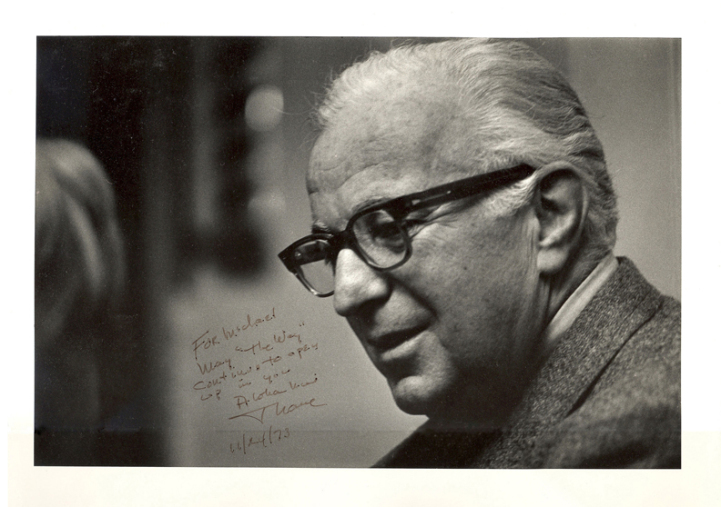
Walker, Thane (Ca. 1890?-1989)

(encyclopedia.com)

Walker, Thane (ca. 1890?-1989)

Founder (with Phez Kahlil) of The Prosperos, a group stemming from the philosophy of mystic G. I. Gurdjieff. Walker was born in Nodaway County, Missouri. He claimed to have been one of America’s first psychologists and to have been imprisoned in a Nazi concentration camp after writing the article “I Saw Hitler Make Black Magic.” He was a Marine Corps officer and entertained American troops in Japan during the occupation in World War II.

As a former pupil of Gurdjieff, Walker became a Gurdjieff-style figure, teaching students through stories and disorienting activities, but also drawing upon Freudian and Jungian psychology and occult and astrological traditions. Walker believed students should wake from the misleading reality of everyday sensory experience and limited personality to a wider reality.

The Prosperos group was founded in Florida in 1956, but the organization has since moved its headquarters to California and reported some 3,000 members at the end of the 1980s.

Sources:

Melton, J. Gordon. Encyclopedia of American Religions. Detroit: Gale Research, 1992.