

Monthly Archives: January 2021
Great man theory
From Wikipedia, the free encyclopedia
The great man theory is a 19th-century idea according to which history can be largely explained by the impact of great men, or heroes; highly influential and unique individuals who, due to their natural attributes, such as superior intellect, heroic courage, extraordinary leadership abilities or divine inspiration, have a decisive historical effect. The theory is primarily attributed to the Scottish philosopher and essayist Thomas Carlyle who gave a series of lectures on heroism in 1840, later published as On Heroes, Hero-Worship, and The Heroic in History, in which he states:
“Universal History, the history of what man has accomplished in this world, is at bottom the History of the Great Men who have worked here. They were the leaders of men, these great ones; the modellers, patterns, and in a wide sense creators, of whatsoever the general mass of men contrived to do or to attain; all things that we see standing accomplished in the world are properly the outer material result, the practical realization and embodiment, of Thoughts that dwelt in the Great Men sent into the world: the soul of the whole world’s history, it may justly be considered, were the history of these.”
Overview
Carlyle stated that “The history of the world is but the biography of great men”, reflecting his belief that heroes shape history through both their personal attributes and divine inspiration.[1][2] In his book On Heroes, Hero-Worship and the Heroic in History, Carlyle saw history as having turned on the decisions, works, ideas, and characters of “heroes”, giving detailed analysis of six types: The hero as divinity (such as Odin), prophet (such as Mohamet), poet (such as Shakespeare), priest (such as Martin Luther), man of letters (such as Rousseau), and king (such as Napoleon). Carlyle also argued that the study of great men was “profitable” to one’s own heroic side; that by examining the lives led by such heroes, one could not help but uncover something about one’s own true nature.[3]
As Sidney Hook notes, a common misinterpretation of the theory is that “all factors in history, save great men, were inconsequential.”[4], whereas Carlyle is instead claiming that great men are the decisive factor, owing to their unique genius. Hook then goes on to emphasise this uniqueness to illustrate the point: “Genius is not the result of compounding talent. How many battalions are the equivalent of a Napoleon? How many minor poets will give us a Shakespeare? How many run of the mine scientists will do the work of an Einstein?”[5]
American scholar Frederick Adams Woods supported the great man theory in his work The Influence of Monarchs: Steps in a New Science of History.[6] Woods investigated 386 rulers in Western Europe from the 12th century until the French revolution in the late 18th century and their influence on the course of historical events.
This theory is usually contrasted with “history from below“, which emphasizes the life of the masses in addition to the leader. An overwhelming wave of smaller events causes certain developments to occur. The Great Man approach to history was most fashionable with professional historians in the 19th century; a popular work of this school is the Encyclopædia Britannica Eleventh Edition (1911) which contains lengthy and detailed biographies about the great men of history, but very few general or social histories. For example, all information on the post-Roman “Migrations Period” of European History is compiled under the biography of Attila the Hun. This heroic view of history was also strongly endorsed by some philosophers, such as Léon Bloy, Hegel, Kierkegaard, Spengler and Max Weber,[7][8][9] but it fell out of favor after World War II.[citation needed]
Hegel, proceeding from providentialist theory, argued that “what is real is reasonable” and World-Historical individuals are World-Spirit’s agents. Hegel wrote: “Such are great historical men—whose own particular aims involve those large issues which are the will of the World-Spirit.”[10] Thus, according to Hegel, a great man does not create historical reality himself but only uncovers the inevitable future.
In Untimely Meditations, Nietzsche writes that “the goal of humanity lies in its highest specimens”.[11] Although Nietzsche’s body of work shows some overlap with Carlyle’s line of thought Nietzsche expressly rejected Carlyle’s hero cult in Ecce Homo.[12]
Assumptions of the Great Man Theory
This theory rests on two main assumptions, as pointed out by Villanova University:[13]
- Every great leader is born already possessing certain traits that will enable them to rise and lead, on instinct[14]
- The need for them has to be great for these traits to then arise, allowing them to lead[15]
This theory, and history, claims these great leaders as heroes that were able to rise against the odds to defeat rivals, while inspiring followers along the way. Theorists say that these leaders were then born with a specific set of traits and attributes that make them ideal candidates for leadership and roles of authority and power. This theory relies then heavily on born rather than made, nature rather than nurture and cultivates the idea that those in power deserve to lead and shouldn’t be questioned because they have the unique traits that make them suited for the position.[16]
Responses
Herbert Spencer was a contemporary critic of Carlyle’s great man theory.
Herbert Spencer’s criticism
One of the most forceful critics of Carlyle’s formulation of the great man theory was Herbert Spencer, who believed that attributing historical events to the decisions of individuals was an unscientific position.[17] He believed that the men Carlyle called “great men” were merely products of their social environment:
You must admit that the genesis of a great man depends on the long series of complex influences which has produced the race in which he appears, and the social state into which that race has slowly grown. … Before he can remake his society, his society must make him.— Herbert Spencer, The Study of Sociology[18]
William James’ defence
William James was a 19th-century philosopher and psychologist.
William James, in his 1880 lecture “Great Men, Great Thoughts, and the Environment”,[19] published in the Atlantic Monthly, forcefully defended Carlyle and refuted Spencer, condemning what James viewed as an “impudent”, “vague”, and “dogmatic” argument.
If anything is humanly certain it is that the great man’s society, properly so called, does not make him before he can remake it … The mutations of societies, then, from generation to generation, are in the main due directly or indirectly to the acts or the examples of individuals whose genius was so adapted to the receptivities of the moment, or whose accidental position of authority was so critical that they became ferments, initiators of movements, setters of precedent or fashion, centers of corruption, or destroyers of other persons, whose gifts, had they had free play, would have led society in another direction.
James’ defence of the great man theory can be summarised as follows: The unique physiological nature of the individual is the deciding factor in making the great man, who, in turn, is the deciding factor in changing his environment in a unique way, without which the new environment would not have come to be, wherein the extent and nature of this change is also dependent on the reception of the environment to this new stimulus. To begin his argument, he first sardonically claims that these inherent physiological qualities have as much to do with “social, political, geographical [and] anthropological conditions” as the “conditions of the crater of Vesuvius has to do with the flickering of this gas by which I write”. He then illustrates his argument by considering the myriad genetic variations that can occur in the earliest stages of sexual reproduction:
Now, when the result is the tendency of an ovum, itself invisible to the naked eye, to tip towards this direction or that in its further evolution, – to bring forth a genius or a dunce, even as the rain-drop passes east or west of the pebble, – is it not obvious that the deflecting cause must lie in a region so recondite and minute, must be such a ferment of a ferment, an infinitesimal of so high an order, that surmise itself may never succeed even in attempting to frame an image of it?
James argues that genetic anomalies in the brains of these great men are the decisive factor by introducing an original influence into their environment. They might therefore offer original ideas, discoveries, inventions and perspectives which “would not, in the mind of another individual, have engendered just that conclusion … It flashes out of one brain, and no other, because the instability of that brain is such as to tip and upset itself in just that particular direction.” James describes the manifestations of these unique physiological qualities as follows:
[T]he spontaneous upsettings of brains this way and that at particular moments into particular ideas and combinations are matched by their equally spontaneous permanent tiltings or saggings towards determinate directions. The humorous bent is quite characteristic; the sentimental one equally so. And the personal tone of each mind, which makes it more alive to certain impressions, more open to certain reasons, is equally the result of that invisible and imaginable play of the forces of growth within the nervous system which, [irresponsive] to the environment, makes the brain peculiarly apt to function in a certain way.
James then argues that these spontaneous variations of genius, i.e. the great men, which are causally independent of their social environment, subsequently influence that environment which in turn will either preserve or destroy the newly encountered variations in a form of evolutionary selection. If the great man is preserved then the environment is changed by his influence in “an entirely original and peculiar way. He acts as a ferment, and changes its constitution, just as the advent of a new zoological species changes the faunal and floral equilibrium of the region in which it appears.” Each ferment, each great man, exerts a new influence on their environment which is either embraced or rejected and if embraced will in turn shape the crucible for the selection process of future geniuses.
The products of the mind with the determined æsthetic bent please or displease the community. We adopt Wordsworth, and grow unsentimental and serene. We are fascinated by Schopenhauer, and learn from him the true luxury of woe. The adopted bent becomes a ferment in the community, and alters its tone. The alteration may be a benefit or a misfortune, for it is (pace Mr. Allen) a differentiation from within, which has to run the gauntlet of the larger environment’s selective power.
If you remove these geniuses “or alter their idiosyncrasies”, then what “increasing uniformities will the environment show? We defy Mr. Spencer or any one else to reply.” For James, then, there are two distinct factors that cause social evolution:
- The individual, who is unique in his “physiological and infra-social forces, but bearing all the power of initiative and origination in his hands” and
- The social environment of the individual, “with its power of adopting or rejecting both him and his gifts”.
He thus concludes: “Both factors are essential to change. The community stagnates without the impulse of the individual. The impulse dies away without the sympathy of the community.”
James asserts that Spencer’s view, conversely, ignores the influence of that impulse and
denies the vital importance of individual initiative, is, then, an utterly vague and unscientific conception, a lapse from modern scientific determinism into the most ancient oriental fatalism. The lesson of the analysis that we have made (even on the completely deterministic hypothesis with which we started) forms an appeal of the most stimulating sort to the energy of the individual … It is folly, then, to speak of the “laws of history” as of something inevitable, which science has only to discover, and whose consequences any one can then foretell but do nothing to alter or avert. Why, the very laws of physics are conditional, and deal with ifs. The physicist does not say, “The water will boil anyhow”; he only says it will boil if a fire is kindled beneath it. And so the utmost the student of sociology can ever predict is that if a genius of a certain sort show the way, society will be sure to follow. It might long ago have been predicted with great confidence that both Italy and Germany would reach a stable unity if some one could but succeed in starting the process. It could not have been predicted, however, that the modus operandi in each case would be subordination to a paramount state rather than federation, because no historian could have calculated the freaks of birth and fortune which gave at the same moment such positions of authority to three such peculiar individuals as Napoleon III, Bismarck, and Cavour.
Other responses
Tolstoy‘s War and Peace features criticism of Great Man Theories as a recurring theme in the philosophical digressions. According to Tolstoy, the significance of great individuals is imaginary; as a matter of fact they are only history’s slaves realizing the decree of Providence.[20]
Among modern critics of the theory, Sidney Hook is supportive of the idea; he gives credit to those who shape events through their actions, and his book The Hero in History is devoted to the role of the hero and in history and influence of the outstanding persons.[21]
In the introduction to a new edition of On Heroes, Hero-Worship, and The Heroic in History, David R. Sorensen notes the modern decline in support for Carlyle’s theory in particular but also for “heroic distinction” in general.[22] He cites Robert Faulkner as an exception, a proponent of Aristotelian magnanimity who in his book The Case for Greatness: Honorable Ambition and Its Critics, criticises the political bias in discussions on greatness and heroism, stating: “the new liberalism’s antipathy to superior statesmen and to human excellence is peculiarly zealous, parochial, and antiphilosophic.”[23]
Before the 19th-century, Pascal begins his Three Discourses on the Condition of the Great (written it seems for a young duke) by telling the story of a castaway on an island whose inhabitants take him for their missing king. He defends in his parable of the shipwrecked king, that the legitimacy of the greatness of great men is fundamentally custom and chance. A coincidence that gives birth to him in the right place with noble parents and arbitrary custom deciding, for example, on an unequal distribution of wealth in favor of the nobles.[24]
ASMR
COVID CELLO PROJECT 10 “Adagio for Strings” by Samuel Barber
Tony Rogers 278 cellists from 29 countries! UPDATE: THIS ARRANGEMENT IS AVAILABLE AT https://gum.co/KBfMXp This is the 10th video created to connect with other cellists across the world, and create something to collaborate on during COVID times. This project continues to grow solely through word of mouth and social media sharing. Please SUBSCRIBE and SHARE this video and keep this project growing organically. This piece is commonly used as a song of anguish and sadness, and features over 100 memorials of people who have left this earth, uploaded by the cellists they appear next to. We are all connected. THIS VIDEO PROJECT CONTINUES BY DONATIONS. PLEASE DONATE IF YOU FEEL INSPIRED venmo.com/TonyRogersCello paypal.me/TonyRogersCello ALLL PROJECTS ARE OPEN TO ALL CELLISTS AT ALL LEVELS: IF YOU ARE A CELLIST and want to participate in the next one, WE WANT YOU TO!! SEND AN EMAIL: COVIDCELLOPROJECT@gmail.com all directions are at: www.covidcelloproject.com. For more cello choir arrangements like this and more, checkout: www.cellochoirmusic.com
My Cancer Journey – December 31, 2020
Ned Henry Dec 31, 2020 · (nedhenry.medium.com)
I’ll figure out how to orgamize each sitting as I go. For now I just want to keep going. I realiized I might piss some people off with what I put down here and I also realized that I really don’t care. This is for me. This is for me to express myself to heal to grow and learn and observe. I think I’ve spent too much of my life trying to be liked and truth be told even though I am a pretty likable guy, it’s not because I tried. It’s because I am genuine most of the time. So having said that let’s get on with it.
I began the word tracking process of NEWS IS TOXIC. Let’s see if I can post a picture of it here just for fun. It worked.
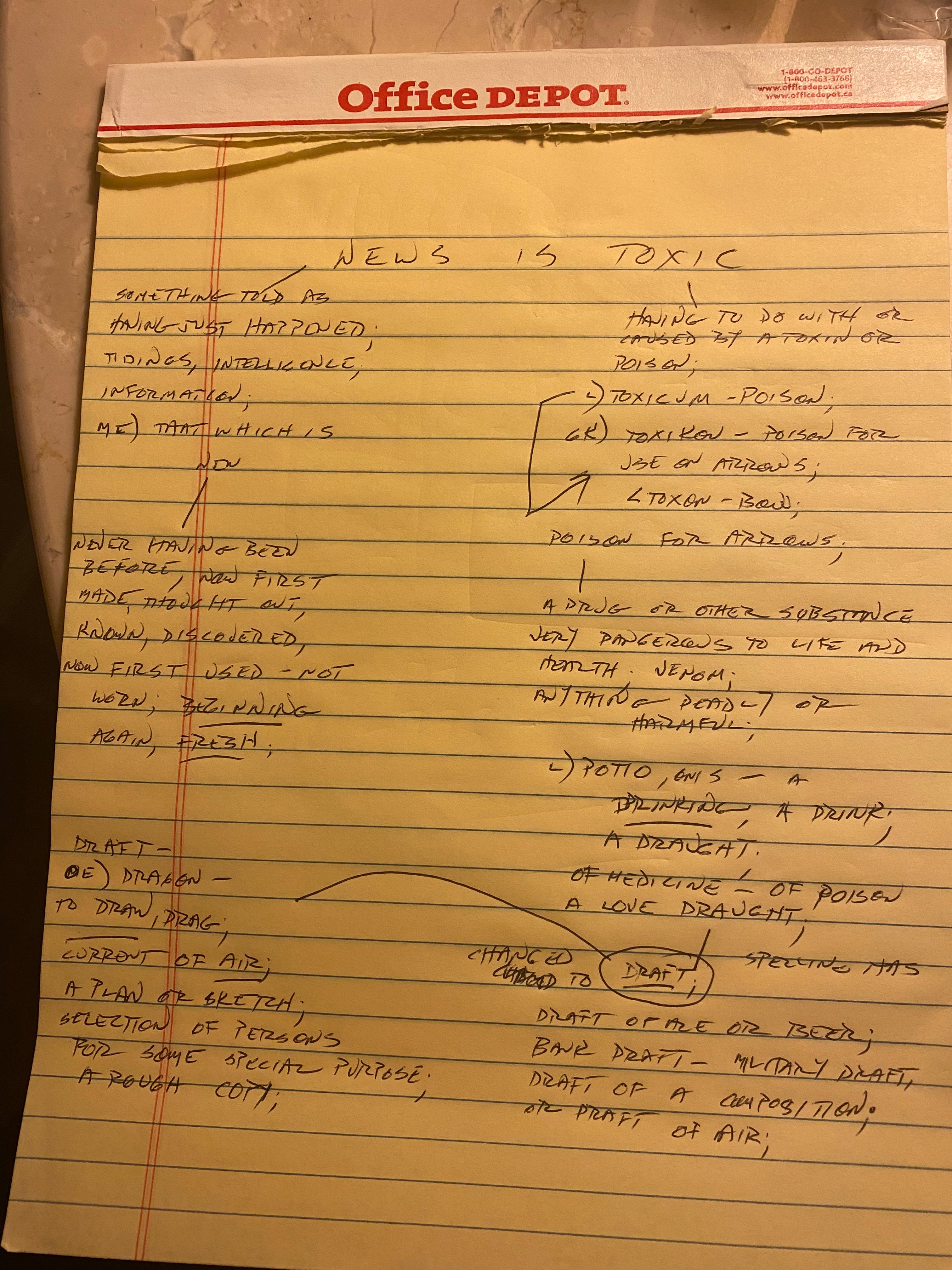
You can’t read it very well but some interesting words. News is intelligence, something discovered or thought out, fresh. Toxic is poisonous. Comes from the greek where they put poison on the tips or arrows. The root is toxon — bow. Poison is something dangerous to life and health, deadly. And that comes from the Latin Potio — which is a drinking or a drink. Draught — a draught of medicine or even love. A love draught. Well draught is just an archaic word for DRAFT. Like to draw or sketch; or a draft of beer or ale; or a draft of air or a plan for a specific purpose. So when my senses tell me that News is Toxic what am I really saying? That’s what the Translation will be all about as I figure that out. Not gonna do that here. By the way, all this word tracking IS related to my cancer in case you can’t see that. Translation involves 5 very specific steps using sylogistic logic based on axioms. It was created by a brilliant man named Thane. I’ll share my 5th step Conclusion with you later in the blog once I work it through.
D.C. Police Lose Control Of Rioting Trump Supporters After Hundreds Of Officers Called Away To Deal With Black Jaywalker


The Fool On The Hill
The Beatles October 30 / 31 1967 – Paul was in France filming ‘The Fool On The Hill’ sequence that was used in their film “Magical Mystery Tour”. “I wandered off to France and did the ‘Fool On The Hill’ part one morning with a couple of mates. It wasn’t quite “union” – you were supposed to take millions of cameramen, but we didn’t want to do that…”
Music in this video
Learn more
Listen ad-free with YouTube Premium
Song
The Fool On The Hill (Mono/Remastered 2009)
Artist
Writers
Paul McCartney, John Lennon
Licensed to YouTube by
UMG (on behalf of UMC (Universal Music Catalogue)); Sony ATV Publishing, SOLAR Music Rights Management, LatinAutor – SonyATV, ASCAP, CMRRA, UNIAO BRASILEIRA DE EDITORAS DE MUSICA – UBEM, LatinAutorPerf, and 8 Music Rights Societies
Day after day, alone on a hill
The man with the foolish grin
Is keeping perfectly still
But nobody wants to know him
They can see that he’s just a fool
And he never gives an answerBut the fool on the hill
Sees the sun going down
And the eyes in his head
See the world spinning roundWell on the way, head in a cloud
The man of a thousand voices
Talking perfectly loud
But nobody ever hears him
Or the sound he appears to make
And he never seems to noticeBut the fool on the hill
Sees the sun going down
And the eyes in his head
See the world spinning roundAnd nobody seems to like him
They can tell what he wants to do
And he never shows his feelingsBut the fool on the hill
Sees the sun going down
And the eyes in his head
See the world spinning roundOhh oh-oh-oh-oh ohh-oh-oh
Round and round and round and round and round
He never listens to them
He knows that they’re the fool
They don’t like himThe fool on the hill
Sees the sun going down
And the eyes in his head
See the world spinning roundOhhhh
Round and round and round and round and
Ohhhh
Source: Musixmatch
Elevating Resolutions for the New Year Inspired by Some of Humanity’s Greatest Minds
By Maria Popova (brainpickings.org)

What if we could augment the bucket-list of typical New Year’s resolutions, dominated by bodily habits and pragmatic daily practices, with higher-order aspirations — habits of mind and spiritual orientations borrowed from some of humanity’s most timelessly rewarding thinkers? After last year’s selection of worthy resolutions inspired by such luminaries as Seneca, Maya Angelou, Bruce Lee, and Virginia Woolf, here is another set for the new year borrowed from a new roster of perennially elevating minds.
| 1. ADRIENNE RICH: CULTIVATE HONORABLE RELATIONSHIPS |

One of the most influential poets of the twentieth century and a woman of unflinching conviction, Adrienne Rich (May 16, 1929–March 27, 2012) became the first and to date only person to decline the National Medal of Arts in protest against the growing monopoly of power and the government’s proposed plan to end funding for the National Endowment for the Arts. Although her poetry collection The Dream of a Common Language is a cultural cornerstone and required reading for every thinking, feeling human being, her lesser-known collected prose, published as On Lies, Secrets, and Silence (public library), pours forth Rich’s most direct insight into the political, philosophical, and personal dimensions of human life.
In it, she writes:
An honorable human relationship — that is, one in which two people have the right to use the word “love” — is a process, delicate, violent, often terrifying to both persons involved, a process of refining the truths they can tell each other.
It is important to do this because it breaks down human self-delusion and isolation.
It is important to do this because in doing so we do justice to our own complexity.
It is important to do this because we can count on so few people to go that hard way with us.
| 2. SØREN KIERKEGAARD: RESIST ABSENTMINDED BUSYNESS |

Søren Kierkegaard (May 5, 1813–November 11, 1855), considered the first true existentialist philosopher, remains a source of enduring wisdom on everything from the psychology of bullying to the vital role of boredom to why we conform. In a chapter of the altogether indispensable 1843 treatise Either/Or: A Fragment of Life (public library), thirty-year-old Kierkegaard writes:
In a latter chapter, titled “The Unhappiest Man,” he considers how we grow unhappy by fleeing from presence and busying ourselves with the constant pursuit of some as-yet unattained external goal:
[…]
The unhappy one is absent… It is only the person who is present to himself that is happy.
| 3. RAINER MARIA RILKE: LIVE THE QUESTIONS |

In 1902, Rainer Maria Rilke (December 4, 1875–December 29, 1926) began corresponding with a 19-year-old cadet and budding poet named Franz Xaver Kappus. Later published as Letters to a Young Poet (public library), Rilke’s missives address such enduring questions as what it really means to love, how great sadnesses bring us closer to ourselves, and what reading does for the human spirit.
In one of the most potent letters, he writes:
| 4. SUSAN SONTAG: PAY ATTENTION TO THE WORLD |

In a terrific 1992 lecture, Susan Sontag (January 16, 1933–December 28, 2004) asserted that “a writer is someone who pays attention to the world — a writer is a professional observer.” But this observant attentiveness to the world, Sontag believed, is as vital to being a good writer as it is to being a good human being — something she addresses in one of the many rewarding pieces collected in the posthumous anthology At the Same Time: Essays and Speeches (public library), which also gave us Sontag on beauty vs. interestingness, courage and resistance, and literature and freedom.
Reflecting on a question she is frequently asked — to distill her essential advice on writing — Sontag offers:
Needless to say, no sooner had these perky phrases fallen out of my mouth than I thought of some more recipes for writer’s virtue.
For instance: “Be serious.” By which I meant: Never be cynical. And which doesn’t preclude being funny.
But these tenets of storytelling, Sontag argues, aren’t just writerly virtues — they are a framework for human virtues:
To be a moral human being is to pay, be obliged to pay, certain kinds of attention.
When we make moral judgments, we are not just saying that this is better than that. Even more fundamentally, we are saying that this is more important than that. It is to order the overwhelming spread and simultaneity of everything, at the price of ignoring or turning our backs on most of what is happening in the world.
The nature of moral judgments depends on our capacity for paying attention — a capacity that, inevitably, has its limits but whose limits can be stretched.
But perhaps the beginning of wisdom, and humility, is to acknowledge, and bow one’s head, before the thought, the devastating thought, of the simultaneity of everything, and the incapacity of our moral understanding — which is also the understanding of the novelist — to take this in.
| 5. BERTRAND RUSSELL: MAKE ROOM FOR “FRUITFUL MONOTONY” |

Many of humanity’s greatest minds have advocated for the vitalizing role of not-doing in having a full life, but none more compellingly than British philosopher Bertrand Russell (May 18, 1872–February 2, 1970) in his 1930 masterwork The Conquest of Happiness (public library) — an effort “to suggest a cure for the ordinary day-to-day unhappiness from which most people in civilized countries suffer,” and a timelessly insightful lens on what “the good life” really means.
In a chapter titled “Boredom and Excitement,” Russell teases apart the paradoxical question of why, given how central it is to our wholeness, we dread boredom as much as we do. Long before our present anxieties about how the age of distraction and productivity is thwarting our capacity for presence, he writes:
[…]
As we rise in the social scale the pursuit of excitement becomes more and more intense.
Many decades before our present concerns about screen time, he urges parents to allow children the freedom to experience “fruitful monotony,” which invites inventiveness and imaginative play — in other words, the great childhood joy and developmental achievement of learning to “do nothing with nobody all alone by yourself.” He writes:
I do not mean that monotony has any merits of its own; I mean only that certain good things are not possible except where there is a certain degree of monotony… A generation that cannot endure boredom will be a generation of little men, of men unduly divorced from the slow processes of nature, of men in whom every vital impulse slowly withers, as though they were cut flowers in a vase.
| 6. URSULA K. LE GUIN: REFUSE TO PLAY THE PERFECTION GAME |

Perfectionism is our most compulsive way of keeping ourselves small, a kind of psychoemotional contortionism that gives the illusion of reaching for greatness while constricting us into increasingly suffocating smallness. That’s what Ursula K. Le Guin (b. October 21, 1929) explores in a wonderful 1992 essay titled “Dogs, Cats, and Dancers: Thoughts about Beauty,” found in the altogether spectacular volume The Wave in the Mind: Talks and Essays on the Writer, the Reader, and the Imagination (public library) — the source of Le Guin’s wisdom on the cultural baggage of gender, the magic of real human conversation, and the sacredness of public libraries.
Reflecting on various cultures’ impossible and often punishing ideals of human beauty, “especially of female beauty,” Le Guin writes:
[…]
I think of when I was in high school in the 1940s: the white girls got their hair crinkled up by chemicals and heat so it would curl, and the black girls got their hair mashed flat by chemicals and heat so it wouldn’t curl. Home perms hadn’t been invented yet, and a lot of kids couldn’t afford these expensive treatments, so they were wretched because they couldn’t follow the rules, the rules of beauty.
Beauty always has rules. It’s a game. I resent the beauty game when I see it controlled by people who grab fortunes from it and don’t care who they hurt. I hate it when I see it making people so self-dissatisfied that they starve and deform and poison themselves. Most of the time I just play the game myself in a very small way, buying a new lipstick, feeling happy about a pretty new silk shirt.
[…]
There’s the ideal beauty of youth and health, which never really changes, and is always true. There’s the ideal beauty of movie stars and advertising models, the beauty-game ideal, which changes its rules all the time and from place to place, and is never entirely true. And there’s an ideal beauty that is harder to define or understand, because it occurs not just in the body but where the body and the spirit meet and define each other.
And yet for all the ideals we impose on our bodies, Le Guin argues in her most poignant but, strangely, most liberating point, it is death that ultimately illuminates the full spectrum of our beauty — death, the ultimate equalizer of time and space; death, the great clarifier that makes us see that, as Rebecca Goldstein put it, “a person whom one loves is a world, just as one knows oneself to be a world.”
With this long-view lens, Le Guin remembers her own mother and the many dimensions of her beauty:
That must be what the great artists see and paint. That must be why the tired, aged faces in Rembrandt’s portraits give us such delight: they show us beauty not skin-deep but life-deep.
More here.
| 7. ERICH FROMM: MASTER THE ART OF LOVING |

Our cultural mythology depicts love as something that happens to us — something we fall into, something that strikes us arrow-like, in which we are so passive as to be either lucky or unlucky. Such framing obscures the fact that loving — the practice of love — is a skill attained through the same deliberate effort as any other pursuit of human excellence.
Long before the Zen sage Thich Nhat Hahn admonished that “to love without knowing how to love wounds the person we love,” the great German social psychologist, psychoanalyst, and philosopher Erich Fromm (March 23, 1900–March 18, 1980) addressed this neglected skillfulness aspect of love in his 1956 classic The Art of Loving (public library) — a case for love as a skill to be honed the way artists apprentice themselves to the work on the way to mastery, demanding of its practitioner both knowledge and effort.
Fromm writes:
[…]
There is hardly any activity, any enterprise, which is started with such tremendous hopes and expectations, and yet, which fails so regularly, as love.
The only way to abate this track record of failure, Fromm argues, is to examine the underlying reasons for the disconnect between our beliefs about love and its actual machinery — which must include a recognition of love as an informed practice rather than an unmerited grace:
More here.
| 8. ANNE TRUITT: CHOOSE UNDERSTANDING OVER JUDGMENT |

Perhaps because she was formally trained as a psychologist, artist Anne Truitt (March 16, 1921–December 23, 2004) possessed exceptional powers of introspection and self-awareness coupled with an artist’s penchant for patient observation. This made her diary, eventually published as Daybook: The Journal of an Artist (public library), a true masterwork of psychological insight.
In one particularly poignant entry, she considers how our preconceptions and our ready-made judgments are keeping us from truly seeing one another, erecting a perilous barrier to love:
More here.
| 9. SIMONE WEIL: MAKE USE OF YOUR SUFFERING |

Long before scientists had empirical evidence of the astounding ways in which our minds affect our bodies, French philosopher and political activist Simone Weil (February 3, 1909–August 24, 1943) — a thinker of unparalleled intellectual elegance and a sort of modern saint whom Albert Camus described as “the only great spirit of our times” — examined the delicate relationship between our physical and spiritual suffering, between the anguish of the material body and that of the soul.
A few months before her painful yet stoic death from tuberculosis — despite her diagnosis and her doctor’s explicit orders to eat heartily, Weil consumed only what was rationed to her compatriots under the German Occupation in a remarkable gesture of solidarity, ultimately resulting in fatal malnutrition — she turned to the problem of pain in First and Last Notebooks (public library). In an entry from late 1942, Weil considers how our instinctive reaction to suffering often only amplifies our pain:
Weil extends this philosophy beyond physical pain and into other forms of bodily and spiritual discomfort that we habitually exacerbate by stiffening with resistance to the unpleasantness:
To make use in this way of the sufferings that chance inflicts upon us is better than inflicting discipline upon oneself.
| 10. JAMES BALDWIN: TELL THE WORLD HOW TO TREAT YOU |

One August evening in 1970, James Baldwin (August 2, 1924–December 1, 1987) and Margaret Mead (December 16, 1901–November 15, 1978) sat together on a stage in New York City for a remarkable public conversation. They talked for seven and a half hours over the course of the weekend, tackling such enduring concerns as power and privilege, race and gender, beauty, religion, justice, and the relationship between the intellect and the imagination. The transcript was eventually published as A Rap on Race (public library) — a testament to both how far we’ve come and how far we have yet to go, exploring such timeless and timely questions as changing one’s destiny, the crucial difference between guilt and responsibility, and reimagining democracy for a post-consumerist culture.
In a portion of the conversation examining race, identity, and the immigrant experience, Baldwin observes:
He offers an autobiographical example:
Now, how in the world am I going to explain to him that there is virtually no way for me to have found out where I came from in Africa? So it is a kind of tug of war. The black American is looked down on by other dark people as being an object abjectly used. They envy him on the one hand, but on the other hand they also would like to look down on him as having struck a despicable bargain.
But identity, Baldwin argues, isn’t something we are born with — rather, it is something we claim for ourselves, then must assert willfully to the world:
More here.
| 11. JOHN STEINBECK: USE DISCIPLINE TO CATALYZE CREATIVE MAGIC |

Many celebrated writers have championed the creative benefits of keeping a diary, but no one has put the diary to more impressive practical use in the creative process than John Steinbeck (February 27, 1902–December 20, 1968).
In the spring of 1938, he embarked on the most intense writing experience of his life. The public fruit of this labor would become the 1939 masterwork The Grapes of Wrath, which earned Steinbeck the Pulitzer Prize in 1940 and was a cornerstone for his Nobel Prize two decades later. But its private rewards are at least as important and morally instructive: Alongside the novel, Steinbeck also began keeping a diary, eventually published as Working Days: The Journals of The Grapes of Wrath (public library) — a living record of his creative journey, in which this extraordinary writer tussles with excruciating self-doubt (exactly the kind Virginia Woolf so memorably described) but plows forward anyway, with equal parts gusto and grist, determined to do his best with the gift he has despite his limitations.
His journal, which became for him a practice both redemptive and transcendent, stands as a supreme testament to the fact that the essential substance of genius is the daily act of showing up. Steinbeck captures this perfectly in an entry that applies just as well to any field of creative endeavor:
The journal thus becomes at once a tool of self-discipline (he vowed to write in it every single weekday, and did, declaring in one of the first entries: “Work is the only good thing.”), a pacing mechanism (he gave himself seven months to complete the book, anticipated it would actually take only 100 days, and finished it in under five months, averaging 2,000 words per day, longhand, not including the diary), and a sounding board for much-needed positive self-talk in the face of constant doubt (“I am so lazy and the thing ahead is so very difficult,” he despairs in one entry; but he assures himself in another: “My will is low. I must build my will again. And I can do it.”) Above all, it is a tool of accountability to keep him moving forward despite life’s litany of distractions and responsibilities. “Problems pile up so that this book moves like a Tide Pool snail with a shell and barnacles on its back,” he writes, and yet the essential thing is that despite the problems, despite the barnacles, it does move. He captures this in one of his most poignant entries, shortly before completing the first half of the novel:
A few days later, he spirals into self-doubt again:
And so he inches forward, day after day. As he nears the finish line, he is even more certain of this incremental reach for greatness:
And yet even as he approaches the end, his self-doubt remains as unshakable as his commitment to finish:
The book, of course, was far from run-of-the-mill. In addition to earning the two highest accolades in literature, The Grapes of Wrath remained atop the bestseller list for almost a year after it was published, sold nearly 430,000 copies in its first year alone, and remains one of the most read and celebrated novels ever written.
| 12. MARTHA NUSSBAUM: HEED THE INTELLIGENCE OF THE EMOTIONS |

As scientists are shedding light on how our emotions affect our susceptibility to disease, it is becoming increasingly clear that our emotional lives are equipped with a special and non-negligible kind of bodily and cognitive intelligence. The nature of that intelligence and how we can harness its power is what Martha Nussbaum (b.May 6, 1947), whom I continue to consider the most compelling and effective philosopher of our time, examines in her magnificent 2001 book Upheavals of Thought: The Intelligence of Emotions (public library). Titled after Proust’s conception of the emotions as “geologic upheavals of thought,” Nussbaum’s treatise offers a lucid counterpoint to the old idea that our emotions are merely animal energies or primal impulses wholly separate from our cognition. Instead, she argues that they are a centerpiece of moral philosophy and that any substantive theory of ethics necessitates a substantive understanding of the emotions.
Nussbaum writes:
[…]
Emotions are not just the fuel that powers the psychological mechanism of a reasoning creature, they are parts, highly complex and messy parts, of this creature’s reasoning itself.
She considers the rationale behind the book’s title:
More here.
| 13. GRACE PALEY: MASTER THE ART OF GROWING OLDER |

Perhaps the greatest perplexity of aging is how to fill with gentleness the void between who we feel we are on the inside and who our culture tells us is staring back from that mirror. The cultivation of that gentleness is what beloved writer Grace Paley (December 11, 1922–August 22, 2007) examines in a magnificent short piece titled “My Father Addresses Me on the Facts of Old Age,” originally written for the New Yorker in 2002 and included in Here and Somewhere Else: Stories and Poems by Grace Paley and Robert Nichols (public library) — a celebration of literature, love, and the love of literature by Paley and her husband, published a few months before she died at the age of eighty-five.
Paley writes:
They said, Really?
My father wanted to begin as soon as possible.
[…]
Please sit down, he said. Be patient. The main thing is this — when you get up in the morning you must take your heart in your two hands. You must do this every morning.
That’s a metaphor, right?
Metaphor? No, no, you can do this. In the morning, do a few little exercises for the joints, not too much. Then put your hands like a cup over and under the heart. Under the breast. He said tactfully. It’s probably easier for a man. Then talk softly, don’t yell. Under your ribs, push a little. When you wake up, you must do this massage. I mean pat, stroke a little, don’t be ashamed. Very likely no one will be watching. Then you must talk to your heart.
Talk? What?
Say anything, but be respectful. Say — maybe say, Heart, little heart, beat softly but never forget your job, the blood. You can whisper also, Remember, remember.
More here.
| 14. FRIEDRICH NIETZSCHE: WALK YOUR OWN PATH |

“Do you have the courage to bring forth the treasures that are hidden within you?” Elizabeth Gilbert asked in framing her catalyst for creative magic. This is among life’s most abiding questions and the history of human creativity — our art and our poetry and most empathically all of our philosophy — is the history of attempts to answer it.
Friedrich Nietzsche (October 15, 1844–August 25, 1900), who believed that embracing difficulty is essential for a fulfilling life, considered the journey of self-discovery one of the greatest and most fertile existential difficulties. In 1873, as he was approaching his thirtieth birthday, Nietzsche addressed this perennial question of how we find ourselves and bring forth our gifts in a beautiful essay titled Schopenhauer as Educator (public library), part of his Untimely Meditations.
Nietzsche, translated here by Daniel Pellerin, writes:
Every young soul hears this call by day and by night and shudders with excitement at the premonition of that degree of happiness which eternities have prepared for those who will give thought to their true liberation. There is no way to help any soul attain this happiness, however, so long as it remains shackled with the chains of opinion and fear. And how hopeless and meaningless life can become without such a liberation! There is no drearier, sorrier creature in nature than the man who has evaded his own genius and who squints now towards the right, now towards the left, now backwards, now in any direction whatever.
Echoing Picasso’s proclamation that “to know what you’re going to draw, you have to begin drawing,” Nietzsche considers the only true antidote to this existential dreariness:
More here.
| 15. MARTHA GRAHAM: EMBRACE YOUR DIVINE DISSATISFACTION |

“Resign yourself to the lifelong sadness that comes from never being satisfied,” Zadie Smith counseled in her ten rules of writing. But how does one befriend this perennial dissatisfaction while continuing to unlock, to borrow Julia Cameron’s potent phrase, the “spiritual electricity” of creative flow?
To this abiding question of the creative life, legendary choreographer Martha Graham (May 11, 1894–April 1, 1991) offers an answer at once remarkably grounding and remarkably elevating in a conversation found in the 1991 biography Martha: The Life and Work of Martha Graham (public library) by dancer and choreographer Agnes de Mille.
In 1943, De Mille was hired to choreograph the musical Oklahoma!, which became an overnight sensation and ran for a record-setting 2,212 performances. Feeling that critics and the public had long ignored work into which she had poured her heart and soul, De Mille found herself dispirited by the sense that something she considered “only fairly good” was suddenly hailed as a “flamboyant success.” Shortly after the premiere, she met Graham “in a Schrafft’s restaurant over a soda” for a conversation that put into perspective her gnawing grievance and offered what De Mille considered the greatest thing ever said to her. She recounts the exchange:
Martha said to me, very quietly: “There is a vitality, a life force, an energy, a quickening that is translated through you into action, and because there is only one of you in all of time, this expression is unique. And if you block it, it will never exist through any other medium and it will be lost. The world will not have it. It is not your business to determine how good it is nor how valuable nor how it compares with other expressions. It is your business to keep it yours clearly and directly, to keep the channel open. You do not even have to believe in yourself or your work. You have to keep yourself open and aware to the urges that motivate you. Keep the channel open. As for you, Agnes, you have so far used about one-third of your talent.”
“But,” I said, “when I see my work I take for granted what other people value in it. I see only its ineptitude, inorganic flaws, and crudities. I am not pleased or satisfied.”
“No artist is pleased.”
“But then there is no satisfaction?”
“No satisfaction whatever at any time,” she cried out passionately. “There is only a queer divine dissatisfaction, a blessed unrest that keeps us marching and makes us more alive than the others.”
| 16. KURT VONNEGUT: CELEBRATE ENOUGHNESS |

In 2005, Kurt Vonnegut (November 11, 1922–April 11, 2007) — a man of discipline, a sage of storytelling, and one wise dad — penned a short and acutely beautiful remembrance of his friend Joseph Heller, who had died several years earlier. Originally published in the New Yorker, it was later reprinted in John C. Bogle’s Enough: True Measures of Money, Business, and Life (public library).
True story, Word of Honor:
Joseph Heller, an important and funny writer
now dead,
and I were at a party given by a billionaire
on Shelter Island.I said, “Joe, how does it make you feel
to know that our host only yesterday
may have made more money
than your novel ‘Catch-22’
has earned in its entire history?”
And Joe said, “I’ve got something he can never have.”
And I said, “What on earth could that be, Joe?”
And Joe said, “The knowledge that I’ve got enough.”
Not bad! Rest in peace!
Biden and Harris Certified early this morning
As of 4:00 am Thursday 1-7-2021
Congress certified President-elect Joe Biden and Vice President-elect Kamala Harris’ victory early on Thursday, the end of a long day and night marked by chaos and violence in Washington, in which extremists, emboldened by President Trump, sought to thwart the peaceful transfer of power that has been a hallmark of modern American history by staging a violent insurrection inside the U.S. Capitol.”
To those who wreaked havoc in our Capitol today, you did not win,” Vice President Mike Pence said, once lawmakers reconvened after many spent hours in lockdown. “Violence never wins. Freedom wins, and this is still the people’s house.”
Biden and Harris finished with 306 electoral votes, while Trump and Pence had 232. It takes 270 electoral votes to win the presidency.
In a statement released just after the certification was finalized, Trump at long last acknowledged his election loss. He said that even though he disagrees with the outcome, “there will be an orderly transition on January 20th.”
Source – npr.org
Age of Aquarius Club
| by Astro Butterfly (astrobutterfly.com) |
The newly launched Age of Aquarius Membership has 2 pillars: 1.) Astrology Content, 2.) Community.
1.) Astrology Content
Each month, you will get access to new astrology content:
- Monthly Astrology Forecasts – the general Astro-weather of the month, as well as forecasts for your Ascendant sign
- An Astrology Tutorial to learn one new Astro skill each month
- New Moon Goal Setting Ceremony
- Monthly Astrology Training inspired by the Topic of the Month
- A Guest Webinar with new guests each month
The “Topic of the Month” will relate to the transits of the month or other important astrological events. The January 2021 Topic of the Month, for example, is “Age Of Aquarius” so the Astrology Training and the Guest Webinar for this month are about the Age Of Aquarius.
In February the Topic of the Month is the “Saturn-Uranus” square, so the Guest Webinar and Astrology Training will be about the Saturn-Uranus square. We will follow this format for each month of the year.
2.) Community

Inside our community, we have several themed topics that you can follow, comment on, ask questions, and contribute towards:
- MONDAYS: Weekly Transits – every Monday, one of our resident astrologers shares the most important transits and a short analysis of the Astro-weather of the week.
- TUESDAYS: Show, Share and Tell – every Tuesday, Abegail will invite you to share your skills, art, music, work, links, or website. Here you can also share other people’s art, links, or resources
- WEDNESDAYS: Natal Chart Discussion Thread. In this thread, you can share your chart, ask questions, and help and engage with other members.
- THURSDAYS: Share Your Opinion. Every Thursday, our resident-astrologer and Community Manager will ask for your opinion about a particular topic of interest. Make sure you share your thoughts!
- FRIDAYS: True Story. Every Friday or Venus-day, one of our resident astrologers shares a story inspired by his personal experiences and the astrology of the week. You are invited to share yours also.
In addition to these weekly threads, we have several general threads:
- Advanced Astrologers’ Thread: If you want to discuss advanced astrology topics, this is your thread!
- 12th House Moonlight’s Shadow: In this thread, our resident astrologer shares Astro-themed songs. Feel free to contribute with your own Astro-inspired tracks!
- General Discussion – In this thread you are invited to discuss any topic that is not covered in the regular threads.
When you join AGE OF AQUARIUS, you get access to Monthly astrology forecasts, astrology tutorials, and a lot of other resources such as the 2021 Calendar and the Auspicious Days Planner.
If you love astrology, this is an excellent offer you don’t want to miss. Join hundreds of members for only $24/month.
You can join us here: