SME (on behalf of RCA Records Label); CMRRA, BMI – Broadcast Music Inc., LatinAutor – SonyATV, SOLAR Music Rights Management, Sony ATV Publishing, LatinAutorPerf, and 3 Music Rights Societies
The emergence of Covid-19 has led to loss and heartbreak all over the world, but it also prompted a wave of unprecedented global collaboration. Within the space of a year, several vaccines have not only been developed, but authorised for use, and have begun to be administered. As one scientist put it: “In the last 11 months, probably 10 years’ work has been done.”
Francis Collins, the director of the US National Institutes of Health, the largest funder of biomedical research in the world told the Guardian it has been a phenomenal effort. “I have never seen anything like this,” he said. “It has been all hands on deck.”
UMG (on behalf of Mercury Studios); LatinAutorPerf, UMPG Publishing, The Royalty Network (Publishing), ASCAP, LatinAutor – SonyATV, SOLAR Music Rights Management, UNIAO BRASILEIRA DE EDITORAS DE MUSICA – UBEM, UMPI, and 13 Music Rights Societies
I’m actually going to try to post this the night before if the site will let me. It is an hour and 15 minute talk that Marianne Williamson gave on January 19, 2018 about Martin Luther King’s Letter from a Birmingham Jail. I just listened to it again this evening. If just one of you takes the time to listen to it, it is well worth making this posting. This was my first exposure to Marianne Williamson. This talk didn’t really sink in at the time in a way that spurred action but it did touch me deeply. It is the reason I wholeheartedly supported her candidacy for President in 2020 when my friends thought I was nuts. This talk is from the heart and I want my President to talk from the heart. I didn’t become a follower of hers or anything. Didn’t hear other talks but did give money to her campaign and got on her mailing list and that is how I found her daily lessons in the Course in Miracles. I urge you to listen to what she has to say about Martin Luther King on this MLK day 3 years later.
It’s 5:15 AM — Couldn’t sleep. Feet too warm or too cold of just too numb. I’m waking them up making coffee. Didn’t go to bed that early. I did sleep a few hours. Just haven’t had a long night sleep since that night I took 2 sleeping pills. But they didn’t work the other night so I went back to Ambien but it’s not really working either. I think those “strong” sleeping pills are more for anxiety than sleep. Coffee’s ready. It’s hard doing this all alone. Even though I’m not, I am. In moments like this at 5 AM. That’s hard.
CIM — Lesson 16 — I have no neutral thoughts.
I’m sleepy but I’m awake. I had a lot of great thoughts lsat night while I was stoned. Great ideas. Things to say. I just let them all go. If they come back great but if not great too. I enjoyed that freedom. Yesterday’s CIM was My thoughts are images I have made. And so I tried to just let them go. Practice. It takes practice. There’s no getting around that. I read your card again Allison. ?
I know who gave me that weighted blanket by the way. And also btw, it is the best foot warmer I have. It holds the heat for a long time. and since it’s weighted it stretches my ankles a little bit when I put it on top of my feet. I sat in a chair last night with that small I guess you’d call it a foot blanket on my feet and just held my heart. Like you taught me Terri in those early days of being in shock and panic.
No music. Just silence. That weeping buddha needs me as much as I need him. We comfort each other. So it’s a reciprocal relationship. It flows both ways. we both have the power to comfort and we both have the ability to receive that comfort. Silly holding a piece of wood in my hands but it’s not. I have no neutral thoughts. I have felt lonely most of my life. We are going to talk about that one day. How I can never seem to fit in — not really fit in for some reaon or another. And it leaves me feeling lonely. Not feeling sorry for myself — but just lonely. I wish I could see those footprints in the sand on the beach where I got carried. I can’t. It’s just one foot in front of the other — my footprint — slower now, weaker now, number now, colder now, just plodding along.
Liz sent me this song.
We sang this at a recent Collegium concert. Different arrangement I think. Appropriate for an early Sunday morning.
Tuesday, January 19 Donizetti’s Lucia di Lammermoor
I’ll put my first commercial in the blog tomorrow to remind you again. 24 hours on demand for free. One of the best operas ever written. I might put an ad in the blog for Travita too. That one’s Thursday the 21st. That’s the day I get chemo in my spine. I know these 2 operas most intimately because I have sung them both.
Bills looked good last night. I had pieces of both the Ravens and the Bills on fantasy teams this year. The guy I had on nearly every team is playing tonight. Kamara. And I do want to watch that game. NFC South. Both rivals of the Falcons. In a usually pretty tough division. I don’t care about the other game.
I wonder if you could do a Zoom Super Bowl party. You know everyone zoom in watching the game in their own homes. Might be weird, might be fun. I watched the 2016 election results on the phone with Peg. Such a sad night for us both. I have no neutral thoughts. It’s 6 AM now.
Sad. Not debilitated. Just sad. Maybe this is the genuine heart of sadness. Maybe learning compassion, or just feeling it. I never took Bodhisattva vows. I did take marriage vows once. That’s didn’t mean much in the end. So quiet sitting here with Liz’s Buddha sitting on the laptop while I type away on the bigger screen. I have to set up a second big monitor. I have them lying around all over this room. I just need to daisy chain another one to this laptop (and give the rest away) and might run into the old Apple minimization of number of ports problem but I’m sure there’s a workaround. John would know. I still need to do that research on what iPad I want. I just feel like crying. Just sad this morning. Not feeling sorry for myself sad. Just sad.
Letting thoughts come and go, remembering I have no neutral thoughts.
This isn’t mine. I just found it on the Internet searching the archetype of Tower of Babel.
“The internet is the Tower of Babel”
“I’ve been thinking about this for past couple of days. Social media was intended to bring everyone together in online communities. The internet was supposed to unleash the market of ideas as never before. I have often struggled with trying to understand the unconscious. Jung says that it is unknowable. I believe that it is best observed on online Anonymous Internet forums, the best example being 4chan.”
“The unconscious is a great source of wisdom and inspiration if tapped into but it also contains our most debased and dark urges.”
“I believe 4chan illustrates this perfectly.”
“The Tower of Babel is an archetype in the Bible that is especially relevant today. The internet, instead of bringing in a new era of reason idealized by the enlightenment divides people into idealogical camps and echo chambers. Nietzsche Declared the Death of God as the grand finality of the enlightenment and 20th century. I believe he was right in doing this. A lot of Jungs writings address this topic and try to determine what we are to do moving forward.”
“It seems God is getting the final world and the internet rather that bringing in globalization and pan nationalism will split us apart and bring a future of tribalism. I think the way we think about government and nations will change dramatically over the next century because of this.”
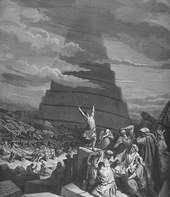
The Confusion of Tongues by Gustave Doré, a woodcut depicting the Tower of Babel
The confusion of tongues (confusio linguarum) is the origin myth for the fragmentation of human languages described in Genesis 11:1–9, as a result of the construction of the Tower of Babel. Prior to this event, humanity was stated to speak a single language. The preceding Genesis 10:5 states that the descendants of Japheth, Gomer, and Javan dispersed “with their own tongues,” creating an apparent contradiction. Scholars have been debating or explaining this apparent contradiction for centuries.[39]
During the Middle Ages, the Hebrew language was widely considered the language used by God to address Adam in Paradise, and by Adam as lawgiver (the Adamic language) by various Jewish, Christian, and Muslim scholastics.
Dante Alighieri addresses the topic in his De vulgari eloquentia (1302–1305). He argues that the Adamic language is of divine origin and therefore unchangeable.[40] He also notes that according to Genesis, the first speech act is due to Eve, addressing the serpent, and not to Adam.[41]
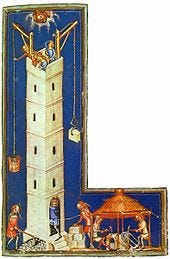
German Late Medieval (c. 1370s) depiction of the construction of the tower
1 And the whole earth was of one language, and of one speech. 2 And it came to pass, as they journeyed from the east, that they found a plain in the land of Shinar; and they dwelt there. 3 And they said one to another, Go to, let us make brick, and burn them throughly. And they had brick for stone, and slime had they for morter. 4 And they said, Go to, let us build us a city and a tower, whose top may reach unto heaven; and let us make us a name, lest we be scattered abroad upon the face of the whole earth. 5 And the LORD came down to see the city and the tower, which the children of men builded. 6 And the LORD said, Behold, the people is one, and they have all one language; and this they begin to do: and now nothing will be restrained from them, which they have imagined to do. 7 Go to, let us go down, and there confound their language, that they may not understand one another’s speech. 8 So the LORD scattered them abroad from thence upon the face of all the earth: and they left off to build the city.
9 Therefore is the name of it called Babel; because the LORD did there confound the language of all the earth: and from thence did the LORD scatter them abroad upon the face of all the earth.
It just feels like we are living this story right right now. Being separate. Being separated. Being isolated into camps. Not speaking the same language not literally the same language like English or Arabic or Chinese, but not speaking the same language of compassion, tolerance, caring.
And what’s going to happen? The story just ends. The people couldn’t talk to each other, lost their singular purpose of reaching God, and tore down the tower and took the bricks to build their own homes. Like looking out for just themselves rather than the common good (finding God) anymore. No more reaching for God — that was presumptuous anyway. Now it’s just me — me — me. Is that where it ends for us like the Babylonians? I refuse to believe that. But it sure looks like my senses are telling me that.
Another cup or coffee. 7 AM now. I’m going to go listen to David Slagle (my across the steet neighbor who installed my new mailbox (the best one on the block) And is a minister. His sermon last Sunday was on Samson so as my hair falls out, I wanna go hear what he had to say about Samson. More personal and immediate than the Tower of Babel but maybe not as important. It’s like the 7 Habits of Highly Effective people. The third quadrant is the one to focus on the most. And that’s where the Tower of Babel is — maybe Samson too. But it doesn’t have the emotional impact on me. I’m just losing my beauty not my strength. At least not yet. Let’s see what David had to say. What a hassle. I’m not giving them a credit card just to listen to a sermon on Vimeo. I get Marriane every day on Vimeo without a subscription. I’ll ask David if there is another way. Otherwise I’ll skip it.
“Tell me nothing of rest,” the young Beethoven bellowed when he began losing his hearing, resolving to “take fate by the throat” despite his disability. A century later, another trailblazing composer of uncommon artistic ability took her own fate by the throat as she faced the same embodied disability.
Ethel Smyth, early 1900s
As a young woman, Ethel Smyth (April 22, 1858–May 8, 1944) had weathered her father’s wrath at the clarity with which she saw music as her life and the determination with which she pursued it, animated by one of her musical heroes’ credo that “to live by music, you must live in music.” And so she lived in it and by it, against the tide of her time — bicyclist, mountaineer, golfer, always with a large dog at her side, counterculturally clad in tweed suits and men’s hats, a woman of inconvenient genius and indecorous passions, writing staggering sonatas for violin, symphonies for cello, raptures for orchestra.
Still a self-described “half-baked neophyte,” she met Brahms (who dismissed her), Clara Schumann (who inspired her), and Tchaikovsky (who — perhaps because he was raised a proto-feminist and perhaps because he sensed another queer person of talent against an even greater tide of convention — actively encouraged her to find her voice).
Having perfected her craft in Florence, Smyth made her debut as a composer of orchestral music in London’s Crystal Palace with her soulful Serenade in D. She was thirty-two. But it wasn’t until late middle age, when she was already losing her hearing, that her work finally began gaining the commensurate recognition. Her 1911 choral suite “Songs of Sunrise” became the official anthem of the suffrage movement, known as “The March of the Women.”
Ethel Smyth at a 1912 meeting at the Women’s Social & Political Union, to whom she dedicated her “March of the Women.” (The Women’s Library collection, London School of Economics Library.)
Across the Atlantic, The New York Times did not hesitate to scintillate with reports of Smyth arrested and accused of arson for her activism. While they published no notable reviews of her music, they ran an obtuse review of her memoir under the headline “A Militant Victorian.” In the journalistic equivalent to the posthumous Royal pardon for the gruesome mistreatment of computing pioneer Alan Turing, the paper would make belated reparations a century later.
Dame Ethel Smyth, 1922
In 1922, Smyth became the first female composer granted damehood. Half a century later, long after her death, she was granted the more substantive honor of a seat at artist Judy Chicago’s iconic Dinner Party project.
Ethel Smyth placemat from Judy Chicago’s The Dinner Party, 1974-1979. (Photograph by Jook Leung Photography, Brooklyn Museum.)
But although by the end of her life she was as highly regarded as Tchaikovsky and Brahms, Smyth was sidelined by the collective selective memory we mistake for history and was all but forgotten within a generation — partly because, unlike other queer women of her epoch and every epochs before and many epochs since, she refused to yield to the cultural pressure to marry a man anyway, thus leaving no heirs to steward her intellectual property and artistic legacy; partly because her music was never recorded in her lifetime — something conductor James Blachly and his inspired Experiential Orchestra set out to remedy a century later in the world’s first crowdfunded symphony orchestra reanimation of a previously unrecorded piece, triumphantly earning Smyth a posthumous Grammy nomination.
Virginia Woolf was smitten with Smyth, as one artist with another, smitten with her uncommon “gift for solidifying the connection between [the composer] and the audience,” and tried to procure for her via her Bloomsbury connections the era’s most admired gramophone — the handmade acoustic E.M.G. behemoth, with its enormous papier-mâché horn. Woolf was also smitten with Smyth as a woman, writing to the seventy-three-year-old composer after returning home from a visit with her:
Look dearest Ethel…. Please live 50 years at least; for now I’ve formed this limpet childish attachment it can’t but be part of my simple anatomy for ever — wanting Ethel — I say, live, live, and let me fasten myself upon you, and fill my veins with charity and champagne.
Smyth had dedicated her 1919 autobiography to the memory of Lady Mary Ponsonby — her great love of a quarter century, who had died three years earlier and who had once been Maid of Honor to Queen Victoria. She dedicated her final memoir to Woolf.
Virginia Woolf with Ethel Smyth (New York Public Library archives)
In the last stretch of winter in 1934, a Jubilee Festival celebrated Smyth’s seventy-fifth birthday with two of her most sweeping works — the orchestral masterpiece The Prison and The Mass in D, a choral enchantment — performed at Royal Albert Hall under the benediction of the era’s most influential conductor and music impresario, Thomas Beecham, who had just co-founded the London Philharmonic and who had previously politely snubbed Smyth’s work. It was a bittersweet triumph for her — by then, she was completely deaf, unable to register how the man whose musicianship she so admired, whom the world so admired, was rendering her work.
From across the hall, Woolf observed Smyth seated next to the Queen in the Royal Box and made a heartbreaking note in her diary of how the composer leapt to her feet at the wrong moment, thinking that the National Anthem was being played.
Despite her warmhearted confidence and exuberant vitality, Smyth sorrowed at the humiliation of her deafness and was always touched by those who simply treated her as a person and not as a person-sized disability to be set aside from ordinary life and managed. After visiting her friend Violet Gordon-Woodhouse — the visionary keyboard player who became the first person to record and broadcast harpsichord music — Smyth wrote in a letter:
I can never tell you how adorable it was of you having me — and letting me feel I shouldn’t wear you out by my deafness. It touched me to the marrow. And I think of all you made possible for me… It made my heart ache to think I am cut off from what is my most overwhelming musical joy — your playing — but I won’t dwell on that. Only don’t think that because I say nothing… well, you know.
In her late seventies, writing in the final memoir As Time Went On (public domain), Smyth notes that neither she nor anyone she knows dare class themselves with Beethoven in matters of his ability or disability, but she shares in his orientation to the creative impulse beneath the physical limitation. While recognizing that what helped Beethoven soar through his deafness was that it struck him when he was “a young man and in the full tide of inspiration,” Smyth declares with a defiant buoyancy that the musician in her “won through in the end,” for inspiration lives outside the bounds of time and age:
If you are still in possession of your senses, gradually getting accustomed, as some people do, to a running accompaniment of noises in your head; if instead of shrinking from the very thought of music you suddenly become conscious of desire towards it… why, then anything may happen… and once more you begin to dream dreams.
The founder of America’s Frontline Doctors — the physician group notorious for spreading misinformation about COVID-19 — confirmed that she participated in the riot on Capitol Hill last week.
Simone Gold, MD, JD, a California doctor who has touted the benefits of hydroxychloroquine and raised unfounded concerns about the COVID-19 vaccines, admitted to the Washington Post that she joined the mob that stormed the Capitol last Wednesday.
Gold confirmed to the Post that it was indeed her in the image and the video. She added that she followed a crowd inside the building and assumed it was legal to do so. She did not respond to a request for comment from MedPage Today.
America’s Frontline Doctors made headlines this summer when several of its physician members held a rally in front of the Supreme Court this summer, spreading misinformation about hydroxychloroquine, protesting lockdown restrictions, and questioning the effectiveness of masking. Since then, the group has attempted to incite public fear about the COVID-19 vaccine.
Following last week’s deadly insurrection on Capitol Hill, in which a mob of Trump supporters stormed the Capitol building in an attempt to disrupt the 2020 election certification results, 13 people are accused of federal crimes and 40 face local charges, according to a Department of Justice press release. The department did not respond to a query about whether Gold has been charged.
Gold spoke at rallies leading up to the storming of the Capitol, inciting fear about the vaccine and claiming COVID-19 to be non-lethal. She stated that people must not comply with taking “an experimental, biological agent deceptively named a vaccine.”
“I urge you to mark this day, this moment, as the united return of our nation, to the eternal fight for freedom, a commitment to integrity, a resolve to seek the truth in all arenas, and to always act upon it,” Gold said in a video posted on Twitter.
In the days leading up to the riot, Gold openly shared her plans to attend Wednesday’s events on social media. “I will be speaking at the #StopTheSteal rally in DC on January 6,” she stated in an Instagram post written on Dec. 28. “Learn the facts you need to fight for freedom from forced experimental vaccines, government overreach, and unconstitutional lockdowns.”
She was accompanied by John Strand, the communications director of America’s Frontline Doctors.
Gold also has spoken at events hosted by Turning Point USA, a non-profit organization that supports grassroots conservative movements on high school and college campuses. Turning Point Action, an arm of the non-profit, sent buses of students to the rally preceding the march on the Capitol.
Turning Point USA founder Charlie Kirk wrote on Twitter that his organization was “honored” to help make the event happen, admitting that it sent more than 80 buses “full of patriots” to Washington. The tweet has since been deleted. A spokesperson from Turning Point told MedPage Today that this tweet was inaccurate, as only seven buses of students were sent to the event, and there was no intention of storming the Capitol on their agenda.
Amanda D’Ambrosio is a reporter on MedPage Today’s enterprise & investigative team. She covers obstetrics-gynecology and other clinical news, and writes features about the U.S. healthcare system. Follow
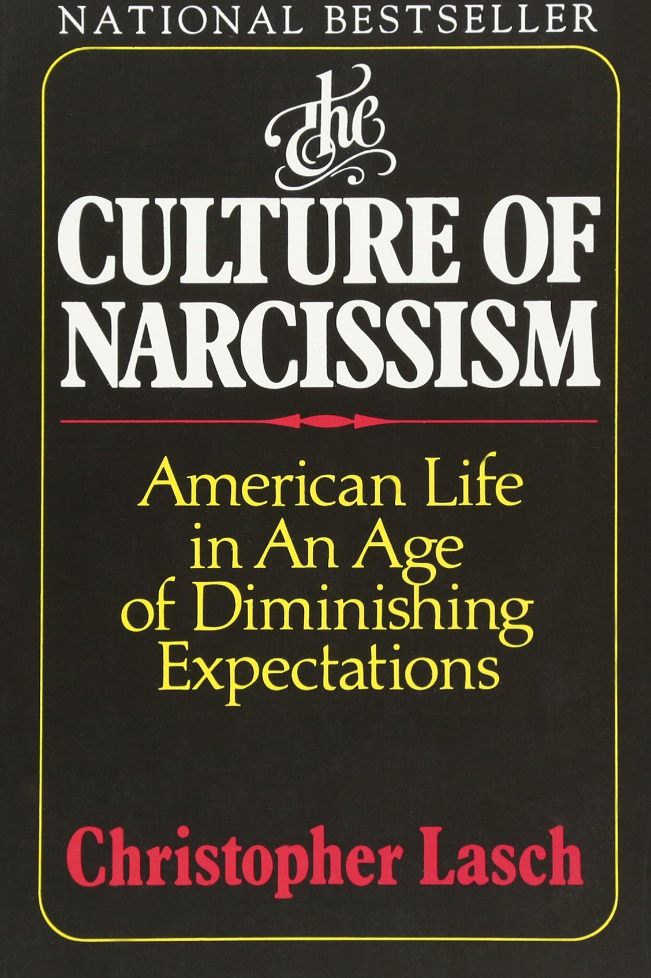
Forty years ago, Christopher Lasch described a soulless society headed toward a “war of all against all.” Are we there? A look back at the book TK readers chose for review
It is symptomatic of the underlying tenor of American life that vulgar terms for sexual intercourse also convey the sense of getting the better of someone, working him over, taking him in, imposing your will through guile, deception, or superior force.— Christopher Lasch, The Culture of Narcissism
Back in 1979, social critic Christopher Lasch wasn’t buying the idea that Americans in the sex-drugs-and-disco era were actually having fun.“
This hedonism is a fraud,” he wrote. “The pursuit of pleasure disguises a struggle for power. Americans have not really become more sociable and cooperative… they have merely become more adept at exploiting the conventions of interpersonal relations for their own benefit.”
Lasch’s reasoning traced to the beginning of American society.
The Puritans embraced the idea of getting rich, but “saw personal aggrandizement as incidental to social labor” and “instructed men who prospered not to lord it over neighbors.” Puritans gave way to Yankees and their Protestant work ethic, which imagined prosperity as a reward for hard work, but also for “self-discipline, the training and cultivation of God-given talents, above all the cultivation of reason.”
A century later, the ideal of self-improvement gave way to what Lasch called a “cult of competitive industry,” as people like P.T. Barnum began to evangelize a more brutally self-interested version of the Ben Franklin Yankee ethos. The new idea was to strive for worldly success “without Franklin’s concern for the attainment of wisdom.” Instead of pursuing an abstract goal of discipline and self-denial, American society became more openly organized around competing and beating one another to the top.
In the twentieth century, mass media promoted a new religion of self-care that stressed turning one’s whole self into an engine of such competitive ascent. People gobbled up magazine articles about “the art of conversation,” fashion, and “culture,” as the “management of interpersonal relations came to be seen as the essence of self-advancement.” New stresses on “winning friends and influencing people” replaced the old ideals of self-discipline and thrift, leading, as Lasch put it, to a stage of history where “the pursuit of wealth lost the few shreds of moral meaning that still clung to it.”
By the sixties and seventies, America became an intrinsically performative society, a vast population that didn’t particularly distinguish between public and private life, for whom image was as important as inner reality. Even foreign policy was understood as an effort to manipulate how other nations perceived us. One of the creepier revelations of the Pentagon Papers was that we waged war in places like Vietnam with an eye out for how our actions would be perceived by what political leaders called “relevant audiences,” e.g. the Communists, the South Vietnamese, America’s Western allies, and the American public
.As society at home became more organized around corporate climbing, our lives became an endless, round-the-clock effort to “excite admiration or envy,” where everything from “assertiveness therapy” to jogging to est helped the individual be better armed in the struggle for personal advancement.
This, apparently, is what Christopher Lasch saw when he looked at Americans grooving to Saturday Night Fever. These were not groups of people letting loose and having fun. They were lonely people grinding away the anxiety of life in a market-based society stripped of all ameliorative restraints, where “pleasure becomes life’s only business” in a dystopian “war of all against all.” In such a society, a narcissistic orientation isn’t deviance or illness, but a crucial adaptive strategy, with the unfortunate side-effect mentioned above: a growing inability to see the words fuck and fuck over as having different meanings.
I started to spot reporters reading The Culture of Narcissism on the campaign trail in 2015. It was one of many books press folk began speed-reading at the beginning of the Donald Trump presidential run. Others included the historical analysis The Paranoid Style in American Politics(written by one of Lasch’s mentors, Richard Hofstadter) and Hannah Arendt’s The Origins of Totalitarianism. Any tracts about narcissism or cults of personality were gobbled up as fodder for Trump analyses.
I avoided those and instead read up on corporate sales and businesses like pro wrestling, because Trump was speaking a language I didn’t understand that apparently came from places like that. Reading The Culture of Narcissism now, it’s clear it’s very much worth reading, but anyone who does so in search of a narrow explanation for Trump is sure to be disappointed.
This is a seething, complicated book that hurls razor blades in all directions, and seems almost to have been written with the specific intent of avoiding appropriation by political opportunists. Lasch is often bitterly condemned by ideologues on both the right and the left, who seem determined to put him in more comprehensible boxes, even if he doesn’t really fit in any.
This is an excerpt from today’s subscriber-only post. To read the entire post and get full access to the archives, you can subscribe for $5 a month or $50 a year.






 Look dearest Ethel…. Please live 50 years at least; for now I’ve formed this limpet childish attachment it can’t but be part of my simple anatomy for ever — wanting Ethel — I say, live, live, and let me fasten myself upon you, and fill my veins with charity and champagne.