Sep 24, 2012 Follow us on http://whatmeditationreallyis.com
(Suggested by Sarah Flynn)

Dec 10, 2020 The truths we once all agreed upon and held dearly may soon be lost to power-hungry, sometimes forceful, and always unrelenting culture war movements. Like a calm before the storm, our society may be on the brink of irreversible and incomprehensible consequences. All objective truth may soon be removed from society and be replaced with a post-modernist approach where truth simply cannot exist. Still, what is the truth? What is the undeniable evolutionary science behind men and women in today’s society? On this episode of Conversations with Tom, Tom is joined by Evolutionary Biologist Heather Heying to discuss such matters and more as they explore today’s society and the undeniable biological differences between men and women, how each sex has a unique and powerful role in societies, and why in today’s modern age, culture wars has eroded trust in objective truth. They discuss today’s social movements and the harmful consequences of letting them go too far, the differences between men and women in society, how hunter-gatherer societies may be key to understanding our roles, the origin of men and women being divided in society by role and purpose, the dangers we face if we continue to deny our differences, why the culture war movements are power hungry, how to have a successful workplace environment and team, and the risks we face as a society if we overprotect our children and refuse to let them take risks and make their own decisions. SHOW NOTES: Controversy | Heather reveals why talking about the sexes is now a hot button issue. [0:18] Better? | Heather discusses if it’s really better to be a male in today’s modern society. [4:55] Hierarchy | Heather discusses the social hierarchy of males and females. [9:20] Strategies | Heather reveals if today’s social movements are simply giant chess games. [12:23] Hunter-Gatherer | Heather reveals what males and females inherently gravitate towards in a hunter-gatherer society. [19:53] Gendered | Heather reveals why cultures divide and label roles as being male or female. [27:18] Mixing | Heather discusses the challenging dynamics present in groups that mix sexes. [30:20] Useful | Heather discusses the productive friction between how the sexes work together. [37:41] Denial | Heather shares the dangers of denying the differences between the sexes. [46:31] Erode | Heather reveals the tools used today to erode the power of others with society. [52:52] Teams | Heather and Tom discuss team dynamics, gender roles, and why all that matters is being able to get it done. [58:08] Choices | Heather discusses if certain traits, choices, or passions are actually ‘better.’ [1:07:09] Fulfillment | Heather shares the fulfillment she feels from presenting challenging and intellectual discussions with diverse groups of people from all walks of life. [1:09:55] Parenting | Heather reveals the consequences of sheltering children from problems. [1:15:36] Risks | Heather reveals the rules she has for her kids so they take on risks. [1:23:58] Locked Down | Heather discusses the consequences of limiting our movement. [1:30:21] Getting Better | Heather reveals why you must expose your ideas to feedback. [1:35:20] Seeking Truth | Heather discusses the fragile echo-chamber of modern day science and academics. [1:41:43] Self-Corrosive | Heather discusses the self-destructive consequences of culture wars full on assault on objective logic. [1:47:30] Power Hungry | Heather discusses how today’s culture wars are simply just a matter of power grabbing. [1:53:50] Narrative | Heather discusses her passion for literature and writing science fiction. [2:00:37] Closing | Tom closes today’s episode and shares where you can continue to follow Heather’s work and teachings. [2:07:27] QUOTES: “…is it true that an entirely male power structure has a tendency to go off the rails in a particular way in which we’re well familiar from like all of history? Yeah, of course, right? Would an all-female power structure go off the rails in a particular way that we’re less familiar with from history? A hundred-percent. I don’t want to see that anymore than I want to see, you know, another World War II…” [15:30] “…what you said earlier is just exactly right and I’ve never heard anyone say it before which is that when you have been on all-male teams, it’s easier, and when you have been on mixed-sex teams, it’s more productive and I just, you know, so hope that that anecdote holds across everything. It’s what I’m sort of banking on…” [57:23] FOLLOW HEATHER: Website: heatherheying.com Twitter: twitter.com/HeatherEHeying LinkedIn: linkedin.com/in/heathereheying Podcast: youtube.com/channel/UCi5N_uAqApEUIlg32QzkPlg Patreon: patreon.com/heatherheying
Dec 22, 2020 Marianne Williamson discusses the Great Conjunction of 2020. Filmed: 12/21/22 Follow Marianne on Social Media Twitter: https://twitter.com/marwilliamson Facebook: https://www.facebook.com/williamsonma… Instagram: https://instagram.com/mariannewilliamson Subscribe to The Marianne Williamson Podcast YouTube Channel: https://bit.ly/3lEb6JT Apple Podcasts: https://apple.co/36qnqH4 Spotify: https://spoti.fi/2JV8pW4
By Maria Popova (brainpickings.org)
The Universe in Verse — the annual celebration of science through poetry I host at Pioneer Works — returns with a very special edition: This year’s show, benefiting Pioneer Works’ endeavor to build New York’s first-ever public observatory, celebrates the 100th anniversary of Sir Arthur Eddington’s historic eclipse expedition to Africa, which confirmed relativity and catapulted Einstein into celebrity. “Dear Mother, joyous news today,” Einstein wrote upon receiving word of the results, which revolutionized our understanding of the universe and shaped the course of modern physics. The scientific triumph was also a heartening, humane moment — just after the close of World War I, a pacifist English Quaker, who had refused to be drafted in the war at the risk of being jailed for treason, and a German Jew united humanity under the same sky, under the deepest truths of the universe. An invitation to perspective in the largest sense.Join us for an evening of poems and stories about eclipses, relativity, spacetime, and Einstein’s legacy, featuring readings by musicians David Byrne, Regina Spektor, Amanda Palmer, Emily Wells, and Josh Groban, astrophysicists Janna Levin and Natalie Batalha, poets Elizabeth Alexander and Marilyn Nelson, actor Natascha McElhone, theoretical cosmologist and jazz saxophonist Stephon Alexander, comedian Chuck Nice, choreographer Bill T. Jones, On Being host Krista Tippett, and the inimitable Neil Gaiman reading an original poem generously composed for the occasion.Find the complete show and the full poem playlist below:
“When I Heard the Learn’d Astronomer” by Walt Whitman and poem #1397 by Emily Dickinson, read by Janna Levin
“Education” by Elizabeth Alexander, read by the poet herself
“Hubble Photographs: After Sappho” by Adrienne Rich, read by Amanda Palmer
“Theories of Everything” by Rebecca Elson, read by Regina Spektor
“A Solar Eclipse” by Ella Wheeler Wilcox, read by Natascha McElhone
Musical interlude: Amanda Palmer
“As If to Demonstrate an Eclipse” by Billy Collins, read by Chuck Nice
“Achieving Perspective” by Pattiann Rogers, read by David Byrne
“The Shampoo” by Elizabeth Bishop, read by me
Musical interlude: Regina Spektor
“Research” by Cecilia Payne, read by Natalie Batalha
“Faster Than Light” by Marilyn Nelson, read by the poet herself
“Explaining Relativity” by Rebecca Elson, read by Stephon Alexander
“Poem to My Child, If Ever You Shall Be” by Ross Gay, read by Bill T. Jones
“After Reading a Child’s Guide to Modern Physics” by W.H. Auden, read by Josh Groban
“Figures of Thought” by Howard Nemerov, read by Krista Tippett
“In Transit” by Neil Gaiman, read by Neil Gaiman
“Einstein’s Daughter” by Jennifer Clement, read by Emily Wells
Musical finale: Emily Wells
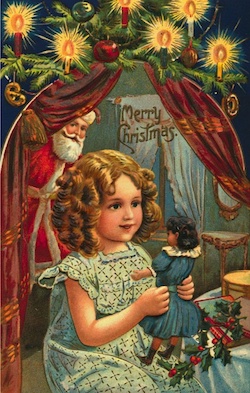
There is an almost magical connection between children and Christmas—but it hasn’t always been that way. Courtesy of Public Domain.
by MARIA SACHIKO CECIRE | DECEMBER 23, 2020 (zocalopublicsquare.org)
There’s a special, even magical connection between children and the “most wonderful time of the year.” Their excitement, their belief, the joy they bring others have all become wrapped up in the Christmas spirit. Take the lyrics of classic songs like “It’s Beginning to Look a Lot Like Christmas,” “White Christmas,” or even the aptly titled “Christmas Is for Children” by country music legend Glen Campbell—these are just a few of the many pop culture offerings that cement the relationship between kids and Christmas. But it hasn’t always been this way, even though the holiday celebrates the Christ child’s birth. How kids got to the heart of Christmas has a lot to tell us about the hopes and needs of the modern grown-ups who put them there.
Until the late 18th century, Christmas was a boisterous affair, with roots in the pre-Christian Midwinter and Roman Saturnalia holidays. You’d find more along the lines of drunkenness, debauchery, and raucous carousing at this time of year, especially from young men and the underclasses, than “silent night, holy night.” For example, in early forms of wassailing (the forerunner of neighborhood carol-singing) the poor could go into the homes of the rich, demanding the best to drink and eat in exchange for their goodwill. (Once you know this, you’ll never hear “Now bring us some figgy pudding” the same way again!)
But the boozy rowdiness of the season, together with its pagan roots, was so threatening to religious and political authorities that Christmas was discouraged and even banned in the 17th and 18th centuries. (These bans included the parliamentarians in mid-17th century England, and the Puritans in America’s New England in the 1620s—the “pilgrims” of Thanksgiving fame.) But then, as now, many ordinary people loved the holiday, making Christmas difficult to stamp out. So how did it transform from a period of misrule and mischief into the domestic, socially manageable, and economically profitable season that we know today? This is where the children come in.
Until the late 18th century, the Western world saw children as bearers of natural sinfulness that needed to be disciplined toward goodness. But as Romantic ideals about childhood innocence took hold, children (specifically, white children) became seen as the precious, innocent keepers of enchantment that we recognize today, understood as deserving protection and living through a distinct phase of life.
This is also the time when Christmas began to transform in ways that churches and governments found more acceptable, into a family-centered holiday. We can see this in the peaceful, child-focused carols that emerged in the 19th century, like “Silent Night,” “What Child Is This?,” and “Away in a Manger.” But all the previous energy and excess of the season didn’t just disappear. Instead, where once it brought together rich and poor, dominant and dependent according to old feudal organizations of power, new traditions shifted the focus of yuletide generosity from the local underclasses to one’s own children.I’ve always found the way we abandon kids to deal with the discovery that “Santa isn’t real” on their own—or even expect them to hide it, for fear of disappointing adults that want to get one more hit of secondhand enchantment—unethical and counter to the spirit of the season.
Meanwhile, the newly accepted “magic” of childhood meant that a child-centered Christmas could echo the old holiday’s topsy-turvy logic while also serving the new industrializing economy. By making one’s own children the focus of the holiday, the seasonal reversal becomes less nakedly about social power (with the poor making demands on the rich) and more about allowing adults to take a childlike break from the rationalism, cynicism, and workaday economy of the rest of the year.
Social anthropologist Adam Kuper describes how the modern Christmas “constructs an alternate reality,” beginning with rearranged social relations at work in the run-up to the holiday (think office parties, secret Santas, toy drives, and more) and culminating in a complete shift to the celebrating home, made sacred with decked halls, indulgent treats, and loved ones gathered together. During this season, adults can psychologically share in the enchanted spaces we now associate with childhood, and carry the fruits of that experience back to the grind of everyday life when it starts up again after the New Year.
This temporary opportunity for adults to immerse themselves in the un-modern pleasures of enchantment, nostalgia for the past, and unproductive enjoyment is why it’s so important that kids fully participate in the magic of Christmas. The Western understanding of childhood today expects young people to hold open spaces of magical potential for adults through their literature, media, and beliefs. This shared assumption is evident in the explosion of children’s fantasy set in medieval-looking worlds over the past century, which was the focus of my recent book, Re-Enchanted (where I discuss Narnia, Middle-earth, Harry Potter, and more). Christmas or Yule appear in many of these modern fairy stories, and sometimes even play a central role—think Father Christmas gifting the Pevensie children weapons in The Lion, the Witch, and the Wardrobe—using the holiday as a bridge between the magical otherworlds of fiction and our real-world season of possibility.
In the early 19th century, buying presents for children became a central part of Christmas celebrations. Courtesy of Public Domain.
Beyond storytelling, we also literally encourage kids to believe in magic at Christmas. One of the most iconic expressions of this is an 1897 editorial in the New York Sun titled “Is There a Santa Claus?” In it, editor Francis Pharcellus Church replies to a letter from 8-year-old Virgina O’Hanlon with the now-famous phrase “Yes, Virginia, there is a Santa Claus,” and describes her friends’ disbelief as coming from the “skepticism of a skeptical age.” Church argues that Santa “exists as certainly as love and generosity and devotion exist,” minimizing the methods of scientific inquiry to claim that “[t]he most real things in the world are those that neither children nor men can see.”
Many of the arguments for the importance of the arts and humanities that we still hear today can be found in Church’s language, which identifies sources of emotional experience like “faith, fancy, poetry, love, romance”—and belief in Santa Claus—as crucial to a humane and fully lived life. According to this mindset, Santa not only exists, but belongs to the only “real and abiding” thing in “all this world.” “Yes, Virginia, there is a Santa Claus,” as it has come to be known, has been reprinted and adapted across media forms since its publication, including as part of holiday TV specials and as the inspiration for Macy’s department store’s “Believe” charity and advertising campaign since 2008.
The fact that the sentiments in this editorial have come to be associated with a major retailer may seem ironic. Yet, calls to reject consumerism at Christmas have been around ever since it became a commercial extravaganza in the early 19th century, which is also when buying presents for kids became a key part of the holiday. How to explain this? Today, just as in premodern Christmases, overturning norms during this special time helps to strengthen those same norms for the rest of the year. The Santa myth not only gives kids a reason to profess the reassuring belief that magic is still out there in our disenchanted-looking world, it also transforms holiday purchases from expensive obligations into timeless symbols of love and enchantment. As historian Stephen Nissenbaum puts it, from the beginning of Santa Claus’s popularization, he “represented an old-fashioned Christmas, a ritual so old that it was, in essence, beyond history, and thus outside the commercial marketplace.” Kids’ joyful wonder at finding presents from Santa on Christmas morning does more than give adults a taste of magic, it also makes our lavish holiday spending feel worthwhile, connecting us to a deep, timeless past—all while fueling the yearly injection of funds into the modern economy.
Does knowing all this ruin the magic of Christmas? Cultural analysis doesn’t have to be a Scrooge-like activity. To the contrary, it gives us the tools to create a holiday more in line with our beliefs. I’ve always found the way we abandon kids to deal with the discovery that “Santa isn’t real” on their own—or even expect them to hide it, for fear of disappointing adults that want to get one more hit of secondhand enchantment—unethical and counter to the spirit of the season. The song “I Saw Mommy Kissing Santa Claus” is supposed to be funny, but it captures shades of the real anxiety many kids go through every year. Knowing what children and their belief do for society during the holidays can help us choose a better approach.
A couple of years ago I saw a suggestion floating around on the internet that I think offers an ideal solution for those who celebrate Christmas. When a child starts questioning the Santa myth and seems old enough to understand, take them aside and, with utmost seriousness, induct them into the big grown-up secret: Now THEY are Santa. Tell the child that they have the power to make wishes come true, to fill the world with magic for others, and as a result, for us all. Then help them pick a sibling or friend, or better yet, look outside the family circle to find a neighbor or person in need for whom they can secretly “be” Santa Claus, and let them discover the enchantment of bringing uncredited joy to someone else. As Francis Pharcellus Church wrote to Virginia O’Hanlon more than 100 years ago, the unseeable values of “love and generosity and devotion” are in some ways the “most real things in the world,” and that seems like something that all kids—”from one to 92“—can believe in.
MARIA SACHIKO CECIRE is an associate professor of literature and the director of the Center for Experimental Humanities at Bard College. This essay has been adapted from material published in her recent book, Re-Enchanted: The Rise of Children’s Fantasy Literature (University of Minnesota Press, 2019).
Dec 25, 2020 The world-renowned British novelist John le Carré died on December 12 at the age of 89. Le Carré established himself as a master writer of spy novels in a career that spanned more than half a century. He worked in the British Secret Service from the late 1950s until the early ’60s, at the height of the Cold War — which was the topic of his early novels. His later works focused on the inequities of globalization, unchecked multinational corporate power and the role national spy services play in protecting corporate interests. His best-known books include “The Spy Who Came in from the Cold” and “The Constant Gardner.” Le Carré was also a fierce critic of the U.S. response to the 9/11 attacks and the Bush administration’s invasion of Iraq. In 2010, he appeared on Democracy Now! for a rare in-depth interview. #DemocracyNow Democracy Now! is an independent global news hour that airs on nearly 1,400 TV and radio stations Monday through Friday. Watch our livestream 8-9AM ET: https://democracynow.org Please consider supporting independent media by making a donation to Democracy Now! today: https://democracynow.org/donate FOLLOW DEMOCRACY NOW! ONLINE: YouTube: http://youtube.com/democracynow Facebook: http://facebook.com/democracynow Twitter: https://twitter.com/democracynow Instagram: http://instagram.com/democracynow SoundCloud: http://soundcloud.com/democracynow iTunes: https://itunes.apple.com/podcast/demo… Daily Email Digest: https://democracynow.org/subscribe
”Let go of people who aren’t ready to love you yet! This is the hardest thing you’ll have to do in your life and it will also be the most important thing: stop giving your love to those who aren’t ready to love you yet.
Stop hard conversations with people who don’t want to change.
Stop showing up for people who are indifferent to your presence.
Stop loving people who aren’t ready to love you.
I know your instincts do everything to win the good mercy of everyone around you, but it’s also the impulse that will steal your time, energy and mental, physical and spiritual health.
When you start manifesting yourself in your life, completely, with joy, interest and commitment, not everyone will be ready to find you in this place of pure sincerity.
That doesn’t mean that you have to change who you are. That means you have to stop loving people who don’t want to love you yet.
When you are excluded, subtly offended, forgotten or easily ignored by people you give time to, you don’t do yourself any favour by allowing them your energy and your life.
The truth is that you’re not for everyone…
And that not everyone is for you…
That makes this world so special, when you find the few people you have friendship, love or a true relationship with…
You will know how valuable that is…
Because you have experienced what isn’t…
But the more time you spend trying to make you loved by someone who cant…
The more time you waste depriving the same connection…
There are billions of people on this planet, and many of them will end up with you, on their level, with their vibration, from where they stand…
But…
The smaller you stay, involved in the privacy of people who use you as a pillow, background option, a therapist and a strategy for their emotional healing…
More time you stay out of the community you wish for.
If you stop showing up, you might be less wanted…
If you stop trying, the relationship might stop…
If you stop texting, your phone stays dark for days and weeks…
Maybe if you stop loving someone, the love between you will dissolve…
That doesn’t mean you ruined a relationship!
That means all this relationship had was the energy that only you and you hire to keep it in the air.
It’s not love.
That’s attachment.
That’s wanting to give a chance to those who don’t want it!
The most valuable and most important thing you have in your life is your energy.
Its not just your time because it’s limited…
It’s your energy!
What you give every day is what will become more and more in your life.
It’s the ones you give time and energy that will define your existence.
When you realize this, you start to understand why you are so impatient when you spend your time with people that don’t suit you, and in activities, places, situations that don’t suit you.
You’re starting to realize that the most important thing you can do for your life, for yourself and for everyone you know, protect your energy stronger than anything.
Turn your life into a safe sanctuary where only ” compatible ” people with you are allowed. You are not responsible for saving people.
You are not responsible to convince them to be saved.
It’s not your job to exist for people and give them your life, little by little, moment after the moment!
Because if you feel bad or if you feel obliged; you are the root of all of this by your insisting, afraid they promise you the favors you won’t give them…
It’s your only fact to realize that you are the loved one of your destiny and to accept the love you think you deserve.
Decide you deserve a true friendship.
Wait then… just a minute…
And look how everything is starting to change…”
~ Anthony Hopkins

Feb 8, 2012 DEBT: The First 5,000 Years While the “national debt” has been the concern du jour of many economists, commentators and politicians, little attention is ever paid to the historical significance of debt. For thousands of years, the struggle between rich and poor has largely taken the form of conflicts between creditors and debtors—of arguments about the rights and wrongs of interest payments, debt peonage, amnesty, repossession, restitution, the sequestering of sheep, the seizing of vineyards, and the selling of debtors’ children into slavery. By the same token, for the past five thousand years, popular insurrections have begun the same way: with the ritual destruction of debt records—tablets, papyri, ledgers; whatever form they might have taken in any particular time and place. Enter anthropologist David Graeber’s Debt: The First 5,000 Years (July, ISBN 978-1-933633-86-2), which uses these struggles to show that the history of debt is also a history of morality and culture. In the throes of the recent economic crisis, with the very defining institutions of capitalism crumbling, surveys showed that an overwhelming majority of Americans felt that the country’s banks should not be rescued—whatever the economic consequences—but that ordinary citizens stuck with bad mortgages should be bailed out. The notion of morality as a matter of paying one’s debts runs deeper in the United States than in almost any other country. Beginning with a sharp critique of economics (which since Adam Smith has erroneously argued that all human economies evolved out of barter), Graeber carefully shows that everything from the ancient work of law and religion to human notions like “guilt,” “sin,” and “redemption,” are deeply influenced by ancients debates about credit and debt. It is no accident that debt continues to fuel political debate, from the crippling debt crises that have gripped Greece and Ireland, to our own debate over whether to raise the debt ceiling. Debt, an incredibly captivating narrative spanning 5,000 years, puts these crises into their full context and illuminates one of the thorniest subjects in all of history. ABOUT THE AUTHOR David Graeber teaches anthropology at Goldsmiths College, University of London. He is the author of Towards an Anthropological Theory of Value, Lost People, and Possibilities: Essays on Hierarchy, Rebellion, and Desire. This talk was hosted by Boris Debic on behalf of the Authors@Google program.

December 21, 2020 • TheOnion.com
Hear how this new productivity trend is helping Pope Francis get through his grueling advent schedule, and why it may be catching on all over Vatican City.