A Christmas Dinner

By Charles Dickens (1835)
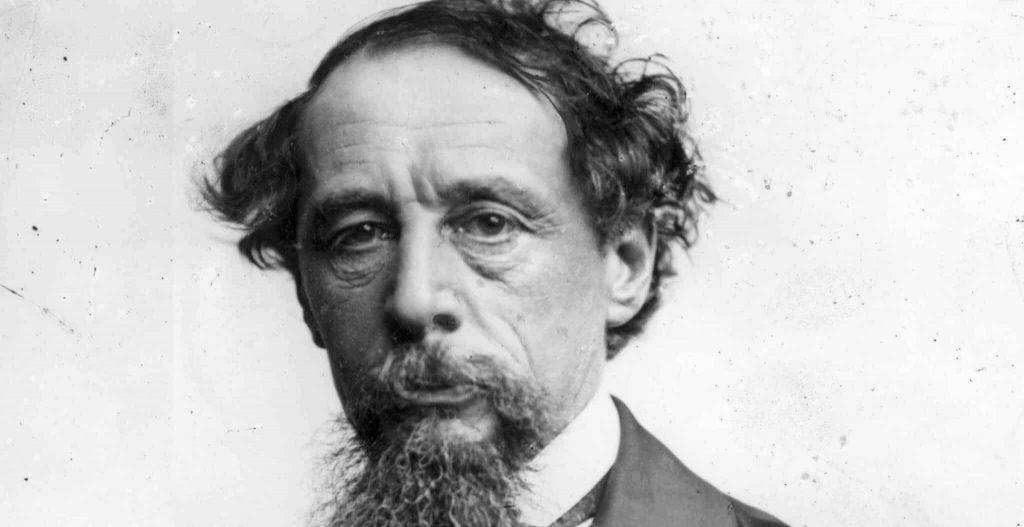
Early Dickens Christmas story describes a Christmas dinner at the home of Uncle and Aunt George. Originally published in Bell’s Life in London in 1835 under the name Scenes and Characters No. 10 Christmas Festivities.

Christmas time! That man must be a misanthrope indeed, in whose breast something like a jovial feeling is not roused – in whose mind some pleasant associations are not awakened – by the recurrence of Christmas. There are people who will tell you that Christmas is not to them what it used to be; that each succeeding Christmas has found some cherished hope, or happy prospect, of the year before, dimmed or passed away; that the present only serves to remind them of reduced circumstances and straitened incomes – of the feasts they once bestowed on hollow friends, and of the coldA Christmas Dinner by George Cruikshank
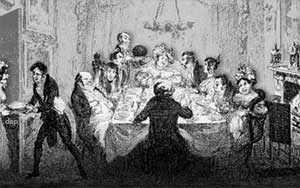
A Christmas Dinner – by George Cruikshanklooks that meet them now, in adversity and misfortune. Never heed such dismal reminiscences. There are few men who have lived long enough in the world, who cannot call up such thoughts any day in the year. Then do not select the merriest of the three hundred and sixty-five for your doleful recollections, but draw your chair nearer the blazing fire – fill the glass and send round the song – and if your room be smaller than it was a dozen years ago, or if your glass be filled with reeking punch, instead of sparkling wine, put a good face on the matter, and empty it off-hand, and fill another, and troll off the old ditty you used to sing, and thank God it’s no worse. Look on the merry faces of your children (if you have any) as they sit round the fire. One little seat may be empty; one slight form that gladdened the father’s heart, and roused the mother’s pride to look upon, may not be there. Dwell not upon the past; think not that one short year ago, the fair child now resolving into dust, sat before you, with the bloom of health upon its cheek, and the gaiety of infancy in its joyous eye. Reflect upon your present blessings – of which every man has many – not on your past misfortunes, of which all men have some. Fill your glass again, with a merry face and contented heart. Our life on it, but your Christmas shall be merry, and your new year a happy one!

Who can be insensible to the outpourings of good feeling, and the honest interchange of affectionate attachment, which abound at this season of the year? A Christmas family-party! We know nothing in nature more delightful! There seems a magic in the very name of Christmas. Petty jealousies and discords are forgotten; social feelings are awakened, in bosoms to which they have long been strangers; father and son, or brother and sister, who have met and passed with averted gaze, or a look of cold recognition, for months before, proffer and return the cordial embrace, and bury their past animosities in their present happiness. Kindly hearts that have yearned towards each other, but have been withheld by false notions of pride and self-dignity, are again reunited, and all is kindness and benevolence! Would that Christmas lasted the whole year through (as it ought), and that the prejudices and passions which deform our better nature, were never called into action among those to whom they should ever be strangers!

The Christmas family-party that we mean, is not a mere assemblage of relations, got up at a week or two’s notice, originating this year, having no family precedent in the last, and not likely to be repeated in the next. No. It is an annual gathering of all the accessible members of the family, young or old, rich or poor; and all the children look forward to it, for two months beforehand, in a fever of anticipation. Formerly, it was held at grandpapa’s; but grandpapa getting old, and grandmamma getting old too, and rather infirm, they have given up house-keeping, and domesticated themselves with uncle George; so, the party always takes place at uncle George’s house, but grandmamma sends in most of the good things, and grandpapa always WILL toddle down, all the way to Newgate-market, to buy the turkey, which he engages a porter to bring home behind him in triumph, always insisting on the man’s being rewarded with a glass of spirits, over and above his hire, to drink ‘a merry Christmas and a happy new year’ to aunt George. As to grandmamma, she is very secret and mysterious for two or three days beforehand, but not sufficiently so, to prevent rumours getting afloat that she has purchased a beautiful new cap with pink ribbons for each of the servants, together with sundry books, and pen-knives, and pencil-cases, for the younger branches; to say nothing of divers secret additions to the order originally given by aunt George at the pastry-cook’s, such as another dozen of mince- pies for the dinner, and a large plum-cake for the children.

On Christmas-eve, grandmamma is always in excellent spirits, and after employing all the children, during the day, in stoning the plums, and all that, insists, regularly every year, on uncle George coming down into the kitchen, taking off his coat, and stirring the pudding for half an hour or so, which uncle George good-humouredly does, to the vociferous delight of the children and servants. The evening concludes with a glorious game of blind-man’s-buff, in an early stage of which grandpapa takes great care to be caught, in order that he may have an opportunity of displaying his dexterity.

On the following morning, the old couple, with as many of the children as the pew will hold, go to church in great state: leaving aunt George at home dusting decanters and filling casters, and uncle George carrying bottles into the dining-parlour, and calling for corkscrews, and getting into everybody’s way.

When the church-party return to lunch, grandpapa produces a small sprig of mistletoe from his pocket, and tempts the boys to kiss their little cousins under it – a proceeding which affords both the boys and the old gentleman unlimited satisfaction, but which rather outrages grandmamma’s ideas of decorum, until grandpapa says, that when he was just thirteen years and three months old, HE kissed grandmamma under a mistletoe too, on which the children clap their hands, and laugh very heartily, as do aunt George and uncle George; and grandmamma looks pleased, and says, with a benevolent smile, that grandpapa was an impudent young dog, on which the children laugh very heartily again, and grandpapa more heartily than any of them.

But all these diversions are nothing to the subsequent excitement when grandmamma in a high cap, and slate-coloured silk gown; and grandpapa with a beautifully plaited shirt-frill, and white neckerchief; seat themselves on one side of the drawing-room fire, with uncle George’s children and little cousins innumerable, seated in the front, waiting the arrival of the expected visitors. Suddenly a hackney-coach is heard to stop, and uncle George, who has been looking out of the window, exclaims ‘Here’s Jane!’ on which the children rush to the door, and helter-skelter down- stairs; and uncle Robert and aunt Jane, and the dear little baby, and the nurse, and the whole party, are ushered up-stairs amidst tumultuous shouts of ‘Oh, my!’ from the children, and frequently repeated warnings not to hurt baby from the nurse. And grandpapa takes the child, and grandmamma kisses her daughter, and the confusion of this first entry has scarcely subsided, when some other aunts and uncles with more cousins arrive, and the grown-up cousins flirt with each other, and so do the little cousins too, for that matter, and nothing is to be heard but a confused din of talking, laughing, and merriment.

A hesitating double knock at the street-door, heard during a momentary pause in the conversation, excites a general inquiry of ‘Who’s that?’ and two or three children, who have been standing at the window, announce in a low voice, that it’s ‘poor aunt Margaret.’ Upon which, aunt George leaves the room to welcome the new-comer; and grandmamma draws herself up, rather stiff and stately; for Margaret married a poor man without her consent, and poverty not being a sufficiently weighty punishment for her offence, has been discarded by her friends, and debarred the society of her dearest relatives. But Christmas has come round, and the unkind feelings that have struggled against better dispositions during the year, have melted away before its genial influence, like half-formed ice beneath the morning sun. It is not difficult in a moment of angry feeling for a parent to denounce a disobedient child; but, to banish her at a period of general good- will and hilarity, from the hearth, round which she has sat on so many anniversaries of the same day, expanding by slow degrees from infancy to girlhood, and then bursting, almost imperceptibly, into a woman, is widely different. The air of conscious rectitude, and cold forgiveness, which the old lady has assumed, sits ill upon her; and when the poor girl is led in by her sister, pale in looks and broken in hope – not from poverty, for that she could bear, but from the consciousness of undeserved neglect, and unmerited unkindness – it is easy to see how much of it is assumed. A momentary pause succeeds; the girl breaks suddenly from her sister and throws herself, sobbing, on her mother’s neck. The father steps hastily forward, and takes her husband’s hand. Friends crowd round to offer their hearty congratulations, and happiness and harmony again prevail.

As to the dinner, it’s perfectly delightful – nothing goes wrong, and everybody is in the very best of spirits, and disposed to please and be pleased. Grandpapa relates a circumstantial account of the purchase of the turkey, with a slight digression relative to the purchase of previous turkeys, on former Christmas-days, which grandmamma corroborates in the minutest particular. Uncle George tells stories, and carves poultry, and takes wine, and jokes with the children at the side-table, and winks at the cousins that are making love, or being made love to, and exhilarates everybody with his good humour and hospitality; and when, at last, a stout servant staggers in with a gigantic pudding, with a sprig of holly in the top, there is such a laughing, and shouting, and clapping of little chubby hands, and kicking up of fat dumpy legs, as can only be equalled by the applause with which the astonishing feat of pouring lighted brandy into mince-pies, is received by the younger visitors. Then the dessert! – and the wine! – and the fun! Such beautiful speeches, and SUCH songs, from aunt Margaret’s husband, who turns out to be such a nice man, and SO attentive to grandmamma! Even grandpapa not only sings his annual song with unprecedented vigour, but on being honoured with an unanimous ENCORE, according to annual custom, actually comes out with a new one which nobody but grandmamma ever heard before; and a young scapegrace of a cousin, who has been in some disgrace with the old people, for certain heinous sins of omission and commission – neglecting to call, and persisting in drinking Burton Ale – astonishes everybody into convulsions of laughter by volunteering the most extraordinary comic songs that ever were heard. And thus the evening passes, in a strain of rational good-will and cheerfulness, doing more to awaken the sympathies of every member of the party in behalf of his neighbour, and to perpetuate their good feeling during the ensuing year, than half the homilies that have ever been written, by half the Divines that have ever lived.

Back to the Dickens and Christmas Page
Back to the Reading Dickens Page

Copyright © 1997-2020 David A. Perdue, All Rights Reserved.
URL: https://www.charlesdickenspage.com/a-christmas-dinner.html
The Charles Dickens Home Page


Tulpa

From Wikipedia, the free encyclopedia

Part of a series on
Tibetan Buddhism
Sects[show]
Key personalities[show]
Teachings[show]
Practices and attainment[show]
Major monasteries[show]
Institutional roles[show]
Festivals[show]
Texts[show]
Art[show]
History and overview[show]
vte

Tulpa is a concept in mysticism and the paranormal of a being or object which is created through spiritual or mental powers.[1] It was adapted by 20th-century theosophists from Tibetan sprul-pa (Tibetan: སྤྲུལ་པ་, Wyliesprulpa) which means “emanation” or “manifestation”.[2] Modern practitioners use the term to refer to a type of willed imaginary friend which practitioners consider to be sentient and relatively autonomous.[3]

Emanation body

Indian Buddhism

One early Buddhist text, the Pali Samaññaphala Sutta, lists the ability to create a “mind-made body” (manomāyakāya) as one of the “fruits of the contemplative life”.[4]:117 Commentarial texts such as the Patisambhidamagga and the Visuddhimagga state that this mind-made body is how Gautama Buddha and arhats are able to travel into heavenly realms using the continuum of the mindstream (cittasaṃtāna) and it is also used to explain the multiplication miracle of the Buddha as illustrated in the Divyavadana, in which the Buddha multiplied his nirmita or emanated human form into countless other bodies which filled the sky. A Buddha or other realized being is able to project many such nirmitas simultaneously in an infinite variety of forms in different realms simultaneously.[4]:125–134

The Indian Buddhist philosopher Vasubandhu (fl. 4th to 5th century CE) defined nirmita as a siddhi or psychic power (Pali iddhi, Sankrit: ṛddhi) developed through Buddhist discipline, concentrated discipline (samadhi) and wisdom in his seminal work on Buddhist philosophy, the AbhidharmakośakārikāAsanga‘s Bodhisattvabhūmi defines nirmāṇa as a magical illusion and “basically, something without a material basis”.[4]:130 The Madhyamaka school of philosophy sees all reality as empty of essence; all reality is seen as a form of nirmita or magical illusion.[4]:158

Tibetan Buddhism

Emanation bodies—nirmanakaya, sprulsku, sprul-pa and so on—are connected to trikaya, the Buddhist doctrine of the three bodies of the Buddha. They are usually emanation bodies of celestial beings, though “unrealized beings” such as humans may have their own emanation bodies or even be emanation bodies.[3] For example, the 14th Dalai Lama is considered by some followers to be an emanation-reincarnation or tulku of Chenrezig, the Bodhisattva of Compassion.[5] The 14th Dalai Lama mentioned in a public statement that his successor might appear via emanation while the current Dalai Lama is still alive.[3]

Tulpa

20th century theosophists adapted the concepts of “emanation body”—nirmita, tulku, sprul-pa and others—into the concepts of “tulpa” and “thoughtform”.[2] The term “thoughtform” is used as early as 1927 in Evans-Wentz‘ translation of the Tibetan Book of the Dead.[6] John Myrdhin Reynolds, in a note to his English translation of the life story of Garab Dorje, defines a tulpa as “an emanation or a manifestation.”[7]

Alexandra David-Néel

Spiritualist Alexandra David-Néel claimed to have observed these mystical practices in 20th century Tibet.[1] She described tulpas as “magic formations generated by a powerful concentration of thought.”[8]:331 David-Néel believed that tulpas could develop a mind of its own: “Once the tulpa is endowed with enough vitality to be capable of playing the part of a real being, it tends to free itself from its maker’s control. This, say Tibetan occultists, happens nearly mechanically, just as the child, when her body is completed and able to live apart, leaves its mother’s womb.”[8]:283 She claimed to have created such a tulpa in the image of a jolly Friar Tuck-like monk, which later developed a life of its own and had to be destroyed.[9] David-Néel raised the possibility that her experience was illusory: “I may have created my own hallucination”, though she said others could see the thoughtforms that she created.[8]:176

Thoughtform

Thought-form of the Music of Gounod, according to Annie Besant and C. W. Leadbeater in Thought Forms (1901)

The Western occult understanding of the concept of “thoughtform” is believed by some to have originated as an interpretation of the Tibetan concept of “tulpa”.[1] The concept is related to the Western philosophy and practice of magic.[10][page needed] Occultist William Walker Atkinson in his book The Human Aura described thought-forms as simple ethereal objects emanating from the auras surrounding people, generating from their thoughts and feelings.[11] He further elaborated in Clairvoyance and Occult Powers how experienced practitioners of the occult can produce thoughtforms from their auras that serve as astral projections which may or may not look like the person who is projecting them, or as illusions that can only be seen by those with “awakened astral senses”.[12] The theosophist Annie Besant, in her book Thought-forms, divides them into three classes: forms in the shape of the person who creates them, forms that resemble objects or people and may become “ensouled” by “nature spirits” or by the dead, and forms that represent “inherent qualities” from the astral or mental planes, such as emotions.[13]

Tulpas in modern society

The concept of tulpa was popularized and secularized in the Western world through fiction, gaining popularity on television in the late 1990s and 2000s.[3] From 2009 onwards, online communities dedicated to tulpas spawned on the 4chan and Reddit websites. These communities collectively refer to themselves as tulpamancers and offer guides and support for other tulpamancers. The communities gained popularity when adult fans of My Little Pony created forums for tulpas of characters from the My Little Pony television series.[14] The fans attempted to use meditation and lucid dreaming techniques to create imaginary friends.[15][16] Surveys by Veissière explored this community’s demographic, social, and psychological profiles. These individuals, calling themselves “tulpamancers”, treat the tulpas as a “real or somewhat-real person”. The number of active participants in these online communities is in the low hundreds, and few meetings in person have taken place. They belong to “primarily urban, middle class, Euro-American adolescent and young adult demographics” and they “cite loneliness and social anxiety as an incentive to pick up the practice.” 93.7% of respondents expressed that their involvement with the creation of tulpas has “made their condition better”, and led to new unusual sensory experiences. Some practitioners have sexual and romantic interactions with their tulpas, though the practice is controversial and trending towards taboo. One survey found that 8.5% support a metaphysical explanation of tulpas, 76.5% support a neurological or psychological explanation, and 14% “other” explanations.[15]

More at: https://en.wikipedia.org/wiki/Tulpa#:~:text=Tulpa%20is%20a%20concept%20in,emanation%22%20or%20%22manifestation%22.

Tokyo Flash mob “Beethoven’s Symphony No. 9”

ICT Tokushima Flash mob “Beethoven’s Symphony No. 9” was performed at Omotesando Hills, Shibuya, Tokyo, on Tuesday, September 13, 2016 Tokushima Prefecture is where Beethoven’s Symphony No. 9 was performed for the first time in Asia. The flash mob orchestra is an event for publicizing the 100th anniversary of this first performance to be commemorated in 2018. Conductor: Keita Matsui Solo singers: Shoko Kumada, Naoko Fujii, Aigaku Kishinami, and Takahito Asai Performer: Tokushima Kinen Orchestra Chorus: Musashino Chorus

Hallelujah Chorus of the Handel’s Messiah from The Soulful Celebration

The Atlanta Chapter of the GMWA Mass Choir In 2008, The Atlanta Chapter of the GMWA, Inc celebrated grand style in A Soulful Gospel Celebration with Ann Nesby sharing as the hostess.. This song was wonderfully celebrated under the direction of Elder Kelvin Manson and to take it on home in the end, please don’t miss the wonderful Ms. Debi Dixon. Truly, Hallelujah is the highest praise. See full Handel’s Messiah: The Soulful Celebration by visiting http://itunes.apple.com/us/album/hand…

Source videos

View attributions

Astrology of January 2021 – Full Steam Ahead

December 26, 2020 (astrobutterfly.com)

January 2021 is a good preview of 2021 – in the sense that it introduces us to the major themes of the year.

January 2021 is also one of the most intense months of 2021.

So, if things go a bit crazy in January, this doesn’t mean that all 2021 will be as intense as January.

The 1st part of the month is relatively harmonious. We get acquainted with the Aquarius energy and we also have a harmonious Venus-Mars trine.

The 2nd part of the month is particularly intense. Best advice? Act from your higher self and ask “What would the better, wiser part of me do?”

January 1st, 2021 – Venus Conjunct South Node

On January 1st, Venus is conjunct South Node at 19° Sagittarius. There is some nostalgia associated with this transit.

Even if January 1st is the 1st day of the new year, we may still linger over some unfinished business of the past.

While this is a great transit to check in with your feelings and values to see what still holds true for you.

January 5th, 2021 – Mercury Conjunct Pluto

On January 5th, 2021 Mercury is conjunct Pluto at 24° Capricorn.

This is a great transit to do intellect-intensive types of work, as well as to have truthful conversations aimed to develop better trust with those around you.

Your mind is sharper and more focused than usual. You’ll be able to cut through what’s non-essential and get to the bottom of things.

January 7th, 2021 – Mars Enters Taurus

On January 7th, 2021 Mars enters Taurus. FINALLY. Mars has spent a record time in his home sign Aries (6 months!).

And no matter how good Mars normally feels in Aries, I guess we can all agree that what’s enough it’s enough. Mars in Aries has been squaring the Capricorn stellium for almost the entirety of its stay. Not easy.

Will Mars in Taurus be smoother?

Not at the beginning. Uranus is in Taurus, and Mars conjunct Uranus will feel very intense (read, “VERY intense”). Later in the transit (February) Mars moves out of the danger zone and we will get to experience the more constructive qualities of this transit.

January 9th, 2021 – Mercury Enters Aquarius, Venus Enters Capricorn

On January 9th, 2021, Mercury enters Aquarius and Venus enters Capricorn.

Do you know someone who has very progressive ideas but they’re really conservative deep inside? That’s Mercury in Aquarius and Venus in Capricorn.

In the coming weeks, our thoughts and communication will become more ‘Aquarius’, and our feelings more ‘Capricorn’.

January 10th-12th, 2021 – Mercury Conjunct Saturn And Jupiter

On January 10th, 2021, Mercury is conjunct Saturn at 2° Aquarius, and two days later, on January 12th, 2021, Mercury also conjuncts Jupiter at 5° Aquarius.

Triple conjunctions are very powerful, especially since Jupiter and Saturn have just moved in Aquarius, and we’re just beginning to tap into this new energy.

Mercury, the planet of intellect, will help us understand what the agenda of Jupiter and Saturn in Aquarius is. Expect important news, announcements and breakthroughs around these dates.

January 13th, 2021 – New Moon In Capricorn

On January 13th, 2021 we have a New Moon at 23° Capricorn. This New Moon closely conjuncts Pluto.

Since Saturn and Jupiter have departed Capricorn, we can now “do the Pluto work” without distractions. With Saturn and Pluto in Capricorn, the theme of the 2020 New Moon in Capricorn was “Resilience”. The theme of the January 13th, 2021 New Moon in Capricorn is “Renewal”.

Since Saturn is no longer in Capricorn, the associated heaviness connected with the transit is gone too. The New Moon in Capricorn conjunct Pluto will feel like spontaneous combustion. Just like a Phoenix birth, we will witness a total rebirth. From the ashes of the old year will rise a new one, a new you, ready to tackle a new set of goals. The process – while intense – will feel rather liberating.

January 14th, 2021 – Uranus Goes Direct

On January 14th, 2021 Uranus goes direct at 6° Taurus.

Uranus is the planet of freedom, truth and divine insight. Our desire to break free from what is FALSE and inauthentic is stronger every time Uranus changes direction.

Uranus’ direct station is the divine go-ahead to do what we must do. However, since stationing Uranus is also square Jupiter, beware of things blowing out of proportion. This transit is pure dynamite. Handle with care!

January 15th, 2021 – Sun Conjunct Pluto

On January 15th, 2021 the Sun and Pluto merge at 24° Capricorn.

Sun exposes Pluto’s darkness, and at the same time, Pluto pierces through Sun’s heart. Light and darkness collide and a powerful force is born from their union.

This is not an easy transit, at least not if we are not comfortable with introspection and self-awareness. Sun conjunct Pluto asks for total surrender and honesty.

But when embraced, the experience of empowerment Sun conjunct Pluto brings doesn’t compare to anything else.

January 18th, 2021 – Jupiter Square Uranus

On January 18th, 2021 Jupiter (6° Aquarius) is square Uranus (6° Taurus).

This is the 2nd most important transits of the year, after Saturn square Uranus. This is also a very brief transit, so we won’t have the square number 2 and 3. Brief and intense.

Whatever the agenda of Jupiter square Uranus is, we will get acquainted with it quickly. Whatever needs to be done, it will get done now. There is friction between the old and the new. Old beliefs and dogmas will get a razor-sharp reality check.

Jupiter exposes and magnifies the planet it touches. Jupiter will trigger and even blow Uranus themes – freedom, truth, liberation – out of proportion. There is no going back with this transit.

January 20th, 2021 – Sun Enters Aquarius

On January 20th, 2021 the Sun enters Aquarius. Of course, with Mercury, Jupiter in Saturn already in Aquarius, we may feel that the Aquarius season has already arrived.

But the Sun in Aquarius is the ‘official’ start of the Aquarius season. We now have 4 planets in Aquarius, and the Aquarian energy will build up even more in February, when Venus joins Aquarius.

This is when we will get an even better sense of the type of energies we’ll get to deal with in the next year (and beyond).

January 21st, 2021 – Mars Conjunct Uranus

On January 21st, 2021 Mars is conjunct Uranus at 6° Taurus. Mars conjunct Uranus in Taurus is a very important transit because it is the first Mars-Uranus conjunction in Taurus since 1942 – so this is a completely new Martian energy very few of us have ever witnessed or recall.

A classical description of Taurus is something along the lines “Taurus is calm and steady, until they erupt seemingly out of nowhere, and then you don’t want to be around them”.

With Mars conjunct Uranus in Taurus, you’ll ‘probably’ get to see the angry and explosive side of Taurus. Think of a bull fighting a matador. The muleta with the red cloth hanging is Mars.

Mars and Uranus are further triggered by a square to Jupiter and a conjunction with the Black Moon Lilith. Let’s face it. This is NOT an energy to be messed with.

Mars’ anger can turn into rage (Lilith) and Uranus can easily blow things out of proportion. The desire to act from your deepest values is so powerful, that you will go beyond common sense or what’s socially acceptable.

Of course, like with any transit, we can channel this raw energy into something constructive. Taurus likes constructive things after all. The higher manifestation of Mars conjunct Uranus is taking meaningful action based on your true values and principles.

Mars will give you the drive, and Uranus will inspire you, and as a result you can achieve things that you otherwise never thought were possible.

January 24th, 2021 – Sun Conjunct Saturn

On January 24th, 2021, Sun is conjunct Saturn at 4° Aquarius. We have one Sun-Saturn conjunction each year, and that’s our yearly opportunity to birth a new Saturn project.

Saturn is the planet of hard work, determination, commitment, and mastery. In what type of project would you like to attract this type of energy?

No great thing has ever been built without Saturn. So if you want to build something great, you want to tap into Saturn’s energy today.

January 29th, 2021: Sun Conjunct Jupiter

On January 29th, 2021 the Sun is conjunct Jupiter at 9° Aquarius. Today is a great time to formulate, or bring your bigger-than-life vision to life.

Sun is our identity and Jupiter is our beliefs and higher truth. Sun conjunct Jupiter is an excellent time to examine – and update – our beliefs and what holds true for us.

Are your 2020 beliefs still valid? Do they still reflect the person you’ve become? What still holds true? What does not? Which new beliefs can you incorporate so that you can continue growing and expanding?

January 31st, 2021 – Mercury Goes Retrograde

I hope you get all your 2021 planning done before January 31st, because on the last day of the month, Mercury goes retrograde at 26° Aquarius.

This is the first time Mercury goes retrograde in an Air sign since 2015. In 2020 Mercury has turned retrograde in Water signs, so it has been influencing us at an emotional level. In 2021 Mercury will go retrograde in Air signs, so it will influence us at a mental level.

Any Mercury retrograde will point to what needs to be reviewed, reassessed, and reinvented, in your life. Pay attention to the Aquarius sector of your chart to get more hints about what needs a cosmic update.

PS: if you like these monthly forecasts, you will love the forecasts we have prepared for you inside the AGE OF AQUARIUS Community. We’re not only going deeper with the monthly forecasts, but we also have a special video report for each Rising sign.

The January forecasts will be available inside the community on December 31st. December 31 is also the last day to benefit from the founding members’ offer, and save $100. Join us here:

AGE OF AQUARIUS Community

“Let It Be” (The Beatles Cover) | GENTRI Covers

GENTRIGENTRI Download/Stream: http://bit.ly/GENTRIPrologueAlbum Buy Sheet Music: (COMING SOON) Follow GENTRI: @GENTRImusic Website: GENTRImusic.com Join GENTRI’s Official Fan Club: http://bit.ly/GENTRIFanClub “I went to bed one night and had a kind of restless night. But I had a dream where my mother, who had been dead at that point for about 10 years, came to me in the dream and it was as if she could see that I was troubled. And she sort of said to me, she said, ‘Let it be.‘” -Paul McCartney

Music in this video

Learn more

Listen ad-free with YouTube Premium

Song

Let It Be

Artist

GENTRI

Album

Let It Be

Licensed to YouTube by

Foundation Media, LLC (on behalf of GENTRI); BMI – Broadcast Music Inc., Sony ATV Publishing, and 3 Music Rights Societies

(Suggested by Ned Henry, H.W.)

Louise Hay: “It is safe for me to look into my past.”

“In the infinity of life where I am, all is perfect, whole, and complete. I am always Divinely protected and guided. It is safe for me to look within myself. It is safe for me to look into the past. It is safe for me to enlarge my viewpoint of life. I am far more than my personality — past, present, or future. I now choose to rise above my personality problems to recognize the magnificence of my being. I am totally willing to learn to love myself. All is well in my world.”

― Louise L. Hay, You Can Heal Your Life

(Suggested by Ned Henry, H.W.)

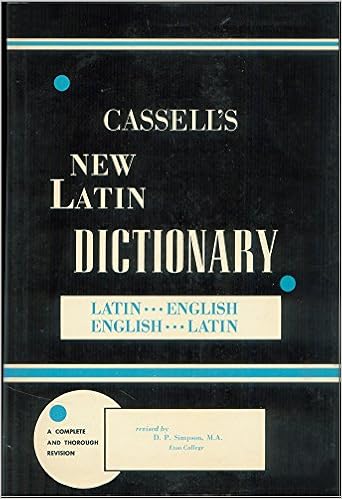
Book: “Cassell’s New Latin Dictionary”

Cassell’s New Latin Dictionary: Latin English – English Latin Hardcover – January 1, 1960

Since its first appearance over a century ago, Cassell’s Latin Dictionary has remained true to the excellent principles of its originators and constant in its appeal to scholars. The Latin-English section has always been distinguished by simplicity of structure and lack of over-elaboration, while the English-Latin section, in the words of the first compiler, aimed “to present a Latin equivalent for every English word and phrase now in current use.”

(amazon.com–suggested by Ned Henry, H.W.)