Ancient, solid stones reflect long shadows of time, And speak of humanity’s longevity on Mother Earth. Each person, a part of the chain of cycles: life, death, and life again. Stand to declare this moment in the breaking light of day, Ourselves to ourselves – Spirit eternal in manifestation. As clouds, gentle cover brings us inward to the Light.
Rancho Mirage Library & Observatory Please join us online in the early evening on Monday, December 21 for a live stream event to view Jupiter and Saturn in a Great Conjunction. From our view on Earth, the two gas giants appear close to each other in the sky approximately every 20 years, but the separation varies due to their orbits. The last time Jupiter and Saturn appeared so close in the sky was in the year 1623! Beginning at 4:30 pm PST, City Astronomer Eric McLaughlin will train our telescopes on Jupiter and Saturn to get views you have never seen before! RMLO Website: https://ranchomiragelibrary.org/ Rancho Mirage Library and Observatory eNewsletter Signup: http://bit.ly/RMLOnews Rancho Mirage Library and Observatory Foundation: https://ranchomiragelibrary.org/found…
The Tolstoys were a well-known family of old Russian nobility who traced their ancestry to a mythical nobleman named Indris described by Pyotr Tolstoy as arriving “from Nemec, from the lands of Caesar” to Chernigov in 1353 along with his two sons Litvinos (or Litvonis) and Zimonten (or Zigmont) and a druzhina of 3000 people.[11][12] While the word “Nemec” has been long used to describe Germans only, at that time it was applied to any foreigner who didn’t speak Russian (from the word nemoy meaning mute).[13] Indris was then converted to Eastern Orthodoxy, under the name of Leonty, and his sons as Konstantin and Feodor. Konstantin’s grandson Andrei Kharitonovich was nicknamed Tolstiy (translated as fat) by Vasily II of Moscow after he moved from Chernigov to Moscow.[11][12]
Because of the pagan names and the fact that Chernigov at the time was ruled by Demetrius I Starshy some researchers concluded that they were Lithuanians who arrived from the Grand Duchy of Lithuania.[11][14][15] At the same time, no mention of Indris was ever found in the 14th-to-16th-century documents, while the Chernigov Chronicles used by Pyotr Tolstoy as a reference were lost.[11] The first documented members of the Tolstoy family also lived during the 17th century, thus Pyotr Tolstoy himself is generally considered the founder of the noble house, being granted the title of count by Peter the Great.[16][17]
Life and career
Tolstoy at age 20, c. 1848
Tolstoy was born at Yasnaya Polyana, a family estate 12 kilometres (7.5 mi) southwest of Tula, Russia, and 200 kilometres (120 mi) south of Moscow. He was the fourth of five children of Count Nikolai Ilyich Tolstoy (1794–1837), a veteran of the Patriotic War of 1812, and Countess Mariya Tolstaya (née Volkonskaya; 1790–1830). His mother died when he was two and his father when he was nine.[18] Tolstoy and his siblings were brought up by relatives.[3] In 1844, he began studying law and oriental languages at Kazan University, where teachers described him as “both unable and unwilling to learn”.[18] Tolstoy left the university in the middle of his studies,[18] returned to Yasnaya Polyana and then spent much time in Moscow, Tula and Saint Petersburg, leading a lax and leisurely lifestyle.[3] He began writing during this period,[18] including his first novel Childhood, a fictitious account of his own youth, which was published in 1852.[3] In 1851, after running up heavy gambling debts, he went with his older brother to the Caucasus and joined the army. Tolstoy served as a young artillery officer during the Crimean War and was in Sevastopol during the 11-month-long siege of Sevastopol in 1854–55,[19] including the Battle of the Chernaya. During the war he was recognised for his courage and promoted to lieutenant.[19] He was appalled by the number of deaths involved in warfare,[18] and left the army after the end of the Crimean War.[3]
His experience in the army, and two trips around Europe in 1857 and 1860–61 converted Tolstoy from a dissolute and privileged society author to a non-violent and spiritual anarchist. Others who followed the same path were Alexander Herzen, Mikhail Bakunin and Peter Kropotkin. During his 1857 visit, Tolstoy witnessed a public execution in Paris, a traumatic experience that marked the rest of his life. In a letter to his friend Vasily Botkin, Tolstoy wrote: “The truth is that the State is a conspiracy designed not only to exploit, but above all to corrupt its citizens … Henceforth, I shall never serve any government anywhere.”[20] Tolstoy’s concept of non-violence or ahimsa was bolstered when he read a German version of the Tirukkural.[21] He later instilled the concept in Mahatma Gandhi through his A Letter to a Hindu when young Gandhi corresponded with him seeking his advice.[22][23]
His European trip in 1860–61 shaped both his political and literary development when he met Victor Hugo. Tolstoy read Hugo’s newly finished Les Misérables. The similar evocation of battle scenes in Hugo’s novel and Tolstoy’s War and Peace indicates this influence. Tolstoy’s political philosophy was also influenced by a March 1861 visit to French anarchist Pierre-Joseph Proudhon, then living in exile under an assumed name in Brussels. Tolstoy reviewed Proudhon’s forthcoming publication, La Guerre et la Paix (“War and Peace” in French), and later used the title for his masterpiece. The two men also discussed education, as Tolstoy wrote in his educational notebooks: “If I recount this conversation with Proudhon, it is to show that, in my personal experience, he was the only man who understood the significance of education and of the printing press in our time.”
Fired by enthusiasm, Tolstoy returned to Yasnaya Polyana and founded 13 schools for the children of Russia’s peasants, who had just been emancipated from serfdom in 1861. Tolstoy described the schools’ principles in his 1862 essay “The School at Yasnaya Polyana”.[24] His educational experiments were short-lived, partly due to harassment by the Tsarist secret police. However, as a direct forerunner to A.S. Neill‘s Summerhill School, the school at Yasnaya Polyana[25] can justifiably be claimed the first example of a coherent theory of democratic education.
Personal life
The death of his brother Nikolay in 1860 had an impact on Tolstoy, and led him to a desire to marry.[18] On 23 September 1862, Tolstoy married Sophia Andreevna Behrs, who was sixteen years his junior and the daughter of a court physician. She was called Sonya, the Russian diminutive of Sofia, by her family and friends.[26] They had 13 children, eight of whom survived childhood:[27]Tolstoy’s wife Sophia and their daughter Alexandra
The marriage was marked from the outset by sexual passion and emotional insensitivity when Tolstoy, on the eve of their marriage, gave her his diaries detailing his extensive sexual past and the fact that one of the serfs on his estate had borne him a son.[26] Even so, their early married life was happy and allowed Tolstoy much freedom and the support system to compose War and Peace and Anna Karenina with Sonya acting as his secretary, editor, and financial manager. Sonya was copying and hand-writing his epic works time after time. Tolstoy would continue editing War and Peace and had to have clean final drafts to be delivered to the publisher.[26][28]
However, their later life together has been described by A.N. Wilson as one of the unhappiest in literary history. Tolstoy’s relationship with his wife deteriorated as his beliefs became increasingly radical. This saw him seeking to reject his inherited and earned wealth, including the renunciation of the copyrights on his earlier works.
Some of the members of the Tolstoy family left Russia in the aftermath of the 1905 Russian Revolution and the subsequent establishment of the Soviet Union, and many of Leo Tolstoy’s relatives and descendants today live in Sweden, Germany, the United Kingdom, France and the United States. Tolstoy’s son, Count Lev Lvovich Tolstoy, settled in Sweden and married a Swedish woman. Leo Tolstoy’s last surviving grandchild, Countess Tatiana Tolstoy-Paus, died in 2007 at Herresta manor in Sweden, which is owned by Tolstoy’s descendants.[29] Swedish jazz singer Viktoria Tolstoy is also descended from Leo Tolstoy.[30]
One of his great-great-grandsons, Vladimir Tolstoy (born 1962), is a director of the Yasnaya Polyana museum since 1994 and an adviser to the President of Russia on cultural affairs since 2012.[31][32]Ilya Tolstoy‘s great-grandson, Pyotr Tolstoy, is a well-known Russian journalist and TV presenter as well as a State Duma deputy since 2016. His cousin Fyokla Tolstaya (born Anna Tolstaya in 1971), daughter of the acclaimed Soviet Slavist Nikita Tolstoy (ru) (1923–1996), is also a Russian journalist, TV and radio host.[33]
Tolstoy’s earliest works, the autobiographical novels Childhood, Boyhood, and Youth (1852–1856), tell of a rich landowner’s son and his slow realization of the chasm between himself and his peasants. Though he later rejected them as sentimental, a great deal of Tolstoy’s own life is revealed. They retain their relevance as accounts of the universal story of growing up.
Tolstoy served as a second lieutenant in an artillery regiment during the Crimean War, recounted in his Sevastopol Sketches. His experiences in battle helped stir his subsequent pacifism and gave him material for realistic depiction of the horrors of war in his later work.[34]
His fiction consistently attempts to convey realistically the Russian society in which he lived.[35]The Cossacks (1863) describes the Cossack life and people through a story of a Russian aristocrat in love with a Cossack girl. Anna Karenina (1877) tells parallel stories of an adulterous woman trapped by the conventions and falsities of society and of a philosophical landowner (much like Tolstoy), who works alongside the peasants in the fields and seeks to reform their lives. Tolstoy not only drew from his own life experiences but also created characters in his own image, such as Pierre Bezukhov and Prince Andrei in War and Peace, Levin in Anna Karenina and to some extent, Prince Nekhlyudov in Resurrection.The Power of Darkness
War and Peace is generally thought to be one of the greatest novels ever written, remarkable for its dramatic breadth and unity. Its vast canvas includes 580 characters, many historical with others fictional. The story moves from family life to the headquarters of Napoleon, from the court of Alexander I of Russia to the battlefields of Austerlitz and Borodino. Tolstoy’s original idea for the novel was to investigate the causes of the Decembrist revolt, to which it refers only in the last chapters, from which can be deduced that Andrei Bolkonsky‘s son will become one of the Decembrists. The novel explores Tolstoy’s theory of history, and in particular the insignificance of individuals such as Napoleon and Alexander. Somewhat surprisingly, Tolstoy did not consider War and Peace to be a novel (nor did he consider many of the great Russian fictions written at that time to be novels). This view becomes less surprising if one considers that Tolstoy was a novelist of the realist school who considered the novel to be a framework for the examination of social and political issues in nineteenth-century life.[36]War and Peace (which is to Tolstoy really an epic in prose) therefore did not qualify. Tolstoy thought that Anna Karenina was his first true novel.[37]
After Anna Karenina, Tolstoy concentrated on Christian themes, and his later novels such as The Death of Ivan Ilyich (1886) and What Is to Be Done? develop a radical anarcho-pacifist Christian philosophy which led to his excommunication from the Russian Orthodox Church in 1901.[38] For all the praise showered on Anna Karenina and War and Peace, Tolstoy rejected the two works later in his life as something not as true of reality.[39]
In his novel Resurrection, Tolstoy attempts to expose the injustice of man-made laws and the hypocrisy of institutionalized church. Tolstoy also explores and explains the economic philosophy of Georgism, of which he had become a very strong advocate towards the end of his life.
Tolstoy also tried himself in poetry with several soldier songs written during his military service and fairy tales in verse such as Volga-bogatyr and Oaf stylized as national folk songs. They were written between 1871 and 1874 for his Russian Book for Reading, a collection of short stories in four volumes (total of 629 stories in various genres) published along with the New Azbuka textbook and addressed to schoolchildren. Nevertheless, he was skeptical about poetry as a genre. As he famously said, “Writing poetry is like ploughing and dancing at the same time”. According to Valentin Bulgakov, he criticised poets, including Alexander Pushkin, for their “false” epithets used “simply to make it rhyme”.[40][41]
Critical appraisal by other authors
Tolstoy’s contemporaries paid him lofty tributes. Fyodor Dostoyevsky, who died thirty years before Tolstoy, admired and was delighted by Tolstoy’s novels (and, conversely, Tolstoy also admired Dostoyevsky’s work).[42]Gustave Flaubert, on reading a translation of War and Peace, exclaimed, “What an artist and what a psychologist!” Anton Chekhov, who often visited Tolstoy at his country estate, wrote, “When literature possesses a Tolstoy, it is easy and pleasant to be a writer; even when you know you have achieved nothing yourself and are still achieving nothing, this is not as terrible as it might otherwise be, because Tolstoy achieves for everyone. What he does serves to justify all the hopes and aspirations invested in literature.” The 19th-century British poet and critic Matthew Arnold opined that “A novel by Tolstoy is not a work of art but a piece of life.”[3]
Later novelists continued to appreciate Tolstoy’s art, but sometimes also expressed criticism. Arthur Conan Doyle wrote “I am attracted by his earnestness and by his power of detail, but I am repelled by his looseness of construction and by his unreasonable and impracticable mysticism.”[43]Virginia Woolf declared him “the greatest of all novelists.”[3]James Joyce noted that “He is never dull, never stupid, never tired, never pedantic, never theatrical!” Thomas Mann wrote of Tolstoy’s seemingly guileless artistry: “Seldom did art work so much like nature.” Vladimir Nabokov heaped superlatives upon The Death of Ivan Ilyich and Anna Karenina; he questioned, however, the reputation of War and Peace, and sharply criticized Resurrection and The Kreutzer Sonata.
Tolstoy dressed in peasant clothing, by Ilya Repin (1901)
After reading Schopenhauer‘s The World as Will and Representation, Tolstoy gradually became converted to the ascetic morality upheld in that work as the proper spiritual path for the upper classes. In 1869 he writes: “Do you know what this summer has meant for me? Constant raptures over Schopenhauer and a whole series of spiritual delights which I’ve never experienced before. … no student has ever studied so much on his course, and learned so much, as I have this summer”.[44]
In Chapter VI of A Confession, Tolstoy quoted the final paragraph of Schopenhauer’s work. It explains how a complete denial of self causes only a relative nothingness which is not to be feared. Tolstoy was struck by the description of Christian, Buddhist, and Hindu ascetic renunciation as being the path to holiness. After reading passages such as the following, which abound in Schopenhauer’s ethical chapters, the Russian nobleman chose poverty and formal denial of the will:
But this very necessity of involuntary suffering (by poor people) for eternal salvation is also expressed by that utterance of the Savior (Matthew 19:24): “It is easier for a camel to go through the eye of a needle, than for a rich man to enter into the kingdom of God.” Therefore, those who were greatly in earnest about their eternal salvation, chose voluntary poverty when fate had denied this to them and they had been born in wealth. Thus BuddhaSakyamuni was born a prince, but voluntarily took to the mendicant’s staff; and Francis of Assisi, the founder of the mendicant orders who, as a youngster at a ball, where the daughters of all the notabilities were sitting together, was asked: “Now Francis, will you not soon make your choice from these beauties?” and who replied: “I have made a far more beautiful choice!” “Whom?” “La povertà (poverty)”: whereupon he abandoned every thing shortly afterwards and wandered through the land as a mendicant.[45]
In 1884, Tolstoy wrote a book called What I Believe, in which he openly confessed his Christian beliefs. He affirmed his belief in Jesus Christ‘s teachings and was particularly influenced by the Sermon on the Mount, and the injunction to turn the other cheek, which he understood as a “commandment of non-resistance to evil by force” and a doctrine of pacifism and nonviolence. In his work The Kingdom of God Is Within You, he explains that he considered mistaken the Church’s doctrine because they had made a “perversion” of Christ’s teachings. Tolstoy also received letters from American Quakers who introduced him to the non-violence writings of Quaker Christians such as George Fox, William Penn and Jonathan Dymond. Tolstoy believed being a Christian required him to be a pacifist; the apparently inevitable waging of war by governments, is why he is considered a philosophical anarchist.
Later, various versions of “Tolstoy’s Bible” were published, indicating the passages Tolstoy most relied on, specifically, the reported words of Jesus himself.[46]Mohandas K. Gandhi and other residents of Tolstoy Farm, South Africa, 1910
Tolstoy believed that a true Christian could find lasting happiness by striving for inner perfection through following the Great Commandment of loving one’s neighbor and God, rather than guidance from the Church or state. Another distinct attribute of his philosophy based on Christ’s teachings is nonresistance during conflict. This idea in Tolstoy’s book The Kingdom of God Is Within You (full text of English translation available on Wikisource) directly influenced Mahatma Gandhi and therefore also nonviolent resistance movements to this day.
Tolstoy believed that the aristocracy was a burden on the poor, and that the only way to live together is anarchism.[citation needed] He opposed private land ownership[47] and the institution of marriage, and valued chastity and sexual abstinence (discussed in Father Sergius and his preface to The Kreutzer Sonata), ideals also held by the young Gandhi. Tolstoy’s passion from the depth of his austere moral views is reflected in his later work.[48] One example is the sequence of the temptation of Sergius in Father Sergius. Gorky relates how Tolstoy once read this passage before him and Chekhov and Tolstoy was moved to tears by the end of the reading. Later passages of rare power include the personal crises faced by the protagonists of The Death of Ivan Ilyich, and of Master and Man, where the main character in the former and the reader in the latter are made aware of the foolishness of the protagonists’ lives.
Without naming himself an anarchist, Leo Tolstoy, like his predecessors in the popular religious movements of the 15th and 16th centuries, Chojecki, Denk and many others, took the anarchist position as regards the state and property rights, deducing his conclusions from the general spirit of the teachings of Jesus and from the necessary dictates of reason. With all the might of his talent, Tolstoy made (especially in The Kingdom of God Is Within You) a powerful criticism of the church, the state and law altogether, and especially of the present property laws. He describes the state as the domination of the wicked ones, supported by brutal force. Robbers, he says, are far less dangerous than a well-organized government. He makes a searching criticism of the prejudices which are current now concerning the benefits conferred upon men by the church, the state, and the existing distribution of property, and from the teachings of Jesus he deduces the rule of non-resistance and the absolute condemnation of all wars. His religious arguments are, however, so well combined with arguments borrowed from a dispassionate observation of the present evils, that the anarchist portions of his works appeal to the religious and the non-religious reader alike.[50]
Tolstoy praised the Boxer Rebellion and harshly criticized the atrocities of the Russian, German, American, Japanese and other troops of the Eight-Nation alliance. He heard about the looting, rapes and murders, and accused the troops of slaughter and “Christian brutality”. He named the monarchs most responsible for the atrocities as Tsar Nicholas II and Kaiser Wilhelm II.[54][55] He described the intervention as “terrible for its injustice and cruelty”.[56] The war was also criticized by other intellectuals such as Leonid Andreev and Gorky. As part of the criticism, Tolstoy wrote an epistle called To the Chinese people.[57] In 1902, he wrote an open letter describing and denouncing Nicholas II’s activities in China.[58]
The Boxer Rebellion stirred Tolstoy’s interest in Chinese philosophy.[59] He was a famous sinophile, and read the works of Confucius[60][61][62] and Lao Zi. Tolstoy wrote Chinese Wisdom and other texts about China. Tolstoy corresponded with the Chinese intellectual Gu Hongming and recommended that China remain an agrarian nation, and not reform like Japan. Tolstoy and Gu opposed the Hundred Day’s Reform by Kang Youwei and believed that the reform movement was perilous.[63] Tolstoy’s ideology of non-violence shaped the thought of the Chinese anarchist group Society for the Study of Socialism.[64]
Film by Aleksandr Osipovich Drankov of Tolstoy’s 80th birthday (1908) at Yasnaya Polyana, showing his wife Sofya (picking flowers in the garden) daughter Aleksandra (sitting in the carriage in the white blouse); his aide and confidante V. Chertkov (bald man with the beard and mustache); and students.
In hundreds of essays over the last 20 years of his life, Tolstoy reiterated the anarchist critique of the state and recommended books by Kropotkin and Proudhon to his readers, while rejecting anarchism’s espousal of violent revolutionary means. In the 1900 essay, “On Anarchy”, he wrote: “The Anarchists are right in everything; in the negation of the existing order, and in the assertion that, without Authority, there could not be worse violence than that of Authority under existing conditions. They are mistaken only in thinking that Anarchy can be instituted by a revolution. But it will be instituted only by there being more and more people who do not require the protection of governmental power … There can be only one permanent revolution—a moral one: the regeneration of the inner man.” Despite his misgivings about anarchist violence, Tolstoy took risks to circulate the prohibited publications of anarchist thinkers in Russia, and corrected the proofs of Kropotkin’s “Words of a Rebel”, illegally published in St Petersburg in 1906.[65]Tolstoy in his study in 1908 (age 80)
In 1908, Tolstoy wrote A Letter to a Hindu[66] outlining his belief in non-violence as a means for India to gain independence from colonial rule. In 1909, Gandhi read a copy of the letter when he was becoming an activist in South Africa. He wrote to Tolstoy seeking proof that he was the author, which led to further correspondence.[21] Tolstoy’s The Kingdom of God Is Within You also helped to convince Gandhi of nonviolent resistance, a debt Gandhi acknowledged in his autobiography, calling Tolstoy “the greatest apostle of non-violence that the present age has produced”. Their correspondence lasted only a year, from October 1909 until Tolstoy’s death in November 1910, but led Gandhi to give the name Tolstoy Colony to his second ashram in South Africa.[67] Both men also believed in the merits of vegetarianism, the subject of several of Tolstoy’s essays.[68]
Tolstoy also became a major supporter of the Esperanto movement. He was impressed by the pacifist beliefs of the Doukhobors and brought their persecution to the attention of the international community, after they burned their weapons in peaceful protest in 1895. He aided the Doukhobors to migrate to Canada.[69] He also provided inspiration to the Mennonites, another religious group with anti-government and anti-war sentiments.[70][71] In 1904, Tolstoy condemned the ensuing Russo-Japanese War and wrote to the Japanese Buddhist priest Soyen Shaku in a failed attempt to make a joint pacifist statement.
Towards the end of his life, Tolstoy become occupied with the economic theory and social philosophy of Georgism.[72][73][74][75] He incorporated it approvingly into works such as Resurrection (1899), the book that was a major cause for his excommunication.[76] He spoke with great admiration of Henry George, stating once that “People do not argue with the teaching of George; they simply do not know it. And it is impossible to do otherwise with his teaching, for he who becomes acquainted with it cannot but agree.”[77] He also wrote a preface to George’s journal Social Problems.[78] Tolstoy and George both rejected private property in land (the most important source of income for Russian aristocracy that Tolstoy heavily criticized). They also rejected a centrally planned socialist economy. Because Georgism requires an administration to collect land rent and spend it on infrastructure, some assume that this embrace moved Tolstoy away from his anarchist views. However, anarchist versions of Georgism have been proposed since then.[79] Tolstoy’s 1899 novel Resurrection explores his thoughts on Georgism and hints that Tolstoy had such a view. It suggests small communities with local governance to manage the collective land rents for common goods, while still heavily criticising state institutions such as the justice system.
Tolstoy died in 1910, aged 82. Just before his death, his health was a concern of his family, who cared for him daily. In his last days, he spoke and wrote about dying. Renouncing his aristocratic lifestyle, he left home one winter night.[80] His secretive departure was an apparent attempt to escape from his wife’s tirades. She spoke out against many of his teachings, and in recent years had grown envious of his attention to Tolstoyan “disciples”.
Tolstoy died of pneumonia[81] at Astapovo railway station, after a day’s train journey south.[82] The station master took Tolstoy to his apartment, and his personal doctors arrived and gave him injections of morphine and camphor.
The police tried to limit access to his funeral procession, but thousands of peasants lined the streets. Still, some were heard to say that, other than knowing that “some nobleman had died”, they knew little else about Tolstoy.[83]
According to some sources, Tolstoy spent the last hours of his life preaching love, non-violence, and Georgism to fellow passengers on the train.[84]
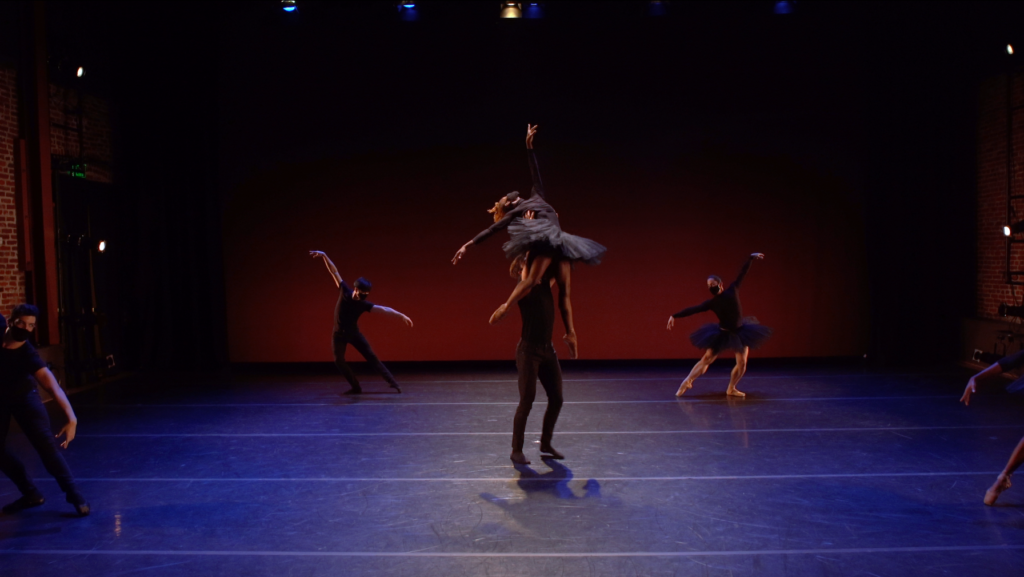
Evan Ambrose and Duane Gosa rehearse a pas de deux from “Swan Lake,” part of Ballet22’s inaugural streaming performances.
Over the summer, as the isolation of the pandemic wore on, Roberto Vega Ortiz posted a video of himself dancing in satin pointe shoes on Instagram, with the hashtag #maleballerinas. Soon, men from around the world were posting videos with the same hashtag, sharing footage of themselves — sometimes bare-chested and sometimes in tutus — dancing en pointe in Mexico, Germany, Brazil, Chile and throughout the U.S.
Vega Ortiz was astonished by the response, but in some ways not surprised. He had grown up in Puerto Rico, where his teachers were “not pleased” to discover him trying on pointe shoes, forcing him to practice in secret. But social media has since busted through those barriers.
Living in Oakland, Vega Ortiz was sheltering in place with Theresa Knudson, a female ballerina with a degree in business administration. When he said, “Wouldn’t that be amazing if we could create our own company of male ballerinas?” she replied, “Why not?”
And so, a new Bay Area troupe, Ballet22, was born, with its first performances titled “Breaking Ground” now streaming online, through Sunday, Dec. 20.
It’s not the way we’ve seen men en pointe before. Since 1974, this niche has been dominated by Les Ballets Trockadero de Monte Carlo, a popular all-male group who perform in drag and mock ballet conventions, with character names like “Maya Thickenthighya.” Vega Ortiz and several other Ballet22 dancers also perform with the Trocks, but in this new venture, they dance sincerely, as themselves.
Les Ballets Trockadero de Monte Carlo perform Saturday–Sunday, March 14–15, 2020 in Zellerbach Hall.
As Joshua A. Stayton, one of the choreographers who contributed to Ballet22’s first season, explained, “When I watch Roberto in my ballet, it’s not a man en pointe I see. It’s an artist in pointe shoes.”
The quality of the company’s first performance is remarkable given how fast it came together. In part, this is testament to how far men en pointe have advanced their technique in recent decades. Vega Ortiz and several other company members have flexible arches that many a female principal would envy, and they move with mesmerizing refinement.
But the show’s quality is also thanks to Knudson’s experience in project management for companies like Peet’s Coffee and Coach’s Oats. She raised money to fly dancers in from New York and beyond, followed safety protocols to have them COVID-tested and sheltered together during the rehearsal period, and rented ODC Theater in San Francisco for a day of intensely efficient filming. The pressures led to artistic serendipities.
Choreographer Omar Román de Jesús arrived from New York with no preconceptions for his commissioned ballet, because he likes to work in the moment, responding to the dancers in front of him. On the first day of the 10-day rehearsal period, he spotted a Romantic-style tulle skirt hanging in the hall and said, “Roberto, can we use this? I think we have to.” Paired with suit jackets, the skirts resulted in wild movements of the men flailing the fabric up and down, then bursting into solos in which some of the dancers shout and scream.
Choreographer Joshua A. Stayton rehearses Roberto Vega Ortiz (on pointe) in Stayton’s ballet “Juntos” for Ballet22’s inaugural streaming performances.
The process was quite different for Stayton, who rehearsed the company in his ballet “Juntos,” originally created for Tulsa Ballet II with a cast of three men and three women. Having followed Vega Ortiz on social media for three years, he leaped at the chance to work with this all-male endeavor.
“I loved seeing that there wasn’t really that much of a difference” between the way the ballet was danced by women and this version danced by men, Stayton said. “Sure, there were some adaptations for gravity — the dancers in flat shoes couldn’t lift the dancers en pointe as far overhead. But that lighter quality for the dancers en pointe — some would call it ‘feminine,’” but really it’s just a softening — that was still there. These roles that we men think we’ll never get to dance, that we try out on the sidelines, now these artists are dancing them.”
Both choreographers were thrilled not only to work with Vega Ortiz and established talent like New York City Ballet member Gilbert Bolden III, but also to discover new stars such as 17-year-old Ashton Edwards, a trainee on full scholarship at Pacific Northwest Ballet in Seattle. Perhaps Ballet22 will shift the paradigm for dancers like Edwards, who dreams of working full time for a gender-nonconforming company. Already Vega Ortiz and Knudson are pulling together their next offering, a Valentine’s program to stream in February.
Ashton Edwards (lifted) in Omar Román de Jesús’s “Mi Pequeñito Sueño,” part of Ballet22’s inaugural streaming performances.
“Right now, for male and trans and nonbinary dancers, when it comes time to do your professional job, you’re either a prince, or you’re in drag,” said Vega Ortiz, who also dances with Diablo Ballet (and alternates between Gaynor Minden and Freed pointe shoes, for those ballet fans who are curious).
“One of our big goals is to make this not just a novelty or after-hours thing, but make a space for this profession,” Knudson added. “We shouldn’t waste these talents, these beautiful dancers doing (roles like) Gamzatti or Odile on Instagram. We should see this. There is definitely a market.”
“Breaking Ground”: Ballet22’s inaugural digital performance continues streaming online through Sunday, Dec. 20. $20. www.ballet22.com/events
Awareness, or consciousness, is perhaps the most profound and significant aspect of human existence. In every moment of our waking life, we are aware. We are conscious. Yet, because of our habitual focus on the “content” of awareness — the thoughts, feelings and sensations that arise from moment to moment — most of us live our entire lives without ever becoming aware of awareness itself. At the core of spiritual awakening is the discovery, in our own experience, of consciousness itself. When we learn how to shift our attention from its habitual fixation on “objects” to the limitless awareness in which all objects arise, we discover that we have always already been free. In this 20-minute audio, Craig guides an experiential journey into your own awareness—how it works, where it “comes from,” and what happens when you learn to identify with it as the primary locus of your own being.
Below the audio is an edited transcript of the talk and a downloadable mp3, if you’d prefer to engage the content in that way.
“Good nature is, of all moral qualities, the one that the world needs most, and good nature is the result of ease and security, not of a life of arduous struggle.”
BY MARIA POPOVA (brainpickings.org)
“Everybody should be quiet near a little stream and listen,” the great children’s book author Ruth Krauss — a philosopher, really — wrote in her last and loveliest collaboration with the young Maurice Sendak in 1960. At the time of her first collaboration with Sendak twelve years earlier, just after the word “workaholic” was coined, the German philosopher Josef Pieper was composing Leisure, the Basis of Culture — his timeless and increasingly timely manifesto for reclaiming our human dignity in a culture of busyness. “Leisure,” Pieper wrote, “is not the same as the absence of activity… or even as an inner quiet. It is rather like the stillness in the conversation of lovers, which is fed by their oneness.”
A generation earlier, with a seer’s capacity to peer past the horizon of the present condition and anticipate a sweeping cultural current before it has flooded in, and with a sage’s ability to provide the psychic buoy for surviving the current’s perilous rapids, Bertrand Russell (May 18, 1872–February 2, 1970) addressed the looming cult of workaholism in a prescient 1932 essay titled In Praise of Idleness (public library).Bertrand Russell
Russell writes:
A great deal of harm is being done in the modern world by belief in the virtuousness of work, and that the road to happiness and prosperity lies in an organized diminution of work.
With his characteristic wisdom punctuated by wry wit, he examines what work actually means:
Work is of two kinds: first, altering the position of matter at or near the earth’s surface relatively to other such matter; second, telling other people to do so. The first kind is unpleasant and ill paid; the second is pleasant and highly paid. The second kind is capable of indefinite extension: there are not only those who give orders, but those who give advice as to what orders should be given. Usually two opposite kinds of advice are given simultaneously by two organized bodies of men; this is called politics. The skill required for this kind of work is not knowledge of the subjects as to which advice is given, but knowledge of the art of persuasive speaking and writing, i.e., of advertising.
Russell points to landowners as a historical example of a class whose idleness was only made possible by the toil of others. For the vast majority of our species’ history, up until the Industrial Revolution, the average person spent nearly every waking hour working hard to earn the basic necessities of survival. Any marginal surplus, he notes, was swiftly appropriated by those in power — the warriors, the monarchs, the priests. Since the Industrial Revolution, other power systems — from big business to dictatorships — have simply supplanted the warriors, monarchs, and priests. Russell considers how the exploitive legacy of pre-industrial society has corrupted the modern social fabric and warped our value system:
A system which lasted so long and ended so recently has naturally left a profound impress upon men’s thoughts and opinions. Much that we take for granted about the desirability of work is derived from this system, and, being pre-industrial, is not adapted to the modern world. Modern technique has made it possible for leisure, within limits, to be not the prerogative of small privileged classes, but a right evenly distributed throughout the community. The morality of work is the morality of slaves, and the modern world has no need of slavery.
Writing nearly a century after Kierkegaard extolled the existential boon of idleness, Russell considers how this manipulated mentality has hypnotized us into worshiping work as virtue and scorning leisure as laziness, as weakness, as folly, rather than recognizing it as the raw material of social justice and the locus of our power:
The conception of duty, speaking historically, has been a means used by the holders of power to induce others to live for the interests of their masters rather than for their own. Of course the holders of power conceal this fact from themselves by managing to believe that their interests are identical with the larger interests of humanity. Sometimes this is true; Athenian slave owners, for instance, employed part of their leisure in making a permanent contribution to civilization which would have been impossible under a just economic system. Leisure is essential to civilization, and in former times leisure for the few was only rendered possible by the labors of the many. But their labors were valuable, not because work is good, but because leisure is good. And with modern technique it would be possible to distribute leisure justly without injury to civilization.
Russell notes that WWI — which was dubbed “the war to end all wars” by a world willfully blind to the fact that violence begets more violence, unwitting that this world war would pave the way for the next — furthered our civilizational conflation of duty with work and work with virtue, lulling us into the modern trance of busyness. More than half a century before Annie Dillard observed that “how we spend our days is, of course, how we spend our lives,” Russell traces the ledger of our existential spending back to war’s false promise of freedom:
The war showed conclusively that, by the scientific organization of production, it is possible to keep modern populations in fair comfort on a small part of the working capacity of the modern world. If, at the end of the war, the scientific organization, which had been created in order to liberate men for fighting and munition work, had been preserved, and the hours of work had been cut down to four, all would have been well. Instead of that the old chaos was restored, those whose work was demanded were made to work long hours, and the rest were left to starve as unemployed. Why? Because work is a duty, and a man should not receive wages in proportion to what he has produced, but in proportion to his virtue as exemplified by his industry.
Pointing out that this equivalence originates in the same morality — or, rather, immorality — that produced the slave state, he exposes the core cultural falsehood it has effected, which stands as a monumental obstruction to equality and social justice in contemporary society:
The idea that the poor should have leisure has always been shocking to the rich.
Born in an era when urban workingmen had just acquired the right to vote in Great Britain, Russell draws on his own childhood for a stark illustration of this belief and its far-reaching tentacles of socioeconomic oppression:
I remember hearing an old Duchess say: “What do the poor want with holidays? They ought to work.” People nowadays are less frank, but the sentiment persists, and is the source of much of our economic confusion.
That sentiment, Russell reminds us again and again, is ahistorical. Advances in science, technology, and the very mechanics of society have made it no longer necessary for the average person to endure fifteen-hour workdays in order to obtain basic sustenance, as adults — and often children — had to in the early nineteenth century. But while the allocation of our time in relation to need has changed immensely, our attitudes about how that time is spent hardly have. He writes:
Every human being, of necessity, consumes, in the course of his life, a certain amount of the produce of human labor.
[…]
The wise use of leisure, it must be conceded, is a product of civilization and education. A man who has worked long hours all his life will be bored if he becomes suddenly idle. But without a considerable amount of leisure a man is cut off from many of the best things. There is no longer any reason why the bulk of the population should suffer this deprivation; only a foolish asceticism, usually vicarious, makes us continue to insist on work in excessive quantities now that the need no longer exists.
But while reinstating the dignity of leisure — or what Russell calls idleness — is a necessary condition for recalibrating our life-satisfaction to more adequately reflect the contemporary realities of work and need, it is not a sufficient one. Exacerbating our already warped relationship with work is the muddling of needs and wants at the heart of capitalist materialism — something Russell would address nearly two decades later in his Nobel Prize acceptance speech, listing acquisitiveness as the first of the four desires driving human behavior. He considers the radical shift that would take place if we were to stop regarding the virtue of work as an end in itself and begin seeing it as a means to a state of being in which work is no longer needed, reinstating leisure and comfort — that is, a contented sense of enoughness — as the proper existential end:
What will happen when the point has been reached where everybody could be comfortable without working long hours?
In the West, we have various ways of dealing with this problem. We have no attempt at economic justice, so that a large proportion of the total produce goes to a small minority of the population, many of whom do no work at all. Owing to the absence of any central control over production, we produce hosts of things that are not wanted. We keep a large percentage of the working population idle, because we can dispense with their labor by making the others overwork. When all these methods prove inadequate, we have a war; we cause a number of people to manufacture high explosives, and a number of others to explode them, as if we were children who had just discovered fireworks. By a combination of all these devices we manage, though with difficulty, to keep alive the notion that a great deal of severe manual work must be the lot of the average man.
Our society, Russell argues, is driven by “continually fresh schemes, by which present leisure is to be sacrificed to future productivity.” He challenges the inanity of this proposition:
The fact is that moving matter about, while a certain amount of it is necessary to our existence, is emphatically not one of the ends of human life. If it were, we should have to consider every navvy superior to Shakespeare. We have been misled in this matter by two causes. One is the necessity of keeping the poor contented, which has led the rich, for thousands of years, to preach the dignity of labor, while taking care themselves to remain undignified in this respect. The other is the new pleasure in mechanism, which makes us delight in the astonishingly clever changes that we can produce on the earth’s surface. Neither of these motives makes any great appeal to the actual worker. If you ask him what he thinks the best part of his life, he is not likely to say: “I enjoy manual work because it makes me feel that I am fulfilling man’s noblest task, and because I like to think how much man can transform his planet. It is true that my body demands periods of rest, which I have to fill in as best I may, but I am never so happy as when the morning comes and I can return to the toil from which my contentment springs.” I have never heard workingmen say this sort of thing. They consider work, as it should be considered, a necessary means to a livelihood, and it is from their leisure hours that they derive whatever happiness they may enjoy.
Decades before Diane Ackerman made her exquisite case for the evolutionary and existential value of play, Russell considers how the cult of productivity has demolished one of life’s pillars of satisfaction. Noting that modern people — true of the moderns of 1932, even truer of today’s — enjoy a little leisure but wouldn’t know what to do with themselves if they had to work only four hours a day, he observes:
In so far as this is true in the modern world, it is a condemnation of our civilization; it would not have been true at any earlier period. There was formerly a capacity for lightheartedness and play which has been to some extent inhibited by the cult of efficiency. The modern man thinks that everything ought to be done for the sake of something else, and never for its own sake.
The seedbed of this soul-shriveling belief is the notion — a driving force of consumerism — that the only worthwhile activities are those that bring material profit. A formidable logician, Russell exposes the self-unraveling nature of this argument:
Broadly speaking, it is held that getting money is good and spending money is bad. Seeing that they are two sides of one transaction, this is absurd; one might as well maintain that keys are good, but keyholes are bad. Whatever merit there may be in the production of goods must be entirely derivative from the advantage to be obtained by consuming them. The individual, in our society, works for profit; but the social purpose of his work lies in the consumption of what he produces. It is this divorce between the individual and the social purpose of production that makes it so difficult for men to think clearly in a world in which profit-making is the incentive to industry. We think too much of production, and too little of consumption. One result is that we attach too little importance to enjoyment and simple happiness, and that we do not judge production by the pleasure that it gives to the consumer.
Another result, Russell argues, is a kind of split between positive idleness, which ought to be the nourishing end of work, and negative idleness, which ends up being the effect of work under the spell of consumerism and its consequent socioeconomic inequality. He writes:
The pleasures of urban populations have become mainly passive: seeing cinemas, watching football matches, listening to the radio, and so on. This results from the fact that their active energies are fully taken up with work; if they had more leisure, they would again enjoy pleasures in which they took an active part.
With an eye to our civilization’s triumphs and failures of self-actualization, Russell points out that, historically, there has been a small leisure class enjoying a great many privileges without a basis in social justice, profiting on the backs of a large working class toiling for survival. While this rendered the oppressive leisure class morally condemnable, it resulted in the vast majority of art and science — “the whole of what we call civilization.” He writes:
Without the leisure class, mankind would never have emerged from barbarism.
The method of a hereditary leisure class without duties was, however, extraordinarily wasteful. None of the members of the class had been taught to be industrious, and the class as a whole was not exceptionally intelligent. The class might produce one Darwin, but against him had to be set tens of thousands of country gentlemen who never thought of anything more intelligent than fox-hunting and punishing poachers.
Russell’s most compelling point is the most counterintuitive — the idea that reclaiming leisure is not a reinforcement of elitism but the antidote to elitism itself and a form of resistance to oppression, for it would require dismantling the power structures of modern society and undoing the spell they have cast on us to keep the poor poor and the rich rich. To correctly calibrate modern life around a sense of enough — that is, around meeting the need for comfort rather than satisfying the endless want for consumerist acquisitiveness — would be to lay the groundwork for social justice. In such a society, Russell argues, no one would have to work more than four hours out of twenty-four — a proposition even more countercultural today than it was in his era. He paints the landscape of possibility:
In a world where no one is compelled to work more than four hours a day, every person possessed of scientific curiosity will be able to indulge it, and every painter will be able to paint without starving, however excellent his pictures may be. Young writers will not be obliged to draw attention to themselves by sensational potboilers, with a view to acquiring the economic independence needed for monumental works, for which, when the time at last comes, they will have lost the taste and the capacity.
[…]
Above all, there will be happiness and joy of life, instead of frayed nerves, weariness, and dyspepsia. The work exacted will be enough to make leisure delightful, but not enough to produce exhaustion. Since men will not be tired in their spare time, they will not demand only such amusements as are passive and vapid. At least 1 per cent will probably devote the time not spent in professional work to pursuits of some public importance, and, since they will not depend upon these pursuits for their livelihood, their originality will be unhampered, and there will be no need to conform to the standards set by elderly pundits. But it is not only in these exceptional cases that the advantages of leisure will appear. Ordinary men and women, having the opportunity of a happy life, will become more kindly and less persecuting and less inclined to view others with suspicion. The taste for war will die out, partly for this reason, and partly because it will involve long and severe work for all. Good nature is, of all moral qualities, the one that the world needs most, and good nature is the result of ease and security, not of a life of arduous struggle. Modern methods of production have given us the possibility of ease and security for all; we have chosen, instead, to have overwork for some and starvation for the others. Hitherto we have continued to be as energetic as we were before there were machines; in this we have been foolish, but there is no reason to go on being foolish for ever.
It is not often that one encounters a great love letter to a great love, composed by someone outside the private world of that love, serenading it across the spacetime of epochs and experiences. In my many years of dwelling in the lives and loves and letters of beloved artists, scientists, and writers, I have encountered none more splendid than The Autobiography of Alice B. Toklas Illustrated (public library) by Maira Kalman — an artist who uses her paintbrush the way Stein used her pen, as the instrument of an imagination tilted pleasantly askance from the plane of common thought.
Gertrude Stein published The Autobiography of Alice B. Toklas in 1933, when she was fifty-nine and Alice fifty-six. She had written it at an astonishing pace the previous autumn. Like Alice disguised her memoir of their love as a cookbook, Gertrude disguised hers as an “autobiography” of the beloved under the lover’s byline. It wasn’t, of course, Alice’s autobiography, or even her biography — rather, it was the biography of their love, of early-twentieth-century Paris, of the community of visionary artists and writers who orbited the couple and who came to be known as the Lost Generation — a term Gertrude Stein coined — as they found themselves, in every sense of the term, at Alice and Gertrude’s salons.
The book begins, naturally, not at Alice’s birth but at her fateful first encounter with Gertrude and her coral brooch the day Alice, thirty-three, arrived in Paris as an American expatriate — a moment she eventually recounted in such deeply felt detail on the pages of her slender actual autobiography, animated by a bereavement that never left her in the twenty “empty” years by which she outlived the love of her life.
Kalman introduces the book with her spare and singular poetics:
Alice met Gertrude. Gertrude met Alice. Gertrude with her big body. Big presence. Alice, a little bird with a mustache. And that was that. A coup de foudre as we say. Gertrude wrote this book of their lives through Alice’s eyes. And here it is (happily) with paintings to illustrate how it was.








 Alice met Gertrude.
.jpg)


