We are transitioning from Germ Theory to Terrain Theory. I have been rereading about Louis Pasteur, a French Biologist, Microbiologist and Chemist who first taught us about Germ Theory that led us to do things like pasteurising milk. This was fortunate for agribusiness as it prolonged shelf life for milk but it is also terrible for our digestive systems. Pasteur led us to disinfecting ourselves against nature to the destruction of our own biome.
Of course, we have learnt that too many germs proliferate when we have inadequate sanitation in close quarters (leading in the past to events like the plague). However, in my opinion we have gone too far with all this endless sanitising, masks and social distancing which weakens and eventually destroys our immune system. Of course you might disagree with me, and thats ok.
Unpasteurised milk that comes from organic / small farms (as opposed to pasteurised) is for most people a good food (there are exceptions) as it contains ingredients that help our body break down the lactose. If we believe in germ theory, we believe someone else can kill us with their germs and we are powerless.
If we understand Terrain Theory we realise it is our own immune systems that protect us. Our immune systems are exercised by being in connection with each other and by being in flow by moving our bodies and eating well. Do investigate the astounding work of Zac Busch and Christiane Northrup.
The human spirit is designed to connect and share love. Let’s allow evolutionary intelligence, including the virus, to lead us to a better place. In these uncertain times, keep moving and flowing as nature does. I feel granny would rather laugh and be hugged than be isolated, afraid and alone. What do you feel?
If you give love, especially to people that feel differently to you, they will truly appreciate it. Stay in your feelings and your daily practises to keep your emotions moving, and move away from this left brain dominance of reason.
Enjoy dancing, cooking, creating, laughing, running, moving, painting. Most of all; BREATHE, which is the elixir of life. Please don’t let fear grip hold of you into no action. What I know is happening is that we are all together in a collective rebirthing process transitioning through this chaos to our true nature which is LOVE.
If you feel stuck or want help, do contact any of the people on my list. Write to me if you want help and I can point you in the right direction. I don’t know what I would do without the wonderful help I get every week from the healers I know.
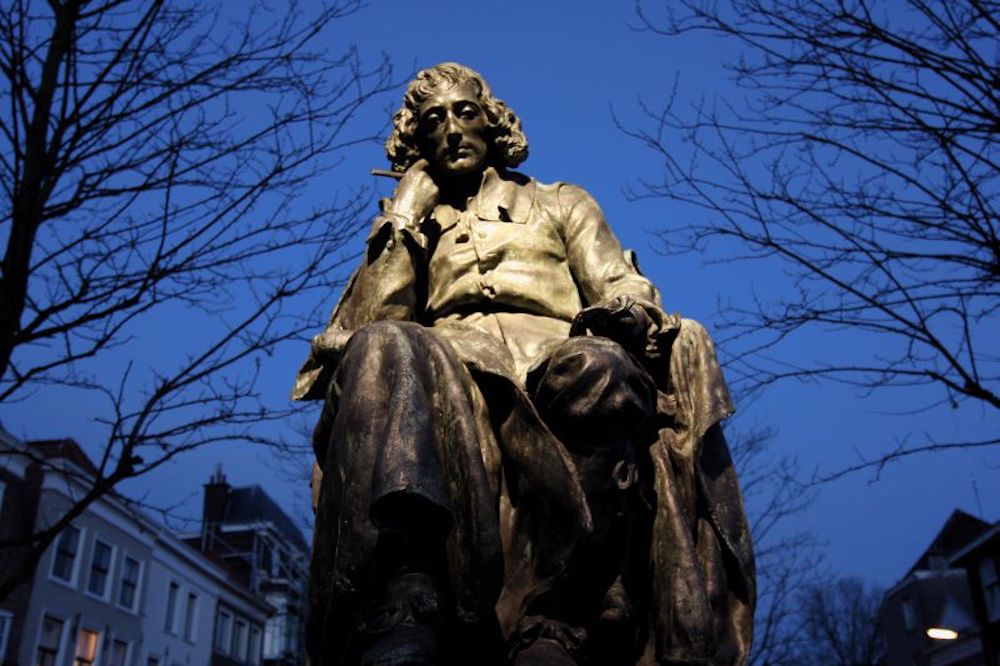
A statue of Dutch philosopher Baruch Spinoza in The Hague, Netherlands. Courtesy of Elvin/flickr.
by SANDRA LIM | NOVEMBER 20, 2020 (zocalopublicsquare.org)
He who loves God cannot endeavor that God loves him in return.
Do you know, I think the cool silver of this is hard to live by.
When there is anything you want very much, you are making up a story
all of the time, of how you will get it and how it will be.
You want the love of God and the human sort. A big treasure and a little treasure.
I wonder if you’re like me, a touch affronted by your own underlying avidity.
For now, it is pleasant to lie on one’s bed, chronicling everything in ice.
Though the hyenas in the room and the real flowers, these things take some of the innocence out of the day.
Want in a person is like hunger in a dog, Spinoza probably would not say.
His wakeful, solitary reasoning plainly outstrips my wildest intuition.
Yet insofar as my heart is a boot with a hole in it, I think this is what writing could be
—what he calls Nature, an existence no longer borne as means or ends.
SANDRA LIM is an associate professor of English at the University of Massachusetts Lowell. Her new book of poems, The Curious Thing, is forthcoming from W.W. Norton in 2021.
AstraZeneca announces its vaccine is effective, pharmaceutical and manufacturing companies work on “ultra-cold” distribution solutions, and Ad Council begins a campaign to boost vaccine trust. Here’s what you should know:
AstraZeneca’s vaccine is effective, and cheaper and easier to transport than its competitors AstraZeneca announced Monday that its Covid-19 vaccine is effective, according to interim analysis of its Phase III trial. The trial tested two different dosing regimens, one of which was 90 percent effective and the other 62 percent effective, making the shot’s average efficacy rate 70 percent. Unlike the other two effective vaccines, AstraZeneca’s can be stored and transported at normal fridge temperatures. At about $2.50 a dose, it’s also cheaper than its competitors.
By now, most of us have heard about the tremendous benefits of meditation for nearly every area of our lives.
Thanks to extensive research over the past few decades, the overwhelming scientific consensus seems to be that meditation is good for you.
But saying meditation is good for you is a bit like saying exercise is good for you.
Just as there are literally hundreds if not thousands of different forms of exercise, there are also hundreds if not thousands of different types of meditation.
And, as with physical exercise, different types of meditation are designed to achieve very different goals.
Various forms of meditation are being taught as a means of reducing stress, improving mental concentration and focus, enhancing athletic performance, boosting creativity, improving decision-making as well as generating relaxation, emotional well-being and a host of other physical, psychological, emotional and spiritual benefits.
Even among meditation techniques designed to bring about spiritual transformation, there are vast differences in both approach and outcome.
Given that you’re reading this email, chances are you’ve probably tried at least a few different kinds of meditation and may have already been meditating for several decades.
So, in order to begin this exploration of the approach to meditation I call “the practice of direct awakening,” I want to invite you to temporarily set aside everything you’ve already learned about meditation.
Not because I think what you’ve learned is wrong or that this approach is “better,” but simply because the approach to meditation I’m teaching may have little or nothing in common with meditation as you’ve been practicing it—other than the outer posture of sitting still for a while every day.
For most of us, meditating means silently repeating a mantra or sacred word, or following our breath, or labeling our thoughts and feelings as they arise, or trying to become a witness of our mind.
But this practice is about something entirely different.
It is a practice of directly recognizing our Enlightened essence or what is often referred to as “awakened awareness” or “awakened consciousness.”
In other words, the Practice of Direct Awakening is an approach to meditation designed to bring us into the immediate and direct awareness of our true nature beyond the mind and ego.
It is not a practice we do now to prepare for a future moment of Enlightenment.
It is not a practice we do now in order to get better at something or to strengthen particular capacities.
It is a practice of being Awake right now. Of being Enlightened right now.
This is possible because Enlightenment is the discovery of who we already are.
It is the discovery of our “true nature.”
Indeed, authentic spiritual awakening is about the radical realization that our true nature is not separate from the most unimaginably sacred thing in the Universe.
It is the discovery that in our essence, we are a luminous, breathtakingly glorious conscious awareness. That we are made of divinity. Or, as the Mahayana Buddhists would say, we have “Buddha Nature.”
The revolutionary proposition at the heart of the Practice of Direct Awakening is that we don’t have to wait for Awakening to happen to us.
We don’t have to spend a lifetime practicing various techniques in the hope that one day we will stumble upon awakened consciousness.
It’s possible to actually practice being Awake, or resting in our true nature which is always already awake.
To do so, we practice a series of “inner postures” that are derived from the experience of Enlightened consciousness itself.
For instance, one of the most remarkable aspects of Enlightened consciousness is the profound ease and contentment we experience when we are Awake to our true nature.
When we know who we truly are, we discover that we are utterly at peace with who we are. Indeed, we are deeply at ease with reality, no matter what challenges life brings our way.
But what if this profound ease of being and contentment wasn’t just something we could “experience” spontaneously in moments of epiphany?
What if we could actually practice being content with reality as it is?
I invite you to try this little experiment as a meditation practice for five minutes sometime today.
Simply sit still and let everything be as it is. For five minutes, be content with your experience, no matter what you are feeling, no matter what your mind is doing, and no matter what is happening in the outer circumstances of your life.
If you are able to really do this, to truly, unconditionally accept the moment as it is, you may find that a portal begins to open—a window into an unimaginable reality of sacred depth and infinite potential.
You see, when we are willing, even for a few minutes, to stop trying to change or become anything, we open the door to the profound and abiding peace that is an inherent expression of our true nature.
But this doesn’t mean that we become simply inert and passive in the face of life’s complexities.
When we learn how to embrace the depth of who and what we really are, we begin to transform into a living expression of this miraculous dimension of being.
Our cosmic essence or supernature is freed to express itself in this world.
When we discover this already divine essence, we are unleashed from the prison of the false and separate self.
We discover a life of boundless freedom, unassailable joy, and overflowing fullness and love.
What’s more, we discover that this higher spiritual self already contains most of the extraordinary abilities and capacities most of us are working so hard to develop.
When we discover this luminous, superconscious self, we find that we have access to a remarkable newfound “wisdom faculty”—an intuitive knowing that enables us to instantly discern powerful truths and spontaneously take effective actions without premeditation.
We are filled with a dynamic source of seemingly limitless energy to do what needs to be done in each moment.
We find that we can tap into an infinite well of creativity, as though the creative power of the cosmos itself is coursing through us.
We have an ability to tap into a wellspring of inner strength that gives us a remarkable steadiness and confidence in the face of life’s challenges.
We have access to an unprecedented ability to focus our attention.
We discover that we have become unimaginably sensitive and tuned in to the deeper needs and feelings of others and, more importantly, to the emergent, evolutionary needs of the moment.
And what may be the most powerful capacity of our true nature is what we might call “evolvability.”
This higher part of ourself is aligned with the impulse of evolution itself and is not resistant to change.
So, it contains a kind of superlearning ability, enabling us to step into new potentials and abilities with remarkable ease and fluidity.
All of these capacities and many others are the natural expression of Awakened consciousness.
And this Awakened consciousness is already our true nature or true self.
By learning to practice the natural inner postures of awakened consciousness, we can step into this extraordinary way of being right now.
Once deemed dangerous and illegal, psychedelic compounds have been rediscovered by the scientific, medical and psychiatric communities as research reveals their capacity to help patients with a range of maladies.
In stressful times, this surprising lesson from neuroscience may help to lessen your anxieties.
By Lisa Feldman Barrett
Dr. Barrett is a psychologist and neuroscientist.
Nov. 23, 2020 (NYTimes.com
Credit…Claire Merchlinsky
Five hundred million years ago, a tiny sea creature changed the course of history: It became the first predator. It somehow sensed the presence of another creature nearby, propelled or wiggled its way over, and deliberately ate it.
This new activity of hunting started an evolutionary arms race. Over millions of years, both predators and prey evolved more complex bodies that could sense and move more effectively to catch or elude other creatures.
Eventually, some creatures evolved a command center to run those complex bodies. We call it a brain.
This story of how brains evolved, while admittedly just a sketch, draws attention to a key insight about human beings that is too often overlooked. Your brain’s most important job isn’t thinking; it’s running the systems of your body to keep you alive and well. According to recent findings in neuroscience, even when your brain does produce conscious thoughts and feelings, they are more in service to the needs of managing your body than you realize.
And in stressful times like right now, this curious perspective on your mental life may actually help to lessen your anxieties.
Much of your brain’s activity happens outside your awareness. In every moment, your brain must figure out your body’s needs for the next moment and execute a plan to fill those needs in advance. For example, each morning as you wake, your brain anticipates the energy you’ll need to drag your sorry body out of bed and start your day. It proactively floods your bloodstream with the hormone cortisol, which helps make glucose available for quick energy.
Your brain runs your body using something like a budget. A financial budget tracks money as it’s earned and spent. The budget for your body tracks resources like water, salt and glucose as you gain and lose them. Each action that spends resources, such as standing up, running, and learning, is like a withdrawal from your account. Actions that replenish your resources, such as eating and sleeping, are like deposits.
The scientific name for body budgeting is allostasis. It means automatically predicting and preparing to meet the body’s needs before they arise. Consider what happens when you’re thirsty and drink a glass of water. The water takes about 20 minutes to reach your bloodstream, but you feel less thirsty within mere seconds. What relieves your thirst so quickly? Your brain does. It has learned from past experience that water is a deposit to your body budget that will hydrate you, so your brain quenches your thirst long before the water has any direct effect on your blood.
This budgetary account of how the brain works may seem plausible when it comes to your bodily functions. It may seem less natural to view your mental life as a series of deposits and withdrawals. But your own experience is rarely a guide to your brain’s inner workings. Every thought you have, every feeling of happiness or anger or awe you experience, every kindness you extend and every insult you bear or sling is part of your brain’s calculations as it anticipates and budgets your metabolic needs.
This view of the brain has many implications for understanding human beings. So often, for example, we conceive of ourselves in mental terms, separate from the physical. A bad stomach ache that follows an indulgent meal may send us to the gastroenterologist, but if we experience that same ache during a messy divorce, we may head to a psychotherapist instead. At the gastroenterologist’s office, we experience our discomfort as an underlying physical problem; at the therapist’s office, we experience the same discomfort as anxiety — a psychological disturbance, physically manifested.
In body-budgeting terms, however, this distinction between mental and physical is not meaningful. Anxiety does not cause stomach aches; rather, feelings of anxiety and stomach aches are both ways that human brains make sense of physical discomfort. There is no such thing as a purely mental cause, because every mental experience has roots in the physical budgeting of your body. This is one reason physical actions like taking a deep breath, or getting more sleep, can be surprisingly helpful in addressing problems we traditionally view as psychological.
We’re all living in challenging times, and we’re all at high risk for disrupted body budgets. If you feel weary from the pandemic and you’re battling a lack of motivation, consider your situation from a body-budgeting perspective. Your burden may feel lighter if you understand your discomfort as something physical. When an unpleasant thought pops into your head, like “I can’t take this craziness anymore,” ask yourself body-budgeting questions. “Did I get enough sleep last night? Am I dehydrated? Should I take a walk? Call a friend? Because I could use a deposit or two in my body budget.”
This is not a semantic game. It’s about making new meaning from your physical sensations to guide your actions.
I’m not saying you can snap your fingers and dissolve deep misery, or sweep away depression with a change of perspective. I’m suggesting that it’s possible to acknowledge what your brain is actually doing and take some comfort from it. Your brain is not for thinking. Everything that it conjures, from thoughts to emotions to dreams, is in the service of body budgeting. This perspective, adopted judiciously, can be a source of resilience in challenging times.
Lisa Feldman Barrett (@LFeldmanBarrett) is a professor of psychology at Northeastern University and the author of “Seven and a Half Lessons About the Brain,” from which this essay is adapted.
The Times is committed to publishing a diversity of letters to the editor. We’d like to hear what you think about this or any of our articles. Here are some tips. And here’s our email: letters@nytimes.com.
False conspiracy theories can drive people to violence, as they did for the Pittsburgh synagogue shooter, and affect political activity.
Anxious people are especially drawn to conspiratorial thinking, experiments show, and the mindset is also triggered by a loss of control.
You can spot hallmarks of fake theories, such as internal contradictions in the “evidence” and contentions based on shaky assumptions, psychologists say.
Stephan Lewandowsky was deep in denial. About six years ago the cognitive scientist had thrown himself into a study of why some people refuse to accept the overwhelming evidence that the planet is warming and humans are responsible. As he delved into this climate change denialism, Lewandowsky, then at the University of Western Australia, discovered that many of the naysayers also believed in outlandish plots, such as the idea that the Apollo moon landing was a hoax created by the American government. “A lot of the discourse these people were engaging in on the Internet was totally conspiratorial,” he recalls.
Lewandowsky’s findings, published in 2013 in Psychological Science, brought these conspiracy theorists out of the woodwork. Offended by his claims, they criticized his integrity online and demanded that he be fired. (He was not, although he has since moved to the University of Bristol in England.) But as Lewandowsky waded through one irate post after another, he discovered that his critics—in response to his assertions about their conspiratorial tendencies—were actually spreading new conspiracy theories about him. These people accused him and his colleagues of faking survey responses and of conducting the research without ethical approval. When his personal Web site crashed, one blogger accused him of intentionally blocking critics from seeing it. None of it was true.
The irony was amusing at first, but the ranting even included a death threat, and calls and e-mails to his university became so vicious that the administrative staff who fielded them asked their managers for help. That was when Lewandowsky changed his assessment. “I quickly realized that there was nothing funny about these guys at all,” he says.
The dangerous consequences of the conspiratorial perspective—the idea that people or groups are colluding in hidden ways to produce a particular outcome—have become painfully clear. The gunman who shot and killed 11 people and injured six others in a Pittsburgh synagogue in October 2018 justified his attack by claiming that Jewish people were stealthily supporting illegal immigrants. In 2016 a conspiracy theory positing that high-ranking Democratic Party officials were involved in a child sex ring involving several Washington, D.C., area restaurants incited one believer to fire an assault weapon inside a pizzeria. Luckily no one was hurt.
The mindset is surprisingly common, although thankfully it does not often lead to gunfire. More than a quarter of the American population believes there are conspiracies “behind many things in the world,” according to a 2017 analysis of government survey data by University of Oxford and University of Liverpool researchers. The prevalence of conspiracy mongering may not be new, but today the theories are becoming more visible, says Viren Swami, a social psychologist at Anglia Ruskin University in England, who studies the phenomenon. For instance, when more than a dozen bombs were sent to prominent Democrats and Trump critics, as well as CNN, in October 2018, a number of high-profile conservatives quickly suggested that the explosives were really a “false flag,” a fake attack orchestrated by Democrats to mobilize their supporters during the U.S. midterm elections.
One obvious reason for the current raised profile of this kind of thinking is that the U.S. president is a vocal conspiracy theorist. Donald Trump has suggested, among other things, that the father of Senator Ted Cruz of Texas helped to assassinate President John F. Kennedy and that Democrats funded the same migrant caravan traveling from Honduras to the U.S. that worried the Pittsburgh synagogue shooter.
But there are other factors at play, too. New research suggests that events happening worldwide are nurturing underlying emotions that make people more willing to believe in conspiracies. Experiments have revealed that feelings of anxiety make people think more conspiratorially. Such feelings, along with a sense of disenfranchisement, currently grip many Americans, according to surveys. In such situations, a conspiracy theory can provide comfort by identifying a convenient scapegoat and thereby making the world seem more straightforward and controllable. “People can assume that if these bad guys weren’t there, then everything would be fine,” Lewandowsky says. “Whereas if you don’t believe in a conspiracy theory, then you just have to say terrible things happen randomly.”
Discerning fact from fiction can be difficult, however, and some seemingly wild conspiracy ideas turn out to be true. The once scoffed at notion that Russian nationals meddled in the 2016 presidential election is now supported by a slew of guilty pleas, evidence-based indictments and U.S. intelligence agency conclusions. So how is one to know what to believe? There, too, psychologists have been at work and have uncovered strategies that can help people distinguish plausible theories from those that are almost certainly fake—strategies that seem to become more important by the day.T
THE ANXIETY CONNECTION
In May 2018 the American Psychiatric Association released the results of a national survey suggesting that 39 percent of Americans feel more anxious than they did a year ago, primarily about health, safety, finances, politics and relationships. Another 2017 report found that 63 percent of Americans are extremely worried about the future of the nation and that 59 percent consider this the lowest point in U.S. history that they can remember. These feelings span the political spectrum. A 2018 Pew Research Center survey found that the majority of both Democrats and Republicans feel that “their side” in politics has been losing in recent years on issues they find important.
Such existential crises can promote conspiratorial thinking. In a 2015 study in the Netherlands, researchers split college students into three groups. People in one group were primed to feel powerless. The scientists asked them to recall and write about a time in their lives when they felt they were not in control of the situation they were in. Those in a second group were cued in the opposite direction. They were asked to write about a time when they felt totally in control. And still others, in a third group, were asked something neutral: to describe what they had for dinner last night. Then the researchers asked all the groups how they felt about the construction of a new subway line in Amsterdam that had been plagued by problems.
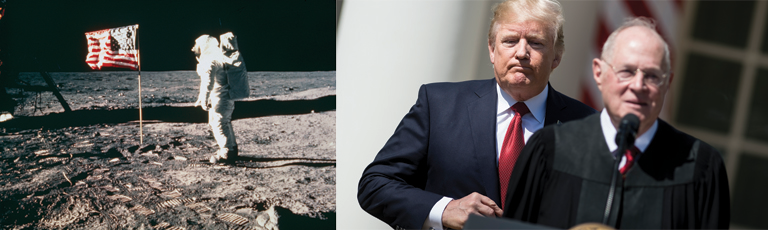
Conspiracy theorists believe plots are behind many situations. Some hold that the Apollo moon landing was faked (left), others that the White House forced Supreme Court Justice Anthony Kennedy to retire (right). Credit: Getty Images (left); Brendan Smialowski Getty Images (right)Others claim that Trump slogans on a mail bomber’s van were put there to frame Republicans (left). The gunman who killed 11 synagogue members in 2018 claimed a Jewish group was undermining America (right). Credit: Alamy (left); Jeff Swensen Getty Images (right)
Students who had been primed to feel in control were less likely than students in the other two groups to support conspiracy theories regarding the subway line, such as the belief that the city council was stealing from the subway’s budget and that it was intentionally jeopardizing residents’ safety. Other studies have uncovered similar effects. Swami and his colleagues, for instance, reported in 2016 that individuals who feel stressed are more likely than others to believe in conspiracy theories, and a 2017 study found that promoting anxiety in people also makes them more conspiracy-minded.
Feeling alienated or unwanted also seems to make conspiratorial thinking more attractive. In 2017 Princeton University psychologists set up an experiment with trios of people. The researchers asked all participants to write two paragraphs describing themselves and then told them that their descriptions would be shared with the other two in their group, who would use that information to decide if they would work with the person in the future. After telling some subjects that they had been accepted by their group and others that they had been rejected, the researchers evaluated the subjects’ thoughts on various conspiracy-related scenarios. The “rejected” participants, feeling alienated, were more likely than the others to think the scenarios involved a coordinated conspiracy.
It is not just personal crises that encourage individuals to form conspiratorial suspicions. Collective social setbacks do so as well. In a 2018 study, researchers at the University of Minnesota and Lehigh University surveyed more than 3,000 Americans. They found that participants who felt that American values are eroding were more likely than others to agree with conspiratorial statements, such as that “many major events have behind them the actions of a small group of influential people.” Joseph Uscinski, a political scientist at the University of Miami, and his colleagues have shown that people who dislike the current political party in power think more conspiratorially than those who support the controlling party. Recently in the U.S., a number of unproven conjectures have come from political liberals as conservatives have ascended to control the government. These include the charge that the White House coerced Anthony Kennedy to retire from the U.S. Supreme Court and the allegation that Russian president Vladimir Putin is blackmailing Trump with a video of him watching prostitutes urinate on a Moscow hotel bed.
When feelings of personal alienation or anxiety are combined with a sense that society is in jeopardy, people experience a kind of conspiratorial double whammy. In a study conducted in 2009, near the start of the U.S.’s Great Recession, Daniel Sullivan, a psychologist now at the University of Arizona, and his colleagues told one group that parts of their lives were largely out of their control because they could be exposed to a natural disaster or some other catastrophe and told another group that things were under their control. Then participants were asked to read essays that argued that the government was handling the economic crisis either well or poorly. Those cued about uncontrolled life situations and told their government was doing a bad job were the most likely to think that negative events in their lives would be instigated by enemies rather than random chance, which is a conspiratorial hallmark.
While humans seek solace in conspiracy theories, however, they rarely find it. “They’re appealing but not necessarily satisfying,” says Daniel Jolley, a psychologist at Staffordshire University in England. For one thing, conspiratorial thinking can incite individuals to behave in a way that increases their sense of powerlessness, making them feel even worse. A 2014 study co-authored by Jolley found that people who are presented with conspiracy theories about climate change—scientists are just chasing grant money, for instance—are less likely to plan to vote, whereas a 2017 study reported that believing in work-related conspiracies—such as the idea that managers make decisions to protect their own interests—causes individuals to feel less committed to their job. “It can snowball and become a pretty vicious, nasty cycle of inaction and negative behavior,” says Karen Douglas, a psychologist at the University of Kent in England and a co-author of the paper on work-related conspiracies.
The negative and alienated beliefs can also promote dangerous behaviors in some, as with the Pittsburgh shootings and the pizzeria attack. But the theories need not involve weapons to inflict harm. People who believe vaccine conspiracy theories, for example, say they are less inclined to vaccinate their kids, which creates pockets of infectious disease that put entire communities at risk.
TELLING FACT FROM FICTION
It may be possible to quell conspiracy ideation, at least to some degree. One long-standing question has been whether or not it is a good idea to counter conspiracy theories with logic and evidence. Some older research has pointed to a “backfire effect”—the idea that refuting misinformation can just make individuals dig their heels in deeper. “If you think there are powerful forces trying to conspire and cover [things] up, when you’re given what you see as a cover story, it only shows you how right you are,” Uscinski says.
But more recent research suggests that this putative effect is, in fact, rare. A 2016 study reported that when researchers refuted a conspiracy theory by pointing out its logical inconsistencies, it became less enchanting to people. And in a paper published online in 2018 in Political Behavior, researchers recruited more than 10,000 people and presented them with corrections to various claims made by political figures. The authors concluded that “evidence of factual backfire is far more tenuous than prior research suggests.” In a recent review, the researchers who first described the backfire effect said that it may arise most often when people are being challenged over ideas that define their worldview or sense of self. Finding ways to counter conspiracy theories without challenging a person’s identity may therefore be an effective strategy.
Encouraging analytic thinking may also help. In a 2014 study published in Cognition, Swami and his colleagues recruited 112 people for an experiment. First, they had everyone fill out a questionnaire that evaluated how strongly they believed in various conspiracy theories. A few weeks later the subjects came back in, and the researchers split them into two groups. One group completed a task that included unscrambling words in sentences containing words such as “analyze” and “rational,” which primed them to think more analytically. The second group completed a neutral task.
Then the researchers readministered the conspiracy theory test to the two groups. Although the groups had been no different in terms of conspiratorial thinking at the beginning of the experiment, the subjects who had been incited to think analytically became less conspiratorial. Thus, by giving people “the tools and the skills to analyze data and to look at data critically and objectively,” we might be able to suppress conspiratorial thinking, Swami says.
Analytic thinking can also help discern implausible theories from ones that, crazy as they sound, are supported by evidence. Karen Murphy, an educational psychologist at Pennsylvania State University, suggests that individuals who want to improve their analytic thinking skills should ask three key questions when interpreting conspiracy claims. One: What is your evidence? Two: What is your source for that evidence? Three: What is the reasoning that links your evidence back to the claim? Sources of evidence need to be accurate, credible and relevant. For instance, “you shouldn’t take advice from your mom about whether the yellow color under your fingernails is a bad sign,” Murphy says—that kind of information should come from someone who has expertise on the topic, such as a physician.
In addition, false conspiracy theories have several hallmarks, Lewandowsky says. Three of them are particularly noticeable. First, the theories include contradictions. For example, some deniers of climate change argue that there is no scientific consensus on the issue while framing themselves as heroes pushing back against established consensus. Both cannot be true. A second telltale sign is when a contention is based on shaky assumptions. Trump, for instance, claimed that millions of illegal immigrants cast ballots in the 2016 presidential election and were the reason he lost the popular vote. Beyond the complete lack of evidence for such voting, his assumption was that multitudes of such votes—if they existed—would have been for his Democratic opponent. Yet past polls of unauthorized Hispanic immigrants suggest that many of them would have voted for a Republican candidate over a Democratic one.
A third sign that a claim is a far-fetched theory, rather than an actual conspiracy, is that those who support it interpret evidence against their theory as evidence for it. When the van of the alleged mail bomber Cesar Sayoc was found in Florida plastered with Trump stickers, for instance, some individuals said this helped to prove that Democrats were really behind the bombs. “If anyone thinks this is what a real conservative’s van looks like, you are being willfully ignorant. Cesar Sayoc is clearly just a fall guy for this obvious false flag,” one person posted on Twitter.
Conspiracy theories are a human reaction to confusing times. “We’re all just trying to understand the world and what’s happening in it,” says Rob Brotherton, a psychologist at Barnard College and author of Suspicious Minds: Why We Believe in Conspiracy Theories (Bloomsbury Sigma, 2015). But real harm can come from such thinking, especially when believers engage in violence as a show of support. By looking out for suspicious signatures and asking thoughtful questions about the stories we encounter, it is still possible to separate truth from lies. It may not always be an easy task, but it is a crucial one for all of us.
This article was originally published with the title “Why We Believe Conspiracy Theories” in Scientific American 320, 3, 58-63 (March 2019)
NASA Faked the Moon Landing—Therefore, (Climate) Science Is a Hoax: An Anatomy of the Motivated Rejection of Science. Stephan Lewandowsky et al. in Psychological Science, Vol. 24, No. 5, pages 622–633; May 2013.
The Influence of Control on Belief in Conspiracy Theories: Conceptual and Applied Extensions. Jan-Willem van Prooijen and Michele Acker in Applied Cognitive Psychology, Vol. 29, No. 5, pages 753–761; September/October 2015.
Putting the Stress on Conspiracy Theories: Examining Associations between Psychological Stress, Anxiety, and Belief in Conspiracy Theories. Viren Swami et al. in Personality and Individual Differences, Vol. 99, pages 72–76; September 2016.
Suspicion in the Workplace: Organizational Conspiracy Theories and Work-Related Outcomes. Karen M. Douglas and Ana C. Leite in British Journal of Psychology, Vol. 108, No. 3; pages 486–506; August 2017.
ZenosWarbirds The quality of the copy of this important film by John Huston currently on YouTube isn’t very good, so I found a better one and tweaked it with digital image and sound processing. For the first time, Huston explored the diagnosis and treatment of what used to be called “battle fatigue” or “shell shock” among returning servicemen. This condition is now know as PTSD – post traumatic stress disorder. “Let There Be Light” wasn’t released to the public for 30 years for obvious reasons, but it’s a story that must be told because it’s still highly relevant to our times. Zeno, Zeno’s Warbird Videos http://zenoswarbirdvideos.com From the IMDB: “The final entry in a trilogy of films produced for the U.S. government by John Huston. This documentary film follows 75 U.S. soldiers who have sustained debilitating emotional trauma and depression. A series of scenes chronicle their entry into a psychiatric hospital, their treatment and eventual recovery.” Don’t blame me if there is a popup ad at the beginning this film — blame YouTube!
Former New York City Mayor Rudy Giuliani, lawyer for U.S. President Donald Trump, speaks during a news conference about lawsuits related to the presidential election results at the Republican National Committee headquarters in Washington, D.C., on Thursday Nov. 19, 2020. (Photo: Sarah Silbiger for The Washington Post via Getty Images)
Joe Biden has won states worth 306 Electoral College votes, 36 more than the 270 needed to win, and received in excess of 5 million more popular votes than Donald Trump. Yet Trump insists the election was stolen from him and he is the victor.
Trump started attacking the election months before it happened. He leveled unsupported charges of massive voter fraud from mail-in ballots to create doubt about the integrity of the election. Knowing that Democrats would cast mail ballots in the midst of the pandemic, Trump told his supporters to vote in person on Election Day to prematurely inflate his vote totals.
When he had an apparent lead on election night, Trump claimed victory and demanded that the vote-counting stop. Sure enough, as the tabulations continued, the mail ballots counted after Election Day put Biden over the top.
Trump Files Frivolous Lawsuits to Delay State Vote Count Certifications
Trump is setting the stage for an electoral coup. Republicans and the Trump campaign have filed frivolous lawsuits, alleging mostly technical violations of voting procedures, which would not change the outcome of the election even if they were meritorious.
“The real goal of this litigation is to create the perception of widespread voter fraud to whip up distrust for the election results.”
The real goal of this litigation is to create the perception of widespread voter fraud to whip up distrust for the election results. This would “give state legislatures political cover to appoint their own electors,” Robert Reich wrote.
Trump’s lawyers are seeking court orders to delay the certification of the votes in key states so GOP-controlled legislatures can appoint Trump electors notwithstanding Biden’s victories. Trump’s legal team has filed litigation in Pennsylvania, Michigan, and Arizona to prevent state officials from certifying the vote count.
On November 13, judges in Pennsylvania, Michigan, and Arizona dismissed Trump lawsuits State judges in Michigan have refused Trump’s requests to delay the certification of the vote count. Judge Timothy Kenny rejected the petition of two Republican poll watchers to delay ballot count certification in Detroit, calling misconduct allegations “not credible.” The plaintiffs’ request for an outside audit of the voting tallies would cause such a delay that electors might not be chosen by the mid-December vote in the Electoral College. Kenny, who characterized some accusations as “rife with speculation and guesswork,” said, “It would be an unprecedented exercise of judicial activism for this court to stop the certification process.
The same day, the law firm Porter Wright Morris & Arthur abruptly withdrew from the federal lawsuit they had filed in Pennsylvania on Trump’s behalf earlier in the week, out of concerns they were being used to undermine the integrity of the electoral process. Also last week, Snell & Wilmer withdrew from representation of Arizona’s Republican National Committee.
“These law firms have been under tremendous pressure as it became clear these claims were baseless, and that they were part of a broader campaign to delegitimize the election,” Wendy Weiser from the Brennan Center for Justice told ABC News.
Both Democratic and Republican election officials in virtually every state reported to The New York Times that there was no evidence fraud or other irregularities affected the election results.
Moreover, on November 12, a joint committee of the Department of Homeland Security’s Cybersecurity and Infrastructure Security Agency (CISA) confirmed the reliability of the election results, calling the November 3rd election “the most secure in American history ” The high-level committee concluded, “There is no evidence that any voting system deleted or lost votes, changed votes or was in any way compromised.”
On November 17, CISA Director Christopher Krebs denied that there was a manipulation of the election systems, tweeting, “59 election security experts all agree, ‘in every case of which we are aware, these claims either have been unsubstantiated or are technically incoherent.’ ” Later that day Trump fired Krebs for making a “highly inaccurate” statement, but Trump provided no evidence of his allegation.
Even Trump advisor Karl Rove wrote in a November 11th Wall Street Journal op-ed that Trump’s challenges “are unlikely to move a single state from Mr. Biden’s column, and certainly they’re not enough to change the final outcome.”
Attorney General William Barr is aiding and abetting Trump’s attempted coup. Just weeks before the election, the Justice Department changed its longstanding ban on voter fraud investigations before an election. Although he told department officials after the election that he didn’t see massive voter fraud, Barr saluted and marched to Trump’s orders. On November 9th, Barr empowered federal prosecutors to investigate “substantial allegations of voting and vote tabulation irregularities.” Sixteen federal prosecutors in charge of monitoring the election wrote to Barr that there is no evidence of substantial voting irregularities.
Richard Pilger, the Justice Department official in charge of voter fraud investigations left his job in protest against Barr’s order. But just the fact that the Department of Justice is authorizing investigations is designed to cast a cloud over the election. Indeed, a Politico/Morning Consult poll found that 70% of Republicans now think the election was not fair or free, compared with 35% of Republicans before the election. The purpose of Trump’s strategy of falsely alleging fraud from mail ballots combined with Barr’s baseless edict establishes fake doubt about the reliability of the vote tallies.
The Constitution gives state legislatures the power to decide how electors are selected. Article II says, “Each State shall appoint, in such Manner as the Legislature thereof may direct, a Number of Electors.” U.S. Code, Title 3, Section 1 requires that electors be chosen on Election Day. However, when a state “has failed to make a choice on [that] day,” then “the electors may be appointed on a subsequent day in such a manner as the legislature of such State may direct,” under Section 2.
But the states did not fail to choose the electors on Election Day. As a result of the voting process, which ended on November 3, Biden garnered more than 270 electoral votes. Trump’s own Department of Homeland Security affirmed that the election was the most secure in U.S. history. Even if charges of fraud were supported, that would not amount to a failure of state voters to choose electors on Election Day. Thus, state legislatures have no authority to select Trump’s electors in the states Biden won.
Trump supporters are targeting Pennsylvania, Michigan, Wisconsin, and Arizona—all of which Biden won—by raising allegations of fraud in hopes of persuading their state legislatures to override the will of the voters and appoint pro-Trump electors. All four states require that electors be awarded to the winner of the state’s popular vote on Election Day.
In October, the Republican majority leaders from Pennsylvania’s Senate and House co-authored an op-ed saying that the GOP-controlled legislature would not select electors to overrule the popular vote. They wrote, “The Pennsylvania General Assembly does not have and will not have a hand in choosing the state’s presidential electors or in deciding the outcome of the presidential election.” But on November 10, members of the Pennsylvania legislature announced their intention to investigate voter fraud allegations.
The Republican leader of Wisconsin’s assembly has long maintained that the legislature would not override the will of the voters and he reiterated that view on November 13. But the Wisconsin legislature is also investigating the election.
Republican leaders in Michigan’s legislature say legislative intervention would violate state law although the GOP-controlled legislature has mounted an investigation of the election. Michigan’s majority leader said, “It is not the expectation that our analysis would result in any change in the outcome.”
On November 17, in a dramatic and overtly political move, the two Republican officials on the four-member board of canvassers in Michigan’s largest county blocked certification of Wayne County’s vote count. But hours later, after powerful public comment and fierce outcry on traditional and social media, board chair Monica Palmer and William Hartmann reversed their “no” votes and the board unanimously certified the tally.
Trump called Palmer after the board meeting and also spoke with Hartmann. The next day, the two GOP board members tried to rescind their “yes” votes, claiming they were pressured into certifying the election with the promise of an audit of voting tallies in Detroit, which is 80% black. Jocelyn Benson, Michigan’s Secretary of State, said the resolution requesting an audit was not binding. The small number of votes that could be affected by the audit is not enough to change the election results.
Benson’s spokeswoman stated, “There is no legal mechanism for them to rescind their vote.”
On November 19, Trump invited the Republican leaders in the Michigan legislature to visit the White House on November 20. The Michigan Board of State Canvassers will review and certify the county certifications on November 23.
Arizona’s Republican House speaker affirmed that the legislature is “mandated by statute to choose according to the vote of the people,” but left open the possibility of changing electors if there is “some type of fraud—which I haven’t heard of anything.” At this point, he added, “I don’t see us in any serious way addressing a change in electors.”
Although Republican leaders in those four states deny they intend to replace Biden electors with Trump electors, allegations of fraud—however spurious—could reverse those intentions. Senate Majority Leader Mitch McConnell is hinting that Trump could win in the Electoral College.
States must count electoral votes and settle election disputes by December 8, the “safe harbor” deadline. On December 14, members of the Electoral College in each state will meet to elect the president.
If legislatures in Pennsylvania, Michigan, and Wisconsin attempt to appoint Trump electors against the will of their voters, the Democratic governors in those states would refuse to sign the certification of electors and submit Biden slates. Arizona has a Republican governor, who may well sign a slate of Trump electors notwithstanding Biden’s victory in that state, according to Harvard law professor Lawrence Lessig.
On January 6, Vice President Mike Pence will preside over the opening of the certified results before a joint session of the new Congress. If there are competing slates of electors in Arizona, Pence might decide to recognize the slate signed by the governor, Lessig says. If both a senator and a member of the House of Representatives sign an objection, the Senate and House would vote on whether to uphold the objection. In all likelihood, the House would vote to sustain the objection. If the Senate votes to overrule the objection, the slate signed by the governor would be counted. Even without Biden electors from Arizona, however, Biden should still have more than 270 electoral votes. But if the state legislatures in Pennsylvania, Michigan, and/or Wisconsin submit competing slates of electors, that dispute would also end up in Congress.
If neither Biden nor Trump secure 270 electoral votes, the 12th Amendment provides that the House would decide who becomes president. Each state gets one vote and since there are more red states than blue ones, Trump would win.
In the event that an electoral clash reaches the Supreme Court, all bets are off. In a recent concurrence, Brett Kavanaugh adopted the position that state legislatures are unconstrained in their selection of electors regardless of the popular vote. Kavanaugh based his theory on Chief Justice William Rehnquist’s concurrence in Bush v. Gore—the case that selected George W. Bush as president in 2000. But that theory has not attained majority support on the high court.
“In the event that an electoral clash reaches the Supreme Court, all bets are off.”
Indeed, in Chiafalo v. Washington earlier this year, a unanimous Supreme Court cited the “tradition more than two centuries old” that “electors are not free agents; they are to vote for the candidate whom the State’s voters have chosen.” Chiafalo affirmed the power of states to punish “faithless electors,” who don’t vote in accordance with the popular vote.
But in light of the willingness of Samuel Alito, Clarence Thomas, and Neil Gorsuch to stay the counting of votes mailed by November 3 but arriving by November 6, in spite of the Pennsylvania Supreme Court’s allowance of the three-day extension, those three might vote for Trump in a case of dueling electors. And Amy Coney Barrett could provide the fifth vote to hand the presidency to Trump.
Trump May Be Preparing for Armed Support of His Coup
Trump is apparently taking steps to quash popular opposition to his attempted electoral theft. On November 9, he fired Defense Secretary Mark Esper. Last summer, Esper refused to support Trump’s proposed deployment of active-duty troops against anti-racist protesters in the wake of the public lynching of George Floyd. Esper opposed the invocation of the Insurrection Act to call out active-duty military on U.S. soil. Mindful that massive protests would erupt if he succeeds in launching an electoral coup, Trump wants his loyalists in place to attack anti-coup demonstrators. Service members, however, have a duty to disobey unlawful orders and may refuse to follow Trump’s illegal directives to repress protesters.
On November 14, thousands of Trump loyalists, including the Proud Boys and other right-wing groups, assembled in Washington D.C. and claimed that Biden was stealing the election. Trump drove by on his way to play golf and gave the demonstrators a thumbs-up. Later that day, in a violently inciteful tweet, Trump urged police not to “hold back” and to crack down on “antifa scum.”
During the campaign, while he leveled false accusations of massive voter fraud, Trump refused to commit to a peaceful transfer of power. His refusal to concede and his strategy to illegally overturn the election results by stealing Biden’s electoral votes confirm his intention not to go peacefully.
“Since 1800, when the incumbent John Adams was defeated, every president who lost a reelection bid has left office,” Berkeley Law School Dean Erwin Chemerinsky told this author. “Not every transition was graceful, but every one occurred. We have seen so many instances around the world where that didn’t happen. I am hopeful that our institutions will work again and keep Trump from impermissibly remaining in office.”
The results of the election must be honored and the presidency awarded to Joe Biden. Hopefully, that will be accomplished with all deliberate speed and the absence of bloodshed. Donald Trump must leave the White House on January 20. As Elena Kagan wrote in the last line of the Chiafalo opinion, “Here, We the People rule.”
A version of this article first appeared on Jurist.