Jupiter conjunction Saturn: December 21, 2020

Published July 23, 2020 (astrologyforaquarius.com)

On January 26, 2020 Jupiter in the sky moved into orb of a conjunction aspect with Saturn.

On March 11, 2020 the World Health Organization declared coronavirus a pandemic. An outbreak of a highly infectious killer disease in Wuhan, China was now spreading rapidly around the world and countries were compelled to take drastic measures to contain the spread of the virus.

In an instant compulsory lockdown measures to safeguard public health radically disrupted daily life. Business activity ceased, spending stopped and unemployment soared. Schools, restaurants, theaters and gyms shut-up shop. The hospitality and arts sectors shut-down. Sport’s world closed.

The world economy crashed and governments were forced to provide financial assistance/stimulus to help save their fracturing economies. Share markets were resilient as optimism fuelled investor sentiment, but the slightest hint of economic disorder easily triggered panic selling.

Jupiter conjunction Saturn wouldn’t reach peak power till December 21, 2020 but from March to June 2020 their merger in the sky was already pulling the strings here on Earth.

The great 2020 covid-19 recession – maybe depression – was the major world event forecast by Jupiter conjunction Saturn; and in the Jupiter-Saturn conjunction chart Uranus – the planet of unexpected events, big shocks, sudden change, disruption, social unrest, rebellious behavior, protests and civil disobedience – is square Jupiter and Saturn. And Uranus has his fingerprints all over the covid-19 pandemic and its sudden and radical impact on daily life and economic activity.

So, with humanity plugged into Jupiter and Saturn in the sky during 2020 the event trend here on Earth will chiefly focus on living with covid, containing covid outbreaks, opening up economic activity, job creation, unemployment, income inequality, poverty, homelessness and the financial sectors capacity to keep on providing help and stimulus.

The aspect’s influence on you personally is via events related to the pandemic and its economic fallout and they’re mapped by the major progressions in your progressed chart.

Jupiter’s optimism fuels hope

Jupiter – ever the optimist – inclines towards hopefulness, buoyancy, expansion, higher prices and economic growth. His optimism fuels hope and raises expectations. It keeps economic activity churning. More goods are produced. Your pay packet expands. You’re willing to spend – even feeling extravagant. Prices and property values rise. 

Jupiter – the planet of selling on a small and large scale – is all about abundance, prosperity and more than enough, but with Jupiter conjunction Saturn there’s a shortage of optimism and prosperity and humanity is starved for hope. There’s scarcity rather than plenty.

Saturn’s pessimism spreads doubt and fear

Saturn – ever the pessimist – inclines towards gloominess, worry, uncertainty, contraction, lower prices and recession. His air of pessimism fuels sluggish economic activity. Fewer goods are produced. Your pay packet stands still or contracts. You’re less inclined to spend – feeling frugal. Prices and property values fall.

Saturn – the planet of safety and security – is all about cautious thinking and careful planning but with Jupiter conjunction Saturn there’s an abundance of doubt, fear and pessimism and humanity is starved for safety, order and certainty. There’s plenty of hardship and suffering.

Saturn’s death spiral

Covid-19 made people frightened. It revealed that life occasionally throws up a drastic situation and that you need to prepare for a prolonged torrential downpour, not just a rainy day.

In 2020 Saturn’s death spiral involves the coronavirus, lockdown measures, business closures, high unemployment, financial anxiety, personal and business bankruptcies, a loss of confidence, more unemployment, soaring levels of poverty, homelessness, more fear, despair and hopelessness and less trust in institutions and leaders.

Navigating covid-19 and economic recovery

Jupiter is the planet of finances, commerce, abundance and plenty and Saturn is the planet of pandemics, economy, unemployment and poverty; and Jupiter conjunction Saturn on December 21, 2020 is writing the script that describes the covid-19 world and the financial and economic landscape that governments, banks and economists are striving to navigate.

Governments are navigating their nation’s covid-19 pandemic and economic recovery. They’re providing financial stimulus and easing lockdown measures. They have to spend (Jupiter) to contain the economic fallout (Saturn) but they just can’t keep spending.

Scientists are striving to find a vaccine; health care workers are trying to save lives; and business is trying to open up and employ people. Economic recovery won’t happen till people get back to work and start spending. Business has to get to work creating jobs.

Public health and economic problems are chiefly political matters. They’re solved by politicians who make decisions as they see fit. And in 2020 some are prepared to sacrifice the public’s health on the altar of economy activity.

Jupiter conjunction Saturn brought economic crisis and financial readjustment on a global scale and humanity is relying on Jupiter’s banks to prevent a pandemic of Saturn’s poverty. It’s relying on Jupiter’s optimism and financial help and Saturn’s caution and careful planning to navigate a successful economic recovery.

But when Jupiter’s hope and optimism is defiled by Saturn’s fear and pessimism his over-optimism and irrational hope can make big mistakes.

When Jupiter’s irrational exuberance moves too fast lockdown restrictions are eased too soon and the coronavirus can come surging back; and when Saturn’s irrational caution moves too slow lockdown restrictions are eased too late and the economic hardship is exacerbated and prolonged.

December 21, 2020 is the day that Jupiter conjunction Saturn in the sky is at peak power. It doesn’t indicate that major events of the Jupiter-Saturn type will occur on that day. It does indicate that the covid-19 economic recovery, which involves living with the coronavirus, will be slow and prone to falter.

The 2020 covid-19 recession will likely last a very long time, so you could accurately conclude that humanity is tumbling in a covid-19 world and December 21, 2020 signposts a perilous abyss date by which any number of countries could fall off the economic cliff.

Jupiter moves out of orb of a conjunction aspect with Saturn on April 3, 2021.

The 1981 Jupiter-Saturn conjunctions timed the 1981-82 global recession.

The Y2000 Jupiter-Saturn conjunction timed the crash of the dotcom bubble.

And the 2020 Jupiter-Saturn conjunction timed the coronavirus pandemic and the 2020-21 global recession.

The next Jupiter-Saturn conjunction occurs October 1, 2040.

Terence McKenna: The Psychology of a Psychonaut

Uberboyo Terence McKenna REVEALS that the EGO is a prison that stops us from seeing the REALM OF JUICE ~ Work with Me 1-on-1 | https://uberboyo.com/coaching/ Get the BOYO BOOKLIST Emailed to you | https://mailchi.mp/4a01d0f87486/join-… PREMIUM Podcast (Patreon Replacement) | https://uberboyo.com/join/ LISTEN on Spotify, Overcast, iTunes | https://fanlink.to/boyoalert My Music | https://podlink.to/uberboyomusic Instagram | https://www.instagram.com/uberboyo/

Music in this video

Learn more

Listen ad-free with YouTube Premium

Song

Parabola (A Tribute To Tool)

Artist

The Metal Heroes

Licensed to YouTube by

LatinAutorPerf, UMPI, ARESA, Abramus Digital, BMG Rights Management (US), LLC, LatinAutor – PeerMusic, and 10 Music Rights Societies

Song

Vicarious

Artist

TOOL

Licensed to YouTube by

SME (on behalf of Volcano); UMPI, Abramus Digital, LatinAutor – SonyATV, ARESA, LatinAutor – PeerMusic, UNIAO BRASILEIRA DE EDITORAS DE MUSICA – UBEM, CMRRA, BMG Rights Management (US), LLC, and 6 Music Rights Societies

What America Owes to the Greeks and Romans

Cato the Younger/George Washington
Cato the Younger/George WashingtonCredit…From left: Hulton Archive/Getty Images; National Archive/Newsmakers

By Virginia DeJohn Anderson

  • Nov. 10, 2020, 5:00 a.m. ET (NYTimes.com)

FIRST PRINCIPLES
What America’s Founders Learned From the Greeks and Romans and How That Shaped Our Country

By Thomas E. Ricks

Stunned by the outcome of the 2016 presidential election, Thomas E. Ricks felt compelled to ask a question that is just as pertinent now as it was then: “What is America supposed to be, anyway?” His search for an answer led him back to the Revolutionary generation to discover their original vision for the nation. “First Principles: What America’s Founders Learned From the Greeks and Romans and How That Shaped Our Country” marks a departure for Ricks, a prizewinning journalist, the author of several works on contemporary military and national security affairs and a columnist for The Times Book Review. In this instructive new book, he offers a judicious account of the equivocal inheritance left to modern Americans by their 18th-century forebears.

“First Principles” tracks the intellectual journeys of the first four presidents by focusing on their immersion in the classics, which, according to Ricks, exerted an “underappreciated” influence on their thinking. Familiarity with classical learning, a hallmark of European and colonial American genteel culture, was not inherently revolutionary. When confronted by an imperial crisis that spiraled into an independence movement, however, American revolutionaries turned to this ancient knowledge as a practical guide in justifying their rebellion and forming new governments. It taught them that the success of their enterprise depended above all on the cultivation of virtue, placing the public good before private interest.

The foremost exemplar of the virtuous citizen, paradoxically, was the one early president who lacked a formal education and never learned to read Latin. But George Washington absorbed classical ideas from the surrounding culture and understood the symbolic importance of crafting a public image based on Roman models. Contemporaries likened him to Cato, the defender of the Roman Republic against the dictatorial Caesar. After the War of Independence, Washington was celebrated as America’s Cincinnatus, determined to relinquish military command and return to his farm. He was less pleased with those who compared him to Fabius, the Roman general who defeated Hannibal by avoiding battle in order to protect his own army.

John Adams, Thomas Jefferson and James Madison encountered the classics while at college. Adams developed his devotion to Cicero at Harvard, poring over the Roman’s famous orations in the hope of attaining a similar eloquence. At William and Mary, Jefferson’s tastes were more eclectic, shaped by the empiricism of teachers steeped in the Scottish Enlightenment and by a preference for Greek philosophers over Romans. Madison attended the College of New Jersey (now Princeton), whose Scottish-born president John Witherspoon relied on the classics to encourage students to love liberty and preserve virtue against encroachments from private interest.

Throughout their public careers, these men repeatedly sought wisdom from the ancients when grappling with the challenges of their own day. Each was keenly aware that all classical republics had eventually succumbed to tyranny once virtue gave way to a pernicious factionalism. Washington sternly warned against the “baneful effects of the spirit of party” in his farewell address. Of the four men, Adams remained the most steadfast classicist. At the time of the Stamp Act crisis in 1765, he urged his fellow colonists to “read the histories of ancient ages; contemplate the great examples of Greece and Rome.” During his presidency, he saw conspiracies around every corner, insisting that he alone remained above party. Deprived of a second term, he retreated to his Massachusetts farm, imagining himself a latter-day Cicero, who likewise ended up “watched, dreaded, envied, by all: no doubt Slandered by innumerable Emissaries, despized, insulted, belied.”

As for Jefferson, the opening words of the Declaration of Independence testified to his attraction to Epicurean thought, which emphasized happiness as “the aim of life.” Over time, classical models exerted a greater influence over his views of architecture than of politics. His first Inaugural Address, in 1801, barely mentioned virtue, and his reminder that “every difference of opinion is not a difference of principle” was at best a lukewarm warning against factionalism.

Madison, the youngest member of this foursome, proved the most intellectually dynamic. He could cite ancient texts as readily as anyone, but argue with them as well. Observing the weaknesses of the national government under the Articles of Confederation, he concluded that factions were unavoidable. The key was to limit their divisive potential through a system of checks and balances designed to prevent any one party from exercising overweening power — an absolute necessity for a republic far larger than any in the ancient world. At the Constitutional Convention, Madison made obligatory gestures toward virtue even as he led the way in devising a governmental structure that placed little reliance on the willingness of the people or their leaders to set aside their private interests for the good of all.

Vestiges of the founders’ fascination with the classics persisted into the early 19th century among many other Americans. New towns bore the names of ancient cities, public buildings followed Greek and Roman designs and politicians reviled their opponents as latter-day Catilines, likening them to one of the most notorious conspirators against the Roman Republic. Yet the heyday of classicism had passed. Such arcane knowledge smacked of elitism in an increasingly egalitarian age. With the rise of a market economy, Americans celebrated competition in pursuit of profit. Beginning with Andrew Jackson, the nation’s leaders embraced the factionalism of party politics. No orator urged his rowdy audience to be virtuous. It seemed that the only time Aristotle was mentioned was in defense of slavery.

So where does this leave Americans in the 21st century? Ricks concludes that the classically trained founders bequeathed us a mixed legacy. On the plus side, he commends the nation’s eventual extension of political rights to far more people than the landholding white male minority enfranchised in the Revolutionary era. One doubts, however, that the first four presidents — three of whom were slaveholders — would be “pleased” to see this, as Ricks suggests. He is on surer ground in claiming that they would be “appalled by how money has come to dominate American politics,” obliterating even the pretense of virtue.

“First Principles” ends with a list of 10 steps we might take to combat our present political ills. Americans should resuscitate virtue as a core principle of society and government, directing their energies at reforming everything — from campaign finance to a dysfunctional system of checks and balances — that undermines the public good. Yet, like Madison, we should be wary of placing our trust in people’s willingness to think less about themselves and more about others. Ricks urges Americans to fix their government so that it protects citizens from the inevitable lapses of a fallible people and, perhaps, even more fallible leaders. How to persuade a fractious people to improve their behavior, however, poses as much of a challenge to us as it did to the founders. The answer to Ricks’s opening question appears to be that today’s America is not at all what the founders hoped the nation would be, but represents instead what they feared it might become.

(Contributed by Sarah Flynn.)

IS A SECRET ANCIENT LANGUAGE OF WANDERERS A HARBINGER OF OUR FUTURE?

The European Travelers’ Tongue Rotwelsch—Which Gave Us the Phrase ‘in a Pickle’—Has United Outcasts for Centuries

Is a Secret Ancient Language of Wanderers a Harbinger of Our Future? | Zocalo Public Square • Arizona State University • Smithsonian

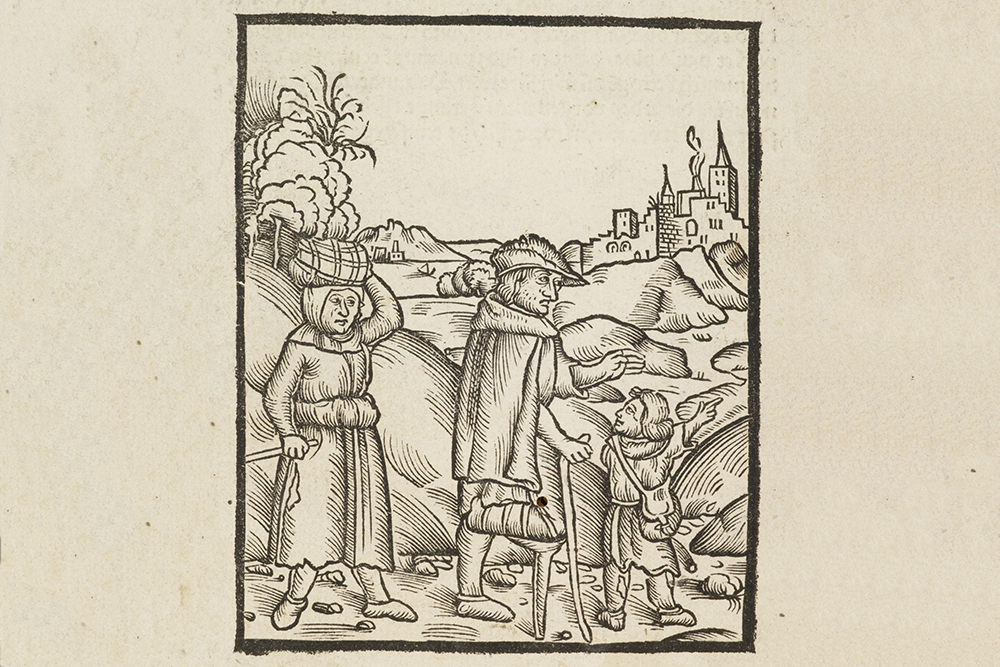
Woodcut from the popular Liber Vagatorum (“The Book of Vagabonds”). A Rotwelsch-German glossary of 219 items is preserved in the early 16th-century manuscript. Courtesy of Public Domain.

by MARTIN PUCHNER | NOVEMBER 9, 2020 (zocalopublicsquare.org)

Have you ever been “in a pickle”?

Then you have encountered Rotwelsch, an ancient language of the road, spoken by vagrants and refugees, merchants and thieves since the European Middle Ages. This tongue was based on a combination of German, Yiddish, Hebrew, a smattering of Romani (the language of Sinti and Roma, pejoratively known as Gypsies), Czech, and Latin—and was incomprehensible to all but initiates.

I was inducted into this strange language during my childhood in Southern Germany. My earliest memories were of strange figures, dressed in long coats that had lost their original colors, who showed up at our door with bags slung across their backs. When it rained, they smelled, and my mother wouldn’t let them inside the house. “I know what you want. Wait. I’ll be right back,” she would say.

Lingering near the door, I would hear noises from the kitchen, my mother fixing open-faced sandwiches. While they ate, she remained standing on the threshold, guarding the house, trying to make conversation. I had trouble understanding them because they spoke a strange dialect, mixed with words I didn’t know. When they had finished, my mother would take the empty plate from their hands and close the door, relieved that the encounter was over.

“Who are they?”

“They don’t have a home. We’re giving them something to eat.”

That didn’t answer my real questions. I wanted to know why: Why didn’t they have a home; why were we giving them something to eat; and why did they have such a strange way of talking?

Later, I asked my father about these men and their language. “They are Travelers,” he said.

I didn’t understand. “Where are they going?”

“They are people of the road, escaping to nowhere.”

My uncle eventually figured out why these travelers kept showing up at our house. One day, he found a sign discreetly carved into the foundation stone, a cross with a circle around it, which meant that there was bread to be had here. The signs were called zinken, a word derived from the Latin signum. But the language was Rotwelsch, also known as kochemer loshn, an adaptation of the Hebrew khokhem, which means a wise person and loshn, tongue, or language.It was a language of those in the know, the lingo of the wise guys. These signs and words pointed to an underground of traveling people; a world hidden away from view.

It was a language of those in the know, the lingo of the wise guys. These signs and words pointed to an underground of traveling people; a world hidden away from view. Over centuries, outcasts had developed this secret world, with its coded lingo, to protect themselves from a world hostile to strangers (Rotwelsch means beggar’s cant). Their special language bound migrants together, because it distinguished those who belonged to the road from those who didn’t.

My father taught me some of their words. A barn was a stinker, and prison was shul (ironically derived from the German word Schule, or school). And then there was my favorite Rotwelsch expression, “being in a pickle.”

As an idiom, it didn’t make sense. A pickle was a delicious snack, so why should it have anything to do with being in trouble? The answer to that question: Because there was a Rotwelsch expression for “having a difficult time,” that sounded, in German, like Saure Gurken Zeit, which was taken to mean “being in a pickle” and assimilated into German (and later, into English). This is how you, too, have been speaking Rotwelsch without knowing it.

When I emigrated to the United States in the 1990s, I was surprised to find that Rotwelsch had preceded me. I got a first inkling when I came across hobo signs, which I recognized as being derived from Rotwelsch zinken, including the one that had drawn travelers to my childhood home. Central European vagrants had probably brought these Rotwelsch signs with them in the 19th century, a time of renewed immigration from German-speaking lands.

But the high tide of hobo zinken came during the Great Depression, when the signs were used in much the same way that Central European itinerants had used them: to navigate the difficult life on the road. The signs were adapted to suit the needs of their new users; a sickle, for example, would warn fellow hobos of dishonest farmers, who would hire you for a day and then cheat you of your wages. American hoboes sometimes walked the road, but they also sneaked rides on trains, which is why a sign emerged, that of a rudimentary train engine, to mark a good place to hop on a train.

Along with Rotwelsch zinken, Central European immigrants also brought their distinct way of speaking to the U.S. Once I started to look for traces of the language, I found them hidden here and there. The Jewish gangs of New York called a whorehouse nafke bias (a blend of nafke, Aramaic for difference; nekeyve, woman and; bayes means house in Hebrew), a thief gonef, just as Central European Rotwelsch speakers had done. They were also accustomed to going to school, meaning prison.

I have been thinking about Rotwelsch while stuck at home during the coronavirus lockdown, contemplating movement and mobility and how we talk about it. Only relatively few Rotwelsch words and signs made it to America, but the existence and persistent of the language raises questions that connect with today’s American political struggles. How much mobility are we willing to tolerate from those who seek to cross borders? To what extent will we accept people who don’t talk like us? How do we police vagrancy and homelessness? Rotwelsch has so many words for police, for prison, and for being arrested because of the increasing criminalization of mobile populations that continues to this day.

Throughout the 700 years of their history, Rotwelsch speakers have been persecuted by police, who didn’t appreciate their itinerant lifestyle and secret words. Countries and communities across Eurasia erected borders and invented passports to control the movements of people, which made the itinerant lifestyle even more difficult. At one time or another, Rotwelsch speakers have attracted the ire of every kind of oppressive ideologue in the modern world, including anti Semites, due to the Yiddish influence in their language.

If you’re looking for the ultimate outsiders, the ultimate scapegoats, Rotwelsch speakers, who numbered in the thousands or perhaps even tens of thousands at a time, would fit the bill. They were not ethnically defined (despite the anti Semitic attacks, which made them the first to land in Nazi concentration camps). All they had in common was the life of the road, the rejection of settled society—and their mysterious language.

When we emerge from the lockdown, a world that was already experiencing high levels of migration will see even more migrants, perhaps more than 100 million, many of them forced on the road by climate change and economic displacement. The future thus promises an ever-larger class of wanderers, many forced to live underground. Inevitably, some will develop new words and even languages as a protection against the police and as a source of identity.

What if Rotwelsch wasn’t a historical curiosity, but a harbinger of the future?

MARTIN PUCHNER is Byron and Anita Wien Professor of English and Comparative Literature at Harvard University, and author of the new book The Language of Thieves: My Family’s Obsession with a Secret Code the Nazis Tried to Eliminate.

Sir David Attenborough: Nature Shows That Prosperity Doesn’t Mean Endless Expansion

VIA GRAND CENTRAL

In Defense of “Green Growth” and Sustaining a Mature Plateau

By David Attenborough

November 9, 2020 (lithub.com)

Our first lesson from nature concerns growth. We have arrived at this moment of desperation as a result of our desire for perpetual growth in the world economy. But in a finite world, nothing can increase forever. All the components of the living world—individuals, populations, even habitats—grow for a period of time, but then they mature. And once mature, they may thrive.

Things can thrive without necessarily getting bigger. An individual tree, an ant colony, a coral reef community or the entire Arctic ecosystem, all exist for a prolonged period when mature as successful entities. They grow to a point, then make the most of things—exploiting their newly won positions, but in a sustainable manner.

They move from the period of exponential growth, the log phase, past a peak to a plateau. And, as a result of the way they interact with the living world beyond, that stable plateau period can last indefinitely.

That is not to say that a plateauing wild community does not change. The Amazon is tens of millions of years old. In that time, it has covered roughly the same patch of Earth with its vast closed canopy as it did until recently, thriving in one of the planet’s prime pitches. The amount of sunlight and rainfall it has received and the level of nutrients in its soil may have been roughly constant throughout.

But the species in its living community will have changed significantly in that time. Like teams shifting their position in a sports league table, or share prices on a stock exchange, in any one year there will have been winners and losers. There will always be populations on the ascent, moving into an area and multiplying at the expense of another; individual trees seizing the site where another has fallen. There will be new arrivals, and others that fade away.

Some of these new arrivals may have innovations that boost the opportunities for others—a new species of bat, for example, may act as a pollinator for night-flowering plants. Conversely, the loss of species may, at the same time, reduce opportunities elsewhere in the forest.

Ever adjusting, reacting and refining, the Amazon rainforest community can continually thrive over tens of millions of years without demanding any further raw resources from the Earth. It is the most biodiverse place on the planet—the most successful of life’s current enterprises—but it has no need for net growth. It is mature enough to simply last.Green growth may come from making products more energy-efficient, or from turning dirty, impactful activities into clean, low or zero-impact activities.

Humankind currently appears to have no intention of reaching such a mature plateau. As any economist will explain, over the  last 70 years all our social, economic and political institutions have adopted one overriding goal—an ever-increasing growth in each nation, judged by the crude measure of gross domestic product. The organization of our societies, the hopes of business, the promises of politicians, all require GDP to climb ever upwards. The Great Acceleration is the product of this fixation, and the Great Decline of the living world, its consequence.

For, on a finite planet, the only way to achieve perpetual growth is to take more from elsewhere. What felt like a miracle of the modern age was just stealing. As the appalling statistics I listed at the end of my witness statement attest, we have taken everything we have directly from the living world. And we have done this while ignoring the damage we have been doing.

The species loss caused by deforestation to grow the soy we need to feed the chicken we eat is not accounted for. The impact on marine ecosystems of the plastic water bottle that we buy and discard is not accounted for. The greenhouse gases produced when making the concrete for the breezeblocks of the extension we build are not accounted for. Little wonder that all of the damage we have done to Earth has crept up on us so quickly.

A new discipline within economics is attempting to solve this problem. Environmental economists are focused on building a sustainable economy. Their ambition is to change the system so that markets around the world benefit not just profits, but also people and the planet too. They call these the three Ps. Many among them have high hopes for what they term green growth—a type of growth that has no negative impact on the environment.

Green growth may come from making products more energy-efficient, or from turning dirty, impactful activities into clean, low or zero-impact activities, or from driving growth in the digital world, which, when powered by renewables, could be described as a low-impact sector.

The advocates of green growth point to a history of waves of innovation that have periodically revolutionized the possibilities for humankind. First there was the advent of water power in the 18th century, enabling mills to drive machinery that hugely increased the productivity of a business. Then came our adoption of fossil fuels and steam power, which not only caused an industrial revolution in manufacturing, but also brought railways and shipping and eventually aircraft that could distribute people and products quickly across the globe.

Three waves followed. The electrification of the early 20th century that brought telecommunications, the space age of the 1950s that presided over a consumer boom in the West, and the digital revolution that launched the internet and brought hundreds of smart devices into our homes. All these have radically changed the world and brought booms in business.

The hope and expectation of many environmental economists is that a sixth wave of innovation—the sustainability revolution—is almost upon us. In this new order, innovators and entrepreneurs will make fortunes by devising products and services that reduce our impact on the planet. Of course, we are already experiencing the start of this—low-energy light bulbs, cheap solar power, plant burgers that taste like meat, sustainable investments.

The hope is that, faced with the scale and urgency of our planet’s Great Decline, politicians and business leaders will stop subsidizing damaging industries and rapidly turn to sustainability as the popular, sensible option for growth to continue, at least for a while.

In the end, though, green growth is still growth. Will humankind ever be able to move beyond its growth phase, mature and settle into a plateau? Can it, perhaps on the other side of that sixth wave of innovation, become like the Amazon—thriving, refining, improving sustainably over the long term, but without getting bigger? There are those who hope for a future in which humankind globally detaches itself from its addiction to growth, moves on from GDP as the be-all and end-all, and becomes focused upon a new, sustainable measure of success that involves all three Ps.

The Happy Planet Index, created by the New Economics Foundation in 2006, attempts to do just that, combining a nation’s ecological footprint with elements of human well-being, such as life expectancy, average levels of happiness and a measure of equality. When you rank countries by this index, you get a completely different league table than from GDP alone. In 2016, Costa Rica and Mexico came top, with better average well-being scores than the USA and UK at a fraction of the ecological footprint.

The Happy Planet Index is certainly not foolproof. Since it is a merged score, it’s possible, like Norway, to rank highly with a heavy footprint if your well-being score is very high. It is also possible, like Bangladesh, to rank highly with poor well-being, if your footprint is light. Yet the Happy Planet Index and others like it are being seriously considered by a number of nations as alternatives to GDP, and encouraging a wider debate about the sum purpose of all humankind’s efforts on Earth. In 2019, New Zealand made the bold step of formally dropping GDP as its primary measure of economic success.Like a sapling in the Amazon eagerly grasping its opportunity to take over a clearing, we have concentrated all our efforts to date on growth.

It didn’t adopt any of the existing alternatives, but instead created its own index based upon its most pressing national concerns. All three Ps—profit, people and planet—were represented. In this single act, Prime Minister Jacinda Ardern shifted the priorities of her whole country away from pure growth and towards something that better reflects the issues and aspirations many of us have today.

The change in agenda may have made her decisions more straightforward when coronavirus arrived in February 2020. She locked the country down before there had been a single death, while other nations hesitated, nervous perhaps, of the effects on the economy. By early summer, New Zealand had few new cases, and could go back to work and mix freely. New Zealand may be a guiding light.

Surveys in other nations show that people across the world are now keen for their governments to prioritize people and planet over profit alone. It is an indication that voters and consumers everywhere may be ready for a sustainable, and ultimately, as Kate Raworth terms it, growth-agnostic world. Every nation has a journey to make to become prosperous and good for its people and good for the planet.

The wealthy nations that have benefitted from unsustainable growth have the formidable task of maintaining a good standard of living while radically reducing their footprints. Poorer nations have the very different challenge of radically raising their standards of living in a way that’s never been done before—while achieving a sustainable footprint. Through this lens all nations are now developing nations with work to do, and all will need to switch to green growth, and join the sustainable revolution.

Humankind has yet to mature. Like a sapling in the Amazon eagerly grasping its opportunity to take over a clearing, we have concentrated all our efforts to date on growth. But, according to the environmental economists, we must now curb our passion for growth, distribute resources more evenly and start to prepare for life as a mature canopy tree. Only then will we be able to bask in the sunlight that our speedy development won for us, and enjoy an enduring, meaningful life.

__________________________________

Excerpted from the book A Life on Our Planet: My Witness Statement and a Vision for the Future by David Attenborough with Jonnie Hughes. Copyright © 2020 by David Attenborough Productions Ltd. Reprinted with permission of Grand Central Publishing. All rights reserved. 

The Coronavirus Update

(image) WIRED Coronavirus Update Logo

11.09.20 (wired.com)

Pfizer releases promising vaccine news, president-elect Biden announces his coronavirus task force, and a new mutation develops on Danish mink farms. Here’s what you should know:

Headlines:

Early data indicates Pfizer’s coronavirus vaccine is more than 90 percent effective

Pfizer announced on Monday that its coronavirus vaccine is more than 90 percent effective, according to an initial review of Phase III trial data. No significant safety concerns were found. The company is expected to apply for emergency authorization from the FDA later in November once it has the necessary two months of safety data. While these results are very early and have not been peer-reviewed, they’re very promising. The government’s Operation Warp Speed promised Pfizer $1.95 billion to deliver 100 million doses, but did not pay for research or development of this vaccine.

Joe Biden announces 13-member coronavirus task force and pandemic plans

This morning, Joe Biden announced the members of his coronavirus task force and their preliminary plans for tackling the pandemic. The task force is made up entirely of doctors and public health experts, including an Obama-era surgeon general and former FDA commissioner. Biden has emphasized the importance of consistent messaging across the country, which members will work with state and local officials to develop.

Covid-19 vaccine from Pfizer and BioNTech is strongly effective, early data from large trial indicate

By MATTHEW HERPER @matthewherper

NOVEMBER 9, 2020 (statnews.com)

Medical ampules
ADOBE

Pfizer and partner BioNTech said Monday that their vaccine against Covid-19 was strongly effective, exceeding expectations with results that are likely to be met with cautious excitement — and relief — in the face of the global pandemic.

The vaccine is the first to be tested in the United States to generate late-stage data. The companies said an early analysis of the results showed that individuals who received two injections of the vaccine three weeks apart experienced more than 90% fewer cases of symptomatic Covid-19 than those who received a placebo. For months, researchers have cautioned that a vaccine that might only be 60% or 70% effective. 

The Phase 3 study is ongoing and additional data could affect results.

In keeping with guidance from the Food and Drug Administration, the companies will not file for an emergency use authorization to distribute the vaccine until they reach another milestone: when half of the patients in their study have been observed for any safety issues for at least two months following their second dose. Pfizer expects to cross that threshold in the third week of November.

“I’ve been in vaccine development for 35 years,” William Gruber, Pfizer’s senior vice president of vaccine clinical research and development, told STAT. “I’ve seen some really good things. This is extraordinary.” He later added: “This really bodes well for us being able to get a handle on the epidemic and get us out of this situation.”

Although it is a bright spot in the battle against the pandemic and a triumph for Pfizer and BioNTech, a German company, key information about the vaccine is not yet available. There is no information yet on whether the vaccine prevents severe cases, the type that can cause hospitalization and death.

Nor is there any information yet on whether it prevents people from carrying the virus that causes Covid-19, SARS-CoV-2, without symptoms. 

Without more information, it’s too early to start predicting how much of an impact the vaccine could make, said Michael Osterholm, director of the University of Minnesota’s Center for Infectious Diseases Research and Policy.

“I don’t want to dampen any enthusiasm for this vaccine. I just want us to be realistic,” Osterholm said. “For a vaccine to really have maximal impact, it’s going to have to also reduce severe illness and death. And we just don’t know yet.”

Because the vaccine has been studied for only a matter of months, it is impossible to say how long it will protect against infection with the virus. The vaccine does cause side effects, including aches and fevers, according to previously published data. Gruber said that he believed the side effect profile was comparable to standard adult vaccines, but probably worse than Pfizer’s pneumonia vaccine, Prevnar, or a flu shot.

The results have not been peer-reviewed by outside scientists or published in a medical journal, and even Pfizer and BioNTech have been given no other  details about how the vaccine performed by the independent monitors overseeing the study.

Initial supplies of the vaccine, if authorized, will be limited. Pfizer says up to 50 million doses could be available globally. by the end of the year, with 1.3 billion available in 2021. There are also expected to be distribution challenges. The vaccine must be stored at super-cold temperatures, which could make it extremely difficult to deliver to many places. Pfizer has said it is confident those issues can be managed.

Although the estimate of the efficacy of the vaccine could change as the study is completed, it is close to a best-case scenario. That also bodes well for other vaccines in the late stages of testing, including those developed by Moderna, AstraZeneca, and Johnson & Johnson. 

“If that headline really number really holds up, that is huge. That is much better than I was expecting and it will make a huge difference,” said Ashish Jha, the dean of the School of Public Health at Brown University. He cautioned, however, that it is always difficult to evaluate science via press release and that researchers will need to see the full results. He noted that side effects are something to watch, because even if there are no serious long-term complications, people feeling sick for a day or two could lead some to be hesitant to take a vaccine.

“This really bodes well for us being able to get a handle on the epidemic and get us out of this situation.”

WILLIAM GRUBER, PFIZER SENIOR VICE PRESIDENT OF VACCINE CLINICAL RESEARCH AND DEVELOPMENT

Both Pfizer’s vaccine and Moderna’s use messenger-RNA, or mRNA, technology, which uses genetic material to cause the body to create a protein from the virus; the immune system then recognizes the virus and learns to attack. Other vaccines in the late stages of development use genetically engineered viruses for a similar purpose, or pieces of protein that are directly injected. No mRNA product has ever been approved by regulators.

The story of how the data have been analyzed seems to include no small amount of drama. Pfizer, seeing an opportunity to both help battle a pandemic and demonstrate its research prowess, made decisions that were always likely to make its study the first of a Covid-19 vaccine to produce data — including its decision to have an independent group of researchers, known as a data safety and monitoring board, take an early look at the data in the 44,000-volunteer study before its completion. 

The first analysis was to occur after 32 volunteers — both those who received the vaccine and those on placebo — had contracted Covid-19. If fewer than six volunteers in the group who received the vaccine had developed Covid-19, the companies would make an announcement that the vaccine appeared to be effective. The study would continue until at least 164 cases of Covid-19 — individuals with at least one symptom and a positive test result — had been reported.

Scientists can now design genetic material called mRNA to help us build immunity to certain viruses, including SARS-CoV-2, the coronavirus that causes Covid-19. Find out how mRNA vaccines work in this video.HYACINTH EMPINADO/STAT

That study design, as well as those of other drug makers, came under fire from experts who worried that, even if it was statistically valid, these interim analyses would not provide enough data when a vaccine could be given to billions of people. 

In their announcement of the results, Pfizer and BioNTech revealed a surprise. The companies said they had decided not to conduct the 32-case analysis “after a discussion with the FDA.” Instead, they planned to conduct the analysis after 62 cases. But by the time the plan had been formalized, there had been 94 cases of Covid-19 in the study. It’s not known how many were in the vaccine arm, but it would have to be nine or fewer.

Gruber said that Pfizer and BioNTech had decided in late October that they wanted to drop the 32-case interim analysis. At that time, the companies decided to stop having their lab confirm cases of Covid-19 in the study, instead leaving samples in storage. The FDA was aware of this decision. Discussions between the agency and the companies concluded, and testing began this past Wednesday. When the samples were tested, there were 94 cases of Covid in the trial. The DSMB met on Sunday.

This means that the statistical strength of the result is likely far stronger than was initially expected. It also means that if Pfizer had held to the original plan, the data would likely have been available in October, as its CEO, Albert Bourla, had initially predicted.

Gruber said that there will not be another interim analysis conducted in the study. He also said that Pfizer’s estimate that it could file for authorization of the vaccine by the third week of November was based on the assumption that the FDA would be willing to accept two-month safety data on half the volunteers in the study as initially planned, when it was to include 30,000 volunteers, not more than 44,000, as is now the case. Those discussions are ongoing.

But Gruber said he now expects that by the time of the planned meeting of the FDA’s vaccine advisory committee in December, the study’s efficacy portion could be completed, having reached 164 cases of Covid-19.

He also emphasized that although there will only be a few months of data from this study, results from earlier studies make him optimistic that immunity from the vaccine will not wane rapidly.

The study has enrolled  43,538 volunteers the companies said, and 38,955 have received their second dose. About 42% of global participants and 30% of U.S. participants have racially and ethnically diverse backgrounds.

Bourla, Pfizer’s CEO, said the results mark “a great day for science and humanity,” in a statement, saying they provide “initial evidence of our vaccine’s ability to prevent Covid-19.” He added: “We look forward to sharing additional efficacy and safety data generated from thousands of participants in the coming weeks.”

Helen Branswell contributed reporting.

About the Author

Matthew Herper

Senior Writer, Medicine

Matthew covers medical innovation — both its promise and its perils.matthew.herper@statnews.com@matthewherper

(Contributed by Michael Kelly, H.W.)

Book: “The Deepest Well: Healing the Long-Term Effects of Childhood Adversity”

The Deepest Well: Healing the Long-Term Effects of Childhood Adversity

The Deepest Well: Healing the Long-Term Effects of Childhood Adversity

by Nadine Burke Harris 

Dr. Nadine Burke Harris was already known as a crusading physician delivering targeted care to vulnerable children. But it was Diego — a boy who had stopped growing after a sexual assault — who galvanized her journey to uncover the connections between toxic stress and lifelong illnesses.

The news of Burke Harris’s research is just how deeply our bodies can be imprinted by ACEs—adverse childhood experiences like abuse, neglect, parental addiction, mental illness, and divorce. Childhood adversity changes our biological systems, and lasts a lifetime.  For anyone who has faced a difficult childhood, or who cares about the millions of children who do, the scientific insight and innovative, acclaimed health interventions in The Deepest Well represent hope for preventing lifelong illness for those we love and for generations to come​.

(Goodreads.com)

Staying Present

By Wendy Mandy
In uncertain times, I think the best way forward is to stay present.

There have been so many distractions this week that have made us feel stressed and anxious.  Now. more than ever, we need to play and laugh and do our daily practises to stay present to our life.  What is important is to create a wave of positivity from yourself to the outside world.  Generosity works towards yourself first and then out towards others.  Be loving and generous as this will come back to you!  However anxious you feel, get up every day and pick the daily practise you need to keep you aligned.  Is it meditation, a walk, Pilates, dancing in your kitchen?  I promise you, generosity works.

For example, last week I lent an amount to a friend that put me into overdraft, but I trusted it was right!  I couldn’t believe I got a tax rebate back to the exact amount!  LOVE REWARDS YOU EVERY TIME.  Generosity works.  It creates a wave of flow in your life.  It may not come back from where you sent the wave of love, but that energy will come from somewhere else right back to you! 

At this time I also feel it is important to stay away from conflict.  It is surprising who wants to wear masks and who doesn’t, who trusts Biden or Trump and who doesn’t.  Be yourself at all times and trust yourself!  Be confident that you will be in your flow!  It’s a bumpy ride now, but love wins!  If you keep love and sureness about your own intuitions in your heart and stay away from arguments, life is going to be wonderful as it should be.

We are heading to a very different narrative to the one being offered at the moment by the matrix. but it is up to each and everyone of us to dream a new world into being.  We must clean up our body, mind and emotions and connect to our souls with daily practise: love, generosity, laughing, dancing.  Also, today and this week, hug anyone who gives you permission.  We all need one.

Love Wendy
Copyright © 2020 Wendy Mandy UK, All rights reserved.

Our mailing address is:
Wendy Mandy Acupuncture
Bath, Somerset BA1
United Kingdom