Empathic Illnesses: Do You Absorb Other People’s Symptoms?

By Dr. Judith Orloff (drjudithorloff.com)

Are you an empath? Take the test here to determine your empath score.
Take the test >

Empaths Survival Guide

Empathic illnesses are those in which you manifest symptoms that are not your own. Many patients have come to me labeled “agoraphobic” with panic disorders, chronic depression, fatigue, pain, or mysterious ailments that respond only partially to medications or psychotherapy. Some were nearly housebound or ill for years. They’d all say, “I dread being in crowds. Other people’s anger, stress, and pain drain me, and I need a lot of alone time to refuel my energy.” When I took a close history of all these patients I found that they were what I call “physical empaths:” people whose bodies are so porous they absorb the symptoms of others. I relate because I am one. Physical empaths do not have the defenses that others have to screen things out. As a psychiatrist, knowing this significantly changed how I treated these patients. My job became teaching them to center and protect themselves, set healthy boundaries, and let go of energy they picked up from others.

To determine if you are a physical empath take the following quiz.

Quiz: Am I a Physical Empath?
Ask yourself:Have I been labeled as overly sensitive or a hypochondriac?Have I ever sat next to someone who seemed nice but suddenly my eyelids got heavy and I felt like taking a nap?Do I feel uneasy, tired, or sick in crowds and avoid them?Do I feel someone else’s anxiety or physical pain in my body?Do I feel exhausted by angry or hostile people?Do I run from doctor to doctor for medical tests, but I’m told “You’re fine.”Am I chronically tired or have many unexplained symptomsDo I frequently feel overwhelmed by the world and want to stay home?

If you answered “yes” to 1-3 questions you are at least part empath. Responding yes to 4 to5 questions indicates you have moderate degree of physical empathy. 6 to 7 “yeses” indicate you have a high degree of empathy. Eight yeses indicate you are a full blown empath.

Discovering that you are a physical empath can be a revelation. Rest assured: You are not crazy. You are not a malingerer or hypochondriac. You are not imagining things, though your doctor might treat you like a nuisance. You are a sensitive person with a gift that you must develop and successfully manage.

Strategies to Surrender Toxic Energy

Physical empathy doesn’t have to overwhelm you. Now that I can center myself and refrain from taking on other people’s pain, empathy has made my life more compassionate, insightful, and richer. Here are some secrets to thriving as a physical empath that I’ve learned so that it doesn’t take a toll on my health.

 9 Strategies To Stop Absorbing Other People’s Illness and Pain Evaluate. First, ask yourself: Is this symptom or emotion mine or someone else’s? It could be both. If the emotion such as fear or anger is yours, gently confront what’s causing it on your own or with professional help. If it’s not yours, try to pinpoint the obvious generator.Move away. When possible, distance yourself by at least twenty feet from the suspected source. See if you feel relief. Don’t err on the side of not wanting to offend strangers. In a public place, don’t hesitate to change seats if you feel a sense of “dis-ease” imposing on you.Know your vulnerable points. Each of us has a body part that is more vulnerable to absorbing others’ stress. Mine is my gut. Scan your body to determine yours. Is it you neck? Do you get sore throats? Headaches? Bladder infections? At the onset of symptoms in these areas, place your palm there and keep sending loving-kindness to that area to soothe discomfort. For longstanding depression or pain, use this method daily to strengthen yourself. It’s comforting and builds a sense of safety and optimism.Surrender to your breath. If you suspect you are picking up someone else’s symptoms, concentrate on your breath for a few minutes. This is centering and connects you to your power.Practice Guerilla Meditation. To counter emotional or physical distress, act fast and meditate for a few minutes. Do this at home, at work, at parties, or conferences. Or, take refuge in the bathroom. If it’s public, close the stall. Meditate there. Calm yourself. Focus on positivity and love.Set healthy limits and boundaries. Control how much time you spend listening to stressful people, and learn to say “no.” Remember, “no” is a complete sentence.Visualize protection around you. Visualize an envelope of white light around your entire body. Or with extremely toxic people, visualize a fierce black jaguar patrolling and protecting your energy field against intruders.Develop X ray vision. The spaces between the vertebrae in your lower back (lumbar spine) are conducive to eliminating pain from the body. It’s helpful to learn to mindfully direct pain out of these spaces by visualizing it leaving your body. Say goodbye to pain as it blends with the giant energy matrix of life!Take a bath or shower. A quick way to dissolve stress is to immerse yourself in water. My bath is my sanctuary after a busy day. It washes away everything from bus exhaust to long hours of air travel to pesky symptoms I have taken on from others. Soaking in natural mineral springs divinely purifies all that ails.

Keep practicing these strategies. By protecting yourself and your space, you can create a magical safe bubble around you that nurtures you, while simultaneously driving negative people away. Don’t panic if you occasionally pick up pain or some other nasty symptom. It happens. With strategies I discuss in my book to surrender other people’s symptoms you can have quicker responses to stressful situations. This will make you feel safer, healthier, and your sensitivities can blossom.

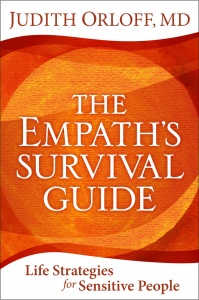
Adapted from Dr. Judith Orloff’s book The Empath’s Survival Guide: Life Strategies for Sensitive People (Sounds True, 2017)

Judith Orloff, MD is the New York Times best-selling author of The Empath’s Survival Guide: Life Strategies for Sensitive People. Her latest book Thriving as an Empath offers daily self-care tools for sensitive people along with its companion The Empath’s Empowerment Journal. Dr. Orloff is a psychiatrist, an empath, and is on the UCLA Psychiatric Clinical Faculty. She synthesizes the pearls of traditional medicine with cutting edge knowledge of intuition, energy, and spirituality. Dr. Orloff also specializes in treating empaths and highly sensitive people in her private practice. Dr. Orloff’s work has been featured on The Today Show, CNN, Oprah Magazine, the New York Times and USA Today. Dr. Orloff has spoken at Google-LA and has a TEDX talk. Her other books are Emotional Freedom, The Power of Surrender, Second Sight, Positive Energy, and Guide to Intuitive HealingExplore more information about her Empath Support Online course and speaking schedule on www.drjudithorloff.com.
Connect with Judith on  Facebook Twitter and Instagram.

Moderna: Covid vaccine shows nearly 95% protection

By James Gallagher
Health and science correspondent

November 16, 2020 (bbc.com)

Vaccination

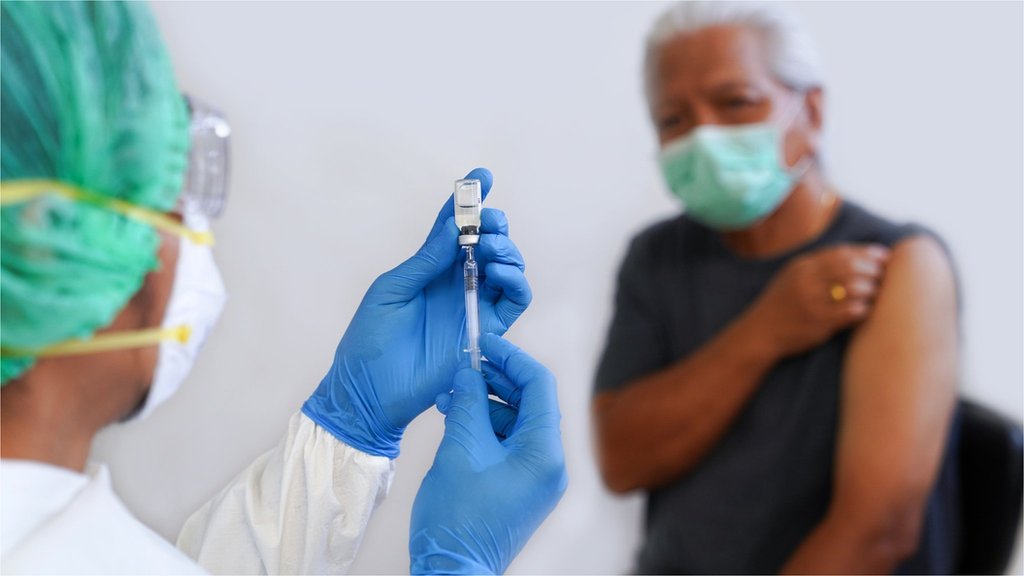
A new vaccine that protects against Covid-19 is nearly 95% effective, early data from US company Moderna shows.

The results come hot on the heels of similar results from Pfizer, and add to growing confidence that vaccines can help end the pandemic.

Both companies used a highly innovative and experimental approach to designing their vaccines.

Moderna says it is a “great day” and they plan to apply for approval to use the vaccine in the next few weeks.

However, this is still early data and key questions remain unanswered.

How good is it?

The trial involved 30,000 people in the US with half being given two doses of the vaccine, four weeks apart. The rest had dummy injections.

The analysis was based on the first 95 to develop Covid-19 symptoms.

Only five of the Covid cases were in people given the vaccine, 90 were in those given the dummy treatment. The company says the vaccine is protecting 94.5% of people.

The data also shows there were 11 cases of severe Covid in the trial, but none happened in people who were immunised.

“The overall effectiveness has been remarkable… it’s a great day,” Tal Zaks, the chief medical officer at Moderna, told BBC News.

Dr Stephen Hoge, the company’s president, said he “grinned ear to ear for a minute” when the results came in.

He told BBC News: “I don’t think any of us really hoped that the vaccine would be 94% effective at preventing Covid-19 disease, that was really a stunning realisation.”

When will I get it?

That depends on where you are in the world and how old you are.

Moderna says it will apply to regulators in the US in the coming weeks. It expects to have 20 million doses available in the country.

The company hopes to have up to one billion doses available for use around the world next year and is planning to seek approval in other countries too.

The UK has today announced that, from spring, it will have five million doses of the Moderna vaccine, enough to vaccinate 2.5 million people. It has already outlined plans that prioritise the oldest people for immunisation.

What don’t we know?

We still do not know how long immunity will last as volunteers will have to be followed for much longer before that can be answered.

There are hints it offers some protection in older age groups, who are most at risk of dying from Covid, but there is not full data.

Mr Zaks told the BBC their data so far suggests the vaccine “does not appear to lose its potency” with age.

And it is not known whether the vaccine just stops people becoming severely ill, or if it stops them spreading the virus too.

All these questions will affect how a coronavirus vaccine is used.

Are there any side effects?

No significant safety concerns have been reported, but nothing, including paracetamol, is 100% safe.

Short lived fatigue, headache and pain were reported after the injection in some patients.

“These effects are what we would expect with a vaccine that is working and inducing a good immune response,” said Prof Peter Openshaw, from Imperial College London.

Moderna labs
image captionModerna scientists used an innovative technique for developing the vaccine so quickly

How does this compare to the Pfizer vaccine?

Both vaccines use the same approach of injecting part of the virus’s genetic code in order to provoke an immune response.

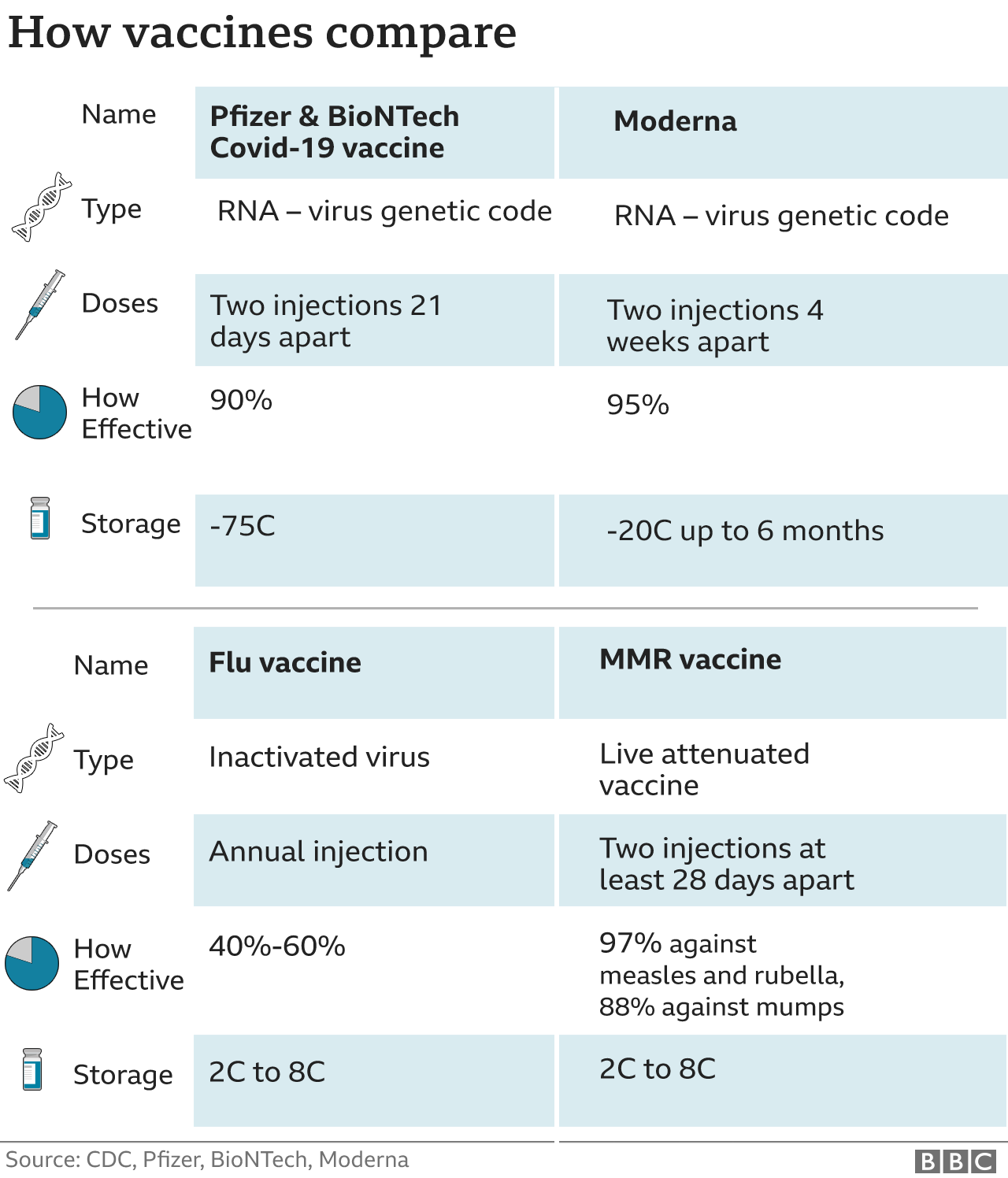
The preliminary data we have seen so far is very similar – around 90% protection for the Pfizer/BioNTech vaccine and around 95% for Moderna’s.

However, both trials are still taking place and the final numbers could change.

Moderna’s vaccine appears to be easier to store as it remains stable at minus 20C for up to six months and can be kept in a standard fridge for up to a month.

Pfizer’s vaccine needs ultra-cold storage at around minus 75C, but it can be kept in the fridge for five days.

The Sputnik V vaccine, developed in Russia, has also released very early data which suggests it is 92% effective.

Vaccine comparison

How does it work?

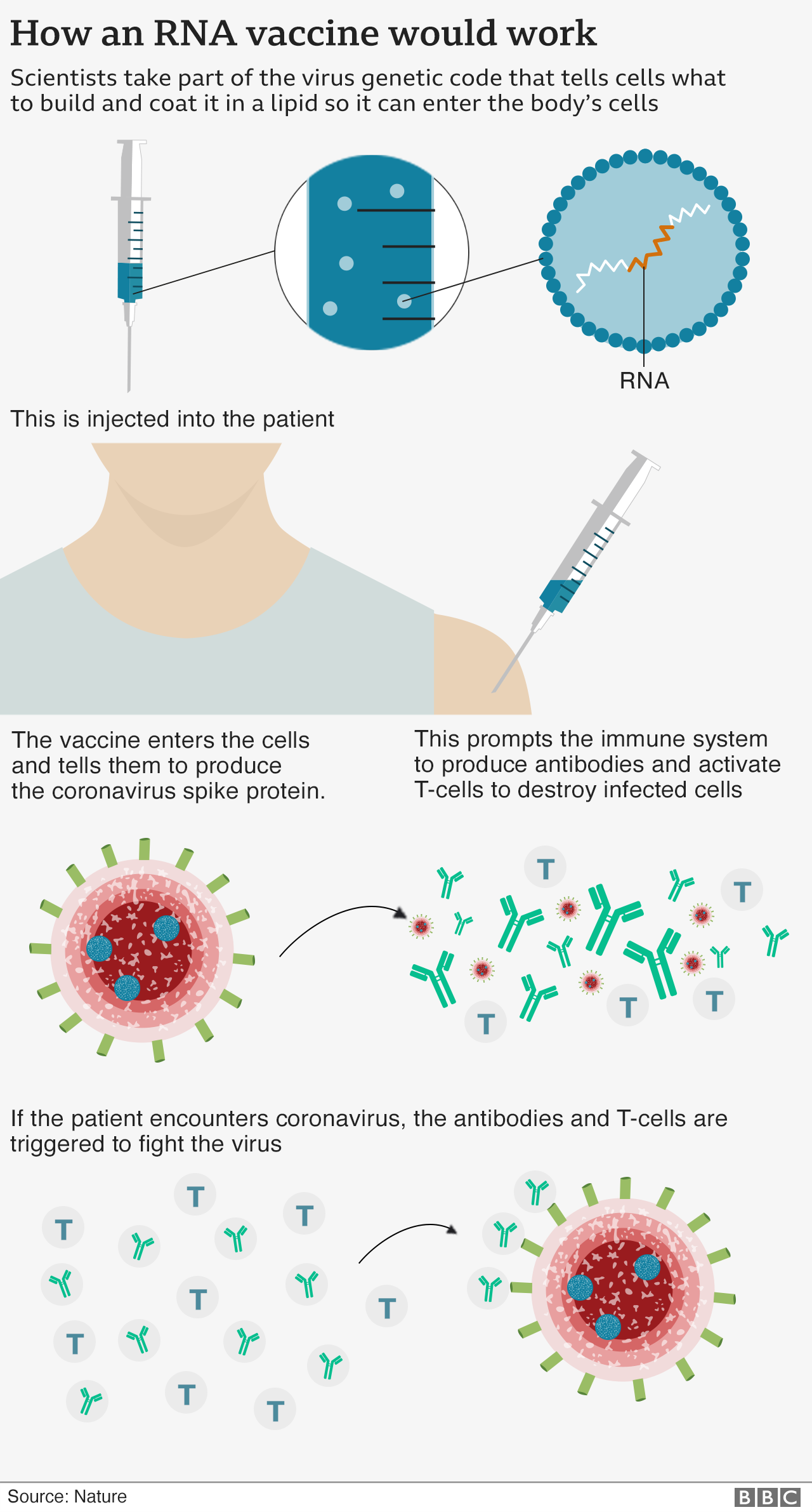
Moderna has developed an “RNA vaccine” – it means part of the coronavirus’s genetic code is injected into the body.

This starts making viral proteins, but not the whole virus, which is enough to train the immune system to attack.

It should train the body to make both antibodies – and another part of the immune system called T-cells to fight the coronavirus.

Graphic

When will Covid be over?

In the space of a week, the positive results from Pfizer, Moderna and Russia have transformed our chances of ending the pandemic.

Before the first results, the talk was of a vaccine that offered maybe 50% protection. Those expectations have been blown out of the water – not only are vaccines possible, they appear to be potent.

The data so far also raise hopes that the other vaccines in development will be successful too, but now as one challenge draws to an ends, another begins.

The logistical effort of actually vaccinating, potentially billions of people, around the world is gargantuan.

Some experts have claimed normality by spring, others by next winter, others still think there is a long journey ahead.

The answer will depend on how quickly countries can get this “hope in a vial” into the arms of people.

What reaction has there been?

“This news from Moderna is tremendously exciting and considerably boosts optimism that we will have a choice of good vaccines in the next few months,” said Prof Peter Openshaw from Imperial College London.

He added: “We need more complete details than we have in this press release, but this announcement adds to the general feeling of optimism.”

Prof Trudie Lang, from the University of Oxford, said: “It is very good news indeed to see another vaccine coming through with similar efficacy results as were reported last week from Pfizer.

“This is also an interim analysis, which means that there were enough cases within the vaccinated volunteers to give statistical significance and allow the team to break the blind to determine who had the active vaccine and who had placebo.”

Dr Richard Hatchett, the head of the Coalition for Epidemic Preparedness Innovations, said: “The Moderna results are as good as we could have hoped for and really terrifically encouraging.”

Banner image reading 'more about coronavirus'
Banner

Follow James on Twitter

Patch Work of Consciousness

By Suzanne Deakins, H.W., M.

The first-time universal consciousness really penetrated me was when I was sitting in the assembly hall at the Inner Space Center in Santa Monica. Thane was talking about Universal Consciousness. I remember thinking how limited my thinking had been. Like many I had been thinking in a narrow stream more centered on myself, family, and immediate friends. It was Thane’s use of the word global and universal that gave me such a jolt.

The thinking that other countries must be competitors and thus a threat as dominated the consciousness of USA these past 4 years, this is tribal thinking. One tribe against another. It is by-the-way the predominate thinking of those who are more conservative and tend to vote republican. Sociological studies show that those who think more globally tend to vote more democratic. In the studies of motivational reasoning simply says that we arrive to conclusions based on what we have previously believed. Beliefs are not easy to track, but it focusses on how your parents and immediate community identified. If you were taught that biological family was everything, came first, then your beliefs, and thinking would not include how your actions might affect others. Hence, no matter what the science says, your actions would not be centered on the greater good, but on the immediate affect on your life. Examples of wanting cheaper gas no matter how detrimental it is to the environment, refusal to wear a mask if you thought it was limiting your personal freedom and income. The facts or long-term strategy would have little validity in your reasoning as immediate causer would prevail in your thinking.

I have been trying to understand why, as a western country, we tend to be so conservative and lack the ability to see how our actions are impacting our world as a whole. We are only partially western. Thane often said that American tended to be psychotic; in that they did not pay attention to how our actions impacted the future of the country; that as a country we were delusionary and were not in touch with reality. Western thinking has been greatly influenced by 2 ideas. First by the Catholic Church who with their canons move us from small family groups and inbreeding by declaring marriage to kin sinful, forcing our social life to move to a wider view. Second, by the introduction of Martin Luther’s idea of Protestantism forced us to read if we were going to be able to understand the “law of God.” By society leaning to read we were no longer limited by the information we gathered via family and small group thinking. We could develop broader views of life. The brain of those that reads looks and acts different than those who cannot.

The more tribal and family center a group are for survival, the more conservative they are going to be voting only as they see it affects them. To understand how this works as a whole we have to understand consciousness and the nature of reality. First immigration and the infusion of populations of disenfranchised individuals is a necessary component of democracy and keeping it alive. Research staring before 1979 by the Pew Group showed the importance of immigration into a democratic society to keep it viable. By the 2nd and 3rd generation from immigration there is a moving away from tribal thinking and conservative thinking to a broader encompassing of beliefs and actions. This is not to say that any tribe, family, or country should not protect themselves and make sure they survive. It does mean that in the nature of reality, universal consciousness, one thought is everyone’s thought. The more one group, tribe, idea is portrayed as dangerous to another, the bigger the divide and the more likely, the facts, of overall disaster, mean little in the thinking of individuals.

Like the psychotic individual whose actions turn back on themselves and erase the ability to interact in meaningful relations with life as a whole; America has become infected with this disease. Similar to the physical disease known as lupus where the body’s immune system turns on itself, destroying the very idea that keeps it alive. We have turned on our self. We don’t need terrorist to destroy us. By taking a stance where we cannot see, hear, or communicate with each other we will destroy ourselves no matter what our political leaning.

When we self-observe our actions and thinking and see where we are denying universal consciousness, can we begin to midwife the emergence of new consciousness, where all life is embraced, all ideas heard, and all tongues saluted as a value to the wonderful array of humanity living on this planet.

© Suzanne Deakins
Emergence of Consciousness
Release date 2021

Inauguration of Second Term

(abraham-lincoln-history.org)

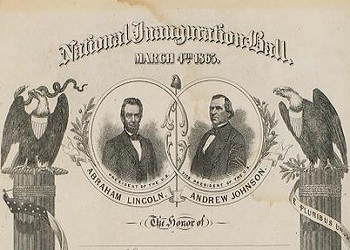
Invitation to Abraham Lincoln’s second inaugural ball. This invitation was created by J. Goldsborouh Bruff.

President Lincoln’s second term inauguration took place on March 4, 1865 at the Capitol in the Nation’s Capital. Lincoln read one of the shortest inaugural speeches, only 703 words but it was one of the most memorable. He tried to reconcile differences between Unionists and Confederates and closed his address with the following words:

“With malice toward none, with charity for all, with firmness in the right as God gives us to see the right, let us strive on to finish the work we are in, to bind up the nation’s wounds, to care for him who shall have borne the battle and for his widow and his orphan, to do all which may achieve and cherish a just and lasting peace among ourselves and with all nations.”

After four years he had mastered the difficult job of Chief Executive. He was the only president elected for two consecutive terms since Andrew Jackson in 1832. His administration followed his leadership and commanded the support of both Houses of Congress.

Lincoln was satisfied with his cabinet. The only change was William Pitt Fessenden who was replaced by Hugh McCulloch as Treasury Secretary. Fessenden resigned to take his post in the senate for the state of Maine. Nicolay and Hay, Lincoln’s personal secretaries, received new appointments. Nicolay was offered the US consulate in Paris and Hay received an appointment as secretary of the delegation in Paris.

Free Government

Elections were held during a war and the fact that they were held at all was a sign of Lincoln’s commitment to democracy and freedom.

On November 10, 1864, from a second floor window, President Lincoln addressed a group of serenaders who had gathered outside the White House:

It has long been a grave question whether any government, not too strong for the liberties of its people, can be strong enough to maintain its own existence in great emergencies.

On this point the present rebellion brought our republic to a severe test; and a presidential election occurring in regular course during the rebellion added not a little to the strain. If the loyal people, united, were put to the utmost of their strength by the rebellion, must they not fail when divided, and partially paralized (sic), by a political war among themselves?

But the election was a necessity.

We can not have free government without elections; and if the rebellion could force us to forego, or postpone a national election it might fairly claim to have already conquered and ruined us. The strife of the election is but human-nature practically applied to the facts of the case. What has occurred in this case, must ever recur in similar cases. Human-nature will not change. In any future great national trial, compared with the men of this, we shall have as weak, and as strong; as silly and as wise; as bad and good. Let us, therefore, study the incidents of this, as philosophy to learn wisdom from, and none of them as wrongs to be revenged.

But the election, along with its incidental, and undesirable strife, has done good too. It has demonstrated that a people’s government can sustain a national election, in the midst of a great civil war. Until now it has not been known to the world that this was a possibility. It shows that, even among candidates of the same party, he who is most devoted to the Union, and most opposed to treason, can receive most of the people’s votes. It shows also, to the extent yet known, that we have more men now, than we had when the war began. Gold is good in its place; but living, brave, patriotic men, are better than gold.

(Contributed by Hanz Bolen, H.W., M.)

Separation Anxiety

According to child development website babycentre.uk.co: “At around seven months, your baby will realise that you and she are separate people. This is a huge cognitive leap worthy of celebration . Because of this, your baby may become distressed and start crying when you leave her, even for a short while. This is known as separation anxiety.”

As students of Truth, we come to realize that we really are not separate from anyone or anything, thus coming full circle.

–Mike Zonta, BB editor

A conservative’s plea: Let’s work together

Arthur Brooks|TED2016 (ted.com)

Conservatives and liberals both believe that they alone are motivated by love while their opponents are motivated by hate. How can we solve problems with so much polarization? In this talk, social scientist Arthur Brooks shares ideas for what we can each do as individuals to break the gridlock. “We might just be able to take the ghastly holy war of ideology that we’re suffering under and turn it into a competition of ideas,” he says.

This talk was presented at an official TED conference, and was featured by our editors on the home page.

ABOUT THE SPEAKER

Arthur Brooks · Social scientist, author. As president of the American Enterprise Institute, Arthur Brooks is changing the way conservatives think about poverty and opportunity.

TED2016 | February 2016