
The Rational National No climate change hasn’t just gone away, as the Arctic has hit its hottest temperature in recorded history. === Support the show at http://TheRationalNational.com/Join Donate Directly at http://PayPal.me/daviddoel Tip at https://streamlabs.com/therationalnat… ‘Join’ on YouTube: https://www.youtube.com/channel/UCo9o… Follow David Doel at http://twitter.com/DavidDoel Follow The Rational National at http://twitter.com/TRNshow Follow on Twitch at http://twitch.tv/TheRationalNational === Sources: https://www.commondreams.org/news/202…https://twitter.com/ScottDuncanWX/sta…https://bit.ly/2V7wX0Yhttps://www.cbsnews.com/news/arctic-h…https://www.theguardian.com/environme…https://cnn.it/3hKR6n4
Monthly Archives: June 2020
I’m Pansexual, and Here’s What I Want You to Know
Hannah Pegg – June 22, 2020, 2:25 PM PDT (Yahoo.com)

The first time I came out to my parents was in 2013. I was 15 at the time, but I still remember it clear as day. I wrote my mom and dad letters, put them each into an envelope, and handed them off. I knew I would be a mess of tears if I tried to come out to them face to face, so I figured I could gather all of my thoughts more concisely into a letter. I don’t think either of them were quite shocked because I was always a little different, but nonetheless, they told me they were proud of me and wouldn’t trade me for the world.
I’d always assumed I was a lesbian because I was attracted to women and had only ever dated a girl before. I was confused and felt the weight of society falling on my shoulders. I was 15 and liked women, but there was still this nagging feeling that maybe I wasn’t just a lesbian.
I knew I liked women, and I knew I’d had feelings for men, but I wasn’t quite sure that I was bisexual.
I never knew that I could be anything more than a lesbian, so I continued to identify that way. It wasn’t until a few years ago that I sparked a conversation with my roommate about sexuality. I was taking a queer studies class, and for the first time since 2013, I stopped and looked my sexuality dead in the face. And I was truly stumped. I knew I liked women, and I knew I’d had feelings for men, but I wasn’t quite sure that I was bisexual. My feelings felt stronger than that.
It wasn’t until I did some necessary internet searching that I came across a list of sexual orientations. I scrolled through terms I knew, and ones I’d never heard of, until I finally landed on pansexual. Something just seemed to fall into place. There was finally a word to explain how I’d been feeling.
Related: 9 Problematic Questions People Tend to Ask When They Find Out I’m Bi

So, what exactly is pansexuality?
This is a perfect starting point for something so complicated to explain. The thing is, you can look up a definition with a click of button, but in the end, you’ll find that pansexuality as a whole is very different from person to person. As Merriam-Webster puts it, “Pansexuality is of, relating to, or characterized by sexual desire or attraction that is not limited to people of a particular gender identity or sexual orientation,” but what I really like to tell people is that pansexuality is fluid and encompasses all people, regardless of their gender identity.
One of the many things I love about being pansexual is that my love for human beings has no bounds. There are no restraints telling my heart that I can’t love a person because of their gender identity. When it comes to attraction, I look for a connection as opposed to a gender, which really opens up a whole new world of relationships.
When it comes to attraction, I look for a connection as opposed to a gender, which really opens up a whole new world of relationships.
A common misconception people have about pansexuals is that since we are attracted to everyone, we must be having lots of sex, right? Well, that depends on the type of person you are. The great thing about sexuality is that it’s not just about sexual preference. Again, for me, I look for someone I can connect with as opposed to jumping into any type of physical relationship. What I’ll never quite understand is why attraction becomes a reason to shame someone for their sexual experiences. If you find yourself in a situation where you’re about to ask someone if they “get around,” take a second to ask yourself, would I feel comfortable answering this?
OK, well this seems very similar to bisexuality. How are they different?
I get asked this question a lot, as I’m sure do many others. The difference really lies in how a person wants to identify. Most people know bisexuality as an attraction to both men and women, but as vocabulary changes, it can now be defined as an attraction to more than one gender. The prefix “bi” in bisexuality means two. However, in recent years, people are becoming increasingly aware that there are more than two genders, thus changing the definition to be more inclusionary of those who fall outside of the gender norms.
For years, there have been disagreements within the bisexual and pansexual communities about whether bisexuality enforces the gender binary. Well, what is the gender binary? It’s the social construct, or gender system, of sex and gender into two categories, masculine and feminine. So when a female is born, she is assumed to be feminine and follow the social codes that have been placed on women (i.e. body standards, sexuality, behavior, etc.).
So then what does this have to do with bisexuality? Well, some people in the LGBTQ+ community believe that labeling oneself as bisexual enforces certain societal codes that do not coincide with those who identify as intersex, gender fluid, androgynous, nonbinary, transgender, etc. So, is bisexuality discrediting certain individuals who do not follow the gender norms? I don’t think so. I think that bisexuality, like pansexuality, varies from person to person.
Is pansexuality just another label?
No, I really don’t think so. In fact, I think it’s important to put a name to the feeling. Previous to a few years ago, I didn’t even know what pansexuality was. I struggled with my sexuality and felt out of place calling myself something I was not. It wasn’t until college that I realized maybe I wasn’t so alone. But I wondered, if I felt this way, how many other people have struggled to find their place in the LGBTQ+ community?
The word pansexual has been around for ages, but it wasn’t until recent years that it took its place on the spectrum. It was first used by Sigmund Freud to describe the sexual desires of humans; however, he never really coined the term as a sexual orientation. Pansexuality as an orientation really took off at the end of the 20th century, leading into the 21st century. So why then do so few people know about it? And how can we make pansexuality a term that is readily available to younger generations?
For me, pansexuality is much more than just my sexual orientation. It has helped me to put into perspective my behavior toward all people.
If you or someone you know is questioning their sexuality, I think it is incredibly important to look into all sides of the LGBTQ+ community. There are so many orientations, genders, and identities that are not covered in schools or by acronyms that deserve to be discussed. Personally, I went to a high school that didn’t do much to explain anything other than the heteronormative in health class. I think it will take time to implement more LGBTQ+-friendly curriculum into schools, however, clubs, events, and open discussions are a wonderful way to expand queer vocabulary. If words like demisexual, asexual, queer, intersex, nonbinary, etc. are talked about more frequently, it will allow those who are unsure a chance to interact with others who feel like them.
Final Thoughts
So what have my years as openly pansexual been like? Honestly, I feel like a weight has been lifted off of my shoulders. For me, pansexuality is much more than just my sexual orientation. It has helped me to put into perspective my behavior toward all people. Perhaps my heart is just a little too big, but I believe that every person I come across, regardless of gender, race, religion, sexuality, etc., is deserving of some type of connection, whether it be emotional, physical, or intellectual. Those connections are what made me who I am and I think what led me to pansexuality.
I don’t think I could have done this without my incredible roommate, who has listened to my struggles for countless hours and encouraged me to explore my sexuality. I’m also incredibly grateful for my family who are always asking questions and have gone above and beyond to research pansexuality and the LGBTQ+ community.
I’m not sure what’s in store for me, however, I know now that I’m not alone or “confused.” In fact, I’m the furthest thing from confused. I didn’t need some big revelation to tell me that I was pansexual. All it really took was some reflection and a Google search.
(Contributed by Janet Cornwell, H.W., m.)
ON THE NATURE OF REALITY: A Theory of Everything There Is
Conceiving Reality: Wholistic Existential Anthropology by Harris W. Stern, Ph.D.
Harris W Stern, Ph. D. · Jun 17, 2019 · Medium.com
“Reality is up for grabs” …….Trapper John………..Mash
INTRODUCTION
Look at the following list of questions:
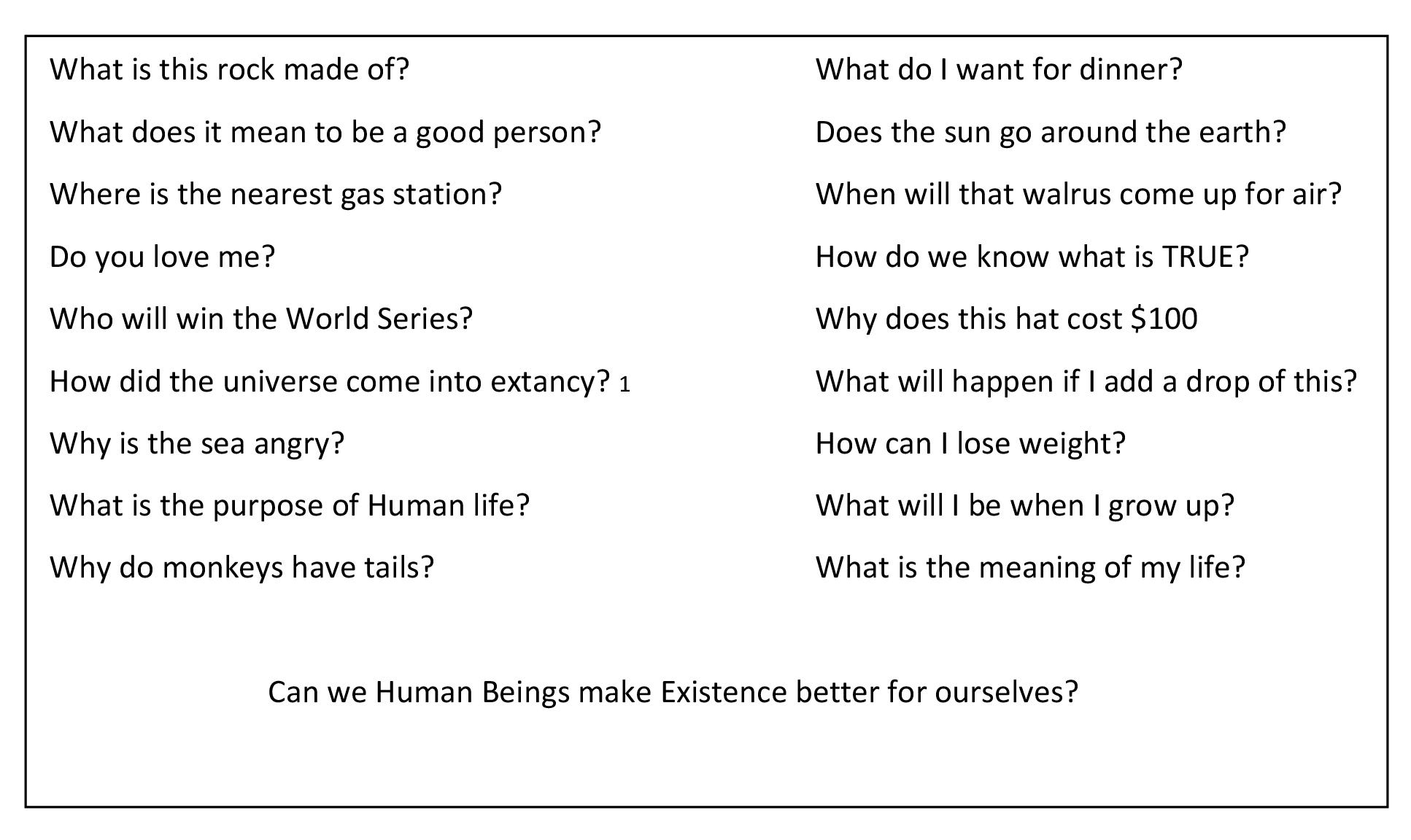
I believe that a careful consideration and thinking about these questions, each and all, and what they “mean” in the broadest sense that we can conceive of the term meaning, will inevitably lead us to another question:
What is the nature of reality?
I also believe that the extancy (1) of the questions, the fact that Human beings can and do ask them, also reveals something about the “nature of reality” and what it means to ask that question as well as how it might be answered. In a certain sense, Human question-asking (and Human language, generally) “co-creates” “reality”.
I also believe that that another important aspect of “reality” that is “revealed” in considering the above list relates to the ”fact” that these questions and the “form” in which they are asked, are limited in “time” and in “space” to some Human Beings and not others. That is, the form and the content of the question and “the nature of reality” implied in their use will vary with the language and culture and historical era of the person asking the question. A group of humans living with preindustrial culture on a remote island or far north on the planet will probably not ask the question “who will win the World Series?” Perhaps these humans will not ask the question “What is this rock made of?”; they may have a creation “myth” or other story narrative , repeatable by most adults in the group, which tells where rocks came from and implies something about what they are thought to be made of. Most modern scientists probably will not ask “Why is the sea angry?” These variations in questions asked suggest something about the variation in the “meaning” of the “nature of reality”.
Human Beings who began calling themselves philosophers (lovers of wisdom) in Greece were asking explicit questions about the “nature of reality” and providing answers to the question over 2000 years ago. It appears that a Human Being named Lao Tzu asked the same question and provided a set of answers in China also 2000 years ago. Meanwhile philosophers and others have gone on asking and providing answers to the question through the ensuing centuries and up until the present day.
Along the way many “philosophical” problems have emerged in thinking about and defining the “nature of reality”. Many of the problems have been recurrent as a source of disagreement among people who are explicitly interested in exploring “reality”. There is the “mind/body problem”, the relationship between language, thought and “reality”, a clash between an exclusively “materialistic” view of “reality” and a purely “spiritual” or otherwise “non-material” conception of “reality”. There are issues related to solipsism, dualism, reductionism, and reification.
Rather than review the historical record of philosophical inquiry into the “nature of reality”, which I am not competent to do in any comprehensive fashion, I will offer here a theoretical structure, which is created to offer a particular way to explore the meaning of the question “What is the nature of reality?” My theorizing will attempt to create a structure which does address what I do know of the historical problems and dilemmas and even paradoxes in the philosophical effort to define the “nature of reality” In other writing I will attempt to show the power of the theory to address many of those issues in an explicit way. I am confident that the theory which I call Wholistic Existential Anthropology represents a unique perspective from which to create and discover new ways to move ahead in the Human journey toward increased knowledge and wisdom.
A PROPOSED THEORY OF REALITY
I am proposing that “reality” be thought of as an abstract, ideational, intellectual theoretical structure that is triadic, systemic, interactive, dynamic and wholistic. I call this theory, Wholistic Existential Anthropology.
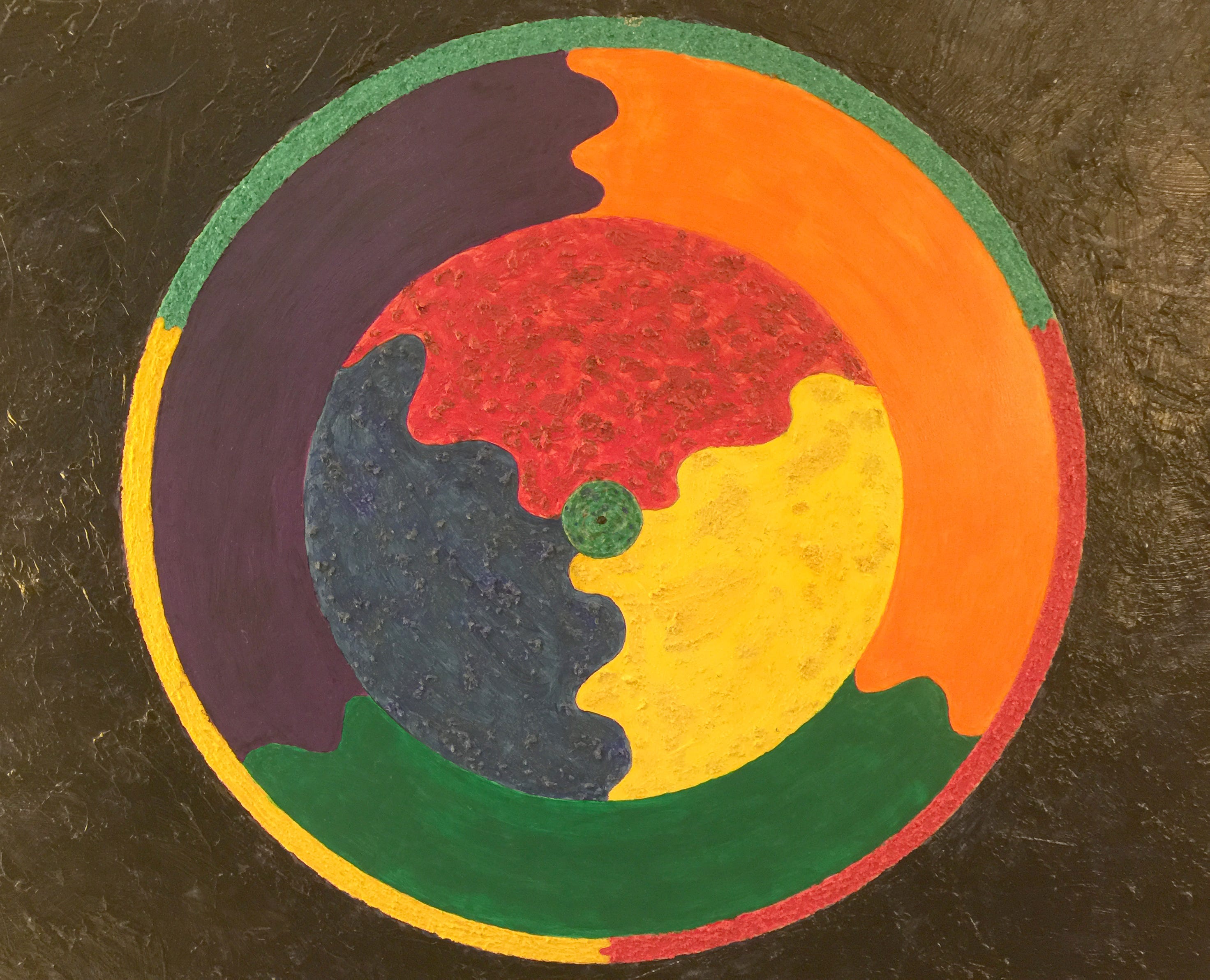
A diagrammatic representation of the theory appears on the next page.
“Reality” is represented by the large circle and is understood to include “everything” there “is”.
The three smaller circles represent three “worlds of reality” as conceived within the theory. Each “world” is conceived to have a different “constituent”. Within “Physical World” of “reality”, the “constituent” is being called “MATTER/ENERGY””. Within “Phenomenological World” the “constituent” is called “MINDING” — further specified as “Human Experience”. Within “Theoretical World” the “constituent” is called “MEANING” which is further elaborated by the concept of “IDEALS”.
Each “world of reality” has a unique process for studying that “world” and for discussions of validity and “truth” within that “world”. These processes of study are indicated by the three rectangles labeled “Physical Science”, “Wholistic Existential Psychology” and “Intellectual Science”.
…………………….REALITY……………………

Diagramatic Representation of “Reality” as a Systemic Dynamic IntegratedTriadic Whole: Wholistic Existential Anthropology
………………… Copyrighted by Harris W Stern, Ph.D., 2018………………..
Each “world of reality” has categories of differentiation within that “world” — for example “Microcosm”, “Macrocosm”, “Biocosm” and “Artifacts” — which can be thought of as categories of organized MATTER/ENERGY within “Physical World”. The categories of differentiation in “Phenomenological World” are “Thinking”, “Feeling” and “Willing” and these can be thought of as functions within MINDING. The categories of differentiation within “Theoretical World” include Myth/religion; Science; Arts/Humanities; and Law which are aspects of Culture within MEANING. All of these distinctions are “theoretical/intellectual” (ideational) and are proposed as potentially useful ways of conceiving the theoretical structure of “reality”. It is easy to see that there are subcategories which already considered to be extant within many of the proposed categories — for example, “philosophy” and “history” within Humanities.
I offer the following six propositions as a further specification of the way of conceiving “reality” within the “theory” of Wholistic Existential Anthropology.
1. Proposition One: Within this “theory” the term “Reality” is an “idea” that represents the systemic, articulated, differentiated, dynamic, integrated, gestalt that is everything.
2. Proposition Two: Within the theory it is conceptualized that three “worlds of reality” are all “real” and equally “real”.
3. Proposition Three: Within the theory the three “worlds of reality” are to be thought of as differentiated from one another, as well as embedded within the same, unified, dynamic, interactive whole.
4. Proposition Four: This triadic way of conceiving “reality” includes the “idea” that our way of studying, defining finding and demonstrating “validity” (or TRUTH) will be different as we “think” about each of three “worlds of reality”.
5. Proposition Five: This triadic, systemic (wholistic) way of “conceiving” or “theorizing” “reality” also includes the specification that each “world of reality” can only be “understood” by including concepts that show how each “world” contributes to and is essential to the understanding of the other two “worlds” and what is “meant” by “reality” as a whole. All aspects of the theory can be thought of as “co-creative” of one another.
6. Proposition Six: This “systemic” (“wholistic”) way of “conceiving” “reality” also includes the “concept” of HEALTH which is proposed to pertain to “all of reality as a whole” and to the relationships among all of the aspects of “reality” which are conceived. The “concept” of “HEALTH” is further specified as a “principle” to be called “BALANCE” which operates within a framework of “Stability” and “Change”.
Wholistic Existential Anthropology is being conceived as a “theory” and within my “conceiving” and “understanding” it is extant and “real” in “Theoretical World”. Also, according to my “conceiving” and “understanding” (consonant with the thinking of many others), “theories” are never absolute or ultimate “TRUTH” (see remarks in the concluding section immediately following).
Concluding Remarks
We can react to or make judgments about any theory including the theory labelled Wholistic Existential Anthropology based on whether we find it interesting or boring, useful or unappliable, understandable or confusing, coherent or inconsistent, logical or self-contradictory, beautiful or ugly, pleasing or distasteful, novel or trite. We might think of all of these dimensions and others as related to the worthiness of the theory — worthwhile to be written. Theories, by definition, are subject to exploration, testing, reformulation, modification, replacement, refutation, or abandonment.
Since I am proposing Wholistic Existential Anthropology as a “theory of everything”, I will address these and many other issues in future essays. Although I think that the theory is worth proposing and worthy of consideration by others as being worthwhile, I am not proposing that this theory is the only one that is worthy as an answer to the question “what is the nature of reality”. Just as an example, I am open to the possibility that a theory that conceives of “reality” as quaternal instead of triadic might be worthy. I will be doing my best to demonstrate that Wholistic Existential Anthropology is worthwhile.
Although questions about “reality” and any theory which is formulated to try to answer such questions are, as suggested above, ”philosophical”, “intellectual” and “abstract”, it is my understanding that some of the responsibility for current very practical, every day, “concrete”, problems in Human life grows out of limitations in how the “nature of reality” is conceived — by intellectuals and philosophers as well as by Human politicians and government officials, by business and religious leaders as well as ordinary people. In addition, I have a strongly held opinion that progress in the fields of “theoretical science” — physics, chemistry and biology — as well in the “applied physical sciences” -engineering and technology- and in the “non-physical applied sciences” of education, clinical psychology, economics, medicine and others, is being limited by the way in which thinkers in these fields “understand” or formulate the “nature of reality”.
“A Table is Real“; “Sadness is just as Real”; “Fairness is equally Real”
“Black Holes are Real”; “Human Willing is equally Real”; “History is as Real as a Table is Real”
_______________________________________________________________
Footnote 1. The terms “extant” and “extancy” will be used in this and other essays when the terms “existence” and “being” might be more usual. Those terms “Existence” and “Being will be used only in relation to Human Beings.
________________________________________________________________
Bibliography
Barbour, Julian. The End of Time: The next revolution in Physics. 1999, Oxford University Press, Oxford.
Binswanger, Ludwig. Being-in-the-World: Selected papers of Ludwig Binswanger. (Translated and with a Critical Introduction to his Existential Psychoanalysis by Jacob Needleman). 1963, Basic Books, Inc., New York.
Brian Beakley and Peter Ludlow (eds.). The Philosophy of Mind: Classical Problems/Contemporary Issues. (Second Edition) 2006, The MIT Press, Cambridge, Massachusetts.
Bruner, Jerome. Acts of Meaning. 1990, Harvard University Press, Cambridge, Massachusetts.
Carroll, Sean. The Big Picture: On the Origins of Life, Meaning and the Universe. 2016, Dutton, New York.
Catapano, Peter and Critchley (eds.). The Stone Reader: Modern Philosophy in 133 Arguments. 2010, Liveright Publishing Corporation: A Division of W. W. Norton & Company New York.
Du Sautoy, Marcus. The Great Unknown: Seven Journeys to the Frontiers of Science. 2016, Viking Press, New York.
Glasersfeld, Ernst von (ed.). Key Works in radical Constructivism (Edited by Marie Larochelle). 2007, Sense Publishers, Rotterdam, The Netherlands.
Glasersfeld, Ernst von. Radical Constructivism: A way of Knowing and Learning. 1995, RoutledgeFalmer New York.
Gregory, Bruce. Inventing Reality: Physics as Language. 1988, Wiley Science Editions, John Wiley and Sons Incorporated, New York.
Hawking, Stephen. A Brief History of Time (Updated and expanded edition). 1996, Bantam, Dell, New York. (Original Edition; 1988, Bantam Books, New York.)
Hawking, Stephen. The Universe in a Nutshell. 2001, Bantam Dell, New York.
Hawking, Stephen. The Theory of Everything: The Origin and Fate of the Universe. (Special Anniversary Edition) 2006, Jaico Publishing House, Mumbai. (Based on the original hardcover edition; 2002, New Millennium Press.)
Heidegger, Martin. Being and Time. (Translated by John Macquarrie and Edward Robinson from the 1926 German Edition) 1962, Harper and Row Publishers, New York.
Hilgard, Ernest. The Trilogy of Mind: Cognition, Affection, and Conation. Journal of the History of the Behavioral Sciences Volume 16 Issue 2 1980
Hossenfelder, Sabine. Lost in Math: How Beauty Leads Physics Astray. 2018, Basic Books, New York.
Kant, Emanual. Critique of Pure Reason. (Translated by J.M.D. Meiklejohn from the 1787 second edition) 1901, George Bell and Sons, London.
Kling, Sheri D. Whitehead’s Metaphysics as a Cosmological Framework for Transpersonal Psychology. The Humanistic Psychologist. June, 2019 Volume 47, Number 2 (pages 181–200). American Psychological Association, Washington D.C.
Krauss, Lawrence M. The greatest Story Ever Told — So Far: why are we here? 2017, Atria Books, New York.
Lao-Tzu. Tao Te Ching. (translated by Stephen Addiss and Stanley Lombardo). 2007, Shambhala, Boston and London.
Lao Tzu. Hua Hu Ching: The Unknown teachings of Lao-Tzu. (Translated by Brian Walker.) 1994, Harper Collins Publisher, New York.
Le Guin, Ursula. The word for World is Forest. 1972, A Tor Book Published by Tom Doherty Associates, New York.
May, Rollo; Angel, Ernest; and Ellenberger, Henry F. (eds). Existence: a new Dimension in Psychiatry and Psychology. 1958, Basic Books, New York.
Minkowski, Eugene. Lived Time: Phenomenological and Psychopathological Studies. (Translated by Nancy Metzel.) 1970, Northwestern University Press, Evanston, Illinois.
Piaget, Jean. The Origins of Intelligence in Children. 1952, International University Press, New York.
Piaget, Jean. The Child’s Construction of Reality. 1955, Routledge and Kegan Paul, London.
Rosen, Hugh and Kuehlwein, Kevin T. (eds). Constructing Realities: Meaning Making Perspectives for Psychotherapists. 1996, Josey-Bass Inc., San Francisco.
Rovelli, Carlo. Reality is not What it Seems: The Journey to Quantum Gravity. (Translated by Simon Carnell and Erica Segre, 2016; from the Original published 2014 by Rafaela Cortina, Milan) 2017, Riverhead Books, Penguin Random House, New York.
Sapir, Edward. Selected writings of Edward Sapir: in Language, Culture and Personality. (1963 Edition, Edited by David G. Mandelbaum.) 1949, University of California Press, Berkeley and Los Angeles California.
Stern, Harris W. Principles of Wholistic Existential Psychology. 2008, website: HarrisStern.com.
Stern, Harris W. Anxiety from a Wholistic Existential Psychology Point of View. 2009, Kindle Books Amazon.
Stern, Harris W. If you don’t MIND, I Will. 2010, Kindle Books Amazon.
Stern, Harris W. Ideals. 2015, Newsletter archived on Constant Contact, accessible though HarrisStern.com
Stern, Harris W. Existential Challenges. 2015, Newsletter archived on Constant Contact, accessible though HarrisStern.com
Whorf, Benjamin Lee. Language, Thought and Reality: Selected Writing of Benjamin Lee Whorf. (Edited by John B. Carroll) 1956, The MIT Press, Cambridge, Massachusetts and John Wiley, New York.
Wittgenstein, Ludwig. On Certainty (G.E.M. Anscombe and G.H. von Wright {eds}; Translated by Denis Paul and G.E.M. Anscombe.) 1969, Harper Torchbooks, Harper and Row Publishers, New York.
Yalom, Irvin D. Existential Psychotherapy. 1980, Basic Books, a Division of Harper Collins Publisher, New York.
WRITTEN BY
Harris W Stern, Ph. D.
A non-technical philosopher and a practicing licensed psychologist/psychotherapist. I have a developing theory which I call Wholistic Existential Anthropology.
How Slavery Sowed the Seeds of American Collapse
America Sold its Soul to Slavery. It’s Still Paying the Price.
umair haque · Jun 19 · Medium.com

It’s Juneteenth — the date celebrating the beginning of the end of American slavery. It’s good that there’s a widespread mass movement now to honor this date — at long, long last.
I think that if we really want to honor this date, it will mean changing how we understand America — its history, right up to now.
The story that we tell about America is wrong — yet American wealth came from ingenuity and innovation, not slavery and subjugation, and so slavery inflicted no long-lasting scars on America as a whole, just on black Americans, whom it mentally and physically wounded.That story is wrong, absolutely and flatly wrong, and being wrong, it has trapped America in a vicious cycle of ignorance. A truer reckoning goes like this.
Slavery made America rich. By about 1850 or so. And then it made it poor. By about 2010 or so.
That is because America became rich in all the wrong ways. Rich in money, to be sure — for a time — but also rich in inequality, greed, brutality, selfishness, and ignorance. And so, in the end — which is today — slavery made everyone poorer. Ultimately, white Americans, whose living standards imploded, when the middle class began to become a minority about a decade ago, became enraged, disappointed, embittered. Where were the better lives they had been promised?
That declining white America turned for salvation to a freakish demagogue who promised to “make them great again.” Did he? Of course not. He did the opposite. Today, 120,000 have died, with many more to come — and unemployment has hit 50 million. It’s not just the pandemic — America was on its way to becoming a poor country, for all, save the 1%. And today, it is.
I’ll explain all that in a moment — don’t worry. First.
America’s greatest economist and philosopher both predicted all this long ago: that hate would destroy prosperity for both victim and oppressor, making them both poor in the end, living in the ruins of a crumbled democracy. Who was he? I’ll come to that. The first thing to be said to anyone who really wants to understand American history is: he was empirically and factually proven right.
Slavery and hate made even whites poor, in the end. How did that come to be?
American economists — most of whom are white men — ignore it, but there’s one date that stands out in American history, like a blinking red alarm signal. 1971. That is when incomes began to stagnate — even for middle class white Americans. They have not recovered to this day.
Americans have faced over fifty years of economic stagnation. That’s more than the Soviet Union. It’s left them poor. Yes, really, poor. The average American now dies in debt. To an economist like me, there’s no more alarming figure. That means the average person will never effectively own, save, or earn anything. Not a penny. Americans are paupers now, even white ones. What happened? Why didn’t all those centuries of slavery and decades of segregation make them rich?
1971 is also the date of another titanic event in American history. The end of segregation.
Is it just one of the greatest coincidences in economist history that incomes began to flatline in America at the precise moment segregation ended? You’d have to be very, very naive to think so, or not want to think about racism at all, like American economists.
The reason that American incomes began to flatline as soon as segregation ended tells us something dramatic, dismal, and deep: America’s economy was based on bitter, brutal exploitation. Without a ready pool of cheap labour — segregated black people — to exploit, what did the American economy do? It began to exploit everyone. That is why incomes flatlined.
Corporations and banks and stock markets could no longer just depend on easy, perpetually rising profits on the backs of black and minority workers. What were they to do? Simple. They decided that everyone was now to be exploited, much the same way that black people and minorities were — only more politely, perhaps, with slightly less overt brutality.
So over the next three decades, even white middle class Americans lost all the following. Pensions. Retirement. Stable incomes. Good benefits. Vacations and leisure time. By about 2000, all those things were becoming a distant memory.
White America was baffled by this. Who was to blame? Fast forward to 2015, and a demagogue emerged — Trump — preaching the same old hate demagogues always do. Who was responsible for the economic woes of the “real” America, the middle class white? It was Mexicans, Muslims, Jews, and of course, black people. Everyone else. Everyone non-white, not “real”, not pure-blooded.
Thiswaspredictabletopeoplelikeme, who understand how poverty made Weimar Germany become Nazi Germany. Poverty creates desperation, which inflames old racial and ethnic tensions. The weakest minority is scapegoated for the economic travails, the sudden poverty, of the majority. In Germany, it was Jews and Poles and others, in America…well, you know the score.
But why did even white Americans become poor? Because they were being exploited, brutally, by their systems — just like once only minorities had been. White Americans were learning what it meant to have to live like their hated minorities. No savings, no stable incomes, everything had on debt, at crippling interest rates.
To be sure, they didn’t suffer police brutality and violence. They didn’t shun each other. But growing poverty among even white Americans is very much the point.
Slavery and segregation hadn’t worked.
You see, the grand idea America had once had — once you go beyond the comfortable sentiments of the “land of the free” — went like this. They’ll do all the work, and we’ll take all the gains. The labour was to be done by black people, especially the hardest and most risky, and the winnings were to be taken by whites, whether in the North or South. That was America’s social contract, for generation upon generation. The central idea was: we will exploit each other, to get rich.
So what was to happen once segregation finally ended — but the central idea of exploitation leading to riches hadn’t changed? Then white America was about to learn the hard way, too, what it meant to be exploited. And it did — as all those things white America’s grandparents took for granted, like pensions, incomes, rising incomes, careers, simply disappeared for most of the middle class.
By 2020, the bitter conclusion is self-evident: slavery and segregation didn’t make Americans rich. It made them poor.
That is the story we have yet to tell as Americans. That is because our economists don’t tell it, because they’re mostly white men, and when you do hear it, it’s from minorities like me, or the great Cedric Robinson — and we are ignored, when we’re not being attacked, mocked, and hated. Don’t think that racism doesn’t exist within economics, too — and that it hasn’t blinded economics to how racism poisoned America, in a double irony.
Let me continue the story, though.
Through the 50s, 60s, and 70s, Europe was busy building the social contracts it’s now famous for — expansive healthcare, retirement, pensions, income, housing, and so on — public goods for all. All. And yes, despite Europe’s own problems with racism, even black people have all that in Europe.
But America built none of these things. It couldn’t. These things are public goods — which means they are for all. America was busy trying to preserve the legacy of slavery, and build a segregated society. But a segregated society cannot ever develop public goods.
So while Europe was investing and reinvesting every year in public goods, America wasn’t — it was malinvesting in things like police forces and armies and national guards. Do you see the stark difference?
That was an additional factor in how slavery destroyed America, in the end. It deprived even white people of having the kinds of public goods that modern-day Europeans take for granted. Why do even white Americans suffer “medical bankruptcy,” or work at Walmart into their 90s, or face hospital or college bills that cost more than a home?
They don’t have public goods. But they don’t have public goods because of racism, which is the legacy of slavery.
Now, the strangest wrinkle of all is this. White Americans chose not to have public goods. They chose to be exploited. Who voted against public healthcare time and again — right down to about three months ago, even on the left? White Americans!
White America chose it’s own ruin. It began with Reaganism, which was the counter-counter-revolution against segregation, and culminated in Trumpism. It chose over and over and over again to deny itself and its own families, kids, parents, things like retirement, healthcare, education, income, stability, and so forth.
Think about the bizarre, twisted irony of it, for a moment. Once they couldn’t exploit black people as slaves anymore, who did white Americans exploit? Themselves! Each other. LOL. They couldn’t imagine a society without exploitation, because that was all they’d had for centuries. And so they just turned on each other.
That is the legacy of slavery and segregation, too: it corrodes the mind. It produced the American Idiot — the kind of person who denies themselves and their own kids healthcare and education, right to this day. The world wonders: what the? What kinds of fools want worse lives for themselves and their own? What on earth is wrong with Americans?
The answer is this. White Americans made a choice. An especially foolish and stupid and childish one. They decided it would be better to still be on top of a ruined society, than equals in a free, just, and prospering one. Hence, “I won’t pay for those dirty, filthy people’s healthcare — even if it means denying my kids their own!!”
It’s crucial to understand that White America got something out of this fools’ bargain, never to develop public goods: supremacy, superiority, primacy. It stayed on top of all the hierarchies of power, whether corporate, cultural, or political ones.
Yet it was exploited, too, now — denying itself healthcare, retirement, education, dignity, purpose, worth, value — and oddly, it was still the one doing the exploiting, too. That is why this mess is so hard to make sense of, by the way.
But choosing to stay on top of a collapsing mountain is just what it appears to be: foolish. Where will you end up? In the abyss that its slid into. White Americans chose to stay on top of a ruined society. And they did.
But that didn’t mean they ended up rich. They ended richer, sure. Black wealth is the same as it was during civil rights. But white incomes have barely risen, either. White people ended up slightly richer than black people — but they ended up poor in absolute terms. Living paycheck to paycheck, unable to pay the bills, dying in debt. It was a fools’ bargain for just this reason. Me choosing to spite you, denying you something we both need — just so that I end up richer than you? It’s foolish. Because I will end up poor, too. That’s what happened in America.
White Americans to this day have never chosen to have a society of true equality. They’ve chosen, over and over again, instead a society based on exploitation — that was the only way they could stay on top, even if, by the 1980s, it simply meant they had to exploit each other, too, not just black people anymore. But the price was that even they ended up poor, desperate, and destitute, also.
See how twisted all this is? How mind-bendingly foolish it is? Nobody should make such choices. Nobody won this fool’s game. Nobody could have. Where can a society based on exploitation ever go? Even if I’m on top today — who will ever rise higher? Nobody. The only way left is down.
To me, the true legacy of Juneteenth is all this. Of course, there is much more to it than that. Centuries of untold suffering. I think today we can scarcely imagine the horror of living in a slave state, where human beings are not treated as human at all, but violated as a way of life.
But I am an economist. And to me, the story is very much this.
The promise of slavery and segregation, brutal as it was, was this: it would make whites rich. But even that didn’t work out, we can see today. The final evidence of this part of the American experiment is before us now. It culminated in Trumpism, which was a reaction of hate and rage from a white middle and working class in free-fall.
And they destroyed American democracy in the process, too.First, in a stillbirth, where black people were “3/5ths human” — right down to today’s Trumpism, whose fascism echoes just that mindset. Slavery and segregation, too, destroyed American prosperity by making whites react and choose their own exploitation, once they no longer had black people to exploit — instead of, like Europe, ever building modern, civilized societies, by investing in public goods and systems for all.
Former slaves may have gained their emancipation when slavery ended, but America isn’t yet free from the poisonous aftermath of slavery. That freedom will take a reckoning which has yet to happen.
I told you that America’s greatest economist predicted all that.
He said it long ago. Who was he?
Go ahead and guess. Really. Close your eyes. Take three guesses.
It was MLK. How deep does racism go in America? Even today, he’s not recognized as the one man who understood, so long ago, the true economic, social, and political consequences of a society premised on the brutality of slavery. How it was destined to poison its prosperity, democracy, and equality, in lasting, terrible ways.
So you tell me. Have we learned as much as we must? Not to repeat history yet? I think the legacy of Juneteenth is so great that it means we must examine American history anew, and write a different story about it. No, slavery and segregation didn’t work. Not for anyone. Neither victim nor oppressor. All that brutality, violence, subjugation — it was for nothing. Today, even white Americans are free-falling into poverty.
Maybe, having read this, you are beginning to understand why my broken heart says that. America should teach history and futurity a lesson. Slavery is a road to nowhere. 1776 led to 2020. 1971 led to 2015. Slavery is America’s original sin, but not just a moral one. America ended up falling into poverty, ruin, disgrace, and authoritarianism precisely because a society built on exploitation then might just be doomed never to be able to find another way.
Umair
June 2020
Bio: Abraham Joshua Heschel
From Wikipedia, the free encyclopedia
| Abraham Joshua Heschel | |
|---|---|
| Heschel in 1964 | |
| Personal | |
| Born | January 11, 1907 Warsaw, Poland |
| Died | December 23, 1972 (aged 65) New York City, New York, U.S. |
| Religion | Judaism |
| Spouse | Sylvia Straus (m. 1946) |
| Children | Susannah |
| Denomination | Orthodox, Conservative |
| Alma mater | University of BerlinHigher Institute for Jewish Studies |
| Profession | Theologian, philosopher |
| Jewish leader | |
| Profession | Theologian, philosopher |
Abraham Joshua Heschel (January 11, 1907 – December 23, 1972) was a Polish-born American rabbi and one of the leading Jewish theologians and Jewish philosophers of the 20th century. Heschel, a professor of Jewish mysticism at the Jewish Theological Seminary of America, authored a number of widely read books on Jewish philosophy and was active in the civil rights movement.[1][2]
Biography
Abraham Joshua Heschel was born in 1907 as the youngest of six children of Moshe Mordechai Heschel and Reizel Perlow Heschel.[3] He was descended from preeminent European rabbis on both sides of his family.[4] His paternal great-great-grandfather and namesake was Rebbe Avraham Yehoshua Heshel of Apt in present-day Poland. His mother was also a descendant of Avraham Yehoshua Heshel and other Hasidic dynasties. His siblings were Sarah, Dvora Miriam, Esther Sima, Gittel, and Jacob. Their father Moshe died of influenza in 1916 when Abraham was nine.
After a traditional yeshiva education and studying for Orthodox rabbinical ordination (semicha), Heschel pursued his doctorate at the University of Berlin and rabbinic ordination at the non-denominational Hochschule für die Wissenschaft des Judentums. There he studied under some of the finest Jewish educators of the time: Chanoch Albeck, Ismar Elbogen, Julius Guttmann, Alexander Guttmann, and Leo Baeck. His mentor in Berlin was David Koigen.[5] Heschel later taught Talmud at the Hochschule. He joined a Yiddish poetry group, Jung Vilna, and in 1933, published a volume of Yiddish poems, Der Shem Hamefoyrosh: Mentsch, dedicated to his father.[4]
In late October 1938, when Heschel was living in a rented room in the home of a Jewish family in Frankfurt, he was arrested by the Gestapo and deported to Poland. He spent ten months lecturing on Jewish philosophy and Torah at Warsaw’s Institute for Jewish Studies.[4] Six weeks before the German invasion of Poland, Heschel left Warsaw for London with the help of Julian Morgenstern, president of Hebrew Union College, who had been working to obtain visas for Jewish scholars in Europe and Alexander Guttmann, later his colleague in Cincinnati, who secretly re-wrote his ordination certificate [6].to meet American visa requirements..[4]
Heschel’s sister Esther was killed in a German bombing. His mother was murdered by the Nazis, and two other sisters, Gittel and Devorah, died in Nazi concentration camps. He never returned to Germany, Austria or Poland. He once wrote, “If I should go to Poland or Germany, every stone, every tree would remind me of contempt, hatred, murder, of children killed, of mothers burned alive, of human beings asphyxiated.”[4]
Heschel arrived in New York City in March 1940.[4] He served on the faculty of Hebrew Union College (HUC), the main seminary of Reform Judaism, in Cincinnati for five years. In 1946, he took a position at the Jewish Theological Seminary of America (JTS) in New York City, the main seminary of Conservative Judaism. He served as professor of Jewish ethics and Mysticism until his death in 1972. At the time of his death, Heschel lived near JTS at 425 Riverside Drive in Manhattan.[7]
More at: https://en.wikipedia.org/wiki/Abraham_Joshua_Heschel
Bio: HENRY DAVID THOREAU
By Maria Popova (brainpickings.org)

To those superficially acquainted with his life and work, Henry David Thoreau (July 12, 1817–May 6, 1862) might appear as a rosy-lensed optimist drunk on transcendentalist delusion, living in self-elected exile from the darker realities of the world. Such an estimation of his inner world — of anyone’s inner world — is not only impoverished of nuance, but orthogonal to the complex full-spectrum human begin who rises from the pages of The Journal of Henry David Thoreau (public library) — that timeless fount of truth bathing us across the centuries in Thoreau’s wisdom on such varied aspects of aliveness as knowing versus seeing, the myth of productivity, the greatest gift of growing old, the sacredness of public libraries, the creative benefits of keeping a diary, and the only worthwhile definition of success.
To be sure, living in such intimate proximity with nature, Thoreau was given to elations that evade the modern civilization-stifled mind. In an entry penned two days after his thirty-third birthday, he exults:
What sweet and tender, the most innocent and divinely encouraging society there is in every natural object, and so in universal nature, even for the poor misanthrope and most melancholy man! There can be no really black melancholy to him who lives in the midst of nature and has still his senses.
But his existential radiance was abruptly blackened when his best and at times only friend — his brother John — died of tetanus from a shaving cut when Thoreau was twenty-five. He watched in helpless horror as lockjaw warped his brother’s face and spasms contorted his body before the deadly bacterium claimed his life. He then sank into a deep depression that never fully receded, lapping at him in lifelong waves.
Again and again, Thoreau took solace in nature. In the high summer of 1852, a decade after his brother’s death and a decade before his own, Thoreau draws in the margin of his journal a sketch of the local hill crests, dotted with the tops of trees, then considers this natural vista as a life-saving calibration of perspective for the sorrow-blinded heart:
In another entry penned in autumn — which, long before the diagnostic notion of seasonal affective disorder, Thoreau noted as a season when the human spirit tends to take a marked downturn — he draws from a particular creation of nature a living metaphor for how to move through the darkest seasons of the heart:
Book: “The Divine Animal: An Exploration of Human Potentiality”
 The Divine Animal: An …by
Roger W. Wescott
The Divine Animal: An Exploration of Human Potentiality
Hardcover, 340 pages Published 1969 by Funk & Wagnalls Edition Language English Other Editions None found All Editions | Add a New Edition | Combine
SUNDAY NIGHT TRANSLATION GROUP – 6/21/20
Translators: Mike Zonta, Melissa Goodnight, Richard Branam, Hanz Bolen, Sarah Flynn
SENSE TESTIMONY: Persons attract to themselves exactly the right challenges that are needed, but may be hard to recover from.
5th Step Conclusions:
1) Truth/Consciousness is the infinite expression of One Individuation; needing only Itself; drawing near only to Itself.
2) Truth being always whole and complete is all that is necessary and is never apart from perfect consciousness being all there is. Truth is always whole, complete perfection.
3) There is only One, Infinite Consciousness Being, which is the limitless source and resource, of all individuation and appearance — which in itself always evokes, the boundlessly flawless reflection, of its perfectly whole origin.
4) The Clear Guidance of Universal Integrity Mind Truth I AM expresses clear guidance, strength, health and value sustaining Each and Every Individuation of being in Harmonious Play. Mind Truth Sustains Harmonious Play.
5) Truth Being IN-herently aperire; the legal rights, responsibilities, reckoning the qualities, and characteristic’s of its fully Stretched principle; Consciousness awareness, completely seized beauty of Eloquence, deliberately self counseled to serve and protect its Androgynous I WE THOU, Identity.
All Translators are welcome to join this group every Sunday at 7 p.m. Pacific time. Zoom link:
https://us02web.zoom.us/j/652387027
Schopenhauer on talent and genius


Jean-Claude Junker on getting re-elected

“We all know what to do, but we don’t know how to get reelected once we have done it.“
–Luxembourg’s prime minister Jean-Claude Junker, uttered back in 2005
Jean-Claude Juncker (born December 9, 2009) is a Luxembourg politician, who served as President of the European Commission from 2014 to 2019 and as the 23rd Prime Minister of Luxembourg from 1995 to 2013. He was also the Minister for Finances from 1989 to 2009. Wikipedia