
June 25, 2020 (TheShiftNetwork.com)
Monthly Archives: June 2020
Heavily Armed Self-Help Gurus Demand America Reopens Their Hearts

June 24, 2020 (theonion.com)
WASHINGTON—Following months of lockdown due to the Covid-19 pandemic, an angry mob of heavily armed self-help gurus reportedly demanded Tuesday that Americans reopen their hearts. “It’s time for U.S. citizens to find a way to look inwards and embrace their own divinity or face the inevitable consequences,” said an AK-47 toting Brené Brown, wielding her weapon and threatening untold violence if the nation didn’t immediately allow itself to be vulnerable in an effort to accomplish its goals. “Our founding fathers created this country as a haven away from that little voice in your head that says ‘No.’ Frankly, it’s unconstitutional to deny others a glimpse of your true inner self. We will uphold the American ideal of love and acceptance with blood if necessary.” At press time, Marianne Williamson slammed a magazine into her FN SCAR and vowed to unleash hell on Earth until the nation welcomed the healing power of crystals.
WITH NO PATIENTS AT HOME, CHINA OUTSOURCES COVID VACCINE TRIALS
CHINESE RESEARCHERS ARE HOLDING A PHASE THREE CLINICAL TRIAL IN THE UAE INSTEAD.
BY DAN ROBITZSKI / June 24, 2020 (Futurism.com)
Scientists at the China National Biotec Group (CNBG) had ambitious plans to run one of the world’s first phase three clinical trials for a potentialcoronavirus vaccine — but they ran into a snag.
The problem was that a phase three trial is the one in which scientists test whether a treatment is actually effective. In this case, that meant the scientists needed to be able to watch recipients of the vaccine candidate in a real-world environment where they could potentially be exposed to the coronavirus.
But with almost no new COVID-19 cases, even though China had been the epicenter of the pandemic, they found that it was no longer a suitable testing ground. So instead of holding the trial at home, Reuters reports that the CNBG is outsourcing its clinical research to the United Arab Emirates (UAE), where more people are still getting sick.
The experiment itself would mark the final stage of testing before the vaccine is approved for use. A couple other experimental vaccines, like those developed by Moderna Inc, AstraZeneca, and Johnson & Johnson, have also reached phase three. But so far, none of the clinical trials have actually begun.
Details on the actual vaccine are still scarce. Reuters reports that the CNBG has developed two experimental vaccines and tested them on 2,000 people in China during previous rounds of trials. But the group didn’t yet specify which vaccine candidate would be outsourced to the UAE.
But in the meantime, outsourcing clinical research on the coronavirus seems to be a growing trend in China, because Reuters reports that two other groups there are doing the same: Clover Biopharmaceuticals ran an early trial in Australia, while Sinovac Biotech is also pursuing a phase three experiment in Brazil.
The Greatest LGBT Love Letters of All Time
By Maria Popova (brainpickings.org)
UPDATE: Since this piece was originally published in 2014, more gorgeous additions to this canon of the heart’s radiance have come to light: Emily Dickinson to Susan Gilbert, Herman Melville to Nathaniel Hawthorne, Tove Jansson to Tuulikki Pietilä, Iris Murdoch to Brigid Brophy, and John Cage to Merce Cunningham.
 What is love? This question haunts the human psyche perhaps more persistently than any other. It has occupied our collective imagination for millennia, it has baffled scientists, taunted philosophers, and tantalized artists. So mystified by love were the Ancient Greeks that they itemized six types of it. But nothing defines it with more exquisite expressiveness than the love letter. At its best, it makes the personal universal, then personal again — a writer from another era or another culture captures the all-consuming complexity of love with more richness and color and dimension than we ourselves could, making us feel at once less alone and more whole in our understanding of love and of ourselves.
As we turn the leaf on a new chapter of modern history that embraces a more inclusive definition of love — both culturally and, at last, politically — here is a celebration of the human heart’s highest capacity through history’s most beautiful and timelessly bewitching LGBTQ love letters.
| VIRGINIA WOOLF AND VITA SACKVILLE-WEST |
The gender-bending protagonist in Virginia Woolf’s pioneering novel Orlando, which subverted censorship to revolutionize the politics of queer love, was based on the English poet Vita Sackville-West, Woolf’s onetime passionate lover and lifelong dear friend. In fact, the entire novel is thought to have been written about the affair — so much so that Sackville-West’s son, Nigel Nicolson, has described it as “the longest and most charming love-letter in literature.” Be that as it may, the two women also exchanged some gorgeous love letters in real life, found in the altogether wonderful collection The 50 Greatest Love Letters of All Time (public library). Here is one from Virginia to Vita from January of 1927, shortly after the two had fallen madly in love:
Look here Vita — throw over your man, and we’ll go to Hampton Court and dine on the river together and walk in the garden in the moonlight and come home late and have a bottle of wine and get tipsy, and I’ll tell you all the things I have in my head, millions, myriads — They won’t stir by day, only by dark on the river. Think of that. Throw over your man, I say, and come.

On January 21, Vita sends Virginia this disarmingly honest, heartfelt, and unguarded letter, which stands in beautiful contrast with Virginia’s passionate prose:
On the day of Orlando’s publication, Vita received a package containing not only the printed book, but also Virginia’s original manuscript, bound specifically for her in Niger leather and engraved with her initials on the spine.
| MARGARET MEAD AND RUTH BENEDICT |
Margaret Mead endures as the world’s best-known and most influential cultural anthropologist, who not only popularized anthropology itself but also laid the foundation for the sexual revolution of the 1960s with her studies of attitudes towards sex. In addition to broadening cultural conventions through her work, she also embodied the revolution in her personal life. Married three times to men, she dearly loved her third husband, the renowned British anthropologist Gregory Bateson, with whom she had a daughter. But the most intense and enduring relationship of her life was with a woman — the anthropologist and folklorist Ruth Benedict, Mead’s mentor at Columbia university, fourteen years her senior. The two shared a bond of uncommon magnitude and passion, which stretched across a quarter century until the end of Benedict’s life.
Margaret’s love letters to Ruth, posthumously gathered in To Cherish the Life of the World: Selected Letters of Margaret Mead (public library) — which also gave us Mead’s prescient position on homosexuality — are a thing of absolute, soul-stirring beauty, on par with such famed epistolary romances as those between Frida Kahlo and Diego Rivera, Georgia O’Keeffe and Alfred Stieglitz, Henry Miller and Anaïs Nin, and Jean-Paul Sartre and Simone de Beauvoir.

In August of 1925, 24-year-old Mead sailed to Samoa, beginning the journey that would produce her enormously influential treatise Coming of Age in Samoa: A Psychological Study of Primitive Youth for Western Civilisation. (Mead, who believed that “one can love several people and that demonstrative affection has its place in different types of relationship,” was married at the time to her first husband and they had an unconventional arrangement that both allowed her to do field work away from him for extended periods of time and accommodated her feelings for Ruth.) On her fourth day at sea, she writes Benedict with equal parts devotion and urgency:
. . . The mail which I got just before leaving Honolulu and in my steamer mail could not have been better chosen. Five letters from you — and, oh, I hope you may often feel me near you as you did — resting so softly and sweetly in your arms. Whenever I am weary and sick with longing for you I can always go back and recapture that afternoon out at Bedford Hills this spring, when your kisses were rained down on my face, and that memory ends always in peace, beloved.
A few days later:
You have no greater gift, darling. And every memory of your face, every cadence of your voice is joy whereon I shall feed hungrily in these coming months.
In another letter:
And later:

Letter from Margaret Mead to Ruth Benedict, October 1925 (Library of Congress)
In December of that year, Mead was offered a position as assistant curator at the American Museum of Natural History, where she would go on to spend the rest of her career. She excitedly accepted, in large part so that she could at last be closer to Benedict, and moved to New York with her husband, Luther Cressman, firmly believing that the two relationships would neither harm nor contradict one another. As soon as the decision was made, she wrote to Benedict on January 7, 1926:
I kiss your hair, sweetheart.
Four days later, Mead sends Benedict a poignant letter, reflecting on her two relationships and how love crystallizes of its own volition:
When I do good work it is always always for you … and the thought of you now makes me a little unbearably happy.
Five weeks later, in mid-February, Mead and Benedict begin planning a three-week getaway together, which proves, thanks to their husbands’ schedules, to be more complicated than the two originally thought. Exasperated over all the planning, Margaret writes Ruth:
Precious, precious. I kiss your hair.
By mid-March, Mead is once again firmly rooted in her love for Benedict:
Sweet, I kiss your hands.
As the summer comes, Mead finds herself as in love with Benedict as when they first met six years prior, writing in a letter dated August 26, 1926:
I am very happy and an enormous number of cobwebs seem to have been blown away in Paris. I was so miserable that last day, I came nearer doubting than ever before the essentially impregnable character of our affection for each other. And now I feel at peace with the whole world. You may think it is tempting the gods to say so, but I take all this as high guarantee of what I’ve always temperamentally doubted — the permanence of passion — and the mere turn of your head, a chance inflection of your voice have just as much power to make the day over now as they did four years ago. And so just as you give me zest for growing older rather than dread, so also you give me a faith I never thought to win in the lastingness of passion.
I love you, Ruth.

Letter from Margaret Mead to Ruth Benedict, January 1926 (Library of Congress)
In September of 1928, as Mead travels by train to marry her second husband after her first marriage crumbled, another bittersweet letter to Ruth leaves us speculating about what might have been different had the legal luxuries of modern love been a reality in Mead’s day, making it possible for her and Ruth to marry and formalize their steadfast union under the law:
[…]
I’ve slept mostly today trying to get rid of this cold and not to look at the country which I saw first from your arms.
Mostly, I think I’m a fool to marry anyone. I’ll probably just make a man and myself unhappy. Right now most of my daydreams are concerned with not getting married at all. I wonder if wanting to marry isn’t just another identification with you, and a false one. For I couldn’t have taken you away from Stanley and you could take me away from [Reo] — there’s no blinking that.
[…]
Beside the strength and permanence and all enduring feeling which I have for you, everything else is shifting sand. Do you mind terribly when I say these things? You mustn’t mind — ever — anything in the most perfect gift God has given me. The center of my life is a beautiful walled place, if the edges are a little weedy and ragged — well, it’s the center which counts — My sweetheart, my beautiful, my lovely one.
Your Margaret
By 1933, despite the liberal arrangements of her marriage, Mead felt that it forcibly squeezed out of her the love she had for Benedict. In a letter to Ruth from April 9, she reflects on those dynamics and gasps at the relief of choosing to break free of those constraints and being once again free to love fully:
Over the years that followed, both Margaret and Ruth explored the boundaries of their other relationships, through more marriages and domestic partnerships, but their love for each other only continued to grow. In 1938, Mead captured it beautifully by writing of “the permanence of [their] companionship.” Mead and her last husband, Gregory Bateson, named Benedict the guardian of their daughter. The two women shared their singular bond until Benedict’s sudden death from a heart attack in 1948. In one of her final letters, Mead wrote:
See more of their gorgeous correspondence here.
| ALLEN GINSBERG AND PETER ORLOVSKY |
From the wonderful 1998 anthology My Dear Boy: Gay Love Letters Through the Centuries (public library) — a diverse collection of missives covering the universalities of romantic love, from longing and infatuation to jealousy and rejection to tenderness and loyalty — comes the correspondence of Beat Generation godfather Allen Ginsberg and the poet Peter Orlovsky. The two had met in San Francisco in 1954, embarking upon what Ginsberg called their “marriage” — a lifelong relationship that went through many phases, endured multiple challenges, but ultimately lasted until Ginsberg’s death in 1997.
Their letters, filled with typos, missing punctuation, and the grammatical oddities typical of writing propelled by bursts of intense emotion rather than literary precision, are absolutely beautiful.
Allen Ginsberg and Peter Orlovsky in San Francisco, 1955
In a letter from January 20, 1958, Ginsberg writes to Orlovsky from Paris, recounting a visit with his close friend and fellow beatnik, William S. Burroughs, another icon of literature’s gay subculture:
O Heart O Love everything is suddenly turned to gold! Don’t be afraid don’t worry the most astounding beautiful thing has happened here! I don’t know where to begin but the most important. When Bill [ed: William S. Burroughs] came I, we, thought it was the same old Bill mad, but something had happened to Bill in the meantime since we last saw him . . . . but last night finally Bill and I sat down facing each other across the kitchen table and looked eye to eye and talked, and I confessed all my doubt and misery — and in front of my eyes he turned into an Angel!
What happened to him in Tangiers this last few months? It seems he stopped writing and sat on his bed all afternoons thinking and meditating alone & stopped drinking — and finally dawned on his consciousness, slowly and repeatedly, every day, for several months — awareness of “a benevolent sentient (feeling) center to the whole Creation” — he had apparently, in his own way, what I have been so hung up in myself and you, a vision of big peaceful Lovebrain. . . .
I woke up this morning with great bliss of freedom & joy in my heart, Bill’s saved, I’m saved, you’re saved, we’re all saved, everything has been all rapturous ever since — I only feel sad that perhaps you left as worried when we waved goodby and kissed so awkwardly — I wish I could have that over to say goodby to you happier & without the worries and doubts I had that dusty dusk when you left… — Bill is changed nature, I even feel much changed, great clouds rolled away, as I feel when you and I were in rapport, well, our rapport has remained in me, with me, rather than losing it, I’m feeling to everyone, something of the same as between us.
A couple of weeks later, in early February, Orlovsky sends a letter to Ginsberg from New York, in which he writes with beautiful prescience:
As soon as he receives the letter the day after Valentine’s Day, Ginsberg writes back, quoting Shakespeare like only a love-struck poet would:
Write me soon baby, I’ll write you big long poem I feel as if you were god that I pray to —
Love,
Allen
In another letter sent nine days later, Ginsberg writes:
Citing another conversation he had had with Burroughs, he goes on to presage the enormous leap for the dignity and equality of love that we’ve only just seen more than half a century after Ginsberg wrote this:
He ends the letter with a short verse:
as tender as ever
swept with warm rain
love from your Allen
| EDNA ST. VINCENT MILLAY AND EDITH WYNN MATTHISON |
In 1917, during her final year at Vassar College — which she had entered at the unusually ripe age of 21 and from which she was almost expelled for partying too much — Edna St. Vincent Millay met and befriended British silent film actress Edith Wynne Matthison, fifteen years her senior. Taken with Matthison’s fierce spirit, majestic beauty, and impeccable style, Millay’s platonic attraction quickly blossomed into an intense romantic infatuation. Edith, a woman who made no apologies for relishing life’s bounties, eventually kissed Edna and invited her to her summer home. A series of disarmingly passionate letters followed. Found in The Letters of Edna St. Vincent Millay (public library) — which also gave us Millay on her love of music and her playfully lewd self-portrait — these epistolary longings capture that strange blend of electrifying ardor and paralyzing pride familiar to anyone who’s ever been in love.
 Writing to Edith, Edna cautions of her uncompromising frankness:
In another, she pleads:
In yet another, Millay articulates brilliantly the “proud surrender” at the heart of every materialized infatuation and every miracle of “real, honest, complete love”:
With love,
Vincent Millay
| ELEANOR ROOSEVELT AND LORENA HICKOK |
Eleanor Roosevelt endures not only as the longest-serving American First Lady, but also as one of history’s most politically impactful, a fierce champion of working women and underprivileged youth.
But her personal life has been the subject of lasting controversy.
In the summer of 1928, Roosevelt met journalist Lorena Hickok, whom she would come to refer to as Hick. The thirty-year relationship that ensued has remained the subject of much speculation, from the evening of FDR’s inauguration, when the First Lady was seen wearing a sapphire ring Hickok had given her, to the opening up of her private correspondence archives in 1998. Though many of the most explicit letters had been burned, the 300 published in Empty Without You: The Intimate Letters Of Eleanor Roosevelt And Lorena Hickok (public library) — at once less unequivocal than history’s most revealing woman-to-woman love letters and more suggestive than those of great female platonic friendships — strongly indicate the relationship between Roosevelt and Hickok had been one of great romantic intensity.

On March 5, 1933, the first evening of FDR’s inauguration, Roosevelt wrote Hick:
I cannot go to bed tonight without a word to you. I felt a little as though a part of me was leaving tonight. You have grown so much to be a part of my life that it is empty without you.
Then, the following day:
Ah, how good it was to hear your voice. It was so inadequate to try and tell you what it meant. Funny was that I couldn’t say je t’aime and je t’adore as I longed to do, but always remember that I am saying it, that I go to sleep thinking of you.
And the night after:
All day I’ve thought of you & another birthday I will be with you, & yet tonite you sounded so far away & formal. Oh! I want to put my arms around you, I ache to hold you close. Your ring is a great comfort. I look at it & think “she does love me, or I wouldn’t be wearing it!”
And in yet another letter:
Hick herself responded with equal intensity. In a letter from December 1933, she wrote:
Granted, human dynamics are complex and ambiguous enough even for those directly involved, making it hard to assume anything with absolute certainty from the sidelines of an epistolary relationship long after the correspondents’ deaths. But wherever on the spectrum of the platonic and romantic the letters in Empty Without You may fall, they offer a beautiful record of a tender, steadfast, deeply loving relationship between two women who meant the world to one another, even if the world never quite condoned or understood their profound connection.
| OSCAR WILDE AND SIR ALFRED “BOSIE” DOUGLAS |
Even as we make historic progress on the dignity and equality of human love, it’s hard to forget the enormous indignities to which the lovers of yore have been subjected across the 4,000-year history of persecuting desire. Among modernity’s most tragic victims of our shameful past is Oscar Wilde, who was imprisoned multiple times for his “crime” of homosexuality, driven into bankruptcy and exile, and finally succumbed to an untimely death. But Wilde’s most “sinful” quality — his enormous capacity for passionate, profound love — was also one of the most poetic gifts of his life.
In June of 1891, Wilde met Lord Alfred “Bosie” Douglas, a 21-year-old Oxford undergraduate and talented poet, who would come to be the author’s own Dorian Gray — his literary muse, his evil genius, his restless lover. It was during the course of their affair that Wilde wrote Salomé and the four great plays which to this day endure as the cornerstones of his legacy. Their correspondence, collected Oscar Wilde: A Life in Letters (public library), makes for an infinitely inspired addition to the most beautiful love letters exchanged between history’s greatest creative and intellectual power couples.

In January of 1893, Wilde writes to Bosie:
Your sonnet is quite lovely, and it is a marvel that those red rose-leaf lips of yours should be made no less for the madness of music and song than for the madness of kissing. Your slim gilt soul walks between passion and poetry. I know Hyacinthus, whom Apollo loved so madly, was you in Greek days.
Why are you alone in London, and when do you go to Salisbury? Do go there to cool your hands in the grey twilight of Gothic things, and come here whenever you like. It is a lovely place and lacks only you; but go to Salisbury first.
Always, with undying love, yours,
Oscar

Letter from Oscar Wilde to Bosie, November 1892 (The Morgan Library)
In early March of 1893, Wilde channels love’s exasperating sense of urgency:
I must see you soon — you are the divine thing I want — the thing of grace and genius — but but I don’t know how to do it — Shall I come to Salisbury — ? There are many difficulties — my bill here is £49 for a week! I have also got a new sitting-room over the Thames — but you, why are you not here, my dear, my wonderful boy — ? I fear I must leave; no money, no credit, and a heart of lead —
Ever your own,
Oscar
* “renter” was slang for male prostitute in London
Their affair was intense, bustling with dramatic tempestuousness, but underpinning it was a profound and genuine love. In a letter from late December of 1893, after a recent rift, Wilde writes to Douglas:
Thanks for your letter. I am overwhelmed by the wings of vulture creditors, and out of sorts, but I am happy in the knowledge that we are friends again, and that our love has passed through the shadow and the light of estrangement and sorrow and come out rose-crowned as of old. Let us always be infinitely dear to each other, as indeed we have been always.
[…]
I think of you daily, and am always devotedly yours.
Oscar
In July of the following year, Wilde writes:
I hope the cigarettes arrived all right. I lunched with Gladys de Grey, Reggie and Aleck York there. They want me to go to Paris with them on Thursday: they say one wears flannels and straw hats and dines in the Bois, but, of course, I have no money, as usual, and can’t go. Besides, I want to see you. It is really absurd. I can’t live without you. You are so dear, so wonderful. I think of you all day long, and miss your grace, your boyish beauty, the bright sword-play of your wit, the delicate fancy of your genius, so surprising always in its sudden swallow-flights towards north and south, towards sun and moon — and, above all, yourself. The only thing that consoles me is what Sybil of Mortimer Street (whom mortals call Mrs. Robinson) said to me*. If I could disbelieve her I would, but I can’t, and I know that early in January you and I will go away together for a long voyage, and that your lovely life goes always hand in hand with mine. My dear wonderful boy, I hope you are brilliant and happy.
I went to Bertie, today I wrote at home, then went and sat with my mother. Death and Love seem to walk on either hand as I go through life: they are the only things I think of, their wings shadow me.
London is a desert without your dainty feet… Write me a line and take all my love — now and for ever.
Always, and with devotion — but I have no words for how I love you.
Oscar
* The fortuneteller’s prophesy apparently came true — Wilde and Douglas travelled to Algiers together the following January.
In 1895, at the height of his literary success, with his masterpiece The Importance of Being Earnest drawing continuous acclaim across the stages of London, Wilde had Douglas’s father, the Marquess of Queensberry, prosecuted for libel. But the evidence unearthed during the trial led to Wilde’s own arrest on charges of “gross indecency” with members of the same sex. Two more trials followed, after which he was sentenced for two years of “hard labor” in prison. On April 29 of that year, having hit emotional and psychological rock-bottom, his reputation ruined and his health deteriorating, Wilde wrote to Douglas on the eve of the final trial:
This is to assure you of my immortal, my eternal love for you. Tomorrow all will be over. If prison and dishonour be my destiny, think that my love for you and this idea, this still more divine belief, that you love me in return will sustain me in my unhappiness and will make me capable, I hope, of bearing my grief most patiently. Since the hope, nay rather the certainty, of meeting you again in some world is the goal and the encouragement of my present life, ah! I must continue to live in this world because of that.
Another letter, written on August 31, 1897, shortly after Wilde’s release from prison, reads:
Tuesday, 7:30My own Darling Boy,
I got your telegram half an hour ago, and just send a line to say that I feel that my only hope of again doing beautiful work in art is being with you. It was not so in the old days, but now it is different, and you can really recreate in me that energy and sense of joyous power on which art depends. Everyone is furious with me for going back to you, but they don’t understand us. I feel that it is only with you that I can do anything at all. Do remake my ruined life for me, and then our friendship and love will have a different meaning to the world.
I wish that when we met at Rouen we had not parted at all. There are such wide abysses now of space and land between us. But we love each other. Goodnight, dear. Ever yours,
Oscar

Oscar and Bosie in 1893
But perhaps the most eloquent articulation of their relationship comes from a letter Wilde wrote to Leonard Smithers — a Sheffield solicitor with a side business of printing erotica, who became the only publisher interested in Wilde’s books in his post-prison years — on October 1, 1897:
More of their exquisite correspondence appears in Oscar Wilde: A Life in Letters, but that one sentence alone — “He understands me and my art, and loves both.” — is an immeasurably beautiful addition to history’s most profound definitions of love, a sublime manifestation of the highest hope one creative soul can have for a union with another.
Why Death is Nothing to Fear: Lucretius and Epicureanism
In his epic poem De Rerum Natura (On The Nature of Things), Roman philosopher Lucretius outlines why, even though there may be no overarching design to life, we have nothing to fear in death.
By Jack Maden | June 2020 (philosophybreak.com)
Lucretius was a Roman poet and philosopher born in 94BC, best-known for his epic poem De Rerum Natura (On The Nature of Things). On The Nature of Things is a didactic, six-book work exploring everything from the fundamental nature of reality and what we can know, to the character of goodness and how we should best live. Since its publication over 2,000 years ago, the poem has been celebrated by such thinkers as Montaigne, Thomas Jefferson, and Einstein.
Why has On The Nature of Things been valued so highly throughout the ages? Well, not only does Lucretius write beautifully, but he also reveals crucial insight into the works of certain philosophers who came before him, much of whose work had been lost. Indeed, in all the ground it covers, the poem essentially propounds the core tenets and philosophy of Epicureanism.
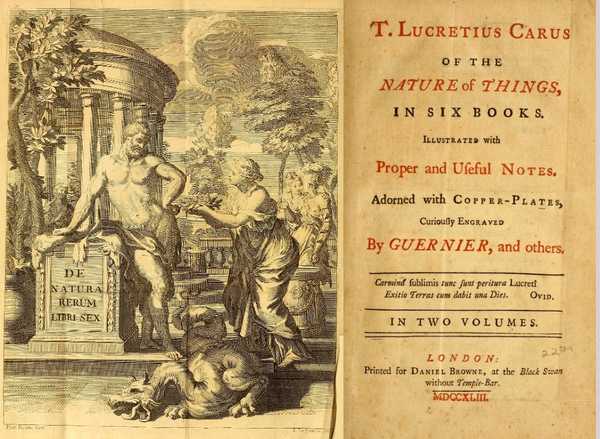
What is Epicureanism?
Epicureanism is a system of philosophy based on the teachings of ancient Greek thinker Epicurus, founded in 307BC. Often caricatured today as an exclusively pleasure-seeking, hedonistic stance towards the world, Epicurean thinking is actually more focused on eradicating pain, fear, and anxiety from our day-to-day lives. As Lucretius summarizes in book two of On The Nature of Things, Epicurists believe the ultimate good for human nature is as follows:
“To avoid bodily pain, to have a mind free from anxiety and fear, and to enjoy the pleasures of the senses.”
And, to satisfy these goods, Lucretius continues, we don’t need anything lavish, expensive, or complicated: the solutions to our needs can be remarkably simple. As he expounds:
“It is plain to see that our bodily nature needs very few things to banish pain, and to furnish us with many pleasures that are enjoyable from time to time. Nature herself does not complain if the halls are not full of golden statues of youths holding flaming torches to light up the banquets that go on all night, or if the house is not sparkling with silver and gleaming with gold, while the music echoes round the gilded rafters. For by the riverside, stretched out on the soft grass under the shade of a tall tree, people can relax and enjoy themselves far better without all that expense, especially when the weather smiles on them and the spring scatters the green meadow with flowers.”
But Epicureanism goes beyond prescribing how to live: it also offers a complete description of reality, one that is startlingly prescient to the physics of today. Advocating an atomic view of the universe, Epicurean thought on this matter can largely be summed up by a quote from an even earlier thinker, Democritus (born around 460BC):
“Nothing exists except atoms and empty space, everything else is opinion.”
Indeed, Epicurus taught that the basic constituents of the world are irreducible bits of matter flying through the void, and he tried to explain all natural phenomena in such terms. He rejected the existence of an immaterial soul, or of anything non-physical, and said that the gods have no influence on our lives.
It is with these two Epicurean principles in mind — that being free from pain and anxiety is the highest good, and that reality is fundamentally godless and atomic in nature — that Lucretius thus turns his attention to our biggest fear of all: death.
We all fear death, and material things don’t allay that fear
According to Lucretius, our fear of death is buried deep, and not always conscious: its presence “tinges everything we do with death’s blackness, leaving no pleasure clean and pure…” — indeed, try as we might to fill our lives with activity or distract ourselves with material things, nothing truly allays this deep, all-pervasive fear of death.
For, as Lucretius puts it, death does not discriminate:
“Suppose you are watching a whole fleet of your ships sailing home on the broad sea: does such a sight drive the fearful superstitions from your mind? Does the fear of death lose its hold on your mind and leave it carefree? Or are not such lavish displays in truth ridiculous and absurd? For the reality is that our human fears, the anxieties that pursue us, are not scared off by the sound of arms and fearsome weapons. They thrive just as much in the company of kings and powerful leaders, and show no respect for the glitter of gold or the glowing splendor of richly coloured clothes.”
We can keep ourselves busy, but as Kierkegaard also notes in Either/Or, voluntarily keeping busy is just a way of avoiding confrontation with things we do not want to confront. Lucretius continues:
“Look at the man who keeps leaving his vast mansion because he feels bored at home, and then suddenly decides to come back because he feels no better abroad. He drives full speed to his country retreat… and then rushes back to see the city again. Thus does everyone try to escape from themselves…”
So, if we cannot outrun or distract ourselves from it, how can we overcome the fear, anxiety, and self-denial that our mortality causes within us? For Lucretius, the power to banish our fear of death belongs to reason alone — darkness of mind must be dispelled by contemplating nature and understanding its workings:
“We hate ourselves because we are sick, yet we cannot grasp the cause of our sickness; but if we could see it, we would abandon such frantic activity and first try to understand the nature of the universe.”
The mind depends on the body, so dying is nothing to us
Lucretius’s first step in seeking to dispel our fear of death is to assert that, as we live in an atomic universe, it follows that our minds too must be physical or bodily in nature. From this base — that the mind is part of the physical body — Lucretius says we must therefore conclude that the mind’s existence is linked irretrievably to the fate of the body:
“The mind is but one part of the human being, which occupies a definite location, just like the ears and the eyes and the other senses that guide our life; and since the hands or eyes or nose cannot feel or function when they are separated from us, but soon putrefy and rot, so the soul cannot exist without the body, or without the whole human being…”
So, if we acknowledge that our conscious minds depend on our bodies, it follows that as soon as our bodies cease to be alive, our minds will cease to exist: in death, no conscious element of ourselves persists. This leads Lucretius to thus conclude that “death is nothing to us” — because it literally will be nothing to us: there is nothing to experience in death, because the experiencer no longer exists.
This echoes the fuller Epicurean slogan: “Death is nothing to us. When we exist, death is not; and when death exists, we are not. All sensation and consciousness ends with death and therefore in death there is neither pleasure nor pain.”
From this doctrine arose the epitaph: Non fui, fui, non sum, non curo (I was not; I was; I am not; I do not care) – which is inscribed on the gravestones of Epicurus’s followers and seen on many ancient gravestones of the Roman Empire.
To see just how little we need to worry about our own deaths, Lucretius continues:
“Consider the time before we were born: we felt no distress when the Carthaginians were attacking Rome on every side; and the whole world was shaken by the frightening tumult of that war… and in the same way in the future, when we shall no longer exist, and the final breaking up occurs for the body and spirit from which we are now compounded into a single unit, nothing whatever will be able to happen to us, or produce any sensation — not even if the the earth should collapse in to the sea, or the sea explode in the sky…”
The act of dying, then — and being dead — is nothing to reasonably worry about, because, just like before we were born, there is no part of our consciousness that exists to experience it.
But what if it’s not death that concerns us, but a fear of missing out, or leaving our loved ones?
So far, we might think, yes, Lucretius’s confrontation of our mortality has somewhat revealed death itself to be nothing to logically worry about, because we won’t even consciously experience it. But what if the act of dying is not really what drives our anxiety? What if it’s more worrying about the life we’ll miss out on, the loved ones we’ll leave, everything we didn’t manage to do?
For Lucretius, this is one and the same worry. Our lust for life and our fear of death are the same thought, merely framed differently. By fretting about not having enough time with our loved ones, by not completing what we want to complete in life — we are really fretting about death. And, as Lucretius puts it, “it is this evil and excessive desire for life that makes us tremble with doubts and forebodings”:
“People often feel a weight on their minds that bears down upon them and exhausts them. But if they could only know what are its causes, they would not live their lives in the way we so often observe: no one knowing what they want, everyone wanting to change their position in life, as if they could thereby lay down their burdens…”
Indeed, it is this unfocused longing for life, springing from a fear of death, that makes us so indecisive, so unhappy with our lot, so wanting for things we don’t have: “our mouths are always gaping open,” as Lucretius puts it, “with a constant thirst for life.”
So what’s the solution? We must remember death is nothing to us, and acknowledge that our unfocused craving for life in fact damages the only life we get: it removes us from appreciating what we already have. So, rather than forego current pleasures by worrying about future inevitabilities, we should accept and celebrate our mortality and live simply and authentically in the face of it. We should acknowledge that our time here is limited, but remind ourselves that it’s okay — because we’ll spend the time well, thankful for the present, without trying to control a future that ultimately we cannot escape, a future we won’t even experience.
Besides, by prolonging life we subtract nothing from the time when we shall be dead. As Lucretius frankly puts it:
“No matter how many generations you live through, the same eternal death is still waiting, and someone who ends life as the sun goes down today will have just as long a period of non-existence as one who died many months and years before.”
Mortality is part of our nature. We wouldn’t expect a flower to live forever — and in fact its beauty in full-bloom, we might argue, is only magnified by its artful impermanence.
Living authentically in the face of death
And so, in seeking to advocate the Epicurean principle of removing excess desire, fear, and anxiety from our lives, Lucretius set his sights on our biggest sickness of all, the root of many of our faults: our fear of death. Do you think he succeeds in using further Epicurean principles, like living in an atomic world, to allay this fear? Are you ready to live authentically in the moment, and banish your worries about the non-existent future? Or do you think Lucretius’s analysis, within the starkly godless universe of nothingness he portrays, provides little comfort?
Whichever side we fall on Lucretius’s arguments, On The Nature of Things remains a fascinating view into how people over two thousand years ago wrestled with the same fears we do today, and a uniquely beautiful, timeless work about the human condition and nature of the universe. It bears exploring in full.
If you’re looking to delve deeper into theories on life, the universe, and other existential themes, we’ve created a reading list of the best introductions to the whole of philosophy. Hit the banner below to access it now.
“The Bond of Life Project” Trailer
Jun 23, 2020
This project is dedicated to one woman who touched the heart of many people including me about Circle of Life.
Rebecca Floyd died Wednesday, January 23, 2013. A true best friend to me, an American mother, and one of the most powerful and beautiful women in my life.
A 18-year-old woman who took care of me like a mother when she was just studying abroad at a university in California from Japan. Especially for me, who lived as an exotic student in this important country, from the teens to the twenties, her presence was really big.
Seven years after her death, I finally reached here. After applying for some of the film festivals, we will also announce the main story to everyone. We would like to express our sincere thanks to everyone who has supported us so far.
(Submitted by Gwyllm Llwydd.)
Eugene V. Debs’s Translation of class

“While there is a lower class, I am in it, while there is a criminal element, I am of it, and while there is a soul in prison, I am not free.”
― Eugene V. Debs
Eugene Victor “Gene” Debs (November 5, 1855 – October 20, 1926) was an American socialist, political activist, trade unionist, one of the founding members of the Industrial Workers of the World and five times the candidate of the Socialist Party of America for President of the United States. Wikipedia
Carole King at Carnegie Hall
June 23, 2020 (CarnegieHall.org)
Following the release of her chart-topping album Tapestry in January 1971, Carole King made her headlining Carnegie Hall debut just five months later on June 18. Still at the beginning of her career as a performer in her own right—up until 1970 she had primarily written hits for other artists, most famously “Will You Still Love Me Tomorrow” for The Shirelles—King made a breathless ascent to a solo show that, for most artists, would be a long-awaited career highlight. Luckily, the performance was preserved, although 25 years elapsed between the concert and the live recording’s eventual release in 1996.
Performing songs drawn mainly from Tapestry, King began the concert with the powerful “I Feel the Earth Move” before transitioning to some of her gentler but still soulful songs. She also brought out a special guest: The year before, King had accompanied James Taylor for his Carnegie Hall concert; the roles were reversed when Taylor made a surprise appearance that night. The moment he appears on stage is captured in the audience’s reaction to the beginning of “You’ve Got a Friend,” a song written by King that Taylor recorded and brought to number one on the charts. The pair also performed a medley of “Will You Still Love Me Tomorrow,” “Some Kind of Wonderful,” and “Up On the Roof,” the latter of which Taylor recorded with King on her debut album, Writer.
King and Taylor had formed a friendship at the Troubadour nightclub in West Hollywood, where the singer-songwriter community was beginning to take hold over the ’70s music scene. In the 2011 documentary Troubadours: Carole King / James Taylor & The Rise of the Singer-Songwriter, King says of this community and its influence on the culture, “When we sprang out of the box there was just all this generational turbulence, cultural turbulence, and there was a hunger for the intimacy, the personal thing that we did.”
The personal and emotional nature of King’s songwriting spoke to the cultural shift that was finally making room for more art by women, realized in their own voices. King and her kindred spirits—like Joni Mitchell, Roberta Flack, and Carly Simon—wrote songs that reflected women’s feelings of love, anger, betrayal, and triumph, in a way that hadn’t been heard on such a scale or received with such popularity and acclaim—King made history when she became the first woman artist to win all three major categories at the 1971 Grammy Awards. It was only fitting that she end her Carnegie Hall debut with “(You Make Me Feel Like) A Natural Woman.”
Scientists: There’s Evidence Pluto Has an Underground Ocean
HOT PLANET TIME MACHINE
A radical new theory argues that Pluto harbors a vast underground ocean of water, like Earth — and even, possibly, life.
VICTOR TANGERMANN JUNE 23RD 2020 (Futurism.com)
According to new research, the frozen dwarf planet Pluto may have started its life as a hot world with a massive underground ocean of liquid water — suggesting, tantalizingly, that it could have harbored life.
Until now, Pluto was widely believed to be a giant boulder of ice, shielded from the Sun’s radiation thanks to the sheer distance from its star. But new evidence, scientists say, suggests that it once had a liquid ocean — and that it may still be there, under its frozen surface.
“Even in this cold environment so far from the Sun, all these worlds might have formed fast and hot, with liquid oceans,” Carver Bierson, UC Santa Cruz graduate student and first author of a new paper about the work published Monday in the journal Nature Geoscience, said in a statement.
The researchers suggest that the process of Pluto accreting matter may have generated sufficient heat to allow a subsurface ocean to form.
“For a long time people have thought about the thermal evolution of Pluto and the ability of an ocean to survive to the present day,” co-author Francis Nimmo, professor of Earth and planetary sciences at UC Santa Cruz, said in the statement. “Now that we have images of Pluto’s surface from NASA’s New Horizons mission, we can compare what we see with the predictions of different thermal evolution models.”
The hot and cold start scenarios of Pluto’s evolution would result in the planet’s surface looking quite different at present day, the scientists argued.
“If it started cold and the ice melted internally, Pluto would have contracted and we should see compression features on its surface, whereas if it started hot it should have expanded as the ocean froze and we should see extension features on the surface,” Bierson said in the statement.
“We see lots of evidence of expansion, but we don’t see any evidence of compression, so the observations are more consistent with Pluto starting with a liquid ocean,” Bierson added.
Whether Pluto has stayed warm enough to allow this ocean to remain liquid is another question. Bierson calculated that gravitational energy released by new material hitting the planet’s surface in its early days would be enough. But that energy would end up radiating away over time.
“How Pluto was put together in the first place matters a lot for its thermal evolution,” Nimmo said. “If it builds up too slowly, the hot material at the surface radiates energy into space, but if it builds up fast enough the heat gets trapped inside.”
If it took less than 30,000 years, according to his calculations, Pluto would have had a “hot start.” But if it took millions of years, sadly, that hot start would be almost impossible.
NASA: NEXT MOON ASTRONAUTS WILL HIKE 10 MILES ON LUNAR SURFACE
June 22, 2020 – DAN ROBITZSKI (Futurism.com)
Nature Walk
NASA just revealed new details about Artemis, its upcoming crewed mission to the Moon.
Once they reach the lunar surface, the astronauts are going to be seriously hoofing it: Space.com reports that NASA expects astronauts to hike ten miles in a single excursion. NASA is putting a lot of faith into its upgraded spacesuits, but the risky excursions could be invaluable for the space agency’s goal of hunting for signs of water on the Moon.
First Place
For context, Buzz Aldrin and Neil Armstrong’s single extravehicular activity (EVA) — that’s what NASA calls any excursion outside of the lunar lander — was only about 3,300 feet.
The Artemis astronauts’ 10-mile hikes will bring them 16 times farther away from the comparative safety of their vehicle while they trek around the Moon’s south pole, Space.com reports.
Pack A Thermos
In order to protect the Artemis crewmembers, NASA is dedicating more resources to new spacesuits that will be able to withstand the extreme cold for long enough to complete the EVAs. The suit, dubbed the Exploration Extravehicular Mobility Unit (xEMU) is a hybrid of the EMU suits worn on the International Space Station and the Moon-specific capabilities of the Apollo suits.
“This is where we’re going to test out technologies, utilize lessons learned from EMU and obviously Apollo, in order to get to 2024,” NASA EVA systems engineer Natalie Mary said during a recent committee meeting. “We do have some things that we are holding off [on] for sustained lunar [exploration].”
READ MORE: Don’t expect NASA’s 1st Artemis astronauts to drive on the moon in a fancy lunar car [Space.com]
More on Artemis: Here’s NASA’s Plan for a Lunar “Base Camp”