Science and homosexuality: Why your genes are just so gay

By: John Pickrell

Feb 23, 2016 (archermagazine.com)

Science and homosexuality: Why your genes are just so gay

Since the realisation that I was attracted to men in my early adolescence, I’ve never had any doubt that the desire was entirely innate and immutable.

I’ve never been attracted to women, and I couldn’t imagine feeling any other way. Not everybody attracted to the same sex feels this way, however. A minority of gay men, and – according to psychologists, such as Lisa Diamond at the University of Utah – certainly many gay women, feel that their sexual orientation is something more fluid and malleable; something that can change, can be shaped by experiences, and is intensified by attachment.

Over the past two decades, there have been many studies that together reveal a strong biological component to being gay (I use the term ‘biological’ instead of genetic because, although the trait is innate, it is not explained by genes alone).

Others suggest that homosexuality serves a useful evolutionary purpose – more on that later. The overall picture of sexual orientation is complex and different factors may be at play in different people.

I have friends, for example, who are identical twins: they possess the same genes and had the same upbringing, but only one of them is gay. There may be a significant genetic component to being gay, but it’s not the whole picture, and is unlikely to be reduced to anything as simple as a single gene. There is an argument that the search for a ‘gay gene’ would be bad for the gay rights movement, because it could lead to parents aborting ‘gay’ foetuses. In fact, I believe the search for the biological basis for being gay is essential if we are to understand the basic nature of our humanity.

Unfortunately, at least for the moment, most of the studies looking into the genetics of homosexuality are about men, not women. There could be an element of sexism to the bias of this research, but it also could be that it’s more difficult to reduce female same-sex attraction to a simple number of factors. Some studies suggest that male same-sex attraction is about 40 per cent genetic, while the genetic component of female same-sex attraction is perhaps 25 per cent.

Whatever the basis for homosexuality, we know it is hard-wired into our bodies and not purely psychological. The first study to find structural difference between the brains of gay men and straight men was published in 1991 by researchers including American neuroscientist Simon LeVay, who has since gone on to write a series of books on the biology of sexual orientation. In 2008, a larger study from the Stockholm Brain Institute in Sweden scanned the brains of 90 people and found that although the gay men and straight women tended to have symmetrical brains, lesbians and straight men tended to have asymmetrical brains, with left hemispheres that were significantly smaller than right ones. These results built on earlier studies that seemed to show that some gay men and straight women had better language skills (left hemisphere), while some straight men and lesbians had better senses of direction (right hemisphere).
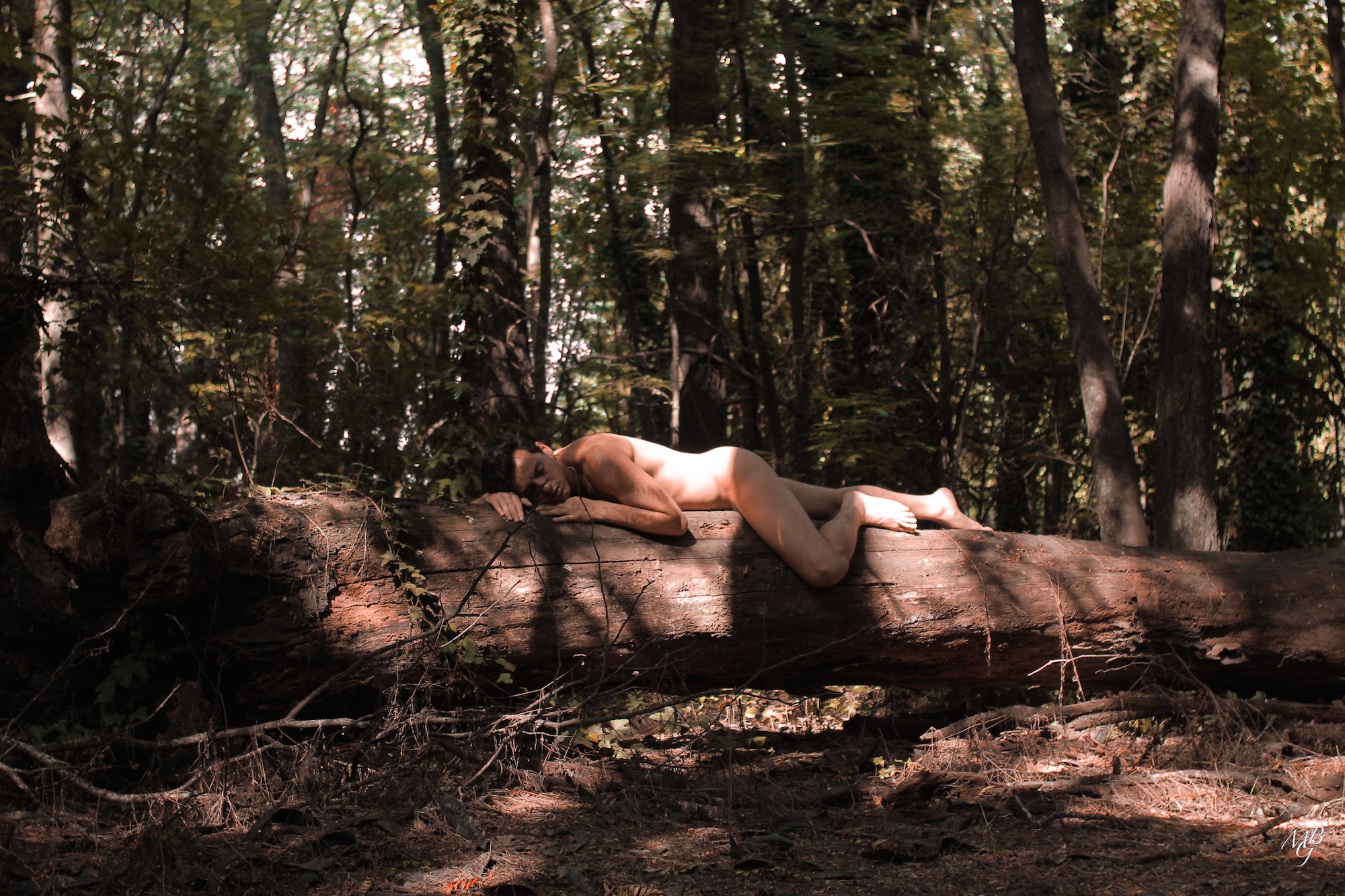
Images: Marina Bonofiglio

Images: Marina Bonofiglio

The first study to reveal a genetic component to being gay was published in 1993 and led by geneticist Dean Hamer at the National Cancer Institute in the USA. His team revealed that a region of the X chromosome – labelled Xq28 – was likely to be shared by brothers who were both gay. A 2014 study, presented at a conference in Chicago in February, looked at 400 pairs of twins. It backed up the role of this gene region, finding that it could explain about 40 per cent of the chance of a man being gay.

“Sexual orientation has nothing to do with choice. Our findings suggest there may be genes at play – we found evidence for two sets that affect whether a man is gay or straight,” lead author Michael Bailey, of Northwestern University in the USA, told the UK’s The Telegraph newspaper. “But it is not completely determinative; there are certainly other environmental factors involved.”

No such genes or gene regions as Xq28 have yet been found for gay women, but we know there is a genetic component because of patterns of homosexuality in identical twins. Some of the best evidence that being gay is partly genetic comes from twins. Identical twins (where both have the same set of genes) are much more likely to both be gay than non-identical twins (where they are only as related as any brother or sister, sharing about half their genes). This strongly suggests there’s a genetic element to being gay, but it doesn’t account for the entire picture; when one identical twin is gay, only in about 20–50 per cent of cases is the other twin also gay.

So if genetics doesn’t account for the whole picture, what other factors are at play? This is where the complex world of ‘epigenetics’ comes in. Our DNA is not the only factor in deciding whether our genes are expressed or not. The way our DNA is packaged up into bundles and packed away within our cells also determines whether genes are hidden away or available to play an active role in our bodies. In effect, genes can be switched on or off – a phenomenon known as epigenetics. It may be the genes that account for same-sex attraction could be switched on by an environmental effect (‘environment’ in this context could be the womb or your upbringing; it could be chemical or psychological). This may mean certain people have the genetic propensity to be gay, but may or may not encounter the environmental conditions that cause that trait to be switched on.

Researchers led by William Rice, at the University of California, published a study in 2012 arguing that epigenetics could be a major factor in explaining both male and female homosexuality. The researchers believe that so-called ‘epigenetic marks’ – a kind of annotation on top of DNA – control how susceptible foetuses are to hormones in the womb. For example, some male babies are made much more susceptible to the effect of maternal hormones than others, and are not able to develop fully masculine traits. This could account for why one of a pair of identical twins ends up being gay, while his brother is straight.

Other research points to hormonal and chemical processes in the womb as having an effect on sexual orientation. Perhaps the best known is a theory labelled the ‘fraternal birth order effect’. A string of studies seem to show that men with many older brothers are more likely to be gay. This is certainly biological and not social, as it’s not seen in cases of younger brothers with older adopted siblings.

Scientists behind these studies suggest that fraternal birth order is the cause of same-sex attraction in about 15–30 per cent of gay men. There’s a certain irony in these statistics, because it means that gay men are more likely to be born into the families of religious conservatives, who may or may not have a problem accepting them, as these families are more likely to have large numbers of children.

A possible explanation for the birth order effect has been put forward by Ray Blanchard, at the University of Toronto in Canada. His work suggests that male foetuses produce a male-specific ‘masculinising’ antigen in the womb, which a woman’s immune system rallies against (anitgens are chemicals foreign to the body that elicit an immune response). With enough antibodies from the mother, this antigen is neutralised and the male foetus is no longer capable of producing a straight-male sexual orientation. As a woman has more male children, she produces more and more of these antibodies during pregnancy, thus making it more likely the child will become gay.

Some gay equality activists have a problem with this scenario, with its implicit assumption that same-sex attraction is a developmental defect which could potentially be corrected in the womb. But these activists are missing the point: whether being gay is caused by genetic effects, epigenetic effects or the environment of the womb, it may still have evolutionary benefits.

Evidence is building that homosexuality is not an accident and that it serves a useful evolutionary purpose, whatever the biological basis behind it. A 2008 study showed that male homosexuality occurs at low, but stable frequencies across many different human societies, suggesting it is not present by chance alone.

More than 450 different species of animal, from penguins to giraffes, have been shown to exhibit gay behaviour, or form gay pairings. Many studies, such as one from the University of California, have argued that these behaviours offer benefits to a species.

There’s plenty of evidence that homosexuality may play a useful role in humans, too. This is either because the genes responsible for same-sex attraction are linked to other useful reproductive traits, or because gay men and women play an important role in societies, which benefits the group as a whole, increasing the overall rate of reproduction.

Some experts have suggested that – at least historically, in hunter-gatherer societies, where the complement of genes we possess today was largely built – gay aunts and uncles may have assisted their siblings in the care of children, even if they didn’t reproduce. In this scenario, the gay aunts and uncles are still winners in the evolutionary sense, as they share many genes with the offspring of their siblings, and the family group produces more offspring overall as a result.

“The gay uncle theory, where you look after your nephews and nieces…makes sense in a wild ancestral human,” says Richard Dawkins, an Oxford University evolutionary biologist. You can imagine a scenario in which the straight men go out hunting, leaving the otherwise vulnerable children in the care of these gay men, says Dawkins, adding, “the gay gene was passed on in the bodies of the children who were being protected.”

Dawkins is also an advocate of what he calls the ‘sneaky fucker’ theory, or “the idea that [many of] the males who possessed the homosexual ‘gene’ may have been bisexual”. He says that while the dominant males in hunter-gatherer societies may have trusted their women in the care of these men, the gay males may have occasionally had sex with the women, fathering some of their children.
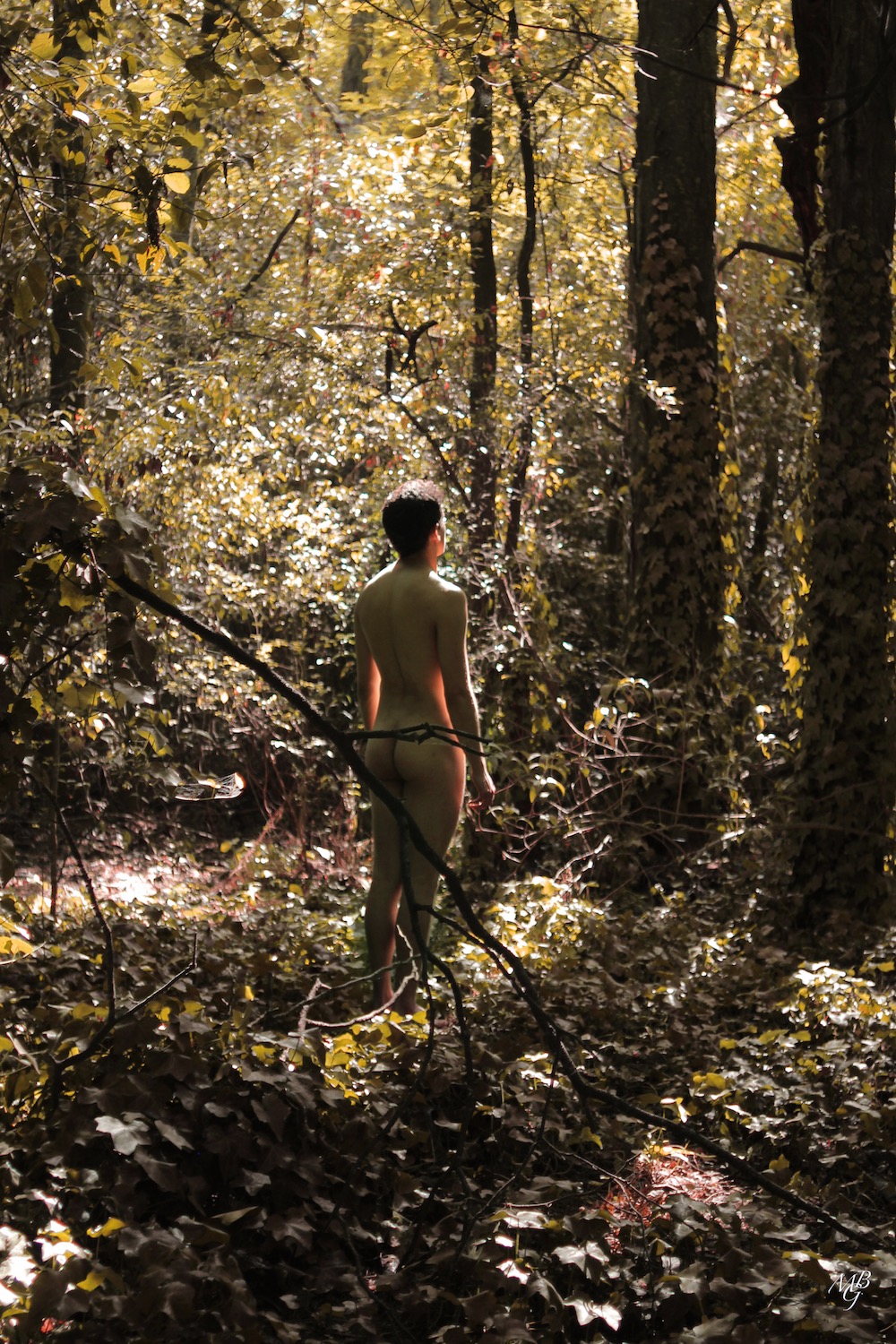
Images: Marina Bonofiglio

Images: Marina Bonofiglio

There have also been some interesting studies that seem to show that genes which cause a brother to be gay might lead his sister to have a larger-than-average number of children. For example, a 2004 study from the University of Padua in Italy (which involved 98 gay men and 100 straight men) found that the female relatives of gay men were likely to have more offspring than the female relatives of straight men.

This ‘sexy sister’ hypothesis suggests these women are reproductively successful enough to discount the fact that their brothers don’t have offspring. It’s also very possible that the genes that make lesbians attracted to women have a reproductive benefit for their brothers, but this is yet to be found by scientists.

A twist on the ‘sexy sister’ idea came from researchers led by Brendan Zietsch at the Queensland Institute of Medical Research in 2008. His team argued that the male siblings of gay men may benefit from a number of genes that partially feminise their behaviour, making them more empathic, agreeable and caring. This made the straight male sibling more attractive to women, leading to a larger number of sexual partners. For their gay brothers, Zietsch suggested, the feminising effect was too great, leading them to be attracted to men instead of women.

The overall conclusion here is that the biological factors that cause homosexuality in men and women very likely have a genetic component, but these are varied and complex. Following the 2014 study on the Xq28 chromosome region, a spate of opinion pieces argued that the search for a ‘gay gene’ was folly, and could potentially set the gay equality movement back if tests were developed to diagnose ‘gay’ foetuses. For example, Alex Andreou, a columnist for The Guardian, wrote: “That a single cent of medical research should be devoted to explaining whom I choose to share my bed with, is utterly obscene.”

This is a head-in-the-sand approach. The pursuit of all knowledge is valuable, particularly when it helps us to understand the very basic nature of our shared humanity. It’s akin to arguing that we shouldn’t have strived to understand the structure of the atom because it led to the development of nuclear weapons. It’s not the knowledge itself that’s a dangerous thing, but what people choose to do with it.

The fear of the development of a diagnostic test for ‘gay’ foetuses is over-exaggerated, because it’s likely the genes only account for the propensity to be gay – one that requires environmental and other factors for it to be realised. This means that any diagnostic test would have a very poor chance of predicting a gay child. Would conservative or homophobic parents be prepared to abort a foetus when there’s a 70 per cent chance it will be straight? It remains to be seen. There’s also the point that many conservatives are against the concept of abortion, in any case.

There’s also very little chance of homosexuality ever being removed as part of the human evolutionary landscape, because it’s likely that it is passed on by heterosexual siblings, for whom it confers a reproductive advantage. Homosexuality is here to stay, and I for one am very keen to understand the genetic and biological basis behind it.

John Pickrell is an award-winning science writer. He has worked in London, Washington DC and Sydney for publications including New Scientist, Science, Science News and Cosmos. More of John’s articles can be found online and in print at National Geographic, Scientific American and the ABC. He is also the editor of Australian Geographic magazine. Follow him on Twitter: @john_pickrell

1 Comment

  1. Tobin Saunders 4 years ago ReplySlave to the binary! Sexuality is a spectrum and people sometimes move around on this spectrum during their lives. Many sit at either end and don’t move, lots defy description. I found this piece an old school and lazy cobble job!

Master Shi Heng Yi – 5 hindrances to self-mastery | Shi Heng YI | TEDxVitosha

TEDx Talks Meet Shaolin Master Shi Heng Yi in his serene talk about self-discovery. Learn why rainfall is an essential part of each flowering. And every small step – part of the journey to the highest peek. The hindrances along the way to self-discovery and personal growth are easy to overcome. Learn how from his talk. For more than 30 years, Master Shi Heng Yi has been studying and practicing the interaction between mind and body. His strength is the ability to smoothly combine this knowledge with physical exercises and to practice Martial art –Kung Fu and Qi Gong. He has an academic background but he prefers to live at the Shaolin Temple Europe, Monastery located in Otterberg, Germany. Since 2010 he has been taking care of the settlement and he personifies the sustainable development and spreading the Shaolin culture and philosophy. As a contemporary monk, Master Yi holds a smartphone in the folds of his clothes as he sees no contradiction between living together with ancient knowledge and high technology. “The universal law of being successful and happy at the same time means finding the balance”, says master Yi. And as for flying – yes, he really can do it! He only needs a stick and a little space. We expect him to fly-in and share about the Shaolin way at TEDxVitosha 2020. Artist: Secret Garden Album: Earthsongs Track: Lotus This talk was given at a TEDx event using the TED conference format but independently organized by a local community. Learn more at https://www.ted.com/tedx

Extreme Ownership | Jocko Willink | TEDxUniversityofNevada

TEDx Talks War is hell, but war is also a brutal teacher. War teaches you about brotherhood, honor, humility, and leadership. In this riveting talk, Jocko Willink explains from personal experience how war teaches you the most when things go wrong. Jocko asserts that when a team takes ownership of its problems, the problems get solved. JOCKO WILLINK is a decorated retired Navy SEAL officer, author of the #1 New York Times bestselling book Extreme Ownership: How U.S. Navy SEALs Lead and Win, host of the top-rated Jocko Podcast, and co-founder of Echelon Front, where he is a leadership instructor, speaker, and executive coach. Jocko spent 20 years in the U.S. Navy SEAL Teams, starting as an enlisted SEAL and rising through the ranks to become a SEAL officer. As commander of SEAL Team Three’s Task Unit Bruiser during the battle of Ramadi, he orchestrated SEAL operations that helped the “Ready First” Brigade of the US Army’s First Armored Division bring stability to the violent, war-torn city. Task Unit Bruiser became the most highly decorated Special Operations Unit of the Iraq War. Jocko returned from Iraq to serve as Officer-in-Charge of training for all West Coast SEAL Teams. This talk was given at a TEDx event using the TED conference format but independently organized by a local community. Learn more at http://ted.com/tedx

Nothing Is Fixed: James Baldwin on Keeping the Light Alive Amid the Entropic Darkness of Being, Set to Music

By Maria Popova (brainpickings.org)

avedonbaldwin_nothingpersonal.jpg?fit=320%2C424

“Against this cosmic background the lifespan of a particular plant or animal appears, not as drama complete in itself, but only as a brief interlude in a panorama of endless change,” Rachel Carson wrote in her poetic, unexampled 1937 essay Undersea as she incubated the ideas that would awaken humanity’s ecological conscience. “There is grandeur in this view of life,” Darwin had written in the closing pages of On the Origin of Species in the middle of the previous century, as though to offer preemptive succor for humanity to steady itself against as he dismantled our comfortable and complacent age-old certitude that we are the pinnacle of “creation,” finished and complete — a certitude applied to the evolutionary, but stemming from the existential, for what is true of the species is true of the individual. As the Harvard psychologist Daniel Gilbert aptly observed, “human beings are works in progress that mistakenly think they’re finished.”

But we are — as individuals, as a species, as a society — unfinished and incomplete, our story unwritten. Darwin and Carson both intimated that while there is disorientation in accepting ourselves as increments in advancement the arc of which far exceeds our lifetimes, there is also transcendence, for a story yet unfinished is a story with myriad possible endings — a story that forestalls despair by the sheer force of possibility; a story in which our individual lives matter not less but more, for they are the pixels shaping the panorama of endless change.

That is what James Baldwin (August 2, 1924–December 1, 1987) explores a century after Darwin and a generation after Carson in the final essay from the forgotten treasure Nothing Personal (public library) — his collaboration with the great photographer and his former high school classmate Richard Avedon, which also gave us Baldwin on the ultimate lifeline for your hour of despair.

JamesBaldwin_MarleneDumas_PioneerWorks.jpeg?resize=680%2C962

James Baldwin by artist Marlene Dumas for the 2020Solidarity project — a series of charitable posters by international artists to help cultural institutions around the world survive during the 2020 crisis. Available as a poster, benefiting Pioneer Works — birthplace of The Universe in Verse.

Baldwin considers how we “emptied oceans with a home-made spoon and tore down mountains with our hands” — a sentiment referring to the failures of human rights and social justice he had witnessed and experienced in his own life, but drawing on nature for a metaphor that renders it all the more poignant in the context of our present ecological undoing — and writes:

2e292385-dc1c-4cfe-b95e-845f6f98c2ec.png

One discovers the light in the darkness, that is what darkness if for; but everything in our lives depends on how we bear the light. It is necessary, while in darkness, to know that there is a light somewhere, to know that in oneself, waiting to be found, there is a light. What the light reveals is danger, and what it demands is faith.

In consonance with Viktor Frankl, who upon surviving the Holocaust two decades earlier had written stirringly about the moral obligation to “say yes to life, in spite of everything,” Baldwin reflects on the stubborn light that must have blazed in his own parents’ eyes in order for them to survive what they survived, in order for him to exist, and adds:

2e292385-dc1c-4cfe-b95e-845f6f98c2ec.png

This is why one must say Yes to life and embrace it whenever it is found — and it is found in terrible places; nevertheless, there it is.

[…]

For nothing is fixed, forever and forever and forever, it is not fixed; the earth is always shifting, the light is always changing, the sea does not cease to grind down rock. Generations do not cease to be born, and we are responsible to them because we are the only witnesses they have.

The sea rises, the light fails, lovers cling to each other, and children cling to us. The moment we cease to hold each other, the moment we break faith with one another, the sea engulfs us and the light goes out.

In this highlight from the fourth annual Universe in Verse — a charitable celebration of the 50th anniversary of Earth Day, the creation of which was inspired by Rachel Carson’s work — musician, activist, and light-filled human vessel of change Morley — the visionary behind the wondrous Borderless Lullabies project — set Baldwin’s transcendent words to music, with Chris Bruce (her sweetheart) on guitar in their quarantine quarters and Dave Eggar on cello, invisible across the spacetime of distanced digital collaboration.

b8bdc76a-e2c7-4c71-bbef-785476857418.png

For other highlights from The Universe in Verse, savor astrophysicist Janna Levin reading “Antidotes to Fear of Death” by astronomer and poet Rebecca Elson, astronaut Leland Melvin reading Pablo Neruda’s love letter to the forest, a stunning animated short film of poet Marie Howe’s ode to our cosmic belonging, Rosanne Cash reading Lisel Mueller’s subtle poem about outgrowing our limiting frames of reference, and a lyrical watercolor adaptation of Mojave American poet Natalie Diaz’s ode to brokenness as a portal to belonging and resilience, then revisit Baldwin on resisting the tyranny of the massesthe writer’s responsibility in a divided societyhow he learned to truly see, and his advice on writing.

Too Sexy to Last: The Right Said Fred Story

The British pop act wasn’t just a one-hit wonder … they had three hits.

Mental Floss (getpocket.com)

  • Jake Rossen
ezgif.com-webp-to-jpg(82).jpg

Photo by Ralph Orlowski, Getty Images.

Guy Holmes popped the tape into the cassette player in his car and waited. The British record promoter was eager to hear new acts, but knew that the majority of them weren’t going to be good or unique enough to cut through the noise of the worldwide music scene. In 1991, it was still a multibillion dollar business, not yet smothered by file-sharing. Success was determined by decision-makers at record labels and radio stations, whose tastes were often mercurial and hard to anticipate.

The cassette had been given to Holmes by a friend, a 19-year-old named Tamzin Aronowitz. She was dating Rob Manzoli, the guitarist of an act called Right Said Fred, and insisted the group—which also consisted of brothers Richard and Fred Fairbrass—had a hook. He listened.

I’m too sexy for my car

Too sexy for my car

Too sexy by far

And I’m too sexy for my hat

Too sexy for my hat

What do you think about that?

Holmes was driving with a friend, a man of Russian descent who had been drinking vodka for most of the night. As Richard Fairbrass sang about other things he was too sexy for—Milan, Japan, parties, his shirt—Holmes noticed his passenger bouncing in his seat and mouthing the words.

This might be a dumb song, Holmes thought. A very dumb song. But it’s catchy.

By 1992, “I’m Too Sexy” was the number one tune in 32 countries, including the United States, and the Fairbrass brothers went from being gym managers and sporadic musicians to the kitschy pop act of the moment. But they wondered whether people knew they were in on the joke, and whether they had the ability to survive the plague that had taken down so many talented musicians before them—the affliction of being an overnight success.

* * *

Richard Fairbrass was born in East Grinstead, Sussex in 1953. His brother, Fred, followed three years later. Raised in a relatively well-off environment by Peter and Mary Fairbrass, Richard thought he might wind up becoming a politician; Fred was more interested in athletics. By their late teens, both had gravitated toward music, forgoing any thought of a formal career in exchange for odd jobs and band practice that led to small gigs with London punk bands. At one performance, an irate—or possibly enthused—fan managed to pee on Richard.

From 1977 to 1987, they performed under a variety of names, including Trash Flash and Money, and landed a series of not-quite-breakthrough gigs. Richard got a job as a session musician for three David Bowie music videos, while Fred had a stint backing up Bob Dylan. Their act wavered from punk to rock to a blend of the two.

After an unsuccessful tour of New York, the brothers returned to London in 1988. Both took to going to the gym to build their bodies back up and shaved their heads. They also met Rob Manzoli, a guitarist, and Brian Pugsley, who had access to computer synthesizers that the brothers thought might evolve their sound into something more palatable than their acoustic act.

Jamming in Pugsley’s apartment one night over a bass line inspired by Jimi Hendrix, Richard took off his shirt—it was hot in there—and proclaimed he was “too sexy” for it. From that line evolved an entire hook that played on the narcissism the brothers had witnessed both in the gym and among the models in New York’s fashion scene. The song wasn’t about the band thinking they were too sexy, but about the self-absorbed egos who really believed it. Supported by a backing track from a DJ named Tommy D, “I’m Too Sexy” was polished into an anthem about vanity.

* * *

Now going by Right Said Fred—a name they took from a 1962 Bernard Cribbins song about furniture movers—the trio started shopping the single to record labels. No one was interested. The only bite was from Holmes, who tried to entice executives but was met with the same resistance. In a self-admitted act of “belligerence,” Holmes produced copies of the single himself, while his secretary, Aronowitz, became the group’s manager. It was a homegrown operation, one in which the group was urged to formally record the final version of the song in an unheated studio because it was cheaper.

“I’m Too Sexy” made its way into the hands of producers at the BBC and Capital Radio. “I’m not sure if this is good or it’s crap,” one radio producer said, then played it anyway. The song spread quickly, making its way to the top of the most-requested queues in England. A DJ from Miami was on vacation in Europe when he heard it. From there, it spread to the United States and abroad, topping the Billboard Top 100 chart for three weeks straight and becoming a perpetual club selection well into 1992. (It only rose to number two in the UK, trumped by Bryan Adams’s “(Everything I Do) I Do It For You.”) The pop icon of the era, Madonna, announced she was sexually interested in Fred. Truant students announced they were “too sexy” for school. Stewardesses asked the brothers if they weren’t “too sexy” to be on a plane, a variation on a joke that they would wind up hearing thousands of times.

“It’s part of the job,” Fred said of the jokes.

Almost immediately, Right Said Fred underwent what industry veterans would call an “image makeover.” A fashion designer squeezed them into vinyl outfits, fishnet shirts, and various half-clothed stage uniforms. Though they were in their early thirties, they fibbed and told reporters they were in their early twenties. They were advised to ease up on the weightlifting, as their pumped-up physiques were deemed too frightening for general public consumption.

Holmes produced their first album, 1992’s Up, and helped them spin off two more successful songs: “Don’t Talk Just Kiss” and “Deeply Dippy.” They made the requisite MTV appearances and fended off speculation that “I’m Too Sexy” was a sign of them being the prototypical one-hit wonder.

Unfortunately, “I’m Too Sexy” wound up proving exactly that. But the brothers would argue that it was not their fault—it was Holmes’s.

* * *

Up had taken just five weeks to record. Their sophomore album, Sex and Travel, took nine months. Released in 1993, it failed to capture the public’s attention in the way “I’m Too Sexy” seemed to reverberate with kids, teens, and adults.

The brothers would later point the finger at Holmes, claiming he had chosen to release the wrong single tracks; Holmes countered that Richard and Fred had final say over what got the “A” side of the records. Subsequent albums followed—nine in all—but none ever reached the heights of their event-filled summer of 1991.

“I’m Too Sexy” remains a popular jab at people who indulge in vanity, and the brothers still perform it as part of their regular gigs. (Manzoli left the band in the mid-1990s.) They approved a new version targeting Syrian president Bashar al-Assad (who was revealed to have had the song on his playlist) and debuted it on Last Week Tonight with John Oliver in 2014. (“I’m too sexy for this shirt” became “You’re too awful for this Earth.”) To this day, however, Fred believes there’s still some confusion over whether the song is to be taken seriously. He tried to clarify it for Rolling Stone in 2017.

“They didn’t get the cynicism and the joke,” he said. “But the idea of the song is that you obviously can’t be too sexy, right? No one can be too sexy.”

Jake Rossen is a senior staff writer for Mental Floss.


This post originally appeared on Mental Floss and was published August 16, 2018. This article is republished here with permission.

SUNDAY NIGHT TRANSLATION GROUP – 5/24/20

Translators:  Mike Zonta, Melissa Goodnight, Richard Branam, Hanz Bolen, Sarah Flynn

SENSE TESTIMONY:  Power and influence can be obtained through dishonesty and deception.

5th Step Conclusions:

1)  Truth is the only cause, the only effect; infinite, truthful, honest, honorable possession already in hand, always at hand; nobody’s fool.

2) One Infinite Consciousness Being, is the only Real commanding Authority — controlling and enabling absolute causative Principle to be realized, which is always in perfect accord with Truth, and only ultimately expressing Truth.

3)  Truth is Omni Affluent ethereal flux, Being pure sound One Infinite Mind,, this enduring continued succession , continual retention, balanced feasibility; sensualness of delight, One Infinite Consciousness Aware sentient Abstract construct; captivating; Androgynous I AM THOU.

4) Truth is only and always the harmonious, graceful, effective, direct intention of whole, complete, perfect beingness.


5) Each and Every Individuation of One Being is holding the total source ability power influence of all one Being, clearly, abundantly in all agreement and all expression, now everywhere always, besides which there is none else. OR: All Individuations of One Being I AM hold the total source of Being clearly abundantly in all expression instantly, everywhere always.


All Translators are welcome to join this group every Sunday at 7 p.m. Pacific time. Zoom link:
https://us02web.zoom.us/j/652387027

Pila of Hawaii on the ego

Pila of Hawaii

“EGO cannot talk directly with God.  In fact, traditional ‘prayer’ may be missing a piece …all these centuries. In the first Hawaiian chants ever written on Tapa cloth, it describes our “Unihipili” (subconscious) as making that “higher connection to God (Aumakua) for us. When it ‘connects’, Our Maker’s blessings: ‘purple-misty rain’ down, upon us.” (Purging, revitalizing the Lower-Self, bringing back hope, radiating love and protection.)

–Pila Chiles

Dr. Evelyn Hooker

Dr. Evelyn Hooker (makinggayhistory.com)

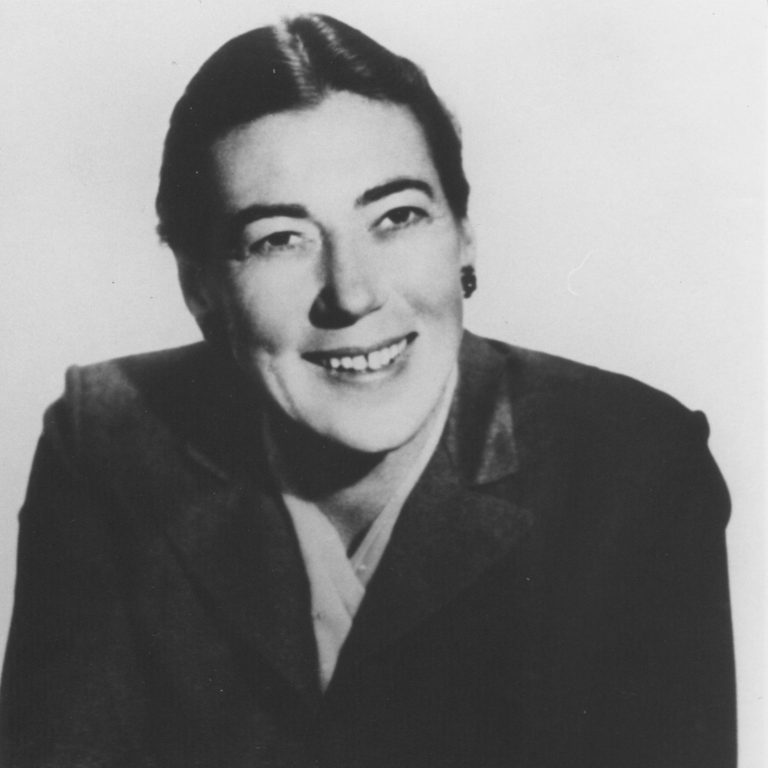
Dr. Evelyn Hooker in an undated photo. Courtesy of Frameline Distribution.

Episode Notes

In 1945 Dr. Evelyn Hooker, a UCLA psychologist, and her husband sat down for a nightcap at the Fairmont Hotel in San Francisco with her former student Sam From and his male partner.  Sam told Dr. Hooker that it was her responsibility to study “normal” homosexuals to show the world what they were really like—to challenge the commonly held belief that gay people were by nature mentally ill.  Dr. Hooker took up the challenge soon after, but then life intervened, derailing her research until 1953, when she secured an unlikely government grant to pursue a study comparing 30 straight men to 30 gay men.

Three years later Dr. Hooker presented the results of her study, “The Adjustment of the Male Overt Homosexual,” at the 1956 American Psychological Association (APA) convention in Chicago (the study was published in 1957).  She rocked the profession by demonstrating that gay men were just as sane as straight men.  While it would be another seventeen years before the American Psychiatric Association would remove homosexuality from the Diagnostic and Statistical Manual’s list of mental illnesses, it was Dr. Hooker’s study that paved the way, legitimizing homosexuality as a respectable field of study.

There’s so much more to this story and the study.  And fortunately there are many resources, a sampling of which you’ll find below.

———

Katharine S. Milar, PhD, a professor of psychology at Earlham College, offers a concise overview of Dr. Hooker’s life and work for the American Psychological Association’s “Time Capsule,” including details about how she conducted her landmark study (which was derisively referred to as “The Fairy Project” by some federal officials).

For a broad overview of Dr. Evelyn Hooker’s life, including a biographical sketch that was adapted from an article in the American Psychologist, as well as tributes and obituaries, have a look here.

The American Psychological Association provides a summary of Dr. Hooker’s groundbreaking study—“The Adjustment of the Male Overt Homosexual”—here.  A copy of Dr. Hooker’s paper is available here, but access is restricted (or requires payment).

In 1991, Dr. Hooker was given the APA’s Award for Distinguished Contributions to Psychology in the Public Interest.  And in 1992 the documentary Changing Our Minds: The Story of Dr. Evelyn Hooker, premiered.  You can watch a clip from it here.  But be warned, the archival footage about lobotomies is horrifying.

You can find Dr. Hooker’s oral history in Eric Marcus’s book Making Gay History.

Beginning in 2008, the APA’s “Division 44” (Society for the Psychological Study of Lesbian, Gay, Bisexual, and Transgender Issues) named an annual award in Dr. Hooker’s honor:  Evelyn Hooker Award for Distinguished Contribution by an Ally.

Here is an overview of the American Psychological Association’s current work concerning LGBTQ rights.  Dr. Hooker’s work is cited in the opening sentence.

“This American Life” produced an episode in 2002 featuring a surprisingly personal story hosted by Alix Spiegel about her psychiatrist grandfather and the 1973 removal of homosexuality from the American Psychiatric Association’s list of mental illnesses. The piece includes recorded interviews with some of the key players in that drama, including Dr. Charles Socarides and Dr. John Fryer (aka, Dr. H. Anonymous). It’s a must-listen episode that helps explain how millions of homosexuals gained an instant cure. Dr. Hooker’s landmark study is cited and gay rights champion Barbara Gittings is referenced as well (although she’s misidentified as a librarian—she loved books and was deeply involved with the American Library Association, but wasn’t a librarian).

The Kinsey Institute at Indiana University offers a treasure trove of information and research on human sexuality and gender.

———

Episode Transcript

I’m Eric Marcus and this is Making Gay History!

This week you’ll meet Dr. Evelyn Hooker.  She was something else.  A force of nature.  Even at 81.  But you had to be a force of nature to do what she did when she did it.

Back in 1953 Dr. Hooker started work on a first-of-its kind psychological study that demonstrated gay men were no different from straight men when it came to their sanity.

At that time, just about everyone thought gay people were mentally ill.  Homosexuality was a sickness.  Even most gay people believed it.

And what do you do when you’re sick?  You try to get cured.  And that’s what a lot of gay people did.  They spent years and fortunes trying to get over an illness they didn’t even have.

The really unlucky ones were forced against their will into horrible treatments that were nothing short of torture.  Lobotomy, chemical castration, and shock treatment.  And I’m really not kidding.  Those were the ways in which gay people were treated.

This is a story about serendipity—a pivotal moment in history when a gay psychology student name Sam From set his sights on Dr. Evelyn Hooker.  He urged Dr. Hooker to study normal gay people to show the world what they were really like.  That was in 1945.  And then life got in the way and Dr. Hooker set aside Sam’s project.  You can read about this part of Dr. Hooker’s life on our website, makinggayhistory.com.

So now it’s 1953 when Dr. Hooker gets back to work.

She found the men she needed, she gave them psychological tests and then got top psychologists to review the results.  When you hear Dr. Hooker talk about someone named Bruno, that’s Dr. Bruno Klopfer, a German psychologist.  He was one of study’s judges.

So in August 1989 I fly out to Los Angeles and drive my rented convertible, because it’s Los Angeles, to Dr. Hooker’s apartment in Santa Monica.  It’s just a couple of blocks from the beach.  She welcomes me into her double-height living room.  Book shelves reach to the ceiling.  And I just about choke on the air.  It’s saturated with smoke and nicotine.  And I’m thinking, “Please god, don’t smoke through the whole interview.”  She does.

Before we sit down, Dr. Hooker shows me her small office.  It’s lined with cabinets filled with the files of the sixty men she studied.  The contents of those cabinets changed the course of history.

We head back into the living room.   Dr. Hooker leads the way.  She walks slowly and deliberately.  She’s got spinal arthritis and gingerly lowers her six-foot frame into her high-backed leather easy chair.  I clip the microphone to her blouse.   She lights a cigarette and draws deeply.  And I press record.

———

Eric:  Interview with Dr. Evelyn Hooker.  Sunday, August 20, 1989.  Interviewer is Eric Marcus, location is the home of Dr. Hooker in Los Angeles, California.

Dr. Hooker:  They wanted us to come to dinner.  We went to dinner.  His lover was introduced as his cousin, a much older man, George.  And, you wouldn’t believe, since you didn’t live then…  You would not believe how gay men, they could put on a business suit… no humor, they were afraid to have me know that they… they wanted my approval so much that they were afraid to let me know that they were gay.  Anyway, delicious dinner, and gradually they became very good friends.

Eric:  He still hadn’t told you that he was…

Dr. Hooker:  I don’t even know… Oh, yes, gradually the fog came down because they saw that I didn’t care what they were like.  I liked them.  I found them to be very interesting people.  I came to be very fond of them.  And I don’t even remember a time when… I’m sure it wasn’t a time when somebody said, “Look, we’re gay, now you…”  There was nothing like that.  It was just a very gradual letting down of hair.

After I’d known them about, I would say, about a year, we were invited by Sam and George to go with them on a holiday, on Thanksgiving holiday to San Francisco.  We get to San Francisco and the first night or second night we’re there, Sammy insists that we should go to Finocchio’s.

Dr. Hooker:  My eyes were wide.  I’d never seen anything like that.

Eric:  What was Finocchio’s like then?

Dr. Hooker:  Oh, my god.  Well, are they still there, the two old bags from Oakland?

Eric:  I don’t know.  But for people who won’t know what it is, can you just describe what the place was like?

Dr. Hooker:  Well, it was of course a tourist place.  It was not a gay bar.  Yes, to be sure, they served drinks.  But it was essentially a tourist place for primarily, as I saw it at least, for transvestites, or would be transvestites, or transsexuals.  And of course it was altogether a different kind of world.  They had a lot of patter, female patter they call it, and it was funny.  I’m sure they’re dead by now and that’s a shame.  They were great.  I thought they were great.

Eric:  So you went back to the Fairmont…

Dr. Hooker:  We went back to the Fairmont.  We sat down, we were gonna’ have a snack before we went to bed.  “Now,” he said, “we have let you see us as we are and it is now your scientific duty to make a study of people like us.”  Imagine that!  And by people like us he meant, “We don’t need psychiatrists, we don’t need psychologists, we’re not insane, we’re not any of those things they say we are.” I said, “But I couldn’t study you because you’re my friends.  And I couldn’t be objective about you.”  And to which he replied, “Hmm, we can get you a hundred man, any number of men you want.  You’re the person to do it!  You know us!  And you have the training.”

Eric:  Why would he want you to do a study?  What was the purpose of doing a study about these…?

Dr. Hooker:  The purpose of doing a study was to show the world what we’re really like.

I could understand there was excitement about doing something that you felt was going to be groundbreaking, whatever happened.  Because it would have been the first time anybody ever looked at this behavior and said, “Now, we’ll use scientific tests to determine is this pathological or not?”

Eric:  All this time everyone had said it was pathological without any studies.

Dr. Hooker:  Without any studies.  They represented, even in that relatively small group, they represented a cross section of personality, of talent, of background, of adjustment, of mental health, the whole kit and caboodle was there.

Eric:  So even by then you knew that the current thinking was incorrect.

Dr. Hooker:  But I had to prove it.

Eric:  Dr. Evelyn Hooker, tape two, side one.

Dr. Hooker:  I had just heard that the National Institute of Mental Health had just been founded.  And I said to myself, “Gee, well, I think what I’ll do is to apply to the National Institute of Mental Health.  If they think this project is worth doing, if the study section thinks this is worth doing, then I’ll do it.

The chief of the grants division flew out and spent the day with me. He wanted to see what type of kook this was.  Is she really crazy or can she do this?  At the end of the day, he said, “I’ll tell you we’re prepared to make you this grant.”

I decided with the consultation with my statistical consultant, Dr. Gingerelli, that we would settle for a small group, 30 in each group, 30 heterosexuals, 30 homosexuals.  But the problem was getting the straight people, the straight men.

Eric:  Why?

Dr. Hooker:  Well, again, remember, this is the early ‘50’s.  And I thought that if I went to, let’s say, to labor unions and asked the personnel director and told him what I was doing that he would be willing to speak individually to men who he thought were thoroughgoing heterosexual men.  Not a bit of it.  He wouldn’t do it.

I was just at my wits end to find people who were of the general educational, economic, etc., level of my gay group.  And one day I was sitting in the study and I heard some steps coming down the driveway and I looked out and there were blue trousers legs.  Four of them.  And I said, “Oh boy!”  And, so it turns out that they were firemen and they were from our local fire department and they were looking at our fire precautions.  So I walked over to talk to them..  One of them said, “Oh, you’re a writer.”  I said, “Well, no, not exactly.  I’m a psychologist.”  “Oh,” he said, “I have two boys and they’re in a psychology experiment at UCLA.”  And I said, “Oh, would you be willing to be in a psychology experiment?”  “Oh, no, I couldn’t do that,” he said.  I said, “Well wait a minute, what about on your days off.  And then he said, “Well, then I have to take care of my boys.” I said, “What if I pay the baby-sitter?”  Finally, he broke down and said, “Okay.”

He introduced me to a cop.  And did I learn about the ins and outs of the police department downtown.  And he wanted to come to me because it turns out he was having marital trouble and he hoped that he could exchange a little information for…

Eric:  A bargain.

Dr. Hooker:  I tell you there’s nothing more interesting than human beings.  Anyway, so we all end up… the whole thing ends up by having the 30/30.

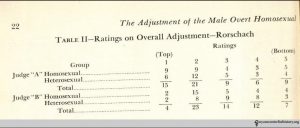
At that time, the ‘50’s, every clinical psychologist worth his soul would tell you that if he gave those projective techniques that he could tell whether a person was gay or not.  No such thing.  I showed they couldn’t.

When Bruno did the judging, people said, “You’ll never get away with this.  Your face will reveal it.  He’ll know.”  I said, “Oh, nonsense.”  Uh, anyway, and he’s the great Rorschach expert, and every day, I think we spent ten days just going over one after the other and one after the other.  But that was of course terribly exciting to see Bruno, who said, “You must let me know where I made the errors afterwards.”  And he would say, “Oh, I knew, I knew there was something about that.  I knew there was something about that.”  But terribly exciting days.  Terribly exciting days.

See, I presented that paper at a meeting of the American Psychological Association in Chicago.

Eric:  Uh…, “The Adjustment of the Male Overt Homosexual.”

Dr. Hooker:  Right.  Right.  The air was electric.  It was just electric.  And of course there were people, some, not too many, but there were some people who were saying, “Well, of course that can’t be right.  And they set off to try to prove that I was crazy.  The hard-liners among the psychoanalysts, like Irving Bieber, for instance, they would as soon shoot me as look at me.

Eric:  Why was it so electric?

Dr. Hooker:  Well, if you’re challenging a long and commonly held position and there are—and you know that there are thousands of lives at stake, I think everybody who, unless they were severely prejudiced, as lots of people are, you know, that in general it was a very exciting, very exciting  concept.

Eric:  What was the impact of your study then, ultimately.

Dr. Hooker:  That I had made it a respectable field of study.  It started a whole spate of pieces of research by gay and straight psychologists alike who had the courage to do it after I had done it and who came up with bits and pieces of this formulation.

What means most to me, I think, is… um, excuse me while I cry… If I went to a gathering of some kind, gay gathering of some kind, I was sure to have at least one person come up to me and say, “I’ve wanted to meet you because I wanted to tell you what you saved me from.”  I’m thinking of a woman, a young woman, who came up to me in a meeting and said that her parents put, when they discovered that she was a lesbian, put her in a psychiatric hospital and that the standard procedure in that hospital was electroshock, but that her psychiatrist was familiar with my work and he was able to keep them from giving it to her, with tears streaming down her face.

I know that…  well…  I know that wherever I go, whether I know it or not, that there are both men and women for whom my little bit of work, and my caring enough to do it, has made an enormous difference in their lives.  So I feel that that’s my monument.

Eric:  That’s a hell of a monument.

Dr. Hooker:  Yes it is.

———

When Dr. Hooker got back from the Chicago convention she met up with a group of the gay men she interviewed for her study at an LA restaurant and she shared the results with them.

But one person who never knew the results was Sam From, Dr. Hooker’s friend.  He’s the one who urged her to pursue the study in the first place.  He was killed in a car crash before the study was finished.

The last time I talked with Dr. Hooker was in 1992.  By then she had circulatory problems and she couldn’t travel.  So she missed the premiere of the documentary about her life at the Castro Theater.  That’s in the heart of San Francisco’s gay community.

But I was there and as soon as I got home I called Dr. Hooker with a full report about the audience’s reaction.  They gave it a standing ovation.  “That was for you,” I told her.  I can’t remember what she said, but I’ll never forget the emotion in her voice.  She was so thrilled and delighted.  I wish she could have been there.

I’d like to thank our Executive Producer, Sara Burningham, our audio engineer, Casey Holford, and our talented composer, Fritz Meyers.  Thank you also to Hannah Moch, our social media guru, our webmaster Jonathan Dozier-Ezell, and our head of research, Zachary Seltzer.  We had production assistance from Jenna Weiss-Berman whose commitment to this project made it possible.

The Making Gay History podcast is a co-production of Pineapple Street Media, with assistance from the New York Public Library’s Manuscripts and Archives Division.  Funding is provided by the Arcus Foundation, which is dedicated to the idea that people can live in harmony with one another and the natural world.  Learn more about Arcus and its partners at ArcusFoundation.org.

And if you like what you’ve heard, please subscribe to the Making Gay History podcast on iTunes, Stitcher, or wherever you get your podcasts. You can also find all our podcasts on our website at makinggayhistory.com.  That’s where you’ll also find photos and really interesting background information on each of the people we feature.

So long!  Until next time!