Vladimir Chertkov working at the Free Age Press workshop, 1902.
Leo Tolstoy (September 9, 1828–November 10, 1910) began tussling with the grandest questions of existence from an early age. As a young man, he struggled through his search for himself, learned the hard way about the moral weight of immoral motives, and confronted the meaning of human existence. By late middle age, his work had gained him worldwide literary acclaim, but had also managed to antagonize both church and state at home — the Russian government found his social, political, and moral views so worrisome that they censored him heavily and threatened imprisonment, while the Orthodox Church was so offended by his spiritual writings that they eventually excommunicated him.
What his homeland withheld the world gave and gave heartily — especially England, where a small but spirited Tolstoy fan base had mushroomed. The author’s devoted secretary and supporter, Vladimir Chertkov, who had landed in London in 1897 after being exiled from Russia, invested his resources and his enthusiasm for Tolstoy’s writing in the Free Age Press — a visionary publishing outfit he founded in Dorset, as spiritually and morally idealistic as Tolstoy himself, dedicated to promoting “reason, justice, and love” and “spreading the deepest convictions of the noblest spirits of every age and race.” The Free Age Press operated from the belief that life has an essential spiritual dimension and that “man’s true aim and happiness consists in unity in reason and love in place of the present insane and unhappy struggle which is bringing and can bring real good to no one.”
The Free Age Press was also a pioneering model for a culture built on sharing rather than ownership and on the understanding that sharing itself is what gives rise to culture. Their original mission statement read:
We earnestly trust that all who sympathize will continue to assist us in circulating these books. No private person has benefited or will benefit financially by the existence of The Free Age Press; the books are issued free of copyright, so that anyone may reprint them who wishes; and any profits made (necessarily small) will go to assist the same work in the Russian language. For the hundreds of kindly letters received from all parts of the world, and the practical help in publicity which has enabled us to circulate upwards of 200,000 booklets and 250,000 leaflets since July 1900, we are very grateful, and tender our hearty thanks.
The press began publishing Tolstoy’s spiritual and moral writings — works bowdlerized or entirely unpublished in Russia in his lifetime — standing as a powerful testament to Neil Gaiman’s assertion that “repressing ideas spreads ideas.” Among the most widely circulated of these works was Tolstoy’s On Life* (public library), originally written as Tolstoy approached his sixtieth birthday in 1888.
In one of the most poignant chapters of the book, Tolstoy examines our gravest misconceptions about love — what he bemoans as “the confused knowledge of men that in love there is the remedy for all the miseries of life,” which stems from our insufficient curiosity about the true meaning of our lives. At the center of his argument is a conceptual parallel to the ethos of the Free Age Press — the insight that sharing only increases the sum total of goodness; that the ownership-based impulse to withhold diminishes it; that love, in its grandest sense, is never a zero-sum game wherein the love we extend to one being is at the expense of another.
He writes:
Every man knows that in the feeling of love there is something special, capable of solving all the contradictions of life and of giving to man that complete welfare, the striving after which constitutes his life. “But it is a feeling that comes but rarely, lasts only a little while, and is followed by still worse sufferings,” say the men who do not understand life.
To these men love appears not as the sole and legitimate manifestation of life, as the reasonable consciousness conceives it to be, but only as one of the thousand different eventualities of life; as one of the thousand varied phases through which man passes during his existence.
[…]
For such people love does not answer to the idea which we involuntarily attach to the word. It is not a beneficent activity which gives welfare to those who love and for those who are loved.
Our self-harming delusions about the nature of love, Tolstoy argues, spring from our over-reliance on reason, which is invariably an imperfect faculty and can be led astray by our misbeliefs. (His compatriot Dostoyevsky had addressed this in a beautiful letter to his brother half a century earlier.) Tolstoy writes:
The activity of love offers such difficulties that its manifestations become not only painful, but often impossible. “One should not reason about love” — those men usually say who do not understand life — “but abandon oneself to the immediate feeling of preference and partiality which one experiences for men: that is the true love.”
They are right in saying that one should not reason about love, and that all reasoning about love destroys it. But the point is, that only those people need not reason about love who have already used their reason to understand life and who have renounced the welfare of the individual existence; but those who have not understood life and who exist for the welfare of the animal individuality, cannot help reasoning about it. They must reason to be enabled to give themselves up to this feeling which they call love.
Every manifestation of this feeling is impossible for them, without reasoning, and without solving unsolvable questions.
Tolstoy turns to the central paradox of reconciling our inherent solipsism with the ethos of universal love. (Twenty years later, he would explore these issues in his little-known correspondence with Gandhi, with whom Tolstoy shared a profound spiritual kinship.) He writes:
In reality every man prefers his own child, his wife, his friends, his country, to the children, wives, friends, and country of others, and he calls this feeling love. To love means in general to do good. It is thus that we all understand love, and we do not know how to comprehend it in any other way. Thus, when I love my child, my wife, my country, I mean that I desire the welfare of my child, wife, and country more than that of other children, women, and countries. It never happens, and can never happen, that I love my child, wife, or country only. Every man loves at the same time his child, wife, country, and men in general. Nevertheless the conditions of the welfare which he desires for the different beings loved, in virtue of his love, are so intimately connected, that every activity of love for one of the beings loved not only hinders his activity for the others but is detrimental to them.
In the name of which love should I act and how should I act? In the name of which love should I sacrifice another love? Whom shall I love the most and to whom do the most good — to my wife, or to my children — to my wife and children, or to my friends? How shall I serve a beloved country without doing injury to the love for my wife, children, and friends?
Finally, how shall I solve the problem of knowing in what measure I can sacrifice my individuality, which is necessary to the service of others? To what extent can I occupy myself with my own affairs and yet be able to serve those I love? All these questions seem very simple to people who have not tried to explain this feeling they call love — but, far from being simple, they are quite unsolvable.
Out of these unanswerable questions, he suggests, arises an awareness and, finally, an acceptance of the multiplicity and variousness of love. This, in turn, furnishes the understanding of love’s essential nature not as a hypothetical conceit but as an active state of being — or, to borrow the great Zen teacher Thich Nhat Hahn’s term, “interbeing” with others — necessarily grounded in the present moment:
The demands of love are so many, and they are all so closely interwoven, that the satisfaction of the demands of some deprives man of the possibility of satisfying others. But if I admit that I cannot clothe a child benumbed with cold, on the pretence that my children will one day need the clothes asked of me, I can also resist other demands of love in the name of my future children.
[…]
If a man decides that it is better for him to resist the demands of a present feeble love, in the name of another, of a future manifestation, he deceives either himself or other people, and loves no one but himself.
Future love does not exist. Love is a present activity only. The man who does not manifest love in the present has not love.
* Curiously, the 2009 digital edition of On Life by an English publisher called White Crow Books bears this affront to the spirit and explicit anti-copyright ethos of the Free Age Press: “All rights reserved. Unauthorized reproduction, in any manner, is prohibited.”
–Jean Houston (born May 10, 1937) is an American author involved in the “human potential movement.” Along with her husband, Robert Masters, she co-founded The Foundation for Mind Research. Wikipedia
Eugène-François Vidocq (French: [vidɔk]; July 24, 1775 – May 11, 1857) was a French criminal turned criminalist whose life story inspired several writers, including Victor Hugo, Edgar Allan Poe, and Honoré de Balzac. The former criminal became the founder and first director of the crime-detection Sûreté nationale as well as the head of the first known private detective agency. Vidocq is considered to be the father of modern criminology[1][2] and of the French police department.[3] He is also regarded as the first private detective.[4]
Biography
Eugène François Vidocq was born during the night of 23 to 24 July 1775 as the third child of Henriette Françoise Vidocq (maiden name Dion, 1744–1824) and her husband, the baker Nicolas Joseph François Vidocq (1744–1799) in Arras in the Rue du Mirroir-de-Venise,[N 1] in France.
Childhood and youth (1775–1795)
Little is known about his childhood; most of it is based on his ghost-written autobiography and a few documents in French archives. His father was well educated and, for those days, very wealthy, since he was also a corn dealer. Vidocq had six siblings: two older brothers (one of whom had died before he was born), two younger brothers and two younger sisters.
Vidocq’s teenage years were a turbulent time period. He is described as being fearless, rowdy and cunning, very talented, but also very lazy. He spent much time in the armories (fighting halls) of Arras and acquired a reputation as a formidable fencer and the nickname le Vautrin (“wild boar”[N 2]). By stealing, he provided himself with some level of comfort.
When Vidocq was thirteen years old, he stole his parents’ silver plates and spent the proceeds from them within a day. Three days after the theft, he was arrested and brought to the local jail, Baudets.[N 3] Only ten days later, he learned that his father had arranged his arrest to teach him a lesson. After a total of fourteen days, he was released from prison, but even this did not tame him.
By age fourteen, he had stolen a large amount of money from the cash box of his parents’ bakery and left for Ostend, where he tried to embark to the Americas; but he was defrauded one night and found himself suddenly penniless. To survive, he worked for a group of traveling entertainers. Despite regular beatings, he worked hard enough to get promoted from stable boy to playing a Caribbean cannibal who eats raw meat. He could not stomach[clarification needed] this for very long, so he switched to a group of puppeteers. However, he was banished from them because he flirted with the young wife of his employer. He then worked some time as an assistant of a pedlar, but as soon as he neared Arras, he returned to his parents seeking forgiveness. He was welcomed by his mother with open arms.
On 10 March 1791, he enlisted in the Bourbon Regiment, where his reputation as an expert fencer was confirmed. According to Vidocq, within six months, he challenged fifteen people to a duel and killed two. Despite not being a model soldier and causing difficulties, he spent only a total of fourteen days in jail. During those two weeks, Vidocq helped a fellow inmate successfully escape.
Battle of Valmy
When France declared war against Austria on 20 April 1792, Vidocq participated in the battles of the First Coalition, including the Battle of Valmy in September 1792. On 1 November 1792, he was promoted to corporal of grenadiers, but during his promotion ceremony, he challenged a fellow non-commissioned officer to a duel. This sergeant major refused the duel, so Vidocq hit him. Striking a superior officer could have led to a death sentence, so he deserted and enlisted in the 11th Chasseurs, concealing his history. On 6 November 1792, he fought under General Dumouriez in the Battle of Jemappes.
In April 1793, Vidocq was identified as a deserter. He followed a general, who was fleeing after a failed martial coup, into the enemy camp. After a few weeks, Vidocq returned to the French camp. A chasseur-captain friend interceded for him, so he was allowed to rejoin the chasseurs. Finally, he resigned from the army because he was no longer welcome.
He was eighteen years old when he returned to Arras. He soon gained a reputation as a womanizer. Since his seductions often ended in duels, he was imprisoned in Baudets from 9 January 1794 to 21 January 1795.[citation needed]
On 8 August 1794, when he was barely nineteen, Vidocq married Anne Marie Louise Chevalier, after a pregnancy scare. No child resulted, and the marriage was not happy from the start, and when Vidocq learned that his wife had cheated on him with the adjutant, Pierre Laurent Vallain, he left again for the army. He did not see his wife again until their divorce in 1805.
Years of wandering and prison (1795–1800)
Vidocq did not stay long in the army. In autumn 1794, he spent most of his time in Brussels, which was then a hideout for crooks of all kinds. There, he supported himself by small frauds. One day, he was apprehended by the police, and as a deserter, he had no valid papers. When asked for his identity, he described himself as Monsieur Rousseau from Lille and escaped while the police tried to confirm his statement.
In 1795, still under the alias of Rousseau, he joined the armée roulante (“flying army”). This army consisted of “officers” who in reality had neither commissions nor regiments. They were raiders, forging routes, ranks and uniforms but staying away from the battlefields. Vidocq began as a lieutenant of chasseurs but soon promoted himself to a hussar captain. In this role, he met a rich widow in Brussels[N 4] who became fond of him. A co-conspirator of Vidocq’s convinced her that Vidocq was a young nobleman on the run because of the French Revolution. Shortly before their wedding, Vidocq confessed to her. Then he left the city, but not without a generous cash gift from her.
In March 1795, Vidocq moved to Paris, where he squandered all his money entertaining women. He went back north and joined a group of Bohemiangypsies, which he later left for a woman he had fallen in love with, Francine Longuet. When Francine left him for a real soldier, he beat both of them. The soldier sued him, and in September 1795, Vidocq was sentenced to three months in the prison Tour Saint-Pierre in Lille.
Vidocq was twenty and quickly adapted to life in prison. He befriended a group of men, among them Sebastien Boitel, who had been sentenced to six years for stealing. Then Boitel was suddenly released, but the next day, the local inspector noticed that the pardon was forged. Vidocq claimed two fellow inmates, Grouard and Herbaux, had asked to use his cell (as a soldier, Vidocq had a cell all to himself) to write something of an unknown nature because the common room was too noisy. Both inmates claimed, however, that he helped in the fabrication and that the whole thing had been his idea. Thus, Vidocq was not released after the three months.
In the following weeks, Vidocq escaped several times with the help of Francine, but was always captured soon again. After one of his escapes, Francine caught him with another woman. He disappeared for a few days, and when he was finally picked up again by police, he was told that Francine had been found with multiple knife wounds. Now, he was not only accused of forgery but also attempted murder. Francine later claimed that the wounds were self-inflicted and the charge was dropped. Vidocq’s contact with Francine stopped when she was convicted and sentenced to six months in prison for aiding the escapes.
The sentence
After a long delay, his trial for document forgery began. On 27 December 1796, Vidocq and a second accused, César Herbaux, were found guilty and sentenced to eight years of hard labour.
Worn out by the bad treatment of every species which I experienced in the prison of Douai, tormented by a watchfulness redoubled after my sentence, I took care not to make an appeal, which would keep me there some months. What confirmed my resolution was the information that the prisoners were to be sent forthwith to the Bicêtre, and there, making one chain, to be sent on to the Bagne at Brest. It is unnecessary to say that I was relying on escaping en route.— Eugène François Vidocq, Memoirs of Vidocq, p. 54 [5]
Le Malheureux Cloquemin Sous les Verroux, 1830, shows a typical chain transport from Bicêtre to the Bagne.
In the prison of Bicêtre, Vidocq was to wait several months for the transfer to the Bagne in Brest to toil in the galleys. A fellow inmate taught him the martial art of savate, which was later to prove useful to him. An escape attempt on 3 October 1797 failed and precipitated his placement in a dungeon for eight days.
Finally, on 21 November, he was sent to Brest. On 28 February 1798, he escaped dressed as a sailor. Only a few days later, he was apprehended due to a lack of papers, but the police did not recognize him as an escaped convict. He claimed to be Auguste Duval, and while officials checked this claim, he was put into a prison hospital. There he stole a nun’s habit and escaped in disguise. In Cholet, he found a job as a cattle drover and, in this capacity, passed through Paris, Arras, Brussels, Ancer and finally Rotterdam, where he was shanghaied by the Dutch. After a short career as a privateer, he was arrested again and taken to Douai, where he was identified as Vidocq. He was transferred to the Bagne in Toulon, arriving on 29 August 1799. After a failed escape attempt, he escaped again on 6 March 1800 with the help of a prostitute.
The turnaround (1800–1811)
Vidocq returned to Arras in 1800. His father had died in 1799, so he hid in his mother’s house for almost half a year before he was recognized and had to flee again. He assumed the identity of an Austrian and spent some time in a relationship with a widow, with whom he moved to Rouen in 1802. Vidocq built up a reputation as a businessman and finally felt secure enough to let his mother come live with him and the widow; but finally, his past caught up with him. He was arrested and brought to Louvres. There, he learned that he had been sentenced to death in absentia. With the help of the local procurator-general, Ransom, he filed an appeal and spent the following five months in prison waiting for a retrial. During this time, Louise Chevalier contacted him to inform him of their divorce. When it seemed that there would be no decision concerning his sentence, he decided to flee again. On 28 November 1805, while unattended for a moment, he jumped out of a window into the adjacent river Scarpe. For the next four years, he was a man on the run once again.
He spent some time in Paris, where he witnessed the execution of César Herbaux, the man with whom his life had started a downward spiral. This event triggered a process of re-evaluation in Vidocq. With his mother and a woman he called Annette in his memoirs, he moved several times in the following years; but again and again, people from his past recognized him. He again tried to become a legitimate merchant, but his former wife found him in Paris and blackmailed him for money, and a couple of former fellow convicts forced him to fence stolen goods for them.
La Force prison in Paris
On 1 July 1809, only a few days before his 34th birthday, Vidocq was arrested again. He decided to stop living on the fringes of society and offered his services as an informant to the police. His offer was accepted, and on 20 July, he was jailed in Bicêtre, where he started his work as a spy. On 28 October, he continued his work in La Force Prison. He sounded out his inmates and forwarded his information about forged identities and unsolved crimes through Annette to the police chief of Paris, Jean Henry.
I believe I might have become a perpetual spy, so far was every one from supposing that any connivance existed between the agents of the public authority and myself. Even the porters and keepers were in ignorance of my mission with which I was entrusted. Adored by the thieves, esteemed by the most determined bandits (for even these hardened wretches have a sentiment which they call esteem), I could always rely on their devotion to me.— Eugène François Vidocq, Memoirs of Vidocq, p. 190 [5]
After 21 months of spying, Vidocq was released from jail on the recommendation of Henry. So as not to raise suspicions among the other inmates, the release (which took place on 25 March 1811) was arranged to look like an escape. Still, Vidocq was not really free, because now he was obliged to Henry. Therefore, he continued to work as a secret agent for the Paris police. He used his contacts and his reputation in the criminal underworld to gain trust. He disguised himself as an escaped convict and immersed himself in the criminal scene to learn about planned and committed crimes. He even took part in felonies in order to suddenly turn on his partners and arrest them. When criminals eventually began to suspect him, he used disguises and assumed other identities to continue his work and throw off suspicion.
American Civil Rights activist Malcolm X (left) pictured in New York in 1963. His radicalism helped shape public discourse. Photo by Robert L Haggins/The LIFE Images Collection/Getty
To those who say anger is destructive or pointless: Not so! Getting angry spurs and sustains us to take action for justice
is a Rhodes Scholar-elect for Hong Kong (2020) and an MPhil in political theory candidate at the University of Oxford. They are also the founding editor-in-chief of the Oxford Political Review, with research interests in historical and contemporary injustice and applied ethics.Listen here
You have stolen my dreams and my childhood with your empty words. And yet I’m one of the lucky ones. People are suffering. People are dying. Entire ecosystems are collapsing. We are in the beginning of a mass extinction, and all you can talk about is money and fairy tales of eternal economic growth. How dare you! – Greta Thunberg, 23 September 2019, New York
At her speech at the United Nations summit on the impending climate crisis, 16-year-old Greta Thunberg spoke with passion and anger, calling out those who have been apathetic towards bringing about global warming. Her speech was criticised by many for Thunberg’s bellicosity, which allegedly put off potential sympathisers to the movement. Anger is alienating, upsetting and even exclusionary under particular circumstances – yet one can’t help but feel that Thunberg’s anger is at least partially justified. After all, it is decades of unbridled carbon emissions and industrialisation that have led us to the mess we are in today.
Thunberg’s speech – and what we make of it – epitomises an age-old conflict between those who oppose anger for its seemingly counterproductive consequences, and those who find anger a natural and appropriate human emotion with value in both public and private spheres. From the righteous, worldwide anger that launched the 2017 Women’s March, the day after Donald Trump’s inauguration as president of the United States, to the nihilistic anger propelling the anti-extradition bill movement in Hong Kong, to the fearful anger emanating from the ongoing anti-Citizenship Amendment Act (CAA) protests across India – the question is the same: what is the value of anger?
For Aristotle, anger was ‘a desire accompanied by pain for perceived revenge caused by a perceived slight, of the sort directed against oneself or one’s own, the slight being undeserved’. Anger is thus reactive towards a perceived violation, and embeds within it a vindictive yearning for revenge. Think about that time your best friend lied to you, or when your cherished bike was stolen – it hurt, but it also made you feel as if you were owed answers.
The philosopher Amia Srinivasan at the University of Oxford is an advocate of anger’s merits. Her work makes the case for anger by drawing extensively on fields ranging from political science and sociology to feminist epistemology. Among the many arguments in her seminal article, ‘The Aptness of Anger’ (2018), she notes that anger can be productive epistemically – that is, in the production, shaping and organising of our knowledge and understanding. It better enables victims to make sense of their oppression by heightening their emotions and allowing them to focus on specific features of their victimisation. Victims of injustice or circumstance are often told by their oppressors to blame themselves; consider, for instance, the black single mother blamed for ‘choosing’ to become a ‘welfare queen’, or those languishing in caged homes in Hong Kong, who are told that their socioeconomic circumstances are their own fault. Gaslighting and dismissal of their lived experiences are part and parcel of everyday life for the voiceless. Anger supplies those who are wronged or slighted with the resilience to say: ‘No! It is not my fault.’ It clarifies the injustice that befalls them, enabling individuals to make sense of their situations by access to their authentic feelings.
Anger is epistemically valuable not just for the individual, but also for those around them. The philosopher Alison Jaggar at the University of Colorado Boulder observes in Just Methods (2014) that ‘anger becomes feminist anger when it involves the perception that the persistent importuning endured by one woman is a single instance of a widespread pattern of sexual harassment’. It is an emotion that both transcends and unites people by providing context for an individual’s grievances. Those on the 2017 Women’s March found solace and reassurance in their shared anger, in knowing that they were not the only ones outraged by the country’s decision to elect Trump as its president. When co-opted skilfully by just causes, anger enables victims to identify similarities in their lived experiences, overcoming the superficial differences that drive them apart.
The philosopher Maxime Lepoutre at Nuffield College in Oxford argues that anger – as expressed through speech or nonverbal cues – can direct attention to the most morally pressing features of particular situations. For instance, victims of domestic abuse, through spontaneous anger, articulate publicly the extent of violation and pain they experience at the hands of their abusers. Thunberg’s angry speech reminds us of the extent to which we are actively, presently complicit in the persistence of climate change. Communicative anger helps us understand what is at stake, and what is most important to those with whom we are speaking.
Anger can motivate people, too. Malcolm X’s anger found voice in his call for violent self-defence and active resistance towards both the institutionally racist police force and the tacitly racist American middle class. His advocacy epitomised a willingness to subvert established legal structures and social norms in advancement of African American interest. Anger mixed with symbolic or psychological violence – as opposed to the non-violent, non-confrontational methodology for which Martin Luther King became known – was the driving force behind those who found King’s methods too conciliatory and inefficacious. Regardless of how one assesses the moral legitimacy of Malcolm X’s methods, his radical activism reshaped public discourse, rendering King’s advocacy not only more palatable, but even honourable in the eyes of the fundamentally shaken American public. As Srinivasan notes: ‘It is historically naive, after all, to think that white America would have been willing to embrace King’s vision of a unified, post-racial nation, if not for the threat of Malcolm X’s angry defiance.’
Moreover, sustaining a social movement is difficult, especially if its constituents come from socioeconomically disenfranchised backgrounds and are cynical about their chances of success. Attending marches and protests could be costly. The prospects of being imprisoned or persecuted are daunting. Against these obstacles, anger rallies people together – it transforms public, societal causes into intimate, personal reasons that you care about and are devoted to. By providing the individual with the instinctive justification to keep believing and carrying on, anger spurs and sustains action, even if the odds of succeeding are slim.
Common anger fuels the construction of an imagined community, held together by the joint repudiation of injustice. It was the anger towards the Wall Street establishment and its impunity in the aftermath of the 2007-8 financial crisis that spurred the Occupy protests. It is the anger towards the ethnonationalist populism of India’s Prime Minister Narendra Modi that convinces CAA protesters to set aside partisan or socioeconomic differences and rally to the defence of Muslim interests.
More fundamentally, however, anger cuts across the layers of excuses and rationalisations that we regularly employ to shirk responsibility. When people are told of the numbers of refugees drowning at sea after being turned away by wanton governments, they often grow numb to these routinised ‘tragedies’. Yet the rending image of a lone dead child, washed up on a Turkish shore, stokes a visceral anger. We feel responsible for not having done more, because in our anger we come to the recognition that we possess the agency to have acted otherwise. In turn, such sense of responsibility propels us to consider how and where we could make a difference.
Nussbaum sees anger as a primitive emotion that amplifies our worst tendencies
But anger also has its critics. Despite its many advantages, it can be injurious, even detrimental. In Homer’s Iliad, Achilles throws a tantrum when Agamemnon seizes his coveted prize of war, the slave Briseis. Achilles’ incandescent rage leads him to refuse to fight alongside his men, almost costing the Greeks a scorching defeat at the hands of the Trojan army. His anger later propels him on a killing spree – against all those who stood between him and the vanquishing of Hector, his nemesis.
As a pioneer in feminist philosophy and practical ethics, the philosopher Martha Nussbaum is one of anger’s most vocal critics. In her 2016 Aeon essay, Nussbaum argues that: ‘The payback idea is deeply human, but fatally flawed as a way of making sense of the world.’ Drawing upon ancient Greek philosophy and the virtues it embodies, Nussbaum sees anger as a primitive emotion that amplifies our worst tendencies and jeopardises tolerance in democratic politics. She argues that anger has two components: the first is the recognition that a serious wrong has been committed; the second is a desire for the wrongdoer to suffer. We are angry towards what we perceive to be a violation of moral expectations, and – where there are clearly identifiable actors – we wish for justice to be served through their suffering the consequences.
Anger is an overriding emotion – it is, by its vindictive and impulsive nature, uncontrollable and blinding. It wages war against cool and steady consideration of all reasons in decisionmaking, by amplifying disproportionately our thirst for what we take to be justice. At its worst, anger is what propels terrorist ideology and mass violence, committed by psychopathic individuals to exact revenge and attain justice under their ideological conceptions. More mundanely, anger causes us to shut out dissent and take pleasure in inflicting pain upon others – it transforms others’ suffering into something we take to be right and warranted. We can be easily skewed by our biases and pre-existing views to project our anger on to the wrong individuals, thereby undermining our ability to act upon our considered judgments.
Also, anger could be counterproductive in politics. For activists, anger could spur irrevocable violence or conflict, exclude those whom it targets, and incite polarisation and vitriol to the point of dissipating mass support for particular causes. Take the extremism of some ‘Bernie Bros’, for instance, who have alienated many in the centre-Left through their angry tirade against Hillary Clinton supporters in 2016 and Joe Biden supporters in 2020. While their progressivism is perhaps understandable and reasonable, their anger arguably only pushed wavering and partially sympathetic individuals away from their movement.
More generally, for democratic politics, anger has the intoxicating effect of polarising discourse – in the aftermath of the 2016 referendum on leaving the European Union, the United Kingdom was driven apart by vitriolic, partisan rhetoric of anger: Brexiteers were angry at Remainers meddling with Brexit’s democratic mandate, whereas Remainers were angry at Brexiteers for forcing the country into a historic mistake.
So anger is clearly a double-edged sword. The question becomes: how should we weigh up the usefulness and appropriateness of anger, against its potentially deleterious effects?
Srinivasan argues that, even if anger undermines the victim’s ability to obtain better outcomes and is counterproductive at combating injustice, there are cases where such anger might still be an apt response to injustice – independent of consequential considerations. The concept of aptness tracks what is appropriate in light of relevant factors and norms guiding our conduct and thoughts – that is, in describing whether our attitudes fit reasonable judgments towards the past. She argues that getting angry ‘is a means of affectively registering or appreciating the injustice of the world’, comparable to our exercise of aesthetic judgment. We react to beautiful art with appreciation of its value, not because such appreciation is instrumentally useful, but because the positive judgment fits with the high quality of the art. Similarly, we should care about reacting to injustices with anger, independent of whether such reactions promote better outcomes, because anger is the appropriate response that registers the wrongness and severity of the injury.
For Srinivasan, social structures and routines preserve a fundamental conflict between appreciating and recognising the world as it is – and making it a better place. This is what she terms ‘affective injustice’, where victims of injustice are naturally told to suppress their authentic, natural reactions in exchange for achieving better outcomes. This tradeoff is itself unjust, for it requires the individual to suspend true sentiments to navigate the quagmire of injustice that’s reality. Individuals are forced to choose between feeling what they’re most naturally and justifiably inclined to feel, and suppressing these emotions to make practical progress. By extension, victims are often negatively judged and policed by others for feeling angry about their circumstances.
Our ability to react aptly to injustice is a core constituent of being fully fledged moral agents
An act of retaliation by a victim of female genital mutilation could trigger condemnation and even a rollback of gender equality interests. Or consider, for instance, members of the Gulabi Gang, an Indian women’s group against domestic abuse, who are told that their vigilante acts instigate backlash towards the feminist movement in India at large. The choice between retributive justice and preserving other women’s interests is a clear case of affective injustice, for it coerces victims into suppressing their anger, to which they are entitled. When these individuals’ actions are justified, then simply experiencing and not acting on anger – which is, if anything, a milder and less intense reaction – could also be justified. If pursuing justice – with both anger and manifested action – can be warranted, it seems only reasonable for individuals to feel, while not acting upon, their anger.
What Srinivasan perhaps misses, however, is how we should weigh up these two considerations – feeling what is apt, and feeling what is conducive towards future betterment of the current state. Indeed, there are good reasons to think that attaining better outcomes is not as important as responding aptly to injustice.
The reason why actions can be morally judged is because humans are moral persons capable of moral agency. Our moral agency gives meaning and value to our actions. It goes to the core of our interactions with one another. Humans, unlike machines, are broadly autonomous, responsive to a wide range of reasons, and constitute voluntary beings with our pursuit of what matters to and for us. ‘We’ are not interchangeable because each of us possesses distinctive thoughts, intentions and characters, as separate moral persons. We are guided by a range of motivations – sometimes to bring about better consequences in the future, at other times to reflect upon and appraise our past, or to make sense of what is happening to us in the now. Picking and choosing from these motivations allows us to be fundamentally free – in determining the character of the lives we lead and our moral personhood. Of course, one can choose to be fundamentally egotistical or evil – while these choices are regrettable and condemnable, our choosing them nevertheless reflects the fullest extent of our agency; we are not, and should not without further reasons, be bound by narrow interpretations of how we should live our lives.
One way to exercise our moral agency is to behave in a manner that we believe brings about the best consequences. There are other methods, such as adherence to absolutist rules, as deontologists hold, or possessing the right dispositions or attitudes, as virtue theorists argue. Of course, there are times when such decisional methods overlap – a virtuous agent can be one that doesn’t break any absolute rules, or contextually brings about the best outcomes. Yet each of these moral frameworks is, at the core of their associated reasons and explanations, different. To bring about the best outcomes is only one moral outlook – among many alternatives – that we can adopt. Not all moral agents are bound to be consequentialists – just as it can be valid for someone to live life adhering to a strict rules-based morality (eg, Kantianism).
On the other hand, a necessary aspect of our moral personhood, cutting across individuals who adopt completely different moral frameworks, is our capacity for judgment of and appropriate response to what befalls us – including, of course, injustices. Our ability to react aptly to injustice is thus a core constituent of our being fully fledged and developed moral agents. There could, of course, be cases where the desire to promote the best outcomes for society outweighs our interests in being well-rounded, comprehensive moral persons. However, we should be allowed to lead lives as dynamic agents who respond to a wide range of reasons, just as we can lead lives centred around pursuing personally significant pleasures and relationships, even at the expense of bringing about the best consequences overall.
Now let us take a step back, and reflect upon whether anger truly is as detrimental as Nussbaum puts it, particularly in instances of injustice. In her criticism of anger, Nussbaum argues that victims of injustice driven by anger must confront a ‘fork in the road’ – either they focus on the perpetrator of injustice, treating the act as a personal violation, and thus demand payback from the wrongdoer; or they focus on the act of injustice itself, and seek compensation, because they believe that the offender’s suffering would in fact make them better in the act’s aftermath. She views the former path as unduly self-centred and obsessive over status, at the expense of other more valuable goods that we can value intrinsically. The latter path doesn’t make sense, because retaliation does little to help recover those deprived goods. Nussbaum thus concludes that anger, at least in the Aristotelian sense, is fundamentally undesirable.
Let’s look at the first path. Nussbaum thinks that when we angrily react to someone who has wronged us, our sentiments stem predominantly (albeit not always) from feeling that we have been slighted and ‘down-ranked’ – that is, we are placed at an inferior or more vulnerable position relative to our wrongdoer, both within the shared perceptions between us and our wrongdoer, but also within the wider community’s perceptions. Nussbaum sees anger as probabilistically connected with the feeling that we have been unduly lowered in our status – not necessarily in the wider, social sense of status, but certainly in the interpersonal sense. As such, she rejects anger because it involves a narrow obsession over status, thus crowding out our ability to pursue alternative goods other than status. Think about the time when your anger towards a close friend compelled you to blurt out words that were deeply hurtful. Nussbaum would say that your fixation with reclaiming a ‘superior’ standing against your friend – by acting out angrily towards them – only precludes you from accessing greater goods, such as friendship and companionship. Alternatively, by focusing on your being disrespected and ‘down-ranked’ relative to someone who, say, hurled racist abuse at you, you end up passing over the alternative paths forward in life that don’t involve confronting and fixating over a racist in anger.
Yet this view – while intuitively compelling – seems to gloss over the real lived experiences of many who undergo oppression or injustice. The apartheid regime that persecuted black South Africans was founded upon a status-hierarchy that privileged the white population. The Indian caste system was historically maintained through the continuous subjugation of ‘lower classes’, enabling the more privileged to derive profits and comforts off the backs of their less-fortune counterparts. Underpinning such injustices is a systemic distortion of status – one that ranks individuals according to arbitrary, often self-serving metrics designed by those in power. In these contexts, the reclamation of status by victims is not only important, but of paramount significance in the reparative process – after all, anger directed at their former oppressors enables victims to regain their ranking in the social hierarchy. Nussbaum attempts to distinguish between ‘the injustice itself’, and ‘the way it has affected my [victim’s] ranking in the social hierarchy’, positing that we should focus on addressing the former and not the latter. Yet this distinction neglects the empirical realities that some of the worst injustices in history are precisely the subjugation of individuals’ rankings and places within the hierarchy.
Anger enables victims to pinpoint the most important components of their restorative process
More importantly, anger extends beyond merely the narrow desire to obtain greater status – it also embodies the total repudiation of the normative order transcribed in the injustice, and the overwhelming desire to make things better in the future. Defiance of imposed values, commitment to future progress – these seem to be not just valuable intrinsic goods, but also enabling attitudes that facilitate greater intrinsic goods to be obtained in the future.
Nussbaum offers us a way out. She argues that such forward-looking ‘Transition-Anger’ should be taken as the exception to the norm, and concedes that such anger has value but must be separated from the ‘garden-variety anger’ most ubiquitous in everyday life.
Yet such a distinction doesn’t seem to be empirically tenable – it’s difficult to imagine individuals being motivated by anger to assiduously avert future injustices, without at least a tinge of anger in how they react to past and present events that have befallen them or their colleagues. Requiring victims to channel all their reactive anger into institutional reform appears to be steeped in affective injustice of another sort. This requirement is far too demanding and unsympathetic to victims’ often entangled emotions and complex situations. Nussbaum’s first attack on anger doesn’t stand.
So what of the second path, the alleged futility of focusing on the act of injustice itself? Nussbaum argues that when we try to regain what we have lost through anger, we never succeed. Anger is overpowering and dominant as an emotion – and renders reconciliation and healing impossible. It also fixates upon the lost cause of attempting to recover the irrevocable. Only in the absence of anger, Nussbaum posits, could we move forward and work towards genuine self-betterment.
Here her argument once again falls short in instances of predicaments confronting most victims of structural injustices and systemic oppression. Where their core goods and interests are stripped away, anger is the sole emotion that offers reassurance that such injustices are through no fault of their own, and that they ought to feel proactively involved in the restoration of goods to which they are entitled. The alternatives to anger in these cases are unlikely to be sanguine hope or prudent optimism. We could hope for these alternatives, but they are likely to be despair, regret and blame – all far more defeatist and inward-looking emotions that sap the very motivation that propels victims to seek justice for their wronging.
While anger might not be the most practically useful emotion to have in all cases, its epistemic and motivational productivity makes it the ideal candidate in steering victims towards making appropriate claims to compensation or reparation. It is the anger towards losing what matters that enables victims to pinpoint the most important components of their restorative process – of course, we might not think that restoration is intrinsically most valuable, but this critique misses the point. Anger can play a crucial role in recovering lost goods.
For far too long, anger has been maligned and rejected as having no role to play in mature politics. Yet, in reality, injustice and failure often leave us feeling angry. And that’s quite all right. Anger need not be defeatist or destructive – it is productive, justified and an innate component of what makes us human.
Be Inspired Important Message from Gregg Braden ►Special Thanks to our partner London Real for providing us these amazing interviews. Subscribe to their channel: https://www.youtube.com/channel/UCCZV… ►Special Thanks to Gregg Braden: https://www.youtube.com/user/GreggBra… www.greggbraden.com ►Footage licensed through: Videoblocks ►Music from Audiojungle ►Copyright Disclaimer: We own commercial licenses for all the content used in this video. For any concerns, business inquiry, please contact us at: biroubeinspired@gmail.com Help us caption & translate this video! https://amara.org/v/C1Cnv/
We’ve all heard that meditation is an essential part of any healthy, conscious lifestyle.
Wisdom traditions have long taught meditation as a path to spiritual transformation and modern science is now showing how this ancient practice can improve our health and well being across dozens of life areas.
As research on meditation continues to deepen, the evidence suggests that meditation may be the most powerful tool we have available to us to transform not only our own lives—but human consciousness as a whole.
Whether you’re a seasoned meditator or simply curious to give it a try, you probably sense that meditation holds the power to both unlock your higher potentials and awaken you to the mystery of who you are beyond the mind.
But if you’re like most of us, you’ve probably also found that your actual experience of meditation rarely lives up to the lofty potentials you’ve heard about and sensed.
Over the past decade, I’ve taught tens of thousands of people how to meditate. Working with so many dedicated and inspired people from all over the world has been a tremendous honor and has blessed my life in extraordinary ways. It has also given me a unique opportunity to see firsthand how people meditate—and how they think about meditation.
People in my meditation courses run the gamut. Some have been meditating since before I was born (in 1965!) and have tried every “brand” of meditation on offer. Others come into my programs with very little or no meditation experience. Most fall somewhere in between those two extremes.
But wherever we are on that spectrum, one thing I’ve observed through my interactions with thousands of meditators is that the vast majority of us are making the same handful of meditation mistakes.
Now, when I say “meditation mistakes,” I don’t mean small things like we’re sitting in the wrong position, or breathing incorrectly. I mean that the way we’re approaching the inner game of meditation is actually preventing us from discovering its extraordinary life-transforming potential.
The mistakes I’m speaking about aren’t the fault of the individual meditator. They all have their roots in a common set of misunderstandings about how meditation works and what the true goal of the practice is.
These misunderstandings are so widespread in today’s spiritual marketplace that many of them will probably be instantly recognizable and may even feel like unquestioned truths to some readers.
Below, I’ve provided a brief overview of the 5 most common meditation mistakes that people tend to make. At the end of each description, you’ll also find a link to a longer article that explores each mistake in more depth.
Meditation Mistake #1: The Myth of the Quiet Mind
Many of us have been taught that meditation is about having a still mind; it’s possibly the most common assumption about meditation. Countless people have conceded “failure” or “not being good at meditation” because they were unable to quiet their minds.
A still mind is something we may experience in moments of meditation, but it’s not the ultimate goal, and it doesn’t necessarily give you better results outside the meditation.
Practically speaking, having a quiet mind in meditation does you little good once you’re back out in life where you need to think and engage. What’s far more valuable is achieving a deep inner stillness that’s present regardless of how unruly your mind is.
You can read a more detailed exploration of The Myth of the Quiet Mind and how to avoid it, here.
Meditation Mistake #2: Why You Can’t Find Inner Peace by Looking for It
Peace and relaxation are often promoted as the primary purpose of meditation. Meditating can produce positive, relaxed feelings and sensations, and many related benefits. It just won’t always do that—nothing always does that! Yet many people end up believing they’ve “failed” at meditation because their practice doesn’t feel calm, peaceful and good every time, every minute—and they miss the greater opportunity that a regular practice offers to their life.
Something much bigger and more powerful—and useful—is possible through meditation. It’s a cultivation of steadiness in the face of every changing life experience. That’s a calm that is deeper and more enduring—superior to the superficial and fleeting “peace” that may or may not occur in meditation. It’s real liberation, and the best kind of feeling better.
You can read a more detailed exploration of Why You Can’t Find Inner Peace by Looking for Ithere.
Meditation Mistake #3: The Misguided Quest for Peak Experiences
Many of us take up meditation in search of a powerful “peak experience” of enlightenment or spiritual illumination. However, achieving a specific, exciting or “ideal” state of consciousness is not the point of authentic meditation, nor are flashy “spiritual fireworks.” In fact, chasing these kinds of experiences is actually counterproductive to meditation’s real purpose. So is trying to “hold on” to powerful experiences when they occur. It’s not possible to reach a fixed or static state of consciousness, because all states naturally come and go, and always will.
Meditation is about the practice of liberation from all states—an equal relationship to everything that arises or ever could arise.
You can read a more detailed exploration of The Misguided Quest for Peak Experiences and how to avoid it, here.
Meditation Mistake #4: Falling Into a Meditation Rut
Even regular, experienced meditators make mistakes. Rote repetition of a single approach can drive you deep into a “meditation rut,” where the practice has lost any vitality and dynamism it once had.
If you’ve been meditating for years but aren’t even sure why you’re doing it any more, can’t name a benefit you’re experiencing, dread the practice, or simply treat it like a habit, this is probably your issue.
Meditation for your mind and spirit is in some ways like exercise for the body. If you perform the same exercise repeatedly at the same level, it will cease to challenge you or produce results. This robs you of the benefits you could gain from stretching yourself.
While in essence all forms of meditation are like spokes on a wheel, “pointing to the same place,” it is only by incorporating a variety of different approaches that you can cultivate a range of capacities that strengthen your ability to open to meditative depth.
Using a variety of approaches requires you to use your awareness in different ways. It’s, in effect, “cross-training” for the mind and spirit. This eliminates the potential for getting “stuck in a rut”—and turns your meditation practice into an ongoing journey of deepening awareness and curiosity. There is literally no end to where you can go with this kind of meditation.
You can read more about how to avoid Falling Into a Meditation Ruthere.
Meditation Mistake #5: The Trap of Practicing with a Future Goal in Mind
We often think about meditation practice as a process that occurs over a period of time. We take up a practice that we imagine will gradually move us closer to some kind of a future goal, whether it be lower stress or spiritual awakening.
But this future orientation is actually a major hindrance on the path and it will likely prevent you from discovering the true magic of meditation and the mystery of awakened consciousness.
Anyone who has even a glimpse of awakening realizes that it is only about discovering the sacredness and wholeness of this moment right now, and that any investment in a future moment of enlightenment is missing the entire point.
The simple, paradigm-shattering truth of enlightenment is that it can only ever be discovered right now in this moment. Any belief that we could do something now to prepare us for a future awakening will always be an obstacle to the immediate realization of enlightenment here and now.
You can read more about The Trap of Practicing with a Future Goal in Mind and how to avoid it, here.
But When Cortés’s Soldiers Arrived Carrying a Novel Virus, the Empire First Succumbed to Smallpox and Then Fell to Spain
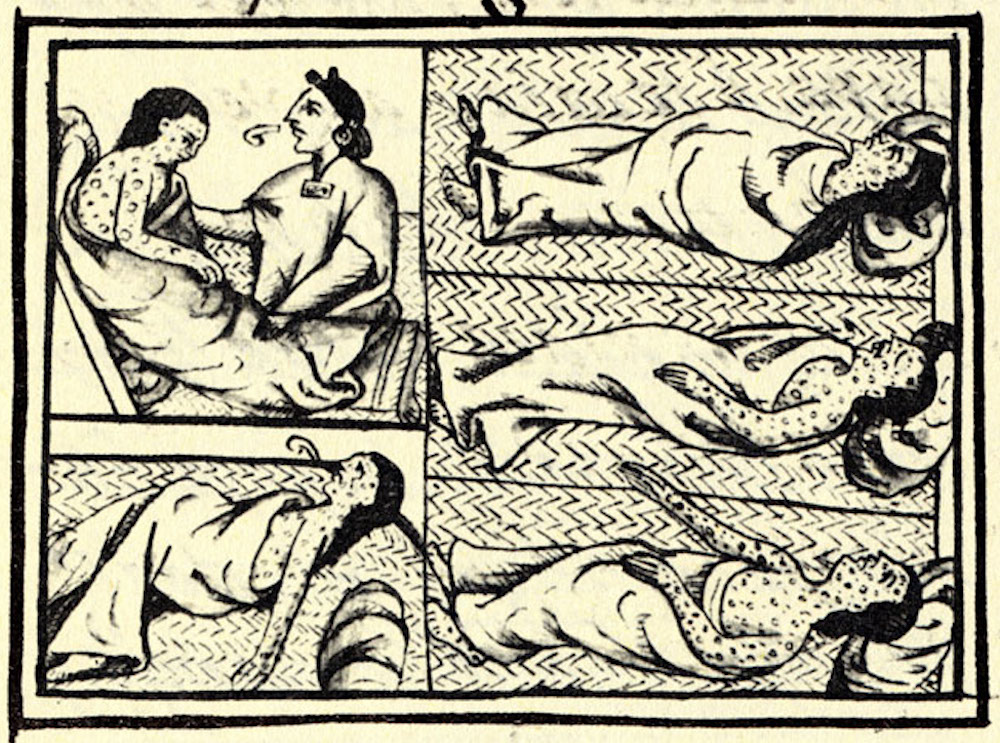
Panel from the Florentine Cortex depicting smallpox outbreaks in the Americas during the 16th century. Courtesy of Wikimedia Commons.
by DAVID BOWLES | MAY 10, 2020 (zocalopublicsquare.org)
Every civilization eventually faces a crisis that forces it to adapt or be destroyed. Few adapt.
On July 10, 1520, Aztec forces vanquished the Spanish conquistador Hernán Cortés and his men, driving them from Tenochtitlan, capital of the Aztec empire. The Spanish soldiers were wounded and killed as they fled, trying in vain to drag stolen gold and jewels with them.
The Spanish more than deserved the routing they got, and the conflict should have ended then. But a fateful surprise made those losses insignificant. By September, an unexpected ally of the would-be conquerors had reached the city: the variola virus, which causes smallpox.
How the Aztecs responded to this threat would prove critical.
The Aztecs were no strangers to plagues. Among the speeches recorded in their rhetoric and moral philosophy, we find a warning to new kings concerning their divinely ordained role in the event of contagion:
Sickness will arrive during your time. How will it be when the city becomes, is made, a place of desolation? Just how will it be when everything lies in darkness, despair? You will also go rushing to your death right then and there. In an instant, you will be over.
Facing a plague, it was vital that the king respond with grace. They warned:
Do not be a fool. Do not rush your words, do not interrupt or confuse people. Instead find, grasp, arrive at the truth. Make no one weep. Cause no sadness. Injure no one. Do not show rage or frighten folks. Do not create a scandal or speak with vanity. Do not ridicule. For vain words and mockery are no longer your office. Never, of your own will, make yourself less, diminished. Bring no scorn upon the nation, its leadership, the government.
Retract your teeth and claws. Gladden your people. Unite them, humor them, please them. Make your nation happy. Help each find their proper place. That way you’ll be esteemed, renowned. And when our Lord extinguishes you, the old ones will weep and sigh.
If a king did not follow this advice, if his rule caused more suffering than it abated, then the people prayed to Tezcatlipoca for any number of consequences, including his death:
May he be made an example of. Let him receive some reprimand, whatever you choose. Perhaps punishment. Disease. Perhaps you’ll let your honor and glory fall to another of your friends, those who weep in sorrow now. For they do exist. They live. You have no want of friends. They are sighing before you, humble. Choose one of them.
Perhaps he [the bad ruler] will experience what the common folk do: suffering, anguish, lack of food and clothing. And perhaps you will give him the greatest punishments: paralysis, blindness, rotting infection.
Or will he instead soon depart this world? Will you bring about his death? Will he get to know our future home, the place with no exits, no smoke holes? Maybe he will meet the Lord of Death, Mictlanteuctli, mother and father of us all.
Clearly, the Aztecs took the responsibilities of leadership very seriously. Beyond uplifting morale, a king’s principal duty in times of contagion was deploying his subjects to “their proper place” so that the kingdom could continue to function. This included mobilizing the titicih, doctor-healers with vast herbal knowledge, most of them women pledged to the primal mother goddess Teteoh Innan.Facing a plague, it was vital that the king respond with grace: “Do not be a fool. Do not rush your words, do not interrupt or confuse people. … Make no one weep.”
What about the rest of the people? As with our own modern call for “thoughts and prayers,” the Aztecs believed their principal collective tool for fending off epidemics was a humble appeal to Tezcatlipoca. The very first speech of their text of rhetoric and moral philosophy was a supplication to destroy plague. After admitting how much they might deserve this scourge and recognizing the divine right of Tezcatlipoca to punish them however he sees fit, the desperate Aztecs tried to get their powerful god to consider the worst-case outcome of his vengeance:
O Master, how in truth can your heart desire this? How can you wish it? Have you abandoned your subjects? Is this all? Is this how it is now? Will the common folk just go away, be destroyed? Will the governed perish? Will emptiness and darkness prevail? Will your cities become choked with trees and vines, filled with fallen stones? Will the pyramids in your sacred places crumble to the ground?
Will your anger never be reversed? Will you look no more upon the common folk? For—ah!—this plague is destroying them! Darkness has fallen! Let this be enough. Stop amusing yourself, O Master, O Lord. Let the earth be at rest! I fall before you. I throw myself before you, casting myself into the place from which no one rises, the place of terror and fear, crying out: O Master, perform your office … do your job!
How many times was this prayer repeated as smallpox ate its cruel way into Mexico, as the domain of the Mexica—ruling people of the Aztec empire—was then already called? We know prayer and the skills and knowledge of the healers were no match for the novel virus.
Smallpox arrived in Mesoamerica with a second wave of Spaniards who joined forces with Cortés. According to one account, they had with them an enslaved African man known as Francisco Eguía, who was suffering from smallpox. He, like many others on the continent of his birth, had no immunity to the disease carried there by the slave traders.
Eguía died in the care of Totonac people near Veracruz, the port city established by the Spanish some 250 miles east of the Aztec capital. His caretakers became infected. Smallpox spreads easily: not only blood and saliva, but also skin-to-skin contact (handshakes, hugs) and airborne respiratory droplets. It raced through a population with no herd immunity at all: along the coast, over the mountains, across the waters of Lake Texcoco, into the very heart of the populous empire.
The epidemic lasted 70 days in the city of Tenochtitlan. It killed 40 percent of the inhabitants, including the emperor, Cuitlahuac. Had he found it increasingly difficult to keep his people’s spirits up as tradition commanded? Had his leadership faltered? Did his subjects pray for his death?
Whatever the case, the memory of that devastation would echo for centuries. Some Nahuas—mostly the sons and grandsons of Aztec nobility—described the devastation decades after the conquest.
It started during Tepeilhuitl [the 13th month of the solar calendar], when a vast human devastation spread over everyone. Some were covered in pustules, which spread everywhere, on people’s faces, heads, chests, etc. There was great loss of life; many people died of it.
They could not walk anymore. They just lay in bed in their homes. They could not move anymore, could not shift themselves, could not sit up or stretch out on their sides. They could not lay flat on their backs or even face down. If they even stirred, they screamed out in pain.
Many died of hunger, too. They starved because no one was left to care for the others; no one could attend to anyone else. On some people, the pustules were few and far between. They caused little discomfort, and those folks did not die. Still others had their faces marred.
By Panquetzaliztli [the 15th month of the solar year], it began to fade. At that time the brave warriors of the Mexica managed to recover.
But a hard lesson had been learned. None of the old remedies had worked. Entire families were gone. Funeral pyres effaced the sun. Although Tezcatlipoca may have heeded their supplications at the end, the price he had made his people pay was staggering.
The epidemic was only the beginning of the unexpected forces working in tandem to bring down the Aztec empire. On May 22, 1521—just as Tenochtitlan was beginning to recover, trying to rebuild trade routes, restock its supplies, replant its fields and aquatic chinampa gardens—Cortés returned.
This time he commanded more Spanish troops, men from the same second wave that had brought the smallpox. With them marched tens of thousands of Tlaxcaltecah warriors, the sworn enemies of the Aztecs. Smallpox had reached Tlaxcallan first, but its people—not as densely packed in urban areas like the Mexica—had fared better and were now ready to finish off their rivals.
The massive military force laid siege to the Aztec capital. Even with more than half the population dead or disabled, with little food or water or supplies, the Mexica held the city for three months.
Then, on August 13, 1521, it fell. Emptiness and darkness indeed prevailed.
It is our God who brings down His wrath, His awesome might upon our heads.
So friends, weep at the realization— we abandon the Mexica Way. Now the water is bitter, the food is bitter: that is what the Giver of Life has wrought.
Without the smallpox, it’s much less likely Cortés and his allies could have taken Tenochtitlan. The epidemic exposed the city’s weakness: the need to import essential goods along causeways that could be destroyed to cut the isle off from the world, the vulnerable aqueduct that carried the city’s only fresh water from distant Chapultepec Hill, the tightly packed boroughs in which commoners lived and worked. The Aztecs were brilliant engineers and soldiers, with capable titicih, but the old ways were not enough. No one thought to isolate the infected, to confine the healthy to their homes to keep them safe. And, absent the practice of inoculation discovered by Chinese physicians a few centuries earlier, there was no safer way of building herd immunity in Tenochtitlan.
Without innovative ways to slow it, smallpox helped invaders bring down an empire. That’s the power of novel viruses, proven time and again. We would do well to learn the lesson.
DAVID BOWLESis an author, translator and associate professor of Literatures and Cultural Studies at the University of Texas Rio Grande Valley. His most recent book is They Call Me Güero: A Border Kid’s Poems. He translated the Nahuatl texts in this article.
From Ned Henry: The Met has been showing a different opera every night on demand for 24 hours for free. Well tomorrow [May 12, 2020] is The Tempest. http://metopera.org
Following the success of Powder Her Face, The Royal Opera, Covent Garden, commissioned a new opera from Adès in the late 1990s. Working with a librettist, a poetic version of the Jonestown Massacre of 1978 was prepared, but the composer found it impossible to set it to music. Finally, the libretto he needed emerged from a collaboration with Meredith Oakes.
The new opera became a co-production with the Copenhagen Opera House and the Opéra national du Rhin in Strasbourg. The Tempest received its world premiere to critical acclaim at the Royal Opera House in London on 10 February 2004. Other productions followed in Strasbourg and Copenhagen later in 2005 and the opera was given its US premiere staging by the Santa Fe Opera on 29 July 2006.
Performance history
Covent Garden revived the opera in March 2007 with the same production team, Thomas Adès conducting, and many of the original London cast, including Simon Keenlyside, Cyndia Sieden, Ian Bostridge, Toby Spence, Philip Langridge, and Stephen Richardson repeating their original roles. Cyndia Sieden is the only member of the cast to sing her role, that of Ariel in all four previous productions. Amongst others new to the cast are soprano Kate Royal as Miranda and countertenor David Cordier as Trinculo.
As a co-production with the 2012 Québec City Opera Festival created by director Robert Lepage[1] and the Vienna State Opera (June 2015),[2] New York’s Metropolitan Opera mounted a new production of The Tempest in the autumn of 2012 featuring Simon Keenlyside.
Meredith Oakes’ libretto
As for the words, you don’t get Shakespeare’s; but you get something that effectively suggests them at key moments, written by Meredith Oakes in rhyming couplets of impactful clarity. Neat and direct.— Michael White’s review of the 2004 Royal Opera House premiere in The Independent[3]
The opera is a brilliant response to the play, rather than merely a setting of it. While entirely true to the spirit of Shakespeare’s play, it is not contained by it. It is its own thing, and allows its own existence and resonance.— Jonathan Kent, director of the 2006 Santa Fe Opera production [4]
Looking for ideas for a new subject, Adès saw Jonathan Kent’s staging of Shakespeare’s The Tempest at the Almeida Theatre in London in 2000.[5] For a new libretto, Adès turned to the experienced dramatist Meredith Oakes, whose work had included a short opera libretto for Miss Treat (2002); since the early 1990s, several original plays, translations and adaptations of classics and modern dramas; and, for television, the story line for Prime Suspect 4 (1995).
Rather than transfer Shakespeare’s words directly into the libretto, Oakes has taken the approach of reducing much of the text to its essence, and she produces a compact libretto with the bulk of the text presented in the form of rhyming couplets. Many examples are given in the following plot synopsis, and they illustrate Oakes’ technique but that does not always mean the complete removal of Shakespeare’s text, as in the following example.
The result is that the original:Full fathom five thy father lies Of his bones are coral made; Those are pearls that were his eyes
in the libretto becomes:Five fathoms deep Your father lies Those are pearls That were his eyes
Differences between the libretto and the play
The libretto is structured into three acts, approximately equal in length. As in Shakespeare’s act 1, scenes 1 and 2, the five main characters are introduced. However, as the relationship between Miranda and Ferdinand progresses, the opera turns away from Shakespeare’s presentation of Prospero as the benign manipulator of events, the controller of the pace of the young couple’s growing love by using his trickery and magical powers.
They are both in either’s pow’rs. But this swift business I must uneasy make, lest too light winning Make the prize light
and later, as his methods begin to take effect: “It works”. The libretto suggests a more fatalistic acceptance by Prospero of the loss of his daughter to the young Prince. Therefore, whereas Shakespeare’s act 1 concludes with Prospero urging on Ariel to further tasks which involve bringing the court to his part of the island, Oakes’ libretto suggests a more vengeful Prospero:
I must punish him And the rest as well Bring me to them, Ariel.
Shakespeare’s act 3, scene 2, in which Prospero accepts Ferdinand and Miranda’s relationship, and later in act 4, scene 1, his:
for I Have given you here a third of mine own life
contrasts sharply with the end of Oakes’ act 2 in which Miranda and Ferdinand find each other again and declare their love, as they are watched over by Prospero, who frees Ferdinand but laments his loss of power in:
Miranda I’ve lost her I cannot rule their minds My child has conquered me A stronger power than mine Has set the young man free.
Oakes’ act 2 features action taking place on the stage in the presence of entire court rather than in separate scenes as in Shakespeare’s act 2.
Thomas Adès’ music
Much has appeared in print about the striking music composed for this opera. Ranging from the almost dissonant (parts of act 1) to the sublimely lyrical (the Miranda–Ferdinand love duet, rare in modern operas, and a quintet passacaglia in act 3), with surges and outpourings of emotion contrasting with harmonic clashes of tone and color, The Tempest is regarded as the composer’s towering achievement to date. This is reflected in the following writers’ statements:
The evening deservedly belongs to Adès, who himself conducts a score as orchestrally lush and evocative as vocally varied and articulate. The cumulative effect is by turns ethereal, witty, incandescent, often ravishing.— Andrew Clements, Review of the 2004 Royal Opera House premiere[6]
… For one composer at least, contemporary lyric opera is still a viable medium. It looks like an opera and it behaves like an opera, offering a musical drama in which the traditional operatic virtues of musically delineated characterisation and musically satisfactory dramatic pacing are wonderfully sustained. The musical action of the opera is continuous but is divided into a sequence of sharply distinct scenes. The techniques of pitch derivation found in earlier Adès scores are used again, so that instead of providing his characters with a set of musical identity cards there is a fluid, evolutionary system of characterisation in which vocal manner and accompaniment style are more important than leitmotifs. Qualities of place and status are as important as individual personalities, so the island is represented by evenly flowing accompaniments in woodwind and strings, while the world of the Milan court is represented by more declamatory writing in which the brass are often evident.— Christopher Fox, The Musical Times, London, [northern] Autumn 2004.[7]
(Submitted by Ned Henry.)
Consciousness, spirituality, biography, sexuality, androgyny, futurism, space, the arts, science, astrology, democracy, humor, books, movies and more