
Novara Media Cycle courier cooperatives are turning technology on the gig economy giants. Film by Cassie Quarless and Usayd Younis of black & brown ⇛ https://blackbrownfilm.com Subscribe to Novara Media on YouTube ⇛ http://novara.media/youtube Support our work ⇛ https://novaramedia.com/support Subscribe to The Burner podcast ⇛ https://novara.media/followtheburner Subscribe to the TyskySour podcast ⇛ https://novara.media/tyskysourpodcast
Monthly Archives: May 2020
Ramadan 2020 in United States began in the evening of Thursday, April 23 and ends in the evening of Saturday, May 23

“Ramadan is not just predicated upon eating or not eating or drinking or not drinking. It’s a state of mind. And it’s an attempt to achieve God consciousness that carries on throughout the day.” — Wajahat Ali
Ramadan, Islam’s holiest month, is a time spent in community — fasting while the sun is up, praying periodically at mosques, and breaking fast together at sundown. This week, we’re revisiting a 2009 show where we heard from 16 Muslim listeners across ages and geographies about what this time means to them. I’ve always loved this episode for its many expressions of Ramadan’s significance. But this year, I wondered how our current circumstances have changed some of those listener’s observations.
Sahar Ullah says, despite the pandemic, this year’s Ramadan has felt more peaceful than in years past. When we first heard from her, she was applying to Ph.D. programs to study Arabic and Islamic literature. Eleven years later, she’s finishing up a postdoctoral lectureship at Columbia University in New York City and teaching a first-year humanities class remotely from her apartment. Several cornerstones of Ramadan have also shifted online for her. Instead of going to a mosque to serve iftar, the meal that breaks fast every evening during Ramadan, her family gathers virtually on Zoom for “ziftar.” And every midnight, she joins a video call with a small group of friends who read the Qur’an together.
Sahar Ullah’s family gathers for iftar over Zoom. Sahar’s sister, Sana Ullah, took this photo at their family’s home in Florida.
“One of my friends has a cat, and every time he sits down and reads, you’ll see a furry tail wave [on] the screen,” she says. “[The midnight Qur’an reading] has been really nice. It feels very grounding, and it gives me a sense of stability.”
Nadia Sheikh Bandukda, a labor and employment lawyer based in Burlington County, New Jersey, cooks food from cultures around the world throughout Ramadan — a tradition she learned from her father and is sharing with her three children. Nadia reflected on the shift from community to family she’s felt during Ramadan this year: “I don’t have access to … standing next to someone with a completely different culture to my left and a completely different age to my right, and feeling that oneness,” she says. “[But] what I enjoy about observing Ramadan during a pandemic [is] the ability to stand next to my son to my left and my husband one inch away and my mother-in-law sitting on the chair behind me kneeling down, and really feeling this groundedness with my own immediate family. That centeredness is still there. It’s just not community. It’s more family-centric.”
Speaking with both Sahar and Nadia, I thought about the ways we’re able to adapt the familiar, even amid a sea change. Perhaps we can understand inventing new ways to hold on to old traditions as a practice of gratitude. It allows us to see the richness of what may have seemed ordinary before. Or, as Nadia reflects, “I’m almost glad we got to experience pre-pandemic Ramadan and post-pandemic because there are pieces of both that I’d like to implement next year.”
Yours,
Kristin Lin
Editor, The On Being Project
Spiritual Awakening is Not Just a Peak Experience: The Liberating Discovery of Your True Nature
By Craig Hamilton (integralenlightenment.com)
By now, most of us have heard about the tremendous benefits of meditation for nearly every area of our lives.
Thanks to extensive research over the past few decades, the overwhelming scientific consensus seems to be that meditation is good for you.
But saying meditation is good for you is a bit like saying exercise is good for you.
Just as there are literally hundreds if not thousands of different forms of exercise, there are also hundreds if not thousands of different types of meditation.
And, as with physical exercise, different types of meditation are designed to achieve very different goals.
Various forms of meditation are being taught as a means of reducing stress, improving mental concentration and focus, enhancing athletic performance, boosting creativity, improving decision-making as well as generating relaxation, emotional well-being and a host of other physical, psychological, emotional and spiritual benefits.
But it wasn’t always this way. Amidst today’s enthusiasm for the diverse tangible, measurable benefits of meditation, it’s important to remember that meditation was originally practiced and taught with one goal in mind: spiritual awakening.
So, if we want to understand the true higher potentials of meditation, we need to first understand what spiritual awakening really is.What is Spiritual Awakening?
Like meditation, the idea of spiritual awakening or enlightenment is used these days by different people to refer to many different types of insights and experiences.
So, before we even begin to approach the nature of spiritual awakening, it’s important to recognize that there are countless different kinds of religious or spiritual experiences human beings can have.
We can experience powerful spiritual feelings like bliss or ecstasy that overwhelm our system.
We can have experiences of oneness, where we feel like we merge with all of reality and lose the ability to distinguish between ourselves and the world around us.
We can suddenly perceive the profound interconnectedness of everything and realize we’re part of what Buddhism calls “Indra’s web.”
Some of us have had spiritual experiences where we were overcome with awe and a reverence for the sacred.
Or perhaps you’ve had an encounter with another person where you felt a deep soul connection—a kind of spiritual nakedness. In these moments, we feel our consciousness becoming one.
We can have experiences of divine love where we realize that we are loved by God or that our true nature is love. We discover that love is always here, ever-present and flowing through us. We just didn’t see it.
We can have spiritual experiences of intense clarity, where everything becomes lucid and unimaginably clear.
It’s also common for meditators to have experiences of intense energy, sometimes referred to as Kundalini. It can feel as if you are plugged into a wall socket with thousands of volts of electricity surging through your body.
On the other end of the spectrum, we can have spiritual experiences of a kind of expansiveness and openness where all the boundaries dissolve and there’s just this awareness of infinite space.
And we can have hundreds, if not thousands, of other kinds of spiritual experiences. And these are all wonderful experiences to have. They’re often transformational. They often give us powerful motivation to pursue the spiritual path.
But the distinction I want to make here is that awakening itself is not any of those experiences. It’s not a state of consciousness, but something more permanent and profound than that.
When I speak about awakened consciousness or enlightenment, I’m pointing to something very specific. It’s a very particular kind of realization. It’s been described as the discovery of our true nature or the recognition of our natural state. It’s the recognition that who we are is not this limited, separate self or any of the thoughts and feelings that we previously identified as ourself or took to be our self.
Spiritual awakening occurs when we realize that who we are at the deepest level is something much bigger and more profound than who we thought we were. We see that our true nature is this kind of superconsciousness, intelligence, love, being, and presence that is at the foundation of reality itself.
This essence is already free and whole and perfect. Who we truly are is this sacred dimension of reality that is beyond comprehension. It’s missing nothing, lacking nothing, and so full that it endlessly overflows with goodness, love, wisdom, power, clarity, humility, strength, courage, and care.
The kind of spiritual awakening I’m talking about is not just the realization that God exists. It’s the realization that that is what we are. The thing we were always seeking and putting outside ourselves is actually our true nature. It’s what’s looking out through our eyes and always has been.
It shatters every conscious or unconscious belief we’ve had in our own limitation. It destroys every sense of lack, of not being enough, of feeling there is somewhere else we need to get to. We realize that the whole thing is already here. I already am that.
I want to make it clear that the awakening I’m pointing to is not a special experience or an altered state of consciousness. It sounds pretty altered, and it does lead to a lot of altered states of consciousness. But the realization itself isn’t any of those experiences.
The reason awakening catalyzes so many powerful experiences is that the realization of our true nature unleashes profound energies and emotions in our psyche. We are living, breathing human beings after all, and when we wake up, we’re often overcome with the experience of the realization.
But awakening, in and of itself, is not a feeling or a particular kind of mental state. In fact, it’s the recognition that every feeling, every mental state, every experience—regardless of how spiritual it seems—has this same essence.
The life-changing realization that the mystics of the ages have been pointing to is the realization that the essence of everything is sacred beyond measure and glorious beyond comprehension. When you discover it, it will bring you to your knees.
It’s called a “nondual realization” because we recognize that the same sacredness and holiness that we associate with our most beautiful experiences is actually the essence of everything else too, even though it’s harder to see. When you look at a beautiful sunset, it’s easy to feel a sense of majesty. But when most of us look at a garbage dump, it’s not quite as easy to feel that way. In spiritual awakening, we realize that all of reality is actually made of this “God-stuff,” or “Buddha-stuff.” We just didn’t see what it was before.
Awakening doesn’t mean that we’re going to some other reality or some other dimension. It’s a realization of what this dimension really is. We just couldn’t see it, and now we do. And that changes everything.
The implications of awakening are immense. Although it often initially occurs in fits and starts, when we’re finally able to deeply embrace who and what we really are, we become a living expression of this miraculous dimension of being. Our cosmic essence, our super nature, is now free to express itself in this world because we’ve made room for it, embraced it, and allowed it to come forth.
That’s the power of awakening and it’s the ultimate promise of the practice of meditation. When we approach meditation as a spiritual practice, we are making a practice out of inviting this profound consciousness to reveal itself within us. We are practicing opening ourselves up to allow awakening to occur.
Conscience in Revolt: Sophie Scholl on Suffering, Strength, and the Deepest Wellspring of Courage
By Maria Popova (brainpickings.org)

“To be a human being among people and to remain one forever, no matter in what circumstances, not to grow despondent and not to lose heart — that’s what life is all about, that’s its task,” the young Fyodor Dostoyevsky wrote in an existential exhale of a letter to his brother hours after his death sentence was repealed; in 1849, still in his twenties, Dostoyevsky had been arrested and sentenced to death for belonging to a literary society that circulated books the tsarist regime deemed dangerous.
Dostoyevsky lived to give us some of the most beautiful and humanistic literature our species has produced — literature laced with admonitions against indulging those murderous impulses of human nature, with invitations to choose again and again not to lose heart, not to lose faith in the human capacity for goodness.
A century later, amid a world that had failed to take Dostoyevsky’s heed, a person even younger took upon her slight shoulders that eternal task in one of the most powerful acts of resistance in the history of our civilization — powerful both for its courage and for its tragedy, outlining both what we are capable of as a human beings and how far we have yet to go to reach our highest potential as a humane society.
Born in a small German town as one of the local mayor’s five children, Sophie Scholl (May 9, 1921–February 22, 1943) was barely out of her teens when her conscience burst awake to the unconscionable inhumanity that had wormed her country’s soul. A month after she began her university studies in biology and philosophy in the nation’s capital, she co-founded the White Rose — a non-violent resistance group of students, artists, and scientists devoted to inspiring their compatriots to take a clear stance against Hitler, “to strive for the renewal of the mortally wounded German spirit,” as they impelled in one of their pamphlets.

Sophie Scholl. Painting by Allison Adams from her lovely grief-healing portrait series of heroic women.
On February 18, 1943 — eight months after the group’s founding — Scholl, her brother, and four other members of the White Rose were arrested, convicted of high treason for distributing anti-war pamphlets, and sentenced to death by the so-called People’s Court.
She was executed four days later.
Scholl is one of sixty-four heroes of resistance to Nazism profiled in Conscience in Revolt (public library) through brief biographies and a selection of their surviving writings that radiate the uncommon courage of living one’s values to the hilt — a 1957 out-of-print treasure that came into my life via one of those rare, improbable wonders that every once in a while reward those of us who mine the forgotten for the timeless: Tucked into my antiquarian copy of another our-of-print book on nonviolence, I discovered a newspaper clipping of a review by an English archbishop and anti-apartheid activist, lauding Conscience in Revolt as “a most moving and challenging pesentation of resistance to tyranny as a personal, individual, intensely human thing.” (Lest we forget, all of our pursuit and defense of truth springs from such a place, as astrophysicist Janna Levin reminds us in her beautiful reflection on science as a personal, “truly human endeavor.”) “It is precisely this we need to be reminded of now and always,” Father Huddleston writes in his review, “for there is no form of escapism more subtle or more general than the use of abstractions. And… there is no more certain way of losing the fight for human dignity and peace than the refusal to believe in the infinite value of the individual.”

The deeply personal nature of Scholl’s resistance and its seedbed in her singular individuality radiate from the previously unpublished private writings quoted in this book I was impelled to track down.
In a letter from February 10 — a fortnight before her execution, and a decade after her French kindred spirit Simone Weil modeled in her own triumph of resistance how to use our suffering as a portal to empathy — Scholl echoes the young Sylvia Plath’s longing “to be affected by life deeply” as she considers the possibility of being drafted for labor service the following summer:

I am not entirely unhappy about it, because I still want to suffer, to share the suffering of these days… to be affected more directly… Sympathy is often difficult and soon becomes hollow if one feels no pain oneself.
One comes to such fearless lucidity only through the awareness, accepted without resistance, of just how intimately the life of the body and the life of the spirit are entwined — an understanding Scholl inhabited with absolute creaturely integrity. In a diary entry vibrating with the invincibility of youth, penned in the last summer of her life not long after her twenty-first birthday, she captures the animalistic pleasure of aliveness that is the wellspring of our strength, our humanity, and the poetry of existence:
The wind tears open the blue sky, out comes the sun and kisses me tenderly. I’d like to kiss him back, but my wish is forgotten in a moment as the wind grasps me. I feel the wonderful firmness of my body, I laugh aloud for the sheer joy of finding I can resist the wind. I can feel all my own strength.
Nearly a century after Walt Whitman, who had served as a nurse to the dying in the Civil War, wrote so beautifully about optimism as a force of resistance and shortly after Holocaust survivor Viktor Frankl penned his impassioned insistence upon believing in human goodness, Scholl located her strength — the supreme strength of the human animal — in the unflinching refusal to succumb to the cowardice of cynicism. That refusal was at the beating heart of her courage and her resistance — an ethos she articulated most directly and most exquisitely in a letter penned when she was only eighteen. Nearly half a century before Maya Angelou observed that “there is nothing quite so tragic as a young cynic, because it means the person has gone from knowing nothing to believing nothing,” this resolutely uncynical young woman writes:
After all, one should have the courage to believe in what is good. I do not mean that one should believe in illusions, but I mean that one should do only what is true and good and take it for granted that other people will do the same, in a way one can never do with the intellect alone. (That is to say — never calculate.)
Complement with Hannah Arendt, writing in the wake of the Holocaust, on our only effective antidote to the normalization of evil, Susan Sontag on moral courage and the power of principled revolt against injustice, Iris Murdoch on the power of literature to dismantle tyranny, and 100-year-old Holocaust survivor Helen Fagin on how books save lives.
Egregore
From Wikipedia, the free encyclopedia

Egregore (also egregor) is an occult concept representing a “thoughtform” or “collective group mind”, an autonomous psychic entity made up of, and influencing, the thoughts of a group of people. The symbiotic relationship between an egregore and its group has been compared to the more recent, non-occult concepts of the corporation (as a legal entity) and the meme.
History
Manuscrit trouvé à Saragosse, or The Manuscript Found in Saragossa written by Polish author Count Jan Potocki (1761–1815) in the early 1800s features the term “Egregores,” referring to “the most illustrious of fallen angels.”[1] However, it is important to take note of the novel’s heavy orientalist and fantastical bent.
The second author to adapt “egregore” in a modern language seems to be the French poet Victor Hugo, in La Légende des siècles (“The Legend of the Ages”), First Series, 1859, where he uses the word “égrégore” first as an adjective, then as a noun, while leaving the meaning obscure.[2] The author seems to have needed a word rhyming with words ending in the sound “or”. It would not be the only example of word creation by Victor Hugo. However, the word is the normal form that the Greek word ἑγρήγορος (Watcher) would take in French. This was the term used in the Book of Enoch for great angel-like spirits.
Eliphas Lévi, in Le Grand Arcane (“The Great Mystery”, 1868) identifies “egregors” with the tradition concerning the “Watchers“, the fathers of the nephilim, describing them as “terrible beings” that “crush us without pity because they are unaware of our existence.”[3]
The concept of the egregore as a group thoughtform was developed in works of the Hermetic Order of the Golden Dawn and the Rosicrucians[4] and has been referenced by writers such as Valentin Tomberg, notably in his anonymously-penned book Meditations on the Tarot.[5] It was also mentioned in the book El maravilloso universo de la magia, by Chilean author Enrique Barrios.
A well known concept of the egregore is the GOTOS of the Fraternitas Saturni.[6]
Contemporary usage
Gaetan Delaforge, in Gnosis magazine in 1987, defines an egregore as a kind of group mind that is created when people consciously come together for a common purpose.[7]
The concept was featured in Corporate Metabolism series of articles by Paco Xander Nathan, which were published in 2001.
The notion of “egregor” also appears in Daniil Andreyev‘s Roza Mira, where it represents the shining cloud-like spirit associated with the Church.
Egregore is also used in relation to the Montreal Surrealists, best known as Les Automatistes, in Ray Ellenwood’s Egregore: a history of the Montréal automatist movement.[8]
Egregore is also the term for the spiritual personification of each nation in the UK LRP game Empire, run by Profound Decisions.[9]
Gary Lachman identifies Pepe the Frog as an egregore in his book Dark Star Rising.[10]
Depth Psychology: Carl Jung | a lecture by Jordan Peterson
Carl Jung was a great psychologist of symbolism. He believed that the imagination roamed where articulated knowledge had not yet voyaged, and that it was the artist and visionary who first explored new territory, civilizing it, in essence, for those who came later. The study of Jung makes the dead religious past spring back to life.
Bio: Early life of Joseph Smith
From Wikipedia, the free encyclopedia
| This article is part of a series on Joseph Smith |
Joseph Smith (December 23, 1805 – June 27, 1844) was an American religious leader and the founder of the Latter Day Saint movement whose current followers include members of The Church of Jesus Christ of Latter-day Saints, the Community of Christ, and other Latter Day Saint denominations. The early life of Joseph Smith covers his life from his birth to the end of 1827.
Smith was born in Sharon, Vermont, the fifth of eleven children born to Joseph and Lucy Mack Smith. By 1817, Smith’s family had moved to the “burned-over district” of western New York, an area repeatedly swept by religious revivals during the Second Great Awakening. Smith family members held divergent views about organized religion, believed in visions and prophecies, and engaged in certain folk religious practices typical of the era. Smith briefly investigated Methodism, but he was generally disillusioned with the churches of his day.
Around 1820 Smith is said to have experienced a theophany, now known as his First Vision among adherents. Around this time he, along with other male members of his family, was hired to assist in searching for buried treasure. In 1823, Smith said an angel directed him to a nearby hill where he said was buried a book of golden plates containing a Christian history of ancient American civilizations. According to Smith, the angel prevented him from taking the plates in 1823, telling him to come back in exactly a year. Smith made annual visits to the hill over the next three years, reporting to his family that he had not yet been allowed to take the plates.
Meanwhile, during one of Smith’s treasure hunting expeditions, he met and fell in love with Emma Smith from Harmony Township, Susquehanna County, Pennsylvania, whom he married in 1827. Returning with Emma to the hill in 1827, Smith said the angel allowed him to take the plates but forbade him from showing them to anyone except those to whom the angel directed. As news of the plates spread, Smith’s former treasure hunting associates sought to share in the proceeds, ransacking places they thought the plates were hidden. Intending to translate the plates himself, Smith moved to Harmony Township to live with his in-laws.
Childhood
Smith was born in Sharon, Vermont, the fifth of eleven children born to Joseph Smith Sr. and Lucy Mack Smith. Through modern DNA testing of Smith’s relatives, it’s likely that the Smith family were of Irish descent originally. Smith carried the Y-DNA marker R-M222, a subclade of Haplogroup R1b found almost entirely in people of Northwestern Irish descent today.[1][2]
The Smiths were a middling farm family, but suffered a fateful loss when Smith Sr., after speculating in ginseng and being cheated by a business associate, was financially ruined. After he sold the family farm to pay his debts, the Smiths “crossed the boundary dividing independent ownership from tenancy and day labor.” In the next fourteen years, the Smiths moved seven times.[3]
Despite the moves and the financial woes, Lucy Smith remembered the period of Joseph Smith’s early childhood as “perfectly comfortable both for food and raiment as well as that which is necessary to a respectable appearance in society.”[4] Then during the winter of 1812–1813, typhoid fever struck along the Connecticut Valley, including the area around Lebanon, New Hampshire, where the Smiths had recently moved. A number of family members fell ill, and Joseph experienced a common complication whereby typhoid bacteria infected bone, in Smith’s case, the shin bone. Lucy later claimed that she had refused to permit her son’s leg to be amputated; in fact, the Smiths had chanced on one of New England’s most respected physicians, Nathan Smith, who “probably alone in American medicine at this time” advocated removal of the dead portion of the bone rather than amputation of the leg. After the typically horrific early nineteenth-century surgery without either anesthetic or antiseptic, Smith eventually recovered, though he used crutches for several years and had a slight limp for the remainder of his life.[5][6]

George Edward Anderson’s photograph of the Smith Family Farm in Manchester, New York, c. 1907. (LDS Archives)
In 1814 the Smiths moved back across the Connecticut River to Norwich, Vermont, where they suffered three seasons of crop failures, the last the result of the Year Without a Summer.[7] The extended Smith clan had already moved west to New York, and in 1817, Joseph Smith Sr. traveled alone to Palmyra, New York, followed shortly by the rest of his family—although not before Lucy Smith was forced to settle with some last-minute creditors.[8] In Palmyra village, Smith Sr. and his oldest sons hired themselves out as common laborers, ran a “cake and beer shop,” and peddled refreshments from a cart; Lucy painted cloth coverings for tables and stands.[9] When Smith was fourteen, he was apparently shot at while returning home from an errand, but was not injured. The bullet missed him, hitting a cow instead, and the perpetrator was not found.[10] In 1820, the family contracted to pay for a 100-acre (40 ha) farm just outside Palmyra in Manchester Township.[11] The Smith family first built a log home,[12] then in 1822, under the supervision of Joseph Smith’s oldest brother Alvin, they began building a larger frame house.[13] Alvin died in November 1823, possibly as a result of being given calomel for “bilious fever“, and the house remained uncompleted for a year.[14] By this time Joseph Smith Sr. may have partially abdicated family leadership to Alvin,[15] and in 1825, the Smiths were unable to make their mortgage payments. When their creditor foreclosed, the family persuaded a local Quaker, Lemuel Durfee, to buy the farm and rent it to them. Nevertheless, in 1829, the Smiths and five of their children moved back into the log house, with Hyrum Smith and his wife.[16]
Joseph Smith had little formal schooling, but may have attended school briefly in Palmyra and received instruction in his home.[17] Young Joseph worked on his family farm and perhaps took an occasional odd job or worked for nearby farmers.[18] His mother described him as “much less inclined to the perusal of books than any of the rest of the children, but far more given to meditation and deep study.” Lucy Smith also noted that though he never read through the Bible until he was at least eighteen, he was imaginative and could regale the family with “the most amusing recitals” of the life and religion of ancient Native Americans “with as much ease, seemingly, as if he had spent his whole life with them.”[19] Smith was variously described as “remarkably quiet,”[20] “taciturn,” “proverbially good-natured,” and “never known to laugh.”[21] One acquaintance said Smith had “a jovial, easy, don’t-care way about him,” and he had an aptitude for debating moral and political issues in a local junior debating club.[22] Biographer Fawn Brodie wrote, “He was a gregarious, cheerful, imaginative youth, born to leadership, but hampered by meager education and grinding poverty.”[23]
Religious background
See also: Cunning Folk Traditions and the Latter Day Saint Movement
Smith grew to maturity during the Second Great Awakening, a period of religious excitement in the United States. New York west of the Catskill and Adirondack Mountains became known as the “Burned-over district” because it was “repeatedly singed by the fires of revival that swept through the region in the early years of the nineteenth century.”[24] Major multi-denominational religious revivals occurred in the Palmyra area in both 1816-17 (when the Smiths were in the process of migrating from Vermont) and in 1824-25.[25] Small denominational revivals and camp meetings occurred during the intervals.[26][27][28]
.jpg)
An engraving of a Methodistcamp meeting in 1819 (Library of Congress)
Joseph Smith’s ancestors had an eclectic variety of religious views and affiliations.[29] For instance, Joseph Smith’s paternal grandfather, Asael, was a Universalist who opposed evangelical religion. According to Lucy Smith, Asael once came to Joseph Smith Sr.’s door after he had attended a Methodist meeting with Lucy and “threw Tom Paine’s Age of Reason into the the [sic?] house and angrily bade him read that until he believed it.”[30] Conversely, in 1811 Smith’s maternal grandfather, Solomon Mack, self-published a book describing a series of heavenly visions and voices he said had led to his conversion to Christianity at the age of seventy-six.[31]
Smith’s parents also experienced visions. Before Joseph was born, his mother Lucy, prayed in a grove about her husband’s refusal to attend church and later said she had had a dream-vision, which she interpreted as a prophecy that Joseph Sr. would later accept the “pure and undefiled Gospel of the Son of God.”[32] According to Lucy, Joseph Smith Sr. also had seven visions between 1811 and 1819, coming at a time when he was “much excited upon the subject of religion.” These visions confirmed in his mind the correctness of his refusal to join any organized church and led him to believe that he would be directed in the proper path toward salvation.[33] Lucy’s account, recorded thirty years after the period in which the visions are said to have occurred, suggests “a tendency to make her husband the predecessor of her son” by echoing passages in the Book of Mormon.[34]
Like perhaps thousands of contemporary Americans,[35] the Smith family practiced various forms of folk magic such as using divining rods and seer stones to search for buried treasure. Four witnesses reported that the Smiths used divining rods in the Palmyra area, and sometime between Joseph Smith’s eleventh and thirteenth years, he began “following his father’s example in using a divining rod.”[36] Magical parchments handed down in the Hyrum Smith family may have belonged to Joseph Sr.[37] Lucy Mack Smith noted in her memoirs that while family members were “trying to win the faculty of Abrac, drawing magic circles or sooth saying,” they did not neglect manual labor, “but whilst we worked with our hands we endeavored to remember the service of & the welfare of our souls.”[38] Smith’s reputation among his Palmyra neighbors was that of a “nondescript farm boy” who was “lazy and superstitious,” and townspeople viewed his family as “treasure-seekers, not eager Christians.”[39] Thus, Smith was reared in a family that believed in prophecy and visions, was skeptical of organized religion, and was interested in both folk magic and new religious ideas.[40]
Smith said he had become concerned about religion “at about the age of twelve years,” although later he seems to have wondered whether “a Supreme being did exist.”[41] Smith apparently attended the Presbyterian Sunday school as a child,[42] and later as an adolescent, he displayed interest in Methodism.[43] One of Smith’s acquaintances said that Smith had caught “a spark of Methodism” at camp meetings “away down in the woods, on the Vienna road.”[44] He even reportedly spoke during some of these meetings, and the acquaintance described Smith as a “very passable exhorter.”[45]
Nevertheless, at some point after 1822,[46] Smith withdrew from organized religion.[47] According to his mother, Smith claimed, “I can take my Bible, and go into the woods, and learn more in two hours, than you can learn at meeting in two years, if you should go all the time.”[48] Still, Smith seems to have been significantly influenced by the interdenominational revival of 1824-25.[49]
First Vision
Main article: First Vision
Like his father, the younger Smith reportedly had his own set of visions, the first of which occurred in the early 1820s when Smith was in his early teens and is called by Latter Day Saints the First Vision.[50] The first description of this event was not published until 1832,[51] which said the event occurred in 1821;[52] however, most accounts date the event to the year 1820.[53] The First Vision was a theophany (a personal and direct communication from God). The details of the theophany have varied as the story was retold throughout Smith’s life.[54]
According to accounts by Joseph and his brother, William, the First Vision was prompted in part by a reading of James 1:5, which in the King James Version reads, “If any of you lack wisdom, let him ask of God, who giveth to all men liberally, and upbraideth not, and it shall be given him”; William suggested that Smith “ask of God”.[55] William also suggested that much of the “religious excitement” in the area was caused by the Rev. George Lane, a “great revival preacher”.[56] Lane is never recorded as having visited Palmyra until 1824, although he visited nearby Vienna in 1819 for a large Methodist conference.[57] Joseph and his family could have traveled to sell cake and beer at this event, as they did other events in the Palmyra vicinity, but this is pure speculation.[58]

Stained glass depiction of Smith’s First Vision, completed in 1913 by an unknown artist (Museum of Church History and Art)
The exact details of the First Vision vary somewhat depending upon who is recounting the story and when. Smith’s first account in 1832 dated the vision to 1821 and stated that he saw “a piller [sic] of fire light above the brightness of the sun at noon day”, and that “the Lord opened the heavens upon me and I saw the Lord and he spake unto me saying Joseph my son thy sins are forgiven thee”.[52] Whether Smith regarded this event as a vision or as an actual visitation by a physical being has been debated, because a missionary tract published for Smith’s church in 1840 stated that after Smith saw the light, “his mind was caught away, from the natural objects with which he was surrounded; and he was enwrapped in a heavenly vision”.[59]
In an account Smith dictated in 1838 for inclusion in the official church history, he described the First Vision as an appearance of two divine personages sometime during the spring of 1820:
“I saw a pillar of light exactly over my head, above the brightness of the sun, which descended gradually until it fell upon me…When the light rested upon me I saw two Personages, whose brightness and glory defy all description, standing above me in the air. One of them spake unto me, calling me by name, and said, pointing to the other, ‘This is my Beloved Son. Hear Him!'”.[60]
It is unclear who, if anyone, Smith told about his vision prior to his reported discovery of the golden plates in 1823.[61] According to Smith, he told his mother at the time that he had “learned for [him]self that Presbyterianism is not true”;[62] however, mention of this conversation is omitted from Lucy’s own history,[63] and Joseph never stated that he described the details of the vision to his family in 1820 or soon thereafter. He did say that he spoke about the vision with “one of the Methodist preachers,[64] who was very active in the before-mentioned religious excitement”.[65] Many have presumed this to be the Rev. Lane, but there is no record of Lane visiting the Palmyra vicinity in 1820.[66] Joseph’s brother William was apparently unaware of any visions until 1823,[67] although he would have only been nine years old in 1820.
Smith stated that the retelling of his vision story “excited a great deal of prejudice against me among professors of religion, and was the cause of great persecution, which continued to increase”.[65] Tales of visions and theophanies, however, were not unusual at the time, though the clergy of many organized religions often resisted the stories.[68][69] Early prejudice against Smith may have taken place by clergy, but there is no contemporary record of this.[original research?] The bulk of Smith’s persecution seems to have arisen among laity, and not because of his First Vision, but because of his later assertion to have discovered the golden plates in a hill near his home;[citation needed] the statement was widely publicized and ridiculed in local newspapers beginning around 1827.[citation needed]
Years later, one non-Mormon neighbor summed up views of Smith and his family by their Palmyra neighbors by saying, “To tell the truth, there was something about him they could not understand; some way he knew more than they did, and it made them mad.”[70]
More at: https://en.wikipedia.org/wiki/Early_life_of_Joseph_Smith
Life and death: Poe and Kierkegaard
The dreadful allure of Edgar Allan
Issue 88, 12th May 2020 (iai.tv)
J. Gerald Kennedy
| professor of English at Louisiana State University and author of Strange Nation: Literary Nationalism and Cultural Conflict in the Age of Poe (Oxford, 2016), currently working on a new book Peering into Darkness: Edgar Poe and Our Culture of Fear.
Both Poe and Kierkegaard were preoccupied with death, denial and fear – worries never more prescient than during the Covid-19 pandemic. Unlike the philosopher, the poet projected his obsessions into a world of stories filled with agnosticism and uncertainty.
In 1832, five months before an Asiatic cholera pandemic reached the United States, Edgar Allan Poe started publishing magazine tales. That summer, the disease killed 3,700 people in Baltimore, where Poe was living, and in two early tales, “Shadow” and “King Pest,” he projected that crisis onto remote, Old World settings. Not until 1842, however, did he fully capture its horror in “The Masque of the Red Death.” Set in Europe, the tale depicts an arrogant ruler’s response to contagion. After his realm has been “half depopulated,” Prince Prospero belatedly invites a thousand “hale and light-hearted friends” to a Gothic abbey and then bolts shut the gates. Five or six months into the quarantine, “while the pestilence raged most furiously abroad,” Prospero defiantly stages a masked ball. But the soirée ends badly. Poe concludes: “Darkness and Decay and the Red Death held illimitable dominion over all.” He implies that while we may temporarily escape a certainkindof death, we cannot avoid dying.
For many, the most frightening aspect of the coronavirus pandemic has been the collapse of our illusions of personal safety. COVID-19 has created shocking scenes, and its complexities have confounded medical experts. Both highly contagious and extremely fatal, the virus and its multiple, dire symptoms have been as puzzling as its insidious transmission by asymptomatic carriers. Factoring in underlying health issues, researchers still cannot explain why some cases remain mild while others spiral from slight discomfort to respiratory failure.
The social upheaval seems equally unreal. In the United States, armed protesters—incited by the President—are rejecting surgical masks and mitigation strategies. They demand the “freedom” to restart the economy, whatever the consequences. Understandably, many wish to return to work. We also long to resume old pastimes—like sporting events—by which (as Kierkegaard remarked) we tranquillize ourselves with the trivial.
Poe was — with the possible exception of Kierkegaard himself — the most deeply preoccupied with mortality, existential dread, and its spiritual corollary, despair.
Prospero’s masked ball, inspired by raging pestilence, illustrates this truth about our species: most people most of the time strive to deny an implacable fact—their own mortality. As Ernest Becker observes in The Denial of Death (1973), “The final terror of self-consciousness is the knowledge of one’s own death, which is the peculiar sentence on man alone in the animal kingdom. This is the meaning of the Garden of Eden myth and the rediscovery of modern psychology: that death is man’s peculiar and greatest anxiety”. Yet as Becker also notes, most human pursuits, especially our most cherished achievements, represent symbolic denial.
“The Masque of the Red Death” exemplifies Poe’s powerful yet perverse attraction for contemporary readers. The perverseness lies in his intractable fascination with death. For among his nineteenth-century contemporaries, Poe was—with the possible exception of Kierkegaard himself—the most deeply preoccupied with mortality, existential dread, and its spiritual corollary, despair. To say that Poe and Kierkegaard were both alive to death is to recognize how they explored, in different forms and registers, the linked problems of fear and denial already afflicting nominally Christian bourgeois culture. Poe devoted his fiction to the subject he embraced (in a preface to his first book)as his legitimate field of study: terror. He traced that terror to the soul and regarded it as a sickness unto death. Fittingly, Kierkegaard’s great work by that title appeared in 1849, the year Poe died.
Anders Sandberg, Patricia MacCormack and Janne Teller ask if fear of death prevents us from living
I have linked these pioneers of dread to bolster the audacious claim made by Michael Capuzzo in Smithsonian magazine: that Poe is “the most influential American author ever.” Yes, more influential than Twain, Whitman, Faulkner, or Morrison. In that article from January 2019, evidence of Poe’s influence comes mostly from popular culture: the Vincent Price Poe films, Poe’s face on the Sgt. Pepper album cover, Homer Simpson’s madcap recitation of “The Raven,” and so forth. But Poe has inspired such ardent, extensive homage, I would argue, because his strange works open us vicariously to the death-anxiety we usually repress. His tales deliver measured doses of the dread that paradoxically makes us feel more fully alive.
One of Poe’s most distinctive themes, premature burial, helps to explain his morbid appeal. Although Becker assumed that fear of death dated from time immemorial, the French historian Philippe Ariès has constructed a more nuanced view. In The Hour of Our Death (1981), he traces the evolution of death imagery and funerary practices across the ages to contrast “the great modern fear of death” with an older attitude of solemn acceptance. The pivotal change occurs in the eighteenth century. Until then, Ariès writes, “incredible as it may seem, human beings as we are able to perceive them in the pages of history have never really known the fear of death”. Previously, people felt sorrow, expressed grief calmly, and acknowledged death’s inevitability. But meek acceptance of mortality faded with the advent of science, medical understanding, and enlightened self-consciousness. By the 1700s, Ariès says, “dissection had become a fashionable art”, and wealthy folk were devising wills to protect their remains from eager anatomists. Some also feared being buried alive and directed that their bodies be preserved until the onset of decay.
As physician Jan Bondeson documents in Buried Alive (2002), scientific debate about the uncertainty of signs of death, a problem elaborated by Jean-Jacques Bruhier in 1749, fueled a reform movement aimed at preventing premature burial. Across Europe, progressive thinkers pondered cases of apparent death and advocated “waiting mortuaries” for the recently deceased. Such topics excited anxieties about death not previously apparent, and analogous literary imaginings produced the cult of melancholy, the Gothic novel, and graveyard poetry. Suffice it to say that these complex cultural influences came down to Poe, a half-century later, via Thomas Gray, Ann Radcliffe, and others. By the nineteenth century, as Bondeson notes, living entombment was stirring new controversy, now inspiring “security coffins” equipped with escape mechanisms. This context illuminates Poe’s “The Premature Burial” (1844), a tale that epitomizes “the great modern fear of death.” Poe used the theme repeatedly to amplify death anxiety by describing the sensations of burial.
While Kierkegaard contemplated death, even suicide, to free himself from the inauthenticity that masked despair, preparing his soul for a leap of faith, Poe projected his anxieties into tales rife with agnosticism.
In Poe’s day, melancholy also had a resurgence in the cult of mourning. Dread disguised itself as sentimentalism and promoted what Ariès has called “the age of the beautiful death”. Meanwhile, accumulating scientific knowledge was challenging religious wisdom. Hard geological evidence undermined the creation story in Genesis as well as the biblical reckoning of time and history. As Kierkegaard remarked sardonically in the preface to Fear and Trembling (1843), everyone was suddenly doubting everything. But while Kierkegaard contemplated death, even suicide, to free himself from the inauthenticity that masked despair, preparing his soul for a leap of faith, Poe projected his anxieties into tales rife with agnosticism. His doubt formed a veritable abyss, and fear of death—with utter uncertainty about a spiritual afterlife—lay at the heart of it all.
Poe had chronic, personal fears—the death of a beloved woman, madness, perverse self-destruction, and accidental burial. With his contemporaries, he also shared several social terrors. Poe was horrified, for example, by Jacksonian mobs and rioting gangs. As a Virginian, he feared slave rebellion, especially after the Nat Turner revolt of 1831. And, having experienced mass death in 1832, when so many acquaintances died of cholera, Poe feared contagion.
But the author’s deepest terror arose from unfocused fear, dread. That unease also permeated a seemingly confident, jingoistic American nation. An increasingly secular culture looked to the mass media, newspapers and magazines, for beliefs and opinions, quoting not preachers but pundits. If, as Benedict Anderson has suggested, print capitalism began to conjure “imagined communities,” reading publics linked by collective national longings, it also began to cultivate audiences attracted by lurid news. Poe’s “The Murders in the Rue Morgue” illustrates the impact of newspapers on public hysteria after a double homicide. The author brilliantly anticipated the “culture of fear” identified by sociologist Frank Furedi in the late twentieth century. In fiction, Poe prefigured many dangers that preoccupy our electronic mass media: frightening strangers (“The Man of the Crowd”), cold-blooded killers (“The Tell-Tale Heart”), sadistic cruelties (“The Pit and the Pendulum”), terrorist acts (“Hop-Frog”), uncontrollable pandemics (“Masque”), and planetary catastrophes (“The Conversation of Eiros and Charmion”).
Poe could not make Kierkegaard’s leap and wrote most brilliantly when sounding the depths of modern doubt.
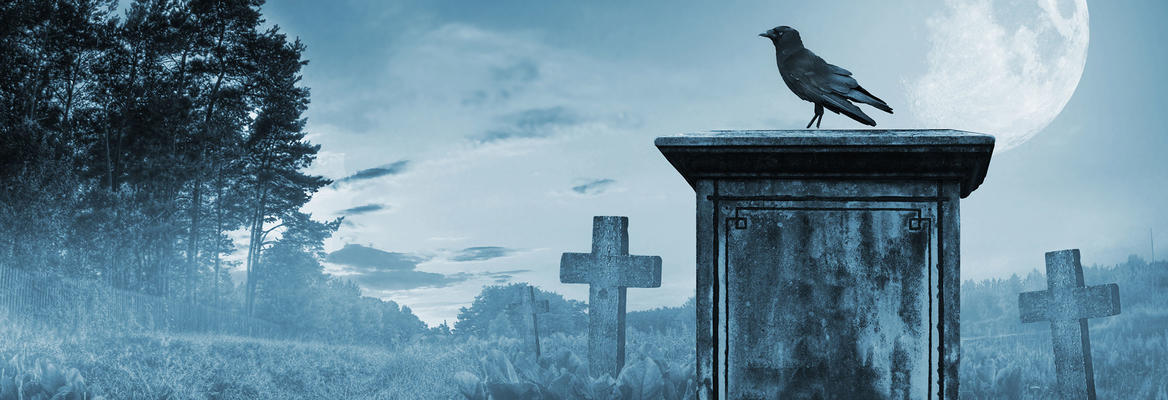
In an age Ariès associates with “invisible death” and rampant denial, fearful themes resonate powerfully. In How Fear Works (2018) Furedi laments our preoccupation with “therapeutic” socialization and risk avoidance. Long ago we jettisoned the old beliefs that provided a “grammar of meaning” for anxiety. In the process, Furedi writes, fear “lost much of its moral bearing.… The fear of God was increasingly displaced by an unfocused and confusing and therefore often meaningless force: the fear of fear itself”. This is precisely Roderick Usher’s predicament in Poe’s greatest tale, “The Fall of the House of Usher,” where an atmosphere of dread underscores the absence of faith or hope. Only “evil things in robes of sorrow” pervade Usher’s domain. Poe’s most celebrated poem, “The Raven,” similarly stages the torment of a man wracked by grief and skepticism. The speaker asks his feathered visitor whether there is “balm in Gilead” (salvation) or whether he will be reunited with Lenore in “some distant Aidenn” (heaven)—already anticipating the bird’s crushing reply, “Nevermore.” Sometimes, however, Poe betrayed a craving for faith, and in works such as “Mesmeric Revelation” he envisioned a transcendent order of being. He even composed a quasi-scientific treatise, Eureka (1848), to prove God’s existence. But he could not make Kierkegaard’s leap and wrote most brilliantly when sounding the depths of modern doubt.
A bit like Furedi, who decries the “fatalistic influence” of our “culture of fear”, Poe also understood, however, that dread can paralyze us. He wrote survival tales (such as “A Descent into the Maelström”) in which characters escape destruction by resisting panic. His final tale of contagion, “The Sphinx,” unfolds during a cholera outbreak in New York. Distressed by daily news, the narrator swoons when a “monster” appears outside his window. But in fact the near-sighted fellow has been gazing at a death’s-head moth dangling before his eyes. Yes, perspective matters, facts matter. So do logic and reason. Like Poe’s narrator, we can inflate trifling risks into terrible threats. Just as ignorantly, though, we can dismiss deadly pandemics as trumped-up hoaxes, becoming, alas, the most recent victims of Prospero’s arrogance.
J. Gerald Kennedy
Issue 88, 12th May 2020
The fallacy of trust
Disaster and disease won’t alter the human condition

Issue 88, 14th May 2020 (iai.tv)
Silvia Camporesi
| Senior Lecturer in Bioethics & Society and Director MSc Bioethics & Society, in the Department of Global Health and Social Medicine at King’s College London
Do some societies trust each other and their governments more than others, and does this explain why stringent lockdown rules have been applied in some places and not others? Or should we be wary of this binary sliding scale reinforcing social stereotypes?
After the lockdown, as measures start to be eased up around the world, who will we trust to see without a mask? Who will we trust with a kiss and hug? Who will we trust to have intimate relationships with?
These are some of the questions on my mind as we very slowly emerge from one of the most stringent lockdowns in Europe. In Italy, Phase 2 has officially started.
After eighty days of isolation, I am free to go out, and can finally go for a run in the park. I can also visit family within the limits of my region, albeit not friends until the Phase 3 is rolled out.
A friend of mine put this beautifully in an email: “I think people will have to restack their self-identities and relationships with family, friends and community. Will we be able to trust the judgment, behaviour of others to ensure our safety before the vaccine and even after? Trust will take on a new dimension I think. But so too will love”.
What does trust even mean?
Trust pervades the everyday reciprocity of social relations: it is the oil that permits the cogs in the wheels of society to run.
As the British sociologist Anthony Giddens theorised in his book “The consequences of modernity, 30 years ago, trust is the foundation of self and provides ontological security. Through primary relationships with parents and carers during the early years of life, we learn to trust others, trust ourselves, and navigate the world.
As we grow up, we learn to do this by trusting others beyond our family unit: from the first persons that our parents trust for childcare, to teachers, and then friends and lovers. Trust pervades the everyday reciprocity of social relations: it is the oil that permits the cogs in the wheels of society to run.
Trust is often quantified. Is there trust? Isn’t there trust? Discussions around covid-19 were dominated by numbers, as pointed out by sociologist Mark Davis at the University of Melbourne. Infection rate, mortality rate, graphs showing the number of daily tests, discussions on whether the expected target was reached, etc… all summed up the calculations and projections which we have been absorbing in the past three months. They have determined in one way or another (although, in ways that have not always been transparent), whether we are confined within the walls of our homes, or whether and when we are able to go out again.
Philosopher Nancy Cartwright asks if science deserves the trust we place in it
Research aimed at assessing the levels of trust of individuals linked, in a statistically significant way, with the compliance to public health measures is not new. To cite one of many similar studies, surveys conducted by researchers at the University of Georgia in the United States on public responses to the 2009 H1N1 pandemic found that respondents who exhibited lower trust were less likely to comply with public health advice. Similar surveys are being conducted now to measure compliance with public health advice in the pandemic.
Governance and politics are imbued with questions of trust and distrust. The expertise and authority of science and medicine are an object of trust, since so many of the life choices individuals are required to make depend on the expert knowledge possessed by others. This was evident in the discussion around lockdown measures and governments claiming to be ‘following the science’.
However, different governments have come up with different solutions (different public health measures) to the same problem. Can that be reconducted to low and high trust in governments? An article appeared in the Guardian which conceptualised trust in a binary way by investigating the cultural factors that shape different countries’ responses. The authors compare the lockdown model of Spain (the most stringent lockdown in Europe, on a par, with Italy’s) with Sweden’s, where social distancing was not enforced by the police but was left to individuals’ moral responsibility. The authors write that they were both “convinced that the “Swedish model” could not be exported to countries such as Spain or Turkey, where levels of social and institutional trust are much lower”.
This is an intuitively appealing view and one shared by many.
I have discussed my critical views on stringent lockdown policies with some friends and family. Fellow Italians have rebuked me: “Yes, of course, this could work in Sweden, or maybe in the UK” – apparently, along this continuum of ‘disciplined and highly-trusting societies’, Sweden ranks higher than the UK – “obviously it couldn’t have worked in Italy, where we don’t know how to queue (though we have been forced to learn in recent months) and we respect the laws only if they are actively enforced.” Plus, they would add: “Italians don’t trust their governments”. Had it been left to us Italians to behave responsibly and socially distance, this reasoning implies, we would not have done it. Trusting societies will follow guidelines voluntarily, it suggests, untrusting societies must have guidelines enforced.
The expertise and authority of science and medicine are an object of trust, since so many of the life choices individuals are required to make depend on the expert knowledge possessed by others.
I remain unconvinced. Isn’t this the exact sort of reasoning itself which reifies the stereotype? In other words, if this sort of argument forms the basis for stringent lockdown policies, it will also – necessarily – end up reinforcing those same behaviours that the public health measures were put in place to counteract.
As a matter of fact, the idea that trust varies along a continuum, and that there are ‘high trust’ and ‘low trust’ societies has been challenged by social scientists before. Among many other researchers, I have also investigated with colleagues the factors that lead to compliance with expert advice in a variety of settings from vaccination , to pharmacological treatment, to climate change, and in a variety of countries and cultures. Our research has shown that more complex and qualitative notions of trust, beyond quantifications along a gradient, are needed to explain the complexities of trust in expert knowledge systems.
There is not a single, simple answer behind child immunisation refusal, nor is there one which can explain compliance or lack thereof. Unfortunately, to make sense of the pandemic, simple and easy answers do not work. Iit is not a coincidence that the authors of the Guardian article cited above write that they could not explain, on the basis of their discrimination between low trust societies (i.e. Spain, Italy) and high trust societies (i.e. Sweden), why the model was not adopted by other Nordic countries, such as Denmark, Norway, that share many of Sweden’s social characteristics. This is because, while enticing, such binary notions of trust need to be abandoned. Other factors will need to be investigated to explain the difference between Sweden and the fellow Scandinavian countries, and the differences between Italy and Spain.
Vaccination elicits strong opinions. So does lockdown. Along the lines of pro or against lockdown, new friendships and relationships are being forged, others are being damaged.
Many people have found themselves divided along the lines of “pro” or “against” lockdown. I, for one, have been reluctant to discuss openly my views about lockdown with some of my friends, because I was afraid of their reactions. What if they did not agree with my views? Would I think less of them? Would they think less of me? Instead of sharing our views, and the information we believe support them, with peers we fear disagreeing with, we turn to the web and fnd other people who, although far away, may be closer in sentiment. After a while, the algorithms behind Facebook and Twitter may just propose back to you the same arguments and ideas, reinforcing your convictions that you are in the right.
Given this complex background, what will trust mean in a post covid-19 world? After the lockdown, as measures start to be eased up around the world, who will we trust to see without a mask? And who will we trust to kiss, hug, and have sex with?
Unfortunately, to make sense of the pandemic, simple and easy answers do not work.
Trust goes hand in hand with vulnerability as a concept. As humans, our condition is to be vulnerable. The Italian poet Giuseppe Ungaretti (1888-1970) captured the human condition beautifully in his poem: “Si sta come d’autunno sugli alberi le foglie” or “we are vulnerable, like leaves on a tree branch in the fall”. This is the human condition; it has not changed with covid-19. Worse and more devastating diseases have ravaged the world before covid-19, and we should be prepared for still worse diseases to emerge in the post-covid-19 world. We are still leaves on a branch as fall is approaching. On a day breezier than others, more leaves than usual will fall. Eventually, they will all fall.
Research is needed to discover the ways in which vulnerable people want to be protected, including, the older people, and those at risk of experiencing severe covid-19 due to pre-existing conditions. I suspect that many people classified as vulnerable — including the older demographics — will not want to spend the last years of their lives isolated from their children and most importantly grandchildren. I suspect that many would rather run the risk of being infected, and dying, by being closer to those they love. I may be wrong. The important message here is: we need, to ask them. The question to ask ourselves is then transformed from “Who will we trust in the post-covid-19 world” to “Who will we allow ourselves to be vulnerable with?”
Shifting the burden from ‘trusting’ others to ‘allowing oneself to be vulnerable’, allows us to think in a different way about the future, and to act differently in the present to make that future possible. Natural disasters and emergencies, including pandemics, will not change the human condition, and should not change the way we live and relate with others. Unless we let them do so.
Find Silvia’s research here, and follow her on Twitter at @silviacamporesi
Silvia Camporesi
Issue 88, 14th May 2020
The Other House: Musings on the Diné Perspective of Time

ESSAY
by Jake Skeets (emergencemagazine.org)
Observing the grief that has arisen during the coronavirus pandemic, poet Jake Skeets explores apocalypse, time, and futurity from a Diné perspective.
My family tells many stories. They are the best storytellers. They use language efficiently and precisely. They have a keen sense and understanding of time. It is through the reimagining of time within their storytelling that they conjure survivance. Of course, we are not allowed to gather today, as the world battles a virus. As a child, I remember the many times my family gathered over mutton, watermelon, and tortillas. We gathered near our hogan at the Other House. My aunts and their families live a short walk from my childhood home. We all refer to their collective homes as the “Other House.” Each home of the Other House holds memories that I remember during these long, tense days. The Other House holds time through our memories. The Other House as a construct and physical space is as sophisticated as any technology. The energy of our landscapes is enough to hold so much of ourselves. The reimagining and reconfiguring of time, I believe, starts with the land.
Today, I notice, among the newfound excitement of working from home, small moments of tense air. These small pockets of density last only moments before another joke cracks or a sarcastic remark bursts the room into laughter. My house is composed of three young adults in their late twenties. We are all relatively healthy, except for the existential dread of our family histories that include diabetes, high blood pressure, certain types of cancers, alcoholism, and mental illness, which are not uncommon among most Native populations across the United States. These temporary moments, though small, are still large enough to notice in the room. I feel their heft balloon in the room before it pops and plastic ribbons fall gently around us. I saw an article headline recently that said this stillness is actually grief. If grief, what are we grieving?
Perhaps grief is related to time. Once upon a time, I considered my best childhood experience to be the many times my older cousin brother would drive us to Gas Man, a local convenience store, to buy junk food. I would stock up on Mr. Goodbar, Flamin’ Hot Cheetos, and nachos with extra cheese. It is still argued that our Gas Man store has the best nachos because of the cheese. The store sits on checkerboarded land, so it is actually not on the reservation. This means it can and does have a liquor license. Each Sunday, while my brother drove us to Gas Man, we would see a line out the door of men and women looking to enjoy a drink, or many. Reflecting now, perhaps that is not the best experience to recall, as today some of my cousins have become those very men and women. Hell, even I have waited in one of those lines. Maybe the small air that heavies when I drive past the store is also filled with grief, and only with time is this grief possible.
Where Gas Man at?
Where Gas Man at?
Shí ga’ anishní
Far away, Far away,
Shí ga’ anishní1
Diné College (DC), where we all work, is considered the first tribally controlled college in the United States. It was founded in 1968 to address the needs of the Navajo Nation. Today its Board of Regents is selected by the Navajo Nation government. When the coronavirus pandemic first hit the United States, DC was very quick to respond. The college has restricted access to the campus. Like a majority of faculty and staff, we are at home. Our days are relatively routine. My partner and I make breakfast and then continue our day as a mix of work, chores, and breaks. My breaks are spent mostly playing solitaire, Scrabble Go with my older sister, or checking social media. Lately, my breaks also included writing this essay and other small poems. Several posts on Twitter and Facebook lament the impossibility of poetry. How can we write poetry at a time like this? How can we write poetry during the apocalypse? Why poetry? How poetry? This essay is not a reflection on why poetry is or is not necessary. Instead, this essay focuses on these so-called end times. I write through and about the concept of apocalypse, time, and futurity from a Diné perspective.
I ask again, if this stillness that envelops the room cyclically is grief, what are we grieving? The world faces a global pandemic, and that type of devastation reaching our reservation, where basic infrastructure and healthcare are already limited because of past and current conquest, would be catastrophic. It would be apocalyptic even. So each day passes with a reminder from the Navajo Nation President to remain at home and limit visiting our families. Each day more cases are confirmed and I am sure each one of us worries about a confirmed case within our family. The Navajo Nation now has the highest number of coronavirus cases per capita in the US, higher than even the hardest hit states of New York and New Jersey. High schools are now being turned into rooms for beds. High schools that once housed Navajo families watching a game of basketball, because rezball is everything on the reservation, are now housing Navajo people infected with this virus. That, for me, is enough for grief. However, there’s something else as well in all that grief, I think.
As with time, I find yearning is an element of grief because we yearn for and desire an absence of grief. As an undergrad, I would run several miles on Johnson Field, an outdoor track on the University of New Mexico’s main campus. During these runs, I would yearn for and desire several things. First, it was hard not to desire the mostly white men completing their workouts on the field. Second, I would imagine myself publishing a book and talking about a book. I would imagine titles of potential collections. I told myself, in true American Dream fashion, that I would become successful. My success, however, was tied to money, capitalism, and advancement of the individual (and not necessarily the self). Today it seems foolish to imagine myself not connected to my community. My community is what molded me, and my success is only possible because of this place. So I often imagine my younger self running on Johnson Field, yearning for something that is causing the current troubles of the world today.
Where Johnson Field at?
Where Johnson Field at?
Shí ga’ anishní
Far away, Far away,
Shí ga’ anishní
As with time, I find yearning is an element of grief because we yearn for and desire an absence of grief.
If grief is tied to yearning and we are indeed grieving and thus yearning, for what or whom do we yearn? The world before this pandemic was already lethal: see the list of conditions above and add to it the long list of things impacting Native and Indigenous communities across the country. I grew up with several cousins I consider brothers. More than half of them we either lost to death or incarceration. Every month, there are numerous headlines announcing the deaths that occur in border towns around the reservation. So if we yearn for the time before this virus, are we also yearning for those ills as well? Or do we yearn for the post-pandemic, which will include either further disaster capitalism or the so-called end times, both of which would be catastrophic for families in the United States? The strangeness for me exists in the fact that even yearning has been conquered. Our yearning has been colonized to such an extent that we can only yearn for the very things that result in colonization. Perhaps that is an apocalypse of the human condition as much as the human experience on earth.
Apocalypse is a funny thing. I do not mean funny as in humorous but funny as in there is not much to feel about it. For me, apocalypse has always been represented in two ways: as an end to human life or a replacement of human life. In the feature film Resident Evil: Extinction, we follow the story of Alice navigating post-apocalyptic Las Vegas where human life has ceased to exist due to zombie outbreaks. On the other hand, X-Men: Apocalypse is a prophetic tale about the character Apocalypse’s intention to destroy the current world and to replace it with a new super civilization. (Cut to my partner mocking Apocalypse’s line, “Everything they built will fall.”) Both of these representations seem overly dramatized. Apocalypse is actually a project of colonialism. The linearity of beginning and ending is the very construct of the American Dream (for which we yearn and grieve). Our futures are set in a binary of success or apocalypse, depending on how tight we tie our bootstraps. The essay “Rethinking the Apocalypse: An Indigenous Anti-Futurist Manifesto” posted by Indigenous Action (indigenousaction.org) details the way apocalypse is a linear project that relies on a colonial past.2 It asks the question, “Why can we imagine the ending of the world, yet not the ending of colonialism?” Colonialism is somehow both immune to an end and reiterates that human lives can and do end. The essay rejects a colonial future and relies on the deep time of Indigenous people. After all, Indigenous people have gone through many beginnings and endings, but never linearly and never without teaching.
There is a joke my father told me as a child. Language and culture loss continue to worry many Diné elders on our reservation; there are several revitalization efforts ongoing to address these losses. As a result, high school students can take Navajo language classes to fulfill foreign language requirements, and most universities and colleges now recognize Navajo as a foreign language, despite its millennia-long existence in the Southwest and its Athabascan relatives to the north and south. The joke my father told captures the politics of language and culture loss and revitalization within a singular punch line. The joke takes place in Chinle, Arizona, a small town located near the heart of the Navajo Nation. Its place name in Diné is Chʼínílį́. The joke is as follows: Two men are arguing over a meal about the correct pronunciation of Chinle. One says they are in Chinle, using the English pronunciation. The other says they are in Chʼínílį́, using the Diné pronunciation. To settle the dispute, one stops a restaurant worker and asks her, “Are we in Chinle or Chʼínílį́?” The worker replies, “Sir, you are in Burger King.” The joke acknowledges the existence of a Burger King near the heart of the Navajo Nation.
Today the Burger King is still a popular destination. Before the outbreak, I myself traveled the twenty minutes down to enjoy a burger and fries. Outside, numerous unsheltered Diné relatives asked for money or rides. Today the Burger King still has the unsheltered Diné, but no patrons dining inside. Instead a drive-thru line extends out into the main road. I repeat: apocalypse is a funny thing.
Where Burger King at?
Where Burger King at?
Shí ga’ anishní
Far away, Far away,
Shí ga’ anishní
Ever since I was a child, I have heard tales of apocalypse and rebirth. In the Diné creation story, worlds are destroyed in apocalyptic ways, most famously by a flood. Each time, the Diné were able to escape through the sky to find a new world. Each time, the Diné took teachings and items from the previous world into the new one, thereby building our current reality from the ground up. Today, in ceremony, we bless ourselves first with our feet and then upward toward the sky. Diné weavers start a rug from the bottom and work their way up. So apocalypses have occurred within our history. Each time, we were reborn from the ground up. I have attended many presentations by Diné medicine people, and they each talk about another apocalyptic event, never with grief but with hope. Right now, it seems hope is hard to feel amid all this grief. Perhaps the social media questions and posts should not be about the impossibility of poetry but about the impossibility of hope.
Hope, however, connotes a type of linear time wherein the subject that hopes is looking forward toward a future without the current challenge. This kind of hope I fear is linked to the onslaught of capitalism and the genocidal ideation of the American Dream. So maybe an answer lies within the reimagining of hope through the reimagining of time.The reimagining and reconfiguring of time, I believe, starts with the land.
Diné time has never been linear. As mentioned above, time is literally built vertically. Time is never on a horizontal axis, never point A to B. Time is hard to imagine through a Diné lens. I’m sure most Diné medicine people and fluent speakers of Diné know the concept of time. For me, a non-fluent speaker, I am on the periphery, ever caught between vocabulary drills and spelling tests and never between the conceptualization and actualization of the Diné language. I do not dream in Diné, and there lies the challenge. However, even from the periphery, I can see time as a nonlinear construct. In English storytelling, one famous phrase we learn early on is “once upon a time.” This phrasing marks time within a particular story as existing in a past and marked on a timeline. Hence the operative word “once,” as in “in this moment this happened.” To make a dangerous reductive comparison, Diné has a similar (but not quite the same) marker of time when storytelling, and that is ałkʼidą́ą́.3 Dą́ą́ is the reference to time. However, the words before dą́ą́ don’t mean “once upon.” After several days of wrestling with translation, I conclude now that there is no neat translation of ałk’i-, but through its broken components, we can piece together an idea of how time is constructed in Diné. K’i is related to planting, perhaps referencing the way plants grow from the ground up or a planting of a thing that took place in time, and this story is the harvest. Like “once,” the Ł takes center stage in this phrasing. I thought long and hard about the Ł and its translations. Many words use Ł, including dił (“blood”), łeezh (“sand”), łį́į́’ (“horse”), and dootłizh (“turquoise”).4
After conversations with my partner, we concluded that the Ł connotes a deep space that has the capacity to possess an entity within it, like time. Dił translates as “blood” and we see how the Ł here references an internal function of the body. Łeezh translates as “sand.” After each apocalypse, our deities carried with them sands from the previous worlds, sands from deep beneath us. This deepness of the world is also represented in the word dootłizh, which translates as “turquoise,” and from that translation can also mean the color blue or green. However, the Ł in this word connotes the deepness of turquoise itself. Whenever I hear the word, I first think of the deep black markings within the blue. Łį́į́ʼ is an onomatopoeia that translates as “horse.” The sound is a matching of the sounds of horses. It uses the nasal and guttural spaces of the head. A medicine person told me once that the breath is the connection between the physical external and the sacred internal, so sound, language, and breathing are considered sacred acts. The nexus being the nasal and guttural spaces of the head. Hair represents rain on a body and the neck represents clouds. This means the head makes up sky space and łį́į́’ is a direct engagement with that idea. The Ł in ałkʼidą́ą́ then becomes a reference to a story being conjured from a deep space and time.5 Time in actuality is built from the deepest spaces of the human and geological body and consciousness.
So perhaps time actually extends from within us and beneath us, from our pasts. And because we are in active movement, each moment of present time is actually our future. Our bodies are our future. Our landscapes are our future. So if we return to the manifesto of an anti-colonial future, we can also employ an anti-colonial hope. One that relies not on linearity but one that is deeply intimate, from the deep space and time of the self. One that is birthed from the deepest parts of our bodies and times. For me, the best way to achieve this is through storytelling and language. I think maybe this is an answer to the question about the impossibility of poetry: the possibility of storytelling. Storytelling has the ability to conjure the deepest parts of ourselves and reimagine time and thus reimagine hope. Storytelling allows us to embrace what is far away, remember what was forgotten, and hope for a future existing now. It starts with Ałkʼidą́ą́, “Once upon a time…”
Where’s the Other House at?
Where’s the Other House at?
Shí ga’ anishní
Far away, Far away,
Shí ga’ anishní
Far away,
Far away,
Shí ga’ anishní
Our bodies are our future. Our landscapes are our future.FootnotesCredits
- WriterJake SkeetsJake Skeets is Black Streak Wood, born for Water’s Edge. He is Diné from Vanderwagen, New Mexico. He is the author of the poetry collection Eyes Bottle Dark with a Mouthful of Flowers, winner of the National Poetry Series. He holds an MFA in poetry from the Institute of American Indian Arts. He won the 2018 Discovery/Boston Review Poetry Contest and has been nominated for a Pushcart Prize. He is a member of Saad Bee Hózhǫ́: A Diné Writers’ Collective and currently teaches at Diné College in Tsaile, Arizona.