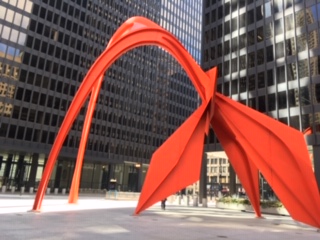
Ohhhhhh, All of you Attorneys, Paralegals and Legal Assistants have seen this gorgeous “stabile”” sculpture in the Federal Plaza in front of the Kluczynski Federal Building in Chicago, Walk underneath and around “Flamingo” and you will see how complex this piece is. The inner and outer structure reflect cubism and surrealist qualities, in that the flamingo becomes fractured and not realllllly looking like a flamingo except in the elongated steel leg or is it a neck and a leg? Calder never wanted his playful pieces to be serious and dedicated his art to deriving meaning in the structure itself. The orange red now has become an artist color “Calder Red.”
“Flamingo”, created by the American artist Alexander Calder, is a 53-foot tall stabile as Calder called the immobile sculptures differentiating from his mobile sculptures. It was commissioned by the United States General Services Administration and was unveiled in 1974, although Calder’s signature on the sculpture indicates it was constructed in 1973.
Alexander Calder, July 22, 1898 – November 11, 1976) was an American sculptor who is best known for his innovative mobiles (kinetic sculptures powered by motors or air currents) that embrace chance in their aesthetic and his monumental public sculptures. Born into a family of artists, Calder’s work first gained attention in Paris in the 1920, when he became friends with Jean Miro, and was soon championed by the Museum of Modern Art in New York, resulting in a retrospective exhibition in 1943. Major retrospectives were also held at the Solomon R. Guggenheim Museum (1964) and the Museum of Contemporary Art, Chicago (1974).
Calder’s work is in many permanent collections, most notably in the Whitney Museum of American Art, but also the Guggenheim Museum; the Museum of Modern Art; the National Gallery of Art, Washington, D.C.; and the Centre Georges Pompidou. He produced many large public works, including .125 (at JFK Airport, 1957), Pittsburgh (Carnegie International prize winner 1958, Pittsburgh International Airport) Spirale (UNESCO in Paris, 1958), Flamingo and Universe (both in Chicago, 1974), (Universe located in the former Sears Tower was dismantled when it was sold and renamed Willis Tower). and Mountains and Clouds (Hart Senate Office Building, Washington, D.C., 1996). (source Wikipedia)
Although primarily known for his sculpture, Calder also created paintings and prints, miniatures (such as his famous Cirque Calder), theater set design, jewelry design, tapestries and rugs, and political posters. Calder was honored by the US Postal Service with a set of five 32-cent stamps in 1998, and received the Presidential Medal of Freedom, posthumously in 1977, after refusing to receive it from Gerald Ford one year earlier in protest of the Vietnam War. (source Wikipedia)
One of the most subtle demons in spiritual practice is complacency. We can think of complacency as a “near enemy” to continuity. If any of us in positions of comfort or privilege have been coasting on the sense that everything is fine, and will continue to be fine — for us, even if we know cognitively that it’s not fine for many others right now — we can be grateful that that particular delusion has finally been punctured.
Disaster has arrived.
How well we live through it depends in part on how well we practice with it. Many of us do have the skills to not waste this crisis, but it will take our wholehearted engagement and skillful practice, all together — if not physically together.
Continuity, where our effort is gentle but persistent, steady but still flexible, is one of the most valued qualities in Buddhist meditation practice. Continuity is when we meditate a little bit every day no matter what, or when the habit of mindfulness is so established that we can’t help but be present with what’s happening moment to moment in our body, heart, and mind. Continuity is what builds samādhi, the meditative stability that is the most valuable kind of focus in the Buddhist system. Relaxed, steady, interested, engaged without being busy or frantic, it’s maybe the one quality that most determines how much we deepen in both meditation and insight.
Complacency feels a little bit like continuity, with its steady, unruffled quality. Except that complacency is the combination of steadiness and NON-mindfulness, which basically means delusion. In continuity, we understand that conditions are constantly changing, and we modulate our effort accordingly. Continuity is intimate with changing experience, and responsive, a contact improv dance with life, where we stay connected in a dynamic often unstable situation. Complacency, on the other hand, is dangerous. It’s when we think we know the dance so well that we don’t have to pay much attention. We’ve gone on auto-pilot, often because of overwhelm or boredom, and very often rooted in privilege. Our habits have been unchallenged for so long that we’ve forgotten that conditions are fundamentally unreliable.
Conditions are fundamentally unreliable.
The Pāli phrase for that, from the Theravāda Buddhist tradition, is sabbe saṅkhārā aniccā, “All processes are impermanent.” It’s followed by its inevitable implication: sabbe dhammā anattā, “All phenomena are not-self.”
The first part of practicing with the current dramatic moment, with public gatherings shutting down, and communities suddenly worried about how to supply people with basic survival needs, is to come out of denial and complacency. To shake off the idea that things are suddenly “not normal,” and that something’s wrong. Nothing is any more wrong than on any other day. People’s lives have been dramatically disrupted constantly, for as long as we have a record of them. What’s happening now is that the borders of first world delusion have been breached, which was always inevitable. We’re just as vulnerable as anyone else to the realities of life on a crowded planet. But unfortunately, it’s been easy to not notice or admit that.
Sabbe saṅkhārā aniccā. “All processes are impermanent.”
It’s so important to remember, in moments like this, but also in moments like… always, that we’re in a constantly changing dynamic system. And that what’s happening is the natural unfolding of vast cycles of action and result, expansion and contraction, through the entire ecosystem. To think of a viral pandemic — like the microscopic partner we now find ourselves dancing with — only in human terms, as if its primary importance revolves around numbers of deaths, or amount of economy disrupted, is to take phenomena as self. To think that this is about us. But this is not about us, or at least it’s not only about us.
We’ve known for decades that the comfort many of us live in is fundamentally unsustainable. This comfort is not just physical, in the way that we take for granted climate-controlled spaces, or abundant clean water, but also emotional and existential. Those of us who reliably have this comfort have believed that it is a God-given right, or the result of our technological brilliance (and those amount to the same thing, and lead to the same racism and cultural egoism), and that it is ours to possess and enjoy. A comfort to enjoy so deeply that many days we don’t even think about it. We’ve forgotten that actions always have results, or in Buddhist language, bear fruit. We ignore the fruits of our actions — melting ice, dying species, pandemics that span the globe rather than stopping at a natural boundary — because we’ve been able to keep them all at a convenient distance. This is the epitome of complacency.
Our perception of what’s happening on this earth has been wrong for a long time. Now is a moment for gratitude that our misperception can finally be corrected. We are not separate from our ecosystem, and never have been. Many people and cultures know this very deeply, of course, especially indigenous cultures and others that retain some of their pre-colonial knowledge systems. But the colonial process, where aliens with a technologically crushing force made contact over vast distances of land or ocean, depends for its power on the erasure of the knowledge of interconnection. Conquest that ruthless is impossible otherwise.
The line about not wasting a good crisis is from Winston Churchill, talking about World War II, and how it took a thing as horrific as that war to create something as world-stabilizing as the United Nations. There’s a whole genre of science fiction, from the Cold War thriller The Day the Earth Stood Still (1951) to my generation’s Ender’s Game (1985) and The Watchmen (1987), based around the idea that only a big external threat, like an alien invasion, would make it possible for the nations of the earth to come out of the habit of war and conflict, out of self-centeredness and xenophobic nationalism, and into cooperation and mutuality.
A useful threat for that purpose has arrived, and it is a kind of alien invasion. A powerful, fast-moving, far-from-human life form has found our species to be the perfect vector for its worldwide expansion. (Way better than bats, who don’t cross oceans very easily!) But the alien stories rarely go far enough. The standard plot line still depends on xenophobia — fear of the Other — as the motivation for human collaboration. Coming out of the delusion of self suggests a different pathway forward. But the different pathway requires thinking like an ecosystem, not like a species.
We know that human activity has thrown the ecosystem out of the equilibrium it enjoyed for millennia. And we can think of this new virus arriving in our consciousness and bodies the same way we think of any invasive species arriving in a new ecosystem: through our short-sightedness and hubris. One of the “invaders” in the San Francisco Bay Area where I live is the tiny whelk snail, or “Atlantic oyster drill.” Indigenous people here, the Coast and Bay Miwok, Ohlone, and Pomo, sustainably ate local “Olympia” oysters for 4000 years. But Gold Rush colonists in the 19th century harvested them to extinction, and in one short-sighted ecosystem mistake among many (see eucalyptus, Scotch broom, nutria, and Himalayan blackberry… and that’s just around here), brought Atlantic oysters across the continent on the new railroad to replace them. The Atlantic oysters died (the water here is too cold in the summer, which any local who lives near the ocean can tell you), but the snails got off the train, thanked us for the ride, and thrived.
Thanks to our miraculous rails, roads, ships, and planes, humans have touched every mile of the globe, and connected all those miles through the medium of our bodies, constantly moving around, moving further and faster than any animal ever did before. It’s only inevitable that our co-inhabitants of this earth would try to hitch a ride with us in whatever way they can. The important shift here is partly to let go of the idea that we’re the only intelligent and self-interested beings around — we’re clearly not. Aliens of all kinds are close by, acting in self-interest, and in relationship with us (and each other) all the time. But the bigger shift is to let go of thinking “us” and “it” or “them” at all. It is to start thinking like an ecosystem.
Sabbe dhammā anattā, “All phenomena are not-self.”
The difficult concept called “not-self” (anattā) is one of the most radical ideas in the Buddhist system. Many religions and philosophical systems have come up with the idea that we’re not the kind of beings we think we are, defined by our bodies, social identities, and personal narratives. But most other systems do something that’s comforting in relation to that rather disorienting proposition: they replace the consensus reality of the personal self with a more cosmic Self. This more “true” Self idea is that you are actually Divine consciousness, or an immortal soul saved by Grace, or never were separate from the Beloved, no matter how alone you felt. These are beautiful and useful ways to conceptualize the vastness we can feel in our most ecstatic moments. But not-self is more radical: it doesn’t replace the personal self with anything at all.
In not-self, we have a path to an extraordinary freedom of heart: nothing is about us. We’re not the center of the universe, as any parent tells their teenager, but we’re not even the center of our own life story! Not because we don’t matter or have worth (of course we do — just as much as anything does), but because there’s no center.
If we let go of the idea that we’re the center, the Coronavirus is just as much the protagonist of this earthly moment as we are. Or even more accurately, when we see that there’s no center at all: the virus is inseparable from us, where “us” means the earth as a living being, or the whole universe as a living phenomenon, singular.
If the first practice for this moment is to wake up from the delusion of normalcy, a second is to wake up from the delusion of separateness. As long as we keep thinking we’re not part of the earth, or that we’re supposed to “subdue it: and have dominion over” it (Genesis 1:27), we’ll never stop making ecosystem mistakes, destroying our only home, our own body, the earth. And we’ll never attain freedom of heart or peace of mind. How could we? We’re self-harming.
Thinking like an ecosystem is not easy, and the ancient viruses of xenophobia and nationalism are harder to contain than a mutating bat germ. But if we’re lucky, this pandemic becomes the “good crisis” that will bring us closer to being a more mature and enlightened earthly community. We must realize that we’re all here together — all the human nations, all the animal nations, all the plant and fungal and spirit nations — and that there are no real borders on this earth.
Of course we care for our vulnerable elders, and all human lives are beautiful, and worth protecting, to a point. Wash your hands. But if we want to thrive as a world, a far bigger perspective is needed, and a change in how we live together that goes way beyond how we manage this breach in our comfortable bubble. May the bubble stay popped for a long time! Long enough for the insight of non-separation to become our new normal. We’ve accelerated movement and inter-species contact throughout our world. There’s no way to do that and continue to pretend we can stay separate, or that we ever were.
The Day the Earth Stood Still ends with the alien emissary, Klaatu, stopping all electrical activity on the planet for a half hour lecture on nuclear disarmament, and a threat: “Your choice is simple: join us and live in peace, or pursue your present course and face obliteration. We shall be waiting for your answer.”
The present course was, of course, pursued, far beyond what even the prophets of the nuclear age could imagine. And the results of our actions are upon us.
The Bodhisattva vow is the vow taken by Mahayana Buddhists to liberate all sentient beings. One who has taken the vow is nominally known as a Bodhisattva. This can be done by venerating all Buddhas and by cultivating supreme moral and spiritual perfection, to be placed in the service of others. In particular, Bodhisattvas promise to practice the six perfections of giving, moral discipline, patience, effort, concentration and wisdom in order to fulfill their bodhicitta aim of attaining enlightenment for the sake of all beings.[1] Whereas the Prātimokṣa vows cease at death, the Bodhisattva vow extends into future lives.
Avatamsaka Sutra
A Bodhisattva vow is found at the end of the Avatamsaka Sutra, in which Samantabhadra makes ten vows to become a Bodhisattva. In the Bodhisattvacaryāvatāra, Shantideva explains that the Bodhisattva vow is taken with the following famous two verses from that sutra:
Just as all the previous Sugatas, the Buddhas Generated the mind of enlightenment And accomplished all the stages Of the Bodhisattva training, So will I, too, for the sake of all beings, Generate the mind of enlightenment And accomplish all the stages Of the Bodhisattva training.[2]
Total PraiseRichard SmallwoodLord, I will lift mine eyes to the hills Knowing my health is coming from You Your peace You give me in times of the stormYou are the source of my strength, Hallelujah And You are the strength of my life, yes You are I lift my hands in total praise to YouLord, I will lift mine eyes to the hills Knowing my health is coming from You Your peace, You give me in times of the stormYou are the source of my strength You are the strength of my life I lift my hands in total…
Translators: Mike Zonta, Melissa Goodnight, Richard Branam, Hanz Bolen
SENSE TESTIMONY: Recovery of value and wellness cannot be shared because of system dislocation.
5th Step Conclusions:
1) Truth is the one Possessor/Possession sharing Itself with Itself with boundless ability, boundless wellness, the only Place, the only Thing, the only Being.
2) All is One Infinite Consciousness — of inherently quintessential Wholeness, that is infallibly ever-present and ubiquitously pervading, such that immaculately righteous order is always perfectly present.
3) Truth is the seductive Attraction, inducement, this preface of reasonableness effecting the resulting stimulation: Cause, the substance exerting its Power into any action, Being the unity of the organically Whole System, these. principles are the pre-arranged, pre-ordered logical plan of Harmony; City of Favorable Commerce.
4) Wellness Value is all that is ever anywhere expressed and guided by Universal Integrity Mind Truth I Am.
All Translators are welcome to join this group. See Weekly Groups page/tab.
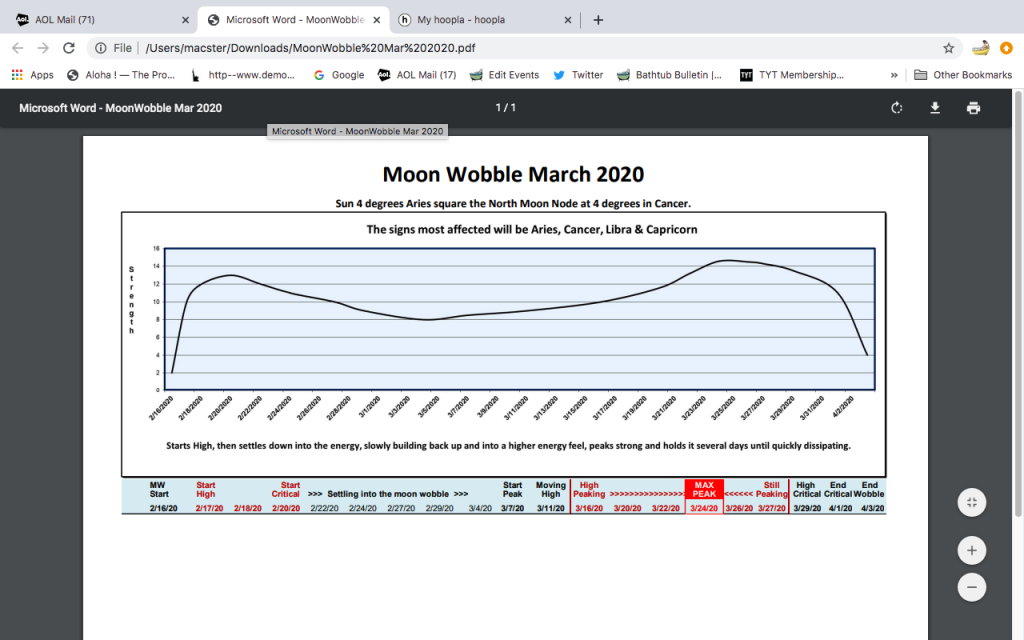
The next Moonwobble cycle is upon us. Let’s start with the basics : Take your time; think things through; look at everything twice, or more. Most importantly, don’t identify with aggravation (e.g., do not get into a game of chicken with fellow drivers on the road). The energy will shift significantly when the Sun moves into Aries on March 20. The tone will shift from confused and unpredictable to strident and pushy.
Culmination of the cycle comes when the Sun reaches 4° 50’ of Aries, square the lunar nodes at the same degree of Cancer (N) and Capricorn (S).
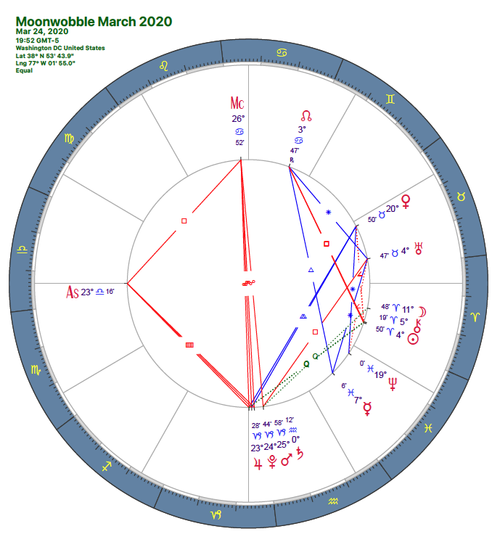
The Washington DC chart shows the Sun in the 6th house with the nodes in the 9th and the 3rd respectively. I suppose we should be grateful these are cadent houses, suggesting that the culminating tensions will show up sluggishly. Which is just as well because Jupiter, Pluto, and Mars are angular on the 4th house cusp and we will be getting plenty of energy from them. Fourth house is home, domestic policy, and of course – elections.
Saturn has moved away from this Capricorn love fest but is still in orb at 0° Aquarius.
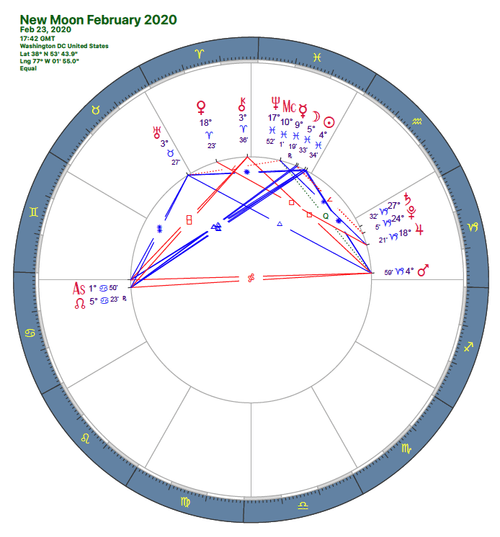
Interestingly, this Moonwobble culminates just after the coming New Moon in Aries. For this analysis, though, I’ve chosen to look at the New Moon of February 23, in Pisces, because this sets the stage for the coming several weeks.
That chart, for Washington DC, has about 2° Cancer ascending and Mars angular in the 7th house, suggesting aggressive attitudes about others and how we in the United States relate to them. It is sextile the New Moon pair and trine Uranus.
I would expect an aggressive U.S. foreign policy aided by fresh initiatives based on philosophical positions, possibly drawing upon an interest in what is perceived as constructive social change. It is a Pisces New Moon, of course, but it’s also in the 9th house and its energy will show up in philosophical discourse and the nation’s way of seeing its own potential growth and learning. Mercury, an important planet in the President’s chart, is on the Midheaven here so, no surprise, he will be prominent during this cycle.
The author and Bernie standee in January 2020. Photo by Anton O’Donnell (www.antonshootsfilm.com)
On the phone with New York voter and first-time father who was at the hospital for second day of labor with his wife. The wife began to go into labor. He kept me on the phone. It sounded like a breeched birth. He said, “There are two heads.” I didn’t know what to do. I Translated birth. Heard baby cry. It was a little girl. Then I cried.
Consciousness, sexuality, androgyny, futurism, space, the arts, science, astrology, democracy, humor, books, movies and more