Russell Brand A clip from the upcoming Under The Skin podcast with philosopher and professor Dr. Brad Evans! We chat about the history of previous pandemics and what revolutionary changes arose from them, we talk about the militarisation of our streets during this Coronavirus crisis, what security means and what community means. You can listen to this entire podcast from Sat 28th March only on Luminary: http://luminary.link/russell Subscribe to my channel here: http://tinyurl.com/opragcg (make sure to hit the BELL icon to be notified of new videos!)
A Half Century Ago, Chemist Gordon Moore Made a Prediction—Or Was It a Challenge?—That Became a Narrative for Our Time
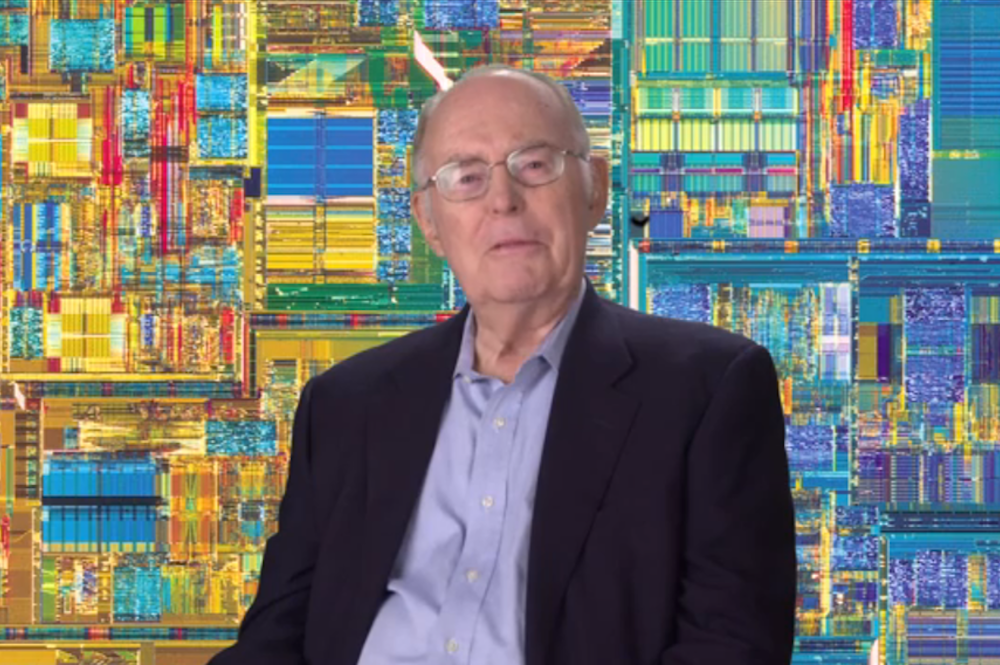
Screenshot of Gordon Moore featured in Scientists You Must Know by the Science History Institute. Courtesy of the Science History Institute.
by RACHEL JONES | MARCH 22, 2020 (zocalopublicsquare.org)
In the last half-century, and especially in the last decade, computers have given us the ability to act and interact in progressively faster and more frictionless ways. Consider the now-ubiquitous smartphone, whose internal processor takes just a millisecond to convert a movement of your finger or thumb to a visual change on your screen. This speed has benefits (in 2020, there’s a virtual library of information online) as well as disadvantages (your gaffe can go viral in seconds).
What made the smartphone—and the rest of our unfolding digital transformation—possible? Many point to a prediction in April 1965, published in a then-little-read article toward the back end of the trade paper Electronics. The piece, written by a young chemist named Gordon Moore, outlined in technical terms how quickly the technology behind computer chips might develop and, by implication, make its way into our lives. It’s been 55 years since the article’s publication, and it’s worth revisiting its original prediction—now known as Moore’s Law.
If you ask people today what Moore’s Law is, they’ll often say it predicts that every 18 months, engineers will be able to come up with ways to double the number of transistors they can squeeze onto a tiny computer chip, thus doubling its processing power. It’s a curious aspect of the law that this is not what Moore actually said, but he did predict consistent improvement in processing technology. Moreover, the world he anticipated did take shape, with his own work as founder of the chipmaker Intel creating much of the momentum necessary to turn his “law” into a self-fulfilling prophecy.
Initially, Moore had few notions of changing the world. Early in life, he discovered a love for chemistry—and though he was kept back at school for his inarticulate style, he excelled at practical activities, making bombs and rockets in a home-based laboratory. He went on to study chemistry at UC Berkeley under two Nobel laureates, and earned a Ph.D. at the California Institute of Technology in 1954.
Moore’s career trajectory coincided with the rise of the transistor, a device made of semiconductor material that can regulate electrical current flows and act as a switch or gate for electronic signals. As far back as the 1920s, physicists had proposed making transistors as a way to improve on the unreliable, power-hungry vacuum tubes that helped amplify signals on telephone lines, and that would be used in the thousands in computers such as ENIAC and Colossus. In 1939, William Shockley, a young Bell Labs researcher, revived the idea of the transistor and tried to fabricate a device; despite several failures, he continued on and in 1947 he and two colleagues succeeded in making the world’s first working transistor (for which they shared a Nobel Prize in Physics). In 1953, British scientists used transistors to build a computer, and Fortune declared it “The Year of the Transistor.”
In 1955, Shockley moved to Mountain View, California, to be near his mother. He opened a semiconductor laboratory and picked a handful of young scientists to join him, including Moore and his Intel co-founder, Bob Noyce. The launch of the Sputnik satellite in 1957 and the escalation of the Cold War created a boom within a boom: Moore and seven colleagues, including Noyce, broke away from Shockley in a group quickly branded “The Traitorous Eight,” forming the seminal start-up Fairchild Semiconductor. They planned to make silicon transistors, which promised greater robustness, miniaturization and lower power usage, so essential for computers guiding missiles and satellites.
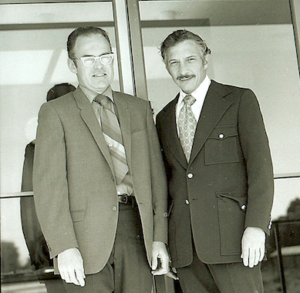
“Our curiosity was similar, but not our approach. Noyce liked things that flew. I liked things that blew up,” said Gordon Moore (left) with Robert Noyce. Courtesy of Intel Free Press.
Developing the core manufacturing technology was a seat-of-the-pants adventure in which Moore played a central role. In March 1958, Fairchild received an order from IBM for 100 mesa transistors priced at $150 each. Mesas, made on 1-inch silicon wafers, were so named because their profiles resembled the flat-topped mesa formations of the American Southwest. Moore’s responsibility was figuring out how to fabricate them reliably, which involved a complex chemical ballet and a considerable amount of thrift and improvisation. Unable to buy appropriate furnaces, Moore relied on glass-blowing skills to create gas-handling systems, assembled on cobbled-together aqua blue kitchen cabinets and Formica countertops. (Real lab furniture was “as expensive as heck,” he remarked.) Delivery solutions were similarly no-frills: Fairchild sent mesa transistors to IBM in a Brillo box from a local grocery store.
The mesa transistor was successful, but the company’s new planar transistor (named for its flat topography) was a game-changer, bringing more stability and better performance. Another key development was the step to connect transistors by making all components of a complete circuit within a single piece of silicon, paving the way for the first commercial integrated circuits, or microchips. Everyone wanted miniaturized circuitry—the obstacle to greater computing power was its need for more components and interconnections, which increased the possibilities for failure. Noyce grasped a solution: why not leave transistors together in a wafer and interconnect them there, then detach the set as a single unit? Such “microchips” could be smaller, faster and cheaper than transistors manufactured individually and connected to each other afterward. As early as 1959, Moore proposed that “sets of these components will be able to replace 90 percent of all circuitry” in digital computers.In the 1970s, seeing progress continue, Moore grew bolder, telling audiences that silicon electronics would constitute “a major revolution in the history of mankind, as important as the Industrial Revolution.”
Six years later, in 1965, when he wrote his now-famous article in Electronics—“Cramming More Components onto Integrated Circuits”—personal computers were still a decade away. Moore, who had seen the number of elements on a chip go from one, to eight, to 60, hinted at how integrated functions would “broaden [electronics’] scope beyond [his] imagination” and at the “major impact” the changes would bring, but saw his analysis as distilling merely a trend in technology that would make everything cheaper. Nevertheless, his analysis was rigorous. Doubling the number of components on an integrated circuit each year would steadily increase performance and decrease cost, which would—as Moore put it 10 years later—“extend the utility of digital electronics more broadly in society.”
As chemical printing continued to evolve, the economics of microchips would continue to improve, and these more complex chips would provide the cheapest electronics. Thus, an electronics-based revolution could depend on existing silicon technology, rather than some new invention. By 1970, Moore asserted, the transistor that could be made most cheaply would be on a microchip 30 times more complex than one of 1965.
In 1968, Moore left Fairchild and joined Noyce to found Intel, with the aim of “putting cleverness back into processing silicon.” In 1975, he reviewed his original extrapolation. Chips introduced until that point had followed the trend he predicted, but engineers were reaching the limits for circuit and device cleverness. Moore now proposed a doubling about every two years.
The analysis in Electronics was becoming known as Moore’s Law. Having correctly observed the potential for exponential growth, Moore overcame his personal dislike of the spotlight by travelling widely to talk about his idea, taking every opportunity to persuade others. After all, the fulfilment of Moore’s Law would be as much social as technical, relying on widespread acceptance: industry needed to invest to develop the technology, manufacturers needed to put microchips into their products, consumers needed to buy and use electronic devices and functions, and researchers and engineers needed to invent advances to extend Moore’s Law.
In the 1970s, seeing progress continue, Moore grew bolder, telling audiences that silicon electronics would constitute “a major revolution in the history of mankind, as important as the Industrial Revolution.” He was so confident in his vision that he told a journalist that students who’d made headlines getting kicked off campuses (“kids with the long hair and beards”) were not the ones to watch: instead, he pronounced, “we are really the revolutionaries in the world today.” In front of a crowd, he pointed out that if the auto industry made progress at the same rate as silicon microelectronics, it would be more expensive to park your car downtown for the night than to buy a new Rolls Royce. “And,” he recalled years later, “one of the members of the audience pointed out, yeah, but it’d only be 2-inches long and a half-inch high; it wouldn’t be much good for your commute.”
The rest is history. “For more than three decades,” the New York Times pointed out in 2003, Moore’s Law “has accurately predicted the accelerating power and plummeting cost of computing. Because of the exponential nature of Moore’s prediction, each change has arrived faster and more furiously.” Its curve, shallow at first (though spawning the birth of the microprocessor, digital calculator, personal computer and internet along the way) has, since 2005, gone almost straight up in “hockey stick” style.
Despite the changes we’ve all witnessed, Moore’s Law is still widely misunderstood, even in tech circles. “[It’s] only 11 words long … but most people manage to mangle it,” said one report. Moore’s 1965 article is a sophisticated piece of analysis but many prefer to interpret it more vaguely: “The definition of ‘Moore’s Law’ has come to refer to almost anything related to the semiconductor industry that when plotted on semi-log paper approximates a straight line,” noted its originator, dryly.
Up to April 2002, Intel’s website noted that “Moore predicted that the number of transistors per integrated circuit would double every 18 months,” even though Moore had pointed out that he “never said 18 months.”
Why did 18 months stick? Perhaps because a projection by an Intel colleague in 1975 led to a conflation of transistor count and doubling of performance; perhaps because this timescale appeared in an influential technology column in 1992, as the modern configuration of Silicon Valley was forming—perhaps because that speed felt more accurate to the semiconductor industry.
During the technology bust of the early 2000s, people began to speculate about the death of Moore’s Law. Others suggested it would peter out because people would drop their computer fixations to spend less time at work and more with their families, or because Silicon Valley’s obsession with it was “unhealthy” for business strategy. In 2007, the year the smartphone launched, Moore pointed out that “we make more transistors per year than the number of printed characters in all the newspapers, magazines, books, photocopies, and computer printouts.” But he recognized exponential growth could not continue forever; he knew the physical and financial constraints on shrinking the size of chip components.
When people in industry circles describe Moore’s Law as a “dictate—the law by which the industry lives or dies,” it is more evidence of the law’s power within Silicon Valley culture rather than its actual predictive accuracy. As the essayist Ilkka Tuomi observed in “The Lives and Death of Moore’s Law,” Moore’s Law became “an increasingly misleading predictor of future developments” that people understood to be something more like a “rule-of-thumb” than a “deterministic natural law.” In fact, Tuomi speculated, the very slipperiness of Moore’s Law might have accounted for its popularity. To an extent, tech people could pick and choose how they interpreted the dictum to suit their business needs.
Today, Moore’s Law continues to thrive in the smartphone space, having put some 8.5 billion transistors into a single phone that can fit in our pockets. The law may now be, in the words of one commentator, “more a challenge to the industry than an axiom for how chipmaking works,” but for what began as a 10-year forecast, it has had an astonishing run. “Once you’ve made a successful prediction, avoid making another one,” Moore quipped in 2015.
Even as technology continues to pervade our lives—with the advent of more specialized chips and materials, better software, cloud computing, and the promise of quantum computing—his law remains the benchmark and overarching narrative, both forecasting and describing our digital evolution.RACHEL JONESis a writer, editor, and biographer, specializing in stories and histories of science, technology, health and innovation. She co-authored Moore’s Law: The Life of Gordon Moore, Silicon Valley’s Quiet Revolutionary.
There’s no squinting in space. Things appear small, sure. From your vantage point, 254 miles above Earth, even the colossal Kapok trees of the Amazon are reduced to a verdant swirl in a cat-eye marble. But in space, as six NASA astronauts tell Inverse, what you see isn’t necessarily what you envision. Up there, where perspective is immeasurably wide, it’s impossible to miss the forest for the trees.
The astronauts — Chris Hadfield, Jerry Linenger, Nicole Stott, Mae Jemison, Leland Melvin, and Mike Massimino — have all had the rare opportunity to view our home planet from space. In doing so, all of them went through a change, not only in how they saw the planet but in their relationship to it. Some refer to that change as the “Overview Effect,” a term coined in 1987 by celebrated space writer Frank White to describe the mental shift astronauts experience when they consider the Earth as part of a larger whole.
The new National Geographic series One Strange Rock, executive produced by Darren Aronofsky and Jane Root of Nutopia, aims to recreate the Overview Effect for everybody else by showing, as best it can, the views that prompted those shifts.
In a series of one-on-one conversations with the astronauts, Inverse asked what exactly each of them saw the moment that everything changed.
Chris Hadfield 166 Days in Space
It sneaks up on you, because you’re busy and you’re doing stuff. Your emotions almost end up somewhere behind you, because things are happening so fast. One of the reasons we take so many pictures is we don’t have time to see what we’re looking at. And you know if you don’t somehow record this right now, you’re going to miss it, and hopefully you’ll have time later to look at it.
So, sometimes when you’re looking back at something you did, you realize what just happened. It was when I took a picture, actually, of Karachi, Pakistan, and I read what I wrote about it the next day, which was: “There are 6 million of us living in Pakistan.” And I realized that that part of the world had become us for me.
Six million of us? When is that no longer “them?” How did that part of the world, which I’ve never even been to, now, suddenly, because of the cumulative effect of where I am, start to feel like us? I think that’s when the world became one place for me.
Jerry Linenger 143 Days in Space
You go through the launch and it’s just chaos — it’s just power. You think, “Wow, mankind built this thing — it’s incredible! This thing’s getting me to 17,500 miles an hour.” All that part is incredible. So you catch up with everything; you do all the things your brain has to do: switches, make sure everything’s correct, make sure the spacecraft’s working.
But it’s when you have that reflective moment, when you just float over the top of a window. In my five months on the Russian Space Station, I had some opportunities where, for 90 minutes, I would just levitate over a window, and I’d see the sun rise, the sun set, the stars come out, and I’d just sort of block the world out. I blocked out science, to some degree. I said: I’m not going to identify the Big Dipper. There’s so much stuff out there; it’s a feeble effort by man to try and put labels on all this stuff.
I took the gestalt of it and said, “Wow, that’s the universe.” And then, on the reverse side, I said, “Wow, that’s Planet Earth, and there’s civilization.” You kind of go back in time with civilization. I said, “Wow, that’s a river, I can see the rivers dotting it, I can see the Ganges River, and the light shining there.” You realize these ancient civilizations are very similar to our civilizations. They needed water in those days, and we still need water. The rivers of the world look like pearl necklaces.
You just have this incredible view of the universe, of Earth, and a little reflection of yourself as a human being, telling yourself, “Wow, I’m in space. What mankind just accomplished is incredible.”
Nicole Scott 104 Days in Space
All I know is I was stunned in a way that was completely unexpected. It was overwhelmingly impressive — beyond anything I’d heard from my colleagues who’ve flown before. We just can’t describe it, you know? When you go to different places here on Earth and experience things that you never thought you would before, it’s difficult to describe it. I think with a lot of those things, you’re seeing it, but you’re feeling it, too. You feel like it’s just getting in you.
The planet just glows. I remember trying to describe to my son, who was seven at the time, what it was looking like to me. I’m like, “Okay, the simplest way I can think is just, take a lightbulb — the brightest lightbulb that you could ever possibly imagine — and just paint it all the colors that you know Earth to be, and turn it on, and be blinded by it.” Because day, night, sunrise, sunset, it is just glowing in all of those colors.
I didn’t expect that. I expected it to be really, really pretty, but I didn’t expect to feel like you could almost reach into it. You immediately cannot deny that it’s a planet. That you live on a planet.
I do remember initially looking out the window the first couple of days and wanting to see my home, wanting to see Florida from space. Finally, we were flying over Florida. I wanted to fly to the window and see it, and then realized somewhere down the line that I wasn’t looking at Florida that same way anymore. I still wanted to see Florida, but Florida had just become this special part of home, which is Earth. I don’t know when that happened. Was that two days after I got there? I mean, it wasn’t like one day I woke up and was like, “Oh yeah, Earth’s my home.”
It’s a feeling of interconnectivity that you sometimes just don’t get when you’re in the middle of something. I think separating ourselves from things that are important to us is good because you then appreciate it in a new way. That definitely happened for me with Earth.
Mae Jemison Eight Days in Space
One of the things that’s really interesting is that you respond to what you took up with you. I didn’t have any, “Aha, everything that belongs to me in life is down here on Earth.” Mine was quite different. Mine was about connecting with the rest of the universe. I never grew up thinking that this was the end-all, be-all. I never thought of boundaries and borders. I always knew they were human-made — that we put them there; they had no relationship to anything. I knew that the clouds carry water over different parts of the world. That wasn’t a big whoop for me.
I tried to make myself afraid. I thought that I would be nervous being up there, but I was just so mellow and cool. I’d done a couple of things: I was exactly where I wanted to be, I’d made my peace with everybody if something happened, so I was very cool and in the moment. But I was like, “This is just feeling a little too good, right?”
I imagined that on the other side of this hatch is an atmosphere and environment that doesn’t support my life form. But I couldn’t make myself nervous. And I tried to imagine myself being on another star system 10,000 light-years away, and I felt fine. I thought it would be important that I was there with a bunch of people, but I was like, “I would have loved to have been up there by myself in a big glass bubble with my cat.”
Because I felt that connected. For me, it wasn’t a connection back down to Earth. It was a connection with the rest of the universe.
For me, it was about outward versus inward. But I think it depends on who you are when you go up.
Leland Melvin 213 Days in Space
Actually, it really happened after we installed the laboratory. Peggy Whitson, who is one of my colleagues on the show, she invited us over to the Russian segment to break bread; basically, to have a meal. And she said, “You guys bring the rehydrated vegetables, we’ll have the meat.”
So, we came over with this bag of vegetables, and we’re floating there, having this meal with people we used to fight against. Russians and Germans are on this mission. It’s almost a Benetton commercial. African-American, Asian-American, French, German, Russian, the first female commander, breaking bread at 17,500 miles per hour, all doing this while listening to Sade’s “Smooth Operator.”
I look out the window, and I see the planet again. We’re going around it so fast and we’re coming over Virginia. I look down and I’m thinking, “My parents are probably having a meal.” Five minutes later, we’re over Paris, where Léo’s from, our French long-duration astronaut. And then Yuri, from Russia, can look over to the side and see his home.
And so, in this one little moment in time, we’re looking at our respective homes, breaking bread, and celebrating like we are in space. And that’s when this shift happened, because I saw so much of the planet in 90 minutes. I saw all these different things happening. And that’s when I think I really got my over-perspective. I thought it would be when I did this task of installing the Columbus laboratory, but that paled in comparison to the human piece of us sharing and breaking bread and seeing the planet in that way. Our respective homes, up in space.
Melvin spoke with Inverse’s James Grebey, at Space Camp.
Mike Massimino 23 Days in Space
It happened during a space walk. At Hubble, we were 100 miles higher than the station, so we could see the curve of the planet from up there. The view is really cool.
If we were in a spaceship now, in this room — say we had windows — we’d see 57th Street. Then, whoop, we blast off into space. And now, through that same window, you see something different. You’re floating around; you’re seeing the Earth. Ah, that’s pretty cool. But you’re still inside.
When you go out, you’re in the backyard, and everything opens up to you. You can see differently. For me, it definitely changed the way I think about things. I really think our planet is a paradise.
I was at the Explorers Club Dinner. Jim Lovell, Apollo 13 guy — I had a conversation with during the day. He said, in his acceptance speech, something to the effect of: He knows what heaven is like because he was born there. Here.
This is a paradise that we live in, I think. I do think of this place as heaven-like.
I think this is a wonderful place to be, but I think seeing it from space, the beauty of it, that was my feeling. This is what heaven must look like, and I can’t imagine anything more beautiful than our planet from space.
Yasmin Tayag is a writer and former biologist living in New York. A Toronto girl at heart, her writing also appears in The Last Magazine and SciArt in America. You might recognize her as a past host of Scientific American’s YouTube series.
This article was originally published on March 27, 2018, by Inverse, and is republished here with permission.
“THIS, TOO, SHALL PASS. WE CAN FIGURE THIS OUT.”BY JON CHRISTIAN / March 23, 2020 (futurism.com)
For many people, the coronavirus pandemic didn’t quite hit home until beloved actor Tom Hanks tested positive.
Now, the Academy Awards-winning Hanks is back with some good news for a tired world: He and wife Rita Wilson, another accomplished actor who also caught the bug, are both on the mend.
“Two weeks after our first symptoms and we feel better,” Hanks tweeted on Sunday.
That’s heartening news for the Hanks/Wilson household, but it’s also a reminder that the vast majority of people who catch the coronavirus make it through and feel much better after a few weeks.
Hanks — “Cast Away” and “Forrest Gump” actor, published author, NPR quiz show guest-host — also used his platform to sing the praises of sheltering in place, which means avoiding unnecessary contact with others in a bid to avoid spreading the coronavirus.
It’s inevitable that COVID-19 will continue to spread at some rate, at least for a while, but the more the public can work together to slow it down, the less strain it will put on the health care system.
“Going to take awhile, but if we take care of each other, help where we can, and give up some comforts… this, too, shall pass,” Hanks wrote. “We can figure this out.”
The Aries New Moon brings a direct, uncomplicated focus to affairs, helping us to move ahead in straight lines. This can be a great boon in many areas of life, but particularly with a situation that has previously felt stuck or too complex. It may be the case that we are motivated to take up fresh activity in an area that has been dormant or lacking in solutions.
The Moon is starting to separate from a sextile to Saturn, which suggests that a serious atmosphere could be softening. This may come about because steps towards greater progress have already been made. Even if not, though, such steps could soon be possible. Perhaps you are about to turn the page on events that have been rather hard-going and drawn out. Either way, a separating aspect that involves the Moon, which is linked with daily changes, can convey the sense of a situation being on the wane.
Where Saturn is concerned, we often have lessons to learn, some of which we can pick up relatively easily, whereas others may just not stick with us. Occasionally, we simply don’t get the message, or at least not right away. Even so, it can turn out that life is intent on ensuring that we do “get it” this time, which may mean that the occasion for learning seems to recur — or the circumstances relating to it do so. There could be a developing theme of history repeating itself.
The planet that rules the Aries Moon is Mars, now in Capricorn, close to where Saturn was located during the previous lunation. According to traditional astrology, Mars is said to be exalted here, giving it strength that relates to its having a natural rapport with Saturn (ruler of Capricorn). We might see that Saturn is an invisible helper, lending support to Mars in this sign. How this may translate for us, in our everyday circumstances, could be through situations going more our way. We may suddenly find the right person on hand to help us meet our needs. Or doors are opened that we thought were closed to us.
Both Mars and Saturn can be linked with a sense of timing. So, a positive development might also relate to swift action, potentially in a place where it is not usually applied. Notably, Mars is also conjunct Pluto and Jupiter, which indicates blessings coming our way, including the gifts of insight. We may have woken up to the inner workings of a situation, for example, and be able to work towards a favorable outcome, instead of being involved in missed opportunities or negative results.
The Pluto energy relates to transformation of some kind. Frequently, when the intensity of Pluto’s presence is obvious, it is because we are witnessing a process of metamorphosis or a desire for change. Managing to keep such energy contained can feel quite difficult. If we have any choice in matters, then we may choose to let go and see where things lead — and be surprised at how much help is available, even when we do not select a specific route. Maybe we realize that we don’t have to make as great an impression as we had imagined. This could be in keeping with a general shift developing around us, which helps us to understand that the times are changing, whether we are doing so or not.
There is a marked theme of healing to this month’s New Moon, because it is conjunct Chiron in Aries. We may well witness an acceleration in a therapeutic process. If we notice any kind of new health problem arising, however, it might be equally wise to take prompt action to nip it in the bud. We could avoid a repeat of a situation we’ve previously experienced, or step away from a matter that will worsen quickly.
This article is from the Mountain Astrologer, written by Diana Collis.
London Real: What are some positive things we can do?
Icke: One of the positive things we can do is to change our self identity. If you identify as your name, your life story, your race, your religion, your background, whatever, you are identifying with a set of labels that are transitory and are incredibly brief. And those set of labels are not you. They are what you are experiencing. I am not David Icke. I am a point of attention which can be myopic or vast within an infinite stream of consciousness. And you are a point of attention in that same consciousness that observes reality from a different point of view. We are all points of attention in that same one consciousness, which is why racism is so ludicrous.
And if you self-identify with your labels as the “I,” as the total “I,” then you see the world in a certain way and it can be very frightening, but when you self-identify as “I am eternal, infinite having this experience” and when I leave the body which is just a way that the body focuses our attention within a tiny band of frequency. And when we leave the body, our attention expands as far as we want it to because that attention is no longer being focused through the body, through the five senses, and we on experiencing and exploring forever, forever.
This is a brief experience for a point of eternal consciousness that we give a name to. And when you observe the world from that perspective, which is where I’ve been coming from for a long time now, it’s not so frightening. And you have the ability to connect dots ’cause you’ll see things from a panorama and not a myopia. From a myopia, it can seem very, very fearful, but from the panorama, it’s just another experience.
Our perceptions, and it can be explained very simply how this works, our perceptions become our experience. And if you fall into fear of something, everything in this reality, even the coronavirus, is a frequency. Every thought is a frequency. Fear is a frequency. It’s a different frequency to love. It’s a different frequency to joy. And we live in this sea of frequency of possibility and probability.
It’s like being a computer this is living in this wi-fi sea, and within that wi-fi sea is everything on the internet. And so potentially you can put anything on the internet on your screen, your experience, but our perceptions are also frequencies. And so if we are in a frequency of fear and we are generating that frequency, that field, that electromagnetic field, we are going to make a symbiotic frequency connection with like frequencies. And what we do is we draw to us, as an experience, what we fear.
And all the time, you know, people say, you know, ‘This is always happening to me. Hey, Ethel, it’s happened again!’ Why? Why do certain things keep repeating in people’s lives but not repeat in others? Because what they’re putting out, this perception, which is a frequency field, is drawing towards them, like a magnetic phenomenon, drawing to them what they’re putting out.
And, so, if you fall into fearing something, the likelihood of that becoming your experience is massively increased. I’ve experimented with this through my life and, you know, I had very serious rheumatoid arthritis. I mean, I remember on one occasion, I was trying to walk through Terminal 5 at Heathrow Airport and literally I was shuffling my feet. I had no shoes on. I was shuffling my feet along towards the plane ’cause I couldn’t even lift my legs.
I don’t have that now. I have no pain. It doesn’t affect my life in any way. And the difference is I changed my perception. You see, why is it that so many people die within the period that the doctor tells they have to live? ‘How long have I got doctor?’ ‘Six months.’ They die in six months over and over again.
And do you know something? People have been told they have a fatal disease. The doctor has given them a prognosis. ‘You have so long to live’ and they die. And when they’ve done the post mortem, they didn’t have the fatal disease. ‘Cause the mind is all powerful. It’s constantly creating our reality. It’s perceptions are constantly becoming our experience.
And so I decided that if my reality was being controlled by my perceptions, then my perception is: this arthritis is not going to trouble me any more. And it’s not going to progress. And it’s not going to have me in a wheelchair and wizened up. And that’s exactly what’s happened. No drugs. No doctor. That’s exactly what’s happened.
And everybody has the power to use their mind to dictate their own reality. Why is it that this cult, this system, is so desperate to control human perception? Because it knows human perception becomes human experience and if we fall into states of fear we are going to manifest reasons to fear all around us. But if we take our minds back, if we take our consciousness back, we can create a different reality.
Because what is human society? It’s the sum total of human perception. Human perception changes. Human society must change, ’cause it’s just a reflection of the sum total of human perception. We love each other. We live in a loving world. We hate each other. We live in a world of hate. We fear. We live in a world of fear.
We are in control. They’ve just persuaded us we’re not.
London Real: And the message you’ve just said, I’ve heard from some of the greatest minds that have ever sat in that chair. Especially ones that have been around for a little while. They come to the same conclusions as you have. That we are what we believe and the energy we put out there is what we get back.
Icke: This book is all about that in a very accessible way because they say the more you know, the more you know there is to know. Well, yeah, on one level that’s right. But there’s another way: The more you know, the more you realize how little there is to actually know to take control of your life and your life experience. And so much of the complexity hides the simple sparkling truths.
Genius. This is the misunderstanding of the academic, intellectual mind. It perceives understanding complexity as intelligence and cleverness when genius is seeing the simple hidden by complexity. And in the end, when you get down to the core, we are what we perceive. Change what you perceive, and you’ll change what you experience.
London Real: And that applies to right now even more.
Icke: Absolutely.
London Real: Because if I’m not in fear, if I’m not worried about this stuff, then I don’t react to it. A friend of mine said, “Brian, I don’t see you running to the store and buying a whole bunch of stuff.” . . .
Icke: When you move your self identity to: I am an infinite point of attention within an infinite state of consciousness, what does that immediately do? It deletes the fear of death. What is death? It’s a withdrawing of our point of attention. That’s all death is. It’s a transfer of our point of attention. So there’s nothing to fear. And once you let go of fear of death, so many things that you are able to be manipulated through that fear of death, go. You can’t manipulate me any more.
Fear of the unknown. Fear of the unknown? Well, I like surprises. [Laughs.] It completely transforms everything when you re self-identify with the “I.” And fear of death is the first one to go. And I’m the same as you. I don’t want to leave here until I’ve done everything I can do to contribute. And I expect I’ll be around for a long time. And in so many ways (I explain this in the book), we can dictate how long we are around.
Again, you know, if the mind can transform rheumatoid arthritis which should have had me in a wheelchair by now and it hasn’t, then it can transform anything including the nature of life. You know, you can think yourself alive and you can think yourself dead. And so I’m going to stay around and make the best contribution I can, but when I go, I will be: “YES!”
Do we want to stay in this myopia band of frequency forever? Are you having a laugh? What a nightmare. So it’s just an experience. And then we move on and experience the infinity of forever. I mean, ‘Oh, I’m terrified. Coronavirus! Oh, God, we’re all going to die!’ I don’t think so.
London Real: Final thoughts on everything we’ve talked about today. The virus, the lockdown, the recession, just anything.
Icke: Well, I would just say what I said earlier in terms of . . . If you want to understand the world, find our where we’re being taken. what the goal is, and then the world just opens up. ‘Oh, so that’s why they’re doing that. Oh, so that’s why that’s happening’ instead of ‘What’s happening? What’s happening? What are they doing that for?’ It becomes so clear.
And what you do is then you take control of your perceptions. Because it’s very difficult, it’s impossible to manipulate people when you understand the game. How does problem/reaction manipulate you when you understand how it works? How does the totalitarian tiptoe manipulate you when you understand how it works? Know the game and you can win the game instead of being a victim of the game which is what’s happened up to this point.
London Real: . . . Just stay calm.
Icke: Yeah, just stay calm. We are an infinite point of eternal consciousness on an eternal journey of exploring all possibility. That’s as bad as it gets. This is just an experience. We can make it a nice experience or we can make it or we can make it an unpleasant experience. We have the power to choose and it’s about time we realized that. Because when enough people do, this cult is history.
London Real: . . . This could be a great catalyst for realization.
Icke: Oh, I think it is, Brian. You know, we need to appreciate the difference between those that control the microphones and so many people, not all by any means, but so many people and gathering in increasing number who don’t get to the microphones. You see the activists, the climate control activists, the coronavirus activists, and the fricking transgender activists, and all that, and the politically correct activists, and . . . And then you talk to the pubic. And you see a completely different perception to that. But because they dominate the microphones, as of course they do, because that’s the agenda, people can get the impression that that’s what the population thinks. It doesn’t. It doesn’t.
My father used to say, ‘The silent majority is silent ’cause it’s got nothing to say.’ It’s time for the silent majority to speak. And when we do, things will change. But not until.
London Real: And that’s something you said in the last episode. You should always say how you feel.
Icke: It simply comes to self respect. I ask people, ‘What are you doing allowing someone else to tell you what to think, to tell you what you can say, to tell you what you an believe . . . What are you doing? Where’s your self-respect?’ We live in a world of psychological fascism where people are constantly seeking to impose their beliefs on other people. We see it with religion all the time. We see it with ‘woke’ mentality all the time. I believe this so you must believe that. And if people acquiesce to that, then tyranny rules. And if we don’t, if we say, ‘You can call me what you like (and people do), I don’t care. Call me this, call me that, call me the other. Oh, thanks for sharing that with me. Have a nice day.’ But you say it anyway. And if enough people say it and refuse to bow to this psychological tyranny, imposing on our lives what we can be, what we can say, what we can think, the number of people being imposed upon is bast compared with the number of people doing the imposing.
I think I see a way out of this. You know, stiffen the backbone. Grow a pair. Say what you believe. Have some self-respect in your own uniqueness. And don’t let anyone take it away. And if we live in a world of multiple uniqueness, where everyone is celebrating their own uniqueness, their own unique . . all part of the same consciousness, yes . . . but their own unique point of attention, then that true, true diversity means tyranny can’t reign.
What does every tyranny want to do? Centralize everything, including perception. The more we celebrate our uniqueness, the more we are withdrawing from the ability of the few at the center to dictate to everybody. ‘You will think this!’ I won’t. ‘You will say that! You won’t say that!’ I will. What they going to do? Why do people acquiesce and self-center? Fear. Get rid of fear. The world changes. Because the world is controlled by fear. Delete fear. Delete control.
According to his contemporary, Jerome, Augustine “established anew the ancient Faith”.[a] In his youth he was drawn to Manichaeism and later to neoplatonism. After his baptism and conversion to Christianity in 386, Augustine developed his own approach to philosophy and theology, accommodating a variety of methods and perspectives.[23] Believing that the grace of Christ was indispensable to human freedom, he helped formulate the doctrine of original sin and made seminal contributions to the development of just war theory. When the Western Roman Empire began to disintegrate, Augustine imagined the Church as a spiritual City of God, distinct from the material Earthly City.[24] His thoughts profoundly influenced the medieval worldview. The segment of the Church that adhered to the concept of the Trinity as defined by the Council of Nicaea and the Council of Constantinople[25] closely identified with Augustine’s On the Trinity.
In the East, his teachings are more disputed, and were notably attacked by John Romanides.[30] But other theologians and figures of the Eastern Orthodox Church have shown significant approbation of his writings, chiefly Georges Florovsky.[31] The most controversial doctrine associated with him, the filioque,[32] was rejected by the Orthodox Church[33] as Heretic Teaching.[34] Other disputed teachings include his views on original sin, the doctrine of grace, and predestination.[32] Nevertheless, though considered to be mistaken on some points, he is still considered a saint, and has even had influence on some Eastern Church Fathers, most notably Gregory Palamas.[35] In the Orthodox Church his feast day is celebrated on 15 June.[32][36] Historian Diarmaid MacCulloch has written: “Augustine’s impact on Western Christian thought can hardly be overstated; only his beloved example Paul of Tarsus, has been more influential, and Westerners have generally seen Paul through Augustine’s eyes.”[37]
Life
Background
Augustine of Hippo (/ɔːˈɡʌstɪn/,[22]/əˈɡʌstɪn/,[38] or /ˈɔːɡʌstɪn/;[39]Latin: Aurelius Augustinus Hipponensis;[b] 13 November 354 – 28 August 430 AD), also known as Saint Augustine, Saint Austin,[41] is known by various cognomens throughout the many denominations of the Christian world, including Blessed Augustine, and the Doctor of Grace[42] (Latin: Doctor gratiae).
The Saint Augustine Taken to School by Saint Monica. by Niccolò di Pietro 1413–15
Augustine was born in the year 354 AD in the municipium of Thagaste (now Souk Ahras, Algeria) in the Roman province of Numidia.[45][46][47][48][49] His mother, Monica or Monnica,[c] was a devout Christian; his father Patricius was a Pagan who converted to Christianity on his deathbed.[50] He had a brother named Navigius and a sister whose name is lost but is conventionally remembered as Perpetua.[51]
Scholars generally agree that Augustine and his family were Berbers, an ethnic group indigenous to North Africa,[52][53][54] but that they were heavily Romanized, speaking only Latin at home as a matter of pride and dignity.[52] In his writings, Augustine leaves some information as to the consciousness of his African heritage. For example, he refers to Apuleius as “the most notorious of us Africans,”[52][55] to Ponticianus as “a country man of ours, insofar as being African,”[52][56] and to Faustus of Mileve as “an African Gentleman“.[52][57]
Augustine’s family name, Aurelius, suggests that his father’s ancestors were freedmen of the gens Aurelia given full Roman citizenship by the Edict of Caracalla in 212. Augustine’s family had been Roman, from a legal standpoint, for at least a century when he was born.[58] It is assumed that his mother, Monica, was of Berber origin, on the basis of her name,[59][60] but as his family were honestiores, an upper class of citizens known as honorable men, Augustine’s first language is likely to have been Latin.[59]
At the age of 11, Augustine was sent to school at Madaurus (now M’Daourouch), a small Numidian city about 19 miles (31 km) south of Thagaste. There he became familiar with Latin literature, as well as pagan beliefs and practices.[61] His first insight into the nature of sin occurred when he and a number of friends stole fruit they did not want from a neighborhood garden. He tells this story in his autobiography, The Confessions. He remembers that he stole the fruit, not because he was hungry, but because “it was not permitted.”[62] His very nature, he says, was flawed. ‘It was foul, and I loved it. I loved my own error—not that for which I erred, but the error itself.”[62] From this incident he concluded the human person is naturally inclined to sin, and in need of the grace of Christ.
At the age of 17, through the generosity of his fellow citizen Romanianus,[63] Augustine went to Carthage to continue his education in rhetoric, though it was above the financial means of his family.[64] In spite of the good warnings of his mother, as a youth Augustine lived a hedonistic lifestyle for a time, associating with young men who boasted of their sexual exploits. The need to gain their acceptance forced inexperienced boys like Augustine to seek or make up stories about sexual experiences.[65]
It was while he was a student in Carthage that he read Cicero‘s dialogueHortensius (now lost), which he described as leaving a lasting impression, enkindling in his heart the love of wisdom and a great thirst for truth. It started his interest in philosophy.[66] Although raised to follow Christianity, Augustine decided to become a Manichaean, much to his mother’s despair.[67]
At about the age of 17, Augustine began an affair with a young woman in Carthage. Though his mother wanted him to marry a person of his class, the woman remained his lover[68] for over fifteen years[69] and gave birth to his son Adeodatus (372–388),[70] who was viewed as extremely intelligent by his contemporaries. In 385, Augustine ended his relationship with his lover in order to prepare himself to marry a ten-year-old heiress. (He had to wait for two years because the legal age of marriage for women was twelve.) By the time he was able to marry her, however, he instead decided to become a celibate priest.[69][71]
Augustine was from the beginning a brilliant student, with an eager intellectual curiosity, but he never mastered Greek[72] — he tells us that his first Greek teacher was a brutal man who constantly beat his students, and Augustine rebelled and refused to study. By the time he realized that he needed to know Greek, it was too late; and although he acquired a smattering of the language, he was never eloquent with it. However, his mastery of Latin was another matter. He became an expert both in the eloquent use of the language and in the use of clever arguments to make his points.
Move to Carthage, Rome, Milan
The earliest known portrait of Saint Augustine in a 6th-century fresco, Lateran, Rome
Augustine taught grammar at Thagaste during 373 and 374. The following year he moved to Carthage to conduct a school of rhetoric and would remain there for the next nine years.[63] Disturbed by unruly students in Carthage, he moved to establish a school in Rome, where he believed the best and brightest rhetoricians practiced, in 383. However, Augustine was disappointed with the apathetic reception. It was the custom for students to pay their fees to the professor on the last day of the term, and many students attended faithfully all term, and then did not pay.
Manichaean friends introduced him to the prefect of the City of Rome, Symmachus, who while traveling through Carthage had been asked by the imperial court at Milan[42] to provide a rhetoric professor. Augustine won the job and headed north to take his position in Milan in late 384. Thirty years old, he had won the most visible academic position in the Latin world at a time when such posts gave ready access to political careers.
Although Augustine spent ten years as a Manichaean, he was never an initiate or “elect”, but an “auditor”, the lowest level in this religion’s hierarchy.[42][73] While still at Carthage a disappointing meeting with the Manichaean Bishop, Faustus of Mileve, a key exponent of Manichaean theology, started Augustine’s scepticism of Manichaeanism.[42] In Rome, he reportedly turned away from Manichaeanism, embracing the scepticism of the New Academy movement. Because of his education, Augustine had great rhetorical prowess and was very knowledgeable of the philosophies behind many faiths.[74] At Milan, his mother’s religiosity, Augustine’s own studies in Neoplatonism, and his friend Simplicianus all urged him towards Christianity.[63] Not coincidentally, this was shortly after the Roman emperor Theodosius I had issued a decree of death for all Manichaean monks in 382 and shortly before he declared Christianity to be the only legitimate religion for the Roman Empire in 391.[75] Initially Augustine was not strongly influenced by Christianity and its ideologies, but after coming in contact with Ambrose of Milan, Augustine reevaluated himself and was forever changed.
Augustine arrived in Milan and visited Ambrose having heard of his reputation as an orator. Augustine quickly discovered that Ambrose was a spectacular orator. Like Augustine, Ambrose was a master of rhetoric, but older and more experienced.[76] Soon, their relationship grew, as Augustine wrote, “And I began to love him, of course, not at the first as a teacher of the truth, for I had entirely despaired of finding that in thy Church—but as a friendly man.”[77] Eventually, Augustine says that he was spiritually led into the faith of Christianity.[77] Augustine was very much influenced by Ambrose, even more than by his own mother and others he admired. Within his Confessions, Augustine states, “That man of God received me as a father would, and welcomed my coming as a good bishop should.”[77] Ambrose adopted Augustine as a spiritual son after the death of Augustine’s father.[78]
Augustine’s mother had followed him to Milan and arranged a respectable marriage for him. Although Augustine acquiesced, he had to dismiss his concubine and grieved for having forsaken his lover. He wrote, “My mistress being torn from my side as an impediment to my marriage, my heart, which clave to her, was racked, and wounded, and bleeding.” Augustine confessed that he was not a lover of wedlock so much as a slave of lust, so he procured another concubine since he had to wait two years until his fiancée came of age. However, his emotional wound was not healed.[79] It was during this period that he uttered his famous prayer, “Grant me chastity and continence, but not yet.”[80]
There is evidence that Augustine may have considered this former relationship to be equivalent to marriage.[81] In his Confessions, he admitted that the experience eventually produced a decreased sensitivity to pain. Augustine eventually broke off his engagement to his eleven-year-old fiancée, but never renewed his relationship with either of his concubines. Alypius of Thagaste steered Augustine away from marriage, saying that they could not live a life together in the love of wisdom if he married. Augustine looked back years later on the life at Cassiciacum, a villa outside of Milan where he gathered with his followers, and described it as Christianae vitae otium – the leisure of Christian life.[82]
In late August of 386,[d] at the age of 31, having heard of Ponticianus’s and his friends’ first reading of the life of Anthony of the Desert, Augustine converted to Christianity. As Augustine later told it, his conversion was prompted by hearing a child’s voice say “take up and read” (Latin: tolle, lege). Resorting to the Sortes Sanctorum, he opened the Bible at random and read Romans 13: 13-14: Not in rioting and drunkenness, not in chambering and wantonness, not in strife and envying, but put on the Lord Jesus Christ, and make no provision for the flesh to fulfill the lusts thereof.[84]
He later wrote an account of his conversion in his Confessions (Latin: Confessiones), which has since become a classic of Christian theology and a key text in the history of autobiography. This work is an outpouring of thanksgiving and penitence. Although it is written as an account of his life, the Confessions also talks about the nature of time, causality, free will, and other important philosophical topics.[85] The following is taken from that work:
Late have I loved Thee, O Lord; and behold, Thou wast within and I without, and there I sought Thee. Thou wast with me when I was not with Thee. Thou didst call, and cry, and burst my deafness. Thou didst gleam, and glow, and dispel my blindness. Thou didst touch me, and I burned for Thy peace. For Thyself Thou hast made us, And restless our hearts until in Thee they find their ease. Late have I loved Thee, Thou Beauty ever old and ever new.[85]
Ambrose baptized Augustine and his son Adeodatus, in Milan on Easter Vigil, April 24–25, 387.[86] A year later, in 388, Augustine completed his apologyOn the Holiness of the Catholic Church.[42] That year, also, Adeodatus and Augustine returned home to Africa.[63] Augustine’s mother Monica died at Ostia, Italy, as they prepared to embark for Africa.[67] Upon their arrival, they began a life of aristocratic leisure at Augustine’s family’s property.[87] Soon after, Adeodatus, too, died.[88] Augustine then sold his patrimony and gave the money to the poor. The only thing he kept was the family house, which he converted into a monastic foundation for himself and a group of friends.[63]
In 391 Augustine was ordained a priest in Hippo Regius (now Annaba), in Algeria. He became a famous preacher (more than 350 preserved sermons are believed to be authentic), and was noted for combating the Manichaean religion, to which he had formerly adhered.[42]
In 395, he was made coadjutor Bishop of Hippo, and became full Bishop shortly thereafter,[89] hence the name “Augustine of Hippo”; and he gave his property to the church of Thagaste.[90] He remained in that position until his death in 430. He wrote his autobiographical Confessions in 397–398. His work The City of God was written to console his fellow Christians shortly after the Visigoths had sacked Rome in 410.
Augustine worked tirelessly in trying to convince the people of Hippo to convert to Christianity. Though he had left his monastery, he continued to lead a monastic life in the episcopal residence. He left a regula for his monastery that led to his designation as the “patron saint of regular clergy“.[91][failed verification]
Much of Augustine’s later life was recorded by his friend Possidius, bishop of Calama (present-day Guelma, Algeria), in his Sancti Augustini Vita. Possidius admired Augustine as a man of powerful intellect and a stirring orator who took every opportunity to defend Christianity against its detractors. Possidius also described Augustine’s personal traits in detail, drawing a portrait of a man who ate sparingly, worked tirelessly, despised gossip, shunned the temptations of the flesh, and exercised prudence in the financial stewardship of his see.[92]
Shortly before Augustine’s death, the Vandals, a Germanic tribe that had converted to Arianism, invaded Roman Africa. The Vandals besieged Hippo in the spring of 430, when Augustine entered his final illness. According to Possidius, one of the few miracles attributed to Augustine, the healing of an ill man, took place during the siege.[93] According to Possidius, Augustine spent his final days in prayer and repentance, requesting that the penitential Psalms of David be hung on his walls so that he could read them. He directed that the library of the church in Hippo and all the books therein should be carefully preserved. He died on 28 August 430.[94] Shortly after his death, the Vandals lifted the siege of Hippo, but they returned not long thereafter and burned the city. They destroyed all of it but Augustine’s cathedral and library, which they left untouched.[95]
Augustine was canonized by popular acclaim, and later recognized as a Doctor of the Church in 1298 by Pope Boniface VIII.[96] His feast day is 28 August, the day on which he died. He is considered the patron saint of brewers, printers, theologians, and a number of cities and dioceses. He is invoked against sore eyes.[26]
According to Bede‘s True Martyrology, Augustine’s body was later translated or moved to Cagliari, Sardinia, by the Catholic bishops expelled from North Africa by Huneric. Around 720, his remains were transported again by Peter, bishop of Pavia and uncle of the Lombard king Liutprand, to the church of San Pietro in Ciel d’Oro in Pavia, in order to save them from frequent coastal raids by Muslims. In January 1327, Pope John XXII issued the papal bull Veneranda Santorum Patrum, in which he appointed the Augustinians guardians of the tomb of Augustine (called Arca), which was remade in 1362 and elaborately carved with bas-reliefs of scenes from Augustine’s life.
In October 1695, some workmen in the Church of San Pietro in Ciel d’Oro in Pavia discovered a marble box containing some human bones (including part of a skull). A dispute arose between the Augustinian hermits (Order of Saint Augustine) and the regular canons (Canons Regular of Saint Augustine) as to whether these were the bones of Augustine. The hermits did not believe so; the canons affirmed that they were. Eventually Pope Benedict XIII (1724–1730) directed the Bishop of Pavia, Monsignor Pertusati, to make a determination. The bishop declared that, in his opinion, the bones were those of Saint Augustine.[97]
The Augustinians were expelled from Pavia in 1700, taking refuge in Milan with the relics of Augustine, and the disassembled Arca, which were removed to the cathedral there. San Pietro fell into disrepair, but was finally rebuilt in the 1870s, under the urging of Agostino Gaetano Riboldi, and reconsecrated in 1896 when the relics of Augustine and the shrine were once again reinstalled.[98][99]
In 1842, a portion of Augustine’s right arm (cubitus) was secured from Pavia and returned to Annaba.[100] It now rests in the Saint Augustin Basilica within a glass tube inserted into the arm of a life-size marble statue of the saint.
Views and thought
Augustine’s large contribution of writings covered diverse fields including theology, philosophy and sociology. Along with John Chrysostom, Augustine was among the most prolific scholars of the early church by quantity.
Wherever you are. We are living in powerful and potent times. We invite you to join us in prayer in the evening on Tuesday, March 24th from wherever you are. In California we will be praying in our homes at 7:30 pm. This is an important time for us to join our prayers together to weave compassion, kindness, strength, health and our visions of a future that is in alignment with the natural laws of our Mother Earth.
Many of us have worked for decades to ensure a safe, healthy, survivable future for the next seven generations. We are water protectors, land defenders and sky protectors who have considered ourselves to be an aspect of Mother Earth’s immune response, working hard with love in our hearts to restore health and balance to the system of life. We have made a difference but we have not been successful in restoring balance and stopping the harms.We are now experiencing the result of the system of life so far out of balance that a new life form has emerged, the Covid-19 virus which can be understood as the system of life protecting itself…from us. We have no immunity, no resistance to this new life form that is taking human lives. This virus has forced humanity to stop living the way we were, stop flying, driving, buying things we don’t need, going to movies, restaurants, parties, and all of the other things we do to distract ourselves from what is important, living within the laws of Mother Earth.
We now have time to consider how we are to be in alignment with a world in balance, a system of life that is healthy, clean, safe and restored for all beings. We can utilize this time of sheltering in place to think about how our actions have caused harm and what to do instead of participating in those harms. We can pray and be quiet enough to ask questions and receive answers from our helpers, spirits who are here to help us.”We call upon our sisters and their allies around the world to gather together on each new moon to pray for the sacred system of life, guidance and wisdom.” These words come from the historic Indigenous Women of the Americas – Defending Mother Earth Treaty Compact of 2015, which was signed on the day of the fourth Blood Moon, the Harvest Moon and the total lunar eclipse on Sunday, September 27, 2015 on Lenape Territory in New York City.
“I am convinced that most people do not grow up,” Maya Angelou wrote in her stirring letter to the daughter she never had. “We carry accumulation of years in our bodies and on our faces, but generally our real selves, the children inside, are still innocent and shy as magnolias.” In that same cultural season, from a college commencement stage, Toni Morrison told an orchard of human saplings that “true adulthood is a difficult beauty, an intensely hard won glory.”
It is tempting, for it is flattering, to think of ourselves as trees — as firmly rooted and resolutely upward bound; as creatures destined, in Mary Oliver’s lovely words, “to go easy, to be filled with light, and to shine.” But even if the highest compliment a great poet can pay a great woman is to celebrate her as a human tree, we are not trees — we don’t branch and root from a single point, we don’t grow linearly; we disbark ourselves at will, at the flash and flutter of a heart, self-grafting every love and loss we live through; our growth-rings are often ungirdled by self-doubt, by regress, by the fits and starts by which we become who and what we are: fragmentary but indivisible. The difficulty of growing up, the hard-won glory of it, lies in the self-tessellation.
That is what Rebecca Solnit explores in a passage from Recollections of My Nonexistence (public library) — her splendid memoir of longings and determinations, of resistances and revolutions, personal and political, illuminating the kiln in which one of the boldest, most original minds of our time was annealed.
Three quarters into the book and half a lifetime into her becoming, Solnit writes:
Growing up, we say, as though we were trees, as though altitude was all that there was to be gained, but so much of the process is growing whole as the fragments are gathered, the patterns found. Human infants are born with craniums made up of four plates that have not yet knit together into a solid dome so that their heads can compress to fit through the birth canal, so that the brain within can then expand. The seams of these plates are intricate, like fingers interlaced, like the meander of arctic rivers across tundra.
The skull quadruples in size in the first few years, and if the bones knit together too soon, they restrict the growth of the brain; and if they don’t knit at all the brain remains unprotected. Open enough to grow and closed enough to hold together is what a life must also be. We collage ourselves into being, finding the pieces of a worldview and people to love and reasons to live and then integrate them into a whole, a life consistent with its beliefs and desires, at least if we’re lucky.