

Monthly Archives: August 2019
How climate change affects your mental health
“For all that’s ever been said about climate change, we haven’t heard nearly enough about the psychological impacts of living in a warming world,” says science writer Britt Wray. In this quick talk, she explores how climate change is threatening our well-being — mental, social and spiritual — and offers a starting point for what we can do about it.
This talk was presented at an official TED conference, and was featured by our editors on the home page.
ABOUT THE SPEAKER
Britt Wray · Science storyteller, author, broadcaster
Britt Wray’s work is about life and what we make of it: past, present and future.
Survival of the Friendliest
It’s time to give the violent metaphors of evolution a break.
Violence has been the sire of all the world’s values,” wrote poet Robinson Jeffers in 1940. “What but the wolf’s tooth whittled so fine the fleet limbs of the antelope? What but fear winged the birds, and hunger jeweled with such eyes the great goshawk’s head?”
We’ve taken these metaphors for evolution to heart, reading them to mean that life is a race to kill or be killed. “Darwinian” stands in for “cutthroat,” “survival of the fittest” signifies survival of the ruthless. We see selective pressures that hone each organism for success and drive genetic innovation as the natural order of things.
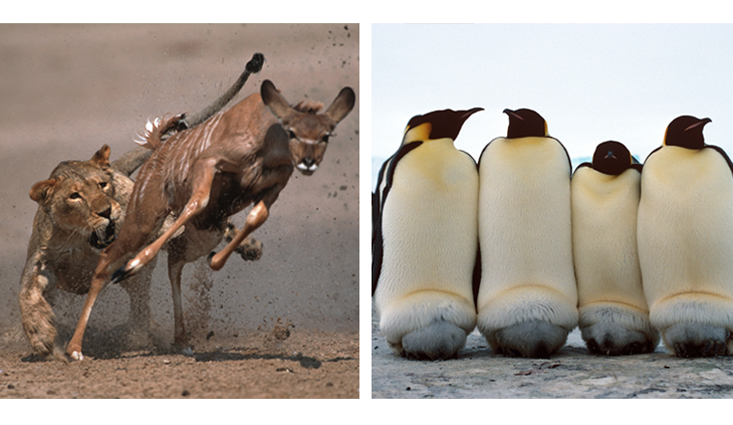
But we know now that that picture is incomplete. Evolutionary progress can be propelled both by the competitive struggle to adapt to an environment, and by the relaxation of selective forces. When natural selection on an organism is relaxed, the creative powers of mutation can be unshackled and evolution accelerated. The relief of an easier life can inspire new biological forms just as powerfully as the threat of death.
One of the best ways to relax selective forces is to work together, something that mathematical biologist Martin Nowak has called the “snuggle for survival.” New research has only deepened and broadened the importance of cooperation and lifting of selective pressures. It’s a big, snuggly world out there.
The fitness of a species can be thought of as a multi-dimensional landscape defined by its compatibility with its environment. The species’ place within that landscape is determined by parameters like its fertility, metabolism, strength, and so on. A “peak” in this landscape represents a place in parameter space where a species’ fitness is high, a “valley” where it could be on the brink of extinction. The slopes of the features are also important. A broad, gentle hill in the fitness landscape would represent an area where the population could mutate and still survive; a narrow ridge would indicate a razor-thin set of possibilities, where even a small change could plunge an individual with a new mutation off a cliff. When selection is relaxed, the fitness landscape itself changes, such that thin precipices broaden out to plateaus. Once a selective constraint is lifted off a trait, the population is able to explore a wider array of possibilities in related traits, and evolution may improvise more freely.
Selection can be relaxed by environmental factors, like a drop in predator numbers. But populations can also relax selection on themselves through their own behavior. A 2017 study conducted by researchers at the University of Sheffield tried to untangle the interplay between behavior and evolution by looking at a decidedly simple behavior in mice: huddling for warmth. The scientists simulated a population of mice, specifying their insulation and metabolic rate, and whether they were loners or huddlers. They tasked an evolutionary algorithm to optimize each population’s metabolic cost while maintaining an ideal temperature range.
The harsh environment didn’t drive the evolution of the behaviors—the behaviors enabled the colonization of harsh environments.
In the case of loners, the solution space allowing mice to efficiently maintain adequate temperatures was tiny. This is doubly problematic for a species. First, if the viable solution space is restricted, it’s much harder for evolution’s random walk to strike upon—“like finding a needle in a haystack.” And secondly, once a solution is found, it’s harder to explore subsequent, potentially beneficial mutations. When a species is inching along a narrow ridge in the fitness landscape, any false step could push it toward extinction. In the researchers’ model, huddling for warmth served to relax selection on the animal’s insulation, allowing genes controlling their metabolism to vary more without compromising their ability to maintain an optimal temperature. This softened the fitness peak, so that successive generations could rapidly explore a broad swath of the fitness landscape and accumulate a greater variety of mutations, providing a richer gene pool that might later be selected for in future times of environmental change. Of course, relaxing selection can also serve to increase the load of potentially deleterious mutations, so there is a tradeoff. But when selection is relaxed and populations are freer to explore the fitness landscape, they may stumble on large adaptive innovations faster.
The authors draw a parallel with the evolution of warm-blooded animals from cold-blooded reptiles. It seems likely that an offshoot of reptiles evolved an insulating factor serving to relax selection—like fur or large body mass—before they began maintaining high body temperatures. Small warm-blooded animals face a great metabolic challenge, as their ratio of surface area to volume is so high that they radiate an enormous amount of heat. Once insulation was in place, the metabolism of proto-mammals was freer to mutate and hit upon stable body temperatures. And when they “discovered” warm-bloodedness, they realized a massive advantage: The first mammals could reliably hunt and forage at night, opening entirely new niches and ultimately resulting in a wildly successful class of animals. The authors argue that by huddling, mice effectively form a “super organism”—sharing heat to behaviorally approximate the benefits inherent to larger organisms without having to evolve a larger body, allowing their metabolism more freedom to change. Of course, computational studies must be taken with a grain of salt—given any model’s requisite assumptions and simplifications—though they allow us to simulate experiments that would take millennia to unfold in nature.
By studying the phylogenetic history of related species, we can begin to correlate the interplay of behaviors with evolutionary dynamics in the real world. This year scientists from Lund University, in Sweden, analyzed the breeding strategies of 4,000 bird species, tracking their movements into new ecosystems using known genetic relationships between the birds. It’s long been known that cooperative-breeding strategies are common in harsh environments. The assumption was that difficult conditions encouraged species to evolve sociable behaviors (at least toward relatives). But what if this presumed causality had it backward? By analyzing the historical migrations of birds, the researchers discovered that species that had already evolved cooperative behaviors in a benign environment were twice as likely to have moved into a harsh one than non-cooperative breeders. The researchers speculate that cooperation buffers against unpredictable breeding seasons, allowing already social populations to be more successful in invading new niches. The harsh environment didn’t drive the evolution of the behaviors—the behaviors enabled the colonization of harsh environments.
We tend to conceive of life as separate from its habitat: The environment is a kind of container, and life is like a liquid that adapts to fill it. Sir Arthur Tansley introduced the concept of the ecosystem in 1935. He believed nature operated like a machine, and so, like an engineer, sought to map the flow of energy and matter through life and its environment. But an ecological niche is not, as I’d gathered from building shoebox dioramas in second grade, the raw physical parameters of an animal’s environment: salinity, alkalinity, humidity, temperature. It’s a web of relations, not just between a species and its habitat, but also with all the other species co-existing in the same space. A niche is no less dynamic than evolution is, contrary to Tansley’s mechanistic vision. “Palaeontologists often say that a burst of diversity in the fossil record simply ‘filled in ecological space,’ as if each new species simply took up residence in a square of a pre-existing chessboard,” writes paleobiologist Douglas Erwin. He suggests that a better analogy is that species build the chessboard themselves. Corals, for example, form their own protective niche by building reefs, which slow currents and reduce erosion on themselves. Reefs also serve to house countless other species, many of which have in turn evolved behaviors to protect corals. If an organism can modify its niche—by altering itself or its relationships with other species—it has the chance to build the world in which its future progeny will evolve, reshaping it to better ensure their survival.
Evolution is not a weapons race, but a peace treaty among interdependent nations.
One striking example of this kind of relationship emerged as a mystery during the dawn of microbiology. In the 19th century, bacteriologists cultured microbes using what was, at the time, cutting-edge technology: a warm vat of meat juice. Physician Robert Koch recognized that such broths likely harbored many different bacterial strains, and he surmised that if the bacteria were given a solid medium on which to grow, different colonies might be separated from each other and studied individually. He split a potato with a sterilized knife and smeared scrapings from an ill patient’s lesions onto it, creating the first solid culture. As different colonies formed, he isolated each onto a separate potato slice, but only a fraction of the divided strains survived alone.
It’s now estimated that 98 percent of bacterial species cannot be singly cultured in a lab, a constraint that is not a purely academic problem: It’s massively hampered the discovery of new biomedical compounds. Our best antibiotics have been stolen from bacteria themselves; after millions of years of co-evolution, many bacteria have evolved highly effective poisons to thwart one another. But if we can’t grow most strains in labs, we can’t isolate the potentially useful compounds they produce. Until 2015, we hadn’t discovered a new class of antibiotic since 1987, and because bacteria evolve so rapidly, many have grown resistant to the antibiotics we’ve employed the past 30 years. There are doubtless many reasons bacteria resist lab life, but chief among them is the fact that, in the wild, bacteria are not self-sufficient: They’ve co-evolved to depend on each other. It may seem precarious, from the vantage point of natural selection, for species to require each other to survive, but the overwhelming ubiquity of interdependence suggest it must have serious advantages. The Black Queen Hypothesis describes one such possibility.
In the Black Queen model, organisms shed genes coding for functions that other species in the environment already provide. It’s a foil to the better-known Red Queen hypothesis, which posits that organisms are subject to a sort of evolutionary arms race, ever adapting new weapons and defenses just to avoid extinction. Though evolution is often characterized as a forward march of complexity, organisms actually shed genes quite often. Biological functions are metabolically costly to maintain, and if they aren’t strictly necessary, they’re best excluded from a genome. (The Black Queen Hypothesis takes its name from the game of Hearts, wherein players try to avoid picking up the queen of spades to avoid a particularly heavy penalty.) A canonical illustration of the Black Queen Hypothesis is found in two free-floating marine cyanobacteria, Synechococcus and Prochlorococcus. They use photosynthesis to feed themselves but are both harmed by a toxic byproduct of the process, hydrogen peroxide. An enzyme that can neutralize hydrogen peroxide, catalase peroxidase, is particularly costly to produce. And, though both need it to survive, only Synechococcus carries the genes for it. Synechococcus mops up all the hydrogen peroxide in the environment, while Prochlorococcus enjoys protection at an energetic discount.
Helper species like Synechococcus can become keystone species in an ecosystem. Because they provide a common good necessary for many species, they may come to be shielded from competition by the species that rely on them, as happens with corals. The success of Prochlorococcus is directly dependent on the relative abundance of Synechococcus. If it begins to outgrow its helper, its numbers will be culled by an increase in hydrogen peroxide. The chessboard has changed: Existence is not a zero-sum game. Shedding the genes for catalase peroxidase confers a substantial energetic benefit to Prochlorococcus, and, as we’ve seen, relaxing selection on a species may allow it to explore new functions in other realms.

Long periods of harmonious co-existence may be the evolutionary precursor for true symbiotic relationships. Billions of years ago, another ancient cyanobacteria was engulfed and “domesticated”by an ancestor of plants. It shed most of the genes it needed for an independent existence and became what we now know as the chloroplast. In return for a safe environment, these chloroplasts performed photosynthesis for their hosts, fueling a new form of life that eventually spread over much of the Earth. It’s likely this same kind of division of labor was a seed for the development of multicellular organisms. Here, evolution is not a weapons race, but a peace treaty among interdependent nations.
You and I may never have evolved if it weren’t for relaxed selection. Humans have created a unique global niche where we are largely shielded from selective forces: Agriculture staves off starvation, medicine protects us from disease, cultural norms promote group harmony. Our evolution has been profoundly influenced by our selection-buffering behaviors. For instance, the appearance of some modern human features appears to be correlated with a rise in energy consumption, linked to the introduction of meat in our diet. Our ancestor Homo erectus began eating significantly more meat than its predecessors, yet its jaws and teeth were made for crushing tough plant matter and ill-adapted for chewing flesh. This species, it seems, was using tools not only to hunt but also to process meat (and, possibly, using fire to cook it). Energy-rich meat relaxed selection on our metabolism and digestive system—we could devote tenfold less time to chewing vegetation—which paved the way for our modern physiology. Our teeth, jaws, and guts shrank, allowing more energy to be allocated to our swelling brains, which necessitated a protracted, calorie-rich childhood to fully develop. Armed with crude but effective hand axes, Homo erectus shifted its evolutionary destiny. In humans and other animals that learn socially, selection buffering is especially powerful: Adaptive habits, like huddling for warmth and using tools to prepare food, can sweep through a population much faster than genomic changes.
Our genomes continue to be affected by culture to this day. Take the lactase gene, which codes for the enzyme that digests lactose in milk. While it’s present in all human genomes, it has traditionally been turned off after infancy, when children stop nursing. But relatively recently in our natural history, several different groups that farmed cattle evolved the ability to digest lactose throughout their lives, enabling access to a new, valuable form of nutrition. Today it is the descendants of those groups who can drink milk as adults without ill effects.
As humans collected into ever larger groups, the discovery of increasingly complex technology was accelerated. In high-density settlements, artisans and innovators could specialize in their crafts and exchange ideas. Selection for tool development has had an associated pressure on our ability to co-exist peacefully in large numbers, and aggressive, uncooperative individuals may have been selected against. We’ve become, by most accounts, a gentler, more cooperative species over time. Our testosterone levels, for instance, appear to have dropped, judging by the brow size of our fossilized predecessors. Some scientists suggest that the emergence of complex human culture amounts to us having, effectively, domesticated ourselves.
For those most invested in the old-school Darwinian view of the survival of the fittest and violence as virtue, then, the message is clear: Just relax.
Kelly Clancy studies neuroscience as a postdoctoral fellow at the University of Basel, in Switzerland. Previously, she roamed the world as an astronomer and served with the Peace Corps in Turkmenistan. She won the 2014 Regeneron Prize for Creative Innovation for her work designing drug-free brain therapies.
Lead Image: SuperStock / Getty Images
This article was originally published in our “Balance” issue in March, 2017.
(Contributed by Gwyllm Llwydd.)
Virgo New Moon, August 30, 2019

Wendy Cicchetti
The Virgo New Moon has a feisty accent, with the Sun and Moon being so closely conjunct Mars. However, 4° further on sits Venus, possibly adding a softening edge to the planetary proceedings. Venus is sometimes described as being figuratively able to pour balm on a situation, which seems appropriate for relating to any damage or harm that Mars could manage to mete out. Though Mars is a planet that gets thing done quickly, it can sometimes ride roughshod over the territory it covers.
That territory may, of course, be inhabited by people and their feelings — whether at home or at work, out and about, pursuing hobbies, running errands, etc. In relationships of all kinds and in all sorts of places, then, there is the potential for one person to push, prod, or jab too hard, or merely try to rush things. All of which may rebound on the pushy individual because, on the other side of that same situation, someone could feel hurt, taken advantage of, or simply not considered.
Arguably, with these planets and the New Moon all in the famously finicky sign of Virgo, it is doubtful that any injured party will let details pass them by. So, there may be a backlash on a particular item and possibly through some kind of pointed response. If that sounds a bit risky or threatening, it probably is.
But we can also hope that all will come out well, with Venus bringing up the rear in the Virgo stellium!(three planets conjunct) For this is where the healing balm might work its powers — or where someone’s ability to make an attractive offer could soften an otherwise harsh and uncomfortable situation.
According to traditional astrology, Venus placed in Virgo is in its fall: unable to operate with quite so much dignity, strength, or even neutrality, as when it is placed in some of the other signs. So, it’s fair to say that Venus’s damage control is truly limited, or that her attractive factor is slightly hampered, and her healing strategies perhaps cannot be pushed to the hilt. It could even be that Mars in Virgo is so critical and cutting that Venus almost cowers in its wake.
This seems reflective of the need to discern when a situation is just too much to handle or when it could be detrimental to try to intervene. Sometimes, the answer is to give a peace offering, but not to assume that it will automatically be accepted — at least, at that time.
What is also interesting in this lunation, though, is that Mercury, Juno, the Moon, Sun, Mars, and Venus are all aligned in trine to Uranus in Taurus. This earthy liaison with the planet of surprises and innovations suggests that practical solutions may appear out of nowhere. So, a problem could turn out to be not as problematic as it first appears!
The answer is out there somewhere — it is just not the answer we first think of. Because Mercury and Venus are a part of the trine to Uranus, there does seem to be potential for a chance connection or discussion which turns life’s wheel for the better.
Venus in the sign of the New Moon is also trine Saturn in Capricorn, adding the need for a sense of propriety around any Venusian gesture. Allowing a slightly looser orb of aspect for trines (normally thought to be around 6°), we can also see an earth grand trine in this lunation chart, which echoes the theme of practicality more strongly.
Saturn is not as closely connected to most of the Virgo stellium planets, though, compared with Uranus. So, while a certain level of tried-and-tested methodology may have relevance, it is probably the extra layer of Uranian innovation that will help matters to more fully progress.
Managing to meet the needs of a variety of individuals, all very different from one another, may be the true challenge here, with the one-size-fits-all, traditional strategy of Saturn feeling a bit outmoded. This may be more noticeable in the Virgo-ruled sector of health.
We should not forget, either, that Virgo tends to value templates to work with, as long as they include all the needed details. An unforeseen master stroke might also come through, particularly if any such template involves new technology.
This article is from the Mountain Astrologer, written by Diana Collis.
How the West can adapt to a rising Asia
As Asian economies and governments continue to gain power, the West needs to find ways to adapt to the new global order, says author and diplomat Kishore Mahbubani. In an insightful look at international politics, Mahbubani shares a three-part strategy that Western governments can use to recover power and improve relations with the rest of the world.
This talk was presented at an official TED conference, and was featured by our editors on the home page.
ABOUT THE SPEAKER
Kishore Mahbubani · Author, diplomat, academic
Through his books, diplomatic work and research, Kishore Mahbubani reenvisions global power dynamics through the lens of rising Asian economies.
With our low voter turnout, is America still a democracy?
- In his latest book, Upheaval, Jared Diamond points out that America’s voter turnout is the lowest of all prosperous democracies.
- While Australia, Belgium, and Indonesia top at 90 percent voter turnout, America’s average is around 60 — and that’s only during presidential races.
- Local elections are even lower; the last Los Angeles mayoral race only turned out 20 percent of Angelenos.
In the final installment of his trilogy on the fate of societies, Upheaval: Turning Points for Nations in Crisis, historian and anthropologist Jared Diamond compares the crises individuals face with those of countries. Although there are obvious differences, Diamond searches for through lines in the recent histories of Finland, Japan, Chile, Indonesia, Germany, Australia, and the United States.
While the book ends contemplating the socioeconomic, political, and environmental future of the entire planet, Diamond devotes two chapters to investigating the strengths and weaknesses occurring in his American homeland. While he specifically avoids focusing on Trump — like all administrations, this one is transient — he homes in on one specific phenomenon that helped elect the current president: civic engagement, or really, the lack of it.
After championing and criticizing American values and democracy in Chapter 9, he focuses the following chapter on three big problems: voting, inequality, and investing in the future. Though all three are interrelated at certain junctions, the voting issue is one every American needs to concern themselves with.
Diamond writes that a democracy in which citizens can’t or don’t vote is not worthy of the name. By those standards, America “is barely half-deserving of being called a democracy.” He points to Los Angeles as an example: in 2017, only 20 percent of eligible Angelenos turned out to elect the current mayor. That lack of civic engagement in one of America’s largest cities is inexcusable.
Yet the rest of the country isn’t much more engaged. Diamond compares America to the rest of the “affluent democracies,” using three measures: residents old enough to vote that did vote; the percentage of eligible voters that voted; and the percentage of registered voters that voted. America comes in last every single time.
By the numbers, Australia, where voting is compulsory, turns out 93 percent of the population; Italy sees up to 93 percent turnout; Belgium, 89 percent; Indonesia has fluctuated between 80 and 90 percent since resuming free elections in 1999; and in most European and East Asian democracies, voter turnout ranges between 58 and 80 percent.
Voter turnout | Political participation | US government and civics | Khan Academy
Then there’s the U.S., in which 60 percent of eligible voters participate in presidential elections and 40 percent for midterm or congressional races. The highest turnout ever was in 2008, when Barack Obama won the presidential vote. A total of 62 percent showed up that year.
Citizens aren’t fully to blame, though they do hold a lion’s share of responsibility. Voter suppression is real, as is gerrymandering, making residents of some districts feel that their vote is ultimately futile. Another intriguing aspect is registration. Diamond writes,
“But there’s another reason why many Americans eligible to vote don’t do so: they can’t, because they are not registered to vote. That’s a distinctive feature of American democracy that calls for explanation.”
The explanation is as follows: in most democracies, citizens are automatically registered to vote when they pay their taxes or apply for a driver’s license. In Germany, when a citizen turns 18 they receive a postcard informing them of the next election. They’ve already been entered into the database.
Trying to get an American teenager excited enough to engage in the civic process is another story altogether. Yet if they received such a postcard, chances are they’d be more inclined to take part. Mobilizing Americans has, sadly, long been a laborious project. That’s likely why Obama is now devoting his time to just that. If anyone knows how to excite a base, it is him.
Voting is also financial, which is its own problem. As Diamond notes, voter turnout is over 80 percent for Americans who earn more than $150,000 and under 50 percent for those earning less than $20,000. This skews the electorate, with higher earners choosing candidates that benefit them financially, regardless of the cost down the line. Those down the line, whose voices are needed the most for deciding the best interests for all Americans, end up not showing up — or can’t, which is why the call for turning Election Day into a national holiday needs to be seriously considered.

Photo by Alberto E. Rodriguez/WireImage
Scientist Jared Diamond attends Conservation International’s 17th Annual Los Angeles Dinner at Montage Beverly Hills on April 4, 2013 in Beverly Hills, California.
Other minor tweaks that should be implemented include same-day voter registration, freeing up citizens to both register and vote simultaneously, and mail-in ballots. I haven’t stepped inside a Los Angeles voting booth in five years. I simply receive my ballot, research the races I’m ignorant of, and mail it in before the deadline.
The biggest obstacle to voting might be one many of us are already feeling: burnout. Just as news is now a 24-7 game with every media company fighting for attention, holding office is less about governing and more about fundraising and campaigning. The day after Obama was elected (and again after he was re-elected), Republicans began the election process; the same holds true for Democrats and Trump. As Diamond writes, “No country approaches the U.S. in the expense and uninterrupted operation of our political campaigning.”
Diamond notes that a retired senator friend expressed his consternation over the reality of the occupation, saying that he spent 80 percent of his time fundraising and campaigning and only 20 percent governing. That’s not what they’re elected to do, but that’s what’s actually being done. The fact that we’re a half-year into the process of deciding who will run in another fourteen months is simply ludicrous.
Perhaps we should, as Diamond suggests, take a hint from the UK, where “campaigning is restricted by law to a few weeks before an election, and the amount of money that can be spent for campaign purposes is also restricted by law.”
Over $5 billion was spent in three of the last four election cycles, including the 2018 midterms, which proved to be the most expensive congressional cycle ever. We can likely expect another record during the 2020 cycle. If Citizens United was overturned and campaign cycles legislated by law, this insane amount of money could be put to much better use supporting the public these politicians are voted to represent. As it stands. we’ll remain, as Diamond suggests, a half-functioning democracy or worse — if we don’t show up to vote.
—

Biography: Jean Gebser

From Wikipedia, the free encyclopedia
|
Jean Gebser
|
|
|---|---|
| Born | 20 August 1905 |
| Died | 14 May 1973 (aged 67) |
| Nationality | Swiss |
| Era | 20th-century philosophy |
| Region | Western Philosophy |
| School | Phenomenology[1] |
|
Main interests
|
phenomenology of Consciousness[1] |
Jean Gebser (German: [ˈɡeːpsɐ]; August 20, 1905 – May 14, 1973) was a philosopher, a linguist,[2][3][4] and a poet, who described the structures of human consciousness.
Biography
Born Hans Gebser in Posen in Imperial Germany (now Poland), he left Germany in 1929, living for a time in Italy and then in France. He then moved to Spain, mastered the Spanish language in a few months and entered the Spanish Civil Service where he rose to become a senior official in the Spanish Ministry of Education.

Before the Spanish Civil War began, he moved to Paris, and then to Southern France. It was here that he changed his German first name “Hans” to the French “Jean.”[web 1][web 2] He lived in Paris for a while but saw the unavoidability of a German invasion. He fled to Switzerland in 1939, escaping only hours before the border was closed. He spent the rest of his life near Bern, where he did most of his writing. Even late in life, Gebser travelled widely in India, the Far East, and the Americas, and wrote half a dozen more books. He was also a published poet.
Gebser died in Wabern bei Bern on May 14, 1973 “with a soft and knowing smile.”[5][a] His personal letters and publications are held at the Gebser Archives at the University of Oklahoma History of Science Collections, Norman, Oklahoma, Bizzel Libraries.
Consciousness in transition
Gebser’s major thesis was that human consciousness is in transition, and that these transitions are “mutations” and not continuous. These jumps or transformations involve structural changes in both mind and body. Gebser held that previous consciousness structures continue to operate parallel to the emergent structure.
Consciousness is “presence”, or “being present”:[6]
As Gebser understands the term, “conscious is neither knowledge nor conscience but must be understood for the time being in the broadest sense as wakeful presence.”[6][b]
Each consciousness structure eventually becomes deficient, and is replaced by a following structure. The stress and chaos in Europe from 1914 to 1945 were the symptoms of a structure of consciousness that was at the end of its effectiveness, and which heralded the birth of a new form of consciousness. The first evidence he witnessed was in the novel use of language and literature. He modified this position in 1943 so as to include the changes which were occurring in the arts and sciences at that time.
His thesis of the failure of one structure of consciousness alongside the emergence of a new one led him to inquire as to whether such had not occurred before. His work, Ursprung und Gegenwart is the result of that inquiry. It was published in various editions from 1949 to 1953, and translated into English as The Ever-Present Origin.[7] Working from the historical evidence of almost every major field, (e.g., poetry, music, visual arts, architecture, philosophy, religion, physics and the other natural sciences, etc.) Gebser saw traces of the emergence (which he called “efficiency”) and collapse (“deficiency”) of various structures of consciousness throughout history.
“On the Hill-Side” by Radclyffe Hall
|
||||||||
|

Marguerite Radclyffe Hall (August 12, 1880 – October 7, 1943) was an English poet and author. She is best known for the novel The Well of Loneliness, a groundbreaking work in lesbian literature. Wikipedia
(Contributed by Alan Blackman)
Amazon Deforestation Reveals Tribe Of Isolated Rich Sociopaths Completely Untouched By Consequence
August 27, 2019 (theonion.com)

MANAUS, BRAZIL—Widespread human-caused fires that have decimated over 1,300 square miles of Amazon rainforest in the year 2019 alone revealed a small tribe of isolated rich sociopaths who are completely untouched by consequence, sources confirmed Tuesday. “As the impact of deforestation continues to grow, a team studying the area located a tiny society of wealthy agribusiness executives and financiers who have never before been visited by any ramifications for their actions,” said anthropologist Cameron Hunt, adding that researchers were working to assemble more information about this remote group of oppressors, but had managed to identify a few of them as Blackstone CEO Stephen Schwarzman, AgroSB co-founder Daniel Dantas, and meat-processing magnate Joesley Batista as well as executives from JPMorgan Chase, Barclays, BNP Paribas, Credit Suisse, BlackRock, and State Street. “Although this uncontacted tribe of affluent sociopaths represents an important anthropological discovery, since we’ve never seen people with so little remorse or empathy, they have almost no connection to modern society and simply don’t understand our way of life, so eliminating rainforest cover could put them at risk. Of course, living in a totally isolated bubble means that they’ll fight back against any integration efforts, so we have to proceed with caution. It’s important to remember that while we may not yet understand their greedy and reckless lifestyle, it’s theirs, and they want to preserve it.” At press time, multiple world leaders and the International Monetary Fund had pledged to fund humanitarian efforts to ensure Amazon deforestation doesn’t affect the isolated tribe of sociopaths’ desire to continue living without repercussions.
Your Horoscopes — Week Of August 27, 2019 (theonion.com)

Virgo | Aug. 23 to Sept. 22
A passionate and intelligent debate over semantics this week will unfortunately get bogged down by pragmatics.

Libra | Sept. 23 to Oct. 22
During an interview with your son’s grade-school teacher, you’ll be relieved to learn how little you give a shit about how he is doing.

Scorpio | Oct. 23 to Nov. 21
Rummaging through your basement, you will stumble upon an old guide on picking up women from the 1970s, which, after a visit to your local bar, you will discover works just as well as the day it was printed.

Sagittarius | Nov. 22 to Dec. 21
You’ll run out of your secret ingredient of love halfway through baking a batch of lemon squares this week. Thankfully, you’ll have enough hate and jealousy on hand for an infinite number of desserts.

Capricorn | Dec. 22 to Jan. 19
You will be accidentally left behind by a tour group while visiting Mexico City next week, resulting in a harrowing and distressing afternoon of not being able to accurately identify which buildings are colonial.

Aquarius | Jan. 20 to Feb. 18
If you somehow magically had the chance to do it all over again, you’d do everything in your power to make her happy. You don’t, though, because that’s not the way it works.

Pisces | Feb. 19 to March 20
After experiencing the steep drops, abrupt and short-lived climbs, and out-of-control spins of a roller-coaster for the first time, you finally see why your therapist so often invokes them in characterizing your mental states.

Aries | March 21 to April 19
As the court stenographer, your job is to transcribe testimony without bias. Still, you will not be able to stop yourself from typing off-color comments about a fast-talking defendant on trial for murder.

Taurus | April 20 to May 20
A deep-sea diving excursion will momentarily help you escape from all of your problems back on land, until you catch sight of a species of sea anemone that seems to perfectly express how far behind you are on your home’s mortgage payments.

Gemini | May 21 to June 20
You’ve been fooling yourself for so long that you’ve lost track of your sense of identity, your joy in life, and which one is actually the real Shroud of Turin.

Cancer | June 21 to July 22
Rock venue managers from across the country will praise your ingenuity and business savvy next week after you successfully employ a sheepdog to corral and guide a lineup of Wilco fans into your club.

Leo | July 23 to Aug. 22
You will soon discover that your home’s fire escape plan, although seemingly effective, fails to take fire into account.