Herman Melville’s Passionate, Beautiful, Heartbreaking Love Letters to Nathaniel Hawthorne

By Maria Popova (brainpickings.org)

figuring_jacket_final.jpg?fit=320%2C486

The summer when nineteen-year-old Emily Dickinson met the love of her life — the orphaned mathematician-in-training Susan Gilbert, who would come to be the poet’s greatest muse, her mentor, her primary reader and editor, her fiercest lifelong attachment, her “Only Woman in the World” — another intense, label-defying love was igniting in the heart of another literary titan-to-be some fifty miles westward. That other love unfolds alongside Dickinson’s in Figuring — a book I wrote to explore, among other existential perplexities, the bittersweet beauty of asymmetrical and half-requited loves. (This essay is adapted from the book.)

On August 5, 1850, Herman Melville met Nathaniel Hawthorne at a literary gathering in the Berkshires. Hawthorne was forty-six. The achingly shy, brooding writer, once celebrated as “handsomer than Lord Byron,” had risen to celebrity a decade earlier, much thanks to a glowing endorsement by Margaret Fuller. Melville — whose debut novel had rendered him a literary star in his twenties — had just turned thirty-one.

melville_hawthorne.jpg?resize=600%2C389

Herman Melville and Nathaniel Hawthorne

A potent intellectual infatuation ignited between the two men — one that, at least for Melville, seems to have grown from the cerebral to the corporeal. Within days, the young author reviewed Hawthorne’s short story collection Mosses from an Old Manse in Literary World under the impersonal byline “a Virginian Spending July in Vermont.” No claim of this intentional ambiguity was true — Melville was a New Yorker, the month was August, and he was spending it in Massachusetts.

The review, nearing seven thousand words, was nothing less than an editorial serenade. “A man of a deep and noble nature has seized me in this seclusion… His wild, witch voice rings through me,” Melville wrote of reading Hawthorne’s stories in a remote farmhouse nestled in the summer foliage of the New England countryside. “The soft ravishments of the man spun me round in a web of dreams.” Melville couldn’t have known that his allusions to witchcraft, intended as compliment, had disquieting connotations for Hawthorne. Born Nathaniel Hathorne, he had added a w to the family name in order to distance himself from his ancestor John Hathorne — a leading judge involved in the Salem witch trials, who, unlike the other culpable judges, never repented of his role in the murders. Unwitting of the dark family history, Melville found himself under “this Hawthorne’s spell” — a spell cast first by his writing, then by the constellation of personal qualities from which the writing radiated. Who hasn’t fallen in love with an author in the pages of a beautiful book? And if that author, when befriended in the real world, proves to be endowed with the splendor of personhood that the writing intimates, who could resist falling in love with the whole person? Melville presaged as much:

2e292385-dc1c-4cfe-b95e-845f6f98c2ec.pngNo man can read a fine author, and relish him to his very bones, while he reads, without subsequently fancying to himself some ideal image of the man and his mind… There is no man in whom humor and love are developed in that high form called genius; no such man can exist without also possessing, as the indispensable complement of these, a great, deep intellect, which drops down into the universe like a plummet. Or, love and humor are only the eyes, through which such an intellect views this world. The great beauty in such a mind is but the product of its strength.

After comparing Hawthorne to Shakespeare, he writes:

2e292385-dc1c-4cfe-b95e-845f6f98c2ec.pngIn this world of lies, Truth is forced to fly like a scared white doe in the woodlands; and only by cunning glimpses will she reveal herself, as in Shakespeare and other masters of the great Art of Telling the Truth, — even though it be covertly, and by snatches.

“I am Posterity speaking by proxy,” Melville bellows from the page, “when I declare — that the American, who up to the present day, has evinced, in Literature, the largest brain with the largest heart, that man is Nathaniel Hawthorne.” In an aside on the process of composing his review, he notes that twenty-four hours into writing, he found himself “charged more and more with love and admiration of Hawthorne.” Quoting an especially beguiling line of Hawthorne’s, he insists that “such touches… can not proceed from any common heart.” No, they bespeak “such a depth of tenderness, such a boundless sympathy with all forms of being, such an omnipresent love” that they render their author singular in his generation — as singular as the place he would come to occupy in Melville’s heart.

oldmanse.jpg?resize=680%2C525

Hawthorne’s home, Old Manse. Concord, Massachusetts. (Boston Public Library.)

Fervid correspondence and frequent visits followed over the next few months. Only ten of Melville’s letters to Hawthorne survive, but their houses were just six miles apart and they saw each other quite often — “discussing the Universe with a bottle of brandy & cigars,” as Melville put it in one invitation, and talking deep into the night about “time and eternity, things of this world and of the next, and books, and publishers, and all possible and impossible matters,” as Hawthorne recounted in his diary. Punctuating the invisible log of all that was written but destroyed is all that was spoken but unwritten, all that was felt but unspoken.

Melville’s ardor was most acute during the period of writing Moby-Dick, which he dedicated to Hawthorne. Printed immediately after the title page was “In Token of My Admiration for his Genius, This Book is Inscribed to Nathanial [sic] Hawthorne.”

everypagemobydick21.jpg

Art by Matt Kish from Moby-Dick in Pictures: One Drawing for Every Page

One November evening over dinner, a restlessly excited Herman presented Nathaniel with a lovingly inscribed copy of the novel whose now-legendary protagonist sails from Nantucket into the existential unknown. I can picture the brooding Hawthorne turning the leaf and suppressing a beam of delight upon discovering the printed dedication. In the following century, Virginia Woolf would perform a similar gesture with her groundbreaking, gender-bending novel Orlando, inspired by her lover Vita Sackville-West and later described by Vita’s son as “the longest and most charming love letter in literature.” On the day of Orlando’s publication, Vita would receive a package containing not only the printed book, but also Virginia’s original manuscript, bound specially for her in Niger leather and stamped with her initials on the spine.

But after the elated private presentation, a very different public fate awaited Moby-Dick. Its 1851 publication was met with a damning review in New York’s Literary World, which set the tone for its American reception and precipitated its decades-long plunge into obscurity. The reviewer’s chief complaint was that the novel “violated and defaced” “the most sacred associations of life”—an indictment aimed at the homoeroticism of Melville’s choice to depict Ishmael and Queequeg as sharing a “marriage bed” in which they awaken with their arms around each other.

fictitiousdishes_mobydick.jpg?w=680

Queequeg’s favorite dish, cooked and photographed by artist Dinah Fried for her project Fictitious Dishes: An Album of Literature’s Most Memorable Meals.

Ten days later, Hawthorne lamented the obtuseness of the review and praised Moby-Dick as Melville’s best work yet. Touched to the point of delirium by this “exultation-breeding letter,” Melville hastened to reply:

2e292385-dc1c-4cfe-b95e-845f6f98c2ec.pngYour heart beat in my ribs and mine in yours, and both in God’s… It is a strange feeling — no hopefulness is in it, no despair. Content — that is it; and irresponsibility; but without licentious inclination. I speak now of my profoundest sense of being, not of an incidental feeling.

Whence come you, Hawthorne? By what right do you drink from my flagon of life? And when I put it to my lips — lo, they are yours and not mine. I feel that the Godhead is broken up like the bread at the Supper, and that we are the pieces.

Aware of how his intemperate fervor might incinerate his relationship with the cooler-tempered Hawthorne, Melville reasons with himself for a moment, then chooses to abandon reason:

2e292385-dc1c-4cfe-b95e-845f6f98c2ec.pngMy dear Hawthorne, the atmospheric skepticisms steal into me now, and make me doubtful of my sanity in writing you thus. But, believe me, I am not mad, most noble Festus! But truth is ever incoherent, and when the big hearts strike together, the concussion is a little stunning.

After signing, he adds a feverish postscript:

2e292385-dc1c-4cfe-b95e-845f6f98c2ec.pngI can’t stop yet. If the world was entirely made up of [magicians], I’ll tell you what I should do. I should have a paper-mill established at one end of the house, and so have an endless riband of foolscap rolling in upon my desk; and upon that endless riband I should write a thousand — a million — billion thoughts, all under the form of a letter to you. The divine magnet is in you, and my magnet responds. Which is the biggest? A foolish question — they are One.

The intensity proved too concussing for Hawthorne — he pulled away from the divine magnet. Melville seems to have presaged the eclipse of their relationship in the review in which the magnetism had begun:

2e292385-dc1c-4cfe-b95e-845f6f98c2ec.pngIt is that blackness in Hawthorne… that so fixes and fascinates me. It may be, nevertheless, that it is too largely developed in him. Perhaps he does not give us a ray of his light for every shade of his dark.

As Hawthorne retreated into his cool darkness, Melville suffered with the singular anguish of unreturned ardor—anguish that stayed with him for the remaining four decades of his life, for he eulogized it in one of his last poems, “Monody,” penned in his final year:

2e292385-dc1c-4cfe-b95e-845f6f98c2ec.pngTo have known him, to have loved him,
After loneness long;
And then to be estranged in life,
And neither in the wrong;
And now for death to set his seal —
Ease me, a little ease, my song!

By wintry hills his hermit-mound
The sheeted snow-drifts drape,
And houseless there the snow-bird flits
Beneath the fir-tree’s crape:
Glazed now with ice the cloistral vine
That hid the shyest grape.

hermanmelville1885.jpg?resize=500%2C687

Herman Melville in his final years.

Meanwhile, the gaps of the invisible and the unspoken are filled with posterity’s questions about specifics that vibrate with the universal: What happened between Melville and Hawthorne in the unrecorded hours? Why did Nathaniel ultimately repel the divine magnet of Herman’s love? Most probably, we’ll never know. Possibly, they themselves never fully did. It is almost banal to say, yet it needs to be said: No one ever knows, nor therefore has grounds to judge, what goes on between two people, often not even the people themselves, half-opaque as we are to ourselves. One thing is certain: The quotient of intimacy cannot be contained in a label. The human heart is an ancient beast that roars and purrs with the same passions, whatever labels we may give them. We are so anxious to classify and categorize, both nature and human nature. It is a beautiful impulse — to contain the infinite in the finite, to wrest order from the chaos, to construct a foothold so we may climb toward higher truth. It is also a limiting one, for in naming things we often come to mistake the names for the things themselves. The labels we give to the loves of which we are capable — varied and vigorously transfigured from one kind into another and back again — cannot begin to contain the complexity of feeling that can flow between two hearts and the bodies that contain them.
SUNDAY NIGHT TRANSLATION GROUP – 2/17/19

Translators:  Melissa Goodnight, Richard Branam, Mike Zonta

SENSE TESTIMONY:  Innovation and renovation can bring about stress, disruption and eruption.

5th Step Conclusions:

1)  Truth is liberal, yielding, authority without being authoritarian, always brand new (“straight from the fire’), always off the beaten track of habitual thought and action, in fact, deconstructing, disrupting, erupting traditional ways of doing and being.

2)  All is One, Infinite Consciousness Beingness, perfectly unrestricted and unconstrained, in limitless indivisible continuity, that is ceaselessly streaming forth in emerging expression, of the fathomless capacity for reforming and transforming anew.

3)  Truth is the Only Consciousness Continuum, Being Universally Principled I Am that I Am, this Universal Language Disruptively, Erupting Ecstatic Force of Entry upon the Intimacy of Truths’ Heart, this Logic is the Novum Organum: Truths’ Masterpiece of Constantly Renewing Lifes’ Achievements’.

HughJohn Malanaphy’s Sunday Meeting Talk on February 17, 2019

HughJohn Malanaphy, H.W.,M. is a very good friend of mine who I met in 1974 when we began doing teaching tours across the USA. Originally from Brooklyn, New York, he is now living in Santa Monica, California. He has always been volunteering and was “on staff” with The Prosperos School of Ontology for many years where he learned not only personal studies and The Prosperos’ techniques, but also business management, advertising, printing, & publishing production.

HughJohn has given many classes, workshops, Sunday Meetings, Assembly talks, and Instruction throughout the years.

He is also a certified graphologist, board member on 3 non-profit organizations & professional in aerospace, IT systems and entrepreneurial enterprises.

HughJohn continues his personal study in technology, lucid dreaming and dream interpretation, space and cultural trends.

Last but not least, HughJohn is a high-quality individual which you will see shining through in this video. Now for his talk:

1,600 Occult Books Now Digitized & Put Online, Thanks to the Ritman Library and Da Vinci Code Author Dan Brown

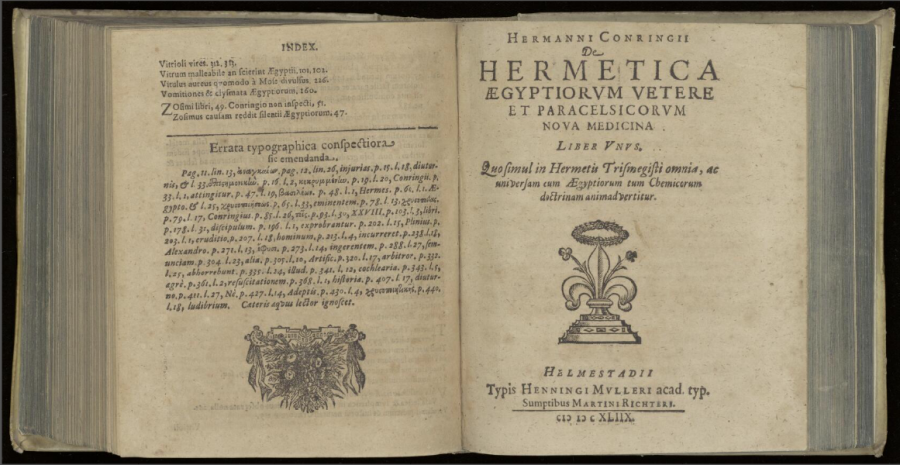
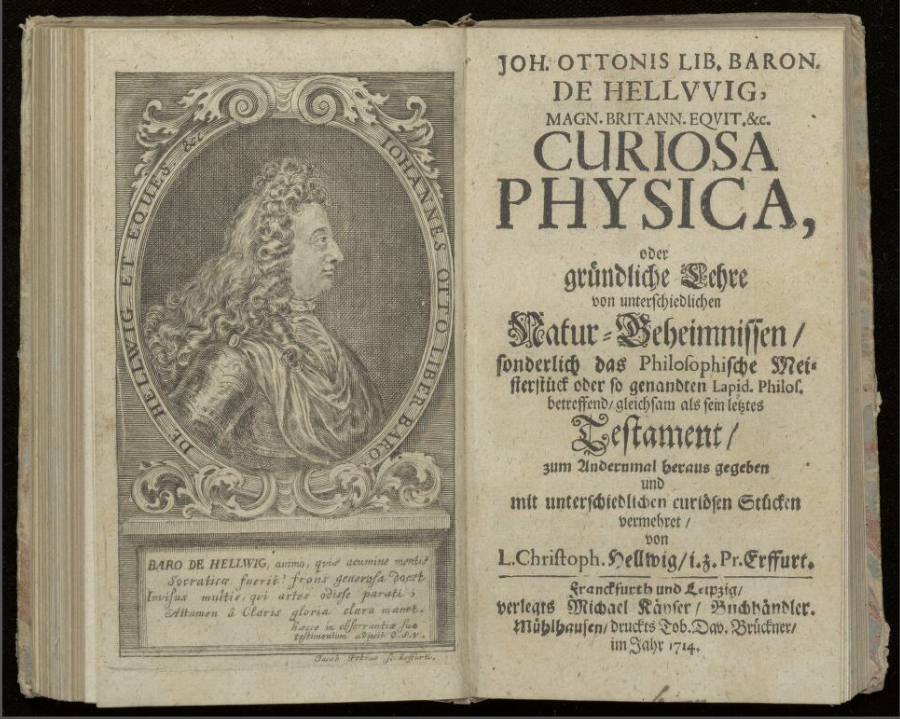
Back in December we brought you some exciting news. Thanks to a generous donation from Da Vinci Code author Dan Brown, Amsterdam’s Ritman Library—a sizable collection of pre-1900 books on alchemy, astrology, magic, and other occult subjects—has been digitizing thousands of its rare texts under a digital education project cheekily called “Hermetically Open.” We are now pleased to report, less than two months later, that the first 1,617 books from the Ritman project have come available in their online reading room. The site is still in beta, so to speak; in their Facebook announcement, the Ritman admits they are “still improving the whole presentation,” which is a bit clunky at the moment. But for fans and students of this literature, a little inconvenience is a small price to pay for full access to hundreds of rare occult texts.

Visitors should be aware that these books are written in several different European languages. Latin, the scholarly language of Europe throughout the Medieval and Early Modern periods, predominates, and it’s a peculiar Latin at that, laden with jargon and alchemical terminology. Other books appear in German, Dutch, and French. Readers of some or all of these languages will of course have an easier time than monolingual English speakers, but there is still much to offer those visitors as well.

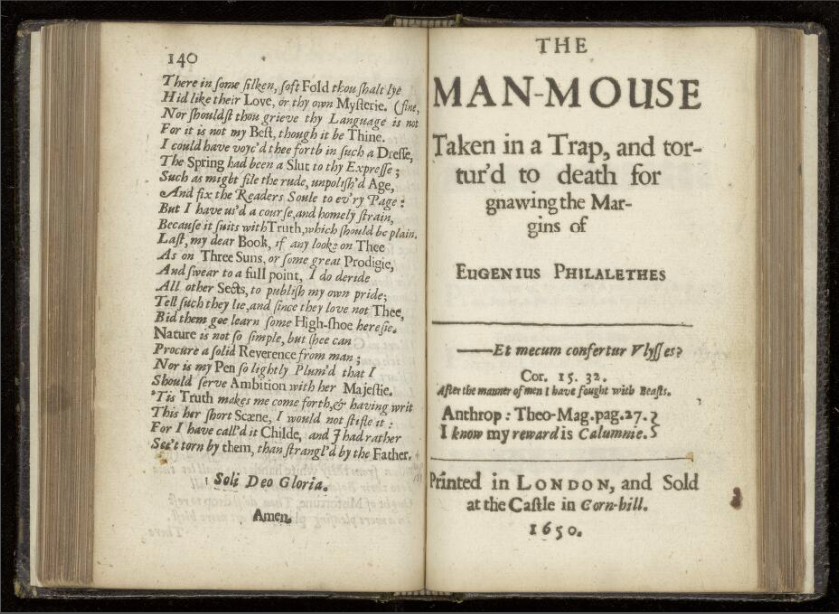
In addition to the pleasure of paging through an old rare book, even virtually, English speakers can quickly find a collection of readable books by clicking on the “Place of Publication” search filter and selecting Cambridge or London, from which come such notable works as The Man-Mouse Takin in a Trap, and tortur’d to death for gnawing the Margins of Eugenius Philalethes, by Thomas Vaughn, published in 1650.

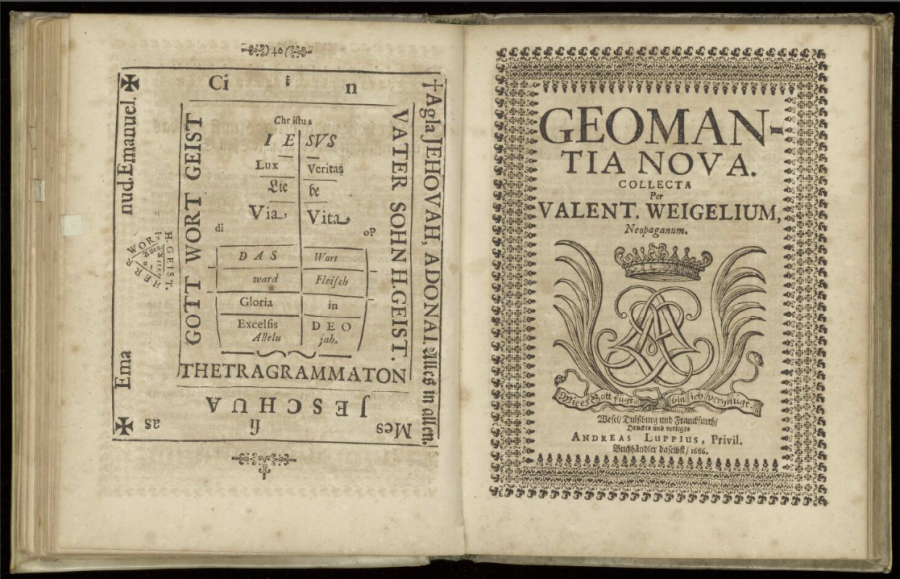
The language is archaic—full of quirky spellings and uses of the “long s”—and the content is bizarre. Those familiar with this type of writing, whether through historical study or the work of more recent interpreters like Aleister Crowley or Madame Blavatsky, will recognize the many formulas: The tracing of magical correspondences between flora, fauna, and astronomical phenomena; the careful parsing of names; astrology and lengthy linguistic etymologies; numerological discourses and philosophical poetry; early psychology and personality typing; cryptic, coded mythology and medical procedures. Although we’ve grown accustomed through popular media to thinking of magical books as cookbooks, full of recipes and incantations, the reality is far different.

Encountering the vast and strange treasures in the online library, one thinks of the type of the magician represented in Goethe’s Faust, holed up in his study,

Where even the welcome daylight strains
But duskily through the painted panes.
Hemmed in by many a toppling heap
Of books worm-eaten, gray with dust, 
Which to the vaulted ceiling creep

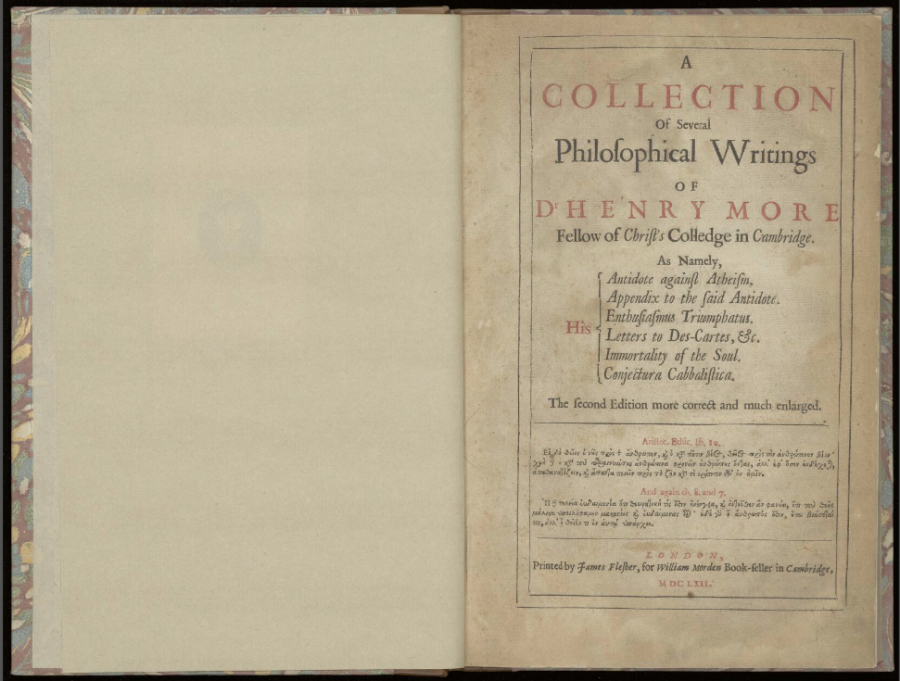
The library doesn’t only contain occult books. Like the weary scholar Faust, alchemists of old “studied now Philosophy / And Jurisprudence, Medicine,— / And even, alas! Theology.” Click on Cambridge as the place of publication and you’ll find the work above by Henry More, “one of the celebrated ‘Cambridge Platonists,’” the Linda Hall Library notes, “who flourished in mid-17th-century and did their best to reconcile Plato with Christianity and the mechanical philosophy that was beginning to make inroads into British natural philosophy.” Those who study European intellectual history know well that More’s presence in this collection is no anomaly. For a few hundred years, it was difficult, if not impossible, to separate the pursuits of theology, philosophy, medicine, and science (or “natural philosophy”) from those of alchemy and astrology. (Isaac Newton is a famous example of a mathematician/scientist/alchemist/believer in strange apocalyptic predictions.)

Given the Ritman’s alacrity and eagerness to publish this first batch of texts, even as it works to smooth out its interface, we’ll likely see many hundreds more books become available in the next month or so. For updates, follow the Ritman Library and The Embassy of the Free Mind—Dan Brown’s own Dutch library of rare occult books—on Facebook.

Enter the Ritman’s new digital collection of occult texts here.

Related Content:

3,500 Occult Manuscripts Will Be Digitized & Made Freely Available Online, Thanks to Da Vinci Code Author Dan Brown

Isaac Newton’s Recipe for the Mythical ‘Philosopher’s Stone’ Is Being Digitized & Put Online (Along with His Other Alchemy Manuscripts)

Aleister Crowley Reads Occult Poetry in the Only Known Recordings of His Voice (1920)

Josh Jones is a writer and musician based in Durham, NC. Follow him at @jdmagness

(Submitted by Richard Burns, HW, M.)

THE TRUTH ABOUT ISLAM AND DEMOCRACY (WITH ANWAR IBRAHIM)

HUNDREDS OF MILLIONS OF MUSLIMS the world over live in democracies of some shape or form, from Indonesia to Malaysia to Pakistan to Lebanon to Tunisia to Turkey. Tens of millions of Muslims live in — and participate in — Western democratic societies. The country that is on course to have the biggest Muslim population in the world in the next couple of decades is India, which also happens to be the world’s biggest democracy. Yet a narrative persists, particularly in the West, that Islam and democracy are incompatible. Islam is often associated with dictatorship, totalitarianism, and a lack of freedom, and many analysts and pundits claim that Muslims are philosophically opposed to the idea of democracy. On this week’s show, Mehdi Hasan is joined by the man expected to become Malaysia’s next prime minister, Anwar Ibrahim, and by Dalia Mogahed, director of research at the Institute for Social Policy and Understanding, to discuss Islam, Muslims, and democracy.

Anwar Ibrahim: We represent Islam the sense that is has to tolerant, liberal, plural, and even accept some of the values of the west.

[Music interlude.]

Mehdi Hasan: I’m Mehdi Hasan. Welcome to Deconstructed.

It’s a never-ending debate. Why do so many Muslims live in undemocratic countries? How do you get more freedom in the Middle East? Does Islam have a problem with democracy? They’re age-old and often quite cliched questions. So, on today’s show, I want to do a bit of debunking and deconstructing, with the help of a very special and a very relevant guest.

AI: You have corrupt, oppressive, tyrannical states and they use the label Islam.

MH: That’s my guest today, the renowned Malaysian leader and former political prisoner Anwar Ibrahim, who is on course to become the country’s next democratically-elected prime minister. I’m also joined by Dalia Mogahed, the American Muslim writer, scholar and former White House adviser.

Dalia Mogahed: When you look at the facts, they simply don’t support the idea that there is a clash of civilizations or a clash of values.

MH: So, on today’s show, what’s the deal with Islam, Muslims and democracy?

Islam and democracy. Is there a clash? Is there a contradiction? I’ve been hearing this question posed by right and left alike my entire life. Since before 9/11 but especially since after 9/11, when we were told by George W Bush, Tony Blair, the neocons and others, that the real problem in the Muslim-majority world is the lack of democracy and freedom and political pluralism. And guess what’s to blame for that? Islam or at least political Islam, whatever that is.

Now, I have a lot of problems with this rather lazy and simplistic narrative, which completely and conveniently overlooks the role played by Western governments in propping up Muslim dictators like the President of Egypt or the King of Saudi Arabia, but here’s my biggest one: it’s factually inaccurate. Right now, in 2019, hundreds of millions of Muslims, possibly the majority of the world’s 1.7 billion Muslims, live in democracies of some shape or form, live in countries where they have the right to vote, the right to choose and to change their own governments — from Indonesia to Malaysia to Pakistan to Lebanon to Tunisia to Turkey, not to mention the tens of millions of Muslims who live in Western countries, in Germany, France, the UK, Canada, the United States. The mayor of London, last time I checked, was a Muslim. And in fact, the country which is on course to have the biggest Muslim population in the world in the next couple of decades is India; which also happens to be the world’s biggest democracy.

So why is it that in the West, in particular, people still associate Islam with dictatorship and totalitarianism and a lack of freedom, why is it so many folks still think Muslims have some sort of inherent objection to, or problem with, the idea of democracy? That we’re not interested in, or grown up enough, or liberal enough, for democracy? What’s the actual reality? It’s a big question but it’s a question I’m asking on Deconstructed today and we’re lucky to have two fascinating and very clever guests who I hope are going to enlighten us all.

[Music interlude.]

More than twenty years ago, Anwar Ibrahim was on the cover of Time magazine, which called him “the star of a rising generation of Asian leaders.” But the then deputy prime minister of Malaysia and devout Muslim leader spent the next two decades in and out of prison on trumped-up charges.

News Anchor: Malaysian reformist leader, Anwar Ibrahim, has been released from prison. The release comes after his opposition alliance won the elections earlier this month.

AI [at press conference]: Now, there is a new dawn for Malaysia. I must thank the people of Malaysia […] regardless of race and religion who stood by the principles of democracy and freedom.

MH: Today, this long-standing advocate for democracy, dialogue and human rights who’s become a bit of a rock star in the Muslim-majority world, is a step away from becoming prime minister of, yes, democratic Malaysia, having come out of prison and helped pull off the unlikeliest of election victories last year. Anwar Ibrahim joins me now to talk Islam and democracy.

[Music interlude.]

MH: Anwar Ibrahim, thanks for joining me on Deconstructed.

AI: Thank you.

MH: To many in the west, Anwar, many here in the U.S., there is a clash, a contradiction even, between Islam and democracy, but you come from a Muslim majority country of more than 30 million people that is a democracy, a flawed democracy. But which democracy isn’t? So what do you make of this constant claim both from right-wing Islamophobes, but also from well-meaning liberals who genuinely seem to think that Islam and democracy, Muslims and democracy don’t go together?

AI: I think, to quote Edward Said, it’s a clash of ignorance. There’s very little understanding what’s happening on the ground, Indonesia is the largest Muslim country in the world. It is as democratic as the United States, Turkey, of course, there are some criticisms, but there was elections which was seen or perceived by the West even as independent and no militia. As you know in the last year’s elections, and now proceeding towards a vibrant democracy. India, although Muslims are the minority but they support the Democratic process. You have Christian democracy in Europe. Why can’t we have Muslim democrats in the Muslim world? The issue is the fundamentals of the democratic process cannot be compromised — judicial independence, free media, equal rights for citizens — and that is being observed.

MH: It’s more than just having elections. A lot of countries have elections which turn out to be not so democratic.

AI: Exactly, with elections in an undemocratic society will always be flawed.

MH: So what’s your explanation then for the preponderance of dictatorships across the Muslim-majority world, especially across the Middle East and the Arab world?

AI: Well, there are also internal dynamics within Muslim societies that must be addressed, but you can ask the similar questions at the Washington elite, the London elite, who actually has been to a large extent complicit in this arrangement. They support the dictators and authoritarian regimes, but I would not use that as a complete argument because I think the Muslim societies themselves need reform and need a further commitment towards this and it is happening in the Muslim world, in Indonesia, Malaysia. It is not happening, unfortunately in the Arab world. The problem is the Arab nations and not a Muslim problem.

MH: And unfortunately, as you yourself have noted Arab nations are often conflated with all of the Islamic world, even though Arabs are a minority of the world’s Muslims. As you mentioned, Indonesia is the world’s largest Muslim-majority country. You said in 2014, that “All eminent Muslim democrats must condemn not just groups like ISIS and Boko Haram but the dictatorships and autocratic regimes in the Muslim world that have persistently denied democratic rights to their citizens and whose human rights records could even put North Korea to shame.”

And when I read that quote Anwar, I’m kind of torn because on the one hand it’s so refreshing to hear a Muslim leader willing to criticize Muslim-majority countries when a lot of Muslims as you know, in our communities turn a blind eye to our own problems and we’re very happy to criticize Israel or America or the West. We don’t want to say things about Muslim countries. So I’m glad that you’re willing to say that. On the other hand, there is this view that it feeds into a dangerous narrative that says Muslims are all collectively responsible for bad things that happen in Muslim societies that we have to constantly play this condemnation game and some would say, you know, what do I have to do with Saudi Arabia? Why should I condemn them? Nothing to do with me. I’m not Saudi. I’m not to blame for Saudi Arabia. I’m not responsible.

AI: That is a problem. I endured these atrocities and imprisonment for two decades. I don’t expect much either from the West or the Muslim world, but the bare fact, the reality is capitals, Western capitals including the United States were more, at least, committed though oftentimes ambivalent, but at least, they have been seen to be more supportive. So they —

MH: Rhetorically.

AI: — Rhetorically, at least, which is not happening in the Muslim world. So, I think that my position is we must be morally coherent and consistent if you condemn atrocities in, for example, some other countries, Latin America, Africa, you must be prepared to do the same.

MH: You’ve noted that in the West, we often equate the Arab countries, as I said, with Islam. You’d like to talk about Indonesia, Malaysia, Muslim democracies, which are culturally politically distinct yet Malaysia does have an official religion. The constitution states that Islam is the religion of the federation but other religions may be practiced in peace and harmony in any part of the federation. Is it your view that you don’t need to be secular in order to be democratic that you can be an Islamic or Muslim democracy?

AI: The Constitution stipulates Islam [as] the religion of the federation. It’s not an Islamic state. It stipulates judicial independence, free media, which need not necessarily be tied to the religious precepts. That must be clear. Secondly, I think, the issue of secular or Islamic, it depends on how you you conceptualize. If it is laïcité in the extreme sense—

Continue reading THE TRUTH ABOUT ISLAM AND DEMOCRACY (WITH ANWAR IBRAHIM)

Schiller on play

Friedrich Schiller

“Man is never so authentically himself than when at play.”

― Friedrich Schiller, On the Aesthetic Education of Man

Johann Christoph Friedrich von Schiller (November 10, 1759 – May 9, 1805) was a German poet, philosopher, physician, historian, and playwright. During the last seventeen years of his life, Schiller struck up a productive, if complicated, friendship with the already famous and influential Johann Wolfgang von Goethe.Wikipedia

THE PROSPEROS’ ONLINE SUNDAY MEETING, FEBRUARY 17TH, HUGHJOHN MALANAPHY

Your Future – Disrupted!!!

Are you driving your disruption?
Are you being disrupted?
The Future is intense Disruption…

The Prosperos Sunday Meeting Online presents Hugh John Malanaphy, H.W., m. on February 17, 2019 at 11am Pacific time via Zoom.us. HughJohn will be speaking on: “Your Future – Disrupted!!!”

HughJohn is a Prosperos student, and instructor since the mid 70’s, originally from Brooklyn, New York, now living in Santa Monica, California. He has been volunteering and was “on staff” with the school for many years where he learned not only personal studies and The Prosperos’ techniques, but also business management, advertising, printing, and publishing production. HughJohn has given many classes, workshops, Sunday Meetings, Assembly talks, and Instruction throughout the years. He is also a certified graphologist, board member on three non-profit organizations and a professional in aerospace, IT systems and entrepreneurial enterprises. HughJohn continues his personal study in technology, lucid dreaming and dream interpretation, space and cultural trends.

Image may contain: 1 person, smiling, eyeglasses and closeup

* * * * *
The Prosperos is a school of self-observation and self-transcendence. We draw a straight line between the latest scientific breakthroughs about the nature of reality and the most ancient mystical insights about the nature of God and man. Our goal is “to make spiritual truth an effective force for ordered freedom and common good” by transcending the ancient definition of man as fearful, grasping, limited and self-seeking and realizing the God-ness within each and every person.

We hope you will join us at 11 a.m. Pacific time on February 17 to hear HughJohn speak. HughJohn will be Introduced by Ben Gilberti, H.W., M.

Here’s the link:

Prosperos Sunday Meeting Online

Time: Feb 17, 2019 11:00 AM Pacific Time (US and Canada)

Join Zoom Meeting
https://zoom.us/j/797106322

One tap mobile
+16699006833,,797106322# US (San Jose)
+19292056099,,797106322# US

Dial by your location
+1 669 900 6833 US (San Jose)
+1 929 205 6099 US
Meeting ID: 797 106 322
Find your local number: https://zoom.us/u/abxifvAzbY

Image may contain: sky, night and nature

Capitalism is Dangerous for Your Mental Health

What if it’s not we who are sick, but an entire society that is incompatible with humanity’s social needs?

Apartments in Ivanovo, Russia. (Natalya Letunova, Unsplash)

Half of all adults in the U.S. will develop at least one mental illness during their lifetime, with 45 million experiencing psychiatric disorders in any given year. Suicide rates are currently at a thirty-year high, substance abuse has become epidemic, and a new culture of online connectedness thinly masks a phenomenon of social isolation. From city to suburbia, virtually everyone has either suffered or knows someone who has.

Most instances of mental illness go untreated, owing to a combination of social stigma and lack of access to care. The more fortunate among us will be prescribed regular meetings with a therapist who promises to fix us and help us adjust ourselves to polite society, possibly with the aid of medication to correct our “chemical imbalances.”

But with the symptoms so widespread in our population, we ought to ask: what if correcting ourselves is not enough? What if the problem runs much deeper: that distress, misery, and loneliness are woven into the very fabric of our social system? We have long known that our social conditions — everything from our physical environment, to socioeconomic background, to prevailing cultural beliefs — exert overwhelming influence over our psychological well-being. It’s time, then, that we started to be precise about what exactly is at the root of the mental health crisis; it’s time we identified this system by its name: capitalism.

An Anxious Society

At the heart of many mental health problems is a perceived lack of control over one’s circumstances, or fear of external forces. According to Irish psychiatrist Peadar O’Grady,

The term ‘anxiety’ is used particularly when the threat is not immediate or is unclear, but it is fear by another name… Whether the particular mental illness does not involve major disorganization of thought or perception (traditionally called neurosis) or is severe with disorganization of thought or perception (psychosis) or brain functioning (Delirium and Dementia), fear is often a central component of suffering and distress.

In this light, the connections between political economy and mental illness become clear; what is capitalism, after all, if not a system that rests upon the great majority of the population living in constant fear and insecurity? For forty years, wages have been stagnant or falling for most households, while those who are fortunate enough to have a steady job typically work longer hours than the average medieval peasant. Sky-high rents push neighbors out of their homes, wrenching apart communities and putting people on the streets. Social media keeps us ever more connected online, while walling us off in the real world. Pressures and expectations set by corporate marketing departments degrade our self-image and induce eating disorders in teenagers. Public spaces are scarce and increasingly privatized, locking out those without the means to pay for the luxury of human interaction (how many places can you think of where you can sit down for an hour and chat with a friend, without buying something or paying a fee?).

The Psychology of Markets

Yet capitalism’s reach extends much further than its economic effects; it also shapes our ideology and how we perceive our place in the world. Modern-day capitalism, with its unshakable faith in deregulated markets, privatization of the public sphere, and austerity budgets, has of course contributed to our financial misery, leading to mass hopelessness and anxiety. But far from being confined to economic policy, contemporary capitalism (often called “neoliberalism”) also embodies a philosophical belief that self-interest and competition, not cooperation, should pervade every aspect of our lives. In short, our world is shaped in the image of the market. For those in distress, Margaret Thatcher’s oft-cited mantra, “There is no such thing as society,” sends the most disturbing possible message: “You’re on your own.”

The psychological toll of this market-extremist thinking is ubiquitous and measurable. A long line of social science research has shown that unemployed people are much more likely to become depressed; after all, under the reigning ideology, our self-worth is measured by our economic output. Moreover, since the market is (we are told) a level playing field, with no single actor appearing as the obvious coordinator, those who happen to be losers in this global scramble ostensibly have no one to blame but themselves. In such a world, it is extremely dangerous to fall below average — to be deemed inadequate, too lazy or incapable of pulling one’s weight, dependent on government handouts, and ultimately a burden on society.

Most of us intuitively understand this game and its stakes, which is why we set out very methodically to climb the corporate ladder and keep our resumes in top shape. This careerist mentality also seeps into our social interactions, as we are constantly spiffing up our Facebooks, uploading perfectly saturated Instagrams, and flouting our wokeness in Twitter arguments, all to market ourselves and develop our personal and social brand. These are not the actions of a human being in their natural state, but rather a creature modeling itself after the capitalist firm, an institution bestowed with the legal mandate to relentlessly maximize profits — social, ethical, and environmental consequences be damned. The corporation checks off so many of the traits usually assessed for psychopathy — manipulativeness, shallow affect, lack of long-term goals, aversion to responsibility — that legal scholar Joel Bakan called it, in his book The Corporation, “a pathological institution.” If we ever encountered a person who sought only to pursue self-interest, they would be regarded as psychopathic; yet increasingly, this is precisely what we are doing and becoming.

An Engine of Alienation

Beyond these direct threats to our material and psychological wellness, modernity also seems to be accompanied by an inescapable feeling of general emptiness, isolation, and lack of meaning, which so many existential philosophers and social theorists have attempted to capture and understand. Some, such as Durkheim, studied how religious communities (or lack thereof) contribute to suicidal tendencies. One historical figure too often omitted in contemporary discourse, however, is the young Karl Marx. In his “theory of alienation,” developed in the Economic and Philosophic Manuscripts of 1844and other texts, Marx showed that the meaninglessness and isolation of modern life is baked into capitalist economic relations.

To do this, Marx asked us to imagine the pre-industrial artisan — the shoemaker, the baker, the tailor — who worked not for a capitalist, but for themselves. Such an independent producer retained control over their work and the entire creative process, so that their product was something they could be proud of and see themselves in; moreover, they had the satisfaction of seeing their product go to immediate use, fulfilling a human need. “Our products,” Marx concluded, “would be so many mirrors in which we saw reflected our essential nature.” Labor was a point of joy, meaning, and human connectedness.

Workers at a Seagate hard disk factory in Wuyi, China. (Wikimedia Commons)

Not so under capitalism, when one toils in the factory or office for a wage. Here, the worker is a replaceable commodity who does what the boss demands; as a result, labor is used not as an outlet for creative self-expression, nor to fulfill the needs of our fellow human beings, but rather to produce a profit. The daily act of work serves as proof of our unfreedom rather than of our humanity; the very product that rolls off the production line appears as an object alien to us, rather than as a manifestation of our individuality. In Marx’s words: “The activity of the worker is not his spontaneous activity. It belongs to another. It is a loss of his self.”

The loss of meaning and agency at work — where we spend most of our waking hours — is a huge blow to the psyche in and of itself. However, the capitalist system generates alienation on an even grander scale. As social beings gifted with powerful mental faculties, we are naturally wired to cooperate and to create. But because capitalism forces us to fight over jobs and resources, we view each other not as collaborators and companions, but as competitors. In time, this system would come to dictate our social relations; now, in an era of competition and profit maximization, we see each other as objects — as means to our various ends, rather than multi-dimensional beings. Indeed, research done by social psychologists such as Tim Kasser have foundthat individuals who internalize “the materialistic ethos of corporate culture” exhibit “more anti-social activities” and “lower empathy.” In short, the capitalist wage relation alienates us from our product, while the superstructure of the labor market alienates us from one another.

Reflecting on the present day, is this not precisely what has transpired? We hate our jobs and have little control over what we do — and often have no idea what purpose it serves anyway. Work feels draining rather than satisfying, because we understand that those hours do not belong to us; our lives begin when work ends. In the pittance of spare time we have left, we try to consume ever more stuff, hoping to satisfy our craving for ownership and expression. But alas, commodities don’t provide lasting fulfillment; only genuine human interaction and authentic self-expression can. The solutions presented by capitalism inevitably fail to cure the malaise capitalism itself created.

Medicalizing the Psyche

What can be done about all this? Today, the severity of the mental health crisis is now widely recognized. There is an international movement comprising public health experts, social workers, and academics, who have set about very seriously and sentimentally to raise awareness of mental illness, to destigmatize the seeking of professional help, and to improve access to care.

Yet the contemporary medical reaction to this epidemic almost never asks the difficult but necessary questions: Why are people physically and emotionally isolated? Why do we feel such lack of control over our own destinies? Which structures in society give rise to these conditions?

Because it lacks a critique of the social systems at the heart of the crisis, the mental health community remains singularly focused on symptoms rather than causes, and ends up peddling palliatives, not cures. As anyone who has seen a psychotherapist knows, the premise is that the subject is “sick” and therefore needs to be fixed, whether by medication, adjustments in lifestyle, or ultimately changing one’s mindset. In recent years, members of the psychiatry community have come out against the social ideology of the field, and especially of the dominant paradigms of therapy such as Cognitive Behavioral Therapy. As psychoanalyst Robert Fancher writes in Health and Suffering in America,

The basic norm of cognitive therapy is this: Except for how the patient thinks, everything is okay. Reality is not pathogenic. Just think straight and life can be good enough. A person should…convince herself of a generally optimistic view of how life works in this time and place — and confine her imagination to possibilities consistent with this. She should quell passions that would put her at odds with the status quo. She should not let her mind drift off into thoughts about life that might make her conclude that she…is unlikely to find fulfillment.

Once we have reduced this complex social phenomenon to the apolitical realm of individual medicine, it follows that the solution to the broader mental health epidemic is presented as merely public “awareness” and “destigmatization” — essentially efforts to funnel people into the therapy pipeline.

But as we have seen, mental distress arises in large part because of the discrepancy between human needs — connection, security, meaning — and the alienating social conditions offered by society. It is the plight of the initially sane person reacting to a mad world, to which the modern psychiatry industry would have us believe that the solution is to improve the individual, whether through therapy sessions or psycho-drugs. The late cultural theorist Mark Fisher summarized the situation thusly:

The privatisation of stress is a perfect capture system, elegant in its brutal efficiency. Capital makes the worker ill, and then multinational pharmaceutical companies sell them drugs to make them better. The social and political causation of distress is neatly sidestepped at the same time as discontent is individualised and interiorised.

Goodna Mental Hospital, Queensland, Australia. 1950. (Wikimedia Commons)

Therapeutic Struggle

How can we go beyond mainstream psychiatry, and build a movement to advance mental health at the societal level? Today, there are slivers of hope: a growing awareness among psychiatrists that social and cultural norms influence mental health and diagnoses; psychology research that critically examines the effects of neoliberal policy and values; and renewed interest in worker cooperatives, which promote greater worker happiness. All of these directions should be explored, nurtured, and funded.

Ultimately, however, we will need to think bigger. Psychiatry, no matter how well-intentioned, is largely structured as a capitalist enterprise, and does not address the causes of the problem. Worker cooperatives, meanwhile, are still subject to the competitive dictates of the market. The present situation calls for a new, radical politics that de-commodifies as much as possible, including and especially human labor. In other words, in the end we must still confront and defeat capital, the cancer that poisoned modernity.

And there is no time to lose: part of the reason why fascism is on the rise across the West is because it gives people meaning, social cohesion, and a sense of purpose. This is of course a cohesion built around the exclusion of marginalized people, but it is a seductive offer that technocratic liberals are ill-equipped to confront. Fortunately on the socialist left, we have arguably the most powerful ideological tools available. It is curious and sublime, though perhaps not coincidental, that the very act of leftist politics is one of social healing, of solidarity and collective struggle — the very opposite of isolation and alienation. It is our task to bring this emancipatory language and action back into the political realm.


Consciousness, spirituality, biography, sexuality, androgyny, futurism, space, the arts, science, astrology, democracy, humor, books, movies and more