House of Commons Emergency Debate on Climate Change


Green Party of Canada
Published on Oct 16, 2018
On October 15, 2018 the House of Commons adjourned to have an emergency debate about the urgent need to take real action on climate change. This debate was requested by three MPs from three different political parties highlighting the urgency and the non-partisan nature of this issue.

More information about the Green Party’s stance and Elizabeth May’s letter to the Speaker requesting this debate can be found here: https://www.greenparty.ca/en/media-re….

The Future of Education – Yuval Noah Harari & Russell Brand – Penguin Talks


Yuval Noah Harari
Published on Oct 8, 2018
Yuval Noah Harari spoke with 350 young people in South London together with comedian and presenter Russell Brand. In this first-ever Penguin Talk, Harari shared his thoughts on the future of humanity in an honest conversation with Brand and the young audience about the challenges facing the next generation (and how they might be overcome).

Prosperos Sunday Meeting with Al Haferkamp, H.W., M., on October 21 at 11 am Pacific time

AlHaferkamp.jpeg


Al Haferkamp, H.W., M.

On October 21, 2018, The Prosperos Sunday Meeting will be presented by Al Haferkamp, H.W., M. at 11 am Pacific time, 2 pm Eastern time via GoToMeeting (link below)
.
Al Haferkamp, H.W., M., has been a Prosperos member since 1970. Al is the Dean of The Prosperos. He is also a Tai-Chi instructor in Los Angeles. 
.
The Prosperos is a school of self-observation and self-transcendence. We draw a straight line between the latest scientific breakthroughs about the nature of reality and the most ancient mystical insights about the nature of God and man. Our goal is “to make spiritual truth an effective force for ordered freedom and common good” by transcending the ancient definition of man as fearful, grasping, limited and self-seeking and realizing the God-ness within each and every person.
.
We hope you will join us at 11 a.m. Pacific time on October 21 to hear Al speak. Al will be Introduced by Richard Hartnett, H.W., M.
.
.
Please join this meeting from your computer, tablet or smartphone.

https://global.gotomeeting.com/join/560979613 

You can also dial in using your phone. 
United States: +1 (312) 757-3121 

Access Code: 560-979-613

First GoToMeeting? Let’s do a quick system check:
https://link.gotomeeting.com/system-check

2018-2019 Sunday Meeting Schedule:
DATE
SPEAKER
TOPIC/TITLE
October 14
Heather Williams, H.W., M.
CREATIVITY
October 21
Al Haferkamp, H.W., M., introduced by Richard Hartnett, H.W., M.
To be announced
November 11
Heather Williams, H.W., M.
CREATIVITY
November 18
Richard Hartnett, H.W., M.,
introduced by Al Haferkamp, H.W., M.
“Lessons in Ontology”
December 9
Heather Williams, H.W., M.
CREATIVITY
December 16
Zoe Robinson, H.W., M., introduced by Calvin Harris, H.W., M.
To be announced
January 13
Heather Williams, H.W., M.
CREATIVITY
January 20
Calvin Harris, H.W., M., introduced by Ben Gilberti, H.W., M.
To be announced
February 10
Heather Williams, H.W., M.
CREATIVITY
February 17
HughJohn Malanaphy, H.W., m.,
introduced by Ben Gilberti, H.W., M.
To be announced
March 10
Heather Williams, H.W., M.
CREATIVITY
March 17
Anne Bollman, H.W., M., introduced by TBD
“Saturn the Teacher in our Life”
April 14
Heather Williams, H.W., M.
CREATIVITY
April 21
Rick Thomas, H.W., M., introduced by Richard Hartnett, H.W., M.
To be announced
May 12
Heather Williams, H.W., M.
CREATIVITY
May 19
Al Haferkamp, H.W., M., introduced by TBD
To be announced
June 9
Heather Williams, H.W., M.
CREATIVITY
June 16
Richard Hartnett, H.W., M.,
introduced by TBD
To be announced
June 14
Heather Williams, H.W., M.
CREATIVITY
June 21
Zoe Robinson, H.W., M., introduced by TBD
To be announced
August 11
Heather Williams, H.W., M.
CREATIVITY
August 18
Calvin Harris, H.W., M., introduced by TBD
To be announced
September 15
Heather Williams, H.W., M.
CREATIVITY
September 22
HughJohn Malanaphy, H.W., m.,
introduced by TBD
To be announced

~ Ben Gilberti  Emoji

Eliza Gibson’s ‘A.I. Therapist’ provides comfort

    The San Francisco Examiner

Eliza Gibson plays all of the characters in “Bravo 25: Your A.I Therapist Will See You Now.” (Courtesy Keiarerah Frauchiger)

By  on October 16, 2018 12:01 am

In her solo show “Bravo 25: Your A.I. Therapist Will See You Now” at The Marsh, Eliza Gibson cleverly imagines a fruitful group psychotherapy session led by a computer. Amusing, touching and entertaining, it’s also, somewhat surprisingly, not all that far-fetched in today’s high tech world where Siri and Alexa have become part of people’s daily lives.

In “Bravo 25,” Amber is the name of the avatar-therapist, and Gibson voices her with a familiar calm, measured intonation.

And she seems to be doing the job well for the six members of the group — most attending for issues related to their love lives.

Breathy, ample-breasted Marsha, whose marriage didn’t turn out to be what she thought it would be, is Amber’s biggest supporter, while sassy Victoria, a lesbian with many lovers, is skeptical.

She’s the one who warns newbie Cheryl, who at the outset accidentally wanders into the session thinking it’s an Alcoholics Anonymous meeting, that the therapy is free. Cheryl stays, and ends up sharing that her estranged sister has reappeared in her life after a decades-long absence.

Also on board are Tony, a macho guy with ex-wife troubles; Jeremy, an unemployed, sensitive gay man with a soul patch whose dad disowned him; and the grieving, lonely Lil Bit, a soft-spoken young woman who lost her mom when she was a child, and whose 20-year older boyfriend Cowboy recently died.

Under veteran director David Ford, known for his solo theater expertise, Gibson impeccably embodies all of the characters; each is clearly defined and each is empathetic, including Amber, who intriguingly takes on humanistic qualities as the session proceeds.

Gibson, who wrote the piece, shares interesting facts, too, about artificial intelligence therapy in actual practice; for example, ELIZA was computer therapist created in the 1960s by Joseph Weizenbaum at MIT.

While “Bravo 25” raises fascinating questions about the use and efficacy of artificial intelligence for psychotherapy, its humans — and their foibles, complications and complexities — are what give the show an undeniable universal appeal.

REVIEW

Bravo 25: Your A.I. Therapist Will See You Now 
Where: Marsh, 1062 Valencia St., S.F.
When: 8 p.m. Oct. 25, 5 p.m. Oct. 27
Tickets: $20 to $55
Contact: (415) 282-3055, www.themarsh.org
Note: Gibson also appears at 8:30 p.m. Oct. 20 and 4:30 p.m. Oct. 21 in “How to Love a Republican,” which is part of “Times Unseen,” a three-day solo performance festival at the Marsh dedicated to the current U.S. politics.

Defining lesbianism: Looking at lesbian erasure

by Victoria A. Brownworth (ebar.com)

The poet Sappho. Photo: Courtesy Wikimedia Commons

The poet Sappho. Photo: Courtesy Wikimedia Commons

Lesbians exist.

Lesbians, like gay men, have always existed.

If there is a singular lesson to be learned this LGBT History Month, it is that lesbians didn’t just appear suddenly in the 20th century, anomalous figures with no antecedents throughout history. Lesbians have lived and loved and had bodice-ripping passionate sex for millennia.

In a brutal irony, the erasing of lesbian sexuality has been done most effectively by female academics who hesitate to define same-sex relationships between women as sexual for reasons that are wholly rooted in male contrivance of female sexuality and the male gaze on it. The theory that women never performed sexual acts together before the 20th century is appallingly smug and not a little homophobic.

Every woman, regardless of her orientation, knows from a young age that lesbians are a trigger for men. The most common retort when a woman rejects a man’s advances or catcalls is to call her a “dyke” or “lesbo.” It happens every day, everywhere. The terms are meant to be both vulgar and dismissive, like “lezzie,” a diminution and infantilizing of a very real female sexual orientation.

This lesbophobic, misogynist, and blatantly ahistorical erasure of lesbian sexuality is similar to the erasure of all autonomous female sexuality: women’s sexual desire has always been viewed, discussed, and portrayed within the construct and purview of the male gaze, and as such has never seemed complete without the intrusion of a male into that space of wholly female desire. The trope of a male entering onto the scene of a lesbian sexual coupling just in time to “complete” the sex has been recorded in erotica and pornography since at least the 17th century in the West and far earlier in Asian erotic art.

One of the most notorious depictions of lesbian sexuality occurs in John Cleland’s infamous erotic novel, “Memoirs of a Woman of Pleasure,” more commonly known by its smutty name, “Fanny Hill,” published in 1748. (In British slang “Fanny” means vulva, hence “Fanny Hill” was a cheeky play on mons veneris.)

In Cleland’s novel, Fanny engages in lesbian sex with Phoebe, a bisexual prostitute. Fanny also witnesses — and describes vividly — other lesbian sex scenes. The novel was first banned in the U.S. in 1821 in Boston, and may have been a progenitor for the term “banned in Boston.”
Initially, the American colonies had sought to imprison lesbians. The criminalization of same-sex female relationships followed that of English Common Law. How often it was actually enforced is unclear. But in the U.S. alone there were laws against lesbianism as early as the 17th century. If there hadn’t been examples of lesbians and lesbian sex, why the laws prohibiting it?

In 1636, John Cotton of the Massachusetts Bay Colony proposed a law prohibiting sex between two women, punishable by death. The law read, “Unnatural filthiness, to be punished with death, whether sodomy, which is carnal fellowship of man with man, or woman with woman, or buggery, which is carnal fellowship of man or woman with beasts or fowls.” There is no record of this law being enacted.

In 1649 in Plymouth Colony, Sarah White Norman and Mary Vincent Hammon were prosecuted for “lewd behavior with each other upon a bed.” The trial documents are the only known record of sex between female English colonists in North America in the 17th century. Hammon, who was the younger of the two, was given a formal admonition, but Norman was convicted. As part of her punishment, she had to allocute publicly to her “unchaste behavior” with Hammon.

In 1655, the Connecticut colony passed a law criminalizing sodomy between women (and men). In 1779, Thomas Jefferson proposed a federal law that included lesbian and gay sex. The law read, “Whosoever shall be guilty of rape, polygamy, or sodomy with man or woman shall be punished, if a man, by castration, if a woman, by cutting thro’ the cartilage of her nose a hole of one half inch diameter at the least.”

Misperception

Lesbianism has been perceived by many — and Sigmund Freud perpetuated this misperception — as a phase of female sexuality that women grow out of. Schoolgirl crushes and teenage experimentation with lesbian relationships was written about by Freud as a stepping-stone to “true,” “adult” female sexuality: heterosexuality. (Ironically or not, Freud’s daughter, psychoanalyst Anna Freud, was in a lesbian relationship with child psychoanalyst Dorothy Tiffany Burlingham for more than 50 years.)

Is language the problem? It’s true that the terminology itself is fairly recent. “Homosexual” was first coined in an 1869 pamphlet written by Karl-Maria Kertbeny to decry anti-sodomy laws in Germany. In 1886, Richard Krafft-Ebing, the noted German psychiatrist, coined the terms “heterosexuality” and “homosexuality” in his work Psychopathia Sexualis.

The term “lesbian” was first seen in poems by men in the 1860s and then more commonly as a medical term for lesbian sex in 1890. The term “Sapphist” occurs earlier, in early 19th century poetry and literature.

The Greek poet Sappho, whose birthplace of Lesbos spawned the term “lesbianism” and whose name has become synonymous with female homosexuals — Sapphists — was born in 630 B.C. The relationship of Ruth and Naomi in the Bible and Talmud, the oft-cited verses in Leviticus, as well as St. Paul’s comments on same-sex relationships in Corinthians, all signal lesbianism as a real — and definitively sexual — fact.

Sappho

Sappho’s extant poetry and other writings explore her love for other girls and women and there are depictions in art throughout the centuries from classical Greece to the 19th century pre-Raphaelites of lesbian lovers entwined in each others’ arms, often fully naked. At the turn of the last century, Toulouse-Lautrec and other French and German post-Impressionists incorporated lesbians into their work as denizens of a Bohemian demi-monde. In Paris, Amsterdam, and Berlin communities of lesbians were thriving, albeit underground, which by the turn of the 19th into the 20th century would include large enclaves of American women, expatriates whose names are now revived each year at LGBT History Month as veritable monoliths in our compendia of writers and artists: Gertrude Stein, Alice B. Toklas, Romaine Brooks, Djuna Barnes, Natalie Barney, Josephine Baker, Renée Vivien, Ida Rubenstein, and more. While these women fled the U.S. and the mores that made it difficult for them to live the openly — some would claim flagrantly — lesbian lives they led in the U.S., there remained hundreds of thousands of lesbians still in America, leading very different lesbian lives — yet not the neutered lives we have been led to believe.

Victoria A. Brownworth writes the Lavender Tube column for the Bay Area Reporter and writes frequently for other publications. Author’s note: For the purposes of space, except for brief references, this article focuses on lesbian couplings in the U.S.

Part 2 is available online at ebar.com.

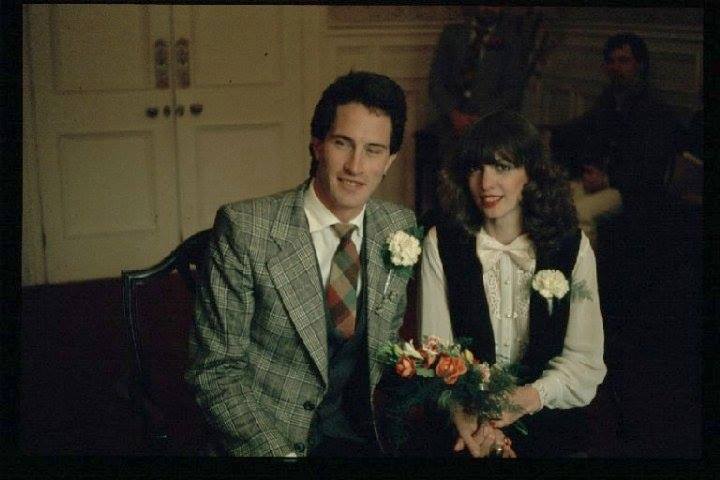
40 year anniversary

October 16, 2018

40 years ago today we married at Chelsea-Kensington Registry Office in London, surrounded by our friends, loved ones.

It has been the best years of my life, and we have grown together over the ensuing years.  Her saying Yes to me all those years ago… still moves my heart.

For all that followed, our son, our adventures, our ups and downs, all have been worth it.

All proceeds from Love, and all returns to Love.

Bright Blessings,
Gwyllm Llwydd

Nicole Krauss’s Beautiful Letter to Van Gogh on Fear, Bravery, and How to Break the Loop of Our Destructive Patterns

By Maria Popova (brainpickings.org)

everyours_vangoghletters.jpg?w=200“Feeling helpless and confused in the face of random, unpatterned events, we seek to order them and, in so doing, gain a sense of control over them,” the great psychiatrist Irvin D. Yalom wrote in his magnificent meditation on uncertainty and our search for meaning. But as our terror of losing control compels us to grasp for order and certainty, we all too often end up creating patterns that ultimately don’t serve us, then repeat those patterns under the illusion of control. These patterns of belief — about who we are, about who others are, about how the world works — come to shape our behavior, which in turn shapes our reality, creating a loop that calls to mind physicist David Bohm’s enduring wisdom“Reality is what we take to be true. What we take to be true is what we believe… What we believe determines what we take to be true.”

To keep repeating a baleful pattern without recognizing that we are caught in its loop is one of life’s greatest tragedies; to recognize it but feel helpless in breaking it is one of our greatest trials; to transcend the fear of uncertainty, which undergirds all such patterns of belief and behavior, is a supreme triumph.

nicolekrauss_vangogh3.jpg?resize=680%2C357

That triumphant transcendence of the pattern is what novelist Nicole Kraussexplores in an exquisite response to Vincent van Gogh’s 1884 letter to his brotherabout fear and risk-taking. Her piece is part of an exhibition by the Van Gogh Museum in Amsterdam, in which twenty-three contemporary artists and writers respond to the letters of Van Gogh in paintings, sculptures, letters, poems, photographs, and videos.

Krauss writes:

2e292385-dc1c-4cfe-b95e-845f6f98c2ec.pngDear Vincent,

You write about fear: Fear of the blank canvas, but also, on a larger scale, of the “infinitely meaningless, discouraging blank side” that life itself always turns toward us, and which can only be countered when a person “steps in and does something,” when he “breaks” or “violates.”

It’s extraordinary that I should have been given your letter now, because it is exactly that act of breaking that has been on my mind this last year, and which I feel has everything to do with how I want to make art, and how I want to live.

It’s a strange thing about the human mind that, despite its capacity and its abundant freedom, its default is to function in a repeating pattern. It watches the moon and the planets, the days and seasons, the cycle of life and death all going around in an endless loop, and unconsciously, believing itself to be nature, the mind echoes these cycles. Its thoughts go in loops, repeating patterns established so long ago we often can’t remember their origin, or why they ever made sense to us. And even when these loops fail over and over again to bring us to a desirable place, even while they entrap us, and make us feel anciently tired of ourselves, and we sense that sticking to their well-worn path means we’ll miss contact with the truth every single time, we still find it nearly impossible to resist them. We call these patterns of thought our “nature” and resign ourselves to being governed by them as if they are the result of a force outside of us, the way that the seas are governed — rather absurdly, when one thinks about it — by a distant and otherwise irrelevant moon.

And yet it is unquestionably within our power to break the loop; to “violate” what presents itself as our nature by choosing to think — and to see, and act — in a different way. It may require enormous effort and focus. And yet for the most part it isn’t laziness that stops us from breaking these loops, it’s fear. In a sense, one could say that fear is the otherwise irrelevant moon that we allow to govern the far larger nature of our minds.

And so before we can arrive at the act of breaking, we first have to confront our fear. The fear that the blank canvas and the blank side of life reflects back to us, which is so paralyzing, as you put it, and seems to tell us that we can’t do anything.” It’s an abstract fear, though it finds a way to take on endless shapes. Today it may be the fear of failure, but tomorrow it will be the fear of what others will think of us, and at a different time it will be fear of discovering that the worst things we suspect about ourselves are true. My lover says that the fear, which seems always to be there when one wakes up in the morning, and which he feels in the hollow between his ribs (above his stomach and below his heart) comes from the “other world,” a phrase that always brings tears to his eyes, and by which he means the awareness of our finitude, our lack of the infinite and eternal. I think he’s right, but I would also add to that that fear, being anticipatory, is always without knowledge. It is a mental calculation based on the future unknown. And yet the experience of fear is the experience of being in the grip of a sensation that seems to possess an unassailable conviction in itself. To be afraid that the plane will crash is, in a sense, to assume that the plane will crash. And yet even if we could scrape away the many forms our fear takes and get to the underlying source-our mortality, our division from the infinite — we would still discover that our fear is not based on actual knowledge, unlike the part of us that chooses to be free. Bravery is always more intelligent than fear, since it is built on the foundation of what one knows about oneself: the knowledge of one’s strength and capacity, of one’s passion. You implied as much in your letter: “However meaningless and vain, however dead life appears to be, the man of faith, of energy, of warmth, and who knows something, doesn’t let himself be fobbed off like that,” you wrote. “He steps in and does something, and hangs on to that, in short, breaks, “violates.”

And so we find ourselves, once again, in front of the blank canvas. The blank canvas, which reflects both our fear and our opportunity to break it. In Jewish mysticism, the empty space — the Chalal Panui, in Hebrew — has tremendous importance, because it was the necessary pre-condition for God’s creation of the world. How did the Ein Sof — the being without end, as God is called in Kabbalah — create something finite within what is already infinite? And how can we explain the paradox of God’s simultaneous presence and absence in the world? And the answer to this, according to the Kabbalah, is that when it arose in God’s will to create the world, He first had to withdraw Himself, leaving a void. To create the world, God first had to create an empty space.

And so we might say: The first act of creation is not a mark, it is the nullification of the infinity that exists before the first mark. To make a mark is to remember that we are finite. It is to break, or violate, the illusion that we are nature that goes around in a loop forever. But it is also a confirmation of our knowledge and freedom, which is all we have in this world.

Sincerely,

Nicole Krauss

Many thanks to reader Carla Taylor for kindly bringing the Krauss letter to my attention. Complement it with Brené Brown on courage and vulnerability, these five spectacular books on fear and the creative process, and a six-year-old’s heartwarming advice on overcoming fear, then revisit Van Gogh on art and the power of love.

Stephen Hawking: “There is no God. No one directs the universe.”

Hawking, who died in March, answers questions like “Is there a God?” and “Is time travel possible?” in his final book, which is available today.

  • Hawking’s final book is geared toward a popular audience.
  • Each of the book’s 10 chapters is posed as a question, such as “How did it all begin?”
  • Hawking claims there is no God, time travel could be possible and intelligent aliens exist.

The final book from Stephen Hawking, the late theoretical physicist and cosmologist, was released Tuesday under the title Brief Answers to the Big Questions.

Hawking, who lived most of his life with the neurodegenerative disorder amyotrophic lateral sclerosis (ALS), was still working on the book when he died in March. The work was completed by his family and publishers, who filled in the gaps by drawing on an “enormous personal archive” of essays, interviews and articles from Hawking’s half-century career.

Brief Answers to the Big Questions is divided into 10 chapters, each of which is posed as a question: “What is inside a black hole?”, “How did it all begin?” and “Is there a God?” Hawking’s answer to the God question is a resounding “no.”

“There is no God. No one directs the universe,” he writes. “For centuries, it was believed that disabled people like me were living under a curse that was inflicted by God. I prefer to think that everything can be explained another way, by the laws of nature.”

This sentiment, by the way, is far clearer than what Hawking famously wrote in his 1988 bestseller A Brief History of Time: “If we discover a complete theory, it would be the ultimate triumph of human reason – for then we should know the mind of God.”

Hawking touched upon the existence of alien life.

“There are forms of intelligent life out there,” he wrote, adding, “we need to be wary of answering back until we have developed a bit further.”

He also argued that traveling back in time can’t be ruled out, artificial intelligence might someday outsmart humans and “within the next hundred years we will be able to travel to anywhere in the Solar System.”

Hawking’s parting gift

(Photo by Jemal Countess/Getty Images)

New Space Exploration Initiative “Breakthrough Starshot” Announcement

Hawking’s final book probably won’t have a big impact in the scientific world. Still, as Matin Durrani writes for Physics World, there’s a good chance the book will strike a chord with a popular audience.

Brief Answers to the Big Questions will appeal to school students, undergraduates and non-scientists with an appetite for the grand challenges in physics. Those who are more familiar with cosmology, relativity and astronomy will not find much that is new, although it is always interesting to see Hawking’s take on affairs. In essence, this book – especially the final chapter “How do we shape the future?” – will stand as Hawking’s manifesto. Optimistic, upbeat and visionary, it sees science – and scientific understanding – as vital for the future of humanity.”

At a book launch event on Monday in London, organizers played some remarks from Hawking lamenting the changing ways in which scientists are received in the culture.

“With Brexit and Trump now exerting new forces in relation to immigration and the development of education, we are witnessing a global revolt against experts, and that includes scientists,” Hawking said.