
Burt Harding
Published on Apr 2, 2018
YOU are an amazing Being, but due to conditioning suffer guilt as if you are missing something or are sinful. Once you see this guilt as nothing more than a need for love then you will see that LOVE is all you really are!!
Monthly Archives: October 2018
Steve Kerr and the Zen art of managing Warriors title expectations

Golden State Warriors head coach Steve Kerr: “There’s no formula for this stuff. You just try to feel it as a coach.”

By Ron Leuty Reporter, San Francisco Business Times
This may be Steve Kerr‘s toughest job yet.
Starting Tuesday night — against the backdrop of the Golden State Warriors’ NBA championship ring ceremony, the start of the franchise’s final season in Oakland and the potential breakup of the team’s all-star roster — Kerr’s two-time defending champions seem to have motivation enough to become the first team in 53 years to make it to five straight NBA Finals.
But no one’s saying it’s going to be easy. There’s a lot of emotion and drama built in to the Warriors’ workplace beyond the 82-game regular-season schedule: Kevin Durant and, possibly, Klay Thompson could exit after the season, new hire DeMarcus Cousins must find a role in coming back from an Achilles injury, and the Warriors will leave “Roaracle” Arena and tip off next year at the gleaming Chase Center in San Francisco.
Kerr, the workplace manager, is taking a Zen-like approach to it all.

Stephen Curry
“Obviously, we want to keep this thing going,” Kerr said at last month’s Warriors media day, “but at some point you just have to enjoy the moment, enjoy the now, because there’s going to be so much speculation as to what’s ahead. Nobody knows what’s ahead.”
So how does Kerr keep a group of on-court workers focused through the season and continue to build the Warriors culture through injuries, interpersonal conflicts and responsibilities that can shift game to game or quarter to quarter?
“There’s no formula for this stuff,” Kerr said. “You just try to feel it as a coach.”
Calling last season “a grind,” Kerr wants to keep that year in its own compartment so Steph Curry, Draymond Green, Andre Iguodala, Shawn Livingston, Durant, Thompson, Cousins and others can focus on a brand-new season.
“We are playing with some house money,” Kerr said. “We won three of the last four championships. Our place in the history of the league is pretty secure. I don’t think our guys should feel a ton of pressure. I think they should feel the importance of trying to do it again, because this may be the last time we have this current iteration of the Warriors, just given all the free agents and the money crunch and everything else.
“So we don’t know what’s going to happen, so why not just go all out and enjoy every step of the way?”
That message is being carried by Warriors veterans to newcomers and younger players.

Andre Iguodala: Good personnel.
“Our front office and basketball operations do a great job of bringing in good personnel, good kids who want to learn, who want to be in this league for a very long time,” Iguodala said. “So they’re open and they all come in with an open mind, and it’s not just me. It’s Draymond, it’s Steph, it’s KD, it’s Klay.”
General Manager Bob Myers, the architect of turning the Warriors from basketball laughingstocks to undisputed champions, sees Kerr’s management as the key.
“If you enjoy going to work and you’re talented and you’re in a good culture, hopefully good things come of that,” Myers said. “So Steve’s good at that. Steve’s a great captain to lead us in the right direction. He’s got a great pulse of what the team needs.”
Your Horoscopes — Week Of October 16, 2018 (theonion.com)

Libra | Sept. 23 to Oct. 22
You go down in history as the world’s lousiest criminal when you attempt to escape from police into the pages of a great romance novel.

Scorpio | Oct. 23 to Nov. 21
A strange incident involving you, a parking meter, a banjo, and a pratfalling Sherpa guide will result in your being featured as a special case in the nation’s medical textbooks.

Sagittarius | Nov. 22 to Dec. 21
A torch-bearing mob drives you from your village after you correctly pick all 15 games in this week’s football pool.

Capricorn | Dec. 22 to Jan. 19
Embarrassment results when, at the last minute, you discover the impossibility of self-crucifixion.

Aquarius | Jan. 20 to Feb. 18
Due to scheduling conflicts, Aquarius will have no future this week.

Pisces | Feb. 19 to March 20
Halfway through telling a ribald joke, you suddenly realize that your audience consists of a rabbi, a Polack, and three guys from Minnesota.

Aries | March 21 to April 19
The mystery of your parentage will be solved this week when General Motors recalls you and 20,000 of your brothers and sisters.

Taurus | April 20 to May 20
The twin specters of confusion and bankruptcy haunt your life when Wilford Brimley confronts you with a prenuptial contract you do not remember signing.

Gemini | May 21 to June 20
You run afoul of the school board this week when you refuse to answer its questions about the space-heaters installed in your children’s lungs.

Cancer | June 21 to July 22
Despite repeated sacrifices to Venus, no loss of virginity is scheduled for you this week.

Leo | July 23 to Aug. 22
Confusion is in store for you this week when you wake from a deep sleep to find ex-heavyweight champ Sonny Liston tenderly massaging your feet.

Virgo | Aug. 23 to Sept. 22
A mutant virus that kills dynamite lovers will sweep the world next week, killing 99 percent of the Earth’s population but sparing you.
Transform The System: personal, social, cultural and political transformation
Aiming to help transform the United States into a compassionate community dedicated to the common good of all humanity, our own people, the environment, and life itself.
Purple Points of Agreement
A majority of Republicans, Democrats, and Independents agree on the following.
Campaign Spending,
in a June 2015 article, “Americans’ Views on Money in Politics,” The New York Times reported:
There is strong support across party lines for limiting the amount of money individuals can contribute to political campaigns, limiting the amount of money groups not affiliated with candidates can spend, and requiring unaffiliated groups to publicly disclose their donors if they spend money during a political campaign….
With near unanimity, the public thinks the country’s campaign finance system needs significant changes. There is strong support across party lines for limiting the amount of money individuals can contribute to political campaigns, limiting the amount of money groups not affiliated with candidates can spend, and requiring unaffiliated groups to publicly disclose their donors if they spend money during a political campaign.
Specifically, the following percentages of Republicans agreed with the following:
- 80 — Thinking about the role of money in American political campaigns today, …money has too much influence.
- 85 — Candidates who win public office promote policies that directly help the people and groups who donated money to their campaigns … most of the time (54) [or] sometimes (31).
- 81 — There are some good things in the system for funding political campaigns but fundamental changes are needed (45). The system for funding political campaigns has so much wrong with it that we need to completely rebuild it (36).
- 71 — Limiting the amount of money individuals can contribute to political campaigns.
- 73 — [Limit spending] on advertisements during a political campaign [by] groups not affiliated with a candidate.
- 76 — [Require] groups not affiliated with a candidate that spend money during political campaigns…to publicly disclose their contributors.
- 55 — Wealthy Americans have more of a chance to influence the elections process than other Americans.
Concerning that study, the Sunlight Foundation highlighted, “Seventy-six percent of respondents (including identical shares of Republicans and Democrats) say money has a greater role in politics than in the past.”
Criminal Justice Reform
In 2015 the ACLU reported:
Republicans and Democrats alike say that communities will be safer when the criminal justice system reduces the number of people behind bars and increases the treatment of mental illness and addiction, which are seen as primary root causes of crime…. In a sharp shift away from the 1980s and 1990s, when incarceration was seen as a tool to reduce crime, voters now believe by two-to-one that reducing the prison population will make communities safer by facilitating more investments in crime prevention and rehabilitation strategies.
According to that study, 54% of Republicans say it’s important for the country to reduce its prison populations. Eighty-seven percent of all respondents agree that drug addicts and those with mental illness should not be in prison. Given the size of that super-majority, presumably a majority of Republicans agreed as well.
Job Creation Programs
A 2013 Gallup poll found:
Americans widely support each of three job creation proposals, including offering tax breaks to businesses that create jobs in the U.S. and a program that would put people to work on urgent infrastructure repair projects. Support for these programs is only slightly lower in a variant of the question that asks respondents if they are in favor of spending government money to pay for the programs.
Specifically, 63% of Republicans supported “a federal government program that would put people to work on urgent infrastructure repairs” and 56% support “a federal jobs creation law designed to create more than 1 million new jobs.” When government spending is mentioned, Republican support for those proposals declined to 53% and 52%.
Military Spending
In 2016 the Center for Public Integrity reported that in 2012 “two-thirds of Republicans and nine in 10 Democrats supported making immediate cuts.” With voters surveyed between December 2015 and February 2016, “50 percent of Republicans favored decreasing spending or keeping it the same, and 48 percent favored increasing it.”
A 2014 Pew study found that 52 percent of Republicans do not believe military strength is the best way to ensure peace.
Corporate Welfare
A 2011 Rasmussen Reports survey found that just 15% of likely U.S. voters believed the federal government should continue to provide funding for foreign countries to buy military weapons from U.S. companies. Seventy percent opposed this funding to promote U.S. arms sales. Given the size of that super-majority, presumably a majority of Republicans agreed as well.
Immigration
A 2014 Pew study found that 54 percent of Republicans do not believe immigrants are burdening the country by taking jobs, housing, and health care from Americans.
Homosexuality
A 2014 Pew study found that only 43 percent of Republicans still agree with 22 percent of Democrats that “homosexuality should be discouraged by society.”
Social Security
A 2014 Pew study found that 65% of Republicans support making Social Security sound. And 67% of all Americans oppose benefit cuts. Given the size of that super-majority, presumably a majority of Republicans agreed as well.
Medicare
A 2014 Pew study found, “Even among consistent conservatives, there is minimal support for the government having absolutely no role in providing health care. Three-quarters of consistent conservatives (75%) say the government should continue Medicare and Medicaid while just 20% think the government should not be involved in providing health insurance.”
Elected Officials
Concerning the 2014 Pew Study, the Sunlight Foundation highlighted these findings:
- 77 percent say elected officials lose touch with their constituents.
- 74 percent say elected officials don’t care what people like me think
- 74 percent say elected officials put their own interests first
Top Priorities
In “Democrats and Republicans Agree on More Than You Think & Why That Matters for 2016, “ William A. Galston wrote:
a closer analysis of the Pew data reveals that in addition to these partisan agendas, there is an American Agenda of “top priorities” supported by majorities of Republicans, Democrats, and Independents and by a super-majority (60% or more) of all Americans. Ranked in order of overall support, they are:

Jeff Hawkins Is Finally Ready to Explain His Brain Research

Jeff Hawkins of Numenta says scientists must explain human intelligence before they can build artificial intelligence.CreditCreditAnastasiia Sapon for The New York Times
By Cade Metz
REDWOOD CITY, Calif. — In the global race to build artificial intelligence, it was a missed opportunity.
Jeff Hawkins, a Silicon Valley veteran who spent the last decade exploring the mysteries of the human brain, arranged a meeting with DeepMind, the world’s leading A.I. lab.
Scientists at DeepMind, which is owned by Google’s parent company, Alphabet, want to build machines that can do anything the brain can do. Mr. Hawkins runs a little company with one goal: figure out how the brain works and then reverse engineer it.
The meeting, set for April at DeepMind’s offices in London, never happened. DeepMind employs hundreds of A.I. researchers along with a team of seasoned neuroscientists. But when Mr. Hawkins chatted with Demis Hassabis, one of the founders of DeepMind, before his visit, they agreed that almost no one at the London lab would understand his work.
Mr. Hawkins says that before the world can build artificial intelligence, it must explain human intelligence so it can create machines that genuinely work like the brain. “You do not have to emulate the entire brain,” he said. “But you do have to understand how the brain works and emulate the important parts.”
At his company, called Numenta, that is what he hopes to do. Mr. Hawkins, 61, began his career as an engineer, created two classic mobile computer companies, Palm and Handspring, and taught himself neuroscience along the way.
Now, after more than a decade of quiet work at Numenta, he thinks he and a handful of researchers working with him are well on their way to cracking the problem.On Monday, at a conference in the Netherlands, he is expected to unveil their latest research, which he says explains the inner workings of cortical columns, a basic building block of brain function.
How a larger community of researchers react to Mr. Hawkins’s work is hard to predict: Will they decide his research is worth exploring? Or will they write him off as too unorthodox in his methods and much too sure of himself?
Mr. Hawkins has been following his own, all-encompassing idea for how the brain works. It is a step beyond the projects of most neuroscientists, like understanding the brain of a fruit fly or exploring the particulars of human sight.
His theory starts with cortical columns. Cortical columns are a crucial part of the neocortex, the part of the brain that handles sight, hearing, language and reason. Neuroscientists don’t agree on how the neocortex works.
Mr. Hawkins says cortical columns handle every task in the same way, a sort of computer algorithm that is repeated over and over again. It is a logical approach to the brain for a man who spent decades building new kinds of computing devices.
All he has to do is figure out the algorithm.
A number of neuroscientists like the idea, and some are pursuing similar ideas. They also praise Mr. Hawkins for his willingness to think so broadly. Being a maverick is not easily done in academia and the world of traditional research. But it’s a little easier when you can fund your own work, as Mr. Hawkins has.
Still, some wonder if his self-funded operation, isolated from the rigors of academic interaction, is a quixotic adventure. They have been researching the brain one little piece at a time for a good reason: Piecing how it all works together is a monumental, hard-to-fathom task.
“It is clear we need a better understanding of intelligence,” said Tomaso Poggio, a neuroscientist at the Massachusetts Institute of Technology who introduced Mr. Hawkins and Mr. Hassabis. “But Jeff is doing this the hard way.”
If Mr. Hawkins’s work should pan out, it could help A.I. researchers leapfrog over what exists today. In recent years, the likes of Google, Apple and Amazon have built cars that drive on their own, gadgets that answer questions from across the room and smartphone apps that instantly translate languages.
They relied on “neural networks,” which are mathematical systems modeled after the web of neurons in the brain — to a point. Scientists cannot recreate the brain because they understand only pieces of how it works. And they certainly can’t duplicate its capabilities.
“The brain is by far the most complex piece of highly excitable matter in the known universe by any measure,” said Christof Koch, the chief scientist and president of the Allen Institute for Brain Science. “We don’t even understand the brain of a worm.”
A call to explain the brain
In 1979, with an article in Scientific American, Francis Crick, a Nobel Prize winner for his DNA research, called for an all-encompassing theory of the brain, something that could explain this “profoundly mysterious” organ.
Mr. Hawkins graduated from Cornell in 1979 with a degree in electrical engineering. Over the next several years, he worked at Intel, the computer chip giant, and Grid Systems, an early laptop company. But after reading that magazine article, he decided the brain would be his life’s work.
He proposed a neuroscience lab inside Intel. After the idea was rejected, he enrolled at the University of California, Berkeley. His doctoral thesis proposal was rejected, too. He was, suffice to say, an outlier.
In 1992, Mr. Hawkins founded Palm Computing. A decade and a half before the iPhone, he had created a hand-held computer for the masses. When he hired the company’s chief executive, Donna Dubinsky, he warned that whenever possible, he would drop his work with Palm and return to neuroscience. “That was always there, simmering in the background,” Ms. Dubinsky said.
U.S. Robotics acquired Palm in 1996 for $44 million. About two years later, Mr. Hawkins and Ms. Dubinksy left to start Handspring. Palm, which became an independent company again in 2000, acquired Handspring for $192 million in stock in 2003.
Around the time of the second sale, Mr. Hawkins built his own neuroscience lab. But it was short-lived. He could not get a lab full of academics focused on his neocortical theory. So, along with Ms. Dubinsky and an A.I. researcher named Dileep George, he founded Numenta.
The company spent years trying to build and sell software, but eventually, after Mr. George left, it settled into a single project. Funded mostly by Mr. Hawkins — he won’t say how much he has spent on it — the company’s sole purpose has been explaining the neocortex and then reverse engineering it.
A coffee cup of clarity
Inside Numenta, Mr. Hawkins sits in a small office. Five other neuroscientists, mostly self-taught, work in a single room outside his door.
Mr. Hawkins said a moment of clarity came about two and a half years ago, while he was sitting in his office, staring at a coffee cup.
He touched the cup and dragged his finger across the rim. Then he leapt to his feet and ran through the door.
He ran headlong into his wife, who had stopped by for lunch, and stumbled toward his closest collaborator, Subutai Ahmad, the vice president of research. “The cortex knows the location of everything,” Mr. Hawkins said. Mr. Ahmad had no idea what he was talking about.
As Mr. Hawkins looked at that cup, he decided that cortical columns did not just capture sensations. They captured the location of those sensations. They captured the world in three dimensions rather than two. Everything was seen in relation to what was around it.
If cortical columns handle sight and touch in this way, Mr. Hawkins thought, they handle hearing, language and even math in similar ways. He’s been working on proving that ever since.
“When the brain builds a model of the world, everything has a location relative to everything else,” Mr. Hawkins said. “That is how it understands everything.”
The source of tension between Mr. Hawkins and other brain and A.I. researchers is not that they necessarily think he is wrong. It’s that they simply don’t know because what he has been trying to do has been so different. And so wildly ambitious.
For the science to advance, what Mr. Hawkins has been working on can’t stay in a silo. His ideas could benefit from extensive experimentation with other neuroscientists, said Nelson Spruston, a senior director at the Janelia Research Campus, a research lab in Virginia that focuses on neuroscience. “A continuous cycle of testing and revising biologically inspired models of neural computation is the key to developing insightful theories of the brain,” he said.
Translation: Mr. Hawkins will have to open his work to rigorous scrutiny and find a way to interact with researchers who most likely have never looked at the brain the way he does.
Follow Cade Metz on Twitter: @CadeMetz
A version of this article appears in print on , on Page B1 of the New York edition with the headline: A New View of How We Think. Order Reprints | Today’s Paper | Subscribe
First ‘active learning’ building in California to open at UCI
New school of thought
September 18, 2018 (news.uci.edu)

Students collaborate on a question at one of the pods in instructor Jacqui Lewis’ abnormal psychology class – the first held in UCI’s new Anteater Learning Pavilion. Steve Zylius / UCI
Irvine, Calif., Sept. 18, 2018 – If it’s been a while since you were in college, the rules are changing: Students may now be required to talk to each other, check their cellphones or trade notes. Professors often no longer lecture from a podium. It’s all part of active learning, which flips traditional education on its head to maximize collaboration.
Next Tuesday, the state’s first building entirely devoted to active learning will open at the University of California, Irvine. The Anteater Learning Pavilion adds much-needed classroom space to the fast-growing campus – and is wired for 21st-century education.
“The heart of everything that UCI does is to help all our students learn and flourish,” said Chancellor Howard Gillman. “This magnificent facility will do just that for generations to come.”

The 65,000-square-foot Anteater Learning Pavilion’s 15 smart classrooms and auditoriums feature flexible furniture, multiple writing surfaces and wireless projection to optimize active learning. Steve Zylius / UCI
The 65,000-plus-square-foot structure features flexible furniture, multiple writing surfaces and wireless projection to optimize active learning. In 15 smart classrooms and auditoriums, old-school audiovisual equipment has been replaced by sleek computer screens on every wall and desk. Each can be linked to from laptop or mobile devices. Seats swivel for group exercises.
In abnormal psychology courses, for example, teams of students use brain imaging to explore schizophrenia. In American history, they create an online frontier town from the 1800s. And in science communications, they calculate how many elephants it would take to raise sea levels, compared to glacier melt.
“Many of our faculty no longer expect – or want – students to simply listen to lectures, take notes and memorize facts,” said Michael Dennin, vice provost for teaching and learning. “In order for our students to be prepared for a complicated and competitive world, they have to be ready to understand and demonstrate processes, analyze arguments and apply what they’ve learned to real-world situations.”
Attendees at the official opening can experience active learning too – including wireless exercises, group quizzes and digital storytelling – via iClickers, Canvas and additional tools.
Research shows that such engaged learning can help undergraduates – particularly first-generation and those belonging to underrepresented minorities – retain knowledge better, earn higher grades and gain lifelong skills.
While active learning programs elsewhere largely focus on science and engineering, UCI’s spans multiple disciplines – from dance, history and language to neurobiology, psychology, chemistry and more.
The only other campus building wholly devoted to active learning is at Oregon State University, and a handful of colleges across the U.S. have numerous classrooms. UCI’s $67 million complex was constructed with $62 million in external financing and $5 million from campus coffers.
To receive priority to teach in the new building, instructors are required to complete an eight-week certification program on active learning techniques and technologies.
Demand for the training is high, with a long waiting list.
Media interested in attending the opening of the Anteater Learning Pavilion can contact Janet Wilson at janethw@uci.edu or 949-824-3969.
About the University of California, Irvine: Founded in 1965, UCI is the youngest member of the prestigious Association of American Universities. The campus has produced three Nobel laureates and is known for its academic achievement, premier research, innovation and anteater mascot. Led by Chancellor Howard Gillman, UCI has more than 30,000 students and offers 192 degree programs. It’s located in one of the world’s safest and most economically vibrant communities and is Orange County’s second-largest employer, contributing $5 billion annually to the local economy. For more on UCI, visit www.uci.edu.
Media access: Radio programs/stations may, for a fee, use an on-campus ISDN line to interview UCI faculty and experts, subject to availability and university approval. For more UCI news, visit news.uci.edu. Additional resources for journalists may be found at communications.uci.edu/for-journalists.
(Submitted by Melissa Goodnight, H.W., M.)
Prague Spring Semicentennial III: Julie Driscoll, Brian Auger and the Trinity: “Czechoslovakia”
“In June ’68 we went to Bratislava, two months after the ‘liberalization and two months before the ‘invasion’.
“‘August ’68, it was dark and it was late, / AN 24 was the first, but there were more…’
“(Jools)
“Three months later, in a New York hotel, Julie completed this song.”
— from the liner notes to the album Streetnoise, from which “Czechoslovakia” is taken.
[If there is any problem with viewing this video, you can also access it by clicking this link.]
* Personnel:
Julie (“Jools”) Driscoll: vocals, composition, lyrics, guitar(?)*;
Brian (“Auge”) Auger: organ (Hammond B-3);
Clive (“Toli”) Thacker: drums;
David (“Lobs”) Ambrose: bass, guitar(?)*.
* A Little History:
Julie Driscoll, Brian Auger and the Trinity had become pretty big in the UK by the time the 1969 double album Streetnoise was released, and they probably seemed to many to be poised on the brink of international stardom – a sign of which being that their record company believed in them enough to allow the recording and release of a double album (something of a rarity even now, and even more so back then…). Sadly, though, the band broke up shortly afterward, due to internal conflicts (interesting two-part article on how all that happened, here and here.)
NOTE: During that period of popularity, Julie Driscoll was often referred to in the UK as “the Face”, for obvious reasons, but in my discussion below I refer to her as “the Voice”, because that’s what she really was back then, and continues to be to this day…
FURTHER NOTE: To read a recent/retrospective review of Streetnoise, click here; to hear the album in its entirety, click here.
* Comments:
“Czechoslovakia” is a composition in four sections – a kind of mini-suite lasting 6 minutes and 24 seconds (can we say, “Masterpiece of Compression”?) – but, especially since the sections are played continuously, it also comports very well with the tripartite structure to be found in much of Western Classical Music. Another important factor is the relationship between the words and the music – how the text is set in melody and how both text and sung melody interact with the other instruments (one hesitates to use the word “accompaniment” here…).
The piece opens abruptly, jumping right into a groove. And quite a groove it is – with steady propulsive sixteenth notes in the drums and an organ sound that I believe would be called “greasy” by aficionados of the Hammond B-3, all of which would be hardly out of place in a smokey little dive bar where said aficionados might gather to listen to that special form of music known as “Organ Jazz“. Except for two things –
First, there’s the metric pattern: a Central European rhythm generally annotated as 3+3+2/8, derived from the folk music of the region and introduced to Western Classical Music by (as I recall) the Hungarian composer Béla Bartók .
Then there’s that jangly rhythm guitar – a sound foreign to Organ Jazz, but which would seem right at home in a venue featuring contemporary folk music – which reinforces both the steady sixteenth-note pulse in the drums and the 3+3+2/8 metrical pattern of the organ, hence bringing them together, while also providing a bright metallic texture, hence taking over the function normally performed by the ride cymbal in a Jazz context.
These various elements create an atmosphere of excitement, as if waking up, discovering new territory – the listener has to really pay attention to get the hang of what’s going on. The contrast of the far from regular accents with the steady pulse also imply, to my mind at least, the first halting steps of a people just setting off on, or returning after far too long a time to, the path of liberty.
But this instrumental section is very brief, serving only to establish the groove. Soon the Voice enters, high and keening (and check out the elaborate rhyme scheme – including all those internals!):
Many people I know with nowhere to go, you know they’re lonely.
But many people have died feeling hung up inside, but don’t think they’re phony.
Cuz they’re only trying to stop you from dying, locked behind your own bars –
Maybe you’ll see how good it would be to feel free…
Don’t close your eyes and put on your disguise – someone’s gonna bust you.
There’s things around bring you down, and they disgust you.
So recognize the hidden lies that surround you,
And maybe you’ll see how good it would be to feel free…
In classical tripartite structure, the first third of a piece is used to “set the stage”, so to speak. And indeed, at around 2:08 (one third of the way through) in “Czechoslovakia”, the music begins to move away from its first material, into a brief codetta. The Voice intones, in a kind of augmentation:
To feel free!
To feel free!
Then, just after that, the music comes to what can only be called a grinding halt. What follows is silence, except for sustained low tones form the organ and spare but dissonant chords on the guitar. The Voice sings, keening even more sharply, as if in tension-filled darkness:
August ’68: it was dark and it was late.
AN 24 was the first, but there were more –
Fighters in close formation,
Ready for the invasion…
(One can almost hear the burbling rattle of idling diesels in the hush of the night…)
At about 4:00 comes the golden section of the piece – in classical tripartite structure this usually marks a kind of turning point, often the re-introduction of the beginning material, sometimes transformed. In “Czechoslovakia”, this is not only a turning point, but the point. Over a complex but consonant arpeggiation in the guitar, the Voice re-enters, softer and gentler – somewhat different from, but still somewhat reminiscent of, the original material:
I remember going to a country where people were warned, and people were ready for changes…
Two explosive booms from the music, then electronic sounds that can only be called chaotic. The Voice again, now crying out, almost screaming:
Iron tanks! From everywhere!
Smash down everything that’s there!
What follows is silence, except for sparse but octave-rich (thus highly consonant) chords on the guitar – perhaps in a kind of resolution, or as close to a resolution as one can get in such a piece of music – and the Voice slowly intoning one word on a rising figure:
Czech — o — slo — vak — i — a…
Finally, in one last gesture of defiance, the drums play the opening motif from the Fifth Symphony of Beethoven, used by the Allies during the Second World War to signify “Victory!” (the letter “V” in Morse code is dot-dot-dot-dash; during the War, the BBC would open all its broadcasts with this motif, played on the drums, much as it is here) over Hitler’s Germany and the other Axis powers. It’s as if the music is reminding Brezhnev and the rest of the Communist leadership that, once upon a time, their governments – indeed, their entire movement – had been part of an alliance dedicated to the very freedom they now seemed so intent on crushing, and also more than strongly implying the statement “You’re Hitler now!” There’s also an element here of “We’re coming for you!”; and well, as the old saying goes, the rest is history…
_____________
* For the album Streetnoise as a whole, Ms Driscoll is listed credited with “vocals, acoustic guitar”, and Mr Ambrose with “4- and 6- string electric bass, guitar”. As to who is playing the guitar parts on this cut, I’ve drawn a blank in my research. My best guess is that Ms Driscoll is playing the jangly rhythm guitar parts in the first section, and Mr Ambrose the more developed guitar parts in the second and third sections. Said best guess is based on a few things: First, there is a very clear bass presence on the first section, at the same time as the jangly rhythm guitar, implying two players, and the bass remains tacet after that – for the rest of the entire piece. Second, although multitracking in recordings was available and practiced in the late Sixties, most studios back then were limited to only four tracks. Third, the musicians here were all steeped in the Jazz tradition, which values interactive playing. Put these three factors together and it’s more than likely that these musicians ended up doing as much as possible all at once, with multitracking only used occasionally.
Borges on Turning Trauma, Misfortune, and Humiliation into Raw Material for Art
By Maria Popova (brainpickings.org)

“Forget your personal tragedy,” Ernest Hemingway exhorted his dear friend F. Scott Fitzgerald in a tough-love letter of advice. “Good writers always come back. Always.”It is an insight as true of writers as it is of all artists and of human beings in general, as true of personal tragedy as it is of collective tragedy — something Toni Morrison articulated in her mobilizing manifesto for the writer’s task in troubled times: “There is no time for despair, no place for self-pity, no need for silence, no room for fear. We speak, we write, we do language. That is how civilizations heal.”
That is what Jorge Luis Borges (August 24, 1899–June 14, 1986) — born the same year as Hemingway, writing two decades before Morrison — conveys with uncommon splendor of sentiment in Twenty-Four Conversations with Borges: Including a Selection of Poems (public library) — the record of his dialogues with the Argentine journalist and poet Roberto Alifano, conducted in the final years of Borges’s life, by which point he had been blind for almost thirty years.

Jorge Luis Borges
In a passage Susan Sontag would come to quote in her magnificent letter to Borgescomposed on the tenth anniversary of his death, he reflects:
A writer — and, I believe, generally all persons — must think that whatever happens to him or her is a resource. All things have been given to us for a purpose, and an artist must feel this more intensely. All that happens to us, including our humiliations, our misfortunes, our embarrassments, all is given to us as raw material, as clay, so that we may shape our art.
Complement with Simone Weil on how to make use of our suffering, Marina Abramović on turning trauma into fuel for art, and May Sarton on the artist’s task to rise above the tumult of the times, then revisit Borges on writing, the measure of success, collective joy and collective tragedy, the paradox of time, and the illusion of the self.
Brave New World predicted 2018 better than any other novel
His book warns us of the dangers of mass media, passivity, and how even an intelligent population can be driven to gladly choose dictatorship over freedom.
13 October, 2018 (bigthink.com)
- This 1931 novel predicted modern life almost to a (model) T.
- While other dystopias get more press, Brave New World offers us a nightmare world that we’ve moved steadily towards over the last century.
- Author Aldous Huxley’s ideas on a light handed totalitarian dictatorship stand in marked contrast to the popular image of a dictatorship that relies on force.
When most people think of what dystopia our society is sprinting towards, they tend to think of 1984, The Handmaid’s Tale, or the Hunger Games. These top selling, well known, and well-written titles are excellent warnings of worlds that could come to pass that we would all do well to read.
However, one lesser-known dystopian novel has done a much better job at predicting the future than these three books. Brave New World, written in 1931 by author, psychonaut, and philosopher Aldous Huxley, is well known but hasn’t quite had the pop-culture breakthrough that the other three did.
This is regrettable, as it offers us a detailed image of a dystopia that our society is not only moving towards but would be happy to have.
Good Ford!

Genetic Engineering
While the human assembly line described in the first part of the story is still a far-off fantasy, the basic concepts that make it work are already here. Today, people make choices to influence the genetic makeup of their children regularly.
Pre-natal screening has created the ability for many parents to decide if they wish to carry a disabled fetus to term or not. In Iceland, this has resulted in the near eradication of new cases of Down Syndrome in the country. Almost 100% of detected cases lead to an abortion shortly after.
Similarly, testing for a child’s sex before birth is a well-known procedure that leads to a wide gender gap in many countries. Less well known is the process of sperm sorting, which allows for a couple to choose the gender of their child as part of the process of in-vitro fertilization.
The above examples suggest we’re open to soft eugenics already. Imagine what would happen if people could determine their child’s potential IQbefore birth, or how rebellious they will be as a teenager. It would be difficult to suggest that the development of such technology would not be hailed as progress by those who could afford to use it. Huxley’s visions of a genetically perfected upper caste might be available soon.
As this article suggests, some choice in baby design is already here and more will be available soon.
Endless distractions
The characters of Brave New World enjoy endless distractions between their hours at work. Various complex games have been invented, movies now engage all five senses, and there are even televisions at the feet of death beds. Nobody ever has to worry about being bored for long. The idea of enjoying solitude is taboo, and most people go out to parties every night.
In our modern society, most people genuinely can’t go thirty minutes without wanting to check their phones. We have, just as Huxley predicted, made it possible to abolish boredom and time for spare thoughts no matter where you are. This is already having measurable effects on our mental health and our brain structure.
Huxley wasn’t warning us against watching television or going to the movies occasionally; he says in this interview with Mike Wallace that TV can be harmless, but rather against the constant barrage of distraction becoming more important in our lives than facing the problems that affect us. Given how stressful people find the idea of a tech-free day and how we take our pop culture so seriously that it was targeted for use by Russian bots, he might have been onto something.
Drugs: A gram is better than a damn!
Brave New World‘s favorite pill, Soma, is quite the drug. In small doses it causes euphoria. In moderate doses, it causes enjoyable hallucinations, and in large doses, it is a tranquilizer. It is probably a pharmacological impossibility, but his concept of a society that pops pills to eradicate any vestige of negative feelings and escape the doldrums of the day is very real.
While it seems odd to say that we are moving towards Brave New World in this era when official policy is opposed to drug use, Huxley would suggest we consider it a blessing, since a dictatorship that encouraged drug use to zonk out their population would be a powerful, if light handed one.
While today we have a war on drugs, it is not on all drugs. Anti-depressants, a powerful tool for the treatment of mental illness, are so popular that one in eight Americans are on them right now. This doesn’t include the large number of Americans on tranquilizers, anti-anxiety medications, or those who self-medicate with alcohol or increasingly legal marijuana.
These drugs aren’t quite Soma, but they bear a striking resemblance in function and use.
Mass consumerism
In the book, the stability of the world state is partly based on total employment. A character informs us that automation has been purposely stalled to assure everybody can work since free time would give them enough extra time to think about their condition. Mass employment relies on mass consumption, however, and numerous systems are in place to assure everybody keeps using new products even when they don’t need anything.
Consumerism is a significant element in all major economies today. While it makes sense that a company would have an incentive to keep us buying things to remain profitable, Huxley’s point is that consumerism can also be used to keep us pointlessly chasing after items that we think we need to be happy as a distraction from exploring other pursuits.
While Huxley thought a dictatorship would have to condition people to want to buy new things and throw out last year’s products to buy similar but newer ones, the lines and fights at Black Friday sales suggest otherwise. Or the lines for every new release of the iPhone.
And just in case you thought it was only corporations getting in on the pressure, don’t forget George Bush wanted you to fight terror by shopping.
Happiness as the only acceptable state of mind
In our modern lives, a similar view on happiness as exists in the novel is developing. In his book The Happiness Industry, William Davies argues that modern capitalism has come across the concept of making happiness the only acceptable mental state and run with it to make more money. Our new found slew of Corporate Happiness Officers and self-help gurus are all designed to keep us happy, consuming, and unwilling to question the larger system in place, he argues.
This notion is summarized in his book in one, jargon-laden, sentence:
The relentless fascination with quantities of subjective feeling can only possibility divert critical attention away from broader political and economic problems.
While claims that we are redefining unhappiness as unacceptable might seem overblown, the standard manual of mental illness now says grieving for deceased loved ones more than a few days is problematic. Perhaps Mr. Davies is onto something.
The concentration of power
Huxley expressed concern in his follow-up book Brave New World Revisited that the increasing complexity of technology and global problems had led to a concentration of power both in business and government. This concentration, he argued, not only made people more comfortable with the idea of being subjugated but also made dictatorship easier to enact.
Today, we have a higher concentration of wealth and power than ever before. In the United States, the top 1% are richer than ever, six corporations control 90% of the media, and the power of undemocratic institutions such as corporations or byzantine bureaucracies are greater than ever before. Many Americans choose not to vote and have the same influence on their government that they would if they had no right to vote.
This can lead to situations little different than that of 1984 but without the hard-totalitarian edge that came with it. In 1984 there was only one television station, and there was no attempt to hide the fact that the government controlled it. In the United States today dozens of seemingly different networks are controlled by a few conglomerates and often promote the same worldview and opinions as a result.
Huxley himself warned against this very situation when he talked about how we were approaching his dystopia back in 1958:
Well, at the present the television, I think, is being used quite harmlessly; it’s being used, I think, I would feel, it’s being used too much to distract everybody all the time. But, I mean, imagine which must be the situation in all communist countries where the television, where it exists, is always saying the same things the whole time; it’s always driving along. It’s not creating a wide front of distraction it’s creating a one-pointed, drumming in of a single idea, all the time. It’s obviously an immensely powerful instrument.
Despite being able to find this out or turn the channel, millions of people willingly continue to watch what might be called propaganda from friendly faces. Indeed, they love it. This soft totalitarianism is often hard to detect or state an objection to, which Slavoj Zizek argues is the point.
How do we avoid this dystopia? Or is the Brave New World already inevitable?
Huxley thought we could save ourselves, though we had to act quickly. While his concerns around overpopulation and eugenics have been shown to be bunk by the march of history, his other ideas still have merit.
In his follow up book Brave New World Revisited, he argues for the decentralization of power as a means to restore the value of democratic government to the typical person who might otherwise realize their vote is meaningless and lose faith in democracy as a result. He suggests that we can better educate people for freedom by drawing their attention to the methods of demagogues and sleazy advertisers. He encouraged those seeking freedom to move to the countryside or to establish stronger neighborhood ties in the cities to resist the pressure to only engage with others as an economic unit and not as a full human being.
He was also warm to the ideas of syndicalism and worker cooperatives, which seek to restructure workplaces to feature workers democratically managing them. He saw this as both a way to decentralize the economy and improve democratic participation.
Aldous Huxley’s Brave New World was a prediction of a nightmare he thought we would be safe from for at least a few hundred years when he wrote it in 1931. By 1958 he realized he had been very optimistic. While we aren’t entirely doomed to the pleasant slavery he envisioned quite yet, the march of progress continues to bring us the tools which make it ever simpler to enact. If we will make the choices needed to avoid it or if we will willingly cry out to be saved from our freedom remains to be answered.
Richard Hartnett on the “white shadow”
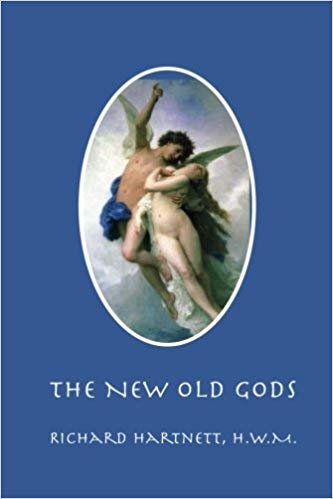
From Chapter 2: “What’s in a Story?” from the book The New Old Gods by Richard Hartnett, H. W. M.
“White shadow happens when we glorify or elevate others to a God-like status. We see these people as being able to express attributes we feel are beyond our capacities. “I could never sing like that…”etc. Here, the attribute expressed is something we hold in highest regard. More than anything, we wish we could express the attribute with the same skill. Because of this adoration, those who are able to express it are elevated in a way that makes them superior: we make them into stars. That may seem innocent enough, but what is toxic about this is that we are disowning something that we can and should claim for ourselves. We are minimizing ourselves rather than empowering ourselves. IT is self-negating to believe that an attribute is totally beyond our capability. Those who are worshiped may express the attributes in a positive way, but they are still carrying our projection, and we use them as a way of avoiding claiming it for ourselves. This is dangerous territory, for some idols become drunk on the projected power they are given and soon lead their followers into ruin and disaster. Examples of this would be David Koresh, Jim Jones and Adolph Hitler. . . .
Just as we disown parts of ourselves, we disown parts of the divine. . . .
White shadow happens with the divine, when we give away our capacity to deal with life challenges. . . .
[W}e must always accept our responsibility to try and do something rather than be victims.
(Submitted by Hanz Bolen, H.W., M.)