“A time is coming when men will go mad, and when they see someone who is not mad, they will attack him, saying, ‘You are mad; you are not like us.'”
–Saint Anthony or Antony the Great (251 C.E. – 356 C.E.) was a Christian monk from Egypt, revered since his death as a saint. He is distinguished from other saints named Anthony by various epithets: Anthony the Great, Anthony of Egypt, … Wikipedia
Deanna Van Buren designs restorative justice centers that, instead of taking the punitive approach used by a system focused on mass incarceration, treat crime as a breach of relationships and justice as a process where all stakeholders come together to repair that breach. With help and ideas from incarcerated men and women, Van Buren is creating dynamic spaces that provide safe venues for dialogue and reconciliation; employment and job training; and social services to help keep people from entering the justice system in the first place. “Imagine a world without prisons,” Van Buren says. “And join me in creating all the things that we could build instead.”
This talk was presented at an official TED conference, and was featured by our editors on the home page.
ABOUT THE SPEAKER
Deanna Van Buren · Activist, architect, artist
Deanna Van Buren is an architect who designs spaces for peacemaking, inside and out.
Elon Musk is a goofball techbro whose real business is quack philosophizing, not inventions or engineering.
I realize that the founder of Tesla and SpaceX really does make things, like electric cars and spaceships. But Musk’s numerous attempts to realize his gleaming visions of a Jetsons-like future have never come close to living up to the (largely self-manufactured) hype. Lately he has started claiming that he is going to send cargo-laden rocket ships to Mars by the middle of President Trump’s second term, in advance of the establishment of a permanent human colony. I’m not holding my breath.
Why have we allowed this lunatic a prominent place in our public and commercial life? Even his name makes him sound like the villain who convinces the Earth Federation in the year 4836 to trade in its fleet of perfectly serviceable if somewhat old-fashioned solar-powered starships for his sleek but shoddily made models that, allegedly, run on nothing but crystals from the planet Flion.
The line between science and science fiction has always been a blurry one. No sooner would Jules Verne write a story about, say, an electric submarine than some genius inventor would will it into reality. The problem with Musk is that he seems willing to calmly accept the reality of every nebulous Star Trek plot device in existence without bothering with the boring part where the thing actually has to work. Even a supercomputer operating on the principle of the so-called infinite monkey theorem could not devise a credible individual repository for all the wild things Musk believes. From the imminence of total human extinction to the perennial undergraduate assertion that, like, maybe we are all living inside in the Matrix, there is no implausible, discredited, absurd-on-its-face theory or cause that Musk has not endorsed with brio.
It would be difficult to think of anyone else who routinely says things as blinkeringly stupid to large audiences as routinely as Musk. Take his most recent pronouncement on artificial intelligence, a favorite subject of his, proffered to the similarly screen-ravaged consciences that attend the annual South By Southwest technology conference in Austin, Texas. “The danger of AI is much greater than the danger of nuclear warheads by a lot,” he said. “Mark my words.” Call me a Luddite, but I’m just not seeing it. The day when we are all putting on camo and fighting endless guerilla war against our cyborg overlords still seems to me pretty remote, alas.
There is one sense, however, in which I think Musk is absolutely correct about the threat posed by artificial intelligence to the flourishing of human kind. I am talking, of course, about self-driving cars. Just two years ago a bleary-eyed enthusiast in Florida, convinced of the mechanical infallibility of his robotic automobile, decided to ignore the road and watch a Harry Potter movie instead. Tragically but not, one thinks, very surprisingly, he soon collided with a semi truck and died.
Did I mention that the vehicle in question was, in fact, manufactured by Musk’s own firm, Tesla? What kind of lunatic expects us all to pay him handsomely for the privilege of climbing into machines he himself considers vastly more dangerous than already existing weapons that could eliminate every life on this planet in a matter of five seconds? What does it mean that in addition to riding in his Terminator sedans and IG-88 minivans of the future he expects ordinary Americans to look forward to the possibility of flying in one of his boutique spaceships to infinity and beyond? At least here on good old terra firma it is at least theoretically possible to jump out of a moving Tesla once you realize that it is hell-bent on bringing your earthly existence to a fiery conclusion. What hope would there be in the cold empty reaches of space when the SpaceX Jupiter module decides that you are a threat to the mission and must be destroyed? I wonder how long it will take to process a refund.
The truth about Musk, though, is that for all his visionary cant there is nothing especially revolutionary about him. He is, in fact, a typical example of a type that is painfully familiar in American life: the shamanic huckster. Such persons have flourished in the fertile soil of this continent and the equally fecund imaginations of our free-thinking citizenry almost since the Mayflower. Sometimes people like Musk convince their fans to follow them into the desert and eat magic mushrooms in between a capella campfire renditions of “Masters of War” and freeform rap sessions on the mysteries of consciousness. Sometimes they see visions of both Jesus and assorted Hindi deities and declare themselves “greater than God.” Sometimes they convince the Beatles to go with them to India. Sometimes they just hand out pamphlets outside train stations and bum cigarettes from tired commuters.
Musk is, thank goodness, much closer to the anodyne type of messianic lunatic than to the Jonestown variety. If it weren’t for his peddling of high-priced death-traps that federal regulators have so far allowed to traverse our crumbling roads, I would feel comfortable declaring him essentially harmless. As things stand, Musk is someone we should mostly ignore rather than worry about. When the robot overlords somehow fail to take over the digital simulation we all inhabit, even he will be relieved.
Elon Musk told a crowd at South by Southwest on Sunday that SpaceX could be embarking on its first mission to Mars by as early as next year.
“We are building the first Mars, or interplanetary ship, and I think we’ll be able to do short trips, flights by first half of next year,” Musk said during his surprise talk in Austin, before cautioning: “Although sometimes, my timelines are a little, you know…”
In September 2017, SpaceX announced plans to send a cargo mission to the Red Planet by 2022, which would confirm water sources and install “initial power, mining, and life support infrastructure.” The company eventually wants to set up a long-term human colony on Mars.
SpaceX’s “Big Fucking Rocket” (BFR) would be the spacecraft for the journey. The nearly 350-foot rocket is reusable and would only cost the privately funded company about $7 million per launch.
Musk hopes SpaceX’s ambition will prove contagious.
“The biggest thing that would be helpful is just general support and encouragement and goodwill. I think once we build it we’ll have a point of proof, something that other companies and countries can go and do. They certainly don’t think it’s possible, but if we do they’ll up their game.”
The focus of the first mission would be to set up basic infrastructure for a colony. But after that?
“… then really the explosion of entrepreneurial opportunity [will begin], because Mars will need everything from iron foundries to pizza joints,” Musk said.
Artist’s rendering of Mars colony for SpaceX.
But Musk’s talk wasn’t marked only by interstellar optimism. He spent much of the morning in Austin warning about the existential threats facing humanity.
“There’s likely to be another dark ages… particularly if there’s a third world war,” he said, adding how human settlements on other planets could basically serve as an insurance plan when catastrophe strikes on earth.
Musk also posed questions over the lack of A.I. regulation.
“Mark my words: A.I. is far more dangerous than nukes. So why do we have no regulatory oversight?”
He said A.I. experts aren’t worried enough.
“The biggest issue I see with so-called A.I. experts is they think they know more than they do. They think they’re smarter than they are. This plagues smart people… they don’t like the idea that a machine could be smarter than them, so they discount the idea.”
To be sure, there were some lighter notes in his talk. Musk said he expects self-driving cars to be 200 percent safer than the ones we careen around in today. He also revealed that Kanye West was a source of inspiration for his ventures. Finally, Musk and his brother, who joined the space entrepreneur onstage near the end of the talk, capped things off by donning cowboy hats and dancing on stage.
They’re now going to sing along to the song from Three Amigos that Musk promised would happen on Twitter. “This is going to be terrible.” I don’t know what more to say! pic.twitter.com/9lCzopKb3r
They’re now going to sing along to the song from Three Amigos that Musk promised would happen on Twitter. “This is going to be terrible.” I don’t know what more to say! pic.twitter.com/9lCzopKb3r
Signs of the times: astrology and horoscopes have become hip again. Illustration: Phil Hackett/Observer
When people contact the women’s website Broadly, to ask why it runs horoscopes, as it has done since its launch in 2015, the UK editor Zing Tsjeng directs them to a video she uses as a catch-all response. It’s the figure skater Adam Rippon, discussing his unexpectedly good run at the Winter Olympics. A reporter asks him why he’s now skating better than ever before. He shrugs gently, with a glint of mischief in his eye, then says: “I can’t explain witchcraft.”
Many people over the age of 35 will have grown up with astrology as a form of light entertainment: big, cartoonish, campy personalities like Mystic Meg and Russell Grant, hidden away in the back pages of newspapers and women’s magazines, picking lucky numbers and promising the intervention of tall, dark, handsome strangers. But the women (and men) who Broadly speaks to may have a different grasp of astrology. That’s why traffic to the site’s horoscopes is growing so rapidly. At The Cut, a site focused on fashion and trends for a similar, millennial audience, staff say that a typical horoscope post got 150% more hits last year than in 2016.
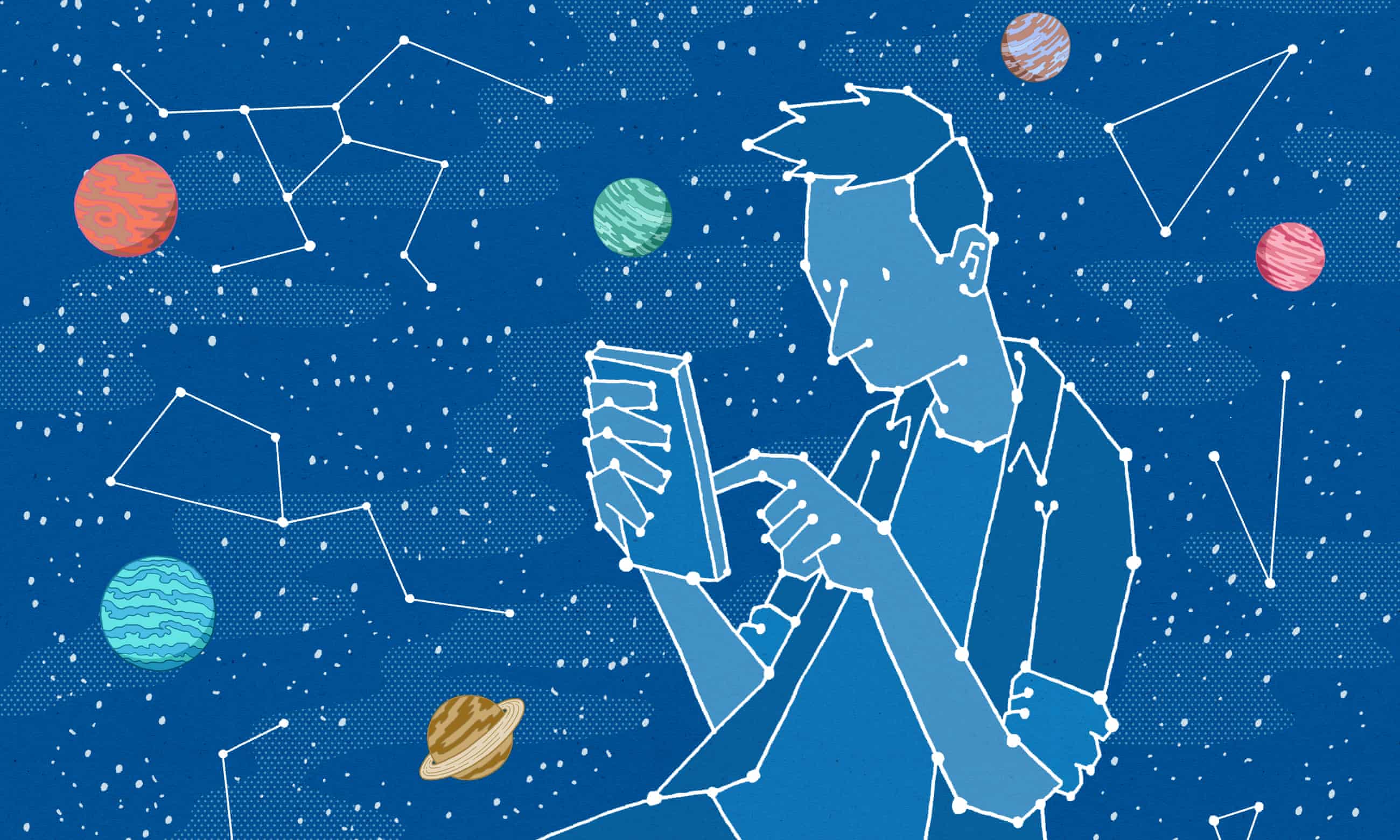
There is a growing familiarity with the patterns and positions of the planets, and it’s not uncommon to hear people in their late teens and 20s talking about, say, “Mercury in retrograde” and “Saturn returns” with confidence and authority. They know that a “star sign” is a sun sign, and that for any half-decent attempt at a reading, you need to know your exact time and place of birth, so you can discuss, with equal reverence, the influence of your rising sign and moon sign, too.
It’s part of a broader shift, one that finds magic and mysticism referenced regularly in popular culture. In the fashion world, labels such as Vetements and Valentino have featured zodiac signs, constellations and cosmic patterns. The high street has followed the trend. An episode of TV show Broad City used a coven of witches in Central Park as its way of digesting the election of Trump – it makes more sense if you watch it. Especially if you’re one of the estimated 800,000 Wiccans in the world. In the UK alone, 60,000 people identify as pagan.
Tomorrow’s world: what does the future hold? Illustration: Phil Hackett/Observer
There’s also a social networking app, Co-Star, which sees just how compatible you are with your friends and lovers, based on their birth charts. “My personal belief is that people tend to turn to mysticism, spirituality and the occult in uncertain times,” Tsjeng suggests. “And I feel that young people, especially, are living in one of the most uncertain times ever, at least in my living memory. There’s an increasing willingness to question the arranged order, break out of pre-defined social norms and look for answers elsewhere.”
Recently, I interviewed a young rapper, a man in his early 20s, as he was about to release his first album. On a break from a photoshoot, we got talking about the emotional ups and downs of suddenly finding oneself in the spotlight. “I guess I’m a Cancer as well,” he said, casually. “I try to be tough on the outside, but inside, I’m soft as shit.”
“Are you needy?” I asked him. “That’s a Cancer thing, right?” He laughed. “I’ll never tell anybody, but I really am needy. So needy.” The ease with which we fell into using astrological language as a shorthand for personality traits was striking. It also felt like a gentle, unthreatening way of discussing deeper emotions.
“Like many people, I came to astrology at a moment of personal crisis and feeling lost,” says Francesca Lisette, 30, who has spent the past decade studying the subject. “I had gone from being able-bodied to suffering with chronic and life-restricting pain, and the invisibility of my pain also led me to wonder about the invisible DNA of my personality. Perhaps I solve my pain, or at least rationalise it.” She recently completed an apprenticeship in traditional astrology and now practises readings under the name the Glitter Oracle. “I quickly drummed up a birth chart on astro-newbie favourite Café Astrology and read through it, thinking it sounded exactly like me, but was also full of contradictions,” she explains, and put its inconsistencies down to it being computer-generated. “That was the moment at which I became obsessed with understanding how to read a chart with the skill of an experienced astrologer.”
The idea of turning to an existing belief system in a time of crisis is as universal as it is familiar. Daisy Jones, 25, grew up in a household where astrology was “like a religion” and regularly had her tarot cards read by her grandmother. “But I would say it was a relatively background entity until just over a year ago, when I went through a major break-up and moved house, and my life felt like it was in a state of flux,” she says. “So as somebody who isn’t religious, it felt like something to embrace during a particularly uncertain period.” Both Lisette and Jones point to the popularity of astrology among women and those who identify as queer, partly, Lisette thinks, because astrology offers an alternative to systems that no longer seem to be working – especially for outsiders. “That’s definitely something I like about it. It’s a system of beliefs not defined by hierarchy or power structures,” adds Jones.
Roy Gillett is president of the Astrological Association of Great Britain, and has been a practising astrologer for the past 40 years. He says he has noticed an uptake in millennials turning not only to sun signs, but also seeking out a deeper understanding of the science on which the system is based. (Sceptics will say that it is not science-based; practitioners will argue roots in astronomy and connections to quantum physics.)
“I think what’s happened to people in their late teens and 20s, and younger people even more so, is a sense of betrayal by conventional knowledge,” he explains. “I know that’s a strong statement to make, but if you think about the circumstances that a person at university finds themselves in right now, compared with me when I was at university, or even my children… There is a lack of values everywhere you look. The things you relied on don’t seem to be reliable. In that sort of culture, you look for something underpinning everything.”
Gillett also points to the internet enabling people to share ideas on a scale not seen before. It’s no coincidence that there is a thriving astrological community online, from Tumblr culture to YouTube astrologers to straight-talking daily sun sign advice, even if it is communicated in pop-up notifications from an app giving an emoji thumbs-up to, say, “sex and magic” for the day. “Over most of the years I’ve been involved, the relationship between astrology and popular culture and society in general has been rather frozen in an extreme, of most people thinking it’s just the sun signs in the newspapers,” explains Gillett. “They think that anybody who follows it is away with the fairies, because it’s just so generalised.” Now, he says, there’s an articulate and informed discussion going on based on the massive expanse of knowledge people have at their fingertips.
Play your cards right: would you trust a tarot reading? Illustration: Phil Hackett/Illustration
The “away with the fairies” argument is a default criticism, whether it’s Richard Dawkins debunking star signs on his documentary TheEnemies of Reason, or the notion that astrology is akin to clairvoyance, that it can be used to predict lottery numbers or who’s going to win the Grand National. Lisette says she is not very good at arguing the benefits of astrology to those already set against it. “I’m not terribly invested in convincing people to see the world the way that I do. I already know that astrology works. It’s rather like somebody saying: ‘Kicking a ball around is boring and pointless.’ OK, but there are still billions of people around the world who get something out of it.” Besides, she adds, you have to extensively engage with astrology to see how it might relate to your life, and most sceptics won’t do that.
With this in mind, and having spent weeks talking to people about their experiences of astrology, I decided to get my birth chart read. I found Leigh Oswald, an astrologer in my home city, and sent her an email asking if she’d give me a reading, and let me write about the experience. Oswald has been an astrologer for more than 40 years, and wrote regular columns for the magazine Artnet that leaned towards socio-political interpretations of planetary positions. After some discussion, she said she would be happy to meet me and read my chart, and answer my questions, if it would help explain some of the misconceptions about astrology. There were unavoidable issues – she was sorry she already knew I was a journalist but, of course, she would not look me up before we met. I know cynics will doubt this, but I’m certain she’d stuck to her word. Besides, Mercury rules my ascendant Virgo, so my intuition is strong.
The reading was uncannily accurate and I have thought about it every day since it happened. She offered clear and precise pictures of the kinds of people I am drawn to, as friends and as partners, and why that might be. We talked about health, diet, political and social leanings, and ways of seeing the world. It felt like a detailed dissection of my personality, including parts of it that I would not offer up willingly to a stranger. It was a personal, probing and, at times, therapeutic discussion about vast, emotional life issues. It made me think about how I can address things that I have been unhappy with, and push myself in areas that I have been too afraid to.
At the end of it, we hugged, and I felt extremely grateful for her time and insight. It is not a common experience, for me at least, to take that kind of time to stop and think. Whether that’s because I believe the position of the planets at my time of birth shaped my personality in some as-yet-inexplicable way, and as such can offer lessons as to how to navigate life, or whether it’s because it was a moment to stop and think about what was weighing on my mind seems largely irrelevant, given how galvanising the whole experience was.
“There’s a saying that sun sign astrology is a silly nursery rhyme. A proper birth chart is a complex symphony, because we’re all so complicated,” explained Oswald. “We’re all a mess of contradictions. I’m a great believer that the more we can know about ourselves the more we can accept ourselves, and make good decisions between our weaknesses and strengths.”
Zing Tsjeng has a more pragmatic approach, but nevertheless, it’s one that gets to the same beating heart of why astrology can hold such fascination, and how that can, in turn, be made useful. “When I read stuff like: ‘Pisces season is an important time for Librans not to get walked over,’ I don’t believe I’m doomed to get walked over that month just because of some random celestial moment that I have no control over,” she explains. “It just prompts me to think, hmm, is there a part of my life where I feel this way? What can I do to avoid that? It gives me a chance to check in with my own thoughts and where I’m at in my life.”
Astrology: reading your stars
The app: Co-Star This relatively new app provides a basic birth chart and daily horoscopes, but with the social network-ey addition of letting you see how well you’re suited to friends and loved ones who have done the same.
The online horoscope: Annabel Gat – BroadlySince 2015, Gat’s monthly horoscopes for Broadly have been conversational, frank and big-sister wise. Little wonder she has such a devoted cult following.
The book: Sextrology Stella Starsky and Quinn Cox’s classic 2004 book has had a long afterlife, particularly among LGBTQ readers, thanks to its same-sex compatibility pairings and frank and funny advice on which peccadilloes may be tied to your planetary positions.
On Twitter: @themeccanismMecca co-hosts a chatty, funny podcast, Stars on Fire, which talks pop culture through an astrological filter, and it’s as fun as her Twitter feed. She does private readings in the US and has contributed to Essence, Bustle, Teen Vogue and Refinery29.
The classic: Sun Signs May be knocking around on a dusty bookshelf but Linda Goodman’s classic is as entertaining to read as it is easy to understand.
THE KEYS TO WORRY FREE CHANGING NOTION OF GENDER, MASCULINITY, & SOCIETY – THE EDGE COMES FROM KNOWING ‘What’s Behind the Curtin’. By Calvin Harris H.W., M.
The Life and Age of Man: The Stages of Man’s Life from Cradle to … FAMSF Explore the Art – Fine Arts Museums of San Francisco
This blog is written to give a ‘Breathing space’ or a broader view to men when issues come up in the matter of Gender identification, the notions of your sexuality vs gender or in the matter of having to defend or change in a time of Societal change. I will start with the comment that if changes are demanded of you and you did not instigate the change, then make note someone else has an agenda or profit to be gained by it.
SiteOfContact’s (SOC) author Calvin Harris, H.W., M., the impetus for writing this blog, began with a call. I got this phone call about an article that was to appear in the March 1st or 2nd, 2018 edition of The Nation.Com, in its SOCIETY Blog Colum. A blog titled: Do We Need to Redefine Masculinity—or Get Rid of It? Written by a Collier Meyerson, a Knobler Fellow at the Nation Institute, where she focuses on reporting about race and politics, as well as an investigative fellow at Reveal. Even before the articles came out, a call came to me, to be on the lookout for it and a request for my reaction to the blog. Since the release of the blog, I have had a barrage of calls with hot opinions about it, more than any article (to date) generated from any blogs that I had written myself. Well, it is my own fault for encouraging you all to read more, and then to dig deep for understanding. I feel, to meet a storm successfully you will need an edge, that is a preparation and or history of the behaviors of the storms and how they behaved in the past, that is where the edge to success is found. So for all of you who are ready to Take Action one way or another, let me play devil advocate here and let’s start with the meaningful action of an investigation. This investigation may seem a bit around the bend but hold fast, for the future is at stake.
Be pre-warned this Blogs, may have intellectual and emotional undercurrents for some, for those of you that take the time to digest and discern what is being offered will find it well worth the read. I welcome your comments and for those of you having regular scheduled session with me, I welcome your phone calls regarding personal issues brought up by this blog.
Also, contain at the end of this article is a link to Ms. Meyerson blog for your perusal and consideration.
I am a believer in having a shameless array of ‘Conscious’ emotions, considered in this conversation when the goal is to lead to a compassionate solution. Yes, even the emotion Anger, if that anger is self-possessed within an idea. The goal then, as Thanissara Mary Weinberg expresses it, is to have – “Anger …traditionally thought of to be close to wisdom. [To be used], When not projected outward onto others or inward toward the self, it gives us the necessary energy and clarity to understand what needs to be done.”
Now, I, in fact, was happy to see an article on masculinity in a publication like ‘The Nation,’ in light of my blog last year in SOC on 30, June 2017, titled “A Man Is Expected – New Pathways of Being.” Yet was surprised by the title implications to Redefine Masculinity or get rid of it. Let’s face it there are not too many women nor men that really want to get rid of Masculinity. So let us knock off the nonsense of getting rid of it and try and reason to the core of the matter.
It’s clear when you look out into society that masculinity is a tough subject to approach for many people, regardless of gender, but it seems it is popping up in one form or another and therefore it wants to be addressed.
I’m afraid beliefs about male and female, that is humans and their rights are being turned upside down and that some of the discussions of the new masculinity reflect more theory first than any real consideration of human progress or history on the subject. I don’t think it’s the wisest move to redefine what it means to be anything beyond Conscious Beings right now. Radicals could easily turn beliefs about humans and unalienable rights they possess upside down especially in a climate demanding change.
It may surprise some to know in a very short number of years it will be a moot point. The rage and outcry in the courts, will be about abuse in the use of Robots and Inanimate Objects and there again the consideration for redefinition. This time for Robots being Sentient Beings, that means beings with consciousness, or in some contexts life itself. Sentient beings for the longest time where considered primary a state belonging only to Humans. To be Sentient you needed to possess five aggregates: matter, sensation, perception, mental formations, and consciousness. As technology and science progressed as rapidly as it has identification of sentient beings have been extended to animals and plant life and will in time move to our machines. At some point, regulated behavior in the use or misuse of Robots and inanimate objects as Sex objects will prevail.
What it means to be a man or a woman can be reduced to just saying ‘Human.’ We have the capacity to think, feel, perceive or experience subjectively and with empathy. When we go beyond that, then we start to get into trouble when like the Eighteenth-century philosophers used the concept to separate, distinguish as it were the ability to think from the ability to feel and maybe where we start some of the modern divisions of men and women. Humans are carbon-based communal societal creatures that have empathy and justice called Love within their somatic DNA and within their shared blood, they as for now, come with a knowledge of an expiration date.
Photo by Jason Beamguard
The Movies Blade Runner and the book that they were adapted from “Do Androids Dream of Electric Sheep?” By writer Philip K. Dick, first published in 1968. Explored issues of “what does it mean to be human.” The fallacy the book tried to point to was the belief that Androids, unlike humans, are said to possess no sense of empathy or compassion in the future, and the question did humans still contain humanity. I would start the conversation here because for some folks The concept of masculinity misseen is the belief that masculinity in the male gender has no empathy or compassion. And thus masculinity in the male gender is a mechanical apparatus that can be turned on or off at will. Rather than it being an evolutionary engineered process once geared to the benefit of family, community or humanity and has historically been manipulated but yet is always evolving.
Man as Machine
There is a book mention in Ms. Meyerson blog by Gail Bederman her seminal book is on the issue, Manliness and Civilization: A Cultural History of Gender and Race in the United States, 1880-1917, author Gail Bederman writes: “I don’t see manhood as either an intrinsic essence or a collection of traits, attributes, or sex roles. Manhood—or ‘masculinity,’ as it is commonly termed today—is a continual, dynamic process.” The first thing we need to do, according to Bederman, is stop arguing that masculinity has traits that are inherent. “Gender,” she writes, “is dynamic and always changing.”
Book Cover of Gail Bederman Book
Between 1820 and 1860, according to Bederman, more and more white men were beginning to identify as middle class: entrepreneurs, professionals, and managers. And with that distinction, there came about a new and important gender identification for men, one that centered around civility. As opposed to brutishness or violent tendencies, manliness during this period was focused on a civilized character, holding off on marriage to accrue wealth. And then a man should focus on providing a good life for his wife, his children, or his employees.
Between 1879 and 1910, the number of middle-class men who were self-employed dropped, from 67 percent to 37 percent, prompting another a shift. “Middle-class Victorian men were obsessed with manhood at the turn of the century,” writes Bederman. They became “obsessed” with cowboy novels, and hunting and fishing. At the same time new epithets, like “sissy,” “pussy-foot,” “cold feet” and “stuffed shirt, ” emerged, indicating “behavior which had once appeared self-possessed and manly but now seemed over-civilized and effeminate,” writes Bederman. Around 1890, a noun defined as “the essence of manhood” took hold for the first time—now, manhood was called “masculinity.”
The idea, Bederman says, was that being “manly” had a “moral dimension,” and was defined by a dictionary at the time as “possessing the proper characteristic of a man; independent in spirit or bearing; strong, brave, large-minded, etc.” But then, when the economy tanked between 1879 to 1896, and with it the whole middle-class white-male “civilized” identity, the concept of “manliness” shifted again. After that, Bederman says, when men wished to invoke a male power they used “masculine” and “masculinity” to describe it. “The adjective ‘masculine’ was used to refer to any characteristics, good or bad, that all men had,” she wrote. The element of morality had been left behind.
The shift in white middle-class American male identification at the turn of the 19th century was also a way to justify white supremacy. “Linking whiteness to male power,” Bederman wrote, “was nothing new.… during the first two-thirds of the nineteenth century, American citizenship rights had been construed as ‘manhood’ rights which inhered to white males, only…Negro males, whether free or slave, were forbidden to exercise ‘manhood’ rights—forbidden to vote, hold electoral office, serve on juries, or join the military. The conclusion was implicit but widely understood: Negro males, unlike white males, were less than men.” But once “masculinity” came around at the end of the 19th century, and black men were fighting for “manhood rights,” a new idea had emerged. White middle-class men were starting to see themselves as maintaining a universal male quality: savagery. But the way they separated themselves from their black counterparts, was to articulate that they had evolved more. Bederman uses the example of National Geographic, which was first published in 1889 and gained popularity “by breathlessly depicting the heroic adventures of ‘civilized’ white male explorers among ‘primitive tribes in darkest Africa.” Similarly, she writes, “Anglo-Saxonist imperialists insisted that civilized white men had a racial genius for self-government which necessitated the conquest of more ‘primitive’ darker races.”
America’s new definition of masculinity was cemented during the 20th century. Though black men gained the right to vote, under Jim Crow laws, which last well into the mid-20th century, they continued to be subjugated by white men, who restrained black men’s economic possibilities and frequently portrayed them as uncontrollable rapists. From early westerns to the action films we watch today, white cis men overwhelmingly were cast as leads in the mass entertainment our culture consumes; guns became a rite and plaything of young white men in our country. And masculinity became a made-up excuse to dominate.
In his essay, Michael Ian Black. an American comedian, actor, writer, writes: “I believe in boys. I believe in my son. Sometimes, though, I see him, 16 years old, swallowing his frustration, burying his worry, stomping up the stairs without telling us what’s wrong, and I want to show him what it looks like to be vulnerable and open, but I can’t. Because I was a boy once, too.”
Black can’t show his son what vulnerability looks like not because he is biologically incapable of doing so. The block is one formed by habit, culture, and American history predicated on white male domination—which produced a masculinity predicated on white male domination. Who says we have to hold onto that? It is only with the understanding that gender identification is moveable, malleable, and worth undoing that we can begin to make the boys all right.”
A change of Role
Tim Marshal & Son
Modifications to masculinity should be a personal and individual choice, to be made by the male or female in their own exploration of their life. Based on their journey to discover their innate self and to get their answer to the great question Who Am I. No one should decide but that individual themselves. They will need of course historic and scientific facts, to be able to look behind the curtain, as well as support both for their spirit and their bodies by their communities. To find that innate self and then to offer their unique contribution to family, community, society and the world.
This would mean no more expectations of a cookie cutter assembly line version of masculinity, or of what it should look like or do. No more of a one version fits all. More of a self-made version of what I call male on man(kind). In my work, I look for the essence in each person I interact with, people to engage their individual merit, on a person by person basis. I have found it seems to work better than applying labels – at least for me.
Freedom to be You
Collier Meyerson blog piece can be found at https://www.thenation.com/article/do-we-need-to-redefine-masculinity-or-get-rid-of-it/
Still from the movie “The Messenger: The Story Of Joan Of Arc,” starring Milla Jovovich. (Distributed by Gaumont, 1999)
One need not be a parent of a young child, as I am, to be conscious of the full-blown resurgence of the superhero in contemporary popular culture. Beyond the dizzying proliferation of fetishised merchandise to do with Marvel and DC protagonists and the frankly obscene sights of middle-aged folk squeezed into uncomplaining lycra and leotards at Comic-Con gatherings, one may sense the spectral presence of the hero, that crucial cultural figure which has beguiled humanity since the epics of Homer and the demigods of ancient mythology. Yet there is more to the hero than a fanciful tale of courage and exceptional strength.
Heroes and heroines are the most explicit and visible manifestations of our aspirations as well as our limitations, poetic accounts of our capacity for transformation within the boundaries of human imagination. What, then, does the ceaseless preoccupation with a particular heroic icon tell us? And why is it that despite all our cynicism and exhaustion, we still find resonance and meaning in the images of those, fictional or factual, who embark on quests for the betterment of their conditions with an unflinching optimism and self-confidence?
I want to address my own decision to write a novel about one of history’s most enduring heroic personae, the medieval Frenchwoman known to us as Jeanne d’Arc (1412–1431), or Joan of Arc in English. I also wish to assess her perseverance as a figure of global fascination despite her historical origins in a world that is very different to ours.
Jeanne’s world was one of conflict, tragedy and turmoil. She was born during one of the most brutal phases of history’s longest war, the Hundred Years War, which pitted an embattled French Kingdom against the forces of an intrepid England and an even more dynamic and rapacious medieval feudal duchy of Burgundy. Her native village and community were directly affected by the war’s ravages, and it was perhaps in response to the miseries of war, and perhaps also due to unique personal and psychological factors, that the young peasant woman, claiming to have been instructed by divine “voices”, left her village to end “the pity in the kingdom of France”. She was, much to the astonishment of future historians, received by the French king, armed and sent to fight the English as the “chief of war” of French forces. Her unexpected victories turned the tide of the war and made Jeanne into one of the most famous and most heroic figures of her epoch.
Has it been unsophisticated of me, a contemporary writer all too aware of the unheroic realities of our age, to devote so many years to researching and writing a book on the life of a woman who may be seen as an archetypal image of female heroism? Why is it that so many other writers and artists continue to write their own novels and songs and make films and musicals about this enigmatic icon of early European history?
I’ve been deeply fascinated with the story of Jeanne d’Arc since early childhood, when I came across an image of her – a horsed knight in an excessively shining armour, with an indisputably feminine face and hairdo – at a bookshop in Tehran in the early 1980s. But fascination alone does not result in an artistic project as complex and all-consuming as writing a modern literary novel.
So it is that I must admit that the tale of the young peasant woman who ran away from her village to become a knight, does not simply interest me. I find it exhilarating. Even though I have spent more than three decades reading and thinking about her, I’m still in awe of some of the basic elements and contradictions of her story.
How could an uneducated teenage girl lead armies to victory? How could a woman as highly attuned to the material conditions of her world – the topography of the battlefields, the byzantine milieu of late-medieval French politics – also sincerely believe in the metaphysical and believe that she heard the voices of saints and angels?
And why is it that this woman, so devoted to her political cause and to her vision of a united France, chose to be burnt at the stake at the age of 19 instead of acquiescing to her judges’ directives during her infamous trials of condemnation, and not live to see to the completion of her figurative crusade?
Paradoxes and complexities
There are many more paradoxes and complexities one may discern when it comes to the life of the so-called Maid of Orléans. For me, these are not entirely resolvable, nor are they reducible to one or more possible resolutions. In her I’ve found a potent paragon of the human subject at its most radical, most truthful embodiment.
She is one of the most extreme manifestations of the singularity of humanity, and a testament to our capacity to break with what reduces us to bare life. I will therefore offer this definition of the hero/ine for our time: s/he is one who, against the obsessions of bourgeois individualism and late-capitalist identity politics, fights to eradicate all impositions of individuality and identity to reach universal selfhood. S/he becomes a champion for all of us, and in her we find that most impossible and improbable phenomenon – genuine, irrefutable hope.
In my view, Jeanne d’Arc, despite living a good 350 years before the advent of the modern revolution, is an exemplary materialisation of the figure of the revolutionary. Long before Robespierre, Marx, Lenin, Luxemburg and Guevara, Jeanne the Maid of Orléans committed herself to the cause of transforming the world from the bottom up.
She fought for justice in the direction of a universal collectivity – a very early, very nascent notion of a unified nation under the rule of one sovereign – and not in the interest of a particular identitarian or sectarian grouping.
In the medieval, pre-modern heroine, we find a pre-emptive inversion of the mantras of the “progressive”, reformist, non-revolutionary bourgeois activists of postmodernity. For Jeanne the Maid, the public was the personal, and not merely the other way around. She made the world be the change that she wanted to see in herself. She thought local and acted global.
Revolutionary rupture
If Jeanne the Maid is a heroine, then, she is the heroine of the rare, luminous event of revolutionary rupture. This take is one which I’ve placed at the heart of my novel, The Last Days of Jeanne d’Arc. The novel is not only an articulation of her radical character as I understand her; it is also a story of forbidden amorous love and intense, heretical spirituality. But central to the novel’s fictionalised account of a historical figure’s life – and my depiction of her sexuality and unique psychology – is my view of her as a woman who was transformed by her drive to transform the world in which she lived.
Other artists, ideologues and believers have had widely differing configurations of the famous Frenchwoman. For most, however, she too has been a heroine, a woman who, against the limitations and expectations situated in socio-personal contexts, fought, defeated and was martyred by formidable manifestations of those very socio-personal limits. Nevertheless, mine and my other contemporaries’ versions of Jeanne the Maid’s heroism perhaps dramatically differ in their content, if not in their basic, heroic discourse.
Unlike pop star Madonna – whose recent song, Joan of Arc, depicts the Maid as metaphor for the multi-millionaire entertainer’s own discontent with fame and disagreeable pop culture journalists – I don’t see Jeanne as a symbol of my personal maladies.
Unlike former pop star David Byrne – in whose recent musical, Joan of Arc: Into the Fire, Jeanne is an anti-Trump (pseudo) riot grrrl enraged by misogyny and binary gendered ideals – I can’t, despite my own overt political leanings, bring myself to ascribe to the medieval heroine the ethos of a contemporary ideological project.
And unlike the great Bruno Dumont – the maverick French philosopher-filmmaker, whose own musical, Jeannette: l’enfance de Jeanne d’Arc, aspires to gently mock and deconstruct the religio-ideological premise of the cult of the Maid – I have approached her life with seriousness and with fidelity to the truths of her narrative.
Whatever one may conclude from considering the trajectories taken by the heroic image of Jeanne d’Arc since her brutal death in the hands of her Anglo-Burgundian enemies in 1431, one cannot but be stricken by the sheer variety of the Maid’s reincarnations. She’s been depicted as a national heroine and a nationalist symbol (and also, to my and many a leftists’ dismay, a popular mascot by French ultra-nationalists), a rebellious heretic and a goodly saint. A feminist role model and a belligerent military leader, an innocent mystic and a tortured victim.
However one may choose to view her, there can be no denying that she is, and will continue to be, one of the most singular and significant exemplars of our troubled species. Forget Wonder Woman and Batman – Jeanne d’Arc may be our one and only true superhero.
Translation is a 5-step system of syllogistic reasoning using words and their meanings and histories to transform the testimony of the senses and uncover the underlying timeless reality of Being/Consciousness.
Sense testimony:
Wealth can be disinherited due to unconscious motives.
Conclusions:
1) Truth is uninheritable wealth, and the volition/motive of Truth is to be Itself.
2) One infinite, Consciousness Being, That I AM, is always perfectly knowing and endlessly expressing, the pure reason that is consummate causation for our everpresent endowment of fathomless fulfillment.
3) Truth is mutable commonwealth, Autismically infusioned, self commanding Psychic energy, Being Consciousness awareness, self possessing Property rights; libidinous instincts, motivated by pure passionate self pleasuring universal principle , dominated by sure, precise Autismically deterministic benevolence , androgynously relevant relationship’s I am I individuated identity that works for the common good;
4) The Value and ability of I We Thou Truth is Universally Guiding All, accepting receiving touching tasting knowing possessing empowering with complete integrity.
The Sunday Night Translation Group meets at 7pm Pacific time via Skype. There is also a Sunday morning Translation group which meets at 7am Pacific time via GoToMeeting.com. See Upcoming Events on the BB to join, or start a group of your own.
Consciousness, spirituality, biography, sexuality, androgyny, futurism, space, the arts, science, astrology, democracy, humor, books, movies and more