19 Moments That Prove Stephen Hawking Had Comedy Down To A Science

Good one, professor.

Posted on 

1. That time he dished out this CLASSIC joke:

Science Channel / Via youtube.com

2. And that time he tried stand-up comedy:

The Mean Channel / Via youtube.com

3. That time he consoled a fan by telling them there’s an alternate universe where One Direction is still together.

View image on TwitterView image on TwitterView image on TwitterView image on Twitter

Reminder that when Stephen Hawking was asked abt teen girls being upset over Zayn Malik leaving One Direction he gave the sweetest answer:

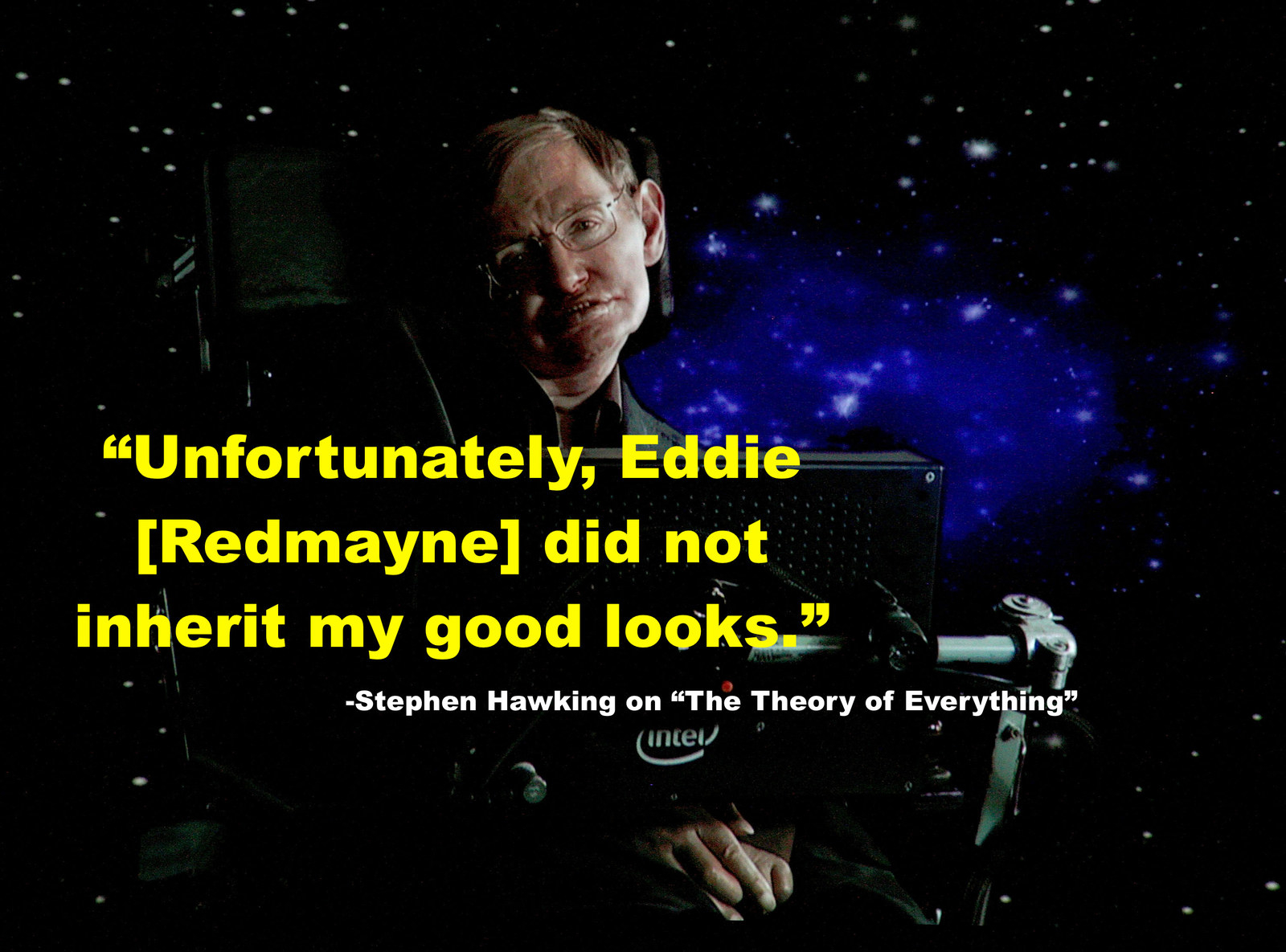
4. That time he gave his review of The Theory of Everything:

Frederick M. Brown / Getty Images

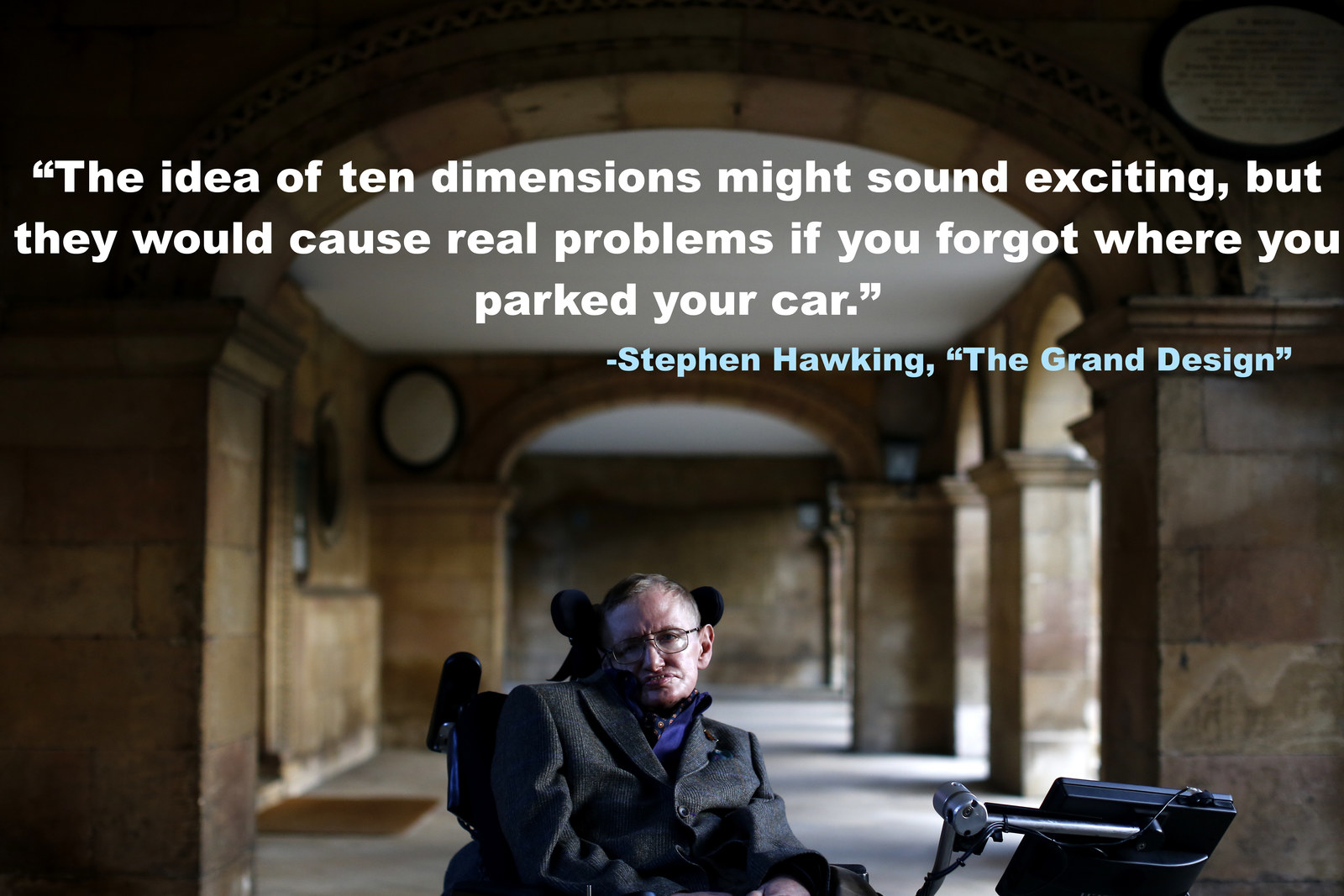
5. That time he told us the real issue with other dimensions.

Afp / AFP / Getty Images

6. That time Gordon Ramsay tried to be his new voice and got brutally shut down:

Comic Relief / Via youtube.com

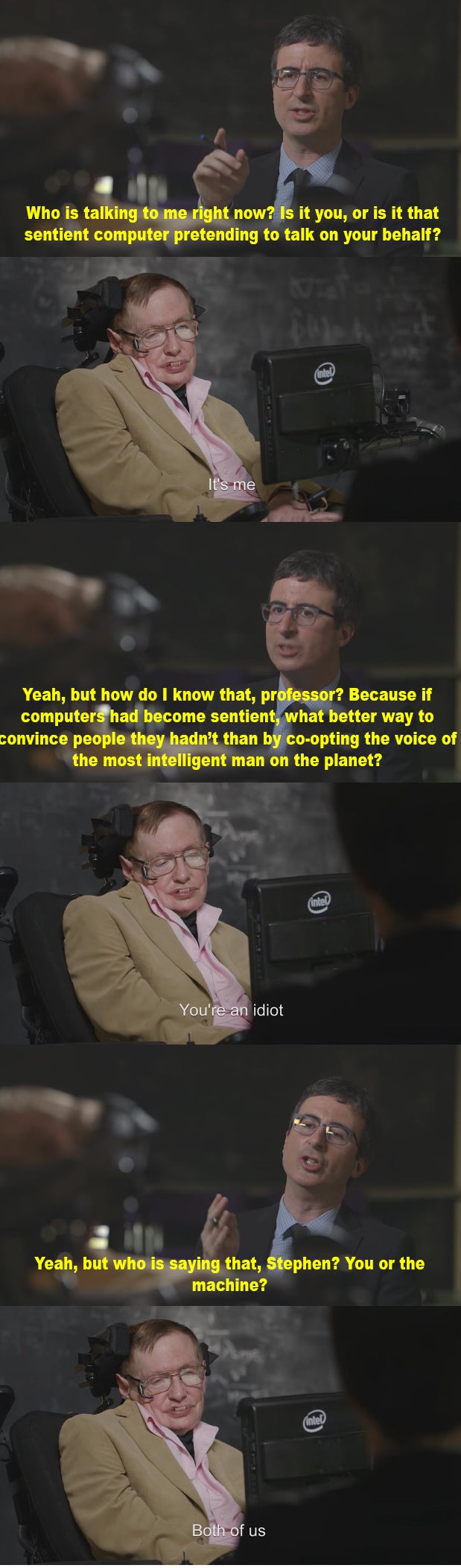
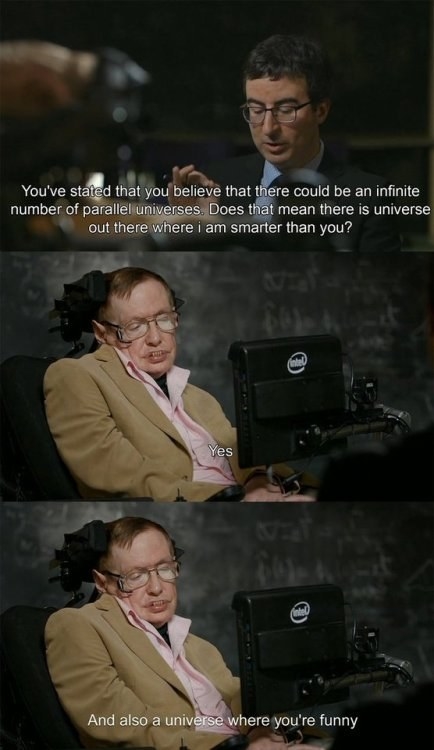
7. That time he owned John Oliver:

Last Week Tonight / Via youtube.com

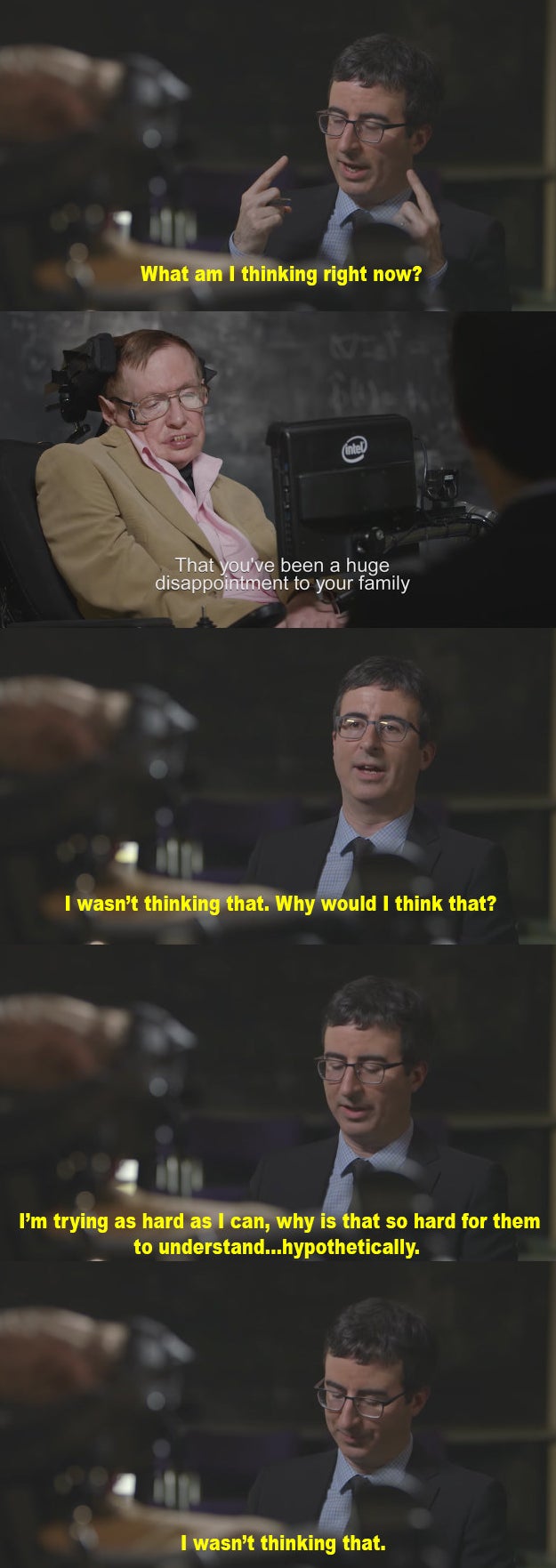
8. And this time:

Last Week Tonight / Via youtube.com

9. And then this time:

Last Week Tonight / Via youtube.com

10. And, you guessed it, this time:

Last Week Tonight / Via youtube.com

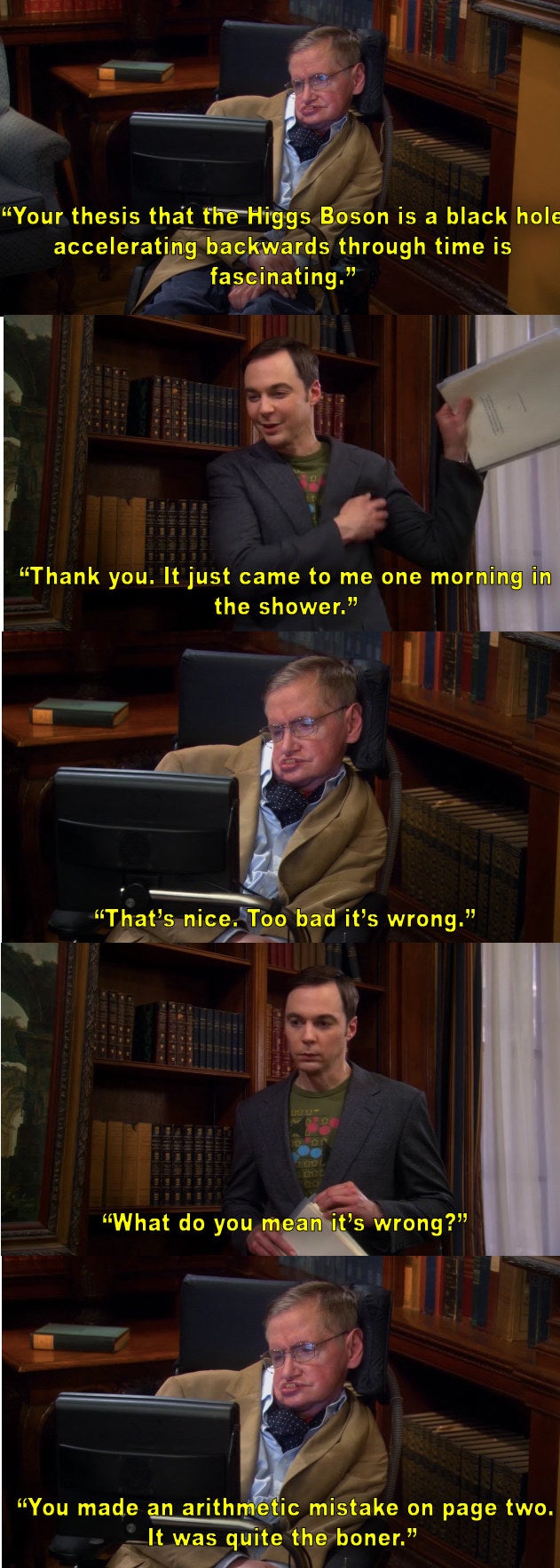
11. Plus, that time he owned Sheldon Cooper:

CBS

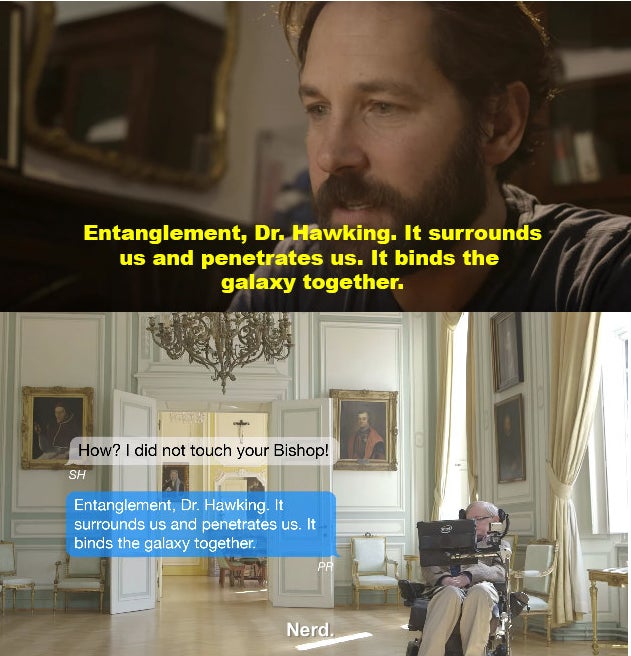
12. That time he called out Paul Rudd during a game of chess.

IQIM Caltech / Via boredpanda.com

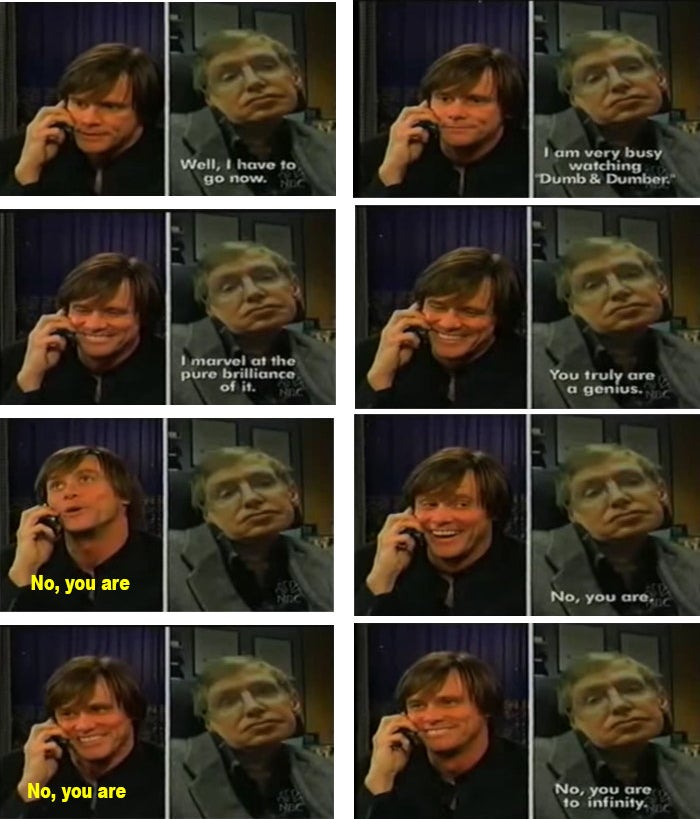
13. That time he complimented another genius.

TBS

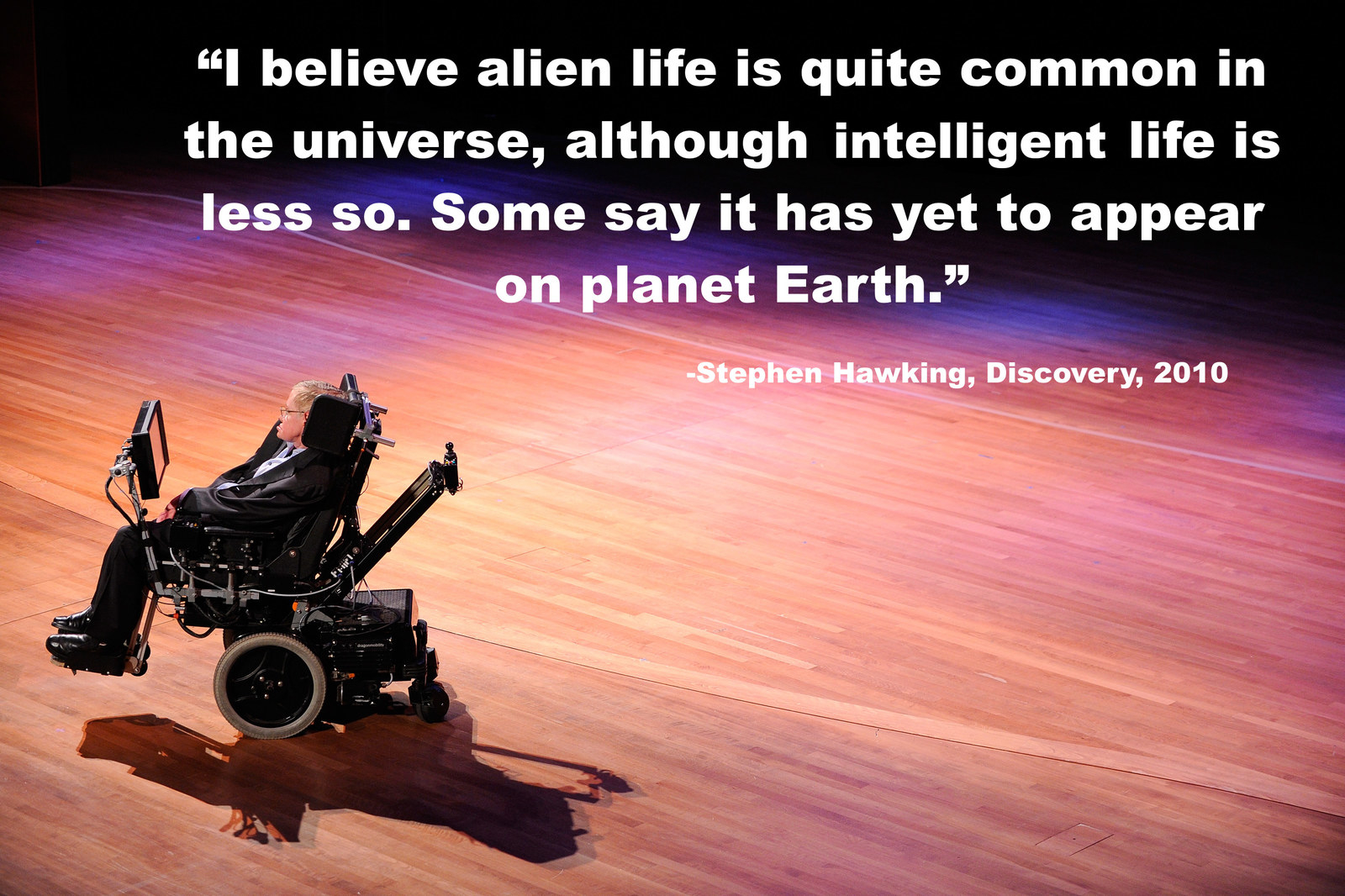
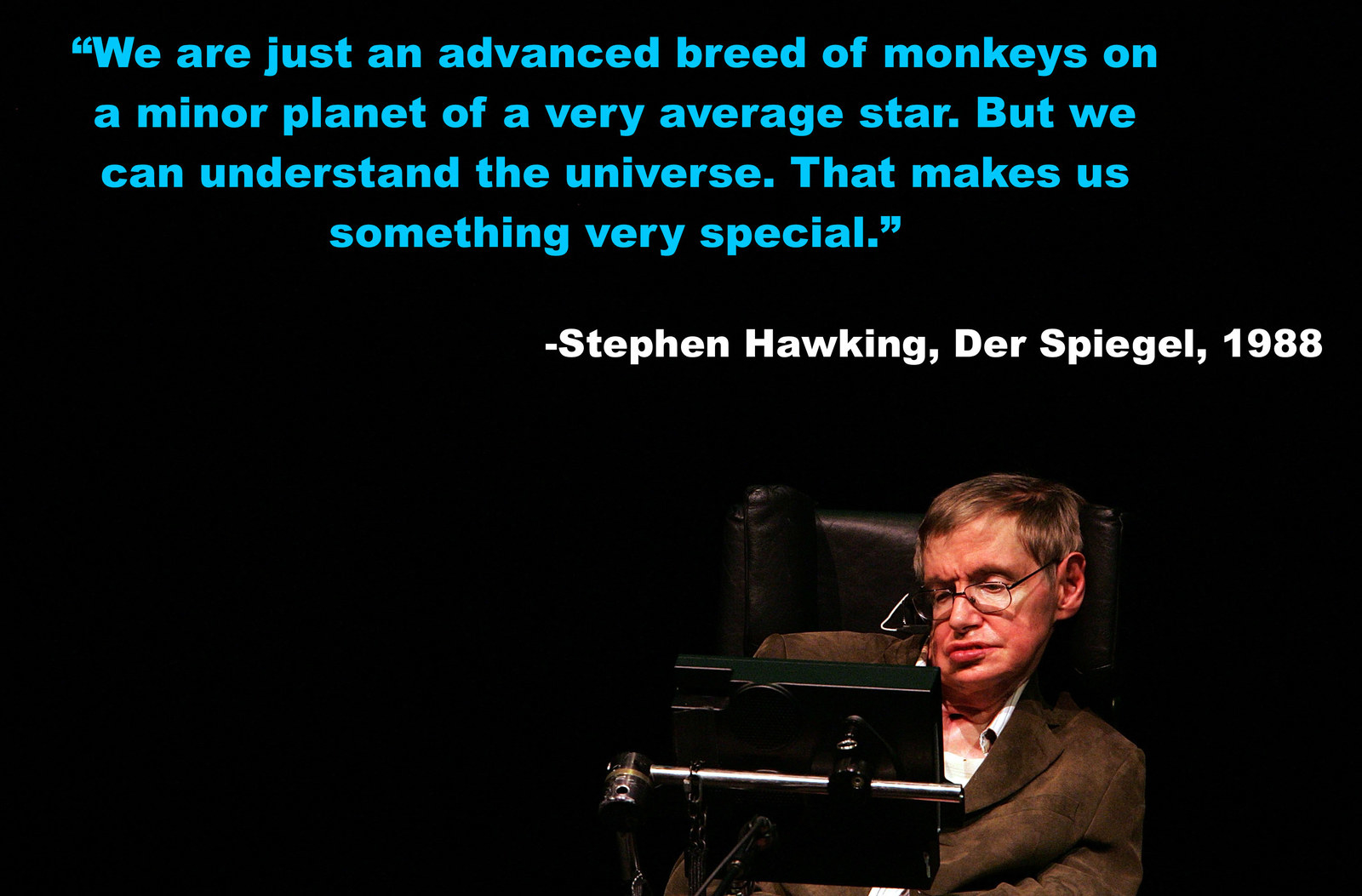
14. That time he kind of roasted humanity:

Jemal Countess / Getty Images

15. That time he had a party only for time travelers and nobody showed up.

wearestarstuff51 / Via youtube.com

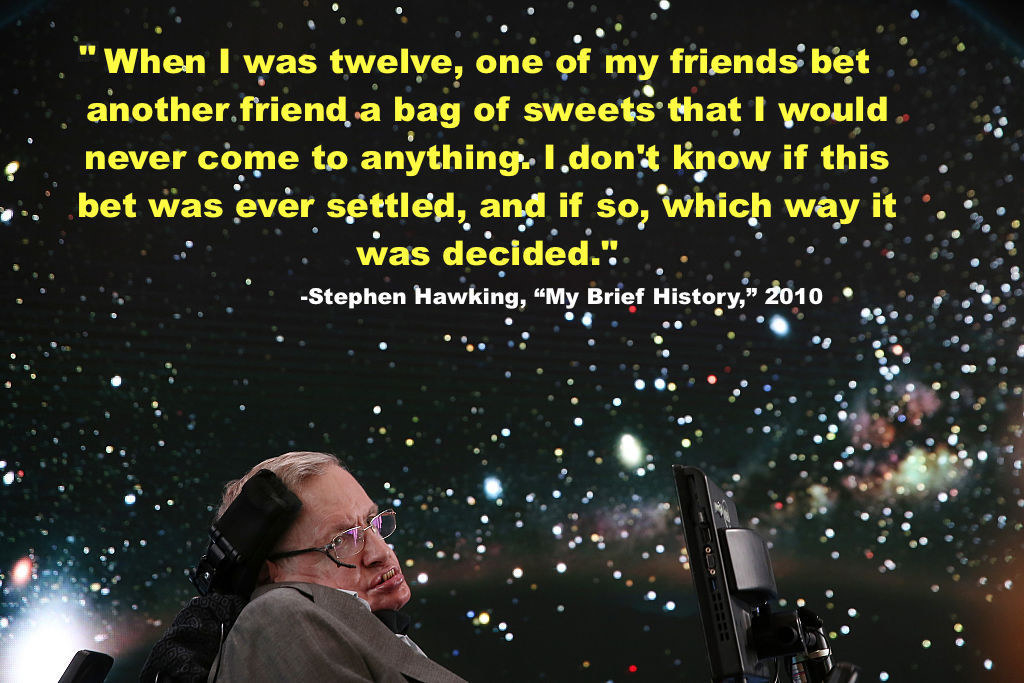
16. That time he really just wanted to know who won the bet.

Jemal Countess / Getty Images

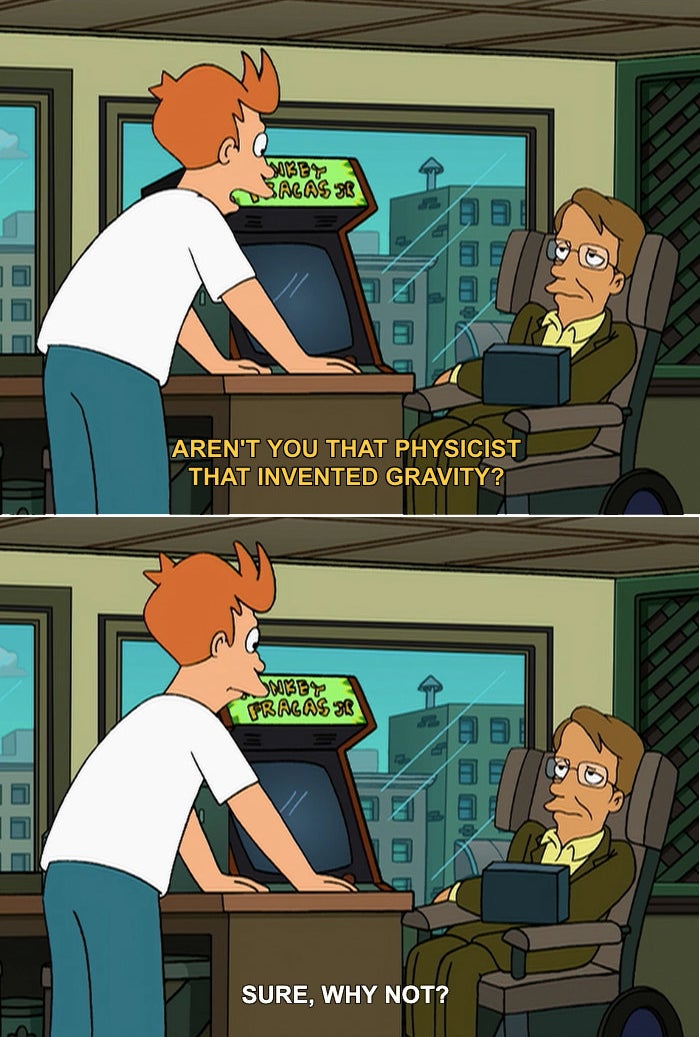
17. That time he went on Futurama as one of Al Gore’s Vice-Presidential Action Rangers.

Fox

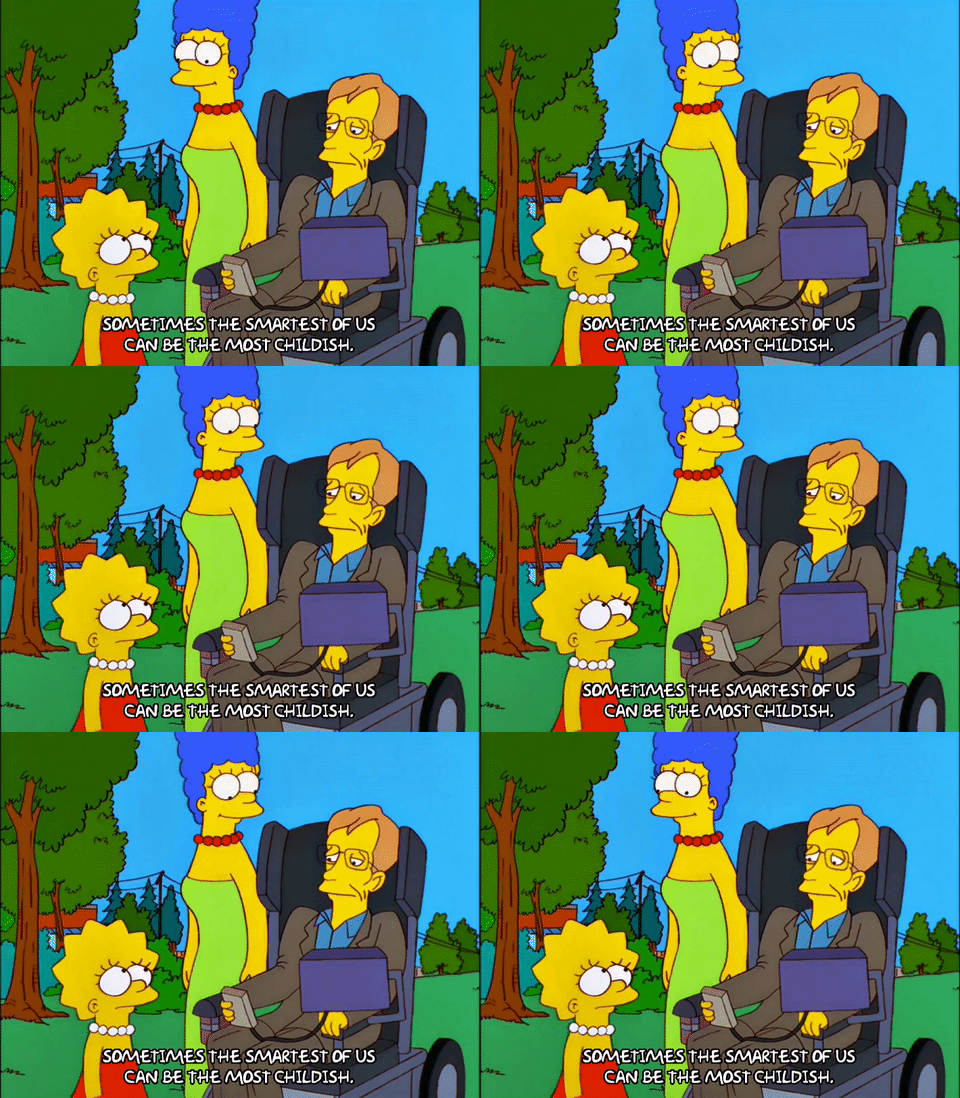
18. All of those times he shared his wisdom on The Simpsons:

Fox

Fox

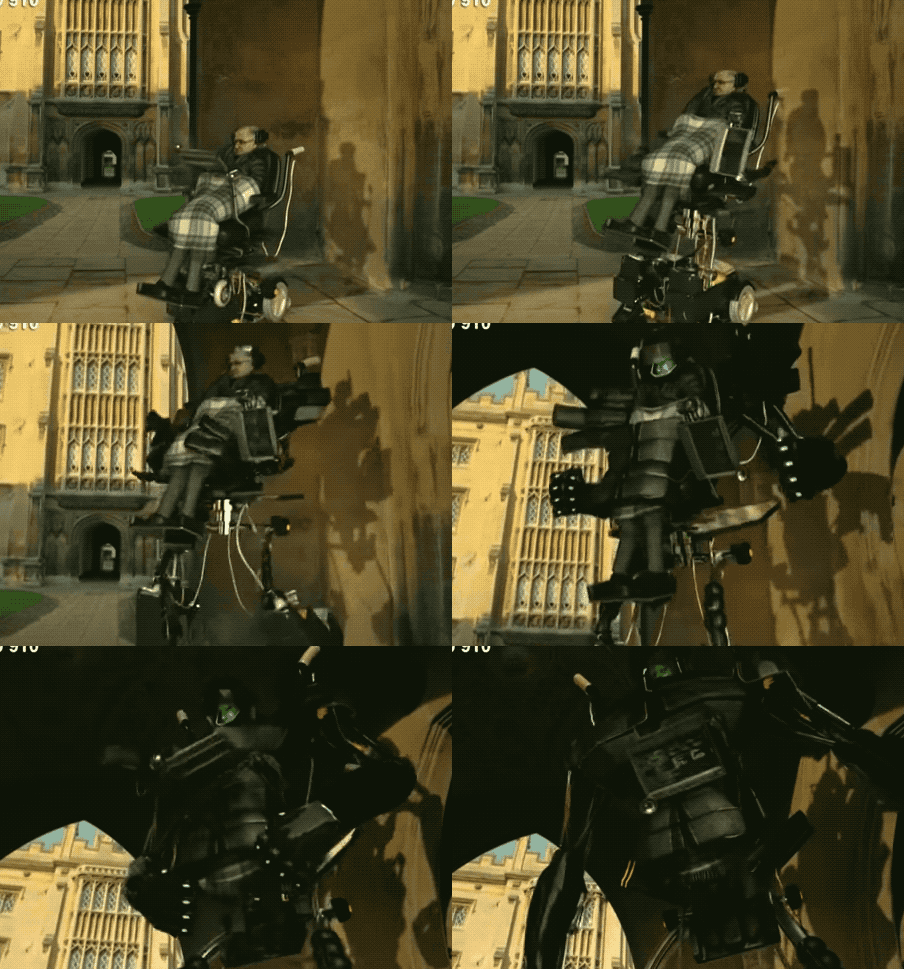
19. And finally, we should never forget about that time he turned into a literal Transformer for Red Nose Day:

BBC / Via youtube.com

Thank you, Dr. Hawking, for your brilliant mind and your great sense of humor.

Justin Sullivan / Getty Images
 (Submitted by Bruce King.)

BBC Documentary Proves Jesus Was A Buddhist Monk Named Issa Who Spent 16+ Years In India & Tibet (ewao.net)

What is the Ides of March and should we really beware of it?

Article Image
Julius Caesar on the Ides of March.


In the Shakespearean play Julius Caesar, a soothsayer or fortune teller warns the great general to, “Beware the Ides of March.” For the ancients, this was a time when a number of competing spiritual forces were battling it out. The superstitious Romans wouldn’t have taken on new business at this volatile time of year, never mind try to overthrow the Republic. Caesar’s tragic flaw in the Bard’s play is arrogance, if not megalomania. He ignores the clairvoyant’s two warnings and, in doing so, seals his blood-soaked fate.

As a result, the notion that March’s ides have a capricious and insidious nature has been cemented in the Western psyche. Case in point, consider the Ryan Gosling-George Clooney film. In The Ides of March, an idealistic communications operative working on a governor’s presidential bid is offered a desirable position with his opponent’s campaign. At the same time, he falls in love with an intern, who isn’t quite who she appears to be. With a star-studded cast including Philip Seymour Hoffman, Paul Giamatti, and Marissa Tomei, the film portrays what this infamous day stands for, a confluence of combative forces positioning themselves for supremacy.

So what is the Ides of March really and should we beware? And if so, how much? The word “ides” comes from Latin for “in the middle of.” So the ides was the exact middle day of each month. March was the first month of the year in the Roman calendar and as it took our satellite’s phases into account, the ides always fell on a full moon, which gave it even more supernatural clout. Unsurprisingly, this was the deadline in the Roman age for paying off one’s debts and settling affairs.

Symbolically, the weather plays its part. The sheer precariousness, coupled with the cabin fever we all feel after being cooped up all winter, adds to the volatility of this day. Unlike the dude, the weather doesn’t always abide. Mother Nature seems surprisingly irritable in the middle of March, if not outright bipolar. We can enjoy warmth and sunshine one day and fight arctic blasts the next.

Since Julius Caesar’s assassination, the Ides of March have been considered unlucky. But even before then it was thought a precarious day where anything, good or evil, could happen. Credit: Getty Images.

Several primary source documents show that Julius Caesar was indeed assassinated on March 15, 44 BCE. Since, the middle day of that month has always been considered unlucky. This is much like Friday the 13th, which is rumored to have been the day when all of the Knights Templar—a secretive and powerful order of crusading knights, were rounded up and burned at the stake. Some were indeed arrested on Friday Oct. 13, 1307, but they weren’t all executed right then and there.

Not all of the Templars had been apprehended by that date (and some argue several might have escaped). Historians say that Friday the 13th is a modern conception. Previous to the 20th century, 13 was an unlucky number and Friday an unlucky day, but the two weren’t married until the novel, Friday, the Thirteenth, was published in 1907. Since then, it’s changed our culture in many ways. Today, some hospitals don’t have any rooms numbered 13 on any floor. Many buildings lack a 14th floor as well.

We’ve also gotten two nearly impossible terms to pronounce terms, Paraskavedekatriaphobia and friggatriskaidekaphobia, each meaning an unnatural fear of Friday, the 13th. Triskaidekaphobia is fear of the number 13 in general. A rumor states that since the 13th apostle betrayed Jesus, this left a stain on the number, causing it to become unlucky. There’s no historical record of this, however.

1314, Jacques de Molay (c. 1244 – 1314), the 23rd and Last Grand Master of the Knights Templar, is led to the stake to burn for heresy. Credit: Getty Images.

Many great historical figures feared the number 13 including Napoleon, Herbert Hoover, and FDR. Roosevelt refused to travel on the 13th of any month and wouldn’t abide 13 guests for dinner. Besides politics and architecture, it’s impacted some country’s economies as well. For instance, in Paris, those who find they have 13 in their party can hire a quatorzieme, or a 14th guest.  Some say the Ides of March have had a similar effect on and culture our history.

Consider that on March 15, 1889, what’s known as the Samoan cyclone wiped out six warships, taking the lives of 200 sailors. Three of the ships were from the US, the other three Germany. While it was terribly unfortunate for those servicemen and their families, the upshot was the disaster may have averted war between the two nations, who were each looking to annex the Samoan Islands.

On March 15, 1917, Czar Nicholas II abdicated the throne, ending a royal dynasty that had lasted 304 years, and ushering in the Bolshevik era. The Romanovs would be held captive until July of the following year, when they were put in front of a firing squad and executed. During the Ides of March, 1939, Germany invaded Czechoslovakia, signaling that Hitler’s forces were on the move and growing more aggressive, instilling great anxiety across the world. Lastly, on March 15, 1971, CBS cancelled “The Ed Sullivan Show,” a staple of US television for the baby boomer generation and a program which introduced Americans to, among other cultural icons, Elvis Presley and The Beatles.

Want to know more about the event that started it all? Click here.

‘Mind over matter’: Stephen Hawking – obituary by Roger Penrose

Theoretical physicist who made revolutionary contributions to our understanding of the nature of the universe

Stephen Hawking dies aged 76

By

Wed 14 Mar 2018

Stephen Hawking at his office at the department of applied mathematics and theoretical physics at Cambridge University in 2005.
 Stephen Hawking at his office at the department of applied mathematics and theoretical physics at Cambridge University in 2005. Photograph: Murdo Macleod for the Guardian


The image of Stephen Hawking – who has died aged 76 – in his motorised wheelchair, with head contorted slightly to one side and hands crossed over to work the controls, caught the public imagination, as a true symbol of the triumph of mind over matter. As with the Delphic oracle of ancient Greece, physical impairment seemed compensated by almost supernatural gifts, which allowed his mind to roam the universe freely, upon occasion enigmatically revealing some of its secrets hidden from ordinary mortal view.

Of course, such a romanticised image can represent but a partial truth. Those who knew Hawking would clearly appreciate the dominating presence of a real human being, with an enormous zest for life, great humour, and tremendous determination, yet with normal human weaknesses, as well as his more obvious strengths. It seems clear that he took great delight in his commonly perceived role as “the No 1 celebrity scientist”; huge audiences would attend his public lectures, perhaps not always just for scientific edification.

The scientific community might well form a more sober assessment. He was extremely highly regarded, in view of his many greatly impressive, sometimes revolutionary, contributions to the understanding of the physics and the geometry of the universe.

Hawking had been diagnosed shortly after his 21st birthday as suffering from an unspecified incurable disease, which was then identified as the fatal degenerative motor neurone disease amyotrophic lateral sclerosis, or ALS. Soon afterwards, rather than succumbing to depression, as others might have done, he began to set his sights on some of the most fundamental questions concerning the physical nature of the universe. In due course, he would achieve extraordinary successes against the severest physical disabilities. Defying established medical opinion, he managed to live another 55 years.

His background was academic, though not directly in mathematics or physics. His father, Frank, was an expert in tropical diseases and his mother, Isobel (nee Walker), was a free-thinking radical who had a great influence on him. He was born in Oxford and moved to St Albans, Hertfordshire, at eight. Educated at St Albans school, he won a scholarship to study physics at University College, Oxford. He was recognised as unusually capable by his tutors, but did not take his work altogether seriously. Although he obtained a first-class degree in 1962, it was not a particularly outstanding one.

Sciama seemed to know everything that was going on in physics at the time, especially in cosmology, and he conveyed an infectious excitement to all who encountered him. He was also very effective in bringing together people who might have things of significance to communicate with one another.

When Hawking was in his second year of research at Cambridge, I (at Birkbeck College in London) had established a certain mathematical theorem of relevance. This showed, on the basis of a few plausible assumptions (by the use of global/topological techniques largely unfamiliar to physicists at the time) that a collapsing over-massive star would result in a singularity in space-time – a place where it would be expected that densities and space-time curvatures would become infinite – giving us the picture of what we now refer to as a “black hole”. Such a space-time singularity would lie deep within a “horizon”, through which no signal or material body can escape. (This picture had been put forward by J Robert Oppenheimer and Hartland Snyder in 1939, but only in the special circumstance where exact spherical symmetry was assumed. The purpose of this new theorem was to obviate such unrealistic symmetry assumptions.) At this central singularity, Einstein’s classical theory of general relativity would have reached its limits.

Meanwhile, Hawking had also been thinking about this kind of problem with George Ellis, who was working on a PhD at St John’s College, Cambridge. The two men had been working on a more limited type of “singularity theorem” that required an unreasonably restrictive assumption. Sciama made a point of bringing Hawking and me together, and it did not take Hawking long to find a way to use my theorem in an unexpected way, so that it could be applied (in a time-reversed form) in a cosmological setting, to show that the space-time singularity referred to as the “big bang” was also a feature not just of the standard highly symmetrical cosmological models, but also of any qualitatively similar but asymmetrical model.

A powerful body of mathematical work known as Morse theory had been part of the machinery of mathematicians active in the global (topological) study of Riemannian spaces. However, the spaces that are used in Einstein’s theory are really pseudo-Riemannian and the relevant Morse theory differs in subtle but important ways. Hawking developed the necessary theory for himself (aided, in certain respects, by Charles Misner, Robert Geroch and Brandon Carter) and was able to use it to produce new theorems of a more powerful nature, in which the assumptions of my theorem could be considerably weakened, showing that a big-bang-type singularity was a necessary implication of Einstein’s general relativity in broad circumstances.

A few years later (in a paper published by the Royal Society in 1970, by which time Hawking had become a fellow “for distinction in science” of Gonville and Caius College, Cambridge), he and I joined forces to publish an even more powerful theorem which subsumed almost all the work in this area that had gone before.

In 1967, Werner Israel published a remarkable paper that had the implication that non-rotating black holes, when they had finally settled down to become stationary, would necessarily become completely spherically symmetrical. Subsequent results by Carter, David Robinson and others generalised this to include rotating black holes, the implication being that the final space-time geometry must necessarily accord with an explicit family of solutions of Einstein’s equations found by Roy Kerr in 1963. A key ingredient to the full argument was that if there is any rotation present, then there must be complete axial symmetry. This ingredient was basically supplied by Hawking in 1972.

The very remarkable conclusion of all this is that the black holes that we expect to find in nature have to conform to this Kerr geometry. As the great theoretical astrophysicist Subramanyan Chandrasekhar subsequently commented, black holes are the most perfect macroscopic objects in the universe, being constructed just out of space and time; moreover, they are the simplest as well, since they can be exactly described by an explicitly known geometry (that of Kerr).

Following his work in this area, Hawking established a number of important results about black holes, such as an argument for its event horizon (its bounding surface) having to have the topology of a sphere. In collaboration with Carter and James Bardeen, in work published in 1973, he established some remarkable analogies between the behaviour of black holes and the basic laws of thermodynamics, where the horizon’s surface area and its surface gravity were shown to be analogous, respectively, to the thermodynamic quantities of entropy and temperature. It would be fair to say that in his highly active period leading up to this work, Hawking’s research in classical general relativity was the best anywhere in the world at that time.

Hawking, Bardeen and Carter took their “thermodynamic” behaviour of black holes to be little more than just an analogy, with no literal physical content. A year or so earlier, Jacob Bekenstein had shown that the demands of physical consistency imply – in the context of quantum mechanics – that a black hole must indeed have an actual physical entropy (“entropy” being a physicist’s measure of “disorder”) that is proportional to its horizon’s surface area, but he was unable to establish the proportionality factor precisely. Yet it had seemed, on the other hand, that the physical temperature of a black hole must be exactly zero, inconsistently with this analogy, since no form of energy could escape from it, which is why Hawking and his colleagues were not prepared to take their analogy completely seriously.

Hawking had then turned his attention to quantum effects in relation to black holes, and he embarked on a calculation to determine whether tiny rotating black holes that might perhaps be created in the big bang would radiate away their rotational energy. He was startled to find that irrespective of any rotation they would radiate away their energy – which, by Einstein’s E=mc2, means their mass. Accordingly, any black hole actually has a non-zero temperature, agreeing precisely with the Bardeen-Carter-Hawking analogy. Moreover, Hawking was able to supply the precise value “one quarter” for the entropy proportionality constant that Bekenstein had been unable to determine.

This radiation coming from black holes that Hawking predicted is now, very appropriately, referred to as Hawking radiation. For any black hole that is expected to arise in normal astrophysical processes, however, the Hawking radiation would be exceedingly tiny, and certainly unobservable directly by any techniques known today. But he argued that very tiny black holes could have been produced in the big bang itself, and the Hawking radiation from such holes would build up into a final explosion that might be observed. There appears to be no evidence for such explosions, showing that the big bang was not so accommodating as Hawking wished, and this was a great disappointment to him.

These achievements were certainly important on the theoretical side. They established the theory of black-hole thermodynamics: by combining the procedures of quantum (field) theory with those of general relativity, Hawking established that it is necessary also to bring in a third subject, thermodynamics. They are generally regarded as Hawking’s greatest contributions. That they have deep implications for future theories of fundamental physics is undeniable, but the detailed nature of these implications is still a matter of much heated debate.

Hawking himself was able to conclude from all this (though not with universal acceptance by particle physicists) that those fundamental constituents of ordinary matter – the protons – must ultimately disintegrate, although with a decay rate that is beyond present-day techniques for observing it. He also provided reasons for suspecting that the very rules of quantum mechanics might need modification, a viewpoint that he seemed originally to favour. But later (unfortunately, in my own opinion) he came to a different view, and at the Dublin international conference on gravity in July 2004, he publicly announced a change of mind (thereby conceding a bet with the Caltech physicist John Preskill) concerning his originally predicted “information loss” inside black holes.

Following his black-hole work, Hawking turned his attentions to the problem of quantum gravity, developing ingenious ideas for resolving some of the basic issues. Quantum gravity, which involves correctly imposing the quantum procedures of particle physics on to the very structure of space-time, is generally regarded as the most fundamental unsolved foundational issue in physics. One of its stated aims is to find a physical theory that is powerful enough to deal with the space-time singularities of classical general relativity in black holes and the big bang.

Hawking’s work, up to this point, although it had involved the procedures of quantum mechanics in the curved space-time setting of Einstein’s general theory of relativity, did not provide a quantum gravity theory. That would require the “quantisation” procedures to be applied to Einstein’s curved space-time itself, not just to physical fields within curved space-time.

With James Hartle, Hawking developed a quantum procedure for handling the big-bang singularity. This is referred to as the “no-boundary” idea, whereby the singularity is replaced by a smooth “cap”, this being likened to what happens at the north pole of the Earth, where the concept of longitude loses meaning (becomes singular) while the north pole itself has a perfectly good geometry.

To make sense of this idea, Hawking needed to invoke his notion of “imaginary time” (or “Euclideanisation”), which has the effect of converting the “pseudo-Riemannian” geometry of Einstein’s space-time into a more standard Riemannian one. Despite the ingenuity of many of these ideas, grave difficulties remain (one of these being how similar procedures could be applied to the singularities inside black holes, which is fundamentally problematic).

There are many other approaches to quantum gravity being pursued worldwide, and Hawking’s procedures, though greatly respected and still investigated, are not the most popularly followed, although all others have their share of fundamental difficulties also.

To the end of his life, Hawking continued with his research into the quantum-gravity problem, and the related issues of cosmology. But concurrently with his strictly research interests, he became increasingly involved with the popularisation of science, and of his own ideas in particular. This began with the writing of his astoundingly successful book A Brief History of Time (1988), which was translated into some 40 languages and sold over 25m copies worldwide.

Undoubtedly, the brilliant title was a contributing factor to the book’s phenomenal success. Also, the subject matter is something that grips the public imagination. And there is a directness and clarity of style, which Hawking must have developed as a matter of necessity when trying to cope with the limitations imposed by his physical disabilities. Before needing to rely on his computerised speech, he could talk only with great difficulty and expenditure of effort, so he had to do what he could with short sentences that were directly to the point. In addition, it is hard to deny that his physical condition must itself have caught the public’s imagination.

Although the dissemination of science among a broader public was certainly one of Hawking’s aims in writing his book, he also had the serious purpose of making money. His financial needs were considerable, as his entourage of family, nurses, healthcare helpers and increasingly expensive equipment demanded. Some, but not all, of this was covered by grants.

To invite Hawking to a conference always involved the organisers in serious calculations. The travel and accommodation expenses would be enormous, not least because of the sheer number of people who would need to accompany him. But a popular lecture by him would always be a sell-out, and special arrangements would be needed to find a lecture hall that was big enough. An additional factor would be the ensuring that all entrances, stairways, lifts, and so on would be adequate for disabled people in general, and for his wheelchair in particular.

He clearly enjoyed his fame, taking many opportunities to travel and to have unusual experiences (such as going down a mine shaft, visiting the south pole and undergoing the zero-gravity of free fall), and to meet other distinguished people.

The presentational polish of his public lectures increased with the years. Originally, the visual material would be line drawings on transparencies, presented by a student. But in later years impressive computer-generated visuals were used. He controlled the verbal material, sentence by sentence, as it would be delivered by his computer-generated American-accented voice. High-quality pictures and computer-generated graphics also featured in his later popular books The Illustrated Brief History of Time (1996) and The Universe in a Nutshell (2001). With his daughter Lucy he wrote the expository children’s science book George’s Secret Key to the Universe (2007), and he served as an editor, co-author and commentator for many other works of popular science.

He received many high accolades and honours. In particular, he was elected a fellow of the Royal Society at the remarkably early age of 32 and received its highest honour, the Copley medal, in 2006. In 1979, he became the 17th holder of the Lucasian chair of natural philosophy in Cambridge, some 310 years after Sir Isaac Newton became its second holder. He became a Companion of Honour in 1989. He made a guest appearance on the television programme Star Trek: The Next Generation, appeared in cartoon form on The Simpsons and was portrayed in the movie The Theory of Everything (2014).

It is clear that he owed a great deal to his first wife, Jane Wilde, whom he married in 1965, and with whom he had three children, Robert, Lucy and Timothy. Jane was exceptionally supportive of him in many ways. One of the most important of these may well have been in allowing him to do things for himself to an unusual extent.

He was an extraordinarily determined person. He would insist that he should do things for himself. This, in turn, perhaps kept his muscles active in a way that delayed their atrophy, thereby slowing the progress of the disease. Nevertheless, his condition continued to deteriorate, until he had almost no movement left, and his speech could barely be made out at all except by a very few who knew him well.

He contracted pneumonia while in Switzerland in 1985, and a tracheotomy was necessary to save his life. Strangely, after this brush with death, the progress of his degenerative disease seemed to slow to a virtual halt. His tracheotomy prevented any form of speech, however, so that acquiring a computerised speech synthesiser came as a necessity at that time.

In the aftermath of his encounter with pneumonia, the Hawkings’ home was almost taken over by nurses and medical attendants, and he and Jane drifted apart. They were divorced in 1995. In the same year, Hawking married Elaine Mason, who had been one of his nurses. Her support took a different form from Jane’s. In his far weaker physical state, the love, care and attention that she provided sustained him in all his activities. Yet this relationship also came to an end, and he and Elaine were divorced in 2007.

Despite his terrible physical circumstance, he almost always remained positive about life. He enjoyed his work, the company of other scientists, the arts, the fruits of his fame, his travels. He took great pleasure in children, sometimes entertaining them by swivelling around in his motorised wheelchair. Social issues concerned him. He promoted scientific understanding. He could be generous and was very often witty. On occasion he could display something of the arrogance that is not uncommon among physicists working at the cutting edge, and he had an autocratic streak. Yet he could also show a true humility that is the mark of greatness.

Hawking had many students, some of whom later made significant names for themselves. Yet being a student of his was not easy. He had been known to run his wheelchair over the foot of a student who caused him irritation. His pronouncements carried great authority, but his physical difficulties often caused them to be enigmatic in their brevity. An able colleague might be able to disentangle the intent behind them, but it would be a different matter for an inexperienced student.

To such a student, a meeting with Hawking could be a daunting experience. Hawking might ask the student to pursue some obscure route, the reason for which could seem deeply mysterious. Clarification was not available, and the student would be presented with what seemed indeed to be like the revelation of an oracle – something whose truth was not to be questioned, but which if correctly interpreted and developed would surely lead onwards to a profound truth. Perhaps we are all left with this impression now.

Hawking is survived by his children.

 Stephen William Hawking, physicist, born 8 January 1942; died 14 March 2018, aged 76.

Poem by Christina Rossetti

Up-Hill


Does the road wind up-hill all the way?
   Yes, to the very end.
Will the day’s journey take the whole long day?
   From morn to night, my friend.
But is there for the night a resting-place?
   A roof for when the slow dark hours begin.
May not the darkness hide it from my face?
   You cannot miss that inn.
Shall I meet other wayfarers at night?
   Those who have gone before.
Then must I knock, or call when just in sight?
   They will not keep you standing at that door.
Shall I find comfort, travel-sore and weak?
   Of labour you shall find the sum.
Will there be beds for me and all who seek?
   Yea, beds for all who come.

Rufus Jones on the deeper stratum of our being


“Nevertheless, I am firmly convinced that there is an unfathomable depth of inward Godlike being at man’s spiritual centre which is the taproot of human self- consciousness and which is unsundered from this Over-World which we call God. Deeper than our faculties, more fundamental than our ideas, or our images, or our volitions, is this subsoil root of our being, this essence of the soul, this core of personality, which is indissolubly connected with a higher world of reality and is the ground of mystical experience.

“This deeper stratum of our being can, like a taste for art, or like appreciation of music, be cultivated, made quick and sensitive, and it can become a transmissive medium of the highest significance, or it can be buried deep under the piles of rubbish which merely secular pursuits or a life of pleasure-seeking may accumulate.

If teachers and trainers of children generally held this high faith, and saw vividly the potency of the interior centre of the soul; if, knowing its importance they developed an adequate technique for cultivating its powers, we might some day have a different race of men, ‘no longer half-akin to brute’ but capable of having a kingdom of God within them.” (p.208)

–Rufus Jones from “The Testimony of the Soul”

Book: “Neurosis and Human Growth”

Neurosis and Human Growth: The Struggle Towards Self-Realization

Neurosis and Human Growth: The Struggle Towards Self-Realization

by Karen HorneyJeffrey Rubin (Foreword by)Stephanie Steinfeld(Foreword by)

Karen Horney was born in Hamburg, Germany, in 1885 and studied at the University of Berlin, receiving her medical degree in 1913. From 1914 to 1918 she studied psychiatry at Berlin-Lankwitz, Germany, and from 1918 to 1932 taught at the Berlin Psychoanalytic Institute. She participated in many international congresses, among them the historic discussion of lay analysis, chaired by Sigmund Freud.

Dr. Horney came to the United States in 1932 and for two years was Associate Director of the Psychoanalytic Institute, Chicago. In 1934 she came to New York and was a member of the teaching staff of the New York Psychoanalytic Institute until 1941, when she became one of the founders of the Association for the Advancement of Psychoanalysis and the American Institute for Psychoanalysis.

In Neurosis and Human Growth, Dr. Horney discusses the neurotic process as a special form of the human development, the antithesis of healthy growth. She unfolds the different stages of this situation, describing neurotic claims, the tyranny or inner dictates and the neurotic’s solutions for relieving the tensions of conflict in such emotional attitudes as domination, self-effacement, dependency, or resignation. Throughout, she outlines with penetrating insight the forces that work for and against the person’s realization of his or her potentialities.

This 40th Anniversary Edition includes a new preface by Stephanie Steinfeld, Ph.D., and Jeffrey Rubin, M.D., of the American Institute for Psychoanalysis.

The Holy Equation Exercise: The Fundamental Key To Inner Work

“You can take force from your animal and give it to Being.” (Gurdjieff to Kathryn Hulme)


The Holy Equation is the basic pattern of all Inner Work and is based on the Law of Three – “The higher blends with the lower to actualize the middle, which becomes lower for the next higher or higher for the previous lower.”  The middle is the Reconciling energy which is coated on the Higher Being Bodies. This process is spoken of by Gurdjieff early in his Teaching career in the unpublished Enneagram Lecture, which was the basis for Chapter 14 of In Search of the Miraculous by Ouspensky :

“A great dispute, if it is not purposeless, must give a result, a conclusion and an effect, and then four elements will be available: yes, no, dispute, result; that is, the transmutation of the binary into the quaternary. That is the first half of the formula. The second part of it speaks for itself and thereby points out the direction of the solution.”

Gurdjieff makes many references to this process in Beelzebub’s Tales. Here is one of them :

In other words, every wish of the planetary body is taken as undesirable for their higher divine part which has to be coated and perfected, and therefore all three-centered beings of our Great Megaloscosmos constantly carry on a relentless struggle against the wishes of their planetary bodies so that there should be formed in them, in this struggle from the what is called ‘Disputekrialnian-friction,’ those sacred crystallizations from which their higher Divine being-part arises and is perfected in them.”
“In this constant struggle of theirs, the equilibrating harmonizing principle is their second being-body, which in their own individual law of Triamazikamno represents the neutralizing source; and therefore this second being-part always remains indifferent to their mechanical manifestations, but for all their active manifestations it always tends according to the second-grade cosmic law ‘Urdekhplifata’ to unite with those desires of which there are more whether in one or the other of the two mentioned opposite being-parts. (3)

This is the Holy Equation, also known as the Holy Affirming Prayer, from Beelzebub’s Tales :

Holy-Affirming,
Holy-Denying,
Holy-Reconciling,
Transubstantiate in me,
For my Being.

“This is a prayer given to us. In it I have found what I call the Holy Equation which provides us with a basic pattern for most of our work. Holy Denying equals our inherited mechanical “myself” manifested by our habits, traits, thoughts, feelings and actions in sleep. Holy Affirming is our conscious effort to accept, endure and to meet with objectivity all our Holy Denyings. Holy Reconciling is the resultant of them both leading automatically to a Transubstantiation. By self-observation we learn to recognize accurately our Holy Denyings to which we then eventually apply our Holy Affirming.”
“We understand the ordinary pursuits of our lives responding to desires to be educated, well thought of, useful, admired, superior, wealthy or spiritual, as examples of Holy Denyings. We try to meet these denyings with our conscious efforts in our search which we call Holy Affirming. Both are of equal substance and importance.”
(Paul Beidler)

“Try to understand that resistance is according to law. If there is no resistance, there can be no struggle; there can be no new energy. Without production of new energy, there can be no possible contact with higher levels in ourselves. Struggle has to be accepted as the only means that we have for producing energy. Each time that we have a little new possibility is that a spark of another kind of energy has linked us with a different level of ourselves. Every moment of our asleep life we are like a man shut in the basement of a very big house who has no idea there is anything else than that dark, bad smelling basement he is used to. As soon as that spark of energy is used up, he is bound to find himself again in that basement. Struggle is necessary – there is resistance – and then I affirm more.” (Inside a Question: Works of Henriette Lannes, Pupil of G.I. Gurdjieff, p.200)

***

Step by Step Explanation

1. Observing a Holy Denying force of desire or suffering : During our daily life we will experience situations and desires that cause suffering. The basis of suffering is the Holy Denying Force of the planetary body, as manifested through its urges, instincts, desires, wishes, and psychological and social drives. Some of these are attributable to Kundabuffer or our inherent and acquired egoism and personality. Other Denying Forces may even derive from Essence. Some examples are given above and on this page.

When, by Self Observation, we notice or recognize the manifestation of a Holy Denying suffering or trait in the course of daily life, we need to acknowledge its presence by naming it, such as ‘this is anger’ or ‘this is a denying force’, etc. We need to Sense its energy in our body. We need to feel its emotional expression. We need to observe the thoughts that accompany it and justify it. In the beginning we may need to allow the Denying force to express itself in action in order to observe all its characteristics, but the ultimate goal is the non-expression of the negativity.

We are a living representation of the Law of Three and by this first step we are experiencing one of the expressions or terms, the Denying one, of the holy equation of energy transformation according to the Law of Three.

2. Holy Affirming of the energy spent by the Holy Denying force of desire or suffering : There are several aspects to this step of the equation, which involves bringing in the second expression or term of the equation, the Affirming one.

One way of Affirming this Holy Denying suffering is to acknowledge that the Holy Denying force is a law conformable and necessary aspect of the universe created by His Endlessness.

Another aspect of Affirmation of the Denying energy is to channel the energy into another activity. We can use the energy to exercise self-restraint to prevent the manifestation the Denying force. We can accept or bear the suffering without complaint. We can employ an Affirmation exercise such as Sensing a part of the body or repeating a mantra or verbal affirmation as suggested on the Affirmation Exercise page.

3. Holy Reconciled Transubstantiation of the energies of Affirming and Denying : This step is the third and final part of the equation of the transformation of energy according to the Law of Three. This step yields the Reconciled result of the blending of the higher Affirming with the lower Denying.

The result will depend on whether the higher and lower forces were equally balanced. If the Affirmation is not strong enough, the Denying force will predominate and we will be captured by our Identification with the suffering and its manifestation will proceed to varying degrees, depending on the strength of the Affirmation. In other words, the Reconciling energy will become higher for a succeeding lower purpose, that of allowing the physical manifestation of the denying force.

If the Affirmation is strong enough to counter the Denying force, a balanced impartiality will be the outcome and some of the Reconciling energy will gravitate towards the center of gravity of our higher being bodies. In other words, the Reconciling energy will become lower for a succeeding higher purpose of coating the higher being bodies.

The Endless Search © 2004 – 2017 Ian C. MacFarlane

(endlesssearch.co.uk)

(Inspired by Ugur Yilmaz.)

Consciousness, sexuality, androgyny, futurism, space, the arts, science, astrology, democracy, humor, books, movies and more