
A while back mentioned what I consider to be the Lesson of the Skin Horse in a comment relating to Notre Dame, and I promised Mike I’d post something about it. To paraphrase Arlo Guthrie, just had to wait for it to come ’round again…
As I mentioned in my reply to Mike’s question, this passage from The Velveteen Rabbit, by Margery Williams, was one of Billye’s favorite things, and, if memory serves, she read it sometime during the course of every RHS class she ever taught.
Here it is:
The Skin Horse had lived longer in the nursery than any of the others. He was so old that his brown coat was bald in patches and showed seams underneath, and most of the hairs in his tail had been pulled out to string bead necklaces. He was wise, for he had seen a long succession of mechanical toys arrive to boast and swagger, and by-and-by break their mainsprings and pass away, and he knew that they were only toys, and would never turn into anything else. For nursery magic is very strange and wonderful, and only those playthings that are old and wise and experienced like the Skin Horse understood all about it.
“What is REAL?” asked the Rabbit one day, when they were lying side by side near the nursery fender, before Nana came to tidy the room. “Does it mean having things that buzz inside you and a stick-out handle?”
“Real isn’t how you’re made,” said the Skin Horse. “It’s a thing that happens to you. When a child loves you for a long, long time, not just to play with, but REALLY loves you, then you become real.”
“Dose it hurt?” asked the Rabbit.
“Sometimes,” said the Skin Horse, for he was always truthful. “when you’re real you don’t mind being hurt.”
“Does it happen all at once, like being wound up,” he asked, “or bit by bit?”
“It doesn’t happen all at once,” Said the Skin Horse. “You become. It takes a long time. That’s why it doesn’t happen to people who break easily or have sharp edges, or who have to be carefully kept. Generally, by the time you are Real, most of your hair has been loved off, and your eyes drop out and you get loose in the joints and very shabby. But these things don’t matter at all, because once you’re Real, you can’t be ugly, except to people who don’t understand.”
*
As I mentioned in my first comment back then, it was André Malraux (I think! – having the deucedest of a time confirming this…) who said that, rather than a building, Notre Dame is a person. I’d think that this is due to something very much like the process described above, with millions of people over an expanse of many centuries loving – indeed adoring, worshiping – Notre Dame.
On a more personal note, my relationship with Notre Dame goes back to late September, or maybe early October, of 1958. I was nine years old, and, along with my parents (of course!), had just arrived in Paris. And visiting Notre Dame was pretty much the first thing we did in that vast and bewildering new city.
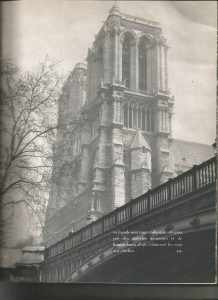
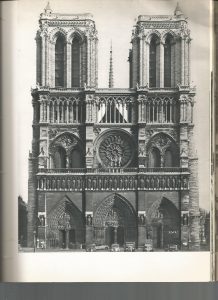
The exterior of the Notre Dame was, back then – like the rest of Paris in those days – black with soot, except for the parts which were higher or protruded a bit from the main structure; though more tactful people were calling the darker parts “charcoal” – one book from that period even refers to Paris as “a symphony in grey”. I’d just come from the US of the 1950s, where everything was modern-new and squeaky-clean, and Disneyland was considered – at least among most of the kids I knew – to be about the coolest thing there ever was. And now here was this building, this cathedral, which was supposed to be so beautiful, but it was all old and worn and crumbly and covered with black soot – so about as far from squeaky-clean as one might get.
Was I put off by this? Hardly! I was fascinated – curious to understand exactly what the deal was.
On the way in, to either side of the door we passed two lines of statues carved into the doorjamb. They were all long and thin and seemed almost to hang there. One of them was carrying his detached head in his hands, his neck just a stump.
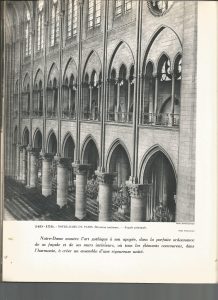
Inside, there was less soot, though the stonework was still pretty dark and the stained glass windows glowed in muted colors since it was a cloudy-greyish autumn day outside. The old dark wooden pews showed more than a few signs of wear. The floor was laid out in a black and white checkerboard pattern – the white squares slightly scooped out, almost like shallow plates; the black stones smoothed out along the edges, having worn down at a different rate from the white. And wherever there were stairs, the stone of the steps was scooped out in the centers from the passage of millions of human feet all up and down over the centuries. How long, how many people walking over the floor and the steps inside Notre Dame, had it taken to result in such a state?
It’s still hard to summarize, into only one or two words, exactly what I experienced that day. The word “history” comes to mind; also “reality” – both so far from the life I’d been leading up ’til then, and from Disneyland with all its contrived environments. Notre Dame, and the rest of the city of Paris – and indeed the whole rest of France and of the other parts of Europe I saw back then – made me question everything I believed at the time. And later I was to write about “France, with all its run down dignity”, and of the fact that France, by and large, has this wonderful quality of looking/seeming “lived in”.
*
I’ve returned to Paris, and to Notre Dame, many times since – at first with my parents, then later on my own. In fact, over the years, I’ve developed a certain long walk, which I always take on my first day, whenever I’m fortunate enough to find myself in Paris, to get myself grounded and centered in that place. And, at the end of that long walk, I always end up inside Notre Dame.
At some point, perhaps in the kind of growing realization that comes with repeated exposure and contemplation, I began to feel as if she (so hard for me to call Notre Dame an “it”!) was alive, that I was walking around, and often quietly sitting, inside the very beating heart of Paris. And then, when I read that quote about Notre Dame being a person rather than a building, I thought “Yes! That’s it! That’s it exactly!”
More recent reflections have led me to suspect that this sense of Notre Dame being alive may also be a matter of Sacred Geometry. Notre Dame was designed and constructed according to a set of mathematical proportions that are to be found everywhere in the universe – thus in all of existence, in all of life. (And thanks again to Pam Rodolph and Zoë Robinson for submitting the great quotation from Ouspensky on Notre Dame and the encoding of knowledge in the Gothic Cathedrals…)
This may be a bit of an aside, but it does tie in somehow, even if only tangentially: Another thing that’s always struck me is the way Notre Dame (and indeed all Gothic cathedrals and churches…) sounds – or rather, the way sounds reverberate inside those vast interior spaces. This is probably because the proportions of the underlying Sacred Geometry are the exact same proportions upon which music is based. Add to this the extremely “live” nature of any space built of stone and glass, and you’ve got something truly magical – the slightest sound sets the whole interior to vibrating.
*
But I think the final word on Notre Dame must come from best-selling author Ken Follett, who discusses Notre Dame most poetically in the latest issue of Smithsonian, which article is in turn excerpted from a forthcoming book. Though he skips over the question of whether Notre Dame is a building or a person, his descriptions and reflections are far more eloquent than anything I’ve been able to come up with so far –
First money quote:
We often catch our first glimpse of a cathedral from a distance. Our next reaction, as we come closer, is often confusion. It’s a bit like the first time you hear a Beethoven symphony. There are so many melodies, rhythms, instruments and harmonies that at first you can’t grasp how they are linked and interrelated. A cathedral, like a symphony, has a coherent plan; its windows and arches form rhythms, its decorations have themes and tell stories, but the whole thing is so rich that at first it overwhelms us.
When we step inside, this changes. Most people experience a sense of tranquility. The cool air, the ancient stones, the regular repetitions of the architecture, and the way the entire building seems to reach toward heaven, all work together to soothe the human soul.
Then, a bit later, this second money quote:
Our encounters with cathedrals are emotional. When we see them we are awestruck. When we walk around we are enraptured by their grace and light. When we sit quietly we are possessed by a sense of peace. And when one burns, we weep.
And finally, on the question of whether Notre Dame can be rebuilt within five years, as promised by French President Macron, Follett points out that:
…French attachment to Notre-Dame is profound. Every road sign that tells you how far you are from Paris measures the distance to kilometer zero, a bronze star embedded in the pavement in front of Notre-Dame.
Besides, it is always unwise to underestimate the French. If anyone can do it, they can.
Read Follett’s article in full here; his forthcoming book, Notre Dame: A Short History of the Meaning of Cathedrals, will be available on Amazon, starting October 29, here. And Follett knows whereof he speaks, having done extensive research into the subject of Gothic Cathedrals and their construction while working on his trilogy known as the Kingsbridge Series.
(Photo credits: Jean Sadoul; Ernest Flammarion; Boudot-Lamotte – from Paris by Ernest Flammarion, 1952.)