
On the Road with Associate Editor Derek Askey
By Derek Askey•October 20, 2025 (thesunmagazine.org)

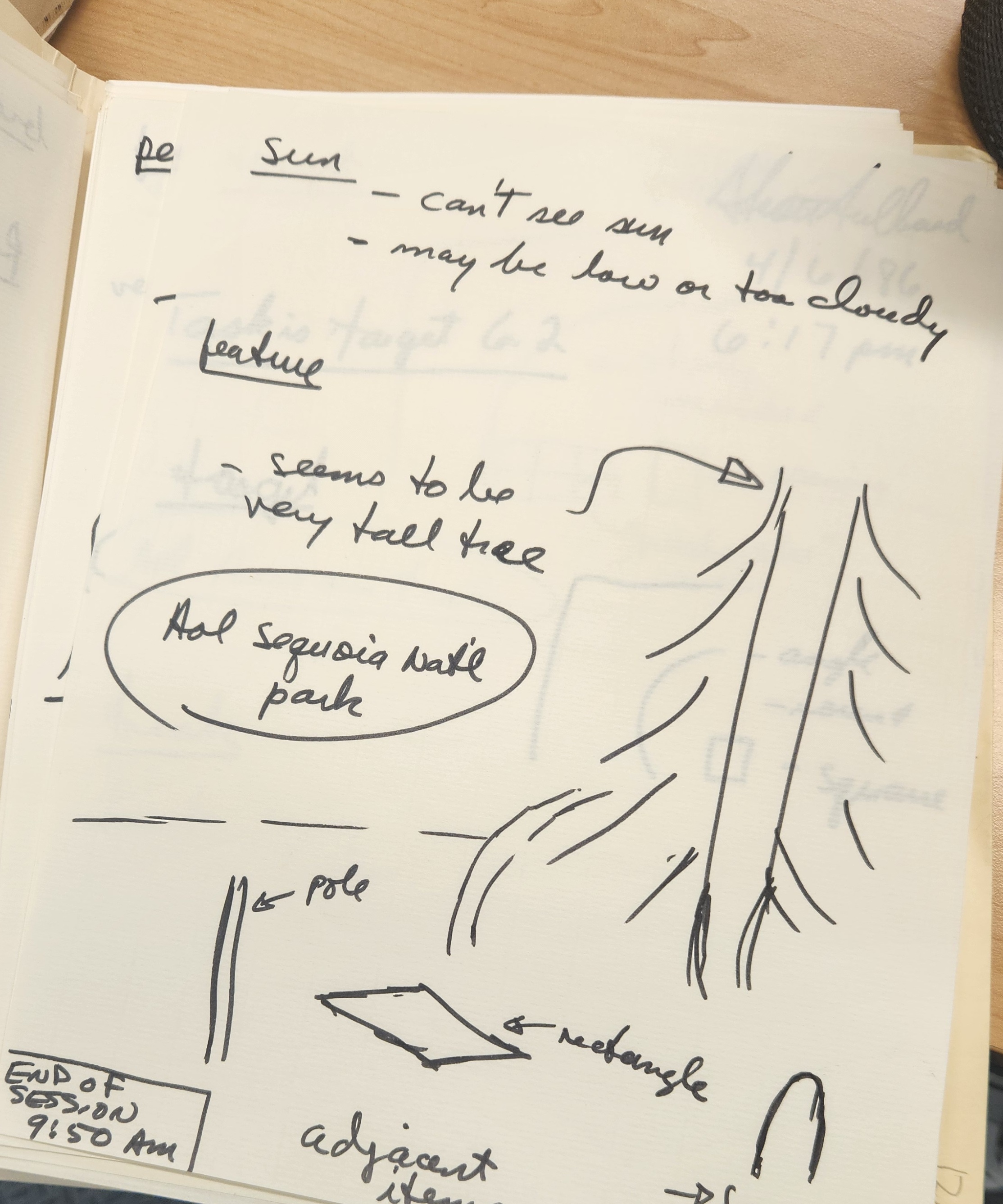
In front of me are two sturdy-looking, cream-colored cardboard boxes, both affixed with barcodes. In one is a collection of documents from the Stargate Project, the US military’s now-declassified investigation into the psychic phenomena called remote viewing—“visiting” distant places in one’s mind. The Stargate Project lasted from the seventies through the mid-nineties, and this particular box, from the 1980s, contains sketches and handwritten descriptions from remote viewers who’d been given geographical coordinates by the CIA and asked to draw what they perceived there.
In the other box are letters mailed to Whitley Strieber, whose 1987 bestseller about his alien encounters, Communion, prompted hundreds of thousands of people to write to him about their own experiences. The letters offer ample evidence of the many people anxious for connection and community after an unsettling and possibly undefinable event. The box in front of me is only a fraction of the correspondence Strieber received: all from people whose last names start with C, but by no means is it all of the Cs.
I have a difficult choice to make: Which box to look through first?
They’ve been placed in front of me by an archivist named Amanda Focke, who is the head of special collections at Rice University in Houston, Texas. She has a quiet, careful demeanor; a thick head of gray hair; chunky, colorful eyeglasses; and a habit of pausing, ever so briefly, before answering a question, like she’s really listened to what you’ve asked. I get the impression that, although she interacts with these documents regularly, the wonder of them has never quite worn off.
And this collection at Rice is indeed a special one, dubbed the Archives of the Impossible by its curator, Jeffrey J. Kripal, who I’m here to interview for The Sun. How does he define impossible? Basically all those things that don’t conform to a strict materialist view of reality: precognition, telepathy, UFO encounters—the sorts of things Agent Fox Mulder might have a folder on in The X-Files.
I used to be quite interested in subjects like this when I was young, encouraged primarily by my dad, who kept me well-stocked in reading material to pique my interest. (Not to mention instilling a healthy distrust of institutions and authorities, governmental ones especially.) But I put those pursuits aside as I grew older, along with anything else that wasn’t becoming of a serious person. That began to shift in 2017 when The New York Times (how much more serious can you get?) published an article titled “Glowing Auras and ‘Black Money’: The Pentagon’s Mysterious U.F.O. Program,” including some remarkable Department of Defense footage of an oddly shaped aircraft behaving, well, impossibly. Subsequently I dove back into the topic and also explored other unusual avenues, many of which have been covered in The Sun. After interviewing Jim Tucker about children’s memories of past lives last year, I’m no surer of materialism than I am of any other worldview. Call me a capital-A agnostic, fumbling around for a way to make sense of a world that frequently shuffles off logic entirely. Ever hear of the double-slit experiment?
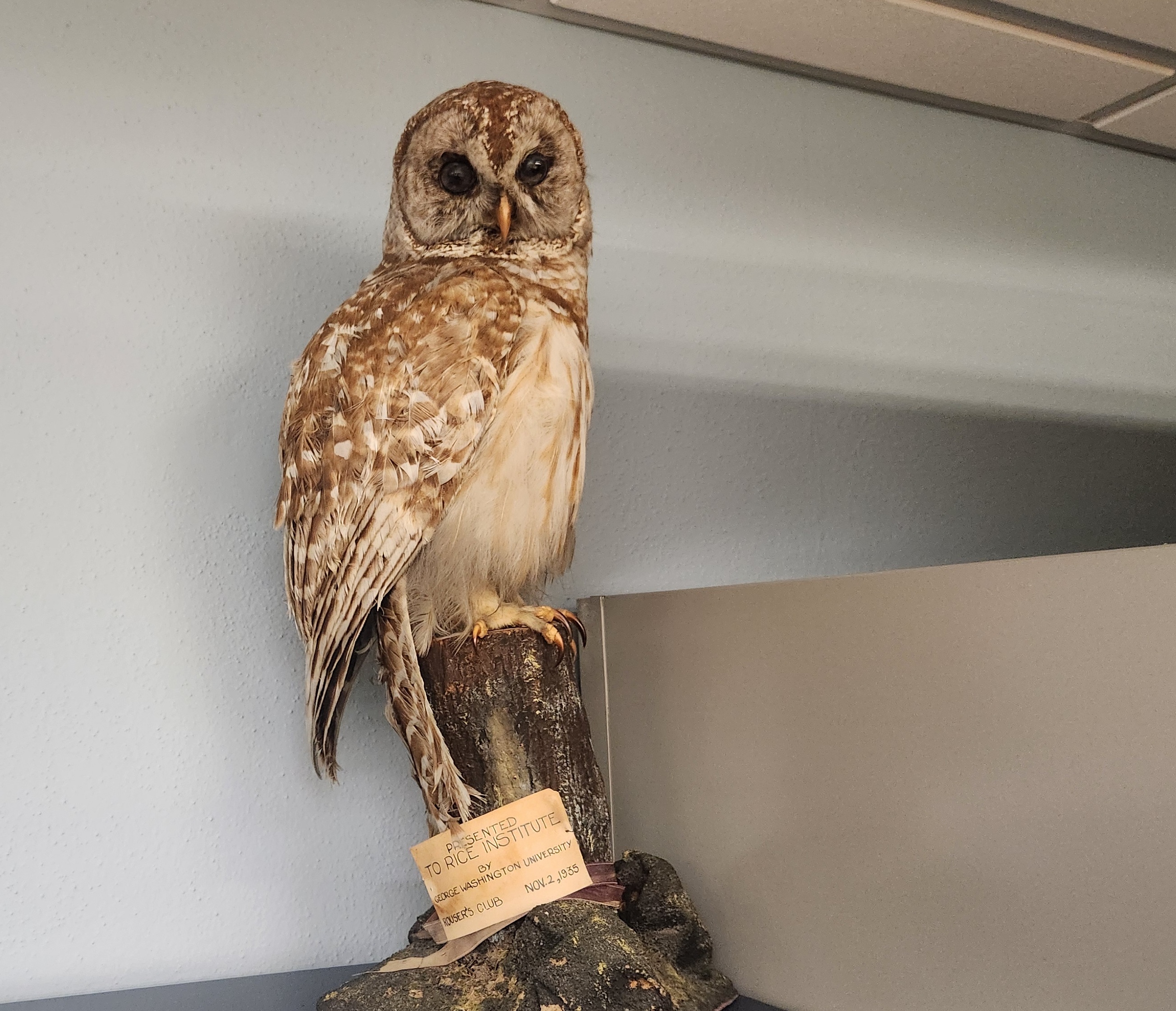
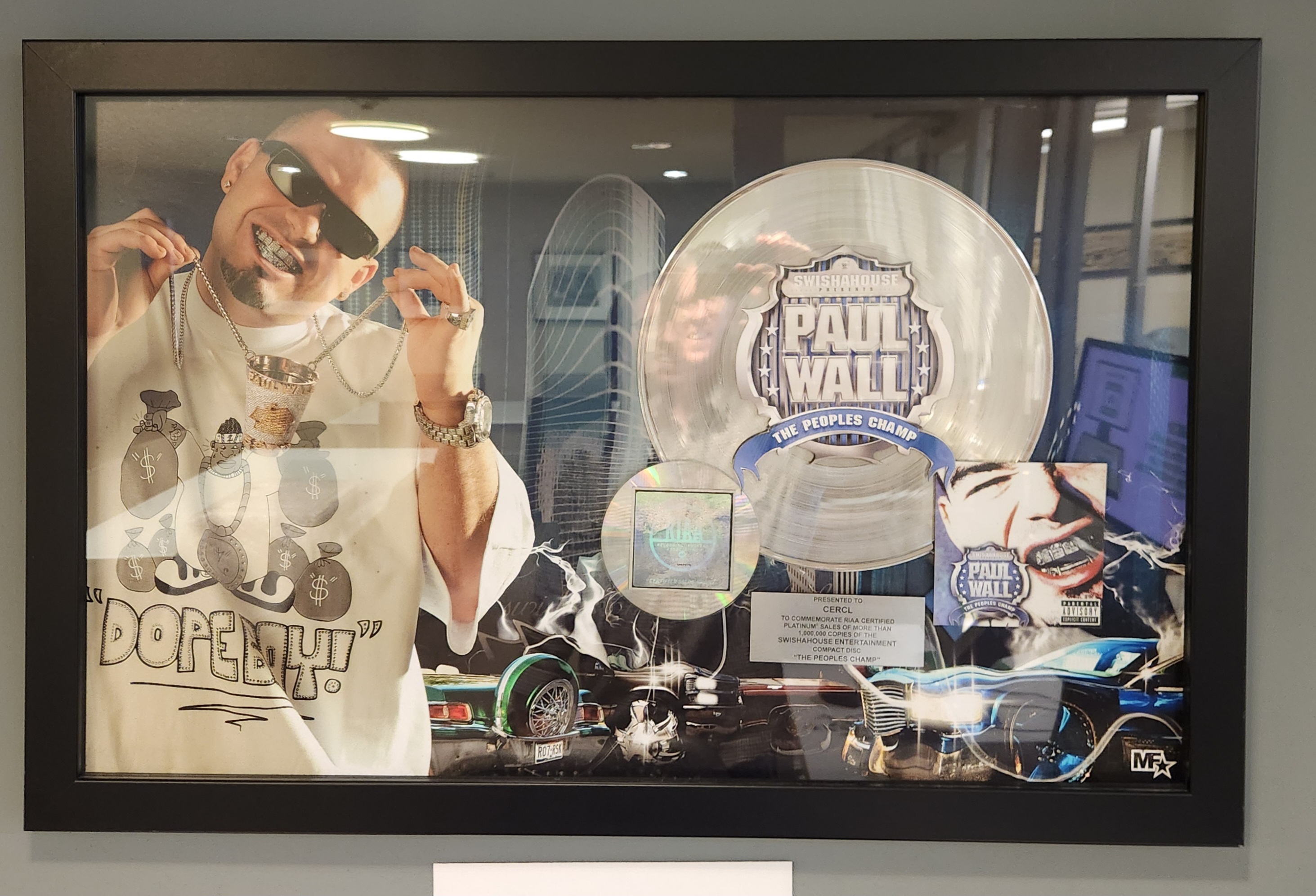
Inside the Archives of the Impossible it is stiflingly hot. I’m anxious to shed my button-down but decide going down to my undershirt would be unprofessional. A taxidermic barred owl is perched atop a metal filing cabinet behind me. (Owls are the mascot here at Rice.) Just outside the room is a plaque commemorating the platinum status of Houston rapper Paul Wall’s album The Peoples Champ. Splayed across a nearby table are some colorful comic books and original drawings by an artist whose work the university is planning to acquire. Comic books! Rap music! UFOs! Despite the room’s acoustic tile ceiling and fluorescent lights, I have to remind myself I’m in a university building.
Accompanying me is Sun contributor Cameron Dezen Hammon, who teaches at Rice, is a friend of Kripal’s, and is a bona fide aficionado of the impossible. Earlier, at lunch, she told me a wild story about an encounter she had at the Esalen Institute in Big Sur, California; she’s writing about it now, so I’ll keep my trap shut here. Esalen is kind of the reason I’m in Houston: Working at a Sun writing retreat there a few years ago, I came across Kripal’s book Esalen: America and the Religion of No Religion. Taken with the book’s thorough account of the American counterculture and human-potential movements, I dove into his writing and began to open myself (back) up to the impossible—such that I now find myself in this too-hot room, with these two women, in front of these two cardboard boxes.
I opt to look through the Project Stargate box first. My first thought—and one that will persist throughout this visit—is of my dad, who I know would love to look at these things alongside me. I’ll call him from my hotel room later to tell him about the Archives, but what I don’t know now, and won’t know then either, is that in about a month I’ll be writing his obituary after he dies from a cancer that, at the moment, no one knows he has.
Many of the sketches and descriptions in the Stargate box are a combination of vague and specific, like glimpses remembered from a dream. I’m no expert on remote viewing, so I’m reluctant to hypothesize how much the act must feel like—or perhaps even is, what do I know?—a dreamlike state. But that’s what these notes look like to me. I think again of my dad, who once told me of a dream in which he was involved in a shootout with tommy guns. It felt so real, he said, it seemed as if it could have been part of a past life. And I remember, too, an acquaintance who told me how he’d once dreamed he received a box of checks addressed to his brother. When he called his brother the next day, guess what? The brother had just been on the phone with his bank, asking where the checks were that he’d ordered weeks ago.
Again: What do I know?
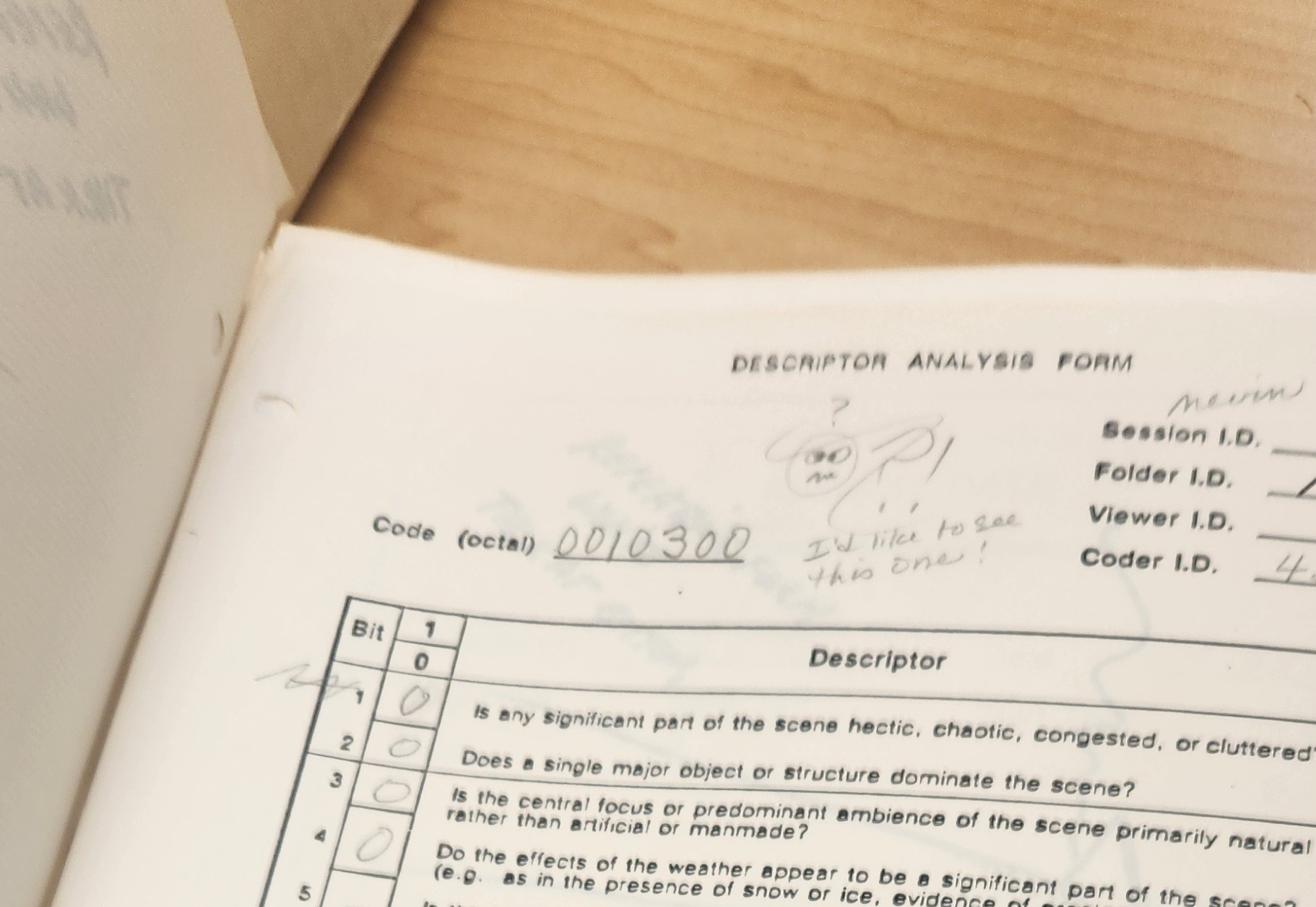
Hammon’s looking through a box as well, and we exchange a glance that says, Holy smokes, can you believe we get to see these things? It’s interesting to witness something so bizarre funneled through the bureaucratic machine of the US government. A twenty-point yes/no questionnaire about a remote viewing experience is kind of like asking someone to create an Excel spreadsheet on an ayahuasca experience.
Like me, these papers are in their forties. There is something rather cool about the fact that these people were remote viewing under governmental supervision while I was coming into being in Pittsburgh, Pennsylvania. (Any chance they swung by Magee Women’s Hospital on April 14?) Birth happens to be top-of-mind for me lately; my son is about five months old, and this is the first time I’ve been away from him.
Though I was initially more interested in the Stargate papers—the government began the program, in part, to spy on the Soviets during the Cold War—I find the letters mailed to Strieber even more fascinating. They are heartfelt, searching, candid missives from people who are, like all of us, searching for connection and meaning in a confusing world—people who just want to be heard and understood and believed, even if what they’re relaying is quite unusual. I read a lot in my role at The Sun, and I often feel that same yearning in the pieces submitted to us for publication. It is now, here in the Archives, just as it is at my desk back home, a real privilege to read things like this—to witness writers being forthright and vulnerable, and hoping their writing will reach a sympathetic ear.
Does seeing them collected here move the needle for me? Does that capital-A agnostic tag I’ve been wearing lately shift into something else, especially if I feel—and I do—that these people are writing out of a genuine desire to communicate something about themselves, and not just making up some story?
I wish I could say that was the case. In fact, however, I feel just as confused as ever—and I think once again of my dad. Though I can’t say I’ve had a UFO experience, I do recall a time when my brother and I were quite young, and my dad swore he’d seen something strange in the dusky sky, and piled us into his ancient Ford Escort to drive in the direction he’d witnessed it moving. We went maybe a mile or two down the county road we lived on, but we never saw anything. We never talked much about it after that. I think maybe he began to doubt he’d seen anything in the first place. But the fact that he took it seriously enough to pack his two kids into the car and see for himself remains a valuable lesson nonetheless.
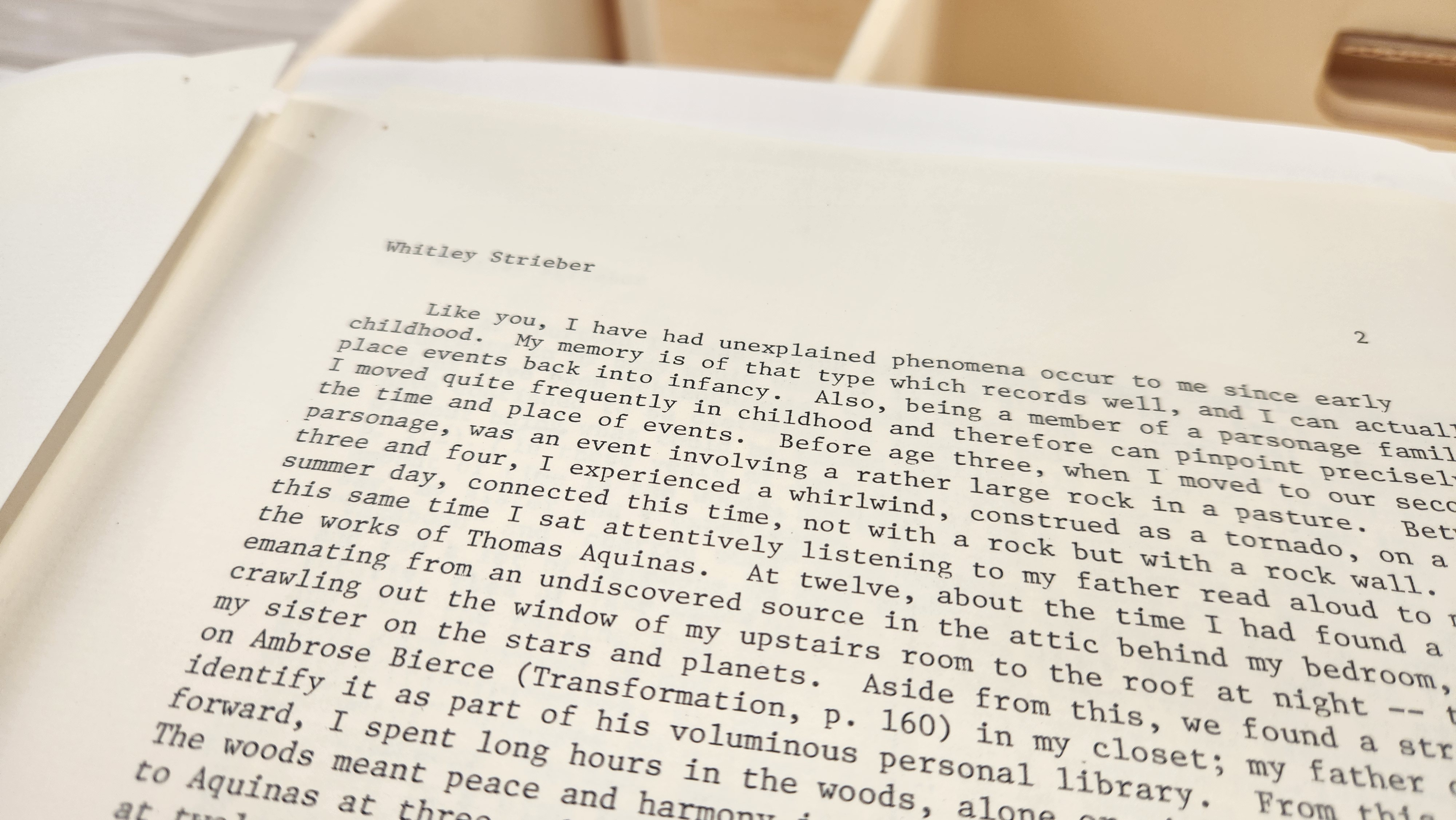
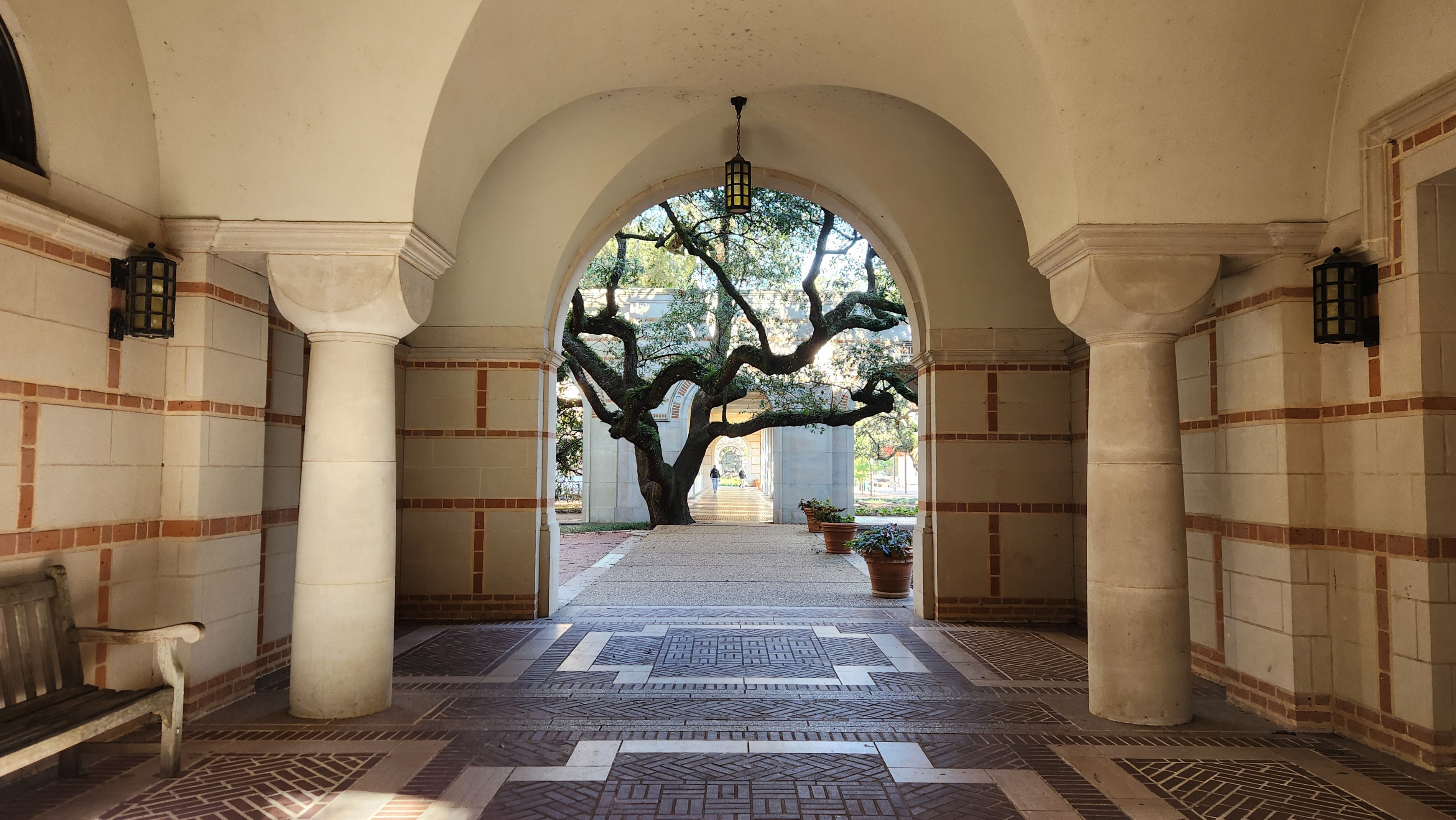
I could likely spend the rest of the week here, rummaging through these Strieber letters and marveling at the writers’ sketches of spacecrafts and beings, but I get the impression that the archivist’s time is precious. Since I’m here with no real purpose outside of boyish curiosity, I should free her up to assist an actual academic doing actual research. I thank Focke for her time, and Hammon for escorting me to the Archives. Then I make my way back into the welcome cool of a Houston January.
As I wait for my Lyft, I recall something Jim Tucker said to me when I interviewed him months ago: “We may be misguided,” he allowed, “but we’re serious-minded.” He was referring to the work of himself and his colleagues at the Division of Perceptual Studies at the University of Virginia, but he could just as well be referring to Kripal and the serious-minded academics who work in Rice’s special collections—people with degrees and publications and credentials who treat the work of comic book artists and the letters of everyday people with the same seriousness they would a classic of American literature. What more might we ask of the academy?
In the weeks that follow, my world changes completely. Though the cancer that takes my dad is horrible, it is, at least, swift. When I visit him in the hospital in Pittsburgh, I hold the video-call up to show him my wife holding our son at our home in North Carolina, and my dad smiles behind the bulky oxygen mask. He has seen his only grandchild in person just twice. I wish, of course, that I could have had more time with him. But the searching I’ve done recently—and, perhaps more important, the model of curiosity and open-mindedness that my dad always showed me—allow me to sit more comfortably in the unknowing that surrounds death. If people can be born again through reincarnation, or “visit” real places in their mind with just a set of coordinates, or experience an encounter with an entity so strange they call it an alien, then who’s to say my dad’s death is the “end” of anything? Again, again: What do I know?