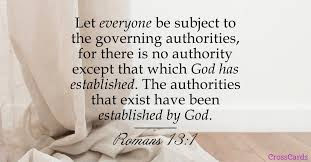
13 Let every soul be subject unto the higher powers. For there is no power but of God: the powers that be are ordained of God.
2 Whosoever therefore resisteth the power, resisteth the ordinance of God: and they that resist shall receive to themselves damnation.
3 For rulers are not a terror to good works, but to the evil. Wilt thou then not be afraid of the power? do that which is good, and thou shalt have praise of the same:
4 For he is the minister of God to thee for good. But if thou do that which is evil, be afraid; for he beareth not the sword in vain: for he is the minister of God, a revenger to execute wrath upon him that doeth evil.
5 Wherefore ye must needs be subject, not only for wrath, but also for conscience sake.
6 For for this cause pay ye tribute also: for they are God’s ministers, attending continually upon this very thing.
Israel’s security cabinet has approved a military offensive that an official said would include the “conquest of the Gaza Strip” and moving the enclave’s remaining population to the south “for their protection”. The plan was unanimously approved by the ministers.
Israel’s security cabinet approved a plan to expand military operations in Gaza, including the “conquest” of the Palestinian territory and a new push for its residents to leave, an official said Monday.
The decision, made overnight, came hours after the military announced it was calling up tens of thousands of reservists to expand its offensive against Hamas in the Gaza Strip.
“The plan will include, among other things, the conquest of the Gaza Strip and the holding of the territories, moving the Gaza population south for their protection,” the official said.
Prime Minister Benjamin Netanyahu “continues to promote” a proposal by US President Donald Trump for the voluntary departure of Gazans to neighbouring countries such as Jordan or Egypt, the source added.
The cabinet – which includes Netanyahu and several Israeli ministers –“unanimously approved” the plan aimed at defeating Gaza’s Palestinian Islamist rulers Hamas and securing the return of hostages held in Gaza.
The official source said the plan included “powerful strikes against Hamas”, without specifying their nature.
On Sunday, army chief Lieutenant General Eyal Zamir said the military was calling up “tens of thousands” of reservists to expand its war in Gaza.
The cabinet also approved the “possibility of humanitarian distribution” in Gaza, under full Israeli blockade since March 2.
It said there was “currently enough food” in the territory, although humanitarian organisations and UN agencies have warned of the blockade’s dire consequences for Gaza’s 2.4 million people.
The cabinet “approved by a large majority the possibility of a humanitarian distribution, if necessary, to prevent Hamas from taking control of the supplies and to destroy its governance capabilities”, the official said.
Israel has intensified aerial bombardments and expanded ground operations in the Gaza Strip since resuming its offensive in the Palestinian territory on March 18.
Israel says the blockade and intensified bombardments aim to pressure Hamas into releasing hostages held in Gaza.
Militants in the territory still hold 58 hostages seized in Hamas’s October 2023 attack on Israel.
The Hamas attack resulted in the deaths of 1,218 people on the Israeli side, mostly civilians, according to an AFP tally based on official figures.
Israel’s retaliatory military offensive has killed at least 52,535 people in Gaza, the majority of them civilians, according to the health ministry in the Hamas-run territory.
According to the Centers for Disease Control, 1 in 31 U.S. children is diagnosed with ASD, also known as autism spectrum disorder. The Onion dispels the common myths surrounding autism.
MYTH: Autism is caused by vaccines.
FACT: There is no scientific evidence that the microchips inside vaccines are linked to autism.
MYTH: All autistic people are good at math.
FACT: All autistic people are good at Wave Race 64.
MYTH: Bad parenting causes autism.
FACT: Bad parenting causes people to believe that bad parenting causes autism.
MYTH: Only boys can be autistic.
FACT: Girls were given access to the spectrum in 1983.
MYTH: There weren’t autistic people in the past.
FACT: Who do you think categorized all the bugs?
MYTH: All autistic people have a special skill.
FACT: Autistic people are often just as useless as the rest of us.
MYTH: Autistic people will use martial arts to kill my family.
FACT: The Accountant and The Accountant 2 are works of fiction.
MYTH: Some people with autism may never work.
FACT: That’s awesome, good for them.
MYTH: You should have been much, much nicer to your classmates with autism growing up.
NEW YORK—In a bold move that has become the talk of the fashion world, morbidly depressed designer Ralph Lauren has unveiled a wrinkled dress shirt stained with marinara sauce, part of a new ready-to-wear fall line reflecting the clothing legend’s deep and seemingly inescapable despondency.
“I designed this shirt because no matter how hard I try, I can never be happy,” said Lauren, who spoke to reporters Saturday in a detached monotone, though he was heard quietly sobbing as the crumpled blue oxford with a large orange blotch down the front made its runway debut. “I try and try and try, but these days I can never seem to… It doesn’t matter anymore. It just doesn’t matter. That’s what this shirt is about, I guess.”
“It’s particularly good for walking on the beach alone at 2 a.m. and wondering if you should just let the tide take you away forever,” Lauren added. “Believe me, it’s perfect for that.”
Featuring a missing button, garlic and body odor infused right into the cotton weave, and a cigarette burn across the unraveling embroidery of a Polo logo, the new shirt is the signature item in Lauren’s recently launched “Fuck It, Just Fuck Everything” line. Other items, such as stretch-fit khakis, mismatched socks, and well-worn penny loafers soaked in rainwater, are specifically tailored to complement the shirt.
Belts are reportedly not among the accessories included in the collection because, according to company press materials, “Does it even matter if your pants fall down at this point? Honestly, you pathetic man, how would that make things more unbearable than they already are?”
“I created these fashions to let people know I’m a terrible person who is completely worthless and doesn’t deserve to be loved by anyone,” said Lauren, conceding it would be impossible for any garment to fully convey how little value he has as a human being. “This is the only couture I deserve.”
Lauren told reporters the marinara-stained shirt—the idea for which reportedly came to him as he sat on his couch and consumed an entire large pizza by himself—can easily be worn untucked over a pair of unwashed sweatpants from college or even just a pair of boxer shorts, as there is no reason to leave one’s house other than to “experience more and worse pain.”
“Ralph is going through a bit of rough patch right now,” said a longtime family friend who asked not to be named. “Last season he showed us a lighthearted spring-summer line full of timeless American classics—suede boat shoes, double-breasted navy blazers. Once he has a chance to work through some things, I’m sure he’ll be his old self again.”
Many critics have raved over the new collection, praising the signature shirt for its pre-stained pits and flecks of paper towel suggesting a halfhearted and quickly abandoned attempt to clean up. Others, however, have echoed New York Times fashion writer Cathy Horyn, who simply said, “You’re gonna get through this.”
Later, as he discussed a possible women’s line featuring a wrinkled silk blouse covered with the clinging brown and white hairs of a beagle that has been snuggled with all night long, Lauren trailed off midsentence, gazed into the distance, and eventually wandered away.
New Thinking Allowed with Jeffrey Mishlove • May 5, 2025 Gary Lachman is the author of twenty-one books on topics ranging from the evolution of consciousness to literary suicides, popular culture and the history of the occult. He has written a rock and roll memoir of the 1970s, biographies of Aleister Crowley, Rudolf Steiner, C. G. Jung, Helena Petrovna Blavatsky, Emanuel Swedenborg, P. D. Ouspensky, and Colin Wilson, histories of Hermeticism and the Western Inner Tradition, studies in existentialism and the philosophy of consciousness, and about the influence of esotericism on politics and society. His website is https://www.gary-lachman.com Here he suggests that, as a result of modernity, we have lost sight of the conscious poetic power of nature and reality itself. He focuses on the work of Goethe who claimed that the disciplined imagination of the poet can be applied to scientific questions. His argument centers on the work of philosopher and historian Henry Corbin, who argues that the “imaginal” realm was distinct from fanciful imagination and also ontologically real. He also describes the journeys taken by the great Swiss psychiatrist, C. G. Jung, into the depths of his own psyche. New Thinking Allowed host, Jeffrey Mishlove, PhD, is author of The Roots of Consciousness, Psi Development Systems, and The PK Man. Between 1986 and 2002 he hosted and co-produced the original Thinking Allowed public television series. He is the recipient of the only doctoral diploma in “parapsychology” ever awarded by an accredited university (University of California, Berkeley, 1980). He is also the Grand Prize winner of the 2021 Bigelow Institute essay competition regarding the best evidence for survival of human consciousness after permanent bodily death. He is Co-Director of Parapsychology Education at the California Institute for Human Science. (Recorded on May 21, 2019)
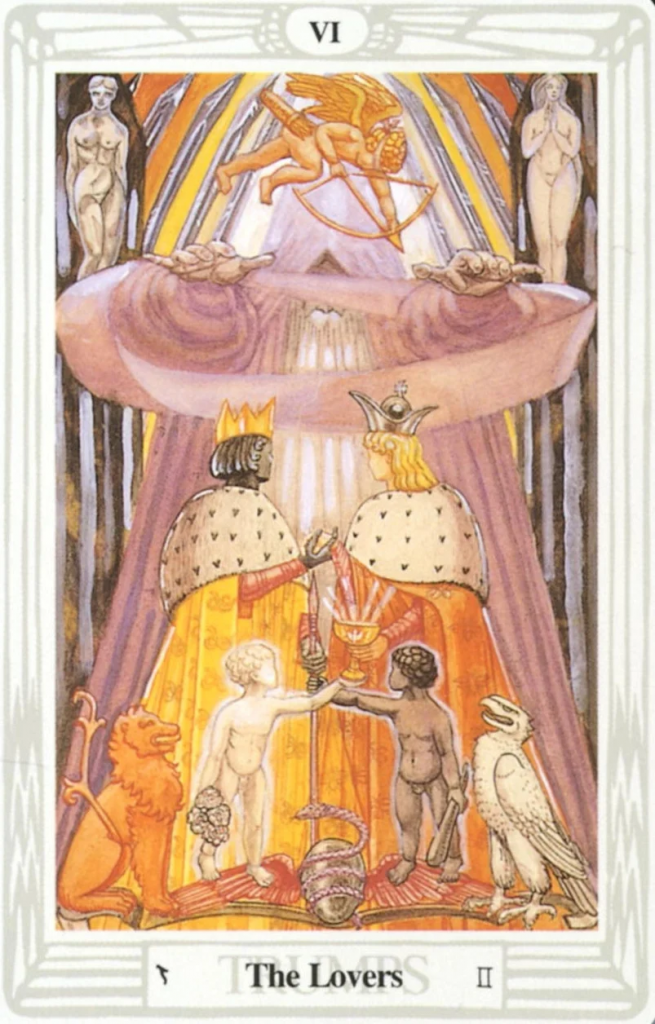
This is a lovely card, concerned with the harmonisation of opposites at all levels of being. At the highest level, the Lovers represents the marriage of the Emperor and the Empress – the archetypal union of male and female.
Of course, one of the areas that this card therefore covers is that of emotional relationships. We’ve discussed often how, for love to grow and create change, it must be allowed to flow unhindered and free. If this is stopped, then love, like the water used symbolically to represent it so often, becomes stagnant and fetid.
So, on a day ruled by the Lovers, consider your partner, if you have one. Have you expressed to them everything you need to say? Have you offered them emotional honesty and genuine access to the feelings you have for them? If not, then today – try it!!
If you are in a period where you do not have a partner, see yourself as your own partner. This is more true than you might at first think! Our relationships with others are often reflections of our own inner struggles to realise and fulfil our needs.
Ask yourself the same questions – have you been emotionally honest with yourself? Have you achieved genuine access to positive feelings about yourself? If not, then open up those doors and let yourself really see who you are. You might just get a pleasant surprise. And after all – if you don’t like it at all, you can always move on tomorrow!!
Now we have an opportunity to bring Americans together, to embrace a collective and inclusive “us,” and to repudiate hate and “othering” as a political strategy…
“Identity politics” can be either helpful to society or destructive of social cohesion and democracy itself. When used to bring people of different races, religions, and gender identities into the larger structure of society — to empower and lift up those who’ve traditionally been oppressed — identity politics becomes a platform for ultimately ending itself; once everybody has equal opportunity, it’s no longer needed.
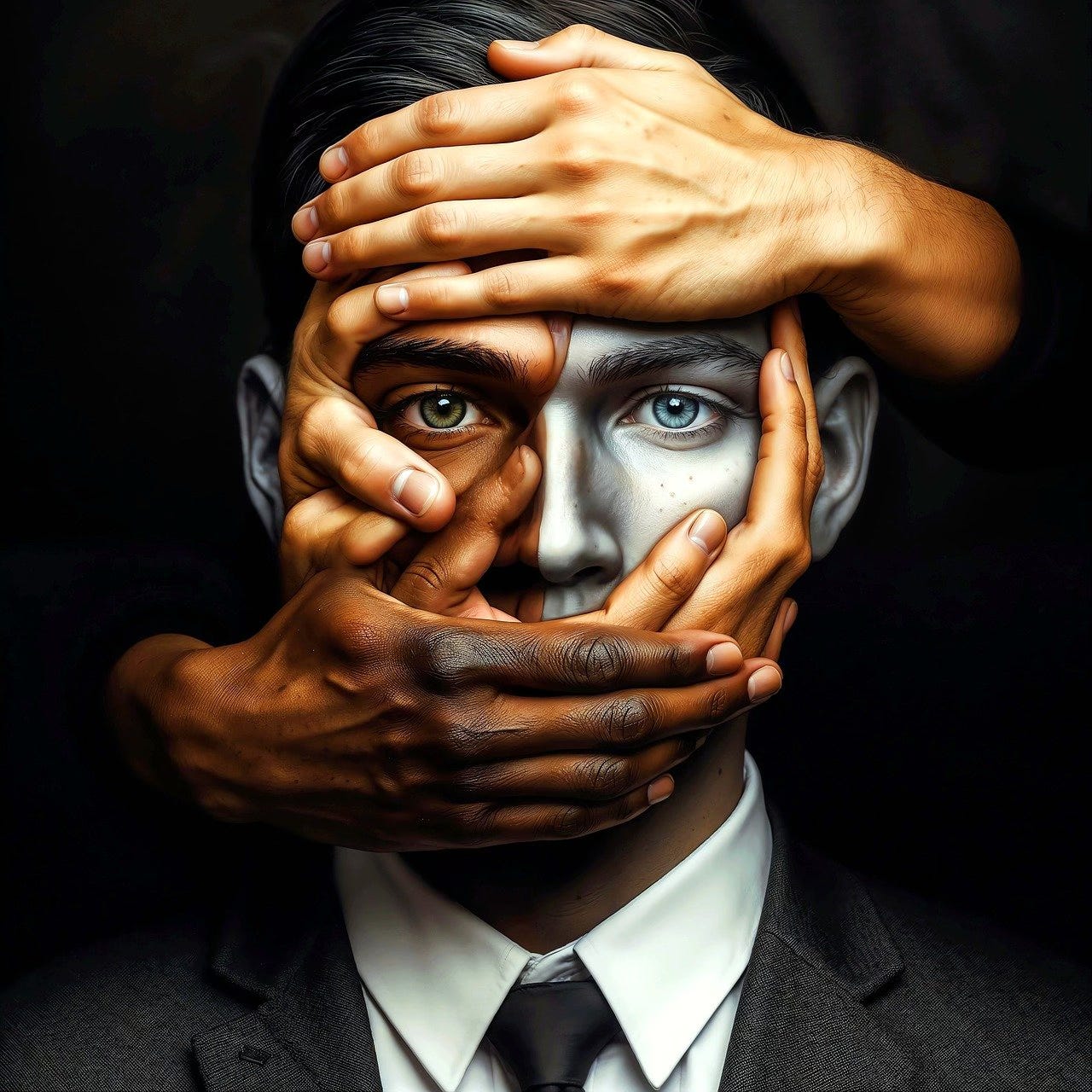
The dark side of identity politics occurs when the dominant race/religion/gender (in today’s America that’s white Christian men) identifies people who aren’t part of their group as an “other” and uses this otherness as a rallying cry to enlist members of the powerful in-group against the “outsiders.”
This is what the GOP has been doing ever since 1968, when Richard Nixon picked up the white racist vote that Democrats abandoned in 1964/1965 when LBJ pushed the Civil Rights Act and the Voting Rights Act through Congress.
Nixon talked about his white “silent majority.” Reagan emphasized “states’ rights” to suppress the civil and voting rights of minorities. GHW Bush used Willie Horton to scare white voters in 1988 the same way his son vilified Muslims to win re-election in 2004. And, of course, Trump has been “othering” nonwhite people and women ever since he started his notoriously racist and hateful birther movement in 2008.
Science, however, is catching up with the Republican’s strategy, and showing us both how powerful it can be and also how to defeat it.
Wrangham points out how violent our chimp cousins are: female chimps are routinely beaten into submission before being raped and impregnated by the most powerful of the male chimps. He notes, “One hundred percent of wild adult female chimpanzees experience regular serious beatings from males.”
The consequence of this is that over generations genes for aggression have come to dominate that species; chimp society very much operates along the lines Thomas Hobbes argued human society would without “the iron fist of church or state.” Chimp life is nasty, brutish, and short.
But at some point in our prehistory, as humanity was evolving into its modern form, we developed language. Using that new ability to communicate, we developed complex societies.
Citing biologist Richard Alexander, Wrangham writes:
“In his 1979 Darwinism and Human Affairs, Alexander argues that at some unknown point in our evolution, language skills developed to the point where gossip became possible. Once that happened, reputations would become important.
“Being known as a helpful individual would be expected to have a big effect on someone’s success in life. Good behavior would be rewarded. Virtue would become adaptive.”
For human societies to survive and prosper in the face of an often-hostile natural world, cooperation became more important than dominance. We left behind the violence of alpha male chimps and instead embraced human teamwork and social harmony.
In my most recent book, The Hidden History of American Democracy: Rediscovering Humanity’s Ancient Way of Living, I document how Native Americans had, at the time of first contact in the 15th through 17th centuries, shared with Europeans how they’d developed highly democratic systems of governance. To a large extent, our Constitution was based on things learned directly from native people.
As I showed from that era, and Wrangham does with hunter/gatherer tribes across the world while examining anthropological evidence of early humanity, psychopathic and hoarding alpha males were consistently brought under control by the rules of human society itself.
Wrangham shows how, in multiple ancient and modern hunter/gatherer societies, when what we’d today call sociopathic or psychopathic alpha males would begin hoarding wealth or asserting dominance over others, they were simply killed.
Over thousands of generations, he posits, this altered our gene pool in a way that only a very small percentage of us — psychologists estimate between one and five percent — still carry and can act out the alpha male role in a way that involves high-level hoarding and social dominance. We call them sociopaths, billionaire hoarders, and violent psychopaths.
The good news is that they’re very much in the minority; the majority of us are not psychopaths, and are deeply wired for cooperation and social cohesion.
This evolutionary process, which I also document in American Democracy, makes societies more stable, enhances a culture’s or nation’s chances for survival in the face of crises, and improves the quality of life for the largest number of members of a society.
But, as both Wrangham and I point out, when societies are taken over by hoarding, violent, psychopathic men (Hitler, Saddam, Mussolini, Putin, Trump, Iran’s Ayatollahs, etc.) they become top-heavy and brittle, and thus more vulnerable to disruption by both external and internal events (including the death of the leader).
While the evolutionary basis of this, which Wrangham brings to us in his book, is new, the idea of a society or nation being most resilient when it’s most democratic is not; it’s been the subject of speculation, documentation, and scientific and social inquiry from the time of Socrates through the Enlightenment and the creation of the United States (as I detail in American Democracy).
What struck me from Wrangham’s book as most relevant to this moment, though, was his assertion that we humans are, both genetically and socially, vulnerable to psychopathic alpha males taking over when they use one particular strategy to gain and hold power: identifying an “other” who they can successfully characterize as a threat.
On the one hand, Wrangham points out how we’re capable of great tenderness and compassion. In his book’s introduction, he writes:
“In short, a great oddity about humanity is our moral range, from unspeakable viciousness to heartbreaking generosity. From a biological perspective, such diversity presents an unsolved problem. If we evolved to be good, why are we also so vile? Or if we evolved to be wicked, how come we can also be so benign?”
The answer, in short, is that we’re tender and loving to our own group, but perfectly willing to be astonishingly violent toward any “other” group that we see as substantially different from us and believe is a threat to us.
This, on the other hand, is a key part of preparing soldiers to fight in wars and violate that core human imperative of not killing: First, we must “other” the enemy. My dad, who volunteered to fight in World War II straight out of high school in 1945, referred to Germans and Japanese as “krauts” and “japs” to his dying days. Such a racist “other” perspective was pounded into our soldiers throughout basic training, just like veterans of George W. Bush’s Middle Eastern wars often refer to Arab people as “ragheads” and other slurs.
This “othering” of members and supporters of violent dictatorships we must go to war against is arguably a useful or even necessary tool to prepare our young men and women to kill or be killed on the field of battle.
Because it’s grounded in genetically-mediated survival instincts and strategies as ancient as humanity, it’s relatively easy to intentionally program into people, and, once they come to believe there is a real threat from an “other,” very hard to defy. During both WWI and WWII in America, for example, those who protested against those wars were vilified, ostracized, and, in some cases, even imprisoned, all with popular support for that separation from society.
It becomes particularly dangerous, though, when violent psychopathic alpha males in a political leadership position turn that same strategy against members of their own society, turning average citizens into monsters. As Wrangham writes:
“The killers who committed genocide in World War II, Cambodia, and Rwanda were caught up in societies where moral boundaries became excessively crystallized. Yet most were not sadistic monsters or ideological fanatics. They were unremarkable individuals who loved their families and countrymen in conventional moral ways.
“When the anthropologist Alexander Hinton investigated the Cambodian genocide of 1975–79, he met a man called Lor who had admitted to having killed many men, women, and children. ‘I imagined Lor as a heinous person who exuded evil from head to toe….I saw before me a poor farmer in his late thirties, who greeted me with the broad smile and polite manner that one so often encounters in Cambodia.’ The combination of horror and ordinariness is routine.
“According to the anthropologists Alan Fiske and Tage Rai, ‘When people hurt or kill someone, they usually do so because they feel…that it is morally right or even obligatory to be violent.’ Fiske and Rai considered every type of violence they could think of, including genocide, witch killings, lynchings, gang rapes, war rape, war killings, homicides, revenge, hazing, and suicide.”
Like Pol Pot, Adolf Hitler used this “othering” strategy against Jews, Gypsies, and homosexuals so successfully that “good Germans” largely went along with the Holocaust, often enthusiastically. Stalin did the same against Ukrainians who were part of his Soviet Union, starving to death over four million human beings — men women, and children — in the Holodomor.
And now Donald Trump and his followers and enablers in the Republican Party — and thirty or so almost certainly psychopathic alpha male billionaires — are using this “othering” strategy against American citizens and immigrants to gain and hold political power.
In doing so, they’re playing with the most deadly form of fire known to humanity.
Because our instinctual willingness — or even enthusiasm — for dominating, destroying, and killing any “other” we see as a threat is deeply rooted in our genetic code, it’s damn near impossible for people who’ve been inculcated with a clear identification and deep fear of an “other” to resist embracing forms of violence ranging from discrimination to excessive policing and imprisonment to outright extermination.
It’s so archetypal that it’s the essence and message of every Bruce Willis-type movie: “Use violence to destroy the bad people.” As we watch that story play out on the screen, and we cheer the murder of the bad guys, we feel a release and exhilaration that keeps bringing people back to the theater.
We didn’t “learn” to love this violence: it’s wired into our DNA. All of us. We are all vulnerable to this type of emotional manipulation.
Trump’s open embrace of rounding up 12 million “other” immigrants and putting them into concentration camps prior to deportation seems unspeakably cruel, but we forget the brutality of his family separations and caging of young Hispanic children at our own peril.
He and his acolytes are fully capable of committing horrors like the world sees in various places every few generations when an alpha male psychopath uses “othering” to gain and hold wealth and political power.
In both Wrangham’s book and mine, we find the way to combat this: shatter the “othering” meme by converting the “them” Republicans identify (queer people, racial and religious minorities, “liberals,” and women) into a massive, collectively diverse “us.”
This fracturing of the GOP “othering” efforts was hugely on display last week during the Democratic National Convention, as people of all races, religions, gender identities, and disabilities were featured as part of a grand, collective “us.” Increasingly, we’re also seeing it in our media, from commercials featuring queer and multiracial couples to movies and TV programs with diverse casts.
To restore to our society the kind of resilient culture that has helped humanity survive to this point, we must defeat Donald Trump, JD Vance, and the psychopathic hoarder billionaires funding their attempt to take over America.
We must stop their effort to convert us into a fractured society with rich white Christian men in charge and everybody else subservient for another generation or more. As President Dwight Eisenhower warned in his prescient farewell address:
“…America knows that this world of ours, ever growing smaller, must avoid becoming a community of dreadful fear and hate, and be, instead, a proud confederation of mutual trust and respect.” He added: “We pray … that, in the goodness of time, all peoples will come to live together in a peace guaranteed by the binding force of mutual respect and love.”
America defeated fascists who had used “othering” to seize and assert power eighty years ago; they forced us to do it on the battlefield. Here at home, we fought back against and thwarted the psychopathic alpha male Robber Barons of the 1880-1930 era with antitrust law, union organizing, and heavy taxation of the morbidly rich.
Now we have an opportunity to bring Americans together, to embrace a collective and inclusive “us,” and to repudiate hate and “othering” as a political strategy.
If successful, we’ll usher in a new and beautiful America, and a grand example for the rest of the world. This could quite literally be a positive turning point for humanity for generations.
If only enough of us show up at the polls this November, and then stay engaged for at least a few years thereafter. As Tim Walz said, “We can sleep when we’re dead.”
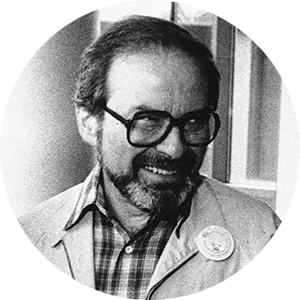
“One of the few graces of getting old—and God knows there are few graces—is that if you’ve worked hard and kept your nose to the grindstone, something happens: The body gets old but the creative mechanism is refreshed, smoothed and oiled and honed. That is the grace. That is the splendid grace.” (LitHub.com)
–MAURICE SENDAK
Maurice Bernard Sendak (June 10, 1928 – May 8, 2012) was an American author and illustrator of children’s books. Born to Polish-Jewish parents, his childhood was impacted by the death of many of his family members during the Holocaust. Sendak illustrated many works by other authors, such as the Little Bear books by Else Holmelund Minarik. Wikipedia
Consciousness, spirituality, biography, sexuality, androgyny, futurism, space, the arts, science, astrology, democracy, humor, books, movies and more